
An engagement party at home can be warm, inexpensive per guest, and unhurried, but only if the host treats the kitchen, the living room, and the front step like a small event venue: count the people, convert the count into food and drink quantities, give every guest a path through the house, and decide in advance what the house will not be asked to do.
Quick answer
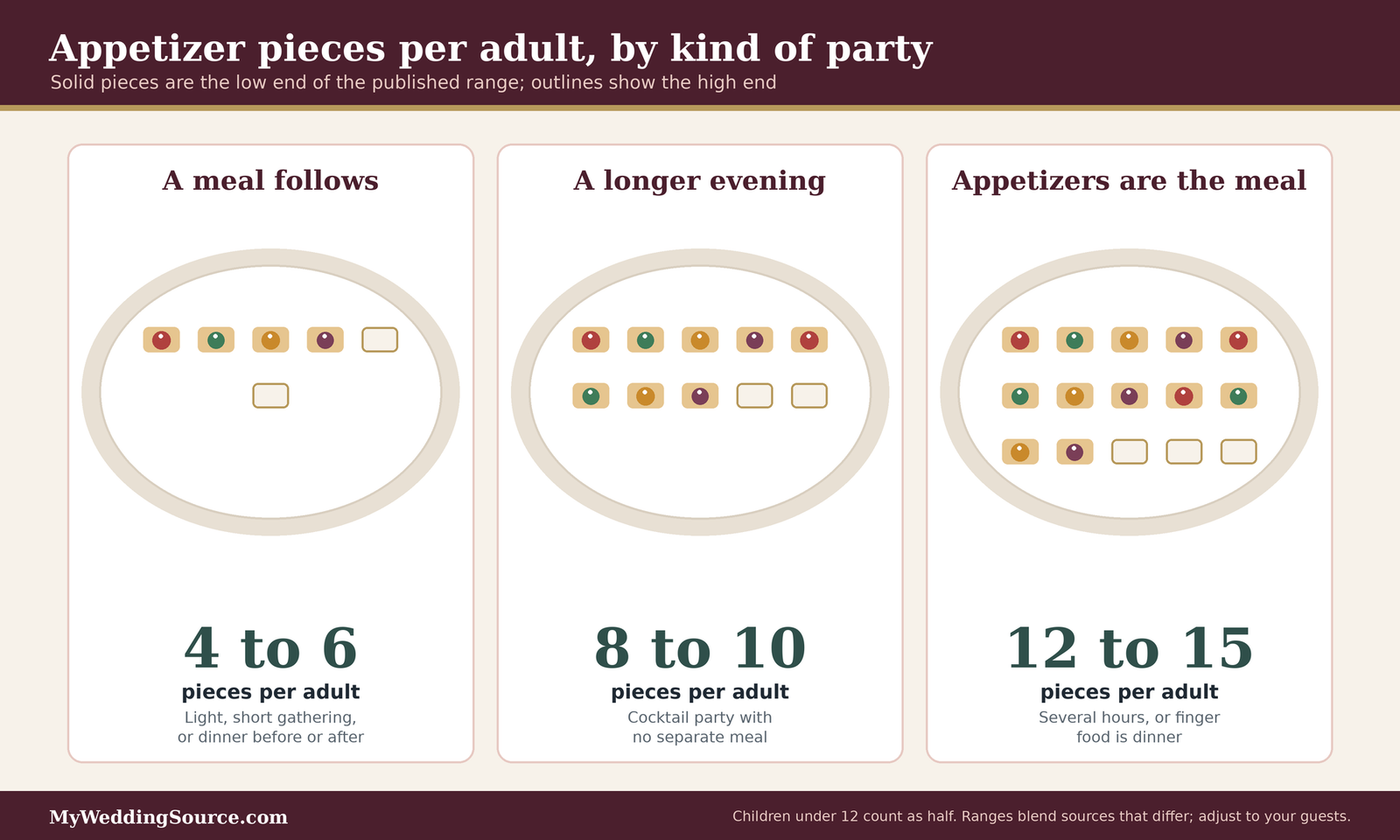
For an engagement party at home, start with one number, the adult guest count, then add children at about half portions. Published party guides we read suggest roughly 4 to 6 appetizer pieces per adult when a meal follows, 8 to 10 for a longer evening, and 12 to 15 when appetizers are the meal. Plan about 9 to 12 square feet per guest for a standing party with some seating and 15 to 18 for a seated dinner. Use two drinks per drinking adult per hour as a starting point, keep hot food at or above 140°F and cold food at or below 40°F, and put everything you decided on one page so a helper can run the evening if you cannot.
Is an engagement party at home the right choice for you?
Hosting at home is the most traditional way to celebrate an engagement. Paperless Post describes the classic version as a party hosted by the bride’s parents at their home, and says a casual cocktail party at someone’s home, a bar, or a restaurant is another common option. That tradition is a good reason to consider it, but not a reason to commit before you have looked at the house, the guest list, and the people who will do the work.
This guide is about the operating details of an engagement party at home: how much to buy, where people stand, how food stays safe, and what to settle with neighbors and insurers. If you are still deciding who to invite and who pays, our general engagement party guide covers the guest-list rule, host roles, and etiquette, and our guide to proposal and engagement party planning covers how the party fits with the proposal and the announcement. We do not repeat those decisions here. We assume you have made them and want the logistics.
What an engagement party at home gains and gives up
Every venue is a trade. Hosting an engagement party at home removes a rental fee and a minimum spend, and it lets the hosts decide the menu, the music, and the end time. It also moves work that a venue would handle onto your own shoulders: furniture, trash, parking, restrooms, cleanup, and every question guests would otherwise ask a manager.
What you gain
An engagement party at home gives you control over the guest experience in ways a rented room rarely allows. You can serve family recipes, keep the music low enough for grandparents to talk, and let the evening end naturally. There is no clock set by a venue contract, though Paperless Post suggests setting a start and end time, typically a two- to four-hour window, so guests know what to expect. Many hosts also find that a smaller, familiar space feels more personal, which suits a party meant for close family and friends.
What you give up
You give up a professional operation. There is no staff to clear plates, no commercial refrigeration, no liquor license, and no one to blame if something runs late. You also give up flexibility on numbers: a living room has a real ceiling on how many people fit comfortably, and that ceiling is lower than most hosts expect once furniture is counted. Later sections show how to estimate it.
Who is actually hosting, and who is doing the work
Paperless Post lists several possible hosts: the bride’s parents, both sets of parents, friends or members of the bridal party, or the couple themselves, and Emily Post notes that the bride’s parents traditionally hosted. The person whose home is used is not always the person paying, and neither is always the person doing the cooking. These roles are worth separating on paper, because confusion about them is a common source of friction.
Separate the home-owner, the payer, and the cook
Write three names next to three jobs. The home-owner decides what the house can handle. The payer sets the budget. The cook, or the person ordering from a caterer, owns the quantity worksheet in this guide. If one person holds all three jobs, say so out loud and agree on a day-of helper. If the party is at a parent’s home and the couple is paying, settle early whether the parent is a co-host or a landlord for the afternoon, because the answer changes who makes final decisions about the menu and the guest count.
Name one day-of lead who is not the guest of honor
The couple should be able to talk to guests. Choose a trusted relative or friend to answer the door, restock the ice, and handle the unexpected spill. Give that person the one-page plan described near the end of this guide, and tell guests who to ask if the hosts are busy.
Shape the engagement party at home before you count the food
Quantities only make sense once the party has a shape. The same twenty people eat very differently at an afternoon dessert reception than at a family-style dinner, and a worksheet cannot guess which one you mean. Decide format, window, and guest count first, then run the numbers.
Choose the format, and say it on the invitation
Paperless Post advises serving either a full dinner or light appetizers and stating the format on the invitation so guests can plan. It also suggests stating what will be served, with wording such as cocktails and light bites. That advice matters more for an engagement party at home than at a restaurant, because guests cannot tell from a house whether dinner is coming.
Four common home formats
Hosts tend to land on one of four shapes. A drinks-and-dessert party is the lightest and works best in the late afternoon or after dinner. A cocktail party with light bites runs about two to three hours and expects guests to eat beforehand or afterward. An appetizers-as-dinner party replaces a meal with a larger spread of finger food and runs longer. A seated or buffet dinner is the heaviest lift and suits a smaller list. The worksheet in the next section gives separate quantity bands for the middle two, plus a dinner column.
Match the wording to the plan
If you intend guests to leave fed, say so: “dinner and drinks at six.” If you intend a snack-level party, say “cocktails and light bites, four to six.” Vague wording produces two predictable problems: guests who arrive hungry at a snack party, and guests who eat dinner first and then face a buffet. Our wedding invitation wording guide has phrasing ideas that adapt well to a casual event, and our wedding RSVP etiquette guide explains how to ask for replies without sounding stern.
Pick a window that matches the food
Time of day sets how much people eat. A late-morning brunch looks nothing like a Saturday evening, and the length of the window changes drink counts more than food counts.
Time of day and meal expectations
Paperless Post notes that engagement parties are often held on Friday or Saturday evenings, and that holiday-adjacent dates are best avoided in the few days before and after the holiday. An evening party that starts near dinner time is read by most guests as a meal, whatever the invitation says, so state the format clearly if you start between five and seven.
Length of the party
A two-hour window needs fewer drinks and a smaller menu than a four-hour one, but long parties do not need proportionally more food, because appetite flattens after the first hour or two. The worksheet handles this by giving a band per format and a per-hour drink rate, so you can lengthen the window without doubling the grocery bill.
Turn the guest list into one working number
The worksheet needs a single input: how many people will actually be in the house at the busiest moment. That is not the same as how many you invited.
Count adults and children separately
For an engagement party at home, Tripleseat’s party guide treats children under twelve as roughly half portions, and that is a reasonable rule for any engagement party at home. Count adults and teens as full portions, and count younger children as half. Write both numbers down, because later sections use them separately.
Estimate attendance from responses
Not everyone who is invited comes, and not everyone who says yes does. We have no reliable published attendance rate to give you, and we would not invent one. A practical approach is to plan food for the number of confirmed yeses plus a small cushion, and to plan space and seating for the number of confirmed yeses plus any guests who may bring someone. Keep a running list as responses arrive, and check it a week before the party and again two days before. Our guide to wedding venue capacity explains the same idea at a larger scale.
The home-host quantity worksheet for an engagement party at home
This section is the working part of the guide. It turns the guest count into pieces, ounces, drinks, and pounds, using ranges that published party and catering guides give. The ranges differ between sources, and where they do, we say so. Your own judgment about your guests, such as an unusually hungry crowd or a group that mostly wants to talk, should move the numbers up or down inside the range.
All of the sources are party-planning or catering references written for general use, and several are written by retailers or caterers. We attribute them by name. Our arithmetic, such as multiplying a per-person figure by a guest count, is labeled as an estimate, and none of it is professional catering advice.
Step one: fill in the inputs
Before using any rate, write down five inputs. Everything else is multiplication.
The five inputs
Adults and teens (A). Children under twelve (K). Length of the party in hours (H). Format: drinks and dessert, cocktail with light bites, appetizers as the meal, or seated or buffet dinner. Share of adults who will drink alcohol (D), expressed as a decimal. For D, use your own knowledge of the group. If you do not know, a cautious planning assumption is that most adults will have at least one drink, and you can rebalance later by adjusting the non-alcoholic supply.
The adult-equivalent shortcut
To keep arithmetic simple, convert children to adult equivalents by halving them, so that adult equivalents (E) equals A plus half of K. Most rates below are per adult, so multiplying by E handles children automatically. For example, thirty adults and four children is thirty-two adult equivalents.
Step two: appetizers and finger food
Sources disagree here, in part because they describe different parties. The Takeout gives about four to six pieces per person for a light, short gathering or when a full meal follows, eight to ten for a longer evening cocktail party, and twelve to fifteen when appetizers are the meal or the event lasts several hours. Tripleseat suggests six pieces per guest before a meal and twelve when finger food is all that is served. WebstaurantStore, a restaurant-supply retailer, gives four to six pieces per guest per hour for passed appetizers and six to eight pieces for a one-hour buffet-style event. Giggster gives a range of six to eight pieces for one to two hours, and its own reference table says twelve to fifteen for a cocktail party with no meal, so its figures are inconsistent with each other.
The common ground is a three-band scale: a low band for pre-dinner nibbles, a middle band for an evening cocktail party, and a high band when the food is the meal.
Pick your band
For an engagement party at home, use four to six pieces per adult equivalent when guests will eat dinner afterward or beforehand. Use eight to ten for a two- to three-hour cocktail party where guests will not have a separate meal but you do not want to run a full buffet. Use twelve to fifteen when appetizers are dinner or the party runs three hours or more. These bands come from The Takeout and Tripleseat, and the middle band is a blend of The Takeout’s evening figure and WebstaurantStore’s hourly buffet figure, so treat it as a planning choice and not a rule.
Count varieties, not just pieces
The Takeout suggests about three distinct choices for a small gathering and four or five for thirty or more guests. A practical rule is to divide your total pieces by the number of varieties to find how many of each to make or buy, then round up for the item you expect to be most popular. If you serve fewer varieties than that, guests tire of the same bite. If you serve many more, you spend extra on shopping and prep without improving the party.
Dips, boards, and large-format items
For items served on a board or platter rather than in single pieces, The Takeout suggests about two ounces of meat, cheese, or vegetables per person and about a quarter cup of dip per person. WebstaurantStore gives two to three ounces per guest for each stationary appetizer type and two to three tablespoons per guest for dips and spreads. Those figures overlap closely. Use them as a floor for each item you put out, and note that they count the item, not the whole table: two boards at two ounces each is four ounces per guest in total.
Step three: the meal, if there is one
If the party includes a dinner, the quantities rest on weight of food, not pieces. The published numbers are more consistent here than for appetizers.
Total food per guest
Tripleseat’s guide gives one pound of food per adult guest, not counting dessert or drinks, and half a pound for children. WebstaurantStore gives a range of half a pound to one pound of total food per guest for buffets in general. For a dinner at an engagement party at home, planning near the upper end is more forgiving, because a home cook cannot easily re-order halfway through the party.
Protein and sides
WebstaurantStore gives six to eight ounces of meat or fish per guest for buffets and barbecues, and four to six ounces for plated meals. Tripleseat gives eight ounces of poultry, meat, fish, or vegetarian entree per guest at dinner. For sides, WebstaurantStore gives four to six ounces each of starch and vegetables per guest, and Giggster gives four to five ounces per side with two or three sides. Tripleseat’s side figures are smaller and vary by dish: for example, five ounces of potatoes, four ounces of vegetables, and two ounces of pasta per guest. These weights are cooked weights, so when you buy raw protein, buy more to allow for cooking loss, and ask the butcher or check a reputable cooking reference for the yield of what you are cooking.
Bread, salad, and the vegetarian plate
WebstaurantStore gives one to two rolls or slices of bread per guest and one cup of side salad per guest. Tripleseat suggests two rolls per guest when bread is served before a meal. Plan at least one substantial vegetarian main or a hearty vegetarian side combination, even if you are not certain anyone will need it, because it also serves guests who do not eat the main protein for other reasons.
Step four: dessert and the cake
Dessert at an engagement party is often a cake or a simple spread, and the quantities are small compared with dinner.
Cake and individual desserts
Tripleseat’s guide says a six-inch cake serves about ten and a twelve-inch cake serves twenty-five to thirty-five. WebstaurantStore gives one standard cupcake or two to three minis per guest, one to two cookies, and one to two brownies or similar bars. Tripleseat gives one and a half pastries or cupcakes per guest and two cookies. If you are serving more than one dessert, divide the total among the varieties, because guests usually take a little of each. If the cake is a centerpiece for a toast, our wedding cake servings guide explains how bakers count slices, and the same logic applies on a smaller scale.
Coffee, tea, and the late-evening cup
If your party runs past dinner time, a coffee and tea station is a low-effort extra. Giggster’s reference, for a one-hundred-person full-meal example, lists four gallons of coffee or tea, which works out to about four hundredths of a gallon per guest in that example; that is our arithmetic, and it is a ratio for a large party and not a tested figure for a small one. For an engagement party at home, a single large coffee maker or a few thermoses, with milk and sweeteners alongside, is a sensible guess, and a short time spent watching how quickly the pot empties tells you more than a ratio does.
Step five: drinks, water, and ice
Drink quantities are driven by hours more than by guest count. The standard published rate is about two drinks per person per hour, and the sources spell out how it varies.
Alcoholic drinks per hour
Tripleseat gives two drinks per person per hour for beer and wine, and one bottle of spirits per ten guests if cocktails are a main feature. Giggster gives two to three drinks per hour for a full-meal or cocktail party. WebstaurantStore gives one to two beer bottles per guest per hour and about two and a half five-ounce glasses of wine per guest for the event, with more for longer events. A reasonable planning approach is to use two drinks per drinking adult per hour, multiply by the length of the party, and use the high end for a cocktail party with no food beyond snacks. Multiply by D, the share of adults who drink, from the inputs.
What counts as one drink
The Centers for Disease Control and Prevention lists standard drink sizes as twelve ounces of beer at about five percent alcohol, eight ounces of malt liquor at about seven percent, five ounces of wine at about twelve percent, and one and a half ounces of distilled spirits at about forty percent. Each contains about 0.6 ounces of pure alcohol. This matters for counting: a generous home pour of wine or a large cocktail may be more than one standard drink, so the quantities above can run short if pours are large. A 750 milliliter bottle of wine holds about 25 fluid ounces, which is about five five-ounce glasses; that is our arithmetic from the bottle size and the CDC pour.
Water, soft drinks, and ice
WebstaurantStore gives eight to ten ounces of water per guest per hour and one soft drink or iced tea per guest per hour, and one to two pounds of ice per guest for drinks, not counting food displays and coolers. Tripleseat gives one cup of water or one bottle and one lemonade, tea, or soda per person per hour. Giggster’s one-hundred-guest supply list includes fifty to seventy-five pounds of ice, which works out to about half a pound to three-quarters of a pound per guest; that is our arithmetic, and it shows how much the sources differ. For an engagement party at home where the freezer is small and ice is a chore, buy toward the upper end, and consider a second cooler for water and soft drinks so that guests do not open the alcohol cooler for every drink.
Step six: put the numbers on one page
A quantity worksheet is only useful if it ends in a shopping list. Use the table below as a template, then fill the blanks with your own inputs.
| Item | Rate per adult equivalent (E) | Source note | Your quantity |
|---|---|---|---|
| Appetizers, meal to follow | 4 to 6 pieces | The Takeout, Tripleseat | E times rate |
| Appetizers, evening party | 8 to 10 pieces | The Takeout | E times rate |
| Appetizers as the meal | 12 to 15 pieces | The Takeout, Tripleseat | E times rate |
| Board or platter items | about 2 oz per item type | The Takeout, WebstaurantStore | E times 2 oz |
| Dips | about 2 to 4 tablespoons | WebstaurantStore, The Takeout | E times rate |
| Dinner, total food | 1/2 to 1 lb | WebstaurantStore, Tripleseat | E times rate |
| Meat, fish, or entree | 6 to 8 oz cooked | WebstaurantStore, Tripleseat | E times rate |
| Each starch or vegetable | 4 to 6 oz | WebstaurantStore | E times rate |
| Dessert | 1 to 2 pieces | WebstaurantStore, Tripleseat | E times rate |
| Alcoholic drinks | 2 per drinking adult per hour | Tripleseat, Giggster | A times D times H times 2 |
| Water | 8 to 10 oz per hour | WebstaurantStore | E times H times rate |
| Soft drinks | 1 per hour | WebstaurantStore, Tripleseat | E times H |
| Ice | 1 to 2 lb for drinks | WebstaurantStore | E times rate |
Round up for the item you can not re-buy
Round up for the item that cannot be replaced quickly, such as the cake or the main protein, and round down for the item that is easy to supplement, such as chips. Running out of ice at nine o’clock is a bigger problem than leftover pretzels.
Keep the sheet and compare it afterward
After the party, write down what ran out and what was left over. If you host again, whether for a shower, a rehearsal dinner, or a holiday gathering, that note is more accurate for your friends and family than any published rate.
Three worked examples for an engagement party at home
Numbers are easier to trust when you can see them used. The three examples below run the worksheet for a small cocktail party, a larger appetizers-as-dinner party, and a seated dinner. Every result is our own arithmetic from the published ranges, shown as an estimate, and every input is an assumption chosen for illustration. Your guests, your kitchen, and your caterer’s own portion sizes will differ.
A small cocktail party for about twenty
Assume eighteen adults and four children, a two-and-a-half-hour window, cocktails and light bites, and eighty percent of adults drinking alcohol. Adult equivalents are eighteen plus half of four, which is twenty.
Food and dessert
At the evening-party band of eight to ten pieces per adult equivalent, the total is 160 to 200 pieces. With three varieties, as The Takeout suggests for small gatherings, that is about 53 to 67 of each. Add one board or platter at two ounces per person, which is about 40 ounces or two and a half pounds in total. For dessert, two six-inch cakes serve about twenty by Tripleseat’s guide, or a few dozen cupcakes if you prefer.
Drinks, water, and ice
Eighteen adults at eighty percent is about fourteen drinkers. At two drinks per hour for two and a half hours, that is about 72 drinks. If half are wine, that is about 36 glasses, or about seven bottles at five glasses each, and the other half is about 36 beers or similar. For soft drinks, twenty adult equivalents for two and a half hours is 50. For water at eight to ten ounces per hour, the total is 400 to 500 ounces, or about three to four gallons. For ice at one to two pounds per guest, plan 20 to 40 pounds.
Space
Count heads, not adult equivalents, for space: twenty-two people. At about twelve square feet per person for a cocktail party with some seating, which is the figure Peake Event Services, a tent rental company, gives, the room needs about 264 square feet of usable floor, after furniture. Many living rooms can do that, and if yours cannot, an adjoining room or a covered porch is the obvious relief valve.
An appetizers-as-dinner party for about forty
Assume thirty-six adults and eight children, a three-hour window starting at five, and seventy-five percent of adults drinking. Adult equivalents are thirty-six plus four, which is forty. Headcount is forty-four.
Food and dessert
At the appetizers-as-meal band of twelve to fifteen pieces, the total is 480 to 600 pieces. The Takeout suggests four or five varieties for large gatherings. At five varieties that is about 96 to 120 of each. Because you are replacing dinner, consider mixing the types: some hot, some cold, a substantial item such as sliders or skewers, and at least one vegetarian item that is filling. For dessert, one to two pieces per adult equivalent is 40 to 80 pieces.
Drinks, water, and ice
Thirty-six adults at seventy-five percent is 27 drinkers. At two drinks per hour for three hours that is about 162 drinks. For soft drinks at one per hour per adult equivalent, plan 120. For water at eight to ten ounces per hour, the total is 960 to 1,200 ounces, or about seven and a half to nine and a half gallons. For ice at one to two pounds per guest, plan 40 to 80 pounds, and consider buying at the upper end because some will melt in the coolers.
Space and the kitchen
At twelve square feet per person for a cocktail-style layout with seating, forty-four people need about 528 square feet. At nine square feet, which Peake gives for a stand-up-only layout, it is about 396. Both are plausible in a larger living and dining area, and both leave little room for a separate bar table, so many hosts at this size open a second room or the yard. The kitchen matters as much as the floor: ask whether your oven, refrigerator, and counters can hold 480 to 600 pieces of food at safe temperatures, which a later section covers.
A seated or buffet dinner for about thirty
Assume twenty-eight adults and four children, a dinner with a short pre-dinner appetizer hour, and a total length of three and a half hours. Adult equivalents are thirty. Headcount is thirty-two.
Food and dessert
Appetizers before a meal at four to six pieces per adult equivalent are 120 to 180 pieces. For the main course, take six to eight ounces of cooked protein, which is 180 to 240 ounces, or about 11 to 15 pounds. For each side, at four to six ounces, that is 120 to 180 ounces, or about 7.5 to 11 pounds. One pound of total food per adult, Tripleseat’s figure, would be 30 pounds. Note that if you use the upper end of every component range, you will exceed that total, so the sources are not entirely consistent. A practical compromise is the lower end of each range, such as six ounces of protein and two sides at four ounces each, and then a bit more of the dish you expect guests to take twice.
Drinks, water, and ice
At eighty percent of twenty-eight adults, 22 drinkers. At two drinks per hour for three and a half hours, that is about 157 drinks. Many dinners shift toward wine and water, so a split of wine, beer, and one signature drink is common, and our guide to signature cocktail batching explains how to scale one drink for a crowd without running out. For ice and water, use the same rates as above with thirty adult equivalents and three and a half hours.
Space, tables, and who sits where
Peake gives fifteen to seventeen square feet per person for a seated dinner and about eighteen with a buffet. For thirty-two people that is roughly 480 to 576 square feet, which is a large room for most homes. If your dining room seats ten, use a second table in an adjoining room, a folding table, or a casual mix of seated and standing. The goal is not that everyone sits at once, but that every guest who needs a seat has one.
Drinks at an engagement party at home: alcohol, non-alcoholic options, and the host’s role
Drinks at an engagement party at home have a different set of responsibilities than drinks at a restaurant. A host is not licensed, there is no server, and guests may be driving home. This section covers the practical side of the bar and leaves legal specifics to a local professional.
Set up a bar that does not become a bottleneck
At an engagement party at home the drink station is where traffic jams form. A single table in a narrow hallway becomes a queue within the first half hour.
Where to put drinks
At an engagement party at home, put drinks away from the food and away from the front door, so that guests arriving do not meet a line immediately. If you can, set up a second water and soft-drink station elsewhere, so that people who are not drinking alcohol are not part of the bar queue. This is our suggestion based on general hosting practice, not a figure from any source.
Self-serve or poured
At an engagement party at home, a self-serve table with wine, beer, and one mixed drink in a dispenser is the lowest-effort option and avoids asking a friend to tend bar. If you want poured cocktails, ask a friend or hired bartender to handle them and keep the menu short. Our guide to wedding bar service planning covers bartender roles and menu limits, and the same principles apply on a smaller scale.
Offer good non-alcoholic choices
Some guests do not drink for health, religious, or personal reasons, and some are driving or pregnant. A good non-alcoholic option is a courtesy, not an afterthought.
Mocktails and zero-proof choices
A pitcher of sparkling water with citrus and herbs, an iced tea, and a prepared mocktail all serve this purpose. Our guides to wedding mocktails and non-alcoholic beer and wine cover recipes and bottled options. Plan the soft-drink quantity from the worksheet, and add a bit more if the guest list is mostly non-drinkers.
Make water easy
WebstaurantStore’s rate of eight to ten ounces of water per guest per hour assumes water is available without asking. A pitcher at the food table and a cooler of bottled water near the door both help.
What a host should think about before serving alcohol
An insurance comparison site, InsuranceQuotes.com, cites the Insurance Information Institute as saying that forty-three states have social host liability laws, and describes the rules as varying widely: some states impose civil liability, others criminal, and rules differ for serving minors and for serving visibly intoxicated adults. The same page says that many homeowners policies cover some legal fees or damages in a civil lawsuit but may not cover the full cost, and that most do not cover intentional or criminal acts. This is general information from a commercial source and is not legal advice.
Check two things before the party
Look up your state’s social host rules, through your state attorney general’s website or a local attorney, and read the liability section of your homeowners or renters policy or call your agent. The InsuranceQuotes.com page suggests both steps, and we agree that they are more useful than guessing. If the party is at a relative’s home, ask them to check, because their policy and address are what matter.
Practical steps that reduce risk
The same page suggests serving plenty of food and non-alcoholic drinks, switching to non-alcoholic beverages at a set point so guests can sober up, encouraging designated drivers, and arranging a ride for guests who seem too intoxicated to drive. We would add that a mixed-age guest list means you should keep alcohol away from anyone under the legal age. Our wedding guest transportation planning guide has ideas for rides home that scale down to an engagement party at home, and if you would rather avoid the question entirely, a dry party with a mocktail bar is a perfectly good choice.
Space, seating, and guest flow at an engagement party at home
A house is not designed for a crowd, and an engagement party at home exposes that within the first hour. The two numbers that matter are how many square feet each guest needs and whether guests can move from the door to the food, the drinks, a seat, and the restroom without a traffic jam.
How much room each guest needs
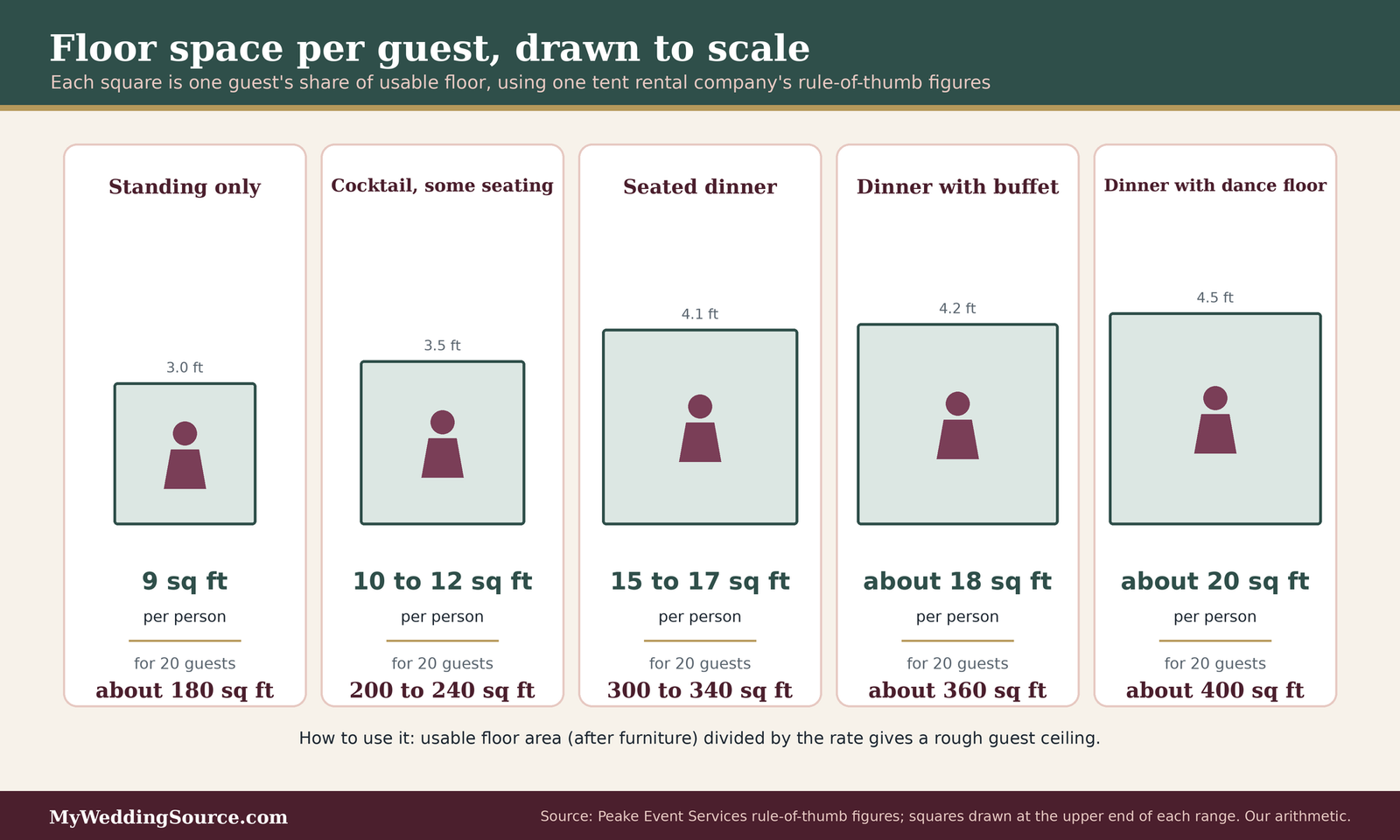
Peake Event Services, a tent rental company, gives rule-of-thumb figures for tented events that are useful for judging whether an engagement party at home will fit. It says its figures are a general rule of thumb and that each event is different.
The published space rates
Peake gives about nine square feet per person for stand-up only, ten to twelve for a cocktail party with a mix of standing and soft seating, fifteen to seventeen for a seated dinner, about eighteen for a seated dinner with a buffet, and about twenty for a seated dinner with a dance floor. These are for the usable floor, not the room’s total area.
Measure usable space, not the room
Measure length times width for each room guests will use, then subtract furniture you cannot move, such as a sofa against a wall, a piano, or a kitchen island. The result is a rough usable area. This subtraction is our suggestion, but it is the step most hosts skip and the reason a room that looks big on paper feels full at thirty people. Add in only the spaces guests will actually use: a bedroom that is closed off does not count.
Design a path through the house
Guests behave like water: they find the easiest path and then stop moving. Where they stop becomes a crowd. A simple layout can spread the crowd out.
The path from the door
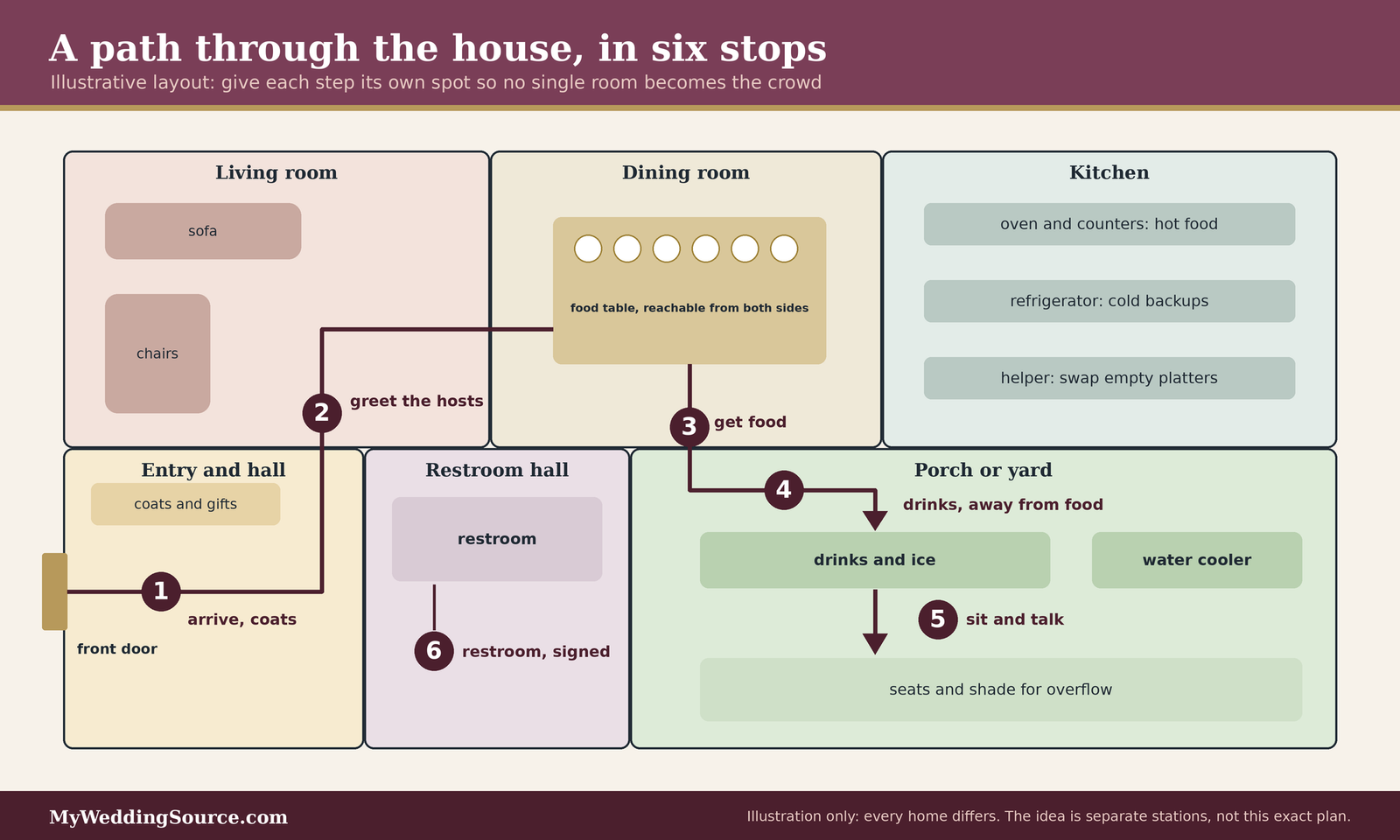
Think of the evening as a sequence: arrive, put down coats and gifts, get a drink, get food, find a place to stand or sit, use the restroom, and eventually leave. Put each of these in a different part of the house if you can. The most common failure is a drink table and a snack table side by side in the kitchen, because the kitchen also holds the host. Moving drinks to a dining room or porch and food to a separate surface gives the kitchen back to the person cooking.
Make the traffic flow one way if you can
A food table that can be approached from both sides moves faster than one against a wall. A table with food at one end and napkins at the other lets people take a plate, serve, and leave without backtracking. These are general layout principles from event practice, not figures from our sources, and they matter most for parties above about thirty guests.
Seating, coats, and comfort
Not every guest wants to stand for three hours, and some cannot. An engagement party at home has an advantage over many venues because seating can be improvised.
Seats for people who need them
Place seating where it is easy to reach and not hidden in a corner. Make sure older guests and anyone who has trouble standing have comfortable chairs near the food. Our guide to seating for guests who cannot stand for long periods explains how to offer seats without singling anyone out.
Coats, bags, and gifts
Pick a bedroom or closet for coats and bags, and a small table for cards and gifts. If you do not clear a place for gifts, they end up on the sofa. A box or basket for cards is a small thing that prevents lost envelopes. Our wedding gift etiquette guide explains how gifts and cards are usually handled.
Outdoor space, tents, and weather
A yard or patio can add a lot of capacity, but the weather is a variable that a living room does not have.
Heat and shade
If the party is outdoors in warm weather, shade and cold drinks matter, and food spends less time safely out. The food-safety section below explains the one-hour rule above ninety degrees Fahrenheit. Our summer wedding heat plan covers shade, water, and signs of heat illness in more detail, and the ideas apply to any outdoor gathering.
Backup plan for rain and cold
Decide the rain plan before you send invitations, and tell guests where the party will move. If the plan is to move indoors, check that the indoor space meets the square-foot numbers above, because a rain plan that doubles the density is not a plan. If you rent a tent, ask the supplier about side walls, flooring, and weights or stakes, and ask your city whether a permit applies. Our wedding rental planning checklist and wedding permits guides explain what to ask.
Food safety for an engagement party at home when your kitchen is the caterer
At a restaurant or with a licensed caterer, someone else is responsible for holding temperatures. At an engagement party at home, you are. The rules are not complicated, but they require attention at the moment when you are busiest.
Temperatures and time limits
The U.S. Department of Agriculture’s Food Safety and Inspection Service describes the danger zone as 40°F to 140°F, the range where perishable food spoils rapidly and where bacteria can double in as little as twenty minutes.
The two-hour and one-hour rules
According to the FSIS, perishable food served hot or cold should not spend more than two hours in the danger zone, and when the temperature is above 90°F, the limit is one hour. A USDA fact sheet on party buffets adds that foods should not sit at room temperature for more than two hours, and recommends tracking how long food has been out and discarding anything left longer. In practice, this means writing down the time you put each dish out.
Hot food and cold food
The USDA advises keeping cold food at or below 40°F and hot food at or above 140°F. For hot food, chafing dishes, warming trays, and slow cookers can hold temperature, but the USDA says they should not be used to reheat cold food, and reheating should reach at least 165°F. Use a food thermometer to confirm. FoodSafety.gov lists safe minimum internal temperatures of 165°F for poultry, 160°F for ground meat and sausage, and 145°F for steaks, roasts, and fish, with a three-minute rest for the red-meat cuts it lists, and 165°F for leftovers being reheated.
Setting up the table to stay safe
The way a table is built matters as much as the temperature of the food in the oven.
Small platters and replacements
The USDA’s party buffet guidance says to replace empty platters instead of adding fresh food to an existing dish, which keeps older food from mixing with new. In practice, this means setting out half of each dish and holding the rest in the oven or refrigerator, then swapping the whole platter when it runs low. It also means that your quantity worksheet and your serving schedule are related: pieces of food are not all on the table at once.
Ice, nesting, and coolers
The USDA suggests keeping cold foods cold on a buffet by nesting serving dishes into bowls of ice, and using a cooler with ice or a commercial freezing gel for transport. Keep coolers out of direct sunlight and open them as little as possible. A separate cooler for drinks means that guests do not open the one holding food.
Clean surfaces, cross-contact, and leftovers
Cross-contamination is easy to miss at a party because the kitchen is crowded.
Hands, platters, and utensils
The FSIS advises washing hands and surfaces with soap and warm water for twenty seconds before cooking and after handling raw meat or poultry, and serving cooked food on a clean platter, not the one that held raw meat. Put out a separate serving utensil for each dish, and replace them if they fall or touch the table.
Leftovers
FSIS advises refrigerating or freezing leftovers right away in shallow containers and discarding food that has been out too long, summed up in the phrase “when in doubt, throw it out.” Do not wait until the last guest leaves. Move food to the refrigerator when the party winds down, and plan for the refrigerator space ahead of time, because a full refrigerator at the end of a party is a common failure.
Allergies, dietary needs, and children at an engagement party at home
Food allergies and dietary restrictions are easier to manage at an engagement party at home than at a large event, because you know who is coming. But a host takes on a responsibility when serving food, and some guests cannot tell by looking what is in a dish.
Ask early, label clearly
An invitation or an RSVP is the right time to ask about allergies and dietary needs. A short line is enough.
What to ask on the RSVP
Ask guests to tell you about allergies and dietary needs when they reply. Our wedding dietary restrictions guide has wording and a method for tracking responses that scales down to an engagement party at home. If you have a guest with a serious allergy, call or message them directly and ask what is safe, because they are the best judge.
Label what is on the table
At an engagement party at home, small cards beside each dish listing the main ingredients and common allergens let guests make their own choices without having to ask. The FDA lists nine major food allergens in the United States: milk, eggs, fish, crustacean shellfish, tree nuts, peanuts, wheat, soybeans, and sesame. A label that names these, when relevant, is helpful, but remember it is based on what you know about the recipe, not on lab testing.
Prevent cross-contact
Cross-contact is when an allergen gets into a food that should not contain it, and in a home kitchen it happens through shared spoons, boards, and surfaces.
Simple habits
The FDA defines cross-contact as the inadvertent introduction of a major food allergen into a product. At an engagement party at home, that means separate serving utensils for each dish, clean cutting boards between uses, and keeping dishes with common allergens, such as nuts, apart from others. If a guest has a severe allergy, consider making one dish in a clean kitchen first, before any allergen is in the room, and serving it separately.
What packaged-food labels do and do not tell you
The FDA says that major allergens must appear in the ingredient list or a contains statement, and that precautionary statements such as “may contain” are voluntary. It also says products on shelves before January 1, 2023, may lack sesame labeling, and recommends contacting the manufacturer if unsure. If you are buying catering trays or prepared appetizers, ask the seller for an ingredient list and ask directly about allergens, and keep the packaging until the party is over.
Children and the quiet corner
Children are guests too, and a party that suits adults can still be long for a young child.
Kid portions and kid food
Tripleseat suggests children under twelve take about half the portion of an adult, which is how this guide counts them. Include at least one plain option, such as fruit, cheese, or plain pasta, because children are often more particular than adults.
A space for rest and play
A corner with a few books, coloring pages, or a movie in a separate room gives children somewhere to be when the conversation turns to adult topics. Make sure there is an adult nearby who is not the host, and keep small objects, hot dishes, and candles out of reach.
Neighbors, parking, restrooms, and house rules for an engagement party at home
Most of what goes wrong at an engagement party at home is not about the food. It is about the things a venue would have handled for you: where cars go, how late music can play, whether a single restroom can serve thirty people, and where the trash ends up.
Neighbors, noise, and local rules
Local rules about noise, street parking, and gatherings vary by city, county, and sometimes by neighborhood association. We did not find a single national source, and we would not guess at a rule for your address.
Tell the neighbors, and check the rules
A short note or a conversation a week ahead, with your phone number and the start and end times, prevents most complaints. Look up your city or county rules on noise and temporary parking, and check any homeowners or condominium association rules for guests, amplified music, and common areas. If you rent your home, read your lease and ask your landlord about guest limits and any restrictions on parties.
Music and the end time
Keep music at a level that allows conversation, and point speakers into the room and away from the neighbors’ windows. State the end time on the invitation, as Paperless Post suggests, so that you are not the one who has to announce it. Our guide to wedding entertainment ideas has low-key options, and if you want a short game or a slideshow, set it early, when guests are fresh.
Parking and arrival
At a venue, there is a lot or a valet. At an engagement party at home there is a street, and guests do not know where to put their cars.
Plan for cars
For an engagement party at home, estimate how many cars will come, roughly one for every two to three guests if many arrive as couples or families, which is our assumption and not a published figure. Look at where they can legally park, and note any driveway, permit, or no-parking rules. Put a short parking note in the invitation or follow-up message. If street parking is tight, consider asking some guests to carpool, or using a nearby lot with permission.
Make arrival easy
For an engagement party at home, put a light and a visible house number at the entrance, keep the walkway clear, and leave the door unlocked or assign someone to answer it. If any guest uses a wheelchair or walker, think through the path from the curb to the door and to the restroom, including steps and thresholds. Our guide to transportation for guests using wheelchairs has questions that apply to a home as well as a venue.
Restrooms, trash, and cleanup
One restroom for thirty people works if people are spread out and the supplies are stocked. It does not work if the paper runs out in the first hour.
Restroom supplies and signs
Before an engagement party at home, stock extra toilet paper, hand soap, and paper towels or clean hand towels, and add a small trash can with a lid. Point to the restroom with a sign if it is not obvious, and close off any bathroom you do not want guests to use. For a large outdoor party, our portable restrooms for outdoor weddings guide explains how rental restrooms are planned, and the same questions apply at smaller scale.
Trash, recycling, and cleanup
Put out more trash cans than you think you need, with a visible recycling bin if your area sorts it, and empty them before they overflow. Ask two or three friends to help with cleanup, and agree beforehand on what must be done that night, such as food into the refrigerator, and what can wait until morning. A bag of ice or a cooler that is still full of water can be a slip hazard, so dump it outside before guests leave.
Fire safety, power, and the small hazards of a crowded house
A house with thirty guests, a full kitchen, extension cords, and candles has more risks than a house on an ordinary evening. None of them is hard to manage, but each needs a moment of attention before the party.
Candles, heat, and the kitchen
Candles and warming equipment are the most common sources of open flame at an engagement party at home.
Candles
At an engagement party at home, candles are common. The U.S. Fire Administration advises keeping candles at least twelve inches from anything that can burn, using stable holders, and placing them where they cannot be knocked over easily. It also recommends battery-operated flameless candles as an alternative. In a crowded room with children, a flameless candle is a simple substitute, and it photographs well.
Chafing dishes and slow cookers
Chafing dishes, warming trays, and slow cookers are useful for holding hot food at 140°F or above, as the USDA notes. Put them on a stable table away from the edge, keep cords out of walkways, and keep any fuel containers for chafing dishes away from guests, particularly children. Read the manufacturer’s instructions for the equipment you are using, because we cannot cover every model.
Power, cords, and lighting
Many homes have fewer circuits than hosts assume, and a coffee maker, a slow cooker, a speaker, and string lights can trip a breaker together.
Check the load before the party
An engagement party at home often runs on one kitchen’s circuits. Spread heating appliances across different outlets and circuits if you can, and know where the breaker box is. If you plan to use outdoor outlets or an extension cord, use equipment rated for outdoor use. For larger outdoor parties with rented equipment, our guide to wedding generator rental explains how power is calculated, and our wedding lighting guide covers lighting choices that do not need a lot of power.
Light the path
Make sure the front walk, the steps, and the restroom path are lit, and that cords and rugs do not create trip hazards. A cheap stick-on night light in the hallway to the restroom is easy to add.
A small first-aid and emergency kit
A basic kit is something a host rarely uses and is glad to have when they do.
What to keep nearby
A basic first-aid kit, a flashlight, phone chargers, and a list of emergency numbers and the address of the house are enough for most parties. Our wedding emergency kit guide has a longer list that includes clothing and grooming items for the couple.
Know who will call for help
Tell your day-of lead where the kit is and who has the address ready. In an emergency, a person who knows the street name and a nearby cross street can direct responders more quickly than a person who has to look it up.
Renting, hiring, and delegating
An engagement party at home can be entirely homemade, entirely catered, or a blend. The right blend depends on the guest count, the kitchen, and how much time the hosts have in the week before.
What to rent
Rentals fill gaps that a home cannot, such as extra chairs, tables, linens, and glassware.
Tables, chairs, and serving gear
For an engagement party at home, count the seats and surfaces you need from the worksheet and the space section, then compare with what you own and what friends can lend. Ask rental companies about delivery, pickup times, damage fees, and whether chairs and tables are set up or left on the lawn. Our wedding rental planning checklist covers delivery windows, damage terms, and returns, and the questions are the same for an engagement party at home.
Glassware and plates
Washing dishes during a party is a task hosts regret. Rented glassware or high-quality disposables, plus enough plates for each guest to use two or three, reduce the load. If you use disposables, choose the sturdiest plates you can afford, because a flimsy plate with a full serving collapses.
Where the money goes at home
We did not find reliable national price figures for home parties, and we would not invent them, so use the quantities in this guide as a shopping list and collect local prices yourself. The cost of an engagement party at home tends to be driven by four lines: food, drinks, rentals, and help. Food and drinks scale with guests and hours. Rentals scale with seats and surfaces. Help scales with how much you want to avoid doing yourself. Multiply each quantity by a local unit price, add delivery and tax, and then compare the total with a caterer’s per-person quote for the same format. Ask any caterer or rental company to put the quote, the fees, and the cancellation terms in writing before you pay a deposit.
What to hire
Hiring does not have to mean a full caterer. A few hours of help can make the difference between a host who talks to guests and a host who spends the evening in the kitchen.
Full catering, drop-off catering, or a few helpers
For an engagement party at home, a full-service caterer brings food, staff, and often equipment. Drop-off catering delivers food that you serve. A helper or two, who might be a teenager from a neighbor’s family or a hired server, can replace platters, refill ice, and clear plates. Our guide to wedding catering explains what caterers typically include and how quotes are built, and our wedding vendor meals guide covers a point hosts often forget: any staff or vendors who work through a meal expect to eat.
Written terms for any vendor
Ask for a written quote that lists what is included, what is extra, when the vendor arrives and leaves, and what happens if you change the guest count. Ask whether the caterer holds a license or insurance, and ask how they keep hot and cold foods at safe temperatures during delivery, which is the practical question behind the USDA’s temperature rules.
Friends and relatives who offer to help
Offers of help are generous, and managing them is a small task of its own.
Give each helper one job
Assign specific roles, such as door, drinks, food, kids, and cleanup, rather than leaving it to chance. A written note with times and tasks is more reliable than a verbal request, and most helpers appreciate knowing when they can stop.
Keep the potluck from becoming a puzzle
If guests offer to bring dishes, give them a category instead of leaving the choice open, such as a dessert, a salad, or a bottle of something non-alcoholic. Tell them whether the dish needs to be hot, cold, or room temperature, and whether you can store it. Counting potluck dishes toward your totals is a good way to reduce what you buy, but only if you know what is coming.
Photos, toasts, and gifts at an engagement party at home
The engagement party is often the first time both families and many friends are in one room. A few details about photos, speeches, and gifts make the evening easier to enjoy.
Photos and consent
An engagement party at home is private, but photos travel. Some guests are happy to be tagged, and others are not.
Set a light photo policy
For an engagement party at home, decide whether you will take photos, hire a photographer, or ask a friend. Our wedding engagement photos guide covers photo sessions for couples, and our guide to engagement announcements explains how to share news without surprising anyone who has not heard yet. If you plan to post photos, ask guests, and respect anyone who says no. Do not record guests secretly. A short note on the invitation or a small sign by the door is enough to set expectations.
Plan one group photo
A single group shot, taken early, before drinks and food have had their effect, is the picture most families keep. Choose a spot with good light and a clean background, and ask a friend to take it with two or three phones.
Toasts and the flow of the evening
At an engagement party at home, there is no host to call for quiet, so a toast is up to you.
Time the toast
At an engagement party at home, plan a short toast about an hour into the party, once most guests have arrived and have a drink. Tell the people who will speak, and ask them to keep it short. Make sure there is a drink in every hand, including a non-alcoholic option, before the toast begins. Our rehearsal dinner toasts guide has ideas for structure that work at any party.
Let the party breathe
Some hosts add a game, a slideshow, or a guest book. These are optional, and a short plan works better than a full program. If the room is full of people who love each other and have not seen each other in a while, conversation is the activity.
Gifts, cards, and thank-yous
Gifts at an engagement party are not required, and etiquette sources differ on how common they are. We cover the range of opinions in our engagement party guide, and our wedding gift tracking guide shows a simple way to record what arrives.
Where gifts go
At an engagement party at home, give gifts a clear place and a record. A card basket or box helps, and a friend who notes what came from whom prevents a hard hour of guessing afterward. If the couple does not want gifts, say so on the invitation in a warm way, such as “your company is the gift,” or leave it unsaid and accept what comes.
Thank-you notes
Send thank-you notes for gifts and for help, including to the people who cooked, lent chairs, or stayed to clean. Our wedding thank-you cards guide has wording ideas that fit a smaller occasion.
A timeline from invitation to cleanup
A good plan for an engagement party at home looks like a short checklist with dates. Paperless Post suggests sending invitations about four to six weeks ahead, with online invitations going out closer to four weeks. The table below spaces the rest around that.
| When | Task | Notes |
|---|---|---|
| Six to eight weeks out | Choose date, format, host roles, and a rough guest count | Settle who pays and who is the day-of lead |
| Four to six weeks out | Send invitations that state the format, start time, and end time | Ask about allergies and dietary needs on the RSVP |
| Three to four weeks out | Look up local rules, check insurance, and tell neighbors | Reserve rentals and any caterer |
| Two weeks out | Confirm guest count and run the quantity worksheet | Order what must be ordered |
| One week out | Confirm rentals, cleaning plan, parking plan, and helper roles | Check ice, coolers, and refrigerator space |
| Two to three days out | Buy perishables, prepare make-ahead dishes, and clear space | Make labels for dishes |
| Day before | Set up furniture, stations, and trash cans | Chill drinks |
| Day of | Set out food in halves, note times, and brief helpers | Keep the one-page plan visible |
| After the party | Refrigerate food, clean, and write down what ran out | Send thank-you notes within a few weeks |
Using the timeline
The point of a timeline is not to produce a grid of deadlines but to move decisions earlier than they feel urgent. The tasks that go wrong at an engagement party at home are almost always the ones that were left to the last day.
Move the long-lead tasks first
Rentals, insurance questions, and any caterer need lead time, and a friend who offers to help is more useful when told weeks ahead than days ahead. Compare this timeline with the general plan in our wedding planning checklist, where the engagement party is one item among many.
Keep a one-page plan
For an engagement party at home, use a single sheet and write the guest count, the format, the start and end times, the food list with quantities, the drinks list, who is doing what, the address, parking notes, and emergency contacts. Print two copies. One is for you, the other is for your day-of lead.
The day itself, in order
A schedule for the day keeps the party from being run by whatever is loudest.
Before guests arrive
About two hours before, set out cold items and drinks, chill what needs chilling, and begin reheating or cooking what needs to be hot. Check the restroom, light the path, set the music, and silence your own phone. Put out half of each platter, and keep the rest in the refrigerator or oven. Write the time on a sticky note beside each dish.
During and after
Check platters at regular intervals, replace instead of topping up, and note the time. Move to the toast at the planned time. At the end, put food away promptly and, if you can, leave the dishes until morning. Thank your helpers before they leave.
Edge cases: when an engagement party at home does not fit the standard worksheet
Not every home is a house with a dining room and a yard. The worksheet scales to other situations if you adjust the inputs.
Small apartments and tight spaces
An apartment with a small living room can host a good engagement party at home, but the square-foot numbers are less forgiving.
Cap the list and stagger the time
If the usable area, after furniture, divided by nine square feet gives a number lower than your guest list, consider an open-house format with a longer window so that guests arrive and leave in waves. Staggered arrival, with a start and end time stated on the invitation, reduces the peak number of people in the room without cutting the list. This is our suggestion and a planning approach, not a published rule.
Use shared spaces carefully
A building rooftop, a courtyard, or a clubhouse may be available to residents. Ask the building manager about reservation, capacity, noise rules, and any insurance requirement, and ask what happens if it rains.
Parents’ home, surprise parties, and mixed expectations
Many engagement parties at home are hosted by a parent, and some are a surprise. Both add a layer of coordination.
Hosting an engagement party at a parent’s home
Agree early on what the home can handle, who pays for what, and who makes the final call on the guest count. Show the quantity worksheet to the host so that the plan is shared. If the hosts and the couple disagree on the format, the invitation is the tiebreaker: write it, and everyone follows it. Our guides to a joint engagement party with two families and to planning an engagement party when parents live far apart cover the family side of the question.
A surprise at home
A surprise adds a few constraints: guests arrive early and need a place to park out of sight, the couple’s arrival needs a decoy plan, and a late couple holds the food. Assign a person to message the couple and a person to text guests. Do not make the surprise depend on a single phone call. Our engagement party gift expectations guide may also help the host decide how to word the invitation about gifts.
Dry parties, daytime parties, and multi-generational crowds
Some parties are shaped by who is coming more than by the house.
A dry or mostly dry party
If alcohol will not be served, the drinks quantity shifts to non-alcoholic drinks, so use the soft-drink rate of one per hour per adult equivalent as a floor and add a hot-drink option in cool weather. A special non-alcoholic drink makes the party feel finished, not like a limited version. Mention it on the invitation so guests are not surprised.
Daytime and brunch parties
Late-morning or afternoon parties shift the food toward lighter, easier items, and heat matters more outdoors. Use the same appetizer and meal ranges, and watch the one-hour rule on a hot day. Tripleseat suggests one and a half bagels or pastries per guest for a breakfast or lunch party, and one and a half sandwiches per guest at lunch, which are useful starting points.
Questions to ask before you commit
These questions turn the ideas above into things you can check, and they work whether you are the host, the person paying, or a family member being asked to host.
Questions to ask before you commit to hosting at home
- What is our confirmed adult count, our child count, and our length in hours?
- Does the usable floor area, after furniture, fit that many people at about nine to twelve square feet each?
- Do the oven, refrigerator, and counters have room to hold this much food at safe temperatures?
- Have we checked our homeowners or renters policy and our state’s rules on serving alcohol?
- Do the neighbors, the lease, or the association need to know?
- Where do cars go, and is there a step-free route to the door and restroom?
- Who is the day-of lead, and have they seen the one-page plan?
- Which dishes are labeled for allergens, and who is the point of contact for guests with allergies?
Questions for caterers and rental companies
If any part of the party is outsourced, these questions protect your plan.
About the food and service
Ask what is included, how portions are calculated, and whether the caterer’s portion sizes match the ranges here. Ask how food is held at safe temperatures, who sets up and clears, and whether the quote lists labor, delivery, tax, and gratuity separately. Ask what happens if the guest count changes within a week of the party.
About equipment and cleanup
Ask about delivery windows, pickup times, damage terms, and whether rentals come washed. Ask who removes trash and leftover food, and whether the cleanup fee is included.
Questions for the home and the people in it
These questions are about the house, not the vendors, and they are easy to skip.
About the house
Ask whether the floors, stairs, and railings are safe for a crowd, whether the restroom will cope, whether the electrical load is enough, and whether any area should be closed off. Ask whether any pets will be present and whether any guest is allergic to them.
About the people
Ask whether any guest needs a seat, a quiet space, a ride home, or a particular meal. Ask whether the hosts have an agreed end time, and who will say so if the party runs long.
FAQ: engagement party at home questions
Planning and quantities
How much food do I need for an engagement party at home?
It depends on the format. Published guides suggest about four to six appetizer pieces per adult before a meal, eight to ten for a longer evening, and twelve to fifteen when appetizers are dinner. For a dinner, Tripleseat gives about one pound of food per adult. Count children under twelve as half portions and add a cushion for popular items.
How many guests can fit in my house?
A tent rental company, Peake Event Services, gives about nine square feet per person standing, ten to twelve for a cocktail party with some seating, and fifteen to seventeen for a seated dinner. Measure usable floor area after furniture, divide by the rate, and compare with your list. These are rules of thumb, not codes.
How many drinks should I plan for?
Tripleseat suggests two drinks per person per hour for beer and wine, and Giggster suggests two to three. Multiply by the number of adults who drink and the hours of the party. A standard drink, per the CDC, is five ounces of wine or twelve ounces of beer, so large pours run short.
Safety and etiquette
How long can food sit out at an engagement party at home?
The USDA’s food safety agency says perishable food should not be in the 40°F to 140°F danger zone for more than two hours, and only one hour when the temperature is above 90°F. Replace empty platters instead of topping them up, note the time each dish goes out, and discard food left too long.
Do I need to worry about insurance if I serve alcohol?
It is worth checking. InsuranceQuotes.com, citing the Insurance Information Institute, says many states have social host liability laws and that homeowners policies may not cover every cost. This is general information, not legal advice. Read your policy, call your agent, and look up your state’s rules, or consider hosting a dry party.
Should I tell my neighbors about the party?
A short note a week ahead, with your phone number and the end time, prevents most complaints. We did not find a single national rule on noise or parking, so check your city or county rules and any lease or association terms. Keep music at a conversational level and point speakers away from neighboring windows.
Format and guests
Should the invitation say what food will be served?
Yes. Paperless Post advises stating on the invitation what will be served, such as cocktails and light bites, and whether it is a full dinner or appetizers. At an engagement party at home, guests cannot tell from the building whether dinner is coming, and clear wording prevents both hungry guests and uneaten buffets.
How do I handle guests with food allergies?
Ask on the RSVP, label dishes with their main ingredients and common allergens, and keep serving utensils separate. The FDA names nine major allergens, including milk, eggs, peanuts, tree nuts, and sesame. For a guest with a severe allergy, ask them directly what is safe, and ask caterers for ingredient lists in writing.
Your next steps
Decide and calculate
Fix the five inputs
For your engagement party at home, write down adults, children, hours, format, and the share who will drink. Run the worksheet for your chosen format and compare the result with what your kitchen, refrigerator, and floor space can hold. Adjust the format before you adjust the food.
Settle the host jobs
Name the home-owner, the payer, the cook, and the day-of lead. Share the one-page plan with all four, and agree on the end time. Our engagement party guide covers who hosts and pays in more detail.
Check and communicate
Check the house and the rules
Read your insurance policy, look up local noise and parking rules, and talk to neighbors, a landlord, or an association if they apply. Plan parking, an accessible path, and a restroom that will not run out of supplies.
Send a clear invitation
State the date, start and end times, format, and what will be served, with a way to share allergies. Send it four to six weeks ahead, and keep a running count of replies. For the wider plan, use our wedding planning checklist.
Sources & methodology
How we built this guide
What we relied on
This guide combines federal food safety guidance on temperatures and time limits, a federal fire-safety page on candles, FDA information on food allergens, CDC standard drink sizes, and published party-planning and catering references for quantities and space. Quantity and space figures come from commercial sources, including a restaurant-supply retailer, an event-software company’s blog, a tent rental company, and general-interest party guides, and we name each one in the text because their figures differ and reflect their own business. The worked examples are our own arithmetic from those ranges and are estimates. Etiquette points come from Emily Post and Paperless Post. Insurance information comes from an insurance comparison site that cites the Insurance Information Institute.
What we did not do
We did not cook for, test, or measure any party, and we did not verify catering portion sizes with a caterer. We did not give legal, insurance, medical, or fire-code advice: social host rules, noise rules, parking rules, and occupancy limits vary by state, city, and building, and you should check your own. Allergy guidance is general and is not a substitute for asking a guest or a clinician. We checked the sources listed below in November 2026, and published guidance can change, so recheck anything safety-related before you rely on it.
Source list
Government and public-health sources
- U.S. Department of Agriculture, Food Safety and Inspection Service, USDA urges consumers to keep clear of the danger zone this summer: https://www.fsis.usda.gov/news-events/news-press-releases/usda-urges-consumers-keep-clear-danger-zone-summer
- U.S. Department of Agriculture, Holiday or party buffets food safety guidance: https://www.usda.gov/node/17644
- FoodSafety.gov, Safe minimum internal temperatures: https://www.foodsafety.gov/food-safety-charts/safe-minimum-internal-temperatures
- U.S. Food and Drug Administration, Food allergies: https://www.fda.gov/allergens
- Centers for Disease Control and Prevention, About standard drink sizes: https://cdc.gov/alcohol/standard-drink-sizes/index.html
- U.S. Fire Administration, Candle fire safety: https://www.usfa.fema.gov/prevention/home-fires/prevent-fires/candle
Etiquette, catering, and event-planning sources
- Emily Post Institute, Engagement party timing: https://emilypost.com/advice/engagement-party-timing
- Paperless Post, Engagement party 101: https://www.paperlesspost.com/blog/engagement-party-101
- WebstaurantStore, A guide to catering portion sizes: https://argo.webstaurantstore.com/article/1013/catering-portion-size-guide.html
- Tripleseat, How much food and drink should you order for your party: https://eventupblog.tripleseat.com/how-much-food-to-order
- The Takeout, How many appetizers you need based on the size of your party: https://www.thetakeout.com/1745597/how-many-appetizers-size-party/
- Giggster, Party food calculator: https://giggster.com/guide/portions/food-quantity/
- Peake Event Services, Tent size guide and square footage calculations: https://www.peakeventservices.com/wp-content/uploads/2026/03/Tent-Size-Guide_Square-Footage-Calculations.pdf
- InsuranceQuotes.com, Hosting a party at your place can affect your home insurance: https://www.insurancequotes.com/home/home-insurance-host-liability
How current these sources are
Figures from commercial and government sources were read on the pages listed, as they appeared in November 2026. Food-safety, allergen, and insurance guidance can change, so recheck anything you will rely on before the party.