
A summer wedding heat plan is a short, written set of decisions about shade, water, food, clothing, schedule, and who is in charge when the temperature climbs, made weeks ahead so that nobody has to improvise while guests are sweating in their good shoes.
Quick answer
Build your summer wedding heat plan around four things you can verify: the hourly forecast and heat index for your venue, shade and a cool indoor fallback for every place guests stand or sit, a food and drink schedule that respects the federal one-hour and two-hour limits for perishable food, and named people with written triggers who can move the ceremony, extend the cocktail hour, or call for help. Check the forecast at fixed points, decide at fixed deadlines, and tell guests only what changes what they do. This guide is general planning education, not medical advice.
What a summer wedding heat plan covers, and what it leaves out
Most wedding timelines assume a comfortable day. A heat plan is the layer you add when that assumption might fail: it names the specific ways heat can disrupt your event, sets thresholds for acting, and assigns the work. It is not a reason to cancel a summer wedding or to cover your guests in warnings. It is a checklist that lets you enjoy the day because the uncomfortable questions were answered in advance.
If you have not yet built the wider schedule, start with our wedding day timeline guide and come back here to add the heat layer. This page deliberately stays narrow so it does not repeat the general planning advice you will find there.
The scope of a summer wedding heat plan
A useful summer wedding heat plan is bigger than “buy fans.” It touches five areas that are usually owned by different people: the venue controls space and power, the caterer controls food temperature, the planner or coordinator controls the schedule, your wedding party controls the small human details, and you control the decisions about timing and guest comfort.
The five areas a summer wedding heat plan touches
Think of the plan as five short lists. The first covers place: shade, shelter, surfaces, restrooms, and a cool room. The second covers time: when the ceremony starts, how long guests stand, and how long photos take. The third covers people: water, rest, medication, and the guests most likely to struggle. The fourth covers food and drink: how long things sit out and how they are kept cold. The fifth covers decisions: who watches the forecast and who may change the plan.
What a summer wedding heat plan is not
A summer wedding heat plan is not a medical protocol, an insurance policy, or a legal document. It cannot tell you how a particular guest’s health conditions respond to heat, and it does not replace the advice of a clinician or the instructions of a 911 dispatcher. Where we describe symptoms and first steps, we are summarizing public guidance from health agencies, and you should treat any serious symptom as a reason to call for professional help.
Who benefits most from having one
Any outdoor wedding in warm weather benefits from a summer wedding heat plan, but the need grows with certain features of your day. Long gaps between the ceremony and the first cool space, dark or heavy formal clothing, a rural site without easy power, or a guest list with many older relatives or small children all raise the stakes.
Features of a wedding that raise the stakes for a summer wedding heat plan
Look at your own event honestly. Is the ceremony in full sun without a roof? Will guests walk a distance from parking to seating? Are cocktails served outdoors for an hour or more? Is the food buffet-style, with trays that sit out? Is the reception in a tent without cooling? Each yes adds a line to your summer wedding heat plan. A wedding in a cool, air-conditioned hall in July has a short heat plan, and that is a perfectly good outcome.
Why a summer wedding heat plan is calmer than a reaction
When heat becomes a problem during the day, decisions are made by whoever is nearest and most anxious, and the couple is often the last to hear. Writing the plan down, with a threshold and a name next to each action, moves those decisions to a quiet afternoon weeks earlier. It also gives your vendors a clear instruction instead of a vague worry. If worry about the logistics is already heavy, our guide to wedding planning stress has ideas for sharing the load.
Identify the failure modes before designing the pretty version
The usual order is backward: couples choose the dress, the arch, and the aisle, then discover that the aisle is a south-facing stretch of dark pavement. The better order is to list what can go wrong first, because the pretty version has to survive those failures. The risk register later in this section is the most reusable part of this summer wedding heat plan, so read it with your venue contract open.
List environmental, access, health, and infrastructure risks in the summer wedding heat plan decision
Heat risk in a summer wedding heat plan comes from four sources that interact. The environment sets the baseline: temperature, humidity, sun, wind, and shade. Access determines how far people must move and how long they stand. Health describes who is present and how vulnerable they are. Infrastructure covers power, water, shelter, and restrooms. A problem in one area is usually manageable. Problems in two or three at once are the ones that turn an uncomfortable afternoon into an incident.
Separate likely inconvenience from high-impact failure in your summer wedding heat plan
Not every risk deserves the same energy. A guest who fans herself with a program is an inconvenience. A guest who becomes confused or faints is a high-impact failure. Sort your list into two piles. Inconveniences get cheap fixes such as fans, hats, and cold towels. High-impact failures get a named responder, a cool place to go, and a clear rule for calling emergency services.
A useful test is to ask what happens if the risk is ignored for thirty minutes. Warm guests will survive that. A guest showing heat stroke signs will not. The National Weather Service describes heat stroke as a medical emergency in which delay can be fatal, and the CDC’s workplace-safety unit lists confusion, slurred speech, seizures, and very high body temperature among its signs. Those are the events your summer wedding heat plan exists to catch early.
Identify which summer wedding heat plan risks the venue controls and which you do
Some risks are yours and some belong to the venue or a vendor, and the contract usually decides which. The venue typically controls shade structures, air conditioning, generators, and restroom access. Your caterer controls how food is held and served. You control the start time, the length of the ceremony, the guest list, and what you tell guests.
Sort every risk on your list into one of three groups: venue controls it, couple controls it, or shared. Then ask the venue about the first group in writing. Our wedding venue questions guide covers contract language more generally, and a heat-specific email takes ten minutes and often surfaces surprises, such as a tent that has sides but no cooling.
Set objective triggers for plan B in the summer wedding heat plan decision
A vague plan says “we will move inside if it is too hot.” A usable one says “if the forecast heat index for 4 p.m. is at or above a stated number at the Thursday check, we move the ceremony indoors.” Objective triggers remove debate, and debate is exactly what you cannot afford on the day.
Use weather, capacity, temperature, or access thresholds for the summer wedding heat plan
The National Weather Service publishes a heat index chart with four categories, measured in degrees Fahrenheit. As of its published chart, a heat index of 80 to 90 is “caution,” 90 to 103 is “extreme caution,” 103 to 124 is “danger,” and 125 or higher is “extreme danger.” The chart’s values assume shade, and the service notes that direct sunlight can raise the heat index by up to 15 degrees. That second sentence is the one wedding plans forget: a shaded forecast of 90 can feel like something near 105 on an open lawn.

You can turn this into your own thresholds. For example, you might decide that if the forecast heat index in the shade is in the “extreme caution” range or higher, the ceremony moves into shade or indoors, and if it reaches the “danger” range, the cocktail hour moves indoors as well. Those specific cutoffs are our suggestion, not an official standard. The agency’s categories are the sourced part, and where you place your triggers is a judgment you should make with your venue and, if you have vulnerable guests, with their input.
Other thresholds matter too. Capacity: if the cool indoor room holds only half your guests, the trigger for using it has to be earlier, because you will need to rotate people. Access: if the walk from shuttle drop-off to seating is long, a lower temperature may justify a golf cart or a shorter route.
Name who makes the summer wedding heat plan decision and by what deadline
A threshold without an owner is just a number. Choose one person to make the call, ideally your coordinator or a calm relative who is not in the wedding party, and one backup. Give them authority to act without asking you, and tell your vendors that this person speaks for you.
Set deadlines that match vendor lead times. A rental company that must deliver a second tent needs notice days ahead. A caterer who needs to change service style needs a day. A venue that must switch on and test a cooling system needs hours. Our contingency table later in this guide lays out a sample schedule of checks and decisions, and you can adjust each deadline to the vendor’s actual answer.
A summer wedding heat plan risk register you can reuse
The table below is an original planning tool, not a statistic. The likelihood and impact ratings are editorial judgments for a typical outdoor summer wedding, and you should replace them with your own after speaking with your venue. Every row has a trigger, a prevention step, an owner, and a plan B, which is the structure that makes a register usable.
The summer wedding heat plan register itself
| Risk | Likelihood | Impact | Trigger | Prevention | Owner | Plan B |
|---|---|---|---|---|---|---|
| Guests overheat during the ceremony | Moderate | High | Forecast heat index in the sun is in the danger range | Shade, early or late start, short ceremony, seats in shade | Coordinator | Move indoors or to the shaded space |
| Perishable food sits out too long | Moderate | High | Air temperature above 90 degrees F | Cold holding, small replenished trays, timed service | Caterer | Swap to shelf-stable items |
| Power loss to fans or cooling | Low | High | Venue cannot confirm backup power | Ask for generator plan and test load | Venue | Battery fans, move guests to shade |
| Makeup and hair fail in the sun | High | Low | Humidity and direct sun at photos | Test run, setting products, blotting kit | Makeup artist | Touch-up kit with a trusted friend |
| Guests run out of water | Moderate | Moderate | Hot day with long gaps in service | Water at arrival and seating | Venue or caterer | Extra coolers from backup supply |
| Ceremony runs long | Moderate | Moderate | Officiant plans extras | Timed script, shorter readings | Officiant | Cut optional elements on the day |
| Hot surfaces and long walks | Moderate | Moderate | Dark pavement, gravel, distance | Route walk, shaded path, carts | Couple and venue | Shuttle or reroute |
How to use the register
Copy the table into a shared document and add a column for “confirmed in writing.” Fill that column in as vendors reply. Any row that stays blank two weeks before the wedding is the next thing to chase. Keep the owner column honest: if the owner column says “everyone,” nobody owns it.
Plan the ceremony time and shade first in a summer wedding heat plan
Timing and shade are the cheapest controls in any summer wedding heat plan. They cost little or nothing, they affect every guest, and they are decided early. Two couples with the same dress and the same venue can have very different afternoons depending on whether the ceremony starts at 2 p.m. in open sun or at 6 p.m. in the shadow of a building.
Choose a start time using the sun, not just tradition
Traditional start times cluster around mid-afternoon, partly because of venue schedules and partly because of habit. In summer, that habit puts a long standing ceremony and a long outdoor photo session in the hottest part of the day.
What the sun is doing at your venue on summer wedding heat plan day
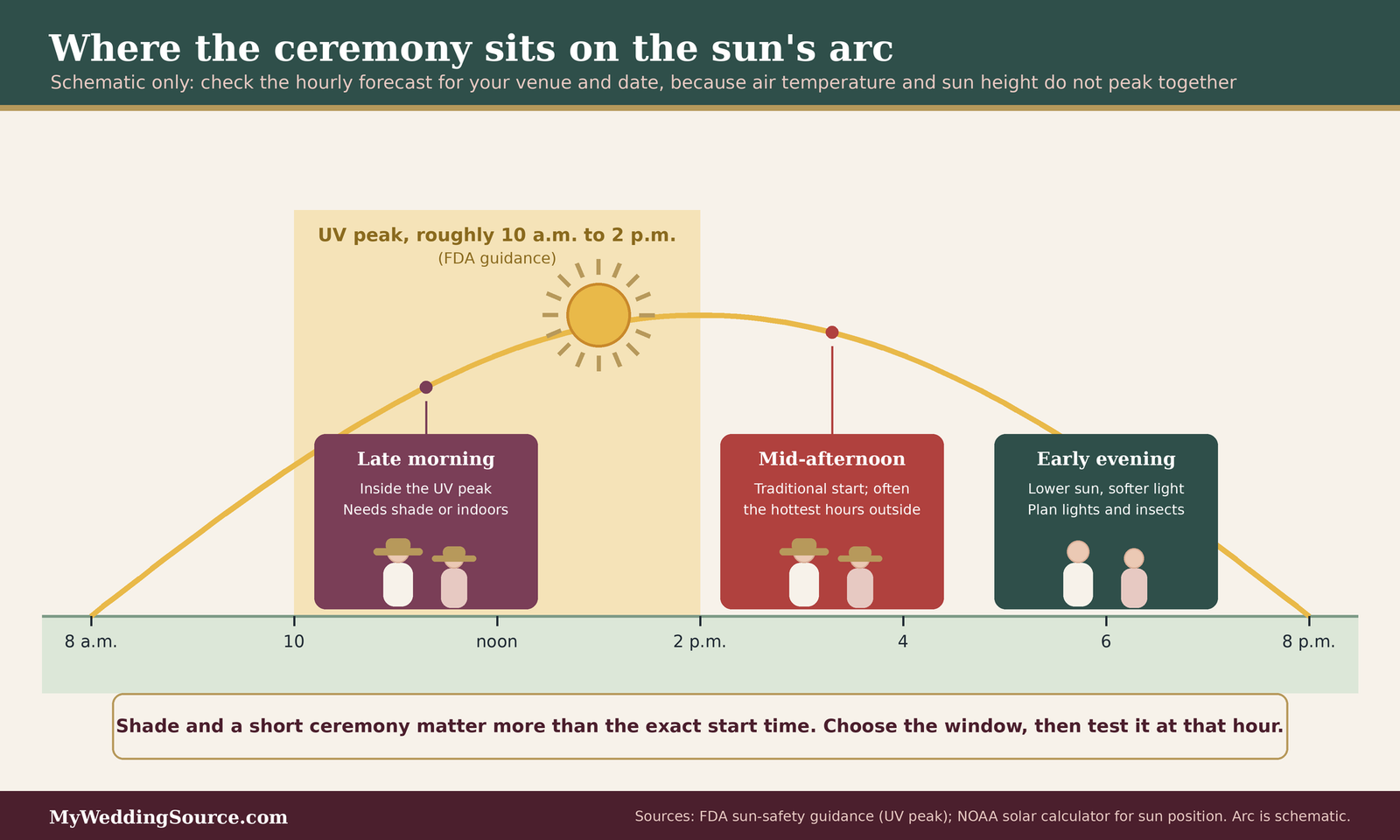
Sunrise, sunset, and solar noon vary by location and date, and NOAA’s Global Monitoring Laboratory offers a solar calculator that reports them for any place on earth, plus the sun’s height in the sky for a chosen time. NOAA’s page notes that the tool is no longer actively maintained and is provided for research and entertainment, so treat the output as a planning estimate and confirm with your photographer. It is still useful for seeing where the sun will be at 3 p.m. versus 6 p.m. on your date.
The FDA says ultraviolet intensity peaks roughly between 10 a.m. and 2 p.m., which is a sound reason to keep long outdoor stretches away from that window. Air temperature and UV are not the same thing, and the hottest air often arrives later than the highest sun, so look at the hourly forecast for your location rather than assuming that late afternoon is cool.
Compare three common start windows
Use the three windows below as a thinking exercise, not a rule. The notes describe tradeoffs, not guarantees.
A late-morning start puts the ceremony inside the UV peak and the reception through the afternoon, which suits indoor venues and brunch-style receptions but is hard on an open-air ceremony. A mid-afternoon start is the traditional choice and often the least comfortable outdoors in summer, since guests arrive in the hottest hours. An early-evening start moves the ceremony and photos toward lower sun, and it may give you softer light for pictures, but it pushes dinner later and needs a plan for lighting and insects. Pick the window that matches your venue, then check the hourly forecast for that exact slot.
Shade as infrastructure in a summer wedding heat plan
Shade is not decoration, it is a piece of infrastructure, and it should be planned with the same care as seating. The FDA recommends pairing sunscreen with shade, protective clothing, and sunglasses because sunscreen alone does not block all ultraviolet exposure.
Natural shade and its limits
Trees are the best shade, but they come with caveats. Their shade moves through the day, so a seat that is shaded at 3 p.m. may be in sun by 4:30. Dense canopy can also trap humid air and attract insects. Visit the site at your wedding time and photograph where the shade falls, then mark which rows stay covered through the whole ceremony.
Tents, canopies, and what they actually do
A tent blocks direct sun but may raise the temperature underneath if it has no airflow. Ask the rental company whether the tent has open sides, sidewalls that can be rolled up, or a cooling option, and ask who is responsible for the power that fans or cooling would need. A canopy over the aisle and seating is useful. A closed tent in still, humid air can feel worse than an open lawn, and that is worth testing before you commit.
If you are choosing a venue with greenery in mind, our guide to garden wedding venues explains how outdoor venues differ and what to ask about shelter.
Keep the ceremony short enough to be kind in hot weather
Guests stand and sit in the same conditions you do, with fewer water breaks. The length of the ceremony is a heat decision.
Time the ceremony to the shade you have
Ask your officiant for the real running length, not the approximate one, and add time for seating and for any late arrivals. A ceremony that is comfortable at twenty minutes can be difficult at forty-five. If you want longer readings or a unity ritual, consider placing them in the shadiest slot or moving them to the reception. Our wedding ceremony guide and wedding officiant guide cover what can be shortened without losing meaning.
Offer water and seats before guests need them
Place water and a few paper fans where guests arrive and where they sit, and offer chairs to anyone who may struggle to stand. Programs printed on sturdy paper double as fans, and our wedding programs guide covers the practical side. Add a line to the program or an usher’s brief that tells guests where water, shade, and restrooms are, so nobody has to ask during the vows.
Protect guests with water, rest, and a way to recognize trouble in a summer wedding heat plan
Heat illness does not announce itself politely, which is why a summer wedding heat plan needs a section on it. The CDC’s workplace-safety unit lists headache, nausea, dizziness, weakness, thirst, and heavy sweating among the signs of heat exhaustion, and several of those look like the ordinary fatigue of a long party. A summer wedding heat plan should therefore include a small amount of knowledge shared with the people most likely to notice.
Water and drink planning for a summer wedding heat plan
Water is the simplest control in a summer wedding heat plan and the one most often under-ordered. The CDC suggests sipping water throughout the day rather than waiting for thirst, and it notes that light yellow or clear urine usually indicates you are drinking enough.
Estimate how much water you need
Here is a transparent way to estimate, using assumptions you can change. Suppose 120 guests attend and you want each person to be able to drink about 16 ounces of water during a two-hour outdoor stretch, plus a second 16 ounces during the reception. That is 32 ounces per person, or 3,840 ounces in total, which is about 30 gallons. Add a margin of at least a quarter for staff, wedding party, and spills and you are near 38 gallons. The 16-ounce figure is our assumption for planning, not a health standard, and your guests, the temperature, and the amount of dancing will change it. The point is the arithmetic: a table with two small pitchers will not cover 120 people on a hot afternoon.
Make water easy to reach and appealing to drink at a summer wedding
People drink what is in front of them. Place water at arrival, at the ceremony seating, at the cocktail area, and near the dance floor. Cold water with citrus or cucumber is more appealing than lukewarm bottles, and a drink station with cups gets used more than a request to ask a server. If you want the bar to be a feature, add equally attractive non-alcoholic options so that water and mocktails are visible choices, not afterthoughts.
Alcohol, caffeine, and sugar
The CDC suggests considering cutting back on alcohol, caffeine, and sugary or salty drinks when it is hot. That does not mean cancelling a toast. It means pacing.
Pace the bar in hot weather
A cocktail hour in full sun with only alcoholic drinks is the combination to avoid. Ask the bartenders to offer water with every order, put water at the bar, and start the first outdoor hour with lighter options. Our open bar wedding guide covers how bar service is structured and priced if you are weighing options, and your caterer can often add a water or lemonade station at a small cost.
Plan for guests who are not drinking
Some guests avoid alcohol for health, pregnancy, medication, or personal reasons. Ask your caterer for a thoughtful non-alcoholic menu, and make sure it is as cold and as visible as the cocktails. It helps everyone and makes the water choice feel social instead of medical.
Guests who may need extra care in your summer wedding heat plan
The CDC’s heat-risk page lists older adults, infants and young children, people with chronic medical conditions, and pregnant people among those at higher risk, along with people without air conditioning and those who work or exercise outdoors. A wedding often contains several of these groups at once.
Seat and schedule for the people at higher risk
You do not need to ask guests about their health. You can design the day so the people who might struggle have easy options: seats in the shade at the end of rows near an exit, a cool room that is easy to find, an usher who knows how to help, and programs that tell everyone where to go if they need a break. Offer a ride from parking for guests who find walking hard, and consider placing grandparents and families with infants near the cool room at the reception.
Invite guests to look after themselves
A short note on the wedding website or in the invitation suite helps. Tell guests that the ceremony is outdoors, suggest a hat and comfortable shoes, mention that water and a cool room will be available, and remind anyone who takes medication to bring what they need. Our wedding invitations guide covers where this kind of practical information can live, and keeping the tone matter-of-fact prevents the note from sounding alarming. The CDC adds that people should not stop or change medicines without speaking to their doctor, which is a good reason to leave health decisions with guests and their clinicians.
Recognize the signs and know the first steps your summer wedding heat plan relies on
This section summarizes public guidance and is not a substitute for medical advice. Your goal is not to diagnose anyone. It is to know when to bring someone to a cool place and when to call 911.
What heat exhaustion can look like
The CDC’s NIOSH page lists headache, nausea, dizziness, weakness, irritability, thirst, heavy sweating, and a raised temperature. The National Weather Service adds pale, clammy skin, a fast weak pulse, cramps, and fainting. Suggested first steps from both sources include moving the person to a cooler place, loosening or removing extra clothing, applying cool cloths, offering small sips of water, and staying with them. The NWS says to get medical help if the person vomits, gets worse, or symptoms last more than an hour.
What heat stroke can look like
Heat stroke is the emergency. The CDC’s NIOSH page lists confusion, slurred speech, unconsciousness, seizures, and very high body temperature, with skin that may be hot and either dry or drenched in sweat. Both agencies say to call 911 right away, stay with the person, move them to a cooler place, and start cooling them. The two sources differ on details such as whether to offer fluids, so the safest instruction for your wedding party is simple: call 911, cool the person with cold cloths or water while you wait, and follow the dispatcher’s instructions.
Keep food and drink safe in a summer wedding heat plan
Heat changes the clock on food. A caterer who is excellent in April can face real constraints in July, especially with outdoor service. This is also one of the few areas of your summer wedding heat plan with a clear federal rule of thumb, so it deserves a careful look.
The one-hour and two-hour rules behind a summer wedding heat plan
The U.S. Department of Agriculture’s food safety guidance says perishable food can generally sit out for up to two hours before it should be refrigerated or thrown away, and that when the outside temperature is above 90 degrees Fahrenheit the limit drops to one hour. It identifies 40 to 140 degrees Fahrenheit as the range where bacteria multiply quickly and recommends keeping cold food at 40 degrees or below.

What counts as perishable
Perishable foods include dairy, meat, poultry, seafood, cut fruit, cooked rice and pasta salads, egg-based sauces, and many desserts with cream or custard. Shelf-stable items such as bread, whole fruit, dry snacks, and many baked goods are lower concern. We are giving you categories here as a planning aid. Your caterer will know the specific items on the menu. Ask what food-safety training, permits, and equipment they bring, since requirements vary by local health department.
How the clock applies to a buffet or a cocktail hour
The clock starts when food leaves refrigeration or a hot box, not when guests arrive. A tray that comes out at the start of the cocktail hour is under the one-hour limit on a hot day, which means a ninety-minute cocktail hour needs a plan: small trays, frequent replacement from cold storage, and removal of the old tray rather than topping it off. A hot buffet needs hot holding, and the USDA page does not give a specific hot-holding temperature, so ask the caterer for theirs and what the local health department requires.
A worked summer wedding heat plan scenario with clearly labeled assumptions
The example below is illustrative. It uses invented numbers to show how to think about timing. It is not a prediction for your event.
The setup and the arithmetic
Imagine a 120-guest wedding with a 4:30 p.m. ceremony and a forecast air temperature of 93 degrees, which is above the USDA’s 90-degree line. Appetizers are set out at 5:15 p.m., so the one-hour limit puts the removal time at 6:15 p.m. If guests are seated at 6:30, the cocktail hour works only if every tray is replaced or removed by 6:15. Now suppose dinner is a buffet whose cold salads and dairy items go out at 6:30, and the caterer opens two lines at 6:45. We assume each line serves three guests a minute, which is our assumption, not a measured rate. With 120 guests and two lines, the first pass takes 20 minutes and ends around 7:05. Under the one-hour limit, anything set out at 6:30 has to come off by 7:30, which leaves about 25 minutes of margin. The risk sits in the second helpings: a guest who returns at 7:45 would be eating from trays that passed the limit unless the caterer swapped them for fresh ones. A plated meal, a smaller first set of trays, or a planned swap at 7:25 removes the problem.
What you would change
In this scenario you might shorten the cocktail hour by 15 minutes, switch two appetizers to shelf-stable items, ask the caterer to hold the buffet in a cooled space, or move to a plated dinner. None of these options is the only answer. The value of the arithmetic is that it shows which timing sits near a limit, so you can discuss it with the caterer instead of guessing. Our wedding catering guide explains service styles and what to ask caterers.
Cold chain, cake, and the late-night snack
Beyond dinner, a summer wedding heat plan has to cover other food items that sit out. Cakes, desserts, late-night snacks, and the groom’s cake can all spend hours in warm rooms.
Coolers, ice, and shade
The USDA suggests packing coolers with ice, gel packs, or frozen water bottles, filling them completely because a full cooler stays colder than a half-empty one, keeping drinks in a separate cooler so the food cooler is opened less often, and placing coolers in the shade. It also suggests using an appliance thermometer to check that cold food stays at 40 degrees or below. These are home-scale tips, so ask your caterer how they achieve the same result at your scale, such as refrigerated trucks, hot boxes, or on-site refrigeration.
Desserts, cake, and the groom’s cake
Cakes with buttercream or cream fillings can soften, slump, and in heat may fall under the perishable-food limits if they contain dairy or eggs. Talk to your baker about the filling, the display time, and whether the cake can stay in a cool room until it is cut. If you are choosing between a traditional tiered cake and something sturdier, an alternative display can reduce the risk. A dessert bar with shelf-stable items can also stay out longer. Your baker or caterer should know which items are heat-sensitive, and it is reasonable to ask for their written guidance.
Dress, makeup, and photos in a summer wedding heat plan
Hair, makeup, clothing, and photos are the visible casualties of heat, so they belong in a summer wedding heat plan too. They are also where the plan has the most room for personal taste. The key principle is the same: test before the day, and plan for reality instead of the best case.
Clothing and the wedding party in the heat
Dark fabrics, heavy layers, and long sleeves hold heat. The wedding party often includes the people standing in the sun longest, so their clothing choices are part of the plan.
Fabrics, layers, and jackets
Lighter weights and breathable fabrics are generally more comfortable in warm weather, though what works depends on the garment’s construction and lining. Ask for fabric content and lining details, and try the outfit on in warm conditions. For attire guidance, see our wedding party attire guide, bridesmaid dresses guide, and groomsmen suits versus tuxedos guide, which compare options. If you set a dress code for guests, our cocktail attire guide can help you write it. A jacket-off signal for the wedding party after the ceremony, agreed ahead of time, makes it easier for everyone to cool down.
Dresses, veils, and alterations
A long gown with layers may be beautiful and warm. Ask your designer about breathable linings, and consider a style or fabric lighter in weight if your venue is in full sun. If you want a beach or outdoor look, see our beach wedding dresses guide. Plan a fitting that tests the dress in warm conditions, and ask the seamstress about hem length, since hot surfaces and damp lawns affect hems. Our wedding dress alterations guide explains timing and what to ask.
Makeup, hair, and skin
We could not find a source in our research for specific makeup products or techniques, so this section sticks to planning steps and leaves product advice to your artist. A professional will know how their kit performs in humid or hot weather and can tell you what they would use.
Plan the trial around real conditions
Schedule your makeup and hair trial for a warm day if possible, wear the look for several hours, and take photos outdoors. Notice what moves, shines, or fades and discuss adjustments with your artist before the wedding. Ask what they bring for touch-ups and whether they stay for photos. Our bridal makeup guide covers how to choose and brief an artist.
Sunscreen belongs in the summer wedding heat plan
The FDA recommends a broad-spectrum sunscreen with an SPF of 15 or higher, applied generously, reapplied about every two hours and sooner after sweating, and paired with shade and protective clothing. The American Academy of Dermatology suggests applying about 15 minutes before going outdoors and about a teaspoon for the face, and it notes the page does not address applying sunscreen over makeup. Because that question is not answered there, ask your artist and a dermatologist how to layer sunscreen with your look, and do the layering at the trial. Remember neck, ears, hands, the tops of feet, and the part in your hair.
Photos without the wilt
Photography is where heat is most visible. The first look, group portraits, and golden-hour portraits can all be scheduled to protect the people in them.
Schedule photos around shade and cool breaks
Ask your photographer to scout shade near the ceremony and to keep group portraits short. Build in water and a cool-down between sessions, and shoot formal portraits before the ceremony only if the location is comfortable. Our wedding photographer shot list and wedding photography guide show how to organize the day so portraits do not cost you your cool-down.
Tell the photographer about the summer wedding heat plan
Photographers are often the first to see someone struggle, since they are watching faces. Share your trigger rules and your contingency contact with them. Ask whether their schedule has flexibility to move group photos indoors if the forecast turns, and whether they can take a photo of the shaded spots you chose at the site visit.
Build redundancy into the guest and vendor plan for the summer wedding heat plan
In a summer wedding heat plan, redundancy means that if one control fails, another is already in place. In a summer wedding heat plan, the controls are shade, cool space, water, power, transport, and communication, and the failures are the ones you listed in your register. The goal is not to buy everything twice. It is to know which single points of failure would hurt and to cover those.
Provide backup space, power, transport, communication, or equipment
Backup space is the biggest item in any summer wedding heat plan, because it decides whether plan B is a real plan or a hope. Power comes second, since fans, misters, and cooling all need it.
Test the backup for the same capacity and accessibility
A backup room that holds sixty people is not a plan for a hundred and twenty. Ask the venue for the legal capacity of the indoor space, then look at how it is arranged: could chairs fit, would the aisle be wide enough for a wheelchair, and is the route step-free? Our wedding venue capacity guide explains how to read capacity numbers, and the same logic applies to the backup space. If the cool room holds only part of the guest list, plan rotation, with older guests and families with infants first.
Power deserves the same test. Ask the venue what the circuits can carry, whether a generator is available, and who runs it. Battery fans and cooling towels are a cheap hedge against a power failure, but they are not a substitute for knowing who flips the switch.
Put transition time into the schedule
Moving a ceremony indoors takes time: chairs, sound, flowers, and people. Moving 120 guests along a path takes longer than most couples expect, especially with older guests and children. Build a buffer into the contingency schedule. If the move takes thirty minutes and your trigger fires at 2 p.m., the ceremony cannot start before 2:30, and photos, lighting, and food all shift with it. A wider plan on the day is easier to adjust if your timeline already has slack. Our wedding planning checklist can help you see where buffers belong.
Where heat planning shows up in the budget
We did not find a reliable national price for heat-related add-ons, so we are not quoting any. Prices for tents, cooling, generators, fans, extra staff, shuttles, and extra drinks vary widely by region and vendor. What we can offer is a method: ask each vendor to quote the heat items separately, on the same scope, so that you can compare them.
- Water and drinks: use the arithmetic earlier in this guide to set quantity, then ask for a per-gallon or per-case quote.
- Shade and cooling: ask for a quote with sides, fans, and power included, and separately without.
- Staffing: ask whether extra staff are needed to replace trays and monitor guests.
- Transport: ask for a quote for a golf cart or a shuttle if the walk is long.
- Backup space: ask whether the indoor space has a rental fee and a time limit.
Add a contingency line to your budget using our wedding budget calculator, and read wedding insurance terms carefully before assuming weather is covered. Policies differ on what counts as a covered event, and this is general education, not insurance or financial advice.
Communicate the summer wedding heat plan without creating panic
Communication is the part of a summer wedding heat plan most likely to be skipped, because nobody wants to scare guests. The solution is to give different people different levels of detail.
Tell guests only what changes their behavior
Guests need to know three things: what to wear and bring, where water and shade are, and what to do if the plan changes. That can be a short line on the wedding website and a sign or an usher on the day. They do not need the risk register, the forecast model, or your internal thresholds. If the plan changes, a simple message with the new location and time is enough. Keep the tone calm and practical, and avoid language that suggests danger when the situation is only a schedule change.
Give vendors the operational version with exact instructions
For a summer wedding heat plan, vendors need specifics: the trigger, the decision-maker, the new schedule, and who they report to. Give them a one-page version in writing, with phone numbers. Say what you want, such as “if the heat index trigger fires, serve cold appetizers in the indoor lobby from 4:30,” instead of “be ready for heat.” Confirm each vendor’s reply in writing, and make sure the coordinator has the same version everyone else has.
A contingency activation table
The table below shows one way to organize checks, decisions, and messages. The timing is an illustration, and every deadline should be adjusted to your vendors’ real lead times. The forecast checkpoints are our suggestion, and no official schedule exists for this.
The summer wedding heat plan table itself
| Checkpoint | Decision to make | Who decides | Communication | Vendor action |
|---|---|---|---|---|
| About 7 days out | Review forecast and confirm backups are available | Couple and coordinator | Brief note to key vendors | Confirm tent, power, and extra supplies |
| About 3 days out | Decide whether to change ceremony location or start time | Coordinator with couple | Update wedding website if guests must act | Rental company and caterer adjust orders |
| Day before | Final call on shade, indoor space, and serving style | Coordinator | One short message to wedding party | Venue sets up backup; caterer confirms cold storage |
| Morning of | Check hourly forecast and heat index | Coordinator | Quick text to vendors | Stage water, fans, and cooling |
| Two hours before ceremony | Final trigger check | Coordinator | Usher brief and signs | Move seating if needed |
| During event | Watch guests; act on illness signs | Designated responder | Call 911 for emergencies | Venue staff direct help |
How to use it
Print it, share it with your coordinator, and agree on each checkpoint before the week of the wedding. If you have no coordinator, assign the role to someone who will not be in photos or giving a toast. They should have a charged phone, a list of contacts, and permission to act. For the wider planning picture, our wedding planning guide and plan a wedding guide can help you place this work in your timeline.
Verify the summer wedding heat plan on site before the wedding
A paper summer wedding heat plan fails in physical places. A site visit is where you discover that the shaded path is a stair, that the cool room is locked, or that the shuttle cannot turn around.
Walk the route as a guest would experience it
Walk the same route a guest would, from where cars park to where they sit, to where they eat, and to the restrooms. Do it in shoes that resemble guests’ shoes, not your sneakers.
Check lighting, surfaces, distances, restrooms, and shelter
Look at each segment of the summer wedding heat plan route. Is the surface gravel, grass, pavement, or boards, and would heels, wheelchairs, or strollers struggle? How far is the walk, and is there shade along it? Are restrooms close enough, and do they have water and ventilation? Where could someone sit down? Where would you take someone who felt faint? Is there good lighting if the ceremony runs into the evening? Photograph each point and add notes to your register. This is also a good time to check wedding decor placement, since arches, signs, and lanterns can block shade or paths.
Test the plan at the relevant time of day
The same spot can feel completely different at 11 a.m. and at 4 p.m. Visit at your ceremony time if you can, and on a warm day if possible. Note where the sun falls and how hot the seats feel. If you cannot visit at the right hour, use the NOAA solar calculator to predict where the sun will be, and ask the venue or a local contact to send photos at that time. Take a thermometer and a bottle of water, and notice how long it takes to feel uncomfortable.
Close gaps with written responsibilities in the summer wedding heat plan
Every item in your summer wedding heat plan needs an owner, and every owner needs to know it. This is the least glamorous part of the plan and the one that most often decides whether it works.
Assign each contingency task
Write a one-page summer wedding heat plan list with each task, who owns it, when it must be done, and who backs them up. Tasks might include staging water, moving signs, informing guests, calling the rental company, checking on elderly relatives, and watching the forecast. Give the list to the person in charge and to a backup. Ask each person to confirm that they have read it. If a task has no owner, assign one or remove it.
Store emergency contacts and vendor escalation paths
Put phone numbers for the coordinator, venue manager, caterer, rental company, officiant, and photographer in one shared note, and print a copy. Add the address of the nearest urgent care or hospital and the venue’s exact location for 911, which can be hard to explain in a large property. Agree who calls whom if something goes wrong. If a guest has a medical emergency, the first call is 911, and the second is the coordinator.
Questions to ask before you finalize the summer wedding heat plan
Questions are the fastest way to find gaps. Ask the venue, the caterer, the rental company, and your coordinator, and keep their answers in writing.
Questions worth asking about heat
- Is there an indoor or air-conditioned space for guests, and what is its capacity?
- What shade is available for the ceremony and cocktail hour at our time of day?
- How is power supplied, and is there backup power for fans or cooling?
- How do you keep cold food cold and hot food hot outdoors, and how do you handle the one-hour rule above 90 degrees?
- What is your plan for replenishing and removing trays?
- Can you provide water stations, and how much water is included?
- Who has authority to move the ceremony, and what is the deadline?
- What is your policy if we need to change the schedule because of weather?
For the venue and rental company
These questions determine what the physical space can do.
Space, power, and shelter
Ask for the capacity and layout of any indoor space, the power available, and the details of tent options. Ask whether sidewalls can be rolled up, whether cooling is available, and who sets it up. Ask what happens if conditions change on the day.
Access and restrooms
Ask about accessible routes, the distance from parking, shuttle or cart options, and restroom numbers and locations. If guests with mobility needs are attending, ask for a map and a plan for them.
For the caterer and other vendors
These questions determine how food, drinks, and schedule respond to heat.
Food service and timing
Ask how long food will sit out and how the caterer measures it. Ask which items are the most heat-sensitive and what the swap options are. Ask how they keep cold food at 40 degrees or below and what hot-holding temperature they use. Ask for their written plan for hot days.
Schedule and communication
Ask each vendor whether they can adjust timing if you trigger the plan, what notice they need, and who on their team will make the call. Ask about extra fees for changes and for extra staff. Keep their answers with your contract.
FAQ: summer wedding heat plan questions
Planning and timing
Is it safe to have an outdoor wedding in the summer?
Many couples do, and a good plan makes it manageable. Safety depends on the forecast, shade, water, schedule, and guests. The National Weather Service rates heat index levels from caution to extreme danger, so check your forecast and set triggers. This is general planning education, and your venue and clinicians can speak to your situation.
What is the best time of day for a summer ceremony?
There is no single best time. The FDA says ultraviolet intensity peaks roughly between 10 a.m. and 2 p.m., so many couples avoid long outdoor stretches then. Check the hourly forecast for your location, since air temperature peaks do not always match the sun’s, and choose shade over a clock time.
When should we decide to move indoors?
Decide by a threshold, not a feeling. For example, you might move indoors if the forecast heat index in the shade is in the extreme caution range or higher. That threshold is our suggestion. Choose it with your venue, name one decision-maker, and set a deadline that matches vendor lead times.
Guests and health
How much water do we need for guests?
Plan from arithmetic. If each of 120 guests drinks 32 ounces over a hot day, that is about 30 gallons, plus a margin. The 32-ounce figure is our assumption, not a health standard. Add more for hot, long, or active events, and place water where guests arrive, sit, and dance.
What are the signs of heat illness at a wedding?
Heat exhaustion may bring headache, nausea, dizziness, weakness, heavy sweating, and fainting. Heat stroke can bring confusion, slurred speech, seizures, and very high body temperature. If you see confusion or collapse, call 911 and cool the person while you wait. This is a summary of public guidance, not medical advice.
Food, makeup, and logistics
How long can food sit out at a hot wedding?
The USDA says perishable food can usually sit out for two hours, but only one hour when the outside temperature is above 90 degrees Fahrenheit. Ask your caterer how they track that clock, replace trays, and keep cold items at 40 degrees or below. Shelf-stable items are less of a concern.
How do we keep makeup from melting?
We did not find a source for specific products, so ask your artist. Do a trial on a warm day, wear the look for several hours, and ask what touch-up kit they bring. For skin protection, the FDA suggests broad-spectrum sunscreen with SPF 15 or higher, reapplied about every two hours.
Do we need wedding insurance for heat?
Not necessarily, and weather coverage varies by policy. Read what counts as a covered event, what is excluded, and the claim deadlines. A policy may not pay because a day is uncomfortable. This is general education, not insurance advice, so ask an insurer or licensed agent about your situation.
Your next steps
Make your summer wedding heat plan this week
Write your triggers and owner
To start your summer wedding heat plan, pick a decision-maker and a backup. Write down one or two heat triggers and the deadline for each. Share them with the venue and your coordinator, and ask for written confirmation.
Send the vendor questions
Email the venue, caterer, and rental company the questions from this guide. Ask about shade, power, backup space, food holding, and water. Our wedding timeline guide can help you place the answers in the schedule.
Verify before the wedding
Visit at the right time of day
Walk the guest route at your ceremony time if you can, and photograph shade, surfaces, and restrooms. Update your risk register with what you learn.
Share the one-page version
Give each vendor and your wedding party a one-page summary of the summer wedding heat plan with the schedule, triggers, contacts, and the rule for calling 911. If the plan feels heavy, remember that most of it is a few phone calls and one printed page.
Sources & methodology
How we built this guide
What we relied on
This guide combines public guidance from U.S. government agencies on heat illness, heat index, food safety, and sun protection, along with a dermatology organization’s sunscreen advice and NOAA’s solar calculator. Where a number is ours, such as the water estimate, the serving-rate assumption, or the sample thresholds, we say so. The risk register and contingency table are original planning tools built from those sources and general planning logic, and their ratings and timings are editorial judgments.
What we did not do
We did not test venues, measure temperatures, or consult clinicians, and this guide is not medical, legal, or insurance advice. We did not find a source for makeup product performance, so we left that to your artist. Agencies describe some first-aid steps differently, so follow emergency dispatchers’ instructions. Verify forecasts, local health rules, and vendor policies for your own date and place.
Source list
Government and public-health sources
- National Weather Service, Heat Index chart: https://www.weather.gov/ama/heatindex
- National Weather Service, Heat illness: https://www.weather.gov/safety/heat-illness
- CDC NIOSH, Heat-related illnesses: https://www.cdc.gov/niosh/heat-stress/about/illnesses.html
- CDC, About heat and your health: https://www.cdc.gov/heat-health/about/index.html
- CDC, Heat and health risk factors: https://www.cdc.gov/heat-health/risk-factors/index.html
- U.S. Department of Agriculture, Food safety outdoors guidance: https://www.usda.gov/node/36757
- FDA, Tips to stay safe in the sun: https://www.fda.gov/consumers/consumer-updates/tips-stay-safe-sun-sunscreen-sunglasses/
- NOAA Global Monitoring Laboratory, Solar Calculator: https://gml.noaa.gov/grad/solcalc/
Professional and consumer sources
- American Academy of Dermatology, How to apply sunscreen: https://www.aad.org/public/everyday-care/sun-protection/shade-clothing-sunscreen/how-to-apply-sunscreen