
Wedding traditions are the shared rituals that turn a legal promise into a story: a veil lifted, a glass broken, a cup of tea poured for a grandparent, a thread tied around two wrists. This guide walks through thirty-one of them, one region at a time, with the history, the meaning and a fun fact for each.
Quick answer
Wedding traditions around the world share a few big ideas: blessing the couple, joining two families, wishing for luck and abundance, and marking the moment two people become a household. The details differ widely. A Greek couple wears crowns, a Hindu couple walks seven steps around a fire, a Jewish couple stands under a chuppah, a Muslim couple signs a nikah contract and a Chinese couple serves tea to their elders. This article compares thirty-one wedding traditions and ends with a table you can scan in a minute.
Open any wedding album from any decade and you will spot a ritual or two. Someone is tossing flowers, someone is cutting a cake, someone is pinning money to a dress. Most of us follow these customs without asking where they came from, and the answers are often surprising. The white dress took off because of one royal wedding in 1840. The bouquet toss may have started as a way to protect the bride’s gown. The broken glass at a Jewish wedding carries a memory that is thousands of years old.
Wedding traditions are also living things. They travel with families who move across oceans, they blend when two cultures marry, and they change when a new generation decides that an old custom no longer fits. A couple in Texas might jump the broom, serve tea to their parents and cut a cake that began as a Roman loaf. That mix is not a mistake. It is how wedding traditions have always worked.
This guide covers wedding traditions from the United States, Europe, Asia, the Jewish, Christian and Islamic worlds, Africa, Latin America and the Pacific. Each tradition has the same four parts: what happens, why it matters, how couples use it today and a fun fact. Each also comes with an illustrated summary, and a comparison table at the end lines up all thirty-one side by side.
How to read this guide
A few notes will help you get the most from it, and keep the guide fair to the cultures it describes.
Customs vary inside every culture. There is no single Indian, Italian or Nigerian wedding. Families, regions, religions and generations all shape what happens. Treat each section as a typical picture, not a rulebook, and when you are attending a wedding, follow the lead of the hosts.
Origins are often debated. Many wedding traditions have a popular origin story and a more cautious scholarly one. Where historians disagree, we say so. A good story can still be worth knowing, provided we label it as a story.
Faith and culture overlap. Some customs belong to a religion, such as the nikah or the chuppah. Others belong to a culture and are shared across religions, such as mehndi in South Asia. Where the difference matters, the text points it out.
Borrowing needs care. If you plan to add a custom from a culture that is not your own, learn what it means, ask someone from that community, and credit it. A ritual with a deep meaning can feel hollow when it is used only as decoration. Many couples find that the honest route is also the most moving one: invite a relative to explain the custom, or keep the ritual that belongs to your own family and give it your own spin.
If you are planning your own day, our guides to wedding etiquette and wedding ceremony script templates show where these rituals can fit.
Wedding traditions in the United States and the English-speaking world
American weddings are a patchwork. The country’s best-known wedding traditions came from Britain and Western Europe, were polished by magazines and department stores, and then mixed with the traditions of every community that settled there. The five below are the ones you will meet most often, whether you are a guest or a planner.
The white wedding dress
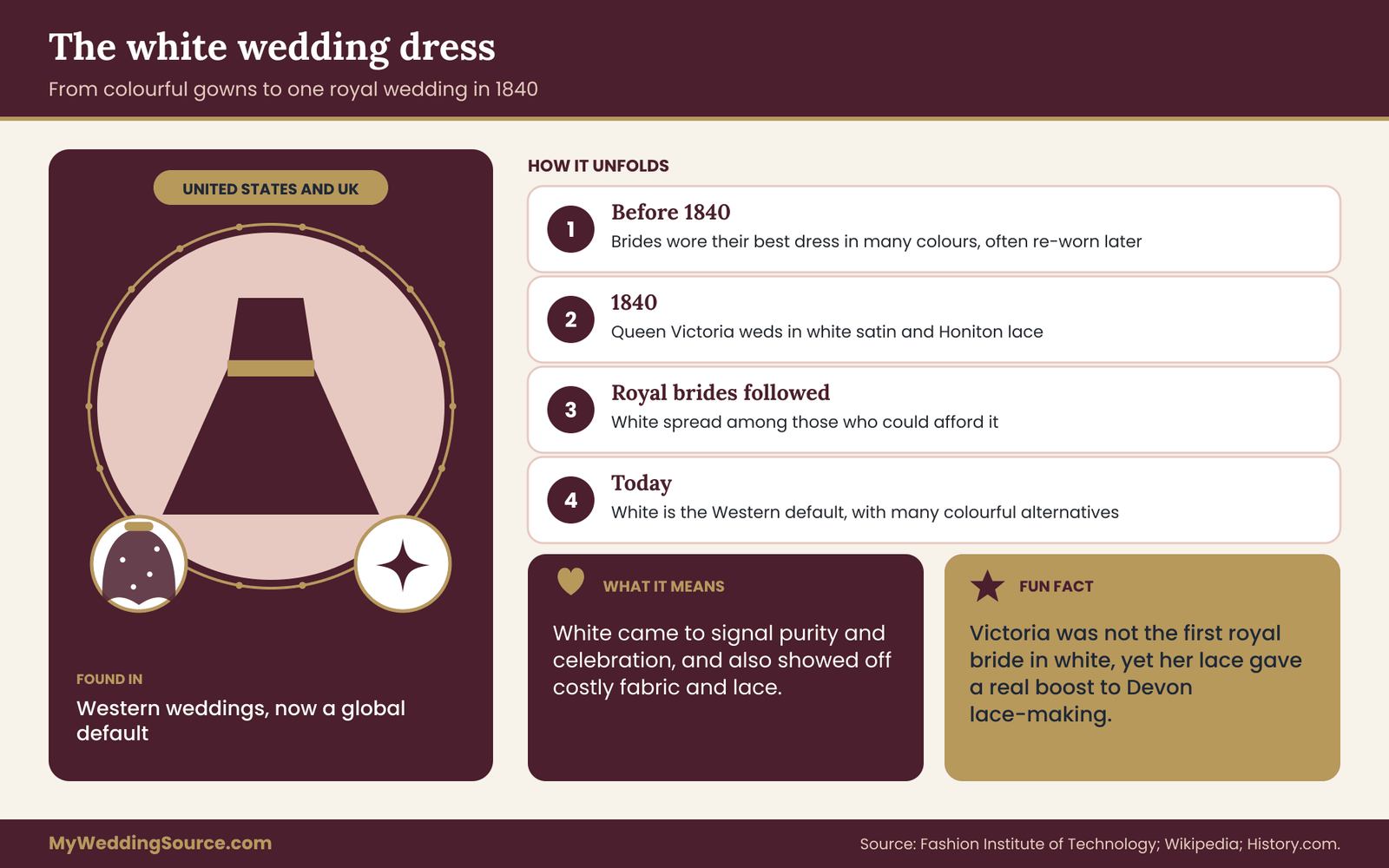
Among Western wedding traditions, few look as fixed as the white gown, yet that picture is fairly recent. For centuries, women married in their best dress, whatever the colour. A practical bride chose something she could wear again, and colour was a matter of taste, budget and fashion. Then, in 1840, Queen Victoria married Prince Albert in white satin trimmed with Honiton lace. Illustrated papers reported every detail, and the look took hold.
White did not appear from nowhere in 1840, because earlier royal brides had worn it too. What changed was the audience. As magazines and, later, department stores spread the idea, white became the sign of a proper, fashionable wedding. The popular link to purity grew over time. Many historians point out that white also showed off expensive, hard-to-clean fabric, which made it a quiet display of means.
Today white is a default, not a rule. Brides choose ivory, blush, champagne, blue, red or black, and many wear two outfits in a day. Practical choices matter more than they used to: how the dress moves, whether it can be altered, how long the train should be. Our wedding dress fit and alterations guide covers the practical side.
Fun fact: Victoria’s wedding gave a real boost to the lace-makers of Devon. Her gown used Honiton lace, and the press covered the choice of fabric in detail.
Something old, something new, something borrowed, something blue
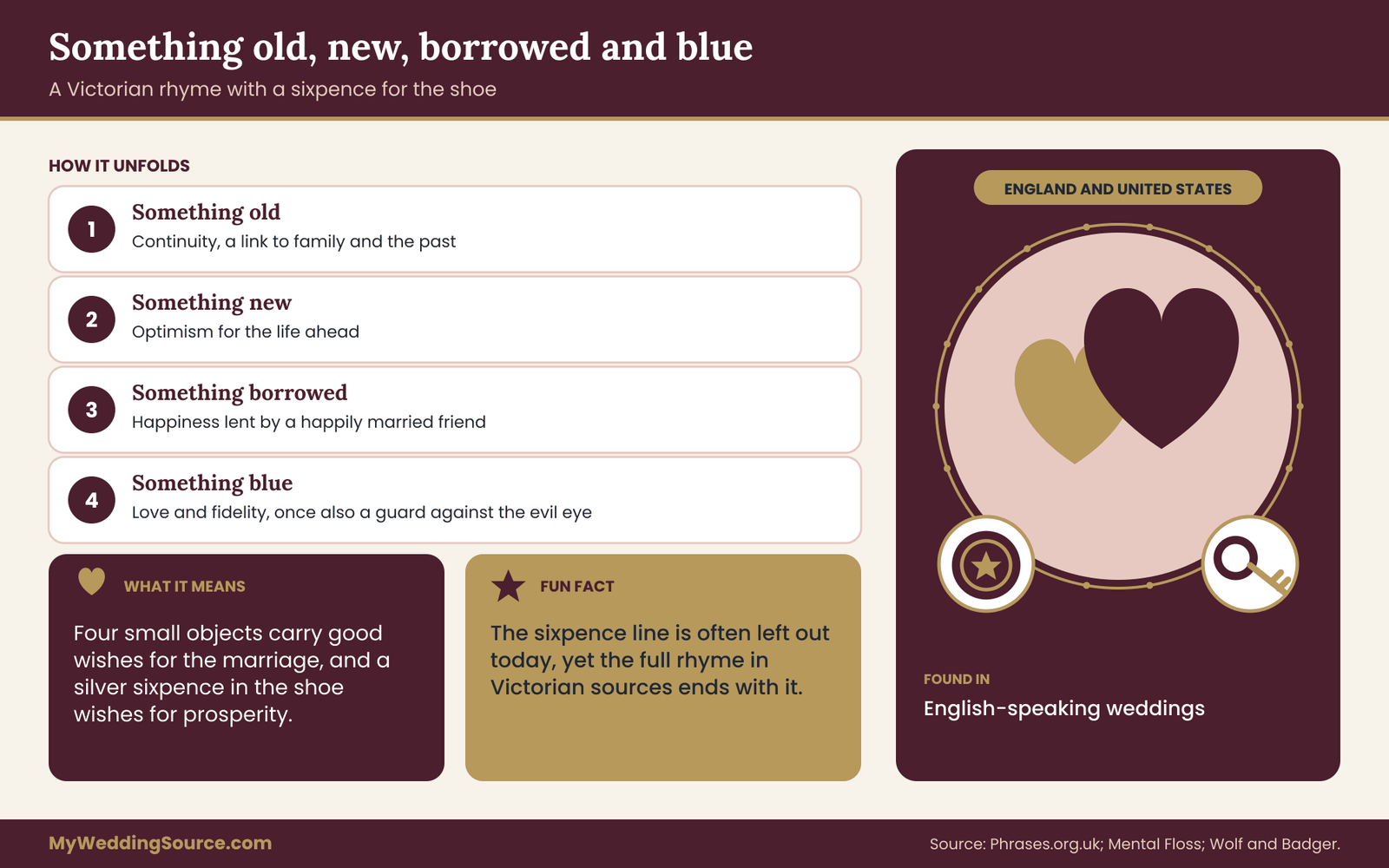
This four-line rhyme is the most quoted of all English-language wedding traditions. It comes from Victorian England, and the complete verse has a fifth line: a sixpence in her shoe. Each item stands for a hope. Something old is a link to family and the past. Something new points to the future and a fresh start. Something borrowed, ideally from a happily married friend, lends her good fortune to the bride. Something blue stands for love and faithfulness, and in older European lore it also helped keep the evil eye away.
Brides have always had fun with the list. An old item might be a grandmother’s brooch or a pair of earrings. A new item is often the dress itself. A borrowed item could be a handkerchief or a bracelet, and a blue item might be a ribbon sewn into the hem, a pair of shoes or a pinch of colour in the bouquet. The sixpence in the shoe is meant to bring wealth, and modern brides sometimes swap in a penny or a lucky coin.
The rhyme is a gentle way to bring family into the day without a long ceremony. A mother or aunt can hand over the old and borrowed pieces, and the bride gets a private moment of connection before the aisle.
Fun fact: The sixpence line is often dropped in modern retellings, but the Victorian version ends with it. In Britain, the sixpence was a small silver coin for centuries.
The bouquet and garter toss
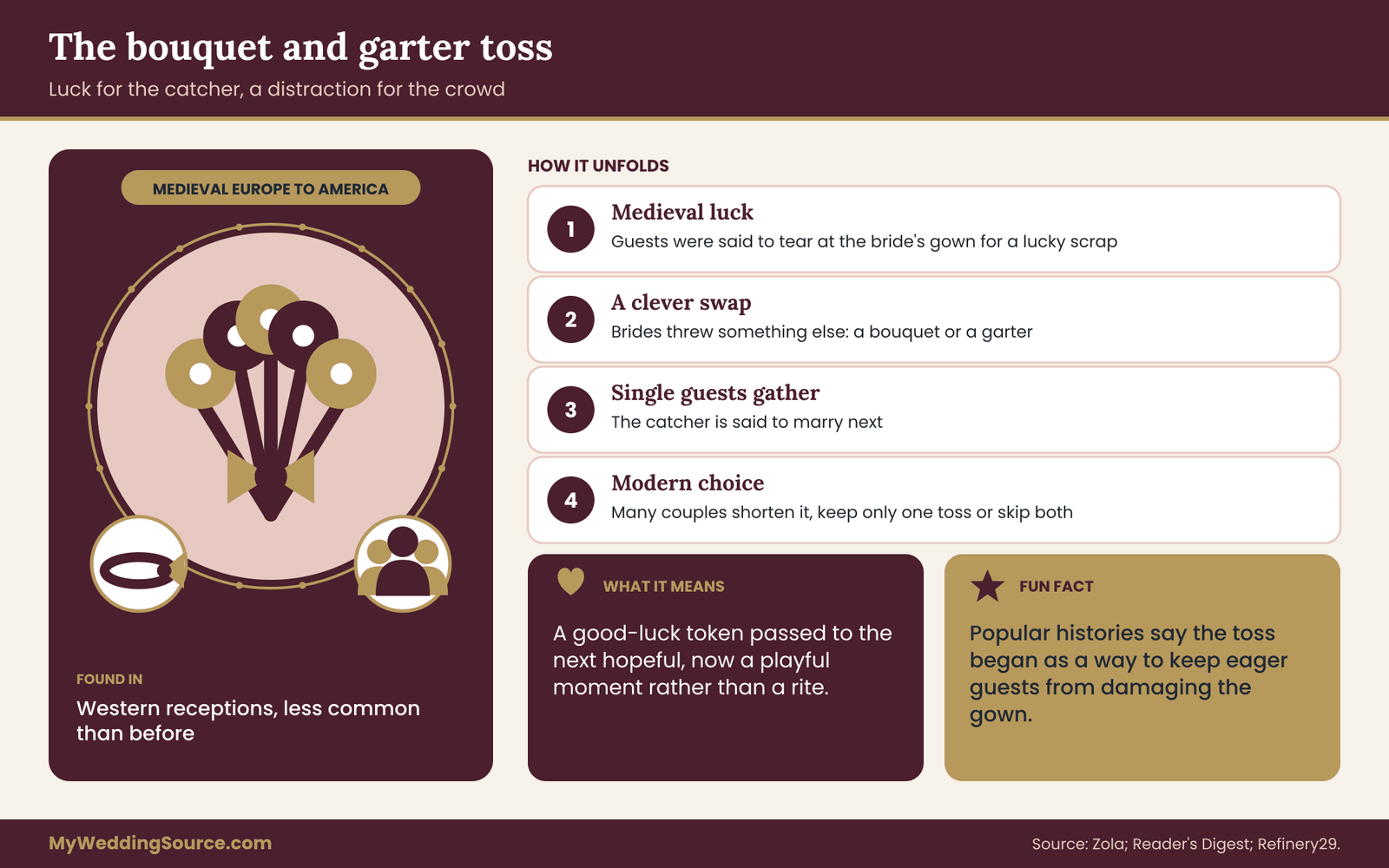
Few wedding traditions provoke as many opinions as the toss. In its classic form, the bride throws her bouquet over her shoulder to a crowd of unmarried guests, and whoever catches it is said to be the next to marry. The groom may follow by removing the bride’s garter and tossing it to the unmarried men. The catcher of each is sometimes asked to dance together.
The popular story goes back to medieval Europe. Guests believed that a scrap of the bride’s clothing carried good luck, and eager crowds were said to tear at her gown. The bride, according to this account, found a clever solution: throw something else, and slip away while everyone scrambles. Historians cannot prove the story, but it explains why the toss exists in so many forms across Europe and North America.
Modern couples treat the toss as optional. Some skip it because they do not want to single out the unmarried. Others open it to everyone, throw a second bouquet to the longest-married couple, or hand a flower to each guest. If you are choosing flowers with a toss in mind, a lightweight bouquet is easier to throw, and our guide to wedding bouquet weight explains how to keep it comfortable to carry.
Fun fact: Many brides now order a smaller “toss bouquet” that is a copy of the real one. It saves the keepsake for photographs and lets the bride throw without hesitation.
Cutting the wedding cake
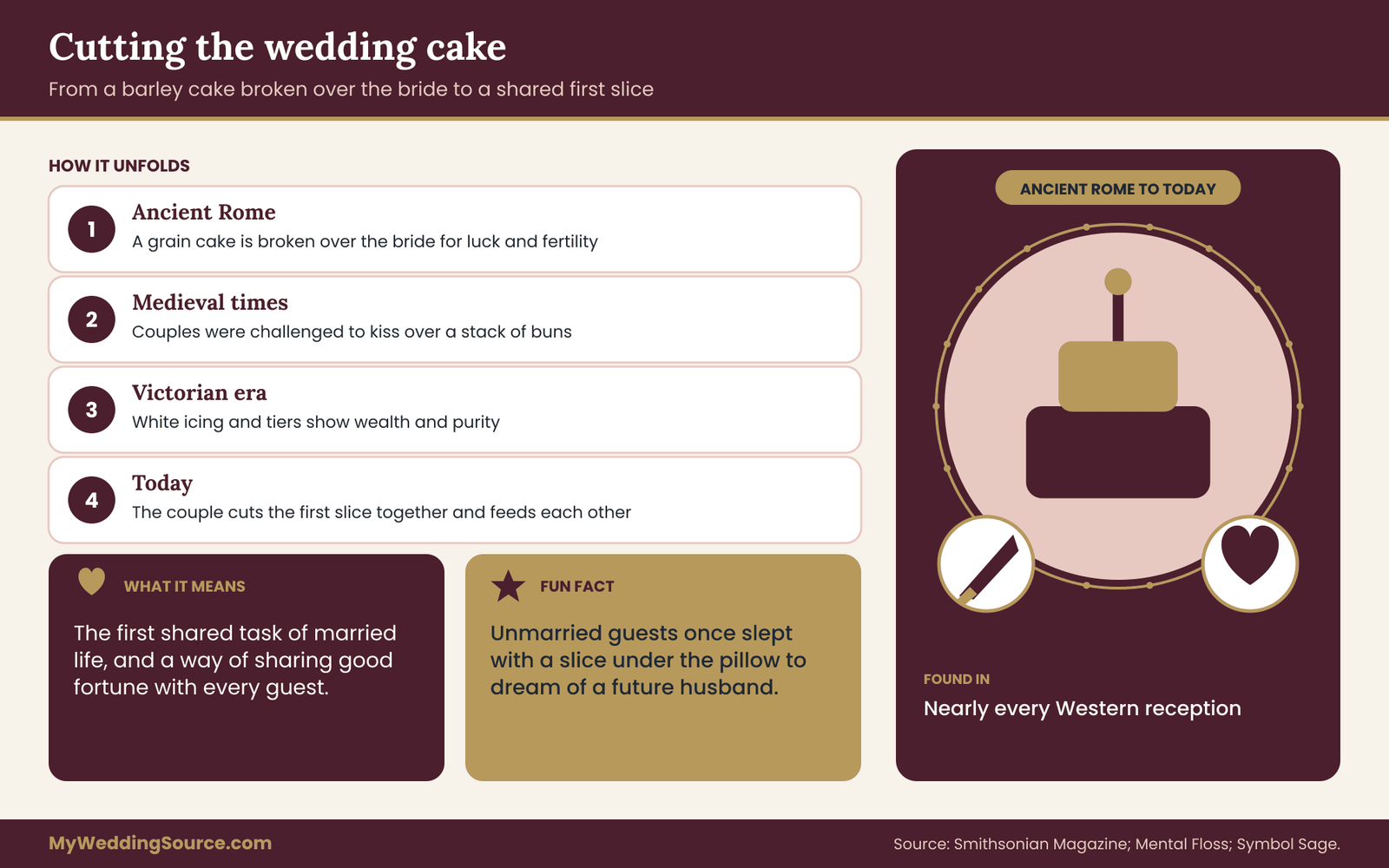
A cake is the centrepiece of nearly every Western reception, and among wedding traditions it has one of the longest histories. In ancient Rome, a cake was eaten by the couple, and popular accounts add that a simple grain cake was broken over the bride’s head as a wish for fertility and plenty. In medieval England, cakes were stacked as high as possible so that the couple could try to kiss over them, a custom linked to the tiered cakes that came later.
By the Victorian era, icing had turned white and the cake had grown into a tall display. White sugar was costly, so a white cake was a statement about wealth as well as purity. The idea that the couple cuts the first slice together, and often feeds each other a bite, became a standard photograph in the twentieth century.
Today the cake cutting marks a small shift in the evening. It is the first task the couple performs together as a married pair, and it signals guests that dessert, dancing and speeches are about to begin. Couples customise freely with tiered cakes, cupcake towers, pies, doughnut walls and cultural sweets. A tiny cut in a decorative cake, with a kitchen team ready to slice, keeps the moment short.
Fun fact: In some older traditions, unmarried guests slept with a slice of cake under the pillow, hoping to dream of a future spouse.
Jumping the broom
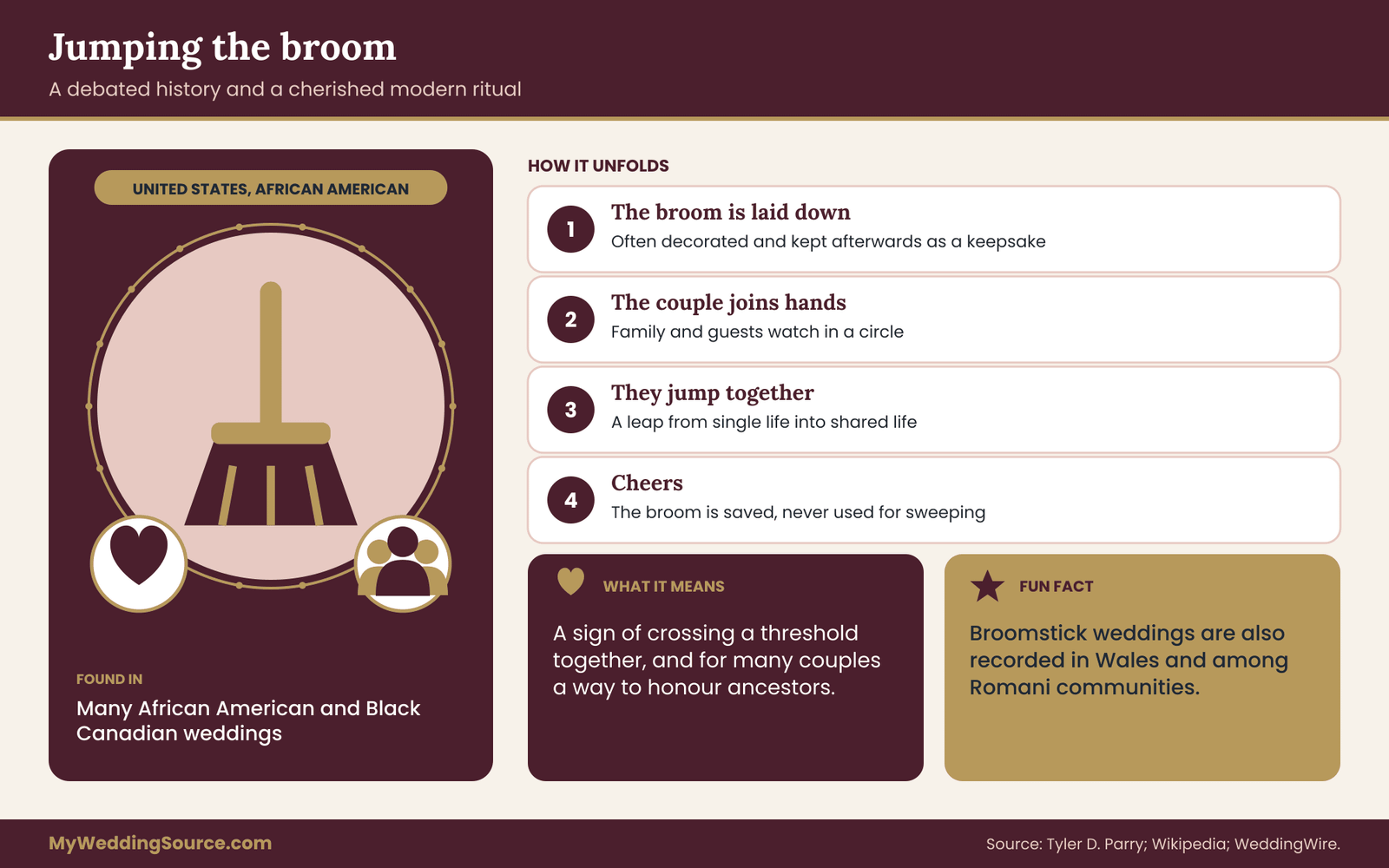
In the United States, jumping the broom is closely tied to African American weddings. At the end of the ceremony, or at the start of the reception, a broom is laid on the floor. The couple holds hands, and they leap over it together, crossing from single life into married life while family and friends cheer. Many couples decorate the broom with ribbons, shells or flowers and keep it afterward as a keepsake.
The history is a topic of real debate. Scholars note that broomstick weddings were also recorded in Wales and among Romani communities in Britain. Historian Tyler D. Parry has argued that jumping the broom held meaning for enslaved people, though the exact role it played is still discussed. What is clear is that the ritual surged in popularity in the 1970s after the television series Roots brought it to a wide audience, and many couples now see it as a way to honour their ancestors.
Today the broom appears in weddings of every background, and as with all borrowed wedding traditions, the best practice is to learn its history before you use it. Some couples invite an elder to explain the custom before the jump. Others pair it with libation, drumming or a reading, which sets the ritual in a clear cultural setting.
Fun fact: The broom is traditionally kept for good luck and is never used for sweeping. Many couples display it in their new home.
Wedding traditions in Europe
Europe is a quilt of languages and customs, and nearly every region has its own wedding traditions. Some are solemn and religious, some are loud and playful, and many are both within the same day. The seven below show the range, from Greek crowns to a German log saw.
Crowns, plates and the money dance in Greece
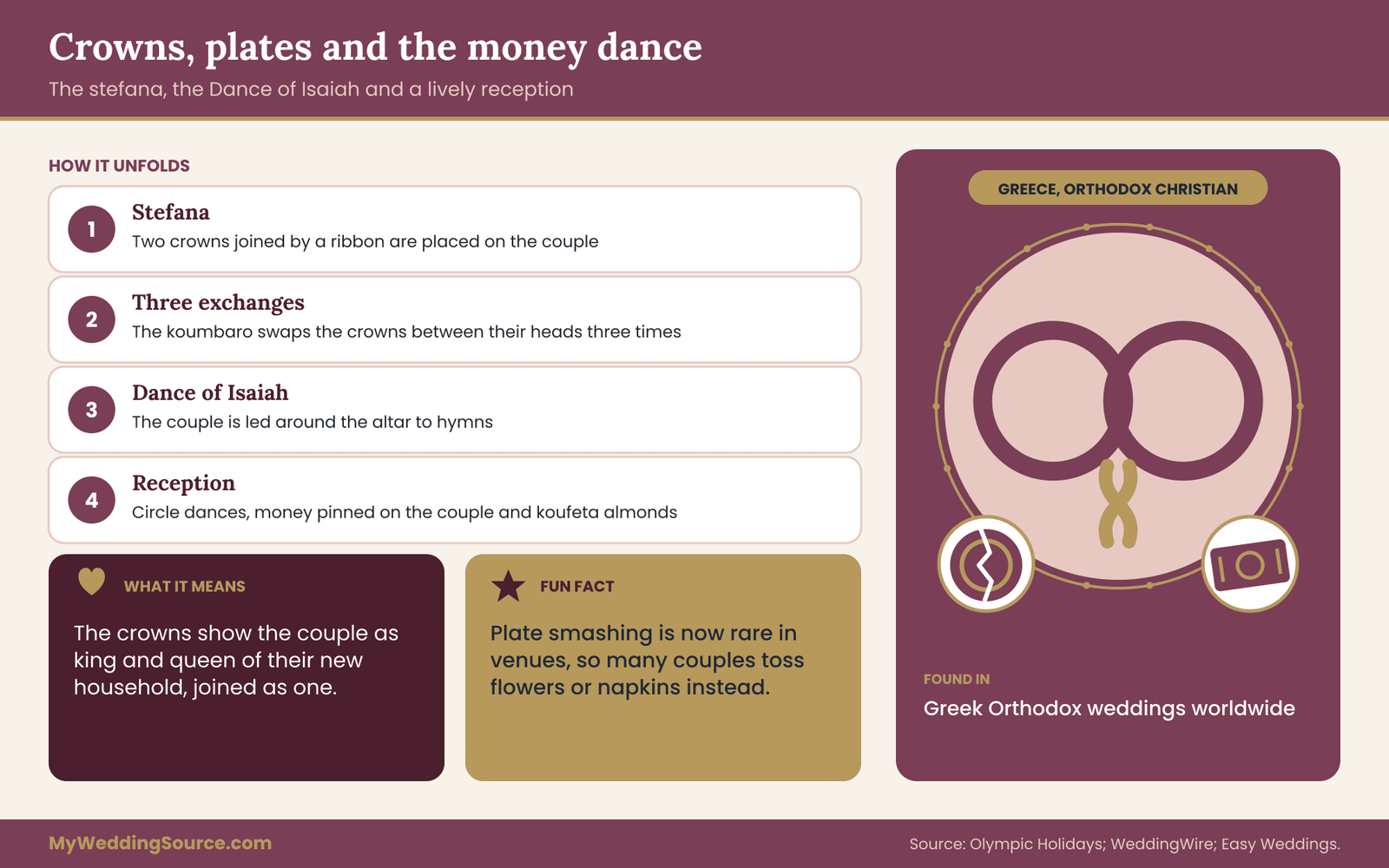
Greek wedding traditions are full of symbols, and the most striking is the pair of crowns called stefana. They are usually made of flowers, metal or beads and joined by a ribbon. During the ceremony, the priest places them on the couple’s heads, and the best man or woman, the koumbaro or koumbara, swaps them back and forth three times. The ribbon shows that the two are joined as one, and the crowns mark the couple as king and queen of their new household.
After the crowning, the priest leads the couple around the altar table three times in a slow procession often called the Dance of Isaiah, while the congregation sings hymns. Guests may throw rice or small sugared almonds, called koufeta, which are also given as wedding favours. The party that follows is famously lively: circle dances, rowdy toasts and, in many families, the money dance, in which guests pin notes to the couple’s clothing as they dance.
Plate smashing is the custom most people picture, yet it is now rare in venues because of safety and cleaning. Many couples use flowers, napkins or specially made plates instead. If you are a guest, the best advice is to join the circle and follow the dancer in front of you.
Fun fact: Money pinned on the couple, or tossed on the floor during the dance, is meant to help the newlyweds start their home, so it is a gift as much as a game.
Polterabend and log sawing in Germany
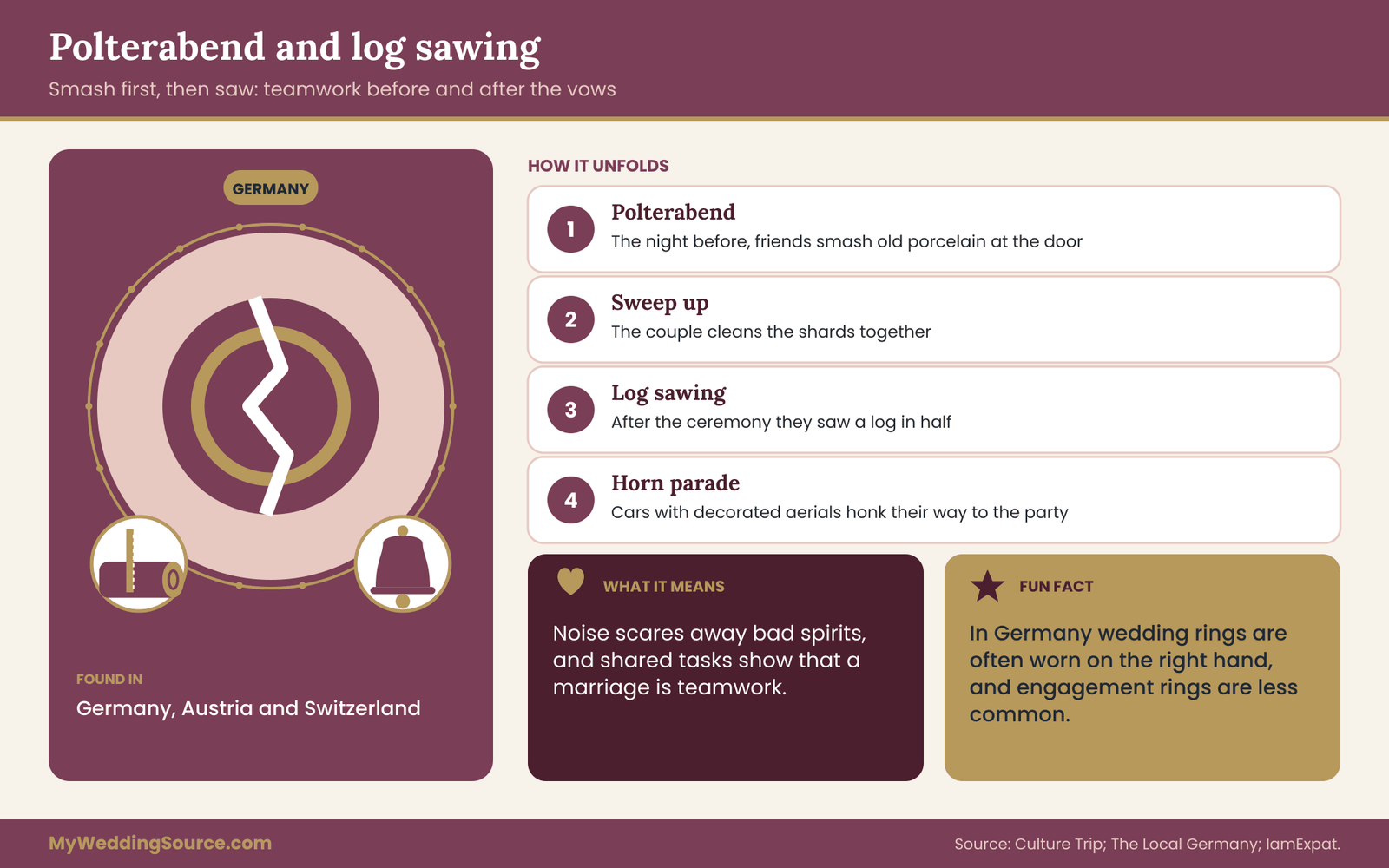
German wedding traditions include two customs built on the same idea: teamwork. The first, Polterabend, takes place the evening before the wedding. Friends and neighbours gather at the bride’s or groom’s home and smash old porcelain, such as dishes, sinks and flowerpots, on the ground. The noise is said to drive off bad spirits, and the couple must sweep up the pieces together. Glass is avoided, because breaking it is thought to bring bad luck.
The second custom comes after the ceremony. The couple is handed a long two-person saw and a log, and they cut it in half in front of their guests. The task is a small test of cooperation. They have to find a rhythm, share the effort and finish in time, and the log is often kept as a keepsake. In some places a crowd of friends offers loud advice while the couple works.
Other German touches are easy to spot. Cars may form a honking convoy with decorated aerials, and rings are commonly worn on the right hand. Many couples choose a quiet, formal ceremony in the morning and a long party in the evening.
Fun fact: In Germany, a plain gold wedding ring is typically worn on the right hand, and engagement rings are less common than in the United States.
Handfasting and the Claddagh ring in Ireland
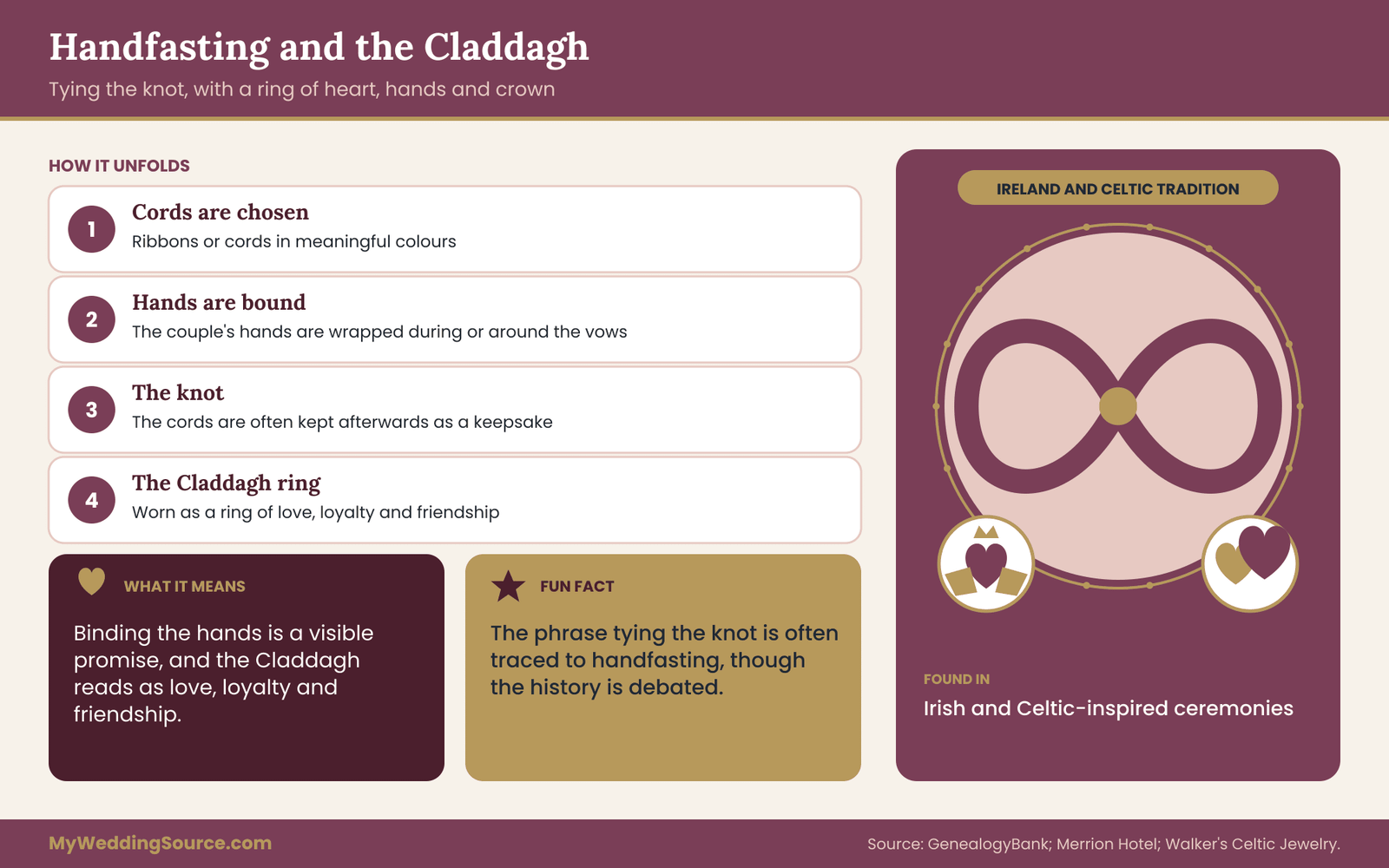
Handfasting is the custom of binding a couple’s hands with a cord or ribbon as they make their promises. It is often described as an ancient Celtic rite, but scholars generally treat that claim as unproven, and the modern version is better seen as a revival than as a surviving old ritual. Today it is popular in outdoor and non-religious ceremonies. The cords are chosen in colours that carry meaning, such as green for fertility, red for passion or blue for loyalty, and a friend or relative often wraps them while the officiant speaks.
The phrase “tying the knot” is often linked to handfasting, but many scholars treat that origin as uncertain. After the ceremony, the couple loosens the cord without untying the knot, and keeps it in a box or frame. If you want to add the ritual to your own vows, our guide to wedding vows offers wording that fits quietly alongside it.
The Claddagh ring is the other favourite among Irish wedding traditions. It shows two hands holding a heart that is topped by a crown, and the three parts stand for friendship, love and loyalty. The ring is named for a fishing village near Galway. Worn with the heart pointing outward, it traditionally signals that the wearer is single, and with the heart pointing inward, that the wearer’s heart is taken.
Fun fact: Many families hand a Claddagh ring down from mother to daughter, and some brides wear it as their “something old.”
Bread, salt and the capping in Poland
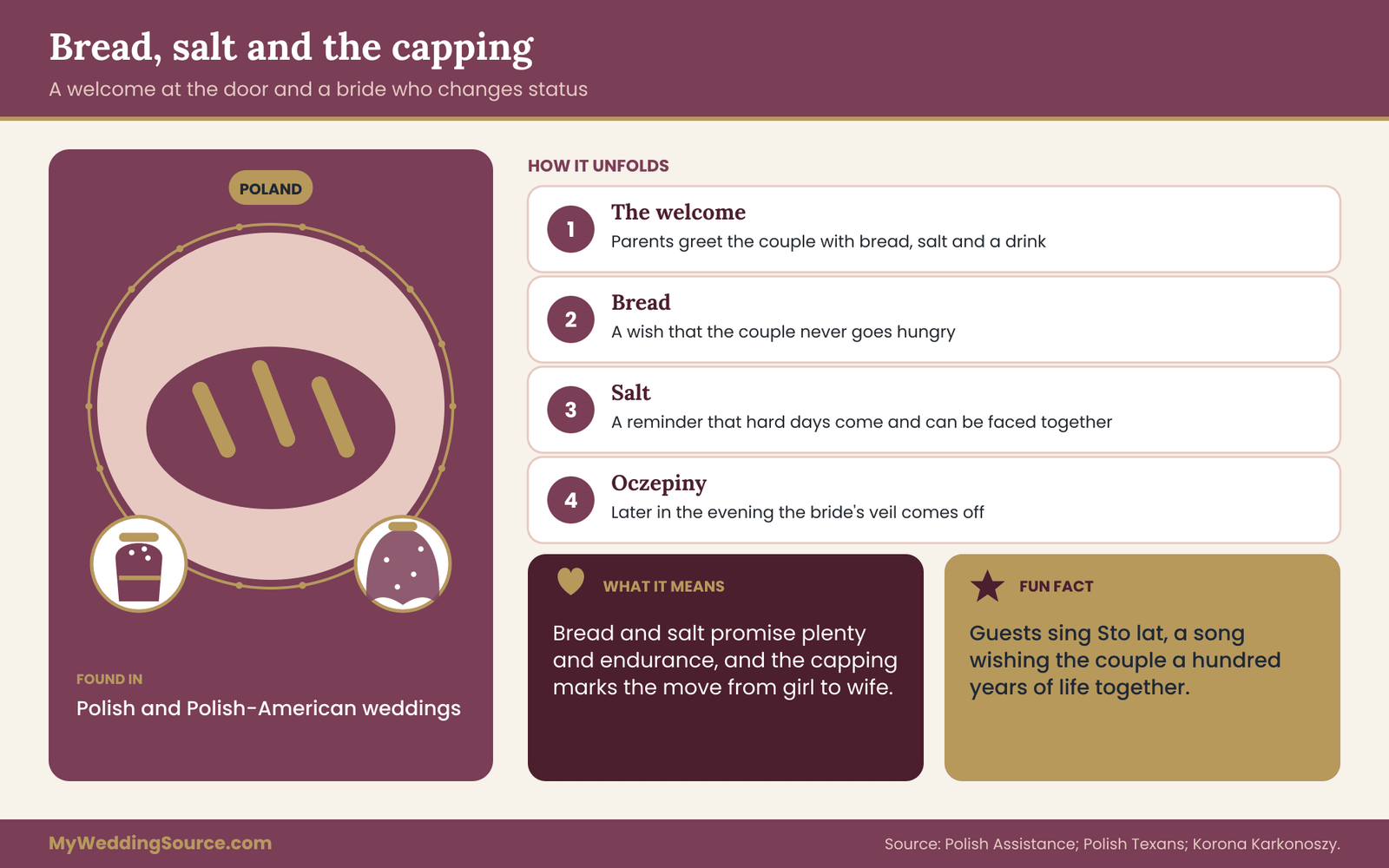
Polish wedding traditions begin at the door of the reception. The couple is welcomed by their parents, who offer a loaf of bread, a small dish of salt and a glass of wine or vodka. The bread is a wish that the couple will never go hungry. The salt is a reminder that life will sometimes be hard and that two people can face the hard days together. The couple takes a bite of each, and the party begins.
Later in the evening comes the oczepiny, a custom that marks the bride’s change of status from a young woman to a wife. The bride’s veil is removed, and in the traditional version a married woman’s cap is placed on her head. Today the ritual has turned into a game: the bride tosses her veil to the unmarried women, the groom tosses a tie to the unmarried men, and the catchers may be asked to perform a funny dance or challenge. If you love the veil’s role in a ceremony, our guide to wedding veil traditions around the world covers it in more depth.
Polish receptions are long, with hearty food, music and dancing that can last until dawn. When guests chant that the vodka has turned bitter, the couple is expected to kiss to sweeten it again.
Fun fact: Guests sing “Sto lat,” a song that wishes the couple a hundred years of life together, and they often sing it more than once.
The rushnyk and the korovai in Ukraine
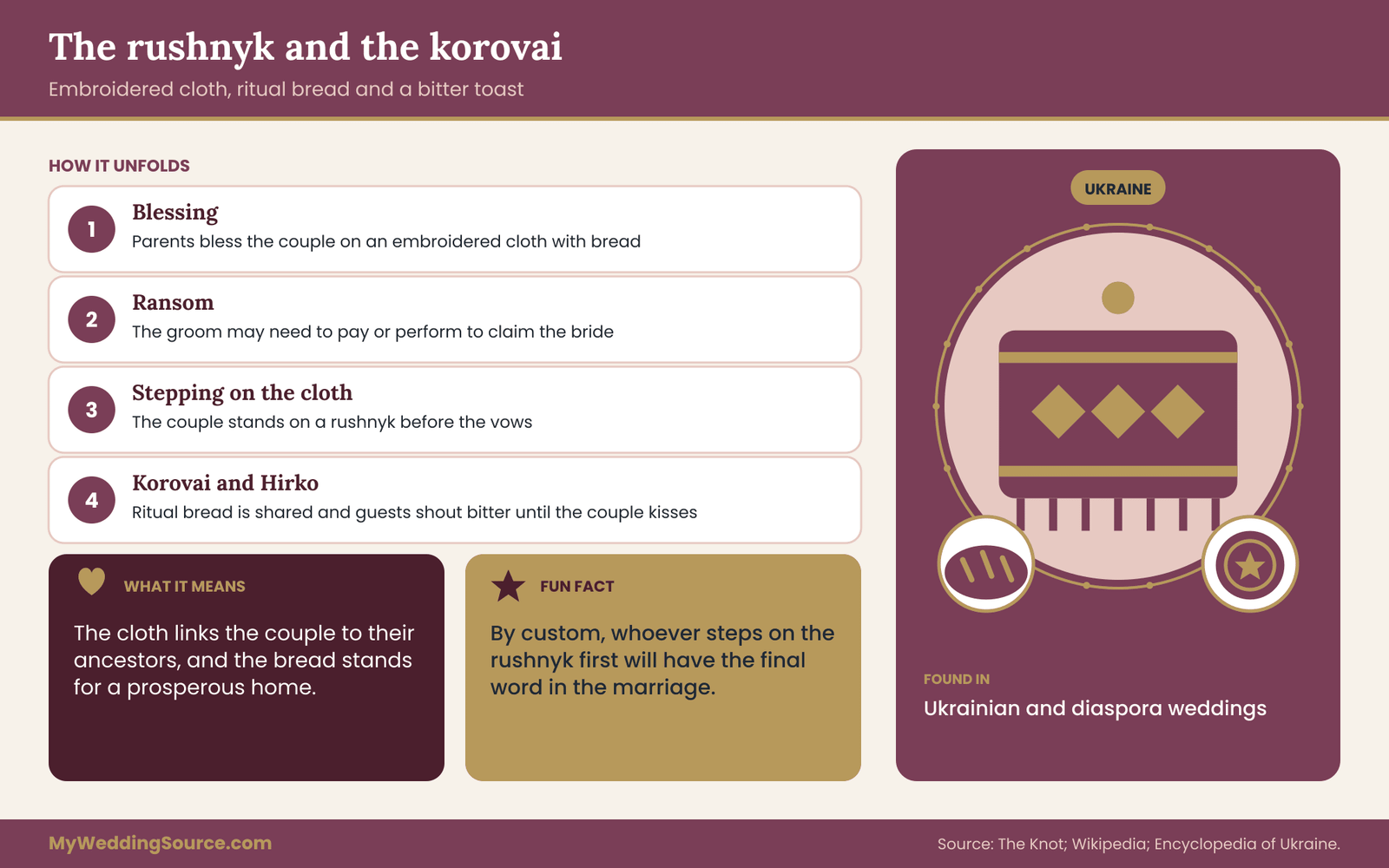
Among Ukrainian wedding traditions, one of the best-known symbols is the rushnyk, a long embroidered cloth. It plays several roles. Parents may bless the couple with bread and salt held on a rushnyk. During the ceremony, the couple stands on a rushnyk laid on the floor, and the officiant may bind their hands with another. The patterns are often worked in red and black thread, and each motif carries a wish for health, abundance and a happy home.
The second symbol is the korovai, a large round wedding bread that is decorated with dough birds, flowers and leaves. It is baked by women of the family, shared among guests and treated with respect. Before the wedding, there may be a playful scene in which the groom’s party must pay a ransom or complete challenges to claim the bride, and at the reception guests shout “Hirko,” meaning “bitter,” until the couple kisses.
By custom, the first partner to step on the rushnyk is said to become the head of the household. Couples tend to enjoy this one, and the guests keep a close eye on who steps first. Many Ukrainian families abroad keep these wedding traditions as a way to carry home with them.
Fun fact: The tradition says the person who steps first on the cloth will have the final word in the marriage, so couples often compete for it.
Confetti and the bomboniere in Italy
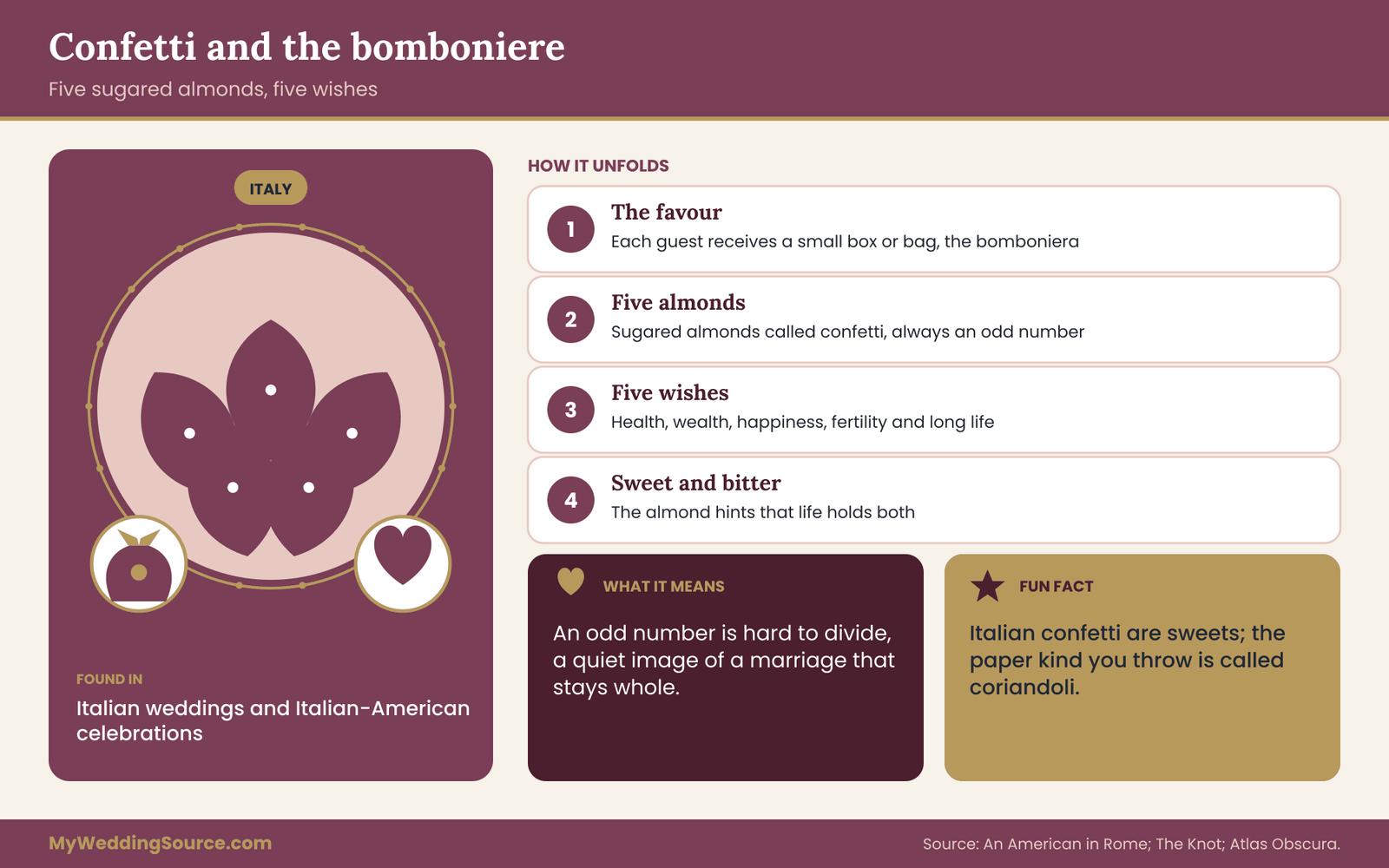
Among Italian wedding traditions, one is easy to enjoy: guests leave with a small gift called a bomboniera. It might be a tiny box, a porcelain ornament or a bag of sweets, and inside it you will usually find five sugared almonds, known as confetti. The number is always odd, because an odd number cannot be divided evenly, which is a quiet image of a couple that stays whole. Each almond stands for one wish: health, wealth, happiness, fertility and a long life.
The almonds are also a reminder that life contains both sweet and bitter. The outer coating is sugar, but the nut inside has a slight bitter edge. Italian families have been giving confetti at weddings and other milestones, such as baptisms and graduations, for generations, and many Italian-American families continue to do so. White is the classic colour for weddings, though couples now match the almonds to their palette.
The wedding itself is often a long, joyful meal with many courses, speeches and music, and a tradition of tarantella dancing in southern regions. Italian weddings are social events in the broadest sense, and a good deal of the planning goes into feeding and entertaining everyone.
Fun fact: In Italy, the word “confetti” refers to sugared almonds. The paper bits you throw at a party are called “coriandoli.”
The bride dance in Hungary
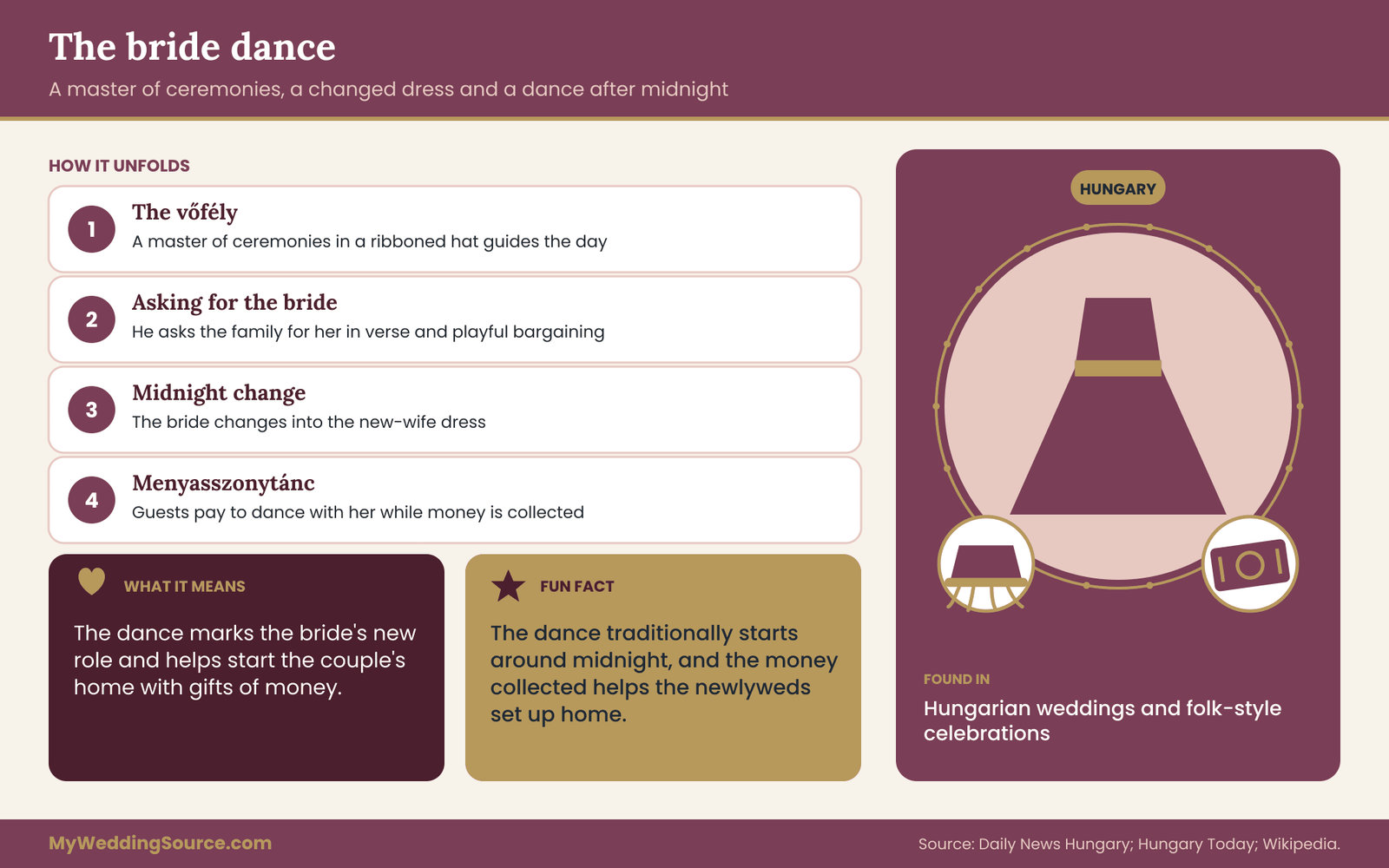
Hungarian wedding traditions, especially in the countryside, have a strong sense of theatre. A master of ceremonies called the vőfély guides the day. He wears a hat with long coloured ribbons, carries a decorated stick, and speaks in rhyming verse to welcome guests, introduce the dishes and announce each part of the programme. In the traditional version, he also asks the bride’s family for her hand in a playful exchange of poetry and bargaining.
The best-known custom comes late in the evening. Around midnight, the bride changes from her wedding dress into a different outfit that marks her new status as a married woman. This is followed by the menyasszonytánc, the bride dance. Guests line up to dance with the bride in return for a small sum of money, and the money is collected in a bowl or pot. The tradition helps the newlyweds start their life together, and it is a lively way for every guest to share a moment with the bride.
Food is central, with soups, stuffed cabbage, roasts and a table of pastries. Many modern Hungarian weddings blend contemporary receptions with folk touches such as the dance and the vőfély. If you plan to add a money tradition to your own party, our guide to wedding gifts explains how to handle cash gifts with grace.
Fun fact: The dance traditionally starts around midnight, so it works as a second wind for the party just when the energy might otherwise fade.
Wedding traditions in Asia
Asia holds more than half of the world’s population and an enormous range of wedding traditions. Some are tied to a religion, some to a family lineage and some to the changing seasons. A theme that runs through many of them is respect for elders, so you will notice ceremonies in which the couple bows, serves tea or receives a blessing from their parents. Here are six that illustrate the variety, from China to Thailand.
The Chinese tea ceremony
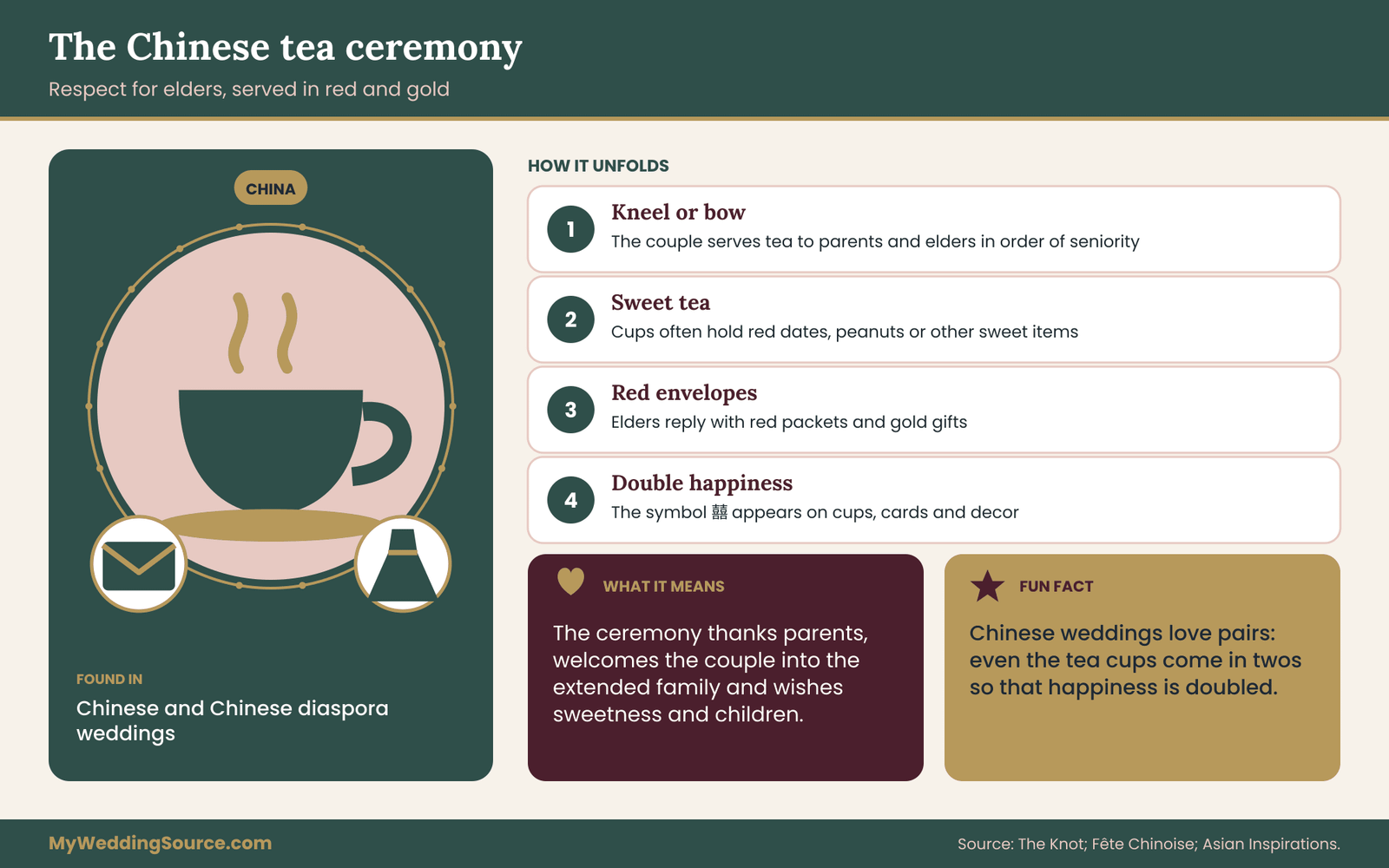
Among Chinese wedding traditions, the tea ceremony is the moment a couple formally thanks their parents and is welcomed into each other’s families. It usually takes place on the wedding morning, at home or in a private room before the banquet. The couple kneels or bows and serves tea to elders in order of seniority, beginning with the parents and moving through grandparents, aunts and uncles, and older siblings.
The tea is chosen with care. Cups often hold red dates, lotus seeds, longan or peanuts, sweet items with wishes for happiness and children. After taking a sip, each elder gives the couple a gift: a red envelope with money, or gold jewellery, which is often a pair of bracelets or a necklace. Younger relatives may serve tea to the couple in return, and each exchange is accompanied by a spoken blessing.
Red and gold are everywhere, because red is the colour of luck and joy. The symbol of double happiness, which looks like two joyful characters joined side by side, appears on cups, invitations and decorations. Many Chinese American couples keep the ceremony and shorten it, or host it for family only. Guests who are not related are not expected to take part, but they are welcome to watch.
Fun fact: Chinese weddings favour pairs. Tea cups, candles and even gifts often come in twos, to double the happiness.
San-san-kudo, the sake vow in Japan
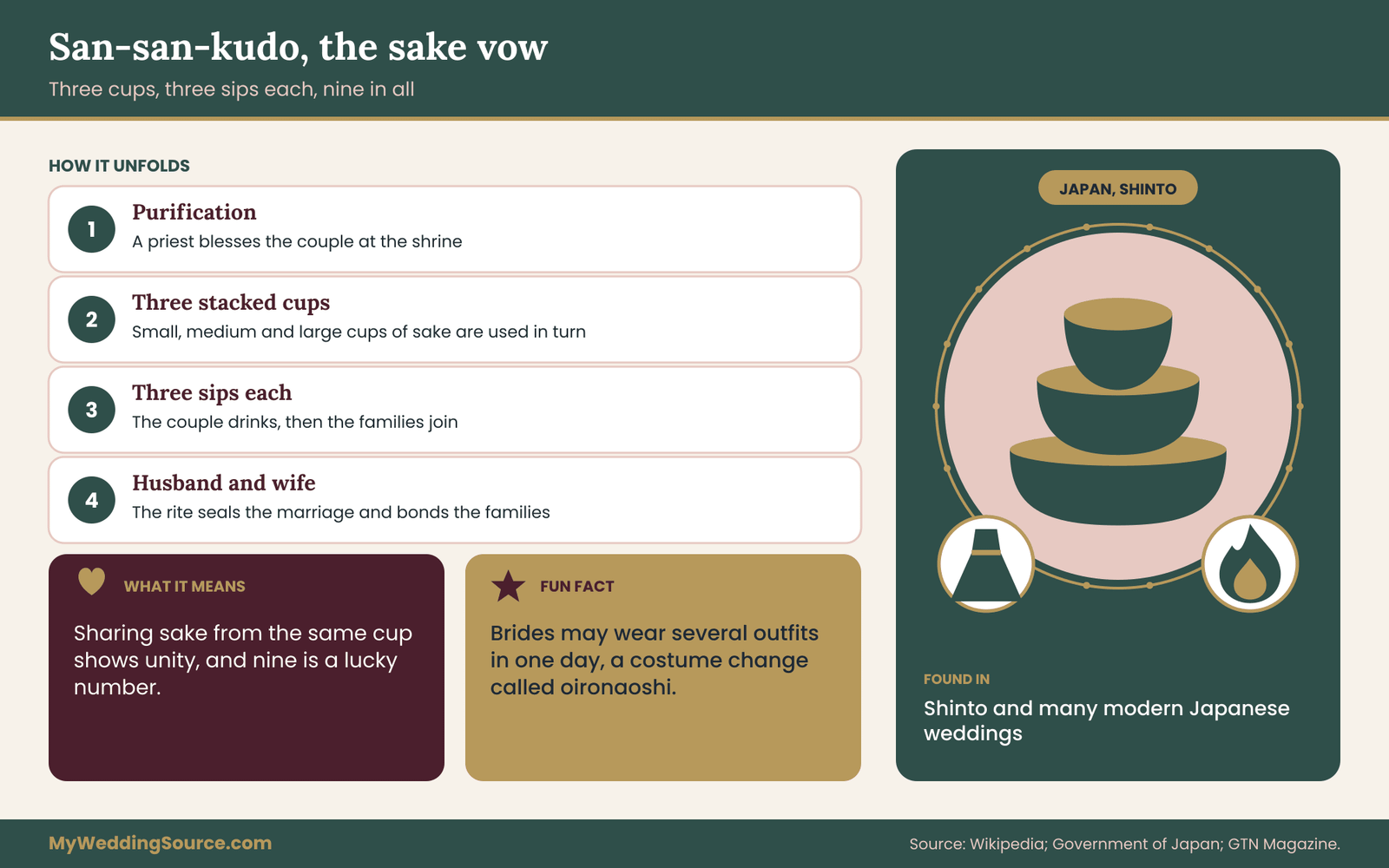
Japanese wedding traditions at a Shinto shrine are quiet, ceremonial and short. It takes place at a shrine, with a small group of close family. The bride wears a white kimono called a shiromuku and often a white headdress, and the groom wears a black formal kimono. A priest offers a purification rite and prayers, and the couple promises to support each other.
The central moment is san-san-kudo, which means three, three, nine. Three stacked cups of increasing size are used. The couple sips from each cup three times, and the families then take turns, which links them together. The number nine is considered lucky in Japan, and the cups represent the couple’s bond with each other and with their relatives. After the vows, the couple presents an offering of a sacred branch to the gods.
Modern Japanese weddings often combine the Shinto rite with a Western-style reception. Brides frequently change outfits during the party, with colour kimonos and Western dresses on the programme. Gifts of money are given in special envelopes, and guests leave with presents of their own.
Fun fact: The costume change has its own name, oironaoshi, and the white of the shiromuku is often explained as a blank slate, ready to take on the colours of the groom’s family.
Wooden ducks and the pyebaek in Korea
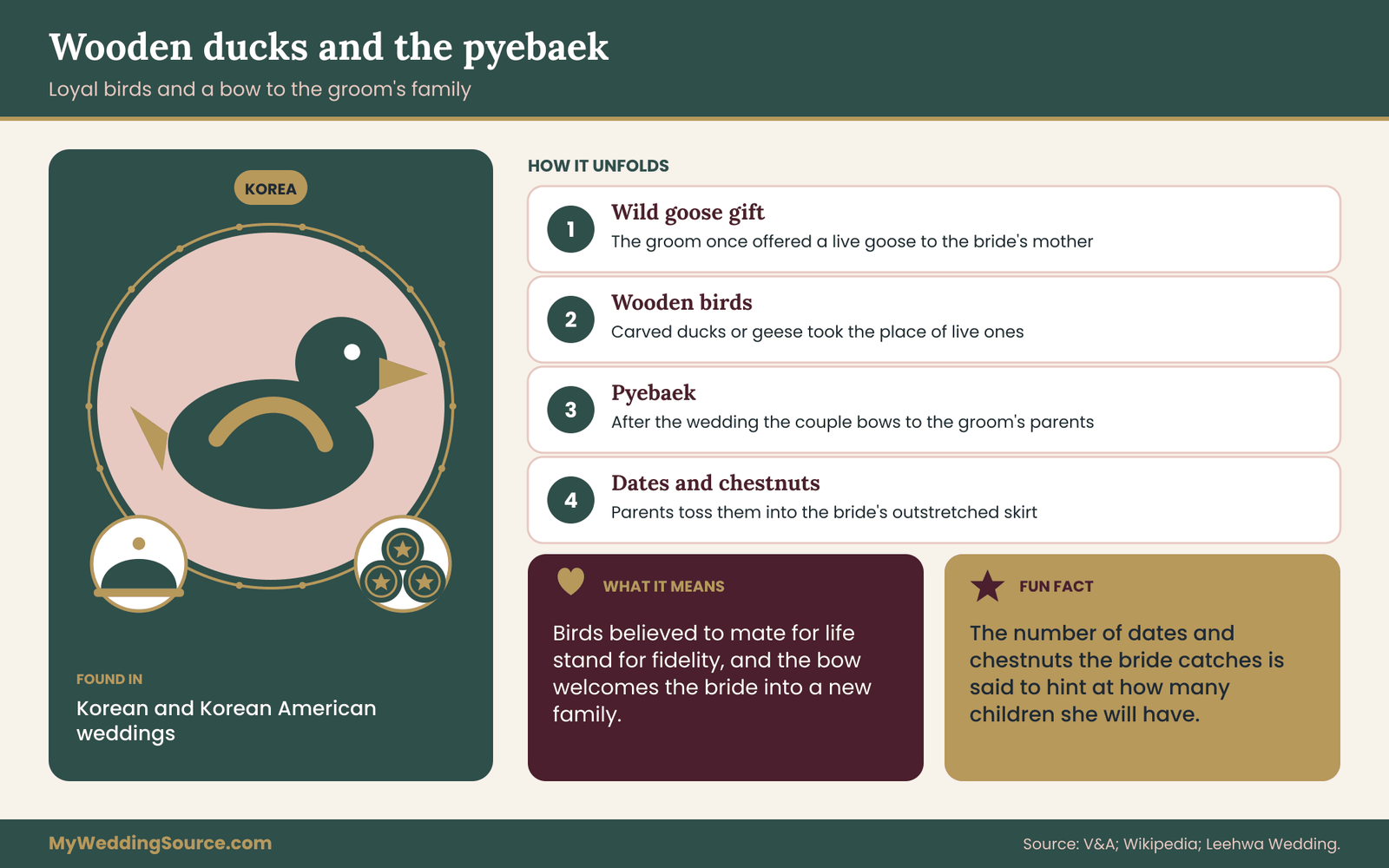
Korean wedding traditions have long used birds as a symbol of loyalty. In the older tradition, the groom brought a live wild goose to the bride’s family, because geese were believed to keep a single mate for life. Over time, carved wooden geese or ducks took the place of live birds. Mandarin ducks, which are often paired in art, appear in many forms of Korean wedding decor and gifts.
After the main ceremony, many families hold the pyebaek, a private ritual in which the couple bows to the groom’s parents and elders, and offers them wine or tea. The elders respond with advice and blessings, and then they toss dates and chestnuts into the bride’s outstretched skirt. These foods stand for children and fertility.
Couples often wear hanbok, the traditional dress, for the pyebaek, even if they wore Western clothing earlier in the day. This is a small but meaningful way to join the old and new. The pyebaek is usually held in a private room, with only close family.
Fun fact: The bride’s skirt is held wide to catch the dates and chestnuts, and relatives often cheer or groan with every one that lands.
Saptapadi, the seven steps in Hindu weddings
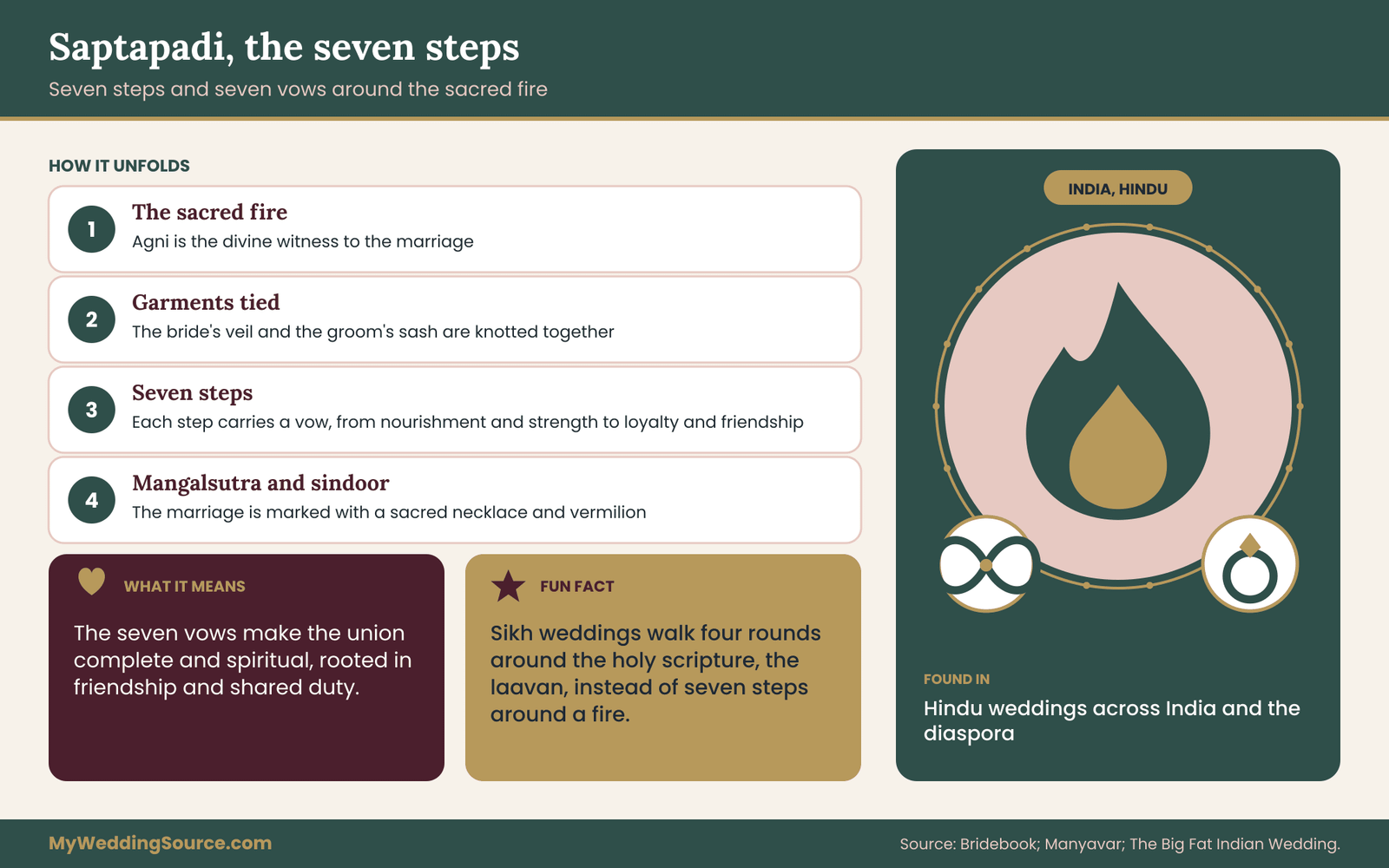
In Hindu wedding traditions, the most important ritual is saptapadi, the seven steps. The couple stands before a sacred fire, which is said to be the divine witness to the marriage. Their garments are knotted together, often the bride’s scarf and the groom’s sash, as a sign that they are now joined. They then walk seven steps, or circle the fire, and each step carries a promise.
A common version of the vows covers nourishment, strength, prosperity, happiness, children, health and long life, and friendship and loyalty. The exact wording and order vary by region and language, and a priest usually recites them in Sanskrit while explaining their meaning. The ceremony is complete when the seventh step is taken, which is why the number carries so much weight.
Other rituals surround the steps. The groom may place a sacred necklace, the mangalsutra, around the bride’s neck and apply red powder, called sindoor, to her hair parting. A Hindu wedding can last several hours, or even several days, with the whole extended family joining in. If you are attending one, wear colour and bring an open mind, and expect to be fed.
Fun fact: Sikh weddings use a similar idea but walk four rounds around the holy scripture, called the laavan, instead of seven steps around a fire.
Mehndi, sangeet and the baraat in South Asia
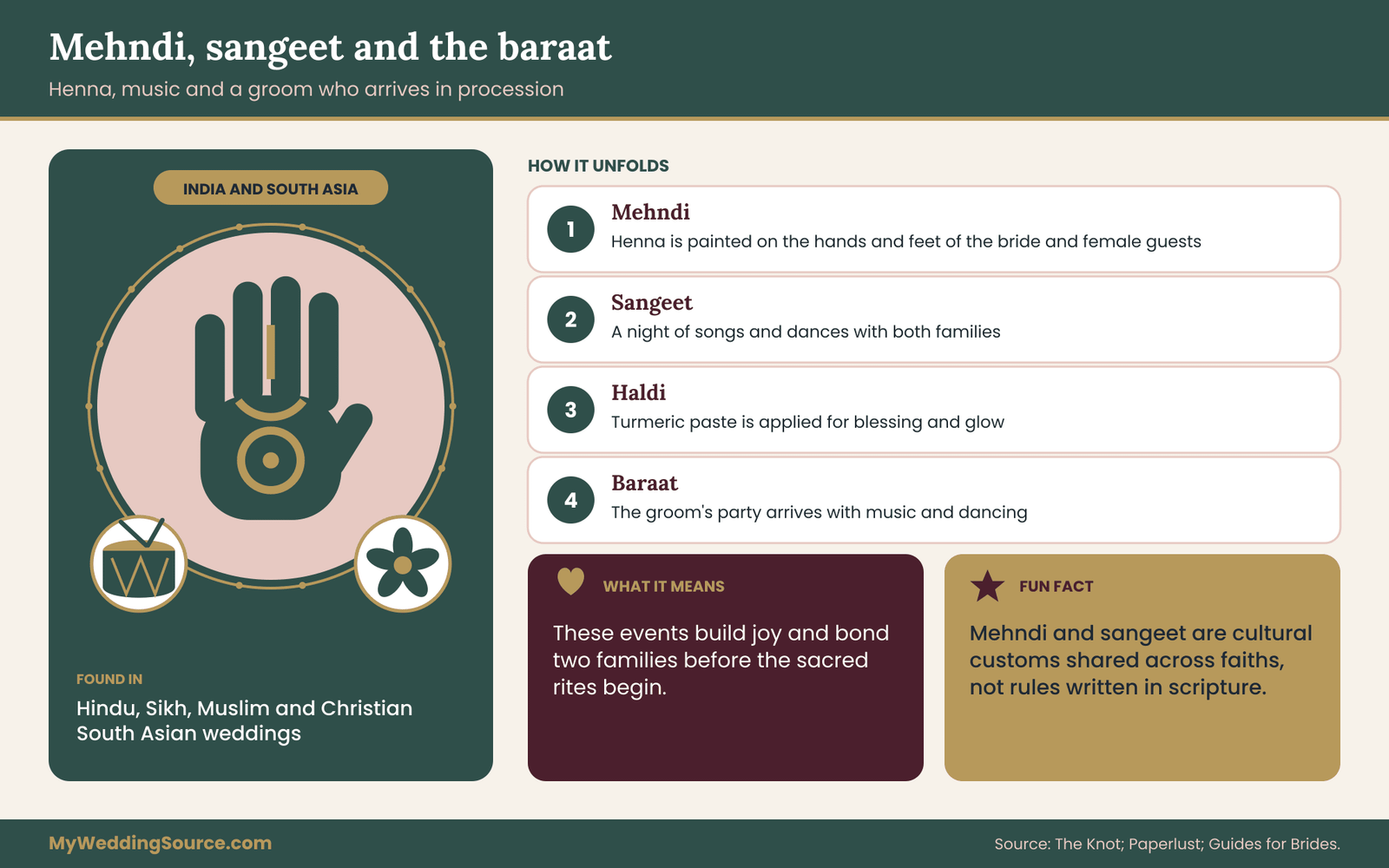
South Asian wedding traditions often form a series of events, and the lively ones come before the main ceremony. At the mehndi, henna is painted in elaborate designs on the hands and feet of the bride and her female relatives and friends. Folk belief says the darker the stain, the greater the love, and the designs can be remarkably intricate. The evening is full of music, snacks and chatter.
The sangeet is a night of songs and dances, in which both families perform for each other. Some are rehearsed for weeks, and some are playful roasts. At the haldi, a paste of turmeric is applied to the bride and groom for blessing and glow. On the wedding day itself, the groom’s party arrives in a procession called the baraat, with drums, dancing and, in some families, a groom on a decorated horse.
These customs are cultural rather than strictly religious, so they appear in Hindu, Sikh, Muslim and Christian weddings across South Asia and its diaspora. Families may keep them all, choose a few or invent new events. They build friendships between two families before the serious part begins.
Fun fact: At many mehndi parties, the bride hides the groom’s name in her henna design, and he is challenged to find it later.
Sai monkhon and the water blessing in Thailand
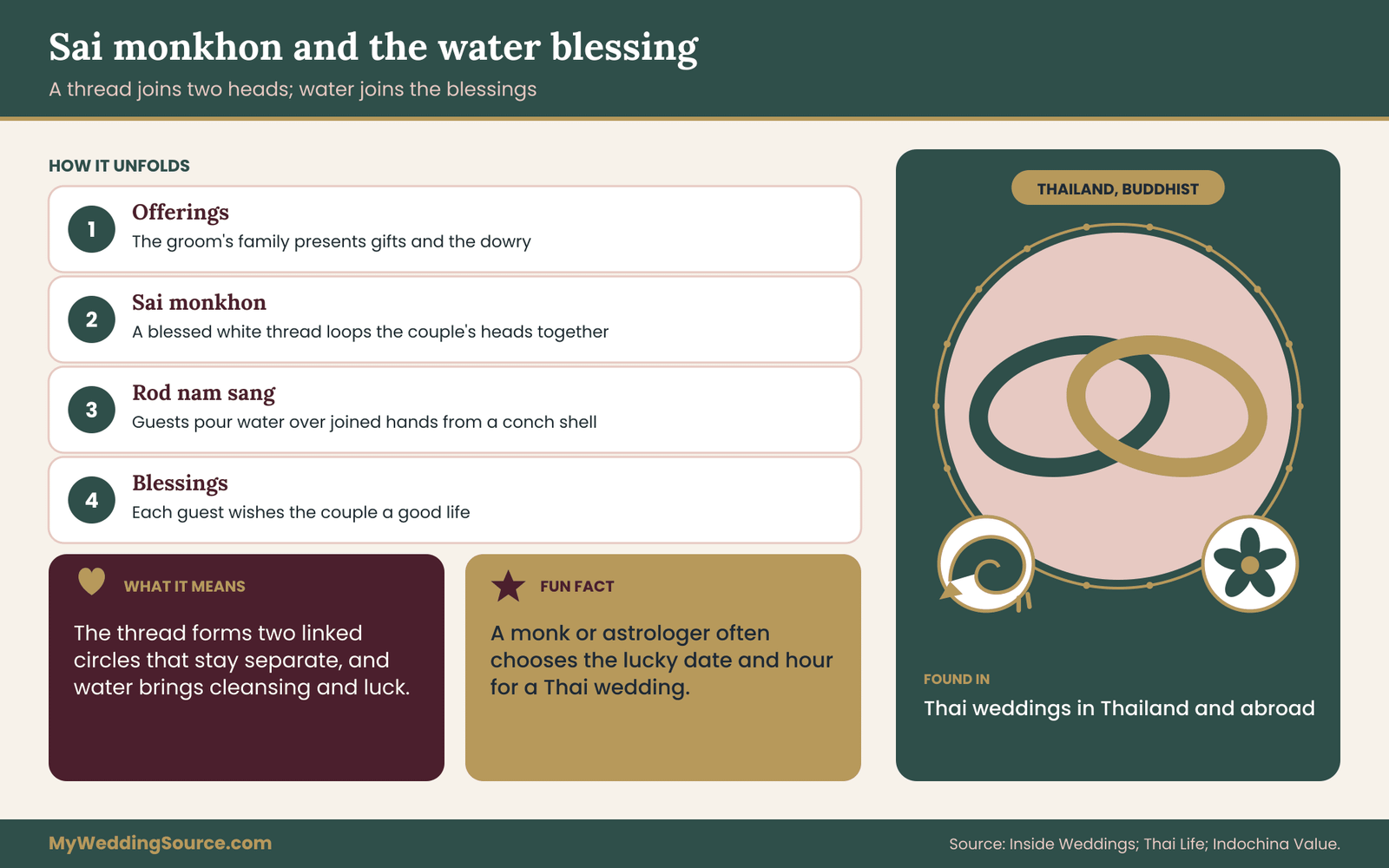
Thai wedding traditions often begin with a morning procession. The groom’s family walks to the bride’s home with gifts and a symbolic payment called sin sod. Many couples begin the day with a morning offering of food to monks.
The sai monkhon is the central ritual. Two loops of white cotton thread, blessed by a monk, are placed on the heads of the couple and joined by a longer length of thread. The loops stay separate, yet they are joined, which is a neat image for two individuals who are also a pair. In the water-pouring ritual, called rod nam sang, the couple holds their hands together over a decorated bowl, and guests pour water from a conch shell over them while offering good wishes.
After the blessings, the day continues with a feast. Many modern Thai weddings are a mix of a Buddhist morning ceremony and a Western-style evening reception. The water and the thread remain the heart of the day.
Fun fact: A monk or astrologer is often consulted to choose the date and hour, so a Thai wedding may start at an odd time that suits the stars.
Jewish wedding traditions
Jewish weddings combine ancient law, family warmth and a great deal of music. Customs differ between Ashkenazi, Sephardi and Mizrahi communities and between Orthodox, Conservative, Reform and secular families, but a few elements are almost universal. The two below are the best known.
The chuppah and the ketubah
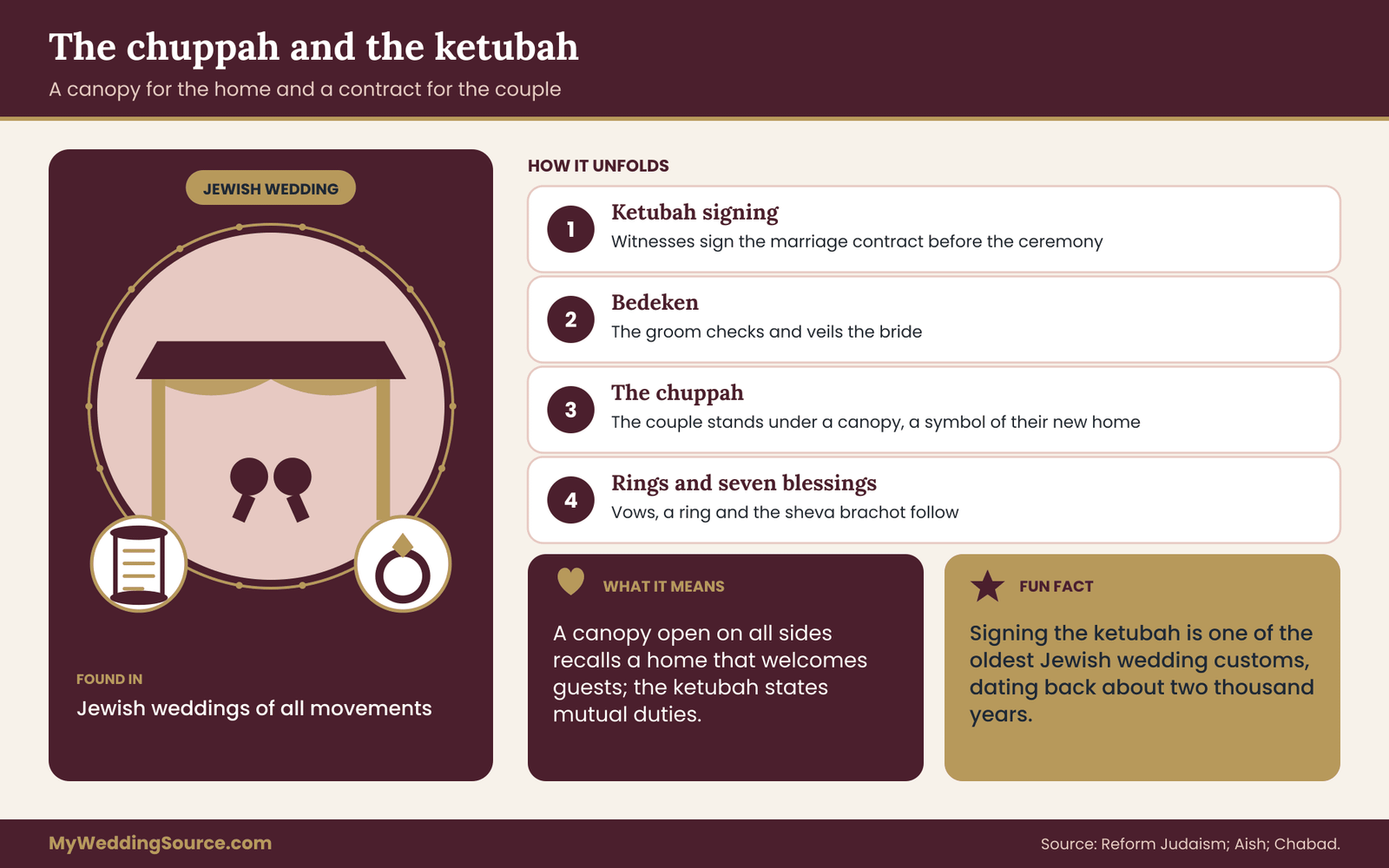
Among Jewish wedding traditions, the chuppah is the canopy under which the couple stands during the ceremony. It can be a simple cloth held on four poles or a floral structure, and it is often open on all sides. Many explanations are given for its meaning. One is that it stands for the new home, and that its open sides recall the tent of Abraham and Sarah, who welcomed guests from every direction. Family members often hold the poles, and the canopy may be made from a family prayer shawl.
Before the ceremony, the couple and two witnesses sign the ketubah, a marriage contract that sets out the groom’s obligations to the bride. Signing a ketubah is one of the oldest Jewish wedding customs, going back roughly two thousand years. Many couples commission a decorated version, and modern wording is sometimes written to be equal for both partners.
Other steps include the bedeken, in which the groom lowers the bride’s veil, the exchange of a ring, and the sheva brachot, seven blessings recited over a cup of wine. For ideas on wording a ceremony of your own, our wedding ceremony script templates give examples of structure.
Fun fact: The ketubah is usually framed and hung in the couple’s home, so it becomes a piece of art as well as a legal document.
Breaking the glass
At the end of a Jewish wedding, the couple stands together and one or both break a glass, usually wrapped in a cloth, by stepping on it. The guests shout “Mazel tov!” and the music begins. For many people, this is the most recognisable moment of the ceremony, and it appears in countless films.
The meaning is rich. The most common explanation is that the broken glass recalls the destruction of the ancient Temple in Jerusalem, a reminder that even at the happiest moment, there is sadness in the world. Another reading is that the glass is fragile, as a marriage can be, and that the couple must handle it with care. Some commentators add that it is a reminder to keep the joy tempered with responsibility.
After the glass, the couple often retreats for a few minutes of quiet together, called yichud, before they join their guests. Many modern couples keep the glass shards and have them made into a keepsake, such as a mosaic or a small piece of glass art.
Fun fact: Guests cheer “Mazel tov” and “siman tov,” phrases that wish the couple good luck and a good sign, as the glass shatters.

Christian wedding traditions
Christian weddings are as varied as the denominations that conduct them, and as the cultures in which they are held. A Catholic wedding in Manila does not look like an Anglican one in Surrey, though both share the exchange of vows, rings and blessings. The three below show how a shared faith can take very different forms.
Reading the banns in England
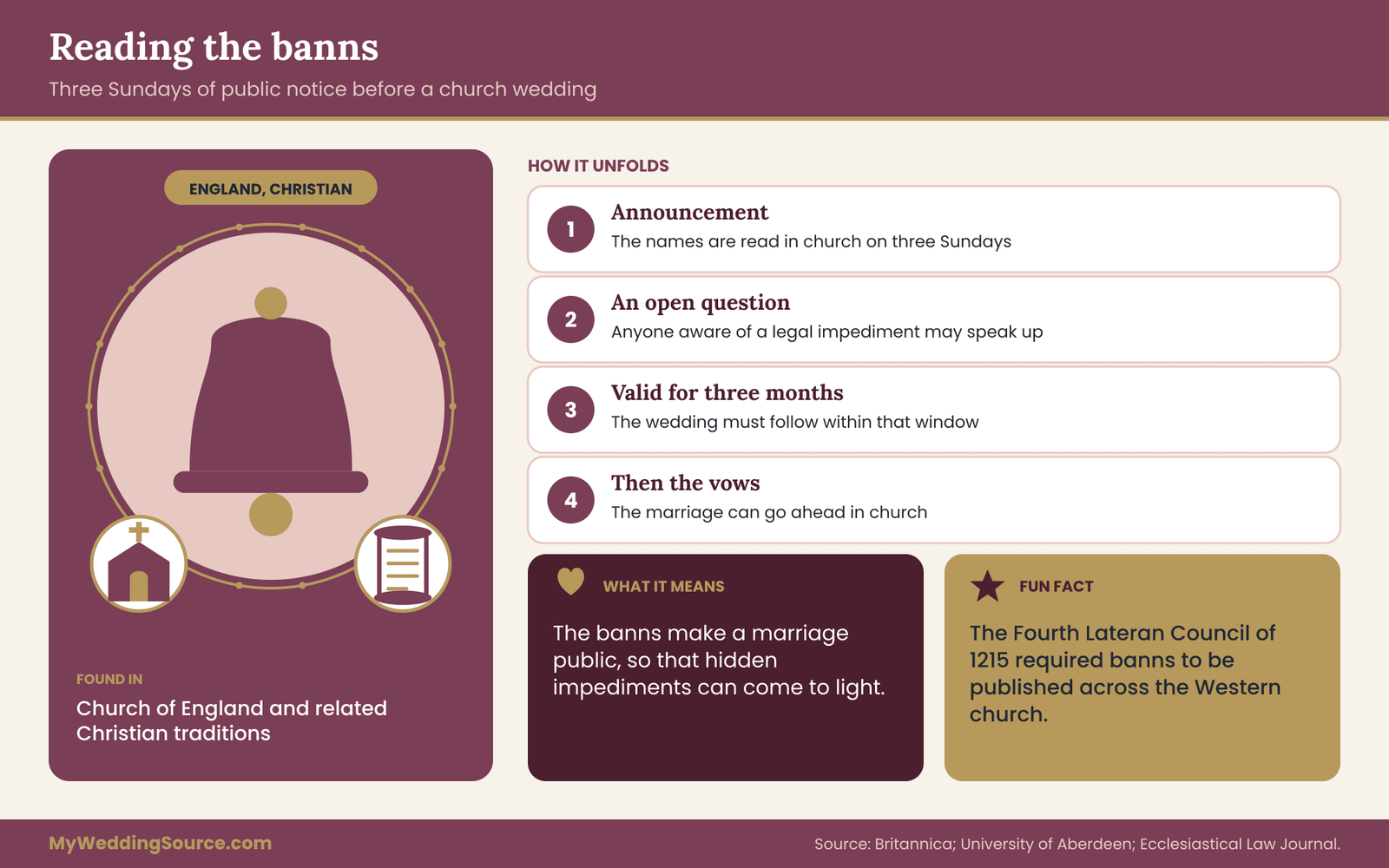
Banns are among the oldest Christian wedding traditions: a public announcement of a coming marriage. In the Church of England, the names of the couple are read aloud in the parish church on three Sundays before the wedding. The minister asks if anyone knows of a legal reason why the couple may not marry, such as an earlier marriage. If no one speaks, the banns are valid for three months, and the wedding can go ahead.
The custom is very old. The Fourth Lateran Council in 1215 required banns to be published across the Western church, so that hidden impediments could come to light. In small communities, the reading also served as a kind of public engagement notice, because neighbours learned of the wedding at church.
Today, banns remain part of a church wedding in England, though some couples find the idea of the congregation hearing their names slightly nerve-wracking. A few treat it as a sweet moment, and may attend the service to hear it. If you plan a church wedding anywhere, check with the clergy early, because each denomination has its own paperwork.
Fun fact: “Being asked in church” was an old English way of saying that a couple’s banns had been read.
Cord, veil and coins in the Philippines
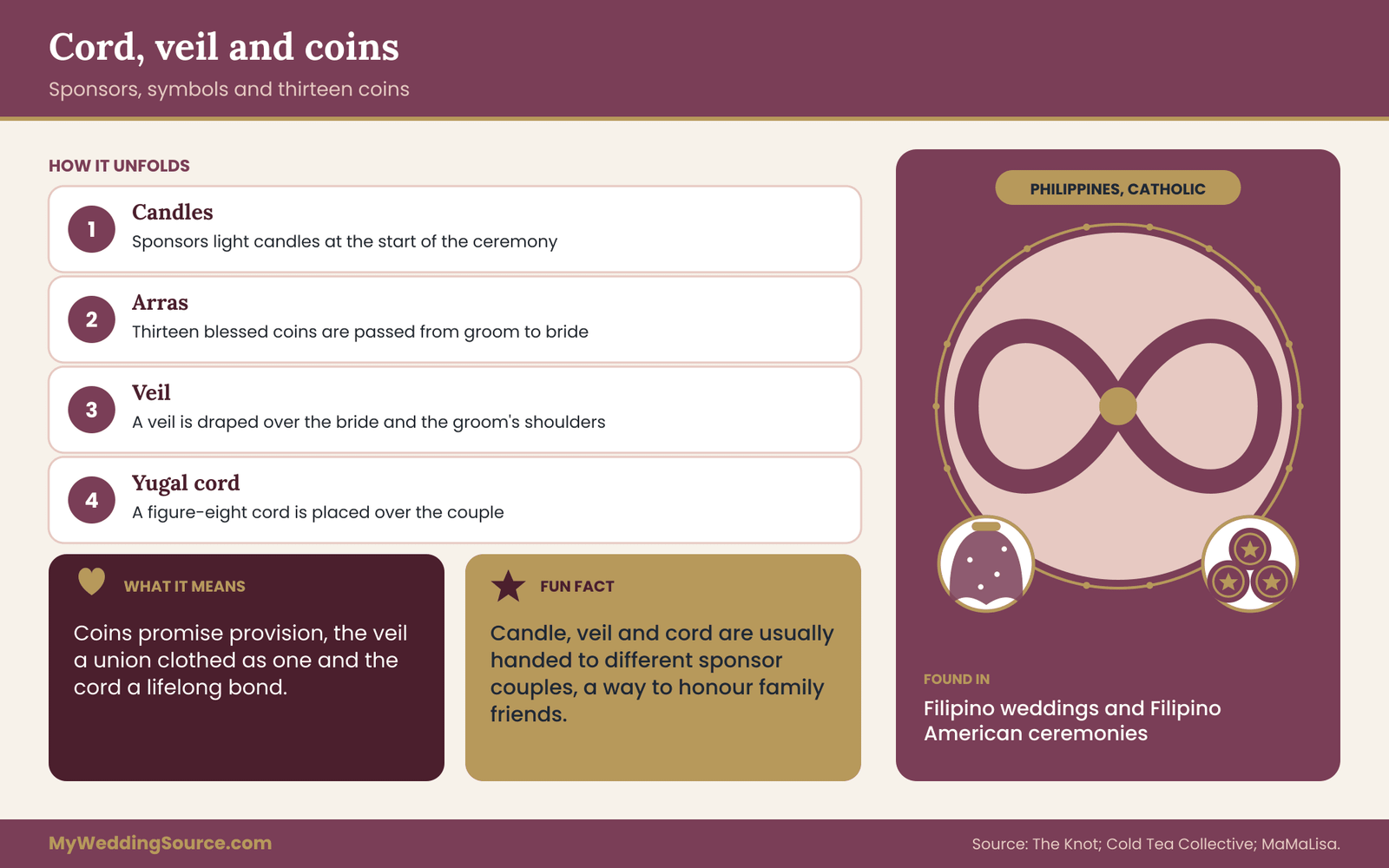
Filipino wedding traditions are rich with symbols and shared with many sponsors. After the vows, the groom gives the bride thirteen coins, called arras, which are blessed by the priest. They are a pledge to provide and to share all that the couple has. Then sponsors place a veil over the bride’s head and the groom’s shoulder, a sign of two lives clothed as one, and a cord, called the yugal, is draped in a figure eight over the couple as a symbol of lifelong bond.
Candles are lit by sponsors at the start of the ceremony. The principal sponsors, known as ninong and ninang, are older relatives or family friends who give their blessing, and many couples have secondary sponsors for each symbol. These roles are an honour, and they link the couple to a wide community.
The reception that follows is a feast, often with a money dance, a lot of karaoke and a table of family favourites. Many Filipino American couples keep the cord, veil and coins even when the rest of the day is modern, because the symbols are easy to understand and beautiful to watch.
Fun fact: Candle, veil and cord are usually handed to different sponsor couples, which is a way to honour several family friends at once.
El lazo and las arras in Mexico
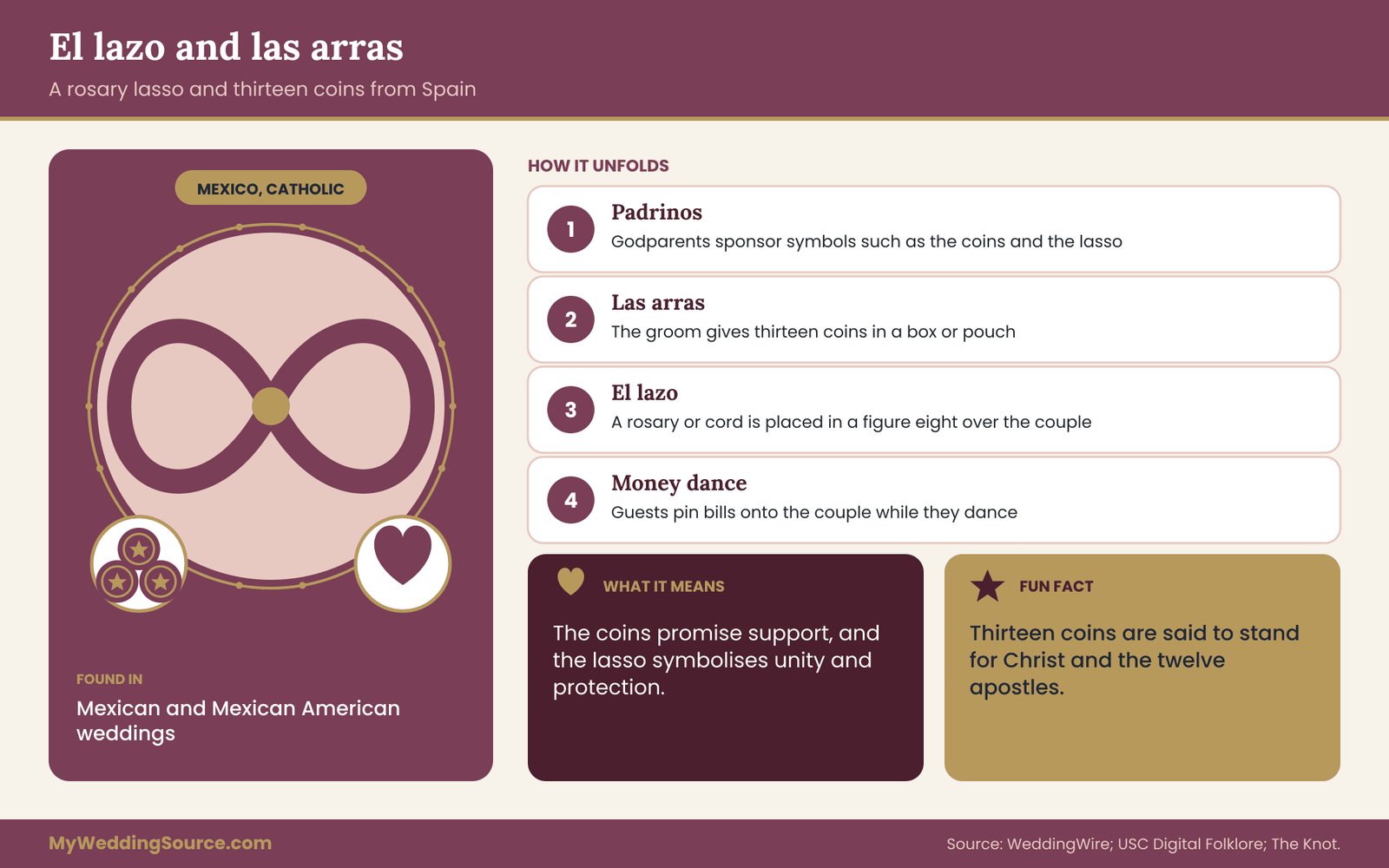
Mexican wedding traditions share the thirteen coins, called arras, with the Philippines, and both customs came through Spain. The groom places the coins in the bride’s hands, often from a decorative box or pouch, as a promise to provide for the household. Thirteen coins are said to stand for Christ and the twelve apostles, though that explanation is a popular one rather than an official one.
The lazo is a large rosary or a looped cord of flowers, which is placed in a figure eight over the couple’s shoulders after the vows. It symbolises unity and protection, and it may be kept by the couple afterwards. Godparents of the wedding, called padrinos, often sponsor items such as the coins, the lasso, the rings, the cake and the Bible, so many people share in the day.
At the party, a money dance, called the dólar dance in some regions, invites guests to pin bills to the couple while they dance. Mariachi music, long tables of food and a late-night snack are common features. The aim of all these wedding traditions is the same: to say that the whole community stands behind the couple.
Fun fact: Many couples keep the coins and the lasso as keepsakes long after the wedding.
Islamic and Middle Eastern wedding traditions
In Muslim communities, a wedding combines a religious contract with a community celebration, and the customs around them vary widely by country. A wedding in Cairo, Karachi, Istanbul, Tehran and Detroit may look quite different, though several themes appear again and again: consent, witnesses, a gift for the bride and a feast for the community. The four below are some of the most widely shared.
The nikah and the mahr
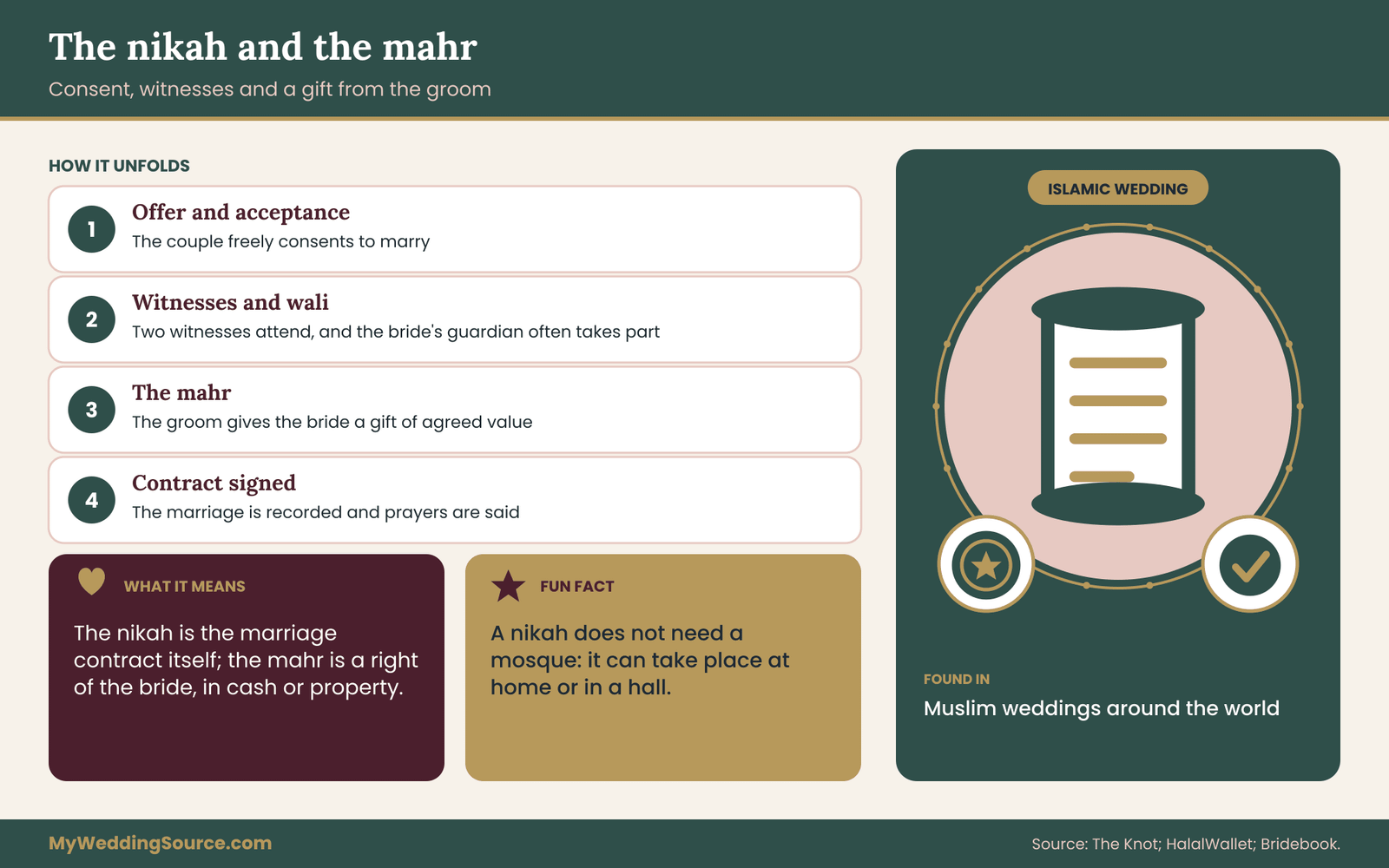
The nikah is the Islamic marriage contract, and it is the heart of Muslim wedding traditions. It requires the free consent of both partners, an offer and an acceptance, and the presence of witnesses. In many communities the bride’s guardian, called the wali, also takes part, and an imam or another knowledgeable person often leads the prayers and a short sermon. The contract is signed and, in many countries, registered with civil authorities as well.
The mahr is a gift that the groom owes the bride. It can be money, property, jewellery or even a promise to teach her something, and the amount is agreed in advance. It belongs to the bride, and it is not a payment to her family. Many couples treat the mahr as a sign of respect and commitment, and some choose a small, symbolic sum that is easy to give.
A nikah does not need a mosque. It can take place in a home, a hall or a garden. Many couples hold it as a short, intimate ceremony with close relatives, followed by a larger celebration on the same day or later. Guests can expect recitation, a sermon about the rights and duties of marriage, and prayers for the couple.
Fun fact: The word nikah can refer both to the marriage contract and to the wedding event, so people sometimes use it for the whole day.
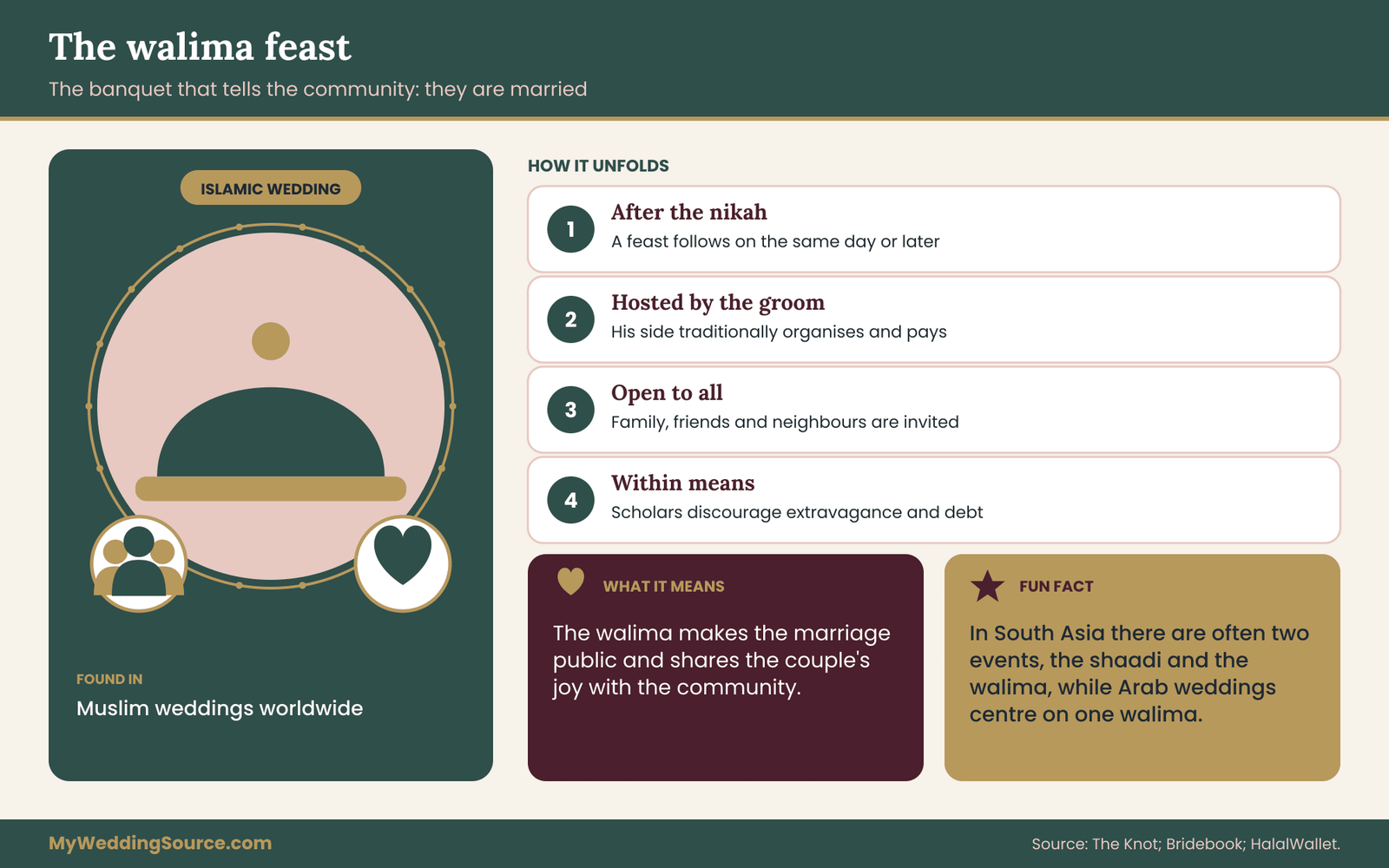
The walima feast
Among Islamic wedding traditions, the walima is the wedding banquet that follows or accompanies the nikah. Its purpose is to announce the marriage to the community and to share the couple’s joy. Scholars generally agree that it should be arranged and paid for by the groom’s side. Tradition says that it should be open to family, friends and neighbours, and that the poor should not be left out.
Many scholars discourage extravagance, noting that the feast should be within the host’s means. In practice, the size of a walima varies enormously. Some families serve a simple meal at home, while others book a large hall and serve a long menu. The food depends on the region, from rice and lamb dishes to stews, breads and sweets.
In parts of South Asia, a family may hold two receptions: one hosted by the bride’s side on the wedding day and the walima, hosted by the groom’s side, on the day after. In many Arab countries, a single large celebration is held. Either way, the walima is the place where the community comes together, congratulates the couple and eats. It rewards a guest who arrives hungry.
Fun fact: The walima is widely taught as a recommended practice, which is why even a very simple Muslim wedding usually includes a shared meal.
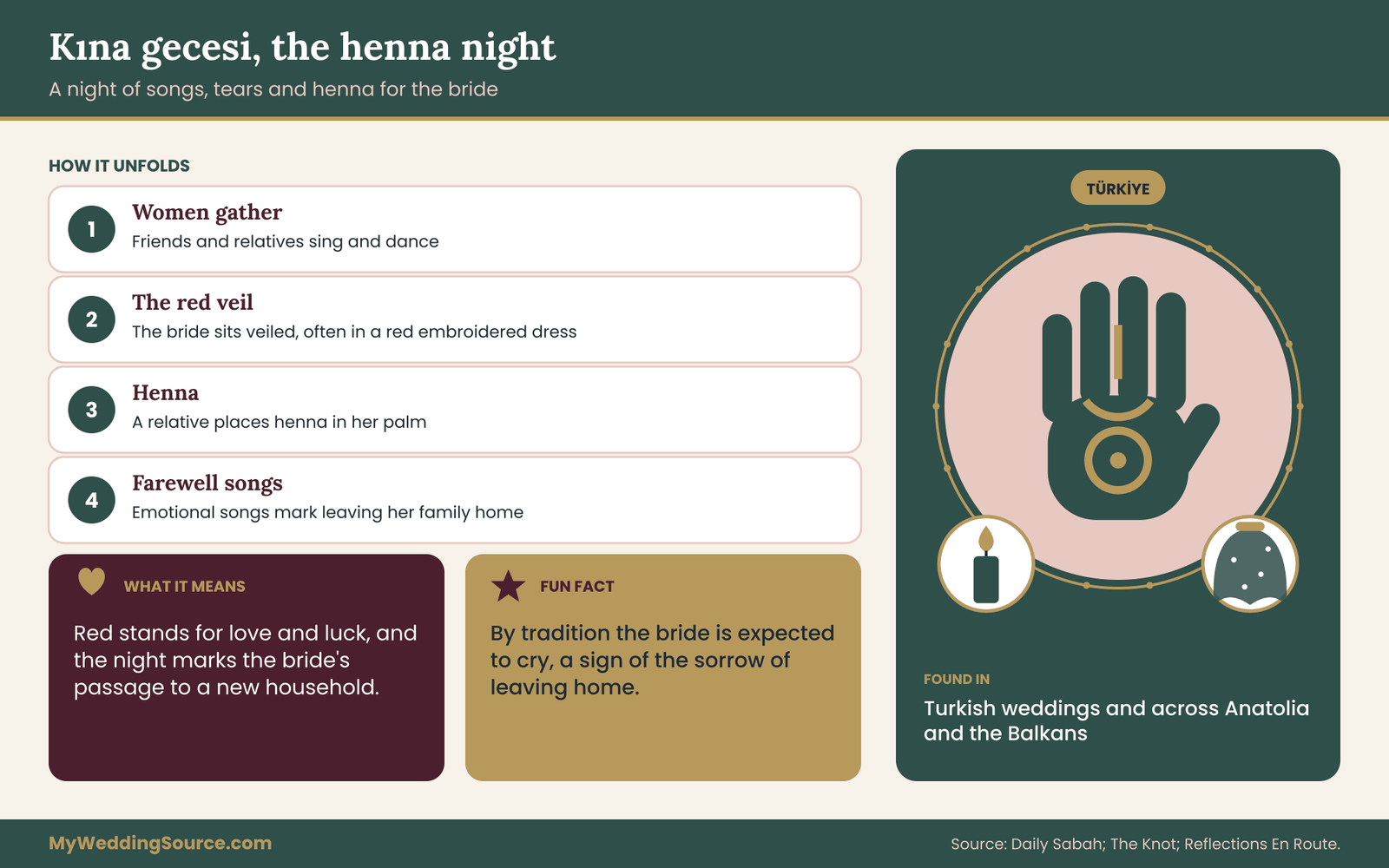
Kına gecesi, the henna night in Türkiye
A henna night is held in Turkey and the former Ottoman lands, usually the evening before the wedding. Women of both families gather to sing, dance and eat. The bride sits veiled, often in a red embroidered dress, and a red veil covers her face. A relative, ideally one who is happily married, places henna in the palm of the bride’s hand, often along with a gold coin, and the guests sing slow, emotional folk songs.
The mood is a mixture of celebration and farewell. The songs speak of leaving home, and the tears that often follow are not a sign of sadness but a part of the ritual, which honours the bond between a daughter and her parents.
Red stands for love and luck throughout the evening. Modern henna nights often include a professional dancer, a playlist and a photographer, but the heart of the night is still the same: women gathering to support the bride as she moves from one home to another.
Fun fact: By tradition, the bride is expected to cry during the farewell songs, and guests are happy to help set the mood.
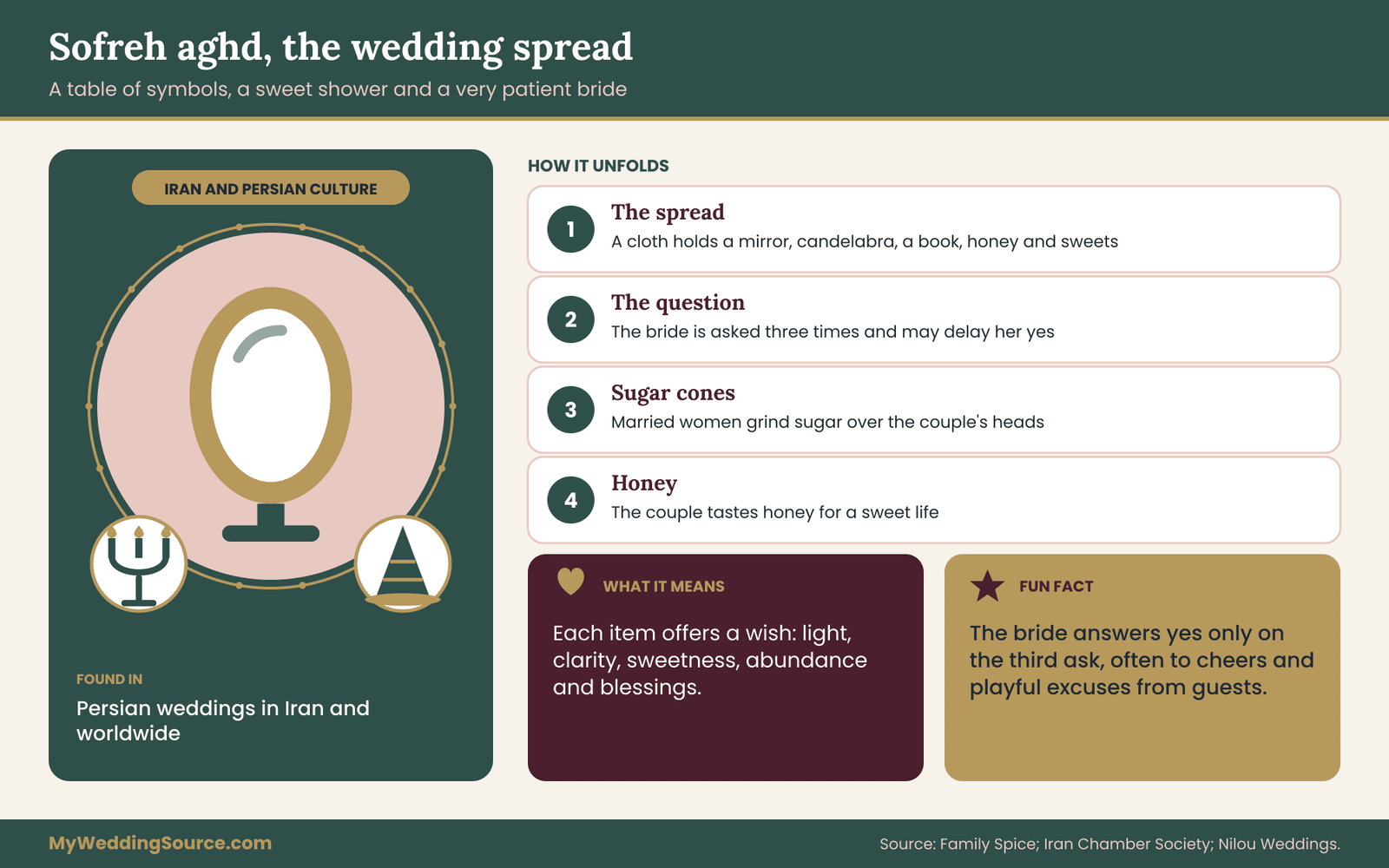
Sofreh aghd, the Persian wedding spread
Persian wedding traditions are centred on the sofreh aghd, a beautifully decorated cloth laid on the floor, where the couple sits during the ceremony. The cloth holds a set of symbolic items. A mirror and two candelabra stand for light and the couple’s shared future, and a tray of herbs and spices is meant to ward off the evil eye. Honey and sugar bring sweetness, coins bring prosperity, and decorated eggs and nuts stand for fertility. A holy book such as the Quran, the poems of Hafez or another cherished volume is often included.
During the ceremony, the officiant asks the bride whether she accepts the groom. According to custom, she does not answer on the first or second ask. Relatives and friends call out playful reasons why she is not ready, and she says yes only on the third request, to cheers from the crowd. Two sugar cones are held above the couple’s heads and rubbed together by married women to shower them with sweetness, and the couple dips a finger in honey and feeds each other.
The sofreh is a feast for the eyes, and many couples spend as much time designing it as they do their dress. It is also a lovely example of how objects can carry wishes.
Fun fact: Sofreh means a spread and aghd means a contract, so the name of the ritual literally means “contract spread.”
African wedding traditions
Africa has thousands of ethnic groups and hundreds of wedding traditions, and no short list can do justice to them. The two below come from West Africa and are among the best known in the diaspora. Both centre on a simple idea: a marriage is the joining of two families, not only two people, and the families must be asked first.
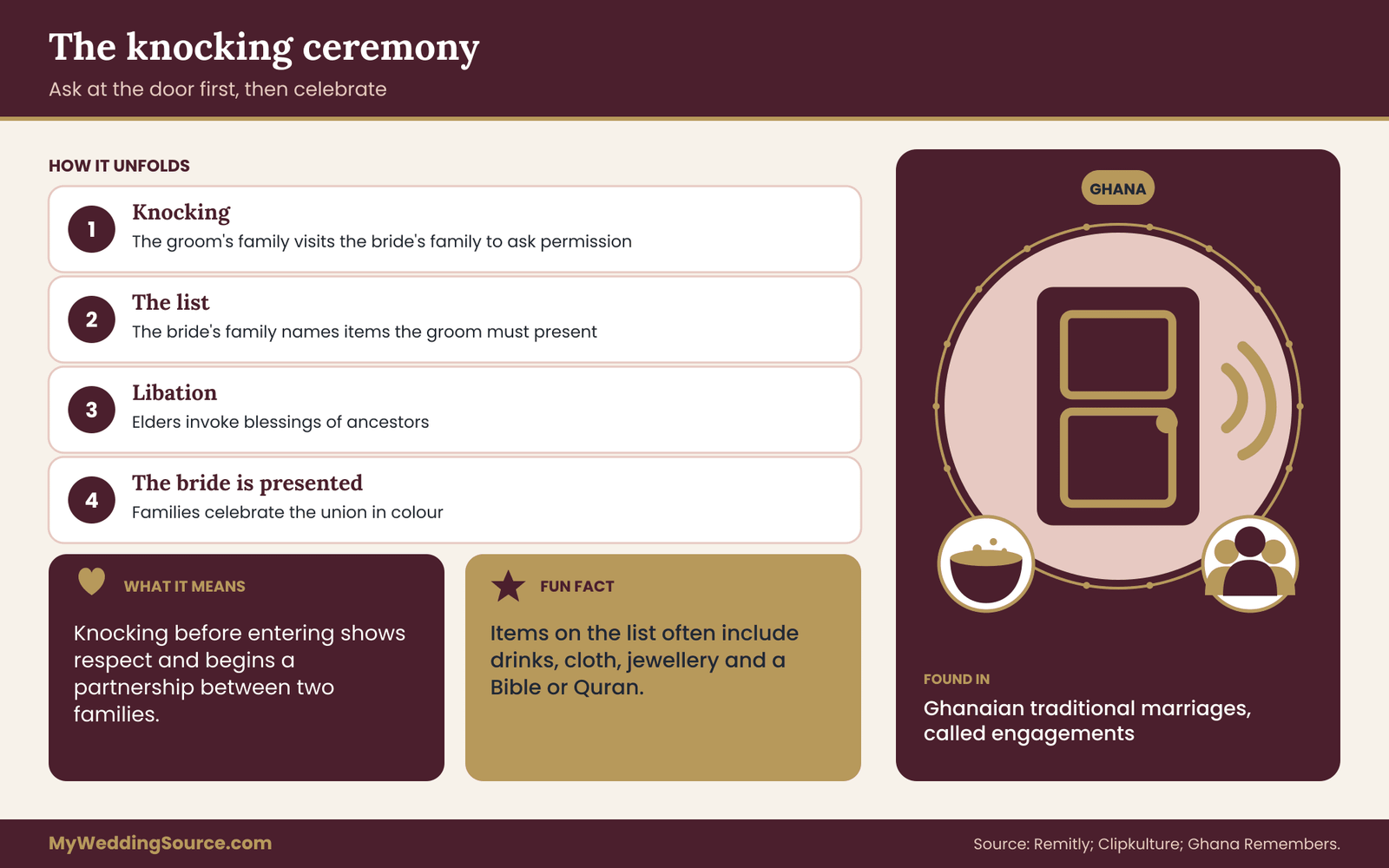
The knocking ceremony in Ghana
In Ghanaian wedding traditions, the marriage ceremony is often called an engagement, and it comes before any church or civil wedding. It begins when the groom’s family arrives at the bride’s home and knocks on the door, hence the name. They bring a spokesperson, called the linguist, who explains why they have come, and the bride’s family responds with questions and good humour.
The bride’s family then presents a list of items that the groom must provide, often including drinks, cloth, jewellery and a Bible or Quran, along with a token sum called the bride price. In the Ghanaian tradition, this is less a payment than a gesture of respect to the family. The families may drink together and an elder may pour a libation, a blessing offered to the ancestors.
Once the gifts are accepted, the bride is presented, in some families after a playful scene in which other women are brought out before the real bride appears. She wears bright kente cloth and gold jewellery, and the families celebrate with drumming, dancing and food. Many Ghanaian couples in the diaspora hold a knocking ceremony before their formal wedding as a way to honour their relatives.
Fun fact: Items on the list often include drinks, cloth, jewellery and a Bible or Quran, and the families usually negotiate the details with plenty of humour.
Igba nkwu, the palm wine ceremony of the Igbo
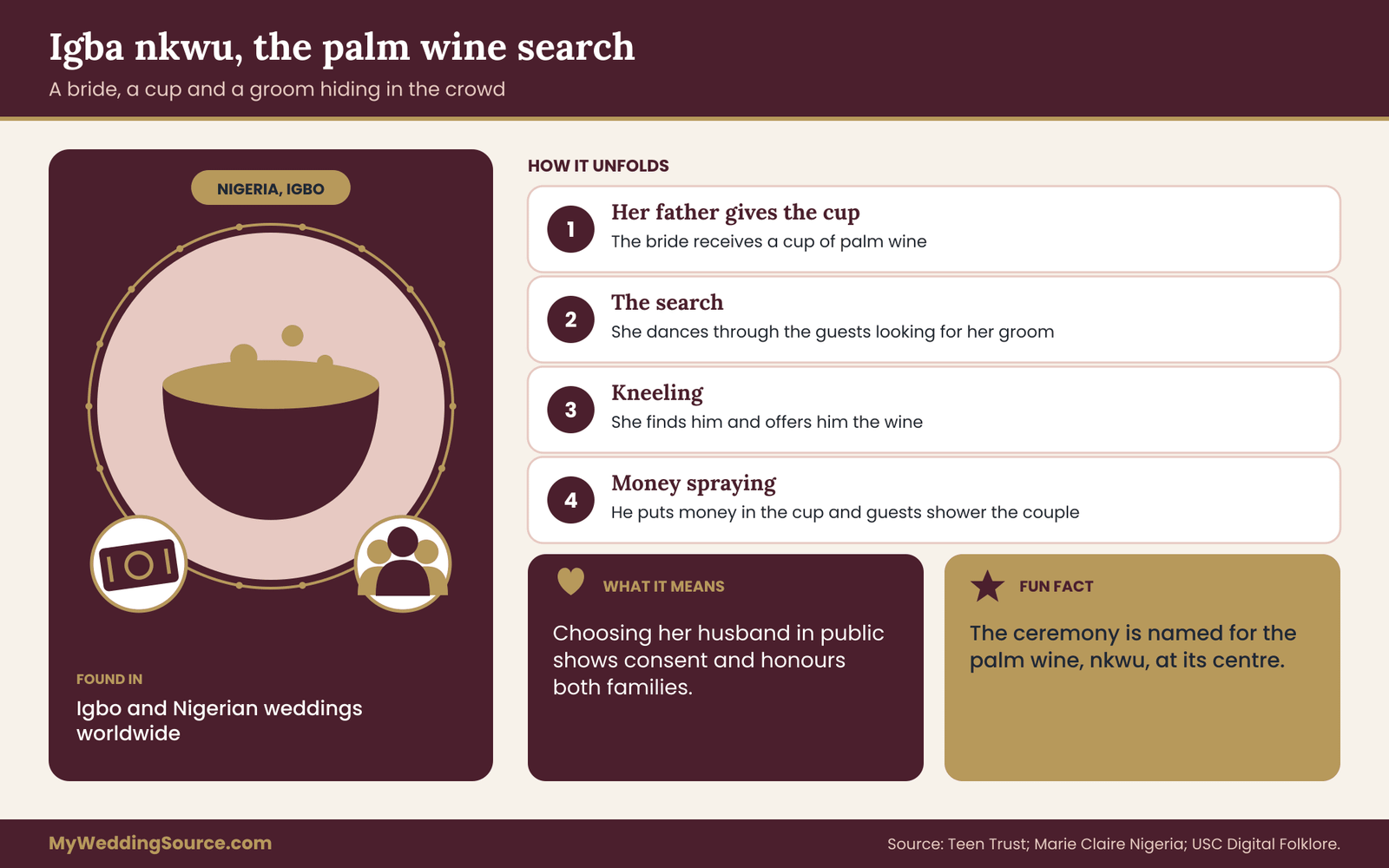
Igba nkwu is the best-known of the Igbo wedding traditions of southeastern Nigeria, and the name refers to the palm wine that sits at its centre. The ceremony comes after the families have agreed the bride price and completed the preliminary visits. The bride’s father hands her a cup of palm wine and tells her to find her husband in the crowd.
The bride then walks through the guests with her cup, dancing and looking. Her friends and relatives call out and tease. When she finds her groom, she kneels in front of him and offers him the wine. He takes a sip, and often drops money into the cup. Choosing her husband in public is a sign of consent and of the couple’s willingness to join the two families.
The party that follows is a celebration of colour. Brides wear elaborate wrappers and beads, grooms wear a traditional outfit with a red cap, and guests spray bills on the couple as they dance. In Nigerian communities abroad, igba nkwu is often held as a separate day before a church wedding. The money spraying and dancing keep everyone on their feet.
Fun fact: The ceremony is named for the palm wine, nkwu, at its centre, and the cup is passed from the bride’s father to the bride and then to the groom.
Wedding traditions in Latin America and the Pacific
The last two wedding traditions in this guide are small ones with big charm. One is a ribbon game with Victorian roots that is also loved in Peru, and the other comes from the islands of Hawaii, where flowers carry a great deal of meaning.
The cake pull
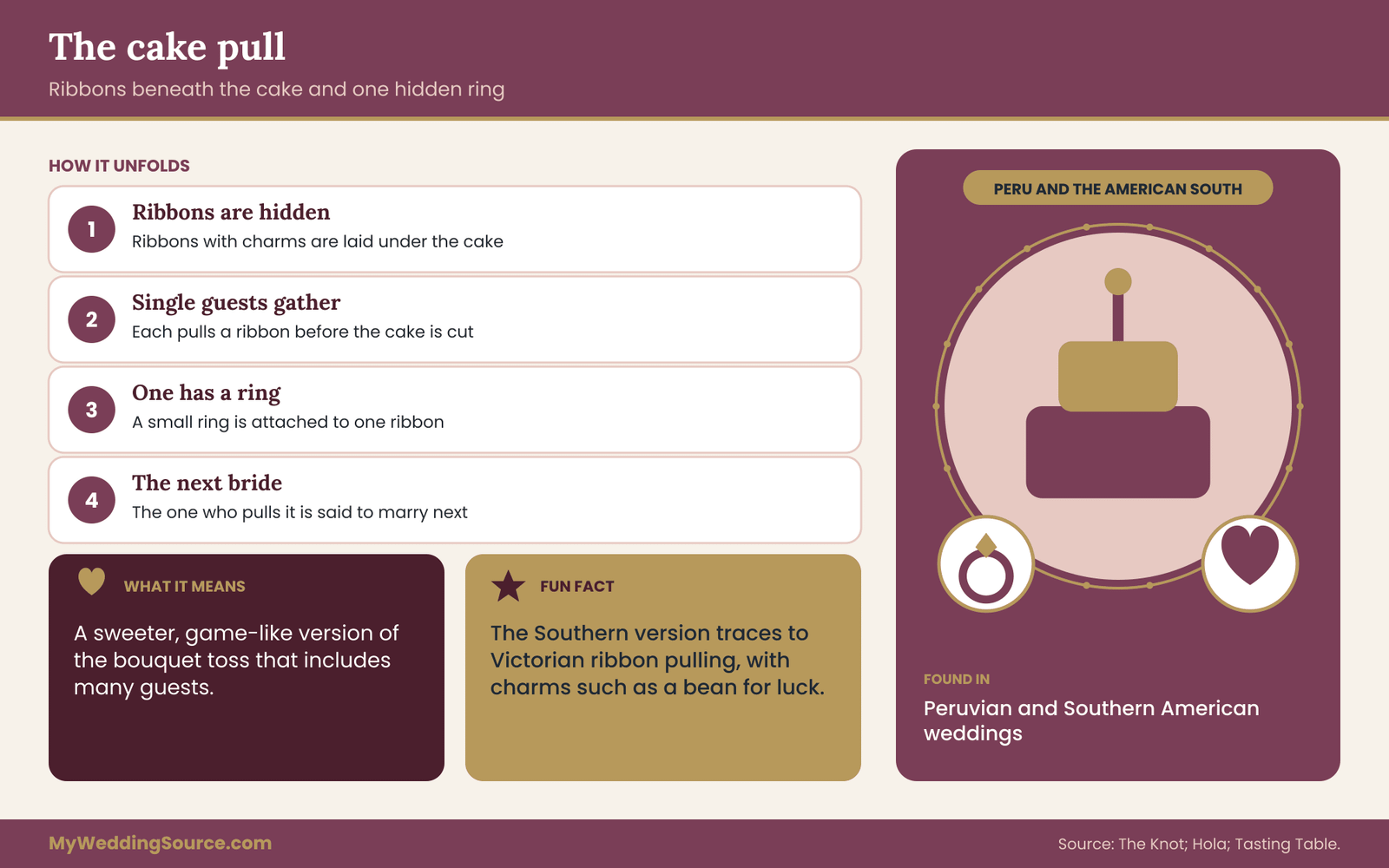
Among Peruvian wedding traditions, the cake pull is a small delight: ribbons are tucked beneath the wedding cake, each tied to a small charm. Before the cake is cut, single guests gather around and each pulls a ribbon. In the Peruvian version, known as the cintas de la torta, one of the ribbons has a ring attached, and the person who finds it is said to be the next to marry. It is a playful alternative to the bouquet toss, and it lets many guests take part without competing in a scrum.
The tradition has Victorian roots. The ribbon pulling of Victorian England used silver charms hidden in the cake, and the custom moved to the American South, where it remains popular. The charms vary: a ring for the next to marry, a heart for love, a coin for wealth. In the Southern version, the guests are often the bride’s close friends and the charms are chosen with care.
For couples, the cake pull has a practical benefit. It happens before the cake is cut, it is easy to organise with a baker and it gives guests a small keepsake to take home. A short note describing each charm adds to the fun.
Fun fact: The Southern version traces back to Victorian ribbon pulling, and it often includes a bean charm that stands for luck.
Lei exchange and ring blessing in Hawaii
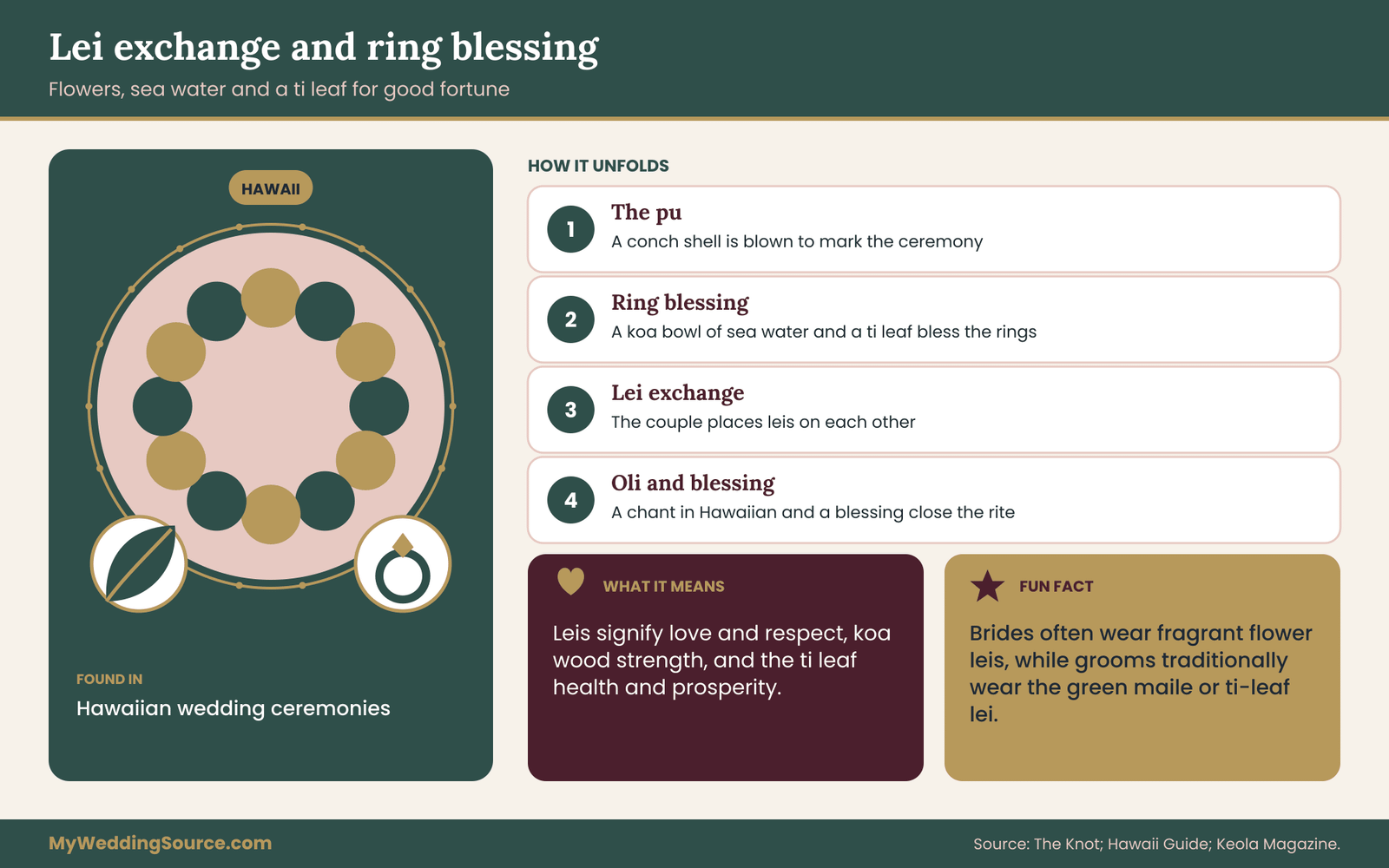
Hawaiian wedding traditions begin with the sound of a conch shell, called the pu, which announces the ceremony. A Hawaiian officiant, or kahu, may chant in the Hawaiian language and offer a blessing. In a ring blessing, the rings are placed in a bowl of sea water, often a koa wood bowl with a ti leaf, and the officiant blesses them with the ocean’s power.
The lei exchange is the best-known part. The couple places leis on each other, as a sign of love, respect and commitment. The leis may be made of flowers such as plumeria or orchids, or of green maile leaves, which are traditionally left open at the ends. The koa wood stands for strength, and the ti leaf is believed to bring health and good fortune.
Many couples choose Hawaii for a destination wedding and add a lei exchange to their own ceremony. If you do, it is respectful to hire a Hawaiian officiant or practitioner, ask what each part means and follow the guidance you are given. The best use of this tradition is a faithful, well-informed one.
Fun fact: Brides often wear a lei of fragrant flowers, while grooms traditionally wear the green maile or ti-leaf lei.
What wedding traditions have in common
After thirty-one customs from every continent, patterns begin to appear. The details differ, but the underlying purposes repeat. Here are the six threads that run through most wedding traditions.
A blessing from elders. The Chinese tea ceremony, the Korean pyebaek, the Ukrainian rushnyk blessing and the Ghanaian knocking ceremony all place elders at the centre. Marriage is treated as a family event, and the couple receives the older generation’s approval.
Shared food and drink. Bread and salt in Poland, tea in China, palm wine in Nigeria, sake in Japan, honey in Iran, cake in the West and the walima feast in Muslim communities all use food to say that a household is being formed and that the community is welcome.
Objects that carry wishes. Crowns, cords, coins, almonds, henna, sugar cones and a sixpence in a shoe each stand for a hope, such as prosperity, fertility, health or loyalty. A good wedding object is easy to see and easy to explain.
Noise, music and play. Smashed porcelain, a honking convoy, drumming at a baraat and a song for a hundred years all mark the day as unusual. Laughter is part of the ritual, because a marriage needs it.
Money and gifts. Pinned notes at a Greek or Hungarian party, red envelopes in China, arras coins in Mexico and the Philippines and the mahr in Islam show that a wedding is also a financial act and that a community helps a new household begin.
A public moment. Banns, witnesses, a glass broken in front of everyone and a ketubah signed before witnesses all make the marriage visible. People want to see that a promise was made.
For the practical details of how to include these wedding traditions in your own day, from ceremony order to guest etiquette, our guide to wedding etiquette is a good companion.
How wedding traditions spread and change
Wedding traditions do not stay still. They move along trade routes, religious networks, empires and family migrations, and they change shape every time they arrive somewhere new. Three forces explain most of the change.
Migration carries customs across oceans. Families who leave one country often hold on to their wedding traditions more tightly than relatives who stayed behind, because a ritual is a portable piece of home. A Ukrainian rushnyk in Chicago, a Persian sofreh in Los Angeles and a Korean pyebaek in Atlanta are all ways of saying that the family is still connected to its roots. Over a generation or two, the details are adapted. A three-day ceremony may shrink to one afternoon, and a long list of guests may become a short one.
Media and fashion speed things up. The white dress is the clearest example, because a single widely reported wedding in 1840 changed what millions of brides wore. Today, photographs and short videos spread wedding traditions even faster. A custom that was local a generation ago, such as the cake pull or the Hawaiian lei exchange, can become a global trend in a season. This is mostly a good thing, as long as people keep the meaning with the ritual.
Couples mix and match. Interfaith and intercultural marriages are common, and many couples build a ceremony from two or three sets of wedding traditions. A couple might sign a ketubah and a marriage licence, serve tea to both sets of parents and jump the broom at the end. The best mixed ceremonies explain each element in the programme and let a relative lead the part that belongs to their family.
Each change raises the same question: which parts of a custom are essential and which can bend? The answer usually comes from the community itself, and the safest course is to ask a respected elder or officiant before you edit a ritual.
How to choose wedding traditions for your own day
Thirty-one customs can feel like a menu with too many choices, so it helps to use a simple filter. These questions can narrow any list of wedding traditions to the few that suit you.
First, ask whether the custom has a personal link. A ritual that belongs to your grandmother’s village or your partner’s faith will carry more weight than one you found on a mood board. Second, ask whether you can explain it in one sentence. If you cannot say what it means, your guests will struggle too. Third, ask whether it fits the room, the weather and the timeline. A plate-smashing circle is lively on a lawn and risky in a hotel ballroom, and a tea ceremony needs a quiet corner and a few spare minutes.
Fourth, ask who will lead it. Some wedding traditions need a priest, a rabbi, an imam or an elder, and others can be led by a friend. Fifth, ask whether it includes everyone. A bouquet toss may be fun for some guests and awkward for others, so offer a version that welcomes the whole room.
Finally, keep the number small. Three or four meaningful customs, each given room to breathe, make a wedding feel rooted. Ten rushed customs can feel like a checklist. If a long train or a veil is part of your look, our wedding dress train lengths guide shows how to plan the movement, and a simple programme card can tell guests what each tradition means.
When each tradition happens: before, during and after the wedding
One more way to compare wedding traditions is by timing. Some customs are a warm-up, some are the ceremony itself, and some belong to the party or to the days after. Seeing them on a timeline helps if you are planning a day that mixes more than one culture.
Before the wedding. Many cultures hold gatherings in the days or hours before the ceremony. German friends smash porcelain at the Polterabend, South Asian families paint henna at the mehndi and sing at the sangeet, and Turkish women gather for the henna night. The Ghanaian knocking ceremony and the Thai morning procession also come first, because families must agree before anything else can happen. In Christian churches, the banns are read on the Sundays before the date.
During the ceremony. This is where the legal or religious core sits. Jewish couples stand under the chuppah and break the glass, Hindu couples walk the seven steps, Muslim couples sign the nikah, Greek couples wear the crowns, and Japanese couples share the three cups of sake. Filipino and Mexican couples receive the arras coins and the cord. These are the moments that make a marriage official in the eyes of the community.
At the reception. Cakes, dances, toasts and favours belong here: the cutting of the cake, the bride dance in Hungary, the money dance in Greece, the bread and salt in Poland, the sugared almonds in Italy and the cake pull in Peru. Most of these are playful, which is why they travel so easily between cultures.
After the ceremony. Some customs continue once the vows are done. The Korean pyebaek follows the main rite, the Persian couple feeds each other honey, the walima feast follows the nikah, and many couples keep the broom, the cord, the glass shards or the coins as keepsakes. A good keepsake turns a tradition into a story the family can retell.
Attending a cultural wedding as a guest
If you are invited to a wedding whose wedding traditions are new to you, a little preparation goes a long way. Hosts are almost always happy to explain, and most guests are forgiven for small mistakes, but a few habits keep you on the right side of good manners.
Start by asking the couple, or a relative, what to expect. Find out how long the day will be, whether there are several events, and what the dress code is. Many South Asian weddings welcome bright colour but not white, and many Jewish and Muslim ceremonies ask guests to dress modestly. Red is celebrated in Chinese weddings, and black can be avoided at some events.
Next, think about gifts. Cash in a red envelope is welcome at a Chinese wedding, an envelope of money is the norm at many Korean, Filipino and Nigerian celebrations, and a registry gift suits most American weddings. Our wedding-gift guides can help you choose something suitable.
Finally, join in. Dance in the circle, stand for the toast, and watch for cues from the family. When a tradition is explained, listen. Nothing delights a host more than a guest who asks what a symbol means and remembers the answer.
Wedding traditions compared at a glance
The table lists all thirty-one wedding traditions in the order they appear in this guide. Use it to compare regions, symbols and meanings, or to find an idea that suits your own celebration.
| Tradition | Where it is found | Core symbol or action | What it says |
|---|---|---|---|
| White wedding dress | United States, UK | A white gown | Celebration, and a display of fine fabric |
| Something old, new, borrowed and blue | England, United States | Four small objects and a sixpence | Good wishes for the marriage |
| Bouquet and garter toss | Europe, United States | A thrown bouquet or garter | Luck passed to the next hopeful |
| Cutting the wedding cake | Rome, Britain, United States | The first shared slice | Plenty and a first shared task |
| Jumping the broom | African American communities | A leap over a broom | Crossing into shared life |
| Crowns, plates and the money dance | Greece | Linked crowns and circle dances | The couple as king and queen of a new home |
| Polterabend and log sawing | Germany | Smashed porcelain and a saw | Teamwork and luck |
| Handfasting and the Claddagh ring | Ireland, Celtic revival | A cord and a ring of heart, hands and crown | Commitment, love, loyalty, friendship |
| Bread, salt and the capping | Poland | Bread, salt and a lifted veil | Plenty, endurance and a change of status |
| Rushnyk and korovai | Ukraine | Embroidered cloth and ritual bread | Ancestral blessing and a prosperous home |
| Confetti and the bomboniere | Italy | Five sugared almonds | Five wishes and sweet and bitter together |
| The bride dance | Hungary | A midnight dance for money | A new role and a gift for the household |
| The Chinese tea ceremony | China | Tea served to elders | Respect, welcome and sweetness |
| San-san-kudo | Japan (Shinto) | Three cups of sake | Unity of the couple and their families |
| Wooden ducks and the pyebaek | Korea | Carved birds and a bow | Fidelity and welcome into a new family |
| Saptapadi | India (Hindu) | Seven steps around a fire | A complete, spiritual union |
| Mehndi, sangeet and baraat | South Asia | Henna, music and a procession | Joy and friendship between two families |
| Sai monkhon and the water blessing | Thailand | A blessed thread and poured water | Two lives joined yet distinct |
| Chuppah and ketubah | Jewish communities | A canopy and a contract | A new home and mutual duties |
| Breaking the glass | Jewish communities | A shattered glass | Joy with a memory of loss |
| Reading the banns | England (Christian) | Three Sundays of public notice | A public, lawful marriage |
| Cord, veil and coins | Philippines | Arras, veil and a figure-eight cord | Provision and a lifelong bond |
| El lazo and las arras | Mexico | A lasso and thirteen coins | Unity, protection and support |
| The nikah and the mahr | Muslim communities | A contract and a bride’s gift | Consent, witnesses and respect |
| The walima feast | Muslim communities | A community banquet | The marriage made public and shared |
| Kına gecesi | Türkiye | Henna and a red veil | A bride’s passage between homes |
| Sofreh aghd | Iran, Persian culture | A spread of mirror, candles and honey | Light, sweetness and blessing |
| The knocking ceremony | Ghana | Asking permission at the door | Respect between two families |
| Igba nkwu | Nigeria (Igbo) | A cup of palm wine | Public consent and joined families |
| The cake pull | Peru, American South | Ribbons and a hidden ring | Luck for the next to marry |
| Lei exchange and ring blessing | Hawaii | Leis, sea water and a ti leaf | Love, respect and good fortune |
FAQ
What are the most common wedding traditions in the world?
The most widespread wedding traditions are the exchange of rings or other tokens, a public blessing or ceremony, a shared meal or drink, and gifts for the couple. Within those themes, customs differ by region. In the West, the white dress, the cake and the bouquet toss are common. In many Asian cultures, respect for elders is central, and in Muslim and Jewish weddings a contract and witnesses are key.
Where did wedding traditions come from?
Most wedding traditions grew out of a mix of law, religion, folklore and practical needs. Some, like the ketubah and the nikah, are rooted in religious law that is centuries old. Others, like the Victorian rhyme about something old and something blue, are social customs that spread through print. Many have debated origins, so it is wise to treat a popular story as a story until a good source backs it up.
Can I include traditions from another culture in my wedding?
Yes, but do it with care. Learn what the custom means, ask someone from that community to explain it or help, and keep its meaning intact. If a ritual is sacred, such as a religious rite, it is better to invite a relative or practitioner who can lead it than to copy it. If you have a family link to the custom, share that story with your guests.
Which wedding traditions are religious and which are cultural?
Some are religious: the chuppah and the ketubah in Judaism, the nikah and mahr in Islam, and the arras and banns in Christian churches. Others are cultural and appear across faiths, such as mehndi and the sangeet in South Asia, the Chinese tea ceremony and the Polish bread and salt welcome. Many couples blend both, and the distinction is often a matter of the community’s own view.
How do I choose which wedding traditions to keep?
Start with the ones that already mean something to your family, then choose a few that fit your values and your schedule. Talk with parents and grandparents, because they may remember customs you did not know about. Keep the list short enough that you can explain each one to your guests in a sentence, and drop any ritual that feels like a performance.
Do wedding traditions change over time?
Yes, constantly. The white dress is less than two centuries old as a common choice, the bouquet toss is shrinking in some places and the wedding cake has travelled from a Roman loaf to a tiered centrepiece. Couples keep adapting wedding traditions to fit their lives, and that flexibility is one reason the customs survive.
Your next steps
- Interview your family. Ask parents and grandparents which customs they remember, which they skipped and which they wish they had kept.
- Pick three meanings, not three props. Choose the ideas you want your day to carry, such as thanks, luck or community, and find the traditions that express them.
- Check the details. Confirm how a ritual is done and who should lead it, and ask a member of that community when you are borrowing from outside your own family.
- Write it into your programme. A two-line note in your programme or on a sign tells guests what each custom means and invites them in.
- Rehearse the timing. Rituals such as a tea ceremony, handfasting or a sake sharing need a few minutes each, so plan them into your timeline.
- Capture the story. Ask a relative to record the meaning of each tradition in writing, so the next generation inherits the explanation as well as the ritual.
For help with the order of a ceremony and the words to say, see our wedding ceremony script templates and wedding vows guides.
Sources
This guide is a general overview drawn from published encyclopedias, wedding-industry guides and journalism. Customs vary by family, region and denomination, and many origin stories are debated, so follow the couple’s and the community’s own guidance when you are unsure. All text in this article is original.
- Wikipedia: Wedding dress – Queen Victoria’s 1840 gown and the spread of white.
- Wikipedia: Jumping the broom – competing theories about the origin of the custom.
- Wikipedia: Handfasting – why the “ancient Celtic rite” claim is disputed.
- Wikipedia: Banns of marriage – the Fourth Lateran Council and the practice of banns.
- Wikipedia: Saptapadi – the seven steps and their vows.
- Wikipedia: Ketubah – the age and purpose of the Jewish marriage contract.
- Wikipedia: Wedding cake – Roman and medieval cake customs.
- Wikipedia: Rushnyk – the embroidered cloth in Ukrainian weddings.
- Wikipedia: Pyebaek – the Korean bow and the dates and chestnuts.
- Wikipedia: Chuppah – the canopy and its symbolism.
- Wikipedia: Mahr – the bride’s gift in Islamic marriage.
- Wikipedia: Walima – the wedding banquet and who hosts it.
- The Knot: Cake Pulls Tradition – the ribbon-and-charm custom and its history.
- The Knot: Peruvian Wedding Traditions – the cintas de la torta.
- Tasting Table: The Southern Cake Pull – how the cake pull is done in the American South.
- HOLA!: Best Latino Wedding Traditions – the Peruvian cake pull as an alternative to the bouquet toss.