

Wedding bar service planning is mostly a question of flow: how many guests will ask for a drink in the same ten minutes, how fast your bartenders can answer, where the bars stand, how much ice is within reach, and whether the guests who are not drinking alcohol have something just as good to order.
Quick answer
Good wedding bar service planning comes down to four numbers and one drawing. The numbers are your peak drinks per minute, your bartender capacity for the menu you chose, the waiting time those two produce at the busiest moment, and your ice and nonalcoholic quantities. The drawing is a floor plan that shows where each bar stands, where its line forms, and how ice and glassware reach it. Published rules of thumb, such as one bartender per 50 to 75 guests and one bar per 75 to 100 guests, are a fair starting point. This guide shows how to test them against your own menu, your own room, and a cocktail hour that is shorter or busier than average, and it gives a worked example you can copy.
What wedding bar service planning has to settle
A bar looks simple from the guest side: a counter, a few bottles, someone smiling. Behind it sits a small logistics operation with staff, supplies, storage, and a line. Most of the frustrations couples remember about a reception bar, such as a long wait at the start, warm drinks, or one guest group with nothing to order, come from decisions nobody made on purpose. This section lists those decisions so the rest of wedding bar service planning has somewhere to attach.
The five decisions behind every bar
Every plan for wedding bar service planning settles the same five things, whether the party is thirty guests in a backyard or three hundred in a hotel ballroom. Naming them early keeps wedding bar service planning concrete when you talk with your caterer or bartending company.
Who serves, and under whose license
First, decide who is allowed to pour. In the United States, alcohol service is regulated by states and localities, and many venues and caterers hold the license for the event and control who may serve. One caterer’s published bartending page says that alcohol bought through the company is served under the company’s license, and that a client who supplies their own alcohol may have to provide a license to the venue. Treat that as one example, not a rule for every state. Ask your venue, in writing, who may pour and what proof of license and insurance it wants. Our wedding venue questions guide lists the other items to settle at the same time.
What is poured, and how it is made
Second, decide the menu. A bar that serves beer, wine, sparkling water, and soda is a different machine from a bar that makes cocktails from scratch. Later sections show that the difference can be a factor of three in how many drinks one bartender can hand across the counter in an hour. The menu is therefore a staffing decision as much as a taste decision.
Where the bars stand
Third, decide the number and position of service points. A single bar placed beside the room entrance and a pair of bars set at opposite sides of the room can be staffed by the same number of people and still produce completely different lines. The floor plan is part of wedding bar service planning, not an afterthought.
What keeps the bar cold, stocked, and clean
Fourth, decide the supply chain behind the bar: ice, mixers, garnishes, glassware, trash, and water. Someone has to bring these in, someone has to refill them, and someone has to keep them safe to serve.
What the guests who do not drink alcohol will order
Fifth, decide what is on offer for guests who are not drinking alcohol, whether by choice, by faith, by health, or because they are driving. This is a hospitality decision first. It is also a practical one, because every guest who orders from a well-stocked nonalcoholic menu is one fewer guest waiting for a bartender to make a cocktail.
What this guide covers and what it leaves to other guides
This is the planning pillar for wedding bar service planning at the reception. It connects to several narrower guides, and it avoids repeating them so you can find the detail you need in the right place.
What you will find here
You will find a demand model that turns your guest count into drinks per minute, a throughput model that turns your menu into drinks per bartender per hour, a wait-time estimate that combines the two, a method for choosing the number and position of bars, a way to count ice by use instead of by rule of thumb, a plan for nonalcoholic choices, and a list of edge cases that tend to break a bar plan. The models are our own arithmetic. We label every assumption so you can replace it with your vendor’s real number.
What is covered elsewhere
Prices, package versus consumption billing, and liquor-quantity math are covered in our open bar wedding guide, so this one does not repeat them. Mocktail recipes and cost per nonalcoholic drink are covered in our wedding mocktails guide. The wider food and beverage picture is in our wedding catering guide. Here we stay on service: people, positions, speed, ice, and choice.
Start wedding bar service planning with your guests and your room
Before any formula in wedding bar service planning, two inputs decide almost everything: who is coming and where the bar will physically stand. Both are easy to get wrong by assumption, so it is worth writing them down.
Headcount, drinkers, and everyone else
The headcount that matters for the bar is not the invitation count. It is the number of people in the room during the hours the bar is open, split into those who will order alcohol and those who will not.
Use attending guests, not invited guests
Responses never arrive at the invited number, and some guests who accept cannot attend. Use your best estimate of attendance for the bar plan and revisit it when your final count is due. Our wedding RSVP etiquette guide covers how to get answers in on time. Remember that vendors usually need a final count some days before the event, so the bar plan has a deadline attached.
Do not assume who drinks
It is tempting to assume that a certain share of guests will not drink, or that every adult will. Neither assumption is safe. Rules about age differ by state, some guests do not drink for religious or health reasons, and some are driving or pregnant. The CDC states that there is no known safe amount of alcohol during pregnancy. For planning purposes, build a bar that works for a wide range of drinkers and a good share of nondrinkers, and ask guests for dietary and beverage needs on the RSVP if you want a firmer number. Our wedding dietary restrictions guide shows how to ask without making it awkward.
The room, the schedule, and the rules
In wedding bar service planning, the room and the schedule decide how demand arrives. The rules decide who is allowed to serve it.
Read the floor plan before the menu
Ask the venue for a scaled floor plan with dimensions, door locations, power outlets, water access, and the route to the loading area. Mark where guests enter, where they will stand during cocktail hour, where the seating and the dance floor are, and where staff can bring supplies without crossing the guest area. You will use this drawing in the layout section, and you will notice problems on paper that are expensive to fix on the day. Our wedding venue capacity guide explains how a room’s stated capacity changes once bars, a dance floor, and service routes take their share.
Know the licensing and liability basics
Alcohol laws vary by state and sometimes by county, so this guide cannot tell you what applies where you are. It can tell you what to ask. A federal report on underage drinking states that as of January 1, 2021, 45 states imposed dram shop liability, which is the civil liability that commercial alcohol sellers can face for harm caused by intoxicated or underage patrons. That is one reason venues and caterers insist on licensed, insured servers and on controlling who pours. This is general information, not legal advice. If you plan to supply your own alcohol, ask the venue and a licensed professional in your state what is required, and read our wedding insurance guide for how event coverage and liquor liability are usually discussed.
A demand model for wedding bar service planning
The most useful step in wedding bar service planning is also the one most couples skip: estimating how many drinks guests will order per minute at the busiest moment, not per hour on average. A bar that can serve the average easily can still produce a twenty-minute line if the guests all want a drink at once.
Why peak matters more in wedding bar service planning than the average
Averages hide the crowd. Over a five-hour reception the number of drinks per hour looks modest, but the bar is not busy evenly. It is busy in waves, and the lines people remember form in the waves.
Why the first hour is the hardest
Published drink guidance consistently describes a front-loaded evening. A liquor retailer’s wedding bar guide describes about two drinks per guest in the first hour and about one per hour after that, and Cascadia Liquor’s event alcohol checklist gives the same two-then-one pattern. A planning site that advises on hiring bartenders suggests two to three drinks per person during cocktail hour and about one per hour afterward. Zola’s budgeting guide adds that guests typically drink less during dinner courses. Those descriptions agree on the shape that wedding bar service planning has to handle: a steep first hour, a dip at dinner, and a steady middle.
Why the busiest ten minutes matter most
Inside that first hour there is a sharper peak. When the ceremony ends or the room doors open, guests arrive at the bar together, and when dinner service pauses or a toast is announced, they arrive together again. We could not find a published figure for how concentrated these waves are, so the model in this guide uses an assumption that you can change: that 40 percent of the first hour’s drinks are ordered in the busiest fifteen minutes. If your cocktail hour begins the instant the ceremony ends and the bar is the only thing to do, the real figure could be higher. If appetizers circulate and a pianist plays, it could be lower.
Turn your guest count into drinks per hour
The demand model needs only four inputs: how many guests attend, how many of them order alcohol, how many drinks each orders in the first hour, and how many drinks the other guests order. Everything else in this part of wedding bar service planning follows by arithmetic.
The formula in plain language
Take the number of guests who drink alcohol and multiply by their first-hour drinks. Add the number of guests who do not drink alcohol and multiply by the nonalcoholic orders you expect from them. The sum is your first-hour order count. Multiply that by your peak share, then divide by fifteen minutes to get the busiest rate in drinks per minute. In our example we assume that nondrinkers order one drink in the first hour, which is our assumption, not a published figure.
A worked example for a hundred and fifty guests
Suppose 150 guests attend, 120 order alcohol, and 30 do not. The 120 order two drinks each in the first hour, which is 240, and the 30 order one each, which is 30, so the first hour holds about 270 orders, or an average of 4.5 per minute. If 40 percent of those fall in the busiest fifteen minutes, that is 108 orders in fifteen minutes, or about 7.2 per minute, which equals 432 per hour. The remaining 162 orders are spread across the other forty-five minutes, or about 216 per hour. We will carry these wedding bar service planning figures through the next sections. They are an estimate built on stated assumptions, and your own guest list can change every input.
Check the rest of the evening
In wedding bar service planning, the first hour sets your staffing floor, but the rest of the evening decides what you pay for and how much you stock. A quick pass over the other hours keeps wedding bar service planning honest.
Dinner and toasts
During plated service, guests are seated, and the bar is quiet. Then the toast arrives and a wave of sparkling wine or champagne must be poured at once. Spec’s, the liquor retailer, notes that a 750 ml bottle of sparkling wine yields about six glasses in smaller flutes, and the event checklist from Cascadia Liquor gives roughly one bottle per seven to eight guests for a sparkling toast. That wave is usually poured by servers, not by the bar, which is a staffing question to settle with your caterer. Our wedding speeches guide covers how long the toast block runs, which tells you how long the pour has to wait.
Dancing and the late evening
After dinner the rate settles to a steady stream, with small surges when the music changes or a late arrival wave comes in. Drinking pace per guest is roughly one per hour in the published guidance, so the late bar needs fewer people than the first hour even though the party feels louder. This is the best argument for staggering bartenders instead of staffing the whole night at the first-hour level, an idea we return to in the staffing section.
How fast a bartender can serve: throughput for wedding bar service planning
In wedding bar service planning, published guides give bartender ratios, but almost none say how fast one bartender actually works, and the answer depends on what is being poured. This section builds a simple throughput model so that the menu and the staffing decision can be tested together.
What slows a bartender down
A bartender’s output is limited by the time it takes to complete one guest’s order, from greeting to hand-off. That time is shaped by the menu far more than by the person.
Steps per drink
A beer needs a cap pulled or a tap opened, a pour, and a hand-off. A glass of wine needs a pour. A liquor and mixer drink needs a glass, ice, a measured pour of spirit, a mixer, and sometimes a garnish. A cocktail from a recipe adds a shaker or mixing glass, several measured ingredients, shaking or stirring, straining, and a garnish. Every added step is time, and time is the only thing a bartender cannot borrow. Kathy Casey, writing in an April 2019 article in PCMA’s Convene magazine, makes the point from the other direction: limiting the menu to one or two signature cocktails plus wine, sparkling wine, and perhaps beer, shortens lines and reduces labor and storage needs.
Rounds, questions, and handling money
Guests rarely order one drink at a time. A guest at the bar often orders for a partner, a friend, or a small group, which reduces the number of transactions per drink. Guests also ask questions, change their minds, and chat. Where guests pay by ticket or card, there is an extra handling step. On a hosted bar the money step disappears, which is one reason a hosted bar is usually faster than a cash bar. Our model captures these effects with two numbers: seconds per guest transaction and drinks per transaction.
A simple throughput model by menu type
To compare menus for wedding bar service planning, we built a small model. It is our own arithmetic, built on assumptions we state below, and it is not measured data from any bar. Replace the assumptions with the numbers your bartending company gives you.
The assumptions we used
We assumed an average of 1.3 drinks per guest transaction, and a working efficiency of 70 percent, which allows for restocking, glassware, wiping the bar, and conversation. We assumed per-transaction times of 30 seconds for beer, wine, and nonalcoholic pours, 45 seconds for a liquor and mixer drink, 90 seconds for a cocktail made from scratch, and 35 seconds for a batched signature cocktail served alongside beer and wine. Drinks per bartender-hour equal 3,600 seconds divided by seconds per transaction, multiplied by drinks per transaction, multiplied by efficiency.
What the model returns
Under those assumptions, one bartender handles about 110 drinks an hour on a beer, wine, and nonalcoholic menu, about 95 with a batched signature cocktail added, about 75 on a liquor and mixer menu, and about 35 on a menu built around scratch cocktails. For wedding bar service planning, the ordering of those numbers matters more than the numbers themselves: a scratch-cocktail menu cuts a bartender’s output to roughly a third of a beer and wine bar’s output, which means three times the staff for the same line.

Blend the menu you actually plan to serve
Real bars are never one type. Guests order a mix, and the mix decides your capacity.
Weight the menu by what guests order
To blend, multiply each menu type’s seconds per drink by the share of orders it will receive, and add the results. If 40 percent of orders are beer, wine, or nonalcoholic, 40 percent are liquor and mixer, 10 percent are scratch cocktails, and 10 percent are batched signature drinks, the blended time is about 33 seconds per drink, which yields about 77 drinks per bartender-hour. We use that 77 figure in the worked example. If you expect more scratch cocktails, your number drops quickly, because slow drinks weigh heavily in the blend.
Pick the menu that fits your staffing, or the staffing that fits your menu
You have two levers: change the menu to speed up service, or change the staff to match the menu. Moving the 10 percent of scratch-cocktail orders in the example above to liquor and mixer drinks raises blended capacity from about 77 to about 86 drinks per bartender-hour without adding a person (our arithmetic). A batched signature cocktail, which Casey describes as a way to pour quickly and keep the pour consistent regardless of who is serving, is a common compromise. She also warns against drinks premade on trays, since they warm and dilute. Batching components, not finished drinks, keeps the speed benefit without that problem.
A note on what counts as a drink
Counting drinks sounds simple until a bartender pours a generous cocktail. A standard-drink definition helps you compare menus and keep your quantities honest.
The standard drink
In the United States a standard drink contains about 0.6 fluid ounces, or 14 grams, of pure alcohol, according to the CDC. That is roughly twelve ounces of regular beer, five ounces of table wine, or one and a half ounces of 80-proof spirits. The NIAAA adds that drink size alone does not tell you alcohol content: a twelve-ounce beer at ten percent alcohol by volume counts as two standard drinks, and typical pours can contain more than one standard drink.
Why a drink order is not a standard drink
Planning guides count “drinks,” and bartenders count orders. A large pour of wine, a double, or a strong cocktail can be more than one standard drink. For logistics, count orders and make sure your bartender’s pour sizes match what you agreed. For the guests’ well-being, remember that the number of orders per hour is not the same as the amount of alcohol per hour, and talk with your caterer about measured pours.
Staffing the bar: from rules of thumb to a waiting-time check
A staffing number in wedding bar service planning should answer two questions: how many bartenders you need, and what the line will look like with that many. Published ratios answer only the first, and loosely.
What published wedding bar service planning ratios say
Ratios are the usual starting point for wedding bar service planning, and the sources disagree enough to be instructive.
Ratios from published guides
The Bash says that 75 guests per bartender is a general rule of thumb and suggests three bartenders for a 200-guest wedding. Zola’s budgeting guide advises one bartender per 50 to 75 guests and one bar station per 75 to 100 guests. Cascadia Liquor’s event checklist suggests about one bartender per 50 guests to keep lines short. A caterer’s staffing table, which assumes one to two drinks per guest per hour, lists one bartender for up to fifty guests, two for one hundred, and three for two hundred. For our 150-guest example, those sources point to two to three bartenders, which is where most wedding bar service planning conversations begin.
What the ratios leave out
None of the sources says how long the line gets, because the answer depends on the menu and the peak. A ratio is a rule of thumb for a typical evening, and wedding bar service planning needs to test it against your evening. It does not know that your ceremony ends at the cocktail hour door, that your signature cocktail is shaken, or that your room has one bar. It also usually leaves out helpers who do not make drinks, which a later section covers.
Test the staffing with a waiting-time estimate
You can estimate the line with simple arithmetic. The model treats the busiest fifteen minutes as a surge in which guests arrive faster than the bar can serve them, and then asks how long the backlog lasts.
How the estimate works
During the surge, the backlog at the end equals the excess of demand over capacity, multiplied by the length of the surge. The wait for the last guest in line equals the backlog divided by capacity. It relies on the same bookkeeping that Little’s law formalizes in queueing theory, which says that the average number of people in a system equals the arrival rate multiplied by the average time each person spends there, and which holds regardless of the details of how people arrive or are served. A reality check: the estimate ignores guests who give up and walk away, so a real line may shorten itself by losing some demand. It also treats all bartenders as sharing one queue, which is more efficient than separate lines.
Results for the worked example
For 150 guests, a peak of 432 orders per hour for fifteen minutes, and a blended capacity of about 77 drinks per bartender-hour, the estimated wait for the last guest in the surge is below.
| Bartenders | Capacity per hour | Backlog after surge | Wait for last guest | Does the line clear in the hour? |
|---|---|---|---|---|
| 2 | about 154 | about 69 drinks | about 27 minutes | No, demand stays above capacity |
| 3 | about 231 | about 50 drinks | about 13 minutes | Slowly, in roughly three hours of modeled time |
| 4 | about 308 | about 31 drinks | about 6 minutes | Yes, in about 20 minutes |
| 5 | about 385 | about 12 drinks | about 2 minutes | Yes, in about 4 minutes |
The “clear” column compares capacity with the steady rate after the surge, about 216 drinks per hour in our example. With two bartenders the bar never catches up during the first hour, which is why it feels like the line never ends.
What to do with the result
The table is not a command to hire five people. It is a way to see which lever matters.
Compare the cost of a wait with the cost of a person
Spec’s reports that U.S. bartenders cost about $40 to $60 per hour including a base fee, and that bar backs cost about $25 to $35 per hour. As our own arithmetic, one extra bartender for the two hours around the cocktail hour would cost about $80 to $120 at those rates, before any minimum shift length or travel fees your vendor applies. One caterer’s published terms, as an example, require two hours of setup and one hour of breakdown per booking, so confirm minimums before assuming the short shift is possible. Set that against the value of ten fewer minutes in line for every guest.
Choose among the levers
If the model shows a long wait, you have four levers. Add a bartender for the first hour. Add a second service point so the same staff works two shorter lines. Simplify the menu so each bartender works faster. Or move some demand away from the bar by having servers pass sparkling wine or a signature drink during cocktail hour, which is a service some caterers offer, so ask. Any of these can work. The best one depends on your room and budget, and the wrong one is the one chosen without checking.
Where the money goes
Staffing is usually the part of a bar budget you can shape the most. Published figures from one liquor retailer put bartenders at about $40 to $60 per hour and bar backs at about $25 to $35 per hour, and one caterer’s published terms show hourly rates starting around $45, with a booking minimum that includes two hours of setup and one hour of breakdown. As our own estimate, adding one bartender for the two busiest hours costs roughly $80 to $120 before minimums, travel, or gratuity, while adding a bar back for a five-hour reception costs roughly $125 to $175. Ask whether staffing can change by the hour, since The Bash suggests asking exactly that. For package and consumption pricing, see our open bar wedding guide, and for tipping norms see our wedding vendor tipping guide. These are estimates, not quotes.
People who are not bartenders but keep the bar moving
In wedding bar service planning, a bar fails more often from an empty ice bin than from a slow pour. Support roles are cheap compared with the delay they prevent.
Bar backs, runners, and servers
A bar back restocks ice, glassware, mixers, and garnishes so bartenders stay at the bar. Spec’s mentions bar backs as additional help for larger events and prices them at $25 to $35 per hour, without giving a ratio. Whether you need one depends on how far the storage is from the bar, how often supplies need refilling, and whether your caterer’s servers handle glassware. A single bar back covering two or three stations can matter as much as a fourth bartender, because it keeps the people who are already there serving.
A named person in charge of the bar
Ask your vendor who is the lead on the night. One person should decide when to open and close the bar, when to call last service, and how to handle a guest who needs to be cut off. Ask for that person by name and make sure your coordinator knows how to reach them. Our wedding planner versus coordinator guide explains who typically owns which decisions on the day.
Staff for the evening you have, not the first hour all night
The model shows that the first hour sets the staffing floor in wedding bar service planning, and that later hours need less.
Stagger the shift
A staggered plan might have the full team in place for cocktail hour, one fewer bartender during dinner, and a return to the full team for the post-dinner dance period. The Bash suggests asking whether you can change the number of bartenders at different points in the event, and some vendors will agree, subject to minimum shifts. Whether it saves money depends on those minimums. It always helps the bartenders, who work shorter bursts of peak load.
Plan breaks and handoffs
A bartender working a long shift needs breaks. Ask how your vendor schedules them, and make sure a break does not coincide with a surge. Ask also what happens if a bartender is sick or late, since the substitution rule belongs in the contract. Our wedding vendor contract guide lists the clauses that tend to matter.
A one-page worksheet for wedding bar service planning
The models above are easier to use when they sit on one page. This section lays out the inputs, the calculations, and three more worked examples, so you can see how the answer moves when the guest count, the menu, or the peak changes.
The inputs and the calculations
Wedding bar service planning with this worksheet takes about six inputs and five steps. Use your own numbers where you have them, and your vendor’s numbers where you do not, so the page reflects your wedding bar service planning and not ours.
Inputs to collect
Write down the attending guests, the number who will order alcohol, the number who will not, the alcohol drinkers’ first-hour drinks (the published guidance says about two), the nondrinkers’ first-hour orders (we assumed one), and the share of first-hour orders that fall in the busiest fifteen minutes (we assumed 40 percent). Then ask your vendor for drinks per bartender per hour on your menu. If the vendor cannot give you one, use the blended figure from the throughput model as a placeholder and mark it as unverified.
Calculations in order
First, add up first-hour orders. Second, multiply by your peak share and divide by a quarter of an hour to get the busiest rate per hour. Third, multiply bartenders by capacity per bartender to get service capacity. Fourth, subtract capacity from the busiest rate and multiply by a quarter of an hour to get the backlog at the end of the surge. Fifth, divide the backlog by capacity to get the wait for the last guest in line. If capacity is below the steady rate after the surge, which is the remaining orders spread over forty-five minutes, the line will not clear on its own, and you should add capacity or reduce demand.
Three more examples
Wedding bar service planning looks different at different sizes. The examples below use the same method and the same stated assumptions as the main example.
A hundred guests with a beer and wine bar
Suppose 100 guests attend, 70 order alcohol, and 30 do not, with a beer, wine, and nonalcoholic menu at about 110 drinks per bartender-hour. First-hour orders are 70 times two plus 30, or 170. The busiest rate is about 272 per hour and the rate after the surge about 136. One bartender would face a wait of about 22 minutes for the last guest in the surge, and the line would not clear. Two bartenders, with about 218 drinks per hour of capacity, would see a wait of about 4 minutes that clears in about 10 minutes. Three would see no line in the model. The published ratios, which give one or two bartenders for 100 guests, are consistent with the two-bartender result.
Two hundred and fifty guests with a mixed menu
With 250 guests, 200 ordering alcohol and 50 not, the first hour holds about 450 orders, a busiest rate of about 720 per hour and a rate after the surge of about 360. On the blended menu at about 77 drinks per bartender-hour, four bartenders would face a wait of about 20 minutes, five about 13 minutes, six about 8 minutes, and seven about 5 minutes. The published ratios suggest between three and five bartenders for this size, so the model says the busy first fifteen minutes are the weak point of that guidance on a mixed menu. A second and third service point, or a menu with fewer slow drinks, would be the first things to try.
The same wedding with a flatter peak
The peak share is the assumption with the most leverage. For the 150-guest example with three bartenders, a peak share of 30 percent gives a wait of about 6 minutes, 40 percent about 13 minutes, 50 percent about 20 minutes, and 60 percent about 27 minutes. With four bartenders the same shares give about 1, 6, 11, and 16 minutes. The lesson is that anything that spreads out arrivals, such as passed drinks during the ceremony recessional, an activity during cocktail hour, or a staggered release of guests, can buy more than an extra bartender.
Where this wedding bar service planning model is weakest
A model is useful when you know where it fails. This one fails in a few predictable places.
What the arithmetic leaves out
The model treats the surge as a clean fifteen-minute block, treats all bartenders as sharing one queue, assumes guests do not give up, and uses a single average efficiency. It also ignores the effect of a particularly slow drink or a guest with a long question. Real lines are lumpy, and a real bar can recover faster or slower than the model suggests. We would rather give you a transparent estimate than a precise-looking one.
How to improve it with real data
Ask your vendor for a recent event of a similar size and menu, and ask how the line behaved at the peak. If your venue hosts weddings regularly, ask the venue staff what they see at the start of cocktail hour. Replace our assumptions with their numbers, rerun the five steps, and keep the page with your planning documents. A good vendor will welcome this kind of wedding bar service planning discussion, since it shows that you are planning to give them a workable setup.
Bar positions and layout in wedding bar service planning
In wedding bar service planning, staffing decides how fast drinks can be made. Layout decides how guests reach them, where they wait, and whether the line blocks something else. The same team can run two very different evenings depending on where the bars stand.
How many service points the room needs
In wedding bar service planning, a service point is a place where a guest can order and receive a drink. It can be a full bar with two bartenders, a single bartender at a table, or a self-serve station for water and nonalcoholic drinks.
Start from the published guideline
Zola’s budgeting guide suggests one bar station per 75 to 100 guests to avoid long lines. For our 150-guest example, that points to two service points. The guideline is a starting count for wedding bar service planning, not a result, and it makes more sense as a minimum than as an optimum for a room where guests arrive in a wave.
Adjust for the surge and the room
More service points help when the surge is sharp, when the room is long or has several zones, or when a single line would stretch into a doorway. They help less when you cannot staff them, because an idle bar is wasted space and a bar with one overworked bartender is worse than none. In the worked example, three bartenders could stand behind one bar of two positions and one single position, or work two bars with one staffed more heavily. Kathy Casey advises having enough bars for the headcount and splitting them by drink type, with separate stations for cocktails, wine, and perhaps beer, so that a slow drink does not hold up a fast one.
Where to put the bars in wedding bar service planning
Position is the part of wedding bar service planning that rewards a drawing. Mark guest flow on the floor plan and place bars where flow does not collide with lines.
Principles that tend to hold
Several principles come from simple geometry and common sense, and none is a rule. Keep bars away from the room entrance, so a line does not block arrivals. Keep them away from the dance floor edge, where guests stand and move. Avoid a single bar in the center of the room, where queues spread into the traffic and seating. Put bars where guests wait without blocking servers or the route to restrooms. Place at least one service point close to where cocktail hour happens, and one near the dining and dancing area so the evening does not need a long walk to the bar. We could not find a published study that settles these, so treat them as planning habits to test against your own room.
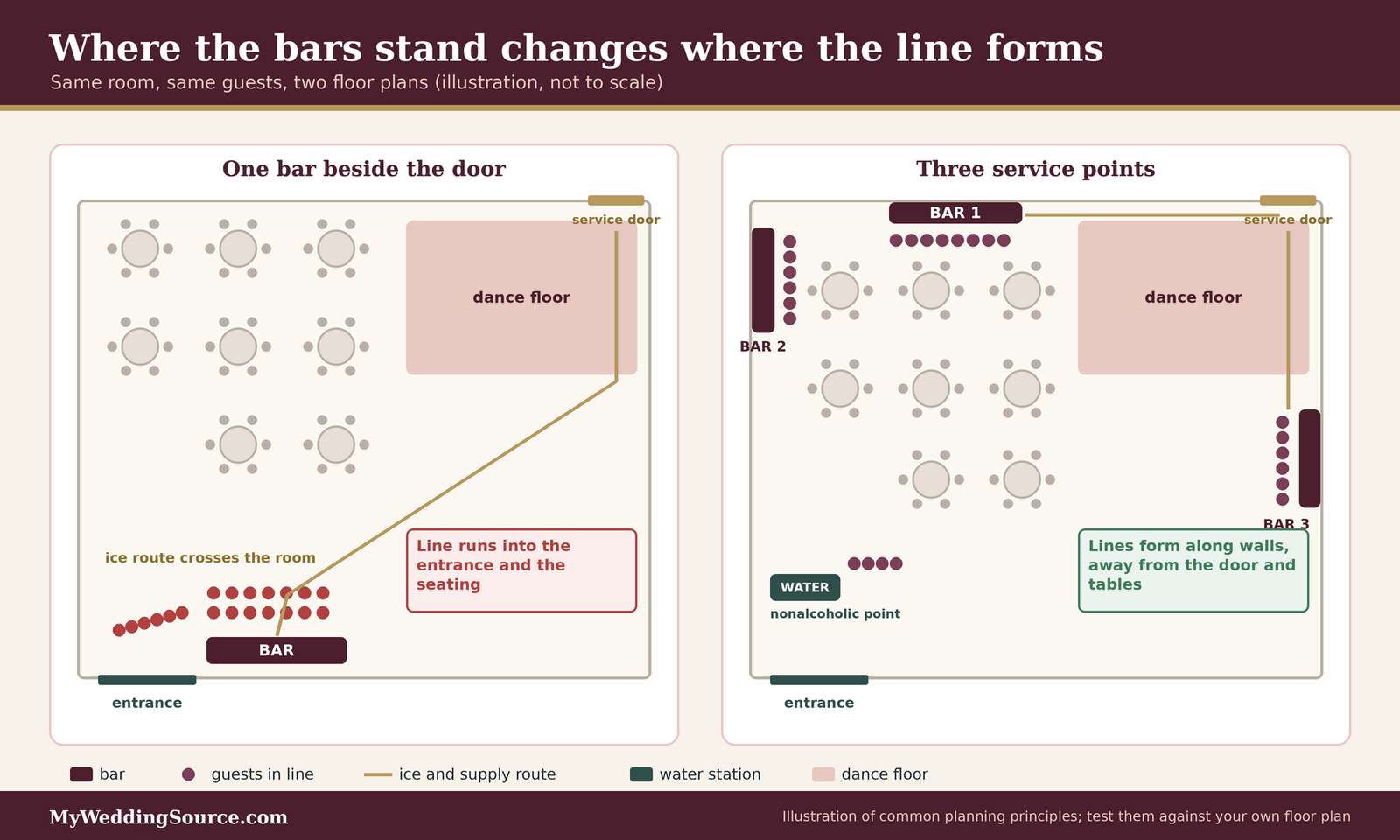
Separate the nonalcoholic and water points
A separate water and nonalcoholic station keeps a share of guests out of the main line. Guests who only want water, soda, or a mocktail, including drivers and pregnant guests, can order quickly, and the bartenders can focus on alcohol. This also normalizes the nonalcoholic choice, since it is the same quality of service. Zola’s guide to alcohol-free weddings suggests displaying a clear list of alcohol-free options at the bar all evening and adding an infused-water station for easy hydration, which supports the idea.
Queue space and traffic
A line takes physical room, and in wedding bar service planning the room is part of the layout. If it has nowhere to go, a line goes through whatever is nearby.
How much room a line needs
By Little’s law, the average number of people waiting equals the arrival rate multiplied by the average wait. In the worked example the arrival rate in the surge is 7.2 guests per minute. If the average guest spends about seven minutes waiting and being served, which is plausible with three or four bartenders at the busiest moment, then 7.2 multiplied by 7 puts about 50 people in the system at once (our arithmetic). As our own planning assumption, a single-file line takes about two feet of floor per person, so fifty people is about 100 feet of line, and two bars that split the crowd would need about 50 feet each. A real crowd bunches into a cluster, not a file, but the footage shows the scale. Measure that distance on your floor plan. If the line would run through a seating area or a doorway, add a service point, change the shape of the queue, or move the bar.
Keep the line away from other work
Servers carrying trays, photographers, the band or DJ, and guests going to restrooms all move through the room. The line should not cross those routes. Leave a clear aisle behind the queue, and where possible set the bar with its back against a wall so the line forms along it, not across the room. Our wedding reception guide covers how the other parts of the reception use the floor, and our wedding table settings guide shows how tables and aisles take up space.
Behind the bar and at the door
A bar has a back side, and failures in wedding bar service planning usually start there.
Back-of-house route
Draw the route that staff take to bring ice, cases, glassware, and trash to and from the bar. It should not cross the guest queue. Ask the venue where ice and coolers can be stored, where the nearest water source is, and where used glassware goes. A caterer’s published bartending page says that a standard bar needs no electrical connection, but that a frozen drink machine does, so if your menu includes a machine or a cooler that plugs in, mark the outlet on the plan.
Access for every guest
At least one service point should be usable by a wheelchair user, a short guest, or a child. The 2010 ADA Standards for Accessible Design describe, for sales and service counters, an accessible portion at least 36 inches long and no more than 36 inches high, with clear floor space for a parallel approach. Whether the ADA applies to a private event depends on the venue and the facts, so ask the venue, and treat this as a design reference, not legal advice. If your bar top is higher than that, add a lower section or a table where a bartender can hand over drinks. Our accessible wedding venue guide shows other points to check.
Wedding bar service planning for ice: counting, storing, and keeping it safe
Ice is the most consumed and least planned item in wedding bar service planning. It also melts, which makes the arithmetic a bit different from other supplies.
Why published ice rules for wedding bar service planning disagree
If you search for how much ice you need, you will find answers that differ by a factor of ten. The reason is that they are answering different questions.
Three published rules for the same event
Cascadia Liquor’s event checklist plans for about one pound of ice per guest, which it says covers mixing drinks and keeping beer and wine cold. Reddy Ice, an ice company, recommends one to two pounds of ice per person attending. John Mahlmeister, the COO of Easy Ice, writing in Total Food Service, advises about one pound of ice per guest for each hour of the event, and says that the amount doubles when the party is outdoors. For a five-hour, 150-guest reception, our arithmetic gives about 150 pounds under the first rule, 150 to 300 under the second, and about 750 indoors or 1,500 outdoors under the third.

What explains the gap
The rules differ in what they count. The per-guest rules read as if they were sized for a party of a few hours that includes drinks and some chilling, though they do not say so. The per-hour rule scales with event length and treats melt as the main driver, which it is for a long outdoor day. None of the sources states exactly what it includes, so we do not know which one fits your reception. This is a good reason to ask your bartending company what it brings and to count your own uses, which the next section shows.
Count your own ice by use
A better approach to ice in wedding bar service planning is to separate the uses and estimate each. It is more work, and it gives a number you can defend.
The four uses
Ice does four jobs at a reception: it goes into drinks, it chills bottled and canned beverages and wine, it keeps food cold if the caterer uses it, and it melts, which is a loss you replace. Easy Ice’s article notes that food needs extra ice depending on the temperature and whether storage is insulated. Count drinks first, then chilling, then add a melt allowance.
A worked example for a hundred and fifty guests
In our model the reception has about 870 orders over five hours, 270 in the first hour plus 150 per hour for four more. Suppose 70 percent are served over ice, and assume, as our own rough estimate, that an iced drink uses roughly 4 to 6 ounces of ice by weight, since cubes leave air gaps in the glass. That is about 150 to 230 pounds for drinks. Add enough ice to chill the bottles, cans, and wine you plan to serve cold, which depends on your list and containers, and add a melt allowance that grows with heat and open-air storage. Drinks alone reach about as much as the lowest published figure of 150 pounds, and chilling and melt add to that, so in warm weather the total can reach the 300-pound end of Reddy Ice’s range or go beyond it. Treat this as a planning estimate and ask your vendor for its own.
Storage, handling, and melt
Ice is a food, and in wedding bar service planning it can be mishandled like one. Storage affects how much you need.
Ice is food
The FDA treats packaged ice as a food regardless of shape or water source, and advises handling it with clean, non-breakable utensils such as tongs or a scoop, avoiding contact with dirty hands or glasses, and storing it in clean, food-safe containers. A health department fact sheet adds practical points: use ice from an approved source, never scoop with a glass, inspect each bucket for cleanliness, cover storage containers, and clean the outside of a bag before opening it. In practice, ask your bartenders how they handle ice, and give guests a scoop at any self-serve station.
Separate drink ice from chilling ice
Mahlmeister recommends two separate supplies, one for bottles and cans and one for drinks, and asking guests not to take cubes from the bottle-and-can bin. He also suggests solid cubes outdoors, plastic coolers in hot weather because metal conducts heat to ice faster, and putting bottles on ice well before guests arrive: about 15 minutes for twelve-ounce bottles, 20 to 30 minutes for larger bottles, and at least 30 minutes for a large bin full of bottles and cans. The consequence for the plan is that ice must arrive and be set before the doors open, not at the first rush.
Delivery, timing, and a backup plan
Ice is perishable in an unusual way: it disappears. That affects when it is delivered and what you do if it runs out.
Who delivers and when
Ask the bartending company whether ice is included, whether it is delivered or you must supply it, and who handles the bagged ice. The Bash lists “Should we supply the ice?” among its questions for bartenders. If ice is yours to supply, ask your venue about freezer space and where deliveries can be received, and schedule delivery close to setup, not the day before. Our wedding vendor timeline guide shows how to sequence arrivals.
What to do if it runs low
Agree on a backup plan: a second supplier on call, a nearby store, and a person, such as a venue staff member or a trusted friend, who is responsible for going. Reserve an amount you will not use unless needed, such as one extra delivery or a number of bags kept in storage. A short, clear plan costs nothing until you need it.
Nonalcoholic choices in wedding bar service planning
Nonalcoholic drinks deserve the same attention as the rest of wedding bar service planning. They serve more guests than most couples expect, they take pressure off the main line, and they decide whether some guests feel looked after or left out.
Treat nonalcoholic drinks as part of wedding bar service planning, not an afterthought
A cooler of soda in the corner is hospitality at its lowest effort. A planned nonalcoholic menu is not much harder, and it changes how the whole bar feels.
Who orders nonalcoholic drinks
Many different guests order nonalcoholic drinks. Some do not drink alcohol at all, whether for religious reasons, health reasons, recovery, or preference. Some are driving. Some are pregnant, and the CDC states there is no known safe amount of alcohol during pregnancy and no known safe time to drink. Some are children and teenagers. Some are drinking alcohol earlier and switch later. Planning for these groups is not a matter of guessing who is who. It is a matter of making the nonalcoholic options good enough that anyone is happy to order them.
Quality is the point
Zola’s guide to alcohol-free weddings suggests creating a nonalcoholic signature drink for cocktail hour, making alcohol-free versions of well-known cocktails, offering sparkling water or juice so every guest has something to toast with, and adding themed stations such as hot chocolate in winter. The Knot’s guide to nonalcoholic drinks argues that soda, water, and juice are often assumed to be enough, but that they fall short of a festive option for guests who are not drinking, and it suggests asking whether a signature cocktail can also be made alcohol-free. We agree with the principle. A guest who gets a drink as thoughtful as everyone else’s does not need to explain why they are not drinking alcohol. Our wedding mocktails guide covers recipes and costs in detail.
What to put on the nonalcoholic menu
A short menu with a clear structure serves most weddings and keeps wedding bar service planning simple. The categories below can be mixed to fit your budget and season.
The base layer: water, soda, and juice
Every bar needs cold water in a form guests can reach without a bartender, ideally still and sparkling, with ice and a scoop or a spigot. Add two or three sodas and a juice or two. These are also the mixers for the alcoholic menu, so they serve two purposes. Spec’s suggests offering three or four mixer options and gives a rule of about one liter of mixer per three guests in its example of a bar that serves liquor, which is a useful starting point for the shared stock, though it is a rule for mixers, not a nonalcoholic forecast.
The special layer: mocktails and zero-proof choices
On top of the base, add one or two drinks that feel like cocktails. A mocktail version of the signature drink is the simplest. Alcohol-free spirits, beers, and wines exist, and The Knot’s guide names several brands of alcohol-free spirits, wines, and canned spritzes, though we cannot compare quality, and tastes differ. Look for products with clear labels, since labeling rules for these products are specific, as the next section explains. Cascadia Liquor’s checklist suggests at least one or two mocktails for guests who do not drink alcohol, and we think more variety is reasonable at a large wedding. For a daytime wedding, Zola suggests considering high tea or espresso-based drinks.
Labels, allergens, and special needs
Nonalcoholic does not mean simple. A few facts keep the menu accurate and safe.
What “nonalcoholic” means on a label
According to a March 2026 National Law Review summary of federal guidance from the Alcohol and Tobacco Tax and Trade Bureau, beverages under 0.5 percent alcohol by volume are not treated as alcoholic beverages and may be labeled “alcohol free” or “non-alcoholic”, while beverages of 0.5 percent or more that have less alcohol than their traditional counterparts fall into a low-alcohol category regulated much like other alcoholic beverages. In practice, a product labeled nonalcoholic can contain a trace of alcohol. Guests who must avoid alcohol entirely, such as some guests in recovery, may want to know. A short tag at the bar with the product name makes asking easy, and a bartender who knows the labels can answer.
Allergens and ingredients
The FDA lists nine major food allergens: milk, eggs, fish, crustacean shellfish, tree nuts, peanuts, wheat, soybeans, and sesame. Mocktails and syrups can contain nut-based syrups, dairy, egg white, or honey, among other ingredients. The FDA also notes that most alcoholic beverages are regulated by other federal agencies, so allergen labeling on alcoholic products may not follow the same pattern as food labels. Ask your bartenders to list ingredients for each signature drink, post them at the bar, and put an allergen note on the menu card. Our wedding dietary restrictions guide covers the food side of the same conversation.
How much nonalcoholic drink to plan
We found no published per-guest forecast for nonalcoholic drinks at weddings, so this section gives a method and labels the inputs as assumptions.
A method you can adjust
Start with the number of guests who will order nonalcoholic drinks, which includes everyone at some point, since most guests drink water. Multiply by drinks per hour and by hours. For water and soft drinks, count every guest. For mocktails and zero-proof drinks, count only the guests you expect to choose them. In our worked example, 30 of 150 guests order nonalcoholic drinks and, by our assumption, one per hour, which adds about 30 orders in the first hour and 150 across five hours when combined with the others. Bump the figure up for heat, for a dry reception, or for a long dance period.
Make it easy to order, and easy to refill
Place a water station where guests can serve themselves, and refill it on a schedule. Label dispensers. Offer nonalcoholic drinks at the main bar with the same attention. Offer pitchers on tables during dinner. Our summer wedding heat plan guide covers hydration logistics for hot days in detail, and our wedding signage guide shows how to post a drink menu that guests will read.
Running the night: timing, pacing, and care for guests
Wedding bar service planning that works on paper still has to meet a schedule and a roomful of people. A few habits keep it steady.
Open, pace, and close with the schedule
Wedding bar service planning runs on the same clock as the rest of the reception. Link its milestones to your timeline.
Build the bar into the timeline
Open the bar a few minutes before guests arrive, with ice set, glassware ready, and mixers chilled. Decide when the bar closes for dinner service if it does, when the toast is poured, when the bar reopens, and when last call happens. Write these times on the day-of timeline, and share it with the lead bartender and your coordinator. Our wedding day timeline guide helps you place these moments, and the wedding vendor timeline guide covers arrival times.
Plan the toast
A toast wave needs a plan. Decide whether servers pour sparkling wine at tables or guests collect it at the bar, and what nonalcoholic option is poured for guests who do not drink alcohol. Cascadia Liquor suggests about one bottle of sparkling wine per seven to eight guests, and Spec’s notes about six glasses per bottle in smaller flutes. Make sure a nonalcoholic sparkling option is poured at the same time, so no guest toasts with an empty glass.
Look after every guest in wedding bar service planning
A well-run bar looks after the people at it. This is a hospitality job and a safety job.
Pour responsibly and agree on a policy
Ask your vendor about its policy for checking identification, for refusing service, and for what the bartender does if a guest seems unwell. Server-training programs such as TIPS exist, and one caterer’s published page says its bartenders are TIPS certified, though training and legal requirements differ by state. Tell the lead bartender who to call, a coordinator or a family contact, if a guest needs help, and give that person authority to act. This is general information, not legal advice.
Think about the ride home
Guests who have been drinking need a safe way home. Share transportation options on the wedding website, arrange shuttles if the venue is remote, and consider having a list of local ride services. Our wedding transportation guide covers shuttles and timing.
Edge cases that break a bar plan
Most wedding bar service planning holds until one thing changes. The cases below are the ones that most often change the arithmetic.
Weather and setting
The setting changes ice, speed, and safety.
Outdoor heat
Heat changes three things. Ice melts faster, and Easy Ice’s article says the amount of ice doubles when a party is outdoors. Guests drink more water, so the water station needs more capacity. Perishable garnishes and anything dairy-based need care: foodsafety.gov says to refrigerate perishable food within two hours, or within one hour when temperatures exceed 90 degrees Fahrenheit, which is a rule written for food, and we apply it by reasonable inference to cut fruit and cream. The CDC lists alcohol among substances that can increase heat-related harm, noting increased sweating and urination, so a bar plan for a hot day should lean toward water access, shade, and pacing. Read our summer wedding heat plan for the wider plan.
Rain, tents, and winter
A tent can shorten the distance between bar and guests and add power or lighting needs, so check where bars can be placed once a tent goes up. Rain moves cocktail hour indoors and changes where lines form, so redraw the floor plan for the rain location. Our wedding rain plan guide helps with the larger switch. In cold weather, Reddy Ice notes that an indoor winter wedding may require less ice, though it gives no figure, and hot drinks or a hot chocolate station may add warmth and variety. See also our winter wedding weather plan.
Size and format
The bar’s format changes your wedding bar service planning.
Small weddings and self-service bars
The Knot says that self-service bars suit small weddings, and that many public venues require a certified, insured bartender on site. A self-serve bar changes the plan: no bartenders to staff, but guests handle ice, openers, and glassware, so give them scoops, clear labels, and a person to restock. At a small gathering, the models in this guide shrink to a simple check: how many guests, how many service points, and who refills. Our micro wedding planning guide covers the small-wedding picture.
Large weddings, tickets, and cash bars
Large guest counts make the peak model matter more, because a small percentage error in the surge becomes a large line. The Knot describes drink tickets as a way to control cost and consumption, and says a cash bar requires a provider with the right license to sell alcohol. Tickets and payments add a handling step to every transaction, which slows service and shifts the numbers in our throughput model. Our open bar wedding guide covers those formats from the budget side.
Venue and vendor constraints
Contracts and venues can fix part of your wedding bar service planning before you start.
Exclusive caterers and house bars
Some venues require you to use their bar or their caterer. Where that is so, your levers are narrower: you can still ask about staffing by the hour, number and location of stations, the menu, and ice. Ask early, and ask the venue to confirm the right to add a station, since extra stations may carry a fee.
When a vendor says no
If a venue or caterer says no to a request, ask what it will do instead. A request to add a nonalcoholic station can be answered with a pitcher station at the buffet. A request to add a second bar can be answered with a servers’ tray at cocktail hour. Writing the answer into the contract makes it a commitment.
Questions to ask before you sign for wedding bar service planning
Take these questions about wedding bar service planning to your caterer, bartending company, and venue. They turn the models above into answers you can compare. Keep the answers in writing, and ask for the figures behind any statement of speed or quantity.
Questions to ask your bar vendor and venue
- Who holds the alcohol license for the event, and who is allowed to pour?
- How many drinks per bartender per hour do you plan for on my menu, and how did you get that number?
- How many bartenders, bar backs, and service points do you recommend for my guest count and room, and can staffing change by the hour?
- Where will the bars stand, and can you mark them on my floor plan with the line space shown?
- What ice is included, how much do you bring, and who restocks it?
- What nonalcoholic drinks and mocktails are included, and can the signature drink be made alcohol-free?
- How do you handle a guest who has had too much, and who is your lead on the night?
Questions about people and positions
These questions test whether the staffing and the layout in your wedding bar service planning match your room.
Staffing and speed
Ask what number of drinks per hour a bartender can serve on your menu. A seasoned vendor will have an answer, and a vague reply is a signal to ask for a reference event of similar size. Ask what the plan is for the first hour, whether any additional staff can be added for it, and whether there is a minimum shift length. Ask how breaks are handled and what happens if someone is sick or late.
Positions and floor plan
Ask for a drawing. A vendor who sketches bar positions, queue space, and the supply route shows that they have thought about the room, and a vendor who says “we’ll figure it out” may mean it. Ask the venue whether any location is off limits, whether the floor can handle a bar and coolers, and where power and water are.
Questions about supplies and choices
These questions confirm what the bar will actually have.
Ice, glassware, and mixers
Ask how much ice the vendor brings per event, how it is stored, how it is protected from melting, and what the backup is. Ask whether glassware is included, whether disposable cups are available for a self-serve station, and what the policy is for breakage. Ask about mixers, garnishes, and how perishable items will be kept cold.
Nonalcoholic service and special needs
Ask whether nonalcoholic drinks cost extra, whether the vendor can make a mocktail version of the signature drink, which products are used, whether any contain trace alcohol, and how allergens are handled. Ask how the vendor will label the menu. Ask for the same attention for nonalcoholic guests as for everyone else.
FAQ: wedding bar service planning questions
Staffing and lines
How many bartenders do I need for a wedding?
Published guides range from one bartender per 50 guests to one per 75, and Zola suggests one bar station per 75 to 100 guests. Menu matters: a cocktail-heavy menu slows each bartender. Test your own numbers with the waiting-time method in this guide, and ask your vendor how many drinks per hour they plan for.
Why is the line so long at the start of a reception?
Most guests order in the first hour, and many order at once when the ceremony ends or the doors open. Published guidance describes about two drinks per guest in the first hour and one per hour afterward. A bar sized for the average hour can still produce a long wait at that peak, so plan for the busiest fifteen minutes.
Is one bar enough?
For a small gathering, one bar can be enough. Zola suggests one station per 75 to 100 guests to avoid long lines, so a larger wedding usually benefits from two or more service points, placed away from entrances and the dance floor so queues do not block traffic. Staff and room still matter more than the count alone.
Ice and supplies
How much ice do I need for a wedding bar?
Published rules differ widely: about one pound per guest, one to two pounds per person, or one pound per guest per hour, doubled outdoors. For 150 guests over five hours, that spans roughly 150 to 1,500 pounds. Count drinks, chilling, and melt separately, and ask your vendor what it includes.
Can guests take ice from the bin where the drinks are chilling?
It is better not to. An ice-company executive recommends keeping separate ice for drinks and for bottles and cans, and asking guests not to take cubes from the bottle-and-can bin. The FDA advises handling ice with clean scoops or tongs, and a health department fact sheet advises never scooping ice with a glass.
When should the ice arrive?
Before guests do. The same ice executive suggests putting twelve-ounce bottles on ice about fifteen minutes ahead, larger bottles twenty to thirty minutes ahead, and a large bin of bottles and cans at least thirty minutes ahead. Schedule delivery close to setup, and confirm who receives it and where it is stored.
Nonalcoholic choices and care
What nonalcoholic drinks should a wedding bar offer?
Offer cold water, a few sodas, juice, and one or two drinks that feel special, such as a mocktail version of the signature cocktail or sparkling nonalcoholic wine. Zola and The Knot both suggest making the nonalcoholic options festive, and Cascadia Liquor suggests at least one or two mocktails. Post ingredients so guests with allergies can choose safely.
Does a nonalcoholic drink contain no alcohol?
Not always. According to a March 2026 summary of federal guidance, beverages under 0.5 percent alcohol by volume may be labeled alcohol free or non-alcoholic. Guests who need to avoid all alcohol, including during pregnancy where the CDC says no amount is known to be safe, may want to check the label or ask the bartender.
Your next steps
Put your wedding bar service planning numbers on one page
Fill in the demand and capacity model
Write down your attending guests, the share who will order alcohol, your first-hour drinks, and your peak share. Then ask your vendor for drinks per bartender per hour on your menu and compute the wait for two, three, and four bartenders. This takes less than an hour and gives you something specific to discuss.
Draw the room
Sketch the floor plan, mark entrances, the dance floor, seating, and restrooms, then place bars and measure the queue space. Add the ice route, the water station, and the nonalcoholic point. Share the drawing with your venue and your vendor before you sign.
Connect wedding bar service planning to the rest of the plan
Confirm rules and timing in writing
Collect the venue’s rules on who may pour, the vendor’s license and insurance, the staffing plan, and the schedule for opening, the toast, and last call. For the wider checklist, use our wedding planning checklist. Once the contract is in hand, our wedding vendor contract guide lists the clauses worth reading twice.
Go deeper where you need it
If the budget is the sticking point, read our open bar wedding guide. For ice, a dedicated wedding bar ice planning guide is coming. To choose the person behind the bar, see choosing a wedding bartender, and for ticket systems see our wedding drink ticket system guide. For the venue side of the plan, start with our wedding venues guide.
Sources & methodology
How we built this guide
What we relied on
This guide combines published guidance from federal and public-health sources on standard drinks, alcohol and pregnancy, food allergens, packaged ice, food safety, labeling of low and no alcohol beverages, accessible counters, and liability, with planning advice from wedding publications, a liquor retailer, an ice company, a caterer, and a beverage consultant. Where a statement comes from a vendor or retailer we say so, because vendor advice reflects the seller’s products and habits. The demand, throughput, waiting-time, line-length, and ice figures in the worked example are our own arithmetic from the stated assumptions, including the assumptions that 40 percent of first-hour drinks fall in the busiest fifteen minutes, that a guest transaction averages 1.3 drinks, that bartenders work at 70 percent efficiency, and that an iced drink uses about 4 to 6 ounces of ice. They are illustrations, not measurements. Pages were checked on November 12, 2026, and prices, rules, and guidance can change after that date.
What we did not do
We did not time bartenders, survey couples, collect vendor quotes, or test any bar layout. We could not find published throughput figures or a published study of bar queues at weddings, so the model is ours. We did not give legal, medical, or financial advice, and alcohol laws, licensing, and liability differ by state, county, and venue, so confirm them locally. Vendors and retailers named here are cited as sources of published claims, not as endorsements. We have not claimed any payment or commission relationship with a source.
Source list
Government, public-health, and regulatory sources
- Centers for Disease Control and Prevention, About standard drink sizes: https://cdc.gov/alcohol/standard-drink-sizes/index.html
- National Institute on Alcohol Abuse and Alcoholism, What is a standard drink: https://www.niaaa.nih.gov/alcohols-effects-health/overview-alcohol-consumption/what-standard-drink
- Centers for Disease Control and Prevention, About alcohol use during pregnancy: https://www.cdc.gov/alcohol-pregnancy/about/index.html
- U.S. Food and Drug Administration, Food allergies: what you need to know: https://www.fda.gov/food/buy-store-serve-safe-food/food-allergies-what-you-need-know
- U.S. Food and Drug Administration, FDA regulates the safety of packaged ice: https://www.fda.gov/food/buy-store-serve-safe-food/fda-regulates-safety-packaged-ice
- FoodSafety.gov, Four steps to food safety: https://www.foodsafety.gov/keep-food-safe/4-steps-to-food-safety
- FoodSafety.gov, home page: https://www.foodsafety.gov/
- U.S. Access Board, 2010 ADA Standards, Chapter 9, Built-in elements: https://www.access-board.gov/ada/chapter/ch09/
- Interagency Coordinating Committee on the Prevention of Underage Drinking, Report to Congress 2022, Dram shop liability: https://www.stopalcoholabuse.gov/media/ReportToCongress/2022/profile_summaries/dram_shop_liability.pdf
- Centers for Disease Control and Prevention, Heat and medications guidance for clinicians: https://www.cdc.gov/heat-health/hcp/clinical-guidance/heat-and-medications-guidance-for-clinicians.html
- District of Columbia Department of Health, Fact sheet: Ice as a food: https://dchealth.dc.gov/sites/default/files/dc/sites/doh/publication/attachments/Fact%20Sheet%20-%20Ice%20as%20a%20Food.pdf
- National Law Review, TTB releases low and no alcohol beverage guidance (March 16, 2026): https://natlawreview.com/article/ttb-releases-low-and-no-alcohol-beverage-guidance
Wedding industry and planning sources
- The Knot, Wedding bar types: https://www.theknot.com/content/types-wedding-bar
- The Knot, Nonalcoholic wedding drinks: https://www.theknot.com/content/non-alcoholic-wedding-drinks
- Zola, How much should you budget for an open bar at your wedding: https://zola.com/expert-advice/how-much-should-you-budget-for-an-open-bar-at-your-wedding
- Zola, How to plan a sober wedding: https://www.zola.com/expert-advice/how-to-plan-a-sober-wedding
- The Bash, How to hire a wedding bartender: https://www.thebash.com/articles/how-to-hire-a-bartender-for-your-wedding
Retailer, caterer, ice, and technical sources
- Spec’s, How to plan an open bar for a wedding: https://static.specsonline.com/blog/open-bar-wedding-planning
- Cascadia Liquor, Event alcohol planning checklist: https://www.cascadialiquor.com/pages/event-alcohol-planning-checklist
- Rocklands Catering, Bartending services: https://rocklands.com/catering/services/bartending/
- Reddy Ice, How much ice you need for a party: https://www.reddyice.com/how-much-ice-you-need-for-a-party
- Total Food Service, John Mahlmeister of Easy Ice, Catering outdoor events: how to maximize ice supply: https://totalfood.com/catering-outdoor-events-how-to-maximize-ice-supply/
- PCMA Convene, Kathy Casey, 3 ways to speed up your event beverage service: https://www.pcma.org/beverage-service-tips-kathy-casey-events-cocktails/
- Wikipedia, Little’s law: https://en.wikipedia.org/wiki/Little%27s_law
- OnTheFly Tapsters, How much alcohol do you really need: https://www.ontheflytapsters.com/blog/how-much-alcohol-do-you-really-need-for-your-wedding-or-event