

Portable restrooms for outdoor weddings succeed or fail on three questions that most couples never ask in the same conversation: how many units your guests will really need at the busiest moment, whether they can be placed where trucks and wheelchairs can reach them, and who keeps them usable from the first guest to the last.
Quick answer
Published unit counts for portable restrooms for outdoor weddings disagree widely. For the same 250-guest, six-hour reception, the sources we read range from 2 units to 8, depending on whether the rule is a public-event minimum, a vendor’s comfort guideline, or a council’s licensed-event table. So do not accept a bare number. Ask your vendor to show the count, the hours, the alcohol assumption, the accessible units (at least 5% of a cluster, and never fewer than one, under U.S. accessibility rules), the handwashing plan, and who services the units during the event. Then walk the ground after rain, because a unit that cannot be delivered, reached, or entered is not capacity at all. This guide is planning education, not legal, engineering, or health advice.
What portable restrooms for outdoor weddings have to do
An outdoor wedding site that has no permanent restrooms, or too few of them, puts the whole guest experience on rented equipment. Guests will forgive a late cake and a breezy ceremony, but a long line in the dark, a unit that has run out of paper, or an entrance a grandparent cannot reach tends to be the part people remember. This guide treats portable restrooms for outdoor weddings as a small system with three parts: capacity, access, and service. It shows how to estimate each one, what to put to your vendor, and how to document the answers.
If you are still choosing a site, our outdoor wedding venues guide covers the larger decision. If you want the whole set of systems that sit beside restrooms (tents, power, water, weather, and layout), our outdoor wedding infrastructure checklist is the hub for that work. This article goes deeper on portable restrooms for outdoor weddings only.
Capacity, access, and service are three separate questions
Vendors often fold these together into one quote line, such as “six units, delivered Friday.” That line hides three different decisions, and a gap in any one of them can undo the other two.
Capacity is about lines at the busiest moment
Capacity for portable restrooms for outdoor weddings is not only a count of toilets. It is the number of people who need a toilet in a short window, divided by the number of toilets, multiplied by how long each visit takes. At a wedding, demand is bunched: everyone has been seated for a ceremony, and then a door opens. The Portable Sanitation Association International (PSAI) makes a related point in its public brochure, saying a relay needs more units than a come-and-go art fair because people tend to use restrooms at the same time. A wedding with a fixed program behaves more like the relay than the art fair.
Access is about getting to a unit and through its door
A unit has to be delivered, set level, reached by a firm route, and opened by every guest who needs it. The U.S. Access Board describes accessible portable units as needing an accessible route and entrance, and any ramp for a change in level has to comply. A grassy lawn can hold a unit but not always a wheelchair route to it, which is why access and placement belong in the same conversation.
Service is about hour five, not hour one
A unit that is clean when the truck leaves can be a problem six hours later. Service covers supplies, cleaning, any mid-event visit, and who checks on the units while the party is running. PSAI says restrooms need to be cleaned and sanitized often enough to stay ahead of unpleasant conditions, and it notes that experienced providers may push back on cutting service or unit counts to save money.
Who decides what
Four parties touch the restroom decision, and each controls a different piece. Writing down who owns what prevents the common situation where the venue assumes the vendor checked the route, the vendor assumes the venue approved the spot, and nobody told the caterer.
What the venue and local authorities control
The venue controls where vehicles can drive, where the ground is safe to place equipment, whether it has existing restrooms you may or may not use, and which vendors it requires or restricts. Local authorities may have their own rules for special events, sanitation, and sometimes occupancy, which vary by city and county. Our wedding permits guide explains how to ask which approvals apply. We do not publish a universal rule, because the rule that matters is the one that governs your site.
What the restroom vendor controls
The vendor controls the unit types, the count they recommend, delivery and pickup windows, the servicing plan, the accessible units, handwashing options, and their own insurance and equipment condition. A good vendor will visit the site or look at photographs and ask about the ground, the route, the hours, and the bar, and a vendor who quotes without asking any of those questions is working from a template.
What you and your planner control
You control the guest count you give them, the program timing, the alcohol plan, the budget, and the willingness to put every answer in writing. If you have a planner or coordinator, the plan for portable restrooms for outdoor weddings is a good item to hand them with a named owner and a review date, as described in our wedding vendor timeline guide.
Why the published unit counts disagree
Anyone who searches for “how many portable restrooms do I need for a wedding” finds a spread of answers, and the spread is not a sign that someone is wrong. The sources are answering different questions. Some are setting a regulatory minimum for public events, some are giving a vendor’s comfort guideline, some come from a council that licenses events with alcohol, and some are workplace rules that were never meant for guests in dress shoes.
We read seventeen pages while researching this article. This is what each type of source says, in our paraphrase, so you can see why the numbers for portable restrooms for outdoor weddings differ.
Industry and vendor guidance
Most of what couples find first about portable restrooms for outdoor weddings comes from industry associations and rental companies. These sources are useful because they reflect how units are actually used, but they also reflect the seller’s products, so we label each one.
The industry association and the retailers that cite it
PSAI’s public brochure says unit counts should account for attendance and duration, hot weather, food and drink service, special needs, and terrain. It gives a worked example of about eight units for one thousand attendees over four hours for an event without pumping service, based on an even split of men and women, and it says to add ten to twenty percent more units if alcohol is served. BigRentz, an equipment rental marketplace, summarizes event guidance it attributes to PSAI. It says to add ten to twenty percent for food and drink, fifteen to twenty percent for alcohol, and that events over four hours may need more. Its examples include one unit for fewer than fifty guests with no food or drink over two hours, and three to four units for two hundred fifty guests over six hours with light cocktails and snacks. Those figures are the retailer’s summary, so ask your vendor which table they use.
Individual vendors with simple ratios
Satellite Industries, which makes portable sanitation equipment, says a common rule of thumb for standard portable units is one toilet per fifty guests for a full-day event, and that it advises a generous ratio for upscale clients because alcohol raises restroom use. Nisly Brothers, a rental company, suggests about one unit per one hundred people for a four-hour event, and at least two units for a wedding of any size, one of them accessible. A page on the emory.edu events site shows charts by guest count and event length, with separate figures for events with and without alcohol, and for two hundred fifty guests over six hours it shows about four units without alcohol and five with it. These are different companies using different assumptions, and they land in different places.
Government and council guidance
Public bodies write rules for events they license or approve, and their numbers for portable restrooms for outdoor weddings are usually tighter than comfort-oriented vendor guidance, or in one case, much looser.
Council and county tables for events
The Marlborough District Council in New Zealand publishes minimums for events over three hours, by peak attendance. For one hundred one to two hundred people it sets six toilets and two handwash stations, and for two hundred one to three hundred it sets eight toilets and two handwash stations. It allows a twenty-five percent reduction for events under three hours or without alcohol. This is a New Zealand council and not a U.S. rule, but it is one of the few published tables that is complete enough to compute from. A San Diego County environmental health document sets a much lower number: one toilet per one hundred fifty participants at a non-mobile event, at least one accessible toilet, and at least one handwashing station, with one more station for each set of required toilets beyond twenty. It allows a three-quarters reduction for events of five hours or less, but not when alcohol is served. That is a floor for a licensed public event and not a guest-comfort target.
State public health agencies
The Georgia Department of Public Health regulates portable sanitation units and the companies that furnish them in that state. Its brochure says to add twenty-five percent to the base number if alcohol is served, that ratios rise with attendance, event length, and hot weather, and that organizers and property owners must ensure units are serviced at least every seven days, or more often if usage requires. It also recommends placing units on flat ground that is easy for the public to reach and accessible to large service trucks, and as far from food vendors as practical. A weekly service interval is a general rule for rentals, and it does not tell you what a six-hour reception needs.
Why workplace tables do not apply
If you search for official numbers, the first table you find is often from the Occupational Safety and Health Administration.
What the OSHA table covers
OSHA’s sanitation standard, 29 CFR 1910.141, includes a table that sets the minimum number of toilets by the number of employees in a workplace, for example one for up to fifteen employees, two for sixteen to thirty-five, and so on. It also requires washing facilities with running water, soap, and towels or air blowers in workplaces, and it exempts mobile crews and unattended locations with ready transportation to nearby facilities. It is a workplace rule for employees and not a standard for portable restrooms for outdoor weddings.
How it still helps you
You can use it as a reference point for your own vendors. A caterer, photographer, band, and rental crew may work your site for many hours, and our wedding vendor meals guide covers the logic of treating them as people with needs. Ask the venue where crew can use a restroom and whether they are expected to share the guest units. We do not claim OSHA applies to your wedding, and you should not either.
One wedding, six answers
To see how far the sources spread, we applied each published rule to the same imaginary event: two hundred fifty guests, a reception of about six hours, and alcohol served. We rounded up, and the arithmetic is ours. The figure for each source depends on the assumptions we describe, and any one of them could change if the source’s full document says something we did not see.

Reading the spread
The spread is wide on purpose. The lowest figure comes from a public-event licensing floor that assumes people come and go. The highest comes from a council table for licensed events with alcohol and a peak crowd. The vendor and industry figures cluster in the middle. A couple who reads only the lowest number may design a long line, and a couple who reads only the highest may pay for more equipment than a short party needs.
What to do with a spread
Treat the range of counts for portable restrooms for outdoor weddings as a prompt for questions, not as a menu. Ask the vendor which rule they use, why, and what they assume about alcohol, hours, and when guests arrive. If they cannot explain it, ask a second vendor for a quote and compare the reasoning as well as the price. Our wedding vendor due diligence checklist can help with how to evaluate the answers. ## A capacity worksheet for portable restrooms for outdoor weddings
A worksheet for portable restrooms for outdoor weddings cannot replace a vendor’s judgment, but it can make you a better customer. It turns the vague phrase “enough restrooms” into inputs you can state, so the vendor can test them against their own tables. We built it from the factors that PSAI, the Georgia Department of Public Health, and the vendors above say change demand: attendance, duration, food and drink, alcohol, weather, special needs, and terrain.
Step one: write down the inputs
The inputs for portable restrooms for outdoor weddings are simple, but each one changes the answer, and couples often leave out the ones that raise it.
Guests, vendors, and the real peak
Start with the number of people on site at the same time, not only the guest list. That means guests, the wedding party, the officiant, the photographers, the band or DJ, caterers, bartenders, and rental crew still on site. Some guests will leave early and some vendors will arrive late, but the peak is what the units must handle. The Marlborough table is built around peak attendance for the same reason.
Hours on site, and when guests arrive
Count the hours from the first guest arrival to the last guest departure, not only the reception. Many outdoor weddings start with a ceremony, a cocktail hour, and a dinner, and a guest who arrives for a four o’clock ceremony and leaves after a late dance has been on site for longer than the invitation suggests. PSAI and BigRentz both say longer events may need more units.
Alcohol, food, heat, and who is attending
Mark whether alcohol is served and for how long, whether the meal is plated or buffet, how hot or cold the forecast looks, and whether there will be young children, older adults, pregnant guests, or guests who need accessible units. PSAI says hot days increase liquid intake and restroom trips, and that families with young children may need diaper-changing tables and child-sized seats. Our wedding bar service planning guide covers how alcohol service changes the rest of the evening.
Step two: run the published rules against your inputs
Take your inputs for portable restrooms for outdoor weddings to three or four of the rules above and compute a number from each. The table below does it for three guest counts, using our own rounding. Treat it as a demonstration of the method and not as a recommendation.
| Source and type | 80 guests | 150 guests | 250 guests | Assumption that matters |
|---|---|---|---|---|
| San Diego County event document (public-event floor) | 1 | 1 | 2 | One toilet per 150 participants; the three-quarters reduction is not allowed when alcohol is served |
| Nisly Brothers (rental company) | 2 | 2 | 3 | One per 100 people per four hours; two minimum for a wedding; the page also says to add for hours beyond four, but its example is unclear |
| Satellite Industries (equipment maker) | 2 | 3 | 5 | One per 50 guests for a full-day event |
| emory.edu events page (charts) | not given | not given | 5 | Two hundred fifty guests over six hours with alcohol, as read from the chart |
| BigRentz summary of PSAI | not given | not given | 3 to 4 | Two hundred fifty guests over six hours with light cocktails and snacks; the page adds more for alcohol |
| Marlborough District Council, New Zealand | 4 | 6 | 8 | Events over three hours with licensed alcohol, by peak attendance |
How to read the table
The rows for portable restrooms for outdoor weddings are not competing for the title of correct. They answer different questions. If a vendor quotes five units for one hundred fifty guests, the table says that is within the range, a bit above a mid-level ratio and below a council table for licensed events. If a vendor quotes two units, the table says to ask what assumptions make two enough, such as a short event, no alcohol, or a venue that already has permanent restrooms.
When to ask for more than the table
Add margin to your count of portable restrooms for outdoor weddings when the day is hot, when guests are arriving all at once from a shuttle, when the program has a long cocktail hour with an open bar, or when many guests are older or have small children. PSAI says special needs and weather change counts, and Georgia adds twenty-five percent for alcohol. You do not need to know the exact percentage to ask the vendor whether they have added any.
Step three: run a queue test
A count of portable restrooms for outdoor weddings tells you how many toilets exist. A queue test tells you what a guest will experience at the worst minute. It takes about five minutes with a calculator, and it is an estimate built on assumptions that you can change.
The calculation is simple: the number of people who will go in the surge window, multiplied by minutes per visit, divided by the number of units, gives the minutes it takes to clear the line. Here is a worked example with assumptions we chose for illustration, not measured values. Suppose one hundred fifty guests are on site, and one in three of them heads for a restroom in the fifteen minutes after the ceremony ends. That is fifty people. If a visit, including the walk to the door and the wait for the one ahead, takes two minutes, four units clear the line in about twenty-five minutes, six units in about seventeen, and eight units in about thirteen. If a visit takes three minutes, the same units take about thirty-eight, twenty-five, and nineteen minutes.
| Units available | Two minutes per visit | Three minutes per visit |
|---|---|---|
| 4 | about 25 minutes | about 38 minutes |
| 6 | about 17 minutes | about 25 minutes |
| 8 | about 13 minutes | about 19 minutes |
What the queue test shows
It shows that a count of portable restrooms for outdoor weddings that looks comfortable for a six-hour event can still create a long line at the single worst moment, and that the line shortens faster than most people expect when you add a unit or two. It also shows why a second set of units near the reception, or a ceremony-site cluster, can matter more than one extra unit in the main bank.
What the queue test does not show
It does not account for guests who wait until the surge passes, guests who skip the ceremony break and go during dinner, differences in how long men and women take, or toilets that are out of order or out of paper. It is a conversation tool. Share it with your vendor and ask them to adjust the assumptions with what they have seen at similar weddings.
Choosing unit types: standard, deluxe, accessible, and trailers
Once you know roughly how many people the units must serve, the next question for portable restrooms for outdoor weddings is what kind of unit. The type changes handwashing, comfort, accessibility, power and water needs, and cost, so it is worth deciding on purpose.
Standard and deluxe portable units
Standard units are the basic single-user cabins most people picture. Deluxe units add features such as a sink, flush, or better lighting, depending on the vendor.
What standard units include
Nisly Brothers says standard units have no sink and suggests a deluxe unit or a separate handwashing station, and that deluxe units include a freshwater sink with soap and paper towels, the water being non-potable. Ask what your vendor’s “deluxe” includes, because the name is not standardized across companies.
What to ask about capacity before service
Nisly Brothers says a standard unit holds about two hundred uses, and a towable unit with a roughly sixty-gallon tank holds about the same, before a technician must service it. That is one company’s statement, not an industry standard. Divide it by your expected usage, and then ask what happens if the number is exceeded during the party. At a two-hundred-guest wedding with alcohol, the number of visits per guest may be several, which is why a mid-event service visit is a reasonable question.
Restroom trailers
Trailers are small buildings on wheels, with several stalls, sinks, climate control, and finishes. Satellite Industries says standard portable units often fall short at upscale or remote weddings and that trailers suit couples who want flushing toilets, running water, climate control, and finishes that match the event’s look. PSAI says luxury trailer units cost more and are often used for weddings or events with VIPs.
Size, capacity, and counts
Satellite’s guide lists station counts by guest count: two or three stations for up to one hundred twenty-five guests, five stations for one hundred seventy-five to four hundred, six stations for up to three hundred fifty, eight for up to seven hundred fifty, and ten or twelve for five hundred or more. Those are the manufacturer’s figures, and the ranges overlap, so ask the rental company how it sizes its own fleet. A trailer with several stalls may serve the same number of guests as a bank of single units, but with a more even queue.
Power, water, and site demands
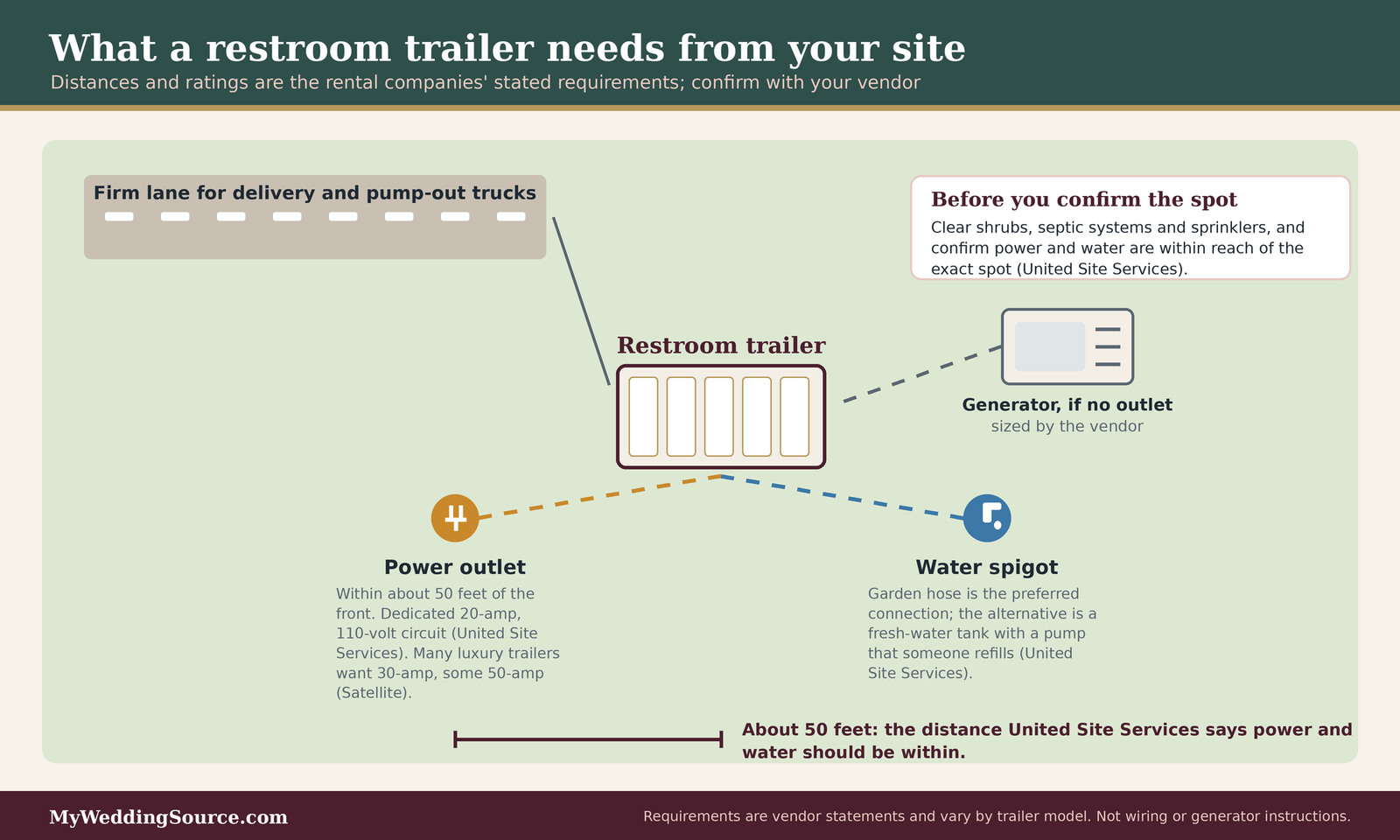
Trailers bring needs that other portable restrooms for outdoor weddings do not. United Site Services says a trailer needs a water source, preferably a standard spigot with a garden hose, or else a holding tank with a pump that someone must monitor and refill, and that a main power source should be within fifty feet of the front of the trailer, with a dedicated twenty-amp, one-hundred-ten-volt circuit and more outlets for larger trailers. Satellite says most luxury trailers need a dedicated thirty-amp service, some larger units need fifty, and a generator of appropriate size is needed if there is no shore power. These are vendor statements and vary by model, so ask the vendor for the exact requirements and have a licensed electrician or the venue’s electrician confirm the connection. We do not give instructions for wiring or generator sizing here. Our guide to wedding generator rental covers the generator side of that question.
Accessible units and the route to them
Accessibility for portable restrooms for outdoor weddings is both a unit question and a ground question, and the second half is the one that gets missed. Our accessible wedding guest experience guide covers the broader picture.
How many accessible units, and what a cluster means
The U.S. Access Board says that when single-user portable units are clustered, at least five percent of the units in each cluster must be accessible, and the requirement applies to portable units at temporary events. The Massachusetts Architectural Access Board states a similar rule for its state, five percent with at least one per cluster, including temporary events. The Colorado Springs guidance adds that if another group of units is not readily visible nearby or is in a distinctly different area, it counts as a separate cluster and needs its own accessible unit. For a wedding with a ceremony cluster and a reception cluster, that means each one needs its own accessible unit. Rental companies describe the ratio as roughly one in twenty. We are not lawyers, and rules differ by place and by who is hosting, so ask the vendor and the venue what applies at your site.
What an accessible unit has, and what the route needs
The Access Board says an accessible portable unit must meet the requirements for a permanent toilet room, including clearances, turning space, door maneuvering clearance, and compliant grab bars, and it must display the International Symbol of Accessibility unless every unit in the cluster is accessible. The Colorado Springs guidance gives specifics for that city: a door opening of at least thirty-two inches, an interior of at least fifty-nine by sixty inches, and a route and door approach on a firm, stable, slip-resistant, level hard surface at a two percent grade or less, with about sixty inches of clear space at the door. It says that routes of gravel, grass, or dirt are not allowed, though the unit itself may sit on those materials. That is one city’s guidance, but it shows the key point: the unit can stand on the lawn, and the way to it cannot be a soggy lawn. Ask your vendor what they supply, and whether they can provide a hard pad or ramp landing. ## A wet-turf placement assessment for portable restrooms for outdoor weddings
Most placement advice for portable restrooms for outdoor weddings assumes dry ground. Outdoor weddings are often held on lawns, fields, and orchards that are fine in August and soft after a week of rain, and rain on the morning of delivery is the most common reason a carefully planned layout falls apart. This section gives you a short assessment you can run on each candidate spot, once in dry conditions and again after rain, or by asking the venue what the spot is like after rain. It is built from what the sources say about ground, access, and the accessible route, and from plain observation. Where a source gives a number, we cite it. Where it does not, the assessment asks a question and does not invent a threshold.
Why wet turf changes the plan
Ground that supports portable restrooms for outdoor weddings on a dry day may not support the delivery truck, the service truck, or a wheelchair on a wet one. Three things change at once, and they pull the layout in different directions.
Delivery and service trucks need firm approach
PSAI says units need flat ground and that service trucks need nearby access, and that planners should arrange truck access in advance. The ZTERS delivery preparation sheet says to choose level, stable ground, to clear rocks, branches, and debris, and to leave enough space for a service vehicle. Neither page addresses wet or muddy conditions, so ask your vendor directly what they do when the lawn is soft, whether they carry ground protection, and who pays for any turf damage. The venue may have its own rules for vehicles on grass, which our wedding venue questions guide helps you raise.
The accessible route cannot be the grass
As the Colorado Springs guidance puts it for that city, the unit may sit on grass, gravel, or dirt, but the route and door approach must be firm, stable, slip-resistant, and level. After rain, a lawn path that was acceptable in a site visit can become the part of the layout that fails. Plan the route as its own object, with its own surface, and do not treat it as the space between units.
Water finds the low spot, and so does a flash flood
The National Weather Service safety page notes that floods can develop slowly, and that flash floods can occur within minutes and sometimes without any sign of rain. For a restroom plan, that means checking whether the spot is a low area where water collects or flows, and agreeing with the vendor on what happens if the forecast turns. Our wedding venue rain plan guide covers the broader rain decision.
The assessment: score each candidate spot
Walk each candidate spot, or have the venue manager walk it, and answer the questions below. The first column cites the source where one exists. A “stop” answer does not mean the spot is impossible. It means the issue needs a solution before you sign off on the spot.
| Check | Go | Ask the vendor or venue | Stop until solved | Basis |
|---|---|---|---|---|
| Ground under the unit | Level and stable, heel does not sink | Slightly soft or sloped; what do you use to level and stabilize? | Standing water, deep ruts, or a visible slope | PSAI and ZTERS call for flat, level, stable ground |
| Truck approach | Firm lane wide enough for the service truck, with turning room | Lane crosses soft lawn; will you lay protection or restrict to dry-day delivery? | Lane passes through a low spot or tight corner | PSAI, ZTERS, and Georgia DPH say trucks need access |
| Accessible route | Hard, level surface to the door with clear space in front | Grass or gravel route; can you add a pad or ramp landing? | No hard route and no way to make one | Colorado Springs guidance: route may not be grass, gravel, or dirt |
| Door approach | About sixty inches of clear, level space | Space is tight or sloped | Door opens onto a slope or step | Colorado Springs guidance, sixty inches and two percent grade or less |
| Surface changes | No lips or gaps along the route | A small lip at a pad edge | A step or gap at the unit entrance | Colorado Springs guidance: no more than one quarter inch, or one half inch if beveled |
| Low spots and drainage | Spot drains and is above nearby low ground | Water pools nearby after rain | Spot sits where water collects or flows | NWS flood warning on flash floods |
| Distance from food service | Clearly separate from food storage and service | Close; can you screen or move? | Downwind and next to food service | Georgia DPH and Marlborough say keep away from food |
| Light at night | Lit path from the reception to the unit | Some dark stretches | No lighting and a rough path | Our editorial judgment, see lighting note below |
| Connections (trailer only) | Power and water within the distance the vendor requires | Needs a long cord or hose run | No source and no generator plan | United Site Services and Satellite requirements |
How to run it in practice
Run the assessment at two moments. First, during a dry site visit with the venue, so you can compare candidate spots and mark the one you prefer and a backup. Second, in the week before the wedding, by phone or photograph, or in person if you can. If a spot passes only when the ground is dry, mark it as conditional and write down the fallback. Take dated photographs of each spot and the route, because they help if anyone later disputes what the site looked like.
Keep a fallback spot on paper
For each group of portable restrooms for outdoor weddings, name a primary spot and a backup, ideally on firmer ground, even if it is less convenient. That way the decision on the delivery morning is “use the backup” and not a new negotiation with a truck waiting. Put both spots on the site map described in our reception floor plan guide, and tell the venue and the vendor which one is the default.

Fixing what the assessment finds
When a spot fails, there are usually a few honest options. We list them as questions because the right answer depends on your site, your vendor, and your venue.
Move the unit, or move the route
The simplest fix is to relocate the unit group to firmer ground, near an existing path or a parking pad. A longer walk on a good surface is often better than a short walk on soft turf. Ask the venue whether there is a gravel lot, a paved service road, or a patio edge within a reasonable distance.
Add a hard surface where the route needs one
If the accessible route has to cross turf, ask the vendor whether they can supply a hard pad or ramp landing, and ask the venue whether it allows temporary ground protection and who installs it. The Colorado Springs guidance says sidewalk pads usually provide enough room for the door approach. We have not found a source that sets a standard for temporary event pads, so ask what they use and confirm that the finished route is level, firm, and without lips.
Change the unit type for wet conditions
A trailer on a hard pad, or a smaller number of units in a firmer spot, may be a better choice than many units on soft ground. That choice comes with its own weight and access considerations, so ask the vendor about delivery path, weight, and whether the trailer needs to be pulled across turf. Do not assume that a trailer is the answer, since it is heavier and bigger than a single cabin.
Placement, light, and the guest path
A spot for portable restrooms for outdoor weddings can pass the ground check and still be a bad one. Placement is about the guest’s walk, the photographer’s frame, the caterer’s workspace, and the smell on a warm evening.
Distance, direction, and view
Where portable restrooms for outdoor weddings sit affects the party more than most couples expect.
Keep units away from food, and out of the picture
Georgia DPH recommends placing units as far from food vendors as practical, and the Marlborough council says portable units should be clearly signposted and placed away from food storage and food service areas. Beyond food, think about the ceremony view, the first-dance spot, the photography backdrop, and where the sun and wind will be. A downwind spot near the dining tent is a poor choice on a warm day. Our wedding photographer shot list can help you think about what will be in the frame.
Close enough to use, far enough to ignore
Guests will not walk far in dress shoes at night, and they will not want to cross the dance floor. A reasonable test is to walk from the reception table to the units at an ordinary pace, in the shoes you plan to wear, and see how you feel about it. That is our own judgment, not a published threshold.
Light, signs, and the walk at night
The route matters after dark as much as the unit does.
Lighting the path and the doorway
Ask whether the units have interior lighting, whether the vendor supplies exterior lights, and who is responsible for lighting the path. Your lighting vendor or venue may handle this, and our wedding lighting guide describes what to ask. If power is limited, battery lanterns along the route are a simple option, and you should confirm with the venue that they are allowed.
Signs that guests can read
A short, clear sign with an arrow, placed where guests will make a decision, saves a lot of questions to the wedding party. Mark the accessible unit with the International Symbol of Accessibility, as the Access Board describes, and mark the accessible route as well. Our wedding signage guide covers style and placement.
Service during the event: supplies, cleaning, and handwashing
The condition of portable restrooms for outdoor weddings at the first toast and at the last dance are two different questions, and the answer depends on a plan that someone has to own.
Servicing and attendants
Service is the part of a quote for portable restrooms for outdoor weddings that is easiest to cut and the part guests notice most.
What a service plan can include
A service plan can include a pre-event clean and stock, a mid-event visit for pumping, cleaning, and restocking, a post-event pickup, and a person on site who checks supplies. PSAI says units must be cleaned and sanitized often enough to stay ahead of unpleasant conditions. Satellite says that for long or multi-day events, trailers may need mid-event waste pumping and fresh-water refills, based on tank sizes. None of the pages we read describe a standard for restroom attendants at weddings, so treat an attendant as an option to ask about, not as an expectation.
Who checks the units while the party runs
If there is no attendant, name a person to check paper, sanitizer, and lighting at a set time, and tell the vendor so that the plan is not a surprise. A friend with a short checklist, or a coordinator, can do it, as long as the vendor agrees and you give them a way to reach the vendor. Our wedding vendor timeline guide can help you place the check times.
Handwashing and sanitizer
Handwashing at portable restrooms for outdoor weddings is a health question, and the evidence we found draws a clear line between soap and water, and the backup.
What the CDC says about soap and sanitizer
The Centers for Disease Control and Prevention says washing with soap and water is the best way to remove germs in most situations, and that hand sanitizer is a backup when soap and water are not readily available, with an alcohol-based sanitizer containing at least sixty percent alcohol. That suggests the best plan is a handwashing option, with sanitizer as a supplement.
How many handwashing stations the rules suggest
The San Diego County event document asks for at least one handwashing station at every event, and one more for each set of required toilets beyond twenty. Marlborough’s table sets two stations for events up to four hundred people. Nisly Brothers says standard units have no sink, and that deluxe units include a freshwater sink, soap, and paper towels. OSHA’s workplace standard requires running water, soap, and towels or air blowers. For a wedding, ask where the water comes from, who refills it, and whether the station is accessible to a wheelchair user. We found no source that requires a wedding to have more or fewer.
A day-of check card
A short card that a named person carries can prevent most of the day-of problems described above.
What goes on the card
List the vendor’s emergency number, the times to check each unit, what to check (paper, soap or sanitizer, lights, door latches, trash, signs), what to do if a unit is out of order, and who authorizes a mid-event service call. Add the venue contact for access problems and the planner’s number for decisions.
When to check
Check once before guests arrive, once at the end of the ceremony before the surge, once about halfway through the reception, and once an hour before the planned end. Those times are our suggestion, built around the busiest moments in the queue test, and your own program may call for different ones.
Weather and edge cases
Weather is the variable you cannot control when you plan portable restrooms for outdoor weddings, and the edge cases are the situations that do not fit a template.
Rain, flash floods, wind, and heat
Rain and heat change the plan in different ways.
Rain and flooding
Beyond the ground check above, ask the vendor what happens if heavy rain is forecast, whether they can deliver early or late, and whether they will move units. The NWS safety page lists floods, lightning, thunderstorms, wind, and heat among its hazards and links to separate pages for each, and we did not rely on those linked pages for detailed lightning or wind guidance. Ask your planner and venue for a written weather plan, and ask whether guests will shelter in the restrooms or elsewhere. We do not recommend portable units as shelter, and we did not find a source that says they are safe for that.
Wind, heat, and cold
Ask how the vendor secures units against wind, and what they do in cold weather so that units stay usable, because the sources we read do not address either. PSAI says hot days increase liquid intake and restroom trips, so a heat plan usually means more demand, not less. Our summer wedding heat plan, and winter wedding weather plan guides cover the broader decisions.
Edge cases that change the count
Some situations for portable restrooms for outdoor weddings do not fit the table.
Two locations, one wedding
If the ceremony is far from the reception, plan restrooms for each, because guests will not walk across a field to use one. As Colorado Springs notes for accessibility, separate clusters need their own accessible units. If the guests ride a shuttle between locations, our wedding guest transportation planning guide helps you time it, and the arrival surge can be bigger than usual.
The venue has some restrooms already
If the venue has permanent restrooms, ask how many, where they are, how far they are from the reception, whether they are accessible, and whether the venue limits their use during events. Count them as capacity only if guests can reach them easily, and ask whether the rental company will give a lower count based on that.
Vendors, crew, and children
Crew may be on site before and after guests, and they may need a place to use restrooms, so ask the venue and the vendor. Families with young children may benefit from a diaper-changing option and child-sized seats, as PSAI notes. Ask the vendor what is available.
Private property and permits
If you are hosting on private property, the question is not always the venue’s rule. County or city rules may cover temporary events, sanitation, and accessibility, and those can differ by place. Ask your venue, and ask the local health or permitting office, and see our wedding permits guide. We cannot say what applies to your site.
Insurance and damage
If a truck damages a lawn or a unit is damaged, who pays? Ask the venue, the vendor, and your insurance agent, and see our wedding insurance guide. ## What portable restrooms for outdoor weddings cost, and how to compare quotes
We do not publish price numbers. Prices for portable restrooms for outdoor weddings vary by region, season, unit type, delivery distance, and the vendor’s own costs, and we did not find a source for current wedding rates that we could verify. What we can do is show you what moves the price and how to compare quotes fairly.
What drives the cost
The main cost drivers are unit type (standard, deluxe, accessible, or trailer), the number of units, the length of the rental, delivery and pickup distance and difficulty, mid-event service visits or an attendant, handwashing stations, power and generator needs for trailers, ground protection or a hard pad for a wet site, and any venue or permit fees. Ask every vendor for a written quote that lists each item separately, and ask what changes the price if the guest count, the date, or the site changes. A lower quote with fewer units, no service visit, and no accessible unit is not the same product as a higher quote that includes them. See our wedding budget guide for where this line fits in the larger plan.
Comparing quotes line by line
Two quotes for portable restrooms for outdoor weddings are comparable only when they describe the same assumptions.
Put the quotes side by side
Make a short table with one column per vendor and one row for each item: unit count, unit types, accessible units, handwashing, service visits, delivery and pickup windows, ground protection, cancellation terms, and insurance. Fill in what each quote states, and mark what is missing. A blank cell is a question, not a zero.
Ask why, not only how much
If one vendor recommends more units than another, ask for the reasoning. A vendor who can explain the hours, the alcohol assumption, and the queue at the busiest moment is giving you information. A vendor who only says “that is what we always do” has told you less.
Where costs tend to hide
Some charges do not appear on a first quote, and the sources we read do not publish prices for them, so we describe them as questions.
Delivery, access, and wet-weather charges
Ask whether the quote includes delivery and pickup to the exact spot, whether there is an extra fee if the truck must wait, return, or deliver on a different day because of wet ground, and whether ground protection or a hard pad is an add-on. These are the lines most likely to change if the weather turns, so ask for them before you sign.
Service, attendants, and add-ons
Ask whether a mid-event service visit, an attendant, handwashing stations, lighting, or a generator for a trailer are priced separately. Our wedding rental planning checklist can help you keep each add-on with its owner, and a short written list prevents surprises on the final invoice.
Questions to ask, and what to get in writing
The questions below about portable restrooms for outdoor weddings are the ones that the sources we read raise, grouped by what you are trying to learn. Take them to the venue and to each vendor, and write the answers down with the date.
Questions to ask your restroom vendor
- How many units do you recommend for my guest count, hours, and alcohol plan, and what table or rule are you using?
- What types are included, and what does “deluxe” mean for your units: sink, flush, lighting?
- How many accessible units are included for each cluster, and what do they include, such as ramp landing and door width?
- Can you provide a hard pad or ramp landing if the ground is soft, and who sets it up?
- What do you do if the lawn is wet on delivery day? Who decides, and what are the fees if delivery is moved?
- Do you carry ground protection for your trucks? Who is responsible for turf damage?
- What is the service plan before, during, and after the event, and what does a mid-event visit cost?
- Do you offer an attendant, and what does that person do?
- What handwashing options are included, where does the water come from, and who refills it?
- For trailers: what power and water do you need, how far from the unit, and what is your backup if the connection fails?
- How are units secured in wind, and what happens in a heat wave or cold snap?
- What are your insurance coverage, cancellation terms, and emergency contact for the event day?
Before you book
Booking is the moment to settle the questions about portable restrooms for outdoor weddings that are hard to change later.
Ask the venue first
Ask the venue where units may stand, which routes vehicles may use, whether ground protection is allowed, whether existing restrooms may be used or counted, and whether it requires or restricts restroom vendors. Our wedding rental planning checklist can help you track each rental item and its owner.
Read the contract for the details that matter
Look for the unit count, the types, the accessible units, the delivery and pickup windows, the service plan, the weather and rescheduling terms, and the damage terms. Our wedding vendor contract guide describes what to look for. This is not legal advice, and a lawyer can review anything you are unsure about.
Before the event
The week before the wedding is the time to confirm portable restrooms for outdoor weddings and not to renegotiate.
Confirm the plan in writing
Send the vendor and the venue a one-page summary of the agreed counts, spots, fallback spots, delivery window, service times, and emergency contacts, and ask them to reply to confirm. Include the site map and the dated photographs from the assessment.
Walk the site on delivery day
If you or your planner can be there for delivery, walk the units and the route with the driver. Check that the units are level, the doors latch, the supplies are stocked, the accessible route is firm, and the units are where the plan says they should be. If something is wrong, it is much easier to fix before guests arrive.
Frequently asked questions about portable restrooms for outdoor weddings
Counts, types, and access
How many portable restrooms do I need for an outdoor wedding?
There is no single answer. In our reading, published rules for a two hundred fifty guest, six-hour reception ranged from two units to eight, depending on whether the source was a public-event minimum, a vendor guideline, or a council table. Ask your vendor to show the hours, alcohol, and peak-crowd assumptions behind the number, then test it with a queue estimate.
Are restroom trailers worth it for a wedding?
They can be, depending on your site and guests. Satellite Industries says trailers suit couples who want flushing toilets, running water, climate control, and finishes that match the event. They also need power, water, and a firm, level spot. Ask the vendor for exact requirements, and compare the total quote, including delivery and service, against a bank of single units.
Do I need an accessible unit at a private wedding?
Rules differ by place and by who is hosting, so ask your venue and your local authorities. The U.S. Access Board says clusters of portable units at temporary events need at least five percent accessible, and Massachusetts requires at least one per cluster. Whatever the legal answer, a guest who uses a wheelchair needs one, so plan it with a firm route.
Can guests just use the venue’s existing restrooms?
Sometimes. Ask how many there are, how far they are from the reception, whether they are accessible, and whether the venue allows guests to use them during events. Count them as capacity only if guests can reach them easily. Tell your restroom vendor what the venue provides, and ask whether they would adjust their recommended count.
Service, handwashing, and weather
Should someone service the units during the reception?
For a long reception, it is worth asking. PSAI says units should be cleaned and sanitized often enough to stay ahead of unpleasant conditions, and Satellite says long events may need mid-event pumping on trailers. Ask what a mid-event visit costs, and, if there is none, name a person to check paper, sanitizer, and lights at set times.
Do portable restrooms need handwashing stations?
The CDC says soap and water is the best way to remove germs in most situations, with alcohol-based sanitizer of at least sixty percent as a backup. Standard units have no sink, according to Nisly Brothers, so ask for deluxe units or a separate station. San Diego County’s event document asks for at least one station at every event.
What if it rains and the lawn is soft?
Ask the vendor before booking what they do on wet ground, whether they carry ground protection, and who pays for turf damage. Agree on a fallback spot on firmer ground, and plan the accessible route as a hard, level surface, because Colorado Springs guidance says the route cannot be grass, gravel, or dirt. The National Weather Service notes flash floods can come within minutes.
Where should portable restrooms be placed?
Choose a level, stable spot that guests can reach by a lit, firm path and service trucks can reach. Georgia’s public health department recommends keeping units as far from food vendors as practical. Beyond that, think about the ceremony view, photographs, wind direction, and low ground where water collects. Walk the spot in the shoes guests will wear.
Your next steps
Decide what you need
Run the worksheet
Write down the peak number of people on site, the hours from first arrival to last departure, the alcohol plan, the forecast, and who needs accessible units. Compute a number from two or three of the rules above, and run the queue test with assumptions you can defend.
Walk the candidate spots
Run the wet-turf assessment for portable restrooms for outdoor weddings on each candidate spot with the venue, mark a primary and a backup for each group of units, and take dated photographs. Add the spots to your site map, using our reception floor plan guide as a starting point.
Get the answers in writing
Send the questions to two vendors
Send the same list of questions about portable restrooms for outdoor weddings to two vendors, and compare their reasoning as well as their price. Keep the answers with the date, the name of the person who gave them, and any change in the quote.
Put the plan on the vendor timeline
Add delivery, a walk-through, service times, weather check times, and pickup to your vendor timeline, and name an owner for each. Our wedding vendor timeline guide shows how to space them. For the other systems on your site, return to the outdoor wedding infrastructure checklist.
Sources and methodology
How we built this guide
What we relied on
This guide combines a U.S. federal accessibility guide for portable toilets, federal workplace sanitation rules, CDC handwashing guidance, a National Weather Service safety hub, a state public health brochure, a city accessibility guide, two council or county event documents, the industry association’s public brochure, and guidance from equipment makers and rental companies. Where a statement comes from a vendor or retailer, we say so, because vendor advice reflects the seller’s products and habits. We fetched and read each page listed below between November 11 and 12, 2026, and rules and company terms may have changed since. The counts in our tables and queue test are our own arithmetic from the published rules, rounded up, and they are estimates.
What we did not do
We did not visit sites, test units, or contact vendors or authorities. We did not find a verified source for current wedding restroom prices, so we do not give any. We did not rely on the National Weather Service lightning pages, which we could not read, or on any source for wind or cold-weather handling of units, so we pose those as questions. We do not give legal, engineering, electrical, or health advice. Requirements for permits, accessibility, and sanitation differ by city, county, and state, so confirm what applies at your site with the venue and the local authority.
Source list
Government, regulatory, and industry sources
- U.S. Access Board, Guide to the ADA Accessibility Standards, Chapter 6, Toilet Rooms: https://www.access-board.gov/ada/guides/chapter-6-toilet-rooms/
- Occupational Safety and Health Administration, 29 CFR 1910.141, Sanitation: https://www.osha.gov/laws-regs/regulations/standardnumber/1910/1910.141
- Centers for Disease Control and Prevention, About clean hands: https://www.cdc.gov/clean-hands/about/index.html
- National Weather Service, Safety: https://www.weather.gov/safety
- Georgia Department of Public Health, Portable toilets requirements brochure: https://dph.georgia.gov/document/document/portable-toilets-requirements-brochure/download
- Portable Sanitation Association International, Public brochure: https://assets.noviams.com/novi-file-uploads/psai/PDFs_and_Documents/psai-public-brochure-f8aedcfb.pdf
State, city, county, and council guidance
- Massachusetts Architectural Access Board, Notice: Portable toilets: https://www.mass.gov/doc/infaabportabletoiletsdoc/download
- City of Colorado Springs, Porta potty considerations and requirements, in brief: https://ColoradoSprings.gov/system/files/2023-12/porta_potty_consideration_and_requirements_-_in_brief.pdf
- County of San Diego, Portable toilet requirements for events: https://www.sandiegocounty.gov/content/dam/sdc/deh/fhd/food/cep/cep_portabletoiletrequirements_fp.pdf
- Marlborough District Council (New Zealand), Toilet facilities for events: https://www.marlborough.govt.nz/recreation/events/event-toolkit/toilet-facilities-for-events
Vendor, retailer, and equipment-maker sources
- BigRentz, How many porta potties per person: https://www.bigrentz.com/blog/how-many-porta-potties-per-person
- Satellite Industries, The essential guide to wedding restroom trailers: https://satelliteindustries.com/blog/wedding-toilet-trailer
- United Site Services, Restroom trailer and shower trailer water and power requirements: https://www.unitedsiteservices.com/restroom-trailer-shower-trailer-rentals-water-power-requirements/
- Nisly Brothers, Portable toilet sizes and capacity planning guide: https://nislybrothers.com/blog/information/portable-toilet-sizes-planning-guide/
- ZTERS, Key takeaways: ADA regulations for events: https://www.zters.com/blog/key-takeaways-ada-regulations-for-events
- ZTERS, Preparing for your portable toilet delivery: https://node01-www.zters.com/pdf/ZTERS-Preparing-for-your-Portable-Toilet-Delivery.pdf
- Emory University events resources, Porta potties: https://www.emory.edu/events/resources/guides/porta-potties.html