
Wedding entertainment ideas work best when you pick the feeling first, then test each idea against your room, your guests, and your vendors, because a painter, a performer, or a game that delights one crowd can stall the flow of another.
Quick answer
Choose one focal point for the evening and one or two low-effort supporting activities. A live painter, a roaming musician, or a set of lawn games all work, but each one competes for the same guest attention and the same square footage. Check four things before you book any of your wedding entertainment ideas: how many guests can take part at once, what the venue allows, who sets up and cleans up, and what happens if the weather or the schedule slips. Treat the costs in this guide as reported averages or published ranges, not quotes, and confirm every detail in a written contract.
Start with the feeling your wedding entertainment ideas should create
Most lists of wedding entertainment ideas begin with the activity: a caricature artist, a cigar roller, a lawn game tournament. That order is backward. A guest does not remember that there was a painter at the reception; a guest remembers whether the evening felt warm, funny, elegant, or lively. If you name the feeling first, the activity becomes a tool you can compare against others instead of a trend you have to justify.
This guide is about the planning layer that sits on top of the schedule. For the full evening, from cocktail hour to the last song, our wedding reception guide covers the blocks that entertainment has to fit into. Here we focus on how to choose, test, and run the extras.
Define the audience and emotional purpose
Wedding entertainment ideas are for guests, but they are also for you. Some couples want a sentimental keepsake they can hang at home. Others want the room to be loud by nine o’clock. Those are different goals, and an idea that serves one often works against the other.
Match the idea to the crowd you actually invited
Write one sentence about your guest list that a stranger could understand. “Forty close family members, three generations, most of whom have not met” calls for something different from “one hundred and fifty friends who like to dance.” Then sort the feeling you want into one of five broad moods.
A private mood suits small guest lists and favors quiet, shared moments such as a solo musician or a guest book that doubles as an activity. A family-centered mood suits wide age ranges and favors things a child and a grandparent can do together, such as outdoor games with simple rules. A high-energy mood favors a dance floor, a band, or a late-night snack, and it needs open floor space. A sentimental mood favors a live painter, a slideshow, or a letter wall, which reward attention more than participation. A playful mood favors games, a photo booth, or a performer who involves guests, and it needs a few confident volunteers.
Most weddings blend two moods. The useful question is which mood should win when the two collide, for example when a quiet toast follows a loud game. Decide that in advance and you will make cleaner choices later.
Do not copy a viral idea without its context
Wedding entertainment ideas that go viral share a problem. A video of a surprise flash mob, a smoke-filled entrance, or a live-painted ceremony looks effortless because the edit hides everything that made it possible: a large open room, a venue that approved the effect, a crew, a rehearsal, and guests who were already in the mood. When you see an idea you like, ask what had to be true for it to work, then check whether those conditions exist for you.
A useful test is to list the invisible requirements. A confetti cannon needs a venue that permits it and someone to clean it up. A choreographed group dance needs rehearsal time and willing participants. A roaming magician needs enough room between tables for guests to gather without blocking servers. If you cannot meet two or more of the invisible requirements, choose a simpler cousin of the idea instead of a weaker copy.
List the practical constraints
Constraints are not the enemy of creative wedding entertainment ideas. They are the filter that keeps a good idea from becoming a bad Saturday. Write them down before you shop, because vendors will pitch what they sell, not what your room can hold.
Space, sound, weather, accessibility, timing, and vendor rules
Walk through the venue, or ask the venue manager, with six questions. How much open floor is left once tables, bars, and the dance floor are placed? Where is power, and is it on a shared circuit with the caterer or the lighting? Does the venue limit amplified sound, and does a neighbor or a curfew cap it? If the activity is outdoors, what is the rain plan, and is there shade or heat relief? Is there a step-free route to every activity? And does the venue restrict open flame, confetti, glitter, fog, or outside vendors?
Timing deserves its own line when you evaluate wedding entertainment ideas. Zola advises keeping cocktail hour to about an hour, noting that guests can get restless when it runs longer. If your entertainment depends on a two-hour gap between the ceremony and the reception, it is carrying more weight than a gap that long can reasonably hold. Our wedding venue questions guide lists what to ask a venue about restrictions, and our wedding venue capacity guide explains why a room that fits your guest count for dinner may not fit it for an activity.
Set a budget or complexity ceiling
Set a ceiling for wedding entertainment ideas in two currencies: money and complexity. Money is easy to measure. Complexity is the number of people, props, permissions, and handoffs an idea needs. A $200 set of lawn games has a low money ceiling and a low complexity ceiling. A live painter has a high money ceiling and a moderate complexity ceiling, because most of the work belongs to one professional. A flash-mob dance costs little and has a very high complexity ceiling because it depends on many people showing up prepared.
A workable rule for wedding entertainment ideas is to allow yourself one high-complexity idea per wedding. If the evening already includes a first dance with choreography, a toast sequence, and a send-off, adding a surprise performance asks the same few people to carry one more task. Our wedding budget calculator can help you decide how much of the total to set aside before you fall in love with a specific quote.
The idea matrix: how common wedding entertainment ideas compare
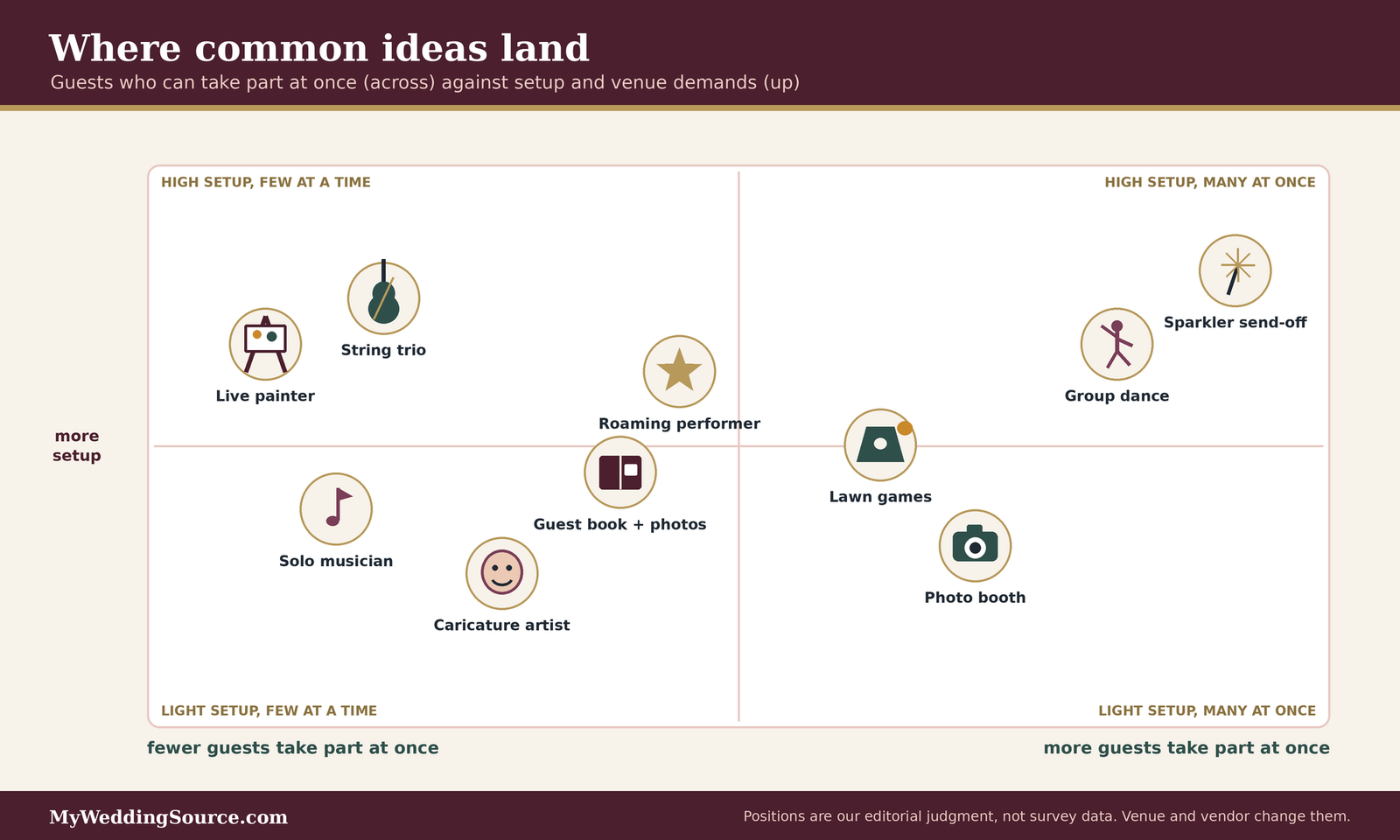
The table below compares ten common options on the five factors the rest of this guide uses: the emotional goal, the guest fit, the setup complexity, the cost tier, and the main way the idea fails. The ratings are our editorial judgments from the sources cited later, not survey results, and your venue and vendor may change any row. Use the table to narrow your list of wedding entertainment ideas, not to make the final call.
Reading the matrix
A matrix of wedding entertainment ideas is only useful if you know what each column means. We defined every column in a way you can reuse for ideas that are not on the list.
What each column measures
Emotional goal is the main feeling the idea produces: warmth, humor, awe, energy, or calm. Guest fit names who enjoys it and who may be left out. Setup complexity is low when the idea needs one person and a few minutes, medium when it needs space, power, or a rehearsal, and high when it needs several people, permissions, or a vendor on a tight cue. Cost tier is relative: $ means under a few hundred dollars, meansafewhundredtoacouplethousand, and$ means several thousand. Failure risk is the most likely way the idea goes wrong, not the chance it does.
How to score your own ideas
Give each of your wedding entertainment ideas a score from one to three on guest fit, setup, and cost, then ask what you would do if it failed. If the answer is “nothing, we would be stuck,” the idea needs a backup before it earns a place. If the answer is “guests would move on to the bar,” the failure is cheap and you can accept more risk.
The table
Table 1 sorts the options from quietest to most participatory. Read across a row before you read down a column, because an idea’s strengths and weaknesses come as a set.
Ten options on five factors
| Idea | Emotional goal | Guest fit | Setup | Cost tier | Main failure risk |
|---|---|---|---|---|---|
| Live painter | Sentiment, keepsake | All ages; passive watching | Medium: floor space, chair, light | $$$ | Painting not finished; blocks sightlines | | Solo or duo musician | Warmth, calm | All ages | Low to medium: power, shade | $$ | Volume competes with conversation |
| String trio or quartet | Elegance | Adults, older guests | Medium: space, weather cover | $$$ | Outdoor wind, heat, or rain | | Caricature artist | Humor, keepsake | All ages; one guest at a time | Low: table, two chairs | $$ | Line forms; only a fraction get a turn |
| Lawn games | Playfulness | Families, mixed ages | Medium: dry, level space | $ | Rain; guests in formal shoes opt out |
| Guest book with instant photos | Warmth, keepsake | All ages | Low: table, sign | $ | Nobody explains it; supplies run out |
| Photo booth | Playfulness | Friends, teens, adults | Medium: footprint, power | |Lineduringpeakdancetime||Roamingperformer(magicorsimilar)|Delight|Mixed;needsconfidentcrowd|Lowtomedium : roombetweentables| | Interrupts service or conversation |
| Choreographed group dance | Humor, energy | Younger friends, family volunteers | High: rehearsal, music cue | $ | Volunteers forget or drop out |
| Late-night send-off (sparklers, lights) | Celebration | All ages with supervision | High: venue approval, fire safety | $$ | Venue prohibits it; wind; supervision |
What the table cannot tell you
The table cannot tell you what your venue permits. It cannot tell you whether your painter is good, or whether your cousin will really stand up and dance. It also cannot tell you how many things are too many. That judgment is the subject of the next several sections, and it starts with the kinds of entertainment that guests watch rather than join.
Live painters and other watch-and-wander wedding entertainment ideas
Some entertainment asks nothing of guests except attention. A painter at an easel, a musician near the bar, and a caricature artist at a small table all create a point of interest that guests can approach or ignore. These wedding entertainment ideas are popular because they add atmosphere without forcing participation. They are also easy to underestimate, because a professional who works for hours takes up space, time, and a bit of your guests’ attention for the whole event.
Live painters: how the day works
A live wedding painter captures a chosen moment, often the first kiss, the recessional, or the first dance, as a painting. The painter may begin before the ceremony and work through the reception. Understanding the sequence helps you decide whether this one of the wedding entertainment ideas fits your schedule.
Timeline and stages
According to The Knot, artists usually arrive before the ceremony to sketch the composition, then keep painting through the ceremony and reception or finish the piece at home afterward. Citing an artist, The Knot gives a rough sequence: about 30 minutes of sketching, two to four hours on the background, two to three hours on the couple, and about an hour on final details. The Knot says completion takes four to ten hours in total, not counting setup and cleanup.
That sequence has two practical consequences. First, the painter is a vendor who is present for most of your day, which affects your meal count and your seating plan. The Knot recommends offering a vendor meal. Second, the work is visible, so where you place the easel matters. The Knot advises placing the painter where they can see the couple but are not in guests’ direct line of sight, so the easel does not block the view of the ceremony or the dance floor.
Cost and delivery
Published prices vary widely and do not come from a shared dataset. Citing a gallery owner, The Knot gives a typical range of $1,500 to $10,000, depending on supplies, the artist’s experience, travel, and demand. A cost guide from Fash gives an average of $1,500 to $8,000 excluding travel, but it does not explain how it calculated that range. A Chicago-area publication describes one Charleston artist whose pricing starts at $3,500 for a 24-by-30-inch canvas, based on canvas size and not on an hourly rate.
Delivery times differ as well. Fash says finished paintings usually arrive two to six weeks after the wedding, while the artist profiled by the Chicago-area publication says finishing takes eight to ten weeks. Neither figure is a rule. Ask for the delivery date in writing, and ask what happens if you want a rush. If you plan to give the painting as an anniversary gift or hang it by a specific date, build in a buffer.
Performers and roaming acts
Not every performer in a list of wedding entertainment ideas sits at an easel. Musicians, caricature artists, and other roaming acts also work at the edges of the room. They share a trait: they are easy to enjoy and easy to overuse.
Background musicians
Zola’s advice for the gap between the ceremony and the reception is to choose background-level music such as a solo guitarist, pianist, or singer, and to look for local restaurants and coffee shops when searching. It describes a jazz trio or a string quartet as a pricier option and suggests placing several musicians in different spots to add surprise. The point of background music is to support conversation, so ask the musician for the volume they will use and the breaks they will take.
If you are weighing live background music against a recorded playlist, the live option adds presence and the recorded option adds control. A playlist can be paused, skipped, and restarted by anyone you trust. A musician cannot be adjusted mid-song without a conversation. Many couples find that a musician for the first hour and a playlist afterward gives them the presence they want without the cost of a long booking.
Caricature artists and one-at-a-time acts
Zola suggests a caricature artist as an indoor cocktail-hour option. The appeal is obvious: guests leave with a keepsake. The limit is arithmetic. Because an artist draws one guest or one group at a time, the number of people who can take part in an hour is small compared with the guest list. We work through that arithmetic below. If you book a one-at-a-time act, plan for the majority of guests who will not get a turn, and think about extending the artist’s hours into the reception instead of compressing them into cocktail hour.
Games and participation: designing wedding entertainment ideas around guest flow
Participation changes the math for wedding entertainment ideas. A passive attraction can serve many guests at once, because watching is free. A game or a station can only serve the guests who can physically take a turn. The more participatory the idea, the more carefully you have to think about queues, space, and the guests who would rather not join.
Lawn and tabletop games
Games are among the lowest-cost wedding entertainment ideas and among the easiest to scale up or down. They also fail quietly, because a game nobody plays is simply a prop in the corner.
Cost, space, and setup
Zola names cornhole, giant Jenga, Connect Four, and croquet as outdoor options that appeal to all ages, and suggests asking the venue first because it may already own some. It also estimates that about $100 to $200 buys a good assortment of party games. For horseshoes and cornhole, the Zola cocktail-hour guide suggests lawn games outdoors, and a photo booth or caricature artist indoors.
Space is the hidden cost. A lawn game needs a dry, level patch that is away from the bar line and the walkway to the restrooms. A game placed on the main path becomes an obstacle. Ask the venue where it recommends placing games, and designate one person to put them out, tidy them during the evening, and pack them up.
Who a game leaves out
Games leave out guests in formal shoes, guests with limited mobility, and guests who do not want to be watched. That does not mean you should skip them. It means a game should never be the only thing happening in a space. Place a few chairs near the games so that spectators can enjoy them, and offer a second activity with a different physical demand, such as a table game or a guest book station.
Guest-flow arithmetic: a worked scenario
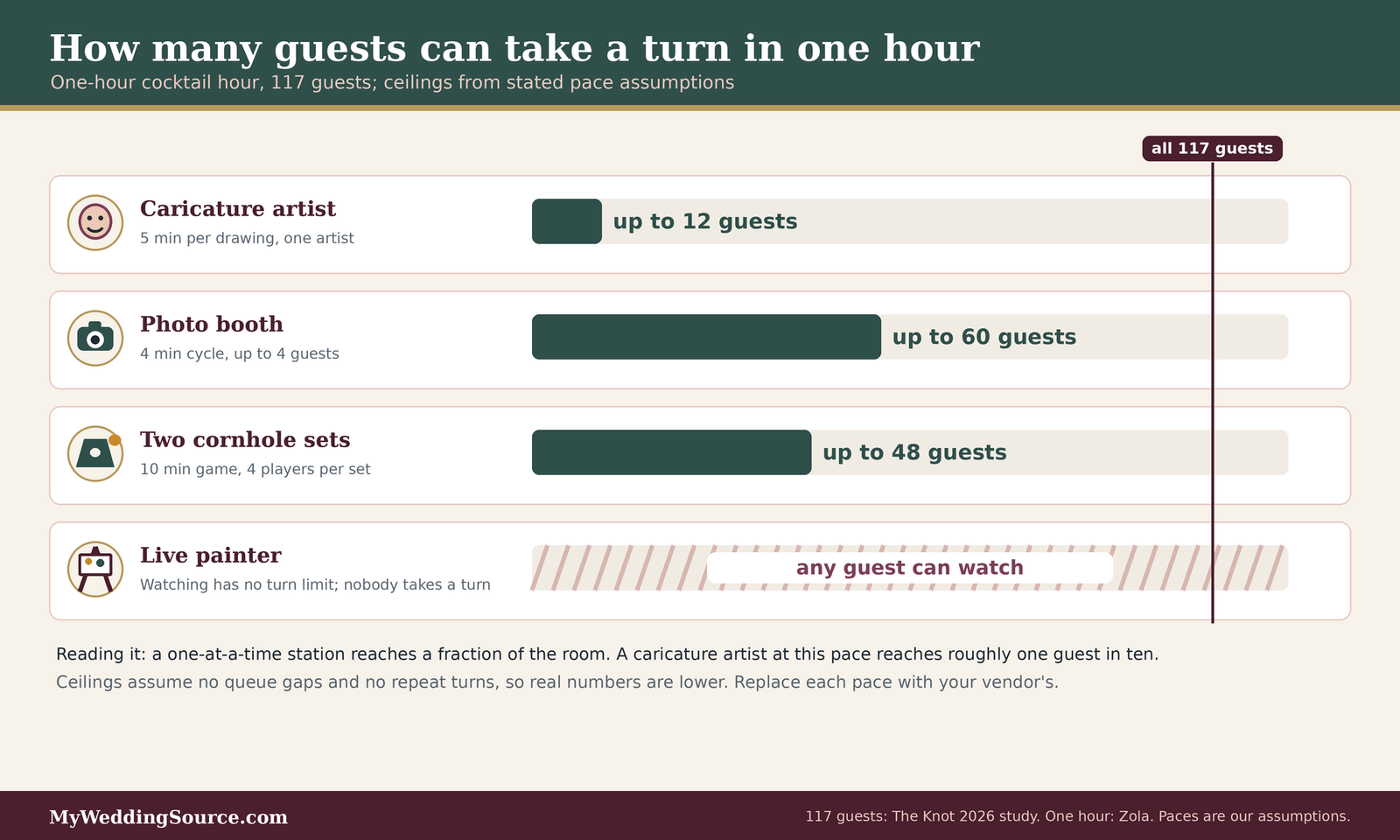
To show how capacity limits shape wedding entertainment ideas during a cocktail hour, we built a small model. It is an editorial illustration with stated assumptions, not research. Replace the assumptions with your own vendor’s numbers.
The capacity model
The Knot’s 2026 Real Weddings Study reports an average of 117 guests, which we use as the guest count. Zola advises allowing about five square feet per person in the cocktail hour, so 117 guests need roughly 585 square feet of standing room before you place a single bar or game. Zola also recommends one hour for the cocktail hour, so we model one hour.
We then assume how long each activity takes per turn: a caricature drawing takes about five minutes, so one artist serves about 12 guests an hour. A photo booth session with a quick reset takes about four minutes and holds up to four guests, so one booth serves up to about 60 guests in an hour at its theoretical peak. Two cornhole sets, with a ten-minute game and four players at a time, offer about 48 player turns. A painter’s capacity is different: watching has no turn limit, so any guest can stop by, but no one participates.
What the model shows
Even under generous assumptions, no single one-at-a-time station reaches most of 117 guests in an hour, and the figures are ceilings, not predictions, because guests repeat turns and skip lines. The caricature artist reaches about one in ten. The photo booth could reach about half, but only if the line never stalls. This is why many couples pair a passive attraction, which serves everyone a little, with a participatory one, which serves a few a lot. It is also why extending a station’s hours into the reception, when the guests have more time, often does more than adding a second station to the same hour.
Develop the idea around guest and vendor reality
Once you have chosen an idea, the next job is to shrink it to the version that will actually happen. This is where most plans for wedding entertainment ideas improve. Take away what does not serve the feeling, name who does what, and test the one piece that could embarrass you.
Choose the minimum elements needed to make it work
The minimum viable version of any of these wedding entertainment ideas is the smallest set of parts that still delivers the feeling. Everything else is optional, and optional things are the first to go wrong.
Remove props or steps that do not improve the moment
For each idea, list its parts and ask whether a guest would notice if each one were missing. A live painter needs an easel, a chair, light, and a clear view. A custom banner, a themed table, and a sign that explains the process might help, but the painter does not need them. A lawn game needs the game and a level patch. A scoreboard and a trophy are optional.
A short list also protects your budget. When a vendor offers an add-on, ask what it changes for guests, not what it adds to the package. If the answer is “it looks nice in photos,” weigh it against the cost and move on.
Assign setup and cleanup
Every one of the wedding entertainment ideas here creates two jobs that the couple should not do: setup and cleanup. Write each job beside a person’s name, not a role. “Someone from the venue” is not a name. If a vendor handles its own setup and breakdown, ask for the time they need and the space they need on arrival, so the floor plan accounts for them. If a friend handles the games, ask them in advance and give them the end time, so they can also enjoy the evening.
Our wedding planning checklist is a useful place to record these assignments next to the rest of your tasks, and our plan wedding timeline guide shows how far ahead vendor decisions tend to land.
Rehearse or prototype the risky part
Not every one of your wedding entertainment ideas needs a rehearsal. The risky parts do, and they are usually the parts that depend on timing, sound, or other people.
Test timing, music, movement, or signage
Ask what could go wrong if the idea had no preparation, and test that. For a group dance, run the song once with the participants. For a surprise performance, confirm the music cue with the DJ or band, and check that the sound system works with the format of the music file. For games, set one up in your living room or backyard and time a round so your estimate of how long a game takes is not a guess. For signage, show it to someone who has not seen it and ask what they think it says.
A test also reveals the unexpected. A friend who sets up the cornhole boards may point out that the boards slide on the slope of the lawn. A musician who plays a ten-minute sound check may learn that the venue’s outlet trips a breaker when a nearby heater switches on.
Create a simpler backup version
For each risky idea, define a backup that takes less than five minutes to switch to. If the lawn games are rained out, the backup might be a table game on a covered patio. If the painter is delayed, the backup might be that the painter sketches at the reception and finishes the ceremony scene from photos. If the group dance falls apart, the backup is that the DJ plays the song and the dance floor opens. A backup is not a failure plan; it is permission to relax.
Our wedding insurance guide explains how cancellation and liability coverage may relate to vendors who do not show up, and our wedding photography guide covers how to tell photographers about entertainment so they are in position.
Protect spontaneity by planning the mechanics of your wedding entertainment ideas
The best moments from wedding entertainment ideas look unplanned. They look that way because the planning happened somewhere guests cannot see it. Your job is to move every instruction, cue, and decision out of the guest-facing space and into a sheet that your vendors, your coordinator, and a few trusted friends can read.
Hide operational instructions from the guest-facing experience
A guest should never have to read a sign that says “wait here,” ask a vendor where to stand, or watch the couple hunt for the microphone. Operational noise is the sound of an event that lacks a plan.
Give vendors cue sheets
A cue sheet is a one-page list of what happens, when, who starts it, and what comes next. Give one to the DJ or band, the photographer, the venue coordinator, and any performer or artist. Table 2 shows the shape we recommend, filled in with an illustrative example. The times are placeholders for your own schedule.
Table 2: a sample cue sheet
| Activity | Cue | Owner | Setup | Backup | Cleanup |
|---|---|---|---|---|---|
| Live painter | Arrives 30 minutes before guests; first sketch before the ceremony | Painter; coordinator confirms location | Easel, chair, outlet, clear sightline | Painter works from a covered spot or from photos | Painter, with venue sweep of floor |
| Background musician | Starts when guests arrive; pauses before toasts | Musician; DJ cues the volume | Power, shade, a stool | Playlist on the venue speakers | Musician |
| Lawn games | Open when cocktail hour starts | Named friend or venue staff | Level patch, boards, seating | Table games on the patio | Friend, then venue |
| Photo booth | Opens when the dance floor opens | Booth attendant | Footprint, power, backdrop | Instant-photo guest book table | Attendant |
| Surprise performance | Cue from the DJ after dessert | DJ; performer; photographer informed | Sound check, open floor | DJ plays the song; floor opens | Performer |
The table is a template, not a prescription. Add or remove columns to match your event. What matters is that every activity has a start cue, a named owner, a backup, and a cleanup step.
Name who starts and ends the moment
Every activity needs a person who can begin it and a person who can end it, and they can be different people. The DJ or emcee often starts a moment because they hold the microphone. A friend or coordinator should end an activity that might run long, such as a game. If nobody owns the end, the activity keeps going until it fades or collides with the next one.
A short note helps any of these wedding entertainment ideas run smoothly. “At 5:25, tell the cornhole players that cocktail hour is ending and the entrance is in five minutes” is a task someone can complete. “Wrap up the games” is not.
Know when to stop adding
The final skill in planning wedding entertainment ideas is subtraction. More ideas do not make the evening richer if they compete for the same ten minutes.
Use one memorable focal point
Choose one moment that you want guests to talk about the next morning, and build the rest of your wedding entertainment ideas around it. If the focal point is a live painting, the schedule should leave the painter an unobstructed view of the first dance and the recessional. If it is a late dance floor, the dinner and toasts should end on time to protect it. If it is a send-off, everything before it should support a calm, safe exit. A focal point does not need to be expensive. It needs to be protected.
Avoid stacking competing surprises
Two surprises in a row turn each one into a distraction. A guest cannot give full attention to a surprise performance if the toast sequence is still going, and a performer who takes the floor at the exact moment the dance floor is filling will reset the energy. The third drawing shows an illustrative evening in which a surprise video and a surprise dance land inside the toasts, and one possible fix. The rule of thumb is to leave at least one unstructured stretch, whether a song, a snack, or a break, between any two planned moments.

Safety, access, and sound: the limits that override good ideas
Wedding entertainment ideas that are unsafe or inaccessible are not good ideas. We cover three limits here: fire and effects, access for guests with disabilities, and volume. None of this is legal advice, and rules vary by venue, city, and state, so confirm the details with your venue and with each vendor in writing.
Fire, sparklers, and special effects
Candles, sparklers, and fog may look simple, but each one has a safety profile and a venue policy attached.
What the safety data says
The U.S. Consumer Product Safety Commission says sparklers burn at about 2,000 degrees Fahrenheit, hot enough to melt some metals, and estimates about 1,300 emergency-room-treated injuries involving sparklers in 2025. It advises that young children should not handle sparklers. The National Fire Protection Association notes on its candle page that candles are a cause of home fires and home fire deaths, which is a reminder that open flame deserves the same care at a party as it does at home. If a sparkler send-off is part of your plan, treat it as a supervised activity with a clear start, a clear end, a place to put used sparklers, and a plan for children and for guests who would rather not take part.
What the venue and your vendors decide
The venue decides whether open flame, sparklers, confetti, glitter, fog, or haze are allowed and may have additional requirements of their own. Ask for the policy in writing before you book a performer or buy supplies. If a vendor offers an effect, ask whether the vendor carries liability insurance and whether the venue requires proof. Our wedding insurance guide explains what liability coverage might and might not address, and a licensed insurance professional can answer questions about your specific event.
Access and sound
Wedding entertainment ideas should include every guest you invited. Access is a planning task, not an afterthought, and sound affects both comfort and conversation.
Make activities reachable and understandable
Walk each activity as a guest who uses a wheelchair, a cane, or a walker would, and check that the route is step-free and wide enough. Place seating near games and performances. For toasts and any performance that depends on spoken words, consider how a guest who is deaf or hard of hearing will follow along.
The ADA’s guidance on effective communication describes auxiliary aids such as qualified interpreters and real-time captioning. It says that title III entities, meaning businesses and nonprofits that serve the public, must communicate effectively with people who have hearing, vision, or speech disabilities, and it says covered entities cannot require a person to bring someone to interpret. Whether and how the law applies to your particular private event and vendors is a legal question we cannot answer for you. A practical step is to ask your venue and your vendors what accessibility services they provide, and to ask guests in your invitation or on your website whether they need any accommodation.
Keep volume useful, not just loud
Loud music is part of the experience for some guests and a reason to leave for others. The National Institute for Occupational Safety and Health sets a workplace limit of 85 A-weighted decibels averaged over eight hours, and explains that each 3-decibel increase halves the allowable exposure time. NIOSH is explicit that this limit applies to workplaces and is not a recommendation for exposures outside work, so it is not a rule for your reception. It does show why a sound level that feels fine for a few minutes can add up over a long evening.
The practical steps are simple. Ask the DJ or band to keep the dinner and toast volume low enough for conversation. Place speakers away from tables of older guests, and point them toward the dance floor. Consider a quieter room or a patio where guests can talk. Our wedding catering guide covers how service flow and sound can interact during dinner.
What wedding entertainment ideas cost
Prices for wedding entertainment ideas vary more than most budget lines because the range includes a $150 game rental and a $10,000 live painting. The sections below separate three types of numbers: survey averages, published ranges, and our own arithmetic. Keeping them separate prevents the common mistake of treating an average as a quote.
Cost context
The Knot’s 2026 Real Weddings Study, based on 10,474 U.S. couples married in 2025, reports an average wedding cost of about $34,000, an average of 117 guests, and an average of $292 per guest. The same study lists an average reception DJ at $1,800, an average live band at $4,500, and $1,500 for additional, non-musical entertainment. About 71% of couples hired a DJ and 12% hired a band. A live painter’s published range is $1,500 to $10,000 according to a gallery owner quoted by The Knot, and $1,500 to $8,000 excluding travel according to a cost guide that does not explain its method. These are averages and ranges, not quotes. Your price depends on region, date, hours, travel, and contract terms.
Reported averages versus quotes
An average cost for wedding entertainment ideas describes a group of couples, not the vendor you are talking to. The way to use one is as a sanity check, not a target.
What the survey figures can and cannot tell you
The Knot’s figures come from couples who chose to respond to an email invitation from The Knot or WeddingWire, so they describe responding couples, not every U.S. wedding. The study’s average DJ cost is $1,800 and its average band cost is $4,500. The Knot also publishes quartiles: for bands, $900, $1,900, and $7,000 at the lower, median, and upper quartiles, and for DJs, $800, $1,600, and $2,700. The wide spread for bands tells you that a single average hides a lot of variation. The figures also do not say how many hours were included.
Where non-musical entertainment fits
The Knot’s average for additional, non-musical entertainment is $1,500, but the page does not break it down by type, and it does not say what share of couples spent anything on it. That means the figure is a broad reference, not a price for a painter, a magician, or a photo booth. Our average wedding cost guide puts these figures in the context of the whole budget, and our how to pay for a wedding guide covers funding.
Comparing entertainer quotes
Two quotes for the same type of entertainer in your wedding entertainment ideas list can describe very different services. Normalizing them is the only way to compare them fairly.
A quote-normalization method
List for each quote: hours on site, hours of active entertainment, setup and breakdown time, travel fees, meals and lodging, overtime rate, deposit, cancellation terms, and what the price excludes. Then calculate two numbers. The first is the price per active hour, which is the total divided by the hours of actual entertainment. The second is the price per guest reached, which is the total divided by the number of guests who could realistically take part, using the arithmetic from the guest-flow section. These are estimates for comparison, not a measure of value. A painter’s price per guest reached may look high, but the painting is a keepsake that outlasts the evening.
For example, suppose one caricature artist quotes a three-hour booking and another quotes a one-hour booking at a higher hourly rate. If the first artist draws about 12 guests an hour at a five-minute pace, three hours reaches about 36 guests. The second reaches about 12. The hourly rate matters less than the number of guests who can take part. This example uses assumed numbers to show the method, so ask each artist for their actual pace.
Contract terms to compare
Read the contract for the items that cost money later: overtime, travel, parking, a vendor meal, substitution rules if the performer is ill, the cancellation schedule, and the delivery date for a commissioned work such as a painting. The Knot’s tipping guidance is that no tip is expected if the painter owns the company and that an employee artist might receive $50 to $200 with a thank-you card. Confirm whether gratuity is already included, so you do not pay twice.
Questions to ask before you book wedding entertainment
Good questions turn a pitch for wedding entertainment ideas into a plan. Ask for answers in writing and keep them with the contract.
Questions worth asking before you book
- How many hours will you be on site, and how many of them are active entertainment?
- How many guests can take part in an hour, and what happens to the rest?
- What space, power, seating, and shade do you need?
- What does the venue require from you: insurance, a permit, or approval for effects?
- What is your plan for rain, wind, heat, or a late schedule?
- What are your overtime, travel, and cancellation terms?
- If you are ill or cannot attend, what substitute do you provide?
- What do I receive afterward, and by what date?
About the performance
These questions confirm what a guest will actually see.
Format, pace, and capacity
Ask for a typical timeline of the booking for your wedding entertainment ideas and for examples of how the entertainer adapts to a crowd of your size. Ask how the pace changes if the evening is delayed. A professional who has worked many weddings should be able to describe their own pace without hesitation.
Style and fit
Ask to see recent work, not just a highlight reel. For a painter, ask for a portfolio of live-painted pieces with the size of the canvas and the conditions of each wedding. For a musician, ask for a recording from a live event. A match in style is easier to judge in an actual sample than in a description.
About the business
These questions decide what happens if something changes.
Contract and insurance
Ask what the contract says about cancellations, substitutions, and refunds. Ask whether the entertainer carries liability insurance and whether the venue wants a certificate. If you are unsure what a clause means, a licensed attorney in your state can explain it. We offer general education only.
Logistics and communication
Ask who your day-of contact is and how to reach them. A phone number that is answered on the wedding day is a basic requirement. Confirm the arrival time, the load-in path, and where the entertainer can wait between sets. Vendor meals and gratuities are easy to overlook, so add them to your budget notes now.
FAQ: wedding entertainment ideas questions
Choosing an idea
How many wedding entertainment ideas should I include?
Fewer than you think when it comes to wedding entertainment ideas. Most weddings work best with one focal point and one or two light supporting activities. Each addition competes for guest attention and floor space. If you are weighing more than three, rank them by the feeling you want, keep the top ones, and save the rest for the rehearsal dinner or a farewell brunch.
Are live wedding painters worth the cost?
It depends on what you value. A painter gives you a handmade keepsake of a real moment and gives guests something to watch, but the published range runs from $1,500 to $10,000, and delivery may take weeks. If you would rather spend that on food or photography, a smaller keepsake, like an instant-photo guest book, may suit you better.
What entertainment works for a mixed-age crowd?
Among wedding entertainment ideas for mixed ages, quiet, low-effort options tend to work: background musicians, lawn games with simple rules, and an instant-photo guest book. Place seating near each activity so that guests who do not want to join can still enjoy it. Avoid activities that require standing in a long line or physical agility unless there is an alternative.
Planning and logistics
When should I book entertainment?
There is no single deadline, because demand varies by region, season, and artist. Availability for popular artists and bands may be limited on busy dates, so begin as soon as your date and venue are set. Ask each vendor what they recommend, and confirm availability in writing before you pay a deposit.
Do I need to tell my venue about entertainers?
Yes. Venues often control load-in times, power, sound limits, open flame, and outside vendors, and some require proof of insurance. Share the entertainer’s name, schedule, and space needs early, and ask for the venue’s rules in writing. A surprise at load-in is hard to fix, and it can cost you the activity altogether.
What if it rains?
Decide on the rain plan before you book. Ask whether the venue has a covered or indoor space large enough for the activity, and whether the entertainer can adapt. Games may move to a patio or become table games. A musician may need a covered corner. Include the rain decision time in your cue sheet so someone owns the call.
Cost and contracts
What is a reasonable budget for entertainment?
The Knot reports an average of $1,500 for additional, non-musical entertainment, plus separate averages of $1,800 for a DJ and $4,500 for a band, among couples married in 2025. Those are averages from responding couples, not targets. Set your ceiling from your own total budget and the feeling you want, then compare written quotes.
Should I tip entertainers?
Practices vary. For live painters, The Knot says no tip is expected if the painter owns the company, and suggests $50 to $200 with a thank-you card if the painter is an employee. For other entertainers, check your contract for an included gratuity first, then decide. A vendor meal is a separate courtesy that many vendors appreciate.
Your next steps
Decide what the evening should feel like
Write the feeling and the focal point
For your wedding entertainment ideas, write one sentence about the mood you want and name the one moment you want protected. Share it with your partner, then with your planner or venue contact. If an idea does not serve that sentence, set it aside without guilt.
Pick a ceiling for money and complexity
Choose a budget for wedding entertainment ideas and a limit of one high-complexity idea. Compare the numbers against your wedding budget calculator results, and keep a note of what you would cut first if the total grows.
Turn ideas into a plan
Build the cue sheet
Fill in a version of Table 2 with your own activities and send it to every vendor and your venue contact. Name an owner for every start, end, and cleanup. Our wedding reception guide shows where entertainment fits in the larger schedule, and our wedding ceremony guide helps with the part of the day before the party.
Test the risky piece
Rehearse or prototype the one idea that depends on timing, sound, or other people, and write a five-minute backup. Then revisit the schedule, the wedding planning checklist, and your wedding planning guide to confirm that nothing else relies on the same hour or the same helper.
Related reading: Wedding Band Questions: 35 Questions to Ask Before You Book.
Sources & methodology
How we built this guide
What we relied on
This guide combines The Knot’s 2026 Real Weddings Study read-outs, published planning advice from The Knot and Zola, two cost articles on live wedding painting, consumer safety data from the U.S. Consumer Product Safety Commission, federal ADA guidance on effective communication, and occupational noise guidance from the National Institute for Occupational Safety and Health. Where a statement comes from a vendor, a publisher, or a single artist, we say so, because those sources describe their own business or one example. The guest-flow model, the quote-normalization method, and the idea matrix are our own editorial arithmetic and judgment, and the numbers in them rest on stated assumptions.
What we did not do
We did not interview artists, test any service, or verify venue rules. We did not give legal, insurance, or medical advice. Prices, delivery times, and venue policies vary by region and change over time. Confirm every detail in writing with your venue and vendors, and ask a qualified professional about legal or insurance questions.
Source list
Surveys and industry publishers
- The Knot Worldwide, 2026 Real Weddings Study press release: https://www.theknotww.com/press-releases/the-knot-worldwide-unveils-2026-real-weddings-study
- The Knot, Average wedding cost: https://www.theknot.com/content/average-wedding-cost
- The Knot, Average cost of a wedding band and DJ: https://theknot.com/content/average-cost-wedding-band-dj
- The Knot, Live wedding painter guide: https://theknot.com/content/live-wedding-painter-artist
- Zola, Top tips for a successful cocktail hour: https://www.zola.com/expert-advice/top-10-tips-for-successful-cocktail-hour
- Zola, How to entertain guests between the wedding and reception: https://zola.com/expert-advice/how-to-entertain-guests-between-the-wedding-and-reception
Government and safety sources
- U.S. Consumer Product Safety Commission, Fireworks safety: https://www.cpsc.gov/Safety-Education/Safety-Education-Centers/Fireworks
- National Fire Protection Association, Safety with candles: https://www.nfpa.org/education-and-research/home-fire-safety/candles
- ADA.gov, Effective communication: https://www.ada.gov/resources/effective-communication/
- ADA.gov, Introduction to the ADA: https://www.ada.gov/topics/intro-to-ada/
- CDC NIOSH, Understanding noise exposure limits: https://cdc.gov/niosh/bulletin/2016/noise.html
Vendor cost articles
- Fash, How much does a live wedding painter cost: https://fash.com/costs/live-wedding-painter-cost
- Chicago Style Weddings, Live artist cost: https://www.chicagostyleweddings.com/?p=282712