
Engagement party gift expectations are mostly set by the hosts, not by etiquette books: the sources we read agree that a gift is optional, but they disagree on registries and on whether anyone should mention gifts at all, so guests fill the silence with guesses unless the hosts decide a position and tell people the same thing in the same few places.
Quick answer
Every source we read treats an engagement party gift as optional. The Knot says guests do not have to bring one, Zola says there is no set amount, and Emily Post says custom varies by region and family. The sources split on registries and on how much hosts should say. Our suggestion is to pick one of four positions (no gifts, gifts welcome but not expected, say nothing but have answers ready, or point to a registry), tell the co-hosts and the wedding party first, put the message on the wedding website or in conversation, and keep a short script for guests who ask. Wording examples are below, and they are our own illustrations, not quotations from any source.
What engagement party gift expectations are, and why hosts get asked
When a couple announces an engagement, the party that follows tends to raise a quiet question for everyone invited: should I bring something? Guests who are close to the couple often ask a sibling, a friend, or the person whose name is on the invitation. Hosts who have not thought about it tend to answer differently from one another, and the guests notice. One co-host says “oh, no gifts at all,” another says “people usually bring a bottle,” and a third says nothing. The couple then spends the party accepting presents they did not plan for, or watching guests who brought nothing feel awkward.
This guide is for the people who set engagement party gift expectations by answering that question: parents, friends, siblings, and couples who are hosting their own party. It does not tell you what to expect from guests in your particular family, because no source we found measured that. It does show where the published etiquette guidance agrees, where it splits, and how to turn a decision into a short message that guests can act on. For the larger picture of timing, guest list, hosts, and budget, see our engagement party planning guide; this article stays with engagement party gift expectations.
Where the sources agree on engagement party gift expectations
Most of the sources we read on engagement party gift expectations are concerned with guests, so there is less direct advice for hosts than you might expect. Even so, a few points appear across them, and they make a safe base to build on.
Gifts are optional
The Knot’s gift guide, last updated in November 2023, says guests are not obligated to bring a gift to an engagement party, partly because they will have chances to give at a shower and at the wedding. The same article adds that couples will not turn a gift down. Zola says bringing a gift is optional, and describes close relatives and members of the wedding party as the people who often do. Paperless Post, an online invitation company, says gifts are not expected and that gift-giving belongs to the shower. WeddingWire says guests are not required to bring gifts. Emily Post says gifts were not traditionally expected.
The amount is up to each guest
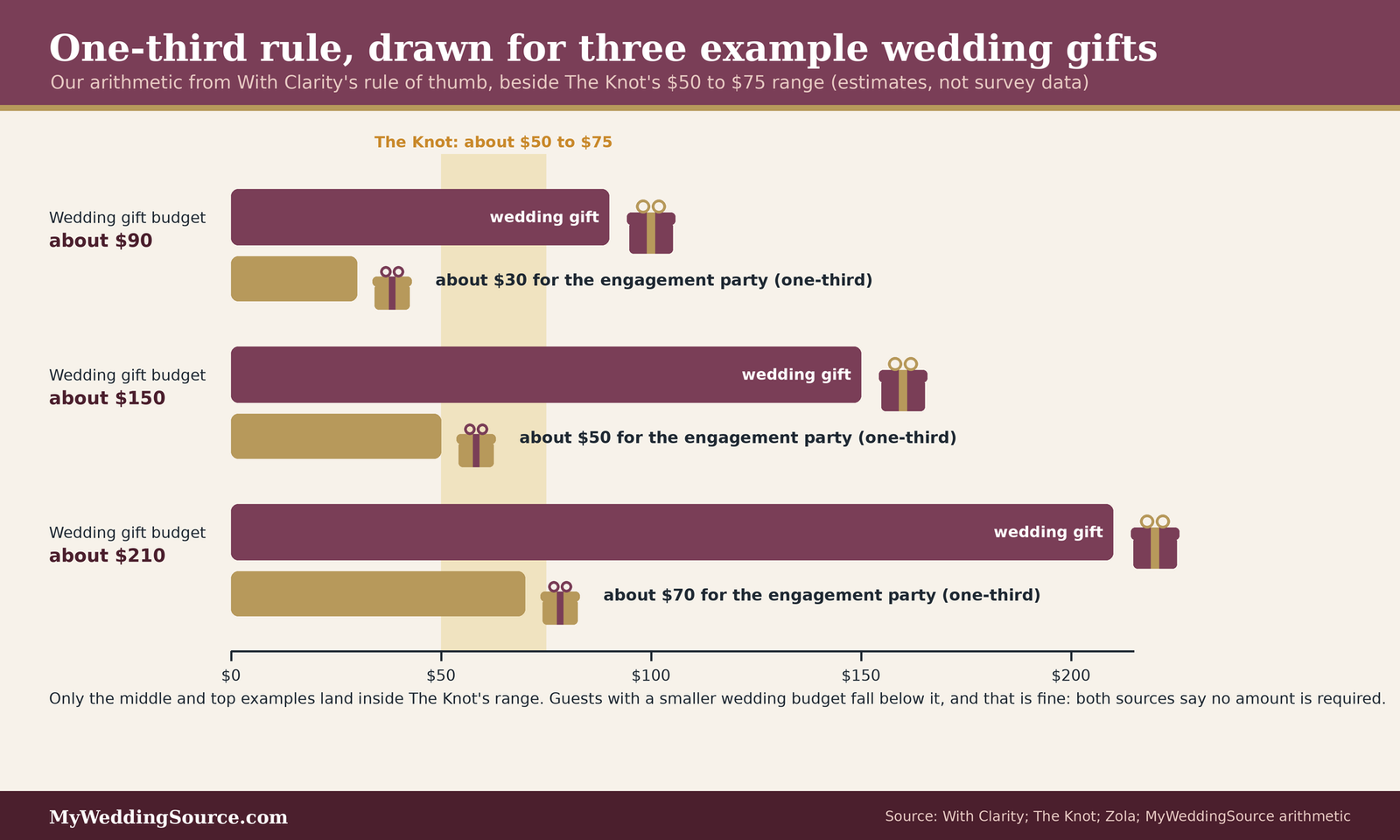
Nobody we read sets a required amount. Zola says to spend what your finances allow and not to stretch. The Knot describes a range of about $50 to $75 as appropriate while saying a guest can spend more, less, or nothing. With Clarity, a jeweler’s blog, suggests a rule of about one-third of what the guest plans to spend on the wedding gift. We treat all three as one publication’s suggestion each, not a standard, and we say more about them in the budget section below.
Where the sources split
The disagreements are where hosts most need a plan, because a guest who reads one source and a host who read another will arrive with different assumptions.
Custom varies
Emily Post says that while gifts were not historically expected, many parts of the country now consider bringing one customary, especially for close friends and family. It says the decision rests on the guest’s relationship with the couple, their budget, and local custom. Paperless Post and The Knot lean toward “optional.” Both can be true at once, which is why engagement party gift expectations differ so much between guests: a guest from one region may expect to bring a bottle, while a guest from another may expect nothing. A host who says nothing leaves both guests guessing.
Registries and requests
Emily Post says the couple should not already have a registry for the engagement party and that hosts should not create one. WeddingWire says asking for gifts directly is improper, and also advises setting up a registry and a wedding website before the party for guests who want to give. The Knot has a separate article telling couples it is fine to register right away and that one registry can serve the engagement party, shower, and wedding, with the registry link shared through the wedding website and not printed on the invitation. Zola notes that couples usually have not registered by the engagement stage. We read these as a genuine split, and the registry section below goes through it in detail.
Decide your position before you write a word
Wording about engagement party gift expectations follows from a decision. Before you write an invitation line or a text to the co-hosts, settle on a position and agree it with the couple. The four positions below are our own framing of choices that the sources point to; they are not categories any single source uses. None of them is more correct than the others. Each is easier to carry out when everyone involved knows which one you picked.
Four positions hosts can take
Position one: no gifts
Here the couple does not want gifts, and the hosts say so kindly. Emily Post says that couples worried about their friends’ budgets may ask the host to tell guests not to bring presents. Zola says that when a couple does not want gifts, guests should respect that and skip them, and that couples often say so on the invitation or the wedding website. WeddingWire says many couples choose a no-gifts policy but advises expecting that a few guests will bring something anyway. The practical consequence is that “no gifts” works best as a message you repeat, not as a line you print once and forget, because engagement party gift expectations are shaped by what guests hear last.
Position two: gifts welcome, not expected
Here the hosts do not discourage gifts, but they also do not suggest any. This fits the sources that call gifts optional and describe small, thoughtful tokens, such as a bottle of sparkling wine or a card. It suits couples who would be happy to receive something but do not want anyone to feel obliged. The risk is that guests who do not know the local engagement party gift expectations may feel pressure from the other guests’ behavior, so a short reply script (see the wording section) matters more here than an invitation line.
Position three: say nothing in print, answer when asked
This is the most common choice in the guidance we read, even though few sources name it. Paperless Post says the hosts do not need to request gifts or list a registry. Emily Post says hosts should ask the couple for a few gift ideas in case guests inquire, which assumes the hosts will say nothing proactively and answer when asked. The invitation and wedding website stay quiet about gifts, so engagement party gift expectations live in the hosts’ answers. The hosts and the wedding party carry a short, agreed answer.
Position four: point to a registry
Here the couple has registered, and the hosts tell guests who ask where to look. The Knot supports this, saying it is fine to register for the engagement party and that guests are not required to buy from the registry. The same article advises keeping registry details off the invitation and sharing them through the wedding website. Emily Post and Paperless Post push the other way, so if your hosts or your family follow those sources, expect some disagreement and talk it through before the invitations go out. Engagement party gift expectations are easier to explain once the family has heard the disagreement.
How to choose between them
Engagement party gift expectations depend on a few things you can check before you decide. None of the sources gives a formula, so treat the checks below as prompts.
Look at the signals your party sends
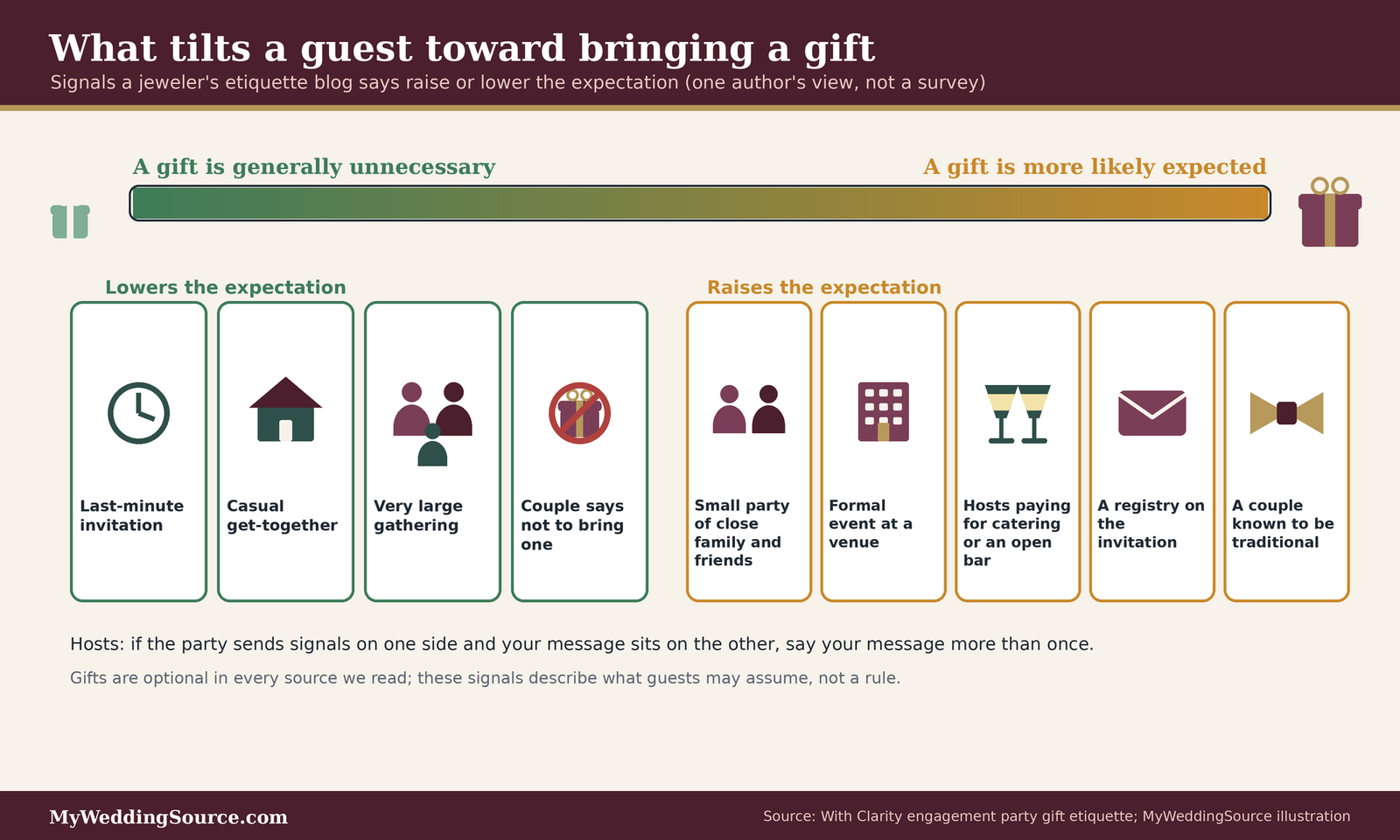
With Clarity says a gift is more likely to be expected when the party is small and made up of close friends and family, when it is formal or held at a venue, when hosts are paying for catering or an open bar, when the couple is known to be traditional, or when the invitation includes a registry. It says a gift is generally unnecessary for last-minute invitations, casual get-togethers, very large gatherings, or when the couple says not to bring one. Those signals are one jeweler-blog author’s observations, not a survey, but they match what many guests think about. If your party sends several “gift expected” signals, say so deliberately, or change the signals. A formal dinner for twenty at a restaurant with a no-gifts position sends mixed messages, and your reply script should address that directly.
Ask what the couple would prefer
This sounds obvious, but hosts often guess. Ask the couple three questions about engagement party gift expectations: would you like to receive gifts at this party, would you like us to tell guests, and if guests ask for ideas, what would you want us to say? Emily Post’s advice that hosts collect a few gift ideas from the couple fits neatly here. Write the answers down in a note you can share with co-hosts. If the couple is undecided, position three (say nothing in print, answer when asked) keeps your options open without making anyone commit.
Check who is hosting and who is attending
Who hosts changes who guests ask. When the parents host, the questions go to the parents, who may be fielding them from their own friends. When friends host, the questions go to the friends. When the couple hosts, the questions go to the couple, which is awkward, since it asks the person who would receive the gift to decide about it. If the couple hosts, name a friend or relative as the person who answers gift questions, as a courtesy to both sides. If two sets of parents host jointly, as in our guide to a joint engagement party with two families, agree the position between yourselves first so each family gives the same answer.
Where and how to tell guests
Once you have a position, the next question is where to say it. The sources are more consistent on where not to put gift information than on where to put it, so this section starts with what they rule out and then walks through the channels that remain.
The channels, from the most to the least formal
The guidance we read treats the invitation as the place for facts about the party and treats engagement party gift expectations as something handled around it. Our summary of that, with the sources named, follows.
The invitation itself
Paperless Post says the hosts do not need to include registry details or ask for presents on an engagement party invitation. The Knot says registry details do not belong on engagement party or wedding invitations. WeddingWire says asking for gifts directly is improper. On wording, none of the sources we read gives a model line for engagement party invitations specifically. Zola says couples often say they do not want gifts on the invitation or the wedding website, and The Knot’s separate article about no-gift weddings takes the opposite approach for wedding invitations, suggesting that the invitation not mention gifts and that a separate insert and the website carry the message. Because the guidance conflicts, our suggestion is cautious: if you want guests to know before they arrive, a short, warm line is more acceptable than a long explanation, and a registry link is the item the most sources advise leaving off. Of all the channels, the invitation has the most influence on engagement party gift expectations, so it deserves the most care.
Paperless Post does suggest that invitations say what food will be served, which matters here, since guests who know a full dinner is planned may infer a gift is expected. Saying “light appetizers and drinks” or “dessert and toasts” is not a gift message, but it helps guests judge the formality, which is one of the signals With Clarity describes.
The wedding website
The Knot says that a website is where guests tend to look when they are ready to buy, and that the registry can be shared there. Its no-gifts article suggests mentioning a no-gifts wish in the gift or FAQ section with a brief reason. Zola says couples often say they do not want gifts on the wedding website. If the website is live before the party, it is a calm place to state your engagement party gift expectations, because guests can check it on their own without asking anyone. If your site is not live, a simple page with a sentence on gifts and a sentence on how to reach a host is enough. For the privacy side of that page, see our guide to wedding planning website privacy and security.
Word of mouth through hosts and the wedding party
The Knot’s no-gifts article says to mention the couple’s wishes in person or by phone and to ask the wedding party to help spread the word so everyone hears the same message. The Knot’s registry article suggests immediate family and the wedding party can help guests find the registry. This is the channel that most sources lean on, and it carries the most risk, since each person who relays the message may phrase it differently. The next subsection is about reducing that risk.
At the party itself
The Knot’s no-gifts article says that you can mention the couple’s wishes at the engagement party itself. Toasts are common at engagement parties (Paperless Post calls speeches customary), and a host can use the welcome toast for one sentence of thanks that also sets expectations. We would keep it to one sentence, and we would not make a speech about gifts. A line such as “Thank you all for being here; your company is the gift” is a pleasant gesture, but it will not reach the guest who has already arrived with a package, so it should not be your only message.

Keeping one message across many mouths
A message about engagement party gift expectations that reaches guests through four channels will drift unless someone owns it. As an editorial observation, not a measured finding, drift usually comes from well-meaning relatives who want to be helpful and add an opinion of their own. A tiny amount of coordination prevents most of it.
Brief the co-hosts first
Before anything goes out, send the co-hosts a short written brief with the position, the sentence to use, and the person guests should ask if they are unsure. Keep it to a few lines. The point is to make the answer the same whoever is asked, so the brief should contain exact words and not a summary of the couple’s feelings. Our wording section below includes a ready-made version you can adapt.
Brief the wedding party and close family
Once the co-hosts agree, give the wedding party and the closest relatives the same sentence. The Knot’s no-gifts article advises this, and it matters most for the people most likely to be asked, which is often the parents and the siblings. Tell them what to say if a guest insists on giving anyway, since that is the point at which improvised answers appear. If a family member objects to the position, treat that as information. It is easier to adjust the plan now than to correct a conflicting message after invitations are out.
Wording examples hosts can adapt
This section is the practical core of the guide: wording for engagement party gift expectations. The wording below is our own illustrations, written to be adapted, and it is not drawn from any single source. None of the etiquette sources we read supplies model language for hosts, and several explicitly decline to. Treat the sentences as starting points. Change them to sound like you, and read them aloud before you use them. If a sentence feels stiff in your mouth, it will feel stiffer on paper.
A short line for the invitation, if you choose to use one
Not every host needs a line about gifts on the invitation. If you chose position three, skip this part. If you chose position one or two and want to say something in writing, the examples below keep it short and warm. They do not mention a registry, which is the item most of the sources we read advise keeping off an invitation.
If you want no gifts
Examples of the shape, which are our own: “Your company is all we are hoping for. Please, no gifts.” Or: “Thank you for celebrating with us. Gifts are not necessary, and we would rather spend the evening with you.” Both give the request and a reason that is about the guest’s presence. Avoid a reason that mentions the couple’s belongings or the size of their apartment unless it is true and you want to say it, since that invites questions. The Knot’s no-gifts article suggests thanking guests and emphasizing that their presence matters most, which both examples do.
If you want to be warm but not directive
An example: “We are glad to celebrate with you. Bring nothing but yourselves, and a story about the couple if you have one.” This does not forbid a gift, and it does not ask for one. A guest who wants to bring something will still bring something, and a guest who does not will feel free to arrive empty-handed. We like this version for parties where the host does not feel strongly.
If the invitation is a message or group text
Informal invitations are the setting where a gift line feels most natural, and the one where it is easiest to be misread. Keep the same shape and add the contact: “No gifts, please. Just come. Questions to [name].” A name gives a guest somewhere to turn that is not a group thread, which Emily Post’s invitation advice (RSVP date, appropriate format) supports in spirit. Emily Post says group texts are not recommended for large guest lists, so for a big party, send individual or email invitations.
Replies to guests who ask
The more useful scripts are the ones you say aloud, because most conversation about engagement party gift expectations happens when a guest calls, texts, or corners a host at the grocery store. Agree the script, then let each host say it in their own voice.
“Do I need to bring a gift?”
If your position is no gifts: “Not at all. We would love to see you, and the couple asked that nobody bring anything.” If your position is gifts welcome but not expected: “Nobody has to, and nobody will notice either way. Come and celebrate.” If your position is registry: “There is no need, but if you would like to, the couple has a list on their wedding website.” Each of these answers the question in one sentence and does not ask the guest to explain their budget. Emily Post says guests who are unsure should call the host and ask. The reply should make that call feel easy.
“What do they like?”
Emily Post says hosts should ask the couple for a few ideas in case guests ask. Have them ready. A host might say: “They have mentioned they like [something the couple chose, such as good coffee or a particular type of wine], but a card is also lovely.” Zola’s suggestions for gifts include flowers, a bottle of wine or champagne, a gift card to a restaurant or coffee shop, and experiences; the Knot suggests items that mark the engagement or help with planning, such as toasting glasses or a planning notebook. Those are publications’ ideas, and your couple’s preferences should win. The Knot also cautions that not every couple drinks, so confirm before suggesting alcohol.
“Is cash okay?”
The Knot says cash is acceptable at an engagement party, with a card and a personal message, and gives the same $50 to $75 range. Emily Post’s gift page does not address cash, and Zola’s does not either. If the couple would be happy to receive cash, a host can say: “That is welcome, with a card if you like.” If the couple would rather not, you can say: “A card is plenty.” Do not volunteer a number. A host naming an amount turns a courtesy into a price list, and a guest who hears a figure may feel bound by it.
“I can’t come, but I’d like to send something”
Guests who cannot attend sometimes ask whether a gift is appropriate. WeddingWire’s guest article says that when the couple has said no gifts, guests should respect it, and suggests a card given privately if the guest still wants to mark the occasion. A host can say: “A note would mean a great deal, and nothing else is needed.” If you chose a registry position, they can share where to look. If the guest is also likely to be invited to the wedding, the gift conversation will come around again, and our guide to wedding gift etiquette covers the later stage.
Messages that hosts send to each other
Scripts for guests are only half of the work. The other half is a few short messages inside your own circle, so that hosts, relatives, and the wedding party are all working from the same text.
A note to co-hosts
An example: “We are using the same answer if anyone asks about gifts: [your sentence]. If someone insists, say thank you and let them leave it with [name]. If someone asks for ideas, the couple suggested [two ideas]. Please do not mention a registry on invitations or at the party unless a guest asks.” Replace the bracketed items with your own. The note keeps your engagement party gift expectations consistent because it tells co-hosts exactly what to say in three situations, and it names a person to catch anything unplanned.
A note for a relative who wants to give something large
Some relatives, especially parents and grandparents, want to give a meaningful gift at the engagement stage regardless of the party’s position. A host or the couple can say: “That is so generous. We would be glad to receive it, and we would like to thank you properly, so we will write you a note.” The reply accepts gracefully and signals that a note will follow, which matches Emily Post’s advice that anyone who gives an engagement, shower, or wedding gift should get a handwritten note. It does not say anything about the party’s position, because family gifts are rarely governed by it.
| Position | If a guest asks if they should bring a gift | If a guest insists on giving | If a guest asks for ideas |
|---|---|---|---|
| No gifts | “Not at all; the couple asked that nobody bring anything.” | “Thank you, that is thoughtful. We will make sure they get it.” | “A card is plenty.” |
| Welcome, not expected | “Nobody has to, and nobody will notice either way.” | “Thank you; they will love it.” | Share two ideas the couple approved. |
| Say nothing, answer when asked | “It is up to you; the couple is just glad you can come.” | “Thank you; that is kind.” | Share two ideas the couple approved. |
| Registry | “No need, but there is a list on the wedding website if you like.” | “Thank you; they will love it.” | Point to the website. |
What guests are weighing, so you can answer kindly
A host who understands the guest’s side of engagement party gift expectations writes better answers. Guests are usually doing quiet arithmetic: how close am I to the couple, what will I owe later, and what is normal here. Hosts cannot settle that for them, but they can avoid making it harder.
The budget behind engagement party gift expectations
Guests with a close tie to the couple often face three gift occasions in a row, which is why several sources tell guests to think about the engagement gift as part of a sequence.
The figure The Knot gives
The Knot describes about $50 to $75 as an appropriate range for an engagement party gift and says guests can spend more, less, or nothing. It says the amount depends on the guest’s budget and how well they know the couple. The article also says to plan the engagement gift alongside what you expect to spend on the shower and the wedding. This is one publication’s description, and the article does not say how it arrived at the range, so we do not treat it as a typical spend. Hosts should not quote it to guests as a target.
The one-third rule of thumb
With Clarity suggests keeping an engagement gift to about one-third of what the guest plans to spend on a wedding gift. Zola says the wedding gift usually should be worth more than the engagement gift. Both fit the same idea: the engagement gift is a smaller gesture early in a sequence. We have drawn the arithmetic in the figure below for three example wedding-gift budgets. The numbers are our own illustration of the rule of thumb, not survey results, and they are estimates.
Shower and wedding gifts still ahead
Zola says attending an engagement party often means a guest will also be expected to give at a shower and at the wedding, so those costs belong in the plan. The Knot says similar. For a guest on a tight budget, WeddingWire’s guest article and With Clarity both describe a card as an acceptable gesture, and Paperless Post says gift-giving belongs to the shower. A host who keeps engagement party gift expectations low by saying “come as you are” removes a layer of stress for such a guest at no cost to anyone.
What gifts cost, and who it falls on
None of the sources we read on engagement party gift expectations measured what guests actually spend on engagement party gifts, and we did not find a survey with a disclosed method, so we do not report an average. What we can say is limited to published guidance. The Knot describes about $50 to $75; With Clarity suggests about one-third of the guest’s planned wedding gift; Zola says there is no set amount. A guest invited to an engagement party, a shower, and a wedding may give three times, which is why a “no gifts” or “come as you are” message can be a real kindness to someone on a budget. Hosts also carry costs: Zola and The Knot say the host generally pays for the party, and Emily Post and WeddingWire both describe a thank-you note and a small gift for hosts as appropriate. Check what any gift or party expense means for your own budget; we do not give financial advice.
Cash, cards, and payment apps
Cash is easy to hand over and easy to decline politely, so it deserves a line in your plan for engagement party gift expectations. A few practical points follow, with the limits of the sources noted.
Cash and cards in an envelope
The Knot says cash is acceptable at an engagement party, with a congratulatory card and a personal message. With Clarity says that if a guest gives cash, the amount should be enough that it does not seem insulting, which is a subjective standard we would not repeat to guests. If you want to take cash at the party, designate one person to hold the envelopes and write down who gave what while the details are fresh. If you would rather not receive cash, position one or position three scripts can cover it.
Payment apps and wrong-recipient mistakes
Some guests will ask whether they can send money through a payment app instead. The Federal Trade Commission’s guidance on mobile payment apps says to check the recipient’s information before you submit a payment so you do not send money to the wrong person, to turn on multi-factor authentication or a PIN, and never to share your login with someone who contacts you. It also advises confirming directly with a friend who unexpectedly asks for money, since their account may have been hacked, and says to contact the app’s support quickly if something goes wrong. For a couple, this suggests two small habits: give guests one verified handle or name if you choose to accept app payments, and tell hosts never to send payment links by group message to people they have not confirmed. Our article on wedding website scam messages describes how fake links can circulate around wedding events.
Large gifts from family and the tax question
Occasionally a relative offers a large cash gift to a couple. The Internal Revenue Service’s gift tax page says the donor, not the recipient, is generally responsible for any gift tax, and lists an annual exclusion of $19,000 per recipient for 2026. It also says gifts to a spouse are generally not taxable. We are not tax professionals and this is not tax advice. The page does not mention wedding gifts specifically, so a donor with a large gift in mind should ask a qualified tax professional. For everyday engagement party gifts, this will not come up.
Registries, wish lists, and the engagement stage
The registry question is where engagement party gift expectations get the most contradictory advice, so it gets its own section. The sources do not agree, and a calm host can explain the disagreement to a relative without picking a side.
The disagreement, explained
It helps to see each side as a publication describing a different assumption about what an engagement party is for.
Leave it out: Emily Post, Paperless Post, and Zola’s observation
Emily Post says the couple should not already have a registry for the engagement party and that hosts should not create one, because the engagement gift is not the focus of the event. Paperless Post says the hosts do not need to list a registry and that gift-giving belongs to the shower. Zola observes that couples usually have not set up a registry by this stage, so guests typically choose their own gifts. With Clarity says an engagement party registry is uncommon and that a registry on the invitation signals that a gift is expected. Taken together, this camp treats a registry as something that changes the tone of the party.
Register early, share through the website: The Knot and WeddingWire
The Knot says it is fine to create an engagement party registry, recommends doing it right away, and says one registry can serve the engagement party, the shower, and the wedding. It says guests are not required to buy from the registry and are not required to bring a gift at all. WeddingWire advises setting up a registry and a wedding website before the party, so guests who want to give know where to look, while also saying that asking for gifts directly is improper. This camp treats a registry as a resource that guests can use if they choose to, and not as a request.
A middle path hosts can use
The two camps overlap on one practical point: registry details do not belong on the invitation. The Knot and Paperless Post both say registry details stay off the invitation, and Emily Post says not to have a registry for the party at all. Beyond that, a couple can choose what suits them.
Have the information available but quiet
If the couple has a registry, a link on the wedding website lets a guest find it when they are ready to buy and spares the hosts from handing it out. It also means no one is asked to name a price or a product in conversation. A host who is asked can say: “There is a list on their website if you would like ideas.” If the couple has no registry, the same host can offer the two gift ideas from the couple. For more on how registries work at the wedding stage, our guides to the wedding registry and wedding registry ideas go into the detail.
Do not let the registry set the tone of the party
If you choose a registry position, keep it out of the room. No cards at the entrance, no signs, no announcements. A guest who has been told that gifts are not necessary and then sees a registry card on the table will conclude the opposite. The message you choose should be the one the room delivers, so that engagement party gift expectations are the same in the room as in the invitation.
Edge cases hosts run into
Most engagement parties are simple, but a handful of situations come up often enough that they are worth thinking about in advance.
Different kinds of party
Engagement party gift expectations change shape depending on how the party is organized, who is invited, and where guests live.
A surprise party
When the couple does not know about the party, the hosts cannot ask the couple’s preference. The Knot says a surprise party right after the proposal is a common arrangement, with the partner who proposed sometimes hosting. Hosts in that situation should choose position three (say nothing in print, answer when asked) and agree among themselves what they will say, since they cannot check with the couple. If guests ask about gifts, a reasonable answer is “optional,” with an offer to pass a card to the couple. That keeps the surprise and leaves the couple free to set their own position at later events.
A party at home or a small dinner
A gathering at home often feels casual, and the guests are close, which matters because With Clarity says a small party limited to close friends and family makes a gift somewhat more likely to be expected. If you are hosting at home, our guide to an engagement party at home covers format and logistics. For engagement party gift expectations specifically, a plain answer from the host is enough.
Two parties, two families, or guests far away
Emily Post says couples with families in different places may hold more than one party, and WeddingWire says the same. If two hosts are running two parties with different tones, guests who attend both may feel pulled in two directions. Agree on the same engagement party gift expectations across both, or tell guests that the second party is different. Our guide to planning an engagement party when parents live far apart deals with the logistics, and the joint engagement party guide covers the shared-host case. WeddingWire also suggests a virtual option for guests who cannot attend; a virtual guest is a likely sender of a card or a gift in the mail, so the gift script and a mailing address belong together.
Guests who bring gifts anyway
Even a clear statement of engagement party gift expectations will not reach everyone. WeddingWire advises expecting that some guests will bring a gift even where the couple has asked for none. Planning for this removes much of the discomfort.
Where gifts go during the party
Planning for engagement party gift expectations includes planning for the gifts themselves. Decide before guests arrive where a gift will be placed, and who will carry it home. A small table near the entrance works, with a host assigned to keep an eye on it. Whether to open gifts at the party is not covered by the sources we read. Our suggestion is to open nothing at an engagement party, since opening gifts in front of guests who did not bring one is the situation a no-gifts message is trying to avoid, and since cards and tags are easier to match later at home. A couple who loves a party game with gifts can adjust.
A guest who feels awkward
A guest who arrives with nothing at a party where others gave gifts will sometimes apologize. A host should have a single sentence ready: “You being here is what they wanted.” Our example is deliberately short, because the longer the reassurance, the more the guest feels there was something to be reassured about. Emily Post says the decision to give rests on the guest’s relationship, budget, and local custom, so a guest who gives nothing has done nothing wrong by that standard.
Cultural and family customs
Some families have customs around gifts at engagement events that differ from the American etiquette sources we read, including customs about who gives and what is given. We did not find an authoritative source that covers these across communities, so we do not describe them, and we do not want to flatten them. If your families follow a custom, ask the elders involved what is expected and let the hosts and couple decide together how it fits with the message guests receive. Emily Post’s observation that custom varies by region and family applies here as well, since engagement party gift expectations are partly a matter of local and family custom.
After the party: tracking and thanking
The work does not end when the last guest leaves. A gift without a record is an easy gift to forget, and a thank-you note is the part of the gift exchange that people remember.
Keep a record while you remember
The party itself is a busy hour, and details fade quickly. A simple record protects the couple from the common situation of three unmarked gifts and no idea whose they were.
What to write down
For each gift, note the giver, the date, what it was, whether it came with a card, and whether a thank-you note has been sent. For a cash gift, note the amount privately, since Emily Post says stating the amount in the note is optional but that the note should confirm the gift arrived. Our guide to wedding gift tracking describes how to organize a gift log for the longer sequence of shower and wedding gifts, and the same log can start here. If more than one person has access to it, see our notes on wedding guest spreadsheet permissions.
Keep the cards with the gifts
Tape or tie the card to the gift as it arrives, or take a quick photo of the tag. It is a small step, and it is much harder to reconstruct afterward. If a guest brought a gift without a card, ask the person who was watching the gift table.
Thank-you notes
The sources agree more strongly on thank-you notes than on any other part of engagement party gift expectations, though they differ on who should receive one.
Who should receive a note
Emily Post says anyone who gave an engagement, shower, or wedding gift should receive a note, even if you thanked them in person, and that each contributor to a group gift should get an individual note. Paperless Post says the couple should send a note when a guest brings a gift or sends a card. WeddingWire says to send a handwritten note to everyone who attends, whether or not they brought a gift, and suggests a note and possibly a small gift for the hosts. We would follow the broader approach in the case of a small party, since it is faster than deciding who deserves one.
Timing
Emily Post says notes are due within three months of receiving a gift, not within a year, and that writing each note the day the gift arrives is ideal. For pre-wedding gifts, it says not to wait for wedding photos before writing. It also says anyone who hosted a party for you should be thanked within two days of the event, with a small thank-you gift. Hosts who are not the couple can expect that note and should be told so.
What to say, and what to leave out
Emily Post says thank-you notes should be handwritten, and that preprinted or fill-in-the-blank cards, emails, and generic website posts do not count. For cash, it says to mention how you plan to use the money. If you want help with the words, our guides to wedding thank-you cards and thank-you card wording cover wording in more depth. Whatever you write, name the gift or the gesture, say what it means to you, and keep it short.
A host’s timeline and one-page brief
Everything above can be collapsed into a short sequence. This section turns the decisions into a schedule, with the caveat that the sources give invitation timing but no timeline specific to gift messaging, so the schedule is our own suggestion built on the timing guidance we found.
A timeline for communicating engagement party gift expectations
Emily Post advises sending engagement party invitations three to six weeks ahead and always including an RSVP date, and says the party ideally happens before save-the-dates go out and at least a month before wedding invitations. Zola notes that guests may need time to buy a gift, which is one reason it advises early invitations. We have built the messaging about engagement party gift expectations around those dates.
Before invitations go out
Settle the position with the couple, write the one sentence, and brief the co-hosts and wedding party. If the wedding website is live, add a short gift line there or confirm there is nothing to add. Decide who answers gift questions, and write down the two or three gift ideas the couple approved. Decide where gifts will be placed at the party and who will watch the table.
Between the invitation and the party
Expect questions to arrive in waves, usually right after invitations land and again in the final week. Keep the same answer each time. If a host realizes the message is not working, for example if several guests misread the invitation, correct it once, with the same sentence, and tell the other hosts. Resist the urge to send a long clarifying message to everyone, which tends to make the gift more prominent, not less.
At the party and afterward
Greet guests, keep an eye on the gift spot, and use the welcome toast to thank people for being there. Record gifts while the details are fresh. Begin thank-you notes within the first week, with the party hosts’ notes going out within two days, as Emily Post advises. If you are the couple, treat the hosts as the first recipients of your attention.
The one-page brief for engagement party gift expectations
A single page can hold everything co-hosts and relatives need. Keep it short enough to read in a minute.
What goes on the page
A one-page brief on engagement party gift expectations can contain the position in a sentence, the exact words to use if a guest asks, two gift ideas the couple approved, the name of the person who answers anything unusual, where gifts go at the party, and the date by which thank-you notes will be sent. Add an instruction on cash if the couple has a view. Do not include the couple’s reasons unless they want them shared.
Where to keep it
Share the page with the people who need it, and no one else. Because it will contain a couple’s preferences about money, keep it in a message or document that is limited to the hosts and the wedding party and not on a public page. Our guide to wedding party coordination checklists describes how to keep a small group aligned, and the broader wedding planning checklist can help you place this task in the larger schedule.
Questions to ask before the invitations go out
- Which of the four positions are we taking, and did the couple choose it?
- What is the one sentence every host will say if a guest asks about gifts?
- Will gifts be mentioned on the invitation, the wedding website, both, or neither?
- Does the couple have a registry, and if so, where will guests find it?
- If a guest asks for ideas, which two ideas did the couple approve?
- Would the couple like cash, and if not, what is the polite answer?
- Who is the single person guests can ask if they are unsure?
- Where will gifts go at the party, and who will record them?
- Which relatives or wedding party members need the one-page brief?
- Who will write the thank-you notes, and when?
Mistakes that make gift expectations unclear
The following patterns blur engagement party gift expectations. They follow from the guidance above, not from a survey. Each is easy to avoid once you can name it.
Mixed signals
Guests read engagement party gift expectations from the whole party, not only the invitation, and a message that conflicts with the party’s feel will lose.
A “no gifts” message at a formal event
With Clarity says a formal, upscale party at a venue, with catering or an open bar, makes a gift more likely to be expected. If the party looks like that and the message says no gifts, guests may take the message as politeness and bring something anyway. Repeat the message, and make sure the hosts know to accept gracefully.
A registry on the invitation
With Clarity says a registry on the invitation signals that a gift is expected, and The Knot says registry details stay off invitations. A link on the invitation therefore creates the very expectation the host may be trying to avoid. Put it on the website or give it when asked.
Hosts who improvise
The problem with improvised answers about engagement party gift expectations is that they differ.
Each host gives a different answer
If one host tells a guest “no gifts” and another tells a guest “just bring a bottle,” both guests arrive believing they were told the rule. One written sentence prevents this.
A host who names an amount
A host who says “most people spend about this much” turns the party into a price list. None of the sources we read tells hosts to quote an amount; The Knot’s range is directed at guests. Leave amounts to the guest.
FAQ: engagement party gift expectations
Gifts and guests
Are gifts expected at an engagement party?
Generally no. The Knot, Zola, WeddingWire, and Paperless Post all describe gifts as optional. Emily Post adds that bringing one is customary in many parts of the country, especially for close friends and family, so custom varies. If a guest is unsure, the host can settle it with one sentence.
Should hosts mention gifts on the invitation?
Sources disagree on how to word engagement party gift expectations, but several advise against requesting gifts or listing a registry there. Paperless Post says hosts need not ask for presents or include registry details, and The Knot says registry details stay off invitations. A short warm line is more acceptable than a long one, and many hosts say nothing in print.
How should a host answer a guest who asks what to bring?
Keep it to one sentence that matches your position, such as telling the guest that nothing is needed, or pointing to the wedding website if the couple has a registry. Emily Post says hosts should have a few ideas from the couple ready in case guests ask, so prepare two before invitations go out.
Is cash appropriate at an engagement party?
The Knot says cash is acceptable with a card and a personal message. Emily Post’s gift page and Zola’s guide do not address it. If the couple would rather not receive cash, the host can say a card is plenty. Do not name an amount, since that turns courtesy into a price list.
Registries, money, and thank-yous
Should a couple register for an engagement party?
The sources split. Emily Post says the couple should not already have a registry for the party, while The Knot says it is fine to register right away, with one registry serving the engagement party, shower, and wedding. Both advise keeping it off the invitation. A link on the wedding website is a quiet compromise.
How much should a guest spend?
No source sets a required amount. Zola says to spend what your finances allow, The Knot describes about $50 to $75 as appropriate while saying a guest can spend more, less, or nothing, and With Clarity suggests about one-third of the planned wedding gift. These are publications’ suggestions, and hosts should not quote them as targets.
Does every guest need a thank-you note?
Emily Post says anyone who gave an engagement, shower, or wedding gift should receive a handwritten note within three months, and that party hosts should be thanked within two days. WeddingWire says to write to everyone who attended, gift or not. For a small party, following the broader approach is simpler.
What if guests bring gifts after we said no gifts?
WeddingWire advises expecting that some will. Accept graciously, note who gave what, and send a note. Hosts can say that the gift is thoughtful and will be passed to the couple, without scolding. The Knot’s no-gifts guidance suggests offering alternatives such as gift cards, experiences, or a cause, for guests who want to give.
Your next steps
Make the decision
Choose the position with the couple
Pick one of the four positions on engagement party gift expectations together, write the one sentence, and list the two gift ideas the couple approved. If the couple is undecided, choose to say nothing in print and answer when asked, which keeps every option open. For the broader plan, see our engagement party guide and wedding planning checklist.
Check the invitation against the plan
Read the invitation and the wedding website as a guest would. Confirm that neither contradicts your position, that no registry link is printed on the invitation, and that a person is named for questions. Our wedding invitation wording guide covers the later stage of invitations.
Tell people and keep records
Send the brief and set up the record
Share the one-page brief with co-hosts and the wedding party, set up a simple gift log, and decide where gifts will go at the party. When the shower and wedding come around, our wedding gift etiquette guide picks up the same thread.
Plan the thank-yous
Schedule time to write notes in the first week and set a date for the rest. If a hosting relative or friend paid for the party, write them first and include a small gift, as Emily Post advises.
Sources & methodology
How we built this guide
What we relied on
This guide on engagement party gift expectations combines etiquette guidance from Emily Post, The Knot, Zola, and WeddingWire, a vendor blog from Paperless Post, a blog from a jeweler, With Clarity, a Federal Trade Commission consumer article on payment apps, and the Internal Revenue Service’s page on gift taxes. We fetched and read each source on November 12, 2026. The Knot’s gift article carries a November 2023 update date and its host article a December 2023 update date, so we do not claim the guidance is current beyond what the pages say. Where a statement comes from a vendor or retailer, we say so. The cost figures are the publications’ own, and the one-third arithmetic in the third figure is our own estimate.
What we did not do
We did not survey guests or hosts, interview an etiquette professional, or find a methodology-disclosed survey of what guests spend on engagement party gifts, so we do not report an average. None of the etiquette sources we read gives model wording for hosts, so the wording examples are our own illustrations. Nothing here is legal, tax, or financial advice. Etiquette differs by region, community, and family, so adapt the guidance to your own.
Source list
Etiquette and planning sources
- Emily Post, Engagement party gifts: https://emilypost.com/advice/engagement-party-gifts
- Emily Post, Etiquette Today: The Engagement Party: https://emilypost.substack.com/p/etiquette-today-the-engagement-party
- Emily Post, Wedding thank-yous: https://emilypost.com/advice/wedding-thank-yous
- The Knot, Modern engagement party gift etiquette: https://www.theknot.com/content/engagement-party-gift-etiquette
- The Knot, Do we register for the engagement party: https://www.theknot.com/content/do-we-register-for-engagement-party
- The Knot, Who pays for the engagement party: https://www.theknot.com/content/who-pays-for-engagement-party
- The Knot, Can we request no wedding gifts: https://www.theknot.com/content/can-we-request-no-wedding-gifts
- The Knot, Engagement party guest etiquette: https://theknot.com/content/engagement-party-guest-etiquette
- Zola, What is an appropriate gift for an engagement party: https://zola.com/expert-advice/what-is-an-appropriate-gift-for-an-engagement-party
- Zola, Who hosts an engagement party: https://zola.com/expert-advice/who-hosts-an-engagement-party
- WeddingWire, The Dos and Don’ts of Engagement Party Etiquette: https://www.weddingwire.com/wedding-ideas/engagement-party-etiquette
- WeddingWire, A Guest’s Guide to Engagement Party Gift Etiquette: https://www.weddingwire.com/wedding-ideas/engagement-party-gift-etiquette
Vendor and jeweler sources
- Paperless Post, Engagement party 101: https://www.paperlesspost.com/blog/engagement-party-101
- With Clarity, Engagement party gift etiquette: https://www.withclarity.com/blog/2023/02/22/engagement-party-gift-etiquette-heres-everything-you-need-to-know/
Government sources
- Federal Trade Commission, Mobile payment apps: how to avoid a scam when you use one: https://consumer.ftc.gov/articles/mobile-payment-apps-how-avoid-scam-when-you-use-one
- Internal Revenue Service, Frequently asked questions on gift taxes: https://www.irs.gov/businesses/small-businesses-self-employed/frequently-asked-questions-on-gift-taxes