

A nonalcoholic bar looks designed when it has a job, a place in the room, a menu that sounds like it belongs next to the other drinks, and a plan for who pours, who refills, and what happens when an ingredient runs short, so wedding mocktails are worth deciding on purpose instead of adding a soda cooler at the last minute.
Quick answer
Treat wedding mocktails as a small bar with its own footprint, glassware, menu card, and staffing, not as an afterthought beside the real bar. Start with the room and the venue’s rules, pick one of four formats (made-to-order, self-serve, passed, or hybrid), keep the menu to three to five drinks that each do a different job, and price the installed bar by dividing the total by the number of drinks you expect to serve. Ask your caterer whether wedding mocktails can sit inside the existing beverage package before you hire anyone separately.
This guide is about the design and logistics of wedding mocktails and the nonalcoholic side of your reception: where it goes, what it looks like, how much to make, what it really costs, and what to put in writing. It assumes you have already chosen a caterer and a general bar approach. If you have not, start with our wedding catering guide and, if alcohol is part of your plan, our open bar planning guide. The rest of this page does not repeat that framework; it goes deeper on one decision.
Decide what your wedding mocktails are for before you choose a look
Design starts with a purpose. A nonalcoholic bar built for a morning garden ceremony has almost nothing in common with one built for a late-night dance floor, even if the recipes overlap. Before you save a single photo, write one sentence that says what your wedding mocktails are supposed to do for your guests, because every later choice, from the glass to the sign, is easier to make when you know the answer.
Place wedding mocktails inside the evening, not beside it
The same drink works differently at different moments. A cold, sparkling welcome drink handed out at the ceremony site is a hospitality gesture. A bar open for the whole cocktail hour is a destination. A toast drink is a shared moment. Choosing the moment decides how many drinks you need, how fast they must come out, and how much attention they deserve.
Welcome drink, cocktail hour, toast, or all evening
A welcome drink is the lowest-effort option and the one most likely to be noticed, because every guest receives one. It needs one recipe, a tray, and a plan for refills. A cocktail-hour bar for wedding mocktails needs a surface, a short menu, and someone to pour. A toast drink needs only a sparkling nonalcoholic option poured at the same time as everything else, so no one is left holding an empty glass. Keeping the bar open all evening is the biggest commitment, because it needs staffing or a restocking plan for hours. Many couples combine two of these, and a sensible pairing of wedding mocktails is a welcome drink plus a standing bar through dinner.
Match the format to the length of the event
If your reception runs four to five hours, think about the arc. Guests often want something cold and bright early, something with more body during dinner, and something warm or dessert-like late. That is a design idea, not a rule, but it is a useful way to avoid a menu where every drink tastes like the same lemonade. A late-night coffee or hot chocolate station, for example, gives the end of the night a second reason to visit the nonalcoholic side of the room. Our wedding reception guide covers the broader timeline these moments fit into, and it helps to know where wedding mocktails land on it.
Know who the bar serves
If you picture only guests who do not drink, you will likely under-build it. The people who reach for wedding mocktails include designated drivers, pregnant guests, guests in recovery, guests who avoid alcohol for religious or health reasons, teenagers and children, older relatives, and ordinary drinkers who want something lighter between cocktails. Designing wedding mocktails for all of them changes the menu and the way you present it.
Guests who will use it without announcing it
Most people do not explain why they are holding a nonalcoholic drink, and a well-designed bar means they never have to. A menu that sits next to the main bar menu, in the same type and on the same card, lets a guest order without drawing attention. A bar tucked in a corner with a handwritten label can quietly sort guests into groups. That is the strongest design argument for putting the two menus side by side, and it is an inclusion choice more than a style choice.
Guests under drinking age and guests who simply want a break
Children and teens will happily drink the mocktails too, which affects quantity and sugar. If you expect many children, a clearly labeled kid-friendly drink on the same menu keeps them from taking the more complex ones meant for adults. For everyone else, the drink between two cocktails is often the one that keeps the evening comfortable, which is a good reason to plan for more wedding mocktails than the number of nondrinkers would suggest.
What the evidence says about demand, and what it does not
Planning guides are full of confident claims about nonalcoholic weddings. Some are backed by data and some are repeated trend talk, so it helps to separate them before you decide how much to invest.
What the surveys show
Gallup’s national telephone survey, conducted July 7 to 21, 2025 with 1,002 adults, found that 54% of U.S. adults said they drink alcohol, a record low in its long-running measure, down from 58% in 2024 and 62% in 2023. The margin of error is about four percentage points. In the same survey, 53% said moderate drinking is bad for health, the first time a majority gave that answer, and adults aged 18 to 34 were the least likely age group to report drinking, at 50%. That is a national adult sample, not a wedding-guest sample, so it tells you that a meaningful share of any guest list may not be drinking, not how many guests at your wedding will be.
What they do not show
Wedding-industry claims are thinner. Zola’s 2026 First Look Report, which it describes as drawn from more than 11,500 couples marrying in 2026, notes that mocktail menus for weddings are joining bar programs, but its published summary gives no percentage and little methodology. Zola’s food-trends article says most couples offer nonalcoholic options alongside alcohol and that fully dry weddings are not taking over, again without a figure. An older Good Morning America report from 2023 quoted Zola as expecting nearly 4% of couples to have alcohol-free weddings that year. The Knot’s article on nonalcoholic drinks was published in 2022 and rests on expert interviews and a TikTok view count, not a survey. The honest summary about wedding mocktails is that the direction is clear, the exact share of weddings is not, and you should plan from your own guest list.
Measure the room and read the rules before choosing a look for wedding mocktails
A mocktail bar that looks beautiful in a photo can fail in a real room because it blocks a doorway, sits next to a speaker, or needs a power outlet that is not there. Measure first, before you commit to any look for your wedding mocktails. It takes twenty minutes and removes more bad ideas than any mood board.
Measure the physical constraints
Go to the venue with a tape measure, your phone, and, if you can, the caterer or bartender who will work there. You are looking for a footprint that fits, a sightline that works, and a supply of the things drinks need: water, ice, power, and a place to put dirty glasses.
Record dimensions, sightlines, heat, wind, and access
Write down the width and depth of the table or bar you plan to use, and add the space behind it for the person pouring. Stand at the entrance to the reception area and note whether guests can see the bar without being told where it is. Look for heat sources, such as direct afternoon sun, kitchen exhaust, or a patio heater, because they affect ice and fresh garnishes. For outdoor receptions, think about wind, which will topple tall signs and light napkins, and shade. Finally, note how a vendor would get supplies in, whether through a loading door, over grass, or up stairs, since heavy coolers and dispensers need a clear path. If you are weighing an outdoor setting, our garden wedding venue guide is a useful companion.
Count the utilities the bar will need
A bar for wedding mocktails uses less than a full bar, but it is not free of requirements. Ask whether there is a source of potable water, whether a sink is nearby for rinsing, where ice will be stored and how often it will be refilled, and whether you will need an outlet for a blender, a carbonation device, or a coffee urn. If the answer to any of these is no, a self-serve format with pitchers and pre-made syrups may fit better than a made-to-order bar. Decide this before you fall in love with a format.
Identify venue and vendor rules that override inspiration
Venues, caterers, and bar companies each have their own policies, and they often decide the design for you. The most useful thing you can do early is ask the questions that will otherwise surface at the last minute.
Outside drinks, outside vendors, and who is allowed to pour
The Knot’s guidance on nonalcoholic drinks suggests asking early what your venue or caterer already stocks and whether outside beverages are allowed, since many venues restrict them. That matters if you plan to bring in a specialty mocktail company, a branded zero-proof spirit, or homemade syrups. Some venues allow only their own caterer to serve any drink, including nonalcoholic ones. Others allow outside vendors but require proof of insurance. Ask for these policies in writing, and ask the caterer separately whether wedding mocktails can be included in the existing beverage package, which The Knot’s cited expert recommends as the first question. For the wider insurance picture, see our wedding insurance guide, which is general education and not individual advice.
Fresh juice, allergens, and food-safety rules
Fresh juice and many syrups raise questions that a soda does not. The FDA says untreated fruit and vegetable juice can carry bacteria, and that children, older adults, pregnant women, and people with weakened immune systems can become seriously ill from it. It also notes that the warning label required on packaged untreated juice is not required for juice sold by the glass, so you cannot rely on a label to tell you what you are getting. Ask your caterer or bar vendor whether the juice they plan to serve is pasteurized or otherwise treated, and whether they prepare it under a food-service permit.
Allergens deserve the same attention. The FDA’s list of major food allergens includes milk, eggs, fish, crustacean shellfish, tree nuts, peanuts, wheat, soy, and sesame. Ingredients in wedding mocktails, such as orgeat or nut-based syrups, egg-white foam, oat or almond milk, and some bitters can contain them. The FDA also notes that any allergic reaction can lead to anaphylaxis, so a mild past reaction does not mean a mild allergy. Put allergen information on the menu card or have the person pouring ready to answer, and ask guests to mention allergies on the RSVP.
Choose a format that fits your guests, your staff, and your budget for wedding mocktails
Once you know the room and the rules, pick a format for your wedding mocktails. There are four common ones, and each trades personal attention against cost and speed. None is better in every setting.
Compare the four formats
The table below compares formats on the physical and practical points that usually decide the choice. It is a design aid based on our reasoning, not a ranking, and your venue and vendor may change any row.
| Format | Footprint and scale | Look and materials | Lighting and sightline | Rule to check | Guest impact |
|---|---|---|---|---|---|
| Made-to-order bar | A table or bar section plus space behind for one or two people | Most flexible: real garnishes, shakers, menu board | Needs light on the pouring area so guests can watch | Who may serve, ice and water access, insurance | Most personal, but a line forms in busy hours |
| Self-serve pitchers or dispensers | A long table with one or two stations and a refill area | Glass dispensers and labeled pitchers read as deliberate | Labels must be readable in dim light | Glass near dance floor, refill staffing, spill control | Fast, but less memorable and needs restocking |
| Passed trays | No fixed footprint; staff move through the room | Small glasses on trays, matching the cocktail hour | Works in any lighting, as staff carry their own light | Staff count, tray glassware, coordination with the caterer | Reaches guests who never visit the bar |
| Hybrid | A small bar plus a self-serve backup or a welcome tray | Combines a showpiece with practical volume | One focal bar, plus simple pitchers elsewhere | Needs a clear plan for who restocks which | Balanced, and easier to scale if the guest count grows |
Made-to-order bar
A made-to-order bar is the version of wedding mocktails most people imagine: a bartender shakes, stirs, and garnishes drinks while guests watch. It gives the most control over quality and the most personal experience, and it lets you offer a signature drink that is more complex than a pitcher can hold. The trade-off is time. A single bartender can only make so many drinks at once, and a line forms when guests arrive at the same moment, such as right after the ceremony. If you choose this format, plan one pouring person for the wedding mocktails side or confirm that the main bartenders will serve both menus, and ask how the vendor handles a rush.
Self-serve pitchers and dispensers
Self-serve is the least expensive and the least staffed. It works well when you want volume and simplicity: a glass dispenser of a spritzer, a pitcher of iced tea, an infused-water station. The design challenge is making it feel intentional, since a plain cooler reads as an afterthought and the same drink in a clear dispenser with a handwritten label reads as a choice. Plan who refills it, because an empty dispenser is the most common failure of this format. Plan where spills go, and avoid placing it where guests carrying drinks will pass.
Passed trays and hybrids
Passed trays put the mocktail in front of guests without asking them to cross the room. They suit welcome drinks and toasts, and they reach people who would never walk to a bar. They require staff and small, stable glasses. A hybrid combines formats, such as a small made-to-order bar for the signature drink plus pitchers for volume. For many weddings that is the practical answer, because it protects the experience and the budget at once.
Put the nonalcoholic menu in the main bar, not beside it
The strongest design signal you can send is that wedding mocktails belong in the same room as everything else. Several sources in the wedding and catering trade make a similar point, and the reasoning is straightforward: a drink listed under “also available” is read as a lesser one.
Share the menu card, the type, and the space
Zola’s food-trends guidance says most couples keep alcohol but display zero-proof drinks as prominently as their alcoholic options. A catering-equipment vendor, Ripples, which sells a foam-printing device and therefore has a stake in the idea, makes a related point in its blog: give nonalcoholic drinks their own space on the menu rather than a footnote under soft drinks. That advice is easy to follow with no special product. For wedding mocktails, print one menu card with two sections in the same typeface, give the drinks descriptive names rather than “Virgin” versions of cocktails, and keep both sections at the same height and visibility.
Glassware, garnish, and ice are the visible design
Zola’s guidance suggests serving mocktails in quality glassware, such as coupes or rocks glasses, with real garnishes. The same logic works at any budget. A drink in the same glass as the cocktails looks like part of the same program, while a drink in a plastic cup looks like a separate one. Real garnishes, such as a citrus wheel, an herb sprig, or a few berries, cost little and carry most of the visual weight. Ice matters too: clear, large cubes look intentional, while crushed ice in a coupe looks like a mistake. The seasonal blooms you already plan to use, covered in our seasonal wedding flowers guide, can suggest garnish colors, but check that anything edible is food-safe and grown for eating.
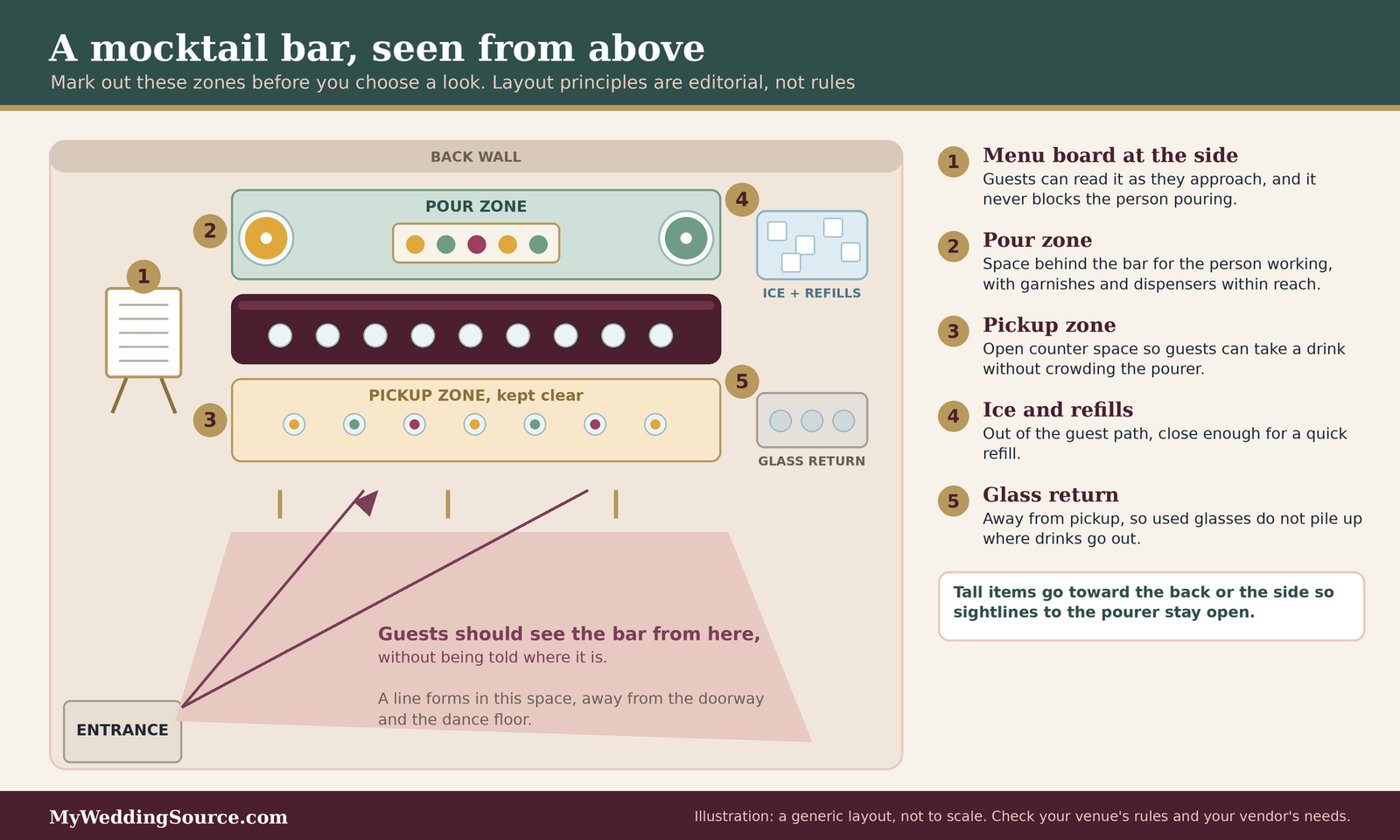
Give every piece of the bar a job, then compose it with wedding mocktails in mind
A bar of wedding mocktails looks designed when nothing on it is there by accident. That does not mean minimal; it means each object answers a question a guest might have: where do I go, what is this, what is in it, and is this for me. This section turns that idea into a short method you can apply to the table, the sign, the glass, and the garnish.
Decide what each element does
Every visible element on the bar should do at least one job. Five jobs cover most of them: it can guide guests to the bar, frame the bar so it looks like a destination, soften a hard surface or a harsh light, make the drinks photograph well, or personalize the bar to the couple. If an element does none of these, it is a candidate for removal.
Decide whether the element guides, frames, softens, photographs, or personalizes
Walk through the bar piece by piece. A menu board guides, since it tells guests what exists and how to order. A runner or a backdrop frames, because it gives the bar edges. A cloth over a plain folding table softens it. Glassware, clear ice, and a simple garnish make the drinks photograph well. A drink named for how you met, or a short note about the recipe’s origin, personalizes. Write the job next to each item on a list. Anything with no job goes on a separate list, and you will decide what to do with it in the next step.
Remove decorative elements with no job
Items with no job often come from a mood board, not from a need: a third candle, a row of unused bottles, a small sign that repeats the large one. Removing them rarely hurts, and it leaves room for the bartender to work. A practical test is to remove one item at a time in a test setup and see whether anyone notices, including the person who will be pouring. If the bar works better without it, keep it off. If you want a prop for sentimental reasons, put it where it will not slow service, such as a shelf behind the bar.
Set one focal point and supporting elements
Visual design for wedding mocktails is mostly about proportion. One thing should be the clear center of attention, and everything else should support it. The usual candidates for the focal point are the menu board, a large dispenser, or a floral arrangement. Choose one, and let the others be smaller and quieter.
Use proportion rather than item count
A bar with ten small items can look cluttered, while a bar with three well-sized ones looks calm. Pick the largest object first, such as a three-gallon glass dispenser or a tall menu board, and size the others as roughly half or a third of its height. That ratio is a design habit and not a rule, but it gives you a quick way to test a setup. Repeat one shape, such as the same glass used throughout or the same garnish across every drink, because repetition reads as intention. Our wedding decor guide goes deeper on color and scale across the whole room.
Control height and negative space
Height creates hierarchy, but it also blocks sightlines and tips in wind. Keep the tallest element toward the back or the side of the table so guests can see the person pouring and the drinks themselves. Leave open space between groups of objects, because crowded surfaces slow service and invite spills. A bar usually needs a clear working zone for the person making drinks, a clear pickup zone for guests, and a place for used glasses that is not in the middle of either. If space is limited, drop an element before you shrink the working zone.
Test the design under real lighting and camera conditions
A setup for wedding mocktails that looks fine in a showroom can look flat at dusk or glare under a spotlight. The only reliable way to know is to test it where and when guests will see it.
Check daytime and evening appearance
If your venue allows a walkthrough, bring one clear glass, a sample drink or just water with a garnish, and your menu card, and look at them at the time of day your reception will start and again later if you can. Notice whether text is readable, whether clear ice disappears in dim light, and whether a pale drink looks washed out against a pale cloth. Dark backdrops make light drinks stand out and make dark drinks vanish, so match the drinks to the surface. If the room will be dim, ask about a small lamp or candle light at the bar, and check the venue’s rules on open flames before you plan around them.
Photograph samples from guest and photographer angles
Take a few photos of your test setup from the entrance, from a seated height, and from the angle a photographer would use for a detail shot. Check for visible clutter, an exit sign or trash can in the background, and glare on the glass. Your photographer can often tell you in a minute whether a surface will photograph well. Our wedding photography guide and wedding photographer shot list show how to ask for detail shots, and a bar of wedding mocktails is a good candidate for one.
The recipes are the part of the project most people look forward to, and also the part where a few decisions save a lot of trouble. The aim for wedding mocktails is a menu that is short enough to serve well and varied enough that every guest finds something.
Give each drink a different job
A common mistake is offering four drinks that taste alike. A short menu of wedding mocktails works better when each drink serves a different guest at a different moment. Three to five drinks is a practical range because it is long enough to offer a choice and short enough that the bartender can keep ingredients fresh. That range is our recommendation, not an industry standard.
Build the menu from distinct roles
Five roles cover most menus. A sparkling, dry, lightly bitter drink serves guests who want something close to a glass of champagne. A bright citrus-and-herb drink is the easy crowd-pleaser. A less sweet, savory or spiced drink serves guests who dislike sugar. A richer, creamier or dessert-like drink suits the end of the evening, and a hot drink suits a cold venue. A signature drink named for the couple can fill any of these roles. If you are offering fewer than five, choose the roles that fit your season and venue. Zola’s trend article lists examples that show the range, from a nonalcoholic take on a bitter aperitif to a turmeric-ginger-lemon drink, but you do not need any specific recipe to follow the structure.
Balance sweetness, acid, bitterness, and dilution
Without alcohol, a drink loses some of the body and the bite that a spirit provides, so wedding mocktails often need a different balance to taste finished. Bitter elements, such as tea, a bitter citrus peel, or a nonalcoholic aperitif, and acidity, such as fresh citrus or a vinegar-based shrub, can add structure that sugar cannot. Ask your bartender or caterer to prepare samples, and taste them cold with ice, because dilution changes the balance as the drink sits. If you are offering drinks to children, keep one option that is not very sweet and not very acidic. If you are choosing glassware for the tables too, our wedding table settings guide is worth a look so the bar and the tables match.
Read the labels on kombucha and nonalcoholic spirits
Two kinds of products raise questions about alcohol content: kombucha, which is fermented, and the growing category of nonalcoholic wines, beers, and spirits. They are different problems, and both are worth a short check.
Kombucha and the half-percent line
The Alcohol and Tobacco Tax and Trade Bureau (TTB), the federal regulator for alcohol, says kombucha with 0.5 percent or more alcohol by volume is regulated as an alcoholic beverage, and that its rules still apply if kombucha is under that level when bottled but reaches it later because fermentation continues. That is a rule for producers, but it matters to you for two reasons. Kombucha on a menu of wedding mocktails is not always free of alcohol in the way guests may assume, and a kombucha station is an easy item to add without asking questions. If a guest needs to avoid alcohol completely, ask the supplier about the product’s alcohol content and whether it is fermented in a way that could raise it, or choose a different drink for that station.
Nonalcoholic spirits, wines, and beers
A summary of TTB guidance describes “non-alcoholic” and “alcohol-free” products as those with less than 0.5 percent alcohol by volume, which are generally not treated as alcoholic beverages, while products at or above that level are regulated more like traditional alcohol. Read plainly, that means a product labeled nonalcoholic can still contain a trace of alcohol. That is our reading of the threshold, not a statement from the agency about any particular product. For most guests it is not an issue. For guests who must avoid alcohol entirely, because of pregnancy, recovery, medication, or religious practice, the safe approach is to read each label, ask the supplier, and tell the guest what is in the drink. For the tact side of guest needs, see our wedding etiquette guide.
Care for the guests who most need an alcohol-free option
A menu of wedding mocktails is also a promise. For some guests, the nonalcoholic drink is the only thing they can have, and details that seem small to the host can matter a great deal to them.
Pregnant guests
The Centers for Disease Control and Prevention says there is no known safe amount of alcohol during pregnancy, that no stage of pregnancy is safe for drinking, and that alcohol can cause problems before a woman knows she is pregnant. You do not need to ask guests about pregnancy. You do need to make sure the nonalcoholic drinks are truly nonalcoholic, that the ones with fresh juice are made with treated juice, and that the person pouring can answer a quiet question about ingredients. The FDA’s guidance on untreated juice names pregnant women among those at higher risk, which is the reason to ask the caterer about pasteurization.
Guests in recovery, designated drivers, and guests who avoid alcohol for other reasons
These guests tend to notice small things: whether a drink is labeled clearly, whether the bar staff will mix it separately from an alcoholic drink, and whether a nonalcoholic drink is poured into the same glass as an alcoholic one. Ask your bartenders to use separate tools or rinse them between drinks, and label garnish and glass choices so a guest can tell which is which. Provide something to drink for guests who are driving, and tell the venue and your transportation vendor what you expect. This is general planning guidance, not medical or legal advice.
Calculate how many drinks and how much liquid to make for wedding mocktails
Quantity is where plans for wedding mocktails most often go wrong, in both directions. Too little and the bar is empty by dinner. Too much and you have paid for gallons of syrup nobody wanted. The method here is simple arithmetic with assumptions you can change.
Estimate the number of drinks
There is no reliable published rule for how many mocktails a wedding guest drinks. How many nonalcoholic drinks a guest takes depends heavily on whether your wedding mocktails sit beside an alcohol bar or replaces it. So we build two scenarios, and we label them as assumptions.
Two scenarios for a 120-guest reception
For a mixed bar, where mocktails sit beside beer, wine, and cocktails, we assume that about half of the guests take one of the wedding mocktails at some point and that those guests average between two and three each, for a planning figure of 150 drinks across a five-hour event. For a dry reception, where mocktails are the main drink, we assume about four drinks per guest, or 480 drinks. These are our own planning assumptions for illustration, not survey results. The point is not that they are right for your wedding, but that writing them down lets you test them.
Adjust for weather, time, and crowd
Hot weather raises consumption, and a long outdoor cocktail hour raises it more. A morning or afternoon wedding with no alcohol usually raises the count of wedding mocktails too, since guests have no other drink. A crowd with many children, designated drivers, or older guests may lean more heavily on the bar. A late-evening reception with a dessert bar may take fewer. If you are unsure, plan the higher figure for the first hour and make the rest from a reserve you can scale up. Our average wedding cost guide gives context for the whole beverage line.
Turn drinks into gallons
Once you have a drink count for your wedding mocktails, turn it into a quantity of liquid you can ask a caterer or vendor to supply. This is arithmetic, and it will change with the size of your pour.
The conversion
A U.S. gallon is 128 fluid ounces. If the base of each drink, before ice and any sparkling top-up, is four ounces, one gallon of batched mix makes 32 drinks. At five ounces it makes about 26, and at six ounces about 21. For 150 drinks at four ounces, you need about 600 ounces, or roughly 4.7 gallons. For 480 drinks at the same pour, you need about 15 gallons. At six ounces those figures rise to about 7 and 22.5 gallons. Add a reserve of 10 to 15 percent for spills, taste tests, and guests who return for a second drink, and round up. These are our estimates, and your glass size, ice, and recipes will move them.

Batch ahead or make to order
Batching saves time at the bar and makes quality more consistent, but fresh citrus, herbs, and carbonation change as they sit. One practical compromise is to batch the base, such as syrups, teas, and shrubs, ahead of time and add the fresh and fizzy elements at service. Ask your vendor what they batch, how long it keeps, how it is stored, and how it is kept cold. Because a bar of wedding mocktails has no alcohol to act as a preservative, ask about food-safety handling as well, especially if the drinks will sit outdoors. As a reference point for scale, one university catering price list we checked in November 2026 charged $17.50 per gallon for lemonade and iced tea, which says nothing about wedding pricing but shows how modest the base liquid can be next to labor and glassware.
Price the installed bar, not the recipe, when budgeting wedding mocktails
A recipe for one of your wedding mocktails costs a little. A bar that serves that drink to 120 people costs labor, glassware, equipment, ice, delivery, cleanup, and a margin for mistakes. Quotes that list only a price per person can hide or omit most of those layers, so the useful move is to build your own list and compare quotes against it.
What this actually costs
Zola’s Wedding Cost Index, as cited in its 2026 food-trends guide, puts the national average for bar and beverage services at about $5,541, with a typical range of $4,400 to $6,600, or roughly 11% of the total budget. That figure covers the whole bar, not mocktails alone, and Zola gives no mocktail-specific price. One mocktail vendor’s listing on Zola says beverages and bar services each start at $5 per person, with a $500 minimum. Treat both as context, not quotes. Your cost depends on staffing, glassware, and what your caterer already includes.
Include labor, equipment, delivery, rentals, teardown, and damage risk
Every cost of wedding mocktails falls into a layer. Naming the layers keeps you from comparing a quote that includes glassware and bartenders with one that does not.
Separate reusable inventory from consumed materials
Consumed materials are the things guests drink or throw away: juice, syrup, tea, herbs, fruit, ice, straws, napkins. Reusable inventory is the things that come back: glassware, dispensers, tubs, trays, signage stands, and any equipment. Consumed materials scale with the number of drinks, so your estimate from the last section drives them. Reusable inventory usually scales with the number of guests and the number of stations, and it comes with rental, delivery, washing, and breakage fees. If a vendor lists a flat price, ask which layers it includes and which it does not. One vendor listing we checked says glassware is available for a small fee, or plastic is included, which is a good example of a choice that moves both the price and the look.
Flag venue labor and fire-code requirements
Venues sometimes add charges that vendors do not know about: a fee for a staff member to be present, a required insurance certificate, a charge for moving furniture, or a rule about open flames, extension cords, or dispensers near exits. Ask the venue whether any apply to a nonalcoholic bar, and whether outside vendors need to be pre-approved. Candles on a bar, hot drink stations with urns, and cords across a walkway are the usual examples to check. We cannot tell you your local fire-code rules, so ask the venue or the fire authority that covers it. Our wedding budget calculator can help you slot these items into your overall plan.
Normalize every quote to a cost per drink
Quotes come in different shapes: a price per person, a flat package, an hourly rate, or a line on the caterer’s invoice. To compare them, convert each to a cost per drink served, using your own drink estimate. Divide the total by the number of drinks you expect, and then adjust for what is left out.
| Cost layer | What it covers | How to price it | Worked example (placeholder) | Often owned by |
|---|---|---|---|---|
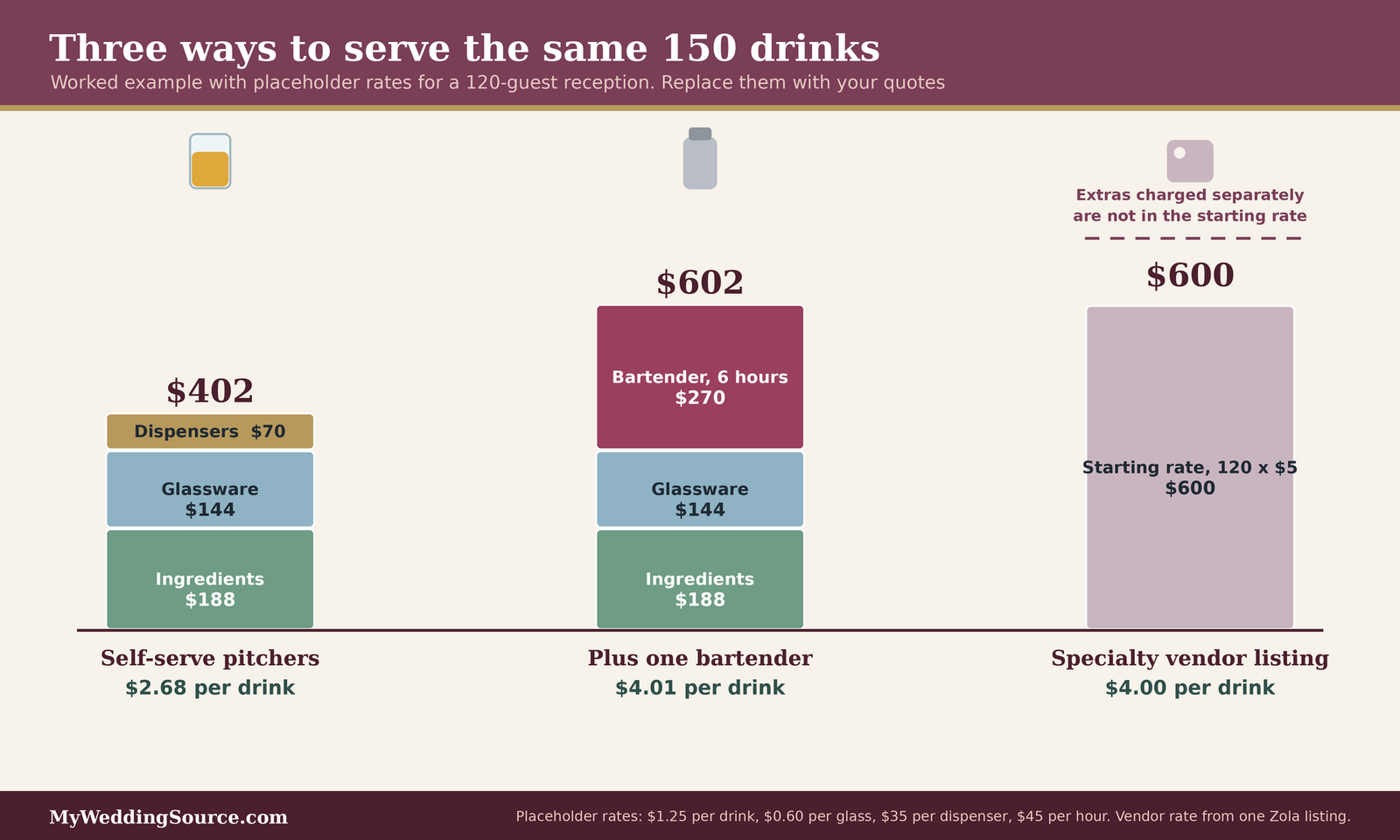
| Ingredients and garnish | Juice, syrups, tea, herbs, fruit, ice | Drinks times cost per drink | 150 x $1.25 = $188 | Caterer or bar vendor |
| Glassware | Rental and washing, or disposable | Glasses times rate, with about two glasses per drink taker | 240 x $0.60 = $144 | Caterer or rental company |
| Dispensers and equipment | Dispensers, ice tubs, urns, sign stands | Units times rental rate | 2 x $35 = $70 | Rental company |
| Labor | Pouring, refilling, setup, cleanup | Staff times hours times hourly rate | 1 x 6 hours x $45 = $270 | Bar vendor or caterer |
| Delivery and teardown | Moving equipment in and out | Flat fee or hourly | Ask; not in this example | Rental company or vendor |
| Service charge and tax | Percent added to the subtotal | Percent times subtotal | Ask; varies by vendor and state | Vendor |
| Substitution reserve | Replacing an ingredient that is unavailable | 10 to 15 percent of ingredients | $19 to $28 | You |
The method
First, write down your drink estimate and the number of guests. Second, fill in each row with the quote or a placeholder, noting which are placeholders. Third, total the rows, add the service charge and tax that apply, and divide by the drink estimate. The number you get is your cost per drink. It is an estimate, and it lets you compare a caterer’s add-on, a self-serve plan, and a specialty vendor on the same basis. If two quotes differ by a lot, look at which rows one of them left out before assuming one is cheaper.
A worked comparison, with placeholders
The rates in the table are placeholders we chose to demonstrate the method, not prices from any vendor. Using them for the mixed-bar scenario of 150 drinks and 120 guests, a self-serve plan with two dispensers, rented glassware, and caterer staff refilling comes to about $402, or $2.68 per drink. Adding one dedicated bartender for six hours at the placeholder rate brings it to about $602, or $4.01 per drink. A specialty vendor listing with a starting rate of $5 per person comes to $600 for 120 guests, or $4.00 per drink, before any extras the vendor charges separately. The three come out close on a per-drink basis once labor is included, which is the main lesson: the real difference is whether someone is pouring.
If you are still shaping the overall budget, our guide to how to pay for a wedding covers funding choices, and the wedding planning stress guide is worth a look if the number of vendor decisions is piling up.
Put substitutions, approvals, and timing in writing for wedding mocktails
Ingredients for wedding mocktails go out of season, suppliers run short, and weather changes plans. A written plan for what happens then costs nothing to make and prevents a surprise on the day.
Create a substitution plan before supply or weather forces one
Decide in advance what is acceptable and what is not. It is far easier to agree on a replacement in a calm email than on the day, with guests arriving.
Define acceptable ingredient, color, and glass substitutions
Write down, for each of your wedding mocktails, what can change and what cannot. For example, a citrus can be swapped for another citrus but a herb cannot be dropped, or a garnish color can shift within a range, or a glass can change only to a similar shape. Note which substitutions affect allergens, because swapping a nut syrup or a dairy-based ingredient changes the allergen information on the menu. Agree who decides and how quickly. This is a short document, and you can build it from the menu you already wrote.
Require approval rules in the contract
Ask that the contract or written confirmation state that any substitution beyond the approved list needs your approval, and that menu and allergen information will be updated if it changes. Ask what happens if the vendor cannot provide a listed drink, including whether the price changes. We are not lawyers, and contract terms vary by vendor and state, so read what you sign, and ask a professional if something is unclear. For food and beverage contracts more broadly, start with our wedding catering guide.
Work backward from the date
Timing is easier to manage as a short list than as a general intention. The schedule below is our suggestion, and your vendors may need more or less time.
A planning timeline
About four to six months before the wedding, decide the role of your wedding mocktails, confirm venue rules, and ask your caterer what can be included. About three months out, choose the format and book any outside vendor. About six to eight weeks out, finalize the menu and schedule a tasting, and confirm glassware and equipment. About two weeks out, confirm the guest count, the drink estimate, and the substitution plan, and send the final menu and allergen information to the vendor. About three days out, confirm delivery times, access, and who is responsible for ice. Our wedding planning timeline and wedding planning checklist show where these steps fit in the larger schedule.
A one-page run sheet for the day
A short run sheet for the wedding mocktails saves a lot of confusion. List when the bar opens and closes, who sets up and who tears down, where ice and spare ingredients are stored, who refills and when, and who is the single contact if something goes wrong. Add the menu, the allergen notes, and a reminder to check labels on any nonalcoholic spirits or kombucha. Give a copy to the caterer, the venue coordinator, and your point person, and make sure it is not you.
Questions to ask before you book wedding mocktails
Ask for the answers in writing and keep them with your contract. If a vendor cannot answer, that is information too.
Questions worth asking before you book
- Can mocktails be added to our existing beverage package, and what does it change in the price?
- Who pours, how many people will staff the mocktail side, and how do you handle a rush?
- Is the juice pasteurized or otherwise treated, and how is it stored and kept cold?
- Which allergens are in each drink, and how will guests find out?
- What is the alcohol content of any kombucha, nonalcoholic wine, beer, or spirit you plan to use?
- What is included: glassware, ice, dispensers, signage, setup, cleanup, delivery?
- What service charge, tax, and fees apply, and which are already in the quote?
- What is your substitution policy, and how will you tell us if a change is needed?
About the bar and the drinks
These questions confirm what you are getting and how it will run.
Staffing and service
Ask how many people will staff the mocktail side, whether they are the same people serving alcohol, and what happens when guests arrive at once. A bar that has one person for two menus can become slow, and a self-serve station without a refill plan can sit empty. Ask how the vendor handles breaks in serving wedding mocktails, since a bar that closes for fifteen minutes during dinner is a design problem as well as a staffing one.
Ingredients, safety, and labels
Ask where the ingredients for your wedding mocktails come from, how juice is treated, how syrups are made and stored, and how allergens are tracked. Ask for the labels of any packaged product and read them yourself. If the vendor mixes in a commercial kitchen or a home kitchen, ask what permits they hold. This is not meant to be an interrogation. A good vendor will have these answers ready.
About the contract and the cost
These questions protect the budget and the plan.
Fees, minimums, and what is included
Ask for a line-by-line quote that lists each of the layers in the cost worksheet, and ask which are optional. Minimums, such as a flat spending floor, can change the math for small guest counts, so compare them with your drink estimate. Ask when deposits are due and what is refundable.
Cancellation, changes, and the guest count
Ask how late you can change the guest count or the menu, what the vendor does if your count falls, and how cancellation works. Ask what happens if the venue changes a rule after you have booked. Keep a record of every change by email.
FAQ: wedding mocktails questions
Planning the bar
Do we need a separate mocktail bar, or can the main bar serve them?
Either works for wedding mocktails. A separate station signals that nonalcoholic drinks are a feature and eases lines, but it needs a surface and someone to pour. Many couples ask the main bartenders to serve both menus from one printed card. Ask your caterer what they recommend for your guest count and whether adding mocktails to the package changes the price.
How many mocktails should we offer?
For wedding mocktails, three to five is a practical range, because it gives variety without forcing the bartender to keep many fresh ingredients on hand. This is our recommendation, not an industry standard. Give each drink a different role, such as a sparkling one, a citrus one, a less sweet one, and a warm or dessert-style one, and add a signature drink if you like.
Should we go fully dry instead?
Whether to go fully dry is a personal decision with no right answer, and wedding mocktails work in either case. Zola’s guidance says most couples keep alcohol and offer zero-proof drinks alongside, and for dry weddings it advises telling guests early and planning other ways to keep the evening lively. Venue rules and budget can also decide it, so ask your venue what it permits.
Can children and teens drink the same wedding mocktails?
Usually yes, since nothing in them is alcoholic, but plan for it. Children raise the count and the sugar, and untreated juice is a higher risk for them, according to the FDA. Consider one mild, lightly sweetened option marked on the menu as kid-friendly, and ask the caterer about juice treatment and allergens before the day.
Safety and labels
Is it safe to serve fresh juice?
It can be, if the juice is treated or prepared safely. The FDA says untreated juice can carry bacteria and poses higher risk to children, older adults, pregnant women, and people with weakened immune systems, and that warning labels are not required for juice sold by the glass. Ask your caterer whether the juice is pasteurized.
Are nonalcoholic spirits and kombucha really alcohol-free?
Not always. Under TTB guidance, products below 0.5 percent alcohol by volume can be labeled nonalcoholic, so a trace may remain, and kombucha at or above that level is regulated as alcohol. For guests who must avoid alcohol entirely, read each label, ask the supplier, and tell the guest what is in the drink.
Cost and quantity
How much does a mocktail bar cost?
There is no reliable national figure for mocktails alone. Zola reports an average of about $5,541 for all bar and beverage services, and one vendor lists a starting rate of $5 per person with a $500 minimum. Your cost depends on labor, glassware, and what is included, so divide each quote by your expected number of drinks to compare.
How much should we make for 120 guests?
In our illustrative scenarios, about 150 drinks for a mixed bar and 480 for a dry reception, which is roughly 4.7 and 15 gallons of base at four ounces per drink, plus a reserve. These are our assumptions, not survey results. Adjust for weather, event length, and how many guests are likely to skip alcohol.
Your next steps
Settle the plan
Write the one-sentence purpose
Write what your wedding mocktails are for, such as welcoming guests, anchoring cocktail hour, or serving a dry reception. Then check the venue’s rules, ask the caterer whether wedding mocktails can join the existing package, and choose a format from the design matrix. If you are working with a modest guest list, our small wedding planning guide is a good place to look at scale.
Run the numbers once
Fill in the cost worksheet with real quotes where you have them and placeholders where you do not, and mark which are which. Divide by your drink estimate to get a cost per drink, and compare each quote on that basis.
Make it look intended
Test the setup
Do a trial of your wedding mocktails with real glassware and garnish at the venue, check it in the light your reception will have, and photograph it from a guest’s view. Remove anything that has no job. For the wording guests will see, our wedding invitations guide is the place to start.
Put it in writing
Send the vendor the wedding mocktails menu, the allergen notes, the substitution plan, and the run sheet, and ask for written confirmation. Keep a copy with your contract and give one to your point person.
Sources & methodology
How we built this guide
What we relied on
This guide combines a national poll of U.S. adults on drinking, wedding-industry articles from Zola and The Knot, federal guidance on pregnancy and alcohol, food allergens, untreated juice, and kombucha and nonalcoholic labeling, a university catering price list, and two vendor sources. Where a statement comes from a vendor, we say so, because vendors describe their own products. The drink counts, gallon figures, and cost examples are our own arithmetic from stated assumptions, and the rates in the cost worksheet are placeholders, not market data.
What we did not do
We did not test recipes, survey guests, or collect vendor quotes, and we did not verify local fire-code, permit, or liquor rules, which vary by place. We did not give medical, legal, or insurance advice. Zola and The Knot did not publish a percentage of weddings that serve mocktails in the pages we read, so we do not offer one. Check your venue’s rules, your contracts, and a qualified professional for your situation.
Source list
Government and regulatory sources
- Centers for Disease Control and Prevention, About Alcohol Use During Pregnancy: https://www.cdc.gov/alcohol-pregnancy/about/index.html
- U.S. Food and Drug Administration, Food Allergies: What You Need to Know: https://www.fda.gov/food/buy-store-serve-safe-food/food-allergies-what-you-need-know
- U.S. Food and Drug Administration, guidance on untreated juice and cider: https://www.fda.gov/food/foodborneillnesscontaminants/buystoreservesafefood/ucm110526.htm
- Alcohol and Tobacco Tax and Trade Bureau, Kombucha general requirements: https://www.ttb.gov/regulated-commodities/beverage-alcohol/kombucha/general-requirements
- National Law Review, summary of TTB low and no alcohol beverage guidance: https://natlawreview.com/article/ttb-releases-low-and-no-alcohol-beverage-guidance
Surveys and wedding-industry sources
- Gallup, U.S. drinking rate at a new low as alcohol concerns surge (August 2025): https://news.gallup.com/poll/693362/drinking-rate-new-low-alcohol-concerns-surge.aspx
- Zola, 2026 Wedding Trends: Zola’s First Look Report: https://www.zola.com/expert-advice/the-first-look-report-2026
- Zola, Wedding Food and Mocktail Ideas: 2026 Trends, Costs, and Menu Planning Guide: https://www.zola.com/expert-advice/wedding-food-ideas-trends
- Zola, How to Plan a Dry Wedding: https://www.zola.com/expert-advice/how-to-plan-a-sober-wedding
- The Knot, It’s Time to Normalize Fun, Non-Alcoholic Drinks at Weddings (2022): https://www.theknot.com/content/non-alcoholic-wedding-drinks
- Good Morning America, Dry weddings become increasingly popular (March 2023): https://goodmorningamerica.com/living/story/dry-weddings-become-increasingly-popular-nonalcoholic-trend-98227396
Vendor and price-list sources
- Illinois State University Catering, Beverages price list: https://catering.illinoisstate.edu/menus/catering/beverages
- Happy Valley Mocktails, vendor listing on Zola: https://www.zola.com/wedding-vendors/wedding-bar-services/happy-valley-mocktails
- Ripples, The New Cocktail Hour Standard (vendor blog): https://www.drinkripples.com/blog/the-new-cocktail-hour-standard-why-caterers-are-investing-in-non-alcoholic-bars/