

A wedding emergency kit is not a bag of everything you might conceivably need; it is a short, deliberate list of fixes for the handful of problems that really do interrupt a wedding day, packed so that one calm person can reach them in under a minute.
Quick answer
Build your wedding emergency kit in three layers. First, items that keep the day moving: safety pins, a small sewing kit, fashion tape, a phone charger, your printed timeline with vendor phone numbers, and any medication you personally rely on. Second, items that protect photos and comfort: a stain pen, white chalk, bandages and blister patches, hair pins, and lip color. Third, a few weather items that match your venue. Leave out anything you cannot name a specific problem for. Pack it about two weeks ahead, give it to one dependable person, and stock a second, smaller pouch for the reception.
What a wedding emergency kit is actually for
Most online lists present a wedding emergency kit as a shopping exercise: dozens of products, each one cheap and each one plausible. The trouble is that a wedding emergency kit built that way ends up heavy, expensive, and hard to search at the moment you need it. This guide takes the opposite approach. We start with the problems that tend to happen on wedding days, match each one to the smallest fix that works, and then decide who carries what.
Nothing here is medical, legal, or financial advice. Where we mention medication or first aid, we point to published guidance and to your own clinician, because what is safe depends on the person.
The job of the kit, in plain terms
A wedding emergency kit has one job: to turn a small problem into a two-minute inconvenience instead of a twenty-minute delay. It is not a replacement for a planner, a coordinator, or a venue that has its own supplies, and it is not meant to solve large failures such as a missing vendor or a cancelled venue.
Small problems, fast fixes
The problems a kit can solve share three traits: they are common, they are small, and a person with the right object can fix them on the spot. A split seam, a drop of coffee on a hem, a blister from new shoes, a phone at four percent battery, a hairpin that gave up. These are the failures where a pin, a pen, a bandage, or a cable changes the outcome.
What a kit cannot fix
A wedding emergency kit cannot replace a vendor who never arrives, a ceremony site that floods, or a payment dispute. For those, your protection is a good contract, a backup plan, and possibly insurance. Our wedding insurance guide explains what that kind of coverage generally addresses, and our wedding day timeline guide covers the bigger sequencing questions that sit above the wedding emergency kit.
Why kits get bloated
Retail kits and many blog lists are designed to look complete. A published list on one wedding site runs to dozens of items, and another publication’s checklist is organized into five sections, from beauty touch-ups to tech accessories. Those lists are useful as a menu, but they are written to cover every wedding, not yours.
The “just in case” trap
“Just in case” has no stopping point. Every item has some small chance of being useful, so adding one more always feels reasonable. The cost shows up elsewhere: a bag too large to carry down the aisle area, items buried under other items, and a carrier who gives up searching. A smaller kit that is easy to search beats a larger one that is not.
Duplicated supplies
Your hair and makeup artist, your photographer, the venue, and your own bridal party may each bring some of the same things. Hair pins, blotting papers, a lint roller, and a steamer often appear in more than one bag. Before you buy anything, ask who already has what. Duplication is the easiest place to cut weight and money from a wedding emergency kit.
Start with problems, not products
The most useful change you can make is to write the problems first. When a product list comes before a problem list, you buy what is on the list. When a problem list comes first, every item has a reason to be there and an obvious place to be cut.
Three questions for every item
For each possible item, ask the same three questions. They take a few seconds per item and they replace a lot of guessing.
How likely is the problem on this day?
A blister is likely if you are wearing new shoes and dancing. A bug problem is likely if you are outdoors near water at dusk. Humidity is likely to affect hair in some places and seasons. Likelihood depends on your venue, your clothing, your season, and your schedule, so the answer will differ from a friend’s.
How bad is it if the fix is missing?
Some problems are mild: a lip color that has worn off. Others stop the day: a dress strap that has come away with no way to secure it, a medication you need that is at home, or a phone that cannot be charged when you must reach the shuttle driver. The consequence is what earns an item its place.
Will someone else already have it?
If the venue keeps an iron or a first-aid kit, or your hair artist carries pins and hairspray, you can lean on them. Ask in advance and write down the answer. Only pack the item yourself when the answer is uncertain and the consequence is meaningful.
A simple sorting method
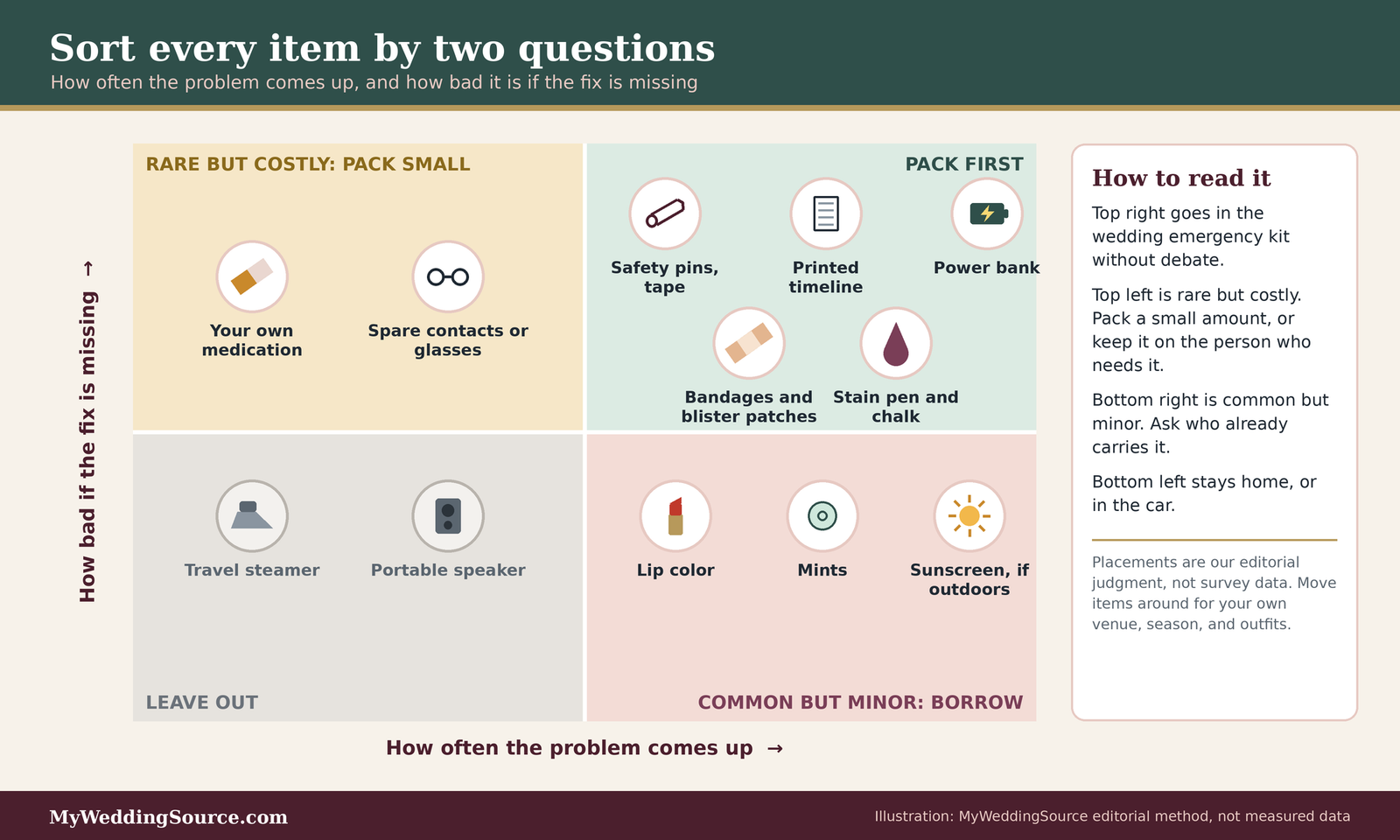
We use a two-axis sort that you can do on paper in ten minutes. It is our own editorial method, not a published standard, and the placements are judgment calls rather than data.
Frequency on one axis, consequence on the other
Draw a square. Put “how often it comes up” along the bottom and “how bad if missing” up the side. Items in the top-right corner (common and costly) go into the wedding emergency kit without debate. Items in the bottom-left (rare and trivial) are left out. The other two corners deserve a second look: rare but costly items such as prescribed medication belong in the kit, and common but trivial items such as an extra lip balm can usually be borrowed.
What the sort usually tells you
Applied honestly, the sort tends to keep a short list of dull items (pins, tape, a pen, a charger, bandages, the timeline) and to remove many decorative or specialized items. It also reveals gaps that glamorous lists skip, such as a printed copy of the phone numbers you would need if a phone died, which the next section returns to.
The day, hour by hour: when problems tend to show up
The same kit serves different purposes at different points in the day. The sequence below is an illustrative schedule, not a template. Your own timeline will differ, but the pattern of which problems appear when is consistent enough to plan around.

Getting ready
The hours before the ceremony are where grooming and clothing problems are most likely, and where a missing item is cheapest to replace if you notice early.
Hair, makeup, and the first dress check
Hair that will not hold, makeup that needs a touch-up, an earring back that has vanished, and a zipper that sticks are all typical of this window. The Knot’s emergency-kit guidance lists bobby pins, elastics, hairspray, a small makeup bag for touch-ups, and extra mirrors for a crowded suite. If you have a professional artist, ask what they bring and whether they stay for touch-ups.
Steaming and last-minute fabric care
A travel steamer or iron is on several published lists, but it is bulky. Whether it earns space depends on whether the venue provides one and whether your outfit has fabric that creases. If a steamer is needed, ask the venue or a hotel front desk before buying one.
The ceremony and photos
Between the walk to the ceremony and the end of portraits, the problems shift toward weather, comfort, and the look of the clothing in photos.
Wind, sun, and outdoor surfaces
If your ceremony is outdoors, sun and wind are the likeliest issues. The FDA advises a broad-spectrum sunscreen with an SPF of at least 15, applied before sun exposure and reapplied at least every two hours, which matters if guests and the wedding party are standing outside for portraits. Heels sink into lawn; heel protectors appear on several published lists for outdoor weddings.
Smudges and snags before the camera
White chalk for smudges on white fabric, clear nail polish to stop a small run in hosiery, and a lint roller are small, light items that appear repeatedly on published lists. Our wedding photographer shot list is a good place to see how many close-up details get photographed, which is a quiet argument for fixing small things before they are captured.
The reception
By the reception, the problems shift again: comfort, food, and logistics.
Shoes, food, and energy
Many couples change shoes for dancing; flip-flops or flat shoes appear on published lists for that reason. Snacks that do not crumble or stain are another recurring item, and water matters in warm rooms. Eating before you are hungry is not glamorous advice, but it is often the cheapest fix on this list.
Timeline, vendors, and the end of the night
Late in the evening, the biggest problems are not physical. They are questions: who is paying the DJ’s overtime, where the cake topper went, who has the decor to load out. A printed timeline with vendor contacts, a pen, and a labeled box for items to bring home are part of a good wedding emergency kit even though none of them looks like an emergency item.
What belongs in a wedding emergency kit: clothing and appearance
Clothing problems are the most predictable category, which makes them the easiest to prepare for. The goal is to hold a garment together long enough to get through photos and the first dance, not to perform tailoring. For lasting fixes, you need a seamstress, and our wedding dress alterations guide explains how that process works.
Holding things together
These items fix tears, loose hems, and wardrobe slips. They are small and cheap, and they solve problems that would otherwise pull a person away from the party.
Safety pins, tape, and a mini sewing kit
Published lists consistently include safety pins in small and large sizes, a sewing kit with small scissors, and fashion tape. Fashion tape can hold a neckline or strap in place, and one wedding blogger reports it kept a strapless dress steady all night, which is an individual account rather than a test. The Knot also suggests a crochet hook for fixing covered buttons and a bustle, which is a specific item worth owning only if your dress has them.
Thread that matches, and who can use it
A sewing kit helps only if someone can sew. Pre-threaded needles in your dress color, or thread wound on a card, make a repair possible for a friend who has not threaded a needle in years. Ask your bridal party who is comfortable with a needle, and give them the sewing kit. If nobody is, stay with pins and tape.
Stains and marks
Food and drink spills are common at weddings, especially at cocktail hour and the reception.
A stain pen, wipes, and white chalk
Published lists suggest a stain-removing pen or wipes, baby powder, and white chalk for marks on white fabric. Fabrics differ in how they respond, so test on an inside seam if you can, and avoid rubbing hard. Our wedding party attire guide covers how fabric choices affect what you can safely do to a garment.
What not to do to a gown
Do not scrub a delicate fabric at the venue, and do not use unfamiliar products on silk, beadwork, or lace. If something bad happens, blot, take a photograph, and ask the dress shop or a cleaner afterward. A quick fix that damages the fabric turns a small problem into a permanent one.
Hair, makeup, and skin
These items are for touch-ups, not transformations. They are light and fit in a pouch.
Pins, spray, and lip color
Bobby pins, elastics, hairspray, a brush or comb, and lip color are the most often recommended items. If you are working with a professional, ask them to put together a small touch-up pouch for you instead of buying duplicates. Our bridal makeup guide covers how to plan makeup so that touch-ups stay minimal.
Deodorant, mints, and small fixes
Deodorant, breath mints, tissues, cotton swabs, tweezers, and a nail file turn up on nearly every list. They are inexpensive and make a person feel put together. If you wear contact lenses or glasses, a spare pair and solution are among the items that earn a place in the “rare but costly” corner of our sort.
What belongs in a wedding emergency kit: body, health, and comfort
This is the part of the wedding emergency kit where caution matters most. We are not clinicians, and we do not tell anyone what medication to take. We can, however, say what published first-aid guidance recommends for kits in general and show where a wedding kit differs.
A small first-aid pouch
A wedding emergency kit does not need a hospital’s worth of supplies. A full first-aid kit is a different product, and some venues have one on site.
What general first-aid guidance recommends
The American Red Cross lists the contents of a basic family kit that include adhesive bandages, gauze pads, adhesive tape, antiseptic wipes, antibiotic ointment, gloves, tweezers, a thermometer, an emergency blanket, and a few other items. Mayo Clinic’s list adds elastic wrap, scissors, over-the-counter pain relievers, antihistamines, and hydrocortisone cream, and notes that an epinephrine auto-injector belongs in a wedding emergency kit only if a doctor has prescribed one. A wedding pouch is a tiny subset of those lists.
What fits a wedding pouch
For a wedding, a small selection is enough: assorted bandages, a few gauze pads, a few antiseptic wipes, tweezers, and a couple of blister patches. Add tissues and hand sanitizer. For anything beyond these, ask the venue where its first-aid kit is kept and who knows how to use it. Our wedding planning checklist includes space to note this kind of detail.
Medication and allergies
This is the area where “just in case” is least useful and personal planning is most important.
Your own medication comes first
Any medication you take regularly should be with you, not in a communal kit, and it should be in its original container. If you carry an epinephrine auto-injector, it should be with you and someone nearby should know where it is and how it is used. Discuss anything about timing, travel, or alcohol with your clinician before the wedding, since the day will not follow your usual routine.
Common over-the-counter items
Published wedding lists commonly include a mild pain reliever, an allergy tablet, and an antacid. If you include them, keep them in labeled original packaging, check the expiration dates, and do not hand anything to another person without asking about allergies and other medication. Merck Manuals and Mayo Clinic both advise checking kits regularly and replacing expired items, which is a reason to build the pouch from fresh packages.
Weather and venue comfort
Weather items should match your venue, not a generic list.
Sun, heat, and bugs
The FDA says sunscreen without an expiration date should be treated as expired three years after purchase, which is a good reason to buy a fresh bottle instead of pulling one from last summer’s beach bag. The American Cancer Society notes that heat can reduce sunscreen effectiveness, so do not leave it in a hot car. A handheld fan, water, and bug spray fit most outdoor settings. Our garden wedding venues guide and beach wedding dresses guide show how outdoor settings change planning.
Rain, wind, and cold
The Knot’s guidance on common wedding crises suggests having backup plans for both ceremony and reception, staying flexible with the timeline, and providing clear umbrellas for guests. A wedding emergency kit can contain a few compact umbrellas, a wrap or jacket, and hair pins that handle wind. Anything bigger, such as a tent, is a venue conversation, not a kit item.
What belongs in a wedding emergency kit: paper, tech, and logistics
The least glamorous items in a wedding emergency kit are often the ones that save the most time.
Paper and contacts
A phone is not a reliable contact list when it is dead, locked, or in a pocket of a gown.
A printed timeline with contacts
Print one page with start times, addresses, and phone numbers for the venue contact, the planner or coordinator, the photographer, the officiant, the caterer, the DJ or band, and the transportation provider. The Knot’s guidance includes a printed timeline in its practical additions. Make two copies: one for the wedding emergency kit and one for a person who will not be at the venue early.
Pens, labels, and a place to put things
A pen, a roll of tape, a few envelopes for cards and vendor tips, and a labeled bag for items to bring home are inexpensive and useful. Our wedding vows guide and wedding officiant guide are worth reading if you want a printed copy of your vows or a ceremony script in the wedding emergency kit as a backup.
Power and phones
Phones carry photographs, music cues, directions, and payments. A dead one is a real problem.
A power bank and the right cables
A portable power bank and a charging cable for each phone type in the wedding party is the single most common tech item on published lists. The Knot also lists multi-head cables and a power strip for the getting-ready room. Charge the power bank the night before, and check that it actually works with your phones.
Music, speakers, and a backup plan
A small portable speaker and headphones appear on several lists for getting ready, but a speaker can also create noise problems at venues with sound limits. Treat it as optional. If music is part of your ceremony, ask your officiant or venue what the backup is if a device fails.
Ceremony and reception odds and ends
Some items belong in the wedding emergency kit because they are small and easy to forget.
Items vendors forget
The Knot’s crisis guidance names stain remover, a spare bow tie, a cake server, extra table numbers, and sewing supplies as basics. Add a lighter or matches only if your venue allows open flame, and check the rules first. For the ring bearer and the rings themselves, keep the real rings with a named person and not in the kit.
Attire for the whole party
A wedding emergency kit often ends up serving the whole wedding party. Our bridesmaid dresses guide and groomsmen suits vs tuxedos guide mention fit and fabric issues that are worth knowing about, such as a missing cufflink, a loose button, or a zipper that sticks.
What to leave out of your wedding emergency kit
Cutting is where a wedding emergency kit gets better. Every item you remove makes the remaining items easier to find.
Duplicates and venue-provided items
Before you add an item, check whether it is already covered.
Ask the venue what it keeps on hand
Some venues have an iron, a steamer, a sewing kit, or a first-aid kit. Others have none. Ask in writing, and note the answer on your timeline. If the venue provides it, you can skip it, but confirm that it will be accessible on the day and not locked in an office.
Ask your vendors what they carry
Photographers, planners, and hair and makeup artists often carry their own kits. Our wedding photography guide is a useful reference for what to ask a photographer, and a coordinator should be able to tell you what they bring. A duplicate pack of bobby pins is harmless; a duplicate steamer is a burden.
The carry test
A wedding emergency kit that cannot be carried is not a wedding emergency kit.
Weight and volume
Test the kit by carrying it for ten minutes, up a flight of stairs, and then placing it under a chair. If you would not be willing to carry it between ceremony and reception, it is too big. Move bulky or rarely used items to the car or the venue’s storage and label the container.
One-hand access
Pack the wedding emergency kit in labeled pouches by problem, such as “clothing”, “first aid”, and “tech”, so someone can reach the right pouch without emptying the bag. A clear pouch lets a person see what is inside. The goal is fewer than sixty seconds from “I need a pin” to “here is a pin.”
Who carries the wedding emergency kit, and how to split it
A well-packed wedding emergency kit helps only if the right person has it at the right time. This is a handoff problem, and it is one of the places where couples most often stumble: the wedding emergency kit is in the car, the person who packed it is in the ceremony, and the problem is in the reception hall.
Choosing a carrier
The Knot recommends giving the wedding emergency kit to someone responsible and dependable, such as a member of the wedding party, a close friend, or a family member, and notes that a planner or day-of coordinator can also hold it.
What makes someone a good carrier
Look for three traits: they will be present for the whole day, they stay calm when something goes wrong, and they are not also in the middle of the main action. A bridesmaid who is walking down the aisle at the key moment is a poor choice for the fix-it pouch, while a sibling who stays in the guest area may be a better one. If you hire a coordinator, ask whether the kit is part of the service.
What to tell them in advance
Give the carrier a one-page note: what is in each pouch, where the printed timeline is, which items are personal medication that should not be handed out, and who to call if a problem is larger than the wedding emergency kit can handle. Walk through two or three “what if” scenarios together, as The Knot suggests doing with your partner and planner.
Three bags instead of one
One large bag is hard to move and hard to search. Three small ones, each with a job, travel better. The figure below shows the split we suggest, with eight, nine, and six line items in the three bags.

The getting-ready bag
This bag stays in the suite with the wedding party. It holds the hair, makeup, and grooming items that matter before the ceremony: bobby pins and elastics, hairspray, lip color, blotting sheets, a nail file and clear polish, deodorant, mints and floss, and tweezers with cotton swabs. When the party leaves for the ceremony, this bag stays behind or goes to the car.
The fix-it pouch and the reception pouch
The fix-it pouch travels with the carrier all day and holds the repair and health items: safety pins, a mini sewing kit with matching thread, fashion tape, a stain pen and white chalk, bandages and blister patches, original-package pain reliever and allergy tablets, menstrual products and tissues, a power bank with cables, and the printed timeline with a pen. The reception pouch is smaller and holds flat shoes or heel grips, a non-crumbly snack, water, spare earring backs, sunscreen and bug spray when relevant, and a compact fan or umbrella.
Worked scenarios: the same problems, different kits
A good test of any list is whether it changes when the wedding changes. If a list would work for any wedding, it is probably too generic. The three scenarios below are illustrative, not case studies of real couples, and the choices reflect our editorial judgment.
An outdoor summer wedding
Imagine a late-afternoon ceremony on a lawn, portraits in full sun, and a tented reception.
What moves up the list
Sun and heat items rise: fresh sunscreen, a handheld fan, bug spray, water, and heel protectors for grass. Hair and makeup that must survive humidity push the hairspray and blotting sheets into the top tier. The Knot also suggests that cake delivery be timed close to cutting in hot weather, and that cutting may be moved earlier to get photos before the cake softens, which is a coordination item rather than a wedding emergency kit item but belongs on the same page of the timeline.
What can be dropped
A travel steamer may be unnecessary if the dress and suits were steamed at a shop the day before, and a heavy umbrella may be unnecessary if the tent covers the guests. Keep the fix-it pouch, but let the venue and caterer handle ice, shade, and drinking water, and confirm that in writing.
A city hotel ballroom
Imagine an evening ceremony and reception in the same building, with a hotel suite for getting ready.
What moves up the list
Because everything is indoors, weather items disappear and logistics rise: a power strip for the suite, a printed timeline with the hotel’s event contact, and a bag for gifts and cards at the end of the night. Comfortable reception shoes matter, since the floors are hard and the night is long.
What can be dropped
Bug spray, a fan, sunscreen, and heel protectors can all stay home. The hotel may have an iron and a steamer on request, and the front desk may have basic first-aid supplies. Ask which of these are included and write down the answer. Our wedding reception guide and wedding ceremony guide cover the surrounding planning.
A small backyard or courthouse wedding
Imagine fewer than twenty guests, a brief ceremony, and no coordinator.
What moves up the list
With few people and no staff, you are the coordinator. The printed timeline and a named carrier matter more, not less, because nobody else will notice when something slips. Our micro-wedding planning guide and small wedding planning guide discuss how fewer guests change the planning load.
What can be dropped
A full beauty bag is unnecessary for a short event, and most of the reception pouch can shrink to water, a snack, and comfortable shoes. A single zip pouch with a dozen items may be enough, which is a good reminder that bigger is not better.
What a wedding emergency kit costs, and how to keep it cheap
Money matters here for a simple reason: a wedding emergency kit is easy to overspend on because each item is cheap and the list is long.
Cost reality check
We did not find a reliable, current survey figure for what couples spend on a wedding emergency kit, so we do not quote one. Retail prices for individual items and for pre-packed kits vary by store and change often, so check current prices yourself. What we can offer is a method: set a spending cap before you shop, count only what you must buy new, and compare any pre-packed kit against your own list. As an illustration only, if you set a cap of $40 and already own pins, tape, a charger, and bandages, your spending might go to a stain pen, blister patches, and fresh sunscreen. That arithmetic is an example, not a price quote.
Build before you buy
The cheapest item is the one you already own.
Take an inventory first
Walk through your home with the list from the sort above. Safety pins, a sewing kit, tape, pens, tissues, bandages, a charger, and a hairbrush are common household items. Gather them in one place and note what is missing. Only then decide what to purchase, and buy the fewest, smallest packages that do the job.
Set a cap and track it
Decide on a cap and note it on your budget. Our wedding budget calculator is a place to add a small line for a wedding emergency kit, and our wedding planning guide explains how small line items add up. If you are under pressure, wedding planning stress is a reminder that perfect preparation is not required.
Pre-packed kit or do it yourself
Both routes work. The right choice depends on your time, your budget, and your confidence.
When a pre-packed kit makes sense
A pre-packed kit saves time and can be a gift from a friend. The Inside Weddings guide says that if you buy one, you should check that it contains what you need. Compare its contents to your own list, look for items you would never use, and make sure it does not duplicate what your vendors carry. Treat a ready-made kit as a starting point, not a finished product.
When assembling your own wins
If you have specific needs, such as a dress with covered buttons, a sensitive-skin routine, or contact lenses, building your own is usually the better path, because a retail kit cannot know them. It is also cheaper when you already own most of the items. A custom list also makes it easier to hand the carrier an exact inventory.
The checklist and the final-week handoff
Two reusable tables follow. The first lists what we would pack and why. The second is a handoff you can fill in during the final week. Both are templates: change them to fit your wedding.
The operational checklist
Read the table as a set of tests, not a shopping list. Each row names the problem the item solves, the tier, who holds it, and the sign that the task is done.
| Item | Problem it solves | Tier | Held by | Done when |
|---|---|---|---|---|
| Safety pins and mini sewing kit | Loose hem, popped seam, strap | 1 | Fix-it pouch | Pins and matched thread are in a labeled pouch |
| Fashion tape | Neckline or strap shifts | 1 | Fix-it pouch | Tape is fresh and tested on fabric you can spare |
| Printed timeline and contacts | Dead phone, late vendor | 1 | Fix-it pouch and a second person | Two copies are printed and checked for typos |
| Power bank and cables | Low battery | 1 | Fix-it pouch | Bank is charged the night before and fits each phone |
| Personal medication | Missed dose, allergic reaction | 1 | The person who needs it | It is in its original container and someone nearby knows where |
| Bandages and blister patches | Blisters, small cuts | 1 | Fix-it pouch | Two sizes of bandage and several patches are inside |
| Menstrual products and tissues | Surprise needs | 1 | Fix-it pouch | A handful of each is packed |
| Stain pen and white chalk | Spills and smudges | 2 | Fix-it pouch | Pen is unexpired and tested on a scrap |
| Hair pins, hairspray, lip color | Touch-ups | 2 | Getting-ready bag | Bag is labeled and with the wedding party |
| Deodorant, mints, floss | Freshening up | 2 | Getting-ready bag | Travel sizes are packed |
| Flat shoes or heel grips | Sore feet, sinking heels | 3 | Reception pouch | Shoes are broken in and stored where the carrier can reach them |
| Sunscreen, bug spray, fan | Sun, heat, bugs | 3 | Reception pouch | Sunscreen is within its expiration date |
| Compact umbrella or wrap | Rain, wind, chill | 3 | Reception pouch | Fits in the pouch or the car is near |
| Snacks and water | Low energy | 3 | Reception pouch | Snacks do not crumble or stain |
How to read the tiers
Tier 1 items are the ones that keep the day moving; pack them first and check them twice. Tier 2 items protect appearance and photographs. Tier 3 items depend on your setting and season, and are the ones to cut first when space is tight. Tiers are our judgment, not a standard.
How to customize the table
Cross out what your venue or vendors already provide, add anything specific to your outfits, and put a name next to every “held by” box. If a row has no named person, the item is not really packed.
The final-week handoff
Table 2 turns the checklist into a set of calls and confirmations. It is shorter, because the final week is busy.
| Task | Contact | Timing | Proof | If it goes wrong |
|---|---|---|---|---|
| Confirm carrier and give the one-page note | Kit carrier | Seven days out | Carrier replies with a photo of the packed pouches | Name a backup carrier |
| Confirm what the venue provides | Venue coordinator | Seven days out | Written reply listing iron, steamer, first-aid kit | Add the item to the fix-it pouch |
| Confirm what vendors carry | Planner or lead vendor | Five days out | Short written reply | Cover the item yourself |
| Print timelines with contacts | You | Three days out | Two copies checked for typos | Reprint at a shop |
| Charge power banks and test cables | You and carrier | Night before | Each phone gets a charge | Swap in a spare bank |
| Place kit where the carrier can reach it | Carrier | Morning of | Carrier confirms location | Move it to the suite or car |
Pack two weeks out
The Knot suggests packing the kit about two weeks before the wedding to avoid last-minute stress, and notes it can also serve the rehearsal dinner and other events. That leaves time to replace anything that did not work and to buy anything missing.
Check and retire expired items
Mayo Clinic advises checking first-aid kits at least every three months, and Merck Manuals suggests every three to six months, replacing anything expired. For a wedding kit that is assembled once, the practical rule is to check dates at packing time. Anything undated, such as sunscreen without an expiration date, should be treated according to FDA guidance: three years after purchase.
Questions to ask before you finalize your wedding emergency kit
These questions cost nothing and prevent duplicate buying. Ask for answers in writing where you can, and keep them with your timeline.
Questions worth asking before you pack
- What does the venue keep on site, such as an iron, steamer, sewing supplies, or a first-aid kit, and where is it kept on the day?
- Does my hair and makeup artist stay for touch-ups, and what do they bring?
- Does my planner or day-of coordinator carry a kit, and what is in it?
- Who will hold the kit during the ceremony and the reception?
- Which items in my outfits are fragile, such as covered buttons, beading, or a bustle, and who can fix them?
- Does anyone in the wedding party have a medical need that the people nearby should know about?
- What is our backup if the weather turns or a phone dies?
About the venue and vendors
These questions tell you what you can skip.
Supplies and access
Ask the venue what supplies it keeps and whether they are available during your event. If a venue says it has a first-aid kit, ask where it is, who has the key, and whether staff are trained to use it. Keep the answer with your timeline. If there is no kit, move first-aid items up your list.
Rules and limits
Ask about rules that affect the wedding emergency kit: open flame, outside food, speakers and sound limits, and drone or tripod restrictions if they apply to your setup. The wedding emergency kit is only useful if the items are allowed. Our wedding catering guide and open bar wedding guide are worth a look if food and drink rules affect snacks and water.
About the people
These questions tell you who carries what.
The carrier and the backup
Ask the carrier directly, not through a group message. Confirm that they are willing, that they will be present for the whole day, and that they know where the wedding emergency kit is. Name a backup person in case plans change, and give both the same one-page note.
Personal needs
Ask each member of the wedding party, privately and lightly, whether there is anything they would like to have available, such as a particular medication, a type of bandage, or a quiet place to sit. Do not ask anyone to disclose medical details. Offer a way to bring their own items and make sure someone knows where they are.
Wedding emergency kit FAQ
Contents and planning
What should a wedding emergency kit include at minimum?
At minimum, include safety pins, a small sewing kit, fashion tape, bandages and blister patches, a stain pen, a phone charger or power bank, tissues, your own medication, and a printed timeline with vendor phone numbers. Published lists are much longer, but these cover the most common small failures. Add weather items that match your venue.
Who should carry the wedding emergency kit?
Choose someone dependable who will be present all day, is calm under pressure, and is not busy in a key role at the critical moments. The Knot suggests a wedding party member, a close friend, a family member, or a planner or coordinator. Give them a one-page note listing what is where and who to call.
When should I pack it?
The Knot suggests packing about two weeks before the wedding, which leaves time to replace anything that fails and to buy what is missing. Check expiration dates when you pack, since sunscreen, medication, and ointments can expire. The same kit can also serve the rehearsal dinner and other events.
Health and safety
Should I put medication in the kit?
Keep your own regular medication with you in its original container, not in a shared kit. If you include common over-the-counter items for others, check labels, expiration dates, and allergies before giving anything to anyone. Ask your clinician about timing, travel, and alcohol. This guide is not medical advice.
Do I need a full first-aid kit?
Usually not. A small pouch with bandages, gauze, antiseptic wipes, tweezers, and blister patches covers most minor problems. The American Red Cross and Mayo Clinic describe fuller kits for homes and families. Ask the venue where its first-aid kit is, and who knows how to use it.
How do I protect against sun and bugs?
The FDA recommends broad-spectrum sunscreen with an SPF of at least 15, applied before going out and reapplied at least every two hours. Treat undated sunscreen as expired three years after purchase. Add bug spray and water for outdoor settings, and ask the venue about shade for guests.
Cost and extras
Is a pre-packed kit worth buying?
It can be, especially as a gift or when time is short. Check the contents against your own list, because a ready-made kit may include items you will not use and miss ones you need. Compare prices yourself, since they change, and make sure it does not duplicate what your vendors carry.
What can I leave out?
Leave out anything you cannot connect to a specific problem, anything the venue or your vendors already provide, and anything too bulky to carry. Many published lists include extras such as speakers, full-size products, and spare appliances that are nice to have but rarely decisive.
Your next steps
Draft the list
Write the problems first
Spend ten minutes listing what could go wrong at your venue, in your outfits, and in your season. Sort them by how common and how costly they are, then pack only for the top of the list. Our wedding planning checklist is a good place to keep the list with your other tasks.
Ask who already has what
Call the venue and your main vendors, and write down what they carry. Then check the timing against our wedding timeline guide, and place the kit handoff on the day-of schedule.
Pack and hand off
Build the pouches two weeks out
Assemble the three pouches, label them, and test the tech. Print the timeline. Keep the pack light enough that someone can carry it for a day. The broader planning picture lives in our wedding planning guide and plan a wedding pages.
Give the carrier a one-page note
In the final week, hand over the kit and the note, confirm a backup, and then let it go. If something is missing on the day, a calm person with pins, tape, and a phone number can usually fix it.
Sources & methodology
How we built this guide
What we relied on
This guide draws on published wedding-day kit lists from The Knot, Here Comes the Guide, and Inside Weddings, general first-aid guidance from the American Red Cross, Mayo Clinic, and the Merck Manuals, and sunscreen guidance from the U.S. Food and Drug Administration and the American Cancer Society. Where an item comes from a wedding publication, we say so, because those lists reflect editorial opinion and personal experience. The sorting method, the three-pouch split, the tier labels, the scenarios, and the tables are our own editorial work, not published standards.
What we did not do
We did not test products or survey couples, and we could not verify any current price or spending figure, so we do not give one. We did not research heat illness, lightning safety, or blister treatment in primary sources for this article, so we keep those points general and leave them to your venue and clinician. This is not medical advice. Ask your clinician about medication, and ask your venue about its own safety plan.
Source list
Government, clinical, and professional sources
- U.S. Food and Drug Administration, Sunscreen: How to Help Protect Your Skin from the Sun: https://www.fda.gov/drugs/understanding-over-counter-medicines/sunscreen-how-help-protect-your-skin-sun
- American Red Cross, Anatomy of a first aid kit: https://www.redcross.org/get-help/how-to-prepare-for-emergencies/anatomy-of-a-first-aid-kit.html
- Mayo Clinic News Network, First-aid kits: Stock supplies that can save lives: https://newsnetwork.mayoclinic.org/discussion/first-aid-kits-stock-supplies-that-can-save-lives/
- Merck Manual Consumer Version, Basic first aid supplies: https://www.merckmanuals.com/home/injuries-and-poisoning/first-aid/basic-first-aid-supplies
- American Cancer Society, How to use sunscreen: https://www.cancer.org/cancer/risk-prevention/sun-and-uv/how-to-use-sunscreen
Wedding publications and planners
- The Knot, The bride’s emergency kit: https://www.theknot.com/content/the-brides-emergency-kit
- The Knot, How to handle common wedding crises: https://www.theknot.com/content/how-to-handle-common-wedding-crises
- The Knot, Bridal suite getting-ready essentials: https://www.theknot.com/content/bridal-suite-getting-ready-essentials
- Here Comes the Guide, Wedding day emergency fashion kit: https://www.herecomestheguide.com/wedding-ideas/wedding-day-emergency-fashion-kit
- Inside Weddings, What to pack in your wedding day emergency kit: https://insideweddings.com/news/planning-design/what-to-pack-in-your-wedding-day-emergency-kit/44553