

A good wedding rental planning checklist is less a list of chairs and more a record of who delivers, sets up, protects, and collects every item, because most rental surprises come from an unwritten handoff and not from the furniture itself.
Quick answer
Build your inventory first, then your responsibility matrix, then your contract questions, in that order. Count what you need from your guest list and table plan, decide which party (rental company, venue, caterer, planner, or you) handles delivery, setup, damage, and pickup for each line, and get those answers in the written agreement before you pay a deposit. Treat every fee and date in this guide as an example to compare against your own paperwork, since terms vary by company and by state.
Rentals are one of the quieter parts of a wedding budget and one of the loudest on the day. Tables, chairs, linens, glassware, lounge pieces, a dance floor, and sometimes a tent arrive on a truck, get arranged by a crew you may never meet, and leave again before or after midnight. In between, plenty can go sideways: a short count, a color that photographs differently than the swatch, a delivery crew that cannot reach the garden, a pickup that happens while guests are still dancing. This guide gives you a working wedding rental planning checklist for all of it, including a rental inventory and responsibility matrix you can copy into a spreadsheet.
We wrote it for couples planning a reception where at least some furniture is not already included with the venue, and for anyone helping them. It does not replace your contract, your venue’s rules, or a conversation with your rental company. It does help you walk into those conversations knowing what to ask.
Why a wedding rental planning checklist starts with responsibility, not with chairs
Most advice about rentals begins with product: which chair, which cloth, which table. That is the fun part, and it is also the part least likely to cause a bad day. The expensive mistakes come from handoffs. Someone assumed the venue would set the tables, someone else assumed the rental crew would, and the florist arrived to a room with no tables at all. A responsibility-first wedding rental planning checklist asks “who does this, by when, and what happens if it goes wrong” before it asks “how many.”
What rentals cover and how common they are
A wedding rental planning checklist matters because rentals sit in an odd place in wedding budgeting, because they are a collection of small decisions that are easy to underestimate and hard to correct late.
The scope of event rentals
For this guide, event rentals means the furniture, linens, tableware, structures, and equipment a company supplies for a limited time and then takes back. That usually includes tables, chairs, cloths and napkins, plates, glassware, flatware, bars, lounge furniture, dance flooring, and tenting. It can also include labor, delivery, setup, and pickup, which are often priced as separate lines. Anything you buy outright, such as décor you keep, is not a rental, and it follows different rules for returns and damage.
What national survey data suggests
The Knot’s 2026 Real Weddings Study surveyed 10,474 U.S. couples who married in 2025 and reported an average guest count of 117 and an average ceremony and reception cost of $34,000. As we read the readout’s vendor table, about 68 percent of couples hired an event rentals vendor. That table was hard to parse in places, so confirm the figures in the original PDF before you quote them. The takeaway for planning is modest: renting is common enough that your rental company has seen your situation before, which is a good reason to ask direct questions.
Where couples lose money and time
A rental order rarely fails in one dramatic way. It leaks through small, avoidable items that stack up.
Handoff gaps
A handoff gap is any task that sits between two parties and belongs to neither. Examples include who unpacks and counts the delivery, who moves chairs from ceremony to reception, who scrapes plates before they go back in the crates, and who signs for pickup. Because these tasks are not exciting, they tend to be missing from proposals. A line in your matrix for each one turns an assumption into an agreement.
Fee surprises
Fees for stairs, firm delivery times, weekend labor, damage waivers, and late returns can add up beyond the headline rental price, so give them a column in your wedding rental planning checklist. Published terms from rental companies show how many separate charges can exist, and later sections walk through real examples. The aim is not to avoid every fee, since many cover real work. It is to see them on paper before you commit, so the final invoice matches what you expected.
The three-layer model we use in this guide
To keep your wedding rental planning checklist simple, we sort every rental decision into three layers. Each layer has its own questions, and each can fail separately.
Layer one: items
Items are the physical things: how many tables, which sizes, which chairs, what linens, which dishes. Item decisions are mostly arithmetic and taste, and they are where most planning attention goes. Getting them right still does not guarantee a smooth day, which is why they are only the first layer.
Layer two: services
Services are the actions around the items: delivery, setup, floor plan execution, breakdown, pickup, and cleaning. Each service has a time, a place, a person, and a price. Two companies can quote the same items at similar prices and differ widely in what services are included, so compare the layer, not only the total.
Layer three: liability
Liability is who pays when something breaks, goes missing, gets stained, or cannot be delivered. This layer lives in contract language, waivers, and insurance. It is also the one couples read least carefully. The later sections on damage terms and the matrix are designed to make it visible.
Decide who provides what: venue, caterer, rental company, and you
Before counting anything, find out what is already covered. A venue that includes tables and chairs changes your order, and a caterer that supplies plates, glassware, and linens changes it again. Skipping this step is how couples end up with duplicate chairs or no cake table, so make it the first section of your wedding rental planning checklist.
What the venue may already include
Venues describe their inventory in very different ways, and a sales tour often skips the details that matter for rentals.
Furniture and equipment on site
Ask for an itemized list with counts and sizes for your wedding rental planning checklist: how many rounds, how many rectangles, how many chairs, what style, what condition, and whether the pieces can be moved outdoors. A line such as “tables and chairs included” is not specific enough to plan from. Also ask whether the venue’s stock is reserved for your date, since a venue hosting more than one event in a weekend may share inventory. Our wedding venue questions guide covers the broader list of things to ask on a tour.
Venue rules that limit rentals
Many venues set their own rules for outside vendors. Typical questions include whether outside rental companies are allowed, whether they must carry insurance and send a certificate to the venue, what hours deliveries are permitted, which doors, elevators, or loading areas must be used, and whether setup staff must be on a preferred list. Get these in writing, because a rental company cannot fix a rule it did not know about.
What the caterer may supply
Catering contracts vary widely in how much equipment they cover, and the gap between “food” and “full service” is where duplicate or missing rentals appear.
Dishware, glassware, and flatware
Some caterers bring plates, flatware, and glassware as part of their service, and others expect you to rent them separately. Ask for the exact list, including water goblets, wine glasses, bread plates, coffee cups, and serving pieces. Our wedding catering guide explains how catering proposals are built, and it is worth reading alongside this one. If the caterer rents on your behalf, ask whether the charge appears on their invoice or the rental company’s, because that affects who handles damage.
Staffing and linen handling
Ask who sets tables, who clears them, and who returns dishware to crates. If the caterer’s staff scrape and stack the plates, that may line up with a rental company’s return rules. If no one does it, you may be responsible. A short conversation between your caterer and your rental company, even by email, prevents two parties each assuming the other will do the work.
Drawing the line in your own plan
After you have the venue and caterer lists, the remaining gap is your rental order. That gap is easier to fill when you write it down as a plain table.
Build a simple gap list
List every function the reception needs, such as guest seating, buffet or plated service, bar, cake, gifts, guest book, lounge area, dance floor, DJ or band stage, and restrooms if needed. Next to each, write who currently provides the furniture and equipment. Blanks are your rental order, and they become the open rows of your wedding rental planning checklist. This also surfaces items people forget, such as a table for the DJ or a covered area for the cake.
Name one person for rental questions
Choose one person, you, your planner, or a trusted family member, as the point of contact for the rental company and the keeper of the wedding rental planning checklist. On the day, a single contact avoids conflicting instructions to the crew. If you have a planner or coordinator, confirm in writing whether they handle rentals or only coordinate with the vendor. Our wedding planner vs. coordinator guide explains how those roles differ.
Count what you need: tables, chairs, and seating math
Counting is where a wedding rental planning checklist becomes concrete. The arithmetic is simple, but it depends on assumptions you should state out loud, such as table size, seats per table, and who needs a chair.
Seats per table and what changes them
Rental companies publish seating charts, and those charts show a range, not a promise. The right number for your event depends on place settings, centerpieces, and chair width.
Rounds, rectangles, and the published ranges
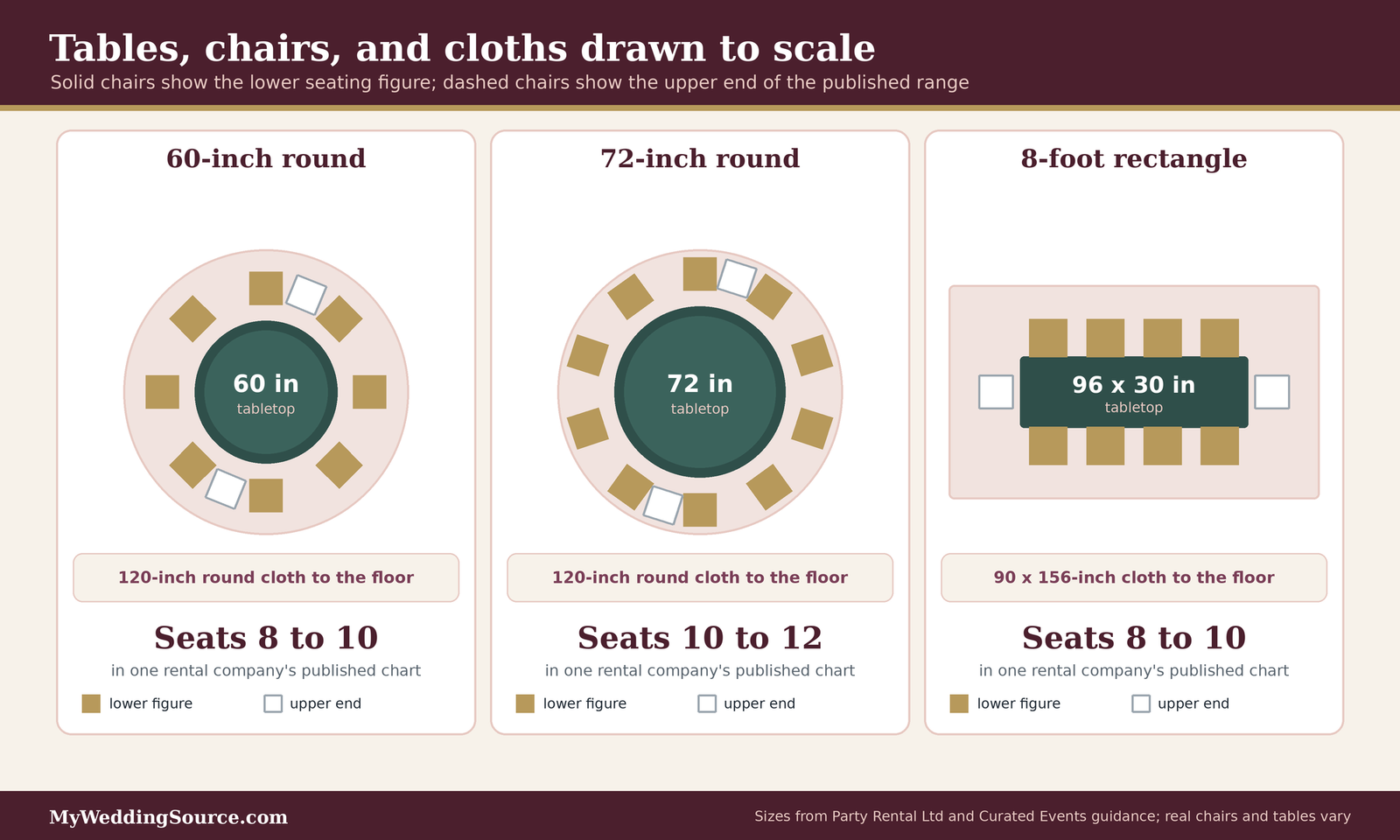
One rental company’s help center lists a 60-inch round as seating eight to ten, a 72-inch round as ten to twelve, and an eight-foot rectangle as eight to ten. A restaurant-supply retailer lists a 60-inch round at eight and a 72-inch round at ten. Both are describing comfortable seating, and they sit at the lower end of the first company’s range. For a plated meal with centerpieces, plan from the lower number and treat the upper number as the tight option.
Space per guest around a table
The same rental company’s guide assumes about 24 to 30 inches of table edge per guest and notes that tabletop items and chair width need room too, and that wider specialty chairs can reduce the number of guests a table comfortably holds. If you are choosing a chair that is not a standard folding or chiavari style, ask the rental company whether their seating chart changes.
Counting tables from your guest list
Once you know the seats per table, the table count in your wedding rental planning checklist is a division problem with a few special cases.
The basic formula
Divide your confirmed guests by your chosen seats per table and round up. As an illustration with our own arithmetic, 117 guests, which matches the average reported by The Knot, at eight per table need fifteen tables, because 117 divided by 8 is about 14.6. At ten per table, the same group needs twelve. That difference of three tables changes linen, centerpiece, and floor space needs, so decide on a table size before you order anything else.
Special tables to add
Beyond guest tables, list the head table or sweetheart table, cake table, gift or card table, guest book table, place card table, DJ or band table, bar service tables, and any buffet or dessert tables. Each one needs a size, a cloth, and a location. Couples often add these late, which is when the rental company has the least flexibility. If the venue or caterer provides some of them, mark that in your list.
Counting chairs without guesswork
Chairs look easy and are often wrong, which is why the chair section of a wedding rental planning checklist deserves a second look, because they serve more than one purpose and move during the day.
Guests, vendors, and spares
Start with guests, then add anyone else who needs a seat: the couple, vendors who are fed at the reception, bandmembers, and a planner. Ask your rental company whether you should include extra chairs and how many, since policies on counts and extras vary. We cover the question in depth in a sibling guide on how to count extra rental chairs for ceremony and reception resets, and we recommend a conversation with your own company over any rule of thumb.
Ceremony and reception resets
If the ceremony and reception happen in the same space, someone has to flip the room, and the chairs often move. Decide whether the same chairs serve both, how many people are needed to move them, how long the flip takes, and who is paying for that labor. If the ceremony uses a different chair than the reception, you are counting two sets, not one. Write the plan down in your wedding rental planning checklist so the crew, venue, and caterer agree on it.
Lounge, cocktail, and display pieces
Smaller pieces change the feel of a room, and a wedding rental planning checklist should list them separately, and they carry their own delivery and damage questions.
Cocktail tables and lounge furniture
Cocktail tables, high-tops, sofas, and lounge chairs are usually rented by the piece. Ask about minimums, since some rental companies set order minimums or require a specific quantity for lounge groupings, and note that upholstered rentals often come with more cleaning restrictions. Our sibling article on lounge furniture rentals covers the layout and delivery questions for those pieces in depth.
Bars, stages, and dance floors
Bars, stages, and dance floors are structures, not just furniture, and they may need level ground, power, or extra labor. If you plan a dance floor over grass, the base requirements are different from a floor on a hard surface, and the cost can too. Ask the rental company what ground conditions they require and who is responsible if the site does not meet them.
Linens, tableware, and small items
Linens and small items are cheap per piece and numerous in total, so errors in count and size are common, and they deserve their own block in a wedding rental planning checklist. They are also the first thing guests touch.
Sizing cloths and runners
Tablecloth sizing is a measurement problem, and rental companies publish charts that remove most of the guesswork.
Match the cloth to the table and the drop
One rental company’s measuring guide describes two common looks: floor-length, where the cloth reaches the floor, and a standard lap length, with a drop of about 15 inches for formal settings and about 8 inches for casual ones. For a 60-inch round, it suggests a 120-inch round cloth for a floor-length look, or a 90-inch square over a round cloth. For a 72-inch round it suggests a 120-inch round to the floor. Those numbers are one company’s guidance, so confirm sizes with yours, because rental inventory comes in standard sizes.
Runners and overlays
The same guide advises making a runner no longer than the tablecloth, ideally about 12 inches shorter, and letting a runner on a bare table hang roughly six inches on each side. If you plan to layer an overlay or a runner, ask the rental company how they price them and whether a runner counts as a linen or a décor item, since categories differ.
Color, texture, and what photographs
Linen color is where a rental checklist meets design. A cloth that looked perfect on a swatch can read differently under warm string lights or in a tent.
Request swatches and test them
Ask the rental company for physical swatches or a sample, and look at them in the lighting you will have, including evening light and any uplighting you have planned. A sibling article on linen swatch testing covers this in detail. Our guides to wedding color schemes and wedding table settings can help you decide what the linens need to coordinate with.
What counts as damage versus variation
One rental company’s terms say that color variations within the same color family are not considered damage. That means a slightly different shade of ivory between two cloths is a natural variation, not a defect you can return. If a very close color match matters, say so in writing and ask how the company handles it, before you place the order, then add the answer to your wedding rental planning checklist.
Dishes, glassware, and flatware
China, glass, and flatware have strict return rules, because they are cleaned and reused between events.
Counting place settings
Count by course and by drink, not only by guest. A plated dinner with a salad, an entrée, a dessert, bread, water, wine, and coffee may need more pieces per guest than a buffet with one plate. Ask whether the rental company counts breakage as part of normal use and whether you need to order extra pieces. Your caterer’s menu determines most of this, so share the final menu with the rental company when it is ready.
Return condition rules
One company’s published terms ask that china, glassware, flatware, and cooking equipment be scraped clean and not marked with writing, and that linens go back in the provided bags, free of food, debris, and confetti. The same terms say that sanitation is not included in base pricing. These are examples, not universal rules, so ask your own company what condition items must be in when they come back, and who on your team is responsible for getting them there.
Space, layout, and access
A rental order is only useful if it fits the space and the crew can get it there, a point every wedding rental planning checklist should make early. Layout and access decisions are quiet and technical, and they are some of the most common reasons a plan changes in the final week.
Fitting furniture to square footage
Floor area is the constraint that connects your table count to your venue or tent size, which is why a wedding rental planning checklist should include a square-footage line.
A rule of thumb from one tent guide
A rental company’s tent guide works out to roughly 12.5 square feet per guest for a seated dinner at 60-inch rounds, with banquet layouts closer to 10 square feet per guest. It advises subtracting 100 to 200 square feet for each added feature such as a dance floor, stage, bar, or buffet. A restaurant-supply guide gives 10 to 11 square feet per banquet guest, 18 to 20 inches between occupied chairs, and 42 to 60 inches between square tables. These figures are guidance from sellers, so treat them as a starting point and ask your rental company to draw your plan.
A worked example, labeled as our estimate
Using those numbers for 117 guests at 12.5 square feet each gives roughly 1,460 square feet for seating alone. If you add four features at 100 to 200 square feet each, the total lands somewhere around 1,860 to 2,260 square feet. That is our own arithmetic, not a vendor quote, and it is meant to show the method. A real layout depends on tent shape, entrances, and your table plan, so treat this line of the wedding rental planning checklist as provisional until the rental company draws it.

Aisles, accessibility, and circulation
A beautiful room still needs to be navigable, including for guests who use wheelchairs, walkers, or canes.
Aisle widths from public guidance
Federal accessibility guidance for business meetings, from the U.S. Department of Justice, says seating plans require aisles at least 36 inches wide, measured with chairs pulled out and occupied, and recommends a 60-inch circle of clear floor in key locations for turning. The City and County of San Francisco’s event guidance keeps at least a 36-inch aisle around tables and seating, prefers 48 inches, and suggests a 60-inch path for main aisles in large seating areas. Those are public-sector event guidelines, not rules for a private wedding, but they are useful targets, and our accessible wedding venue guide covers related checks.
Linens, cords, and thresholds
The Justice Department guidance suggests avoiding long or billowing tablecloths, which can catch wheels and canes, and the San Francisco guidance says changes in level greater than a quarter inch are not permitted without a ramp. For a wedding, that is a prompt to ask about floor-length cloths near the main aisles, cable covers across walkways, and any threshold between a tent and a building.
Ground, power, utilities, and permits
Outdoor and tented events add site questions that a rental company may handle only partly, so an outdoor wedding rental planning checklist needs a few extra rows.
Staking and underground utilities
An 811 education page says staking a tent can strike buried gas, water, or electric lines, and recommends submitting a locate request about two to three business days before digging, with the installer making the call. One rental company’s tenting terms require the client to mark private utilities and obtain any necessary permits. Ask your tent provider who contacts 811, who marks private lines such as irrigation or a septic system, and what happens if staking is not allowed on your surface.
Fire and building permits for tents
Rules vary by place, so check locally. Fairfax County, Virginia, requires a permit for a tent over 900 square feet or an occupant load of 50 or more, along with a flame-propagation certificate and an inspection, and sets spacing from buildings and vehicles. Portland, Oregon, requires a permit for a tent over 700 square feet, with documents due at least 21 days before the event. Your local fire marshal’s office is the authority. Ask the tent company whether they pull permits or you do, and see our wedding permits guide for the broader picture.
Delivery, setup, and pickup: the part nobody sees until it goes wrong
Delivery and pickup are services with their own windows, access rules, and fees, and each deserves a line in a wedding rental planning checklist. They are where a rental order meets the real site, and where the venue, the crew, and your schedule have to agree.
Delivery windows and site access
A delivery window is a range, not an appointment, and the crew’s path from truck to room matters as much as the arrival time.
How windows usually work
One rental company’s help center says crews may arrive at any point within the window, that the window does not include the time needed to finish the delivery or pickup, that routes are set the night before, and that asking for a specific time may cost extra. Another company’s terms list normal delivery hours of 6:00 a.m. to 6:00 p.m., with surcharges for later windows and a separate fee for firm delivery times. Neither is universal. Ask your company how wide the window is, whether setup time is inside or outside it, and when you will get a confirmed time.
Distance, stairs, and elevators
The same help center says stair charges apply when a site is reachable only by stairs or when items will not fit in the elevator, that a flight is counted landing to landing, and that for beach events crews deliver to the parking lot and the client carries items onto the sand. The other company’s terms say delivery must be within 100 feet of an accessible truck or extra labor fees apply, and that the client must disclose obstacles such as narrow doors, stairs, or small elevators. Walk the route from loading area to final position with a tape measure and a camera, and send the notes to your rental company along with your wedding rental planning checklist.
Setup labor and floor plans
Setup is where a list of items becomes a room. Whether it is included, and how precise the plan must be, varies a great deal.
Included, optional, or extra
One company’s FAQ says setup and takedown are available for an additional charge, and that the labor charge covers arranging rentals on site. Another company’s terms say labor and floor plans are needed at least three days before delivery and that late or changed plans may add fees. Ask whether the delivery price includes placing items where they will be used or only dropping them at a door, and write the answer into the wedding rental planning checklist, since the two are priced very differently.
What a usable floor plan contains
A floor plan the crew can follow shows the room’s dimensions, entrances, table numbers and shapes, chair counts, head table, bar, buffet, cake, dance floor, and aisles. Add anything that cannot move, such as columns, outlets, and fire exits. Keep it simple enough to read on a phone. Share the same plan with your venue, caterer, florist, and DJ, so every vendor is working from one picture, and attach it to your wedding rental planning checklist. Our wedding seating chart guide covers the guest side of that plan.
Pickup and return condition
Pickup is the least glamorous part of the order, and any wedding rental planning checklist should treat it seriously, and the one with the most room for disagreement, because it happens when everyone is tired and the room is full of belongings.
Who is on site and when
Ask whether pickup is the same night or the next day, who must be present to release the items, and whether the crew will count them with you. One company’s terms say equipment must be returned to the delivery location or pickup fees apply, and that when several vendors are in the same space the client must clearly separate rentals from other items. Name a specific person to hand off the order and make sure they have the contact details and the packing instructions.
Late returns and extended rental
The same terms say that items returned late incur extended rental charges. If your venue has a hard out time, or the crew cannot reach the room until morning, get the pickup time in writing and ask what happens if the time slips for reasons outside your control. Our sibling guide on rental return logistics goes deeper on who packs, who counts, and who pays for losses. See wedding rental return logistics.
Contracts, damage terms, and fees: what to read before you pay
A rental contract describes how much you pay, when, and what happens when plans change or something breaks. It is also where a wedding rental planning checklist earns its keep, because the details that matter are usually in the terms, not the quote.
What this actually costs
The headline price for rental items is only one line. Delivery, stair or distance labor, setup, firm-time windows, a damage waiver, taxes, and late-return charges can each appear as separate lines, and published terms from two rental companies show waiver rates of 4 percent and 6.5 to 9 percent. We do not quote a typical total, because it depends on your items, site, and company. Ask for a fully itemized estimate, with every fee named, before you pay a deposit.
Deposits, payment, and cancellation
Payment schedules and cancellation fees tell you how much flexibility your wedding rental planning checklist really has, and they differ widely by company and by product type.
Deposit and final payment examples
One rental company’s terms list a 35 percent deposit to reserve items and 50 percent at signing for tenting, with final payment due seven days before delivery for general rentals and full payment before delivery for tenting. They also list order minimums of $500 off-season and $750 in peak season, and say final counts for specialty items are due 14 days before delivery. These are examples from one company’s published terms. Ask for your own schedule in writing, including the date the final count locks.
A cancellation schedule to compare against
The same terms list no cancellation fee at 61 or more days before the event, a 35 percent fee from 30 to 60 days, 50 percent from 48 hours to 30 days, and 100 percent within 48 hours. The figure below draws that schedule so you can see how quickly flexibility narrows. Your company’s schedule may differ, and some fees apply to the order total or only to certain categories, so ask which. If you are worried about postponement, pair this with a conversation about wedding insurance, which we cover separately.

Damage waivers, losses, and what is usually excluded
A damage waiver is a fee that a rental company charges to cover a defined set of minor damage. It is not the same as insurance, and it differs by company.
What two published waivers say
One national company’s help page describes a waiver equal to 4 percent of the gross rental order that is non-refundable and taxable, and says it covers minor wear such as broken glassware or china, stained linens, dented trays, and scratched flatware. It excludes theft and missing items, vandalism and improper use, damage from leaving items outdoors in bad weather, and electrical damage from incorrect voltage. Another company’s terms describe a waiver of 6.5 to 9 percent depending on product line, say the client pays for missing items, major damage, and neglect, and treat treatable stains as covered. There is no universal waiver, so read yours line by line. We cover the topic in depth in our guide to wedding rental damage waivers.
Where your liability usually begins
In published terms, items you are responsible for tend to include anything missing at pickup, anything left outside in weather, anything damaged by misuse, and conditions like wax, burns, or stickers on chairs. The second company’s tenting terms also cap its own liability at the amount paid under the agreement and require clients hosting on their own premises to carry general liability insurance at stated limits. Ask your company whether similar terms apply to you, and whether your venue requires a certificate of insurance from you or from the rental company.
Fees, surcharges, and how to compare quotes
Two quotes with similar totals can be built very differently, and a wedding rental planning checklist helps you line them up. Comparing them fairly means lining up every line.
The fees worth finding
Look for delivery and pickup fees, stair or distance labor, setup and breakdown labor, firm-time or narrow-window fees, after-hours or holiday surcharges, weekend or last-minute fees, order minimums, cleaning or sanitation charges, damage waiver, taxes, and anything labeled a fuel or service fee. One company’s published schedule, for example, lists surcharges for late delivery windows, firm delivery times, last-minute orders, and holidays. Use that kind of list as a prompt, not a prediction.
Normalizing two quotes
Put both quotes in a spreadsheet next to your wedding rental planning checklist, with the same rows: item cost, delivery, setup, pickup, waiver, taxes, and estimated fees. Mark any row where one quote says “included” and the other is silent, then ask the silent company directly. A cheaper quote that omits setup labor is not cheaper once you add it, and the wedding rental planning checklist is what reminds you to look. Our guide to hidden wedding costs covers other places budgets drift, and wedding budget planning can show where rentals fit.
Paying in a way that protects you
How you pay can change your options if something goes wrong, and it is worth a short decision before the first deposit.
Cards and billing disputes
The Federal Trade Commission’s consumer guide on credit card disputes says a billing-error dispute must reach the card issuer in writing within 60 days after the first bill showing the error was sent, and that billing errors include items not delivered as agreed. It also says that for disputes about the quality of goods or services, conditions apply, including trying to resolve the problem with the seller first. This is general consumer information, not legal advice, and it belongs in the payment notes of your wedding rental planning checklist. Check your card agreement, and keep your contract, emails, and photos.
Keeping a paper trail
Save the signed agreement, every revision of the quote, the floor plan you sent, the delivery confirmation, and photos of the room after setup and before pickup. If a dispute comes up, dates and images carry more weight than recollection. Ask your rental company for a written final invoice and a returned-items count, and save both with your other wedding records.
The rental inventory and responsibility matrix
This is the working core of the wedding rental planning checklist. The matrix puts every rental line and every handoff in one view, so each row has a name and a date. Copy it into a spreadsheet, add columns for your own vendors, and fill it in as you collect answers, so the wedding rental planning checklist becomes a living document.
How the matrix works
Each row is one thing that has to happen. Each column answers a question you would otherwise discover on the day.
The columns to keep
Keep five columns for every row: what it is, who owns it (rental company, venue, caterer, planner, or you), by when it must be settled, where it is written down, and what the backup is if it fails. If a row has two possible owners, leave it highlighted until one is chosen. A highlighted row is a conversation you still need to have, and that is the entire point.
Why we do not pre-fill the owners
Defaults differ by company and venue, and we have no basis to say who usually does what. Pre-filled answers would give false comfort. The table below lists the rows and the question to settle for each, and leaves the owner for you to fill in from your own contracts.
| Row | What to settle | Possible owners | Settle by | Where to record it |
|---|---|---|---|---|
| Guest tables | Size, shape, count, seats per table | Venue, rental company | Before layout | Order and floor plan |
| Guest chairs | Style, count, spares, ceremony reuse | Venue, rental company | Before final count | Order and floor plan |
| Special tables | Head, cake, gifts, DJ, bar, buffet | Venue, caterer, rental company | Before layout | Floor plan |
| Linens | Cloth sizes, napkins, runners, colors | Rental company, caterer | After swatch check | Order with sizes |
| Dishes and glassware | Courses, drinks, counts, who washes | Caterer, rental company | After menu is final | Caterer and rental contracts |
| Lounge pieces | Pieces, minimums, cleaning limits | Rental company | Before layout | Order |
| Dance floor and stage | Size, base, ground conditions | Rental company, venue | After site visit | Order and site notes |
| Tent and structures | Size, sidewalls, anchoring, permits | Tent company, venue | Well before the event | Tent contract and permit file |
| Delivery | Window, route, contact, truck access | Rental company, venue | Final week | Confirmation email |
| Setup | Who places items, from what plan | Rental company, venue, planner | Before delivery | Contract and floor plan |
| Ceremony flip | Who moves chairs, how long, what labor | Venue, planner, rental company | Before the day | Timeline |
| Breakdown | Who scrapes, bags, stacks, counts | Caterer, venue, planner | Before the day | Timeline and contract |
| Pickup | Time, who releases items, who counts | Rental company, venue | Final week | Confirmation email |
| Damage and loss | Waiver scope, replacement fees | Rental company, you | Before deposit | Contract |
| Insurance | Certificates, limits, who supplies them | Rental company, venue, you | Before deposit | Contract and venue file |
| Payment and cancellation | Deposit, final due date, count lock | You, rental company | Before deposit | Contract |
Using the matrix with your team
A matrix works when other people use it. Share it with the vendors who touch each row, since a wedding rental planning checklist only protects you if the people on it have seen it.
Send it with questions, not as a demand
Send the venue, caterer, and rental company a short note: here is how we are dividing responsibilities, please confirm or correct anything that does not match your contract. Vendors often reply with details you did not know to ask, such as a load-in elevator rule or a linen return deadline. Their corrections are the most useful part of the exercise.
Update it as plans change
Each time the guest count, menu, or venue layout changes, revisit the rows it touches and update your wedding rental planning checklist. A changed guest count affects tables, chairs, linens, glassware, and square footage. A changed menu affects dishes. Keep a dated version so you can see what changed and when you told the vendor.
Documenting condition
Evidence is the quiet third of the matrix and of any wedding rental planning checklist. It is what lets you settle questions after the fact without argument.
Photographs at delivery
Photograph the delivered items before use if the crew allows, especially upholstered pieces, glassware crates, and anything already marked. Count the major items with the crew and note the count on the delivery slip. If the crew leaves before you can check, send an email the same day listing anything short or damaged, since a prompt note is easier for a company to act on.
Photographs and counts at pickup
Take photos of the room before pickup begins, of the bagged linens and crated items, and of the loaded count. Ask for the pickup count in writing. Many companies check returns later at the warehouse, so a record of what you handed over helps if a count is questioned. Keep it with the contract and receipts.
A timeline for rental decisions
Rentals have lead times, count deadlines, and payment dates that sit apart from the usual wedding calendar, so give your wedding rental planning checklist its own dates. A short timeline keeps them from slipping.
Early decisions
The earliest steps shape everything else, and they are the cheapest to change.
When to reach out
One rental company’s FAQ recommends calling at least six months before the event for the best availability, especially in busier months, and notes that all reservations depend on availability. That is one company’s advice, so ask yours how far ahead to book for your date. Request a site visit when you choose your venue if tenting or a dance floor is possible, and ask the venue about outside rental rules at the same time.
Decide the big items first
Tent or no tent, table size, and chair style set your costs and layout. Settle those before smaller choices such as linen color and napkin fold, and put them at the top of your wedding rental planning checklist. If you are still comparing venues, our wedding venues guide and wedding venue capacity article can help you test what fits.
The final month
Count deadlines and permits tend to cluster in this period, and they are easy to miss without a wedding rental planning checklist on the calendar.
Count locks, payment, and plans
Using the examples from one company’s terms, which you can copy into your wedding rental planning checklist as placeholders, floor plans are due about three days before delivery, specialty counts about 14 days before, and final payment about seven days before. Your dates will differ. Ask for each in writing, put them in your calendar with a reminder a week earlier, and check whether adding or removing guests after the lock changes your price.
Permits and utilities
If you need a tent permit, ask early, since Portland’s rule asks for documents at least 21 days before the event and Fairfax County requires a fire marshal inspection before use. If staking is planned, an 811 request is generally recommended two to three business days before digging. Your tent company may handle these steps, so ask, and keep copies of any permits on site.
The week of and the day of
The last week of a wedding rental planning checklist is about confirmations. The day itself is about handoffs.
Confirm in writing
Confirm the delivery window, the route, the on-site contact, the floor plan, the pickup time, and the person who will sign. Send one message to the rental company and copy the venue and planner. Reply with any changes the same day, so there is a clear record if something shifts.
Day-of handoffs
On the day, make sure the person receiving the delivery has the floor plan, the contract, and the contact numbers. Check the room against the plan before the florist or caterer arrives, and fix issues while the crew is still there. At the end, make sure someone has the pickup instructions and the authority to sign. Our wedding day timeline and wedding vendor timeline guides show where these handoffs fit in the day.
Edge cases that break a standard checklist
A wedding rental planning checklist works for the typical order. These situations are the ones where it needs adjusting, because the assumptions behind it do not hold.
Weather and outdoor sites
Outdoor weddings add variables that rental companies mention in their terms, and they are worth reading closely.
Wind, lightning, and tents
One rental company’s terms say that winds of 38 miles per hour or higher, or lightning, require everyone to leave tents immediately, and that the company is not liable for injuries or damage if people do not evacuate. They also warn that wet floors may be slippery, require clients to have severe weather plans, and say weather-related extra labor must be agreed in advance. Ask your tent company for its wind rating and evacuation guidance, and read our wedding rain plan guide for planning around weather.
Furniture near open sides and left outdoors
The same company’s terms for one product line say furniture cannot be placed near open tent sides and that no tarps are provided, and the first company’s waiver excludes damage from leaving items outdoors in bad weather. For an outdoor reception, ask which items can go outside, what happens when it rains during setup, and whether you need a covered storage plan for unused items. Our outdoor wedding venues guide covers other site questions.
Shared spaces and multiple vendors
Many weddings involve several parties moving equipment through the same room.
Venue stock mixed with rentals
If the venue’s chairs and the rental company’s chairs look alike, they can end up mixed in a stack. The terms we cited tell clients to clearly separate rentals from other items, and that is good practice anywhere. Mark rented items, ask the crew to count at pickup, and decide ahead of time who separates stock if the venue and rental company both collect items.
Several rental companies on one event
If you rent tables from one company, linens from another, and lounge furniture from a third, each has its own delivery, damage, and pickup rules. Build one master schedule that lists each company’s window and contact, and check that their trucks do not need the same loading area at the same time. A planner can handle this, and so can a calm friend with the matrix open.
Changes late in the process
Plans move after the order is placed, and a wedding rental planning checklist should say what happens when they do. Knowing how your contract handles change keeps you out of a rush.
Guest count changes
If your count drops or grows after the lock date, ask how the company handles it. Some companies allow additions subject to availability and some do not allow reductions without a fee. A short conversation when you sign, and again when your RSVPs are in, avoids unpleasant surprises. Our wedding guest list guide covers how counts shift.
Venue or date changes
If your venue or date changes, rental deposits and cancellation schedules apply. Check whether the company allows a date transfer, what it costs, and whether the deposit moves with you. Ask this before signing, because the answer shapes how much risk you carry while other plans are still uncertain.
Three sample setups, worked through with the checklist
The framework is easier to trust once you see it applied to a wedding rental planning checklist for a real-sized guest list. These three scenarios are illustrations built from the published figures in this guide and our own arithmetic. They are not quotes, and none of them is a recommendation for how your wedding should look. Each uses 117 guests, the average reported in The Knot’s 2026 readout, so the numbers are comparable.
| Question | Venue with furniture included | Venue with almost nothing | Private property with a tent |
|---|---|---|---|
| Tables and chairs | Confirm counts and style; rent only the gaps | Rent everything | Rent everything |
| Linens and tableware | Often a separate choice; ask what is included | Rent or ask the caterer | Rent or ask the caterer |
| Delivery rules | Set by the venue | Set by the venue | Set by you and the tent company |
| Permits and utilities | Usually the venue’s concern; ask | Venue and rental company | Likely yours to confirm |
| Biggest risk | Assuming “included” means enough | Missing a handoff | Weather, ground, and access |
| First question to ask | What exactly is on the inventory list? | Who sets up and who breaks down? | Who pulls permits and calls 811? |
The venue that includes furniture
This is the simplest case on paper, and it still needs a careful wedding rental planning checklist, because “included” can hide a lot of variation.
What to confirm before you rent anything
Ask the venue for the written inventory and compare it with your count. If you need fifteen guest tables and the venue owns twelve, you are renting three, and those three should match the others in size and look. Ask whether the venue’s chairs are suitable for the ceremony and whether the venue handles the ceremony flip. Our wedding venues guide explains how venue packages are commonly structured, so you can see what a given package leaves out.
What to rent on top
In this setup, rentals are often add-ons: linens in your colors, a different chair for the ceremony, lounge pieces, a dance floor, or a few specialty tables. Because the venue already handles setup and breakdown, the main question is whether the rental company can deliver on the venue’s schedule and whether the venue’s crew will place the items. Add those rows to your matrix and ask both parties to confirm in writing, since a wedding rental planning checklist is only as good as the answers behind it.
The venue that provides almost nothing
Raw spaces, such as galleries, warehouses, and open halls, give you the most freedom and require the most coordination.
Everything is a rental, so everything needs an owner
With tables, chairs, linens, tableware, and often lighting and restrooms all coming from different sources, the matrix does the heavy lifting. For 117 guests at eight per table, our arithmetic gives fifteen guest tables plus special tables, and at ten per table, twelve. Rentals for a space like this may involve several companies, so build a master schedule showing each delivery window, each contact, and who is at the venue when each truck arrives.
Venue rules become more important, not less
A wedding rental planning checklist for a raw space has to cover venue rules, since raw venues often have strict rules about load-in times, insurance, noise, and what can be attached to walls and floors. Ask for them in writing, and share them with every vendor. Our wedding venue questions guide lists items worth checking, and our wedding reception guide covers how the room itself should flow.
The private property wedding with a tent
A tent on private land is the most complex rental scenario, because the site, the structure, and the permits all become your responsibility unless you agree otherwise.
Square footage, permits, and the tent contract
Using the figures cited earlier, 117 guests at about 12.5 square feet each need roughly 1,460 square feet for seating, and four added features push the estimate to around 1,860 to 2,260 square feet, which is our own estimate. That exceeds the 900-square-foot permit trigger in Fairfax County and the 700-square-foot trigger in Portland, which suggests a permit conversation is likely in many places, though your local rules decide. Ask the tent company whether it pulls permits, who orders the inspection, and what is in the tent contract about wind, evacuation, and liability.
Ground, access, and backups
Walk the site with the tent company and add what you learn to the wedding rental planning checklist. Ask about slope, soil, irrigation, septic lines, overhead branches, power, and truck access. Under one company’s published terms, tenting requires the site be cleared of debris, furniture, and low branches, and the client must mark private utilities. Plan an alternate layout and an evacuation location, and read our wedding rain plan guide for how to think about weather.
How to compare rental companies without relying on price alone
Price is the easiest number to compare and the least complete, which is why a wedding rental planning checklist adds a column for terms. A fair comparison looks at what is included, how terms are written, and how the company communicates before you pay.
Reading a proposal closely
A proposal is a sales document, and a contract is a legal one. The gap between them is where surprises sit.
Proposal versus agreement
Ask whether the proposal’s items, quantities, delivery details, and prices carry over unchanged into the agreement. If the agreement contains a term that the proposal did not mention, such as a cancellation schedule, a waiver rate, or a minimum, ask about it. Written clarification now is cheaper than a disagreement later. This guide is not legal advice, and if a contract is complex or the stakes are high, an attorney can review it.
Vague words to pin down
Phrases such as “setup included,” “standard delivery,” “reasonable condition,” “normal wear,” and “as needed” can mean different things to different people. Ask the company to define each in terms of time, number, or condition. For example, ask what normal wear means for linens and glassware, how a firm delivery time is defined, and what the delivery fee covers.
Signals of an organized company
There is no formal rating for rental companies, but there are practical signals of clear communication.
Specific answers to specific questions
A company that answers your floor plan, access, and timing questions with specifics, such as who will be on the crew, how they will count, and where they will park, is giving you information you can plan with. A company that answers every question with “we will take care of it” may be reliable, and it is still worth asking for the details in writing.
Willingness to put things in writing
Ask whether the company will confirm delivery windows, pickup times, counts, and special instructions in an email. A written confirmation does not guarantee a perfect day, and it gives everyone a reference when plans shift. If a company resists writing down simple operational details, that is useful information about how disputes may go.
Matching the company to your setup
Companies differ in what they do well, and your setup should drive the choice.
Full-service versus pick-your-own
Some companies sell a package with delivery, setup, and pickup, and others sell items and leave labor to you. Neither is wrong. A full-service quote may cost more upfront and save you from coordinating labor, and an item-only quote may fit a venue with a strong crew. Compare the services, not only the totals.
Tent and structure specialists
Tents, flooring, and structures involve engineering, permits, and safety rules that table-and-chair rentals do not. Ask a tent provider about experience with your surface, their process for permits and inspections, wind guidance, and insurance. Their answers will tell you whether the checklist you are following needs more rows.
Insurance, venue requirements, and liability in one place
Insurance questions appear in several parts of a rental order, and they are easier to manage when you look at them together on one page of the wedding rental planning checklist.
What published terms say about insurance
Insurance is rarely the first thing couples ask about and sometimes the one that holds up a delivery.
Rental company coverage
One rental company’s published terms say the vendor carries general liability coverage at stated limits and that clients hosting on their own premises must carry matching limits. Another company’s help material does not address it. Ask your company what coverage it carries and whether it will send a certificate of insurance to your venue. This is information to gather, not advice on what coverage you need.
Venue and client requirements
Venues often require outside vendors, and sometimes clients, to provide a certificate naming the venue as an additional insured. Ask your venue what it requires, who must supply it, and how far in advance it is due. If your event is at private property, ask your rental company what coverage it expects you to have. Our wedding insurance guide covers event insurance in general.
How insurance interacts with waivers
A damage waiver and an insurance policy are different tools, and they should not be confused.
What a waiver is not
Based on the published waivers we read, a waiver covers a defined set of minor damage to rented items and excludes theft, misuse, and weather exposure. It is not liability insurance, and it does not cover injuries or property damage beyond the rented items. If you need coverage for those events, talk to an insurance professional.
Gaps to check
Ask what happens if a guest is injured on rented furniture, if a tent is damaged by weather, or if items are stolen from a venue overnight. Ask who is responsible in each case under the contract. These questions are uncomfortable, and they are better asked in writing, calmly, before the event.
Reading tent and structure rules before you rent one
Tents are the most regulated rental in this wedding rental planning checklist, and they affect other rows in your matrix, including furniture placement, heaters, power, and exits.
What fire codes tend to ask for
The details below come from two local jurisdictions and are examples, not national rules.
Spacing, exits, and flame resistance
Fairfax County’s guidance requires a flame-propagation certificate covering the tent, sidewalls, and decorations, keeps tents at least 20 feet from lot lines, buildings, other tents, and vehicles, and requires exits within 100 feet of any point. It sets minimum exit counts by occupant load, with at least two exits for 10 to 199 people. Portland’s guidance requires at least two exits at 72 inches wide, keeps vehicles 20 feet from the tent, and does not allow guy wires to cross an exit below eight feet. Ask your tent company how they meet these requirements.
Heaters, cooking, and generators
Fairfax County bars open flames, charcoal, and cooking devices inside or within 20 feet of an occupied tent unless the fire official approves them, and notes that larger generators may need electrical permits. If your caterer plans to cook on site, or you want heaters, show them in the plan the tent company submits, and ask whether additional approvals are needed.
How tent rules change your furniture plan
Rules for exits and aisles come back to your layout, and they affect how many tables fit.
Aisles and exit paths
Fairfax County lists aisles of at least 44 inches wide and says required exit width scales with the number of occupants. Those numbers can reduce the usable area, which is one reason to ask the tent company to draw your table plan before you finalize the count. A layout that works on paper at 12.5 square feet per guest may need adjusting once exits and aisles are drawn.
Who files the plan
Some jurisdictions require a plan showing tables, chairs, aisles, and exits as part of the permit application. Ask whether your tent company prepares it, whether they need your floor plan, and who attends the inspection. Keep the approved plan on site, since Fairfax County says it must be available at the event.
Questions to ask your rental company, venue, and caterer
Good questions turn a vague quote into a clear agreement, and they are the last section of a wedding rental planning checklist worth printing. Ask for the answers in writing and keep them with your contract and your wedding rental planning checklist.
Questions worth asking before you pay a deposit
- What exactly is included in the price, and what is charged separately?
- What are the delivery window, the pickup window, and the fees for firm times?
- Who places the items from the floor plan, and is that labor included?
- What does the damage waiver cover and exclude, and is it refundable?
- What condition must items be in at pickup, and who is expected to prepare them?
- When does the final count lock, and what happens if it changes?
- What is the cancellation schedule, and does the deposit transfer to a new date?
- Who handles permits, utility locates, and insurance certificates?
For the rental company
These questions cover the contract, the inventory, and the crew.
About the order and the contract
Ask for a fully itemized estimate and a copy of the terms before you pay, and check them against your wedding rental planning checklist. Ask which items are reserved for your date and which are subject to availability, how substitutions work if an item is unavailable, and what the process is if the count is short on delivery. Ask whether the company carries liability insurance and can provide a certificate to your venue.
About delivery, setup, and pickup
Ask how wide the delivery window is, whether setup is included, how the crew will access the site, who will be on the team, and how they will count items with you. Ask what happens if the venue is not ready or the route is blocked. For pickup, ask when it happens, who must be present, and what the late-return policy is.
For the venue
These questions find the venue rules that shape the order.
About access and rules
Ask which hours outside vendors may load in and out, which doors and elevators they must use, and whether there are limits on weight, vehicles, or staking. Ask whether outside rental companies must carry insurance and how they should submit it, and whether there are fees for outside vendors. Our wedding venue questions guide covers more.
About what is already on site
Ask for an itemized inventory with counts, sizes, and condition, and whether the pieces are reserved for your event. Ask whether the venue staff will help with setup, whether the ceremony flip is included, and who is responsible for the venue’s own pieces if they are damaged during your event.
For the caterer and planner
These two roles overlap with rentals more than most couples expect.
About equipment and breakdown
Ask what the caterer supplies, what they expect you to rent, who sets and clears tables, and who scrapes and stacks dishware for return. Ask whether they coordinate directly with the rental company and how they handle breakage. Our wedding vendor contract guide covers other terms worth checking.
About coordination on the day
Ask your planner or coordinator whether they will receive the delivery, check the layout against the plan, and supervise pickup, or whether those tasks are yours. If you have no planner, name a person and brief them with the matrix, floor plan, and contract. Having one named person is simple, and it is the cheapest upgrade to any wedding rental planning checklist.
FAQ: wedding rental planning questions
Planning and budget
When should I start booking rentals?
It depends on your date and your venue. One rental company recommends contacting them at least six months ahead for the best availability, especially in busy months. Ask your own company for its guidance, and ask your venue what it already provides before you place an order, so you do not pay for duplicates.
How do I compare rental quotes fairly?
Put each quote in a spreadsheet with the same rows: items, delivery, setup, pickup, damage waiver, taxes, and other fees. Mark any row where one company says included and another is silent, then ask directly. A lower item price can be higher overall once labor and fees are added.
Counts and layout
How many tables will I need?
Divide your confirmed guests by the seats per table and round up, then add special tables such as head, cake, gifts, and DJ. For example, 117 guests at eight per table need fifteen guest tables. Published charts show seat ranges, so confirm the number with your rental company for your chair style.
How much floor space should I plan?
One rental company’s tent guide works out to about 12.5 square feet per guest at 60-inch rounds, minus 100 to 200 square feet per added feature. Treat that as a starting point. Ask your rental company to draw your layout, and check any local permit thresholds for tents.
Damage, fees, and contracts
What does a damage waiver cover?
It depends on the company. One published waiver covers minor wear like broken glassware and stained linens and excludes theft, vandalism, misuse, and items left out in bad weather. Another sets a different rate and scope. Read your own contract and ask what is excluded before you rely on it.
What if something is missing or damaged?
Published terms usually place missing items and major damage on the client, apart from what a waiver covers. Photograph items at delivery and pickup, count with the crew, and send questions in writing quickly. If you paid by card, the Federal Trade Commission describes a written dispute process with a 60-day window.
Delivery and pickup
Who should be on site for delivery and pickup?
Name one person who has the floor plan, the contract, and the authority to sign. Delivery windows can be wide, and pickup can happen late, so confirm times in writing. If you have a planner or venue coordinator, ask whether they can receive and release the order.
What if it rains or the wind picks up?
Ask your tent and rental companies for their weather terms before you sign. One rental company’s terms require everyone to leave tents in winds of 38 miles per hour or higher or in lightning, and place weather planning on the client. Have a backup layout and confirm who pays for extra labor.
Your next steps
Start the inventory
Gather what is already provided
Ask your venue and caterer for itemized lists of tables, chairs, linens, and tableware. Fill in the first columns of the matrix, and note every blank as an open item on your wedding rental planning checklist. Our wedding planning checklist can help you place these steps in your broader timeline.
Count and measure
Decide on table size, seats per table, and chair style, then calculate your table and chair counts and a rough floor area. Walk the delivery route with a tape measure, and photograph doors, stairs, and elevators for your rental company.
Lock in the agreement
Request itemized estimates
Ask two companies for fully itemized estimates and compare them in a spreadsheet. Read the damage, cancellation, and delivery terms before you pay a deposit. Our wedding decor and wedding reception guides can help you decide which extras are worth adding.
Set the dates and the contacts
Put count lock, final payment, floor plan, delivery, and pickup dates into your calendar with reminders. Name the person who will receive the delivery and sign at pickup. Share the matrix and floor plan with every vendor who touches the room, and keep the finished wedding rental planning checklist with your contracts.
Sources & methodology
How we built this guide
What we relied on
This guide draws on published rental company terms and help pages, public fire and accessibility guidance, a consumer-protection guide on credit card disputes, a utility-safety education page, and a national wedding survey. Where a claim comes from a rental company, it is labeled as that company’s published terms, and we treat it as an example, not a rule. Floor-area and table-count figures that are not attributed are our own arithmetic, labeled as estimates. Sources were checked on November 12, 2026, and rental terms, permit rules, and prices change, so verify current terms with your own vendors.
What we did not do
We did not obtain quotes, audit any rental company, or verify that any company’s current terms match the pages we read. We did not give legal, insurance, or financial advice, and we did not invent price ranges or typical fee totals. Permit and fire rules differ by city and county, and the examples here come from two jurisdictions only. Consult your local fire marshal, your venue, and your rental contract.
Source list
Government and public-sector sources
- U.S. Department of Justice, Civil Rights Division, ADA guidance on accessible business meetings (April 2009): https://archive.ada.gov/business/accessiblemtg.htm
- Federal Trade Commission, Using Credit Cards and Disputing Charges: https://consumer.ftc.gov/articles/using-credit-cards-and-disputing-charges
- Fairfax County Fire Marshal, Tents and membrane structures: https://www.fairfaxcounty.gov/fire-ems/fire-marshal/tents
- Portland Fire & Rescue, Outdoor tent permit requirements: https://www.portland.gov/fire/permits-inspections/outdoor-tent-permit-requirements
- City and County of San Francisco, Make your event set-up accessible: https://sf.gov/information/make-your-event-set-accessible
- 811 Before You Dig, Before You Stake: https://811beforeyoudig.com/before-you-stake/
Survey and industry sources
- The Knot, 2026 Real Weddings Study: https://www.theknot.com/content/real-weddings-study
- The Knot, 2026 Real Weddings Study data read-out (PDF): https://images.theknot.com/rules/2026/the-knot-real-weddings-study-data-read-out-2026.pdf
Rental company and retailer sources (company guidance, not independent testing)
- Party Rental Ltd, Do you charge a damage waiver fee?: https://help.partyrentalltd.com/en_US/delivery-and-fees/do-you-charge-a-damage-waiver-fee
- Party Rental Ltd, Delivery and fees: https://help.partyrentalltd.com/en_US/delivery-and-fees
- Party Rental Ltd, How many people can sit at a table: https://help.partyrentalltd.com/en_US/how-many-people-can-sit-at-a-table
- Peak Event Services, Rental terms and policies: https://www.peakeventservices.com/?p=1582
- Curated Events, Frequently asked questions: https://curatedevents.com/faqs/
- Curated Events, How to measure tablecloth sizes for your event: https://curatedevents.com/blog/how-to-measure-tablecloth-sizes-for-your-event/
- Rental company blog, Tent size guide: how many guests fit in each tent: https://oarfish-finch-phmr.squarespace.com/blog/tent-size-guide-how-many-guests-fit-in-each-tent
- WebstaurantStore, How many people fit at a banquet table: https://www.webstaurantstore.com/blog/115/how-many-people-can-different-size-banquet-tables-seat-comfortably.html