

A wedding planning checklist works best when every task has an owner, a “done when” test and a decision gate, so you can see what is blocking what and catch the items couples most often forget.
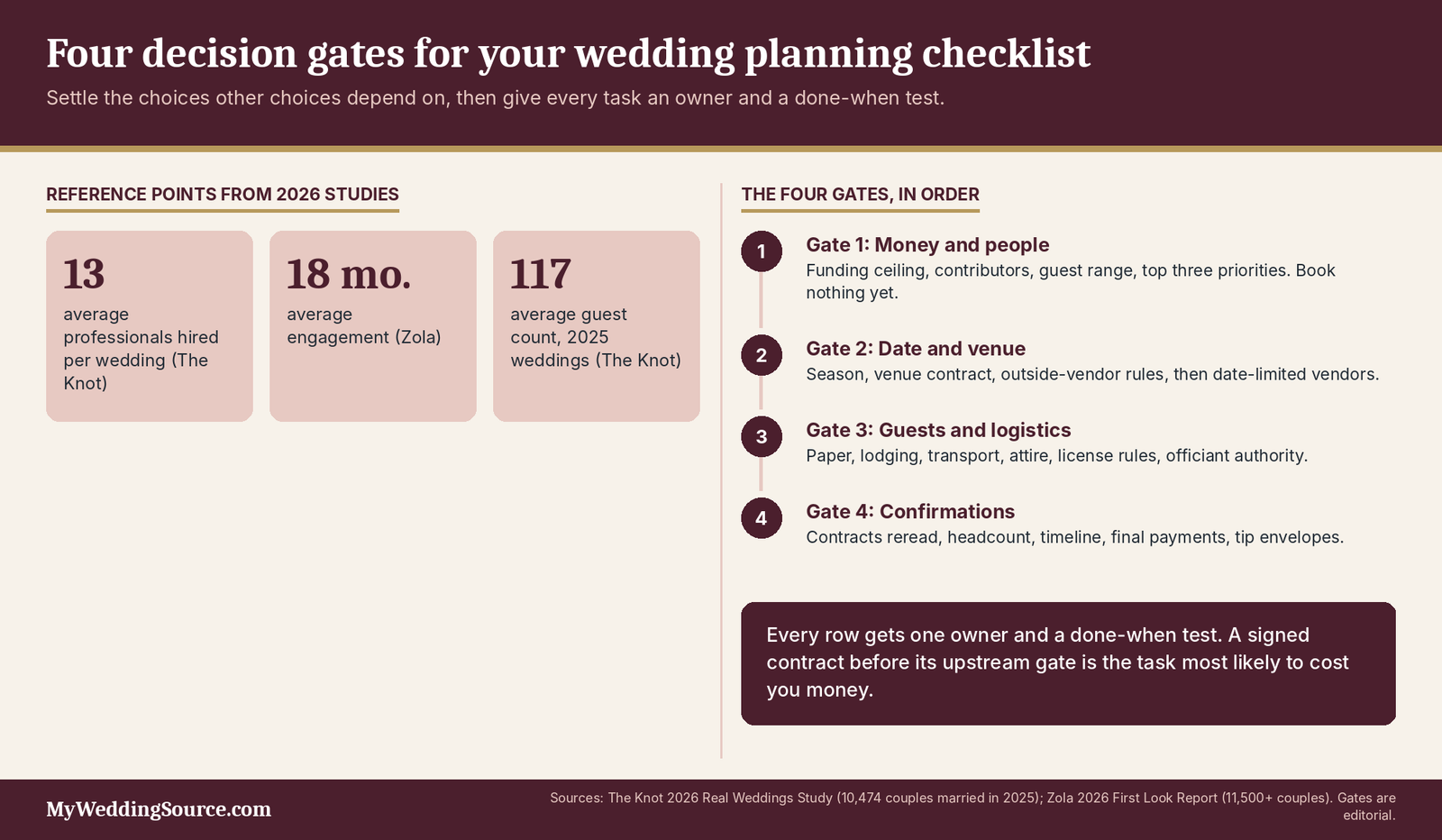
Most couples do not lack a list; they lack a list that tells them which task unlocks the next one. A generic checklist might say “book photographer” in month ten and “order invitations” in month four, but it will not tell you that the photographer’s shot list depends on the venue’s lighting, or that your invitation count depends on a guest-list decision you postponed in month twelve. The result is a familiar pattern: the first few months feel productive, then a quiet logjam forms around guest count, budget and venue, and everything else waits on all three. Researchers who track real couples see the scale of the job, with The Knot’s 2026 Real Weddings Study reporting that couples hired an average of 13 professionals, and Zola’s 2026 First Look Report putting the average engagement at about 18 months.
This page organizes the work by category rather than by calendar month, because the calendar version already exists on our site as a month-by-month wedding timeline. Here you get tick-box tables for money and people, venue and vendors, legal paperwork, guests and paper, attire and ceremony, food and vendor confirmations, and the final week. Each table names who usually owns the task, what “done” looks like, and the gate it belongs to. A short list of commonly missed items closes each section, because the forgotten tasks are rarely the glamorous ones; they are the certified marriage license copies, the tip envelopes and the name on the airline ticket.
Nothing here is a downloadable file, and none of it is a promise that your wedding should look like any average. Cost and timing figures come from named 2025 and 2026 studies and are labeled as survey findings, while examples marked illustrative are editorial arithmetic you can replace with your own quotes. Laws, contract terms and prices vary by state and vendor, so treat this as general education and confirm the specifics with the people who will actually sign or issue the paperwork.
How to use this wedding planning checklist: owners, gates and tick-boxes
What a checklist can and cannot do
Checklist, timeline and guide: three different jobs
A checklist answers “what has to be true before the wedding?” A timeline answers “when should each thing happen?” and a guide answers “why does this choice matter?” Mixing the three produces the bloated 400-item lists that make couples close the tab, so this page deliberately leaves the calendar logic to our wedding planning guide and the month-by-month schedule linked above. What remains is the tick-box layer: concrete tasks you can finish, assign and confirm. If you want the reasoning behind a choice, follow the links in each section; if you only want to know whether you have forgotten something, stay in the tables.
The practical test for any checklist item is whether a person who has never heard of your wedding could tell when it is done. “Figure out the florist” fails that test, while “Florist contract signed, deposit receipt saved, delivery window and setup access written into the agreement” passes it. Items that pass the test can be handed to a partner, a parent or a coordinator without a ten-minute explanation. That handoff is the whole reason to keep the list in a shared document and not in your head.
What the research says about the load
The planning job is large enough that sharing it deliberately is worth the awkward conversation. Zola’s 2026 First Look Report found that 84% of women in heterosexual relationships say they carry more of the planning, and only 29% of same-sex couples say they split planning equally, which suggests that even couples who intend to share the work often end up with one default planner. Zola also found that 93% of those primary planners say they take on more because they are more detail-oriented, not because they have more free time. A checklist with an owner column turns that unspoken default into a visible choice, and you can revisit it at each gate.
Scale matters too. The Knot’s 2026 study of 10,474 couples who married in 2025 found an average of 13 hired professionals, with 89% booking a venue, 88% a photographer and 85% a caterer. Thirteen vendors means thirteen contracts, thirteen payment schedules and thirteen sets of arrival times, which is why vendor tasks get their own gate later in this page. Adopting the owner habit early is cheaper than rebuilding responsibility lines in month three when the fifth vendor email arrives.
The owner column and the decision gate
Who should own which kind of task
Give each task one owner, even when two people will help. Shared ownership usually means unowned, because each person assumes the other sent the email. A workable split is by category rather than by task: one partner owns money and contracts, the other owns guests and paper, and both co-own the venue and the vendors who shape the day’s feel, such as the photographer and the caterer. Couples who have a parent, friend or paid coordinator involved can assign them whole categories, such as the rehearsal dinner or the hotel block, with a clear “report back by” date.
Owners also need permission as well as responsibility. If a parent owns the rehearsal dinner, decide in advance who signs that contract, who pays the deposit and who approves the guest list for it. The most common friction point in shared planning is not disagreement about the task; it is discovering that someone has been doing it differently than the other person assumed. A one-line note in the owner column, such as “decides alone up to $500, checks with both beyond that,” prevents most of those moments.
Four decision gates and what each one unlocks
A decision gate is a short list of choices that must be settled before the next set of tasks makes sense. The reason to name gates is that couples tend to move forward on whatever feels fun, such as the color palette or the playlist, while the gate items, such as the guest range, are uncomfortable and quietly wait. Treat each gate as a meeting with your partner (and any funder) that ends in written answers. The table below shows the four gates used throughout this page.
| Gate | What must be settled | What it unlocks | If you skip it |
|---|---|---|---|
| 1. Money and people | Funding ceiling, contributors, guest range, top three priorities | Venue search, vendor budgets, invitation count | Shopping with no filter; quotes you cannot compare |
| 2. Date and venue | Season, date, venue contract, rules on outside vendors | Photographer, caterer, music, officiant availability | Booking vendors for a date or space you do not hold |
| 3. Guests and logistics | Final-ish guest list, lodging, transport, paper, attire | Invitations, RSVPs, seating, hotel blocks | Reprinting, late changes, guests who cannot plan travel |
| 4. Confirmations | Contracts reread, headcount, timeline, final payments, tips | Day-of timeline, vendor handoff, peace of mind | Overtime fees, missing payments, unclear load-in |
Gates are not walls. You can browse photographers while you are still deciding on the venue, and that is a sensible way to learn what a good portfolio looks like. What a gate prevents is signing: a signed contract before its upstream decision is made is the item most likely to cost you money later.
Gate 1: money, people and priorities (12 months out and earlier)
The money tasks that come before any booking
Name the funding ceiling and the contributors
The first task on every credible checklist is a conversation, and it is the one most often postponed. Write down who is contributing (you, your partner, family, or anyone else), how much each has confirmed, and whether any of it carries expectations about guest count, venue or traditions. A confirmed amount is one the contributor has actually said out loud with a number, not a general sense that “we’ll help.” The sum of confirmed money, plus what the two of you can save between now and the date, is your funding ceiling, and every later row is a drawdown against that figure.
Do not borrow against a number you have not yet seen in contracts, and do not treat a national average as a target. Zola reports an average of about $36,000 for its 2026 couples and The Knot about $34,200 for 2025 weddings, but those are averages across wildly different guest counts, regions and formats. Your ceiling might be $12,000 or $80,000 and both are legitimate. If you are considering credit cards or loans, that is a moment for a nonprofit credit counselor or financial professional rather than a checklist, since this page offers general education only.
Set up one place where costs are tracked
Create a single shared spreadsheet with four columns for every line: estimate, quote, contract total and amount paid. The distinction matters because a quote is a vendor’s proposal, a contract total includes whatever was added or removed during negotiation, and the amount paid shows what has actually left your account. Add a “due date” column and a “refundable?” column on the day you sign, not later. Couples who do this tend to spot problems early, such as a final payment landing in the same week as a fitting fee, and they can reorder payments before cash flow gets tight.
Keep the tracking sheet separate from the inspiration board. Inspiration boards are for possibilities, while the sheet is for commitments, and mixing them is how a florist’s quote ends up looking like a decision. If you want a budget method that goes line by line, the budget pages on our site cover that arithmetic, and the checklist’s only job is making sure the sheet exists before the first deposit.
The people tasks that shape every other choice
Tier the guest list and set a range
Before you tour a venue, sort your list into three tiers: people you cannot imagine the day without, people you very much hope will come, and people you would invite if space and budget allow. Zola’s checklist recommends this “must invite, hope to invite, if space allows” structure at the 12-months-out mark, and it works because it lets you plan for a range instead of one number. A range of, say, 80 to 110 guests is far more useful to a venue coordinator than a single guess of 95.
Then plan for decline rates. The Knot’s guidance suggests starting from a 20% decline rate as a rule of thumb and adjusting up if many guests face expensive travel, which is an editor’s estimate rather than a measured statistic. Illustrative example, not a forecast: if you invite 125 people and assume 20% decline, plan for about 100 attendees, and ask the venue what its capacity and minimums look like at 90 and at 125. That one question protects you against both a half-empty room and a fire-code problem.
Name three priorities and a skip list
Zola found that couples save on favors (48%) and stationery (36%) so that they can spend more on the venue (47%) and photography (45%), and that 52% have put other milestones, such as buying a home or paying down student debt, on hold. Those numbers are not a recommendation, but they show how common it is to trade one category against another. Pick your own top three priorities (for example, food, music and photography) and a “skip list” of categories you will keep minimal. Write both down at Gate 1, because priorities that live only in conversation tend to evaporate under vendor pressure.
A skip list is not a sign that those things do not matter to you; it is a way to say “we will spend nothing extra here unless something changes.” That makes later tradeoffs fast. When a florist offers an upgrade, you can check it against the list instead of reopening the whole conversation.
| Task | Suggested owner | Done when | Often missed |
|---|---|---|---|
| Funding ceiling and contributors confirmed | Partner A (money) | Numbers written, contributors named | Conditions attached to gifts of money |
| Shared cost sheet created | Partner A | Estimate, quote, contract, paid, due date columns exist | A “refundable?” column |
| Guest list in three tiers with a range | Partner B (guests) | Low, expected and high counts recorded | Plus-one and children policies |
| Top three priorities and skip list | Both | One shared note, dated | Revisiting after each major quote |
| Shared email, folder and calendar | Either | All contracts and receipts in one place | Backup access for a trusted person |
Table: Gate 1 tick-box tasks, with owners and completion tests
Gate 2: date, venue and the first vendors (about 12 to 8 months out)
The venue checklist, from tour to signature
What to settle before you sign the venue contract
The venue decision drags more tasks behind it than any other single choice, because it fixes your date, your maximum guest count, your ceremony and reception hours, and often your caterer, bar and rentals. Zola’s guidance puts venue booking at roughly 12 to 18 months out for most couples, and its own task list places it at 11 months once research is done. Before signing, write answers to five items: capacity at ceremony and reception setups, the hours you are paying for (including load-in and load-out), whether outside vendors are allowed, the rain or heat plan, and the vendor insurance the venue requires. Anything the venue says out loud but does not write down should be treated as unconfirmed.
Ask for the venue’s full price sheet or a sample invoice from a comparable event, not just the rental fee. A quote that reads $12,900 on page one, which happens to match The Knot’s reported average reception venue cost, can look very different once food-and-beverage minimums, service charge and taxes are added. Our venues hub collects the deeper pages on costs, questions and red flags. For checklist purposes, the venue row is done when you hold a countersigned contract, a receipt and a written list of the hours, rules and fees.
Contract terms to tick before a deposit leaves your account
Contracts are where a friendly conversation becomes an obligation, so read these lines slowly: the deposit amount and which part is refundable, the cancellation and postponement schedule, the final-payment date, the substitution policy, and what happens if the venue closes or cannot host. Pricing is complicated, and most vendors are not trying to hide anything, but contract language is written to protect the vendor and the burden is on you to understand it. Terms and state laws vary, so this is general education and not legal advice; if something affects a large sum, a local attorney can review it.
Pay deposits with a method that leaves a record. The FTC explains that a written billing-error dispute, including for services not delivered as agreed, must reach your card issuer within 60 days after the first bill showing the error was sent, and the issuer must resolve it within 90 days of receiving it. That is a general consumer protection, not a guarantee of any outcome, and some vendors charge a card fee that you should weigh against it. Whatever method you use, save the contract, the invoice and the receipt together in your shared folder the same day.
The first vendors to book and why
Which vendors are date-limited
Date-limited vendors are those who can work only one event at a time or who are in short supply on popular dates. They are usually the photographer, caterer (when the venue does not provide one), officiant, and live music. Zola recommends booking photographers, caterers and bands around 9 to 12 months out and florists and bakers around 6 to 8 months out, with the DJ at about 8 months in its own task list. Those windows are guidance rather than law, and peak-season Saturdays in popular regions can sell out earlier, so ask each vendor how far ahead they typically book.
Shorter engagements work differently. Zola advises couples with 6 to 9 months to prioritize the venue, photographer and officiant first, consider digital invitations, and keep the guest list smaller. If your timeline is compressed, the checklist order does not change, but you will tick several rows in the same week and should lean harder on written confirmations.
Planner, coordinator or neither
The planner decision belongs at Gate 2 because a hired planner shapes every later task, including who talks to vendors. The Knot’s May 2026 planner data reports an overall average of about $2,100, with full-service planning averaging roughly $3,800 (about 33% of couples who hired help), month-of coordination about $2,400 (17%) and day-of coordination about $1,600 (37%). Zola’s cost index shows a higher planner average of $4,047, which illustrates how different samples and service definitions produce different numbers. Neither is a quote for your market.
If you are not hiring a planner, assign a named person to be the day-of point of contact so you do not become the person fielding “where do I park the van?” texts in your veil. The Knot’s data separates day-of, month-of and full-service coordination, which tells you the scope differs by package. Ask whether the person will attend the rehearsal, manage the vendor timeline and handle load-out, and get the answers in the contract.
Putting the Gate 2 tasks on one page
Booking lead times and the order to work through them
The table below compresses the vendor lead times from the Zola and Knot sources into a single reference. Lead times describe typical windows rather than deadlines, and your own market may run earlier or later. The “owner” column assumes a two-person split and is only a starting suggestion.
| Task | Typical lead time | Suggested owner | Check before signing |
|---|---|---|---|
| Venue contract | 12 to 18 months | Both | Hours, capacity, outside-vendor rules, insurance |
| Officiant | About 11 months | Partner B | State authorization, rehearsal, license signing |
| Photographer | 9 to 12 months | Both | Shot list, second shooter, delivery date |
| Caterer and bar | 9 to 12 months | Partner A | All-in price, service charge, final headcount date |
| Band or DJ | 8 to 12 months | Partner B | Power, setup time, overtime rate |
| Florist and baker | 6 to 8 months | Partner B | Delivery, setup, rental returns |
Zola’s checklist also lists the hair and makeup artists at about five months and the baker at about four months, which is later than the main vendor window above. If your wedding falls on a popular holiday weekend, shift every row one step earlier. If it falls in a quieter month, you may find more flexibility, but you will still need the written confirmations described in Gate 4.
Commonly missed Gate 2 items
Three tasks hide inside the venue and vendor process. First, the vendor meal: photographers, DJs and coordinators often need a meal during a long day, and some venues charge a reduced price for it, so ask. Second, the load-in and load-out window: if the florist needs two hours before the ceremony and the venue only opens the door one hour early, the contract needs to say what happens. Third, the rain plan, which is covered next.
Weather is the plan most often written on a napkin and forgotten. For any outdoor element, get a written decision time (for example, “call made by 10 a.m. the day before”) and a named person who makes the call. Our November wedding checklist covers the final-month version of this for a cold-weather date, and the same decision-time logic applies in any season.

Gate 3, part one: legal and paperwork tasks
Before the wedding: license, officiant and signing
How to confirm your marriage license requirements
A marriage license is permission to marry, issued under state law. USA.gov explains that a license “legally allows you to marry,” while a marriage certificate proves you got married, and licenses generally expire within 30 days to a year depending on the issuing state. Because the rules are state and often county specific, the only reliable source is the office that will issue yours. The CDC’s marriage registration handbook confirms that license requirements, waiting periods, expiration dates and who may solemnize a marriage are set by each state’s laws and vary by state.
To show how much variation hides in that sentence, one Texas county (Fort Bend) currently lists a 72-hour waiting period with several exceptions, a license valid for 90 days, a $71 fee that drops to $11 with a state-approved premarital course, and both applicants appearing together. That is one county’s illustration, not a Texas-wide or national rule, and your jurisdiction may differ on every point. The checklist row is done when you have the issuing office’s page open, you know the waiting period and expiration date, and the license application date is on the calendar.
Officiant authorization and who signs what
Not every person can legally officiate in every state. The CDC handbook notes that the officiant is usually a member of the clergy or judiciary, that officiants should know state and local rules, and that some places have registration requirements. If a friend or relative will officiate, verify their authority with the same office that issues your license, well before the wedding, and ask who must sign the license, whether witnesses are required and how the completed license is returned.
Also assign someone to carry the license on the wedding day and to return it. The officiant typically has a time limit for filing the license after the ceremony, and the limit varies by jurisdiction, so ask the issuing office for the specific number of days. Forgetting this step is among the quieter ways to delay getting your certified copies, which you need for nearly everything in the next section.
After the wedding: certified copies and name-change tasks
Certified copies and Social Security
Order several certified copies of your marriage certificate once it is registered, because name-change and insurance updates often require an original or certified document and not a photocopy. USA.gov directs you to the vital records office in the state where you married for certified copies and tells you to ask that office about cost and whether you can order online, by mail or in person. For the Social Security card, the SSA’s Form SS-5 requires proof of identity, a recent document that identifies you by both old and new names, and original or certified documents; the form states applying for a card is free.
Those who keep their names have fewer tasks here, but the checklist still has paperwork: beneficiary designations, joint accounts and insurance policies may need updating either way. Treat this as a “no-rush, no-skip” group. It is not tied to the wedding day, and 60 to 90 days afterward is a realistic window to finish it for most couples.
Passport, REAL ID and travel documents
Name changes cause the most trouble when they meet a trip. The State Department’s guidance says that if your passport was issued less than a year ago, you can use Form DS-5504 by mail at no fee for the correction, and if more than a year has passed you renew by mail (when eligible) with a certified name change document or apply in person on Form DS-11. Routine processing is listed as 4 to 6 weeks, expedited as 2 to 3 weeks for an extra $60, and the department suggests allowing about 10 weeks for routine service once mailing is added. If your honeymoon is international, decide before booking whether the trip will be under your current passport name, and file any passport change only after the trip or well ahead of it, so that the passport and the tickets match.
For domestic flights, TSA lists a REAL ID-compliant license, a valid U.S. passport and several other documents as acceptable identification. The airline ticket should match the ID you will show, so if you plan to change your name soon after the wedding, book the honeymoon in the name that matches your current documents, and ask the airline how to handle updates. Our Hawaii honeymoon article shows the kinds of booking terms worth checking on a honeymoon, and the passport page also notes that demand peaks from late winter through summer, so the October to December window is quieter.
| Task | When | Who owns it | Where to confirm |
|---|---|---|---|
| License rules, fee, waiting period, expiration | 6 months out | Partner B | Issuing county or state office |
| Officiant authorization verified | 4 to 6 months out | Partner B | Same issuing office |
| License obtained | 1 to 2 months out, or per local rules | Both | Issuing office |
| Certified copies ordered after filing | Within weeks after | Partner A | State vital records office |
| Social Security, driver’s license, passport updates | 1 to 3 months after | Whoever is changing | SSA, state DMV, State Department |
| Health coverage update | Within 60 days of marriage | Both | HealthCare.gov or your plan |
Table: Legal and paperwork sequence, with the official source to check for each
Health coverage and other post-wedding timing
HealthCare.gov lists getting married as a life event that can qualify you for a Special Enrollment Period, and for many such events the window is 60 days before or 60 days after the event. If either of you is changing health plans because of the marriage, put a calendar reminder within the first month, not the third. Employer plans have their own enrollment windows, so ask the benefits office for the exact number of days.
That is general information, not advice for your situation. Tax filing status, benefits and immigration paperwork depend on individual circumstances, and a tax professional, benefits administrator or immigration attorney is the right person for those questions. The checklist’s job is to make sure the row exists so you do not discover the deadline after it passes.
Gate 3, part two: guests, paper and communication
From save-the-date to RSVP
The paper trail in order
Guest-facing paper follows a fairly predictable sequence, and Zola’s checklist gives a useful spine for it: send save-the-dates six to eight months before the wedding, order invitations around four months out, and mail them no later than six weeks before the date. RSVPs start arriving about two months out, and Zola suggests finalizing them along with the seating chart at one month. The reason for the early save-the-date is practical rather than sentimental, since guests who must book flights or request time off need a longer runway than guests who live ten minutes away. Guests who are flying in, taking leave or traveling with children benefit most, so mark them in your list and send those first if you stagger the mailing.
Order paper only after the guest list is stable. The stationery bill is small compared with the venue, since The Knot reports an average of about $510 for invitations and stationery, but reprinting a suite because you added 12 households is an avoidable irritation. Zola advises ordering one invitation per household and about 10 to 15% extra envelopes, which covers addressing mistakes. Put the RSVP deadline at least three to four weeks before the caterer’s final-headcount date so you have time to chase the stragglers, and ask the caterer for that date in writing before you print the card.
Wedding website and the information guests actually need
A wedding website is the cheapest place to answer repeated questions, and Zola’s checklist suggests starting it near the 12-month mark alongside the registry. Treat it as a living document: add the date, the venue address and parking, the schedule outline, the dress code described in plain language, lodging options, transportation, and a note on children and plus-ones. Be specific, because “cocktail attire” means different things to different people, and a one-line description such as “suits or dressy dresses, indoor-outdoor venue, bring a wrap for the evening” saves a dozen texts.
If a registry is part of your plan, it belongs on this site as well. Our registry checklist handles that list in detail, including timing and fees, so this page leaves it at one tick-box: registry created and link added. Keep the tone of the page warm and clear, and avoid assuming anything about your guests’ budgets, travel ability or family structure.
Taking care of the people who travel
Lodging, transportation and the rehearsal dinner
Zola’s list suggests considering a hotel room block at about nine months, arranging transportation at about four months, scouting rehearsal dinner locations at five months, and booking the dinner venue at three months, ideally within about a 45-minute drive for most guests. A room block is an agreement with a hotel to hold rooms at a negotiated rate, and the contract details matter: ask for the cutoff date after which unreserved rooms are released, whether you are responsible for unsold rooms, and how guests book. Not every block carries financial risk for the couple, but some do, so read it as you would any vendor contract.
Transportation is the line item people forget until the final month. If your ceremony and reception are at different locations, or if the venue is far from the hotel, a shuttle or car service has to be booked, scheduled against the day-of timeline and tipped, as the Knot’s tipping data lists transportation drivers at 15 to 20% of the total bill or about $50 per driver when the tip is not already in the contract. Decide who tells guests where to meet, and print the pickup times on the website and the welcome note.
Dietary needs and accessibility
Collect dietary restrictions and accessibility needs on the RSVP, then pass them to the caterer and venue in writing. The FDA lists nine major food allergens (milk, eggs, fish, crustacean shellfish, tree nuts, peanuts, wheat, soybeans and sesame) and notes that its labeling rules generally do not cover unpackaged foods at food service establishments, so you should ask caterers directly about ingredients and shared equipment. Reactions can begin within minutes to a few hours and can be severe, which is why the FDA recommends planning for emergency medication and rapid medical care when allergens are involved. This is food-safety information, not medical advice; guests with serious allergies are the best judges of what they need.
Accessibility is partly a venue question and partly a layout question. Ask about step-free routes from parking to ceremony to restroom, seating options near the aisle, and whether the venue can describe its accessible features in writing. A short, matter-of-fact note on the website (“step-free entrance on the east side, accessible restrooms inside”) helps guests decide without asking. If you need a deeper review of a particular venue, treat that as a job for the venue’s coordinator and your own site visit.
| Task | Typical timing | Suggested owner | Done when |
|---|---|---|---|
| Wedding website live | About 12 months out | Partner B | Date, venue, travel and dress notes posted |
| Save-the-dates sent | 6 to 8 months out | Partner B | Every household has one; bounces fixed |
| Hotel block and transport options | 9 and 4 months out | Partner A | Cutoff dates and shuttle times in writing |
| Invitations ordered | About 4 months out | Partner B | Proofed twice; extra envelopes included |
| Invitations mailed | No later than 6 weeks out | Partner B | Mailing receipt kept; RSVP deadline set |
| Dietary and access needs collected | With RSVPs | Partner A | List sent to caterer and venue |
Table: Gate 3 guest and paper tasks, with timing from Zola’s checklist
What couples forget in the guest category
The forgotten items here are small, and each has a predictable consequence. People forget to set an RSVP deadline earlier than the caterer’s deadline, so the headcount scramble lands on a weekend. They forget a plan for the guests who do not answer, which usually means assigning a person to call or text them. They forget to say whether children are invited, which is easier to handle with a clear line on the invitation envelope and the website than with a dozen awkward phone calls. And they forget to put the venue’s address on the website in a form that works in a map app.
A reasonable fix is a single “guest care” owner who holds the master list, the dietary notes, the lodging details and the transportation schedule. That person can be a sibling, a friend or the coordinator, and giving them a defined job is more helpful than telling everyone to “just text me.” Our engagement season checklist covers the earlier, announcement-stage tasks that come before this guest-care work.
Attire, people and ceremony details
Attire and beauty appointments
The attire sequence from first appointment to final fitting
Zola’s task list starts attire appointments at about ten months, picks wedding party attire at eight months, finalizes attire at five months, and schedules the first fitting at two months and the second at one month. The sequencing exists because ordering and alterations take weeks, not days, and because rush charges are a common extra on tailored garments. If you are buying off the rack or renting, the window may be shorter, but the final fitting should still happen far enough ahead that a hem or a sleeve can be corrected. Add the shoes and undergarments to your fitting appointments, since they change how clothing sits.
Whatever you are wearing, the checklist items are the same: confirm the order in writing, know the delivery date, schedule fittings with the same person, and ask what the alteration cost includes. For attendants, send clear instructions on sizing deadlines and who pays for what, so no one is surprised. The Knot’s tipping data lists alterations professionals at about $20 to $30 at the final fitting, which is another small line item to add to the tip envelope list.
Hair, makeup and the trial run
Zola lists securing hair and makeup artists at about five months, and the same logic applies to any beauty service: ask how many people they can serve in your time window, whether they travel and what the travel fee is. The Knot’s reported averages for a single hairstylist and a single makeup artist are about $150 each, but your market, the number of people being styled and any early-morning surcharge will change the total. A trial run is worth scheduling a few weeks ahead so you can adjust before the day.
Put the day-of beauty timeline in writing and share it with the photographer, because getting-ready photos depend on it. If your plan runs long, tell the photographer early; do not discover on the morning that hair for six people takes three and a half hours. Photography scheduling has its own logic, including shot lists and portrait windows, which a dedicated photography timeline handles better than a general checklist.
The ceremony, the wedding party and the family
Roles, processional and the rehearsal
The ceremony has surprisingly few moving parts, and nearly all of them are people. Decide who stands where, who walks in what order, who holds the rings, who keeps the license safe and who cues the music. Zola puts processional order and ceremony music at one month out, vow writing at two months, and the rehearsal the day before. Put the order on a single page and send it to the wedding party, the officiant, the musicians and the coordinator at the same time, so no one works from an old version.
If you plan a first dance or another staged moment, treat it as a ceremony-adjacent task with its own song choice, practice time and cue. A good rule is that any moment involving a cue (music starting, lights changing, a toast beginning) needs one named person who gives or receives the cue.
Rings, gifts and the small purchases
Zola places the ring purchase at about two months, which leaves time for sizing and engraving, though many couples buy earlier. The Knot reports an average of about $3,000 for wedding rings, and that figure varies widely with materials and whether the couple bought matching sets. Add to the list: attendant gifts, parent gifts, a guestbook or alternative, signage, a day-of emergency kit and a small bag with the marriage license, rings, vows, tip envelopes and a phone charger.
The emergency kit, which Zola suggests starting around nine months, is the one task couples like because it feels like preparedness, not paperwork. Pack the items you would regret not having: stain remover, safety pins, a sewing kit, pain relievers, bandages, snacks, a portable charger, blotting papers, and any prescription medication you take. Assign someone to carry it, and make sure that person knows where the venue’s first-aid kit is.
| Task | Typical timing | Suggested owner | Often missed |
|---|---|---|---|
| Attire appointments and orders | About 10 to 5 months out | Each wearer | Delivery date and alteration cost |
| Wedding party attire and instructions | About 8 months out | Partner B | Sizing deadline and who pays |
| Hair and makeup booked | About 5 months out | Each wearer | Travel fee and early start time |
| First and second fittings | 2 and 1 months out | Each wearer | Shoes and undergarments at fittings |
| Rings bought and sized | About 2 months out | Both | Engraving time |
| Processional, music, vows | 2 to 1 months out | Both | Named person for each cue |
| Emergency kit packed | Start about 9 months, finish final week | Partner A | Who carries it |
Table: Attire, people and ceremony tasks, grouped by category
Gate 4: food, drink and the vendor confirmation round
Food and drink decisions that become numbers
Tastings, menu choices and the headcount deadline
Zola places caterer tastings at about nine months, menu finalization at about two months and the final details call to the caterer in the last week. Between those points sits the number that drives the bill: the final headcount, which most caterers require a set number of days before the event. Ask for that date in writing and put it in your shared calendar with a reminder a week earlier. Our food and catering hub collects the deeper pages on menus and caterer questions, while the checklist row only needs to say: tasting done, menu chosen, dietary list delivered, headcount date known.
Per-person pricing is the part that surprises people most. The Knot reports an average catering cost of about $80 per person and an average of about $2,800 for alcohol, which are national averages that your market and format may beat or miss by a wide margin. Ask whether the catering price includes service staff, plates, glassware, linens and cleanup, because those are common line items that appear separately in some proposals. An apples-to-apples comparison between two caterers requires the same scope, so write down what each quote includes before you compare totals.
Bar, service charge and gratuity
A service charge is a fee the vendor adds, usually as a percentage of food and beverage, and it is not automatically the same thing as a tip. The Knot’s tipping guidance says that caterer tips are not necessary if gratuities are already listed in the contract or invoice, and for bartenders it notes that a service charge (it cites roughly 2%) is usually built into food and drink fees, so it advises checking your contract to see who receives it. Because policies differ, the only safe approach is to ask the caterer: what does the service charge cover, who receives it and is gratuity separate?
Also ask about alcohol logistics: who supplies it, who serves it, whether a licensed bartender is required by local rules, and what the corkage or cake-cutting fees are if you bring your own. State and local alcohol rules vary, so this is a question for the venue, caterer and local authority, and not a rule to guess at. Our checklist row for the bar is done when you have the service plan, the quantity method (per-person, per-hour or consumption), the insurance requirement and the end time in writing.
The confirmation round: contracts, insurance and payments
Reread every contract against your notes
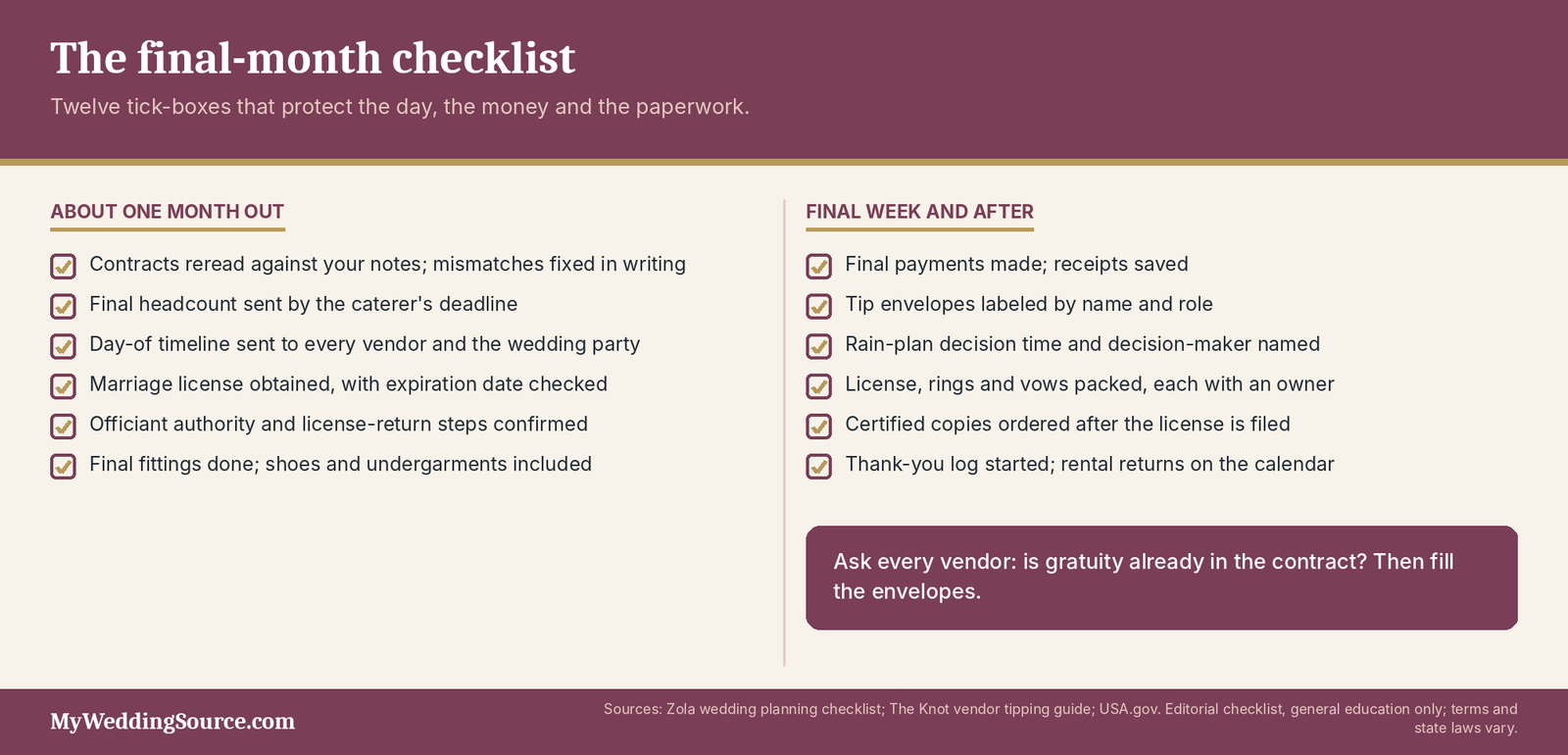
About seven months out Zola suggests reviewing contracts and setting up payment schedules, and a second pass at about one month out is where small mismatches get caught: wrong date, wrong address, forgotten hours, a changed headcount, or a package that does not match what was discussed. Put each contract’s key facts in your tracking sheet: arrival time, end time, final-payment date, payment method, overtime rate and the contact name and phone. A thirty-minute reread per contract is cheaper than a late-night call to a vendor who has no record of the change you made in March.
When you find a mismatch, ask for a corrected document or a written addendum rather than a verbal assurance. That is not a sign of distrust; vendors manage many events and appreciate a clear paper trail as much as you do. Our wedding planning hub collects the contract and vendor pages if a clause worries you, though a local attorney is the right resource when the sums are large.
Event insurance: liability, cancellation and what each covers
Event insurance is two different products, and the NAIC consumer guide separates them. Liability insurance covers injury to others or damage to property caused by your event, is the most common type, and is sometimes required by venues, which may ask to be named as an additional insured. Cancellation coverage can reimburse costs when covered events, such as certain weather or vendor-failure situations, force a change, but costs are generally not reimbursed if you call off the event voluntarily. The NAIC notes that coverage can take several days to take effect, suggests considering a purchase once vendor contracts are signed or deposits are paid, and advises confirming the insurer is licensed in your state.
Your own homeowners or renters policy may cover some gaps, but you should ask your agent whether it extends to a scheduled event. Vendors carry their own insurance, which is a third category; ask each vendor for a certificate if the venue requires one. Keep the policy, vendor contracts and deposit records together so a claim does not require a hunt through six email threads.
The vendor confirmation table
What to confirm, pay and hand over, vendor by vendor
Use the table below at roughly one month out, and again in the final week for anything that changed. It condenses the tip ranges from The Knot’s vendor tipping guide, so it doubles as an envelope list, but treat the ranges as suggestions rather than obligations. If a contract says gratuity is included, the tip column becomes “none needed unless service is exceptional.”
| Vendor | Confirm in writing | Final payment and tip | Owner |
|---|---|---|---|
| Photographer and videographer | Arrival time, shot list, delivery date | $50 to $200 per team member, or 5 to 15% of contract | Partner A |
| DJ or band | Setup time, power, song list, do-not-play list | DJ $50 to $150; band $15 to $50 per member | Partner B |
| Caterer and bartenders | Final headcount, menu, dietary list, end time | Per contract; otherwise 15 to 20% of food and beverage | Partner A |
| Coordinator or planner | Timeline, vendor list, rehearsal attendance | Coordinator $50 to $150; planner 15 to 20% of fee | Partner B |
| Florist and baker | Delivery window, setup access, pickup of rentals | $50 to $200, or a small gift; tip delivery staff | Partner B |
| Hair and makeup | Start time, number of people, location | 15 to 25% of the bill | Each wearer |
| Transportation | Pickup times, route, wait time | 15 to 20% of the bill or about $50 per driver | Partner A |
| Officiant | Rehearsal time, license handling | $50 to $100, plus a donation if religious | Partner B |
Payment calendar and cash flow
Line up every payment date on one calendar view. Zola suggests preparing final vendor payments and tip envelopes at one month, completing final payments in the last week and giving the caterer final details then as well. If several balances fall due in the same two weeks, ask whether any vendor can accept an earlier partial payment, or whether you can pay on a different card or date; many will, but you have to ask before the due date and get the change in writing.
Consider how you pay. A credit card gives you the federal billing-error process described earlier, though a vendor may add a card fee and carrying a balance can be expensive, while a bank transfer or check follows different rules and is harder to reverse. This is general information and not personal financial advice; a nonprofit credit counselor can help if payments look tight. The checklist row is done when each vendor has a paid-in-full note, a receipt and a tip envelope labeled with the recipient’s name and role.
The final week, the wedding day and the first 90 days after
The last seven days
Seven-day tasks that protect the day
Zola’s one-week list is short and practical: pack for the honeymoon, finish final payments, prepare tip envelopes, give the caterer final details, gather ceremony and reception items and hold a final call with the planner or coordinator. Add to that a weather check, a printed copy of the day-of timeline for the wedding party, and a charged phone with the key vendor numbers saved under clear names. Share one document with all the vendors at once, and name the person who will answer questions on the day so it is not you.
The day-of timeline should include arrival times, the ceremony start, the cocktail hour, the room flip if the ceremony and reception share a space, dinner, toasts, first dance, cake cutting, send-off and load-out. It needs a time for each transition and a person responsible for each cue. A timeline with only three entries (“ceremony, dinner, dancing”) is a wish; a timeline with fifteen is a plan, and your coordinator or friend with a clipboard can run it.
The pack list and who carries what
Pack the license in a folder with a copy, the rings, vows, tip envelopes, the emergency kit, a change of shoes, a phone charger and any prescription medication. Give each item an owner: a trusted attendant can hold the rings, the coordinator the envelopes, a sibling the license. Hand over the items at the rehearsal or the morning of, and write the owner’s name on the item list so nobody has to ask three people where the guest book went.
The marriage license deserves its own sentence: confirm that the license is valid on your wedding date (many have waiting periods and expiration dates), that the officiant knows where it will be, and that someone has the filing instructions. If a hotel is part of your plan, add a thirty-second check that the room is reserved under the correct name and dates.
The day before and the day of
Rehearsal, deliveries and the night before
Zola’s day-before list is the rehearsal with the wedding party, confirmation of delivery times with vendors and packing wedding-day items. The rehearsal is a walk-through, not a performance, and it takes about as long as the ceremony plus the questions. Keep it short, have the officiant or coordinator lead it and make sure everyone knows where to stand and when to enter.
Confirm delivery times by text or call and put the answers in your timeline. Then stop planning. A calm night before is not an indulgence; it is a risk reducer, because exhausted couples make more mistakes and enjoy the day less. Eat a real dinner, drink water, and hand the phone to a trusted person with instructions to answer only for emergencies.
Day-of delegation
On the day, your job is to be married. The delegation list should name who handles vendor arrivals, who answers guest questions, who moves gifts and cards at the end, who settles any final balances and who leads the load-out. Zola suggests delegating the job of keeping the wedding party on schedule, which is good advice: choose someone organized and good-natured, and tell them it is their whole job, not a side task.
Take a few quiet minutes together before the ceremony or between the ceremony and reception. It sounds like a small thing, and it tends to be the part couples remember most vividly. If a problem arises, let the coordinator or delegate handle it first; a missing centerpiece rarely matters as much as it feels like it does in the moment.
After the wedding: the first 90 days
Thank-you notes, returns and photo follow-up
Zola suggests sending thank-you cards within three months, with up to a year considered acceptable, and your first task after the honeymoon is to start them. Write notes in batches while you still remember who gave what, and keep a gift log to make it painless. Return rentals on time, because late returns are a common avoidable fee, and ask the photographer when the gallery will be delivered so you can plan for album orders.
If you are keeping the dress or suit, ask the cleaner about preservation and storage, and decide who will take the flowers or the cake topper. These are small tasks, but a single sentence in your checklist (owner, date) means they do not hang around for six months.
Name changes, insurance and the long tail
The paperwork that began in the legal section has its second half now: certified copies, Social Security, driver’s license, passport, banks, employers, insurance, and beneficiaries. Update the ones you must first (ID and Social Security) and the ones with deadlines (health coverage) and work through the rest as time allows. Keep a copy of the marriage certificate and a list of every account you update, so you can retrace your steps if a name does not match somewhere.
| Category | Commonly forgotten | Why it matters | Simplest fix |
|---|---|---|---|
| Money | Refundable column, tip envelopes | Surprise cash needs | Add both to the cost sheet |
| Venue | Load-in/out hours, rain-plan decision time | Overtime and last-minute stress | Put both in the contract |
| Legal | Certified copies, officiant authority | Name-change delays | Verify with issuing office |
| Guests | RSVP date before caterer date | Headcount scramble | Set RSVP deadline 3 to 4 weeks earlier |
| Attire | Shoes at fittings, alteration cost | Late fixes | Book fittings with a fixed date |
| Day-of | Named owner for every cue | Confusion on site | One-page cue sheet |
| After | Rental returns, thank-you log | Late fees, stale memories | Put dates in the shared calendar |
FAQ: wedding planning checklist questions
Using the checklist
How far ahead should I start a wedding planning checklist?
Start it as soon as you have agreed on a rough season and a funding ceiling, because the first gate costs nothing and shapes everything else. Zola’s checklist begins at 12 or more months out, and its booking guidance puts venues at roughly 12 to 18 months before the date, with photographers, caterers and bands at 9 to 12 months. Zola’s report puts the average engagement at about 18 months, so many couples have a long runway. If your engagement is shorter, Zola advises prioritizing the venue, photographer and officiant, keeping the guest list smaller and considering digital invitations.
Who should own each task on the checklist?
Give each task one named owner, grouped by category so that the work divides cleanly: one partner for money and contracts, the other for guests and paper, and both for the venue and the vendors who shape the day. Revisit the split at each gate, because a first draft rarely matches how the work feels after three months. Parents, friends or a coordinator can own whole categories, such as the rehearsal dinner or lodging, as long as they know who signs contracts and who pays. Zola’s 2026 report suggests that planning tends to fall to one partner by default, so an explicit owner column is a kindness to both of you.
What do couples most often forget?
The pattern is consistent: refundable-deposit terms, the load-in and load-out hours, the rain-plan decision time, an RSVP deadline earlier than the caterer’s headcount date, tip envelopes, certified copies of the marriage certificate and the name on the honeymoon tickets. None of these are dramatic, which is why they slip. They share a trait, though: each is solved by one sentence in a contract, one date on a calendar or one named person. The most-forgotten table in the final section gathers the fixes in one place.
Money, protection and paperwork
How much should I set aside for tips and fees beyond vendor prices?
There is no single right figure, because contracts differ on whether service charges and gratuity are included. The Knot’s vendor tipping guide gives suggested ranges (for example, $50 to $200 per photographer, $50 to $150 for a DJ, 15 to 25% for hair and makeup) and says tips for caterers are not necessary when gratuity is already on the contract. Ask each vendor for an all-in estimate with tax, service charge and gratuity shown, then add a line for envelopes. In our illustrative example, tips for a typical set of vendors came to roughly $325 to $1,025, but your own total depends on your contracts.
Do I need wedding insurance?
It depends on your venue, your deposits at risk and your tolerance for loss, and it is worth separating the types. The NAIC explains that liability insurance covers injury or property damage to others and is sometimes required by venues, while cancellation insurance can reimburse costs after certain covered events but generally does not cover a voluntary cancellation. Coverage can take several days to start, and the NAIC suggests considering a purchase once contracts are signed or deposits are paid. Ask your venue what it requires, ask your insurance agent what your current policy covers and confirm that any insurer is licensed in your state.
When should I start the name-change paperwork?
The paperwork follows the wedding, since most agencies want a certified marriage certificate, but the research can begin earlier. Zola’s checklist puts name-change research at about seven months out, and the practical steps (certified copies, Social Security, driver’s license, passport and accounts) fall in the first one to three months after the wedding. The State Department lists passport processing of 4 to 6 weeks routine and 2 to 3 weeks expedited, plus mailing time, so avoid scheduling a passport change right before an international honeymoon. Keeping your name is a perfectly valid choice, and it still leaves some paperwork, such as beneficiaries and insurance, to review.
Your next steps
This week
Hold the Gate 1 conversation and set up the sheet
Block an hour with your partner and anyone contributing, and leave with four written answers: the funding ceiling, the guest range (low, expected, high), your top three priorities and your skip list. Then create the shared cost sheet with columns for estimate, quote, contract total, paid, due date and refundable. Put the owner for each category next to its name. If you only complete one thing from this page this week, make it this, because every later row depends on it.
Pick your first three tick-boxes
Choose three rows from Gate 2 that match your timeline, such as requesting venue price sheets, confirming your state’s license rules and asking two photographers about availability. Give each an owner and a date within the next fourteen days. A short list that actually gets finished builds momentum, and a long list that gets ignored builds guilt. When the three are done, choose the next three.
Before you pay a deposit
Run the five-line contract check
Before any deposit leaves your account, confirm five things in writing: the date, hours and services; the deposit amount and which part is refundable; the cancellation and postponement schedule; the final-payment date and accepted payment method; and the all-in price with tax, service charge, gratuity and overtime shown. If anything is missing, ask for a corrected version and give the vendor a reasonable time to reply. Pricing is complicated, and a clear question rarely offends a good vendor.
File the paper trail the same day
Save the signed contract, the invoice and the receipt in your shared folder, and enter the due dates in your calendar and cost sheet within the hour. Note which payment method you used, since that affects your options if something goes wrong. If a vendor’s terms look unusual or a large sum is at stake, a local attorney can review the contract; this page offers general education only, and terms and state laws vary.
Sources & methodology
- The Knot Worldwide: 2026 Real Weddings Study press release — 10,474 U.S. couples married in 2025; about $34,000 average, 117 guests, $292 per guest, 13 vendors, and vendor booking rates; sample and methodology.
- The Knot: average wedding cost — $34,200 average, vendor category averages (venue, catering per person, photographer, rings, stationery, alcohol) and guest-count tiers.
- The Knot: how much wedding planners charge — planner averages by service type, updated May 2026.
- The Knot: how to tip wedding vendors — suggested tip ranges, timing and service-charge notes.
- The Knot: how many wedding guests RSVP no — 20% decline rule of thumb.
- Zola: wedding planning checklist — task timing from 12 months to the day after, booking lead times, shorter-engagement priorities, and Zola Wedding Cost Index figures.
- Zola: 2026 First Look Report — 11,500+ couples, $36,000 average, 18-month engagement, planning-load and budget-priority findings.
- USA.gov: marriage certificates and licenses — license versus certificate, certified copies, and license validity range.
- CDC/NCHS: Handbook on Marriage Registration — state law governs license requirements, waiting periods and who may solemnize.
- Fort Bend County, Texas: formal marriage license — one county’s waiting period, validity, fee and appearance rules, used only as an illustration.
- Social Security Administration: Form SS-5 — documents needed for a name change on a Social Security card; no fee.
- U.S. Department of State: change or correct a passport — passport name-change routes and forms.
- U.S. Department of State: passport processing times — routine and expedited timing, $60 expedite fee and mailing allowance.
- TSA: REAL ID — acceptable identification for domestic flights.
- HealthCare.gov: Special Enrollment Period — marriage as a qualifying life event and the typical 60-day window.
- FTC: disputing credit card charges — 60-day billing-error window and treatment of undelivered services.
- NAIC: event insurance consumer insight — liability versus cancellation coverage, exclusions and timing.
- FDA: food allergies — the nine major allergens and labeling limits for food service.
Methodology. Verified facts come from official or primary sources: USA.gov, the CDC, the SSA, the State Department, TSA, HealthCare.gov, the FTC, the NAIC, the FDA and a county government page. Survey findings and averages come from The Knot’s and Zola’s studies, which use different samples and methods, so their figures differ and should be read as ranges and not as quotes; sample sizes are stated where the source gives them. Task timing and tip ranges are published industry guidance, not rules. Dollar examples labeled illustrative are editorial arithmetic, and judgments about owners, gates and sequencing are editorial opinion informed by those sources. This is general educational information; laws, license rules and contract terms vary by jurisdiction and agreement.
Freshness note. Cost averages reflect 2025 weddings reported in 2026; recheck The Knot and Zola figures each spring when new editions publish. Recheck license rules, fees and waiting periods with your issuing office before you apply, and recheck passport processing times, TSA identification requirements and health-plan enrollment windows before relying on them, because the TSA page text retrieved for this article referenced a 2025 enforcement date. Last researched October 12, 2026.