

Wedding dietary restrictions come down to one job: finding out, early and kindly, what each guest cannot or will not eat, then getting that information to the people who actually cook and carry the plates, so that nobody has to explain a medical condition to a server in the middle of your reception.
Quick answer
Treat food allergies and celiac disease as safety issues and religious, ethical, and preference diets as hospitality issues. Ask one clear question on the RSVP, follow up privately with anyone who flags a serious need, and give your caterer a written roster that names the guest, the food to avoid, and the table. Then choose a service style, a dessert plan, and a day-of routine that keep the right plate with the right person. This guide covers wedding dietary restrictions as a planning system, and it is general information, not medical or legal advice.
Most advice about wedding dietary restrictions stops at “add a line to your RSVP.” That is a sensible first step, and it is not enough, because the answer a guest writes on a card is only useful if it survives four handoffs: from the guest to you, from you to the caterer, from the caterer’s office to the kitchen, and from the kitchen to the person who sets a plate down at a particular seat. Most failures in handling wedding dietary restrictions happen at one of those handoffs and not at the question itself.
This guide follows the information the whole way. It starts by sorting needs into categories that call for different levels of care, then moves through how to ask, how to organize the answers, how service style changes the risk, what to do about cake and drinks, how to run the day, what to put in the contract, and how to handle the human moments that no spreadsheet covers. If you are still choosing a caterer, our wedding catering guide covers service styles, quotes, and fees in more depth, and this page picks up where that one leaves off.
Sort wedding dietary restrictions into four kinds before you plan anything
A single field on your RSVP will collect a jumble of wedding dietary restrictions: “no shellfish,” “vegetarian,” “kosher,” “low carb,” “gluten sensitive,” “allergic to tree nuts, carries an EpiPen.” These are not the same kind of request, and treating them as one list is the most common reason a thoughtful couple ends up with an uneven result. Some of these entries describe a medical risk. Others describe values or taste. Both deserve respect, but they call for different amounts of process.
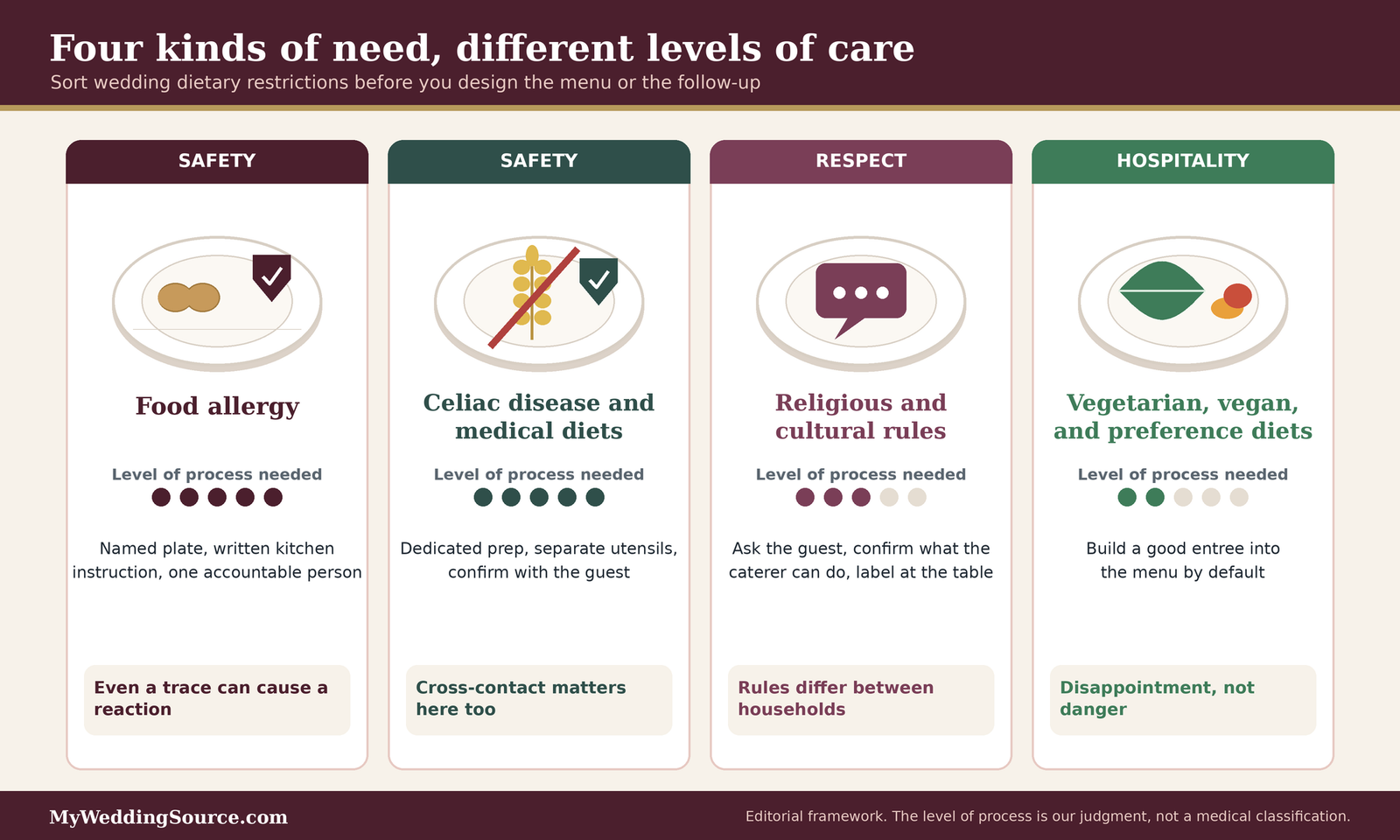
The categories of wedding dietary restrictions below are our own working framework, not a medical classification. They are meant to help you decide how much effort each answer needs, and they are a planning aid, not a way to judge anyone’s reasons.
The first split: medical risk versus personal practice
The first question to ask of any entry is simple: what happens if this goes wrong? If the honest answer is “a guest has a frightening or dangerous reaction,” you are in safety territory. If the answer is “a guest is disappointed, hungry, or asked to eat something that conflicts with their beliefs,” you are in hospitality territory. The second is still worth getting right, but the margin for error and the process around it are different.
Food allergies sit at the top of the risk scale
A food allergy is an immune reaction, and the U.S. Food and Drug Administration lists nine major food allergens: milk, eggs, fish, crustacean shellfish, tree nuts, peanuts, wheat, soybeans, and sesame. The FDA also says symptoms typically appear within a few minutes to a few hours after eating the food, and that a severe reaction, called anaphylaxis, can be life-threatening. That is why an allergy answer on your RSVP is never “a preference” and should never be handled as a menu note.
Celiac disease and other medical diets need real process too
Celiac disease is an autoimmune condition triggered by gluten. The FDA describes it as damaging the lining of the small intestine and estimates it affects about 3 million Americans. It differs from an allergy in mechanism, but for a caterer the practical task is similar: a guest who says “celiac” needs a plate prepared without gluten and without gluten cross-contact. Other medical diets, such as a diabetic meal plan, a low-sodium diet, or a texture-modified diet after surgery, are usually less about cross-contact and more about composition, but they still come from a clinician’s instructions and deserve a careful answer.
Religious and cultural rules call for accuracy, not guesswork
Kosher, halal, and other religious food practices carry real rules about ingredients, preparation, and sometimes who prepares the food. The rules differ between communities and between individual households, so the useful move is to ask the guest or the family what they need and then ask the caterer what is realistically possible. Do not assume that “vegetarian” or “no pork” satisfies a religious requirement. If you are unsure, a short, respectful question to the guest is better than an assumption.
Ethical and lifestyle diets mostly need good options
Vegetarian, vegan, pescatarian, and similar choices are values or habits, and the main task is making sure there is a satisfying plate. For scale, a Gallup telephone survey of 1,015 U.S. adults conducted in July 2023 found that 4% identified as vegetarian and 1% as vegan, with a margin of error of plus or minus four percentage points. Those figures describe the adult population, not your guest list, but they suggest that at most weddings a handful of guests will want a meatless meal and a smaller number will want it entirely free of animal products.
Why the category changes your response
Once you separate the kinds of wedding dietary restrictions, you can spend your attention where it matters. A vegetarian guest needs a real entree. A guest with a peanut allergy needs a kitchen that understands cross-contact, a plate that is identified by name, and a plan for what happens if something goes wrong. Giving every entry the same treatment either wastes effort or, worse, under-protects the people who need the most care.
Match the level of process to the level of consequence
A practical rule for wedding dietary restrictions: allergies and celiac disease get a named plate, a written instruction to the kitchen, and a person responsible on the day. Religious practices get a confirmed answer on what is possible and a clear label at the table. Ethical and preference diets get a good option built into the menu. Texture and calorie preferences get a polite note. This is our editorial judgment about proportion, and a caterer may group them differently, but having a rule in mind keeps your follow-up questions short.
Know that needs change, and that guests may not know theirs
According to Food Allergy Research and Education, which cites a 2019 study in JAMA Network Open, nearly 11% of U.S. adults, more than 27 million people, have at least one food allergy, and more than one in four adults with a food allergy say all of their allergies began in adulthood. Nearly half say at least one began in adulthood. In practice, that means a guest you have known for years can have an allergy you have never heard about, and a guest may mention a reaction that is only a few months old. Ask everyone about wedding dietary restrictions, including the people you think you know well.
Ask once and ask well: how to collect wedding dietary restrictions without a survey
The way you ask shapes the quality of the answer. A long questionnaire gets skipped, a vague “any dietary needs?” gets one-word replies like “no” or “picky,” and a question buried in an email thread gets lost. The goal is a short, specific prompt in the place guests already respond, followed by a personal check-in only for those who raise a serious need. That keeps your guests from feeling interrogated and keeps you from chasing forty replies.
The Knot’s guidance on collecting wedding dietary restrictions through RSVPs is consistent with this approach. It suggests asking about serious allergies and dietary needs tied to religious standards, adding simple options such as vegan, vegetarian, and kosher where relevant, and using an open-ended field online. It also notes that knowing about allergies matters for any service style, since a buffet heavy with dairy could leave a dairy-free guest with little to eat.
Put the question where guests already answer
Most guests respond through a wedding website or a reply card, so that is where your question about wedding dietary restrictions belongs. Our wedding RSVP wording guide covers phrasing for the card itself, and the same principles apply to a form: keep it short, make it specific, and say why you are asking.
Write a prompt that invites a real answer
Compare two ways of asking about wedding dietary restrictions. The first says, “Dietary restrictions?” and invites a shrug. The second says, “Please tell us about any food allergies or dietary needs we should share with our caterer, and whether you have a medical or religious requirement.” The second tells the guest what will happen to the answer and signals that serious needs are welcome. You can make the form even clearer by adding checkboxes for the common items, such as vegetarian, vegan, gluten-free, and kosher, plus a text box labeled “Allergies and anything else we should know.” Checkboxes speed up the common answers, and the text box catches what they miss.
Collect it per person, not per household
If you invite a family or a couple on one reply, make sure the form asks for each person’s wedding dietary restrictions. A household reply that says “no shellfish” does not tell you whether it applies to one person or four. Online forms can require a response for each guest, which avoids that confusion, and on a paper card you can give each invited person a line. Include children, plus-ones, and anyone traveling with a caregiver, because a plus-one you have not met is still someone whose plate you are responsible for.
Collect entree choices only when you need them
If your reception is a plated dinner with several entrees, you will need each guest’s selection. If it is a buffet, stations, or a single plated entree, you do not. The Knot makes the same point. Asking for a selection you do not need adds friction and gives guests one more thing to forget, so collect the minimum that your service style requires. When the choice and the dietary information live in the same form, link them: a guest who selects the beef entree and also lists a sesame allergy needs a conversation with the kitchen about the sauce.
Follow up privately with anyone who flags a serious need
Not every answer about wedding dietary restrictions needs a follow-up, but a serious allergy, celiac disease, or a strict religious requirement does. A short, warm message helps you collect the details a caterer will ask for, and it shows the guest that someone is taking the answer seriously.
Ask the three questions a kitchen will ask you
When a guest lists a serious allergy, a caterer will want to know what the guest must avoid, how careful the kitchen needs to be, and whether there are foods that are safe that you should know about. Ask the guest those same questions in a friendly way: “Thanks for letting us know. Can you tell me exactly what to avoid and how cautious the kitchen should be? Is there anything you usually can eat that I should mention?” Some guests have a trusted list, a chef card, or an allergist’s note, and they may offer it. You are not asking for medical records, only for enough information to give the kitchen a clear instruction.
Respect privacy and avoid making a fuss
Wedding dietary restrictions often involve medical information, and it is the guest’s to share. Collect what the kitchen needs, share it only with the caterer and the people who need it on the day, and avoid mentioning it in group messages or at the table. Many guests with serious allergies are used to being treated as a problem and appreciate a host who handles the matter quietly and competently. A simple “we have it covered” is often the kindest reply.
Set a deadline that works for the caterer
Your RSVP date drives everything that follows for wedding dietary restrictions, because your caterer needs time to finalize counts and plan special meals. Ask your caterer when they need the dietary list and the final guest count, then set your RSVP deadline early enough to leave a buffer. Our wedding invitations guide explains how to work backward from a caterer’s deadline. If a guest’s answer arrives late, call or message them directly and pass the information to the caterer right away.
Turn guest answers into a kitchen brief your caterer can use
Once the answers are in, you hold a messy list with names, half-sentences, and abbreviations. The caterer needs something different: a clean document that a line cook and a banquet captain can read in thirty seconds. The step between those two is where wedding dietary restrictions most often get lost, and it is the step you control. A one-page roster is the simplest tool for it.
Build a one-page roster of wedding dietary restrictions
A roster of wedding dietary restrictions is just a table with one row per guest who has a need. It should be accurate, current, and short enough that nobody skips it.
What every row should contain
Include the guest’s name, the table or seat, the item or ingredient to avoid, the severity in plain words, any known safe foods, and a contact who knows the guest. Severity matters because it changes the kitchen’s response. “Avoids pork” is a request, while “peanut allergy, carries epinephrine, avoid cross-contact” is an instruction. If the guest has told you how they describe their own risk, use their words. If they have not, ask, and do not guess.
A worked example from an illustrative 120-guest wedding
Imagine a plated wedding with 120 guests. After the RSVP follow-up, the couple has nine rows on the roster: one guest with a tree nut allergy, one with a shellfish allergy, one child with an egg allergy, one adult with celiac disease, two vegetarians, one vegan, one guest who needs halal meat, and one guest on a low-sodium diet. That is an invented scenario for illustration, but it shows a realistic mix: three allergies and one celiac plate need the kitchen’s closest attention, the halal and low-sodium requests need confirmation, and the three meatless plates need a good dish. Our estimate is that about 7.5% of guests have a listed need, which is within what you might expect from survey figures, but your list will differ.
| Guest (table) | What to avoid | Severity in plain words | Plan | Who confirms |
|---|---|---|---|---|
| Guest A (4) | Tree nuts | Allergy, carries epinephrine | Separate plate, nut-free sauce and dessert, named at pass | Caterer lead |
| Guest B (7) | Shellfish | Allergy | No shellfish in the kitchen’s allergy prep area | Caterer lead |
| Child C (2) | Egg | Allergy, parents attending | Egg-free entree and dessert, parents informed | Parent and captain |
| Guest D (9) | Gluten | Celiac disease | Dedicated prep, separate utensils, gluten-free dessert | Caterer lead |
| Guests E, F (5, 5) | Meat and fish | Vegetarian | Vegetarian entree from the main menu | Server |
| Guest G (11) | All animal products | Vegan | Plant-based entree and dessert | Server |
| Guest H (3) | Non-halal meat | Religious requirement | Caterer confirms what is possible; otherwise a vegetarian plate | Couple and caterer |
| Guest I (8) | Added salt | Medical diet | Low-sodium entree on request | Captain |
Keep one version and date it
The roster of wedding dietary restrictions will change as late replies arrive. Keep one master copy, put the date in the file name, and send updates to the caterer in a single thread, not in scattered texts. A caterer working from the version dated three weeks ago is a failure waiting to happen, and a single living document makes it obvious which version is current.
Hand the caterer a document, not just a conversation
A conversation with a sales manager about wedding dietary restrictions is valuable, but the sales manager is rarely the person at the stove. The document, and the way the caterer circulates it, is what reaches the kitchen.
Ask how the roster travels inside the company
Ask who receives the roster, how it reaches the head chef and the banquet captain, and whether it is printed for the line. A caterer with a clear system will answer in a sentence. A caterer who says “we’ll take care of it” may be sincere but has not described a process. Ask them to repeat back the three or four serious items, which is a quick way to confirm that the information has been understood.
Request a written confirmation of the plan
Ask for an email that lists each serious need and the planned plate. This works as a checklist for you and as a record for the caterer. It also gives you something to compare against the menu on the day. If a substitution is needed because an ingredient is unavailable, the written plan helps everyone decide quickly and consistently.
Ask who is accountable for the allergy plates on the day
Name one person, usually the catering captain or the executive chef, who is responsible for the allergy and celiac plates. That person should know where the plates are prepared, who plates them, and how they travel to the right guest. If the answer is “everyone,” nobody is accountable. You can say this politely: “Who should I ask if I have a question about the allergy plates during dinner?”
Match the service style to your guest list, because wedding dietary restrictions change the risk
The same menu behaves differently depending on how it is served. A plated dinner is a series of individual decisions the kitchen can control. A buffet is a shared surface that guests control. The right choice for your wedding depends on how many serious needs you have and how much control you want, and it is worth making that decision with the roster in front of you.
For the broader trade-offs of cost, staffing, and timing, see our wedding catering guide. This section looks only at how each style affects safety and flexibility for guests with dietary needs.
How plated, buffet, stations, and family-style compare for safety
No service style is risk-free for wedding dietary restrictions, and none is automatically wrong. What changes is who handles the food and where an allergen can travel.
Plated dinners give the kitchen the most control
A plated meal is the easiest format for wedding dietary restrictions to manage, because the kitchen prepares each dish and a special plate can be built, marked, and carried to a named guest. That control is the main advantage when a guest has a serious allergy. The trade-offs are that you must collect entree choices in advance, that last-minute changes are harder, and that a mislabeled plate can still reach the wrong seat if the handoff is sloppy. If you choose a plated meal, ask how special plates are identified, such as with a ticket, a different garnish, or a different plate, and who delivers them.
Buffets offer choice and more cross-contact risk
A buffet can serve many wedding dietary restrictions at once, because a guest can pick among dishes and see what is on offer. It also places many foods side by side with shared serving spoons. Both the American Academy of Allergy, Asthma and Immunology and Food Allergy Research and Education describe buffets and shared settings as hard to navigate safely because of cross-contact through containers, surfaces, and utensils. If you have a guest with a serious allergy, a buffet can still work if the caterer plates that guest’s meal in the kitchen and delivers it, or if the guest goes first and the caterer controls the line. Ask the caterer what they propose.
Stations and family-style service sit in between
Stations spread the risk across several points, with one person usually serving each. That helps if the server knows the ingredients and uses separate utensils. Family-style service passes shared platters around a table, which makes it difficult to control who touches what. AAAAI lists family-style service, along with buffets, among the settings that are hard to navigate for guests with allergies. If you love the idea of family-style dining, consider serving the guest with a serious allergy an individually plated meal and explaining it privately.
Cocktail-style receptions need the most labeling
With passed appetizers and small bites, guests often eat without knowing what is in each item. If your menu is mostly small plates, ask the caterer to label every item with its main ingredients, and ask servers to know the answers to common questions. A guest with a serious allergy may need a separate platter of items that are safe for them, or a plated meal arranged ahead of time.
Design the menu so most needs are covered by default
A good menu reduces the number of special plates your wedding dietary restrictions require. If one entree is dairy-free and gluten-free by design, and one is vegetarian, you may have covered several guests without anyone asking for anything special.
Build in one flexible entree
Ask the caterer to propose a vegetarian entree that is also vegan and free from the most common allergens, so it can serve several needs at once. Be careful, though: a dish that is “free of” an allergen on paper still needs the same cross-contact care in the kitchen. A flexible entree helps with variety, and it does not replace the need for a confirmed process.
Prefer simple dishes for the highest-risk plates
AAAAI points out that simple dishes with clearly identified ingredients are safer than complex sauces or seasonings, and FARE gives similar advice. That is a useful rule for your highest-risk plates. A grilled protein with a plain side is easier to verify than a layered dish with a house sauce. If the guest with the allergy gets the simplest plate on the menu, that is not a lesser meal, it is a verifiable one, and a good caterer can make it look generous.
Think about the ingredients that hide
Nuts, sesame, and dairy appear in places guests do not expect. AAAAI notes that peanut, tree nuts, and sesame are common in some Asian and Middle Eastern dishes, desserts, bakery items, and sauces such as pesto and mole, and that breads and baked goods often contain milk and egg. Ask your caterer about sauces, dressings, breadcrumbs, marinades, and garnishes, and ask whether purchased items such as rolls or desserts have ingredient lists the kitchen can check.
Handle cake, drinks, and the small items people forget
Couples often plan the main meal carefully and then forget that wedding dietary restrictions apply to everything guests eat, including the cake, the late-night snack, the cocktail-hour bites, and the welcome-bag treats. Allergens can hide in any of them, and the vendors for these items are often different from your caterer. Each one needs the same question.
Dessert, cake, and anything made outside the kitchen
The cake is frequently made by a baker who is not part of the catering team and who may not know the roster at all. That makes it one of the most likely gaps in your plan.
Tell the baker what you told the caterer
Share the relevant part of your wedding dietary restrictions roster, without private details, with the cake vendor. Ask what is in the cake, the filling, and the frosting, and whether the bakery handles nuts, eggs, dairy, or wheat in the same space. If a guest has a serious allergy, ask the baker whether a separate small cake or cupcake can be made in a way that avoids cross-contact, and whether the baker is comfortable doing it. Some bakeries are, and some will say honestly that they cannot, which is a useful answer.
Plan an alternative dessert for the people who cannot have the cake
A guest who skips the cake because of a dietary need should still have something to eat when the rest of the room does. Ask the caterer for an allergy-friendly dessert that is made and plated in the kitchen, or arrange a sealed, labeled option from a source the guest trusts. Because purchased desserts may contain ingredients the staff cannot confirm, FARE advises caution with items not made in-house. Our wedding catering guide discusses how to coordinate cake service and cutting fees.
Ask about the cutting and serving tools
Even a safe cake can pick up an allergen from a knife or a serving server that was just used on another cake. Ask the caterer or baker to use clean tools for the special slices and to cut them first. This is a small step that removes a common source of cross-contact.
Drinks, the bar, and late-night food
Beverages are easy to overlook when you plan for wedding dietary restrictions, and a few details are worth a short conversation.
Check bar items for hidden ingredients
Some cocktails use egg white, dairy, nut-based syrups, or flavored liqueurs, and a signature drink may be built on one of them. If you plan a signature cocktail, ask the bartender to list the ingredients, and offer an alternate for a guest who cannot have them. Our open bar wedding guide covers how bars are staffed and priced, and the same conversation can include a request for an ingredient list and a good nonalcoholic option for guests who do not drink.
Provide a satisfying nonalcoholic option
Guests who are pregnant, in recovery, taking medication, or simply not drinking should have more than water or soda. This is not strictly a dietary restriction, but it belongs on the same list, and it costs little to ask the bartender for a proper alternative. A good nonalcoholic option also reduces awkward questions at the bar.
Treat late-night snacks as a second meal
A late-night food truck or snack table is a second round of service, often from a different vendor with a different kitchen. Ask the vendor the same questions: ingredients, cross-contact, and labels. If you cannot get a clear answer, consider placing the guests with serious allergies on a different plan for that part of the night, such as a snack they bring or a sealed item you provide.
Run the day so the right plate reaches the right guest
Even a perfect roster of wedding dietary restrictions can fail in the last ten feet. The difference between a plan and a result is usually an ordinary routine on the day: who knows, who checks, and who answers a question in the moment. This section is about those routines.
Labeling, seating, and the last ten feet
The most reliable systems are boring. They use a name, a table number, and a person who checks.
Decide how special plates will be identified
Ask the caterer how they mark special plates for wedding dietary restrictions. Common methods include a ticket on the plate, a different plate color, a card at the seat, or a captain who carries the plate and says the guest’s name. The method matters less than the fact that it is consistent and that servers understand it. If you choose place cards, our wedding table settings guide can help you plan how they look, and a small, discreet symbol on the card can mark the seat for staff without drawing attention from guests.
Seat guests so staff can find them
Seat guests with serious wedding dietary restrictions where servers can reach them easily, ideally with a friend or family member nearby who knows what to do. If possible, tell the captain the table numbers before service starts. Our wedding reception guide covers how to build a floor plan and schedule, and the same plan can include a short briefing for staff before doors open.
Label buffet dishes and station items
If you serve a buffet or stations, ask the caterer to label each dish with its name and the major allergens it contains or may contain. A label from a caterer is a communication from the company, so ask how it is verified and who updates it if a recipe changes. Also ask guests with serious needs to speak directly with the event captain or the chef, not just a server who may not know the kitchen.
Emergency readiness without alarm
Most weddings pass without any medical event. The point of preparing is that a few quiet minutes of planning can make a difference if one occurs, and it need not change how the day feels.
Know what the guest has told you to do
Some guests with serious allergies carry epinephrine and have a plan. AAAAI advises people with food allergies to carry two epinephrine auto-injectors or nasal epinephrine, and notes that epinephrine is the first-line treatment for anaphylaxis. If a guest tells you where their medication is and who knows how to use it, share that with the person you designate for the day. Do not ask a guest to carry out their plan on your behalf, and do not give medical advice. If you want to understand the guidance, talk to the guest or read what allergy organizations publish.
Know the venue address and the fastest route out
Write down the full address of the venue, the entrance emergency crews should use, and who will meet them. Tell your venue coordinator, planner, or a trusted friend where this information is. This is the same preparation that helps for any emergency, and it takes five minutes. The FDA advises that someone who suspects a reaction should stop eating the food, consider whether emergency medication is needed, and seek medical attention. In a true emergency, call 911.
Consider event insurance as one part of the plan
Some couples buy event insurance to cover cancellations and certain liabilities. It is not a substitute for careful planning and will not necessarily cover a food-related incident. If you are considering it, read our wedding insurance guide, and ask an insurance professional how a policy treats guest injuries and food-related claims. We do not give insurance or legal advice.
Price it, write it down, and plan for what could go wrong
Accommodating wedding dietary restrictions is rarely a big line item, but it is a line item, and it belongs in the contract. Couples sometimes hesitate to ask about it because they do not want to seem difficult. A good caterer expects the question and answers it routinely, and a vague answer is itself information.
What accommodation costs and what to ask about it
We did not find a reliable national average for what caterers charge to handle wedding dietary restrictions with special plates, and we are not going to invent one. Practices vary: some caterers include vegetarian and common allergy plates in the per-person price, some charge a modest fee, and a few price a separate allergy-safe meal at the full rate. The honest approach is to ask each caterer and compare in writing.
What this actually costs
There is no standard national price for handling wedding dietary restrictions, so compare the quotes you receive, not an average you read online. Ask each caterer whether vegetarian, vegan, gluten-free, and allergy plates are included, charged per plate, or charged as a flat fee, and whether a guest meal replaced by a special plate changes the per-person total. Put your own reserve for last-minute swaps in the budget, then check it against our wedding budget calculator.
Ask for the price of a special plate in writing
Request a line that says what a vegetarian, vegan, gluten-free, or allergy-specific plate costs, if anything, and whether the cost differs for a child. If the answer is “included,” ask that it be written into the proposal. A verbal promise is hard to enforce when staff change, and a written line protects both sides.
Check whether accommodation affects the final count or minimum
Some caterers require a guaranteed final headcount and bill for it, so a special plate for a guest who does not attend may still be charged. Ask what happens if a guest cancels after the deadline, and whether a special plate can be reassigned. This is also a good moment to read the cancellation and substitution terms.
Set aside a small contingency
Because late replies and surprise needs are common, a modest buffer, for example one or two extra vegetarian plates, can save you from a scramble. Whether that is worth the cost depends on your numbers and your caterer’s rules. It is a judgment call, and you can adjust it as the final count approaches.
What the contract should say
A contract is only useful for wedding dietary restrictions if it records what you actually agreed to. We are not lawyers, and this is general education, so read your own contract carefully and ask a professional if something is unclear.
Name the allergy process and the person responsible
Ask that the contract or the written proposal describe how the caterer handles allergy and celiac plates and who is accountable on the day. Even a short paragraph helps: it shows that the caterer has thought about it, and it gives you a reference if something goes wrong. If the caterer’s standard contract has no such language, ask for an addendum or a confirming email.
Confirm the substitution policy
Ask what the caterer will do if an ingredient is unavailable on the day. A vague “we’ll substitute something comparable” is not enough if a guest has a serious allergy. Ask that substitutions affecting a listed allergen require your approval, or the approval of the caterer’s lead who has the roster, before service begins.
Check the venue’s rules for outside vendors
If your venue has an in-house caterer or a list of approved vendors, ask whether they will accommodate special plates and whether an outside baker or a specially prepared meal is allowed. Our wedding venue questions guide includes how to ask about wedding dietary restrictions when you tour a venue, and the answers can influence which venue you choose.
Questions to ask your caterer about wedding dietary restrictions
- How do you prepare and plate meals for guests with serious allergies or celiac disease, and who is accountable for them on the day?
- How does our dietary roster reach the head chef and the banquet captain, and can you repeat back the serious items?
- How do you prevent cross-contact on shared surfaces, fryers, grills, and serving utensils?
- Are your sauces, breads, and desserts made in-house, and can you share ingredient lists for any purchased items?
- How are special plates identified and delivered to the right guest?
- Are vegetarian, vegan, gluten-free, and allergy plates included in the per-person price, or do they cost extra?
- What is your substitution policy if an ingredient is unavailable on the day?
- Who is our contact if a guest has a question or a concern during dinner?
A risk register for wedding dietary restrictions
A risk register for wedding dietary restrictions is a short table that lists what could go wrong, how likely and how serious it is, what warning sign to watch for, how to prevent it, who owns the fix, and what the backup is. The table below is our own editorial synthesis, not a statistical ranking, and the likelihood and impact ratings are judgments for a typical wedding. Adjust them for your guest list and venue.
| Risk | Likelihood | Impact | Warning sign | Prevention | Owner | Plan B |
|---|---|---|---|---|---|---|
| Allergy not passed from RSVP to caterer | Medium | High | Roster still has unanswered rows near the deadline | Single dated roster, one thread | Couple | Phone call to caterer lead and guest |
| Cross-contact in the kitchen or on the line | Medium | High | Vague answers about process, shared fryer or grill | Ask about process, simple dishes, named plate | Caterer lead | Pre-plated sealed meal or guest’s own safe meal |
| Wrong plate delivered | Medium | High | No marking system, servers unfamiliar with roster | Ticket or card system, captain delivers | Banquet captain | Remove plate, replace from kitchen, check guest |
| Cake or dessert contains a hidden allergen | Medium | High | Outside baker, no ingredient list | Share needs with baker, request list | Couple and baker | Alternative dessert made in the kitchen |
| Late-arriving need or plus-one change | High | Medium | RSVP changes after the deadline | Buffer plates, quick update process | Couple | Vegetarian or simple plate with caterer approval |
| Buffet or shared dishes contaminated by guests | High | Medium to high | Shared spoons, unlabeled dishes | Separate utensils, labels, guest served first | Caterer | Individually plated meal for that guest |
| Staff do not know the answer to a guest’s question | Medium | Medium | Servers say “I’m not sure” | Pre-service staff briefing | Banquet captain | Ask the chef or captain before the guest eats |
| Guest has a reaction | Low | High | Symptoms after eating | Know the plan, address, and who to call | Designated friend or planner | Call 911, follow the guest’s own plan |
Read the table by impact first
When you review the register, start with the “High” impact rows and ask whether you have a prevention and a backup for each. Likelihood matters, but a low-probability event with a severe consequence still deserves a plan. The rows with a “Medium” impact are the ones you can address by flexibility and good humor.
Use the table to decide who owns what
Every row has an owner. If you cannot name one, that is the gap to close. Share the relevant rows with your planner, venue coordinator, and caterer, and ask each to confirm that they accept the task.
Revisit it a month out and again a week out
The register is a living document. Update it when RSVPs close, when the caterer confirms the menu, and a few days before the wedding. Each update takes a few minutes and tends to surface a task that was slipping.
What the evidence says about asking, telling, and checking
It helps to know that the system you build for wedding dietary restrictions is not just etiquette, it is a risk reducer. A research summary from AAAAI describes data from FARE’s patient registry, collected from September 2017 to September 2019, in which dining out ranked second only to home as the place where food allergy reactions occurred. Among adults, 31% of reactions occurred while dining out, compared with 35% at home. The summary also reports that tree nuts were the most common cause of reactions requiring epinephrine in restaurants.
Telling staff helps, and combining strategies helps more
In that registry, participants reported fewer reactions when they chose restaurants that declared allergens on the menu than when they only told staff about their allergy, and the fewest when they did both. The numbers reported were 27% for declared allergens, 54% for telling staff, and 14% for both. The data are self-reported, from a registry rather than a random sample, and reactions still occurred despite precautions, so we use them as direction, not proof. The lesson for a wedding is to do both: have the guest tell the caterer, and have the caterer label what is on the plate.
Registries do not describe your kitchen
The registry covers restaurants of all kinds, and a wedding caterer works differently, with a fixed menu, a known guest list, and time to plan. That works in your favor: you can do in advance what a diner at a restaurant must do at the table. Use the registry as a reason to prepare, not as a forecast.
Handle the human moments: etiquette, late requests, and needs you cannot meet
The logistics of wedding dietary restrictions are the easy part. The harder part is the conversation with the guest who emails the week before, the relative who dislikes the menu, or the friend who asks for a special diet that does not fit your caterer’s process. Our wedding etiquette guide covers general manners, and these moments call for the same calm, specific, kind approach.
Late requests and changing needs
Even with a good RSVP process, a late request about wedding dietary restrictions will arrive. The best response is quick, warm, and honest about what is possible.
Say yes when you can, and be specific when you cannot
If a guest tells you a week before the wedding that they have a new allergy, call the caterer the same day and ask what can be done. If the caterer can accommodate, tell the guest exactly what to expect. If the caterer cannot guarantee a safe plate, tell the guest plainly, and offer a practical option such as bringing their own meal and having the kitchen warm it. A guest with a serious allergy will usually prefer an honest “we cannot guarantee this” to a vague reassurance.
Set a cutoff, and keep a back door open
Tell guests the date after which accommodations become difficult, and say so kindly. Then, if someone misses it, work with the caterer to find a simple solution. A cutoff keeps the process manageable, and flexibility keeps the relationship intact.
Do not ask guests to justify their needs
You do not need a diagnosis, a doctor’s note, or an explanation for wedding dietary restrictions. Some guests may share more than you ask, and others may not, and both are fine. Collect what the kitchen needs and leave it there.
Preferences, picky eaters, and children
Not every one of your wedding dietary restrictions is a medical or religious one, and it is reasonable for a host to treat them differently. That does not mean treating the guest as less important.
Be generous with preferences, within reason
A guest who does not like fish or avoids red meat can almost always be served from the existing menu. If the menu offers a choice, you have already covered most preferences. Beyond that, it is fair to decide how much customization you can reasonably provide, and to say so gracefully.
Plan the children’s meals on purpose
Children often eat a separate meal, and that meal may have its own allergy risks. Ask parents about allergies on the RSVP, and ask the caterer how children’s meals are prepared and delivered. A child’s plate is easy to overlook in the rush of service, and it should be on the roster like any other.
Include the vendors and the wedding party
Photographers, musicians, and other vendors who work through dinner often eat a vendor meal, and they may have dietary needs too. Our wedding party costs guide discusses expenses connected with the wedding party, and it is worth asking vendors about their needs when you confirm their meal. The same goes for your wedding party at the head table, who may have needs you already know about.
What to tell guests, and when to say nothing
A short, friendly note about wedding dietary restrictions in your invitation suite or on your website tells guests what to expect and gives them a path to ask. It can also reduce last-minute messages.
A line for the wedding website
Something like this works: “We want everyone to enjoy the meal. Please list any allergies or dietary needs on your RSVP by the date shown, and we will work with our caterer. If your needs are serious, we will follow up with you directly.” It is short, kind, and sets the expectation without promising what you cannot deliver.
Keep the printed menu simple and accurate
If you print menus or a program, list main ingredients and note common allergens only if the caterer confirms the information. Our wedding programs guide explains what usually goes on a printed program. An incorrect allergen note is worse than none, so only print what the caterer has verified, and add a line inviting guests to ask the captain.
Timelines and decision points
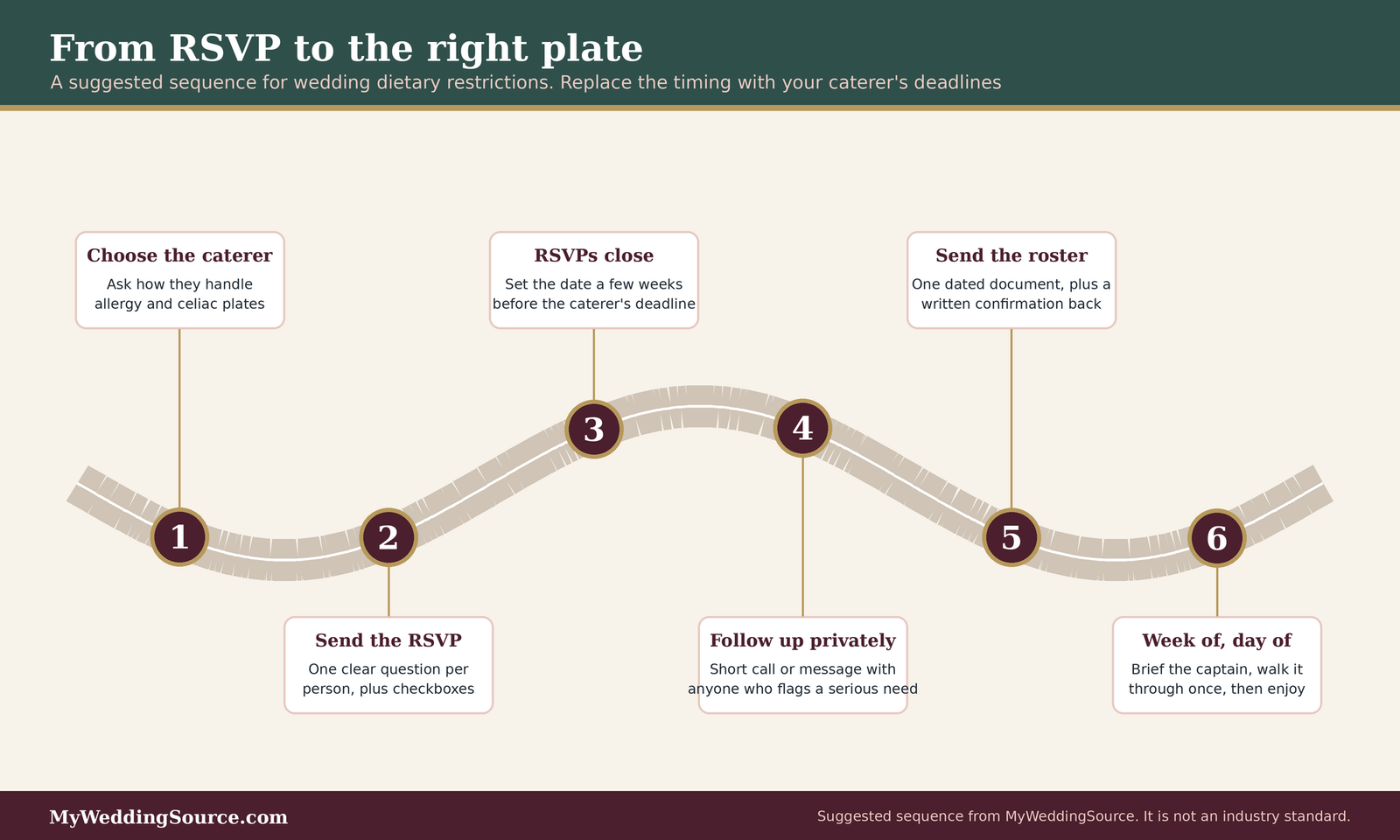
For wedding dietary restrictions, the sequence matters more than the exact dates, and your caterer’s deadlines come first. The timeline below is our suggestion, built to leave buffers, and it is not an industry standard.
Months out: choose with the roster in mind
When you are selecting a caterer and a service style, ask about allergies and celiac handling before you sign, and ask whether a tasting can include the safest plates. Starting here saves you from discovering a mismatch after the deposit. Our wedding planning checklist and wedding planning guide show where food decisions fit in the wider plan.
Weeks out: collect, follow up, and confirm
Send the RSVP question, follow up with serious needs, build the roster, and send it to the caterer. Ask for a written confirmation of the plan for each serious item. Reconfirm with the baker and the bar. Table 2 below shows how to link decisions, deadlines, and actions.
| Trigger | Decide by | Who decides | Tell the guest | Tell the vendor |
|---|---|---|---|---|
| New serious allergy reported after the RSVP deadline | Within one day of notice | Couple and caterer lead | Plain answer on what is and is not possible | Send updated roster, request written confirmation |
| Caterer cannot guarantee a safe plate | As soon as known | Couple | Offer a guest-supplied meal or alternative | Ask for safe handling and heating of that meal |
| Ingredient unavailable for a listed plate | Before service starts | Caterer lead, with couple’s approval | Only if it affects their plate | Require approval before substitution |
| Plus-one or guest count changes | By the final count date | Couple | Confirm their needs | Update counts and roster |
| Guest has symptoms of a reaction | Immediately | The guest, or the nearest informed person | Stay with them, follow their plan | Stop service to that area, call 911 if needed |
The week of: brief the people who will act
Reconfirm the roster and the final count, brief the captain, and give your designated friend or planner the key details. Print the roster for the venue coordinator, because a phone or laptop is not always handy during service. Our small wedding planning guide may help if your guest list is modest and you want a lighter version of this process.
The day of: check once, then enjoy
Do a short walk-through with the captain before doors open. Confirm the special plates, the names, and the tables. Then step back. Your caterer and designated person can handle the rest, and you will have done the part that only you could do.

Collecting and organizing the information
What should I ask about on the RSVP?
Ask about wedding dietary restrictions for each invited person, including allergies, plus a place to note medical or religious requirements. The Knot suggests checkboxes for common choices such as vegan, vegetarian, and kosher, with an open-ended field online. Add entree selections only if you serve a plated meal with several options.
How early should I collect wedding dietary restrictions?
Ask your caterer for their deadline first, then set your RSVP date a few weeks ahead of it so late replies and follow-up calls fit in the gap. The exact timing varies by caterer, so treat any general number as a starting point and confirm the date in writing.
Do I need to follow up with every guest who lists a need?
No. Vegetarian and similar choices usually need no follow-up. Follow up privately with anyone who lists a serious allergy, celiac disease, or a strict religious requirement, and ask what to avoid and how careful the kitchen should be. Keep the conversation short, warm, and private.
Should I tell my guests which meals contain allergens?
Only if your caterer has verified the information. A wrong allergen note is worse than none. Invite guests with serious needs to speak with the event captain or chef, who can answer in detail, and ask the caterer to label buffet dishes with main ingredients and major allergens.
Safety, service, and etiquette
Is a plated dinner safer than a buffet for a guest with an allergy?
Often, because the kitchen controls each plate. Allergy organizations describe buffets as harder to navigate because of shared utensils and surfaces. A buffet can still work if the caterer plates that guest’s meal in the kitchen. Ask each caterer how they would handle your specific roster.
What is cross-contact, and why does it matter at a wedding?
Cross-contact happens when an allergen touches a food that does not contain it, through shared hands, utensils, surfaces, grills, or fryers. Allergy organizations say even a trace can make food unsafe, and cooking does not remove allergens. Ask the caterer how they prevent it, not just what is in each dish.
What if a guest tells me about an allergy the week before the wedding?
Call the caterer the same day and ask what is possible. If they can accommodate, tell the guest exactly what to expect. If they cannot guarantee a safe plate, say so plainly and offer a practical alternative, such as a meal the guest brings that the kitchen can warm.
Do I have to accommodate every diet request?
You are not required to meet every request, and this is not legal advice, but a good host provides a satisfying option for most diets and takes serious medical needs seriously. Be honest about limits. If a request is beyond what your caterer can do safely, say so kindly and work out an alternative.
Your next steps
Set up the system
Write the RSVP question and the roster template
Draft one clear question about wedding dietary restrictions for the RSVP and a one-page roster with columns for guest, table, what to avoid, severity, plan, and who confirms. Having both ready before invitations go out means answers land in the right place from the first reply. Our wedding RSVP wording guide can help with phrasing.
Ask three caterers the same questions
Use the questions in this guide about wedding dietary restrictions and compare the answers in writing. Pay attention to who is accountable, how the roster travels, and how special plates are identified. Our wedding catering guide shows how to compare full quotes.
Prepare the day
Brief the people who will act
Give your planner, venue coordinator, or a trusted friend the roster of wedding dietary restrictions, the table numbers, and the venue address. Share relevant details with the baker and the bartender. Put the plan on your wedding planning checklist so it does not depend on memory.
Walk through it once, then let go
A short check with the captain before service is enough. Confirm special plates, names, and tables, then enjoy your wedding. A plan that is written, shared, and owned by named people is the best protection you can give your guests.
Sources & methodology
How we built this guide
What we relied on
This guide combines U.S. federal information on food allergens and gluten labeling, allergy-organization guidance on dining out and cross-contact, a published research summary of a food allergy registry, a national survey of vegetarian and vegan identification, a university food-safety extension page on the Food Code, and wedding-industry advice on RSVPs from The Knot. Where a statement comes from an advocacy organization or a publisher, we say so. The scenario, roster, risk register, activation table, and timeline are our own editorial constructions, and the percentage of guests on the sample roster is our own arithmetic from an invented example.
What we did not do
We did not test caterers, kitchens, or products, and we did not find a reliable national figure for the cost of special dietary plates, so we do not give one. We are not medical professionals or lawyers. Allergies, celiac disease, and religious practices vary by person and by household, and food-safety rules vary by state and locality. Talk with the guest, an allergist or other clinician where appropriate, your caterer, and, for contract questions, a qualified professional.
Source list
Government and regulatory sources
- U.S. Food and Drug Administration, Food Allergies: https://www.fda.gov/food/nutrition-food-labeling-and-critical-foods/food-allergies
- U.S. Food and Drug Administration, Gluten and Food Labeling: https://www.fda.gov/food/allergens/gluten-and-food-labeling
- Food and Drug Administration, Food Labeling; Gluten-Free Labeling of Foods, final rule (Federal Register, August 5, 2013): https://www.govinfo.gov/content/pkg/FR-2013-08-05/html/2013-18813.htm
Allergy, research, and survey sources
- Food Allergy Research and Education, Facts and Statistics: https://www.foodallergy.org/resources/facts-and-statistics
- Food Allergy Research and Education, Food Allergy Patient Toolkit: https://www.foodallergy.org/resources/food-allergy-patient-toolkit-english-pdf
- American Academy of Allergy, Asthma and Immunology, Dining out with food allergies: https://www.aaaai.org/tools-for-the-public/conditions-library/allergies/dining
- American Academy of Allergy, Asthma and Immunology, Characteristics of food allergic reactions in United States restaurants (research summary): https://www.aaaai.org/tools-for-the-public/latest-research-summaries/the-journal-of-allergy-and-clinical-immunology-in/2021/restaurant
- Gallup, What percentage of Americans are vegetarian: https://news.gallup.com/poll/510038/percentage-americans-vegetarian.aspx
Food safety and wedding-industry sources
- Cornell University Institute for Food Safety, Understanding required competencies for the 2022 Food Code: https://cals.cornell.edu/institute-for-food-safety/extension-services/understanding-required-competencies-for-2022-food-code
- The Knot, Do you need to include a meal selection on your RSVP card: https://www.theknot.com/content/reception-entree-options-on-invites