
A proposal picnic setup is a small, temporary dining room built on public or private ground, and the parts that go wrong are rarely the blanket or the flowers: they are the permission to be there, the clock on the food, and the weather decision nobody agreed on before the day.
Quick answer
A rented proposal picnic setup usually covers styled seating, a table or low surface, and some food, and the vendor sets up and clears away. It usually does not cover permission to use the park, a backup location, or the ring. Published vendor terms we read put weather on you: one asks you to arrange an indoor backup, another reschedules for weather without charge. Before you pay, get four things in writing: who may call off the picnic and when, where the backup is, what a reschedule costs, and whether the park needs a permit for your plan.
If you are planning to propose over a picnic, you are really planning three things at once: a surprise, a small outdoor event, and a contract with a stranger who will arrive before you do. This guide covers the second and third. It explains what a typical proposal picnic setup includes, what published rental terms say about price, deposits and weather, how park rules treat the equipment that makes a picnic look special, and how to turn the weather into decisions made in advance. It ends with a rental setup checklist, a weather-trigger checklist, and a list of questions for the vendor and the park office.
We read the published terms of picnic companies, the permit pages of national and city park systems, and federal weather and food-safety guidance. Where we do arithmetic, we label it as an estimate. Where a rule differs by place, we say so rather than guess, and we are not lawyers, so nothing here is legal advice. If you are still deciding whether a picnic suits your partner at all, start with our guide to private proposal vs public proposal, and for the wider list of ideas see our proposal ideas guide.
What a proposal picnic setup includes
The phrase covers a wide range, from a blanket and a basket you assemble yourself to a styled table with a vendor who arrives hours early. Knowing which layers exist helps you compare quotes that look different but may be offering the same thing.
The anatomy of a rented proposal picnic setup
Most rental packages for a proposal picnic setup combine three layers. A quote can be strong in one layer and silent about another, and the silence is where surprises hide.
The seating and styling layer
This is the visible part: low table, cushions or a rug, a backdrop or canopy, tableware, flowers or greenery, and sometimes lanterns. Photos on a vendor page show the finished look, but a photo is not an inventory. Ask for the list of items that will actually be on the ground, and whether anything you see in photos is a paid extra. Styling also determines how much wind and sun the setup can tolerate, a point we return to in the weather sections.
The food and drink layer
Some packages include a grazing box or similar food; others leave food to you. One picnic company’s published terms say food is not included but you may bring your own, and the same terms say the company does not provide alcohol because of licensing and park restrictions. Another vendor page we read describes a package built around a seasonal charcuterie box with water. Do not assume food is included, and do not assume it is safe to sit out: the food-safety clock is part of the plan, and we cover it in the heat section.
The service layer
This is what the vendor does besides supply objects. According to one published policy, the team arrives one to two hours before your start time to set up and style, and takedown takes about thirty to forty-five minutes. Your time slot starts and ends on schedule even if your party is late. Another vendor says picnics run forty-five minutes to two hours, with extra time sold in thirty-minute blocks. These details matter for a proposal, because you control the arrival time of exactly one person, and that person is not you.
The picture below puts those published durations on one clock, together with the food-safety limit we discuss later, so you can see how little slack a two-hour slot has.

What usually stays your responsibility
Rental terms for a proposal picnic setup read as if the vendor sells an experience, but the legal and practical risk of the location sits with you. The pieces below are the ones we saw assigned to the customer or left unmentioned.
Location and permission
The vendor can style a spot, but the park decides whether the spot may be used that way. One vendor in our reading says its page does not describe permit requirements; park pages we read say permits can depend on group size, equipment, food service, and the kind of event. Treat permission as your job unless your contract explicitly makes it the vendor’s, and ask the question directly. Our guide to proposal location permissions covers the asking process in more depth.
A backup that you can actually reach
One published weather policy tells customers they must arrange a backup location, preferably indoors, and that the company may refuse setup if no alternative is found. That puts the backup on you. A backup is only useful if it is reserved or confirmed, close enough to move to quickly, and known to the vendor and anyone helping you.
The ring, the photographer, and the question
No rental package takes responsibility for the ring, the question, or the person you are asking. Decide who holds the ring while the vendor works, whether a photographer will be present, and what you will do if your partner is early, late, or in a bad mood. Our engagement ring insurance guide is worth a look if the ring is already purchased and will be traveling outdoors.
How rental packages compare: what published terms show
Pricing for a proposal picnic setup is often “starts at” pricing, with the real number set after a conversation. That is normal for small event businesses, but it means you should compare terms, not headline numbers. Below we summarize what two named vendors publish, then show how to read the pattern.
Two vendors, read closely
We looked for vendors that publish deposit, time, and weather terms, because those are the terms a proposal depends on. We checked these pages on November 12, 2026, and vendors change their terms, so confirm them directly. We are not recommending either company.
The Coop Luxury Picnics
According to its price page, each picnic is individualized and starts at a stated base price of $222, with possible travel fees and add-ons that are not itemized. Picnics run forty-five minutes to two hours, and extra time costs $50 for each thirty minutes. A thirty percent deposit is required to hold the date and is non-refundable. For events within fourteen days, the page asks for the full amount with a non-refundable fifty percent deposit, which does not quite match the thirty percent figure elsewhere on the page. That small mismatch is a good example of why you should ask the vendor to state the final numbers in your own written quote.
Bohemian Escape Co.
The picnic company whose site is bohemianescapeco.mypixieset.com lists no prices on its FAQ page but states that a fifteen percent tax and service fee is non-refundable. Cancelling at least seventy-two hours ahead refunds the package amount only. Within seventy-two hours, you can reschedule subject to availability or cancel for a fifty percent non-refundable fee, and same-day cancellations and no-shows are not refunded. There is no deposit; instead, you pay in full within forty-eight hours of approval to secure the date. If weather may affect the booking, the company says it will contact you to discuss options, and weather rescheduling carries no charge.
What the two have in common, and what neither says
Both let you reschedule for weather, but they handle the backup question differently: one expects you to supply an indoor alternative, the other promises to discuss options. Neither page we read says what happens if the weather turns during the picnic itself, after setup is done. That in-the-moment case is the one a proposal is most exposed to, and it should be settled in writing before you book.
Reading the price
A base price for a proposal picnic setup is the start of a calculation. The steps below show where the final number comes from and how to estimate it before you ask.
Base price, time, and add-ons
Take the base figure, then add time beyond the included window, travel, styling extras, and any fee on top. Using only the published figures above: a base of $222 plus one thirty-minute extension at $50 would be $272 before travel, add-ons, and tax. That is our arithmetic, not a quote, and a real quote can differ.
Deposits and payment timing
Deposit rules decide how much of your money is at risk before the weather is known. A non-refundable thirty percent deposit on a $222 base would be about $67, which is our estimate from the published percentage. A pay-in-full-within-forty-eight-hours model, by contrast, puts the whole package at stake, though weather rescheduling may be free. Neither model is better; the point is to know which one you signed.
Fees that sit outside the package
A fee added on top of the package, such as the fifteen percent tax and service fee described above, may not be refundable even when the package is. As a hypothetical only, a package priced at $300 would carry a fee of about $45, for a total of $345. We use a round example because we do not want to imply that any real vendor charges that amount.
What this actually costs
From the published terms we read, a rented proposal picnic setup starts with a base price that excludes travel and add-ons, a time window of roughly forty-five minutes to two hours, and money at risk from the deposit date. The most useful number is not the base price but your refundable amount if the weather turns. Ask for that figure in writing, along with the final total including any fee, travel, and extra time.
Rent, build, or mix
A rental is not the only way to run a proposal picnic setup, and for many couples a hybrid costs less and gives more control. The choice depends on your time, the location rules, and how much help you will have.
Full rental
A full rental proposal picnic setup suits you if you are short on time, want a styled look, and are comfortable with the vendor’s schedule. It moves setup and takedown off your plate, which matters because someone has to be on site before your partner arrives. The trade-offs are less flexibility on timing and the terms you accept on cancellation.
Doing it yourself
A self-built proposal picnic setup costs less in rental fees but adds work: carrying, setup, food handling, and cleanup, on the day you most want to be calm. It also means you are the person who calls the weather. If you go this route, borrow a helper for setup and keep the plan small enough to move in one trip, a theme we return to in the checklists below.
A hybrid with rented pieces
Some couples rent only the pieces they cannot easily supply, such as a low table or a canopy, and bring their own food. If you take this route, ask whether the rental company delivers and collects, since carrying furniture across a park can undermine the surprise. For ideas on renting furniture for outdoor events in general, see our guide to lounge furniture rentals and our wedding rental planning checklist, which cover delivery windows, damage terms, and returns in more detail.
Park rules that shape a proposal picnic setup
For a proposal picnic setup, the same blanket can be unremarkable in one park and a permit question in another. The difference is usually not the blanket. It is the equipment, the number of people, the food service, and whether the park sees your plan as a private visit or an event.
What official park pages say
To see how a proposal picnic setup meets park rules, we read permit pages from three National Park Service units and three city or county park systems. They are examples, not a map of your park. Their value is to show which questions come up, so you can ask them of your own park office.
National park examples
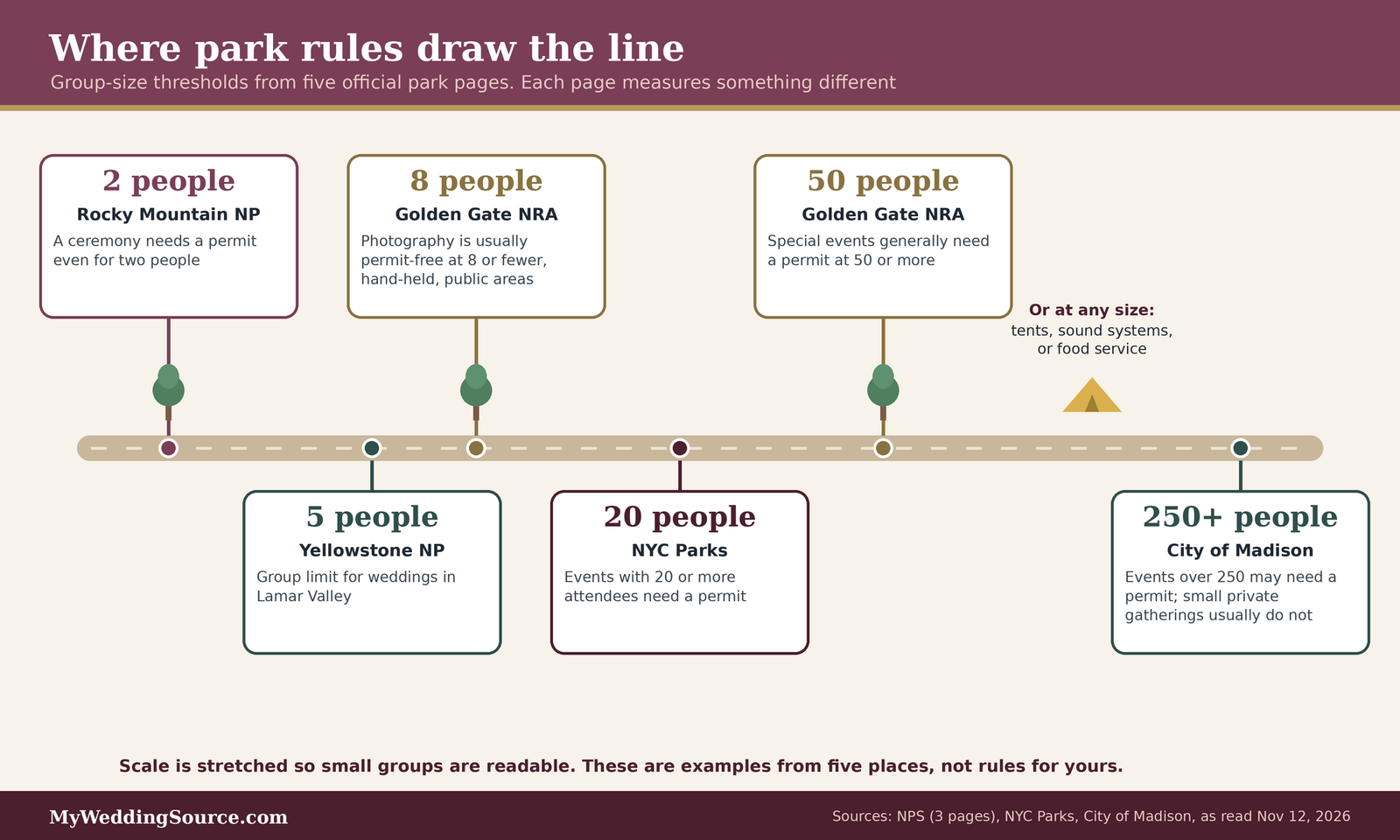
The Golden Gate National Recreation Area’s special park uses page says a special event permit is generally required for gatherings of fifty or more people, and also regardless of size when there is substantial equipment such as generators, sound systems or signs, or onsite catering or food service. It says weddings and outdoor ceremonies need a permit at any size. For filming and photography, it says there is usually no permit or fee for eight or fewer people in public areas using hand-held equipment, if the activity does not need exclusive use or harm resources or visitors. It also says picnic tables cannot be reserved through special event permits.
Rocky Mountain National Park’s page says any ceremony needs a special use permit, even one with two people, and that decorations, altars, tables, tents, floral displays and generators are prohibited or restricted, with a few chairs allowed for guests who cannot stand. It caps ceremonies at two hours including setup, teardown and photos, and bans drones. Yellowstone’s wedding page requires a special use permit and sets small group limits by location, such as five people in Lamar Valley. These pages are about weddings and similar ceremonies, and none of the three mention proposals.
City and county examples
New York City Parks’ special events FAQ says events with twenty or more attendees need a permit, and that smaller groups may still want one to reserve an area, use amplified sound, or bring canopies or tables. It says tents need approval and cannot be staked into the ground, that tents are generally not allowed in Manhattan, and that tables there are allowed only with approval and limited to two. Milwaukee County’s picnic spot policies allow tents only in designated picnic areas with a valid permit, with no stakes, and say decorations and tape must be removed at cleanup. Madison’s park event page says small private gatherings usually do not need a permit even if shared on social media, while events over two hundred fifty people, events with vending, and events with a broad public promotion may.
What none of these pages answer
The pages we read describe weddings, public events, and picnic reservations. They do not say whether a rented, styled table for two with a vendor on site counts as a private visit, a commercial activity, or an event. A vendor operating on public land may also need its own permission, which the pages we read do not describe. That is why the practical step is not to guess from a rule that sounds close, but to describe your exact plan to the managing office and ask which category it falls in.
Setup items that trigger rules
A proposal picnic setup is mostly made of items that park rules mention by name. When you list your items, check each one against the pages for your park.
Tents, canopies and anchoring
For a proposal picnic setup, a canopy gives shade and a backdrop, and it is also the item most often regulated. Some park pages restrict tents to designated areas or require approval, and several prohibit stakes, which pushes you toward weights or sandbags. A canopy also catches wind, so a rule on anchoring and a rule of sense point the same way. Our guide to ceremony wind limits explains why lightweight structures need a plan for gusts.
Tables, decor, signs and tape
Low tables, backdrops, banners, balloons, and confetti can each be a separate rule. Park pages we read treat tables, signs and decorations in different ways, and Rocky Mountain’s page prohibits or restricts most of them for ceremonies. If your style relies on a particular object, ask about it by name instead of asking whether decorations are allowed, because the answer to the general question can hide an exception. Also ask about cleanup: Milwaukee County’s page, for instance, requires decorations and tape to be removed.
Sound, alcohol, grills and food service
In a proposal picnic setup, speakers, wine, candles, and anything cooked on site tend to sit under stricter rules than a blanket. Milwaukee County’s page says most picnic areas prohibit amplification and that alcohol must stay within the rented space and be served only to people twenty-one or older. New York City’s page says barbecuing is allowed only in designated areas and propane tanks are prohibited. The Golden Gate page treats onsite catering as a permit trigger and mentions a separate temporary food permit. A vendor who supplies alcohol or hot food may be taking on rules you have not read, so ask who holds the necessary permission.
How to ask the park office
The most useful thing you can do before a proposal picnic setup is to ask a precise question and keep the answer. A vague question gets a vague answer, and a verbal answer is hard to rely on if a ranger or officer asks you to leave.
A short script
Describe the plan in four sentences: the date and time window, the number of people including a vendor and a photographer, the items you will bring or have delivered, and that this is a private proposal with no public invitation. Then ask three questions: does this plan need a permit, are any of the items restricted, and may a vendor deliver and set up on site. Do not mention the proposal if you need the surprise kept, since the office does not need that detail. You can say it is a private gathering for two.
Keep the reply
Ask for the answer by email, or write down the name, date, and what was said. If a park says no permit is needed for a small group, ask whether that holds with a vendor and with a canopy. If the answer is unclear, treat it as unconfirmed and pick a different spot. For a broader treatment of this process, see our guides to proposal location permissions and wedding permits, which describe the same kind of conversation for events.
Weather contingencies for a proposal picnic setup
Weather is the one variable in a proposal picnic setup that you cannot book, so the useful move is to decide in advance what each condition means. A trigger is a condition and a decision, written down, with a named person who makes the call.
Why triggers beat hope
People who plan a proposal picnic setup tend to check the forecast and then adjust on the spot, which is when the pressure of the plan makes every cloud look fine. Triggers remove that pressure.
Decide before the day
Write each condition for your proposal picnic setup as a pair: if this, then that. For example, if thunder is heard, move to the backup and wait. The aim is that on the day you are following a plan you made calmly, not arguing with yourself about a surprise. Our guide to wedding photography rain backups uses the same approach for bigger events.
Name the person who calls it
A proposal picnic setup usually has a secret, and the secret can freeze the decision. Choose one trusted person, perhaps a friend who knows the plan, and one deadline by which they can say move or stay. If the vendor’s contract lets the company ask for a location change when bad weather is predicted, make sure that person knows how to reach the vendor.
Lightning and storms
Storms are the one weather condition in a proposal picnic setup where the safety guidance is clear and not a matter of taste. A proposal is not a reason to wait.
The thunder rule
The National Weather Service’s lightning tips say that hearing thunder means you are close enough to be struck, and that you should wait at least thirty minutes after the last rumble before resuming outdoor activity. Treat the first thunder as the trigger to move, not the first rain. Build that into the plan as a rule the vendor, the photographer, and your helper all accept.
Where to go
The same guidance points to a solid building with wiring or plumbing, or a closed, metal-roofed vehicle with the windows up. It lists places to avoid when no shelter is nearby, including hills, open water, lone trees, and metal fences. A pavilion or a tent is not a substitute for a building. When you scout the picnic site, find the nearest real shelter and time the walk to it, because it determines how early you need to decide.
What it means for the schedule
If the last thunder is followed by thirty minutes of waiting, a storm can eat a one-hour window whole. That is not a reason to give up. It is a reason to keep a flexible start time, or to hold the question for the backup location. A proposal can happen at a table indoors, and the ring does not mind.
Heat, sun and food
Heat is quieter than lightning and affects more picnics. It shapes every proposal picnic setup in warm months. It affects how people feel, how the setup looks, and whether the food is safe.
The heat index and the sun
The National Weather Service explains that the heat index combines temperature and humidity to describe how hot it feels, giving an example in which air at 96 degrees Fahrenheit with 65 percent humidity feels like 121 degrees. It adds that heat index values assume shade and light wind, and that full sunshine can raise them by up to 15 degrees. A picnic in open sun is therefore hotter than the number on your phone, and a sheltered spot is worth planning for. Our summer wedding heat plan goes into shade, water and timing for longer events.
Ultraviolet exposure
The Environmental Protection Agency’s UV index guide groups the scale into bands and advises seeking shade from late morning through mid-afternoon at moderate or higher levels. It offers a simple check: if your shadow is shorter than you are, UV exposure is higher. For a picnic, that suggests choosing a shaded spot, bringing sunscreen and hats for guests, and avoiding the middle of the day if you can.
The food clock
USDA guidance says perishable food should not sit out for more than two hours, and for no more than one hour when the temperature is above 90 degrees Fahrenheit. A full cooler in the shade holds its temperature longer than a partly filled one in the sun, and cold dishes should be served in small portions with the rest kept chilled. For a two-hour slot, our arithmetic is simple: on a hot day the food limit is half the slot. If the vendor supplies food, ask how it is kept cold and how long it sits out.
People who feel heat sooner
The Centers for Disease Control and Prevention lists signs of heat illness, including heavy sweating, dizziness, headache, weakness and nausea, and notes that children, older adults, pregnant people, and people with chronic conditions are at higher risk. If your picnic includes parents, grandparents, or children in the background, plan the shade and water for the most vulnerable person present, not for the two of you.
Rain, wind and cold
For these three conditions we found less authoritative guidance specific to picnics, so the points below are practical judgment, and you should adapt them to your site.
Rain
Light rain may not stop a picnic, but it changes the setup: wet ground, cold hands, damp food. A canopy can help, but may be restricted. Decide in advance what level of rain moves the picnic, and whether a drizzle that clears is worth waiting for. If your vendor’s policy offers a free weather reschedule, ask by when the decision must be made, because the window can close before the weather does.
Wind
Wind turns light decor into projectiles and napkins into litter. A heavy table setting with weighted items does better than a loose arrangement. Backdrops and balloons are the first to go. Choose pieces for the worst gust you expect, not the average.
Cold
In cold weather, the picnic becomes a question of how long a person can sit still. Blankets and warm drinks help, but a proposal needs a pause that feels comfortable. Our winter wedding weather plan explains how to think about cold exposure for guests, which applies on a smaller scale here.

Weather and cancellation terms in a proposal picnic setup contract
The words in the vendor’s policy decide who pays for a proposal picnic setup when the weather turns. Reading them before you book is cheaper than arguing after.
Terms we found in the wild
These are three examples of how weather appears in published terms for a proposal picnic setup. They differ enough that you cannot assume the next vendor’s policy matches any of them.
A vendor that expects you to supply the backup
The Coop Luxury Picnics’ page says you must arrange a backup location, preferably indoors, and that the company may request a location change if bad weather is predicted and may refuse setup if no alternative is found. It adds that a fully paid booking cancelled for severe weather can be rescheduled within three months, subject to availability, and that you can reschedule once, with a second cancellation forfeiting the full cost. Emergency cancellations must be made at least forty-eight hours ahead, and day-of cancellation forfeits the full cost. Notice how much turns on who decides that weather is severe.
A vendor that promises to discuss options
Bohemian Escape Co.’s page says that if bad weather may affect the booking, the company will contact you in advance to discuss options and that weather rescheduling carries no charge. It also says the tax and service fee is non-refundable. A promise to discuss options is friendlier than a rule, but it does not say who has the final say, so ask that question in writing.
A park reservation with no weather remedy
A help-center page at mkecoparks.helpscoutdocs.com, which covers a park picnic-area rental and not a styled vendor setup, says bad weather does not qualify for a refund and a booking cannot be moved to a later date. That is a useful reminder that a park reservation and a vendor booking are separate contracts with separate weather rules. If you reserve a pavilion or picnic area and also rent a setup, a weather reschedule from the vendor does nothing for the park fee.
Terms to negotiate or at least understand
You may not be able to change a vendor’s standard terms, but you can ask for the exceptions that matter most to a proposal.
Who calls it, and by when
Ask for a decision deadline that is late enough to use a forecast and early enough for the vendor to adjust. Ask what happens if the weather changes after setup begins, and whether you or the vendor decides. Get the answer in writing, and make sure the helper who holds the secret can reach the vendor.
What is refundable, what is movable
Separate three kinds of money: the deposit, the balance, and any fee on top. A policy may refund the package amount but not the fee, or allow one reschedule and no more. Ask for a plain list of what you get back in each case. A proposal can slip a week for rain, but only if the rescheduling terms allow it without losing the date for a second time.
Moving the picnic, not just the date
If a backup location is part of the plan, ask whether the vendor will set up there, whether the price changes, and how much notice is needed. Some vendors serve parks only, and some require a site visit first. A backup the vendor will not serve is only half a backup. For a longer treatment of vendor terms, our wedding vendor due diligence checklist offers a way to compare contracts.
The proposal picnic setup checklist: rental and weather triggers
This section is the working tool for your proposal picnic setup. Print it, paste it into your notes, or hand it to the helper who knows the plan. Items are written as actions you can tick off, and the weather part is written as if-then triggers so the decision is made before the day.
Rental setup checklist
The checklist runs from the early commitments to the last minutes before your partner arrives.
Four to six weeks out
- Choose the location and write down a second location within a short drive that has real shelter.
- Describe your plan to the park office and keep the reply, including the question about a vendor and any canopy.
- Get written quotes from at least two vendors that state the base price, included time, travel fee, add-ons, tax and service fees, deposit, and refundable amounts.
- Ask each vendor what happens to the proposal picnic setup in rain, heat, wind, and a thunderstorm, and who decides.
- Confirm the backup location is reserved or open, and ask whether the vendor will serve it.
- Decide whether the proposal picnic setup includes a photographer, and agree on the terms in writing.
The week before
- Confirm the arrival time of the vendor and the time your partner will arrive, leaving a gap for setup and a gap for delays.
- Share the plan with one helper who can decide on weather and handle the vendor.
- Decide who carries the ring, who holds it during setup, and where it will be at the moment of the question.
- Check the forecast daily and write down the triggers below with the time of each decision.
- Confirm food arrangements, allergies, and how perishable items will be kept cold.
- Pack a small kit: water, sunscreen, a towel, a spare blanket, napkins, wipes, a small bag for trash.
The day of
- Message the vendor in the morning to confirm that setup is going ahead.
- Walk the site early or send your helper: check the ground, shade, wind, insects, nearby events, and crowds.
- Check that no item is blown, wet, or missing, and that the setup matches what was agreed.
- Keep perishable food in a cold cooler until it is needed, and note the time it comes out.
- Agree on a signal with your helper for any change, and leave the ring in a safe spot until the moment.
- Plan the pack-up: who takes the ring, who takes the leftovers, who talks to the vendor on return.
Weather-trigger checklist
Write the triggers on a card. Each line is a condition, a decision, and an owner. The thresholds that come from official sources are labeled, and the rest are our judgment, which you should adjust for your place and your guests.
The night before
- If the forecast shows thunderstorms during your window, decide now: move the time, move to the backup, or reschedule under the vendor’s terms. The vendor’s decision deadline may be today.
- If the forecast shows a heat index of concern, shift the picnic to a shaded spot or a cooler hour, and plan the food around the one-hour rule that applies above 90 degrees.
- If rain is likely but not certain, ask the vendor what they need to hear and when.
- If wind is forecast, choose weighted table pieces and leave the backdrop out.
The morning of
- If thunder is audible or a storm is visible in the area, move to the backup and do not return until thirty minutes after the last thunder, per the National Weather Service guidance.
- If the sun is strong and there is no shade, add a canopy only if the park allows one, or move to a shaded spot.
- If the day is above 90 degrees, cut the time perishable food is out to one hour and keep it in the cooler until the last minute.
- If someone in the group is older, very young, pregnant, or has a health condition, plan shade and water for them first.
During the picnic
- If the weather changes after setup, the helper decides, not the person carrying the ring.
- If you need to move quickly, take the ring, leave the objects, and let the vendor handle the cleanup under the contract.
- If the moment has passed because of weather, you can still propose at the backup. A new setting is not a failed one.
- If someone shows signs of heat illness, stop and take care of them. The question can wait.
Photography, consent and privacy at a picnic proposal
A proposal picnic setup often includes a camera. How you handle it affects your partner’s comfort, the vendor’s access, and whether anyone feels watched.
Photographers and vendors
In a proposal picnic setup, a hidden photographer is a stranger who arrives before your partner does. Think about whether your partner would enjoy knowing that someone was there.
Agreements and ownership
If you hire a photographer, ask who owns the images, how long they are kept, and whether the photographer may use them for marketing. Ask for the answers in writing. A picnic vendor may take photos of the setup for its own portfolio, and some vendors ask for permission to post. Say no if you want to keep the moment private. Our engagement announcement photo session guide covers the follow-up session, and our wedding photography guide offers more on contracts.
Park rules on photographers
Some park pages tie photography to group size and equipment. The Golden Gate page we read says photography usually needs no permit or fee for eight or fewer people using hand-held equipment in public areas without exclusive use, and otherwise a permit and fees apply. Rocky Mountain counts photographers in the group limit, and bans drones. If you plan a photographer, vendor, and guests, count everyone, because the group limit may include them all.
Guests, recording and consent
A proposal picnic setup for two can easily become a gathering with a hidden audience, and the rules around recording are more complex than most people expect.
Photos and video versus audio
Law differs between photographing people in public and recording what they say. Justia’s fifty-state survey says federal law and most states allow recording a conversation if you are a party to it, while fifteen states clearly or potentially require every party’s consent in some or all circumstances. It also says that rules often depend on a reasonable expectation of privacy. We are not lawyers, so if you plan to record audio of your partner or others, ask for consent or take legal advice. The simplest rule is to ask everyone present.
No secret recording of guests
Our own rule, not a legal one, is to avoid secretly recording any guest, including friends and family hidden nearby. A surprise is not a reason to record people who do not know. Tell everyone who will be there that photos and video are planned, and agree when anything will be shared. For the wider question of privacy and attention, see our guide to private proposal vs public proposal.
Edge cases in a proposal picnic setup
Most plans for a proposal picnic setup meet one or two of the situations below. Read the ones that fit, and leave the rest.
Accessibility and comfort
A picnic on the ground is a particular kind of seat. Not everyone can get down to it or up from it comfortably.
Seating and ground
Low seating can be difficult for people with limited mobility, back or knee trouble, or pregnancy. Ask the vendor if a higher table and chairs are available, and check whether the park allows them. Rocky Mountain’s page, for example, allows a few chairs for guests who cannot stand for a ceremony, which is a reminder to ask rather than assume. Check the path from the parking area to the site for slopes, steps and soft ground.
Heat, cold and shade
Your partner may be more sensitive to sun, cold, or insects than you realize. Think about what your partner finds comfortable, not just what looks good in photos. If the picnic is meant to last, plan seating that works for the full time, with shade or warmth as needed.
Food, allergies and alcohol
Food adds three separate questions: what is on it, how it is kept, and what rules apply to drinking it.
Allergies and dietary needs
Ask the vendor how they handle allergies and cross-contact, and what is in each item. If your partner has a serious allergy, consider supplying the food yourself or confirming that the vendor can meet the need in writing. Published vendor pages vary on dietary requests, and a line on a website is a prompt to ask, not a promise to rely on.
Alcohol rules
Alcohol is regulated by place. Milwaukee County’s page says alcohol must stay within the rented space and be served only to people twenty-one or older, and one picnic company says it does not provide alcohol because of licensing and park restrictions. Check the park’s rule before you bring a bottle, and plan for a non-alcoholic option your partner likes as well.
When the plan changes
Even a well-built proposal picnic setup sometimes shifts. A few situations come up often enough to plan for.
Moving indoors without losing the mood
If the weather forces a move, the picnic can come with you in a smaller form: a few pieces, a blanket, and the food. Ask the vendor whether a partial setup is possible. A cafe, a porch, a friend’s living room, or a hotel lobby can work if you have asked in advance, and a short walk can feel like part of the story.
Leaving the setup unattended
One vendor’s terms say you must never leave the picnic unattended, and if you need to leave early you should contact the company. That matters for a proposal because the ring and your partner’s belongings may be on the blanket. Decide who stays, and keep valuables on a person, not on the ground.
When the date must move
A weather reschedule can collide with your partner’s schedule, a family visit, or a holiday. If the date must move, decide whether you can still keep the secret, and whether the vendor’s reschedule terms allow a second move. If your plans involve travel, our guide to planning a proposal while traveling covers moving parts that interact with weather.
Questions to ask a picnic vendor and the park office
Use these questions about your proposal picnic setup as written, in an email, and keep the replies with your records.
Questions to ask before you pay
- What exactly is included, and which items in your photos cost extra?
- What is the final total, including travel, time, taxes, and fees?
- What is refundable if weather forces a change, and by when must I decide?
- Who decides that the weather is too severe, and how is that communicated?
- Will you set up at a backup location, and does the price change?
- What time will you arrive, how long is takedown, and who is on site during the picnic?
- How is food kept cold, and what is your allergy process?
- Do you hold any permit or permission for this park, or is that my responsibility?
- May your staff photograph the setup, and may you post it?
- For the park: does a small private group with a vendor and a canopy need a permit?
For the vendor
These questions confirm what you are buying and what happens when plans change.
Scope and price
Ask for an itemized quote for the proposal picnic setup and a written inventory. Ask what is not included, and whether the setup in the photos is the setup you will receive. A request for the inventory is ordinary, and a vendor who answers clearly is easier to trust.
Weather and cancellation
Ask for the weather policy for the proposal picnic setup in plain terms, with examples: light rain, a storm warning, heat above 90 degrees, and wind. Ask for the same in an email so that you have the wording. If the policy says discuss options, ask what the options are.
For the park office
These questions confirm that the spot can be used for your plan.
Permit and group size
Ask whether a permit is required for a proposal picnic setup for a group of your size, with the vendor, any photographer, and the equipment. Ask whether the limit counts staff and photographers. Ask how far in advance the answer is valid, since rules and closures can change.
Equipment and conduct
Ask about the tents, tables, signs, sound, alcohol, candles, and cleanup in your proposal picnic setup, by name. Ask about quiet hours, closing times, and whether other events are scheduled nearby. Ask who to call on the day if there is a problem.
FAQ: proposal picnic setup questions
Cost and booking
How much does a proposal picnic setup cost?
It depends on the vendor, time, and extras, and many publish only a starting price. One company states a base of $222, with travel fees and add-ons extra and thirty extra minutes at $50. Treat a starting price as the beginning of a quote, and ask for the final total in writing.
Should I rent a setup or build my own?
Rent a proposal picnic setup if you are short on time and want setup and takedown handled. Build your own if you want lower fees and more control over timing and food, and have a helper. A hybrid works well: rent only the pieces you cannot supply, and ask whether delivery and collection are included.
Is the deposit refundable if it rains?
Not necessarily. One vendor’s page says its deposit is non-refundable but that a severe-weather cancellation can be rescheduled within three months. Another says weather rescheduling has no charge but its fee is non-refundable. Ask what is refundable, what is movable, and by what date, and keep the answer.
Weather and safety
When should we call off a proposal picnic because of weather?
Call it off for thunder, and let the other conditions depend on your plan. The National Weather Service says to move to shelter when you hear thunder and wait at least thirty minutes after the last rumble. For heat, rain, wind or cold, write your own triggers before the day and name who decides.
How long can food sit out at a picnic?
USDA guidance says perishable food should not be out more than two hours, or one hour when the temperature is above 90 degrees Fahrenheit. A full cooler in the shade holds its temperature longer. If your picnic runs two hours on a hot day, plan to serve cold food in small portions.
What if my partner is sensitive to heat or sun?
Plan for them first. The CDC lists heavy sweating, dizziness, headache, weakness and nausea as signs of heat illness and says some groups are at higher risk. For a proposal picnic setup in warm weather, choose shade or a cooler hour, bring water, and keep the picnic short enough to be comfortable. A shorter, calmer picnic is better than a long one.
Permission and privacy
Do I need a permit for a small picnic proposal in a park?
It depends on the park, the size of the group, and what you bring. Pages we read tie permits to group size, weddings, equipment such as tents, and food service, and none mention proposals. Describe your plan to the managing office, including any vendor and canopy, and keep their reply.
Can I record the proposal with friends nearby?
Photos and video of people are treated differently from recording speech. Justia’s survey says most states allow recording a conversation you are part of, but some require every party’s consent, and rules often depend on privacy expectations. We are not lawyers, so ask everyone present for consent and avoid secret recording of guests.
Your next steps
Settle the location and the rules
Pick a spot and a shelter
Choose the proposal picnic setup site and a backup with real shelter within a short drive. Time the walk between them. If the backup is indoors, confirm it in advance. For the wider planning picture, our wedding planning checklist shows how to keep dates and tasks in one place.
Ask the park and keep the reply
Send the short script from the permissions section, and keep the answer. If the answer is unclear, choose a different spot. Our proposal location permissions guide goes into more detail.
Compare vendors and write the triggers
Collect two written quotes
Ask for the base price, time, travel, add-ons, fees, deposit, and the refundable amounts. Use the questions in the block above, and compare terms before price. Our wedding vendor due diligence checklist helps you compare contracts.
Write the weather card
Put the triggers for your proposal picnic setup on a card, name the person who decides, and share it with the helper and the vendor. Then plan the celebration that follows: our guides to proposal and engagement party planning and engagement party at home cover what comes after the question.
Sources & methodology
How we built this guide
What we relied on
This guide combines permit and policy pages from the National Park Service and city and county park systems, National Weather Service, Environmental Protection Agency, USDA and CDC guidance, a legal survey of recording laws, and the published terms of picnic companies. Where a statement comes from a vendor, we say so, because vendor terms reflect that company’s own business and can change. Our price examples are our own arithmetic from published figures, or labeled hypotheticals, and are estimates, not quotes. We checked these pages on November 12, 2026.
What we did not do
We did not book a picnic, test a vendor, or contact park offices, so we cannot confirm how any office would treat your exact plan. Rules, fees and policies change and differ by place, so confirm them directly. This guide is not legal, medical, or insurance advice.
Source list
Government and public agency sources
- National Park Service, Golden Gate National Recreation Area, Special Park Use Permits: https://home.nps.gov/goga/planyourvisit/specialparkuses.htm
- National Park Service, Rocky Mountain National Park, Weddings and Other Ceremonies: https://www.nps.gov/romo/planyourvisit/weddings.htm
- National Park Service, Yellowstone National Park, Wedding Information: https://www.nps.gov/yell/planyourvisit/weddinginfo.htm
- National Weather Service, Lightning safety tips: https://www.weather.gov/safety/lightning-tips
- National Weather Service, Heat index: https://www.weather.gov/safety/heat-index
- U.S. Environmental Protection Agency, UV Index Scale: https://www.epa.gov/sunsafety/uv-index-scale-0
- U.S. Department of Agriculture, outdoor food safety guidance: https://www.usda.gov/node/12480
- Centers for Disease Control and Prevention, Heat and health: https://www.cdc.gov/heat-health/about/index.html
- NYC Parks, Special events permit FAQ: https://php1-84.nycgovparks.org/permits/special-events/faq
- Milwaukee County Parks, Picnic Spot Policies: https://county.milwaukee.gov/files/county/parks-department/Permits/Picnic-Spot-Policies.pdf
- City of Madison, Park Event Permit: https://www.cityofmadison.com/node/95746
Legal and vendor sources
- Justia, Recording Phone Calls and Conversations: 50-State Survey: https://www.justia.com/50-state-surveys/recording-phone-calls-and-conversations/
- The Coop Luxury Picnics, Pricing and Packages: https://thecoopluxurypicnics.mypixieset.com/Price/
- Bohemian Escape Co. (name taken from its web address), Policies and FAQs: https://bohemianescapeco.mypixieset.com/faqs/
- Help center (mkecoparks), picnic rental inclement weather policy: https://mkecoparks.helpscoutdocs.com/article/277-what-is-the-picnic-rental-policy-on-inclement-weather