

Wedding makeup for mature skin works best when you judge it the way a camera will, which means testing the whole look in several kinds of light, scoring each part of the face on texture, color, and wear, and bringing that evidence to your trial instead of relying on adjectives like “natural” or “luminous.”
Quick answer
For wedding makeup for mature skin, plan three checks around your trial: (1) a skin routine that stays gentle and familiar, since dermatology sources describe skin that gets drier and thinner with age, (2) a texture and photo-lighting grid, where you photograph the finished look in window light, indoor light, warm evening light, and flash and score seven zones of the face, and (3) a written agreement about products, trial time, touch-ups, and sanitation. Bring honest reference photos, ask the artist to explain each layer, and run a patch test on any new product. This guide supplies the grid, the scoring rule, and the questions. It is general information, not medical advice, and not a promise of any result.
Why wedding makeup for mature skin deserves its own trial
Most bridal makeup advice quietly assumes a face that behaves the way a twenty-five-year-old’s face behaves in a product photo. If you are planning wedding makeup for mature skin, you may already know that a product that looks lovely in a bathroom mirror can look different under a photographer’s flash, and that your skin may be drier, thinner, or more reactive than it used to be. That is not a flaw to hide. It is a set of conditions to plan around.
This section explains what “mature” means in this guide, why a wedding is a demanding test for any face, and what we ask of you in return. Everything after it builds on those ideas, so the rest of the guide to wedding makeup for mature skin stays practical.
What “mature” means in this guide
“Mature skin” is an everyday phrase, not a medical term, and it has no fixed starting age. We use it because it is the phrase people search for, and because it points at a real set of changes that dermatology sources describe. It applies to a bride in her forties, a mother of the bride in her sixties, a groom’s mother in her seventies, and anyone else who will sit in the makeup chair and wants the result to look like themselves.
A word about the word
Age is only one input. Sun exposure over the years, smoking history, genetics, hormones, medications, and skin type all shape how a face looks and behaves. Two people of the same age can need very different plans. The American Academy of Dermatology (AAD) describes sun exposure as the main driver of premature skin aging, which is one reason skin of the same age can look so different from person to person. Nothing here is a diagnosis, and no part of this guide assumes that your skin needs correcting.
What dermatology sources say changes
The AAD’s pages on skin care in the forties and fifties and in the sixties and seventies describe skin that becomes drier and thinner and loses water more easily, with fine lines, wrinkles, age spots, and blotchiness becoming more common. Harvard Health Publishing adds that oil gland output decreases with age, so skin can feel dry and rough. The AAD’s page on menopause adds that skin can hold less water, that bruising may come more easily, and that skin may become more reactive and slower to heal. Not every person will notice all of these. They are the reasons that wedding makeup for mature skin often rewards a slower trial and a gentler routine.
What is different on a wedding day
A wedding stacks several demands on a face at once. None is dramatic alone, but together they explain why a quick trial in a flattering salon light may not predict how the look will read in your album. Those same stresses are why wedding makeup for mature skin benefits from a trial that copies the day.
Close cameras and large prints
Wedding photographers work close, and images may be printed large or shown on a big screen at the reception. Texture that is invisible across a table can be visible in a close portrait. That is not an argument for heavy coverage, which can look more noticeable than the texture it covers. It is an argument for looking at your trial in the same kind of images the wedding will produce, which is the purpose of the grid in this guide. For wedding makeup for mature skin, that close-up view is the one worth rehearsing.
Hours of wear, warmth, and emotion
Wear time matters. The look has to last through a ceremony, photographs, hugs, possibly tears, a warm reception room, and dancing. Dry or thinner skin may behave differently from oily skin over those hours, and makeup that settles into fine lines or clings to dry patches may show it by the second half of the day. Our guide to wedding makeup for oily skin covers the opposite problem, and it is worth a read if you have combination skin and are unsure which describes you.
What this guide asks of you
This is a decision-support guide, not a style guide. We do not recommend brands or promise outcomes. We ask you to gather evidence, so that you and your artist can have a specific conversation. The aim is wedding makeup for mature skin that you have seen working, not merely heard described.
Evidence instead of adjectives
Words like “natural,” “dewy,” and “radiant” mean different things to different artists. Photographs, scores, and notes mean the same thing to everyone. When you bring images and a completed grid to the conversation, you replace a vague preference with a visible one, and you give a good artist something concrete to respond to. A grid of scores gives wedding makeup for mature skin a shared language.
Where to stay flexible
The grid is a tool, not a verdict. Your artist may see something in your face that a phone photo does not show, and may suggest a technique you had not considered. Stay open to that, and treat the grid as the way you check whether the suggestion works in your photos. Our guide to the bridal makeup basics and the broader wedding makeup overview cover the general ground. Used that way, it keeps wedding makeup for mature skin a collaboration.
Skin groundwork before the trial
Makeup sits on skin, so the condition of the skin beneath it sets the starting point for wedding makeup for mature skin. This section is not a treatment plan, and it does not recommend any product. It collects low-risk habits that appear in dermatology guidance, plus one rule that protects your trial: change as little as possible close to the date. Our bridal skincare timeline and the guide to wedding facial timing cover the calendar in more detail.
Moisture and gentle cleansing
The simplest advice in the dermatology sources is also the most consistent: keep skin hydrated and treat it gently. Both help makeup sit more evenly, though we found no source that promises a particular makeup result. None of this is a prescription, only a stable base for wedding makeup for mature skin.
Hydration that suits drier skin
The AAD advises applying moisturizer every day and, for skin in the sixties and seventies, choosing a thick, fragrance-free moisturizer within about three minutes of bathing. The AAD notes that “unscented” products can still contain masking chemicals that may irritate dry skin, which is why it points to fragrance-free instead. Harvard Health Publishing suggests a fragrance-free moisturizer daily and whenever skin feels dry, with hyaluronic acid or glycerin named as helpful ingredients. For your trial, the practical point is to use the exact moisturizer you will wear on the day, so the base is judged over the same surface.
Washing without stripping
The AAD advises washing the face with warm water and a mild cleanser instead of soap, and avoiding scrubbing. Mayo Clinic similarly recommends mild cleansers and patting skin dry. A sudden switch to a stronger cleanser or a new scrub in the weeks before the wedding is a risk without a clear benefit, and it can change how your skin takes makeup halfway through your trial schedule.
Sun protection and what it means for photos
Dermatology sources are clear and consistent about daily sun protection. The photography question, whether the sunscreen in your routine will affect flash photos, is a separate one, and we address it directly. It helps to separate the two questions when you plan wedding makeup for mature skin.
What the dermatology guidance says
The AAD advises a broad-spectrum, water-resistant sunscreen with SPF 30 or higher on all uncovered skin, every day, and describes sun protection as the foundation of any anti-aging skin-care plan. Mayo Clinic gives the same SPF 30 figure and advises reapplying about every two hours, or more often when swimming or sweating. Harvard Health Publishing recommends a daily broad-spectrum sunscreen of at least SPF 30, even in winter. We are not able to tell you what is right for your skin, and a wedding day involves your own decisions about sun exposure. If you have questions, ask a dermatologist before the day.
Sunscreen, makeup, and flash photography
Some people notice a pale or ghostly cast in flash photos. A Practical Wedding, a wedding blog, describes how some SPF products are designed to reflect light, so a direct flash can bounce back and make a face look washed out. Its author’s informal test found that direct flash caused problems with nearly all the foundations tested, including those without SPF, so SPF was not the only factor. L’Oréal Paris, a brand, names zinc oxide, titanium dioxide, and silica as ingredients that can reflect flash. Neither source is a controlled study. The sensible response for wedding makeup for mature skin is to test your actual combination of products with a flash, as we describe later, and to ask your photographer whether they use direct flash or bounced flash.
What to avoid starting near the date
A new product or treatment near the wedding adds a variable you cannot afford. The rule is simple: if it is new, test it early or skip it. That caution applies to every product you add to wedding makeup for mature skin.
Exfoliation and retinoids
Harvard Health Publishing notes that retinoids are chemical exfoliants and warns that overusing exfoliants can irritate skin. The AAD’s page on skin care during menopause advises checking with a dermatologist before trying exfoliation or microdermabrasion, because thinner skin can be harmed. If you already use a retinoid or exfoliating product under direction from a clinician, ask whether to keep, pause, or adjust it before the wedding, and tell your makeup artist what you use. We cannot advise you, and neither can the artist.
Spots, changes, and skin checks
The AAD advises regular skin checks and says that spots that look different, change, itch, or bleed should be evaluated by a board-certified dermatologist. It also advises a professional exam before treating any dark spot. Harvard Health Publishing describes age spots as harmless but notes that spots with an irregular shape, color, or size should be evaluated. If you plan to cover a spot with makeup, and it is new or changing, have it checked first. Makeup is a poor substitute for that conversation. Check first, then plan the wedding makeup for mature skin around what you learn.
The texture and photo-lighting evaluation grid
This is the heart of the guide. The grid asks you to photograph your trial look in different lighting conditions, then score seven zones of the face on three things: texture, color, and wear. It turns a vague impression of wedding makeup for mature skin into a record that you and your artist can both read.
The lighting descriptions below are common photographic principles and our own editorial suggestions. We did not find an authoritative source that quantifies how each light affects each kind of texture, so we do not claim that they always hold. That is the reason the grid exists. It lets you check what each light does to your own face. Treat the grid as a way to test wedding makeup for mature skin on your own face.
The five lighting conditions to photograph
For wedding makeup for mature skin, five conditions cover most weddings. Each condition is common at weddings, and each can show makeup differently. Use the same phone, the same distance, and the same expression for every photo, so the only variable is the light.
Window light from the side
Stand beside a large window in daylight, with the light falling across one side of your face. Side light tends to rake across the surface of skin, so it can make texture, dry patches, and any product sitting in fine lines easier to see. For this reason it is a demanding test, and a useful one. If the look holds up here, you have learned something about how it will read near a window at a ceremony or a first look.
Flat indoor light from above
Ceiling lights in a reception hall, a hotel room, or a getting-ready space often fall from above. Overhead light can deepen shadows beneath the brow, under the eyes, and under the nose. Photograph yourself under ordinary ceiling light, facing forward, and then with your chin slightly raised. Look at the under-eye area and the eyelids in particular. It is a common setting for wedding makeup for mature skin to be judged.
Warm evening light
Receptions often use warm lamps, candles, string lights, or uplighting. Warm light can shift how foundation and blush look, and it can change how a shade matches your neck. Photograph yourself under a warm household lamp in a dim room. Compare the face to the neck and chest, which are often visible in the dress neckline. Warm evening light is often where wedding makeup for mature skin gets its final test.
Direct flash
Some photographers use flash for formal portraits or for dark reception rooms. Photograph yourself with your phone’s flash turned on, from the distance a guest would stand. Look for any pale cast, for powder that appears to sit on the surface, and for texture that the flash exaggerates. Ask your photographer whether they use direct or bounced flash, because it changes how much this test matters for you. Our guide to wedding lighting explains the venue side of this question. Flash is the condition most likely to surprise anyone planning wedding makeup for mature skin.
Open shade or direct sun outdoors
For an outdoor ceremony, take a photo in open shade, such as the side of a building, and, if the ceremony may be in bright sun, one in direct sun. Squinting changes the face, so take the photo with your eyes relaxed, and compare the under-eye area, the eyelids, and the nose and cheeks.

The seven zones of the face
Scoring the whole face as one lump hides the useful information. Dividing it into zones lets you tell your artist exactly where a look succeeds and where it does not. That is how wedding makeup for mature skin turns into specific feedback.
Under-eyes and eyelids
In wedding makeup for mature skin, this is the busiest zone. This is the zone most affected by lighting and the one where product most often settles. Look for creasing, flaking, a pale cast, shadows, and any sign that concealer has gathered in fine lines. Look at the eyelids with your eyes open and slightly closed, because eyeshadow that looks smooth on a closed lid may crease when the eye opens. AARP’s advice, written by a beauty editor, suggests filling the brows before liner, shadow, and mascara and creating a soft crease above the natural one to lift hooded lids, but it is editorial advice, not research. Test it, and score what you see.
Smile lines and cheeks
When you smile, makeup moves. Photograph the face at rest and with a natural smile, then look at the lines around the mouth and the cheek. Check whether foundation or powder has settled into lines, and whether blush looks natural in each light. AARP advises applying foundation in the center of the face first and blending outward, using sheer coverage instead of building thick layers. Watch whether your trial look honors that principle in practice.
Forehead and brows
Look at the forehead for dryness, flaking, or shine, and at the brows for shape and color. Brow color that looks right in the artist’s lighting can look too dark or too light in a different light, so check this zone in each condition. Notice whether powder or primer around the hairline looks cakey.
Lips and the area around them
Lipstick that looks crisp in the chair may feather or fade. AARP suggests lining and filling the lips with a lip-toned pencil to prevent feathering and help color last, and blotting lipstick with a tissue for a more muted finish. Photograph the lips at rest and mid-speech, and again after a drink of water. This tells you more about the real day than a single posed photo does.
Nose and chin
Look at the sides of the nose, where redness or dryness can show, and at the chin and jawline, where makeup often fades first from touching and talking. Photograph from slightly below and slightly above eye level, because a camera angle changes which of these areas is emphasized. Note any place where powder looks heavy or foundation has worn thin.
Jaw, neck, and chest
The face does not appear alone. Wedding photographs show the neck and the neckline, so check that the face color matches the neck in every light. Look at the jawline, where a visible edge between face and neck is easy to spot in flash and side light. Ask your artist how they handle a mismatch, and whether the neck and chest are included in your booking.
Hands
Hands appear in ring photos and bouquet photos, and they are often an afterthought. AARP suggests testing foundation shade on the thin skin between thumb and forefinger instead of the back of the hand. For your trial, photograph your hands holding something, such as a bouquet-sized bunch of flowers, and decide whether you want them included in the plan. If you have age spots on your hands, see the edge cases section.
Scoring texture, color, and wear
Numbers keep opinions from drifting. Use a simple scale, because you will fill it in while standing in a bathroom with a phone. The same scale works for every look you try for wedding makeup for mature skin.
The grid
For each zone and each light, score three things from one to five: texture (does skin look smooth and comfortable, or does product sit in lines or on dry patches?), color (does the shade match and look like you, or too pale, too orange, too gray?), and wear (does it look the same after a few hours?). Five means “I would be happy with this in a large print.” One means “I would need to fix this right now.” Write the lowest of the three, and a note about which one was lowest. These three scores describe wedding makeup for mature skin more usefully than a single overall impression.
| Zone | Window side light | Ceiling light | Warm evening | Direct flash | Outdoors | Notes (texture, color, wear) |
|---|---|---|---|---|---|---|
| Under-eyes and lids | ||||||
| Smile lines and cheeks | ||||||
| Forehead and brows | ||||||
| Lips and surround | ||||||
| Nose and chin | ||||||
| Jaw, neck, chest | ||||||
| Hands |
Write the pass rule first
Before you look at the photos, write a rule, for example: “A look passes if no zone scores below three in any light and the under-eye and smile-line zones score at least four in window light and flash.” Choose your own threshold, but choose it before you see the photos. That keeps you from loving whichever look took the longest to apply, and it keeps a persuasive conversation from changing your mind. It also settles disagreements about wedding makeup for mature skin before they start.

Planning the trial for wedding makeup for mature skin
A trial is the only rehearsal you get, so it deserves a plan. Our guide to the wedding hair trial covers the hair side, and the wedding hair and makeup schedule shows how trial timing fits the larger plan. This section is about getting real information out of the makeup trial. Here is how to make a trial for wedding makeup for mature skin produce real information.
Before the trial: what to bring and say
The best trials start before you sit down. What you share in advance shapes what the artist can do, and what you decide in advance protects you from a hurried conversation in the chair.
Honest reference photos
Bring three or four photos of yourself that you like, taken in ordinary conditions, plus one or two photos of makeup looks you like on other people. Add one photo you did not like, and be ready to say why. Images of people with very different skin texture, age, or coloring than yours can mislead, so tell the artist what you are drawing from, such as the color story, the finish, or the mood, instead of expecting a transfer. They help the artist understand what you want from wedding makeup for mature skin, not just what you have seen.
Your routine and your sensitivities
Tell the artist, ahead of time, which moisturizer and sunscreen you use, whether you use retinoids or exfoliating products, and anything that has irritated your skin before. The FDA advises reading labels, and it notes that “hypoallergenic,” “organic,” and “natural” have no formal definition in its guidance, so a product’s name will not tell either of you what is in it. Ask for ingredient lists on request. If you take medications or have a skin condition, a clinician is the right person to ask what to test, not the artist.
Questions you want answered
Bring a short list: how long the look is expected to last, what a touch-up involves, who can do it, and what happens if you dislike the result. Our wedding makeup artist sanitation guide goes deeper on hygiene questions. Those answers shape every later decision about wedding makeup for mature skin.
During the trial: what to watch and ask
Treat the trial as an exchange of information. A good artist will explain what they are doing, and you should be able to see why each choice was made.
Ask for a layer-by-layer explanation
Ask the artist to name each product as it goes on and say what it is for. You are looking for a coherent logic, not a particular brand. If a layer’s purpose is unclear, or if three products seem to do the same job, ask whether one could be left out. Fewer layers can be easier to touch up, and each extra one is another variable in your photos, though we did not find a source that says fewer layers always look better. Treat that as something to test with the grid. That logic matters more than any single product in wedding makeup for mature skin.
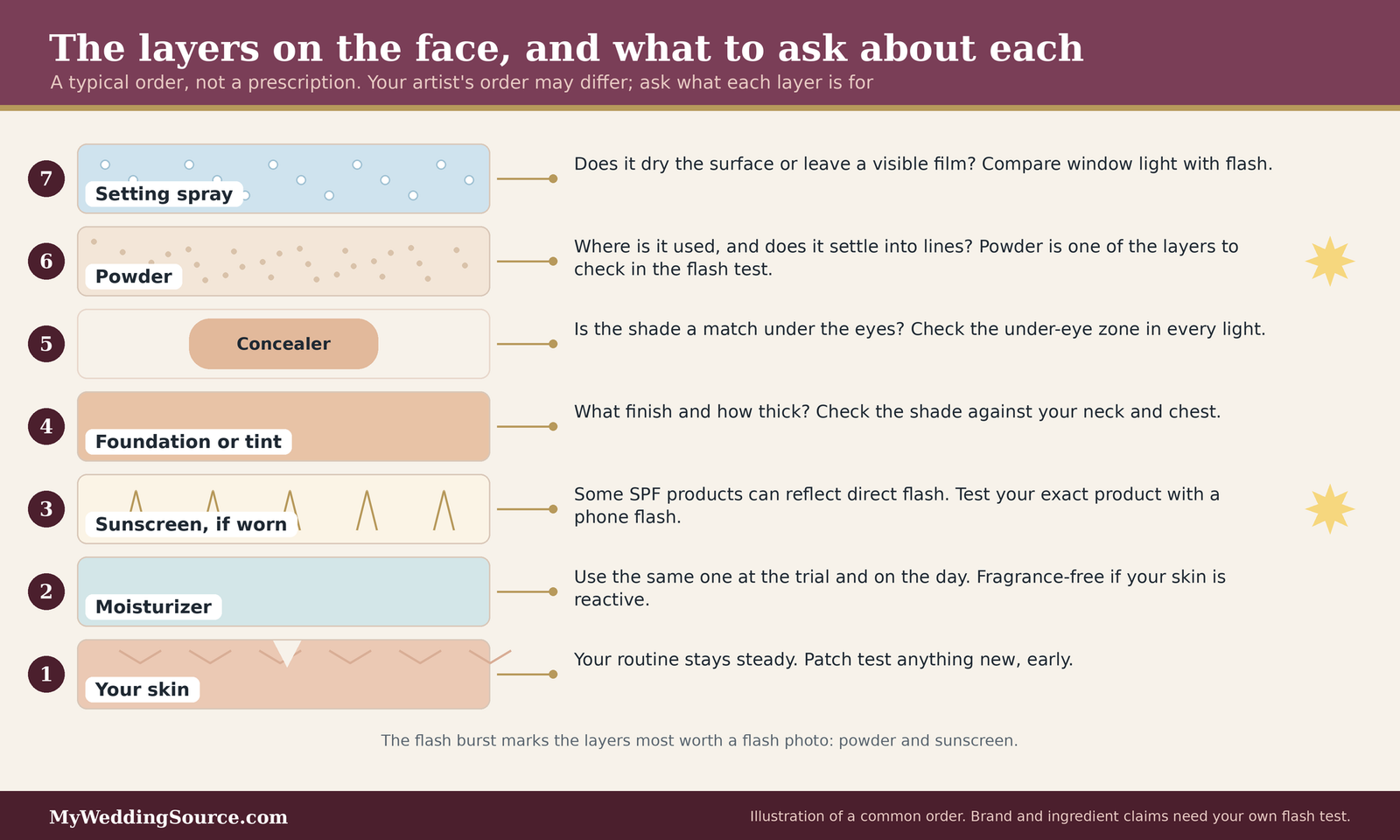
Notice technique and tools
AARP’s beauty editor notes that fingers can be more economical than makeup sponges, because sponges absorb a lot of product, and suggests a damp sponge to press off excess. She also advises applying creams and serums with upward and outward strokes and blending foundation from the center of the face outward. These are editorial opinions, not tested rules. Use them as conversation starters. Ask the artist why they chose a brush, a sponge, or their fingers, and notice whether they work gently on skin that may be thinner.
Watch the lighting in the chair
Salon and studio lighting is often flattering and even. Ask to see your face in a hand mirror by a window, and take your first photos there, not under the artist’s ring light. A look that only works under one light is a look you have not yet tested. Do not feel awkward about this. A confident artist will welcome a window test. Lighting is a major variable in wedding makeup for mature skin.
After the trial: the photo and wear test
The trial in the chair is the beginning. What you learn over the following hours is what helps you decide.
Photograph before you leave and as you go
Before you leave, run the full set of lighting photos from the grid, using the same phone and the same distance. Then photograph again after two hours, four hours, and six hours, if you can, without touching the face. Mark where product has moved, where skin looks dry, and where color has changed. If your wedding day is longer than six hours, add another checkpoint. Our wedding hair makeup schedule guide can help you estimate your real timeline. A full record is the strongest evidence you can collect for wedding makeup for mature skin.
Run the flash check
Apply your foundation, powder, and sunscreen the way you plan to on the day. Take a photo with your phone’s flash on, and then one without it. A Practical Wedding suggests this test: if the flash photo shows what looks like white powder or a ghost, you may have trouble with a photographer who uses direct flash, and if you look normal, you are probably fine. This is a blog’s informal method, not a lab test, but it is cheap and gives you something to bring back to your artist.
Write down what you felt
Notice how the skin felt, not just how it looked. Tightness, itching, stinging, or warmth are signals. The FDA advises stopping a cosmetic if it causes a rash, redness, burning, or other unexpected reaction, contacting a healthcare provider, and reporting the problem. Photographs will not show everything you need to know about comfort over a long day. Comfort belongs in the evaluation of wedding makeup for mature skin.
Products and finishes: what to ask about and what to test
You do not need to know product names to have a useful conversation about wedding makeup for mature skin. You need to know which questions reveal the artist’s thinking and which choices your trial photos can settle. We do not recommend brands, and we found no independent study ranking them for mature skin.
Base and concealer
The base is the layer that most changes how skin reads in a photo. It is also the one where finish, shade, and thickness interact. In wedding makeup for mature skin, the base deserves the most scrutiny.
Finish: matte, satin, and dewy
People often assume that mature skin needs a dewy finish, or that it needs a matte one. Advice conflicts, and both can work or fail depending on the skin. AARP’s beauty editor recommends satin or matte powder for toning down bold lipstick. L’Oréal Paris, a brand, says matte formulas reflect less light than dewy ones, which is a claim about flash photography from a seller of makeup. Instead of picking a finish from advice, photograph two or three finishes in your grid and compare the under-eye and smile-line zones.
Matching shade and undertone
AARP suggests testing foundation on the thin skin between thumb and forefinger, not the back of the hand. Whatever test the artist uses, check the shade in window light and warm light, and compare it to your neck and chest. A shade that matches in the chair can look different in an evening photo. If you have age spots, redness, or a lot of variation in tone, ask how the artist approaches those, and whether the base is meant to even tone or to leave natural variation. L’Oréal Paris notes that a concealer that is too light for your skin adds to a pale cast in flash, again as a brand claim, so check the under-eye shade in the flash test.
Powder, setting, and shine
Powder is the layer most likely to settle, and the layer most likely to reflect a flash. Because skin may be drier, many people want less of it, but some need a little to keep the base in place. Powder choices can make or break wedding makeup for mature skin in photos.
Where powder helps and where it hurts
AARP mentions pressed, loose, blush, or bronzer powders as options for finishing a look and mentions a shimmery powder over lipstick for shine. We did not find evidence that powder suits every mature face, so use your photos. Look at the under-eye and smile-line zones for powder that sits on the surface, and look at the center of the face for places where the base has worn through. Ask the artist whether they use powder everywhere or only where needed.
What can create a pale cast in flash
L’Oréal Paris names zinc oxide and titanium dioxide, which are common in sunscreens and some concealers and foundations, and silica, common in face powders, as ingredients that can reflect flash. A Practical Wedding names titanium dioxide, silica, and talc as possible culprits but did not confirm any of them, and its author suggests simply testing the product. That is the sensible takeaway: ingredient lists are a clue, and a flash test is the answer. If you are thinking of changing your sunscreen for the wedding, ask your clinician first, and tell your photographer what you decide.
Eyes, brows, lips, and cheeks
These features frame the face, and they are where many people want specific advice. The advice below comes from a beauty editor and from FDA safety guidance, so treat the beauty tips as opinions to test. These details finish wedding makeup for mature skin.
Brows first
AARP’s beauty editor advises filling the brows before liner, shadow, and mascara, using a shade one or two steps lighter or darker than your hair, and shaping from the nose toward the outer eye. Brows frame the whole look, and they are a zone to score in every light. If your brows have thinned, or you have changed hair color, tell the artist before the trial so the plan accounts for it.
Eyes, safely
The same article suggests gray or brown liner for a softer look and a beige pencil along the lower waterline to cancel redness. For safety, the FDA advises using products near the eyes only if they are labeled for eye use, not adding saliva or water to mascara, and discarding eye makeup after an eye infection. It also says store testers carry a higher contamination risk and suggests single-use applicators for sampling. Ask your artist how they handle mascara and liner between clients. Our wedding makeup artist sanitation guide goes through this.
Lips and cheeks
The same editor suggests lining and filling lips with a lip-toned pencil to prevent feathering and notes that blush can be pressed off with a damp sponge if it is too strong. Check your lips after eating a bite and drinking water, because the wedding will include both. Photograph the cheeks in window light and flash, since blush color can shift between them.
Reading labels without being misled
Labels tell you some things and not others. A few facts from the FDA keep the conversation grounded. These facts apply to any wedding makeup for mature skin you buy or are offered.
What the FDA says about claims
The FDA says cosmetics are not FDA-approved but are FDA-regulated, and that companies and individuals who market cosmetics have a legal responsibility to ensure their safety. It does not test cosmetics before they are sold, but it monitors their safety. It does not define “hypoallergenic,” “organic,” or “natural,” and it advises not to assume that those labels mean a product is safer. Cosmetics are also not legally required to carry an expiration date, so write the date you open a product on its container.
Fragrance-free and ingredient lists
The AAD recommends fragrance-free products for dry skin and for skin that is irritated, and notes that unscented products can still contain masking chemicals. If you know that fragrance bothers you, ask the artist in advance for fragrance-free options, including for setting sprays and primers, and request ingredient lists for the products you will wear. This is a reasonable request, and an artist who treats it as a nuisance has told you something.
Vendor questions, sanitation, and contract terms
Hiring an artist for wedding makeup for mature skin involves the same business questions as any bridal makeup booking, plus a few that matter more. Our guides to wedding vendor contracts and wedding vendor due diligence cover the general ground, and professional bridal makeup vs DIY helps if you are weighing whether to hire at all.
Questions to ask the artist
The questions that matter most are about approach, evidence, and process. Their answers matter less for the exact products than for how the artist thinks. Use them to compare artists for wedding makeup for mature skin on the same terms.
Questions to ask
- How often do you work with clients of my age or older, and can I see photos, with permission, taken in more than one kind of light?
- Which products would you use on skin that is drier or thinner, and can I have the full ingredient lists?
- How do you prepare skin that feels dry on the morning of the wedding, and what do you need me to do the night before?
- How will we check the look in window light and with flash, and will you do that at the trial?
- Do you use powder everywhere or only where needed, and how do you handle texture around the eyes and mouth?
- How do you clean brushes, sponges, and palettes between clients, and do you use single-use applicators for eye and lip products?
- What is your touch-up plan, who does it, and what does it cost?
- What happens if I react to a product, or if you are ill or running late on the day?
About experience and approach
Ask to see a portfolio that includes people in your age range, and ask for photos taken in natural light, not only edited studio images. Portfolios are curated, so treat them as the best case and ask what a typical result looks like. A good artist should be able to describe a philosophy in plain words, such as “lighter coverage, more skin-prep time, and a flash test,” without being defensive about a request to see evidence. Ask the same of every candidate for wedding makeup for mature skin.
About products and skin
Ask what the artist would change if your skin is drier than usual on the day, and how they handle fine lines around the eyes and mouth. Ask how they handle redness, age spots, or uneven tone, and whether they offer fragrance-free options. Listen for curiosity about your skin, not just a standard routine, and notice whether the artist asks about your sunscreen and moisturizer.
About photography and lighting
Ask whether the artist has worked with your photographer, or with photographers in general, and how they adapt for flash and for outdoor light. Ask whether they test in window light. If the artist dismisses the question, you can still run the grid yourself, but you will know the conversation on the day will be harder.
Sanitation and hygiene
Makeup touches eyes, lips, and skin, so sanitation is a legitimate question and not an insult. Rules for licensed professionals vary by state, so check your state’s licensing board for what applies to makeup services where you live. It belongs on the list for any wedding makeup for mature skin booking.
What state rules look like
We read two examples. Minnesota’s licensing board publishes a guide for salon professionals that says to wash hands with soap and water before any service, to clean and disinfect makeup brushes after use, to treat items like sponges and paper or wood applicators as single-use, and to remove product from containers with disposable or disinfected spatulas and never with fingers. Texas rules for esthetician services require equipment to be cleaned and disinfected after each client, makeup brushes and sponges to be replaced with clean ones for each client, and applicators never to be re-dipped into a product container. These are examples from two states, not a national standard, and they apply to licensees in those states, so ask what your artist follows and what your state requires.
What to look for at the trial
Notice whether the artist washes or sanitizes their hands, uses clean brushes, and dispenses cream or liquid products onto a palette or a clean surface instead of dipping directly. Notice whether mascara and lip products are applied with single-use wands and applicators. The FDA advises not sharing makeup and advises washing hands before applying products. If anything looks careless, you can say so, and you can walk away.
Putting it in writing
Verbal promises about wedding makeup for mature skin disappear on the day. A short written list protects you and the artist.
Terms to confirm
Confirm the trial date and length, the day-of start and end times, whether touch-up service is included and for how long, how many people are included if others are in the chair, the product list or ingredient lists on request, your known sensitivities, the cancellation and illness backup plan, and the price of each. Keep the confirmation with your other vendor contracts. Writing it down makes wedding makeup for mature skin a matter of record.
Where the money goes
We did not find reliable, current price data for trials, day-of makeup, or touch-up service for mature skin, so we do not quote typical fees. Prices vary by region, by artist, and by how many people are in the chair. Treat these as separate lines to ask about: the trial, a second trial if the first does not pass your grid, the day-of application, additional people, a touch-up visit or an extended stay, travel, and any products you buy. Compare artists on the same list and add the total to your budget. Our guides to wedding hair and makeup cost and the wedding budget show where these costs fit. Our home grid costs only your time.
Coordinating with other vendors
If your photographer has requirements, such as avoiding certain finishes or needing a flash test, tell your artist, and ask the artist to coordinate on timing. Our wedding vendor timeline guide explains how to sequence vendors on the day.
Edge cases: when the plan for wedding makeup for mature skin needs to change
A plan works until conditions change. These are the situations where the standard approach is stressed, and what to do about each. None of this is medical advice, and a clinician is the right person for any skin concern. Wedding makeup for mature skin is no exception.
Skin conditions and sensitivities
Wedding makeup for mature skin should account for sensitivity. Skin that is thinner, drier, or more reactive needs a little more caution, not a different goal. The principle is the same as everywhere else in this guide: test early, change little, and write things down.
Dryness, flaking, and thinner skin
The AAD describes dry, itchy skin as common in the sixties and seventies because skin gets thinner and loses water more easily. If your skin flakes or feels tight, tell the artist, ask what prep they suggest, and test it at the trial. Do not start a strong new treatment to fix dryness in the final weeks, since the AAD advises checking with a dermatologist before exfoliating thinner skin. If you bruise easily, mention it, and ask the artist to use a gentle touch around the eyes.
Redness, rosacea, and easy flushing
The AAD says changes in skin can make it more reactive around menopause, and it names rosacea among the conditions to see a dermatologist about if they worsen. If you flush easily, score the cheeks and nose zones closely in each light, and ask how the artist approaches redness. AARP suggests a foundation, beauty balm, or BB/CC cream over the nose area, where redness shows most, and a beige pencil on the lower waterline to cancel redness around the eyes. Treat those as options to test, not rules.
Allergies and the patch test
Patch testing is the simplest safeguard against a reaction on the day. Healthline, a consumer health site, describes a home test that uses a small amount of the product on a spot where it will not be rubbed off, such as the inner forearm, or behind the ear for face products, applied twice daily for about 7 to 10 days while watching for itching, burning, redness, swelling, or a rash. It also notes that a home test cannot rule out every reaction, and that people with eczema, rosacea, or sensitive skin still need to test new products. The FDA advises stopping a product that causes a reaction and contacting a healthcare provider. If you are prone to reactions, ask your clinician whether an in-office patch test is worth doing early.
Spots, lids, and features people ask about
Many people have specific features they worry about. The honest answer to most of them is the same: describe the feature, test the approach, and let the photos decide. Wedding makeup for mature skin is easiest to plan when each concern is named.
Age spots and uneven tone
Harvard Health Publishing describes age spots as flat brown, black, or gray spots on sun-exposed skin that are usually harmless, and it notes that options such as topical products, peels, or lasers are cosmetic choices. It also says spots with an irregular shape, color, or size should be evaluated. If a spot is new, changing, itchy, or bleeding, see a dermatologist before the wedding, not after. If you choose to cover spots, ask the artist whether the goal is full coverage or evening the tone, and check the result in side light.
Hooded, crepey, or creased eyelids
Eyeshadow can behave differently on lids that fold or crease. AARP suggests a soft medium-shade crease above the natural one to lift hooded lids, which is editorial advice you can test. Photograph with your eyes open and relaxed, and then with a natural smile, because a smile changes how the lid sits. Score the under-eye and lid zone in every light, and ask the artist what changes if the look creases by the second half of the day.
Under-eye shadows and puffiness
Harvard Health Publishing describes under-eye darkening, puffiness, and swelling as linked to factors such as weakened tissues, lack of sleep, genetics, or fluid retention, and lists cold compresses and sleeping with your head slightly raised among suggested steps. Whether to cover shadows, brighten them, or leave them is a style decision, and the flash test shows what each choice does. Remember that a concealer that is too light can add to a pale cast in flash.
Day-of conditions
The best-tested look can still be stressed by the day itself. Plan for the conditions you can predict. Wedding makeup for mature skin has to survive the day, not just the trial.
Heat, humidity, and outdoor settings
Warm rooms, long outdoor ceremonies, and sweat change how makeup wears. Even skin that tends to be dry can look different when warm. Photograph a test look after fifteen minutes of walking in a warm room, which is our own suggestion and not a measured protocol. Our summer wedding heat plan and guide to the wedding emergency kit cover the practical side. Heat is one of the main stresses on wedding makeup for mature skin.
Glasses, jewelry, and veils
If you wear glasses, photograph the trial look with them on, since frames and lenses can hide the under-eye area or reflect light, and check whether a lens glare affects the eye makeup. If you wear a veil, hat, or hair piece, put it on and see what touches your face. Look for transfer on a collar or neckline. Our wedding hairstyles guide covers how hair choices change what the camera sees.
Video and close-up cameras
If the wedding is filmed, motion adds a new test. Walk, turn, laugh, and talk on camera at the trial, and look at how the base moves in video, not only in stills. Ask your photographer or videographer whether they use bright on-camera lights, which can reveal texture differently. Our wedding photography guide covers the broader plan. Moving images test wedding makeup for mature skin differently than stills.
When more than one person is in the chair
Many weddings include several people who want makeup for mature skin: the couple, parents, grandparents, and attendants. The plan for the person with the oldest skin may differ from the plan for the youngest, and that is normal.
Mothers, grandmothers, and honored guests
The mother of the bride or groom, a grandmother, or another honored guest may want the same careful trial, and may feel shy about asking for one. Offer it, and put it in the booking. Our guide to mother of the bride dresses covers the wardrobe side. Share the grid with them, so they can score their own photos, and make sure the artist knows about any sensitivities before the day.
Vow renewals, second weddings, and small ceremonies
A vow renewal, a second wedding, or a small ceremony may have less structure than a large wedding, but the same photographs will be treasured for years. Smaller events can make it easier to run a proper trial, since the schedule is less tight. The grid works the same way, and you can adapt it to the lighting you expect, such as a backyard, a courthouse, or a restaurant.
Coordinating with your photographer and the day
Your photographer sees your face at close range for hours, so their input is as relevant as the artist’s. A short conversation can prevent a disappointment. A short conversation can protect wedding makeup for mature skin from surprises.
Talking to your photographer
Photographers vary in how they light and edit, so ask instead of assuming.
Lighting and flash plans
Ask whether the photographer expects to use flash, bounced or direct, at the ceremony, portraits, and reception, and whether you can see sample images from a similar venue. A Practical Wedding says photographers usually use bounced flash, which caused only minor issues in its author’s informal test, and recommends asking. Our wedding photographer shot list guide and the guide to candid wedding photography explain how those shots are planned.
Retouching expectations
Ask what retouching is included and what is available on request, and be clear about what you would like left alone. Our guide to wedding photo retouching requests explains how to ask. It is reasonable to want natural texture preserved, and equally reasonable to want a distracting blemish removed. The point is to decide before the album.
Building the day
Makeup is one item on a crowded morning. A realistic plan gives it room. Wedding makeup for mature skin needs a realistic slot in that morning.
Time, order, and who goes first
Ask the artist how long each person needs, and build the schedule backward from the first photographs. Put the person with the most intricate look first, and leave slack in case something needs adjusting. Our wedding vendor timeline guide and our guide to bridal hair and makeup planning help with the order.
Touch-ups, kits, and who helps
Decide before the day who handles touch-ups, and what goes in the kit. Our bridal makeup touch-up kits guide covers the contents. Whoever helps should wash their hands, use clean applicators, and not share eye products, in line with the FDA’s advice against sharing makeup. For skin that tends to dryness, a fresh trial of the touch-up routine at the same time as the grid saves surprises. A small kit supports wedding makeup for mature skin after the artist leaves.
FAQ: wedding makeup for mature skin
Short answers to common questions about wedding makeup for mature skin. They are general information and not medical advice.
Products and finishes
What kind of foundation is best for mature skin at a wedding?
There is no single best foundation. Advice about matte, satin, and dewy finishes conflicts, and none comes from an independent study. Photograph two or three finishes in window light and flash, score the under-eye and smile-line zones, and keep the one that looks like you. Ask the artist to explain each layer they use.
Should I wear sunscreen on my wedding day?
Dermatology sources, including the AAD and Mayo Clinic, advise daily broad-spectrum sunscreen of SPF 30 or higher. Some wedding sources note SPF can reflect direct flash, so test your exact products with your phone flash and ask your photographer about flash. Ask a dermatologist what suits your skin and the setting.
Will powder make my skin look older?
It can for some people and not for others. Powder may settle into fine lines or reflect flash, according to brand and blog sources, but none of this is proven for every face. Ask the artist to use it only where needed, and check the under-eye and smile-line zones in window light before deciding.
Trial and testing
How many trials do I need?
One full trial is common, and a second can be worth it if the first fails your grid. Ask what a second trial costs before you book. Run your own photo checks at several hours after each trial. Keep any changes small, and avoid introducing new skin products in the final weeks.
What is the flash test?
Apply your base, powder, and any sunscreen as you will on the day, then take a phone photo with flash and one without. A Practical Wedding describes this informal test. If the flash photo looks pale or powdery, tell your artist and photographer. It is not a laboratory test, but it is quick and free.
How do I patch test a new product?
Healthline describes testing a small amount on a spot such as the inner forearm, or behind the ear for face products, twice daily for about 7 to 10 days. Stop and wash it off at any itching, burning, redness, or swelling. A home test cannot rule out every reaction, so ask your clinician if you are prone to reactions.
Safety and planning
What should I ask about hygiene?
Ask how brushes, sponges, and palettes are cleaned between clients, whether eye and lip products use single-use applicators, and whether the artist washes hands before starting. The FDA advises against sharing makeup and warns that testers carry a higher contamination risk. State rules vary, so ask what your artist follows.
What if my skin reacts on the wedding day?
Stop using the product and wash it off gently. The FDA advises contacting a healthcare provider for a rash, redness, burning, or other unexpected reaction, and reporting the problem to the FDA. Tell your artist so they can change the plan. If a reaction is severe or includes trouble breathing, seek emergency care.
Your next steps
Build your evidence
Run the grid at your trial
Photograph the finished look in window light, ceiling light, warm light, flash, and outdoors, score each of the seven zones for texture, color, and wear, and write your pass rule first. Our wedding makeup and airbrush versus traditional bridal makeup guides help you decide which looks to compare.
Test new products early
Patch test anything new, and do not change your skin routine in the last weeks. Add the dates to your wedding planning checklist and the wedding beauty timeline.
Lock in the details
Put terms in writing
Ask the artist to confirm trial and day-of times, products, touch-up service, sanitation practices, and backup plan, and compare others on the same list. Keep the confirmations with your vendor contracts.
Brief your photographer and helpers
Share your flash results with your photographer, write a short touch-up card for your helper, and rehearse the touch-up once before the wedding.
Sources & methodology
How we built this guide
What we relied on
This guide to wedding makeup for mature skin combines U.S. Food and Drug Administration consumer pages on cosmetic safety and eye cosmetics, dermatology and health guidance on aging skin from the American Academy of Dermatology, Mayo Clinic, and Harvard Health Publishing, and two state licensing-board documents (Minnesota and Texas) as examples of sanitation rules. We also read editorial and brand pages (AARP, A Practical Wedding, and L’Oréal Paris) and we identify their claims as editorial opinion or brand claims wherever we mention them. The lighting observations, the evaluation grid, the scoring rule, and the sample tests are our own suggestions. They are not clinical protocols and they have not been tested. We checked the sources on November 12, 2026, and product guidance and rules can change.
What we did not do
We did not test products, evaluate individual brands, or give medical advice. Skin varies from person to person, and so do reactions. We did not find reliable current pricing, so we do not quote fees, and we did not find an authoritative source that quantifies how lighting changes the look of makeup on mature skin. Ask your artist for ingredient lists and written terms, and see a dermatologist or other clinician about persistent skin concerns, changing spots, or reactions.
Source list
Government and regulatory sources
- U.S. Food and Drug Administration, Cosmetics overview: https://www.fda.gov/cosmetics
- U.S. Food and Drug Administration, Using cosmetics safely: https://www.fda.gov/cosmetics/consumers/using-cosmetics-safely
- U.S. Food and Drug Administration, Eye cosmetic safety: https://www.fda.gov/cosmetics/cosmetic-products/eye-cosmetic-safety
- U.S. Food and Drug Administration, Cosmetics tips for women: https://www.fda.gov/consumers/womens-health-topics/cosmetics-tips-women
- Minnesota licensing board, Stay Clean. Stay Safe. (guide for salon professionals): https://mn.gov/boards/assets/Stay%20Clean%20Stay%20Safe_tcm21-432901.pdf
- Texas Administrative Code, 16 TAC 83.104, Health and safety standards for esthetician services: https://regulations.justia.com/states/texas/title-16/part-4/chapter-83/section-83-104
Dermatology and health sources
- American Academy of Dermatology, Skin care in your 40s and 50s: https://www.aad.org/skin-care-basics/skin-care-in-your-40s-and-50s
- American Academy of Dermatology, Skin care in your 60s and 70s: https://www.aad.org/skin-care-basics/skin-care-in-your-60s-and-70s
- American Academy of Dermatology, Skin care during menopause: https://aad.org/public/everyday-care/skin-care-secrets/anti-aging/skin-care-during-menopause
- Mayo Clinic, Skin care: 5 tips for healthy skin: https://www.mayoclinic.org/healthy-lifestyle/adult-health/in-depth/skin-care/art-20048237
- Harvard Health Publishing, Skin care for aging skin: minimizing age spots, wrinkles, and undereye bags: https://www.harvardhealth.org/healthy-aging-and-longevity/skin-care-for-aging-skin-minimizing-age-spots-wrinkles-and-undereye-bags
- Healthline, How to patch test skin products: https://www.healthline.com/health/self-skin-patch-test
Editorial and brand sources
- AARP, Makeup tips for older women: https://www.aarp.org/entertainment/beauty-style/makeup-tips-older-women/
- A Practical Wedding, SPF flashback: https://apracticalwedding.com/spf-flashback/
- L’Oréal Paris, How to prevent makeup flashback in photos (brand site): https://www.lorealparisusa.com/beauty-magazine/makeup/makeup-looks/prevent-makeup-flashback.aspx