
A wedding ceremony script is the written version of the most important twenty minutes of your day: every word the officiant says, every promise you make and every cue that tells your guests what is happening and why.
Quick answer
A good wedding ceremony script follows nine beats in a fixed order: welcome, optional remembrance, reading, the officiant’s address, vows, declaration of intent, rings, pronouncement and kiss. Most ceremonies run 15 to 30 minutes, and The Knot notes that the declaration of intent is the only part that is legally necessary, so the rest is yours to shape. Pick your tone first, choose a template that matches it, personalize three or four moments (usually the address, the vows and one reading) and keep the legal language your officiant needs. Start drafting about three to four months out so there is time for two or three revision sessions.
Most couples spend months choosing flowers and a few frantic evenings on the one document guests will actually remember. The wedding ceremony script gets less attention than the dress, the menu or the playlist, yet it decides whether the ceremony feels like a warm, specific moment between two people or a stock speech that could have been read at any wedding on any Saturday.
This guide gives you everything you need to write one. You will find the structure of a ceremony explained beat by beat, the legal elements you must not cut, the differences between religious, secular, interfaith and light-hearted tones, complete fill-in templates with original wording you can adapt, vow and ring-exchange options, a step-by-step method for writing your own, a timeline, and a rehearsal plan. If you are still choosing who will lead the ceremony, our guides to choosing a wedding officiant and wedding officiant requirements are good companions to this one.
The article is written for couples marrying in the United States, so the legal notes reflect U.S. practice, but the structure and the wording options work almost anywhere. Nothing here replaces the advice of your officiant, your clergy or the clerk who issues your license, and where a rule varies by state or tradition we say so.
What a wedding ceremony script actually is
A wedding ceremony script is the full text and sequence of the ceremony, written down. At minimum it lists what happens and in what order. At its most complete it contains every sentence the officiant will speak, the exact wording of vows and the ring exchange, the names of readers, the music cues, and notes for the people who need to stand, sit or move at a given moment.
It helps to separate three things that people often blur together:
- The outline. A list of the parts of the ceremony in order, such as welcome, reading, vows, rings, pronouncement. This is what most printed programs show.
- The script. The words themselves, written out for the officiant and for anyone with a speaking role.
- The run sheet. The practical layer: who walks when, who hands the rings over, which song starts, when the microphone is switched on. It is usually a one-page cue sheet kept with the script.
A strong wedding ceremony script has all three, even if they live in one document. The outline keeps the ceremony balanced, the script keeps it personal, and the run sheet keeps it calm on the day.
Who writes the script
There is no single rule, and the right answer depends on your officiant and your tradition.
If you are marrying in a religious tradition, the wedding ceremony script usually starts from the order of service the denomination provides, and your clergy member adapts it with you. The Greenvelope team notes that many denominations already have a script written out, so a religious couple often starts from a fixed text and personalizes the margins: readings, music, a short homily about you as a couple, and sometimes vows.
If you are using a civil officiant, a friend who was ordained online or a professional celebrant, the usual pattern is collaboration. The officiant brings a skeleton and sample language, you bring the stories, values and preferences, and together you shape a draft. Zola describes the couple as writing their own vows and personal elements while the officiant offers an outline and helps finish the script.
If you are officiating for a friend, the script is your job, and it is worth reading our guide to wedding officiant cost and what you are paying for to understand what professionals bring to a ceremony and what you will need to replace with preparation.
Whoever holds the pen, the couple should always make the final call. An officiant can draft a lovely wedding ceremony script about two people they barely know, but only the couple can say whether the joke lands, whether a story is private and whether a phrase sounds like something they would actually say.
Why a written script is worth the effort
Couples sometimes ask whether they can simply let the officiant “wing it.” A good officiant can, but there are four reasons a written wedding ceremony script is safer than improvising.
First, it protects the legal moments. The words that make the marriage valid are short, and they are easy to lose in an improvised speech. Second, it protects time. A ceremony with no written structure tends to run long, and guests in outdoor settings or in heat or cold feel every extra minute. Third, it protects the people with small roles. A reader who knows exactly when to step up and how long the passage is will do a better job than one who is guessing. Fourth, it gives you a document to hand to your photographer, videographer, musician and day-of coordinator, which means everyone is working from the same plan.
The structure of a wedding ceremony script, beat by beat
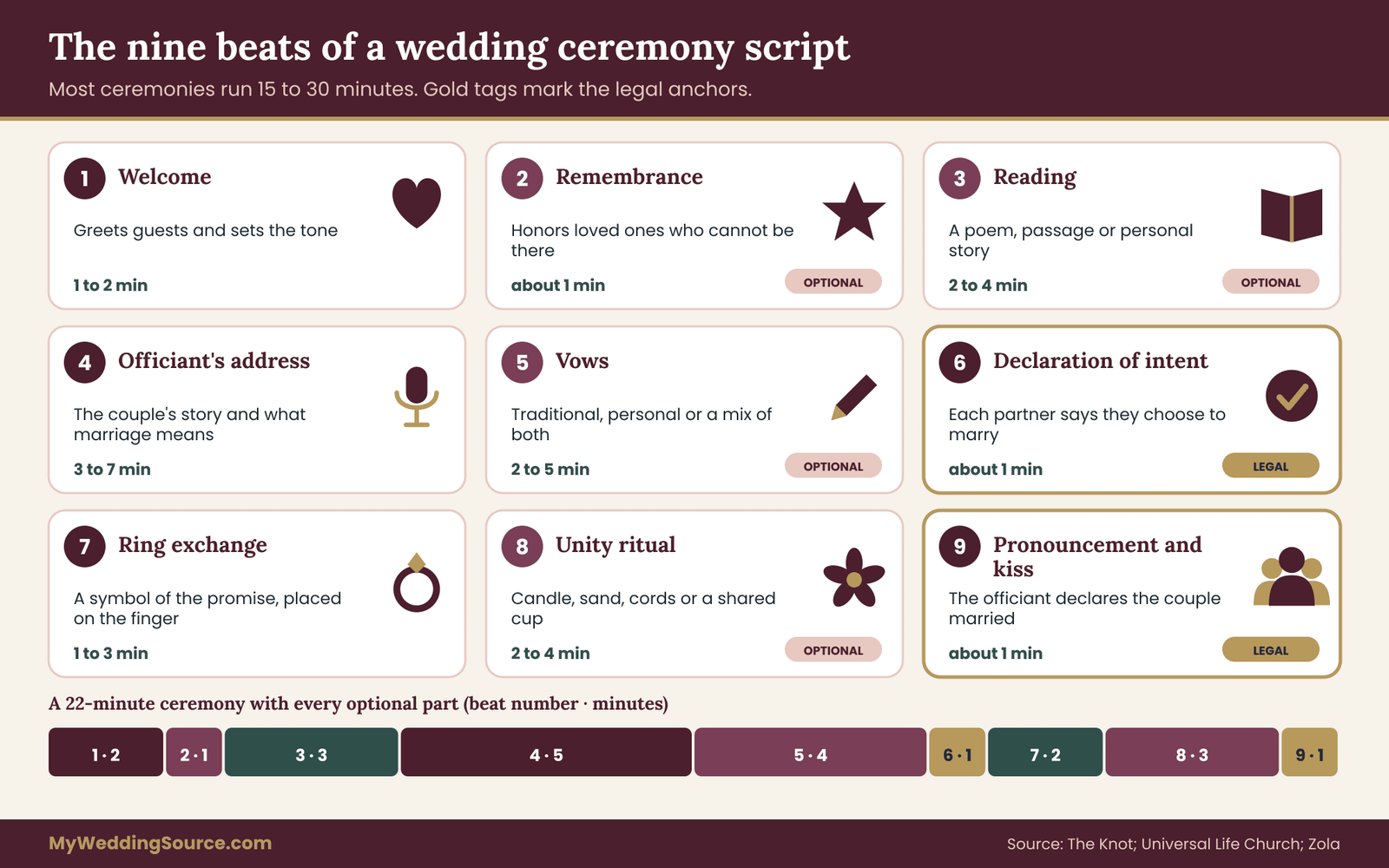
Almost every ceremony in the world, religious or secular, big or small, follows a recognizable arc: people gather, a leader frames what is about to happen, the couple makes promises, those promises are sealed with a symbol, and the leader announces the result. The Knot’s guide to ceremony scripts lists nine parts in order, and the Universal Life Church’s script library uses a similar sequence with a family blessing and a presentation of the couple at the ends. The version below combines these and adds timing so you can see how the minutes add up.
Beat one: the welcome (about 1 to 2 minutes)
The officiant greets the guests, says who is getting married and sets the tone. In a religious ceremony this may include a welcoming prayer. In a secular ceremony it is often a short, warm statement of why everyone has gathered. This is also the moment to give any housekeeping that guests need, such as a gentle request to put phones away, which our guide to the unplugged wedding ceremony covers in detail.
A good welcome is short. Guests are settled but still adjusting after the processional, and a long opening speech spends their attention before the meaningful parts begin. If you want to say something about the people who traveled or helped, a sentence is enough here; you can say more at the reception.
Beat two: remembrance and blessings (optional, about 1 minute)
Many couples acknowledge relatives who have died, or parents who are not present, or a family blessing that ties the two sides together. The Knot lists remembrances as an optional second part of the script. Keep it brief and sincere. A single sentence naming the people being remembered, followed by a moment of quiet, is usually more powerful than a longer tribute.
Beat three: readings or personal stories (optional, 2 to 4 minutes)
A reading is a poem, passage of scripture, excerpt from a book, or a short piece the couple or a friend has written. A personal story is a short account of how you met or what you have learned together. Both are optional in a civil ceremony, and some religions require readings, such as the Liturgy of the Word in a Catholic Mass.
Choose readers who are comfortable speaking in public and who will not be overwhelmed by emotion at the microphone. Give them the text in a large font a week early and tell them the length. A passage that takes two minutes to read feels twice as long to a nervous reader and half as long to a guest who is moved by it.
Beat four: the officiant’s address (3 to 7 minutes)
This is the heart of the script for many couples, and the part where a template is most obviously generic. The address is where the officiant says something true about marriage and something specific about you. It can be spiritual, philosophical, humorous or a mix.
A reliable structure for the address has three short movements. The first is a story or two about the couple, ideally from the couple themselves rather than guessed by the officiant. The second is a reflection on what the stories show about the relationship, for example that you both treat small chores as shared adventures or that you apologize quickly. The third is a turn toward the future, introducing the vows as the next chapter. If you want ideas for the middle movement, the section on how to write your own wedding ceremony script below has prompts.
Beat five: the vows (2 to 5 minutes)
The vows are the promises the couple makes to each other. They can be traditional words, repeat-after-me phrases, personal vows read aloud, or a combination. Because vows are the emotional center of the ceremony, we give them their own section below, including three templates and a decision guide. Our separate guide to writing your wedding vows goes further into drafting and delivery.
Beat six: the declaration of intent (about 1 minute)
The declaration of intent is the officiant’s question, answered by each partner, confirming that they freely choose to marry. It is the classic “Do you take…” moment, and the answer is usually a simple “I do” or “I will.” The Knot quotes officiant Tanya Pushkine calling it the only legal portion necessary, and the Universal Life Church lists it as required legal language alongside the pronouncement.
Some scripts place the declaration before the vows, others after. Either order is legally fine in most places, but check with your officiant or local authority because wording and placement requirements differ by jurisdiction.
Beat seven: the ring exchange (1 to 3 minutes)
The rings are the visible symbol of the promise. The officiant usually says a sentence about what the rings represent, then the couple places the rings on each other’s fingers, sometimes repeating a short phrase. Culturally specific ceremonies may add a blessing here, such as a Jewish blessing over wine before the exchange.
Beat eight: the unity ritual (optional, 2 to 4 minutes)
A unity ritual makes the joining of two lives visible. Candle lighting, sand pouring, hand-fasting, wine blending, tree planting and a family medallion ceremony are all common. The Knot’s advice is that the officiant should explain the ritual to guests, because symbols that are obvious to the couple are often opaque to everyone else. Our guide to unity ceremony ideas has more than a dozen options with practical notes about wind, fire rules and time.
Beat nine: the pronouncement and kiss (about 1 minute)
The officiant declares the couple married and invites them to kiss. This is the second legal anchor in most scripts. Religious traditions may add a closing blessing, a final prayer or, in Jewish weddings, the breaking of a glass. A presentation of the couple to the guests follows, and the recessional begins.
Add the nine beats up and you get roughly 15 to 30 minutes depending on how many optional parts you include. That matches The Knot’s note that ceremonies usually run 15 to 30 minutes, and Universal Life Church’s observation that the median ceremony is about 20 minutes. Zola cautions that more than 30 minutes can test guests’ patience, and a well-rehearsed script can say what it needs to in under 15.
The legal essentials your wedding ceremony script must keep
The most common mistake in a customized wedding ceremony script is cutting a sentence that turned out to be legally important. The good news is that the legal core of a wedding ceremony script is small.
What is usually required
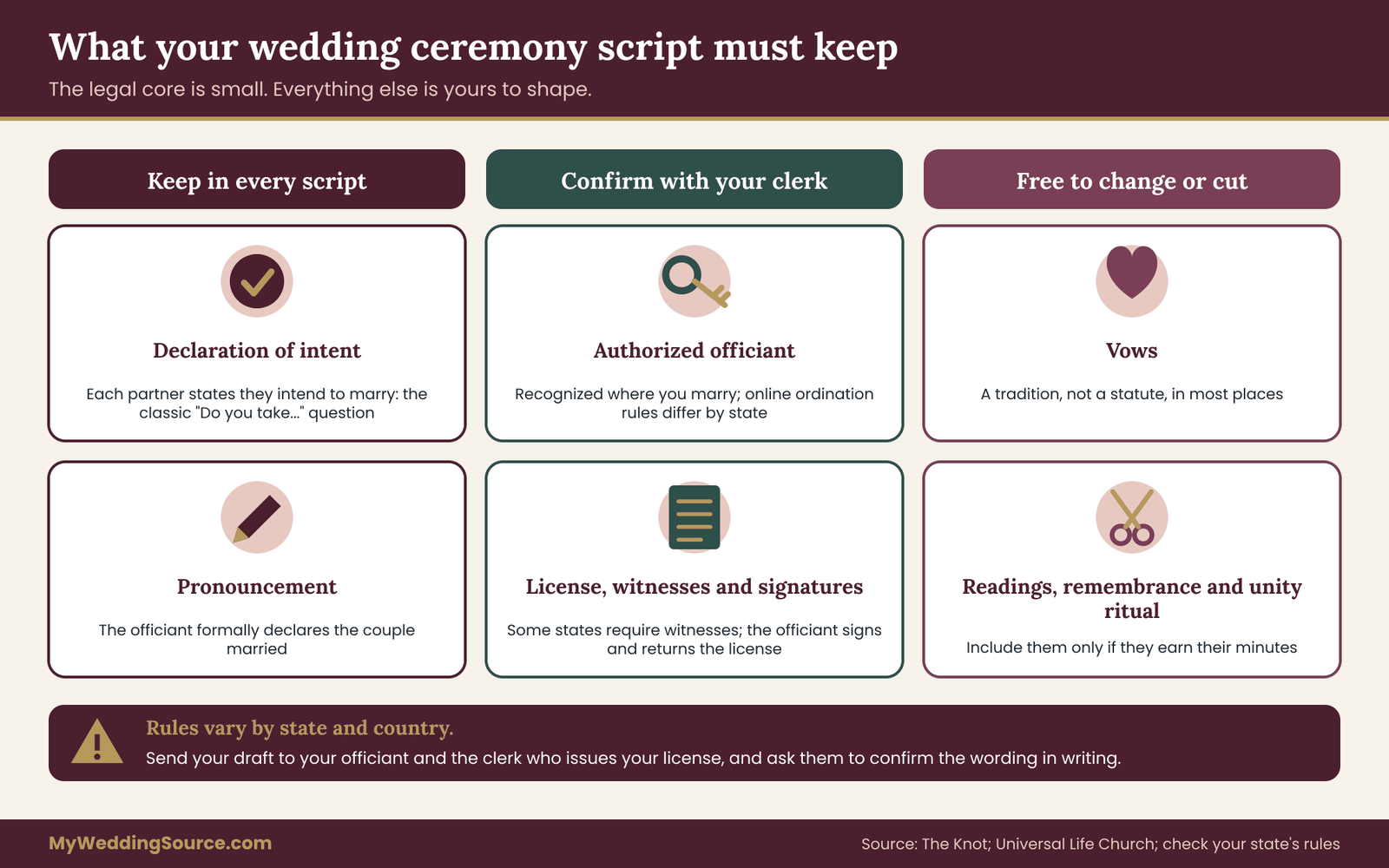
Requirements vary by state and by country, so treat this as orientation rather than legal advice. In most U.S. jurisdictions, a marriage ceremony needs the following.
A valid license. Before the ceremony, the couple obtains a marriage license from the appropriate clerk. Rules about waiting periods, expiry dates and identification vary, and our guides on how to get a marriage license and the difference between a marriage license and a marriage certificate explain the sequence.
An authorized officiant. The person who solemnizes the marriage must be authorized under the law of the place where the wedding happens. Some states recognize online ordinations, some require registration, and some treat a one-day designation differently. Read our wedding officiant requirements guide before you lock in a friend, and confirm with the issuing clerk.
A declaration of intent. Each partner states, in answer to a question or in their own words, that they intend to marry the other person. This is the part The Knot and the Universal Life Church both flag as essential.
A pronouncement. The officiant formally declares the couple married. The Universal Life Church’s example includes a reference to the authority vested in the officiant.
Witnesses and signatures. Some states require one or two witnesses to sign the license, and the officiant must usually sign and return the license for recording. The script rarely needs special wording for this, but your run sheet should name the witnesses and the moment when the license will be signed.
What is almost always optional
Everything else is up to you: the processional music, readings, remembrance, unity ritual, even the vows. Many couples are surprised to learn that vows are not required by law in most places, so a wedding ceremony script can be legally complete without them. It is tradition, not a statute. This means you can shorten or remove personal vows if public speaking is hard for either of you and still be legally married as long as the declaration of intent and pronouncement are in the script.
The Knot also notes that couples who prefer not to share personal vows publicly can exchange them privately, either before the ceremony or on their own. If one of you is shy and the other is not, a private vow exchange during the “first look” or the morning of the wedding can solve the problem without making the public ceremony feel thin.
A short legal checklist for your officiant
Send your draft to the officiant with these questions and ask them to confirm each point in writing.
- Does this script include the legally required declaration of intent and pronouncement for our location?
- Are you authorized to solemnize a marriage in this state and county, and what proof does the clerk need?
- Who must sign the license, and how many witnesses are required?
- Who returns the license, and by when?
- Is there any wording the clerk or the state requires that we have not included?
If you are being married by clergy, ask the same questions plus whether your religion requires specific wording, paperwork or premarital preparation that affects the script.
Choosing the tone before you choose the words
Couples often start with templates and discover halfway through that the template feels wrong. A faster path is to decide the tone first. The Knot suggests asking questions about length, vows, tone, other participants, privacy and religion or culture before the script is drafted, because the answers shape everything else. We have turned those questions into a short tone decision below.
Five tones that work
Traditional religious. Uses the language and order of a specific faith. Expect scripture, prayer, a homily or sermon and formal vows. Length is often longer, and Catholic and Indian ceremonies tend to follow more structured outlines, as The Knot points out. Your clergy member will lead the structure, and your role is to choose readings and music within it.
Traditional but not religious. Keeps the familiar words and ritual shape without scripture. “Dearly beloved” language, “to have and to hold” vows and a formal pronouncement are common. This tone works well for couples who want ceremony without a specific faith.
Modern secular. Replaces scripture with poetry, personal stories and original vows. The address focuses on the couple’s story and shared values. This is the most flexible tone and the one most people mean when they say “personalized ceremony.” The third template below is built for it.
Interfaith or intercultural. Blends rituals from two or more traditions. The skill here is explanation: guests may know one tradition well and the other not at all, so the officiant should briefly explain each element. A short program note helps; see our guide to wedding programs.
Light-hearted. Prioritizes warmth and humor, with funny stories, playful vows and a relaxed officiant. It still needs the same legal and structural backbone, and the humor should be affectionate rather than at either partner’s expense.
How to decide
Sit down together and each answer these five questions separately, then compare.
- If a guest described our ceremony in one word afterward, which word would we most want them to use?
- Which two parts do we most want to be remembered, and which two are we doing out of obligation?
- Are there family members or traditions we need to honor, and how much space do they need?
- How long can our guests comfortably sit or stand in the setting we have chosen, given weather, heat and age?
- What do we absolutely not want, such as a long sermon, jokes about exes or a reading that feels like it belongs to someone else?
The overlap between your answers is the tone. The disagreements are the conversations to have with your officiant, who can often suggest a compromise, such as a short religious blessing followed by personal vows. ## How long should a wedding ceremony script be?
Length is the quiet variable in every wedding ceremony script and shapes every other choice. Before you pick a template, decide how many minutes you are aiming for, because a wedding ceremony script that suits a 10-minute elopement will feel hollow at a church wedding with 150 guests, and the reverse is just as true.

Published guidance clusters in a narrow band. The Knot says ceremonies usually run 15 to 30 minutes, with Catholic and Indian weddings running longer. The Universal Life Church puts the median at about 20 minutes and offers a handy rule of thumb: each page of script takes roughly a minute and a half to two minutes to deliver, which means a typical script is thirteen or fourteen pages. Zola suggests that anything over 30 minutes risks losing guests and that a well-rehearsed script can say what matters in under 15.
Use those numbers as a budget for your wedding ceremony script. If you want a 20-minute ceremony, you have roughly 20 minutes to spend, and every optional element costs some of it. A reading is two to four minutes. A unity ritual is two to four. A personal story from the officiant is two to three. Adding all three to a core of welcome, vows, rings and pronouncement takes you from about twelve minutes to about twenty-one.
Match length to the setting
A few practical conditions change how long guests can comfortably listen.
- Heat, cold and wind. An outdoor ceremony at midday in summer needs a shorter script or shade and water. Our guide to wedding ceremony wind limits covers the conditions that make a long outdoor ceremony risky.
- Standing guests. If anyone will stand, keep it under 15 minutes. Our guide to seating guests who cannot stand for long periods helps you plan around this.
- Children. A group with several small children will tolerate 12 to 15 minutes at most.
- Venue time limits. Some venues book ceremony slots tightly. Ask whether your slot includes the processional and photos, not just the vows.
- Sound. If guests cannot hear, they stop listening. Our guide to wireless wedding ceremony audio explains how to avoid the common failures.
Template one: a wedding ceremony script for a modern 20-minute ceremony
This is a flexible, secular-friendly script that follows the nine beats described above. Replace the bracketed text with your own details, and cut any part that does not feel like you. All wording here is original and free to adapt for your own ceremony.
1. Welcome
Good afternoon, everyone, and welcome. We are here today to celebrate the marriage of [Partner A] and [Partner B]. Thank you for the journeys you made, whether it was across town or across the world, to be part of this moment. Your presence matters to them more than they could say, and in a few minutes they will try anyway.
Before we begin, [Partner A] and [Partner B] have asked me to say that this is a day for being fully present, so if you can, please put your phones away and enjoy what is in front of you. [Photographer’s name] has everything covered.
2. Remembrance (optional)
Today is full of joy, and it is also a day when we feel the absence of the people we wish could be here. [Partner A] and [Partner B] hold [names] in their hearts, and we will take a quiet moment to hold them in ours too.
(Pause for five to ten seconds.)
3. Reading (optional)
To open our ceremony, [Reader’s name], who has known [Partner A] since [year or place], will share a reading the couple chose because [one-sentence reason].
(Reader delivers a one- to two-minute piece.)
4. The address
[Partner A] and [Partner B], when you first met, [short true detail from their story]. It was not dramatic or cinematic. It was ordinary in the best way, which is how the most lasting things often begin.
Since then, the people who know you have noticed a few things. [Partner A], you [specific trait], and [Partner B], you [specific trait]. You make each other braver and funnier, and you make each other better at the daily work of being a person, which is what a good marriage is for.
Marriage is not one big promise made on a sunny afternoon. It is thousands of small ones kept on tired Tuesdays. It is saying “I’m sorry” first, and “thank you” often, and “I’ll do it” when the dishes are piling up. It is choosing each other again on the days when it feels less like a feeling and more like a decision. [Partner A] and [Partner B], you already know this. You have been practicing for [length of relationship], and today you make it official.
5. Introduction to the vows
[Partner A] and [Partner B] have written promises to each other. They are about to say them out loud, which is a brave thing to do in front of everyone they love. [Partner A], please begin.
(Vows are read. See the vow templates below.)
6. Declaration of intent
[Partner A], do you take [Partner B] to be your spouse, to love and cherish, to support and respect, in good times and in difficult ones, for as long as you both shall live?
(Partner A: “I do.”)
[Partner B], do you take [Partner A] to be your spouse, to love and cherish, to support and respect, in good times and in difficult ones, for as long as you both shall live?
(Partner B: “I do.”)
7. Ring exchange
Rings are one of the oldest symbols we have, and one of the simplest. A circle has no beginning and no end. These rings will sit on your hands through everything that is still to come: signing contracts, washing dishes, holding babies, holding hands in waiting rooms. May they remind you of this day and of the promise you are making in it.
[Partner A], please place the ring on [Partner B]’s finger and repeat after me: “[Partner B], I give you this ring as a sign of my love and my promise.”
(Repeat for Partner B.)
8. Unity ritual (optional)
[Short explanation of the ritual and why it was chosen. For example: “Each of you holds a candle lit by a family member. Together, you will light one larger flame, which stands for the new life you are building without putting out the individual lights that brought you here.”]
9. Pronouncement and kiss
[Partner A] and [Partner B], you have declared your intentions and made your promises before your family and friends. By the power vested in me by [the State of ___ / name of church or authority], I now pronounce you married. You may kiss!
10. Presentation and recessional
Friends and family, it is my great joy to introduce, for the first time, [names as they wish to be introduced]!
This wedding ceremony script template runs about 18 to 22 minutes with a short reading and a unity ritual, and about 14 minutes without them. If you want the processional order to flow smoothly into the script, our guide to wedding processional order shows who walks when, including for blended families and non-traditional wedding parties.
Template two: a short wedding ceremony script for 10 to 12 minutes
A short ceremony is not a lesser one. Many couples choose a short wedding ceremony script because they prefer intimacy, because the setting calls for brevity or because they would rather spend the time on the celebration afterward. The trick is to keep every sentence doing work. The version below gives you a complete framework you can print and fill in today.
Welcome
Thank you all for being here. [Partner A] and [Partner B] are about to get married, and they wanted the people they love most standing right where you are. Please join me in giving them your full attention.
Address (about two minutes)
Marriage is a promise to keep choosing someone, especially when it would be easier not to. [Partner A] and [Partner B], you have already shown that you know how to do this: you [one specific example]. Today you make it a vow.
Vows (repeat-after-me)
Please repeat after me. [Partner B], I choose you. I will love you, respect you and stay beside you. I will listen when it is hard and laugh when it is not. I give you my hand and my heart, today and every day.
(Repeat for Partner A.)
Declaration of intent
[Partner A], do you take [Partner B] as your spouse? (Partner A: “I do.”) [Partner B], do you take [Partner A] as your spouse? (Partner B: “I do.”)
Rings
These rings are a symbol of the promise you have just made. Please place them on each other’s hands.
Pronouncement
By the authority vested in me by [State/organization], I now pronounce you married. You may kiss!
This short wedding ceremony script runs about ten to twelve minutes and keeps all the legal and emotional anchors: a short address, vows, a declaration of intent, a ring exchange and a pronouncement. It works well for elopements, courthouse weddings, intimate gatherings and ceremonies in challenging weather.
Template three: a story-led secular wedding ceremony script
A secular wedding ceremony script gets its warmth from the couple’s own story rather than from scripture or ritual. The template below swaps the generic address for a three-part narrative and replaces the unity ritual with a shared “words from guests” moment. It runs about 22 to 25 minutes.
Welcome and framing
Friends, family and everyone who made the trip, welcome. We are here because [Partner A] and [Partner B] decided something, and they wanted all of you to be there when they said it out loud.
Part one: how they met
The story begins [place or circumstance]. [Partner A] remembers [detail] and [Partner B] remembers [different detail], which tells us something important about this marriage: they will always have two versions of every story, and they will always enjoy telling both.
Part two: what the people around them have noticed
We asked a few people who know them well to describe them together. One word came up three times: [word]. Another friend said, “[short, specific quote].” We think that is the best summary of a relationship we have heard.
Part three: what they are choosing
Marriage is a choice made in advance of everything you do not know yet. [Partner A] and [Partner B], you cannot know what the next decade holds, but you have decided who you want beside you for it. That is the whole point.
A moment for the guests
I would like to ask everyone to take a moment. If you are willing, please place your hand on your heart and silently offer [Partner A] and [Partner B] one wish for the years ahead. That is the only gift we are asking for in this ceremony, and it is the one they will keep longest.
(Pause for a few seconds.)
Vows, declaration, rings and pronouncement
Use the vow and ring-exchange wording from the sections below, then close with the pronouncement from template one.
The story-led structure works best when the couple supplies the raw material. A good officiant will ask for it, and the section below on writing your own script gives you prompts to use.
Template four: an interfaith wedding ceremony script
Interfaith and intercultural ceremonies have a distinct challenge: two or more traditions need to be present without either one feeling tacked on, and guests who know only one tradition must be able to follow what is happening. The solution is a balanced structure and short explanations.
Welcome in both traditions
Welcome, and as we say in [tradition one], “[short greeting or blessing].” In [tradition two] we say “[short greeting or blessing].” Both of these welcome you, and both of them mean that you are glad to be here.
An explanation of the structure
Today’s ceremony draws on the traditions of both families. You will notice a [ritual from tradition one] and a [ritual from tradition two]. We will explain each one as we go, and you do not need to know the traditions to take part. All you need to do is be here.
Readings from each tradition
One reading from each tradition, chosen for what it says about love rather than what it says about doctrine.
Vows and rings
Use the vow options below, with one section phrased in each tradition if the couple wants it. A short sentence from each language or faith can be added at the ring exchange.
Joint ritual
A ritual that belongs to both: hand-fasting, a shared cup, a tree planting or a candle lit from two flames. The officiant explains what it represents and why it was chosen.
Pronouncement
Use a civil pronouncement that fits the legal requirements in your state, and add a blessing from each tradition if you wish.
Three practical points help interfaith ceremonies run well. First, ask both families’ leaders early so no one is surprised by what is included. Second, write a short explanation of each ritual for the program, which our guide to wedding programs shows how to format. Third, keep a copy of the script that marks the legal language so it survives any editing for balance.
Swap-in lines for any wedding ceremony script
Once you have a template, small swaps change its character without rewriting it. The lines below are original and designed to drop into any wedding ceremony script at the beat named. Mix and match until the language sounds like something your officiant would actually say.
Alternative welcomes
- Warm and simple: “Thank you for being here. Every person in this space is part of the story of [Partner A] and [Partner B], and they are glad you are in it.”
- Light-hearted: “Welcome. If you are here for the cake, you are in the right place, but you will have to sit through some promises first, and we think you will enjoy those too.”
- Reflective: “We gather today not to start a love, which has been growing for years, but to witness the moment it is formalized and celebrated.”
Alternative bridges into the vows
- “[Partner A] and [Partner B] have prepared something to say to each other. Everyone else is about to learn what they have been practicing in the shower.”
- “Promises are what make a marriage more than a feeling. Please listen as these two make theirs.”
- “In a moment you will hear what it sounds like when two people who know each other well decide to say it aloud.”
Alternative closings before the kiss
- “You have chosen each other in front of the people who love you most. May the choice get easier every year.”
- “May your home be a place where both of you can rest, laugh and be entirely yourselves.”
- “Go forward as partners, as friends and as the family you have decided to be.”
Alternative closing lines for the recessional
- “Please rise and join me in applauding the newly married [names].”
- “Friends and family, I present to you, for the first time, [names]. Please cheer as loudly as you can.”
- “The ceremony is complete, the marriage has begun, and everyone is invited to celebrate with [couple’s names] at [location].”
How to choose between options
Read each alternative aloud, preferably in your officiant’s voice rather than your own, and ask whether it sounds natural coming from them. A line that works for a funny, relaxed officiant can feel forced from a formal one. If you are uncertain, use the quieter option at the legal moments, which should be clear and unhurried, and save the personality for the welcome and the address. The best wedding ceremony script balances the two, so the funny parts feel earned and the serious parts feel sincere. ## Vows inside your wedding ceremony script
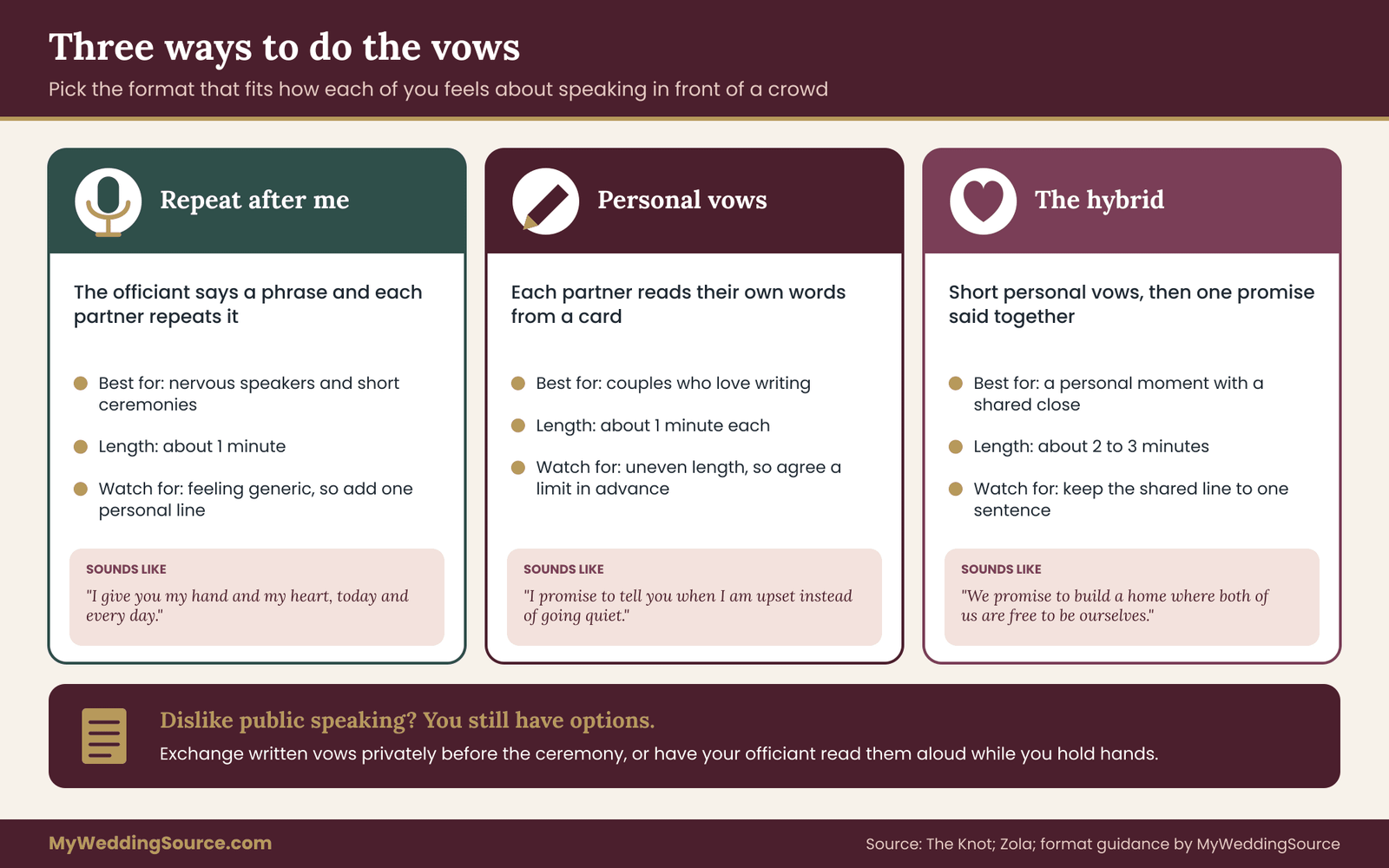
The vows are the one place in a wedding ceremony script where the words belong entirely to the couple, and they are where most people feel the most pressure. The good news is that there are at least three well-tested ways to do them, and the right choice depends on how each partner feels about speaking in front of a crowd.
Option one: traditional or repeat-after-me vows
The officiant says a short phrase and each partner repeats it. This is the most accessible format. Nobody has to memorize, nobody can lose their place and the words are sure to be balanced. Many couples choose it even when they could write their own, because the emotion comes from saying familiar words to a person they love.
A modern repeat-after-me set can be as short as four lines.
I, [name], take you, [name], to be my spouse. I promise to love you, to respect you and to be honest with you. I will stand beside you through joy and difficulty. I give you my hand, my heart and my loyalty, from this day forward.
If you want the traditional register, “to have and to hold, from this day forward, for better, for worse, for richer, for poorer, in sickness and in health, to love and to cherish” is the classic structure, and it is widely recognized without being tied to a specific denomination in civil ceremonies. Religious traditions have their own wording, which your clergy will provide.
Option two: personal vows read aloud
Each partner writes their own promises and reads them from a card or a small book. This format is the most personal, and the one most likely to be remembered. It carries two risks. One partner may write a three-minute speech and the other a thirty-second one, which can feel lopsided. And emotion or nerves can make it hard to read.
The fix for both problems is simple: agree on length and structure in advance. A common agreement is “one minute, three parts.” The first part is a sentence or two about what you love in the other person. The second is two or three promises, specific and realistic. The third is a closing line that echoes the future.
Here is a skeleton you can adapt.
[Name], from the first time [specific small memory], I knew [something you learned about them]. You make me [verb] and you make me [verb]. I promise to [daily-life promise]. I promise to [promise about hard days]. I promise to [promise about the future]. I love you, and I choose you, today and always.
Avoid inside jokes that only a few guests will understand, and avoid sharing anything that would embarrass your partner in front of their grandmother. A single concrete memory feels more real than a list of adjectives.
Option three: a hybrid
A hybrid uses short personal vows followed by a shared traditional promise. For example, each partner reads a one-minute personal vow, and then the officiant leads both in repeating a single sentence together: “We promise to love each other, to honor each other and to build a home where both of us are free to be ourselves.” The hybrid gives you the personal moment without the uneven length, and it adds a unison line that brings the guests in.
What if one of you hates public speaking?
Say so early. Several workable options exist:
- Use repeat-after-me vows in the ceremony and exchange written vows privately before the ceremony or on your own. The Knot notes that couples who prefer not to share personal vows publicly can do exactly this.
- Have the officiant read each partner’s vow aloud, with the couple holding hands.
- Keep the vows to two or three sentences each.
- Practice aloud three or four times in the week before, then read from a card on the day. Reading from a card is entirely normal and often looks elegant.
Our guide to writing wedding vows goes into drafting, editing and delivery for each of these formats.
Making vows sound like you
Whichever option you choose for your wedding ceremony script, three small edits help most. Replace abstract words like “love” and “happiness” with a specific scene. Replace large promises like “I will always make you happy” with promises you can actually keep, such as “I will tell you when I’m upset instead of going quiet.” And read the vow aloud to someone you trust, because what looks good on paper often sounds stiff when spoken.
Ring exchange wording
The ring exchange is short, but it is a moment guests photograph, so the wording should be easy to say and to hear. There are three common structures.
A statement from the officiant. The officiant says a sentence about what the rings mean while the couple places them. This is the simplest option and works well when either partner is nervous.
These rings are a symbol of the promise you have made today. Please place them on each other’s fingers.
Repeat-after-me. The officiant says a short phrase and each partner repeats it as they place the ring.
[Name], I give you this ring as a sign of my love and my promise.
A personal sentence. Each partner says one sentence of their own as they place the ring. Keep it to one sentence, because everyone has been standing for a while.
[Name], wear this ring as a reminder that I am always on your side.
Some couples add a blessing of the rings, where the officiant or a family member holds the rings and offers a short wish before the exchange. If a family member is handling this, tell them exactly how long it should be, and make sure the ring bearer, best man or maid of honor has a plan for where the rings are kept. Our guide to the flower girl and ring bearer rehearsal covers how to prepare the youngest members of the wedding party for this moment.
Readings, rituals and special moments
Beyond the legal core and the vows, your wedding ceremony script has room for a few extras. The question is not how many you can fit but which ones deserve the minutes.
Choosing a reading
A reading should say something you could not have said better yourselves. Good sources include scripture, poetry, passages from novels, song lyrics treated as poems, letters and excerpts from speeches. Because many poems and book passages are protected by copyright, it is wise to check that the reader or officiant has permission, particularly if the reading will be printed in the program or filmed for broadcast. A public-domain reading, an excerpt from scripture or a piece written by a friend avoids the question.
Practical tips for readings:
- Keep it between one and three minutes.
- Choose the reader for how they speak, not for how close they are to you.
- Print the reading in large type with the first line marked.
- Introduce the reader in one sentence so guests know why they are speaking.
- Rehearse with the microphone, because a quiet voice can disappear in an outdoor setting.
Unity rituals
A unity ritual is a visible symbol of two lives joining. The options are wide: lighting a single candle from two flames, pouring two colors of sand into one vessel, tying cords or ribbons, blending two wines, planting a tree, or presenting a family medallion or heirloom. Our guide to unity ceremony ideas lists many more, including options for outdoor and windy settings.
Three guidelines keep rituals from becoming awkward. Explain them briefly, because symbols that are obvious to the couple are not obvious to guests. Time them, because a unity ritual should add one to three minutes at most. And rehearse any ritual that involves fire, liquids or breakables, because a spilled vessel or a snuffed candle is a distraction, even if the guests are kind about it.
Honoring family and children
If either partner has children, the ceremony is a good place to include them. A short family vow, in which the couple makes a promise to the children, can be a beautiful addition. Keep the language gentle and age-appropriate, and let the children know in advance what will happen so they feel included rather than put on the spot. For blended families, a short family medallion or a shared candle can work well.
Remembering absent loved ones
A short remembrance honors those who cannot be present. Options include a moment of silence, an empty chair with a flower, a sentence in the address, or a photograph displayed at the ceremony entrance. Whichever you choose, keep it brief and let it be an acknowledgment rather than a eulogy.
Inclusive and personalized touches
Modern ceremonies often adapt traditional language. “Husband and wife” can become “spouses” or “partners,” “Who gives this woman” can become “Who supports this couple?” or be dropped entirely, and “bride and groom” can become the couple’s names. This is all within the officiant’s discretion in most places. For legal wording, check with the officiant and the clerk to confirm that the pronouncement and declaration of intent still satisfy local rules.
How to write your own wedding ceremony script, step by step
If you are working with an officiant who writes most of the script, you can skip to the section on collaboration. If you are writing or co-writing a wedding ceremony script, this seven-step method keeps the process manageable and the result personal.
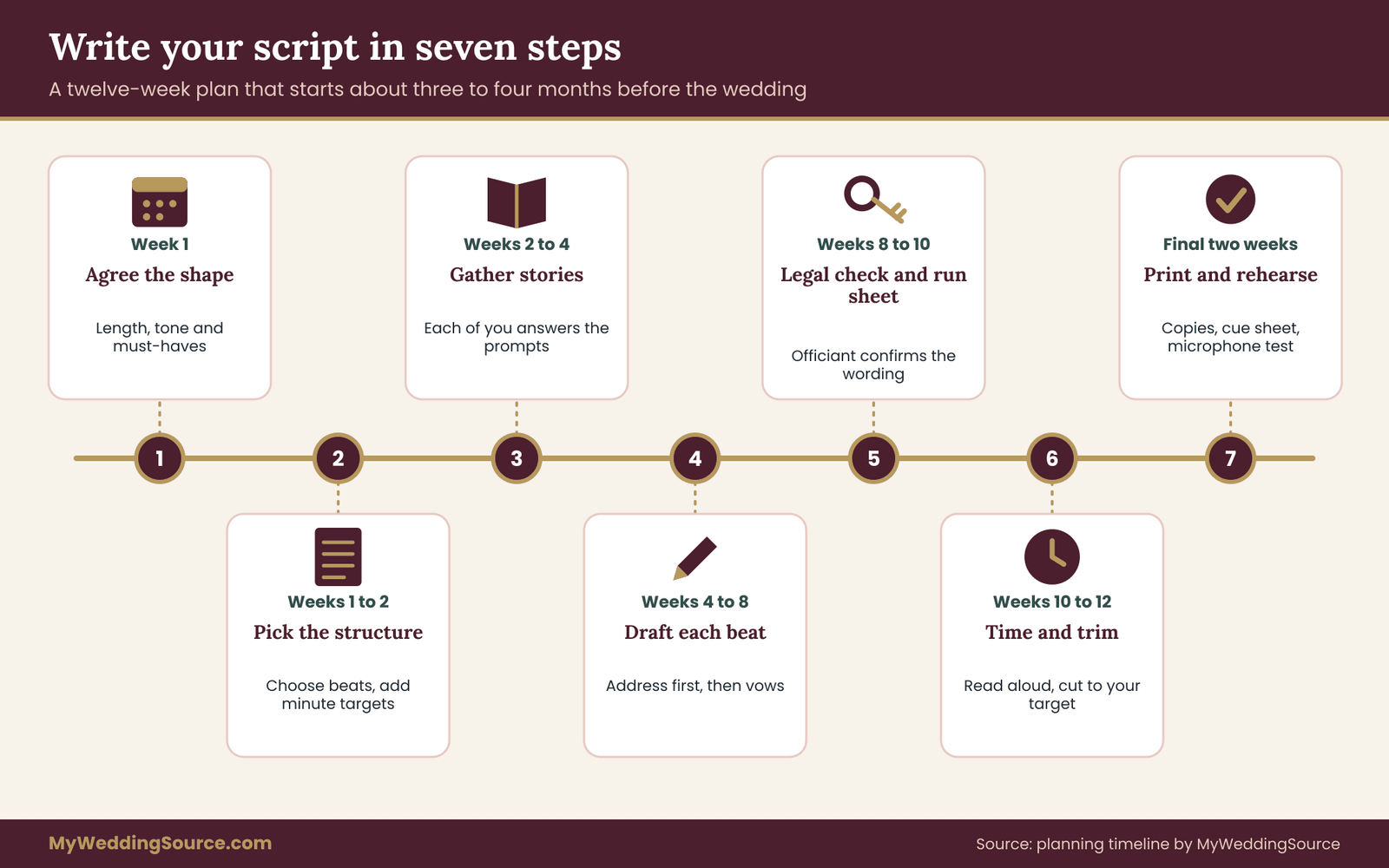
Step 1: agree on the shape (week one)
Sit down together and decide on length, tone and non-negotiables using the questions earlier in this guide. Write down the answers in a shared document. This single page prevents many later disagreements, because it is easier to say “we agreed the ceremony would be about 20 minutes” than to argue about whether a story should be cut.
Step 2: choose the structure (week one or two)
Pick which of the nine beats you will include. A common selection for a 20-minute secular wedding ceremony script is welcome, one reading, address, vows, declaration of intent, rings, pronouncement and kiss. Write the beats as an outline with minute targets next to each. If you plan a unity ritual or a family element, add it now so you do not discover later that it pushes the ceremony over time.
Step 3: gather the raw material (weeks two to four)
The best addresses are built from details only the couple can provide. Each of you should write answers to these prompts separately, then share them.
- How did we meet, and what was our first impression of each other?
- What is one moment when we knew this was serious?
- What do we do together that nobody else would guess?
- What is a small habit or ritual that is uniquely ours?
- What have we learned from a hard time that we handled well?
- What do we want the next ten years to feel like?
- What would our closest friends say about us in one sentence?
Aim for specific, sensory details. “She always laughs at her own jokes before the punchline” does more work than “she has a great sense of humor.”
Step 4: draft each beat of the wedding ceremony script (weeks four to eight)
Write the wedding ceremony script beat by beat rather than from start to finish. Draft the address first, because it carries the most weight, then the vows, then the connecting language. Keep each paragraph to three or four sentences and read it aloud. If you stumble on a sentence, rewrite it, because the officiant will stumble too.
Write for the ear, not the eye. Short sentences, concrete nouns and active verbs work better aloud than long, ornate constructions. Repetition is your friend: a phrase that returns three times, once at the welcome, once in the address and once at the pronouncement, gives the ceremony a shape that guests can feel.
Step 5: add the legal language and run sheet (weeks eight to ten)
Once the draft of your wedding ceremony script is complete, check it against the legal checklist in this guide and send it to your officiant for confirmation. Add the run sheet: who stands where, who hands over the rings, which song starts and ends, who signs the license and when. Include phone numbers for the officiant, coordinator and anyone with a role.
Step 6: time your wedding ceremony script and trim it (weeks ten to twelve)
Read the full wedding ceremony script aloud at the pace the officiant will use, and time it. Add 10 percent for pauses, laughter and the walk of the processional. If it runs over your target, cut from the middle, where the longest paragraphs tend to live. Cut stories that have more than one punchline, readings that repeat the address, and rituals that need long explanations.
Step 7: finalize and distribute the wedding ceremony script (the last two weeks)
Print copies for the officiant, the couple, the coordinator and anyone who reads. Share a one-page version with your photographer and musician so they know the cues. Keep a digital copy in a place your coordinator can reach on the day. Our guide to planning your wedding timeline shows where the script fits into the larger schedule.
Working with your officiant on the script
An officiant is a collaborator, not a vending machine. The most successful partnerships begin early and share material freely.
Meet at least three times to shape the wedding ceremony script. The first meeting is about tone and structure. The second reviews a draft, and the third finalizes timing and logistics. Many officiants will also join the rehearsal. Our guides to the wedding rehearsal and to who needs to attend a ceremony rehearsal explain how to include them.
Give feedback in specifics. “It feels too formal” is hard to act on. “Replace this paragraph with a sentence about how we met in the library” is easy. If a joke does not land, say so kindly and ask for alternatives.
Ask about their process. Some officiants have a library of sample language, some write from scratch, and some use a client questionnaire. Knowing their method lets you supply what they need. If you are still comparing officiants, our guide to choosing a wedding officiant covers what to ask.
Agree on the legal checklist early. A good officiant will tell you what must stay and what can change. If they cannot, that is a sign to ask the clerk or find a more experienced celebrant. ## Delivering the wedding ceremony script on the day
A good wedding ceremony script can be undone by a bad delivery, and a modest script can be lifted by a confident one. Delivery is mostly preparation, and it is the part couples most often leave until the morning of the wedding.
Rehearse the wedding ceremony script out loud, with the people who will be there
The single most useful thing you can do for your wedding ceremony script is to say it aloud with everyone who has a speaking part. A rehearsal reveals sentences that are too long, names that are hard to pronounce, jokes that rely on timing and places where the officiant needs a pause. It also tells you how long the ceremony really takes. If you cannot rehearse at the venue, rehearse in a living room with the script in hand. Our guide to the wedding rehearsal explains the order of a typical run-through.
Mark up the officiant’s copy
The officiant’s copy of the wedding ceremony script should be easy to read at a glance. Print the wedding ceremony script in a large font with generous line spacing and put each beat on its own page or section. Mark the legal moments in a bold color so they cannot be skipped. Add cue notes in brackets, such as “[music fades]” or “[pause for reading],” and include phonetic spellings for any names that are difficult to pronounce. Bring a spare copy in a different bag.
Plan for the microphone
Many ceremonies are heard poorly because nobody tested the audio. Decide in advance who will use a microphone: the officiant, the couple, the readers or all of them. If the couple will not be miked, the officiant can repeat the vows briefly for the guests, or the couple can speak a little louder and slower than feels natural. In outdoor settings, wind and traffic can drown out soft voices, so plan accordingly. Our guides to wireless wedding ceremony audio and preventing feedback at an outdoor wedding ceremony explain how to avoid the usual problems.
Slow down when you read the wedding ceremony script
Nerves speed everyone up. A script that reads comfortably in twenty minutes at a conversational pace can finish in sixteen when read under pressure, which means the guests have less time to take it in. Tell your officiant and readers to take a breath at the end of every paragraph and to pause after the declaration of intent and the pronouncement. These pauses are the ceremony’s punctuation, and guests need them.
Hold the cards, not your phone
If you are reading personal vows from your wedding ceremony script, use a card, a small book or a folded sheet of paper. A phone is risky because notifications, glare and low battery can intrude. Ask the best man or maid of honor to carry a spare copy, and give your officiant a second copy of both vows in case a card is lost.
The day-of run sheet
The run sheet is the practical companion to your wedding ceremony script. It is a single page that tells everyone what is happening and when. A good run sheet includes:
- Timing. The start time, the processional, the length of each beat and the expected end time.
- People. The names and phone numbers of the officiant, coordinator, photographer, musicians, readers and anyone responsible for the rings.
- Cues. Which song starts, when it stops and who signals the music. Which moment the photographer should be ready for, such as the ring exchange or the kiss.
- Objects. The rings, license, pen, unity ritual materials, vow books and any readings, with the name of the person responsible for each.
- Legal steps. When the license will be signed, by whom, and who will return it.
- Contingencies. What happens if it rains, if a reader is late or if the microphone fails.
Give a copy to everyone with a role, and keep one in your coordinator’s folder. Our guide to planning your wedding timeline shows how the ceremony slots into the full day, and the companion article on wedding day timeline failure points lists the moments where schedules most often slip.
Common wedding ceremony script mistakes and how to avoid them
After reading many a wedding ceremony script, the same problems appear again and again. None is fatal, and each is easy to avoid once you know to look for it.
Cutting the legal language. The most serious mistake is editing out the declaration of intent or pronouncement in pursuit of a more original script. Keep both, and ask your officiant to confirm that the wording satisfies local rules.
Letting the officiant speak for too long. An address that runs ten minutes tests guests who have been seated for half an hour already. Aim for three to seven minutes, and let the vows carry the emotional weight.
Using jokes that need context. A joke that depends on a story only a few guests know will confuse everyone else. If you want humor, choose stories that a newcomer could understand in one sentence.
Overstuffing the ceremony. Every ritual, reading and tribute adds minutes. A wedding ceremony script with three readings, a unity ritual, a family vow and a long address can run past forty minutes. Pick the elements that matter most and let the rest go.
Forgetting the guests. Guests are the audience for a ceremony, and a script that never addresses them can feel closed. One sentence of welcome and one of thanks make a surprising difference.
Mismatched vows. If one partner writes a lyrical three-minute speech and the other writes two sentences, the contrast is uncomfortable. Agree on a length and format in advance.
No plan for the rings. A forgotten ring box is a classic ceremony disaster. Assign a person and a backup, and write the plan into the run sheet.
Leaving pronunciation to chance. If a name or place is hard to say, spell it phonetically in the officiant’s copy and check it with the person at the rehearsal.
Ignoring the setting. A script that works in a church can feel long and formal in a garden. Adjust for noise, heat, seating and sightlines.
Waiting until the last minute. A wedding ceremony script written in the last week is usually rushed and generic. The timeline above gives you twelve weeks, which is enough to write, revise and rehearse without stress.
Adapting your wedding ceremony script to your situation
No two couples have the same ceremony. The notes below cover common situations and the adjustments that help.
Second marriages and later-in-life weddings
Couples who have been married before often want a ceremony that acknowledges history without dwelling on it. Keep the address focused on the present and the future, and consider including children or grandchildren in the vows or rituals. If a former spouse has died, a respectful remembrance can be included; if the marriage ended in divorce, it is usually best to leave it out entirely. Many couples in this situation choose a shorter ceremony of 10 to 15 minutes and a larger celebration afterward.
Elopements and very small weddings
With few guests, the ceremony can be more conversational. The officiant can speak directly to the couple, and guests can be invited to share a wish or a short story. A short script of ten to twelve minutes is typical, and the legal elements remain the same. Our guides to small wedding planning and micro wedding planning cover the rest of the day.
Destination weddings
Destination ceremonies raise a few extra points. Confirm the legal requirements of the country or state, because some places need paperwork weeks in advance or require a local officiant. Consider adding a short welcome in the local language, and plan for guests who may not know your traditions. Many couples hold the legal ceremony at home and a symbolic ceremony at the destination, with the script adjusted to say so. Our guide to destination wedding planning covers the legal and logistical pieces.
Same-sex and nonbinary couples
Traditional scripts were written for a bride and a groom, and many officiants now offer inclusive language as a matter of course. Replace “husband and wife” with “spouses,” “partners” or the couple’s own words, and avoid gendered phrases that do not fit. The legal core is the same: a declaration of intent and a pronouncement. If your officiant has not worked with a couple like you before, share the script early and ask for their comfort with the wording.
Bilingual and multicultural ceremonies
A short greeting, blessing or vow in each language can honor both families without doubling the length of the ceremony. Provide translations in the program so guests can follow, and give the officiant phonetic spellings. If a ritual from one culture needs explanation, a one-sentence introduction is usually enough.
Ceremonies with children
If children are part of the ceremony, keep their roles short and clear. A child who is asked to hold rings, carry a sign or read a line should be rehearsed and given an easy way out if they change their mind on the day. For ceremonies where children are guests, a short ceremony, a quiet activity and an aisle seat for an easy exit all help.
Ceremonies for guests who cannot travel
Some couples livestream or record the ceremony for relatives who cannot attend. If you do, tell the officiant so the script can include a welcome to those watching, and make sure the audio is clear. Our article on wedding speech transcripts explains how to make audio and text records of the day.
FAQ: wedding ceremony script questions
What should a wedding ceremony script include?
At minimum, a wedding ceremony script should include a welcome, a declaration of intent, a pronouncement and the kiss. Most also include an address by the officiant, vows and a ring exchange. Optional elements include a remembrance, readings, a unity ritual and a family blessing. The two legal anchors are the declaration of intent and the pronouncement, which should stay in the script even if everything else is customized.
How long should a wedding ceremony script be?
Ceremonies usually run 15 to 30 minutes, with a median of about 20. Each page of script takes roughly a minute and a half to two minutes to deliver, so a 20-minute ceremony is about thirteen or fourteen pages. Shorter scripts of 10 to 12 minutes work for elopements and intimate weddings, while religious ceremonies with sermons and rituals can run 45 minutes or more.
Do we have to say vows in a wedding ceremony?
In most places, no. Vows are a tradition rather than a legal requirement, and the legally important parts are the declaration of intent and the pronouncement. Couples who dislike public speaking can use repeat-after-me vows, have the officiant read their vows or exchange personal vows privately. Check with your officiant and local clerk to confirm the rules where you are marrying.
Who writes the wedding ceremony script?
It depends on the tradition and the officiant. In religious ceremonies the denomination often supplies the order of service, and the clergy member adapts it with the couple. With a civil officiant or celebrant, the usual pattern is collaboration: the officiant offers an outline and sample language, and the couple supplies stories, vows and preferences. If a friend officiates, the couple and friend usually write it together.
When should we start writing the wedding ceremony script?
Three to four months before the wedding is a comfortable window. That gives you time to gather stories, draft the address and vows, review with your officiant, time the script and rehearse. Starting earlier is fine, but there is little benefit to finishing more than a few weeks before the wedding, because small changes often arise from the rehearsal.
Can we use a template for our wedding ceremony script?
Yes. Templates are a good starting point, especially for the structure and the legal language. The risk is that a template can feel generic if you do not add anything personal. Replace at least three elements with details that are specific to you, typically the address, the vows and one reading, and ask your officiant to adjust the tone to match your voice.
How do we make a wedding ceremony script personal without making it long?
Choose a few moments to personalize rather than every moment. A two-minute story in the address, a short reading by a friend and personal vows are usually enough. Cut anything that repeats a point already made, and use specific details instead of general praise. A short ceremony with specific, honest details usually feels more personal than a long one with generic language.
What is the difference between a wedding ceremony script and a program?
The wedding ceremony script is the full text and sequence of the ceremony, written for the officiant and participants. The program is a printed handout for guests that lists the order of events, the names of the wedding party and any explanations of rituals. The script is for the people leading the ceremony, and the program is for the people watching it. Our guide to wedding programs covers formats and wording.
Your next steps
- Decide the tone and length. Answer the five tone questions together and agree on a target length.
- Check the legal basics. Confirm your license, officiant authority and required wording with the clerk and officiant.
- Pick a template. Choose the one closest to your tone and mark the three moments you will personalize.
- Gather your stories. Each of you answers the seven prompts separately, then share and select.
- Draft, time and rehearse. Write each beat, read the script aloud, trim to time and rehearse with everyone who has a role.
- Print the final copies. Prepare the officiant’s copy, the run sheet and a spare, and share the cue sheet with your vendors.
For the rest of your ceremony planning, see our guides to wedding etiquette, the full wedding ceremony and your marriage license.
Sources
This guide draws on published wedding-industry and officiant guidance. Ceremony lengths and wording vary by tradition, officiant and jurisdiction, so confirm legal requirements with your officiant and the clerk who issues your license. Costs, policies and laws change.
- The Knot: Wedding Ceremony Script Examples and How to Write Your Own – ceremony parts in order, typical length, guiding questions and the declaration of intent.
- Universal Life Church: Wedding Scripts – required legal language, median ceremony length and the page-per-minute rule of thumb.
- Universal Life Church: Wedding Ceremony Scripts – reminder that scripts must include certain legal language.
- Universal Life Church: How to Write a Wedding Officiant Speech – conventional script structure and the officiant’s role.
- Zola: Wedding Ceremony Script – structure, timing advice and who writes the script.
- Greenvelope: Wedding Ceremony Script – religious, modern and secular script types.
- Apartment Therapy: How to Write Your Own Wedding Ceremony – parts of a wedding ceremony and declaration of consent.
- Offbeat Wed: Wedding Ceremony 101 – writing a ceremony from scratch and ring exchange formats.
- Junebug Weddings: Wedding Ceremony Script Ideas – typical script components.
- Shutterfly: How to Write a Personalized Wedding Ceremony Script – structure and unity ceremony additions.