

A joint engagement party with two families works when the hosts decide, in advance and in writing, who invites whom, who pays for what, and who answers the phone on the day, because a shared celebration with no owner quickly becomes two celebrations that are quietly competing.
Quick answer
Choose one of four formats first: one party with both families hosting, one host family with the other contributing, two separate parties, or a couple-hosted party. Then fill in the co-host decision and payment responsibility chart in this guide so that every job has one lead, one backup, and one person who pays. Sources we read say whoever hosts is generally expected to cover the bill, that the guest list should match the wedding list, and that a window of roughly one week to three months after the proposal is common. Treat those as habits, not rules, and write down what your families agree.
What a joint engagement party with two families actually is
An engagement party is the first time many relatives and friends meet the couple as a pair, and when two families share it, they also meet each other. That is the real job of a joint engagement party with two families: it introduces two social worlds in one afternoon or evening. Because that is a bigger task than a single-family party, it helps to name the format before anyone books anything.
Four ways two families can host together
The word “joint” covers several arrangements that feel very different to the people paying for them. The Knot’s etiquette guidance says both sets of parents can come together to host, and that if they live in different areas, each can host a party in their own home area. Those two ideas already give you more than one shape, and the sections below add two more that couples commonly use.
One party, two host families, one shared bill
Both families appear as hosts, pick the date and place together, and split the bill by an agreed method. This is the format most people mean by a joint engagement party with two families, and it demands the most coordination, because every decision has two owners until you assign them. Its strength is symmetry: nobody is a guest at their own child’s celebration, and both sides can invite their own circles without asking permission. Its weakness is decision speed. If you choose this format for your joint engagement party with two families, the chart later in this guide is the tool that keeps it moving.
One party, one host family, the other family contributing
One family takes the lead and the other contributes money, food, drinks, or a defined task. Emily Post notes that when a different family hosts, such as the future in-laws, it can be a kind gesture that lets them introduce the couple to their friends and share the news. A party like this has a single decision maker, which is fast, but the contributing family can feel like a guest unless its role is named. Agree on what the contributing side owns, and make sure its guests are invited in the same voice as the lead family’s guests.
Two parties, one for each family
If the families live far apart, or if the guest lists barely overlap, two parties may be kinder than one. The Knot suggests that couples can hold more than one party, for example a family gathering and a separate party for friends. Two events cost two sets of preparation, and the couple has to attend both, but each family gets to host in its own style and place. Our separate guide on planning an engagement party when parents live far apart covers that distance problem in detail, so this article stays with the single shared event.
One party hosted by the couple, both families as honored guests
Some couples host the party themselves and ask both families to attend as guests of honor, with an optional contribution. Zola describes hosting as flexible these days, with the couple, siblings, friends, or families all possible hosts. This format removes the pressure of two sets of parental expectations, and it suits families who would rather not take on the bill. The trade-off is that the couple becomes the project manager and the payer, so be honest about your own budget before you choose it.
Why the format matters more than the venue
People often start with a restaurant or a backyard and then discover that the format was the unsettled question. Choosing the format first prevents the common situation, in a joint engagement party with two families, where one family has already put down a deposit and the other family learns about it from a cousin.
The format decides who is on the invitation
An invitation carries the hosts’ names, and the hosts’ names tell guests who is welcoming them. With two host families, both names appear. With one lead family, the invitation may say that the other family is joining in. With a couple-hosted party, the couple’s names appear. In a joint engagement party with two families, settling this early also settles the RSVP address and the thank-you list, which are small details that cause real friction when they are left to the last week.
The format decides who answers the questions
At a joint engagement party with two families, guests ask hosts about parking, dietary needs, whether children are invited, and whether gifts are expected. If two families host, name one person per question. A simple rule works well: the family whose home or venue it is answers logistics, and the family whose guests are asking answers about their own guests. Put one phone number or email on the invitation so that guests are not guessing between four parents.
When a joint party is a poor fit
A joint engagement party with two families is not automatically more generous than two separate celebrations. It is a tool, and there are conditions under which it stops serving the couple. Recognizing them early is easier than repairing a conflict after invitations have gone out.
When the hosts are not comfortable planning together
If the two families have a strained history, or if the first conversation between the parents is already tense, a joint engagement party with two families may force a conflict into a room full of guests. That does not mean the families can never share a party. It may mean that a first meeting should happen privately and early, as the Knot suggests, or that two smaller events are a gentler start. The purpose of the party is to celebrate you, not to test the families’ ability to cooperate.
When the guest lists will not fit one room
If one family has a very large extended circle and the other a small one, a joint guest list can look lopsided. A room that holds sixty comfortably will not hold ninety, and cutting guests from a family that is hosting is a painful conversation. If the lists for your joint engagement party with two families do not fit, consider a larger venue, an open-house format with staggered times, or two events. We return to capacity later, with a way to divide it fairly.
Start with the couple, then hold a hosts’ conversation
Most disagreements at a joint engagement party with two families are not about the party. They are about expectations that were never said aloud. The cheapest step in the whole process is a short conversation that happens before any money moves, and it works best in a particular order: the couple first, then the families.
Settle three decisions as a couple before calling anyone
For a joint engagement party with two families, parents are far more willing to help when they are asked a specific question than a vague one. If you arrive at the first family conversation with answers to three questions, you give the hosts something to react to, and you protect your own preferences from being decided by whoever speaks first.
Size and tone
Decide whether you want a small dinner, a cocktail party, a backyard afternoon, or an open house. Tone includes dress, music, speeches, and whether children and plus-ones are invited. Zola advises that the couple chooses the dress code and states it on the invitation, which is a good reminder that tone is yours to set even when someone else is paying. Write a sentence you can say aloud about your joint engagement party with two families, such as “an afternoon cookout for about fifty people, casual, no formal program.”
A budget ceiling and what you will accept
Decide how much of the budget you will contribute and whether you are comfortable receiving money from either family. A ceiling helps when two enthusiastic hosts begin to expand the plan: it gives you a number to point to when someone proposes a band, a larger venue, or an extra course. If you want to understand how the party’s cost fits into your wedding costs, our wedding budget guide and our guide to how to pay for a wedding are good companions.
What you want from each family
Before planning a joint engagement party with two families, think about what each family could give that you would value: hosting at home, introducing you to their friends, helping with food, or simply attending with warmth. Asking for what you actually want is kinder than accepting whatever is offered and resenting it later. It also helps you thank each family for something specific, which hosts tend to notice and remember.
Run the first conversation between families
The first conversation about a joint engagement party with two families sets the tone for everything after it. A calm, brief, specific first conversation, preferably held by the couple with both sets of parents on the same call or at the same table, is usually better than two separate calls that each family replays differently.
Decide who calls whom, and in what order
Families often have an unspoken hierarchy about who should be asked first. If you can, ask both families at about the same time, and use the same words. If one family has already offered to host, thank them and then tell the other family that you would like them to be part of it. Emily Post suggests thanking future in-laws who offer to host and encouraging them to choose the date, which is a courteous way to accept without handing over every decision.
Introduce the parents before the party if they have never met
The Knot recommends scheduling a separate introduction beforehand when parents are meeting for the first time, such as a quiet lunch or a cocktail hour, because at the party itself everyone will be busy mingling. That advice is especially useful for a joint engagement party with two families, where the hosts are expected to share a welcome and perhaps a toast. A short, low-pressure meeting turns two strangers into two people who already know each other’s names.
Write down what was agreed
After the conversation, send one message to everyone with the format, the date window, the budget method, and who leads each job. This is not about distrust. It is about the plain fact that four people will remember a verbal conversation in four ways. A short written summary also gives you a document to update if plans change, and it makes it easy to bring in a sibling or friend who has offered to help.
Accept offers gracefully while keeping the choice
Generous offers can arrive with strings attached that nobody intended. Because hosting is a gift, the first rule is gratitude, and the second rule is to keep the decisions that affect you, such as the date window and the guest list rules, in the open.
Thank the offer, then ask what the host has in mind
When a parent offers to host, answer with thanks and a question: “What did you picture?” Their answer tells you whether they want a formal dinner or a backyard barbecue, and whether they assume a particular guest list. It is much easier to adjust a picture in the first conversation than a deposit in the third. This also gives the other family a chance to say what they would enjoy contributing.
When both families offer at the same time
If both families offer to host a joint engagement party with two families, you have a good problem, and the answer is usually to combine rather than choose. Offer a joint event with a shared bill or a split of tasks, or suggest that one family hosts the engagement party and the other hosts a later event, such as a rehearsal dinner. Our rehearsal dinner toasts guide can help later, when the second family’s turn comes around.
The co-host decision and payment responsibility chart
This chart is the working tool of the guide. It breaks a shared party into jobs and gives each job a lead, a backup, and a payer. It is our own planning framework, built from the etiquette sources we read, not a rule from any of them. You can copy it into a shared note and edit the names.
How to read the chart
For a joint engagement party with two families, the chart asks four questions about each job: who leads, who backs up, who pays, and what must be agreed together. Most couples find that only about half the rows need joint decisions. The rest can be delegated, which is the point.
Lead, backup, and payer are three different roles
The lead makes the decisions and talks to the vendor. The backup steps in if the lead is traveling or unreachable. The payer may be the same person as the lead, but does not have to be. In a joint engagement party with two families, separating the roles prevents the common problem of one parent making purchases that another parent is expected to reimburse without having been consulted. If a lead cannot spend without the payer’s approval, write the approval limit into the chart.
What the etiquette sources say about who pays
Zola says whoever hosts is generally expected to cover the bill, and that costs can be shared by dividing tasks among hosts, for example one person hosting at home, another providing drinks, and another covering food. It adds that if the party is held at an event space, the cost can be split among everyone who offered to host. The Knot describes the traditional picture, with the bride’s parents hosting, and notes that today close friends and family often host and some couples host their own celebration. Neither source gives a single fixed split, so your agreement is the rule.
The chart itself
Use the chart below as a starting point and replace the suggestions with what your families agree. A blank cell is a useful warning: it means a job has no owner yet.
| Job | Suggested lead | Decide together | Who pays under split-by-task | Write it down by |
|---|---|---|---|---|
| Date window and format | The couple | Both families approve | No cost | First hosts’ conversation |
| Master guest list and capacity | The couple | Each family supplies its list | No cost | Before invitations |
| Venue booking and deposit | Family whose home or choice it is | Cancellation terms | Venue lead | Before signing |
| Invitations and RSVP tracking | Couple or one designated host | Names on the invitation | Invitation lead | Before printing or sending |
| Food and caterer | Family with the stronger kitchen or caterer contacts | Menu, dietary needs, headcount | Food lead | Four weeks out |
| Drinks and bar | The other family | Whether alcohol is served | Drinks lead | Four weeks out |
| Rentals, decor, signage | Whoever has the time | Look and style | Rentals lead | Three weeks out |
| Photography | The couple | Who invites the photographer, consent notice | Whoever hires | Three weeks out |
| Music or audio for toasts | Venue or one host | Volume and end time | Audio lead | Two weeks out |
| Toasts and program | The couple with both hosts | Order and length | No cost | Two weeks out |
| Accessibility and guest needs | Both hosts | Parking, seating, food labels | Included in venue or food | Two weeks out |
| Day-of host and cleanup | One named person per family | Who closes the party | No cost | One week out |
| Thank-yous | The couple, with hosts included | Who writes to whom | No cost | One week after |
The jobs that need both families in the room
In a joint engagement party with two families, three rows in the chart almost always need joint decisions: the date window, the master guest list, and the toasts. They are the places where the two families’ preferences touch. Everything else can be delegated once those three are settled. If you only have energy for one joint meeting, spend it on those three.
The jobs you can hand to one person
At a joint engagement party with two families, rentals, decor, audio, and cleanup are practical jobs that benefit from one decision maker with a clear budget. A single lead avoids the common problem of two relatives each ordering similar items. Give the lead a spending cap and a deadline, and ask for a photo or list of what has been ordered so that the other family can see progress without having to ask.
Choosing a payment model
There are four ways to pay for a joint engagement party with two families, and none is more correct than the others. The right choice depends on income, on who invited more guests, and on how each family feels about being generous or being fair.

An even split
Each family pays half of the total cost of the joint engagement party with two families. This is easy to explain and easy to track, and it signals symmetry. It can feel unfair if one family invites many more guests or has a much smaller budget. If you choose it, agree on a total ceiling first, so that “half” does not grow without a decision.
Split by task
One family covers certain jobs and the other covers the rest, as Zola describes. It reduces the number of reimbursements, because each family pays vendors directly, and it lets each family contribute in the way it enjoys. The risk is that the totals end up unequal, so add a short balancing step: after the party, compare the two totals and settle the difference if the families want an even result.
One host family, a fixed contribution from the other
The lead family pays vendors and the other family sends a set amount, for example a round figure agreed in advance. This limits surprises for the contributing family, because its share is known. It also gives the lead family the authority to make quick decisions. Put the contribution and the date it is due in writing.
Proportional to each family’s guest list
Each family pays according to its share of the guests. This reflects who benefits from the party, and it can feel fair to families whose lists are very different. It requires a final headcount before the bill is divided, and it can feel transactional to some families. Decide how to count shared friends, who are invited by both sides, before the first invoice arrives.
What the models look like in dollars
Here is a hypothetical party budget of $3,600 for about fifty guests, which is $72 per guest. The numbers are invented to show how each model works, and the arithmetic is ours, so treat it as an estimate. The budget assumes venue rental of $900, food of $1,500, drinks of $600, rentals and decor of $300, and photography of $300.
- Even split: each family pays $1,800.
- Split by task: Family A covers venue and food, which is $2,400, and Family B covers drinks, rentals, and photography, which is $1,200. Balancing transfers of $600 would even this out.
- Fixed contribution: Family A pays vendors and Family B contributes $1,000, so Family A’s net share is $2,600.
- Proportional: if Family A invites thirty of the fifty guests, its share is $2,160, and Family B’s is $1,440.
Real costs vary widely by region and format, so replace these figures with quotes from your own vendors.
Keep money gifts and tax questions separate
Sometimes a parent prefers to give the couple money and let them host their joint engagement party with two families. That changes who the host is, and it may raise tax questions. We are not tax advisors, and this section only reports what a federal source says.
What the IRS page says
The IRS publishes a page of frequently asked questions on gift taxes. It lists the annual exclusion as $19,000 per recipient for 2026, and notes that spouses who own property together can each use the exclusion. It also says that for most small gifts below the annual exclusion you may not need a professional, and that tuition or medical expenses paid for someone are generally not taxable gifts.
What it does not say
The page does not address party or wedding expenses, so we cannot say how a family’s payment toward a joint engagement party with two families should be treated. If a parent is giving a large sum, or is unsure whether a payment is a gift, a tax professional can answer for your situation. For most families paying a caterer directly for a party, the question never comes up, but nobody should assume that without checking.
Merging two guest lists into one invitation
The guest list is where a joint engagement party with two families most often runs into trouble, because it makes visible the sizes of two circles. A little arithmetic and a clear rule at the start prevent the hard conversation later.
The rule most sources share
The etiquette sources we read agree on one rule for who to invite, and it is worth adopting because it protects your wedding list as well.
Invite people you would also invite to the wedding
The Knot says everyone invited to the engagement party should also be invited to the wedding, so no one feels slighted. Zola gives the same general advice. This matters more with a joint engagement party with two families, because each family will be tempted to invite a wide circle of friends. If you can already see that the wedding will be small, say so, and let the engagement party stay modest too. Our guide to engagement parties covers the broader planning questions.
The exceptions, and how to explain them
Both sources note exceptions: a destination wedding, or a small wedding paired with a larger engagement party. In those cases they advise being honest and tactful with guests. A short line in the invitation or on your wedding website saying that the wedding will be small can prevent hurt feelings. Our wedding invitation etiquette guide covers the wording.
One party per guest, with exceptions
The Knot also notes that guests should not be invited to more than one engagement party, except close family such as parents and siblings. If you are holding two parties, split the lists so that friends and extended relatives are invited to only one event. Keep a single master list with a column for which event each guest is invited to.
Dividing capacity between the families
For a joint engagement party with two families, a room has a limit, and the limit is the neutral party in a negotiation between families. Starting from the number of seats avoids starting from the number of feelings.
Start with the room, then divide by buckets
Find the real capacity from the venue, including any fire or occupancy limits the venue states. Then divide it into buckets: the couple’s own friends, each family’s guests, and a small flex bucket for later additions. A common approach is to give each of the three main buckets about the same share and hold a few seats back. The example in the figure below is ours, with sixty seats, three groups of eighteen to twenty, and a flex of four. Adjust the shares to match your situation.

Count overlap guests once
At a joint engagement party with two families, some guests are on both families’ lists, such as shared cousins or mutual friends. Count each person once and assign them to the family that knows them best. If you count them twice, each family will believe the room is fuller than it is, and the real total will exceed capacity. A single shared spreadsheet, with one row per household, prevents double counting.
Keep a waitlist for declines
Some guests will decline a joint engagement party with two families, and a waitlist lets you fill those spots without breaking the balance between the families. Agree on the rules before sending invitations: who is first on each family’s waitlist, and who decides when to send the second round. Do this quietly and early, so that guests do not receive an invitation that arrives too late to be useful.
Who sends the invitation, and in whose name
The invitation is the first public signal of who is hosting. Because of that, it is worth a few minutes of thought about names and addresses.
Names on the invitation
If both families host, both sets of names appear, usually with the couple named as the honorees. If one family leads and the other contributes, you can name both families or only the lead. What matters is that neither family is surprised when they see it. Show a draft to both sides before it goes out, and ask them to read it for names, spellings, and titles.
Where RSVPs go
Choose one RSVP destination, such as a shared email address, a phone number, or an online form, and put it on the invitation. If RSVPs go to two homes, answers get lost. Our guide to RSVP etiquette explains how to handle late replies. Zola notes that for an impromptu party an evite works if you have an RSVP system, and paper invitations are an option if the party is a few weeks away.
Say what the party is, in plain words
State the format, the start and end times, whether it is a meal or appetizers, the dress code, and whether children are invited. Zola recommends stating the dress code on the invitation. A clear invitation reduces the number of questions that both families have to answer, and it makes a joint engagement party with two families feel organized rather than improvised.
Timing a joint engagement party with two families when two calendars compete
A joint engagement party with two families means two sets of work schedules, travel plans, and holidays. The etiquette sources give a wide window, so the real deadline is usually the date when the most important guests can attend.
What the sources say about the window
The sources we read do not agree on a single number, and they do not claim to. Reading them side by side shows a range, which is more honest than picking one.
Reading the ranges together
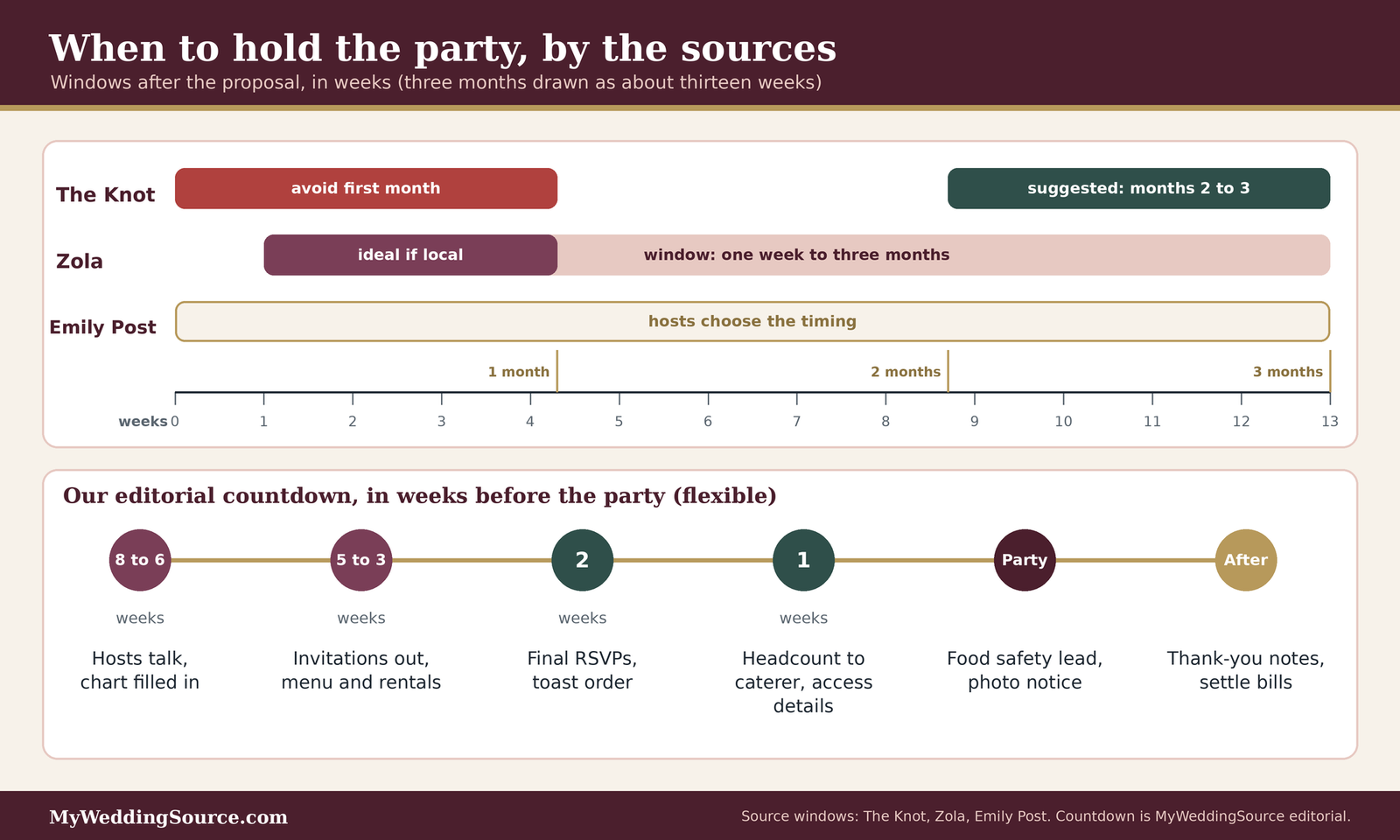
The Knot says to hold the party no later than three months after the engagement is announced, to avoid a major event in the first month, and suggests two to three months after the proposal. Zola recommends a window from one week to three months after the proposal, with one to four weeks ideal if guests are local or if you plan to announce the engagement at the party. Emily Post says the hosts can choose the timing, since engagements are often no longer kept secret. The figure below places these ranges on one scale, using our own conversion of three months to roughly thirteen weeks.
Why the ranges differ
The advice differs because the sources picture different parties. A party announcing the news to local friends happens fast, while a party for relatives who travel needs lead time. A joint engagement party with two families sits between those two cases, because two families usually need more time to coordinate than one. That is a reason to start the hosts’ conversation as soon as the engagement is known, even if the party itself is weeks away.
A countdown you can build backward
Pick the date of your joint engagement party with two families first, then count backward. The steps below are our own editorial suggestions, not a rule from any source, and the number of weeks is flexible. A smaller backyard gathering needs less lead time than a rented room.
Eight to six weeks before
Hold the first hosts’ conversation, settle the format and payment model, and fill in the chart. Ask a few key guests, such as grandparents or out-of-town relatives, which dates work. If a venue is needed, ask about availability and read the cancellation terms before paying a deposit. Zola advises sending invitations as early as possible so guests can arrange work, travel, and gifts.
Five to three weeks before
Send invitations, set an RSVP date, and confirm the menu and the headcount method with the caterer or the cook. Order rentals and decor. Decide whether a photographer is attending and who will tell the guests. Check the weather plan if any part of the party is outdoors. This is also the window to introduce the parents, if they have not yet met, so that the first meeting is not at the party.
Two weeks before
Collect the final RSVPs and call the guests who have not answered. Give the caterer or the cook the final count and any dietary needs. Draft the toasts order and share it with each speaker. Confirm who is arriving early and who is closing up. Confirm parking and any accessibility details with the venue, so that you can tell guests who ask.
The week after
Write thank-you notes. The Knot says hosts should receive a handwritten thank-you note, and that a small gift is optional. Reconcile the bills between the families and settle any balancing payment. Thank the vendors, and note what you would change for the wedding events that follow.
Dates, holidays, and travel
Even a perfect plan fails if the date collides with a major commitment. A few checks reduce the chances.
Check religious and civic calendars for both families
Look at the holidays and observances that matter to each side, and avoid dates that would force relatives to choose. If you are unsure whether a date matters to a family, ask the person who would know. A short question now is better than discovering a conflict after invitations are out.
Think about the wedding date
If you have not chosen a wedding date, the engagement party can come first, but if you have a date in mind, check that the party does not crowd the wedding preparations. A party two or three months after the proposal tends to leave plenty of time. For the larger timeline, our wedding planning checklist and the proposal and engagement party planning guide show how the pieces fit together.
Venue, contracts, and public property
A joint engagement party with two families creates a question that a single-family party does not: whose name is on the contract, and who owes the deposit if something changes. Answering it early prevents disputes that look like family conflict but are really paperwork problems.
Whose name is on the booking
A venue, a caterer, or a rental company will have one customer of record. That person is legally and practically the one who signs, pays the deposit, and can change the booking.
One signer, one payer, one backup
For a joint engagement party with two families, choose one person to sign and make sure the other family knows what was signed. If the signer is not the payer, agree in writing on how and when the other family reimburses the deposit. Name a backup who has the contract and the vendor’s phone number, in case the signer is unavailable. Our guides on wedding vendor contracts and vendor due diligence explain what to look for before signing.
Cancellation, postponement, and guest changes
Read how much of the deposit is refundable and until what date. Ask what happens if the guest count drops or rises, and whether the minimum spend changes. Because two families share the cost, a cancellation affects both budgets. Agree in advance on who bears a lost deposit, in case a date must change. This is a financial and contractual matter, and a lawyer or the vendor can answer specific legal questions.
Public parks and National Park Service rules
Parks are popular for a joint engagement party with two families because they are scenic and inexpensive, but public land has rules. The primary federal reference for park rules is the National Park Service, and its sites list permit information for each park.
Permit thresholds vary by park
The Denali National Park page says a special use permit is required for most events or ceremonies with groups larger than twelve, with an application fee of $200 and possible additional fees. It also says ceremonies must not block other visitors, that littering is prohibited including balloon releases and throwing rice, birdseed, or petals, and that party size determines which locations can be used. That is one park. Other parks and other public land managers set their own thresholds, fees, and lead times, so always read the page for the specific place.
Photography and permits
The Colonial National Historical Park page says personal-use photos do not need a permit, that a permit is needed only if a shoot uses a model, set, or prop or requires entry into a closed area, and that wedding parties are not considered models. It also says applications must be postmarked at least forty-five days before the activity. Again, that is one park. If you plan to hire a photographer for a party on public land, ask the park office directly and get the answer in writing. Our wedding permits guide covers the broader permit picture.
Choosing between a home, a restaurant, and a rented space
Each type of place changes the payment model and the workload, and the best choice often follows from the payment model you chose.
A home
A home is a natural choice for one host family, and it lowers venue costs, but it concentrates the work. The family whose home it is takes on cleanup, parking, and neighbors. Our companion guide on an engagement party at home covers quantities and flow for that case. If you host a joint engagement party with two families at home, give the other family a defined, visible job so that it is not merely a guest.
A restaurant or private room
A restaurant simplifies food and cleanup and usually has one point of contact. Ask about a minimum spend, a room fee, service charges, and the deadline for the final headcount. Because one family will usually put down a card, agree on how the bill is divided before the evening, rather than at the table.
A rented hall or a neutral space
A neutral space can feel fairer to two families, since neither is the host in its own home. It adds rental, setup, and sometimes insurance requirements. Ask what the venue includes and what it does not, such as tables, chairs, and cleanup. Our venue questions and capacity guides can help you compare rooms.
Food, drink, and care for guests across two families
A joint engagement party with two families often means two food traditions, two sets of dietary needs, and two ideas of what a party looks like. Planning for that on purpose makes guests feel welcome, and it is also a matter of safety.
Food safety at a shared buffet
Whoever serves food is responsible for keeping it safe, and a buffet that is shared between families is easy to leave out too long, because nobody feels in charge.
The temperature and time limits
The FDA’s party food guidance says to keep hot food at 140°F or warmer and cold food at 40°F or colder. It says to discard perishable food left at room temperature for more than two hours, and that the limit drops to one hour if the buffet area is above 90°F. It also advises replacing nearly empty dishes with freshly filled ones rather than adding food to a partly filled dish, and notes that some warmers only hold food at 110°F to 120°F, so you should check the product label.
Name one food safety lead
Because a joint engagement party with two families can have dishes from two kitchens, name one person to watch the clock, check temperatures with a food thermometer, and swap out dishes. Write the time each dish goes out on a card. The FDA also advises taking extra care with high-risk guests, including pregnant women, young children, older adults, and people with weakened immune systems. If you are unsure, ask the caterer about their holding procedures.
Allergies and dietary needs from two kitchens
When food comes from two families, ingredients and preparation are harder to track. A short, early question prevents the most serious problems.
Ask on the invitation and in a follow-up
Add a line to the invitation asking guests to share dietary needs by the RSVP date. For a guest who reports a serious allergy, a direct conversation is better than assumptions. Michigan Medicine advises calling the guest beforehand to learn their needs and how severe the allergy is, since even trace amounts can trigger a reaction. Our guide on wedding dietary restrictions goes deeper.
Labels, utensils, and separate areas
Michigan Medicine recommends labeling all dishes and marking those that are not allergy-friendly, using separate labeled serving utensils, and keeping allergy-friendly dishes in their own area. It also notes that inviting a guest to bring their own food is often the safest option, though it can leave the guest feeling isolated. With two families cooking, agree on who writes the labels and who checks them, and ask each cook for a list of ingredients.
Alcohol and host responsibility
Whether to serve alcohol at a joint engagement party with two families is a decision for the hosts together, since it affects both families’ guests and both families’ risk.
Decide whether alcohol is served, and who is in charge
Families may differ on alcohol for religious, personal, or health reasons. Decide together, and tell guests on the invitation if the party will be dry. If alcohol is served, name one adult from each family to watch the bar and to make sure that nobody underage or visibly intoxicated is served. Our guide on bar service planning covers quantities and staffing.
Social host laws vary
County Health Rankings describes social host laws as holding private property owners liable if they provide alcohol, or allow it to be provided, to minors or obviously intoxicated people on their property and someone is injured as a result. It says liability varies from state to state and can be criminal or civil, and that its state counts date from 2016. Laws may have changed, so check your state’s current rules. This is general information, not legal advice, and a homeowner’s insurance agent can tell you what your policy covers.
Making the party accessible for both families’ guests
Guests at a joint engagement party with two families may include older relatives, people who use mobility devices, people who are deaf or hard of hearing, and others with access needs. Planning for them is part of hosting.
Venue and layout
SF.gov’s guide to hosting an accessible event advises providing accessible parking and paths of travel to every part of the event, including restrooms, and treating travel paths, seating, and performance areas as parts of one accessible layout. For a party, that means checking steps, door widths, and seating before you choose the room. Our guide on the accessible wedding guest experience lists more questions.
Tell guests what to expect
The same SF.gov guide says notices should describe any accessibility features that will be available, and suggests writing an event access plan. For a private party, a short line on the invitation, such as “the venue has a step-free entrance and an accessible restroom,” helps guests decide whether to attend. Offer a way to ask about needs privately, and name the person who will respond.
Toasts, photos, and thank-yous with two hosts
At a joint engagement party with two families, the program is short, but it is where both families are visible at once. A few agreements beforehand keep it warm and brief.
Toast order when there are two hosts
Toasts are optional, and the Knot says hosts may give a speech congratulating the couple, while the couple may thank guests. If two families host, the toast order is a question of respect rather than a rule.
Who speaks first
Zola describes a common order: a toast from the hosts first, then the couple’s parents, family members, and close friends, with the couple often closing by thanking the hosts and guests. With two host families, one common solution is to have one parent from each family speak briefly, in an order the families choose, or to have a single joint toast. Ask each speaker how long they plan to talk, and agree on a time limit, such as two or three minutes.
Share the order before the day
Send the toast order to each speaker a week ahead, with the venue’s audio setup and the time. A short written order prevents the awkward moment when two relatives rise at once. Our guides on wedding speeches and rehearsal dinner toasts offer wording and timing advice.
Photos and recording
Photos of a joint engagement party with two families are part of the memory, and they involve consent. Agree on who is photographing and tell guests.
Tell guests when a photographer is present
If a photographer or videographer is attending, say so on the invitation or with a sign at the entrance, and ask guests to tell the photographer if they prefer not to be photographed. Our plan rule is simple: no guest should be secretly recorded. Our guide on engagement photos and the one on wedding photography explain what to ask a photographer.
Recording laws vary
The Digital Media Law Project says each state has its own wiretapping statute and its own rule on how many parties need to consent to recording a phone call or conversation. The page is no longer updated and describes itself as general information, not legal advice. In practice, the safest course at a party is to be open about any audio or video recording and to ask before recording speeches that will be shared online.
Thank-yous and gifts
At a joint engagement party with two families, gratitude is the last job, and it is easy to forget when two families are involved, since each may assume the other will do it.
Thank both hosts, individually
The Knot says hosts should receive a handwritten thank-you note, and that a small gift is optional. With two host families, write a note to each, and mention a specific thing each family did. If a relative gave a toast or opened their home, say so. Our thank-you cards guide offers wording ideas.
Gifts from guests
Zola notes that guests need time to buy an engagement party gift, and another of its articles asks whether guests should bring one without answering it in the piece we read. Expectations vary by family and region, so signal your preference gently. Our separate guide on engagement party gift expectations and our wedding gift etiquette guide cover this in more depth.
Edge cases that come up with two families
Real families rarely fit the standard picture, and a joint engagement party with two families shows it, and a few situations deserve their own plan.
When the families are not simple
Parents may be divorced, remarried, estranged, or grieving, and your family may include stepparents and half-siblings who each expect a role. There is no formula, but a few habits help.
Divorced or blended families
If a parent has remarried, decide who is on the invitation as a host and who is a guest of honor. Ask each parent privately what they would be comfortable with, before announcing a plan to the group. Consider seating arrangements and the order of toasts so that nobody is surprised in front of others. A neutral venue can ease tension.
When hosts disagree
If two hosts want different things, return to the couple’s three decisions: size and tone, budget ceiling, and what you want from each family. Say what you would like, kindly, and ask the hosts to help find a way to deliver it. If the disagreement continues, a smaller party or two parties may be a gentler answer than forcing agreement.
When traditions differ
Two families may bring different customs about food, dress, speeches, and who sits where. We did not research any specific tradition for this guide, so we do not describe any here.
Ask what matters, not what is typical
Ask a trusted elder in each family which part of the event matters most to them, such as a blessing, a particular dish, or a seating custom. Then build the program around two or three of those, and leave the rest. Telling each family that you have included something from their side tends to matter more than the size of the gesture.
Explain unfamiliar parts to guests
If part of the program may be unfamiliar to guests from the other family, add a line to the invitation or a short note in the program. A sentence of context makes guests feel included rather than puzzled, and it gives the host a chance to share something they care about.
Questions to ask before you commit
These questions help you collect the details that determine cost and fairness for a joint engagement party with two families. Ask vendors for answers in writing, and ask hosts to confirm decisions in the shared summary.
Questions to ask before you commit
- Whose name is on the contract, and who owes the deposit?
- What is refundable if the date or the headcount changes?
- Is there a minimum spend, room fee, service charge, or cleanup fee?
- What is the deadline for the final headcount?
- How does the caterer handle allergens, labels, and food held at temperature?
- Are step-free entry, parking, and an accessible restroom available?
- If we use a public park, what permit is needed for our group size, and how far ahead?
- Who is on the invitation, and where do RSVPs go?
- How will photos be taken, and how will guests be told?
Questions for venues and caterers
These questions confirm what you are buying and when decisions lock.
About price and policy
Ask for a written quote that shows the room, the food, service charges, taxes, and gratuities. Ask what is refundable and by when. A venue with clear policies is easier for two families to share, because each family can read the same page.
About food and access
Ask how the venue handles dietary needs and what access features exist. Ask whether the caterer can provide ingredient lists, and who is on site to answer questions during the party.
Questions for the hosts
These questions keep the plan for a joint engagement party with two families genuinely shared.
About money and authority
Ask each host what they are comfortable contributing and what approval they expect before purchases. Agree on a spending limit for each lead and on how to report expenses.
About guests and tone
Ask each host how many guests they hope to invite, whether children are included, and what the family would most like the party to feel like. Compare the answers before you decide on a venue.
FAQ: joint engagement party with two families
Hosting and money
Who traditionally hosts an engagement party, and does that apply to two families?
The Knot says the bride’s parents traditionally host, and that both sets of parents can host together today. Zola calls the tradition a little dated and says the couple, siblings, friends, or families may host. Choose the arrangement that suits your families, and tell everyone plainly.
Who pays for a joint engagement party with two families?
Zola says whoever hosts is generally expected to cover the bill, and that hosts can divide the cost by task or split an event-space bill. No source we read sets one fixed split, so agree on a method, such as even, by task, fixed, or proportional, and write it down.
Can one family host and the other help?
Yes. Emily Post describes a future in-law family hosting as a kind gesture that lets them introduce the couple to their friends. Name the other family’s role, such as drinks or a toast, so that it is a partner in the event rather than a guest at it.
Guests and timing
Who should be invited?
The Knot and Zola both advise inviting only people you would also invite to the wedding, with exceptions such as a destination or very small wedding. Merge the families’ lists into one spreadsheet, count shared guests once, and divide the room’s capacity before sending invitations.
When should the party happen?
The Knot suggests two to three months after the proposal and no later than three months, avoiding the first month. Zola gives a window of one week to three months and says one to four weeks suits local guests. Emily Post says the hosts choose. Let your key guests’ calendars decide.
What if the parents have never met?
The Knot suggests a separate introduction beforehand, such as a quiet lunch or cocktail hour, because everyone will be busy mingling at the party. A short, informal meeting also gives the families a chance to agree on toasts and hosting jobs without an audience.
Safety and etiquette
How long can food sit out?
The FDA says to discard perishable food left at room temperature for more than two hours, or one hour if the area is above 90°F, unless it is kept hot at 140°F or warmer or cold at 40°F or colder. Replace dishes rather than topping them up.
Are toasts required, and who speaks?
The Knot says toasts are optional. Zola describes hosts speaking first, then parents, family, and close friends, and the couple closing with thanks. With two host families, agree on the order and a time limit beforehand, and share it with each speaker a week ahead.
Your next steps
Decide the shape
Pick the format and payment model
Choose one of the four formats for your joint engagement party with two families and one of the four payment models, and write them in two sentences. If you are unsure, ask each family what it pictured, then propose a combination. For the wider plan, use our wedding planning checklist.
Fill in the chart
Copy the chart into a shared note, assign a lead, a backup, and a payer for each job, and send it to both families. Mark the three joint rows first: the date window, the guest list, and the toasts.
Lock in the details
Merge the guest list and set the date
Build one list, count shared guests once, and divide capacity into buckets. Choose a date that key guests can attend. For the announcement side of things, see our engagement announcement guide.
Confirm the vendor and safety details
Confirm the contract signer, the cancellation terms, the headcount deadline, the food safety lead, the allergy plan, and the access details. Then send both families a single summary, and keep it updated.
Sources & methodology
How we built this guide
What we relied on
This guide combines etiquette guidance from three wedding publishers, party food-safety guidance from the FDA, permit and photography pages from two National Park Service units, the IRS gift tax FAQ, a municipal accessibility guide, a university health system’s allergy-hosting tips, a county health ranking summary of social host laws, and a legal guide to recording laws. We read each page on November 12, 2026, and we paraphrase rather than quote. The chart, the capacity example, the countdown, and the dollar examples are our own editorial work and our own arithmetic, so treat them as estimates and starting points. Where a statement comes from a publisher, we name the publisher, because etiquette advice reflects that publisher’s view and not a rule.
What we did not do
We did not give legal, tax, insurance, or medical advice, and we did not research any specific cultural or religious tradition. The park pages describe individual parks, and other parks and public lands differ. Social host and recording laws vary by state and change over time. Confirm current rules with the park office, your state, a tax professional, or an attorney where it matters. We have not verified that the companion articles named in this guide are live at the time of writing.
Source list
Government, regulatory, and public-sector sources
- U.S. Food and Drug Administration, Food safety for parties and large groups: https://www.fda.gov/food/resourcesforyou/consumers/ucm328131.htm
- Internal Revenue Service, Frequently asked questions on gift taxes: https://www.irs.gov/businesses/small-businesses-self-employed/frequently-asked-questions-on-gift-taxes
- National Park Service, Denali National Park and Preserve, Permits: weddings, ceremonies, and gatherings: https://www.nps.gov/dena/planyourvisit/weddings-ceremonies-and-gatherings.htm
- National Park Service, Colonial National Historical Park, Filming and photography permits: https://www.nps.gov/colo/filming-photography-permits.htm
- City and County of San Francisco, Host an accessible event: https://sf.gov/step-by-step/host-accessible-event
Etiquette, health, and legal-information sources
- The Knot, Who hosts the engagement party: https://www.theknot.com/content/whos-hosts-engagement-party
- Zola, Who hosts an engagement party: https://zola.com/expert-advice/who-hosts-an-engagement-party
- Emily Post Institute, Engagement party timing: https://emilypost.com/advice/engagement-party-timing
- Michigan Medicine, Hosting guests with food allergies: six tips for a safer meal: https://michiganmedicine.org/health-lab/hosting-guests-food-allergies-6-tips-safer-meal
- County Health Rankings and Roadmaps, Social host laws: https://www.countyhealthrankings.org/strategies-and-solutions/what-works-for-health/strategies/social-host-laws
- Digital Media Law Project, State law: recording: https://www.dmlp.org/node/1289