

Knowing how to plan an engagement party when parents live far apart comes down to four early decisions, which are which city or cities, which family hosts, who pays, and how the parent who cannot be in the room will still be part of it, and a written two-family schedule keeps all four from slipping.
Quick answer
When you are working out how to plan an engagement party when parents live far apart, pick a format before you pick a date: one party in one hometown, a party in each family’s area, a party in a middle city, or one party with a planned remote window for the people who cannot travel. Then use the two-family coordination schedule in this guide to give every task one owner and one deadline. The sources we read say the hosts are generally expected to pay, invitations should go out early so people can arrange travel, and guests invited to the engagement party should also be invited to the wedding. They treat nearly everything else as a family choice, so write down what your families agree.
How to plan an engagement party when parents live far apart: what changes
An engagement party is usually described as a gathering hosted by someone who loves the couple, held soon after the proposal. When both sets of parents live in the same town, almost every decision is easy to make over a single phone call. When they live in different states, or on opposite coasts, the same decisions need a little more structure, because each decision now has a travel cost, a time zone, and sometimes a relative who simply cannot come. This guide is about that structure, and it is not about making the party bigger or more elaborate.
What distance actually changes
Distance changes three things more than it changes anything else. First, it changes who can attend without a plane ticket, which in turn decides which guests are realistic and which are hopeful. Second, it changes the clock, because a 4 p.m. party on the East Coast is a 1 p.m. party on the West Coast, and a parent in a third time zone may be eating dinner or still at work. Third, it changes who holds the information, because two households will each have a group of friends and relatives the other household has never met. Those three changes shape everything else in how to plan an engagement party when parents live far apart.
Everything else, such as the budget, the menu, and the mood, behaves the way it does for any engagement party. That is useful to remember, because it means you do not need a new kind of event. You need the ordinary event, with a few extra decisions made earlier and written down. In short, how to plan an engagement party when parents live far apart is mostly a question of timing and ownership.
The travel cost sits with someone
When one parent or the couple has to travel for the party, a real cost appears that does not exist for a local event: fares, a place to stay, time off work, and for some older or less mobile relatives, physical effort. It helps to name who is bearing that cost before invitations go out. Nothing we read sets a rule for who covers guest travel to an engagement party, so treat it as a family conversation and not as an etiquette question with a fixed answer.
If you are comfortable asking, one useful opening line is simply, “Would you want to travel for this, or would you rather celebrate where you are?” The answer tells you quickly whether you are planning one party or two.
The party is not the only moment
Another effect of distance is that the party is rarely the only time the two families can meet. Parents who live far apart may only be in the same place for the party and then again for the wedding. That raises the stakes a little, and it can make a first meeting feel like a performance. Planning a small introduction beforehand, even by video, takes pressure off the party itself. We return to this later in the guide.
What stays exactly the same
Much of the advice that applies to any engagement party applies here too. Hosts generally cover the bill, according to Zola. The guest list should only include people you expect to invite to the wedding, according to The Knot and Zola. And the party works best when it has one clear job. Our main engagement party guide covers those basics in full, and our guide to a joint engagement party with two families covers the case where both families are in the same room. This article picks up where those leave off, with the specific problems that come from distance.
Etiquette is flexible about the details
Emily Post’s engagement-party timing advice notes that the hosts can choose whatever timing they like, and that a future in-law family who offers to host should be thanked and encouraged to hold the party when it suits them. Zola’s host guidance puts it more bluntly, saying there is no one right way to decide who hosts. That flexibility is helpful when families are far apart, because it means a plan that fits your actual geography is not a departure from etiquette. It is just a choice among several accepted ones.
The purpose still decides the shape
Whether the party is meant to announce the news to a wide circle, to let two families meet, or simply to give relatives a reason to hug the couple, that job still decides how long it runs, what is served, and how formal it is. A short, relaxed afternoon in a living room can do the job of a three-hour dinner. If you are unsure, our proposal and engagement party planning guide helps you decide what the sequence of events should look like in the first place.
Choose a format before you choose a date
Most of the stress in these plans comes from choosing a date before choosing a format. If one parent suggests a Saturday in June and the other has not yet said whether they will travel, the date quickly becomes the thing everyone is negotiating, when the real question is where the party will be. Settle the format first, then the date follows more easily. That ordering is the core of how to plan an engagement party when parents live far apart.
Four formats that fit parents in different places
The sources we read describe several of these arrangements, and we have combined them into four. They are not mutually exclusive, and some couples end up with two. The Knot suggests that each set of parents can host a party in their own area, or that you hold one family-focused gathering and a separate livelier party for friends. Paperless Post suggests choosing a venue near where most guests live, such as a parent’s hometown, and suggests two parties if friends and family are in different cities.
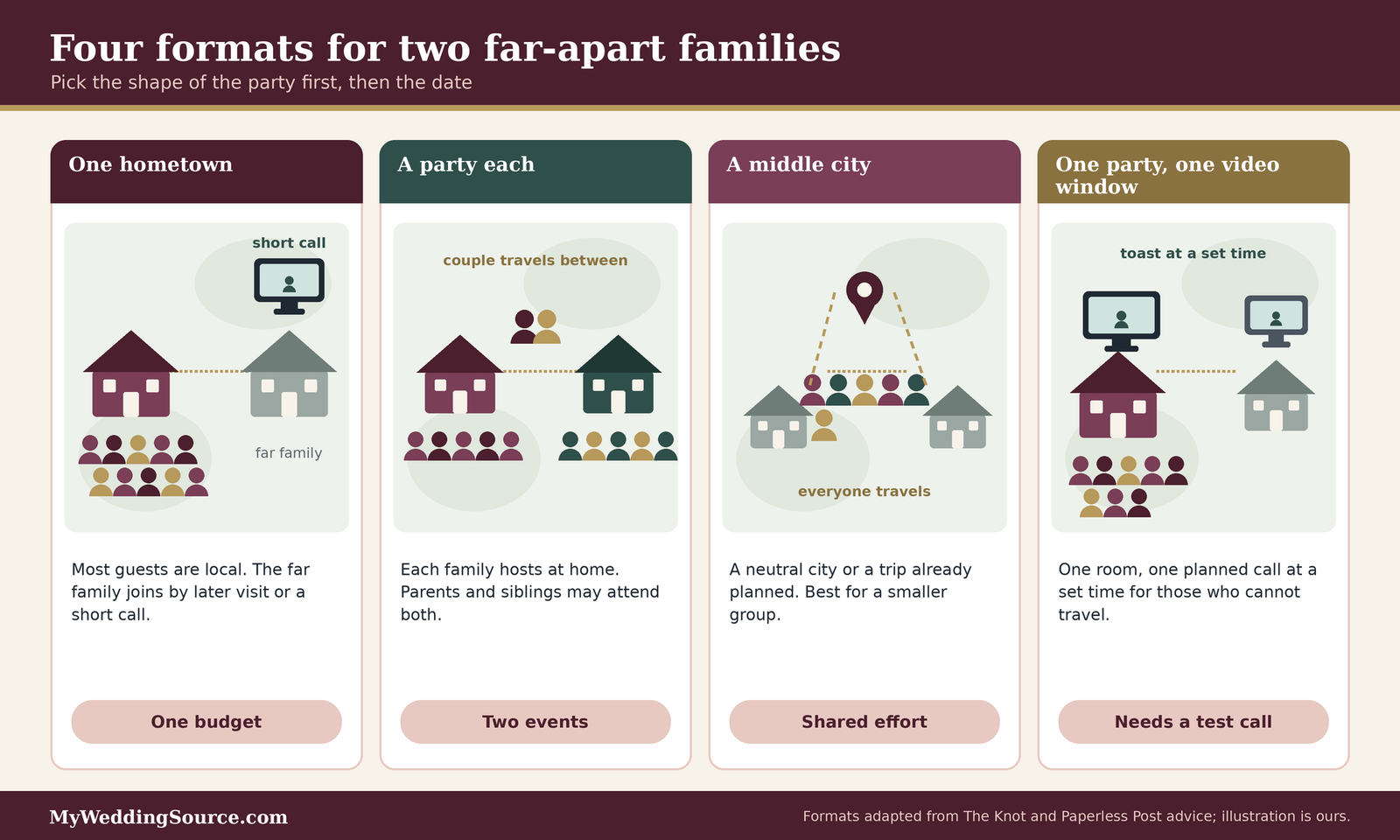
One party in one hometown
The simplest format is a single party in the city where most of the guests live. It means one venue, one budget, and one date. The cost is that the other family’s travel is optional, and some relatives may not be able to come. This format works well when one family is much larger or more local than the other, and when the family farther away has said it is comfortable celebrating through a video call or a later gathering.
A party in each family’s area
The Knot describes this arrangement: each set of parents hosts a party in their own area. Each host handles invitations, food, and venue for the guests they know, and the couple travels between the two. The Knot adds that guests should generally attend only one party, though close family such as parents and siblings can attend both. The trade-off is that the couple attends two events, perhaps on two weekends, and each family sees only part of the other’s world.
A party in a middle city
Paperless Post suggests that if guests are traveling in, you pick a city other than the wedding location to avoid travel fatigue. For parents who live far apart, a middle city can feel fair, but it can also mean that everyone travels and nobody is at home. It tends to suit a smaller group, perhaps parents, siblings, and a few close friends, and it works better when the date lines up with a trip people were already taking.
One party with a planned remote window
A fourth format is one in-person party with a deliberate window for remote guests, such as a video toast at a set time. It is the most flexible format, because it lets a parent who cannot travel take part without needing a plane ticket. It does require some preparation, and we cover that in the remote access section below.
How to choose among them
Choosing is mostly a matter of asking a few plain questions and listening to the answers. It helps to ask them before anyone books anything, because a booking makes the decision for you. We suggest asking each parent, one at a time, which version they would enjoy and which they would find stressful. Parents often tell a single person things they will not say in a group call.
Ask about ability, not only willingness
A parent who says “we would love to come” may still be unable to travel for health, work, or money reasons they would rather not say. Ask in a way that leaves room, such as asking what would make the trip easy for them, and listen for hesitation. If travel is hard, a remote window is not a consolation prize, and it can be planned to feel like part of the day. The TSA says travelers who need screening help can contact TSA Cares, and recommends doing so at least 72 hours before departure, which is a useful reminder that some trips take more planning than a ticket.
Count the people who would come
Before choosing, write a rough list of who would attend a party in each family’s area. Sometimes the numbers decide the question. If thirty people could come to one family’s hometown and six could come to the other, a single party in the larger place plus a small gathering elsewhere is probably kinder than forcing a middle location that suits neither crowd. Our wedding guest transportation planning guide is written for the wedding, but its habit of counting who needs what before booking is a useful one here too.
When a second event is the better answer
Two events can sound like twice the work, and sometimes they are. They can also be less work than one event that tries to please everyone, because each family hosts in a place and style that suits it, and nobody has to compromise on a venue.
A small family dinner plus a larger friends party
The Knot’s idea of a family-focused gathering and a separate livelier friends party is useful for couples whose families are far apart but whose friends are spread out too. A quiet dinner for parents and siblings lets the two families meet properly. A looser party for friends does the announcement job. Keep the two guest lists clearly separate, and keep the invitations clearly worded so nobody wonders which event they are being invited to.
Combining with a trip that already exists
Paperless Post suggests combining the celebration with another occasion, such as a holiday or a birthday, when relatives are already gathering. That is a real saving when parents live far apart. If a grandparent’s birthday already brings both families to one city in the fall, a short engagement toast there can replace a separate trip. Check that nobody feels the occasion has been taken over, and let the person whose occasion it is say yes first.
Decide who hosts, who pays, and who does what
Hosting arrangements are where distance causes the most quiet friction. One family may be more comfortable hosting, the other may be wealthier or less so, and each may have ideas about what counts as generous. The calmest way to handle it is to put names and roles on paper before any money is spent. Money is the part of how to plan an engagement party when parents live far apart that families most often leave unspoken.
Who hosts when families live in different places
The Knot says the bride’s parents traditionally host, and that the groom’s parents may throw their own party later. Zola says that today the hosts may be the couple, close friends, or other relatives, and that there may be several engagement parties. For families far apart, the most useful reading of this is that hosting is local. Whoever lives where the party is happening is usually the most practical host, and the other family can contribute in other ways.
One family hosts and the other contributes
When one family hosts in their own city, the distant family can still have a defined role, such as providing a toast, a dessert, a gift for the couple, or a share of the cost. Naming the role matters because it turns the farther family from a guest into a partner. Emily Post describes a future in-law family offering to host as a kind gesture that gives them a chance to introduce the couple to their friends, which is worth remembering if that family is the one who lives nearer to the venue.
Each family hosts its own party
If each family hosts a party in its own area, each host group decides its own venue and menu, and the couple’s job is mostly to show up and to keep the guest lists from overlapping. Share the date plans early so the two parties do not land on the same weekend, and share the invitation wording so both feel like the same occasion, since a gentle common thread makes the two parties feel like one celebration in two places.
Paying for a party across two households
Zola says that the host is generally expected to cover the bill, and that costs can be split among several hosts, for example one person hosting at home while others cover food or drinks, or everyone sharing the cost of an event space. With two households far apart, the practical question is how to share a bill when only one family is physically there to pay a venue deposit.
What distance can add to the bill
No source we read gives an average engagement party budget for families in different cities, so we will not invent one. The extra costs are easy to name, though: a deposit paid by someone who may not be in town to sign, shipping or carrying decor and food, a travel fare for the couple or a parent, a hotel night, and perhaps a second party. Zola says costs can be split among hosts, so one useful habit is to list each of these lines and write a name beside it before any money moves. Public-property rules can add fees too. Denali National Park, for example, lists a $200 application fee for most events that need a special use permit, and that fee is non-refundable. That is one park’s rule, and others differ.
Split by task or by share
Two common ways to split a bill across two households are by task and by share. By task means that one family handles the venue and another handles food or drinks. By share means that each family pays an agreed percentage, such as half and half, or in proportion to how many of their guests attend. We think splitting by task is easier across distance, because it needs fewer transfers of money and avoids anyone fronting the full deposit.
Whichever you use, write the arrangement in a short message that every host can read. A plain list works well: who pays the venue, who pays food, who pays any rentals, and how any refund is shared. Written down, the plan protects relationships on the days when someone misremembers.
Who holds the deposit
The person whose name is on a venue contract, or whose card pays a deposit, bears the risk if the date changes. Across two households, it is tempting to let the nearest family sign and hope to settle up later. A better habit is to agree, before signing, who is responsible for the deposit and how the other family will reimburse their share, and to send that reimbursement promptly. Our wedding vendor due diligence checklist is about wedding vendors, but its habit of asking for terms in writing applies to any venue.
Gifts of money, and what to say
When a parent in another city wants to help with the cost, it often arrives as money sent to the couple or to the host. The IRS says that for 2026 the annual gift tax exclusion is $19,000 per recipient, and that a gift under that amount is generally not a taxable gift. The same page says the general rule is that any gift is taxable unless an exception applies. Its content does not say how a parent’s payment toward a party is treated, so treat the figure as background and ask a tax professional about your own situation. We do not give tax or legal advice.
Keep the money conversation short and kind
Offering to help with a cost is a form of love for many parents, and it is easy to hurt feelings by seeming to refuse. A plain reply works: thank them, say what the money would cover, and tell them how you will share the final bill. If you decline, decline warmly and offer them a role, such as a toast, instead.
Be careful with group chats about money
Money conversations belong in a one-to-one call or a small message thread, not in a chat with every relative on it. Our guide to wedding party group chat rules explains how to keep a shared thread useful, and the same discipline helps here. If a parent shares a card number or a bank detail, move it out of the chat and into a safer channel.
Who does what: a plain job list
Distance makes it important to name an owner for each job, because nobody can see that a job is undone. Owners are central to how to plan an engagement party when parents live far apart. A shared note with a named owner and a due date beside each job helps more than any app.
Five jobs that need a name
Most engagement parties need five jobs covered: the venue or space, the food and drink, the invitations and RSVPs, the guest list, and the day-of host who greets people and watches the clock. For a party with a remote window, add a sixth: someone who runs the video call. Give each one an owner and a backup, and write down the names where both families can see them.
Choose a point person on each side
A single point person for each family keeps messages from multiplying. The couple can be that person, or a sibling or close friend can. What matters is that when something changes, one person tells one other person, and that person tells their family. It is a small structure that prevents the most common confusion, which is two versions of the plan circulating at once.
Build one guest list across two cities
The Knot and Zola both say that everyone invited to an engagement party should also be invited to the wedding, because otherwise guests may feel slighted. Zola adds that exceptions include destination weddings, where fewer people can attend, and small weddings paired with larger engagement parties, and it advises being honest and tactful. That rule matters more when families live far apart, because each side will invite from a circle the other side does not know. Guest lists are where how to plan an engagement party when parents live far apart gets personal.
Merge two lists without losing track
The easiest way to keep two lists honest is to keep them in one document that both families can see. Merge, count shared guests once, and mark each person with a family tag and a city. Our guide to wedding planning password sharing covers how to share a document without sharing a password, which is worth reading if the list contains addresses and phone numbers.
Use one sheet with a city column
A column for city or time zone does three jobs at once. It shows who is within driving distance, it shows who will need a remote option, and it shows how the room divides if you hold two parties. Add a column for whether each person is on the wedding list too, so that the one rule is easy to check. A sheet like this takes an hour to build and saves many conversations.
Decide what counts as the wedding list
Because engagement parties often happen before a wedding guest list is final, you may not know yet who is coming to the wedding. We suggest drafting a rough wedding list first and marking each name as sure, likely, or uncertain. Invite only the sure and likely names to the party. That keeps the party list honest without forcing anyone to commit to a wedding invitation in writing too early.
Splitting guests by distance
Distance sorts guests into three groups, and each group needs a different invitation. People near the venue can simply come. People who could travel need early notice. People who cannot travel need a way to take part or an easy way to send a note and feel included.
Near guests
For guests within a short drive, the invitation is the ordinary one: date, time, place, what will be served, and whether gifts are welcome. Paperless Post says to note on the invitation what will be served, such as cocktails and light bites or a full dinner, so guests can plan. A plain statement saves guests from guessing whether to eat first.
Guests who could travel
For guests who might fly or drive a long way, send invitations early. Zola says that it is ideal to send invitations as soon as possible, so guests can arrange travel and time off. Paperless Post suggests sending about four to six weeks ahead, with online invitations going out closer to four weeks. For travelers, we suggest leaning toward the longer end of that range, and sending a short message first, since a friendly heads-up lets people check their calendars before they decide.
Out-of-town guests and the travel fatigue question
An engagement party is a smaller occasion than a wedding, and guests may not want to fly for it. Treat attendance as a real choice for them. A message that says “we would love to see you, and no pressure at all if travel is hard” makes saying no easy, and it keeps the invitation from feeling like a demand.
Say plainly that remote is welcome
If you plan a remote window, say so in the invitation, with the time in each relevant time zone. Guests who cannot travel will usually be relieved to see a clear way to join. Guests who can travel will also know they have a choice.
Remember the gift question
Emily Post says gifts are not obligatory at an engagement party, though bringing one is now customary in many parts of the country, and that some couples ask the host to tell guests not to bring presents. For far-away guests, a line on the invitation saying gifts are not expected spares them from shipping something. Our upcoming engagement party gift expectations guide covers this question in depth.
The two-family coordination schedule, with remote access built in
This is the working centerpiece of the guide. It is a countdown from the day you choose the format to the week after the party, and it has three lanes: what Family A does, what Family B does, and what the remote guests need. It is a suggestion drawn from the sources we read and our own judgment, not a rule, and you should shift any step to suit your families. Treat it as a template for how to plan an engagement party when parents live far apart, and edit it freely. The anchors that come from named sources are invitations about four to six weeks ahead (Paperless Post), a party window between one week and three months after the proposal (Zola), a latest date of about three months after the engagement (The Knot), and a 72-hour call to TSA Cares for travelers who want screening help (TSA).
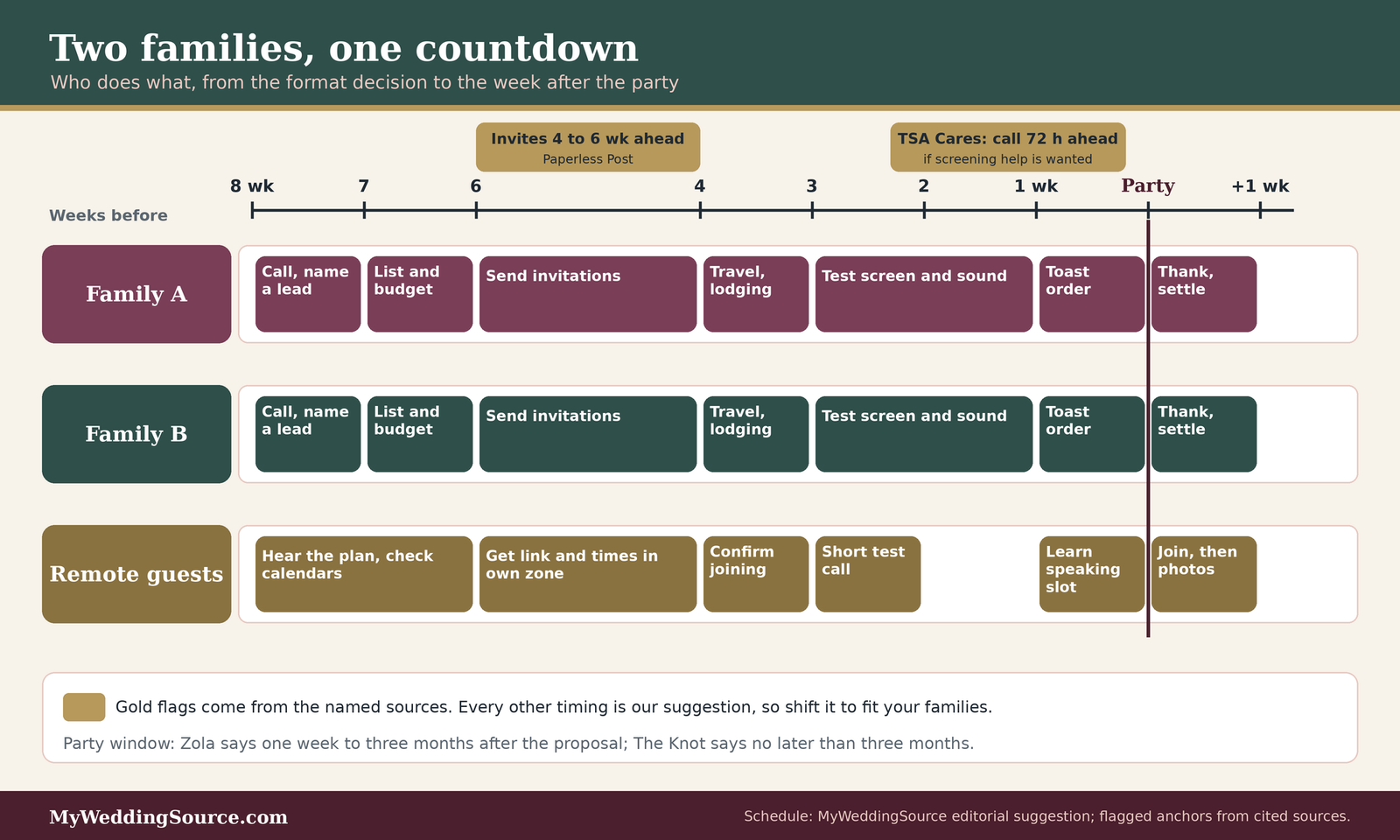
Eight weeks out to six weeks out: decide
The first stretch is about conversations, not purchases. Nothing is booked until the format is agreed.
Eight weeks out: call each parent, then the group
Start with separate calls to each set of parents, to learn who can travel, who wants to host, and what each would find stressful. After that, hold one short group call, or send one written summary, naming the format you have chosen. Ask each family for a point person. Put every decision in writing the same day, so nobody remembers the call differently.
Seven weeks out: budget, guest list, and date
Share the rough budget by task, as described earlier, and build the single guest list with the city column. Choose two or three possible dates and check them with the people whose presence matters most. If a grandparent or a parent with a long trip is involved, their calendar decides. Do not announce a date to the wider circle until those people have said yes.
Six weeks out to two weeks out: invite and prepare
This is the middle of the schedule, where invitations go out and the remote plan takes shape.
Six to four weeks out: send invitations
Paperless Post says to send invitations about four to six weeks ahead, and that online invitations can go out closer to four weeks because they arrive instantly. Include the date, the start time in each relevant time zone, the place, what will be served, a note about gifts, a way to RSVP, and a line about the remote window if there is one. Zola warns that when invitations are sent by email, you need an RSVP system, so choose one and tell both families which one it is.
Four to three weeks out: confirm travel and lodging
Ask travelers to tell the host person when they have booked. If a relative needs a place to stay, help find one near the venue. If anyone wants help at airport screening, remind them that TSA Cares can be reached at (855) 787-2227 and that the TSA recommends calling at least 72 hours before departure. For airport wheelchair service, the TSA says to contact the airline, because TSA does not provide it.
Three to two weeks out: test the remote setup
If you plan a remote window, run a short test with the remote guest and the person who will run the call. Check sound, camera angle, the time of the link, and who will mute and unmute. We say more about this in the remote access section. A fifteen-minute test now prevents most of the problems that show up on the day.
Two weeks out to the party
The last two weeks are about the order of the day, not new ideas. Keep changes small.
The week before: script the toast and the day
Agree on who speaks, in what order, and for how long. Zola says the toast typically comes from the hosts, then the parents of the engaged couple. With two families in different places, we suggest sharing the order with each speaker a week ahead, and arranging for a remote parent to speak at a set time so the call is not left waiting. Share a one-page run of the day with both families.
The day before: confirm the small things
Confirm the venue time, the food delivery or shopping, the chairs, the screen or tablet, the charger, and the link. Tell the remote guests when the link opens, and remind them of their local time. Charge devices, and put a backup phone number on the one-page plan.
The day itself and the week after
The party and the week after it are where the two families see the plan work, and where a few kind gestures matter more than any decoration.
On the day: one host owns the clock
Name one person to watch the time, start the video call, and cue the toast. If you have a remote window, assign a second person to be the remote guests’ friend in the room, who points the camera, turns the screen toward the toast, and checks in on the call between speeches. That one assignment makes remote guests feel present.
The week after: thank, share, and settle
Send thank-you messages promptly to hosts and guests, and mention remote guests by name. Settle any shared costs, and share a handful of photos with people who could not come. Photos of guests should only be shared with their permission, as discussed later. A short note to each parent about what their part meant to you is worth more than any gift.
The schedule in one place
How to read the table
For couples who like a printable view, the table below puts the steps in order with an owner for each lane. The timing is our suggestion, and the sources behind the anchors are named above.
| When | Family A | Family B | Remote guests |
|---|---|---|---|
| Eight weeks out | Take the call, name a point person | Take the call, name a point person | Told the plan is coming |
| Seven weeks out | Share guest names with city | Share guest names with city | Check calendars |
| Six to four weeks out | Send invitations to their circle | Send invitations to their circle | Receive link and time zones |
| Four to three weeks out | Confirm travel and lodging | Confirm travel and lodging | Confirm they will join |
| Three to two weeks out | Test the screen and sound | Test the screen and sound | Join a short test call |
| One week out | Share toast order | Share toast order | Learn their speaking time |
| Day before | Confirm venue and food | Confirm travel arrivals | Receive reminder with link |
| Party day | Host owns the clock | Greeter helps travelers | Join at set time |
| Week after | Thank and settle costs | Thank and settle costs | Receive photos with permission |
Where to shift it
If your party is only a few weeks away, compress the first rows rather than skipping them. Keep the order, because the decisions earlier in the table feed the ones after it. If your party is more than two months away, add a check-in call around the midpoint so that the plan does not go quiet.
Remote access: make the parent who cannot come part of the room
A remote window can be the best feature of a long-distance engagement party or an awkward fifteen minutes, depending on planning. The difference is mostly preparation. This section covers the platform, the time, access needs, and privacy. Remote access is the part of how to plan an engagement party when parents live far apart that most changes the day.
Choose a method and test it
A video call is the most common method, but a phone call on speaker, or a prerecorded message played at the party, can also work. Choose the method that your remote guests are comfortable with, not the one that looks most polished. A parent who has never used a video app may prefer a plain phone call.
Pick the simplest tool your guests already use
Ask remote guests what they already use and choose from that. Google Meet, for example, offers captions that guests can turn on, and its translated captions are limited to certain Google Workspace editions according to Google’s help page. Features differ by plan and change over time, so check the current page for the tool you choose. We did not retrieve the steps for other platforms, and we do not endorse one.
Do a real test, not a hope
A real test means joining from the same device your guest will use on the day, from the room they will use, at roughly the same hour. Check that the guest can hear the room and that the room can hear the guest. Also check how the link behaves when the host joins late. It is better to find out two weeks ahead than at the toast.
Time zones and the right hour
A party time that works for the host may be the middle of someone else’s morning. Clocks are an easily missed part of how to plan an engagement party when parents live far apart. A little arithmetic helps. In the contiguous United States, Central Time is one hour behind Eastern, Mountain two hours behind, and Pacific three hours behind. A 4 p.m. Eastern party is therefore 3 p.m. Central, 2 p.m. Mountain, and 1 p.m. Pacific. That is our own arithmetic, offered as an estimate, so confirm the offsets for your date and any location that does not observe daylight saving time.

Choose a start that falls in everyone’s waking hours
Assume a comfortable window of about 8 a.m. to 10 p.m. in each guest’s place. That is our assumption and families differ. If your parents are three hours apart, any Eastern start between 11 a.m. and about 7 p.m. keeps a three-hour party inside everyone’s window. Paperless Post says weekend evenings are preferred, with a two- to four-hour window. For cross-country families, an early evening Eastern start can be a mid-afternoon Pacific start, which is often a friendly compromise.
Write times in each zone on the invitation
Do not make guests do the arithmetic. Write the time in each relevant zone, such as 4 p.m. Eastern and 1 p.m. Pacific, and name the zone in words. That small step prevents the common mistake of someone joining an hour early or late.
Access: captions, sound, and clear instructions
A remote window should be easy for everyone to use, including a grandparent who is hard of hearing. Planning for access is part of how to plan an engagement party when parents live far apart in a way that includes everyone. SF.gov’s guide to hosting an accessible event says that announcements should describe accessibility features, and that communication options can include captioning and virtual accessibility. It also recommends a written access plan so that staff and attendees can find the information easily.
Offer captions and a phone option
Turn on captions if your platform offers them and tell guests how to find them. Offer a plain phone number as an alternative way to dial in, if your platform supports it. In a room with a lot of conversation, keep the microphone close to whoever is speaking and ask people to take turns. These small steps help everyone, not only guests with a hearing difference.
Say how to ask for help
Put a line in the invitation telling guests whom to contact if they need something to take part, such as a different seat, a captioned link, or a ride from the airport. Naming a person and an email or phone number is better than a general invitation to “let us know.” Our guide to an accessible wedding guest experience goes deeper on this habit.
Recording, photos, and privacy
It is natural to record the toast for a parent who cannot attend. It is also worth treating recording as something guests agree to, not something that happens to them. Our editorial rule is plain: do not secretly record anyone.
Ask before recording or streaming
The Digital Media Law Project’s page notes that each state has its own wiretapping law and sets its own rule about how many parties must consent to recording a conversation. The page says it is no longer updated, so check current rules for your state before relying on it. In practice, tell people at the start that the toast is being shared on a video call, and offer a way to step out of frame.
Decide where photos will go
Before the party, decide whether photos will be posted online and where. Ask hosts, and tell guests with a sign or a short announcement. Some guests, including people with safety concerns, may not want to be posted. If you are unsure, send photos privately to the people who appear in them. Our guide to wedding planning website privacy and security covers how to keep names, addresses, and photos from reaching people you did not intend.
Travel and logistics for parents who are coming in
When a parent or grandparent travels for the party, the logistics deserve as much thought as the menu. A trip that feels easy for a younger relative may be a long day for an older one, and small details such as a ride from the airport matter. Travel details are easy to overlook when you are learning how to plan an engagement party when parents live far apart.
Getting people there and home
Ask each traveler what would make the trip easy. Some will want a ride, some a flexible time, some a room close to the venue. Do not assume. Our wedding transportation guide covers the wedding case, and the habit of asking first applies to a smaller party too.
Airports and screening help
The TSA says travelers who want screening help can call TSA Cares at (855) 787-2227 and request a Passenger Support Specialist, and that requesting one does not exempt a traveler from screening. TSA recommends contacting TSA Cares at least 72 hours before departure. For airport wheelchair service, contact the airline. Pass this information on to relatives who might want it, without assuming that they do.
Rides, stays, and the day of arrival
Plan the first hours after arrival as carefully as the party. A traveler who lands at noon and attends a four o’clock party may be tired. If possible, offer a quiet place to rest, a simple meal, and a clear plan for how they will get back to their lodging. Leave time between events.
A place to stay
A place to stay can turn a draining trip into a pleasant one. Choose lodging close to the venue where you can, with step-free access if anyone needs it.
Home stays and hotels
Staying with family saves money and adds time together, but it can also add stress if the home is busy. A hotel gives rest and privacy. Offer both, and let travelers choose. If a family member is staying in a guest room, ask about their preferences, such as bedding, noise, and meal times.
Who pays for the stay
Nothing we read says who pays for guest lodging at an engagement party, so treat it as a family decision. State it clearly before booking, so no one feels awkward at checkout. If one family is covering lodging, tell guests so they do not feel they should offer to pay.
Keeping the trip short and kind
A short, kind trip beats an ambitious one. Think about what is the minimum people need to feel the occasion was real.
One shared meal can be enough
If time is short, a single shared meal can do the job of a weekend. Paperless Post says a party window of two to four hours is typical. A dinner the evening before or a brunch the next morning gives families time to talk without a long program.
Leave room for rest
Build in a break between events, and avoid scheduling two long events in a row. Older relatives, children, and people who have traveled all day will all appreciate a quiet hour. A schedule with room in it feels generous.
Venue, food, and public property
The venue is the part of the plan most affected by who is nearby and who is paying. Venue choice shapes how to plan an engagement party when parents live far apart more than almost any other single decision. Home, restaurant, and park each carry different rules, and each is different when the host is not the one who lives closest.
Home, restaurant, or public space
A home is the cheapest and most flexible choice, and it needs someone local to host. A restaurant moves the work to the staff but adds a minimum spend and a fixed schedule. A park or public space adds permit questions. For a home party, our engagement party at home guide covers the details of space, food, and flow.
When the host is far from the venue
If the person paying does not live near the venue, give a local person the keys to the day: someone who can meet a delivery, unlock a door, and handle a surprise. A sibling, cousin, or close friend is a good choice. Pay them in thanks, not in tasks they did not agree to.
Restaurants and rooms with their own rules
A restaurant or hotel room usually has a contract or a policy. Ask for it in writing, and ask about deposits, minimums, cancellation terms, and food allergies. The Americans with Disabilities Act applies to businesses that serve the public, according to the ADA’s Title III primer, which lists restaurants and hotels among the covered places. The primer does not address event hosts or private homes, so ask the venue what accessibility features it has.
Parks and public property
Some couples choose a park for a casual engagement party. Public-property rules are one more local detail in how to plan an engagement party when parents live far apart. Public-property rules vary widely, and a little checking prevents an awkward moment. If you are planning a picnic, our proposal picnic setup guide covers the practical side, and our proposal location permissions guide covers how permits work.
What one national park says
As one example, Denali National Park’s page says a special use permit is generally required for events or ceremonies with more than twelve people at any location in the park, and that applications should be submitted as far in advance as possible. It lists a $200 application fee for most events, which is non-refundable, and says ceremonies may not impede other visitors and may not use rope or blocks to close an area. It also prohibits littering, including releasing balloons and throwing rice, birdseed, or flower petals. That is one park’s rule, not a national standard, so confirm the rules for the place you choose with the managing office.
Photography and guests
The Denali page we read does not address photography. Photography rules for public property and for private venues vary, and a professional photographer may need a separate permit or agreement. Ask the property office before you hire one. Our wedding permits guide covers how to find out which office handles an event.
Food safety when you are not at home
Food that travels from one place to another has more chances to be left out too long. The FDA says to discard perishable food left at room temperature for more than two hours, or one hour if the temperature is above 90 degrees Fahrenheit. It says to keep hot food at 140 degrees or warmer and cold food at 40 degrees or colder. The USDA says the same 2-hour and 1-hour limits apply and that coolers should be kept out of direct sunlight.
Serve small portions and swap dishes
The FDA suggests serving small portions and replacing dishes instead of topping them up, because hands and room temperature allow bacteria to grow. Put out less, and bring out more from a cooler or oven. That keeps a buffet safe while a party stretches over several hours.
Plan around allergies and diets
When guests come from many places, you may not know their dietary needs. Ask on the RSVP, and label dishes at the party. Our wedding dietary restrictions guide explains how to gather this information without making anyone feel singled out. We are not giving medical advice, and anyone with a serious allergy should decide for themselves what is safe.
Edge cases and hard situations
Real families rarely fit a template. These situations come up often enough to deserve a plain answer, and none of them has a rule in the sources we read, so what follows is our judgment, offered as options. The thread running through them is how to plan an engagement party when parents live far apart without making either family feel like a guest.
When the parents do not know each other, or do not get along
Distance often means the two sets of parents have never met. That is a common wrinkle in how to plan an engagement party when parents live far apart. It can also mean they have met and the meeting was tense. In either case, the party should not be the first moment they have to perform.
A short introduction before the party
We suggest a separate introduction beforehand, because everyone is busy mingling at the party and there is little room for a real conversation. With parents far apart, a short video call between the two sets, even ten minutes, can serve as that introduction. Keep it informal, and have the couple present to steer the conversation.
Two parties instead of one
If the relationship between the families is strained, two separate parties may be the kind choice. The Knot describes parents hosting a party each in their own area. Neither family has to share a room, and both can celebrate on their own terms. Do not read this as failure, because a smaller, calmer party often serves the couple better than a forced reunion.
When a parent cannot travel
Sometimes a parent cannot travel because of health, money, work, or caregiving duties. They may not say so directly. The goal is for them to feel included without having to explain.
Bring the party to them
A small gathering where the parent lives, even a lunch with a few relatives, can serve as their party. The couple can travel to them, with other relatives invited locally. Pair it with a remote window at the larger party so both events feel connected.
Plan a remote role that matters
Give the parent a real role, such as a toast at a set time, a recorded message, or a story shared with the group. A role makes them part of the program, not just an audience. Check with them first, because some people are shy on camera and would rather send a letter to be read aloud.
When the parents are divorced or remarried
Families with divorced or remarried parents add more people, more households, and sometimes more tension. The same basic structure applies, with more care about who sits where and who speaks. Our guide to family photo combinations when parents are divorced is written for wedding photos, and its habit of asking each person what they are comfortable with applies here.
Ask each household separately
Talk to each household on its own, and ask about seating, speaking order, and photos. Do not announce a plan to the group that one person has not heard first. If two parents prefer not to share a table, seat them at separate tables and keep the layout calm.
Keep the toasts simple
If a speaking order is delicate, shorten it. Zola says the toast typically comes from the hosts, then the parents of the engaged couple. A shorter version, such as one host and one parent from each side, avoids a long list that can create new problems.
When the schedule slips or plans change
Distance makes changes more costly, because a change in one place may affect flights and bookings in another. A short plan for changes helps. Contingency thinking is part of how to plan an engagement party when parents live far apart too.
If the date moves
If the date changes, tell everyone through the same channel at the same time, and say plainly which parts are fixed and which are open. Check whether any deposit is refundable before you decide. Avoid changing the date more than once if possible, because each change forces travelers to rebook.
If someone drops out late
If a parent or key guest cannot attend at the last minute, decide quickly whether to go ahead, shift to a remote window, or move the party. Usually, going ahead with a remote role for the absent person is the least disruptive. Keep the tone warm and avoid blame.
When one family hosts and the other feels left out
A common risk is that the family farther from the venue feels like a guest at their own child’s party. Avoiding that is a quiet goal of how to plan an engagement party when parents live far apart. Give them a role, share the plan early, and ask for their input on one or two decisions, such as a song or a toast.
Offer a real choice
Offer choices that matter, such as the menu theme, the toast order, or a guest list addition. Avoid asking for input on decisions you have already made, because that is worse than not asking.
Mark their presence
Mention the distant family in the toast, display a photo of them if they are not there, and invite them to send a short message or video to be shared. These small gestures are inexpensive and are often remembered longer than the party itself.
Questions to ask before you commit
Questions to ask hosts, venues, and travelers
- To each parent: Would you rather travel for this, or celebrate where you are, and what would make either easy?
- To each parent: Who is your point person, and how should we reach them?
- To the venue: What are the deposit, minimum spend, cancellation terms, and what is the policy on outside food, decor, and recording?
- To the venue: What accessibility features are there, such as step-free entry, restrooms, and parking, and can you describe them in writing?
- To a public-property office: Does a group of this size need a permit, what is the application fee, and what are the rules on decorations, balloons, and photography?
- To the host who is traveling: Who will hold the keys, meet deliveries, and handle problems on the day?
- To remote guests: What do you already use for video, and can we do a short test call two weeks ahead?
- To all hosts: How will we split costs, and who will reimburse whom by when?
Using the questions well
The questions are only useful if the answers are written down. Written answers keep how to plan an engagement party when parents live far apart from turning into a game of telephone. Keep a shared note with the date of each answer and the person who gave it, so disagreements about what was said can be settled by looking.
Ask in writing when you can
A short email after a call, summarizing what you heard, gives the other person a chance to correct it. It also gives you a record. With distance, the record is often the only place both families can see the same plan.
Note anything you could not confirm
If someone says they will check and get back to you, put the follow-up date in the note. A question left open tends to become a surprise later. Write down what is still unknown and who will find out.
Know when to simplify
If the plan has become heavy, simplify. Simplicity is a legitimate answer to how to plan an engagement party when parents live far apart. A smaller party, a shorter program, or a single family hosting can be a relief to everyone. The party exists to celebrate the engagement, and any plan that makes people anxious has drifted from its purpose.
What to cut first
Cut the parts that add stress and little joy: a long program, a complicated menu, an elaborate remote setup. Keep the toast, the food, and the people. These carry the occasion.
What to keep
Keep the clear invitation, the named owners, the test call, and a kind note afterward. Those few habits carry most of the value of this guide on how to plan an engagement party when parents live far apart.
Frequently asked questions
Hosting and money
Who hosts an engagement party when parents live in different states?
Zola says there is no one right way to decide, and hosts can be the couple, friends, or relatives. The Knot says each set of parents can host in their own area. Choose by who lives near the venue and who wants the role, then name what the other family will contribute.
Who pays for an engagement party when two families are far apart?
Zola says the host is generally expected to cover the bill, and that costs can be split among hosts, such as one hosting at home while others cover food or drinks. Agree on a split by task or by share before anything is booked, and write it down.
Do we need to hold two parties?
No source we read requires it. The Knot describes parents each hosting in their own area, and Paperless Post suggests two parties if friends and family live in different cities. One party with a remote window is also an option. Pick the format that fits your guests and your energy.
Timing and guests
How soon should we hold it?
Zola gives a window of one week to three months after the proposal and says one to four weeks suits local guests. The Knot says no later than three months and suggests avoiding the first month. Emily Post says hosts can choose. Let the calendar of your key guests decide.
When should invitations go out?
Paperless Post says about four to six weeks ahead, with online invitations closer to four weeks. Zola says to send them as soon as possible so guests can arrange travel and time off. For people traveling a long way, send a friendly heads-up first, then the formal invitation.
Who should be invited?
The Knot and Zola both say that everyone invited to the engagement party should also be invited to the wedding. Zola notes exceptions for destination weddings and small weddings, and advises honesty and tact. Build one list with a city column and check each name against the wedding list.
Remote access and safety
How do we include a parent who cannot travel?
Give them a real role, such as a toast at a set time, and test the connection two weeks ahead. Write the time in their zone, offer captions and a phone option, and put someone in the room who looks after them on the call. Check that they are comfortable on camera.
How long can food sit out at the party?
The FDA says to discard perishable food left at room temperature for more than two hours, or one hour if it is above 90 degrees Fahrenheit, unless it is kept hot at 140 degrees or warmer or cold at 40 degrees or colder. Swap dishes rather than topping them up.
Your next steps
Start the conversations
Call each parent this week
Ask each parent separately what they would enjoy, who can travel, and whom they would like to be their point person. Keep notes, and send a short written summary afterward. Our wedding planning checklist puts this step in the wider plan. That call is the first real step in how to plan an engagement party when parents live far apart.
Choose the format and a date window
Pick one of the four formats and two or three possible dates, and check them with the guests whose presence matters most. This is the decision everything else in how to plan an engagement party when parents live far apart depends on. Our wedding etiquette guide and engagement announcement guide help with the wording.
Build the plan
Fill in the schedule
Copy the coordination schedule into a shared note, and put a name and a date beside each step. Share it with both point people. Our wedding weekend event planning guide shows how the same approach scales for a larger event.
Plan the photos and the keepsakes
Decide who will take photos and whether you will hire a photographer. Our engagement photos guide and engagement announcement photo session guide cover the options, and our wedding budget guide helps you keep the costs honest.
Sources & methodology
How we built this guide
What we relied on
This guide on how to plan an engagement party when parents live far apart combines etiquette advice from The Knot, Zola, Emily Post, and Paperless Post, food-safety guidance from the FDA and USDA, travel-support guidance from the TSA, accessibility guidance from SF.gov and the ADA’s Title III primer, a gift-tax page from the IRS, a public-property example from the National Park Service, and a page on recording laws from the Digital Media Law Project. Where a statement comes from a company, we say so, because company advice reflects its own products and habits. The time-zone arithmetic and the schedule are our own estimates and suggestions, not sourced rules. We checked these pages in November 2026, and we cannot vouch for anything that changed after that.
What we did not do
We did not test video platforms, contact venues, or speak with families. We did not give legal, tax, medical, or travel advice. Park rules, recording laws, and venue policies vary, so confirm them with the managing office, venue, or an attorney. Etiquette sources describe customs, not rules.
Source list
Government, regulatory, and public-institution sources
- National Park Service, Denali National Park, Weddings, ceremonies, and gatherings: https://www.nps.gov/dena/planyourvisit/weddings-ceremonies-and-gatherings.htm
- Transportation Security Administration, Passenger support: https://www.tsa.gov/travel/passenger-support
- U.S. Food and Drug Administration, Food safety for parties and buffets: https://www.fda.gov/food/resourcesforyou/consumers/ucm328131.htm
- U.S. Department of Agriculture, Food Safety and Inspection Service, Keep clear of the danger zone: https://www.fsis.usda.gov/news-events/news-press-releases/usda-urges-consumers-keep-clear-danger-zone-summer
- Internal Revenue Service, Frequently asked questions on gift taxes: https://www.irs.gov/businesses/small-businesses-self-employed/frequently-asked-questions-on-gift-taxes
- U.S. Department of Justice, ADA Title III primer: https://www.ada.gov/resources/title-iii-primer/
- City and County of San Francisco, Host an accessible event: https://sf.gov/step-by-step/host-accessible-event
- Digital Media Law Project, Recording law: https://www.dmlp.org/node/1289
Etiquette, planning, and platform sources
- The Knot, Who hosts an engagement party: https://www.theknot.com/content/whos-hosts-engagement-party
- Zola, Who hosts an engagement party: https://zola.com/expert-advice/who-hosts-an-engagement-party
- Emily Post, Engagement party timing: https://emilypost.com/advice/engagement-party-timing
- Emily Post, Engagement party gifts: https://emilypost.com/advice/engagement-party-gifts
- Paperless Post, Engagement party 101: https://www.paperlesspost.com/blog/engagement-party-101
- Google Meet Help, Use captions in Meet: https://support.google.com/meet/answer/9300310