

Wedding engagement photos are worth planning when you know what you want from them, which usually means a few usable images for save-the-dates and your wedding website, a low-stakes rehearsal with your photographer, and a record of this stretch of your life; they are just as reasonable to shrink or skip when budget, comfort or time says otherwise.
Somewhere between the proposal and the first vendor meeting, someone asks whether you are doing an engagement session. Your photographer may offer one as part of a package, your mother-in-law-to-be may already have a frame picked out, and your feed is full of couples laughing in wheat fields. Underneath the question are several smaller ones: do you need these photos at all, how far ahead of your save-the-dates should they happen, what do they cost, and what does the contract say about who can print and post them?
This guide answers those in the order most couples meet them. It starts with whether a session earns its place, then covers timing against your save-the-dates and the sun, locations and permission, outfits and comfort, the shots worth prioritizing, and what a session really costs once extras are counted. The back half covers package and contract questions, the practical ways to use the photos, and how the session doubles as a rehearsal for the wedding day. It stays on the engagement session itself; if your question is about the wedding-morning reveal, our companion piece on wedding first look photos handles that separately.
One honest limit before we start. The big wedding surveys report what couples spend on wedding-day photography, but they do not publish a price or a participation rate for engagement sessions, so the session prices below come from marketplace data and photographer-sourced articles. Treat them as ballparks for a conversation with a local photographer, not as a quote for your city.
Do You Need Engagement Photos, and What Do They Actually Do?
Nobody checks whether you had an engagement session, and no vendor or venue requires one. What you are really deciding is whether a few hours of photography now will make later decisions easier, cheaper or calmer. This section lays out what a session gives you, when it makes sense to scale back, and what lighter options exist.
What does a session give you that your phone camera does not?
Which uses actually justify the session?
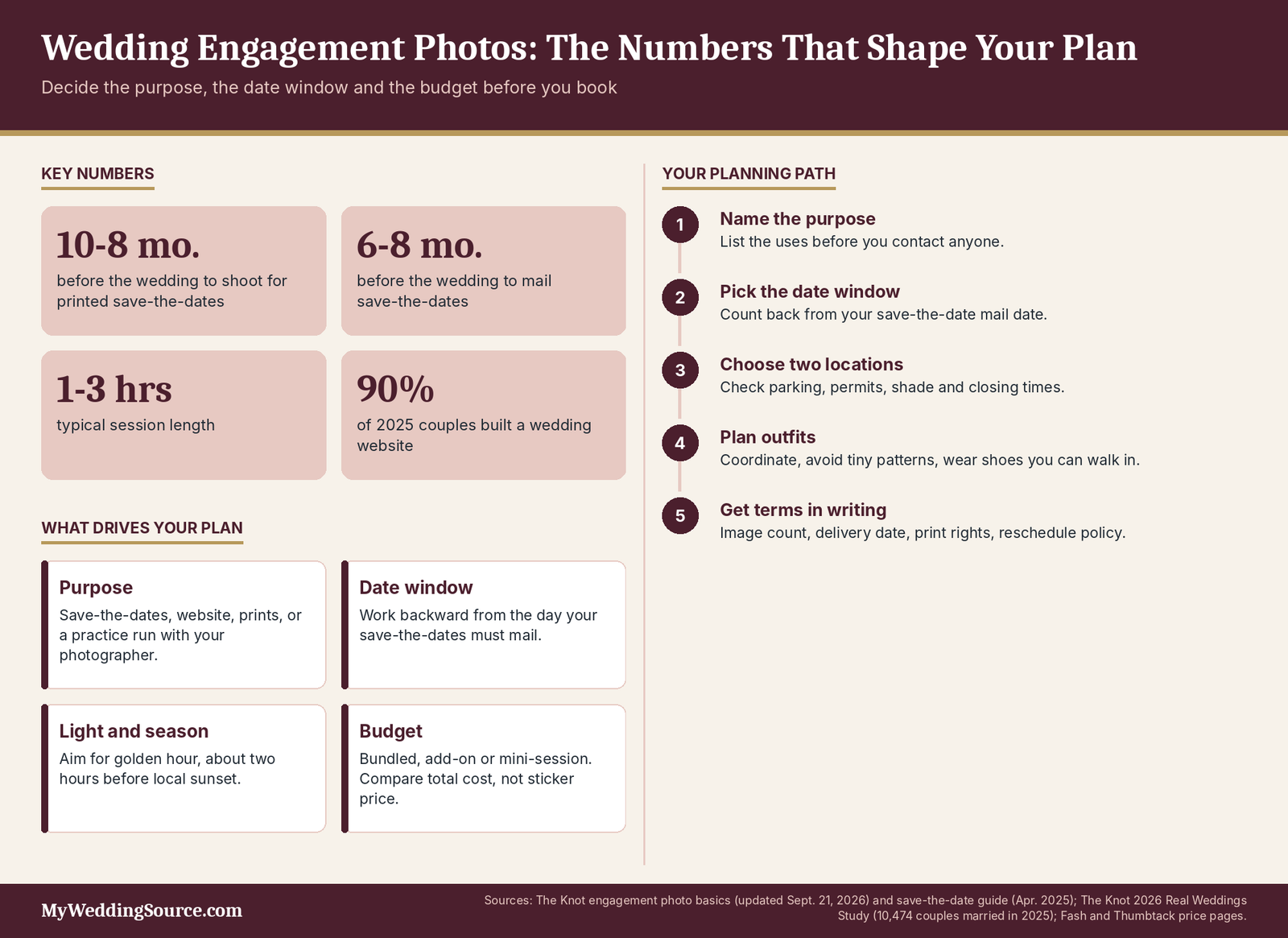
The strongest reason is a set of consistent, well-lit images you can reuse. The Knot’s guide to engagement photo uses (updated September 2026) lists framed prints, a coffee-table album, save-the-date cards and a wedding website as the common destinations. The website matters more than it sounds, because The Knot’s 2026 Real Weddings Study, which surveyed 10,474 U.S. couples married in 2025, found that 90% of couples created a wedding website. A site with one crisp hero photo reads as more finished than a stretch of cropped selfies, and your guests will visit it more than once. If none of those uses appeals to you, the case for a paid session gets thinner.
How does a session help you practice for the wedding day?
A session is a trial run for being photographed by a particular person. The Knot’s piece quotes photographer Clane Gessel, who has shot more than 500 weddings, describing engagement sessions as a dress rehearsal for wedding-day photos, and photographer Alexander Johnnides notes that couples get to see how a wedding portrait session will work. You learn how your photographer gives directions, how long you can stand being asked to look at each other, and which of your habits show up on camera. Most couples are more relaxed the second time a stranger points a lens at them, which is exactly the point. If you have not chosen a photographer yet, the session can also function as a paid audition, though that works best when you agree on the terms in advance.
When is it reasonable to skip them or scale back?
What if budget, comfort or time says no?
Skipping is a legitimate choice, and it does not mean your photos will be worse. The Knot’s guide presents the session as an optional, recommended step rather than an expectation, and a short engagement can make it logistically awkward. If the money is better spent on wedding-day coverage hours, that is a defensible call, especially since The Knot reports an average photographer spend of $3,000 for 2025 weddings and 88% of couples hiring a professional. Comfort counts too: if being photographed makes one of you dread the whole thing, a smaller version beats a full production that leaves both of you tense. Nothing about your relationship is documented any less because you skipped a golden-hour shoot.
What are the lighter-weight options?
You can scale a session down without abandoning it. Ask for a 30-minute mini-session, which Thumbtack’s listings show some photographers offer at a lower price point (one Kansas City listing on the page is 30 minutes for $199, as an example of format rather than a typical rate). Ask your wedding photographer to fold a short portrait stop into a venue walkthrough or tasting, since The Knot notes that sessions at your venue help you learn the space. Or shoot a few frames yourselves with a tripod on a timer for a casual website image, and keep the paid photography for the day itself. The aim is a small number of images you like, in a format you can use, at a cost you did not have to rationalize.
When to Schedule Engagement Photos Around Save-the-Dates and Your Wedding Date
Timing is the part couples most often get wrong, usually by booking the session after the save-the-dates are already due. Because printed pieces need editing, design, proofing, printing and mailing, the photo date is really a deadline set by your stationery schedule. This section works backward from the wedding and then adjusts for light and season.
How far before the wedding should you shoot?
What do the published windows say?
Two photography sources give a similar answer with different framing. The Knot’s basics page suggests shooting six to four months before the wedding in general, and about 10 to 8 months out if the images will appear on save-the-dates that go out around six months ahead. Wedding photographer Susan Stripling calls six to nine months before the wedding the sweet spot, and says three months out is probably too late for printed save-the-dates because it leaves little runway for editing, printing and mailing. The two ranges overlap in the 8 to 9 month zone, which is a sensible target if you want one date that serves both the stationery and the website. If your wedding is under about eight months away, you are working with a compressed schedule and should decide up front which uses matter most.
What if your engagement is short?
A short engagement changes the order of operations rather than ruling anything out. The Knot says to skip save-the-dates entirely when you are under four months out and send invitations instead, so a late session mostly serves the website, thank-you notes and your own keepsakes. Stripling points out that a session about three months before the wedding is fine when the photos will not go on printed pieces, and that two months out still beats skipping it. In practice, that means booking the first available opening and asking the photographer for a small, fast-turnaround batch of images rather than the full gallery. Pair that with a plain digital announcement and a single hero image, and you have what you need without a rush fee dominating the budget.
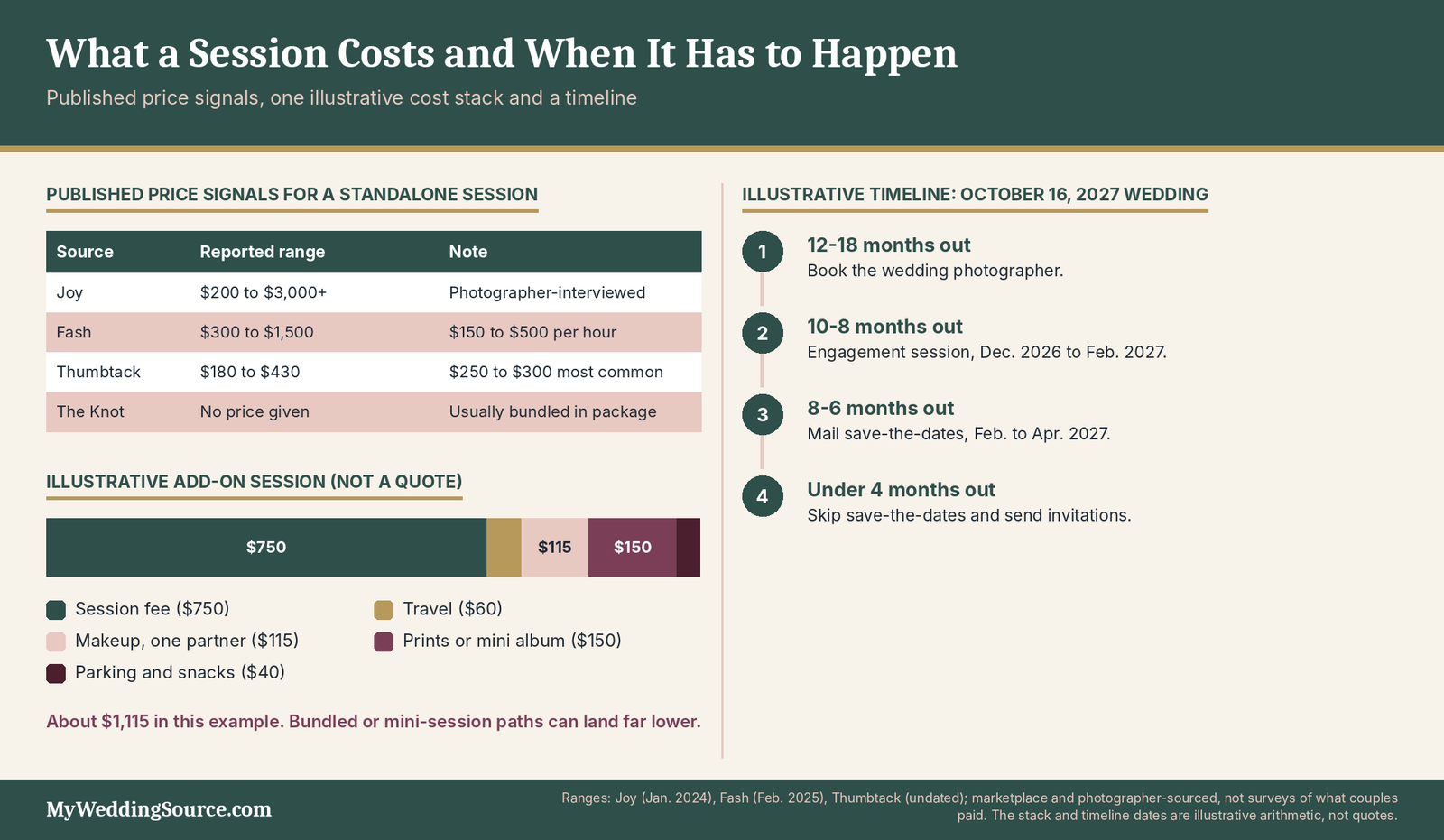
Here is how the offsets look for an illustrative Saturday, October 16, 2027 wedding, which is exactly twelve months from the date of this article.
| Milestone | Offset from wedding | Example date | Source or basis |
|---|---|---|---|
| Book wedding photographer | 12 to 18 months | Now through Oct. 2026 | The Knot lead time |
| Engagement session for printed save-the-dates | 10 to 8 months | Dec. 16, 2026 to Feb. 16, 2027 | The Knot basics page |
| Edit, design and proof save-the-dates | After the session, before mailing | Jan. to Mar. 2027 | Editorial estimate; ask your printer |
| Mail save-the-dates | 8 to 6 months | Feb. 16 to Apr. 16, 2027 | The Knot save-the-date guide |
| General window if you skip printed save-the-dates | 6 to 4 months | Apr. 16 to Jun. 16, 2027 | The Knot basics page |
How do season and light change the plan?
What time of day should you book?
Light matters more than location for how a session looks. The Knot suggests mid-afternoon for clean, even light, late afternoon for city settings, golden hour (about two hours before sunset) for less urban areas, sunset for beaches, and blue hour just after sunset or before sunrise. Midday summer sun, by contrast, tends to produce squinting and hard shadows, so most photographers steer couples toward the edges of the day. Golden-hour slots are in demand; the Joy engagement cost guide notes that they usually carry no extra fee but can mean a waitlist of weeks or months. If you have a flexible schedule, a weekday late-afternoon time can be easier to get than a Saturday evening.
How much do sunset times shift across the year?
More than most people expect, and the shift changes your start time by hours. The approximate mid-month sunsets below are editorial calculations using the standard NOAA solar-position method for 2027 dates, so confirm your own date and city with a tool such as the NOAA Solar Calculator, which the lab notes is no longer actively maintained and is offered for research and entertainment. In Chicago, sunset is about 4:44 p.m. in mid-January and 8:24 p.m. in mid-July, so a “two hours before sunset” session means roughly 2:45 p.m. in winter and 6:25 p.m. in summer. Late-fall couples who are also sorting wedding-day light can pair this with our guide to planning a November wedding timeline around earlier sunsets.
| City | Jan. 15 | Apr. 15 | Jul. 15 | Oct. 15 |
|---|---|---|---|---|
| Atlanta | 5:51 p.m. | 8:08 p.m. | 8:48 p.m. | 7:03 p.m. |
| Chicago | 4:44 p.m. | 7:31 p.m. | 8:24 p.m. | 6:09 p.m. |
| Denver | 4:59 p.m. | 7:38 p.m. | 8:27 p.m. | 6:20 p.m. |
| Seattle | 4:45 p.m. | 7:58 p.m. | 9:03 p.m. | 6:21 p.m. |
Which seasonal risks should you plan around?
Each season has a predictable way of disrupting a session. Summer afternoons can be hot enough that the National Weather Service lists heat cramps, heat exhaustion and heat stroke as escalating problems, so schedule shaded or air-conditioned breaks and keep water on hand. Autumn evenings turn cold quickly after the sun drops, and Stripling warns that outdoor autumn sessions can be chilly. Winter has the shortest usable light and the hardest logistics, which is why we wrote a separate guide to winter engagement photos. Spring brings unpredictable rain, so confirm a reschedule window with your photographer before the date arrives rather than on the morning of.
Choosing Locations and Getting Permission
A location does two jobs at once: it gives the photographer a backdrop and light, and it determines how much stress you carry through the hour. The pretty spot that requires a 20-minute hike in dress shoes is a poor trade, and so is the famous landmark with a permit requirement nobody mentioned. This section covers how to choose a place and how to find out what the place requires.
What makes a location work for the photos and for you?
How do you weigh meaning against logistics?
Start with meaning, then run it through a logistics filter. The Knot’s basics page lists places meaningful to your relationship, your neighborhood, a local landmark, or a spot that contrasts with your wedding setting as good options. The logistics filter is where plans quietly fail: parking, restrooms within a reasonable walk, shade, crowd levels at your chosen hour, and whether the path suits both of you physically. A rooftop where you had your first date may be wonderful and still unworkable if the building closes at 5:00 p.m. Ask your photographer which of your top two or three ideas they have shot before, because a location they know well saves minutes of scouting during your session.
Should the setting match your wedding or contrast with it?
Either choice can work, and the right one depends on what the photos are for. Contrast gives your save-the-dates and website a different feel from the wedding itself, so a beach-town couple marrying in a ballroom has a built-in reason to shoot by the water. Matching, such as a session at your venue, helps you learn the space, a benefit The Knot highlights, and gives your photographer a preview of lighting and angles you will use later. If you do plan a venue session, ask the venue about it roughly a week ahead, as The Knot’s piece advises, since many venues have event calendars and rules about outside photographers. If the venue is also where you are marrying, treat the session as a chance to ask the questions about outside photographers that you will need answered before you sign anything.
Do you need a permit, a fee or permission?
What about public parks and government land?
The honest answer is that it depends on the agency, the group size, who is paying the photographer and how the photos will be used. A National Park Service example: Yellowstone’s special use permit page says a permit is required for commercial filming and photography, and that compensated portrait photographers may need a special use permit for still photography when the group exceeds five people using only cameras and tripods. A Professional Photographers of America update from 2022 describes Grand Teton rescinding portrait and wedding rules after pushback, which shows how quickly park policies shift. Rules at city and state parks differ again, so the practical step is a phone call or email to the specific site, ideally with your photographer, before you set a date. Many experienced photographers already know which parks in their area ask for permits and will say so up front.
What about private property, businesses and venues?
Places that feel public often are not. A farm, an orchard, a vineyard, a restaurant patio or a downtown lobby may need the owner’s permission, and some charge a small access fee or require proof of insurance from the photographer. Ask who to contact and when, and get a yes in writing, even a short email, so you are not negotiating with a manager in the middle of golden hour. The Knot’s guide suggests tying a stop at a favorite restaurant or bar into the session, which works best when you have spoken to the staff beforehand and picked an off-peak time. Aerial photography is a separate question: some parks and cities limit drones, so ask the location and your photographer rather than assuming the answer.
Outfits, Grooming and Staying Comfortable
Outfits are the one part of the session entirely in your hands, and they are also what couples worry about most. The good news is that the advice from photographers is fairly consistent: wear things you can move in, avoid small tight patterns, and coordinate instead of matching. This section covers choosing clothes, deciding how many changes to bring, and staying comfortable through the hour.
How do you choose outfits that photograph well?
Why coordinate instead of match?
Matching outfits tend to read as costumes, while coordinated ones read as a pair. Fash’s outfit guide calls its golden rule “coordinate, don’t match,” and recommends muted, jewel, earth or neutral tones. Both Fash and The Knot advise against small, tight patterns such as thin stripes or tiny polka dots, which can cause a flickering effect called moire on camera, and suggest larger prints or solids instead. If one of you wears a pattern, the other can wear a solid in a shade pulled from it. Also skip big logos, neon, and anything you are not sure you can sit, walk and hug in, since the photos will show you adjusting.
How many outfit changes are worth it?
Advice differs here, and the answer depends on your session length. The Knot suggests at most one outfit change, while Fash suggests two to three outfits per person for a 60 to 90 minute session, starting dressier and switching to casual. Every change costs session minutes you could spend shooting, plus a place to change and a bag to carry. A sensible middle path for a 90-minute session is two looks: one that feels like you on a dress-up day, and one that feels like you on a good Saturday. Ask your photographer how they would split the time, and if you want a third, say sentimental outfit, pick a location that makes changing easy.
| Season | Colors that tend to work | Comfort note |
|---|---|---|
| Spring | Blush, sage, lavender, soft blue, ivory | Bring a light layer for cooler golden hour |
| Summer | White, light blue, coral, yellow, soft pastels | Breathable fabrics; avoid heavy, dark fabrics that trap heat |
| Fall | Burgundy, rust, mustard, olive, deep plum | Knit sweaters and boots add warmth and texture |
| Winter | Emerald, navy, cranberry, camel, charcoal | Coats, scarves and gloves; jewel tones stand out against snow |
How do you stay comfortable and still look like yourselves?
What should you think about with shoes, layers and weather?
Comfort shows up in posture, and posture shows up in photos. The Knot advises comfortable footwear and warns against breaking in new shoes on the day, and Fash notes that stilettos sink into grass and sand while block heels, flats, wedges or boots hold up. Bring a backup layer in any season, since a clear afternoon can turn windy once the sun drops. In summer heat, plan for water and shade, and know the warning signs of heat exhaustion that the National Weather Service lists, which include heavy sweating, weakness, dizziness and nausea. If either of you has mobility needs, say so when you choose the location, because a good photographer can adapt the plan but cannot guess.
How do you handle hair, makeup and grooming?
Decide how polished you want to be, then decide who does it. Fash’s engagement photography cost page lists a makeup artist at about $60 to $170, or $130 to $270 for a hair and makeup package, as marketplace estimates for budgeting. Some couples treat the session as a trial run for wedding-day hair and makeup, which is a reasonable editorial suggestion if your artist offers it, although you will want to confirm how that is priced. Schedule a haircut, beard trim or nail appointment several days beforehand rather than the morning of, so you have time to adjust. Steam outfits, clean jewelry and bring a small kit of tissues, lip balm, a lint roller and bobby pins.
Poses, Shot Priorities and Camera Comfort
Most couples who say they do not know how to pose are asking the wrong question. Photographers direct movement and expressions so that you do not have to hold a rigid stance, and the images that people save are usually the unposed ones. What you can control is which shots you ask for and how you tell the photographer you feel.
Which shots should be on your priority list?
What is a sensible core set?
Think in terms of what each photo will do. A single strong image can serve as the wedding website header, a second works for the save-the-date, and a third can be a quiet detail shot, such as hands with rings or two pairs of shoes at the edge of the water. You also want a few candid frames of you laughing, because those carry the personality of the whole set. The table below pairs each shot with its likely use so that you can brief your photographer in two minutes at the start of the session.
| Shot | Why it matters | Likely use |
|---|---|---|
| Wide frame with location | Shows the place and the two of you in scale | Website header, signage |
| Mid-length portrait, looking at camera | The classic image everyone recognizes | Save-the-date, guest book |
| Close, interacting, not looking at camera | Conveys closeness and personality | Website, album |
| Candid laughing or walking | Captures how you actually move together | Social, thank-you cards |
| Detail (hands, rings, shoes) | Adds texture for design layouts | Stationery accents |
| Vertical and horizontal versions | Fits cards, banners, social crops | Everything |
How do you leave room for design?
If you plan to print the photos on a card, tell your photographer so that they can leave space for the date and names. Ask for the same moment in both vertical and horizontal orientations, because a wide banner on a website and a tall card are different crops. If you want a close-up of the ring, consider the setting: a ring worn on rough terrain, near water or in cold weather deserves a thought, and our guide to engagement ring insurance and hidden costs covers what coverage usually does and does not include. Ask for a few clean frames with simple backgrounds, since designers often prefer them as a base for text.
How do you feel natural when you dislike being photographed?
What helps with movement and prompts?
Movement beats posing for most people. The Knot’s guide advises not overthinking posing and says candid, genuine moments tend to read best, and that funny shots can help couples relax. Walking, tickling, whispering a joke, spinning, or carrying something the other person has to take from you gives your hands a job and your face a reason to move. Ask the photographer for a first five minutes of unstructured warm-up, and do not judge those frames in real time. Warm-up frames are rarely the keepers, but they are what gets you to the keepers.
How do you tell your photographer what you need?
Tell them early and specifically, because they cannot read your mind. If one of you dislikes your profile, hates having teeth shown, wears glasses, has a visible scar, uses a mobility aid, or simply shuts down when asked to look at the lens, the photographer can plan around it. Same-sex couples, trans and nonbinary partners, couples with differences in height or body type, and couples bringing children or pets all benefit from a short conversation about what feels respectful and what you want to emphasize. A confident photographer will ask these questions without being prompted, and a stiff or dismissive reaction tells you something before the wedding rather than during it. If you have a dog, ask whether a handler or a helper should come so that you can focus on each other.
What Engagement Photos Cost, and What Gets Added to the Price
Engagement session pricing is messy for a simple reason: no major wedding survey publishes a price for it, so the numbers come from photographer-written articles and marketplace estimates. That is a weaker evidence base than the wedding-day data, and it is worth saying plainly before any dollar figure appears. This section gives the ranges, explains why they disagree, and shows how extras stack up.
What do published price ranges say?
What do three different sources report?
Each source describes a different slice of the market, which is why the ranges barely overlap. The Joy engagement cost article, last updated January 31, 2024 and based on photographers it interviewed, gives an overall range of $200 to more than $3,000. Fash’s cost page, which draws on estimates its users receive from local professionals and lists a February 2025 date, gives $300 to $1,500 per session or $150 to $500 per hour. Thumbtack’s engagement pricing page, undated, shows national fixed-price data from $180 to $430, with $250 to $300 most common. None of them is a survey of what couples paid, so read them as marketplace snapshots.
| Source | Reported range | What the figure reflects | Date or caveat |
|---|---|---|---|
| Joy | $200 to $3,000+ | Photographer-interviewed range; metro examples $400 to $1,500 | Updated Jan. 31, 2024 |
| Fash | $300 to $1,500 per session; $150 to $500 per hour | Estimates from local professionals; sessions 1 to 3 hours | Dated Feb. 2025; page title says 2026 |
| Thumbtack | $180 to $430 fixed price; $250 to $300 most common | Fixed-price listings; proposal shoots may cost up to double | No date on page |
| The Knot | No engagement price given | Says sessions are most often bundled into wedding packages | Updated Sep. 21, 2026 |
Why do the ranges differ so much?
Four things drive the gap. First, location: Joy’s examples put hour-long sessions at about $500 to $1,000 in Southern California and Boulder, about $400 to $750 in suburban Asheville, and about $1,000 to $1,500 in greater Washington, D.C. and similar East Coast metros. Second, experience, since a student or newer photographer might charge a fraction of what a full-time wedding studio does. Third, deliverables: the number of edited images, the length of the session and the usage rights all change the price. Fourth, the way the platform collects data; a fixed-price listing for 30 minutes and a studio’s three-hour package are not the same product. For a sanity check on your own market, collect three local quotes with the same session length and image count and compare those.
Which extras stack on top?
What can the photographer add to the bill?
The line items to look for are travel, extra locations, editing, delivery and rush fees. Joy reports that multiple locations within a 45-minute to two-hour drive may add a per diem of $30 to $100, and a trip of three hours or more may bring in hotel costs. Basic editing such as color and lighting is often included, but complex retouching such as removing objects or blemishes is typically extra, per Joy and Fash. Prints and albums are usually priced separately by size and quality. Thumbtack notes that a session that captures a proposal can cost up to double a standard one, because it is treated as event photography.
What costs land on your side of the ledger?
These rarely appear on the photographer’s price sheet but they show up on your card. Outfits matter if you buy new ones, and shoes you will actually walk in often cost more than the dress or shirt. Hair, makeup and grooming can add the $60 to $270 range above. Parking, a permit or access fee at some sites, snacks or a drink partway through, a sitter for the dog, and a pair of backup shoes are small individually and meaningful together. If you drive an hour each way and miss half a workday, count that too, because it explains why couples often choose a nearby location over the famous one.
Is it cheaper to bundle the session with the wedding package?
What does bundling usually mean?
The Knot’s basics page says engagement shoots are most often included in a wedding photography package, though some photographers sell them separately, and recommends asking at contract time whether the session is covered by the fee. Joy likewise reports that some photographers bundle a shoot for less than it would cost separately, without giving a figure. Bundled does not mean free: the value is usually priced into the package, or the session is limited to a shorter time and smaller gallery. A bundle is still often the simplest path, because the person who will photograph your wedding also knows your faces, your preferences and your timeline.
How do you compare options apples-to-apples?
Compare total cost for the same deliverables, not sticker prices. Write down session length, locations, edited image count, delivery date and usage rights for each option, then add the extras that apply to you. The scenarios below are illustrative arithmetic using figures within the published ranges above, not quotes from any photographer.
| Cost layer | A: Included in package | B: Add-on with wedding photographer | C: Mini-session, local photographer |
|---|---|---|---|
| Session fee | Included | $750 | $300 |
| Travel or second location | $0 | $60 | $0 |
| Makeup for one partner | $0 (DIY) | $115 | $0 (DIY) |
| Prints or small album | $0 | $150 | $0 |
| Parking and snacks | $25 | $40 | $25 |
| Illustrative total | $25 plus any package premium | $1,115 | $325 |
Packages and Contract Questions to Clarify Before You Pay
An engagement session contract is usually shorter than a wedding contract, which makes it easy to skim and costly to misread. The terms that matter most are the same ones that matter on the wedding day: what you get, when you get it, what you may do with it, and what happens when something goes wrong. This section is general education, not legal advice, and contract terms and state laws vary.
What should the package spell out?
What belongs in the description of the session itself?
Get the basics in one place: session length, the number of locations, the start time, who may attend, the number of outfit changes allowed, and what happens if the sun sets before you finish. Ask whether the stated time includes travel between locations and warm-up. Ask how far the photographer will travel before fees begin. Thumbtack’s list of price factors, from travel to second shooters to outfit changes, is a good checklist of what a package should define. If anything is promised verbally, such as a particular sunset spot or a proposal-style surprise, put it in an email or the contract itself.
Which deliverables and deadlines should be in writing?
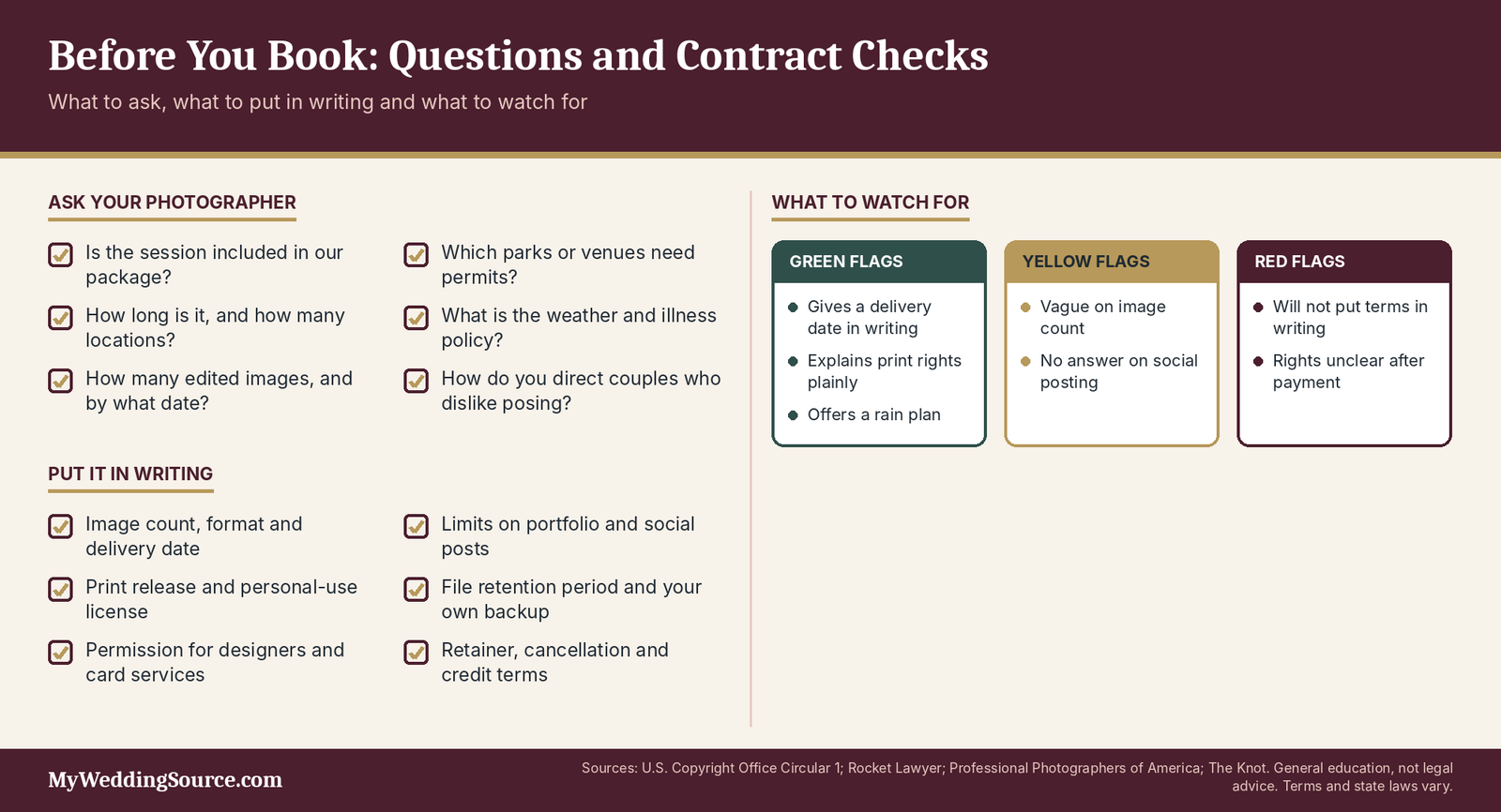
Count and date are the two details that cause the most friction. Published image counts vary, with Joy citing many photographers who guarantee 35 to 70 edited images, Fash citing 20 to 60, and Thumbtack describing galleries of about 30 to 60. Ask for the minimum number of edited images, the format and resolution, how long the gallery stays online, and a delivery date that gives your stationery designer enough runway. If your save-the-dates need to mail by a specific week, ask whether a small batch of preview images can arrive early and what a rush fee would be. A date in the contract is more useful than a promise that “we turn things around quickly.”
Which rights and release terms matter?
How does copyright differ from the license you receive?
By default, the person who takes the photograph owns the copyright, and you receive the images under whatever license the contract gives you. The U.S. Copyright Office’s Circular 1 states that copyright initially belongs to the author, that transfers generally must be in writing and signed by the owner, and that owning a copy does not give you the copyright. Rocket Lawyer’s guide describes three common arrangements: permission needed for each use, a limited license, or an assignment of full rights. A limited license for personal use, including printing and sharing, is typical. Read the actual words, because phrases like “personal use only” can exclude things you assumed were fine.
Can your designer, printer or other vendors use the photos?
This is the clause most couples overlook, and it is the one most likely to create a surprise at the stationery stage. A print release lets you print the photos at the lab of your choice, and without one you may be limited to the photographer’s lab or products. Ask whether your invitation designer, a custom-sign maker or an online card service can use the images, and whether credit is required. Ask whether you may edit, crop or apply filters, since a designer will often crop for layout. If something is not in the contract, ask for a short written addendum before you pay.
How may the photographer use your images?
Many photographers reserve the right to post images in a portfolio, on social media or in marketing. That is normal, but you can ask for limits, such as no location tags if you want privacy, no faces on public ads, or approval before posting. The Professional Photographers of America lists model release templates among its contract resources, which tells you the release language is standard and negotiable rather than a mystery. Ask that releases for friends, kids or pets in the shoot be handled separately, since you cannot consent for other adults. Put your preference in writing, because a photographer’s default does not always match your comfort.
What happens if plans change?
What if weather or illness interrupts the date?
Ask for a written reschedule policy before the retainer is paid. A good policy names who can call off the session for weather, how much notice is required, how many reschedules are free, and what happens if the new date is in a busy season. Ask what the fallback is if rain is forecast but not certain, such as shooting under a covered area or starting earlier. Confirm what happens if one of you is ill; some photographers will move the date, while others charge a fee. A short written answer now beats an argument later.
How are backups, file retention and cancellation handled?
Ask whether the photographer shoots with dual card slots, backs up files after the session, and keeps your gallery for a defined period. Ask what happens if they cannot attend, and whether they will provide a qualified replacement. Look at the cancellation terms too, including what part of the retainer is refundable if you change your mind or cancel the wedding. If the engagement session is bundled with your wedding package, check whether canceling one affects the other. Your own copy matters as much as theirs: download the full gallery the day it arrives and keep it in two places.
| Question to ask | Why it matters | What a clear answer looks like |
|---|---|---|
| How many edited images, and by what date? | Your stationery deadline depends on it | A number and a date in writing, plus a rush option |
| What may we print, post and share? | Prevents a stalled order at the print lab | A written print release and personal-use license |
| Can our designer or card service use the photos? | Vendors need rights to reproduce | Named permission or a general third-party clause |
| How will you use our images? | Privacy and portfolio use | Opt-in or limits on location tags and faces |
| What if weather or illness interrupts? | Avoids surprise fees | Free reschedule window and a fallback plan |
| How long do you keep our files? | Protects you if a hard drive fails | A retention period and your own download |
| What happens if we cancel the wedding? | Bundled sessions can be entangled | Clear terms on retainer and session credit |
Putting the Photos to Work: Save-the-Dates, Your Website and the Wedding Itself
Photos that sit in a gallery folder have not done their job. The practical payoff of a session is in the places the images end up, and each of those places has its own format, deadline and privacy considerations. This section follows the photos from your first announcement through the wedding day.
How do you use the photos before the wedding?
What should a photo save-the-date include?
A save-the-date has a short job: tell guests the date, the general location, and that an invitation is coming. The Knot’s save-the-date guide, updated April 2025, says to send them about six to eight months ahead, closer to eight for a destination or holiday weekend, and to skip them if you are under four months out. Include the date and city or area, and optionally a link to your website; the exact venue and ceremony time can wait for the invitation. Order at least five extras for keepsakes and last-minute additions, and remember that magnets cost more to mail than postcards. Choose a photo with a clear space for text, and ask your photographer for a crop that works in both a tall card and a wide email header.
How should you use the photos on a wedding website and social media?
The website is where engagement photos get the most views. With 90% of couples building one according to The Knot’s 2026 study, guests expect a site with a photo, details and a registry link. Pick a hero image that loads quickly and still looks good on a phone screen, and ask your photographer for web-sized files so that you are not uploading a giant original. Think about what you reveal: a photo tagged at your venue plus your wedding date tells strangers a lot, so consider a password, a limited guest list for the schedule page, and location tags turned off. Before you post engagement photos publicly, make sure the photographer’s contract allows it and that your save-the-dates have reached the people who might be hurt to see the news online first.
How do you use the photos at the wedding itself?
Where can engagement photos appear on the day?
Small, deliberate uses work better than a wall of portraits. A framed print or two at the welcome table, a sign near the guest book, or a short slideshow during cocktail hour all give guests something to look at while they wait. The Knot’s guide mentions framed prints and a coffee-table album as common homes for the photos. If you want a photo-based guest book, ask the printer for a size and resolution spec before you order, so the cover image does not come back blurry. Decide which images you are willing to show to extended family and coworkers, because a candid photo that delights you can feel different on an easel.
What do you do with the photos afterward?
After the wedding, engagement photos can sit beside the wedding portraits in an album or hang as a pair in your home. They also work in thank-you cards, which gives you another use if you did not print save-the-dates. Keep a full-resolution copy of the gallery in two locations, such as a cloud service and an external drive, since photographers’ retention policies vary. If you opted for a print release, order a few prints from a reputable lab when your calendar is calm, not in the week before the wedding. If you received only digital files, check the license before printing in bulk.
Using the Session as a Rehearsal for Wedding-Day Photos
The session is the lowest-stakes opportunity you will have to learn how photography works for the two of you. Wedding-day photos involve more people, less time and more pressure, so every lesson you collect now pays off later. This section turns the session into a set of observations and then into decisions about your wedding photography plan.
What should you learn during the session?
How does your photographer work, and does it suit you?
Watch how the photographer gives directions, handles awkward moments, and responds when you say you are tired or uncomfortable. Some photographers narrate every move, some prefer to let you wander, and some offer humor to break tension. Neither style is wrong, but one will fit you better. If you are still comparing photographers, our list of wedding photographer questions gives you a structured way to cover communication style, backup plans and delivery before you sign a contract. After the session, trust your own sense of whether you felt heard.
What do you like, and what makes you tense?
Pay attention to the moments you enjoyed and the ones that felt forced. Notice which side each of you prefers, whether glasses glare, what kind of prompts get real laughter, and how long it takes before you stop thinking about the camera. Write these notes within a day, while you can still remember them, and share them with your photographer when the wedding-day plan comes together. A short debrief email with three things that worked and three that did not is useful to a professional, and it signals that you are paying attention.
How do you carry the lessons into wedding-day planning?
How should the session inform your shot list and portrait time?
Use what you learned to shape your priorities. If you froze during staged portraits, build more candid time into the day; if you loved walking shots, ask for them during portrait time. Our wedding photographer shot list guide helps you convert those preferences into a prioritized list your photographer can use. Share the engagement images you like most so that the wedding-day style is clear. The more concrete your references, the less you leave to guesswork when time is short.
What if the session raises doubts about your photographer?
A rough session does not automatically mean a poor match, but it deserves an honest conversation. Talk with the photographer about what was uncomfortable and listen to how they respond, because defensiveness is information. Review your contract to see what your options are if you decide to change course, and remember that terms and state laws vary, so consider asking a local attorney if the stakes are high. If the problem is simply that you were nervous, a second short session or a few minutes of practice at the venue may fix it. Most photographers want you to feel at ease, since relaxed couples produce better work.
FAQ: Engagement Photo Questions Couples Ask
Planning and logistics questions
Are engagement photos required, or just expected?
They are not required by any vendor, venue or legal process. The Knot’s guide presents them as an optional, recommended step, and plenty of couples skip them or fold a short portrait stop into another event. If your reason for skipping is cost or comfort, that is a complete answer. If your reason is that you want photos for save-the-dates, you can get those from a smaller session or a friend with a good camera.
How long does a session last?
Most last one to three hours, depending on how many locations and outfit changes you plan, according to The Knot. Fash notes that many professionals book 90-minute sessions, and that hourly pricing often has a minimum of 60 to 90 minutes. A shorter mini-session of 30 to 45 minutes can work if you choose a single location and a single outfit. Build in time for travel, parking and a short warm-up, and add a buffer if the light is changing quickly.
Does the engagement photographer have to be our wedding photographer?
No, but there are tradeoffs. Using the same person gives you a rehearsal and often a bundle, and it lets your photographer learn your preferences. Hiring someone else can make sense if you want a specific style, a particular location they know well, or a lower price for a shorter shoot. If you split the work, confirm that each contract covers the usage you need and that no exclusivity clause prevents you from using another photographer.
Money, rights and etiquette questions
Who pays for engagement photos?
There is no etiquette rule that assigns this cost. Many couples pay themselves, some receive the session as a gift from family or friends, and some get it included in a wedding package. Do not assume parents or anyone else will pay, and avoid bringing up the cost with relatives in a way that sounds like an ask. If someone offers, confirm the amount and what it covers before you book.
Can we post the photos before our save-the-dates go out?
You can, but think about who learns your date from a public post before they receive a card. People close to you may be hurt to find out about the wedding from a feed, and unplanned posts can invite attention from guests you have not invited. A simple approach is to send save-the-dates first, then post. If your photographer shares a sneak peek on social media, ask in your contract how much notice you get and whether you can approve the image.
Can we take engagement photos ourselves?
Yes. A tripod, a timer or remote, good light and a location you like can produce images for a website or a simple card. The limits are quality at print sizes, the stress of being both subject and photographer, and the lack of a rehearsal with your wedding photographer. If you go this way, shoot during the hour before sunset, check the background before you press the button, and keep your files in two places.
Your Next Steps
Pick a purpose, a date window and a budget before you contact anyone, then let the quotes come back and compare them on the same terms. The checklist below is ordered so that each step feeds the next, and the earliest ones take about an hour. If you are earlier in the planning process, our engagement season checklist and the wedding planning hub show where the session fits among your other tasks.
This week
What do you decide first?
Write down what the photos are for, using your list of uses from earlier: save-the-dates, a website, prints, or just a keepsake. Count back from your save-the-date mail date using the timeline above, and note the shoot window that results. Agree on a spending ceiling and on the two or three outfits you already own that you would feel good wearing. A shared note with these four items takes less than an hour and prevents most of the arguments that follow.
What do you check about locations?
Choose two or three candidate places and check their rules: permits, fees, closing times, parking and restrooms. Look up sunset for your date range and city using a tool like NOAA’s calculator, then work back to a start time. Send a short message to the owner or agency of each place, ideally with your photographer copied. Ask your photographer which location they prefer and why.
Before you pay a deposit
What goes in writing before you book?
Ask for a written package that names session length, locations, outfit changes, the number and format of edited images, the delivery date, and the price including travel and tax. Ask whether the session is included in your wedding package or priced separately, and what happens to the credit if you change course. Keep the email thread as part of your records. If the photographer’s template does not cover these points, ask for a short addendum.
What rights and backup terms do you confirm?
Confirm your print release, whether your stationery designer may use the images, and how the photographer may share your photos. Ask about the reschedule policy for weather and illness, how long they keep your files, and what happens if they cannot attend. Download your gallery the day it arrives and store it in two places. Then book the date, put it on both calendars, and set a reminder for the day before to check the forecast and charge your phone.
Sources & methodology
- The Knot: What are engagement photos for? — uses of engagement photos, timing, session length and bundling (updated September 21, 2026)
- The Knot: Engagement photo basics — timing windows, time of day, outfits, locations and booking lead time (updated September 21, 2026)
- The Knot: When to send save-the-dates — save-the-date timing and etiquette (updated April 17, 2025)
- The Knot 2026 Real Weddings Study data read-out — 10,474 U.S. couples married in 2025; 88% hired a professional photographer, $3,000 average photographer spend, 90% created a wedding website
- The Knot: Average wedding cost — $3,000 average photographer cost, 2025 weddings
- Susan Stripling: When to take engagement photos — photographer’s timing guidance relative to save-the-dates
- Joy: How much do engagement photos cost? — photographer-sourced price ranges, regional examples, image counts and add-ons (updated January 31, 2024)
- Fash: Engagement photography prices — marketplace estimates, session length, makeup costs
- Fash: What to wear for engagement photos — color, pattern, shoes and outfit-count advice
- Thumbtack: Engagement photography prices — fixed-price ranges, typical inclusions, proposal-shoot note
- U.S. Copyright Office, Circular 1 — initial ownership, written transfers, copies versus copyright
- Rocket Lawyer: Do photographers legally own wedding photos? — license versus assignment structures
- Professional Photographers of America: contract templates — release and contract resources for photographers
- National Park Service, Yellowstone special use permits — example of commercial still-photography permit conditions
- Professional Photographers of America: National Park photography update — 2022 change in Grand Teton portrait and wedding photography rules
- National Weather Service: Heat illness — heat cramps, exhaustion and stroke signs
- NOAA Solar Calculator — sunrise and sunset by location and date
Verified facts here are the published survey figures from The Knot’s 2026 study and the quoted federal copyright and park-permit language. The engagement session price ranges are marketplace estimates and photographer-sourced figures, not surveys of what couples paid, and the scenario table, timeline dates and sunset times are editorial arithmetic labeled as illustrations. Everything about packages, releases and cancellation is general education that is not legal advice, because terms and state laws vary.
Freshness note: recheck The Knot’s engagement and save-the-date pages and the price pages from Joy, Fash and Thumbtack each quarter, since they are updated without notice. Confirm any park or city permit rules directly with the agency before booking, and recompute sunset times for your actual date and location.