
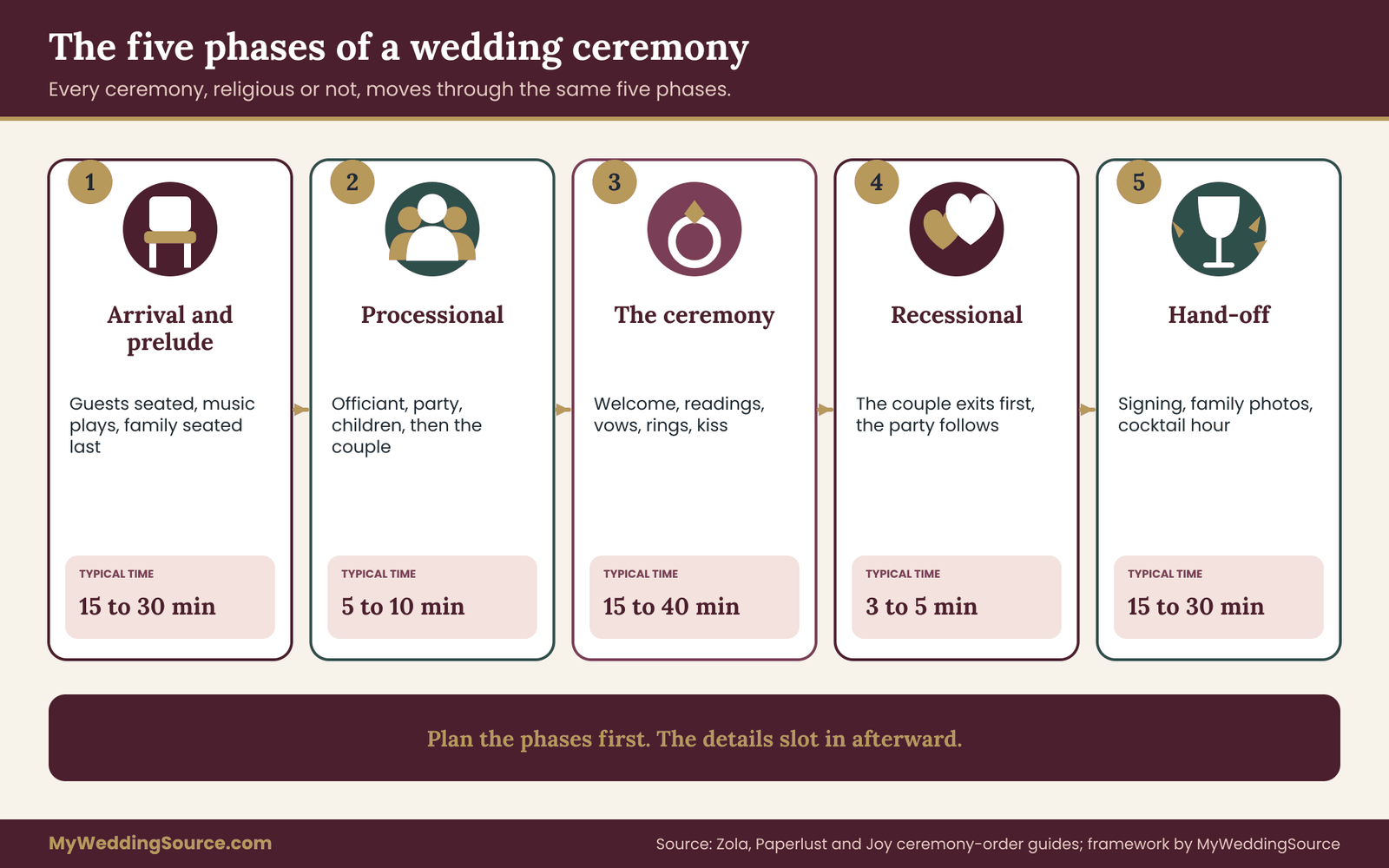
A wedding ceremony step by step runs in five phases: guests arrive and the prelude plays, the family and wedding party process, the officiant leads the ceremony itself, the couple recesses, and everyone hands off to the next part of the day, with each phase having its own cues, people and timing.
Quick answer
A typical non-religious wedding ceremony step by step lasts 20 to 30 minutes and moves through about fifteen steps: prelude music, seating of grandparents and parents, the wedding party processional, the couple’s entrance, opening words, optional readings, an address, vows, the ring exchange, an optional ritual, the pronouncement, the first kiss, the introduction of the couple and the recessional. Guests usually arrive 15 to 30 minutes early, the bride’s or second parent is seated last to signal the start, and the recessional reverses the processional. Religious ceremonies add their own steps and can run from half an hour to several hours.
Most couples can picture the aisle walk and the kiss. Far fewer can say what happens in between, who cues the music, where the rings are kept, when the officiant steps aside or how guests find out they may leave. A wedding ceremony step by step plan fills those gaps. It turns a vague idea of “the ceremony” into a sequence of small moments, each with a person responsible and a cue that starts it.
This guide walks through that sequence from the first guest’s arrival to the moment the cocktail hour begins. For every step you will find what happens, who is responsible, how long to allow, what commonly goes wrong and how to prevent it. You will also find sample run sheets, notes on religious and cultural variations, a rehearsal plan and a troubleshooting section for the problems that most often appear on the day.
If you need the high-level overview first, our wedding ceremony guide covers order, roles, timing and the legal hand-off in a shorter form. This article goes deeper into the sequence itself, one step at a time.
The five phases of a wedding ceremony step by step
It helps to think of the ceremony in phases, because each phase has different people in charge and different risks. Planning guides commonly describe three phases: the processional, the ceremony proper and the recessional. Two more matter for anyone running the day: the arrival that comes before the processional and the hand-off that comes after the recessional.
Phase one: arrival and prelude. Guests arrive, ushers seat them, and prelude music sets the mood. The couple and wedding party are getting final touches elsewhere. The coordinator or a trusted friend is in charge.
Phase two: the processional. Family is seated, the officiant and the partners take their places, and the wedding party walks in. This phase is mostly choreography, and the main risk is confusion about who goes when.
Phase three: the ceremony itself. The officiant leads the welcome, readings, address, declaration of intent, vows, rings, any ritual, the pronouncement and the kiss. This phase is mostly words, and the main risk is pacing and sound.
Phase four: the recessional. The couple exits first, followed by the wedding party and family, and guests are released. It is short and joyful, and the main risk is a messy traffic jam at the end of the aisle.
Phase five: the hand-off. Guests move to the next event, the couple and family handle photographs and the license is signed. This phase is mostly logistics, and the main risk is a long gap that leaves guests waiting.
Each phase below gets its own set of steps. The numbering is a guide, not a requirement. Some couples skip steps, reorder them or add their own, and that is fine, as long as everyone who has a role knows the plan.
How long does each step of a wedding ceremony take?
Before you build a plan, it helps to know typical timings. Different planning sources give slightly different ranges, which is normal, because ceremonies vary. The ranges below come from published ceremony-order guides and give a realistic planning baseline for a Western, non-religious or lightly religious ceremony.
| Step | Typical time |
|---|---|
| Guests seated before the start | 15 to 30 minutes before |
| Family seating | 5 to 10 minutes before |
| Processional | 5 to 10 minutes |
| Opening words | 2 to 4 minutes |
| Each reading | 2 to 5 minutes, with three readings as a practical maximum |
| Address or homily | 3 to 7 minutes |
| Declaration of intent | About 1 minute |
| Vows | 3 to 8 minutes in total |
| Ring exchange | 2 to 4 minutes |
| Unity ritual (optional) | 3 to 5 minutes |
| Pronouncement and first kiss | 1 to 2 minutes |
| Introduction and recessional | 2 to 5 minutes |
Add the middle of those ranges and a simple ceremony without readings or a ritual runs about 15 to 20 minutes, while a fuller one with two readings and a ritual runs 25 to 30. That matches the overall durations most guides give: a simple civil ceremony takes about 15 to 20 minutes, a non-religious ceremony with more elements takes 20 to 30, and a secular or non-denominational ceremony can run to 45 minutes.
Religious ceremonies run longer. One planning guide lists Catholic ceremonies without Mass at roughly 30 to 45 minutes and with a full Mass at 60 to 90 minutes, Protestant ceremonies at 30 to 50 minutes, Jewish Reform or Conservative ceremonies at 30 to 60 minutes and Hindu ceremonies at anywhere from one to four hours. Another puts a shorter Jewish ceremony at 20 to 30 minutes. The point is not the exact number. It is that the length of your wedding ceremony step by step plan depends heavily on the tradition, so ask your officiant for a realistic estimate and build your schedule from that.
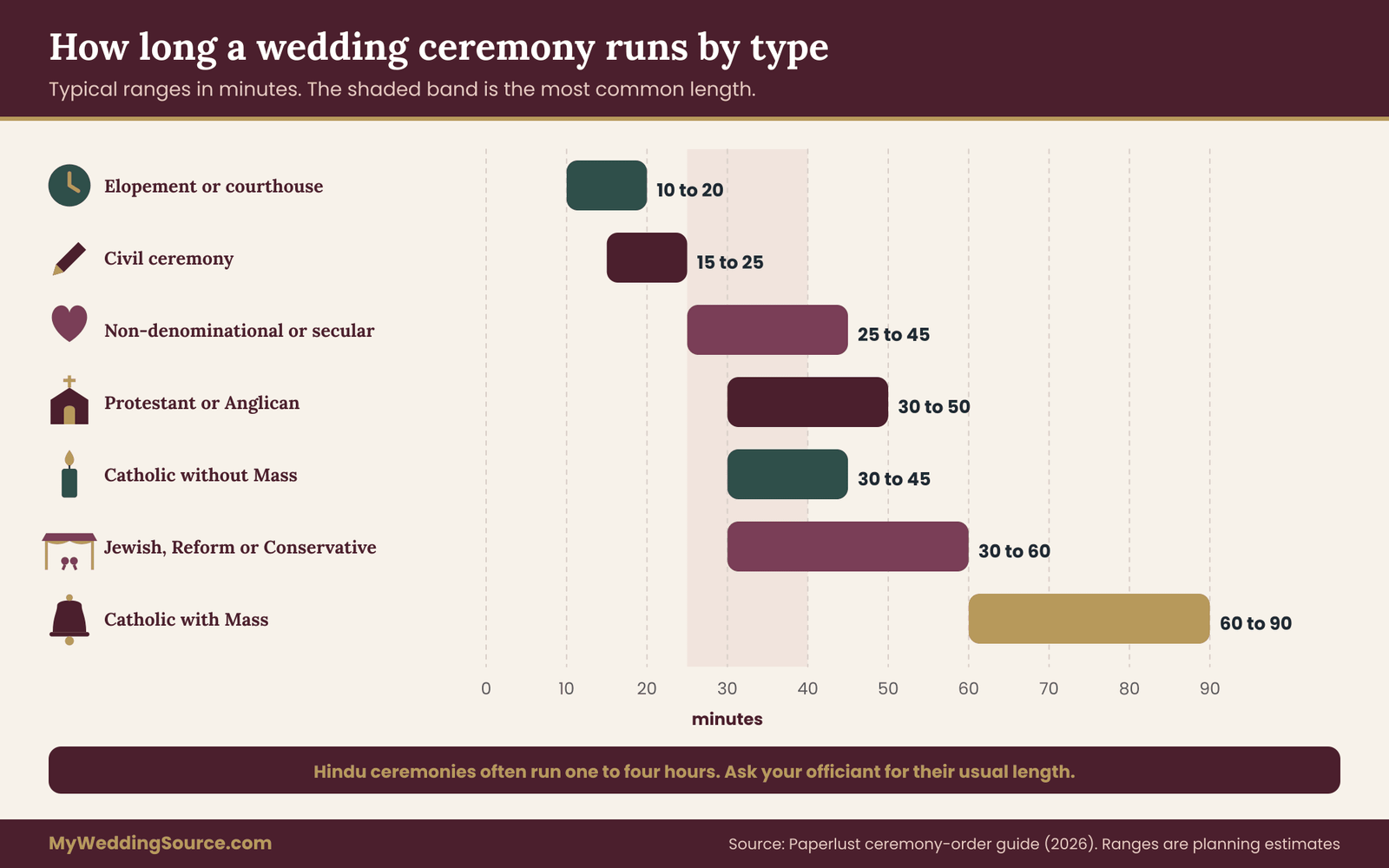
A useful target for many couples is a ceremony of about 25 to 40 minutes door to door, counting seating and the processional. Within that, the spoken ceremony itself can be 15 to 25 minutes. That is long enough to feel meaningful and short enough that guests stay comfortable, particularly outdoors.
Before you begin: set up the wedding ceremony step by step plan
A smooth ceremony is mostly decided before the day. These five habits make the steps that follow easier to run.
Name one person in charge. On the day, someone should own the schedule, cue the music, signal the processional and field questions. That might be a planner, a venue coordinator or a trusted friend. Rehearsal guidance from WeddingWire says plainly that having a single point person makes the ceremony run much more smoothly, and that wedding party members and family should direct their questions to that person.
Write the plan as a run sheet. A run sheet is a one-page list of steps, times, people and cues. It is the single document everyone shares. Later in this article you will find samples for three types of ceremony.
Share it early. Send the run sheet to the officiant, coordinator, photographer, videographer, musicians and venue at least a week before the wedding. One planning guide suggests exactly that, and it prevents the sort of surprise that happens when the photographer does not know when the first kiss will occur.
Decide who holds what. Rings, vows, readings, the license, the program and the unity ritual materials each need an owner. Missing items are one of the most common sources of last-minute panic.
Pick a rehearsal time. Even a short run-through the day before, or the morning of for small weddings, catches most problems. A later section explains how to run one.
Phase one: arrival and prelude in the wedding ceremony step by step
Step one in the wedding ceremony step by step: final preparation (30 to 45 minutes before)
The wedding ceremony step by step really begins half an hour or more before the first guest is seated. The wedding party should arrive early enough to meet the officiant, review the processional order and take any last photos. One timeline guide suggests allowing 30 to 45 minutes. This is when the coordinator checks that the rings, license, vows, readings, programs and any ritual items are where they should be.
Who is responsible: the coordinator, with help from the best man and the maid or matron of honor.
What to check: the officiant has the final script and the signed license paperwork. The ring holder has the rings. The readers have printed copies of their readings. The musician or DJ has the cue list. The microphone works. The flower girl and ring bearer know where their parents will be.
What commonly goes wrong: the rings are in a bag in the car, the license is at the hotel or the readers have not seen the text in large print. A short pocket checklist, read aloud, prevents all three.
Step two: guests arrive and are seated (15 to 30 minutes before)
In a wedding ceremony step by step plan, most guides suggest that guests arrive 15 to 30 minutes before the start time, so that everyone is seated before the processional. Ushers or designated friends guide people to seats, hand out programs and answer simple questions such as where the restrooms are.
Who is responsible: the ushers, usually groomsmen or friends, with the coordinator watching the clock.
Seating: the old rule that one family sits on each side of the aisle is optional now. Many couples invite guests to sit wherever they like, and a sign that says “Choose a seat, not a side” is a popular way to say so. Reserve a few rows at the front for immediate family and for anyone with mobility needs.
Unplugged ceremony: if you want guests to put away phones, say so early. One planning guide recommends having the officiant or an usher mention it during seating, or placing a sign at the aisle, instead of waiting for the processional, when it is too late.
What commonly goes wrong: late arrivals who slip into the aisle during the processional. Ask ushers to hold late guests at the back and seat them during a natural pause, such as the first reading.
Step three in the wedding ceremony step by step: prelude music (15 to 30 minutes before)
In the wedding ceremony step by step, prelude music plays as guests find their seats. It is background, not a performance, and it sets the tone for what follows. A common recommendation is four to six pieces that reflect your style, such as instrumental versions of songs you love, classical pieces or acoustic arrangements. Some guides say the prelude starts 15 to 20 minutes before the ceremony and others say 20 to 30, which tells you the exact number matters less than a clear plan.
Who is responsible: the musician, DJ or whoever is running the sound.
Cue: the prelude ends when the processional begins. Make sure the person running the music knows how to recognize that moment, ideally from a visual signal from the coordinator and not from guessing.
What commonly goes wrong: the prelude runs out while guests are still arriving. Build in a longer playlist than you think you need, and plan to loop quietly if the start is delayed.
Step four: family is seated (5 to 10 minutes before)
Family seating tells the room that the ceremony is about to start. In the traditional order, ushers or groomsmen seat the grandparents first, then the parents. One parent is seated last, right before the processional, and in the traditional pattern this is the bride’s mother, which signals to guests that the ceremony is about to begin. In weddings of same-sex couples or blended families, parents can be seated together or in any order that feels right.
Who is responsible: the ushers, cued by the coordinator.
Tip: let your ushers know exactly who they are seating and in which row. A printed list of names and seats is better than memory, and it prevents the awkward moment when a stepparent is not sure where to go. Our wedding processional order guide covers blended families, divorced parents and nontraditional orders in detail.
What commonly goes wrong: a family member arrives late, and the ushers have to improvise. Appoint one person to meet any late family members and walk them in quietly.
Phase two: the processional
Step five in the wedding ceremony step by step: the officiant and the partners take their places
In the wedding ceremony step by step, the officiant is the first person to take a position at the front. In many ceremonies, one partner, or both, then enters, either from the side or down the aisle. In traditional ceremonies, the groom and best man walk in together or enter from a side door. In modern ceremonies, the first partner may walk down the aisle with a parent, or both may enter together.
Who is responsible: the officiant and the coordinator.
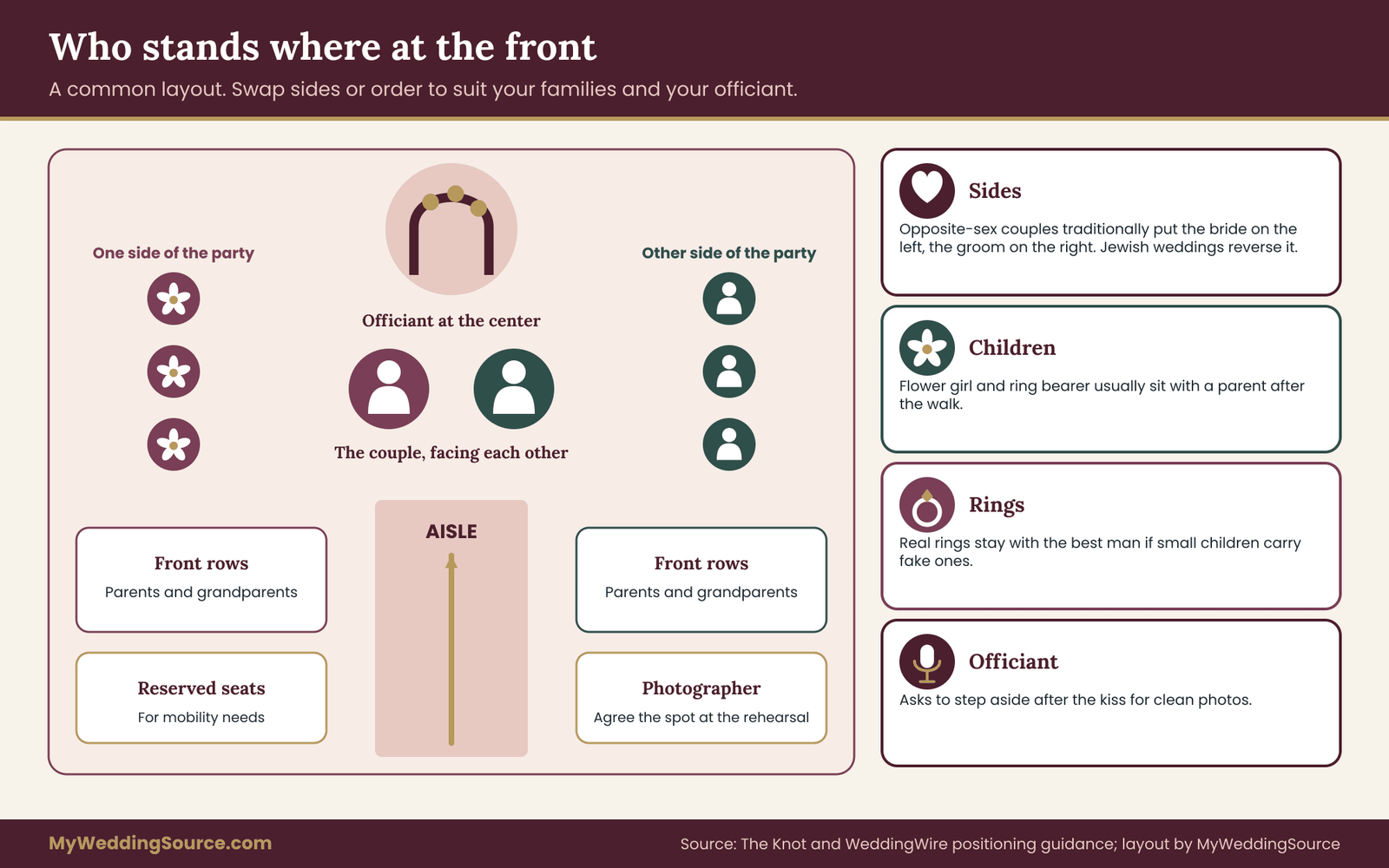
Where to stand: in many Western ceremonies, the officiant stands in the middle facing the guests, with the couple facing each other or facing the officiant. In heterosexual ceremonies, tradition puts the bride on the left and the groom on the right, from the guests’ point of view, though Jewish ceremonies reverse this and the choice is entirely up to the couple and the officiant. In many modern ceremonies, partners simply stand where they feel most comfortable.
What commonly goes wrong: the officiant stands too far back, and the couple’s faces are hidden from the photographer. Ask the photographer to suggest positions during the rehearsal.
Step six: the wedding party walks in
In the traditional order, the groomsmen and bridesmaids walk in pairs, followed by the maid or matron of honor. Some couples have the groomsmen wait at the front with the groom, and some have everyone walk in together. Common modern variations include having the wedding party enter together, in mixed pairs or in a single line.
Who is responsible: the coordinator cues each person to start, usually with a quiet hand signal or a whispered count. Pairs should leave a gap of about four or five seconds, or roughly the length of a slow step, so the aisle does not look crowded.
Pace and spacing: walk slowly, with each step landing on the beat. A faster walk looks nervous, and a slower walk looks solemn. A slow count in your head, one step per beat, keeps the pace even.
What commonly goes wrong: someone speeds up because they are nervous. Remind the party during the rehearsal to count in their heads.
Step seven in the wedding ceremony step by step: flower girl and ring bearer
If you have young attendants, they typically enter after the wedding party and just before the couple. The flower girl scatters petals, carries a basket or a sign, and the ring bearer carries a pillow, a box or a sign. Neither is expected to stand at the front for the whole ceremony. The usual plan is to have them sit with a parent in the front row after they arrive, or to stand with a comfortable adult nearby.
Who is responsible: a parent or a trusted adult, waiting at the back to guide them.
Rings: many couples use fake rings on the pillow and entrust the real ones to the best man or maid of honor, so a young child does not have to carry them. Our guide to the flower girl and ring bearer rehearsal has practical advice for children of different ages.
What commonly goes wrong: a child freezes in the aisle. Plan for it. Station a parent halfway down, and tell the child that a hug is a perfectly fine way to finish the walk.
Step eight: the music changes and guests stand
When the couple, or the partner who enters last, is ready, the music changes. This is the cue for everyone to stand and turn toward the aisle. It is a small moment with a big effect, because the whole room shifts together.
Who is responsible: the person running the music, cued by the coordinator or the ushers.
Tip: if you want guests to stand, the officiant or an usher can say so, or the program can note it. A simple line such as “Please rise as [Partner A] enters” prevents the awkward few seconds when guests wonder whether to stand.
Step nine in the wedding ceremony step by step: the couple’s entrance
The final person or people to walk down the aisle are the couple, or one partner followed by the other. They may walk alone, with parents, with both parents, with a child, together or from opposite sides. Whatever you choose, plan how you will arrive at the front. If someone is escorting a partner, decide in advance how the handoff will work. WeddingWire’s rehearsal guidance notes that the escort can present the partner in several ways, such as answering a question from the officiant, a hug, a kiss on the cheek or a handshake, and everyone involved should agree beforehand.
Who is responsible: the couple, the escort and the officiant.
Bouquets and hands: decide what to do with the bouquet. Many brides hand it to the maid of honor at the front, and the couple then joins hands and faces each other. Practicing that moment once removes most of the awkwardness.
The pause: after the last person arrives, give everyone a breath. The officiant can wait for a few seconds before inviting guests to sit. That pause is a good moment for photographs, and it gives the couple a chance to look at each other.
Timing: the whole processional typically takes 5 to 10 minutes, depending on the size of the wedding party and the length of the aisle. A long aisle with a large party can take more, and a small ceremony can take under two minutes.
Setting up the space for your wedding ceremony step by step
The layout of the ceremony space affects every step of the wedding ceremony step by step plan. A few simple choices make the whole sequence easier.
Aisle width. Aim for an aisle wide enough for two people to walk side by side, which is also wide enough for a wheelchair or walker. If the aisle is narrow, plan for the escort to walk one pace behind.
Sightlines. Everyone should be able to see the couple, and the couple should be able to see the guests. If you have a ritual that happens on a low table, raise it or add a screen.
Sound. Outdoor ceremonies with more than about fifty guests usually need a microphone and speakers, because natural sound carries poorly. Test the sound before guests arrive and have a backup.
Shade, wind and weather. Outdoors, consider the position of the sun, wind direction and a plan for rain. A weather decision time, such as two hours before the ceremony, prevents last-minute arguments.
Photographer and videographer positions. Mark where they may stand, and tell them where the officiant will stand. One tip from wedding professionals is to ask the officiant to step aside after the pronouncement so that they are not in the background of the first kiss photographs.
Phase three: the ceremony itself, step by step
Once the couple reaches the front, the officiant takes over. The next steps are mostly spoken, and the main job of the wedding ceremony step by step plan is to keep them in a sensible order and at a sensible pace. Our wedding ceremony script guide has full templates for the words. Here we focus on how each moment works in practice.
Step ten in the wedding ceremony step by step: opening words and welcome (2 to 4 minutes)
The officiant welcomes guests, thanks them for coming and says a few sentences about why everyone is gathered. In religious ceremonies, this is also where a prayer or invocation often goes. The welcome should be short, warm and clear. It is also the best place to remind guests of anything practical, such as that the ceremony is unplugged or that a reception follows.
Who is responsible: the officiant.
Tip: ask the officiant to wait a beat before speaking. Guests are still settling, and a pause helps the room go quiet without a request.
What commonly goes wrong: a long, rambling opening. Aim for one short story or idea, and then move on.
Step eleven: readings (optional, 2 to 5 minutes each)
Readings add a second voice and give the ceremony a pause between the officiant’s remarks. Most guides suggest keeping each one to two or three minutes, and treat three readings as the practical limit before attention wanders. Readers are usually friends or relatives who are seated until it is their turn. Our wedding readings guide explains how to choose texts that fit.
Who is responsible: the reader, cued by the officiant.
Logistics: give each reader a printed copy in large type, show them where to stand and tell them whether the microphone is a handheld, a stand or a lapel. If the readers are seated in the front row, the walk to the microphone is short, and the whole moment is smoother.
What commonly goes wrong: the reader does not know when it is their turn. The officiant should introduce each reader by name and wait for them to arrive before speaking.
Step twelve in the wedding ceremony step by step: the address, homily or personal words (3 to 7 minutes)
This is the part of the ceremony in which the officiant speaks about the couple and about marriage. In a religious ceremony, it may be a sermon. In a secular ceremony, it may be a short reflection on commitment, a few stories about the couple or a set of wishes. A long address is the single most common reason ceremonies run over time, so keep it short and specific.
Who is responsible: the officiant, who should have a draft the couple has approved.
Tip: ask the officiant to end with a clear transition into the vows, such as “[Partner A] and [Partner B] have chosen to say their promises aloud.” A clean handoff keeps the energy up.
Step thirteen: the declaration of intent (about 1 minute)
The declaration of intent is a short exchange in which each partner confirms that they are entering the marriage freely. Most places require it in some form, and it is usually phrased as a question answered with “I do.” It is one of the few spoken elements that is commonly required by law, along with the pronouncement, so make sure your officiant has confirmed the local wording.
Who is responsible: the officiant and the couple.
Tip: pause for a moment before the answer, and let the answer land. Guests will remember how it felt more than the words.
Step fourteen in the wedding ceremony step by step: the vows (3 to 8 minutes in total)
Vows can be repeated after the officiant, read from cards or spoken from memory. One planning guide suggests that personal vows run two to four minutes per person, or about 200 to 350 words each, while another recommends keeping each person’s vows under three minutes. A middle path is around 150 to 250 words each, which is about a minute or two aloud. Our wedding vows guide goes deeper into structure and length.
Who is responsible: the couple, with help from the officiant who may hold a backup copy.
Logistics: decide who goes first, where the cards are kept and whether the couple will hold hands. A handheld microphone, a lapel microphone or a stand can make it easier for guests to hear quiet vows.
What commonly goes wrong: vows that run long or fall quiet. Rehearse aloud at the pace you will use on the day, and mark the places where you want to pause.
Step fifteen: the ring exchange (2 to 4 minutes)
The officiant introduces the rings with a sentence or two about what they represent, the ring bearer or best man hands them over, and each partner places a ring on the other’s finger, often repeating a short line. If you are using fake rings for a child to carry, make sure the real ones are with the best man or another adult.
Who is responsible: the person who holds the rings, and the officiant.
What commonly goes wrong: no one can find the rings. Assign the duty clearly during the rehearsal, and ask the person to check that they are in a pocket before the processional begins.
Step sixteen in the wedding ceremony step by step: a unity ritual (optional, 3 to 5 minutes)
A unity ritual such as a sand ceremony, a candle lighting, a tree planting or a handfasting gives the ceremony a visual moment. It usually happens after the vows or the rings, though some couples place it earlier. Choose one and keep it simple. Rehearse once with the real objects, because the first pour of sand or the first strike of a match rarely goes exactly as planned.
Who is responsible: the couple and the officiant, with a helper to set up the table.
Tip: if the ritual happens at floor level or on a small table, raise it so guests in the back can see.
Step seventeen: the pronouncement (about 30 seconds)
The officiant declares the couple married. This is the second spoken element that is commonly required, and it usually includes a phrase such as “by the power vested in me.” It is a short moment, and it is the cue for the kiss.
Who is responsible: the officiant.
Tip: tell the photographer and videographer exactly when this will happen, so that they are ready for the kiss.
Step eighteen in the wedding ceremony step by step: the first kiss (about 30 seconds)
The kiss is brief, and the photographers often wish it were longer. If the officiant stands in the middle, ask them to step aside after the pronouncement so that they do not appear in the background of the kiss photographs. Some couples ask for a second kiss “for the camera,” and many guests will cheer in the meantime.
Who is responsible: the couple, the officiant and the photographer.
Step nineteen: the introduction of the couple (about 1 minute)
The officiant introduces the couple for the first time as a married couple, often by name, and invites guests to cheer or stand. The introduction is the cue for the recessional music to start. A short, joyful line works better than a long one, for example, “Friends and family, it is my honor to present, for the first time, [names].”
Who is responsible: the officiant, cued by the person running the music.
Phase four: the recessional
Step twenty in the wedding ceremony step by step: the exit (3 to 5 minutes)
The recessional is the reverse of the processional. The couple exits first, followed by the wedding party in reverse order, then the parents and any other honored guests. The ushers then release guests row by row, or guests follow the wedding party out. This usually takes three to five minutes, depending on the size of the party and the length of the aisle.
Who is responsible: the coordinator, the ushers and the music person.
Tip: decide what the wedding party does when they reach the end of the aisle. A designated spot for them to gather, such as a corner of the lobby, prevents the traffic jam that happens when everyone stops at the door.
What commonly goes wrong: the music ends before the last person exits. Ask your musician to play a longer track than you think you need.
Phase five: the hand-off
Step twenty-one: signing the license and family photographs
Many couples sign the marriage license right after the ceremony or soon afterward, witnessed by whoever the local law requires. Some do it in front of guests, with music playing, and some do it privately with the officiant and the witnesses. Wherever it happens, plan the time. The signing usually takes a few minutes, and the officiant is responsible for returning the license to the local office according to the rules of your state.
Family photographs often follow, and a short list of the groupings you want, prepared in advance, keeps them under half an hour. One tip from planners is to assign a loud, friendly friend to round up family members, so the couple does not have to chase them.
Step twenty-two in the wedding ceremony step by step: the transition to the cocktail hour
Guests need to know where to go next, and they need something to do while the couple takes photographs. A clear sign, an usher with a gesture or a line from the officiant, such as “Please join us for cocktails on the terrace,” moves the crowd. Make sure there is food and drink ready within a few minutes. A long gap between the ceremony and the cocktail hour is one of the most common guest complaints.
If you are planning the rest of the day around the ceremony, our wedding planning timeline shows how to build the schedule backward from the hard deadlines, including the ceremony start time.
How the wedding ceremony step by step changes by tradition
Everything above describes a Western, non-religious or lightly religious ceremony, which is the most common format in the United States. Religious and cultural ceremonies follow their own orders, and the right source for those is your officiant or religious leader. The notes below show how the wedding ceremony step by step plan typically shifts, so you can ask better questions.
Catholic. A Catholic ceremony may be held with or without a full Mass. Without Mass, the ceremony is built around a greeting, a Liturgy of the Word with readings, the Rite of Marriage with the consent and vows, a nuptial blessing and a final blessing, and it commonly runs about 30 to 45 minutes. With Mass, a Eucharistic liturgy is added, and the total can reach an hour or more. Parish rules often decide music, readings and who may take part, so talk to the priest early.
Protestant and Anglican. These ceremonies usually follow a familiar structure of welcome, prayer, readings, a sermon, vows, rings, a blessing and the pronouncement, and typically take 30 to 50 minutes. Many allow personal vows and custom readings, subject to the pastor’s guidance.
Jewish. Jewish ceremonies differ in the processional and the structure. In a common pattern, the rabbi enters first, followed by the grandparents and parents, who may escort the couple to the chuppah. The ceremony includes betrothal blessings over wine, the ring exchange, the reading of the ketubah, the seven blessings and the breaking of the glass, and the couple exits first. Positions at the front are often reversed compared with Western tradition. Length ranges from about 20 to 30 minutes for a shorter ceremony to up to an hour, depending on the community.
Hindu and South Asian. These ceremonies often include many rituals and can run from one hour to several hours, and in some families they are part of multi-day celebrations. A priest or family elder leads them, and the order is closely tied to family customs. If you are planning a combined ceremony, ask the officiant or family elder which elements are essential and which can be shortened.
Interfaith. An interfaith ceremony blends elements from two traditions and often runs 30 to 45 minutes. The key is to choose a few elements from each side that carry the most meaning, and to have an officiant who is comfortable with both. Explaining the symbolism in the program helps guests who are unfamiliar with one tradition.
Civil and secular. A simple civil ceremony can run 15 to 20 minutes, and with readings it can reach 25 to 35 minutes. A humanist ceremony led by a celebrant can run 30 to 50 minutes, because it often includes more reflection and personal stories. If you want help writing the words, our wedding ceremony script guide has full templates.
A rule that holds across every wedding ceremony step by step plan: ask your officiant for their standard order, and then adapt it. They know the legal and ritual requirements, and they know where flexibility exists.
Sample run sheets for three kinds of ceremony
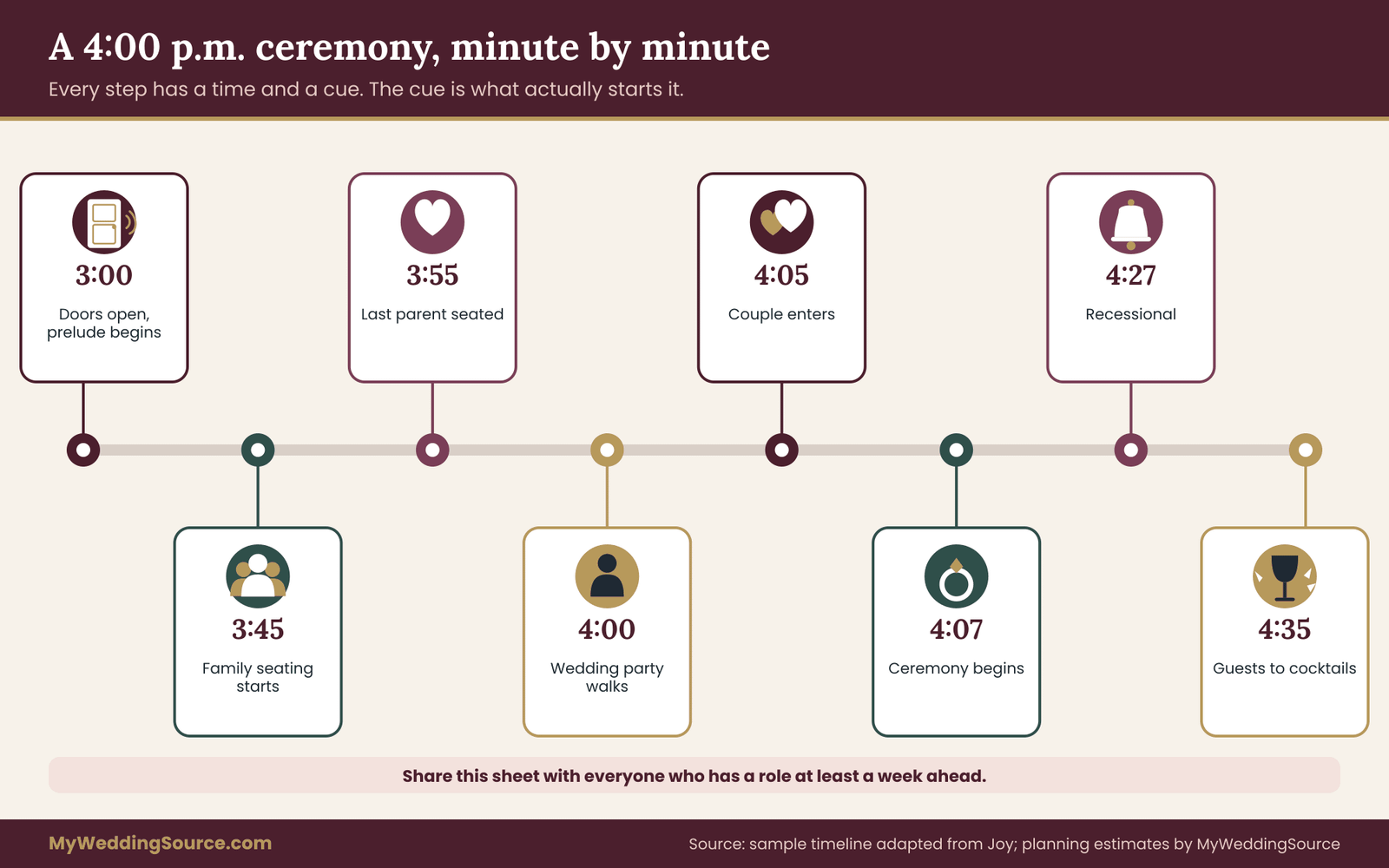
A run sheet is the practical output of a wedding ceremony step by step plan. It lists each step, the time it happens, who is involved and the cue that starts it. The three samples below show how the same structure looks for different ceremonies. Replace the times with your own, and add the names of the people responsible.
Run sheet one: a 4:00 p.m. ceremony of about 25 minutes
This sample follows the shape of a published sample timeline, with a few additions.
| Time | Step | Who | Cue |
|---|---|---|---|
| 3:00 | Doors open, prelude begins | Ushers, musician | Coordinator confirms start |
| 3:45 | Family seating begins | Ushers | Coordinator signals |
| 3:55 | Last parent seated, processional music cued | Usher, musician | Last parent in seat |
| 4:00 | Officiant and partner in place, wedding party walks | Coordinator | Hand signal |
| 4:05 | Final partner walks, guests stand | Coordinator, musician | Music change |
| 4:07 | Opening words | Officiant | Guests seated |
| 4:10 | Reading | Reader | Officiant introduces |
| 4:13 | Address | Officiant | Reader returns to seat |
| 4:17 | Declaration of intent and vows | Couple | Officiant transitions |
| 4:22 | Ring exchange | Couple, ring holder | Vows complete |
| 4:25 | Pronouncement, kiss, introduction | Officiant | Rings placed |
| 4:27 | Recessional | Musician, ushers | Introduction |
| 4:35 | Guests released to cocktail hour | Ushers | Last of wedding party exits |
The key point in a run sheet like this is that every step has a cue, not only a time. A time says when something should happen. A cue says what actually starts it.
Run sheet two: a short civil ceremony of about 12 minutes
| Time | Step | Who | Cue |
|---|---|---|---|
| 11:00 | Guests seated, quiet music | Coordinator | None |
| 11:10 | Couple and officiant enter | Couple | Coordinator signals |
| 11:11 | Welcome and one idea | Officiant | Couple in place |
| 11:14 | Declaration of intent | Couple | Officiant asks |
| 11:16 | Short vows | Couple | Declaration complete |
| 11:19 | Ring exchange | Couple | Vows complete |
| 11:21 | Pronouncement and kiss | Officiant | Rings placed |
| 11:22 | Signing the license | Couple, witnesses | Officiant invites |
| 11:25 | Photographs, then lunch | Coordinator | Signing complete |
Run sheet three: a 35-minute ceremony with a ritual
| Time | Step | Who | Cue |
|---|---|---|---|
| 5:00 | Prelude, ushers seat guests | Ushers | Start |
| 5:25 | Grandparents and parents seated | Ushers | Coordinator signals |
| 5:30 | Wedding party processional | Coordinator | Hand signal |
| 5:35 | Couple’s entrance | Escorts | Music change |
| 5:37 | Opening words | Officiant | Couple in place |
| 5:40 | First reading | Reader 1 | Officiant introduces |
| 5:43 | Address | Officiant | Reader returns |
| 5:48 | Declaration of intent | Couple | Officiant asks |
| 5:50 | Vows | Couple | Declaration complete |
| 5:55 | Ring exchange | Couple, ring holder | Vows complete |
| 5:58 | Unity ritual | Couple, helper | Rings placed |
| 6:02 | Second reading | Reader 2 | Ritual complete |
| 6:05 | Pronouncement and kiss | Officiant | Reading complete |
| 6:07 | Recessional | Musician | Introduction |
Notice that the third run sheet sets aside a few minutes at the start of each phase for transitions. Real ceremonies run a little slow, so a plan with no padding will almost always finish late.
Who does what: the roles behind every wedding ceremony step by step plan
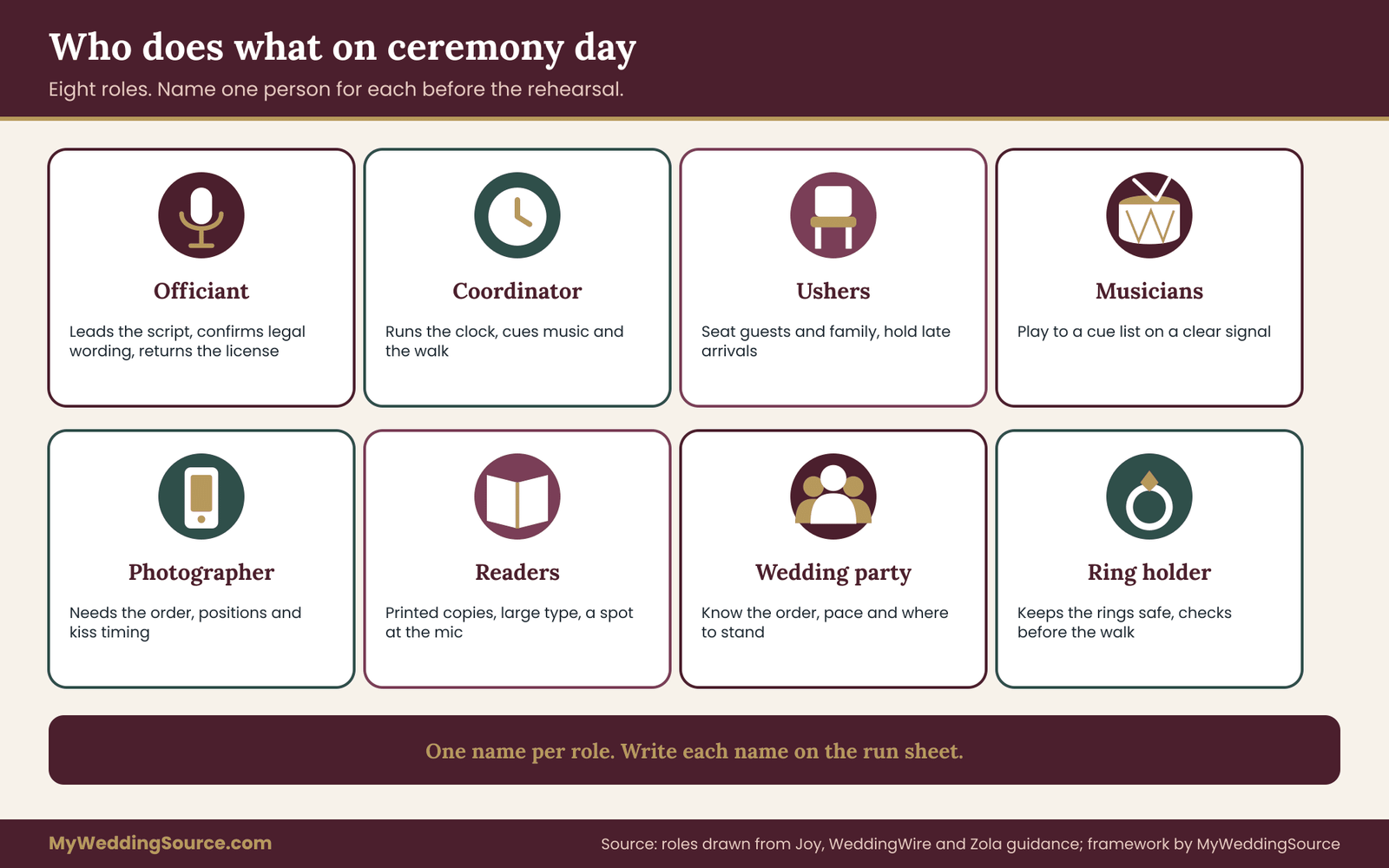
A ceremony looks effortless when everyone knows their job. These are the roles that matter most, and what each person is responsible for.
The officiant. Leads the ceremony, delivers the script, confirms the legal requirements and signs and returns the license. They should receive the final script and run sheet at least a week before the wedding.
The coordinator. Runs the schedule, cues the music, the processional and the transitions, and fields questions from anyone with a role. The coordinator can be a professional planner, a venue coordinator or a friend with a clipboard, but it needs to be one person.
The ushers. Greet guests, hand out programs, seat family and handle late arrivals. They need a printed seating list for the front rows and a clear idea of what to say when a guest asks a question.
The musician or DJ. Plays the prelude, processional, any interlude music and recessional. They need a cue list, and they need to know who gives the signal for each change.
The photographer and videographer. Capture the ceremony, and need to know the order, the officiant’s position, when the first kiss will happen and where they may stand. Rules about flash and movement during the ceremony should be agreed in advance.
The readers. Deliver readings and need printed copies in large type, a rehearsal and clear instructions about when to stand.
The wedding party. Stand with the couple, hold items such as bouquets and rings, and support the couple. They need to know the processional order, their positions and what to do after the ceremony.
The ring holder. Keeps the rings safe, produces them on cue and, ideally, double-checks them before the ceremony.
The rehearsal: how to practice your wedding ceremony step by step
A rehearsal is a walk-through of the ceremony, usually the day before. It gives the couple, the officiant, the wedding party, parents and readers a chance to practice their roles, learn the cues and fix problems while there is still time. Planning sources suggest 30 to 45 minutes for most weddings, with longer if you have a large party, a complicated ritual or an unfamiliar venue. Even a short rehearsal is worth it, and for destination weddings it is especially useful, because the couple and out-of-town participants can learn the venue.
Questions to settle at the rehearsal
WeddingWire’s rehearsal guidance lists nine topics worth deciding. Use them as an agenda.
- Who is in charge? Name one point person for logistics on the rehearsal day and the wedding day.
- Have the ushers been briefed? They need to know the seating plan, any special arrangements and how to manage late guests.
- What is the lineup? Confirm the processional order, and make sure each person knows who walks directly before and after them. If you line people up by height, have them wear their wedding-day shoes.
- How should bouquets be held? Practice together so the group looks consistent on the aisle and at the front.
- Where do children go after the processional? Flower girls and ring bearers usually do not stand at the front. They may sit with a parent or stand with a comfortable adult.
- How will the giving-away work? Agree on whether the escort answers a question, hugs, kisses a cheek or shakes a hand, and make sure everyone is comfortable.
- What do the partners do with their hands? Decide where the bouquet goes and how the couple stands, and practice it once.
- Who carries the rings? Assign the duty clearly, and consider using fake rings on the pillow.
- Where and when should everyone be? Set arrival times and meeting points for the day, including a spot for family photographs after the ceremony.
How to run the rehearsal
To rehearse the wedding ceremony step by step, start with the processional, since it is the step with the most movement. Have people walk it twice: once slowly to learn positions and once at the real pace. Mark positions at the front with tape or small flags, which helps children and anyone nervous about where to stand. Then move through the ceremony in order, with the officiant reading cues but not the full script. Practice the transitions that are easy to forget: where readers stand, how the ring exchange works, what the couple does during the ritual and how the recessional starts.
Finish with the recessional and with a clear instruction about where everyone goes next. A short, friendly wrap-up, with a printed run sheet for each person, sends everyone off knowing what to expect.
If you can, hold the rehearsal in the actual ceremony space, at about the same time of day. Different light, sound and weather change how things feel, and the more familiar the space, the calmer the day.
Accessibility and inclusion in a wedding ceremony step by step plan
A good plan makes the ceremony comfortable for everyone in the room. Small choices at the planning stage prevent big problems later.
Mobility. Make sure the aisle, the seating and the route to the restrooms are accessible, and reserve seats at the end of rows for guests who use wheelchairs, walkers or canes. Offer an usher’s arm or a quiet escort for anyone who wants one. Gravel, grass and sand can be difficult, so consider a mat or a temporary path.
Hearing and vision. If guests have hearing loss, a microphone and speakers help, and printed programs with the readings and vows can add context. For guests with low vision, large-print programs and seats near the front are useful. If you have guests who use sign language, arrange an interpreter and a clear sightline.
Seating for elders. Older relatives may tire during a long ceremony or in hot weather, so provide water, shade and a chair with arms where possible.
Children. If children are invited, plan seating near the aisle for easy exits, and consider a small activity bag. If you have chosen an adults-only ceremony, say so on the invitation and the website, and be ready to answer questions kindly.
Couples and families of every kind. Use inclusive language in the script and program, let parents and stepparents choose how they would like to take part and avoid assumptions about who walks whom. Our wedding officiant guide explains what to ask an officiant about inclusive wording.
Adapting the wedding ceremony step by step to your situation
The sequence above is a framework, not a rulebook. These situations come up often, and each changes one or two steps.
A small or micro wedding
With 30 guests or fewer, the wedding ceremony step by step plan gets simpler and more personal. You may skip ushers and programs, seat everyone in a circle or a horseshoe and have the officiant speak without a microphone. Many micro ceremonies run 20 to 35 minutes, and some of the most memorable ones are shorter. Use the saved time to include something personal, such as inviting each guest to say one wish, or having a close friend read a letter.
The risk in a small wedding is that no one is officially in charge, because everyone is family or a friend. Name one person to hold the run sheet, even in a living room.
An outdoor ceremony
Outdoor ceremonies add weather, sound and light to the plan. Guides recommend renting a sound system when you have more than about 50 guests, and assigning a person to cue the musicians. Face the couple away from the strongest sun, so guests are not squinting and the photographer has a flattering light. Provide shade, water and a plan for wind, since veils, programs and petals all take flight.
Write the weather decision into the wedding ceremony step by step schedule as a step of its own, for example, “Two hours before: decide plan A or plan B.” Tell the officiant, the musicians and the ushers the new plan at the same time.
A destination wedding
A destination wedding often has a short ceremony, a smaller guest list and a local officiant. Local rules differ, and some places require paperwork days or weeks in advance, so ask the venue and the officiant early. Because many participants meet the space for the first time on the day, a rehearsal is especially useful. Bring printed copies of everything, since printing at your destination can be hard, and carry the rings and the vows in your hand luggage.
Blended families and second marriages
Many couples bring children from earlier relationships, and the wedding ceremony step by step plan can honor them. Children can walk with a parent, stand with the couple, read a short passage or take part in a family ritual, such as a pledge or a shared symbol. Ask each child how much they want to take part, and give them an easy way to step back.
If parents are divorced or relationships are complicated, decide the family seating and the escorts in advance and talk to each person. Our wedding processional order guide offers options, and the rule of thumb is simple: use the plan that keeps everyone comfortable.
Two officiants or two traditions
If two officiants take part, assign a clear role to each: one may lead the welcome and the address, and the other the blessing or the ritual. Give each the full run sheet, and rehearse the handoffs. The same applies to ceremonies that blend two religious or cultural traditions, where the order and the language matter. The wedding ceremony step by step plan should show which elements come from which tradition, so the officiants do not duplicate each other.
A ceremony without a processional
Some couples skip the aisle altogether, and welcome guests as they arrive, then begin at the front. In that case, the “processional” steps disappear, and the plan becomes a prelude, an opening and a clear start signal. This can feel relaxed and intimate, and it solves the problem of a narrow aisle or a tight venue.
A ceremony and reception in the same room
When the ceremony and reception share a space, the room must change during the cocktail hour, which adds a step to the wedding ceremony step by step plan. Ask the venue how long the flip takes, and plan a cocktail hour of at least 45 minutes, so guests are not left waiting. Tell guests where to go, and decide who will move which items, such as the officiant’s table or the unity ritual.
Etiquette notes for the wedding party and guests during the wedding ceremony step by step
A few habits make the wedding ceremony step by step plan feel polished without extra work.
For the wedding party. Arrive early, wear the shoes you will wear on the day for the rehearsal, hold your bouquet at about waist height and keep your hands relaxed. Face the guests with a soft expression. Avoid checking your phone in the lineup, whisper rather than talk and stay put until the recessional begins.
For the readers. Walk to the microphone at a calm pace, wait a moment, read slowly and look up now and then. A reading that feels long on paper is quick when spoken slowly.
For the officiant. Keep the tone of the ceremony consistent with the couple, speak clearly and give the couple a moment of silence for the kiss and the rings. Remember that guests only remember the highlights, so choose the stories carefully.
For guests. Arrive on time, silence phones, hold applause until the introduction and follow the ushers’ directions. If you want to photograph the ceremony, ask the couple first, because many ask for an unplugged ceremony.
For parents. Parents and stepparents appreciate knowing exactly where to sit and when to stand. A short phone call a week before beats a surprise at the door.
How the vendors fit into the wedding ceremony step by step plan
Everyone with a role in the ceremony should see the same run sheet. These are the details each vendor needs.
Photographer. The order of events, the officiant’s position, the time of the kiss, the first look of the couple at the end of the aisle and any rules from the venue or a religious community about flash and movement. A short list of the key moments, such as the entrance, the vows, the rings and the kiss, helps a photographer plan positions.
Videographer. The same list, plus the sound plan. If the officiant has a lapel microphone, the videographer can often tap into it, which gives much cleaner audio.
Musicians. The cue list, the length of each piece and the hand signals. A processional that takes six minutes needs a piece that lasts at least that long, or a plan to loop. Tell them how you want the music to change when the couple enters and when the pronouncement happens.
Coordinator or planner. The full run sheet, the vendor contact list and the weather plan. The coordinator should also have a list of the key family members and an emergency kit with safety pins, tissues, mints, a sewing kit and extra programs.
Venue staff. The start and end times, the layout, the sound check and any restrictions on candles, petals or confetti. Ask who unlocks the space, and when the next event starts.
Florist. The delivery times and the placement of arch, aisle and altar flowers. Ask the florist to include the wedding party’s bouquets and boutonnieres, and decide who pins them on.
What to do in the first 60 seconds after the wedding ceremony step by step ends
The minute after the pronouncement is where the wedding ceremony step by step plan meets the rest of the day. Planners suggest a few small habits that make a difference.
Give the couple a moment before the recessional. A pause, a short smile and a look at the guests gives photographers a chance and gives the couple the feeling of arriving. Ask the officiant to step aside after the kiss. Then, as the couple exits, the ushers can release guests row by row, so the aisle does not turn into a crowd.
Appoint a person to meet the couple at the exit with water and, if the couple wishes, a few minutes alone. Many couples find that a short private moment, even two minutes behind a door, helps them take in what has just happened before the photographs begin.
Building your wedding ceremony step by step plan backward from the date
The best wedding ceremony step by step plan is built backward from the day, not forward from the first idea. Each deadline below leaves room for the next one, so nothing lands on the final week.
Three to four months out. Choose the officiant, confirm the ceremony location and ask what the venue or the religious community requires. Find out whether a rehearsal slot is included and how long the space is yours on the day. Decide whether the ceremony will be religious, civil, secular or blended, because that choice drives almost every other step.
Two months out. Draft the outline of the wedding ceremony step by step order with your officiant, and choose the readings, the ritual (if any) and the style of vows. Choose the musicians and give them a first list of the moments that need music: prelude, processional, the couple’s entrance, a possible interlude and the recessional.
One month out. Finish the script and the vows, choose your readers and confirm the processional order. This is also the time to design the program, which is the guests’ version of your plan. Our wedding programs guide shows what to include and how to word it.
Two weeks out. Send the final run sheet to every person with a role: officiant, coordinator, musicians, photographer, videographer, ushers and readers. One popular planning guide recommends sharing the timeline at least a week ahead, and two weeks gives people a margin to ask questions.
The week of the wedding. Print the run sheet, the license paperwork, the readings and the vows. Pack the ring box, the pen for signing and any ritual items in one bag with a name on it. Confirm the weather plan and the time you will decide between plan A and plan B.
The day before. Hold the rehearsal, and walk the wedding ceremony step by step with the people who will be in it. Finish with a clear note about where everyone should be and when.
The morning of. Have one person check the ceremony space, the sound system, the seating, the program table and the aisle. Check the rings, the license and the readings one last time.
Writing the guest-facing version of your wedding ceremony step by step
Your guests do not need every cue on your run sheet, but they do need to know what to expect. A short program turns the wedding ceremony step by step plan into something readable.
A good program has the names of the couple, the date and place, the order of the ceremony in a short list, the names of the wedding party and readers, a line of thanks and any practical notes. It does not need to explain every ritual, but a sentence on an unfamiliar tradition helps guests feel included, especially in an interfaith or multicultural ceremony.
The order of events in a program should match the run sheet. If you decide to cut a reading on the morning of the wedding, ask the printer or print a corrected insert, because a program that disagrees with the ceremony makes guests feel that something went wrong.
Announcements at the start. Whoever speaks first, usually the officiant, can make three short announcements: that the ceremony is unplugged, that guests are welcome to take their seats and that there will be a reception or cocktail hour afterward. Keep these to a few sentences, and say them warmly. A friendly tone works better than a rule list.
Signs and cues. A sign at the entrance with the order of events, a sign for “choose a seat, not a side” and a sign that points to the cocktail hour keep ushers from answering the same questions again and again.
What to say when something goes wrong during a wedding ceremony step by step
Almost every ceremony has a small surprise. Having a calm line ready for each one keeps a small problem from becoming a big one.
The music does not start. The officiant can say, “Let us take a moment,” and the coordinator can fix the sound. Guests are usually patient for a minute or two.
A child does not want to walk. Stay calm and smile. A parent can step forward and walk with the child, or the child can sit down. Guests will be delighted either way, and the processional can move on.
Someone forgets a line or a reading. The officiant should hold a spare copy of every reading and the vows, and a gentle prompt, such as “Take your time,” helps the person recover.
The rings are missing. Ask the best man to confirm before the processional, and keep a backup plan in mind. In an emergency, the couple can exchange the rings after the ceremony in private and keep the public moment simple.
It begins to rain. Decide the weather plan well in advance, and name who makes the call and when. A tent, an indoor room or a covered porch should already be on the run sheet, and the ushers should know the new route.
A guest interrupts or arrives during the vows. Ushers can quietly hold the person at the back, and the officiant can continue without comment. Late guests can slip in after the vows or between sections.
A phone goes off. A light joke from the officiant usually ends it, and the ceremony continues. This is one more reason to announce an unplugged ceremony at the start.
The ceremony runs long. If the plan is running over, the officiant can trim the address, and a reader can skip a verse. Decide in advance which parts are optional, so the person leading can cut gracefully.
Common mistakes in a wedding ceremony step by step plan
These are the errors that come up most in planning guides and in real ceremonies. Each is easy to prevent once you know about it.
Having no single person in charge. A ceremony with six people giving cues is a ceremony with six different ideas about when to start. Name one coordinator.
Treating the rehearsal as optional. A short walk-through reveals problems in the aisle, the sound and the sightlines, and it calms the whole party. Even a 20-minute practice is better than none.
Making the address too long. The officiant’s remarks are the part of a ceremony most likely to run over. Ask for a draft and set a time limit.
Forgetting the practical details. The marriage license, the pen, the rings and the printed readings are the items most likely to be left behind. A checklist read aloud before the processional prevents it.
Overpacking the ceremony. Three readings, a unity ritual, a long address and two songs can easily push a ceremony past 40 minutes, and guests tire. If you want a rich ceremony, choose carefully.
Ignoring the guests’ comfort. Sun, wind, hard chairs and long waits all take a toll. Provide shade, water and a clear schedule, and start on time.
Skipping the transition. A ceremony that ends without a clear next step leaves guests standing awkwardly. Have the officiant announce where to go and what happens next.
Letting the plan live only in one person’s head. If the only copy of the plan is with the bride, the whole day depends on her. Share the run sheet.
Choosing a length for your wedding ceremony step by step plan
How long should the ceremony be? Planning guides agree that 25 to 40 minutes is a comfortable range, and many say that around 30 is a sweet spot for non-religious ceremonies. Shorter is common for civil ceremonies and elopements, and longer is normal for ceremonies with many rituals or a full Mass.
A useful way to decide is to start from your priorities. If the vows matter most, give them time and shorten everything else. If a ritual is central, plan it with care and cut the readings. If you want to keep it tight, choose one reading, short personal vows and no ritual, and you can finish in 15 to 20 minutes.
Think about the guests too. Older guests may find a long ceremony in the sun difficult, and children may struggle after 20 minutes. If you are not sure, aim shorter, since a ceremony that leaves guests wanting a little more is better than one that outstays its welcome.
Your wedding ceremony step by step checklist
Use this list as a final check. Print it, and go through it with your coordinator the day before.
- The officiant has the final script, the run sheet and the license paperwork.
- The coordinator has the full schedule and has shared it with everyone who has a role.
- The musicians have a cue list and know who gives each signal.
- The ushers have a printed seating list for family and know how to handle late guests.
- The wedding party knows the processional order, the pace and where to stand.
- The readers have printed copies, large print if possible, and know when to come forward.
- The ring holder has the rings, and a second person has checked.
- The couple knows what to do with bouquets, hands and the first kiss.
- The sound system works, and a backup microphone is available.
- The weather plan has a decision time and a named decision-maker.
- The photographer and videographer know the order, the positions and the timing of the kiss.
- Guests know where to go after the ceremony, and food and drink are ready.
If you would like to match the ceremony to the rest of the day, our rehearsal dinner toasts guide pairs well with the rehearsal, since the two usually happen on the same evening.
FAQ
How long should a wedding ceremony step by step plan take on the day?
Most non-religious ceremonies run 20 to 40 minutes, and many planners treat 25 to 30 minutes as the sweet spot. Religious ceremonies vary widely. A Catholic ceremony without a Mass often runs 30 to 45 minutes, and one with a Mass can reach an hour or more, while Hindu ceremonies can last several hours. Ask your officiant for their usual length, and then build your wedding ceremony step by step plan around it.
What is the order of a wedding ceremony step by step?
A common order is the prelude, family seating, the officiant and partners taking places, the wedding party’s entrance, the couple’s entrance, opening words, readings, an address, the declaration of intent, vows, rings, an optional ritual, the pronouncement, the kiss, the introduction and the recessional. Religious ceremonies reshape this order, so ask your officiant for their version.
Who walks down the aisle first at a wedding?
In the traditional order, the officiant is in place first, followed by grandparents, parents, the groom and best man, the wedding party in pairs, the maid or matron of honor, the ring bearer, the flower girl and the bride last. Many modern ceremonies change this, with partners entering together or each walking with their own family. Choose the order that suits your family.
How early should guests arrive for the ceremony?
Most guides suggest guests arrive 15 to 30 minutes before the start time. Printing a start time that is 15 to 20 minutes before the real start can help, but it is better to be honest and clear. Ushers should be ready before the doors open, and the prelude music should begin as the first guests arrive.
Do we need a wedding rehearsal?
A rehearsal is not required, but it is strongly recommended. It lets the couple, officiant, wedding party and readers practice the wedding ceremony step by step plan and fix problems while there is still time. Planning sources suggest 30 to 45 minutes for most weddings, and the rehearsal is usually held the day before, or in the days leading up to the wedding.
How long should wedding vows be in the ceremony?
Personal vows are often one to three minutes each, which is roughly 150 to 250 words, and some guides allow up to about 350 words. Traditional vows repeated after the officiant take much less time. Rehearse out loud, because a vow that feels short on paper can run long when read slowly.
Who should hold the rings during the ceremony?
The best man or another trusted adult usually holds the real rings. If a child is carrying the rings on a pillow, use fake ones and hand the real ones to an adult. Make the assignment clear at the rehearsal, and have the person check that the rings are in their pocket before the processional begins.
Can we skip parts of the traditional wedding ceremony step by step order?
Yes. Apart from the legally required elements, such as the declaration of intent and the pronouncement in many places, the rest is optional. You can skip the giving away, readings, a unity ritual or a long address. Ask your officiant what your state requires, and then build the wedding ceremony step by step plan around what matters most to you.
Your next steps
Start with three things this week. First, ask your officiant for their standard order and length, and note anything required by your state or community. Second, copy the sample run sheet closest to your plan, and replace the times with your own. Third, choose your coordinator, because a person who owns the schedule makes every later step easier.
Then write the words with our wedding ceremony script templates in hand, return to this wedding ceremony step by step plan to place each part, and schedule the rehearsal. A clear plan makes the ceremony feel natural, and a well-planned ceremony leaves you free to be present for it.
Sources
- Wedding Ceremony Order: A Complete Guide to What Happens and When, Paperlust
- Order of Service for a Wedding: A Complete Ceremony Guide, Paperlust
- Outlining Your Wedding Ceremony Order: A Stress-Free Guide, Joy
- A Guide to the Wedding Ceremony Order of Events, Zola
- Wedding Processional Order Walkthrough for Every Couple, Zola
- Simple Wedding Ceremony Outline, Loverly
- A Comprehensive Guide to the Wedding Ceremony Processional Order, The Knot
- The Right Wedding Ceremony Order for Nearly Every Kind of Nuptials, The Knot
- 9 Questions to Ask During Your Wedding Rehearsal, WeddingWire
- Wedding Ceremony Outline: Ceremony Tips From Mindy Weiss, MasterClass