

Planning a proposal while traveling means arranging a once-only moment in a place you cannot fully control, with people you may never meet in person, so the plan has to be written down, shared on a need-to-know basis, and backed up before you leave home.
Quick answer
Choose the moment first, then build around it: write a one-page brief, give each vendor only the part they need, and prepare three versions of the same moment (a main plan, a close-by indoor or covered alternative, and a next-morning fallback) with a decision time for each. Carry the ring and documents with you, not in checked luggage, and put every deposit, confirmation, and cancellation term in one place. Planning a proposal while traveling goes best when the ring, the vendors, and the backup are settled before the trip starts, and when you propose early enough in the trip that a delay does not cost you the moment.
Most advice about planning a proposal while traveling is about the setting: the beach, the overlook, the rooftop. This guide is about the logistics underneath, because those are what go wrong. It covers how to coordinate a photographer, a hotel, a restaurant, and any local helpers when you are not there to supervise; how to read permit and drone rules in a place you do not live; how to build a backup itinerary you can actually switch to; and what to do about the ring, the paperwork, the money, and the secret itself. It is written for U.S. travelers, whether the trip is a long weekend by car or a flight abroad.
Two notes before we start. First, this is general planning information, not legal, financial, or insurance advice, and rules differ by park, city, airline, and country. Second, we checked the official and vendor pages named in the source list in November 2026, and we say so where a statement comes from a vendor or planner and not from a regulator. Rules and fees change, so confirm anything that matters with the office or company involved, in writing.
What changes when you are planning a proposal while traveling
Planning a proposal at home leans on things you rarely notice: you know the neighborhood, you can drive past the spot, you can fix a problem in an hour, and your phone is full of people who can help. Travel removes most of that at once. The first step in planning a proposal while traveling is to name what you are losing, so you can replace each item on purpose.
Distance removes your usual safety nets
At home, a problem is an inconvenience. On the road, the same problem can end the plan, because you have a fixed number of days, a booked flight home, and a partner who is standing next to you.
You cannot scout twice
You may get one look at the place, or none, before the day. Photos and maps show where a viewpoint is, but not where the wind comes from, how many other people will be there, which way the light falls, or whether a path is closed. If you can only visit once, visit at the same time of day you plan to propose, and treat that visit as part of the trip so it does not look like scouting. If you cannot visit at all, ask the people who know the place, such as the hotel concierge or a local photographer, and ask them specific questions: where do crowds gather, where is it quiet, and what changes with weather.
Your tools are replaced by someone else’s
At home you might hire a florist, borrow a speaker, or ask a friend to hold a camera. Away, you rely on a hotel desk, a restaurant manager, a tour guide, or a photographer you found online. Each is helpful and each has their own priorities, schedules, and policies. The practical response is to write down what you need from each of them in plain language, and to ask what they need from you, instead of assuming that a friendly email means everything is arranged.
Travel adds failure points the proposal itself does not have
A proposal has few moving parts: a place, a time, a question, and a way to record it. A trip adds transport, lodging, weather, jet lag, and time zones, and each of them can shift the time you chose.
Transit failures
When planning a proposal while traveling, flights are delayed, bags are lost, trains are late, and rental cars are not ready. Event planners quoted by Benchmark Resorts & Hotels, a resort operator, suggest anticipating disruptions such as weather or missed connections and keeping a plan B and a plan C that you can adjust through your hotel, restaurant, or tour contacts. That advice comes from the two planners in that article, and it matches common sense: the more of your plan that depends on arriving on time, the less slack you have, so avoid proposing on the day you land.
Information leaks
When several people hold a secret, one of them can slip. Travel adds new routes for leaks: a hotel email that lands on a shared device, a confirmation text that pops up on a lock screen, a booking made on a joint account, or a vendor who replies to a group thread. The same Benchmark article suggests keeping one shared itinerary for your partner and storing the real proposal plans only on your own phone, and turning off push notifications or using a privacy screen so hotel or concierge messages do not give the surprise away. That is a planner’s tip, not a rule, but it is cheap to follow.
Start with the date, the place, and a written outline
Before you contact a single vendor, decide three things about your trip proposal: when in the trip it happens, roughly where, and how many people you are comfortable involving. Vendors can only help once you have answers, and every later change costs more.
Choose the moment, then protect it
When planning a proposal while traveling, the best day for the question is often not the most scenic day. It is the day with the most slack around it.
Early in the trip, or late
One of the planners in the Benchmark article recommends proposing early, ideally within the first day or two, so you are not anxious for the rest of the trip. There is a second benefit: if something goes wrong, you still have days left to try again. The case for later is that you will know the place, you will have had time to check the light and the weather, and your partner will be relaxed. If you choose later, keep at least one spare day before you fly home. Avoid arrival day, because delays and tiredness are most likely then.
Leave slack on both sides
Put a buffer of an hour or more before the moment, so a late taxi does not push you into the dark or into a dinner reservation. Leave a buffer after it as well, because you may want photographs, calls to family, or simply a quiet walk. If a photographer is booked, ask how long they hold the slot and what happens if you run late. If you are planning a proposal while traveling across time zones, write the time in both zones on your brief so nobody calculates it in their head.
Write a one-page brief
A short written plan is the single most useful tool for planning a proposal while traveling. It forces decisions, and it is the document you can send, in pieces, to the people who need it.
What goes on it
Include the date and the time window; the exact meeting point, with a map pin and a description of how to find it; the name and phone number of each person involved; the cue that tells everyone it is time to start; what your partner knows and does not know; the plan B location and the time you will decide; and the ring’s location during the day. Add the phone number and address of the hotel, because vendors may need to reach someone who is not you. Keep it to one page. If the brief gets longer, the plan is probably too complicated for a trip.
Who sees which version
Not everyone needs the whole brief. The photographer needs the place, the time, the cue, and how to recognize you both. The restaurant needs the table, the time, and what you would like prepared. A friend who is meeting you needs only the part they play. Make a separate short message for each, and keep the full brief to yourself. This is also the tidy way to follow the advice to keep the circle small: fewer people see the full picture, so fewer people can spoil it.
Vendor coordination when you are planning a proposal while traveling
Vendors are the part that most people underestimate. At home, you can stop by. On a trip, a single email thread may be your only contact. Good coordination is mostly clear writing, one confirmation per person, and a call the day before.
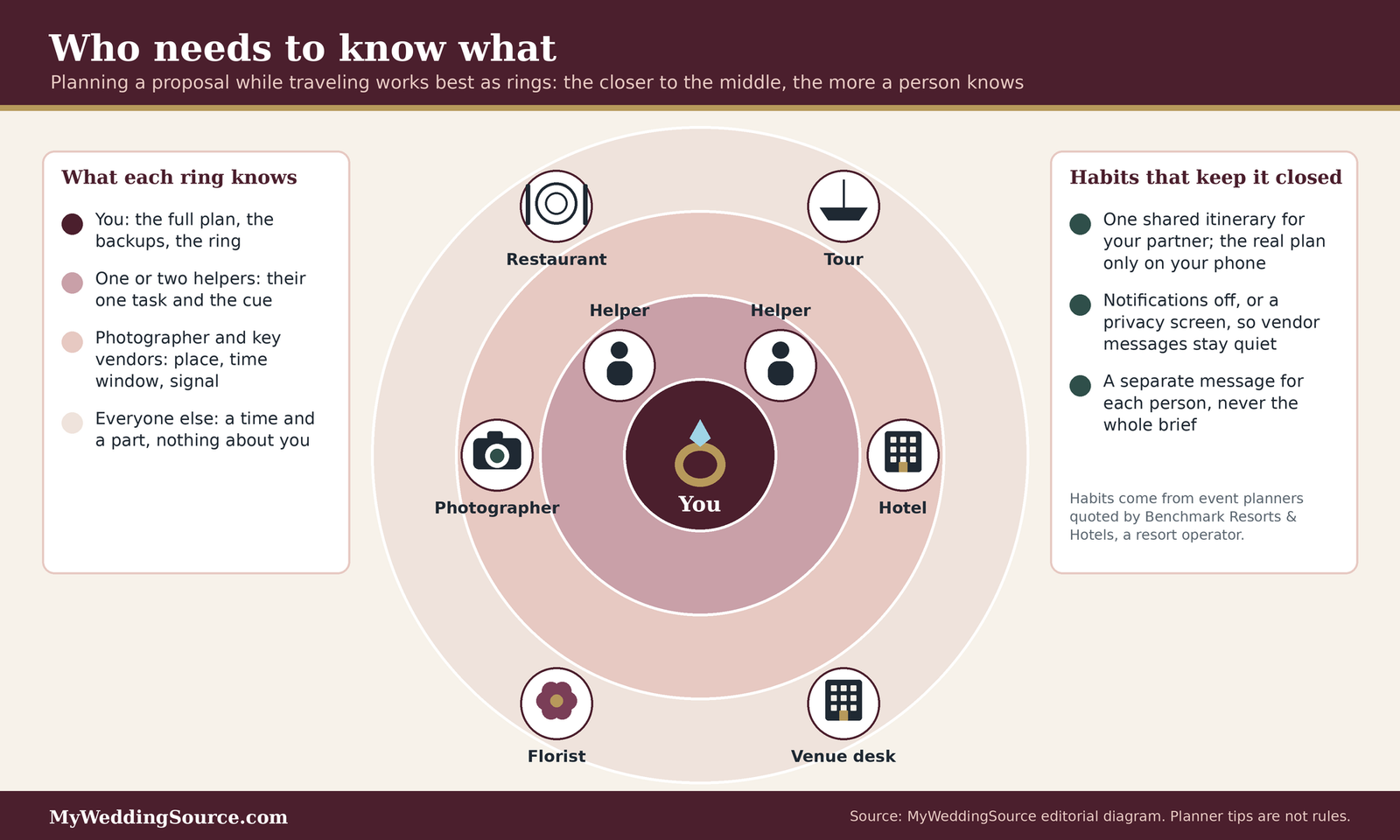
The need-to-know circle
Think of your plan for planning a proposal while traveling as a set of rings around you. The closer someone is to the center, the more they know. Most vendors belong in the outer ring: they know a time, a place, and a signal, and nothing about your partner’s habits or your history.
Photographers and videographers
When planning a proposal while traveling, the photographer is usually the person who knows the most, because they have to be in position and recognize you. Flytographer, a marketplace for vacation photographers, says that connecting with a photographer first can get you location recommendations and mockups, and that its concierge team and photographers stay in touch before the trip to confirm plans. Those are the company’s own claims, so treat them as a description of how that service works, not a general promise. Whatever service you use, ask the photographer to confirm the meeting spot, the length of the session, the number of delivered images, the delivery date, and what happens if weather forces a move. Our guide to wedding photography covers contract basics that carry over, and engagement photos explains what to ask about the session afterward.
Hotels, restaurants, and local helpers
When you are planning a proposal while traveling, concierges and managers can hold a table, keep a bottle chilled, deliver flowers, or simply note that something is happening so staff do not interrupt. One planner quoted by Benchmark suggests telling the concierge early that it is a surprise, and says that keeps things under wraps. Ask who exactly will be on duty on the day, because a promise from the day-shift manager does not help if the evening team has not heard. Give them the time window, the table or spot, and a contact number. Ask for their cancellation terms before you pay, and ask what they will do if the weather changes your plan.
The vendor coordination sheet
A single table, kept on your phone, turns scattered messages into a plan you can check in a minute. Fill one row for every person or business that has a part. Keep it private and do not share the whole sheet.
| Who | Needs to know | Does not need to know | Confirm by | If they fall through |
|---|---|---|---|---|
| Photographer | Date, time window, meeting spot, cue, how to recognize you | Your partner’s full name, if you prefer, and any gifts planned | Written confirmation one week before; call the day before | Backup photographer or a friend with a charged phone |
| Hotel concierge | That a surprise is planned, the time window, any room or table needs | The exact words of the question | Reply from a named person; check again on arrival | A second hotel contact or the front desk manager |
| Restaurant | Table, time, party size, any special request, dietary needs | Anything about the ring | Written confirmation; call on the morning | A nearby restaurant already identified |
| Tour or boat operator | Departure time, meeting point, route changes if weather turns | The proposal itself, unless they must stage it | Confirmation; check the weather policy | A rebooked slot or a land-based option |
| Florist or decorator | Delivery time, address, who will receive it | Anything beyond a delivery window | Written confirmation with a named contact | Flowers from the hotel or a local shop |
| Friend or family helper | Their one task, the cue, and how to stay out of sight | The rest of the plan | A short message the evening before | A second helper or doing it without them |
Reading the sheet
The columns are in a deliberate order. If you cannot fill the “does not need to know” column, you probably have not decided what each person’s job is. If you cannot fill the “if they fall through” column, you have a single point of failure, and that is the row to fix first.
Confirmations and the day-before call
Email is good for a record and bad for urgent changes. Ask each vendor for a phone number that someone will answer on the day, and call or message the day before to confirm the time and the meeting spot. If you are planning a proposal while traveling in a country with a different language, use short sentences and numbers, and ask the vendor to repeat the time back to you. Save screenshots of confirmations to your phone so you can show them if the names or times are disputed.
Hiring people you cannot meet in person
You may be booking a person you have never spoken to, in a place you have never been. That is common, and it is worth a few extra checks.
Check them remotely
Look for a business name, a published address or service area, an accessible portfolio, and recent reviews from named people. Ask for two references or for a short video call. Our vendor due diligence checklist walks through the same checks, and they apply here even though the job is small. Be cautious about anyone who asks for the full payment by a method that cannot be traced or reversed.
Put the terms in writing
Even a short job needs a written agreement or a clear booking confirmation. It should list the date, the time window, the meeting place, the price, the deposit, the cancellation and rescheduling terms, what is delivered and when, and whether the photographer can use the images in marketing. If your plan changes later, our guide to contract change orders shows how to document the change so both sides agree. If the vendor has no replacement policy, ask what they would do if they were ill on the day, and read our note on vendor replacement policies.
Permits, public places, and photography rules away from home
Rules for public places are local, and they change from one park or city to the next. When you are planning a proposal while traveling, the question is not only whether you may stand somewhere, but who manages the land, what they allow, and what changes once a hired photographer or a drone is involved. Our guide to proposal location permissions covers the general process in detail; this section covers what changes when you do not live nearby.
Parks and public land
National parks and other public lands publish their own pages, and the details vary park by park. The two park pages we read show how different the answers can be.
What one national park says
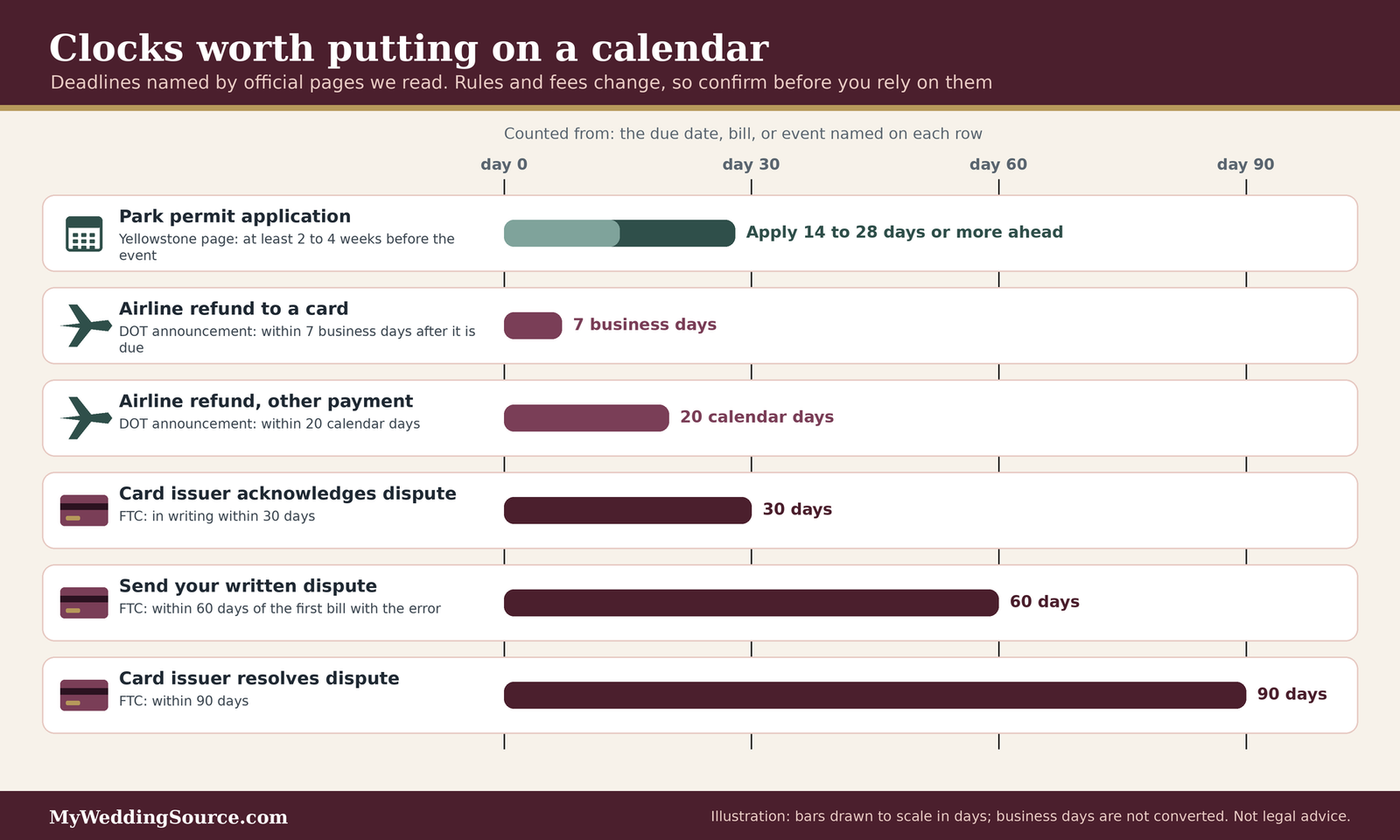
Yellowstone’s special use permit page says weddings and other ceremonies may be permitted in certain areas depending on location, group size, and time of day or year, and that special events may need a Special Use Permit. It does not mention proposals, and it tells readers to contact the permitting office to ask whether a permit would be needed. It also states that a permit is required for commercial filming, photography, and audio recording, and that compensated portrait photographers may need a Special Use Permit for Still Photography if the group is larger than five people and uses only cameras and tripods. An application fee of $250, non-refundable, has applied since October 1, 2021, and applications generally need to be in at least two to four weeks ahead depending on the season. Fees and rules can change, so confirm them with the park.
What another park says
Petrified Forest National Park’s page on weddings and ceremony permits says weddings can be scheduled up to a year in advance and that the couple must request the permit themselves, not a planner. It names no group size limit and no wedding permit fee on that page. Those details are about weddings, not proposals, so treat them as a sign of how a park may think, not as a rule for you. The practical lesson is to ask each park directly, describe your plan in plain words, and keep the reply. If a park’s page does not mention proposals, do not assume that means yes or no.
Photographers, drones, and consent
A hired photographer changes the picture, because many parks treat paid photography differently from casual snapshots. A drone changes it again.
Hired photographers on public land
The Yellowstone page says wedding photographers may need a Commercial Use Authorization, and that commercial photography needs a permit. Ask any photographer you hire whether they hold the authorizations the place requires, and who is responsible if one is missing. A photographer who works in the area regularly will usually know. A photographer who does not know the answer is not necessarily careless, but you should ask the park and not rely on a guess. For proposals, where the group is two people and a camera, the answer may be simple, but it should come from the managing office and not from an assumption.
Drones
The National Park Service says superintendents can prohibit launching, landing, or operating uncrewed aircraft on park lands and waters under a 2014 policy memorandum, that the policy remains in force with limited exceptions, and that a violation can be a misdemeanor with penalties of up to six months in jail and a $5,000 fine. It also says park rules do not change FAA requirements for aircraft in the national airspace system. So a drone can be allowed by the FAA and still be banned by the park. Our guide to wedding drone photography explains the aerial-photo trade-offs; for a proposal, the simpler answer is usually to ask whether a drone is allowed at all, and to plan without one if the answer is unclear.
The FAA side
For recreational flyers, the FAA says a drone weighing 250 grams or more must be registered, the registration number marked on the outside, and registered drones must broadcast Remote ID unless flown in a recognized identification area. Recreational flyers must pass the free TRUST test and carry proof, keep the aircraft within visual line of sight, and stay at or below 400 feet in uncontrolled airspace. Near airports, in controlled airspace, flying requires prior FAA authorization through LAANC or DroneZone. If you are unsure whether a flight counts as recreational, the FAA advises assuming the commercial rules apply, which matters if someone is paid to fly. Flying abroad is governed by that country’s rules, not the FAA’s, so check them before you pack a drone.
Recording, privacy, and strangers
A proposal is a private moment that often happens in a public place. Plan for the people who happen to be there.
Strangers in the frame
Other visitors did not agree to be part of your moment, and some do not want to be photographed or recorded. Ask your photographer to avoid close shots of strangers, to keep clear of children, and to stay out of areas where signs prohibit photography. Our own standard is simple: nobody should be secretly recorded. That includes guests you have invited as helpers. If friends will film from a distance, tell them what they are doing and why, and ask them to delete anything your partner would not want shared. Recording laws differ by place, and this is not legal advice, so ask the venue or a local professional if you are unsure.
Rules and customs abroad
Outside the United States, rules about photography in religious sites, government areas, and some beaches or markets can be stricter than at home, and customs about public affection and posed photographs differ. Ask your hotel or photographer what is normal locally, and whether any place on your list restricts tripods, flash, or recording. If a place is a working temple, memorial, or private estate, ask for permission through the person who manages it, and be prepared for a polite no. Our note on private vs public proposals can help you decide how visible you want the moment to be.
The backup itinerary: Plan A, Plan B, and Plan C
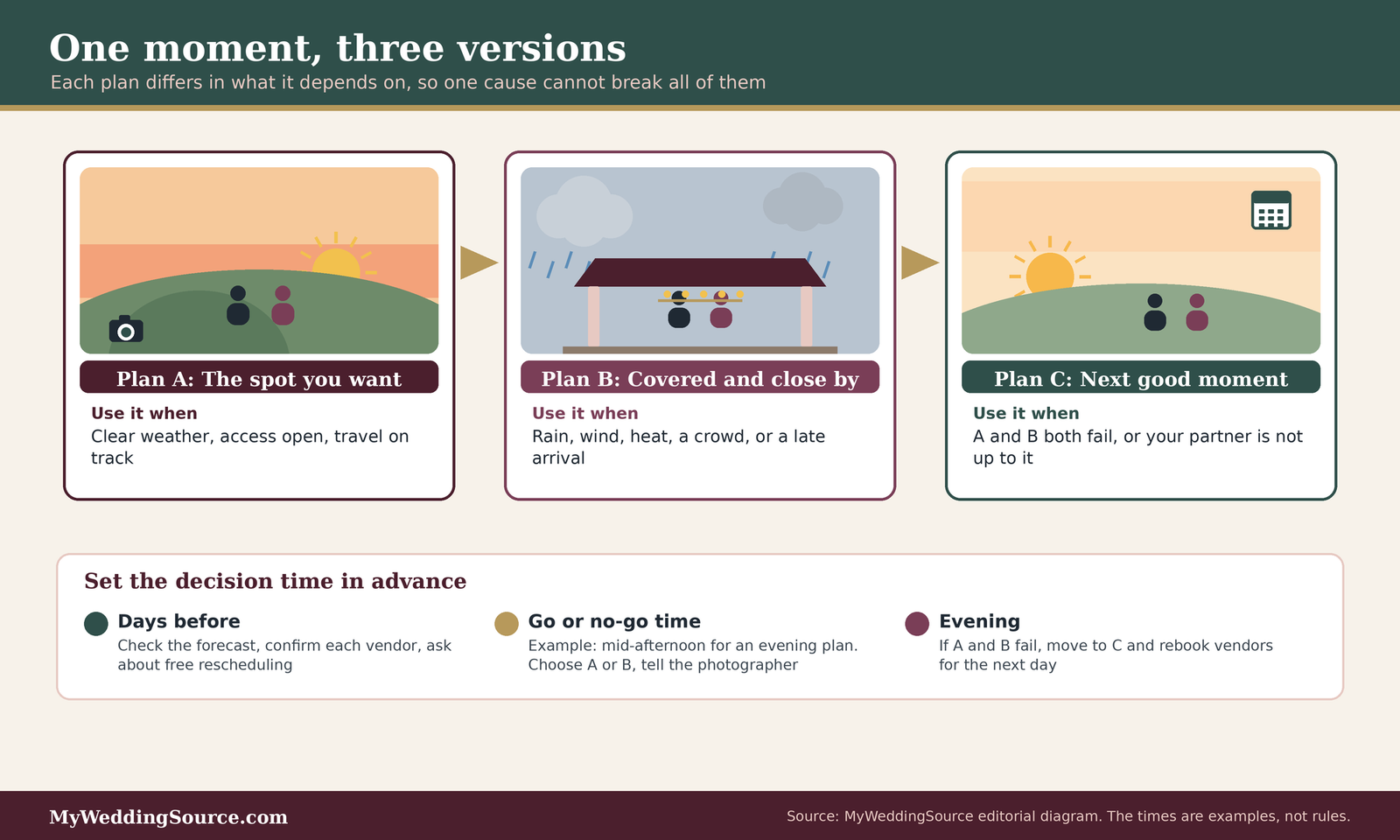
A backup for planning a proposal while traveling is not a worry list. It is a second and third version of the same moment, with a time at which you decide to switch. This is the central deliverable for planning a proposal while traveling, and it works best when each plan is as detailed as the first.
How to build three plans
Each plan in planning a proposal while traveling needs a place, a time, a vendor arrangement, and a cue. The plans should differ in what they depend on, so a single cause cannot break all three.
Plan A: the one you want
Plan A, for anyone planning a proposal while traveling, is the full version: the best location at the best time, with the photographer, any reservation, and any extras. Write it with its dependencies visible, such as clear skies, a path that is open, or a boat that sails. Those dependencies tell you what to watch. If Plan A needs good light at a specific time, check the local sunset time for that date and add the time to your brief. If it needs a quiet place, note what time that place fills up and what you will do if it already has a crowd.
Plan B: close by, covered, and quick to switch to
Plan B should be a short move from Plan A, ideally within walking distance or a short ride, and it should work in rain, wind, or a crowd. A covered terrace, a hotel lobby with a view, a quiet corner of a museum garden, or the restaurant itself can all work. Tell the photographer and the venue about Plan B in advance, because the switch is only quick if everyone already knows it exists. The Benchmark planners’ example is a beach dinner moved indoors or to a covered terrace if rain threatens, and that is a good model for how little needs to change. Our guide to photography rain backups covers how photographers think about the same switch at weddings.
Plan C: a different time, not a different dream
Plan C is the next good moment, usually the next morning or the next evening. It protects the proposal when Plan A and B both fail, such as when a storm lasts all day or a delay makes you arrive late. Plan C is the reason to keep a spare day in the itinerary, and the reason to ask vendors about rescheduling terms before you pay. Check which vendors can move their booking to the next day, whether they charge for it, and whether your partner’s plans allow it. Plan C should feel like a calm second try, not a rescue.
Decision points and who decides
A backup that depends on a decision made in a panic is not much of a backup. Set the decision time in advance, and name who makes the call.
Pick a go or no-go time
For planning a proposal while traveling, choose a time, such as mid-afternoon for an evening plan, at which you will check the forecast, the vendor messages, and your travel status, and then decide for Plan A or Plan B. Put this time on your brief and tell the photographer. If you can switch at the last minute without cost, you can decide later, but a fixed time gives everyone certainty. For a morning plan, the decision time may be the night before.
Triggers that move you from one plan to the next
Write the triggers down, and keep them factual. The table below is a template. Adapt it to your trip, and keep each trigger something you can check without guessing.
| Plan | Use it when | Where | What changes | Decide by |
|---|---|---|---|---|
| A | Weather, access, and travel are on track | The main spot | Nothing | The planned go or no-go time |
| B | Rain, wind, heat, a crowd, or a late arrival affects the main spot | Covered or indoor spot nearby | Photographer and venue move to the new spot | The go or no-go time; tell vendors at once |
| C | Plan A and B both fail, or your partner is unwell or exhausted | Same spot or another, next day | Rebook vendors, shift dinner or tour | The evening before the new date |
| No-go | The place is unsafe or closed, or the moment feels wrong | None | Cancel or move vendors, keep the ring safe | Any time; there is no penalty for waiting |
Weather, heat, and safety
Weather is a common reason that plans for a proposal while traveling change, and it can also be a safety issue. Treat it as one.
Lightning
The National Weather Service’s lightning safety message is short: when thunder roars, go indoors. It says that if you can hear thunder you are likely within striking distance of the storm, and that waiting too long to reach shelter contributes to many lightning deaths and injuries. That is not a reason to give up on an outdoor proposal, but it is a reason to have an indoor plan B and to accept the switch without argument. If a storm is forecast near your time, move the moment, not the risk.
Heat and guests
The NWS heat guidance says young children, older adults, people with chronic medical conditions, and pregnant women are at higher risk, and that it is never safe to leave a child, a disabled person, or a pet locked in a car. If relatives or friends are part of your plan, think about shade, water, seating, and how far they must walk. A plan that is comfortable for the two of you may be hard on a grandparent who was asked to arrive early and stand in the sun. Choose a spot with shade or a short walk, and give helpers a place to wait.
Getting the ring, the documents, and your partner there
Planning a proposal while traveling depends on three things arriving: the ring, the paperwork, and your partner, in a good mood and on the right day. Each has its own travel risks.
The ring in transit
A small, valuable, easily lost object needs a plan from the moment it leaves home.
Keep it with you
TSA says travelers with valuable items such as jewelry should keep them on their person and not in checked baggage, and adds that the officer makes the final decision on what may go through the checkpoint. The Benchmark planners suggest packing the ring in a small pouch or an interior pocket of your carry-on, not carrying it in a pocket through security where screening could reveal the surprise, and not putting it in checked luggage. If you are worried about questions, TSA also says you can ask for private screening of yourself and your valuables. Treat the ring like medication or travel documents: it travels with you, in the same place, every time.
Insure and document it
The same planners recommend insuring the ring before you fly and photographing it for documentation. Our guides to engagement ring insurance appraisals and hidden costs in ring insurance explain what a policy may and may not cover, and whether coverage applies when the ring is outside the country. Read the travel terms before you rely on any policy, and keep the receipt, the appraisal, and the photographs somewhere other than the ring’s bag. If you do not yet know the ring size, our ring sizing guide explains how to find out quietly.
Tickets, passports, and names
Travel documents are boring, and they are a frequent reason a trip falls apart.
Passports
For international trips, the State Department advises renewing well before travel, even if the passport has a few months left, and notes that some countries require a passport to remain valid for at least six months beyond your trip dates. Its renewal page lists optional expedited service for an additional fee. It does not promise a processing time, so do not plan around a guess. Check your passport dates, and your partner’s, before you book anything non-refundable. If you need to check your partner’s passport quietly, plan how you will do that without giving the secret away.
Names on tickets
Airlines generally ask that the name on a ticket match the traveler’s travel document. If you plan to book for both of you, check spelling and name order for each traveler, because a mismatch can be costly to fix. Our guide to name mismatches on honeymoon tickets explains the issue, and the same logic applies to any trip with a proposal. Keep the booking confirmation where you can reach it without your partner seeing the notification.
Batteries and gear
Cameras, phones, and drones all run on batteries, and airlines have rules about them.
Power banks and spare batteries
The FAA’s PackSafe guidance says power banks and spare lithium batteries under 160 watt-hours must stay with the passenger in the cabin, that larger power stations are not permitted on passenger aircraft, and that damaged or recalled batteries must not be carried aboard unless made safe. Pack your spares in your carry-on, and keep a power bank charged for the day, because a dead phone can mean a missed message from the photographer.
Drone batteries and other gear
The FAA page we read does not address drone batteries specifically and refers readers to its separate guidance for passengers, so check the airline’s rules and the FAA’s passenger battery guidance before you pack a drone. Also check whether the drone is allowed at your destination at all, as covered above. If you are borrowing gear, test it before you leave home, because a tripod that does not fit the camera is easier to solve in your living room than on a mountain.
Money, deposits, and what to do when plans fall through
Money is where backup plans become real when you are planning a proposal while traveling. A plan C is easy to write and harder to pay for, so look at the costs and the deadlines for getting money back before you commit to anything non-refundable.
What to budget for
Costs for planning a proposal while traveling vary too much by destination and season to give an honest average, so we do not quote one. Build your own list from these lines: photographer session fee and any travel fee; permit application fees where a park or city requires one (Yellowstone’s page lists $250, non-refundable, for its special use permit applications); restaurant or tour deposits; flowers or decoration; ring insurance or a rider; travel insurance; rebooking and change fees; a rental car or transfer to the spot; and a reserve for Plan C. A reserve of about one extra vendor booking is our own rule of thumb, not a statistic. Ask every vendor which deposits are refundable and until when.
Where the money goes
Costs fall into two groups: those that depend on the proposal and those that depend on the trip. The proposal costs are small and specific. The trip costs are larger and are already part of your plans.
Line items to list
When planning a proposal while traveling, write each line with an amount, a due date, a refund rule, and the name of the person you paid. Include any card or booking fee. If you are using points or a travel credit, note the deadline and the penalty for changing. Our honeymoon booking checklist uses a similar structure for trip bookings and can serve as a model for the dates and confirmations. Keep the list private and on your phone, because planning a proposal while traveling usually involves shared devices.
A small reserve for Plan C
If Plan C means a second photographer slot, a second dinner, or an extra night, someone will pay for it. Decide ahead whether you will, and ask vendors if they offer a free reschedule for weather. Some do and some do not, and the answer is part of what you compare. A reserve means you can switch without arguing with yourself about cost on the day.
Refunds, disputes, and deadlines
Plans for a proposal while traveling can fall through for reasons you cannot control. Knowing the official clocks in advance lets you act in time.
Airline refunds
In its announcement of a final rule on automatic refunds, the U.S. Department of Transportation says passengers who decline alternatives when a flight is canceled or significantly changed are entitled to a refund of the ticket price, taxes, and fees, without having to ask. The announcement defines a significant change as a departure or arrival time that moves by more than three hours on a domestic flight or six on an international one, a different airport, added connections, or a downgrade in class. It says refunds for credit card purchases are due within seven business days after they become due, and within twenty calendar days for other payment methods. We read the announcement and not the full regulation, so check the current text and your airline’s policy, and do not treat this as legal advice.
Credit card disputes
The FTC explains that under the Fair Credit Billing Act you can dispute certain billing errors on a credit card, including goods not delivered or not accepted as agreed, by writing to the issuer so that it arrives within sixty days of the first bill that contained the error. The issuer must acknowledge in writing within thirty days and resolve the dispute within ninety days, and you may withhold the disputed amount while it investigates. Whether a particular vendor problem qualifies is a question for your card issuer, and a dispute is a last resort after you have asked the vendor for a refund. The Consumer Financial Protection Bureau explains that debit card and bank-account disputes follow different timelines, which is one reason to pay deposits by credit card where the vendor allows it.
Travel insurance and cancellation terms
Insurance does not usually cover a change of heart, and every policy has exclusions. Read the actual terms.
What a policy may and may not cover
Our guide to honeymoon travel insurance explains the common categories: trip cancellation, interruption, delay, medical, and baggage. Ask whether a covered reason such as illness, severe weather, or a carrier cancellation would apply to your booking, and whether a proposal-related vendor payment counts as a prepaid, non-refundable trip cost. If you are unsure, ask the insurer in writing and keep the answer. We cannot tell you what a given policy covers.
Ring coverage while you travel
Ring insurance and travel insurance are different products. Check whether your ring policy covers loss, theft, or damage outside your home, in another country, and while the ring is in a carry-on. Some policies require the ring to be appraised or listed first. If the ring has not yet been insured, do it before you fly and keep the receipt, the appraisal, and photographs where you can reach them from any device.
Edge cases and what to do about them
Some situations do not fit the standard plan. These are situations that commonly complicate a trip proposal, with a calm way to think about each.
When your partner helps plan the trip
If your partner is a co-planner, planning a proposal while traveling gets harder, because they see the bookings.
Shared itineraries and accounts
When planning a proposal while traveling with your partner, keep a clean itinerary that your partner can see, and a separate private plan that only you can reach. Do not book proposal vendors from a shared account, a joint card statement, or a device that shows previews. The Benchmark article’s tip to turn off push notifications or use a privacy screen is worth following here, and our guide to wedding-planning password sharing explains how to separate accounts without friction. If your partner handles the money, use a card statement that will not arrive before the trip.
Giving a reason for a different plan
Sometimes you need your partner to be at a certain place at a certain time, dressed a certain way. Offer a plausible reason that is true: a sunset dinner, a photo you want to take, a spot a friend recommended. Do not invent a reason that would worry them, such as a work emergency. Flytographer’s advice to subtly guide your partner toward a suitable outfit and hint at the destination is a gentle model, though that is the company’s own suggestion. If you cannot give a true reason, choose a more flexible plan.
When family or friends are traveling with you
A group trip adds people to your proposal who want to help, and people who do not know they are not supposed to.
Choose helpers carefully
When planning a proposal while traveling with a group, pick one or two people who can keep a secret and follow a single instruction. Give each one a task with a start and an end, not a broad role. Ask them to turn off notifications from the group chat during the plan, and set up a separate chat for the proposal helpers. Our guide to wedding party group chat rules has ideas for keeping a chat tidy that apply here too.
Plan the celebration separately
If relatives are nearby, decide whether they join right after, later that evening, or on a video call the next day. A planned moment of privacy followed by a planned gathering is calmer than a crowd that appears during the question. If family is far away and cannot travel, our guides to the engagement party, the engagement announcement, and planning an engagement party when parents live far apart can help you celebrate when you are home.
When the trip changes under you
Sometimes the trip itself shifts, and the proposal has to shift with it.
Delays, lost bags, and late arrivals
If you are planning a proposal while traveling and arrive late or tired, postpone. A proposal at the end of a long day of travel is rarely the one you wanted. Tell vendors as soon as you know, because most can move a slot if given notice. If the ring is in your carry-on, keep it there, and do not leave it in a hotel safe you have not checked. If a bag is lost, replace essentials first and use Plan C.
The secret slips, or your partner is unwell
If your partner guesses, you can still go ahead; a suspicion does not undo the question. Our private proposal guide describes how much surprise matters to different people. If your partner is unwell, exhausted, or upset, wait. Nothing about the plan is lost by a day, and the vendors you have already asked about rescheduling can help. A proposal is a question, and a good answer depends on a good moment.
Questions to ask before you commit to planning a proposal while traveling
Use the callout below as a script for emails and calls when you are planning a proposal while traveling. Most of the answers will be short, and the short answers are the ones to keep.
Questions for vendors and venues
Ask in writing where possible, and save the reply.
For photographers and tour operators
The questions below cover the points that most often go wrong when you cannot meet in person.
Questions to ask
- What is the exact meeting point, and how will we recognize each other?
- How long is the slot, and what happens if we arrive late?
- If the weather turns, can we move to a covered spot nearby, and can we reschedule at no charge?
- Do you hold any permit or authorization the location requires, and who is responsible if one is missing?
- Can you work discreetly so my partner does not notice you early?
- How many edited images will we receive, and by what date?
- Do you require a deposit, and what is refundable and until when?
- Who covers you if you are ill, and do you have a replacement?
- What is the best way to reach you on the day, and who answers if you do not?
For hotels, restaurants, and parks
Ask the hotel who will be on duty and how to reach them. Ask the restaurant what the cancellation and no-show terms are, and whether they can hold a table near a window or in a quiet corner. Ask the park or city office whether a proposal needs a permit, whether a photographer or a drone changes the answer, and how far ahead to apply. Keep the names and the dates of every reply.
Questions to ask yourself
Some questions are not for a vendor.
Is the plan too big?
If planning a proposal while traveling needs more than a few people, a permit, three vendors, and a perfect sky, the plan may be too complicated for a trip. A smaller version of planning a proposal while traveling, with one photographer and a quiet spot, can be just as meaningful and much easier to rescue. Our proposal ideas and proposal picnic setup guides show simpler formats.
Is this how my partner would want it?
Planning a proposal while traveling can drift toward what looks good in photographs. Come back to your partner when planning a proposal while traveling: how they feel about attention, travel, surprise, and cameras. If you are not sure, choose the quieter version. The rest of the plan, including the party, can be as large as you like afterward, and our proposal and engagement party planning guide covers that step.
FAQ: planning a proposal while traveling
Planning and timing
How far ahead should I start planning a proposal while traveling?
Start planning a proposal while traveling as soon as you know the trip dates, because vendors, permits, and flights all have lead times. Yellowstone’s page asks for applications at least two to four weeks ahead, and other places may need far more. Settle the date, the plan B, and the photographer first, then deposits and documents, leaving at least one spare day.
Which day of the trip is best for the proposal?
There is no universal best day. One planner quoted by a resort operator recommends the first day or two so you are not anxious later, while a later day gives you time to scout. Avoid arrival day and keep a spare day so a delay does not ruin the moment.
Vendors and permits
Do I need a permit to propose on public land?
It depends on the place, the group size, and whether a paid photographer or other equipment is involved. The park pages we read cover weddings and commercial photography but say little about proposals. Contact the managing office, describe your plan in plain words, and keep the reply in writing.
Can I use a drone for a proposal?
Maybe, but you need two yeses: the FAA’s rules and the land manager’s rules. The National Park Service says superintendents may prohibit drones in parks, and the FAA requires registration and a safety test for most recreational flights. Many couples choose to skip the drone and keep it simple.
The ring and the money
How should I carry the ring when I fly?
Keep it with you, in carry-on, and not in checked luggage. TSA says to keep valuables on your person, and offers private screening on request. A planner quoted by Benchmark also suggests a small pouch inside the carry-on and not a pocket at security. Insure and photograph the ring before you leave.
What if a vendor cancels or does not show up?
Use the written terms first: ask for a refund or a reschedule, and have your backup photographer or plan ready. If a paid service was not delivered, ask your card issuer about its dispute process, and note that deadlines can be as short as sixty days. This is general information, not legal advice.
Backups and secrets
What if the weather ruins Plan A?
Switch to Plan B at your set decision time, and tell the photographer and venue at once. If thunder is audible, the National Weather Service says to go indoors, so do not wait for a perfect sky. If both plans fail, use Plan C the next day and ask vendors about free rescheduling.
How do I keep my partner from finding out?
Keep the number of people small, give each only their part, and store the real plan on your phone only. A shared itinerary for your partner and a private plan for you works well. Turn off notifications from vendors, and avoid joint accounts for deposits. If the secret slips, you can still proceed.
Your next steps for planning a proposal while traveling
Before you book anything
Write the one-page brief
For planning a proposal while traveling, pick the day and the time window, a main spot, a close-by covered alternative, and a next-day fallback, and write them on one page with the decision time. Check your passport and your partner’s passport dates, and note any lead times for permits. For the wider plan, use our wedding planning checklist and wedding planning guide once the proposal is done and the larger planning begins.
Ask the first three questions
Email the managing office or the hotel about the place, ask a photographer about availability and terms, and ask your card issuer or insurer how cancellations are handled. Save every reply with its date. Then decide whether your plan is the right size for the trip.
In the week before you travel
Confirm and pack
Confirm each vendor in writing and by phone, fill the coordination sheet, and share only the relevant message with each person. Pack the ring, the receipts, and the photographs in your carry-on, a charged power bank, and the vendor phone numbers on paper as well as on your phone.
Set the signal
Choose the go or no-go time, tell the photographer, and prepare a simple message to send if you switch plans. After the proposal, take a quiet moment before you call anyone, and look at our guides to engagement announcements and the engagement announcement photo session when you are ready to share the news.
Sources & methodology
How we built this guide
What we relied on
This guide combines park permit and drone pages from the National Park Service, drone and battery guidance from the FAA, TSA guidance on valuables, a U.S. Department of Transportation announcement on airline refunds, FTC and CFPB consumer pages on disputing charges, National Weather Service safety pages, the State Department’s passport renewal page, and two vendor pages, one from a resort operator quoting event planners and one from a vacation photographer marketplace. Where a statement comes from a vendor or planner, we say so, because their advice reflects how they work. Two pages described below are single-park pages and do not set rules for other parks. We checked these pages in November 2026 (November 12 for the final read) and did not verify anything after that date. The reserve suggestion in the cost box and the structure of the plans and tables are our own editorial judgment, not statistics.
What we did not do
We did not test any vendor, visit any location, or contact any park or airline. We read the DOT announcement of its refund rule and not the regulation text, and we did not confirm which parts are in effect for your flight. We give no legal, financial, insurance, or medical advice. Permit rules, fees, drone rules, refund rules, and recording laws vary by place and change over time, so confirm with the managing office, your airline, your card issuer, or an attorney where it matters.
Source list
Government and regulatory sources
- National Park Service, Yellowstone National Park, Special Use Permits: https://www.nps.gov/yell/planyourvisit/special-use-permits.htm
- National Park Service, Petrified Forest National Park, Weddings and Ceremony Permits: https://www.nps.gov/pefo/planyourvisit/ceremonypermits.htm
- National Park Service, Uncrewed aircraft in the national parks: https://www.nps.gov/articles/uncrewed-aircraft-in-the-national-parks.htm
- Federal Aviation Administration, Recreational flyers: https://www.faa.gov/uas/recreational_flyers
- Federal Aviation Administration, PackSafe: https://www.faa.gov/hazmat/packsafe
- Transportation Security Administration, Jewelry: https://www.tsa.gov/travel/security-screening/whatcanibring/items/jewelry
- U.S. Department of Transportation, announcement of the final rule requiring automatic airline refunds: https://www.transportation.gov/briefing-room/biden-harris-administration-announces-final-rule-requiring-automatic-refunds-airline
- U.S. Department of State, Renew your passport: https://travel.state.gov/content/travel/en/passports/have-passport/renew.html
Consumer protection and weather sources
- Federal Trade Commission, Using credit cards and disputing charges: https://consumer.ftc.gov/articles/using-credit-cards-and-disputing-charges
- Consumer Financial Protection Bureau, What is a chargeback: https://www.consumerfinance.gov/ask-cfpb/what-is-a-chargeback-en-1017/
- National Weather Service, Lightning safety: https://www.weather.gov/safety/lightning-safety
- National Weather Service, Heat safety: https://www.weather.gov/safety/heat
Vendor and industry sources
- Benchmark Resorts & Hotels, How to pull off a proposal while traveling (advice from two event planners): https://www.benchmarkresortsandhotels.com/mosaic-traveler/how-to-pull-off-a-proposal-while-traveling/
- Flytographer, Destination proposal (photographer marketplace, company claims): https://www.flytographer.com/blog/destination-proposal/