

Wedding invitation wording works when a guest can tell, in about ten seconds, who is inviting them, what they are invited to, when and where it happens, how to reply, and what to wear, and this guide gives you adaptable templates for each of those lines, including the family situations that make couples stall.
The draft is open on your laptop, the printer has asked for final copy by Friday, and you are stuck on the first line. Do both sets of parents go on it, or just yours? How do you list a stepparent next to a parent who has not spoken to him in years, or honor a mother who died without making the invitation sad? Most couples do not have a wording problem so much as a family-logistics problem that shows up as a wording problem, and it is easier to solve when you see a few working examples side by side.
This page is the template library. It covers host lines, formal and casual versions, divorced, blended and deceased-parent situations, same-sex and two-name couples, reply lines, dress code, registry and website lines, response deadlines, and the things that do not belong on an invitation at all, plus a short look at printing and postage costs. If you want the basics of when to mail and how many weeks to leave for replies, the wedding invitation timing and wording basics page covers that ground, and the broader rules of courtesy live in Wedding Invitation Etiquette: Modern Rules, Wording, and Real-Life Examples. Here we stay with the words themselves. Every template uses invented names, and you should treat each one as a starting point to adapt, not a rule you owe anyone.
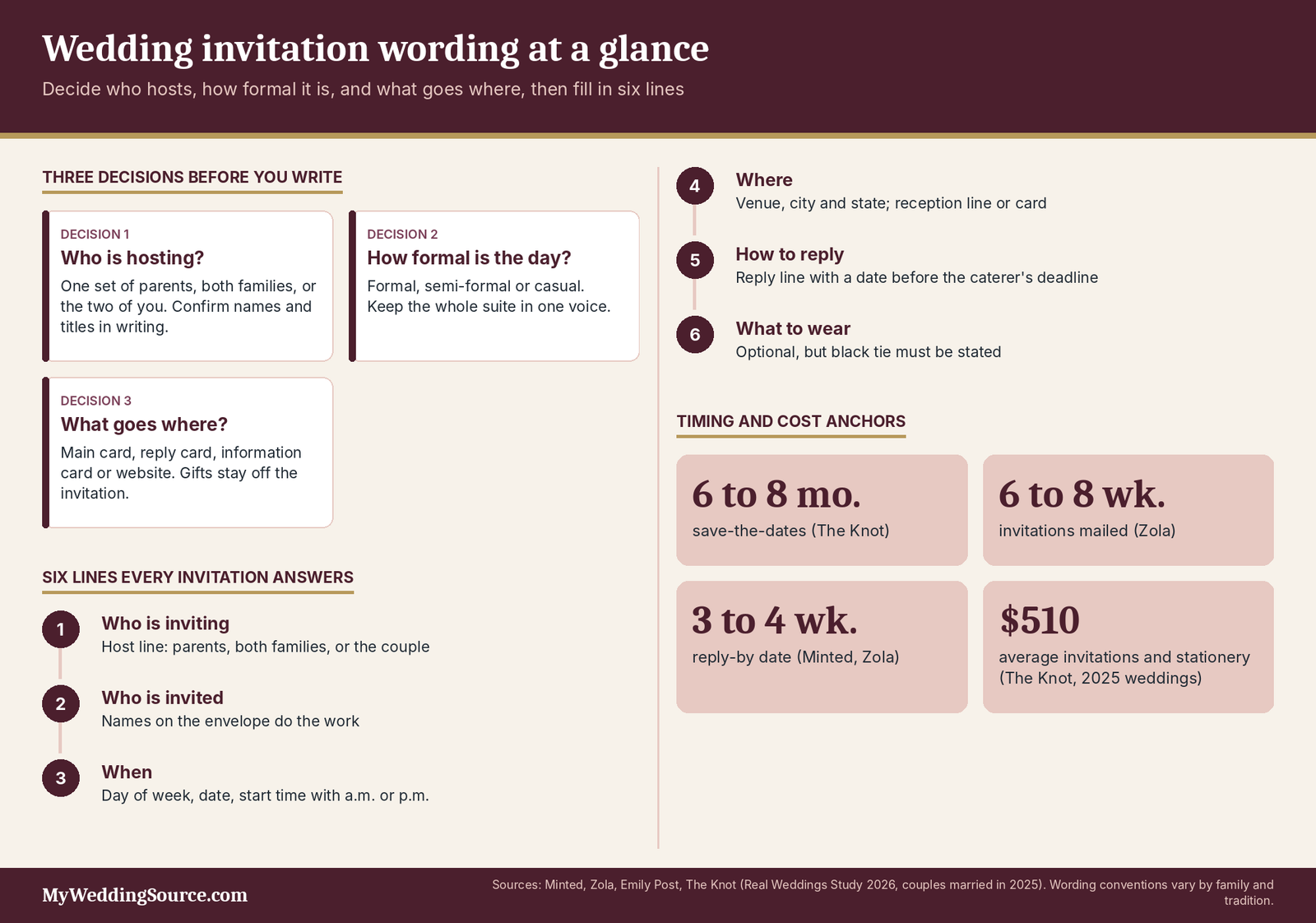
Start with the decision: who is inviting, and how formal is this?
Choose the voice before you choose the words
Formal, semi-formal and casual are three different sentences
The same wedding can be announced three ways, and the voice you pick shapes every other line. A formal version reads “Mr. and Mrs. Allen Jones request the honor of your presence at the marriage of their daughter.” A semi-formal version reads “Together with their families, Maya Chen and Jordan Ellis invite you to celebrate their marriage.” A casual version reads “Maya and Jordan are getting married, and we would love you there.” None of these is more correct than the others, and a backyard barbecue wedding with a printed formal invitation sends a mixed signal just as a black-tie ballroom with a casual one does. Pick the voice that matches the day, then let it decide capitalization, spelling out dates and the tone of the reply line.
Match the whole suite, not one card
Minted’s wording guidance makes a point that is easy to miss when you are focused on the main card: keep formality consistent across the invitation, reply card and any enclosures, and do not mix formal and casual phrasing. In practice, that means that if the invitation says “request the honor of your presence,” the reply card should say “The favor of a reply is requested by,” not “Let us know!” A suite that swings between registers makes guests unsure how formal the event is, and the dress-code question follows within a day. Write all the cards in one sitting, in the same voice, then read them aloud as if you were a guest who has never met your parents. If a line sounds like it came from a different couple, rewrite it.
The parts of an invitation, in the order guests read them
Host line, request line, names, date, venue
Traditional invitations have a recognizable skeleton, and knowing it makes every template in this guide easier to adapt. The host line says who is inviting. The request line is the verb phrase, such as “request the honor of your presence” or “invite you to celebrate.” The action line names the occasion, such as “at the marriage of their daughter,” and the couple’s names follow, then the date, the time, the venue and its city. Emily Post’s formal invitation samples spell out the date, year and time in words for the most formal versions, while street addresses use numerals. The skeleton works for any hosting situation, which is why the sections below mostly change the first three lines and leave the rest alone.
What belongs on enclosure cards instead
An invitation card has limited space, and guests need more information than it can carry. Minted’s guidance lists four common enclosures: a reply card with the reply-by date and name line, a reception card when the party is at a different venue, an activity card for multi-event weekends, and an information card for directions, transportation, lodging and website details. Splitting content this way keeps the main card readable and gives you room to be generous with practical detail without crowding the host line. It also helps with cost, since the main card is often the most expensive piece to print and a change to a hotel block is far cheaper to fix on a card or a website than on a reprinted invitation. When a line starts to feel crowded, ask whether it is a “who, what, when, where” line or a “how do I get there” line, and move the second kind to an enclosure.
| Element | What it does | Formal example | Casual example |
|---|---|---|---|
| Host line | Says who is inviting | Mr. and Mrs. Allen Jones | Together with their families |
| Request line | Makes the invitation | request the honor of your presence | invite you to celebrate |
| Occasion | Names the event | at the marriage of their daughter | the wedding of Maya and Jordan |
| Date and time | Sets the when | Saturday, the twelfth of June, at half after four o’clock | Saturday, June 12, 2027, at 4:30 p.m. |
| Venue | Sets the where | The Garden Pavilion, Asheville, North Carolina | The Garden Pavilion in Asheville |
| Reply | Gets a headcount | The favor of a reply is requested by May 14 | Kindly reply by May 14 |
Host line templates for the most common situations
When parents, couples and families host
One set of parents hosting
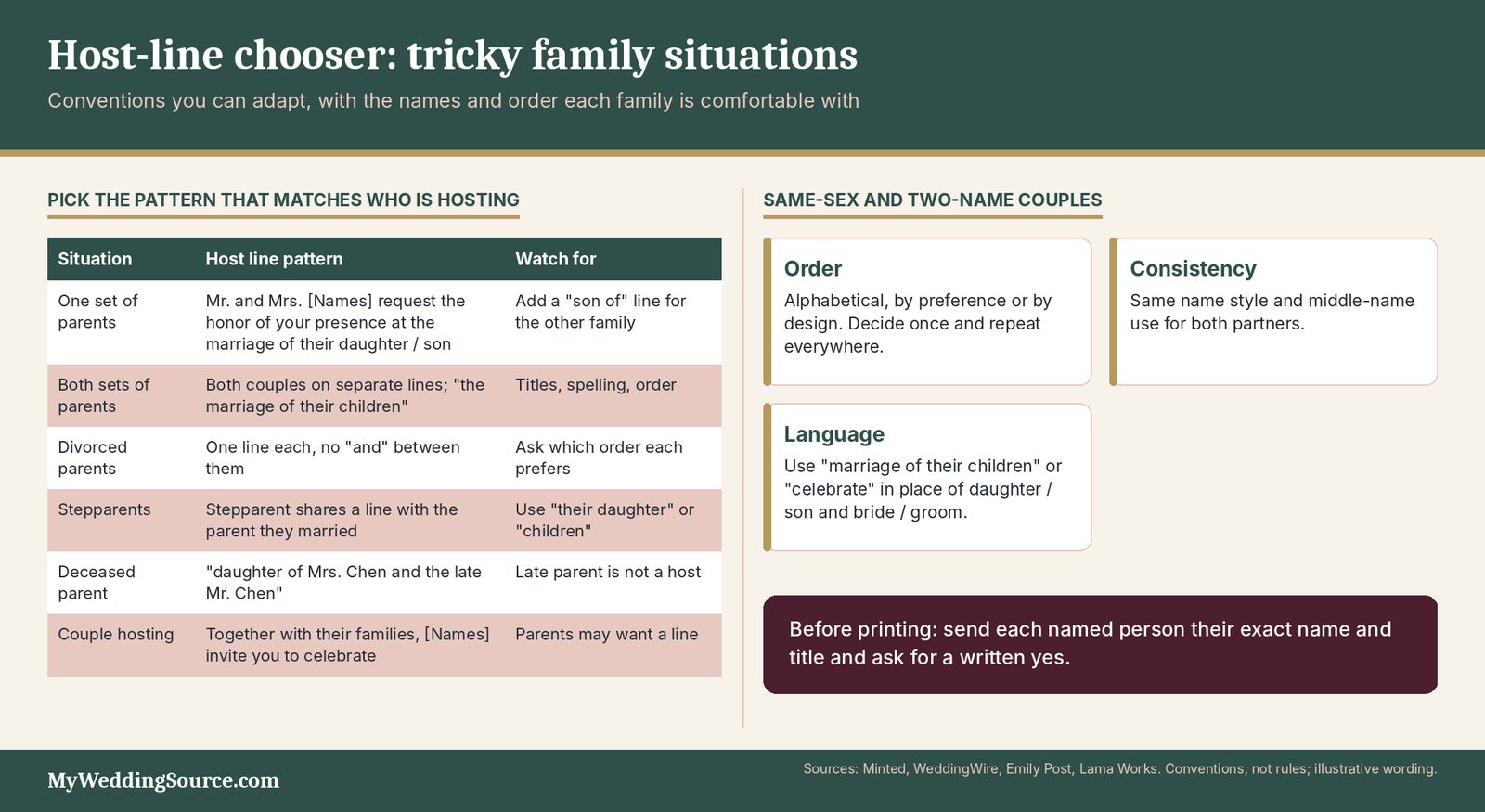
When one couple is hosting, such as the parents of one partner, the host line names them and the action line says whose wedding it is. For different-sex couples, tradition names the bride’s parents, but nothing requires that, and any parent or family can host. A typical formal version looks like this.
Mr. and Mrs. Allen Jones
request the honor of your presence
at the marriage of their daughter
Maya Chen
to
Jordan Ellis
Saturday, the twelfth of June
two thousand twenty-seven
at half after four o’clock
Notice that the second partner’s parents do not appear anywhere. Many couples add a line such as “son of Mr. and Mrs. Robert Ellis” after the second name to acknowledge them without making them hosts. Emily Post’s samples use this “son of” construction when only one family is listed as host. Use it when the second family is contributing or simply deserves a place on the card.
Both sets of parents hosting
When both families are hosting, you can list both couples at the top and change the action line to “children.” Minted notes that for different-sex couples tradition lists the bride’s parents first, and for same-sex couples names are ordered by preference or by what suits the design. Here is a version that works for either, with invented names.
Mr. and Mrs. Allen Jones
and
Dr. and Mrs. Robert Ellis
request the honor of your presence
at the marriage of their children
Maya and Jordan
That version is deliberately even-handed, since neither family is named as the main host and neither partner is described as a daughter or a son. Check the spelling and titles with each family before you print, because “Dr.,” military rank and “The Honorable” all belong in the host line when they apply. A softer, less formal option is “Together with their families,” followed by the couple’s names, which signals that everyone is hosting without ranking anyone. If the wording of “their children” feels slightly off because the couple are adults with their own households, “the wedding of” is a clean substitute.
The couple hosting, with or without family
Couples who are paying for the wedding themselves, or who simply want their names first, have several clean options. WeddingWire’s wording guide describes “Together with their families” or “Together with their parents” when costs are shared, and suggests “With great joy” as an optional opener when the couple pays alone, while Minted notes that a couple hosting alone can skip the host line or open with a warm phrase such as “With open hearts.” The table below shows two complete versions, one with a “together with” opener and one with a single celebratory phrase. In both, the couple’s names carry the card and the request line does the inviting.
| Opener | Full wording (lines separated by a slash) |
|---|---|
| Together with their families | Together with their families / Maya Chen and Jordan Ellis / invite you to celebrate their marriage / Saturday, June 12, 2027, at 4:30 in the afternoon |
| With great joy | With great joy / Maya Chen and Jordan Ellis / request the pleasure of your company / at their wedding |
A host line is also a courtesy, because it tells guests whom to thank. If parents are paying for most of the day but the two of you prefer a couple-first card, say so to the parents in advance and let them choose whether to be named in a “together with” line. Most families respond warmly to being asked, and the conversation often settles other questions too, such as whether grandparents or stepparents should appear anywhere on the card.
What “honor,” “pleasure,” “request” and “invite” really signal
Honor versus pleasure, and where the sources disagree
Traditional etiquette treats “honor” as the weightier word. Minted’s guidance says “request the honor of your presence” is traditionally used for religious ceremonies and “request the pleasure of your company” for non-religious ones, and that couples who use the British spelling “honour” should pair it with “favour” on the reply card. Emily Post’s samples use “honour” when parents or the couple host and “pleasure” when a more distant relative, such as an aunt and uncle, hosts. Those two rules overlap but do not match, so treat them as conventions rather than laws. If you are married in a house of worship, ask your officiant whether the congregation has a preferred phrase, and otherwise pick the word that sounds like your family.
Choosing the action line
The action line is where couples most often reach for a phrase that does not quite fit. “At the marriage of their daughter” is correct only when the hosts are that person’s parents, and it quietly excludes everyone else. “At the marriage of their children” works for both families, and “at the celebration of their union,” offered by Minted for couple hosting, reads more modern. If the guests are being invited to a ceremony that has already happened, such as a legal wedding at a courthouse followed by a party, “to celebrate the marriage of” is more accurate than a request to attend. Whichever you choose, check it against the host line above it, because a mismatch such as “their daughter” under a couple-first host line is the most common proofing error.
| Who is hosting | Host line pattern | Action line that fits |
|---|---|---|
| One set of parents | Mr. and Mrs. [Names] | at the marriage of their daughter / son |
| Both sets of parents | Both couples, separate lines | at the marriage of their children |
| Parents and couple together | Together with their families | the celebration of the marriage of |
| Couple alone | With great joy (optional) | invite you to celebrate their marriage |
| Another relative or friend | [Name] requests the pleasure of your company | at the wedding of [Names] |
Wording for divorced, blended and deceased-parent situations
Divorced and remarried parents
When both parents are hosting: separate lines, no “and”
The most widely repeated convention for divorced parents who are both hosting is to give each parent a separate line and leave out the word “and” between them, because “and” implies a married pair. Minted lists the mother first and then the father, each on their own line, and Lama Works makes the same point: separate lines signal that the two are not married to each other. The order is a courtesy, not a rule, so ask both parents which they prefer if there is any sensitivity. A version might look like this.
Ms. Elena Chen
Mr. Paul Chen
request the honor of your presence
at the marriage of their daughter
Maya
to
Jordan Ellis
If either parent has remarried, the stepparent usually appears on the same line as the parent they are married to, which gives you “Mr. and Mrs. Paul Chen” on one line and “Ms. Elena Chen” on the other. Where parents have different surnames or prefer first names, the same structure holds.
Stepparents on the line
Stepparents are the family members most likely to be left off by accident and hurt by it. The convention described by WeddingWire and Lama Works is to list a stepparent alongside the parent they are married to, and to use “their daughter” or “their children” so that the wording reads as inclusive instead of strictly biological. A blended host line for a couple where each partner has a parent and a stepparent might read as follows.
Mr. and Mrs. Paul Chen
Ms. Elena Chen and Mr. Tom Alvarez
Mr. and Mrs. Robert Ellis
joyfully invite you to the wedding of
Maya and Jordan
That is a lot of names on one card, and you may need a slightly smaller type size or a different layout. Ask your printer to show the layout before you commit, since a crowded host line is the kind of problem that is cheap to fix in a proof and expensive to fix after printing. If the number of hosts begins to crowd the page, “Together with their families” is a graceful reduction that names no one and excludes no one, and you can acknowledge the full family elsewhere, for example in the program.
When one parent is not involved
Sometimes the honest answer is that one parent will not be hosting, whether because of distance, estrangement or simply a choice. You are not obligated to list a parent who is not hosting, and you are equally free to list them if they are paying or you want them included. A single-parent host line is clean and needs no explanation: the one parent’s name, “request the honor of your presence at the marriage of their daughter.” For stepparents who raised the child, Lama Works notes that listing the parent and stepparent together with “their daughter” recognizes the stepparent as a parent, which is often the more accurate description of the family. The deciding question is not which version is traditional but which one the person being named will be comfortable seeing in print and in their relatives’ mailboxes.
Honoring a parent who has died
The “the late” formula
The usual way to acknowledge a deceased parent without listing them as a host is to place them in the line that identifies the couple, not in the host line. Minted describes pairing the couple’s name with “daughter of” or “son of” and putting “the late” before the deceased parent’s name, and WeddingWire gives the example “son of Randall Apple and the late Julie Apple.” This approach respects both facts at once: the family tie is stated, and the host line stays accurate because only living people are inviting. Here is how it looks with a surviving parent hosting.
Mrs. Elena Chen
requests the pleasure of your company
at the marriage of her daughter
Maya Chen
daughter of Mrs. Elena Chen and the late Mr. Paul Chen
to
Jordan Ellis
This keeps the host line accurate, since only the living parent is inviting, while still making room for the family tie. Some families prefer to skip the “daughter of” line entirely, which is also fine, and a parent who is hosting alone may like the simpler “request the pleasure of your company at the marriage of her daughter” without anything further. Ask the surviving parent which version feels right, because the answer is personal and can change from year to year.
Remembering without a line on the card
Some couples prefer that the invitation stay celebratory and handle remembrance in the ceremony, the program, a reserved seat or a photo table. That is a legitimate choice, and it avoids a printed line that some relatives may find painful or, conversely, may feel is missing. Lama Works describes three ways to acknowledge a late parent without implying they are inviting guests, and all three keep the host line to living people. If you are unsure, ask the surviving parent and close relatives how they would feel about each option, since the answer varies with the family and sometimes with the year. Whichever you choose, avoid putting the late parent on a host line with “request,” because that would suggest they are issuing the invitation.
Conversations to have before you print
Ask each person how they want to appear
Wording problems in blended families almost always trace back to assumptions made without asking. Before you finalize a host line, send a short message to each parent and stepparent with the exact name and title as you plan to print it, and ask them to confirm or correct it. Some will want a middle initial, a professional title or a first name without a surname, and others will prefer to be left off the card in a way that is not a reflection on you. A written confirmation also protects you later, because the printer will reproduce exactly what you submit, and a name spelled wrong on 120 invitations is an expensive correction. This step takes a day and prevents weeks of awkwardness.
A tact checklist for tense situations
If two parents do not want to appear in the same space, you have more options than you might think. You can host as a couple and list nobody, you can use “Together with their families,” or you can invite guests through two separate lines on separate cards, one for each side of the family, though that is rare and usually unnecessary. You can also keep the invitation neutral and move the family detail into the ceremony program, where seating and acknowledgments are controlled by the people involved. Whatever you decide, share the final wording with the people named before it goes to print, and do not rely on guests to deliver the news. Questions worth asking each person include how they want their name written, whether they want their partner listed, and whether they are comfortable being named as a host.
Wording for same-sex couples, two-name couples and non-traditional hosts
Names, order and the details of consistency
Alphabetical, by preference, or by design
There is no single convention for the order of names when the couple is not a bride and groom. Minted says that for same-sex couples, names can be ordered by preference or by what suits the design, and WeddingWire says they can be listed alphabetically or in whatever order the couple prefers. Some couples order by the sound of the names together, some by age, and some by a coin flip they are happy to tell guests about. The one thing to avoid is applying the “bride first” logic to an arrangement where it does not fit, since it will leave one partner’s name second for no reason. Decide the order once and use it on every piece of paper, from the save-the-date to the thank-you cards.
Match middle names, titles and name styles
WeddingWire adds a useful consistency note: whichever order you choose, present both names in the same style, including the same use of middle names. If one partner appears as “Maya Chen” and the other as “Jordan Michael Ellis,” the card feels uneven even if no one can say why. The same applies to titles and honorifics such as “Dr.,” and to couples who use different surname conventions, two last names or a hyphenated name. Pick one style for both partners and apply it. If one partner uses a name that is different from their legal name on documents, the invitation is a social document, so use the name that person uses in daily life, and keep the legal name for your marriage license application.
Language that fits every kind of couple
Replace “bride and groom” with words that fit
Many templates carry built-in assumptions, and a simple edit usually fixes them. Replace “the marriage of their daughter” with “the marriage of their children” or “the wedding of” when you are not sure the phrase will fit both families, and replace “bride and groom” with “the couple” or the partners’ names. Minted’s “at the celebration of their union” and WeddingWire’s “With great joy” are both neutral, and “Together with their families” works for nearly any hosting situation. The goal is for each guest, including relatives who are meeting your partner for the first time, to see an accurate description of the day. None of this requires a political statement or a long explanation, because a clean invitation does the work on its own.
Hosts who are not parents
Not every wedding is hosted by someone’s mother and father. Grandparents, siblings, friends and employers sometimes host, and Emily Post’s samples include versions for a sibling or an aunt and uncle that use “requests the pleasure of your company” instead of “honor.” A friend-hosted version might read “Dana Whitfield requests the pleasure of your company at the wedding of her sister Maya Chen and Jordan Ellis.” If the couple is paying, a simple couple-first line is probably the most honest. When a family member hosts only part of the day, such as a rehearsal dinner or a welcome brunch, put that detail on an activity card instead of the main invitation, so the host line on the main card stays accurate.
Date, time, venue and reception lines
Writing out dates, times and places
Spelled-out formal style versus numerals
Formal invitations spell out the date, year and time, and the details follow a recognizable rhythm. Emily Post’s samples write the date as “Saturday, the twentieth of June,” the year in words, the time as “half after three o’clock,” and the street address in numerals. A semi-formal version drops the “the twentieth of” and writes “Saturday, June 12, 2027, at 4:30 p.m.” The casual version uses numerals and abbreviations freely. Pick the style that matches your host line, because a card that opens with “request the honor of your presence” and then lists “6/12 @ 4:30” feels unfinished. Whichever style you use, include the day of the week alongside the date, since it is the detail guests check first when they look at their calendar.
Details that prevent confusion on the day
A date and time are only helpful if guests know what they mean. State the ceremony start time, not a doors-open time, and decide whether guests should arrive 15 or 30 minutes early. If the ceremony and reception are at one venue, write “Reception to follow” on the main card, which Minted suggests as the short version. Include the city and state under the venue name, since guests will type it into a map app. If your wedding crosses time zones for out-of-town guests or begins in the late afternoon in a place where sunset comes early, add a line on the information card with the sunset time and a suggestion about layers. A last check: read the card as if you have never been to your venue and decide whether you could find the entrance.
Reception, venue and multi-day wording
Same venue, different venue, no meal
When the reception is in the same place as the ceremony, a single line is enough. When it moves, Minted recommends a separate reception card with its own address and time, which keeps the invitation uncluttered and gives you space for parking and shuttle details. If the reception does not include a full meal, say so plainly, with a line such as “Cocktails and dessert to follow,” because guests plan their day, and their dinner, around what the invitation implies. A late-afternoon ceremony with no meal can leave hungry guests and unhappy relatives, and a single clarifying line costs nothing. The same logic applies to a brunch reception or a mid-afternoon cake-and-champagne party, where naming the format helps people dress and eat accordingly.
Weekend events, travel and holiday dates
If your wedding includes a welcome party, a farewell brunch or a ceremony in a different town, put the schedule on an activity card in chronological order and mirror it on your website. Minted’s guidance lists the activity card as the place for multi-event festivities, and the information card as the home for transportation and lodging. For guests who must travel, the card is also where you can note room-block names and deadlines, though the details are better kept on the website, where they can be updated. Destination and holiday-weekend weddings ask more of guests than a local Saturday does, so it is worth reading how those costs build up in destination wedding guest costs and in the analysis of Thanksgiving weekend wedding costs, travel problems and guest etiquette. The practical takeaway for wording is that distant weddings need earlier mailing, more detail on the website, and a clear line about where to find it.
| Situation | What the main card says | What goes on an enclosure |
|---|---|---|
| Ceremony and reception at one venue | Reception to follow | Parking, timing, dress details on website |
| Reception at a different venue | Ceremony details only | Reception card with address and time |
| Cocktails and dessert, no dinner | Cocktails and dessert to follow | Website note on what to expect |
| Multi-day weekend | Main event only | Activity card in chronological order |
| Travel-heavy or destination | Main event and city | Information card with lodging, transport, website |
RSVP lines, response cards and deadline wording
The reply line itself
Formal and casual reply wording
The reply line has two parts: the request and the date. Formal invitations pair “The favor of a reply is requested by” with a date, and Minted notes that “kindly reply by” or “kindly respond by” suits less formal suites. Response cards add a name line, traditionally written “M” followed by a blank, which Emily Post’s response card guidance explains is for the guest’s name, with room for a guest’s name if one was invited. The accept and decline lines can be “accepts with pleasure / regrets” for formal suites or “will attend / will not attend” for casual ones. A simple card that works for either tone starts with the M line and a blank for the guest’s name, offers two choices (joyfully accepts, regretfully declines), asks for the number attending, and ends with “Kindly reply by May 14.” If you offer a plus-one, the card should make clear how many seats are reserved, and the envelope should be addressed to match. The plus-one wedding etiquette guide covers that in more detail, and it is worth settling before the cards are printed, since a “number attending” blank invites guests to bring more people than you planned for.
The reply-by date, and why it is earlier than you think
Sources differ on how far before the wedding to set the deadline, and you are choosing among sensible ranges rather than a single correct number. Minted suggests roughly 3 to 4 weeks before the wedding, Zola also recommends asking for replies 3 to 4 weeks out, and Emily Post’s response card guidance says 2 to 3 weeks, which gives hosts time to follow up with people who have not answered. The calendar that matters most is your caterer’s and venue’s: find the date by which you must give a final guest count, then set the reply-by date at least a couple of weeks before it. That buffer is where follow-up texts, last-minute declines and meal-choice questions happen. If you send invitations 6 to 8 weeks out, a reply-by date four weeks before the wedding leaves guests about two to four weeks to answer.
Online replies, meal choices and attendance estimates
Website RSVP versus mailed cards
A wedding website can collect replies, meal choices and dietary notes in one place, and it saves you from deciphering handwriting. A mailed card is more traditional and gives older relatives who prefer paper an option that does not require a device. Emily Post notes that if you prefer replies by email or phone, you can list that contact information on the card and leave out the envelope. Many couples offer both: a card for those who prefer it and a website link on the information card. Whatever you choose, state it clearly on the card, because guests who see both an envelope and a URL will wonder which one counts. The sibling guide on wedding RSVP etiquette goes deeper on following up with guests who do not respond.
Meal choices, dietary needs and optional questions
If the reception includes entrée options, the response card is where guests mark their choice, usually by writing their name or initials beside the selection, and Emily Post suggests a discreet system, such as a symbol on the place card, to tell servers which meal belongs to which guest. Minted lists other optional prompts, including dietary restrictions, song requests, transportation needs and checkboxes for each event in a multi-day celebration. Every added question is another thing to track, so include only the ones you will use. A dietary-needs line is almost always worth including, since your caterer will ask for it anyway. For allergies specifically, a free-text line is better than a checkbox, and you should follow up with any guest who writes one.
How many “yes” replies to expect
The invitation count and the attending count are different numbers, and the gap shapes your budget. The Knot’s RSVP guidance says some studies put “yes” responses at around 83%, others range from 60% to 85%, and its senior editor suggests starting from about 20% declines and adjusting up or down with travel distance and time of year. That article, last updated in February 2024, also cites The Knot’s 2023 Guest Study, which put the average cost of attending a wedding at about $580, a reminder of why distant or expensive weddings see more declines. Treat these as planning ranges and not predictions, and avoid padding your invitation list based on an assumed decline rate, since a higher-than-expected yes rate lands on your catering bill.
| Weeks before the wedding | Milestone | Wording note |
|---|---|---|
| 26 to 35 (6 to 8 months) | Save-the-dates go out | Include the website address on this card |
| 6 to 8 (more for travel) | Invitations mailed | Include reply card, reply-by date and information card |
| 3 to 4 | Reply-by date suggested by Minted and Zola | Choose a date before the caterer’s guarantee |
| 2 to 3 | Latest reply-by date in the sources above (Emily Post) | Leaves time to follow up |
| Varies by vendor | Final count due to caterer | Confirm meal counts and seating |
Dress code, website, registry and guest-limit lines
Dress code and website lines
When a dress code line helps
A dress code line is optional, but Minted is clear on one exception: black tie must be stated, because guests will not guess it. Place the line after the reception location, and WeddingWire notes it traditionally sits at the bottom or lower right of the card, depending on the design. Use words guests understand, such as “Black tie,” “Formal attire,” “Cocktail attire,” “Garden party attire” or “Beach casual,” and add a short note on the website for guests who need more guidance, such as footwear for lawns or sand. WeddingWire also notes that most invitations today do not include a dress code at all, so skipping it is common if the venue and time of day make the expectation obvious. Guests who are unsure often check the invitation first, which is why the guide to wedding guest dresses starts with decoding the dress line.
Where the wedding website address goes
Minted advises against printing the website on the main invitation, and recommends placing it on the reception or information card, as well as on the save-the-date. The reasoning is that the main card carries the formal invitation and a URL looks like an advertisement in the middle of a host line. Use a short, memorable address, and test it on a phone before printing, since many guests will type it by hand. If you worry about privacy, keep addresses and detailed schedules behind a password and tell guests the password on the information card. Anything you print will end up in recycling bins and group chats, so assume anything on a card is semi-public.
Registry, gifts and guest-limit language
Keep gift information off the invitation
The advice here is consistent across sources: do not put registry or gift information on the invitation. Emily Post says registry details do not belong on the invitation or its enclosures, and that guests should learn about your registry from your website and by word of mouth. Zola’s wording guidance says to direct guests to the website or a separate card, and Minted agrees. If relatives ask where you are registered, a spoken answer or a link on the website is the normal route. Asking for cash directly on the invitation is the line most often cited as the one to avoid. If you plan to collect cash or honeymoon funds, put it on the website and describe what contributions will go toward, as Emily Post suggests for honeymoon registries.
Adults-only and guest-limit lines
Telling guests who is invited is easiest when the envelope does the work. Address the outer or inner envelope to exactly the people invited, by name, and a guest who sees only their own name will understand the invitation is for them. When you need a written line as well, Minted offers “Adult celebration to follow,” “We respectfully request that this be an adults-only celebration,” and a warmer version, “Although we love all the children in our lives, this will be an adult-only event.” Put the line on the reception or information card and repeat it on the website. For a fuller look at pushback and scripts, see child-free wedding policy wording and pushback, and for the guest-list pressure behind these choices, the guide on real problems with the wedding guest list.
What not to put on a wedding invitation, and where it goes instead
Information that belongs somewhere else
Gifts, cash requests and registry details
The clearest rule in all of the wording guidance is that gift information stays off the invitation. Emily Post says registry details do not belong on the invitation or its enclosures, Zola’s guidance says never to put gift or shopping list information on the main card, and Minted says to leave out gift registries and any request for money. The reasoning is that an invitation is a request for someone’s presence, and attaching a shopping list makes it read like a transaction. If you want guests to find your registry, your wedding website is the right home, and close family and the wedding party can pass along the link when asked. A line such as “Details and registry at our website” on an information card is a reasonable middle path, as long as the main invitation stays free of it.
Logistics that change, and details that need privacy
Anything likely to change after the cards are printed should live on the website instead of the card. Shuttle times, hotel room-block deadlines, parking arrangements and weather plans are the usual suspects, and a printed error cannot be updated while a web page can. The same holds for details you want some control over. A private home address, a full itinerary with arrival windows, or an entry code for a gated venue is safer on a password-protected page than on paper that will be forwarded, photographed and posted. Bar details, such as whether wine and beer are offered, are another example where a line on the website gives guests information without cluttering the card, though that is an editorial preference and not a rule. The test is simple: if you might edit it later, or would not want a stranger to read it, keep it off the paper.
Proofing mistakes that cost a reprint
The proofreading list that catches most errors
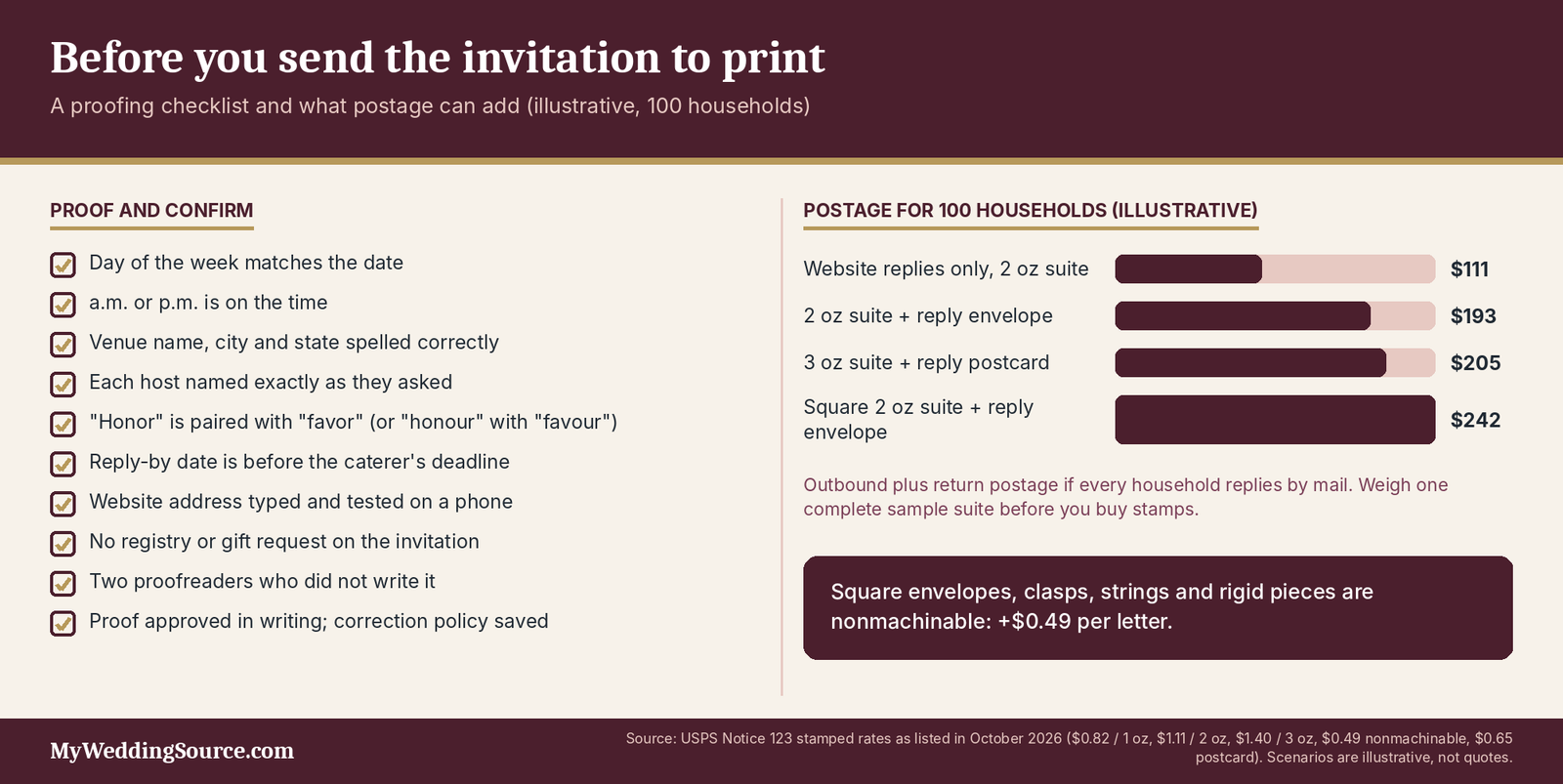
Most reprints come from a handful of small errors that nobody caught because everyone was looking at the pretty parts. Check that the day of the week matches the date, that a.m. and p.m. are right, that the venue name and city are spelled the way the venue spells them, and that the reply-by date falls before your caterer’s deadline. Confirm that “honor” is paired with “favor” and “honour” with “favour,” that every host name is spelled and titled as the person asked, and that the website address is typed correctly. Have at least two people proofread who were not involved in writing the card, and read it aloud once, slowly, since the ear catches repeated words the eye skips. A printed correction on 120 sets is an avoidable bill.
What to ask your printer about corrections
Printers handle corrections differently, and the policy is worth knowing before you submit copy. Ask whether a proof is included, whether you must approve it in writing, how many rounds of changes are free, and what happens if the error is yours rather than theirs. A printer that reproduces exactly what you approved is behaving normally, so approval is the point at which the responsibility passes to you. If you have a deadline, ask how many business days a correction adds to the schedule, since a short delay can push your mail date past your plan. Put the answers in an email, so the policy is in writing and not in memory.
| Item | Why not on the invitation | Where it goes instead |
|---|---|---|
| Registry or gift requests | Reads as a request for gifts | Wedding website; word of mouth |
| Wedding website address | Clutters the formal card | Information or reception card; save-the-date |
| Hotel and shuttle details | May change after printing | Information card; website |
| Private address or entry code | Cards are forwarded and posted | Password-protected page |
| Long weekend schedule | Crowds the main card | Activity card; website |
| Guest-limit rules | Blunt on the main card | Envelope names; reception or information card; website |
Printing, postage and digital: what your wording choices cost
What the stationery budget looks like
The average, and what it covers
The Knot’s 2026 Real Weddings Study, which surveyed 10,474 U.S. couples who married in 2025, reports an average of $510 for wedding invitations and stationery, against an average total cost of $34,200 and 117 guests. That figure is a national survey average and not a quote, and the page does not say whether postage is included, so ask any printer you consult what their quote covers. Zola’s 2026 First Look Report, which surveyed more than 11,500 couples marrying in 2026, is the other large annual benchmark, but it uses a different sample and different categories, so compare the two sets of figures cautiously. The takeaway is that stationery is a modest line in the budget for most couples, and it is one of the easier places to simplify without guests noticing.
Where wording changes the price
Wording itself rarely changes the price, but the decisions around it do. Each additional enclosure adds printing, paper and weight, and a heavier suite can push the postage up a tier. An envelope that is square, or has a clasp, string or button, costs more to mail, and a foil, letterpress or custom design costs more to print than digital printing. Ask your printer whether pricing is per piece or per set, whether setup fees apply, and whether quantity breaks change the total. Ordering a few extra sets for keepsakes and mistakes is reasonable, but an order of 150 for a list of 100 households is a cost worth reconsidering.
Postage: the line items people miss
Stamps, weight and shape (U.S. rates)
Postage for a full suite is easy to underestimate because the invitation, reply card, envelope and inserts add up in ounces. According to USPS Notice 123, as listed in October 2026, a stamped 1-ounce letter costs $0.82, a 2-ounce letter $1.11, and a 3-ounce letter $1.40, with a $0.49 surcharge on nonmachinable letters. USPS Domestic Mail Manual section 101 defines a letter as nonmachinable if its length divided by its height is less than 1.3 or more than 2.5, which includes square envelopes, or if it has clasps, strings, buttons, or a rigid body. The same manual limits a letter to 11.5 by 6.125 inches and 1/4 inch thick, and 3.5 ounces; heavier pieces pay large-envelope prices that start at $1.69. USPS also says you can weigh a letter on a kitchen scale, a postal scale or at the counter, so assemble one complete sample suite before you order stamps.
The return envelope and digital alternatives
If you enclose a stamped reply envelope, you are paying postage twice, once to send the suite and once for each reply you expect. A reply postcard costs $0.65 under the same notice, compared with $0.82 for a stamped letter, which saves 17 cents per reply, though postcards must meet their own size rules. Some couples skip the paper reply entirely, using a website link or a QR code on the information card, and a digital reply cuts postage and data-entry work at the cost of reaching less tech-comfortable guests. If you go digital, keep the same wording and the same reply-by date, and consider a printed card for relatives who prefer paper.
| Scenario (100 households) | Outbound postage | Return postage if all reply by mail | Total |
|---|---|---|---|
| Rectangular suite, 2 oz, reply envelope | $111 | $82 | $193 |
| Square suite, 2 oz, reply envelope | $160 | $82 | $242 |
| Rectangular suite, 3 oz, reply postcard | $140 | $65 | $205 |
| Rectangular suite, website replies only | $111 | $0 | $111 |
Digital invitations and the words around them
What changes when the invitation is a link
A digital invitation carries the same wording as a printed one, and the same host-line decisions apply, so you can use every template here. What changes is the risk. Messages can land in spam folders, links can expire, and a guest who scrolls past a long email may miss the reply button. Send a short plain-text note with the date, the venue and the reply link, so the key facts survive even if the design does not load. An image-only invitation is hard to read with a screen reader, so repeat the key details as text in the message body. These are editorial judgments and not tested findings, but they are inexpensive habits.
Mixing paper and digital without confusing anyone
Many couples send printed invitations to older relatives and digital ones to everyone else, which works as long as the wording and dates match exactly. Keep one master document for the wording and copy from it for each format, so a late change does not leave two versions in circulation. State how to reply on each version, and track replies in one spreadsheet. If you send both to the same household, say so, since a guest who receives a paper card and an email may think one is a reminder. Digital-only invitations are a common choice for casual weddings, though formal and religious weddings still tend to expect paper.
FAQ: wedding invitation wording questions
Wording questions
Can I list only one side’s parents without offending the other?
Yes, and it is common, but the cleanest way to avoid hurt feelings is to tell the other family before the cards are printed. Emily Post’s samples show a version where only one family hosts and the other appears in a “son of” or “daughter of” line, which acknowledges them without making them hosts. If both families are contributing, listing both or using “Together with their families” is more accurate. The right choice depends on who is paying, who wants to be named and what each family expects, and a short phone call with each side saves a long conversation later. Send each family the final wording a week or two before the printer’s deadline so they have time to react.
Is it okay to ask for cash or say “no gifts” on the invitation?
The sources agree that gift and money requests stay off the invitation. Emily Post, Zola and Minted all point to the website, an information card or word of mouth for registry and gift details. A “no gifts, please” line is a different question that the guidance we reviewed does not settle, and some couples include it on the website instead. Whichever you choose, keep it kind and brief, and put it where guests who want to know will look. If you are collecting contributions to a honeymoon fund or a house fund, describe what the money will be used for on the website.
Do I have to spell out the date and time?
No. Spelling out the date, year and time is a feature of the most formal invitations, as in Emily Post’s samples, and semi-formal and casual cards use numerals. The more useful rule is consistency: if the host line is formal, the date line should be too. Include the day of the week, and write the time with a.m. or p.m. so no one wonders whether a 4:30 start is morning or afternoon. If your guests are traveling, add the time zone to the information card. A card that is easy to read matters more than one that follows a tradition your guests may not recognize.
Mailing and reply questions
When should I mail invitations, and what reply-by date should I print?
Zola says to mail invitations 6 to 8 weeks before the wedding and ask for replies 3 to 4 weeks before, and to send each piece at least 2 to 4 weeks earlier for far-off or travel-heavy events. Emily Post’s guidance on response cards says 2 to 3 weeks before the wedding for the reply-by date. The date that matters most is the one your caterer gives you for a final count, and the reply-by date should be comfortably earlier. Work backward from that date, then add a week of slack for late mail.
Are digital-only invitations acceptable?
Yes for many weddings, particularly casual or small ones, and there is no etiquette police checking your envelope. Formal or religious weddings, and families with older relatives, often expect paper, so a hybrid may be the safest option. If you go digital, make the reply path obvious, repeat the key facts in plain text and follow up with guests who do not open the message. Wedding invitation etiquette varies across communities, so ask a parent or officiant if you are unsure what your families expect.
What if guests don’t reply by the deadline?
Expect some. The Knot’s RSVP guidance notes that planning ranges for yes replies run from 60% to 85%, and a share of invited guests will simply forget. Plan to contact non-responders within a few days of the deadline, starting with the people you know best, and use a short, friendly text or call that offers an easy way to answer. Your catering guarantee date is the real limit, so keep a buffer between your reply-by date and that deadline. Do not assume silence means no, and do not add guests to the count without a reply.
Your next steps
This week
Settle the host line and write the names down
Start by deciding who is hosting, and put the names exactly as each person wants them printed in one document. Send that list to each parent or host and ask them to confirm in writing, which turns a possible argument into a quick yes. Decide the order of the couple’s names and the style of titles and middle names, then use the same decisions everywhere. If the family situation is complicated, choose the “Together with their families” option as your fallback and tell people that you did. This takes an evening and removes the largest source of wording stress.
Draft three versions and read them aloud
Write a formal, semi-formal and casual version using the templates above, then read each aloud with someone who knows your families. Pick the one that sounds like you and fits the venue, the time of day and the dress code. Keep the winning version in a master document that you copy from for the invitation, website and digital messages. Add the reply line, with a date you have checked against your caterer’s deadline. When you are done, you should have one final text that you could hand to a printer today.
Before you pay the printer
Weigh a sample and price the postage
Order or assemble one complete sample suite, with the invitation, reply card, envelopes, information card and every insert, then weigh it. Compare the weight against the current USPS tables, check whether the envelope shape triggers the nonmachinable surcharge, and decide whether a reply postcard or website reply makes sense. Budget the postage for every household, including extras for corrections and late additions. If the postage is higher than you expected, drop an insert or change the envelope before you place the order.
Get the proof and the correction policy in writing
Before you approve a proof, check the list of names, dates, times, venue spelling and website address one final time, and have someone who has not seen the text read it. Approve the proof in writing and save the email. Confirm the delivery date and the date you plan to mail, and leave a few days of buffer for address labels, stamps and a trip to the post office. Then set a calendar reminder for your reply-by date and the follow-up window, so the invitation is the start of a smooth process and not the end of one.
Sources & methodology
- The Knot, Real Weddings Study overview — sample basis (couples married in 2025, data collected January to December 2025).
- The Knot, average wedding cost — 2025 averages for total cost ($34,200), guest count (117) and invitations and stationery ($510); n = 10,474.
- The Knot, how many people RSVP no — range of yes rates (60% to 85%), 20% decline starting point, 2023 Guest Study average attendance cost.
- The Knot, when to send save-the-dates — 6 to 8 months guidance and the skip-save-the-dates cutoff.
- Zola, First Look Report 2026 — survey sample (more than 11,500 couples marrying in 2026).
- Zola, wedding invitation wording — mailing and reply timing, host-line options, keeping gift information off the main invitation.
- Minted, wedding invitation wording and etiquette — honor and pleasure, divorced and deceased parent wording, same-sex order, reply lines, adults-only lines, dress code and website placement, enclosure cards.
- WeddingWire, wedding invitation wording decoded — host-line purpose, stepparents, “the late,” same-sex couples and consistency, dress code placement.
- Emily Post, formal invitation samples — spelled-out dates and times, host-line samples, “son of” construction.
- Emily Post, wedding response cards — M line, reply-by timing of 2 to 3 weeks, meal choices.
- Emily Post, wedding registry etiquette — registry details off invitations, honeymoon fund descriptions.
- Lama Works, divorced and deceased parent wording — separate lines for divorced parents, acknowledging a late parent.
- USPS Notice 123 — stamped letter prices, nonmachinable surcharge, postcard and large-envelope prices as listed in October 2026.
- USPS Domestic Mail Manual 101 — letter dimensions, weight limit and nonmachinable criteria.
- USPS, sending letters — Forever stamp price, square-envelope surcharge, weighing options.
Methodology: Dollar averages, guest counts and RSVP ranges are survey findings from The Knot and are national averages, not quotes. Wording conventions come from publishers of etiquette and stationery guidance whose advice overlaps but does not always agree (for example on “honor” versus “pleasure” and on reply-by timing), so we present them as conventions and ranges and not as rules. Postage figures are published USPS rates, while the postage scenarios, host-line templates, names and dates are illustrative, and the suggestions on digital invitations, privacy and printer questions are editorial judgment. Nothing here is legal advice, and religious and cultural traditions may call for different wording.
Freshness note: USPS prices change on a schedule set by the Postal Service, so recheck Notice 123 and weigh a sample at the post office before you buy stamps. Recheck The Knot’s Real Weddings Study each February and any etiquette page you rely on if it is more than a year old. Review this page each October.