

Wedding permits are the approvals a land manager, city, county, fire official, or alcohol regulator may require before your ceremony or reception can happen outside a venue that already holds them, and finding out which ones apply to your site is a planning task you can finish in an afternoon of phone calls.
Quick answer
There is no national rule for wedding permits. Each place sets its own, and the trigger is usually one of five things: the size of your group, exclusive use of public ground, equipment such as chairs and arches, a tent over a certain footprint, or alcohol, amplified sound, and open flame. Start by finding out who owns or manages the exact spot, call that office, and ask what it requires for your headcount and setup. Get answers in writing, note the date you asked, and expect lead times that run from about two weeks to more than a year, depending on the place.
What wedding permits are and who issues them
People use the phrase wedding permits for several different approvals, and mixing them up is a common reason a plan stalls. A permit for a ceremony in a park, one of the most common wedding permits, is not the same thing as a tent permit from the fire marshal, and neither is the same as a one-day alcohol permit from a state regulator. Each office that issues wedding permits has its own form, its own fee, and its own deadline, and none of them speaks for the others.
This guide is general education, not legal advice. Rules differ by state, county, city, and even by beach or trailhead, and they change. Every figure about wedding permits below comes from a government or tourism page we read on November 11, 2026, and it describes that one place, not the country. Treat those pages as examples of what to ask, and confirm your own site’s rules with the office that issues them.
Permission, wedding permits, and law are three different things
A property owner can say yes to your wedding, and you may still need a permit. A city can issue a park permit, and a fire official may still need to approve your tent. Thinking in layers keeps you from assuming that one yes covers everything.
Permission from the owner or manager
This is the first layer. On private land such as a family farm, a rented home, or a venue, the owner decides whether you can hold an event at all. On public land the manager, such as a parks department or a federal park unit, decides whether your date, location, and group size fit its rules.
Approval from a government office
This is the second layer. It might be a special use permit, a facility use permit, a beach event permit, a tent permit, or an alcohol permit. Some are required only above a threshold, and some depend on what you bring. Our wedding permits checklist later in this guide sorts them by the question that triggers each one.
Why a marriage license is a separate document
A marriage license is the legal paperwork that allows you to marry. Wedding permits are about where and how you hold the party or ceremony. You can have a license and no permit, or a permit and no license, so keep the two tracks separate on your to-do list.
What the license covers
The license is issued by the jurisdiction that records your marriage, and it has its own waiting periods and expiration rules. Our guide to the marriage license explains how that process works, and it is worth starting early because it runs on a different calendar from your site paperwork.
What the license does not cover
A license does not give you the right to stand on a beach, set up chairs in a park, or serve a cocktail. One county clerk’s help page we read in Okaloosa County, Florida, makes the point that any event on its beaches needs a beach permit approved by the county commissioners, and it sends readers to a separate marriage license section for the license itself. That is a useful reminder that two offices handle two jobs.
Start with who controls the ground
The single most useful question in this whole process is “Who manages this exact spot?” Parks and beaches often have layers of ownership, and the answer decides which wedding permits you need and where you apply. A stretch of sand can belong to a city, a county, a state park system, or a federal agency, and the dividing line may be a few hundred feet away.
Wedding permits on federal, state, county, and city land
Public land managers publish their own rules, and wedding permits differ in ways that matter to your plan. The examples below show how much variety to expect, and none of them should be assumed to apply to another place.
Federal land
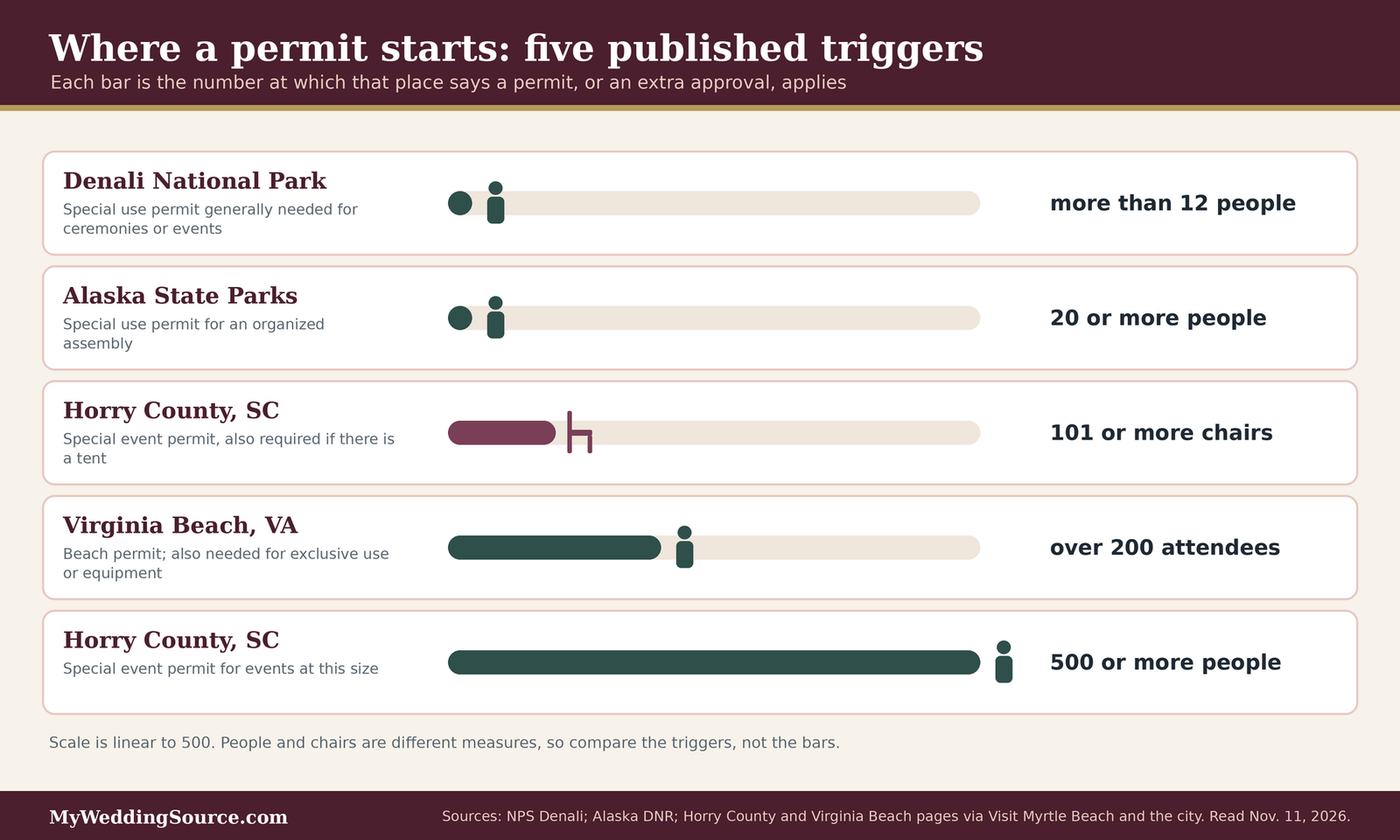
National park units handle wedding permits as a special use permit, and each unit sets its own location list, group-size caps, and conditions. Yellowstone, for example, publishes a headcount for each approved ceremony site, from five people at one roadside pullout to 250 at its chapel. Great Smoky Mountains National Park lists site-specific limits such as seat counts at a cabin and vehicle limits at small churches. Denali says a permit is generally needed for ceremonies or events with more than 12 people anywhere in the park.
State, county, and city land
State park systems, county park departments, and cities usually run their own permit programs for weddings. Alaska State Parks asks for a special use permit for an organized assembly of 20 or more people. Virginia Beach requires a beach permit when a ceremony closes off part of the public beach, uses equipment, or exceeds 200 attendees. Santa Barbara’s city beaches need a city permit handled through its parks department, while the county-managed beaches in that area do not allow weddings directly on the sand.
How to find the office for your wedding permits
You do not need to guess. A short sequence of calls and searches usually identifies the issuer within a day.
Search the place name plus “special event permit”
Use the official park, city, or county website, not a vendor’s summary of it. Look for a page titled special use permits, special events, facility use, or weddings. If the site is a national park, the unit’s own page lists its coordinator and application form.
Ask the person who answers the phone
Ask three questions in this order: who manages this exact spot, what triggers a permit for a wedding of our size, and is there a separate approval for alcohol, amplified sound, or a tent. If they point you elsewhere, write down the name and the date, and call the next office. Our wedding planning checklist has room for this kind of paper trail.
Keep a record of every answer about wedding permits
Because rules change and people misremember, a short written record protects you. It also helps the venue, the caterer, and your planner work from the same information.
Date every source
Write the date you read a page or spoke to someone. A page you read a year ago may describe last season’s fee, and a verbal answer can be forgotten. When an official page and a phone answer disagree, ask for the answer by email and keep the reply.
Save the permit conditions, not just the permit
Many permits arrive with a conditions sheet that lists what you may and may not do. Sequoia and Kings Canyon, for instance, publish a conditions document that covers decibel limits, decorations, vehicles, and cleanup. The permit approving your date is only half of what you need to read.
Parks: thresholds, fees, and conditions for wedding permits
Park rules for wedding permits usually start with a size threshold and then add conditions about what you bring. Understanding the structure helps you compare very different places without memorizing each one.
National parks and wedding permits
National park units describe their wedding rules on their own pages. What we found shares some patterns, and it also varies a great deal in detail.
Group size and site caps
Group-size limits tend to be written per location, and they are often strict. The Sequoia and Kings Canyon conditions document says the total headcount, including the wedding party and officiant, is capped at each location’s limit, with no exceptions. Yellowstone sets caps site by site. Great Smoky Mountains lists seats or vehicles rather than a single headcount for some places. When you read a park page, look for your exact location, not the park’s general policy.
Fees and timing in the sources we read
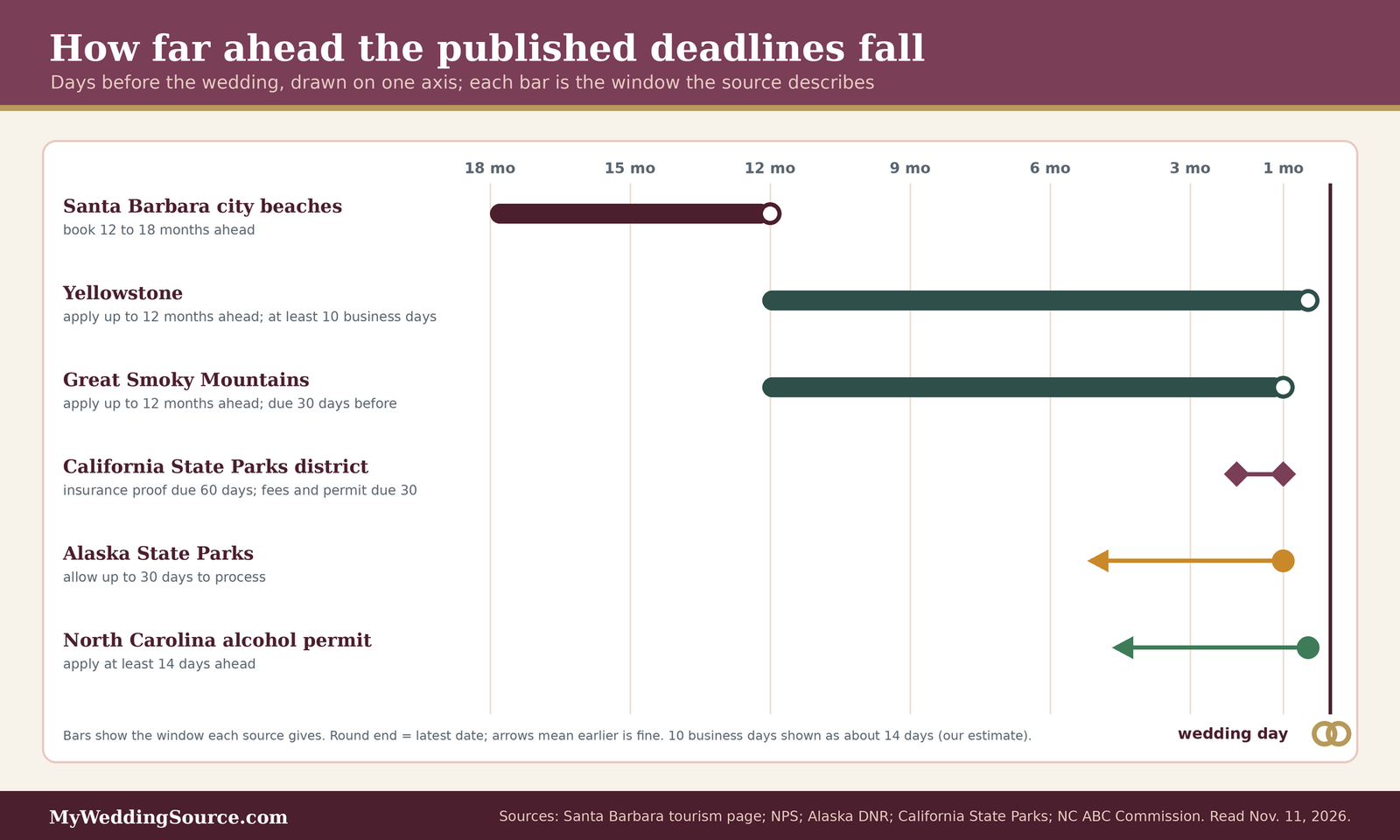
The fees and deadlines we found illustrate the range. Great Smoky Mountains charges a $50 non-refundable application fee, accepts applications up to 12 months ahead, and asks for them no later than 30 days before the event. Denali’s application fee is $200, and it notes that monitoring fees may apply when staff must be present. Sequoia and Kings Canyon list a $150 non-refundable application fee, and say entrance fees are not waived, so guests pay the standard park entry. Yellowstone asks for requests at least 10 business days ahead, allows applications up to 12 months ahead, and notes that permits are usually issued only a few weeks before the event because conditions can change. Its chapel application fee is $300, with a monitor costing extra.
Conditions in wedding permits that change how the day feels
Wedding permits often matter less than the conditions attached to them. They are written to protect the place and other visitors, and they shape your guest list, your decor, and your schedule.
Restrictions on decor and rituals
Denali’s page says littering is prohibited, including releasing balloons or throwing rice, birdseed, petals, or other materials, and that couples cannot rope off or block areas. The Sequoia and Kings Canyon conditions prohibit throwing rice, birdseed, confetti, or other food, ask that flowers and plant materials be taken out of the park, and ban releasing animals such as butterflies or birds. If your ceremony includes a send-off, a petal toss, or a release, ask before you plan it, because a ritual you love may be a violation there.
Receptions often have to happen somewhere else
Several parks treat the ceremony and the party as separate things. Sequoia and Kings Canyon say receptions must be held in concessioner facilities or on private property. Great Smoky Mountains discourages large, exclusive, or heavily decorated celebrations and suggests holding them outside the park. Yellowstone says large or heavily decorated events suit outside venues or its park lodges better. If your plan includes a long reception, assume you need a second site and a second approval.
State parks and wedding permits
State parks make their own choices, and the examples below show how they combine headcount, structures, and photographers.
Alaska State Parks as a worked example
The Alaska factsheet is unusually specific, which makes it a good example to learn from. A special use permit is required for an organized assembly of 20 or more people, and ceremonies of fewer than 20 with no structures need none. The application fee is $100 and non-refundable. The permit cost depends on group size: $50 for 20 to 50 people, $100 for 50 to 100, and $225 for 100 or more. Temporary structures add $100 per permit, parking is separate, and processing can take up to 30 days. The state also says permits are likely to be denied for holiday dates and dates that already have a permit.
California State Parks guidelines for special events
One California State Parks district’s 2026 guidelines, which refer to its Pajaro Coast and Santa Cruz Mountain parks, show a different structure. Weddings must be permitted and held at designated venues, and on the Pajaro Coast weddings are capped at 50 guests with no alcohol. Regular permits run $300 to $625 depending on headcount, with a refundable $250 security deposit (or $350 with alcohol), and a non-refundable $25 filing fee paid at least 30 days before the event. The document says that filing late adds a $100 rush fee. Insurance is required when a commercial vendor, caterer, or planner is involved, or the event poses greater risk. Weddings usually do not need insurance unless they include something like a band or tent. If you have questions about insurance, our guide to wedding insurance explains what coverage can and cannot do.
Beach wedding permits: the rules change at the county line
Beach weddings look informal, but wedding permits for sand are some of the most layered of any public event. Beaches belong to different governments, and the line between two sets of rules can be a single access ramp.
Public sand and what triggers beach wedding permits
The question for a beach is not “is a permit required?” but “what does this specific beach count as an event?” The answers vary, and a few examples show how.
Exclusive use, equipment, and headcount
Virginia Beach says an oceanfront beach wedding permit is required if the ceremony closes off part of a public beach for exclusive use, uses equipment, or has more than 200 attendees. Okaloosa County says any event on its beaches needs a permit approved by the county commissioners. Horry County, South Carolina, says a special event permit is usually not needed in its unincorporated areas, but is required for events with 500 or more people, 101 or more chairs, a tent, or an event that does not meet its standard conditions. Three places, three triggers.
Where the rules are strictest
In Santa Barbara, the city lists headcount limits by ceremony area, from 60 at one ceremony area to 200 at others, and asks applicants to plan 12 to 18 months ahead depending on the site. The county-managed beaches in the same region do not allow weddings directly on the sand, only at designated reservable areas that overlook the water. The practical lesson is that a beach with a famous name may have the least flexibility, so confirm the exact stretch of sand before you fall for it.
Beach wedding permits: chairs, shade, sound, and timing
Beach rules often get granular, because they have to share one limited space with everyone else. The examples from the Myrtle Beach area are a useful catalog of what to ask about.
North Myrtle Beach and Horry County
The Myrtle Beach tourism page describes rules that vary by jurisdiction within a short drive. In North Myrtle Beach, ceremonies must stay at least 25 feet from beach access points, off the dunes, and away from sea turtle nesting areas. Vendors may set up no more than 30 minutes before the ceremony, and the listed limits are one battery-operated speaker, one portable arch up to 16 square feet, two small tables, and 24 folding chairs. From May 15 through Labor Day, most shade devices are banned, with small center-pole umbrellas and infant shades as exceptions. In unincorporated Horry County, from May 1 through Labor Day, ceremonies with chairs, arches, or sound systems must start after 5:00 p.m., with setup also after 5:00 p.m., and only a portable sound system is allowed.
Paid services and the word “commercial”
The same page notes that in the City of Myrtle Beach, a wedding with paid services such as a professional photographer counts as commercially produced, and those are banned from the public beach but allowed in commercial-area parks with a facility use permit. That surprises many couples. Before you hire a photographer or planner for a public beach, ask whether the site treats paid vendors as a commercial use. Our wedding photography guide can help you plan the photographer search once you know the site’s rules.
Alcohol and wedding permits: who can pour, and who needs approval
Alcohol rules sit in a different office from other wedding permits, and they stack on top of them. A park can ban alcohol outright, a state can require a one-day permit, and a caterer’s license may or may not cover your event. Our open bar wedding guide covers budget and etiquette, so this section stays on the permission side.
Two separate questions
When couples research wedding permits for alcohol, they often ask one question when two are needed: is alcohol allowed on this property, and is a permit needed to serve it? A yes to the first does not answer the second.
Is alcohol allowed at the site?
Many public places restrict it. The California State Parks guidelines we read say alcohol is banned on Pajaro Coast beaches, with waivers available in some other parks that are not guaranteed and cost $50 to $300 depending on attendance. North Myrtle Beach says alcohol and glass containers are not allowed on the beach. Sequoia and Kings Canyon say rangers strictly enforce laws on excessive drinking and that guests must follow federal, state, county, and park rules. The answer depends on the exact place, so ask for it in writing.
Does serving it require a permit?
Often it does when you bring the alcohol onto someone else’s property. North Carolina’s Alcoholic Beverage Control Commission says a Limited Special Occasion Permit is generally needed to serve fortified wine or spirituous liquor at a wedding or similar event on someone else’s property. It costs $50 and must reach the commission at least 14 days ahead. The same agency says no permit is needed if only beer or unfortified wine of 16 percent alcohol or less is served free to guests 21 and older, the event is free, and the property owner allows it. That is one state’s rule, and other states draw the lines in other places.
What an alcohol application for wedding permits can ask for
The North Carolina example is useful because it lists the paperwork in detail, and similar documents turn up in other states.
Documents and who must apply
For the North Carolina permit, the applicant must have the property owner’s permission and cannot be the owner or possessor of the property. The commission asks for a notarized application, a signed lease or rental agreement in the applicant’s name that lists the address and event dates, and a certified criminal record check from the clerk of courts in the applicant’s county of residence. The point is not that your state does the same. It is that a permit can require documents that take days to gather, so do not leave it for the last week.
Conditions attached by the land manager
Even with a regulator’s permit, the site may add conditions. California’s guidelines say that when alcohol is allowed, only beer and wine are permitted, consumers must be 21 or older, and service must stop one hour before the event ends. Events serving alcohol need a ranger monitor for an 8-hour shift, and outside alcohol vendors need an ABC permit. Events selling alcohol also need host liquor liability coverage. If you are unsure, ask both the land manager and the alcohol regulator, and let your caterer or bartending company tell you which parts they handle. Our wedding catering guide explains what to ask a caterer about licensing.
When alcohol is not worth the paperwork
Sometimes the right choice is to move the drinks, not the permit. If your preferred public site bans alcohol, a ceremony there followed by a reception at a licensed venue may give you the setting and the toast.
Splitting the day
A short ceremony at a scenic public spot, followed by a reception at a venue that holds its own alcohol license, can be simpler than a permit stack at one location. It also fits sources we read that suggest holding larger receptions outside parks. Plan travel time between the two, and tell guests early.
Non-alcoholic menus
If you hold the event somewhere alcohol is restricted, a thoughtful non-alcoholic menu keeps the toast in the plan. Sparkling juices, spritzers, and house-made lemonade photograph well and fit nearly any park rule. Check with your caterer about glass, which several beaches ban.
Sound limits and wedding permits: music, microphones, and neighbors
Noise rules, and so the wedding permits that cover sound, are mostly local. The U.S. Environmental Protection Agency says it closed its noise office in 1981 and that state and local governments handle most day-to-day noise matters, such as neighbor noise and loud vehicles. That means the limit for your speaker comes from a city ordinance, a park rule, or a permit condition, and the number can differ from one block to the next.
Amplified sound in public places
Amplified sound is where a casual ceremony most often crosses a line. A small speaker for a processional is one thing, and a DJ is another, and public places draw the line differently.
Examples of how sites treat it
At Sequoia and Kings Canyon, amplified music and public address systems cannot exceed 60 decibels measured at 50 feet, and quiet hours run from 10 p.m. to 6 a.m. The California guidelines generally prohibit amplified sound, though acoustic music, limited public address use, and background ceremonial music may be approved case by case, and amplified sound is banned in redwood parks. In Santa Barbara, amplified sound is prohibited at one ceremony area and an amplified-sound permit is issued for another. In North Myrtle Beach the listed limit is one battery-operated speaker. A site that sounds friendly to a speaker may still cap it.
Questions about ceremony audio
Ask whether a single battery speaker for vows and a processional counts as amplified sound, whether a microphone for the officiant counts, and whether a live acoustic musician needs any approval. Ask what the decibel limit is and how it is measured. If the site will not give a number, ask what a ranger or officer would do if a neighbor complained. Our wedding ceremony guide and wedding officiant guide are good places to plan the ceremony itself once you know what sound the site allows.
Private property is not exempt
Holding an event at a friend’s land does not remove sound rules. The property may be inside a city, a county noise ordinance, or a homeowners’ association with its own restrictions.
Local ordinances and quiet hours
Many places set quiet hours and give the decibel limit in a local code. Search your city or county code online for “noise” and look for rules on amplified sound, event hours, and measuring distance. If an event will extend late, ask whether a temporary noise exception exists. If the answer is vague, ask the clerk or code enforcement office for the name of the person who decides.
Be a good neighbor on purpose
Tell the neighbors the date and the end time. Offer a phone number for concerns. A short note costs nothing and may head off a call to the authorities. It is a courtesy, not a legal shield, and it does not replace any required approval.
Tents and wedding permits: when the fire marshal gets involved
A tent is the point where a wedding becomes a structure, and tent wedding permits come from fire officials who treat structures as safety matters. The rules are written for crowds, and they apply to weddings whether or not the tent rental company mentions them. In many places, the rental company handles the paperwork, and in others you do. Ask which, and have the answer in writing.
The size threshold
Fire codes often set a footprint above which wedding permits for tents are required. The examples we read share a number, though local adoption and exemptions differ.
The 400 square foot trigger
Seattle’s fire code chapter on temporary structures (the 2015 edition we read) says a permit and fire code official approval are required for any tent or membrane structure over 400 square feet, with exemptions such as recreational camping tents and certain open-sided tents. DeKalb County, Georgia, also lists over 400 square feet for a permit, and says open-sided tents may be exempt if each canopy is 700 square feet or less with 12-foot clearances to structures and other tents. These are two jurisdictions and two documents, so the thresholds in your county may differ, and codes are updated over time. Four hundred square feet is a 20-by-20-foot footprint, so even a modest wedding tent can cross the line.

Park and beach rules sit on top of fire code
A tent can trigger a second approval on public land. Horry County’s special event permit applies if an event includes a tent. Alaska State Parks adds $100 per permit for temporary structures and asks that you list them on the application. California’s guidelines call tent setup an “out of the ordinary” activity that can trigger insurance requirements. In North Myrtle Beach, most shade devices are banned from mid-May through Labor Day. Whether it is a pop-up canopy or a frame tent, ask whether the site treats it as a structure.
What inspectors look at
If tent wedding permits are needed, the inspection is usually about safe exits, flame-resistant fabric, and anchoring. Knowing the list helps you ask your rental company the right questions.
Fabric, exits, and anchors
The Seattle chapter says fabric, sidewalls, drapes, floor coverings, and decorations must pass a recognized flame-spread test or be treated with flame retardant, and that a testing lab certificate must be filed before a permit is issued. Every tent needs at least one exit, with the minimum number and width set by occupant load, and exits must be spaced so every point is within 100 feet of one. Structures must be roped, braced, and anchored to withstand weather and prevent collapse. DeKalb says plans must show how the membrane is secured, such as with pegs. On grass that is easy, and on a patio or a beach it requires weights or other methods, so ask your rental company how the tent will be held down at your site.
Heaters, cooking, and clearances
Seattle’s code says open flames, fuel-burning devices, and cooking equipment are prohibited inside an occupied tent and generally within 20 feet of it unless the fire official approves. Heating and cooking equipment needs official approval, and cooking tents need 20 feet of separation from other tents. DeKalb says tents must be at least 20 feet from lot lines, buildings, other tents, parked vehicles, and engines, with some exceptions based on floor area, and that tents with cooking need a health department inspection. A heated tent, a food truck beside it, and a bar tent next to the dance floor each change the clearance picture, so describe your layout to the permit office.
Who pulls the permit for tents
Couples often assume the tent company handles everything, and some do. Confirm it rather than assuming it.
Ask the rental company about its tent permits
Ask whether the company pulls the permit, whether the price includes inspection fees and flame-retardant certificates, and what happens if the inspector requires changes on the day. Ask for the answers in the contract. Our wedding reception guide can help you plan the layout that goes inside the footprint.
Wind and weather plans
A permit approves a layout, but it does not approve the forecast. Ask the rental company when it will decide to lower sidewalls, add weights, or evacuate guests if conditions change, and who makes that decision on the day. If you are unsure, ask for the company’s written weather policy.
Fire and wedding permits: candles, sparklers, torches, and fire pits
Open flame is where wedding permits, fire codes, and park rules meet most directly. Some places ban it outright, some allow it with conditions, and some require approval of the specific device. Ask before you buy.
What public sites say about flame in wedding permits
The examples we read show a spectrum, and none of them is a national rule.
Bans and conditions
California’s guidelines say fireworks and sparklers are banned, gas and electric grills are allowed unless a high fire warning is in effect, and portable fire pits and heaters are not allowed. Fires are only permitted in park fire rings. Tiki torches and candles may be allowed in certain areas if the wax is contained. North Myrtle Beach and Horry County both ban Chinese lanterns. A tent adds the Seattle rule that open flames are generally kept 20 feet away unless the fire official approves.
Why the rules exist
Sparklers are a common wedding exit, and the U.S. Consumer Product Safety Commission says they burn at roughly 2,000 degrees Fahrenheit. Its fireworks page reports about 1,300 emergency room visits involving sparklers in 2025, and says burns are the most common fireworks injury overall. CPSC advises keeping a bucket of water or hose nearby, keeping young children away, and checking that fireworks are legal where you live. That is the practical reason many sites say no. The rules are about fire risk and crowds, so a flame you consider decorative is still a flame to the permit office.
Alternatives that keep the look
If a site bans flame, you can keep the feel without breaking the rule.
Flameless candles and lights
Battery-operated candles and string lights are accepted in many places. Ask whether the site has any rules about lighting, extension cords, or generators, because those can bring their own approvals. Our wedding decor guide is a place to look for lighting ideas once you know your site’s limits.
Send-offs without sparks
Bubbles, ribbon wands, and a simple applause line carry the same emotion with fewer permit questions. North Myrtle Beach lists bubbles as permitted, while other sites ban items such as confetti, so check first. If you are choosing a site that already allows garden-style ceremonies, our garden wedding venues guide is a good starting point.
Other public-space rules in wedding permits that catch couples off guard
Beyond the big five, several smaller rules show up in wedding permits again and again. They rarely make headlines, but they decide whether setup day goes smoothly.
Vendors, photographers, and drones
Anyone you pay to work at a public site can raise a question of their own. Your wedding permits may cover your ceremony and say nothing about a vendor’s right to operate there.
Paid photographers and commercial use
Alaska State Parks says paid photographers are commercial operators and need their own Commercial Use Permit. The Myrtle Beach tourism page says paid services such as professional photography make a wedding commercially produced in the city, which is banned on its public beach. Neither rule is universal, but both show why you should ask whether your photographer, planner, or florist needs separate approval. Our wedding photographer shot list helps you plan the pictures once the location is confirmed.
Drones
Aerial photos come with federal rules and often local ones. The Federal Aviation Administration says recreational flyers must register a drone that weighs 250 grams or more, pass a free online safety test called TRUST, and carry proof. In controlled airspace around airports, prior FAA authorization is required, and in uncontrolled airspace flights stay at or below 400 feet and within visual line of sight. The FAA page does not address park-specific restrictions and says you are responsible for knowing the rules for your location, so ask the land manager before anyone launches a drone. Hiring a licensed operator does not remove that question.
Setup, parking, and cleanup
Permit conditions often read like a list of small chores, and each can affect your vendor schedule.
Parking, vehicles, and entrance fees
Sequoia and Kings Canyon require vehicles to park only in designated areas, recommend carpooling, and do not waive entrance fees. Alaska State Parks says parking is separate from the permit. Great Smoky Mountains sets vehicle limits for some small church sites, such as six to eight vehicles at certain locations. Tell guests early, and consider a shuttle for any site with a vehicle cap. If a sign near your site shows a gate closing time, ask whether your permit overrides it.
Decor, staking, and leave-no-trace
The California guidelines say no staking into the ground and no staples, nails, or screws, and say signs must be freestanding and removed after the event. They also prohibit balloons, rice, petals, confetti, and bounce houses, and say glass is never allowed on beaches. North Myrtle Beach says chairs and arches must be removed right after the ceremony. Plan for strike time. If your arch needs stakes, ask whether weights are acceptable, and if your florals need water, plan how you will carry them out.
Wedding permits: lead times, costs, and a worked scenario
The most useful thing you can do with the sources above is turn them into a calendar and a budget for your wedding permits. Figures differ so much by place that a rule of thumb would mislead, so the planning method matters more than any single number.
What the fees in our sources looked like
Application fees for wedding permits in the pages we read ranged from $25 to $300, and the same pages show that the application fee is rarely the whole bill. Add permit tiers by headcount, monitor fees, structure fees, deposits, alcohol waivers, insurance, parking, and entrance fees. These are figures for specific places, not averages. For a broader budget frame, see our wedding budget calculator and average wedding cost guide, and treat the permit lines as items to verify one by one.
Build a backward calendar
A backward calendar for wedding permits starts at your wedding date and subtracts each approval’s published lead time, with a buffer. The buffer is our suggestion, not a rule from any source.
Use the longest lead time as your anchor
List every one of your wedding permits and write its lead time next to it. The examples we read run from 14 days for a North Carolina alcohol permit to 30 days for Great Smoky Mountains applications and for processing at Alaska State Parks, and from 12 to 18 months for some Santa Barbara beach sites. Your anchor is whichever is longest, because it decides when you must start. The Yellowstone page adds an important nuance: you can apply up to 12 months ahead, but permits are usually issued only a few weeks before the event.
Add a buffer for a no
Wedding permits can be denied or modified. Alaska’s factsheet says permits are likely to be denied for holiday dates and dates that already have a permit, and Great Smoky Mountains awards locations in order of receipt. If your top site says no, you need time to choose another. We suggest a buffer of at least one full application cycle for the approval with the longest lead time, and more for peak dates. Our wedding planning timeline shows where those cycles fit in the broader schedule.
A worked wedding permits scenario with transparent arithmetic
The scenario below is illustrative. The numbers come from the Alaska State Parks factsheet we read, and the totals are our own arithmetic, so treat them as an estimate and not a quote.
Sixty guests, one tent, a paid photographer
Suppose a couple plans a ceremony for 60 people at an Alaska state park site, with one temporary structure. From the factsheet: the application fee is $100, the permit for a group of 50 to 100 people is $100, and a temporary structure adds $100. That is $300 in permit-related fees. Parking is separate, and a paid photographer would need their own Commercial Use Permit, whose fee we did not find. So the real total is higher than $300, and the point of the exercise is to list every line, not to promise a final bill.
The same plan with alcohol, in a different system
Now imagine the same plan under the California district guidelines we read. A regular permit runs $300 to $625 depending on headcount. An alcohol waiver, where available, runs $50 to $300, a ranger monitor is listed at $700, and the refundable deposit is $350 with alcohol. As an estimate, the non-refundable fees alone could run from about $1,050 (a $300 permit, a $50 waiver, and a $700 monitor) to about $1,625 (a $625 permit, a $300 waiver, and a $700 monitor), before insurance, liquor liability coverage, and any prime-location fee of $200 to $1,200. That is arithmetic on one document, and your park may charge differently or ban alcohol entirely.
A wedding permits checklist and a risk register
Two reusable tools for wedding permits tie the sections together. The first sorts approvals by the question that triggers them, and the second helps you decide where to spend your attention.
| Question | Office that usually answers | Example trigger in our sources | Lead time seen in sources | What to get in writing |
|---|---|---|---|---|
| Can we hold a ceremony here? | Park, parks department, or county | Denali: more than 12 people; Alaska State Parks: 20 or more | Up to 30 days to process (Alaska) | Permit, date, site name, headcount cap |
| Is the beach an event site? | City or county beach office | Virginia Beach: exclusive use, equipment, or over 200 | Varies; 12 to 18 months at some Santa Barbara sites | Exact stretch of sand, hours, equipment list |
| Is alcohol allowed and licensed? | Land manager plus state alcohol regulator | North Carolina: spirits on someone else’s property; California parks: waiver | 14 days (North Carolina) | Permit or waiver, allowed beverages, end time |
| Is amplified sound allowed? | Land manager or city | Sequoia and Kings Canyon: 60 decibels at 50 feet | Usually set in the permit | Device list, decibel limit, quiet hours |
| Does the tent need approval? | Fire marshal or building office | Over 400 square feet in two fire codes we read | Ask the rental company | Permit, flame-retardant certificate, layout |
| Is open flame allowed? | Land manager and fire marshal | Sparklers and portable fire pits banned in California guidelines | Usually set in the permit | Written yes or no for each flame item |
| Do vendors need their own approval? | Land manager | Alaska: paid photographers need Commercial Use Permit | Ask each vendor | Vendor list on permit or vendor permits |
Reading the checklist
The table is a conversation guide, not a legal document. Use it to organize the calls you make, and add rows for anything your site mentions that this list does not.
Put every row in one place
Create one shared document for your wedding permits with the table, the name and phone number of each office, and the date of every conversation. If a planner or venue coordinator is helping, give them access. A single source of truth reduces the chance that one person assumes another has handled a form.
When two offices disagree
If the park says alcohol is allowed and the state says you need a permit, both can be right. Do what the stricter one requires, and ask each office to confirm in writing what it expects of the other. If a conflict remains, ask for the name of a supervisor or for a pre-event meeting.
A risk register for wedding permits
A risk register ranks what could go wrong by how likely it is and how costly it would be. The rankings below are our judgment, not statistics.
| Risk | Likely cause | Consequence | Mitigation |
|---|---|---|---|
| Date or site is denied | Holiday or existing permit; site full | Redo location and invitations | Apply early, name a backup site |
| Tent not approved on the day | Missing certificate; layout changed | Delay or tent removed | Confirm who pulls the permit; share the final layout |
| Alcohol service stopped | No permit or waiver | Bar closed; possible penalties | Ask both land manager and regulator |
| Sound complaint | Speaker over the limit; late hours | Warning or shutdown | Get the limit; test volume |
| Cleanup deposit lost | Litter, stakes, or damage | Lost deposit | Assign a strike crew |
Which risks deserve the most attention
Date denial and alcohol are the two with the longest lead times and the least flexibility, so they come first. Sound and cleanup are inexpensive to prevent once you know the rule, so write them into your day-of plan.
Where insurance fits
Insurance can be required by the site, or it may be something you choose. The California guidelines require a certificate in specific situations, such as when a caterer or band is involved. Event insurance is not a permit, and it does not make a prohibited activity allowed. Read our wedding insurance guide to learn what such policies usually cover, and ask the insurer whether your site’s conditions affect your policy.
Questions to ask before you apply for wedding permits
Good questions turn a vague yes into something you can plan around. Ask them of the land manager first, and then of each vendor.
Questions to ask
- Who manages this exact spot, and is there a separate office for alcohol, tents, or sound?
- What triggers a permit for a wedding of our size: headcount, chairs, equipment, a tent, or exclusive use?
- What is the full cost, including monitor, deposit, structure, parking, and entry fees?
- What is the earliest date we can apply, the latest, and the usual processing time?
- Are alcohol, amplified sound, candles, and sparklers allowed, and what are the conditions?
- Do our photographer, planner, caterer, and rental company need their own approval?
- What happens if weather forces a change, and what is the cancellation and refund policy?
For the land manager or city
These questions about wedding permits are about the place. Ask them early, and ask them again when you have a final layout, because details that seem small at the start can change an answer.
Start with the trigger
Ask what triggers a permit and ask for the threshold in numbers, such as people, chairs, or square feet. Ask whether the answer changes by season, as Horry County’s does in summer. Then ask whether your plan fits under the threshold or over it.
Ask about the day itself
Ask about setup and strike times, who can enter the site, whether a monitor will be present, and how to reach someone on the day. Ask what the site would do if rain forced a move. A site that has no weather plan may leave you with only a refund.
For vendors and family
Your vendors work under your wedding permits or under their own, and you need to know which. Family members who offer to bring a speaker, a fire pit, or a case of champagne can unknowingly create the risk you are trying to avoid.
Put rules in vendor contracts
Ask each vendor to confirm in writing that they have read the permit conditions, and state who is responsible for any fines or fees. Our wedding planning guide helps you decide which tasks to hand to a planner.
Give a one-page rules sheet to helpers
A short sheet with the headcount cap, sound limit, alcohol rules, and cleanup plan helps friends and family help without guessing. Hand it to the people setting up and tell them who to call with a question.
FAQ: wedding permits questions
Do I always need wedding permits
Do I need wedding permits for a small ceremony in a public park?
Not always, but it depends on the place. Denali’s page says a permit is generally needed for ceremonies with more than 12 people, and Alaska State Parks says a permit is needed at 20 or more people, with no permit for smaller groups without structures. Many other sites set different thresholds, so ask the land manager before you assume.
Does a marriage license replace wedding permits for a park or beach?
No. A marriage license is legal permission to marry, and a site permit is permission to use a particular place for an event. One county clerk page we read says any event on its beaches needs a beach permit approved by county commissioners. Keep the two tasks separate on your checklist.
Can my caterer or tent company handle wedding permits?
Some do, and some do not. Ask in writing who pulls each permit, who pays for inspections and flame-retardant certificates, and what happens if a requirement changes on the day. A vendor saying they have done it before is not the same as a contract line saying they will.
Alcohol, sound, and fire
Can guests bring their own alcohol?
It depends on the site and the state. North Carolina, for example, requires a permit for spirits or fortified wine on someone else’s property and none for free beer or unfortified wine in specific conditions. California parks in the document we read ban alcohol on some beaches. Ask the land manager and the state regulator both.
Can I use a speaker for the ceremony?
Often yes, within limits, but check. Sequoia and Kings Canyon cap amplified sound at 60 decibels measured at 50 feet, and North Myrtle Beach lists one battery-operated speaker. Other sites prohibit amplified sound or issue a separate sound permit. Ask whether a single speaker or microphone counts.
Are sparklers or candles allowed outdoors?
Often not in public places. California’s guidelines ban sparklers and portable fire pits and allow candles only in certain areas when wax is contained, and North Myrtle Beach bans Chinese lanterns. A tent adds more distance rules. Ask in writing for each flame item, and consider flameless alternatives.
Tents and timing
When does a tent need a permit?
Two fire codes we read set the trigger at tents over 400 square feet, which is a 20-by-20-foot footprint, with exemptions for some open-sided canopies. Your local code may differ, and some parks and beaches treat any tent as a structure. Ask your rental company and the local fire office.
How far ahead should I apply?
It depends on the place. Examples in our sources run from at least 14 days for a North Carolina alcohol permit to 12 to 18 months for some Santa Barbara beach sites. Start by finding your longest lead time, add a buffer in case you are told no, and apply as soon as the site allows.
Your next steps
Find out what applies
Write down your plan in numbers
List your headcount, the number of chairs, any tent size, the alcohol plan, the sound plan, and any flame. Those numbers are what offices ask about when you apply for wedding permits, and having them ready makes every call shorter. If your list is short, our small wedding planning and micro wedding planning guides show how smaller guest lists can simplify the process.
Call the land manager first
Use the question list above, take notes, and ask for written confirmation. Then call the fire office, the alcohol regulator, and the noise or code office as needed. Put each answer and its date in your shared checklist.
Lock in the calendar
Apply in order of lead time
With wedding permits, start with the approval that takes longest or fills first. Keep a backup site in mind until the main site is confirmed in writing, and set reminders for deadlines such as final headcount, insurance certificates, and deposits.
Share the rules with your team
Give vendors, your planner, and family helpers a one-page rules sheet, and keep copies of every permit and conditions document with you on the day. The permit may need to be shown on site, and Great Smoky Mountains says the approved permit must be with you during the event.
Sources & methodology
How we built this guide
What we relied on
This guide draws on public pages and documents from national and state park systems, city and county beach and park offices, a state alcohol regulator, two municipal fire code documents, the U.S. Environmental Protection Agency, the Federal Aviation Administration, and the U.S. Consumer Product Safety Commission. We read each page on November 11, 2026. Where a figure comes from one place, we name the place, because wedding permits are set locally and a number from one park is not a national average. The totals in the worked scenarios are our own arithmetic and are estimates.
What we did not do
We did not contact the offices named here, and several pages did not address alcohol, sound, tents, or fees, so we left those topics out for those places. We did not survey couples or vendors, and we do not give legal advice. Rules change, codes are revised, and your site may differ, so confirm every requirement with the issuing office and keep a dated record.
Source list
Federal, state, and municipal sources
- National Park Service, Yellowstone National Park, Weddings: https://www.nps.gov/yell/planyourvisit/weddinginfo.htm
- National Park Service, Great Smoky Mountains National Park, Wedding information: https://www.nps.gov/grsm/planyourvisit/wedding-information.htm
- National Park Service, Denali National Park, Permits: Weddings, ceremonies, and gatherings: https://www.nps.gov/dena/planyourvisit/weddings-ceremonies-and-gatherings.htm
- National Park Service, Sequoia and Kings Canyon National Parks, 2025 wedding permit conditions: https://www.nps.gov/seki/planyourvisit/upload/2025_wedding-permit-conditions.pdf
- Alaska Department of Natural Resources, State Parks wedding permit fact sheet: https://dnr.alaska.gov/parks/permit/weddingsfactsheet.pdf
- California State Parks, Special event guidelines 2026: https://www.parks.ca.gov/pages/532/files/SPECIAL-EVENT-GUIDELINES-2026.pdf
- North Carolina Alcoholic Beverage Control Commission, Do you need a permit for a special event: https://abc.nc.gov/webform/ncc_permit_application_flowchart
- North Carolina Alcoholic Beverage Control Commission, Limited Special Occasion and special one-time permits: https://www.abc.nc.gov/permits/specialpermits
- City of Virginia Beach, Outdoor event permits: https://virginiabeach.gov/services/outdoor-event-permits
- Okaloosa County Clerk, Do I need a beach permit: https://okaloosaclerk.helpjuice.com/en_US/29119-marriage-license/245511-do-i-need-a-beach-permit
Safety, noise, fire code, and tourism sources
- U.S. Environmental Protection Agency, Noise pollution: https://www.epa.gov/clean-air-act-overview/clean-air-act-title-iv-noise-pollution
- Federal Aviation Administration, Recreational flyers: https://www.faa.gov/uas/recreational_flyers
- U.S. Consumer Product Safety Commission, Fireworks safety: https://www.cpsc.gov/Safety-Education/Safety-Education-Centers/Fireworks
- City of Seattle, Seattle Fire Code Chapter 31, temporary structures (2015 edition): https://www.seattle.gov/documents/Departments/SDCI/Codes/SeattleFireCode/2015SFCChapter31.pdf
- DeKalb County, Georgia, Tent requirements: https://www.dekalbcountyga.gov/sites/default/files/users/user2017/Tent%20Requirements.pdf
- Visit Santa Barbara, Your guide to a Santa Barbara beach wedding: https://santabarbaraca.com/weddings/venues-services/santa-barbara-beach-weddings/
- Visit Myrtle Beach, Know the rules for weddings: https://www.visitmyrtlebeach.com/things-to-do/weddings-honeymoons/know-the-rules/