

Proposal and engagement party planning works best when you treat the two events as one connected project: a proposal that has a place, a photographer’s view and a quiet signal, followed by a party that has a realistic date, a host, a guest list and a plan for photos and food.
Quick answer
Decide the proposal first, because everything else hangs on it. Pick a setting where you have permission and a backup, agree on one quiet cue with whoever is taking photos, and keep the camera at a distance with a long lens and two angles if you can. Then hold the party one to four weeks later if most guests are local, and up to about three months later if the plan is bigger, according to Zola’s guidance. Invite people you also expect to invite to the wedding, keep gifts optional, and check food, accessibility and photo consent before you send invitations.
Why proposal and engagement party planning is one project, not two
Most advice treats the proposal as a private surprise and the party as a separate social event. In real life they share the same constraints: one set of families, one budget conversation, one photographer’s calendar, one announcement. When you plan them together, you avoid the common mistakes, such as a perfect proposal location that has no easy way to gather people afterward, or a party date that lands before the people who matter can travel. This section lays out the logic, and the rest of this guide works through it in order.
How the two events depend on each other
The proposal sets the starting date for every later decision, and the party gives the proposal a place to land in public. A short framework helps you see where one decision limits another.
The proposal sets the clock
Anyone doing proposal and engagement party planning should start from this fact. Once the question has been asked and answered, news travels fast. Emily Post’s guidance notes that engagements are often no longer kept secret, which means the party can happen whenever the hosts prefer instead of being a surprise announcement. In practice that means the clock starts the moment you post, text a parent or tell a coworker. Good proposal and engagement party planning therefore decides, before the proposal, who hears first and how quickly the party should follow, so no one learns the news from a group chat before a phone call.
The party gives the news a destination
A proposal usually involves two people and perhaps a photographer. An engagement party involves dozens. The party is where grandparents, college friends and future in-laws meet each other for the first time, and Emily Post describes that introduction as one of its main purposes. If you plan the proposal with that later gathering in mind, you can pick a proposal setting, an outfit and a photo style that suit the announcement photos you will want for invitations and a social post.
The order of decisions that saves rework
People often start with Pinterest boards and end with a calendar problem. The order below keeps expensive or hard-to-change decisions at the front.
Decide the proposal’s privacy level and place
For proposal and engagement party planning, this is the first fork in the road. Private or public, indoors or outdoors, planned with family present or alone: these choices decide permits, photographer access and weather risk. Our guide to proposal ideas covers the creative options, and this guide focuses on the logistics behind whichever one you choose. If you are still deciding between a private moment and a public one, ask your partner’s friends how your partner behaves in front of a crowd, and weigh the answer more than any trend.
Lock permission, then photographer, then date
Permission comes first because a location that requires a permit may not be available on your preferred date. A photographer comes second because experienced proposal photographers can lose a date quickly in peak seasons, and because the photographer’s scouting visit should happen at the same time of day as the proposal. The party date comes third, because it depends on how many loved ones are local and how elaborate you want the event to be.
What this guide covers, and what it leaves out
You will find a photographer angle map, a cue timeline, a roadmap for the weeks between the proposal and the party, and checklists for venue, guests, photos and food. You will not find legal advice, a guarantee that any park or venue will approve your plan, or a single “correct” script for the day.
What we mean by “angle map” and “cue timeline”
An angle map is a top-down sketch of the proposal spot that marks where the couple stands, where the sun is, and where each camera and helper will be. A cue timeline is a short list of small, ordinary actions that tell the photographer, a helper or a venue partner exactly what is happening, minute by minute, without anyone speaking or looking at anyone. Both are practical planning tools we built from published photographer advice, and you can adapt them in a notebook in ten minutes.
Where the facts come from, and where our judgment fills in
Rules in this article come from park agencies, a federal aviation page, a federal food-safety page, a Department of Justice accessibility guide and etiquette sources, all listed at the end with the date we checked them. Where we make a recommendation that is our own judgment, such as how many minutes to leave between a signal and the question, we say so. Rules differ by park, city, venue and state, so treat the examples as illustrations and confirm locally.
Choosing the proposal setting: privacy, permission, and backups
The setting is where proposal and engagement party planning stops being abstract. A location has opening hours, crowd patterns, light, rules and neighbors. A good choice is not necessarily the most scenic one. It is the one where the plan still works if it rains, if a wedding party arrives at the same overlook, or if a ranger asks who you are.
Matching the setting to the couple
Before you look at locations, describe your partner in practical terms. The best setting fits how they behave when people are watching.
If your partner prefers privacy
Proposal and engagement party planning looks different for a private person. If your partner dislikes being the center of attention, the safest choice is a place where strangers are unlikely to wander into the frame: a quiet corner of a familiar park, a home, a trail you walk together, or a restaurant booked for a table away from the main floor. A hidden photographer can still work in these places, but the cue plan must be even simpler because there are fewer natural hiding spots.
If your partner enjoys a crowd
A social partner changes proposal and engagement party planning in a few specific ways. Some people would love a proposal in front of friends. In that case, the practical questions change. You need an audience-friendly place, a signal for guests who are hidden or waiting nearby, and a clear plan for what happens in the first minute after the answer, because everyone will want to hug the couple at once. Photographers like this situation less than people expect, because a crowd blocks sight lines, so the angle map matters more.
If the answer is uncertain
Most couples have talked about marriage by the time one proposes, but not all have. If you are not sure of the answer or the timing, a smaller, more private setting with no audience is kinder to both of you. Plan the setting so that either answer can be received gracefully, and do not invite an audience, a hired photographer or a video crew into a moment that you cannot predict.
Permission by location type
“Permission” covers rules from several different authorities: public land agencies, city park departments, private venues and event hosts. The examples below come from pages we checked on the date listed in the Sources section. They are examples of how different the rules can be, not a substitute for contacting the office that controls your spot.
National parks: rules vary by park
Proposal and engagement party planning often runs into park rules first. The National Park Service publishes rules park by park. Yellowstone’s page says weddings and other ceremonies may be permitted in certain areas depending on location, group size and time, and says compensated portrait photographers, such as those shooting engagement or wedding sessions, may need a permit if the group exceeds five people using only cameras and tripods. It lists a $250 non-refundable application fee effective October 1, 2021, and asks for applications two to four weeks ahead, with most applications not accepted more than a year before the event. Rocky Mountain National Park’s page describes a different threshold: permits and fees generally are not required for filming or still photography by eight or fewer people in public areas with hand-carried equipment, and a special use permit is required if your group performs any ceremony such as a wedding or elopement. The same page says photographers working for clients still pay entrance fees. Two parks, two thresholds. That is why you cannot assume.
City parks: a proposal may or may not count as an event
City park systems often separate ceremonies, special events and photography. The Chicago Park District’s page says outdoor ceremonies need a Special Event Permit regardless of location or guest count, that engagement and wedding photography requires a separate Filming and Photography Permit, and that no food or beverage service of any kind is allowed at outdoor ceremony permits. The same page does not mention proposals specifically, so ask the district whether a proposal counts as a ceremony, a photography session or neither. Central Park Conservancy’s Conservatory Garden page says garden wedding ceremonies and proposal events are welcome by permit only, with applications at least ten days before the date, and says the garden stays open to the public during permitted events. Our own guide to wedding permits explains how these systems usually work, and our article on proposal location permissions goes further into parks, rooftops and private property.
Private property: the owner’s yes is the permit
In proposal and engagement party planning, a private venue is usually the simplest to arrange. On private property, such as a restaurant, a rooftop, a winery, a hotel terrace or a friend’s backyard, the permission is the owner’s or manager’s. Ask in writing, name the date and time, say whether you will bring a photographer or a helper, and ask what staff will do if a plan changes. A friendly manager who knows a surprise is coming can seat you at the right table, keep the nearby tables quiet and warn the photographer when the moment is near. A manager who learns about it on the day may refuse.
Backups, holds, and the cost of changing your mind
Every setting needs a plan B that is genuinely different, not a worse version of the same idea. Rain, wind, a closed trail, a wedding party at your overlook or a stalled train can all change the plan in a few hours.
Build a plan B that changes only one variable
A strong backup changes one variable, such as moving from an overlook to a covered terrace in the same park. The photographer’s lens, the cue and the guests’ route remain the same. A weak backup changes everything at once, such as moving from a sunrise hike to a restaurant, and it breaks the photographer’s plan, your outfit and your partner’s expectations. Our guide to a wedding rain plan uses the same logic, and the same habit works here.
Know what a hold costs and when it expires
Good proposal and engagement party planning tracks deadlines as carefully as dates. Some bookings are refundable until a date and nonrefundable after it. Central Park Conservancy’s page, for example, says cancellations more than thirty days ahead are refunded and cancellations inside that window are not. Whatever the rule, write down the last date you can cancel without losing money, and set a calendar reminder a few days before it. If your proposal date might move because your partner’s schedule is uncertain, choose the more flexible setting even if it is less photogenic.
The photographer angle map: where each camera, helper, and sightline goes
Most guides to proposal photography give you a list of tips. An angle map is more useful because it turns the tips into a picture of your actual place. It shows where the couple will stand, where the light falls, where the primary camera and a second angle sit, and where helpers, escape routes and crowds are likely to appear. You can draw it on paper after a ten-minute site visit, and it makes the conversation with a photographer concrete.
How to read the angle map
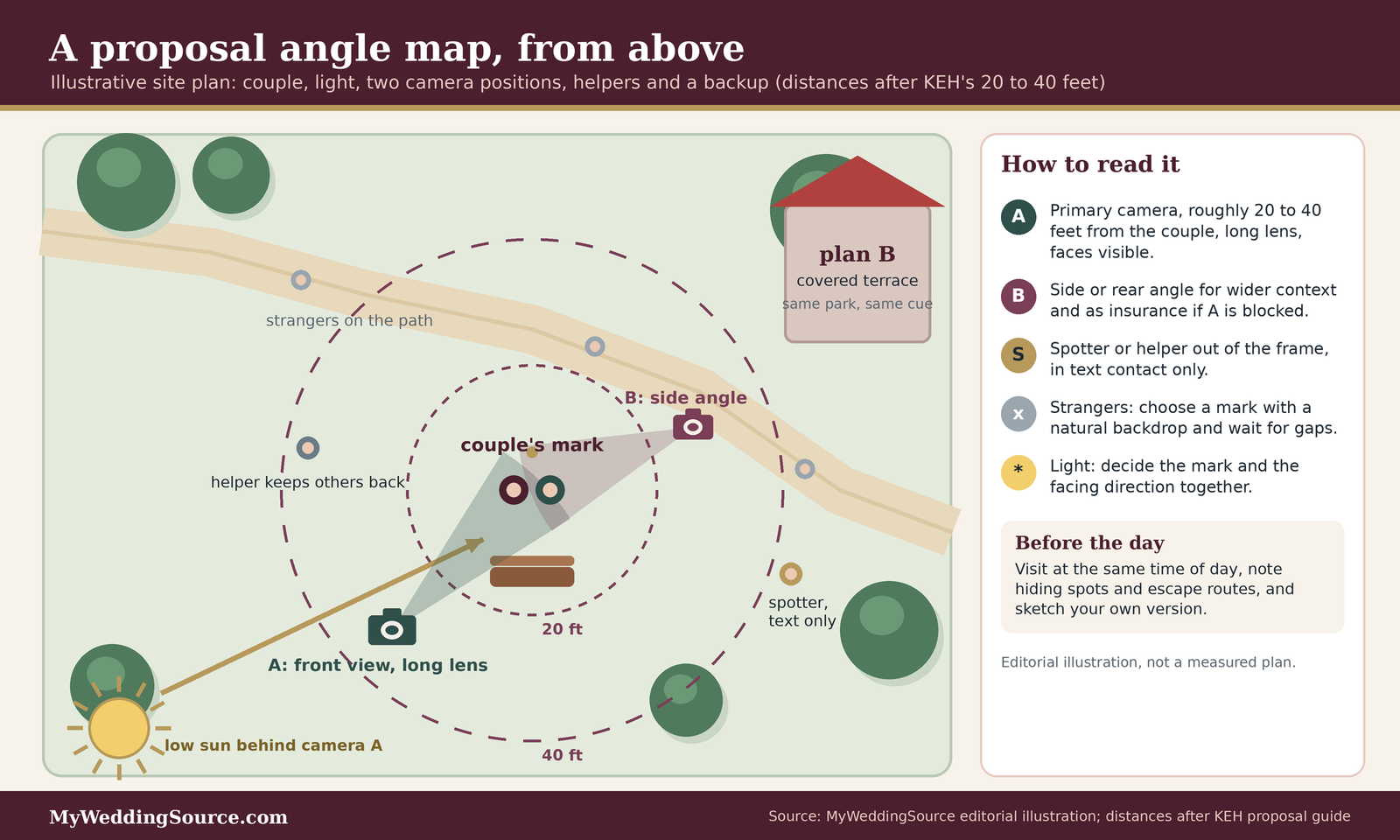
The figure below shows a typical open-air proposal spot with a path, a bench, trees and a low sun. It is an editorial illustration, not a measured site plan, and the distances come from published photographer guidance. Use it as a template and replace our assumptions with yours.
The couple’s mark and the light
The angle map is the one piece of proposal and engagement party planning that benefits from a drawing. Start with the spot where your partner will stand when you ask. Then note where the sun will be at that time of day. ShootProof’s guidance for proposal photographers suggests advising the proposer on where to stand so the light stays even, and notes that golden hour suits dreamy photos, while KEH’s guide says harsh midday sun is easier to handle if the light comes from the side or behind. The practical point: choose the mark and the facing direction together, so the light falls on faces rather than casting them into shadow.
The primary camera: front view, long lens
KEH’s proposal guide recommends working roughly 20 to 40 feet away with a telephoto zoom instead of a close wide lens, and prioritizing a front-facing view for expressions and the ring reveal. That is Position A on the map. It sees both faces if you turn your partner slightly toward it, which you can do by choosing where the bench faces or where you stand when you start talking.
The second angle: side or back
If you have a second photographer or a friend with a good phone camera, KEH suggests a side or back position for wider context. That is Position B. It shows the setting, the ring box, the crowd of friends or the view, and it protects you if the primary photographer’s view is blocked at the key moment. You do not need it, but it is insurance.
Choosing positions for different settings
Setting changes the geometry. The table below summarizes the usual approach for six common settings. These are planning suggestions drawn from the photographer guides we read plus our own judgment, and a photographer who knows your location may choose differently.
| Setting | Primary camera (A) | Second angle (B) | Main risk |
|---|---|---|---|
| Open park or overlook | Front, 20-40 ft, long lens | Side, behind a tree line | Strangers walking through |
| Beach or shoreline | Front, low sun behind the photographer | Dune or boardwalk | Wind, glare, shifting crowds |
| Restaurant or rooftop | Table-side with manager’s help | Bar or doorway | Staff traffic, low light |
| Garden with paths | Front along the path | Behind hedge or fountain | Permit boundaries, other events |
| Trail or summit | Ahead on the trail, telephoto | None, or a friend on the descent | Narrow spots, weather |
| Home or backyard | Window or doorway | Hidden helper inside | Guests spoiling the surprise |
Open spaces with strangers
Open parks are where proposal and engagement party planning meets the unpredictable public. In a busy park, the main issue is that strangers walk into the frame. Choose a mark that has a natural backdrop, such as a tree, a fountain or a railing, so the photographer can wait for gaps. KEH’s guide recommends dressing the photographer to match the setting, like a tourist or a jogger, and photographing other subjects too so they do not look fixated on the couple. ShootProof suggests a telephoto lens and a spot that is not obvious.
Indoor and venue spaces
Indoors, light is lower and sight lines are shorter. KEH notes that a shorter zoom, such as a 24-70 mm, suits tight indoor spaces, and fast prime lenses help in low light. The better advantage indoors is staff: KEH points out that venue staff can give the photographer a heads-up. Ask the manager to be the spotter and to hold nearby servers for a minute.
Trails, summits, and places with no hiding spots
When a place has no cover, a hidden photographer is not realistic. You can still plan for it by having the photographer go ahead and wait, or by telling your partner that a friend will be taking photos at the overlook because you want a picture together. A simple, kind explanation is gentler than a stranger with a long lens trailing the couple on a narrow trail, and it keeps the surprise about the question itself.
Hired photographer, friend, or phone on a tripod
Not every couple hires a professional, and not every proposal needs one. The right choice depends on how much the photos matter, how much you can plan, and how much your partner would notice.
When to hire a professional
Hiring is a budget line in proposal and engagement party planning, so decide on purpose. Consider a professional if the proposal setting is crowded, if the light is hard, if you want a mini-session afterward, or if you cannot stop thinking about whether the moment will be captured. ShootProof’s guidance says a short mini-session after the proposal can work, since couples may not be ready for a full shoot right away. Ask for a portfolio of real proposals, not only engagement sessions, and read the contract for what happens if the plan moves. Our guides on wedding photographer portfolios and vendor contracts explain what to look for.
When a friend or family member can do it
A friend with a good camera and a calm temperament can do a surprisingly good job if the plan is simple. Give them the angle map, a cue, a clear role and a fallback if they miss it. Do not make them both a guest and the photographer unless they are comfortable missing some of the moment. Also tell them what happens if the answer is not yes, so they do not keep shooting.
When a phone and a tripod are enough
Some proposal and engagement party planning is deliberately low-tech. For private proposals, a phone on a small tripod or hidden in a bag can capture a wide shot. KEH mentions that a hidden remote flash in a bag or behind a plant is another approach in low light. A phone cannot follow expressions like a long lens, but it is unobtrusive. The privacy rules in the guest-photo section apply here too: only record people who know or reasonably expect it, and never record private conversations covertly.
Light, timing, and distance
Photographers talk constantly about light because it decides whether faces are readable. You do not have to master it, but you should know which hour of the day suits your spot.
Scouting at the same time of day
Scouting is the cheapest step in proposal and engagement party planning. Both KEH and ShootProof recommend scouting. KEH says to visit at the same time of day as the planned proposal, and to note hiding places, lighting problems and escape routes. ShootProof suggests visiting about a week ahead. If you cannot visit, ask the photographer to scout, or use a map app and a sun-position tool to estimate where the light will fall.
Distance is a safety valve
Distance protects the surprise and the privacy of the moment. At 20 to 40 feet, according to KEH, a telephoto lens still gives a close view, and your partner is far less likely to notice the camera. It also gives the photographer room to move without crossing into the couple’s space. If you are using only phones, plan for a smaller crop and for less detail, and accept it.
A one-page worksheet to hand to your photographer
The most useful thing you can give a photographer is not a mood board. It is a single page that answers the questions they would otherwise ask in six separate messages. Fill this in together, and keep a copy yourself.
What goes on the page
A good worksheet makes proposal and engagement party planning easier for everyone involved. Write the address and the exact spot, with a pin you have dropped on a map. Add the date, the planned time of the question, the sunset time for that day, and the plan B location. Add a recent photo and an outfit description for the person asking, and a second for the person being asked, so the photographer can find the right pair among strangers. List the three cues and what each means. List the helpers, their roles and phone numbers, and name the one person who decides whether to switch to plan B. Finally, write what the photographer should do if the answer is not yes, and whether you want a short mini-session afterward.
How to use it on the day
Send the page the evening before, and a short text on the morning of the day with any change. Keep the sketch with the angle map on your phone, so you can show it to a venue manager if a staff member asks what you are doing. A page like this also lets a second photographer or a friend step in if the first one is delayed, because everything they need is written down. After the day, add notes about what worked, because the same sketch helps when you plan the engagement photo session or the party.
The discrete cue timeline: how to signal without anyone noticing
A proposal photograph depends on a few seconds that no one can repeat. A cue timeline is the plan that makes sure the photographer and any helpers are ready for those seconds without a visible conversation. Both KEH and ShootProof advise agreeing on a subtle signal in advance, and the timeline below turns that single tip into a sequence you can rehearse.
Designing the cues
A cue should be ordinary, repeatable and impossible to mistake. It should also be something your partner will not notice or remember.
Choose actions that look like normal behavior
Cues are a small but important part of proposal and engagement party planning. KEH gives examples such as checking a watch or touching your hair. The point is that the action fits the setting and is not a gesture you would not normally make. If you rarely wear a watch, checking one will stand out. Pick something you do anyway, such as adjusting a jacket, tying a shoe, taking a drink from a bottle, or checking your phone for the time. Keep a short list of three cues with distinct meanings so the photographer does not confuse them.
Give each cue exactly one meaning
A useful system has three cues: “we are arriving,” “I am about to start,” and “the question is being asked.” That is enough. More than three invites mistakes. Write each on a card the photographer can keep, and agree on what happens if a cue is missed, for example that the photographer will start shooting continuously once the proposer kneels, whether or not a signal was seen.
Use a text channel for the people who are not in sight
Helpers are a quiet part of proposal and engagement party planning. Spotters and helpers may be out of sight. ShootProof suggests asking for a text describing the proposer’s outfit and sharing photos so the photographer follows the right person, and KEH notes that a friend can act as a spotter and send updates. A private group message with a short, agreed vocabulary such as “turning in,” “on the bench,” and “starting” avoids phone calls and keeps everyone current. Set phones to silent and warn helpers not to look at the couple while typing.
A timeline from the morning to the afterglow
The timeline below uses clock offsets from the moment you plan to ask the question. The offsets are our own planning suggestions. They give you a rhythm and a place to adjust for your setting, and no source defines them.

| When | What happens | Who acts | Cue or channel |
|---|---|---|---|
| Morning of | Photographer receives outfit description and a recent photo | Proposer | Text |
| One hour before | Photographer and helpers are in position and have checked light | Photographer | Private group text |
| Thirty minutes before | Proposer and partner leave for the spot on the usual pretext | Proposer | None |
| Ten minutes before | Arrival at the setting; helper confirms nobody else is at the mark | Spotter | Text: “turning in” |
| Two minutes before | Cue one: proposer settles at the mark | Proposer | Cue one |
| The moment | Cue two: proposer begins; photographer shoots in bursts | Proposer, photographer | Cue two |
| Right after | Pause; a hug; the ring on; no one rushes in | Everyone | None |
| Ten minutes after | Photographer approaches only if invited; short mini-session if the couple wants it | Photographer | Verbal |
| An hour after | Calls to parents and a quiet moment before any announcement | Couple | Phone |
The morning and the hour before
On the day, the photographer needs a clear description of your outfit, a photo, the planned route and a way to reach you. Ask the photographer to arrive early, check the light and choose a position that fits the angle map. Helpers should arrive before you do and stay out of the line between the camera and the mark. Put the ring somewhere secure and easy to reach, and decide who will hold your partner’s phone or bag if the plan requires it.
The final ten minutes
The final minutes are where proposal and engagement party planning pays off. The last ten minutes are for calm. KEH’s advice about burst mode applies: expressions change in fractions of a second, so the photographer should already be set to continuous shooting with the focus mode ready. Avoid verbal updates from the photographer to the proposer. Spotters should be silent unless something changes, such as a crowd arriving. If the area becomes busy, the helper can send a “hold” text, and you can use your plan B in the same park.
The first minutes after the answer
Give the couple a few minutes alone. ShootProof notes that the couple may not be ready for a shoot straight away, so a mini-session afterward is best offered, not assumed. A good plan has the photographer approach only if you wave them over, and has helpers wait until you invite them. If the answer is not yes, or is “not yet,” the photographer and every helper should know in advance to stop shooting and leave quietly. ShootProof says a photographer should decide boundaries for a rejected proposal ahead of time but not raise the possibility with the client, which is a sensible way to handle it.
When the plan goes wrong
Even a well-built timeline can fail. The aim is to fail gently.
The photographer misses the moment
Even careful proposal and engagement party planning cannot guarantee every frame. Decide in advance whether you will repeat the moment. Many couples prefer a short reenactment photo session afterward, because it gives them a picture without pressure. Others skip it, and use phone photos taken by friends. Neither is wrong. Tell the photographer which you prefer, and never ask your partner to redo the actual question.
A stranger walks into the frame or a crowd forms
Because strangers are impossible to control in public spaces, build in flexibility. A spotter can delay the start by a minute. The photographer can move to a different angle. If a crowd forms, the plan B in the angle map takes over. If your partner notices unusual behavior, a simple explanation such as “I wanted a photo of us here” lets the moment continue without a lie that has to be maintained later.
Your partner senses something is happening
Flexible proposal and engagement party planning leaves room for this. Partners notice more than we expect. If you sense suspicion, move forward earlier than planned or switch to a simpler version of the proposal. Often the best outcome is a short, sincere moment with fewer photographs. A good plan includes a decision about what matters more, the picture or the moment, so you can choose in a second without panic.
The first forty-eight hours after yes
Once the answer is given, proposal and engagement party planning shifts from secrecy to communication. The first two days are about telling people in an order that feels respectful, protecting the ring and the photos, and deciding how much to share publicly. Few of these decisions are urgent, but a couple that has not discussed them often ends up making them under pressure.
Telling people in the right order
Some people will be hurt if they learn the news from social media. Others will be happy with any form of announcement. Decide who you want to tell personally and in what order, and write it down together.
Family and closest friends first
The first calls are an emotional part of proposal and engagement party planning. Call parents, siblings and any child who needs to hear it from you. If the two of you have different family situations, divide the calls. If a family member lives far away, a video call is better than a text. The party can wait, but the phone calls should not. Our guide to engagement announcements covers wording, timing and photo choices for the public version.
Public announcements and photos
Photos tie the proposal to the party, which is why they matter in proposal and engagement party planning. Agree on a plan for social media before you post. Some couples prefer to wait a day or two, until close family has heard. Others post right away. Tell the photographer when images can be shared and whether they may be used in the photographer’s own portfolio. If you want a professional announcement photo, our article on engagement photos covers the shoot itself.
Protecting the ring
The ring is often the most valuable object in the story, and it is easy to lose in the first excited days.
Insurance and documentation
Protecting the ring is easy to forget in proposal and engagement party planning. Photograph the ring from several angles, keep the receipt and any appraisal, and ask the seller about their documentation. Our guides to engagement ring insurance and the hidden costs of ring insurance explain what to ask. Insurance terms vary, so read the policy and do not assume a homeowner’s or renter’s policy covers it.
Sizing and early adjustments
If the ring does not fit, do not force it, and do not wait long to adjust it. A ring that is too loose can slip off during hand washing or swimming, and a ring that is too tight can be uncomfortable. Our ring sizing guide explains how to measure and what resizing involves. A temporary guard or a ring box carried in a bag is better than a loose ring on a finger.
Setting the first decisions together
Not everything has to be decided in two days. A few small decisions, made early, prevent stress later.
Who will host, and when to talk about it
Hosting is the biggest open question in proposal and engagement party planning. Emily Post says that traditionally the bride’s parents host, while today in-laws may host as a kindness, and Zola says that the couple, close friends, the groom’s parents or siblings may also host, and that multiple parties are possible. Have an honest conversation about who would like to host, what they can afford, and what you would prefer, before well-meaning relatives start planning in parallel. Our guide to how to pay for a wedding offers a framework for conversations about money that works for the party too.
How much of the wedding to decide now
The engagement party is not the wedding, and the first question guests ask is often “when is the date?” Decide beforehand what you want to say. A simple answer such as “We are still deciding” avoids pressure. If you know that the wedding will be small, destination or private, decide how you will manage the guest list now, as the guest-list section below explains. The wedding planning checklist is a good place to put the decisions you are ready to make.
Timing the party: the window between the proposal and the celebration
The most common question in proposal and engagement party planning is “how soon is too soon?” The answer depends on who is traveling, how much you want to organize and whether the news is still a surprise. The sources we read agree on a wide window and disagree about the details, which is useful: it means you have room to choose.
The published window and what shapes it
Etiquette sources describe a flexible period, not a deadline. The details below are paraphrased from the pages we checked.
What the etiquette sources say
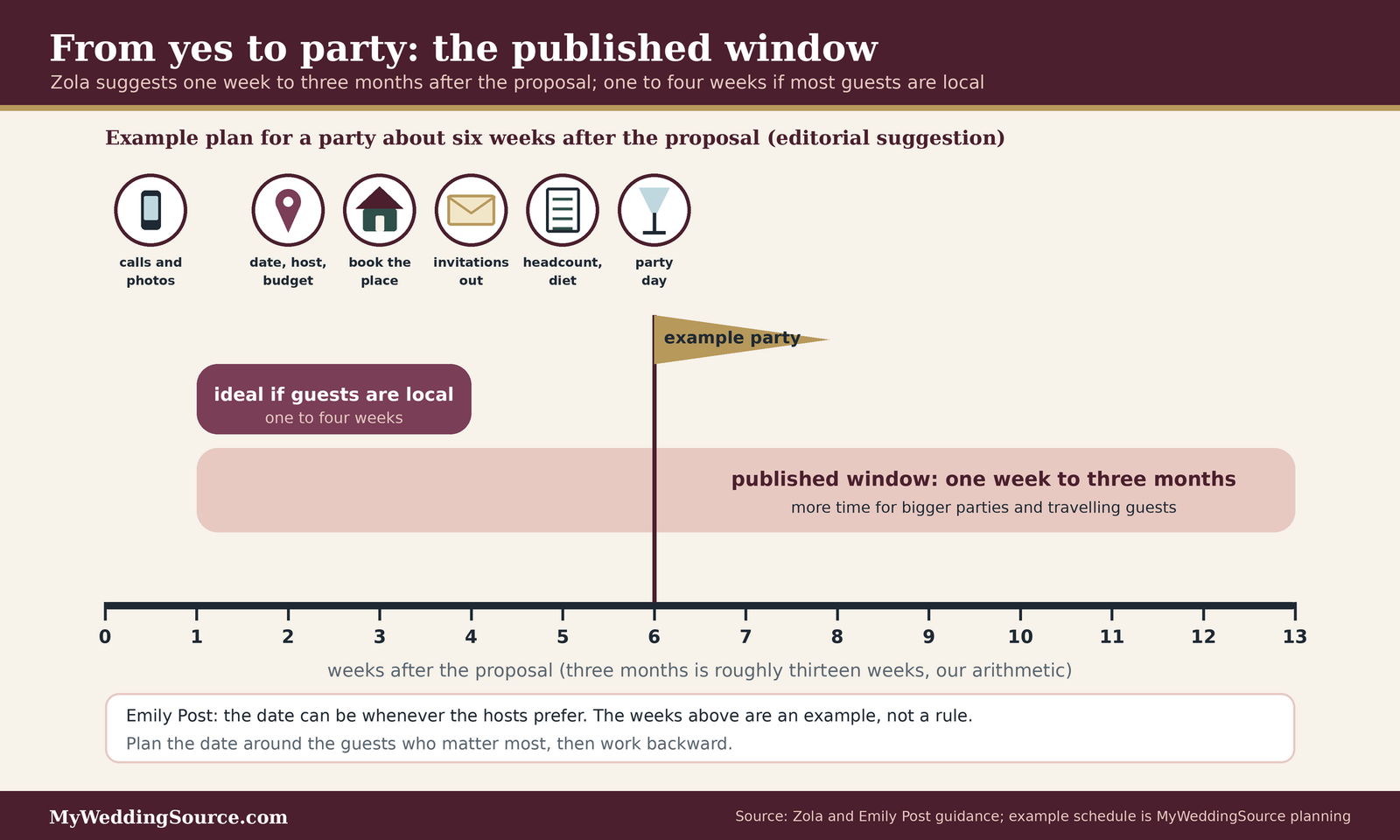
Etiquette sources give proposal and engagement party planning a wide window, not a single date. Emily Post says engagement parties are most often held soon after the engagement and that the hosts can choose the date because engagements are rarely secret anymore. Zola recommends anywhere from one week to three months after the proposal, says one to four weeks is ideal if most loved ones are local or you plan to announce at the party, and adds that a more elaborate party can take a few extra weeks to plan. Zola also notes that most engagement parties happen within the first few months of the engagement.
Why your own calendar matters more than a rule
In practice, proposal and engagement party planning follows your guests’ calendars. A party at the earliest possible date only works if the people you most want to see can come. If a grandparent needs to travel, a three-week window may be too short. If a key friend is deployed, a student or a shift worker, a later date may be better. Consider the seasons too: a venue, caterer or park may be booked on the weekends you prefer. The roadmap below shows how the weeks between the proposal and the party can be used, and the exact dates are yours to choose.
A week-by-week roadmap from yes to party
The roadmap is our own planning suggestion, built around the window Zola describes. It assumes a party about six weeks after the proposal, and you can shorten or stretch it.
| Week | Focus | Main tasks |
|---|---|---|
| Week one | Tell people, protect the ring | Calls, photos, insurance documents, host conversation |
| Week two | Shape the party | Choose date window, host, budget, formality, rough guest count |
| Week three | Book the place | Home or venue, permit if needed, food plan, accessibility check |
| Week four | Invite | Send invitations with RSVP, notes on gifts and photos |
| Week five | Confirm | Headcount, dietary needs, rentals, schedule, photographer |
| Week six | Host | Final walk-through, food safety plan, announcement moment, thank-yous |
Week one: calls, photos, and the host conversation
Week one of proposal and engagement party planning is about people more than tasks. The first week is mostly about relationships. Make the calls, store the photos safely and talk to whoever might host. Agree on a rough budget and on how much of the party you want to direct yourselves. If two families are involved, our guide on a joint engagement party with two families explains how hosts can coordinate. Do not book anything that cannot be moved until the host and budget are settled.
Weeks two and three: shape and book
In week two, choose the format, such as a backyard afternoon, a cocktail hour or a dinner, and set a guest-count range. Week three is for booking. Zola recommends sending invitations as early as possible, which means the date and place should be fixed before invitations go out. If you want a restaurant or venue, ask what is included and what extra fees apply, using the questions in the venue section below.
Weeks four to six: invite, confirm, host
Invitations go out in week four, and RSVPs should be due early enough for a final headcount in week five. Zola says that for a short-notice party, email invitations work, but you need an RSVP system, and that a party a few weeks away can use mailed or hand-delivered paper invitations. The final week is for confirmations, food-safety planning and a short run-through with anyone helping you host.
Choosing a date that works for the people who matter
A date is a social decision as much as a logistical one.
Ask two or three key guests first
A short poll helps proposal and engagement party planning stay realistic. Before you announce a date, ask the people whose attendance matters most, such as parents, grandparents and siblings. Offer two or three options and pick the one with the most overlap. This avoids the awkward situation where the party happens without the people the party is for, and it costs a few phone calls.
Avoid collisions with big dates and with the wedding timeline
Calendar clashes are a common snag in proposal and engagement party planning. Check for holidays, graduation weekends, local festivals and major events that fill hotels and restaurants. Also consider where the engagement party falls relative to the wedding: if the wedding is a year away, there is time. If you are planning a short engagement, the party competes with wedding tasks for your attention, and a simpler party may be wise. Our wedding planning timeline shows how these tasks fit together.
Choosing the host, format, and budget
Format and hosting are linked. A relative who offers a backyard and a casual afternoon shapes the party in one way. A couple who books a restaurant private room shapes it in another. The notes below help you decide what you want before you accept an offer.
Who hosts, who pays, and how to share the load
Hosting is flexible now, and the old rule that one family pays is only one option.
The traditional and modern patterns
Emily Post says that traditionally the bride’s parents host and announce the engagement as a surprise, and that today future in-laws may host as a kindness. Zola says the couple, close friends, the groom’s parents or siblings may host, and that whoever hosts is generally expected to pay, though hosts can split tasks and share costs, for example one person hosting at home while others cover drinks or food. Neither source says the couple must accept an offer.
Co-hosting without confusion
Shared hosting needs structure in proposal and engagement party planning. If more than one person wants to help, assign clear lanes in writing: who handles the guest list, who pays for what, who communicates with guests. Without lanes, the same guest may receive three invitations or none. A short shared note or message thread is enough. The couple should have the last word on the guest list and the tone, because the party is about them.
Formality and the money it implies
Formality decides cost, invitations and gift expectations more than any other single choice.
Casual, cocktail, or seated dinner
Format drives cost in proposal and engagement party planning. A casual afternoon at home needs food, drinks, seating and a plan for weather. A cocktail party needs a venue, bartenders or a drink plan and appetizers. A seated dinner needs a place that can serve everyone at once. The more formal the event, the earlier you need to book, and the more guests expect a printed invitation. The Knot article on gifts notes that a casual invitation, such as drinks at a bar, usually calls for no gift, while a formal cocktail event with a custom invitation may make a gift more appropriate.
A simple way to budget
A rough budget keeps proposal and engagement party planning grounded. List the categories: space, food, drinks, rentals, decorations, photography, invitations and a cushion. For each, write a firm amount and a stretch amount. Then divide the total by your expected headcount to see an approximate cost per guest. That arithmetic is an estimate only, and the number is useful mostly for comparing formats, not for judging whether a party is good. Our wedding budget guide uses the same approach for the larger event.
What it may cost, and what is not in the estimate
We did not find a reliable national average cost for an engagement party, so we do not quote one. Published fees we did find are small and specific: Yellowstone lists a $250 non-refundable application fee for special use permits, and the Chicago Park District lists a $45 application fee for a special event permit plus rental fees and a $45 application fee for a filming and photography permit plus per-hour permit fees. Those pages were checked on the date in the Sources section, and fees change. Other costs depend on your area and choices: venue or rental, catering, drinks, photographer time, decor and invitations. Before you commit, ask each vendor what is included, what is extra, what the deposit is and what happens if you cancel.
Splitting the work, not only the cost
Money is one part of hosting. The other is effort.
Roles for the day
Roles keep proposal and engagement party planning from landing on one person. A party runs more smoothly with named helpers: someone to greet, someone to manage food and drinks, someone to handle photos, someone to watch the time. Assign these before the day and tell the helpers what you want. If a helper is also a close family member, give them permission to step out of the role if they want to be present with the couple.
The announcement moment
If the party is the first time guests are hearing the news, plan a short announcement. Zola says that traditionally the father of the bride made the announcement at the end of the party, and that when the couple hosts, they can use the party to share the news. A short toast, a minute of quiet and a clear time are enough. Decide who speaks and ask them for a time limit so the toast does not run long.
Venue and logistics for the party
Once you know the date, host and format, you can choose the place. Think about the guests first, then the facilities, then the extras. The sections below follow that order.
Home, restaurant, or rented space
Each type of place has typical strengths and limits. These are planning observations, not rankings.
Hosting at home
Many couples begin proposal and engagement party planning at someone’s kitchen table. A home can be warm and inexpensive, and it often suits a smaller guest list. The limits are space, parking, bathrooms, seating and cleanup. Our article on an engagement party at home covers food quantities and hosting logistics in detail. If you have older guests or guests who use mobility devices, walk through the house and entrance from their point of view before you invite anyone.
A restaurant or bar
A restaurant simplifies proposal and engagement party planning but adds rules. A restaurant takes care of food, service and cleanup, but it may impose minimums, set menus, time limits or restrictions on decorations. Ask whether the space is a private room, a semi-private area or the main floor, what noise level to expect and whether you can bring a cake or decorations. Our wedding venue questions list is built for weddings but works for a smaller event as well.
A rented hall, garden, or outdoor space
Rented space adds paperwork to proposal and engagement party planning. A rented space gives you control over the date and layout but demands more planning. Ask about rental hours including setup and cleanup, insurance requirements, alcohol rules, outside catering, noise limits and the rain plan. Our guides to outdoor wedding venues and wedding venues explain what to look for. If the space is a public park, the permit rules in the proposal section apply, and the Chicago Park District page states that no food or beverage service of any kind is allowed at outdoor ceremony permits, so a picnic-style party may need a different kind of permit or place.
Accessibility and comfort
An engagement party is a mixed-age event, so accessibility is not optional.
What a basic accessibility check covers
Accessibility belongs in proposal and engagement party planning from the start. The U.S. Department of Justice’s ADA guidance on choosing meeting sites names six minimum features to look for: parking and drop-off areas, routes to the entrance, the entrance, routes to the event space, the space itself and restrooms. It says the entrance should connect to an accessible route, that routes should generally be at least 36 inches wide and free of steps and steep slopes, and that if restrooms are provided, accessible ones should be available too. That guidance is written for meeting sites, but the checklist works well for parties. Our guide to accessible wedding venue red flags goes into more detail.
Layout, lighting, and communication
The same guidance advises measuring aisles with chairs pulled out and occupied, avoiding long tablecloths that can catch wheelchairs and canes, and avoiding seating that places speakers against bright windows. It also says some communication aids, such as interpreters, may take weeks to arrange, so ask guests about needs when you send invitations. A line such as “Tell us if you need anything to be comfortable” is enough.
Food, drinks, and safety
Food is the part of a party where mistakes can make people ill.
Temperature and time rules
Food safety is a small, practical part of proposal and engagement party planning. FDA’s party food-safety guidance says to keep hot food at 140°F or warmer and cold food at 40°F or colder, and to discard perishable food left at room temperature for more than two hours, unless it is kept hot or cold. If the buffet area is above 90°F, the safe holding time drops to one hour. It also says leftovers should be refrigerated within two hours, plates of cold food can sit on ice when they will be out longer, and nearly empty dishes should be replaced, not topped up. For a three-hour party, that means a plan to refresh platters in smaller batches instead of putting everything out at the start. That arithmetic is our estimate based on the two-hour rule.
Guests who need extra care
Thoughtful proposal and engagement party planning considers who is at the table. FoodSafety.gov lists adults 65 and older, children younger than five, people with weakened immune systems and pregnant women as groups more likely to become seriously ill from foodborne illness. It lists foods these guests should avoid, including raw or undercooked meat and seafood, unpasteurized milk and cheeses, foods with raw eggs, and deli meats that are not heated to steaming. Label dishes and ask guests about dietary needs on the RSVP. Our guide to wedding dietary restrictions covers allergies and preferences, and the wedding catering guide helps if you hire a caterer.
Alcohol and the people who will drive
If alcohol is served, plan for non-alcoholic options, food, water and a way for guests to get home safely. Check the venue’s alcohol rules, and ask whether the venue or caterer holds the right license. Rules differ by state, and this is not legal advice. A host who is worried about liability should ask the venue and a qualified professional.
A schedule for a three-hour party
A simple run of show helps hosts relax. The times below are our own planning suggestion for an afternoon or early evening party, and you can scale them.
The first hour: arrivals and the first drink
A run of show makes proposal and engagement party planning feel manageable. Plan for guests to arrive over about the first thirty to forty-five minutes, with a welcome drink and a few foods that hold well. Put a helper at the entrance and keep the photographer busy with arrival photos. If guests are meeting each other for the first time, a simple name-tag habit or a host who makes introductions saves everyone from awkward moments. Check food temperatures and refresh platters before the second hour begins.
The second and third hours: the announcement, the toast, and the wind-down
Place the toast or announcement after most guests have arrived, usually near the middle of the party, so it is not lost and no one leaves before hearing it. Keep it short. After the toast, let people mingle, bring out dessert if you have it, and have a helper start to pack away perishable food within the two-hour window. A clear end time on the invitation makes it easier for guests to leave gracefully, and for hosts to feel the party has ended well.
Guests, invitations, gifts, and photos
The guest list is where proposal and engagement party planning meets family politics. A clear policy prevents most hurt feelings.
Who to invite
The guest list for the engagement party affects the wedding list.
Invite people you also plan to invite to the wedding
The guest list is where proposal and engagement party planning touches the wedding. Zola says etiquette generally suggests inviting only people you also plan to invite to the wedding, which prevents hurt feelings when wedding invitations go out. It names two exceptions: destination weddings, where fewer people can attend, and couples who choose a small wedding with a larger engagement party. In those cases, it advises being honest and tactful. Our guide to the wedding guest list helps with those decisions, and the save the date article explains the next step.
Plus-ones, children, and coworkers
Edge groups cause most of the worry in proposal and engagement party planning. Decide the policy before you invite, and apply it consistently. If you invite children, plan for food and space for them. If you do not, say so kindly on the invitation. Coworkers and acquaintances are the hardest group, and a quiet no is easier than an uncomfortable yes. Remember that a person invited to the party may reasonably expect an invitation to the wedding.
Invitations and RSVPs
Invitations tell guests what to expect, and they are the best place to set the tone.
What the invitation should say
The invitation sets the tone for proposal and engagement party planning. Include the date, time, place, host names, dress expectation, RSVP deadline and a note about gifts and photos. If the host is not the couple, say so. If the party is a surprise for the couple, say that on the invitation and ask guests not to post early. Zola says that invitations should go out as early as possible so guests can arrange time off, travel and gifts. Our wedding invitation wording article offers phrasing you can adapt.
Handling RSVPs
Counting heads is a dull but necessary part of proposal and engagement party planning. An RSVP system is not optional for a short-notice party, according to Zola. A simple online form or a shared message thread works. Ask about dietary needs and mobility needs, and set a deadline a week before the party. Follow up with a short, friendly message to guests who have not answered. Our wedding RSVP etiquette guide explains how to handle late replies.
Gifts
Gifts are the topic where hosts most often feel confused.
What guests are generally expected to do
Gift questions come up in nearly every round of proposal and engagement party planning. The Knot article, which quotes Lizzie Post of the Emily Post Institute, says guests generally do not have to bring a gift to an engagement party, though it is welcome. It says small, sentimental gifts such as champagne or a framed photo are appropriate, that couples often have not set up a registry yet, and that guests should not use an engagement gift in place of a wedding gift. It also says that if the invitation or the family asks guests not to bring presents, they do not have to.
How hosts can state their wishes
If you prefer no gifts, say so on the invitation or in a message. If you would like to point guests to a registry, do so only if guests ask. Our guides to wedding gift etiquette and wedding registry ideas help you think through the timing.
Photos, video, and privacy
Photos are part of the party, and so is the guests’ right to say no.
Guest consent and a simple photo policy
A photo policy belongs in proposal and engagement party planning from the first draft. Tell guests there will be a photographer or that photos will be shared, and give people a way to opt out, such as a note to the photographer or a no-photo sticker. Ask people to check with parents before posting photos of children. If you want guests to put phones away for a toast, say so kindly. Our guide on unplugged ceremonies offers wording that works for any gathering.
Recording conversations is different from taking photos
Privacy law is a limit worth knowing in proposal and engagement party planning. The Digital Media Law Project guide explains that federal law allows recording a conversation with the consent of at least one party, that many states follow that rule, that some require every party’s consent, and that secret or hidden recording can create criminal and civil exposure in some states. Because of that, a plan to record guests’ private conversations without telling them is a bad idea. Photos and video in an open setting are different, and a visible camera in a shared space is what most guests expect at a party, though local rules and venue policies vary. Ask a qualified professional about your state’s rules, as this is not legal advice.
Drones and aerial photos
Drones are one of the newer questions in proposal and engagement party planning. If someone proposes to bring a drone, FAA’s recreational flyers page says recreational flyers must complete the free Recreational UAS Safety Test and carry proof, register drones that weigh 250 grams or more, broadcast Remote ID when registration is required, get authorization to fly in controlled airspace near airports, and keep the drone within visual line of sight. The page does not address flying over people or local rules, and parks, cities and venues may have their own restrictions, so ask them first. For a close, crowded party, a drone adds risk and noise, and most couples will be happier without one.
Edge cases and hard choices
Most proposals and parties go smoothly. The situations below are the ones that cause the most stress when they are not discussed in advance. None has a single right answer, and the goal is to name the choice early.
Families, traditions, and complicated logistics
Families are rarely simple, and engagement events show it quickly.
Parents who live far apart or do not speak
Family geography can reshape proposal and engagement party planning. When parents live in different cities or are on difficult terms, one party may not suit everyone. Zola notes that multiple parties are possible, which gives you room to hold a smaller gathering in each place. Consider a party that follows the family’s travel patterns, such as a holiday visit, and keep expectations modest. Our article on joint parties with two families covers co-hosting when families do want to share one event.
Cultural or religious customs
Respecting traditions is part of thoughtful proposal and engagement party planning. Some families have traditions about who announces, who hosts, what is served and what is worn. Ask elders and the other family what matters to them before you finalize. A short, respectful conversation, such as “What would feel right to you?”, avoids misunderstanding. If a custom conflicts with your preferences, you can honor part of it, such as a blessing or a dish, without adopting all of it.
A surprise party for the couple
A surprise adds a layer to proposal and engagement party planning. A surprise party after a proposal needs a clear plan, because the person being surprised may be tired and emotional. Choose a setting that is calm, keep the guest list small and warn guests not to post early. Make sure the person being surprised has a way to leave if they need quiet. A surprise works best when the couple already knows each other’s limits and has talked about it in general terms.
When timing or circumstances do not cooperate
Plans change, and the work is to respond without drama.
A long-distance or delayed party
Distance changes proposal and engagement party planning more than almost anything else. If key guests cannot come soon, you can hold a small gathering first and a larger one later, or wait until the guests can attend. A video call for far-away relatives can work alongside a local party, though it needs a host who is not distracted by guests. Tell people early what to expect, and avoid asking anyone to travel on short notice.
A short engagement or a very small wedding
A short timeline compresses proposal and engagement party planning. If the wedding is a few months away, an engagement party may overlap with wedding tasks. Consider combining it with a relaxed gathering, or skip it and put the energy toward the wedding. The guest-list guidance above matters most here: if you invite many people to the party and few to the wedding, be honest early. Our guides to micro weddings and small wedding planning can help.
The answer is “not yet,” or the plans change
Kind proposal and engagement party planning includes a plan for hard outcomes. A proposal that does not end in a yes, or a couple that decides to postpone, needs privacy and kindness. Photographers and helpers should leave quietly, and the posting plan should wait. If a party has already been booked, ask the venue about cancellation terms, and tell guests simply and without detail. Keep your own wellbeing in mind. Support from a trusted friend or family member matters more than the schedule.
Photos, privacy, and consent in awkward cases
Photos and privacy cause the most disagreements after the event.
Guests who do not want to be photographed
Privacy needs are part of fair proposal and engagement party planning. Some guests have personal or safety reasons to avoid photos, such as a protective order, a custody situation, or religious beliefs. Make it easy for them to opt out, and brief the photographer. Do not tag or post photos of guests who asked not to appear. A host who respects this will keep the trust of the family.
Children and photos online
Parents may have preferences about their children’s images. Ask them before posting, and follow what they say. If the photographer shares a gallery, check whether it is public and whether download links can be limited to guests.
The photographer’s rights and your own
Contracts matter in proposal and engagement party planning even for a small shoot. Ask what the photographer’s contract says about who owns the images, how you can use them and whether the photographer can post them. Read the cancellation and weather terms. Our guide to wedding photography and the wedding photographer shot list help you decide what to request at the party.
Questions to ask before you book
- Does this location or park require a permit for a proposal, for photography or for a ceremony, and who issues it?
- What are the permit fees, the lead time, the cancellation terms and the rain policy?
- Is there a time window, and can the area stay open to the public during our use?
- Will you scout the location at the same time of day, and where would you stand?
- What cues do you want to use, and what happens if we miss one?
- Who owns the photos, when will we see them, and may you post them?
- For the party: what is included, what are the minimums, and what are the deposit and cancellation terms?
- How does the space handle accessible entry, restrooms and seating?
- Who is responsible for food temperatures, serving times and leftovers?
FAQ: proposal and engagement party questions
The proposal
Do I need a permit to propose in a park?
It depends on the park and what you plan to do. Some agencies require permits for ceremonies, events or professional photography, and some state their rules for proposals separately. Contact the office that manages the spot, describe your plan, including any photographer, and ask what applies. Get the answer in writing.
Where should the photographer stand?
A common starting point is about 20 to 40 feet from the couple with a telephoto lens, facing the person being proposed to, with a second position at the side if possible. Scout at the same time of day and choose the position with your photographer.
What is a good cue for the photographer?
Choose a normal action that fits the setting, such as checking the time or adjusting a jacket, and agree on what it means. Use no more than three cues, for example arriving, about to start, and asking. Rehearse with the photographer in advance, and plan what happens if a cue is missed.
The party
How soon after the proposal should the engagement party be?
Etiquette sources describe a flexible window. Zola suggests anywhere from one week to three months, with one to four weeks being ideal if most loved ones are local. Emily Post says the date can be whenever the hosts prefer. Choose a date that the people who matter most can attend.
Who hosts and pays for an engagement party?
Traditionally the bride’s parents hosted, but modern hosts can be the couple, in-laws, friends or siblings. Zola says whoever hosts is generally expected to pay, though hosts can share tasks and costs. Talk early so offers do not overlap, and agree on who decides the guest list.
Do guests have to bring gifts to an engagement party?
Generally not. The Knot, quoting the Emily Post Institute, says a gift is optional and small gifts are fine, and that a casual invitation usually calls for none. Couples can say “no gifts” on the invitation, and guests should not treat an engagement gift as a replacement for a wedding gift.
Guests and photos
Should I invite only people who will be at the wedding?
That is the usual etiquette advice. Zola suggests inviting only people you also plan to invite to the wedding, with exceptions for destination weddings or small weddings with a larger party. If you invite more people, explain your reasoning kindly so nobody expects an invitation later.
Can guests post photos or record video at the party?
Tell guests your preference on the invitation. Photos in an open setting are common, but covert recording of private conversations can raise legal problems in some states, so never do it. Offer an opt-out, ask parents about children’s photos, and ask a professional if you have legal questions.
Your next steps
Before the proposal
Draw the angle map and write the cues
Sketch the spot from above, mark the sun, the couple’s mark and two camera positions, and write down three cues. Share the sketch with your photographer or helper, and visit the place once at the planned time of day. Our proposal ideas guide can help you choose the setting.
Confirm permission and a backup
Contact the office or owner that controls the place, ask about permits and photography rules, and get the answer in writing. Choose a backup that changes only one variable. Our wedding permits guide explains the usual process.
Between the proposal and the party
Make the calls and set the window
Tell family and close friends first, and agree on a posting plan. Choose a window for the party with the people who matter most, and settle the host and budget conversation before anyone books anything. The wedding planning checklist is a useful place to keep the list.
Check food, access, and photos
Review the food-safety times, the accessibility basics and your photo policy before you send invitations. Add a line about gifts and dietary needs, and give guests a way to opt out of photos.
Sources & methodology
How we built this guide
What we relied on
This guide combines park and city park permit pages, a federal aviation page for recreational drone flyers, federal food-safety pages, a Department of Justice accessibility guide, a legal-information guide to recording conversations, etiquette articles and published advice from photographers. We checked each page on November 12, 2026, and pages change, so confirm current rules with the office or venue involved. Where a statement comes from a photography or etiquette publisher, we say so, because those are practitioner views. The camera distances, cue timeline offsets, roadmap weeks and budget arithmetic are our own planning suggestions or estimates, not findings from a study.
What we did not do
We did not visit or test any park, venue or photographer, interview any official or give legal, medical or financial advice. Permit rules, drone rules, recording laws, alcohol rules and fees vary by place and change over time. We did not find a reliable national cost figure for engagement parties, so we did not state one. We did not receive payment from any park, venue or vendor mentioned.
Source list
Parks, permits, and public-space rules
- National Park Service, Yellowstone National Park, Special Use Permits: https://www.nps.gov/yell/planyourvisit/special-use-permits.htm
- National Park Service, Rocky Mountain National Park, Filming, Photography, and Audio Recordings: https://www.nps.gov/romo/planyourvisit/permitsandreservations.htm
- Chicago Park District, Weddings and Other Ceremony Permits: https://www.chicagoparkdistrict.com/weddings-other-ceremony-permits
- Chicago Park District, Filming and Photography Permits: https://www.chicagoparkdistrict.com/filming-photography-permits
- Central Park Conservancy, Weddings and Photography in the Conservatory Garden: https://www.centralparknyc.org/activities/weddings
Government, legal, and safety sources
- Federal Aviation Administration, Recreational Flyers: https://www.faa.gov/uas/recreational_flyers
- U.S. Food and Drug Administration, Food Safety for Parties and Large Groups: https://www.fda.gov/media/84739/download
- FoodSafety.gov, People at Risk of Food Poisoning: https://www.foodsafety.gov/people-at-risk
- U.S. Department of Justice, ADA guidance on accessible meetings, conferences and seminars: https://archive.ada.gov/business/accessiblemtg.htm
- Digital Media Law Project, Recording Phone Calls, Conversations, Meetings and Hearings: https://www.dmlp.org/book/export/html/1246
Etiquette and photography sources
- Emily Post Institute, Engagement party timing: https://emilypost.com/advice/engagement-party-timing
- The Knot, Do I need to bring a gift to an engagement party: https://www.theknot.com/content/do-i-need-to-bring-a-gift-to-an-engagement-party
- Zola, Who hosts an engagement party: https://zola.com/expert-advice/who-hosts-an-engagement-party
- KEH, The complete guide to proposal photography: https://www.keh.com/expert-advice/photography/education/the-complete-guide-to-proposal-photography-tips-tricks-and-gear/
- ShootProof, Behind the scenes of a proposal photographer: https://www.shootproof.com/blog/behind-scenes-proposal-photographer/