

Planning wedding seating for guests who cannot stand for long periods means looking at the whole day through a chair’s eye view: where each guest will be asked to stand, how far they must walk between seats, and whether the place you offer them still lets them see, hear, and feel part of the celebration.
Quick answer
Ask guests early and privately what would help, then audit your schedule for every block where people are expected to stand: the ceremony, the receiving line, photos, cocktail hour, toasts, cake cutting, and the send-off. Offer a seat or a rest point in each block, keep walking routes short and firm underfoot, and choose seats with a clear view instead of a far corner. Test the chairs, confirm aisle and table clearances with the venue in writing, and name one person who can move chairs on the day. If a seated guest also relies on a sign language interpreter, plan the interpreter’s position and lighting alongside the seat. These steps apply to wedding seating for guests who cannot stand for long periods whether the venue is a hall, a garden, or a tent.
Who this planning is for and why standing time adds up
Most wedding days are built around people on their feet. Guests stand to greet, stand to watch a processional, stand through a cocktail hour with a plate in one hand, and stand again to cheer a first dance. For many guests that is fine. For others, even a short stretch is a real cost, and the cost compounds across a long day. Wedding seating for guests who cannot stand for long periods is therefore less about a single reserved chair and more about a pattern of small decisions that keep a person comfortable from arrival to departure.
Many reasons a guest may not be able to stand for long
The reasons vary widely, and you often cannot see them. Treat the list below as a reminder of how different the underlying needs can be, not as a checklist for guessing at anyone’s health.
The reasons are varied and often invisible
The Centers for Disease Control and Prevention says on one of its disability-and-health pages that more than one in four U.S. adults has some type of disability, and the same page lists mobility at 12.2 percent. The page does not say which survey year sits behind those figures, and it does not explain how mobility is defined, so read them as a general signal that this is common, not as a count of how many guests you will have. People who cannot stand for long include guests with joint or muscle conditions, guests who tire quickly, guests who feel dizzy or faint on their feet, guests recovering from surgery or injury, guests who use a cane, walker, or wheelchair, and older relatives who simply find a long stand tiring. Mayo Clinic describes one common cause: a drop in blood pressure on standing, which can bring lightheadedness, blurred vision, weakness, and sometimes fainting. It notes that heat, dehydration, certain medications, and age of sixty-five or older raise the risk, which is one reason a standing ceremony in the sun deserves extra thought.
Fatigue is a need too
Not every need shows up as a device or a diagnosis. Arthritis UK, a patient charity, describes managing fatigue through problem solving, planning, prioritizing, and pacing, and gives plain examples such as spreading tasks across days and doing demanding things when energy is highest. A wedding cannot be paced in the same way, but you can borrow the idea. If a guest has told you they tire easily, the useful question is not “can you stand?” but “when would a seat make the biggest difference?”
Standing is a hidden cost in the schedule
Planners tend to think of a timeline in terms of vendors and cues. A guest who cannot stand for long thinks of it in terms of stretches of time between available seats. The two views rarely match until someone sits down and compares them.
Short stands add up
A ten-minute receiving line, a twenty-minute portrait session with the whole family, a forty-minute cocktail hour, and a ten-minute send-off can each feel manageable in isolation. Stacked on a ceremony and a few toasts, they can leave a guest on their feet for much of a long afternoon. This guide uses an example schedule in the second half of this section to make that visible. The durations in it are our own illustration, not a measured average, so replace them with your own.
Where the gaps are
The gaps that cause trouble are usually the transitions: the walk from the ceremony to the cocktail space, the wait while the wedding party is photographed, the line at a bar, the move from cocktail hour into the reception. Seats are available during the main events and missing in between. Most of this guide is about closing those gaps.
What this guide does and does not cover
The aim of this guide to wedding seating for guests who cannot stand for long periods is practical and needs-led. It does not assume that any guest is disabled, it does not tell you what a guest “should” be able to do, and it avoids claims about what every venue must provide.
Needs-led, not label-led
Two guests with the same diagnosis can need very different things, and a guest without any diagnosis may need a seat more than anyone. Build your wedding seating for guests who cannot stand for long periods from questions about distance, duration, and surface, which are described in the next section, instead of from categories. That approach also keeps you out of the business of guessing, and it is kinder.
This is not legal advice
We summarize federal accessibility guidance because it is a useful yardstick, and we say so when we do. The Americans with Disabilities Act places duties on businesses open to the public, such as many venues, restaurants, and hotels. It does not follow that a couple hosting a private party carries the same duties, and the answer for your event can depend on the venue, the contract, and local law. If a question turns on legal responsibility, ask the venue to explain it in writing and consult a lawyer. Nothing here is medical advice either; a guest’s clinician is the right person for questions about what a body can safely do.
Ask first, without singling anyone out
You cannot design good wedding seating for guests who cannot stand for long periods from guesses, and guests are usually relieved to be asked kindly. The skill is asking in a way that is easy to answer, protects privacy, and does not turn a guest into the subject of a conversation they did not choose.
Build the question into the things guests already receive
The least awkward way to learn what people need is to put the question where every guest will see it, so nobody is singled out. Our guide to the accessible wedding guest experience covers the wider picture; the focus here is wedding seating for guests who cannot stand for long periods.
Wording for the RSVP and the wedding website
For wedding seating for guests who cannot stand for long periods, a short, open line on the RSVP or website works well: tell us if anything would make your day more comfortable, such as seating near an aisle, a place to rest, or step-free access. Keep it optional and give a way to answer privately, such as a phone number or an email address that goes to one person. A retailer’s blog we read for this guide suggests asking guests to note access needs on the reply card and sharing access details on the invitation or website so people can plan ahead; we treat that as a sensible practice, not a rule. For sample phrasing, see our notes on RSVP wording and invitation wording.
A private follow-up for anyone who answers
When a guest does mention a need, follow up one to one, ideally by a person they know, with the aim of understanding instead of verifying. Contributors to an Offbeat Wed reader thread described wanting to check in with a relative without making her feel singled out, and another reader suggested a private conversation. Ask what would help, offer a couple of options, and let the guest choose. A good question is “Would you rather sit near the front or near the exit?” A poor question is “What is wrong with your legs?”
Translate answers into seating needs
Replies will rarely come in the form of a seating plan. Reduce them to a few variables that you can act on.
Distance, duration, and surface
Three questions cover most situations of wedding seating for guests who cannot stand for long periods. How far can this guest comfortably walk between seats? How long can they stand before they need to sit? And what surfaces are difficult: grass, gravel, stairs, steep ramps, thick carpet? The answers decide where to place a chair, how many rest points you need between the ceremony and the reception, and whether an outdoor venue needs a firm path. A guest may not know the answer in minutes or feet, so offer comparisons: “Is the length of a hallway fine, or is it better if the seat is near the door?”
Companions, mobility devices, and service animals
Some guests will arrive with a companion who should sit alongside them, with a cane or walker that needs a place to rest within reach, with a wheelchair that needs a clear space rather than a chair, or with a service animal that needs floor room. The Department of Justice says that wheelchairs and manually powered devices such as walkers, canes, crutches, and braces must be allowed in all areas open to the public at businesses and government facilities. For a dog, the same federal guidance describes a service animal as a dog trained to do specific tasks tied to a person’s disability, and says staff may ask only two questions when the need is not obvious. Those rules are directed at businesses, not guests at a party, but they are a good model for how a host can behave: welcome the device or animal, plan the floor space, and do not interrogate anyone. When you plan a table, leave room beside a chair for a device and a companion’s chair, and for an animal to lie down out of the walkway.
Respect privacy once you know
Information about a guest’s body is theirs. Handle it the way you would handle a surprise party guest list: share it only with the people who need it, and only the part they need.
Share the seat, not the reason
Your caterer, planner, and the person who sets chairs need to know that Table Four needs an aisle-side chair with a clear path, not why. When you hand wedding seating for guests who cannot stand for long periods to a vendor, write the instruction as a seating need, for example “reserved seat near the aisle, row two, with space for a walker,” and keep the reason out of group messages, vendor email threads, and printed charts.
Do not ask for proof
A host has no reason to ask for documentation, and the federal guidance on mobility devices says staff at covered businesses may not ask about the nature or extent of a person’s disability. Taking a guest at their word is both the courteous and the practical choice. If a request is costly or complicated, such as a rented lift, talk through options together instead of asking the guest to justify the request.
Map the standing day with a schedule audit
An audit is a simple way to improve wedding seating for guests who cannot stand for long periods: list every block of the wedding day, mark what guests are expected to do in each, and decide what the seated alternative is. It takes about half an hour and tends to uncover three or four gaps that nobody had noticed.
Walk the day in blocks
Start with your run of show and look at it from a guest’s point of view. The picture below shows an example, which you can copy on paper and adapt.
An example day, drawn in standing and seated blocks
The first figure shows an invented afternoon-and-evening schedule with the stretches where guests are on their feet and the stretches where a seat is usually provided. The durations are our illustration for planning purposes, not data about real weddings, so replace them with your own timings.
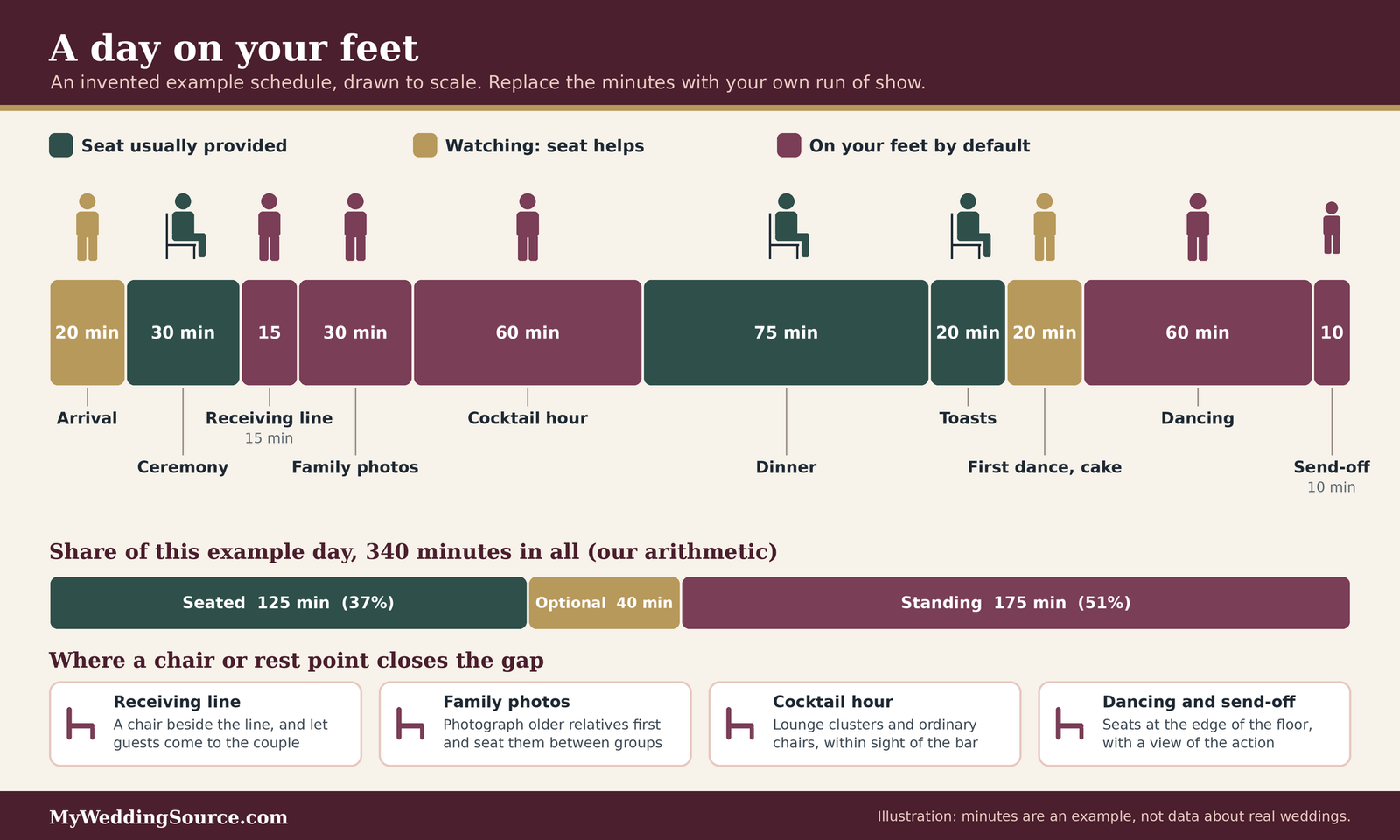
Reading it, notice that the seated blocks are not the problem. The ceremony and the dinner have chairs. The trouble is the standing blocks between them: the receiving line, the photo call, the cocktail hour, the dance-floor stretch, and the send-off.
Where standing hides
Look hardest at these five places. A receiving line asks guests to wait their turn on their feet. A group photo session often assembles relatives early and holds them in place while photographers work through combinations; our photographer shot list guide shows how those lists are built, so you can see how many groupings you are really asking for. A cocktail hour often has high-top tables and a few lounge seats. Toasts often end with everyone rising to raise a glass, and a guest may be unsure whether they are expected to stand. Cake cutting and the send-off draw crowds that stand to see.
Decide the seated alternative for each block
For each standing block, decide whether, in your wedding seating for guests who cannot stand for long periods, a seat is essential, optional, or unnecessary, and make sure the answer is written on the plan.
Always seated, optional, and standing by default
Sort each block into one of three groups. Always seated: the ceremony, the meal, speeches. Optional seat: the receiving line, photos, the cake cutting, the first dance, where a chair near the action lets a guest watch comfortably. Standing by default: the send-off, a dance floor, a cocktail hour, where you should add chairs or lounge areas so that nobody is forced out of the moment. An Offbeat Wed article on chairs recommends seating for at least sixty percent of guests at a cocktail-style reception; that is one writer’s advice and a sensible target, not a standard.
Pace the day the way an energy plan would
Arthritis UK’s approach to fatigue centers on planning and pacing. At a wedding, that translates to spacing the standing blocks apart, putting a seated block after a long stand, and building a quiet corner into the day. If your schedule has an hour of photos followed immediately by a cocktail hour, consider switching one of them to a seated activity, or hold the family photos before guests arrive so older relatives are not standing while they wait.
Ceremony seating that works without a long stand
The ceremony is the one block where nearly everyone expects a chair, so it is the easiest place to get right and the easiest place to get quietly wrong. Here, wedding seating for guests who cannot stand for long periods comes down to the aisle, the first rows, and the exits. The arrangement of the aisle, the first rows, and the exits matters as much as the number of chairs.
Seats, aisles, and reserved places
The central question for wedding seating for guests who cannot stand for long periods at the ceremony is which seats are reachable and which offer an easy way out.
Aisle seats and seats near an exit
Aisle seats let a guest enter and leave without asking a row of people to rise. The U.S. Access Board’s standards for assembly areas, written for theaters and similar venues, call for designated aisle seats to have folding or retractable armrests on the aisle side when nearby seats have armrests, and for each such seat to be marked with a sign or marker. Those provisions are written for fixed seating in covered buildings, so they will not bind a rented-chair ceremony, but the logic transfers. Put the people who need an easy exit on the aisle, tell them which seat it is, and make sure no one else sits in it. A guest who may need to step out quietly during the vows is better placed on a side aisle near a door than in the center of a middle row.
Reserved signs and who sets them
Reserving seats is a core part of wedding seating for guests who cannot stand for long periods, and it only works if someone enforces it. Use plain, discreet signs that do not name a reason, and put them on the chair rather than the row. Assign one ushers’ role to the job: before guests arrive, the usher walks the reserved seats and confirms that each one is placed where the guest was told, then offers an arm or a hello to the guest on arrival. Our guide to wedding signage covers sign styles, and the processional order guide helps you plan when ushers are free to seat guests. If the first rows are traditionally held for family, be explicit with your family about which seats are held for whom, so that nobody is bumped from a chair they were promised.
Standing ceremonies and long ceremonies
Not every ceremony offers rows of chairs, and some run long. Both situations need a plan before the day.
If the ceremony is meant to be a standing one
Some outdoor, garden, or cocktail-style ceremonies have no rows at all. An Offbeat Wed article on accessible wedding chairs says standing ceremonies can work as long as some chairs are provided for guests who cannot stand for long. In practice, that means a visible cluster of chairs with a sightline to the couple, not a few chairs pushed to the edge of the lawn. A guest who has to hunt for a seat in the middle of a ceremony will often skip the seat altogether.
The couple and the wedding party
Standing is also a question for the people at the front. One contributor to an Offbeat Wed thread suggested seating the couple and the wedding party at the altar, which helps anyone with limited mobility, and the same thread suggested a practice walk-through the night before with the people who will walk you and the officiant. If either partner, a parent, or a member of the wedding party cannot stand for the full ceremony, tell the officiant in advance, so that the script, the cues, and the camera positions all work for a seated person. Our rehearsal guide is a good place to build that walk-through into the plan.
Surfaces and weather at an outdoor ceremony
An outdoor ceremony adds two variables that indoor planning rarely faces: the ground and the sun.
A firm, flat path to the seats
Reader comments on the Offbeat Wed thread are blunt on this point. One contributor said uneven surfaces such as stones are unsafe with a quad cane and that a flat, firm runner works better; another warned that ramps can be deceptive, because some are too steep and some have a lip that is hard to cross in a wheelchair. The Access Board’s accessible-route guidance gives the formal yardsticks for covered facilities: surfaces should be firm, stable, and slip resistant, the running slope of a walking surface should not exceed 1:20, small changes in level up to a half inch should be beveled, and larger changes need a ramp, curb ramp, or elevator. You are unlikely to bring a surveyor to a garden venue, but you can ask the venue directly about slope, surface, and the route from the parking area to the seats, and you can walk it yourself in the shoes and with the walking pace of the guest you are planning for. Our outdoor infrastructure checklist covers the broader ground-and-power questions.
Shade, water, and a cooler place to retreat
Mayo Clinic lists heat exposure and dehydration among the common triggers of the blood-pressure drop that can make standing risky, and it flags adults aged sixty-five and older as higher risk. The practical conclusion for hosts is modest: if the ceremony will be in the sun, provide shade over the guest seats, offer water before the ceremony begins, and have a cooler, seated place where anyone can go without announcing why. Our summer heat plan walks through these steps, and the winter weather plan covers the cold-weather mirror image, where a long wait outdoors in a thin coat is its own barrier.
Reception tables: wedding seating for guests who cannot stand for long periods
Once the ceremony ends, the room changes, and so does the shape of wedding seating for guests who cannot stand for long periods. Chairs are re-set, tables arrive, and the clearances that mattered in a row of chairs suddenly depend on the shape of the floor plan. The second figure shows two versions of the same room.
Aisle widths, turning space, and table clearances
Federal accessibility standards give concrete measurements that are useful as a yardstick even when your event is not a covered facility. They are numbers to check with your venue and rental company, not guarantees about anyone’s comfort.
Aisle width and turning space
The Access Board’s accessible-route guidance gives a baseline clear width of thirty-six inches, which may narrow to thirty-two inches for a short stretch such as a doorway. Where a route turns around an element narrower than forty-eight inches, the guidance calls for more space, and it gives a sixty-inch-diameter circle or a T-shaped space as the standard turning space. Clear floor space for one wheelchair is given as thirty by forty-eight inches. For a person with a walker or a cane the exact numbers differ, but the principle is shared: the walking route through a reception needs to be wider than a chair back and a person’s shoulders, and the pinch points are chair backs, centerpiece stands, and the place where a server’s cart parks.

Table height and knee space
The Access Board’s standard for dining surfaces puts the top of the surface between twenty-eight and thirty-four inches above the floor, with knee and toe clearance below it. Its guide describes knee space at least thirty inches wide, at least seventeen inches deep where it is required, and at least twenty-seven inches high at the leading depth. The section we read does not give a number of seats that must meet it, so we do not give a count either. For a wedding, the question to put to the rental company is simple: what is the height of this table, what is the leg or pedestal arrangement, and is there room to pull a wheelchair or a stool under it? Ask to see a picture or a sample of the base instead of relying on a general rule about table styles. Our table settings guide covers what sits on the table once the table itself is chosen.
Where to seat people
Seat placement is the heart of a seating plan, and it is where good intentions most often go astray.
Near the route, not in the far corner
An Offbeat Wed contributor advised placing guests with access needs in more convenient seats instead of the back corner, with room to move between chairs. The reasoning is straightforward. A far corner is far from the entrance, the restroom, the buffet, and the dance floor, and it means that a guest who cannot stand for long must cross the whole room more than once. In wedding seating for guests who cannot stand for long periods, choose a table that is near the main route, close enough to a restroom and an exit that a short walk gets there, and not so close to a door that every arrival and every server passes by. Our seating chart guide covers the social side of tables, and you can use it to fold these constraints in with family and friend groupings.
Included, not parked
Convenient should not mean isolated, a trap that catches a lot of wedding seating for guests who cannot stand for long periods. A table beside the kitchen door may be near the restroom, but it is also far from the people the guest came to see. Whenever you can, seat the guest with the companions they know best, within view of the couple and the dance floor, and make sure the table does not block anyone’s access to the room. The guest should be able to see the toasts, watch the first dance, and be reached by friends who want to say hello without crossing a crowd.
Cocktail hour, buffets, and stations
The most difficult blocks for guests who cannot stand for long are the ones that rely on movement: the cocktail hour, a buffet line, a dessert station, a bar.
Seats for a standing format
If cocktail hour is a standing event, plan seating deliberately: a mix of lounge seating, low tables, and ordinary chairs in clusters that a guest can reach without crossing a crowd. Position the chairs in view of the entrance and the bar, so a guest sitting down is still part of the conversation. As noted earlier, one Offbeat Wed article recommends seating for at least sixty percent of guests at a cocktail-style reception.
Bringing the food to the guest
A line can be the longest stand of the evening. Ask your caterer whether guests who cannot stand for long can be served at the table, called to the front of the line, or offered plated service. Our guides to catering service planning and dietary needs explain how service styles and special requests are handled. A kind, quiet arrangement, such as a server who checks in at the table, works better than a sign announcing who may skip the line.
Choosing and testing the chairs
In wedding seating for guests who cannot stand for long periods, the chair is the plan, and it is the actual object a guest will spend hours on, and it is easy to forget that rental chairs vary a great deal. The catalog photo tells you very little about how a chair feels at hour three.
What to test in a chair
Whenever possible, sit in the exact chair you intend to rent, for longer than a minute.
Sturdiness and weight limits
An Offbeat Wed article on chairs says Chiavari chairs are described as having a high weight limit, and that folding chairs also tend to have fairly high limits but can still feel fragile and unstable, which worries guests and can make them leave early. Ask your rental company for the stated weight rating of each chair and whether it applies to the model you will receive. A chair that is technically rated for a guest but feels unsteady is not a good seat for someone who is nervous about falling.
Padding, back support, and edges
The same article notes that benches are less suitable for guests who need back support, so it suggests offering some chairs alongside them. It also warns that industrial-style chairs, with a bar across the back, can press into the hips and cause bruising after long sitting. It describes cross-back chairs and Chiavari chairs as comfortable and says a cushion improves comfort further. We did not find a reliable source on seat height or armrests for guests who have difficulty rising from a chair. For that, an occupational therapist or an accessibility organization is the right authority, and the guest’s own preference is more informative still. If you are not sure, offer a few styles and let the guest choose.
Mixing chairs across the room
You do not need to rent a different chair for every guest. A small number of options, placed thoughtfully, solves most problems.
A few supportive seats among the standard ones
Consider adding a handful of sturdier, higher-backed chairs near the aisle at the ceremony and at the tables of guests who asked. Mark them quietly with a ribbon or place card so the ushers know where they go, and do not announce the purpose. Take care that any exceptional chair does not look like an exception: a seat that matches the rest of the room is easier to accept than one that is obviously different.
Rental and delivery details
Confirm quantities, delivery time, and who sets up which chairs. Put the special chairs in the rental order as a separate line so they are not swapped on delivery, and plan to inspect them on arrival. Our rental planning checklist covers contracts, delivery windows, and the damage and replacement terms that sit in the fine print.
Sightlines, interpreters, and the booking checklist
A seat is only a good seat if the guest can see and hear from it. In wedding seating for guests who cannot stand for long periods, the view matters twice: they cannot easily shift position to find a better one, and a bad view may mean missing the entire ceremony. This section also covers guests who rely on sign language and need a seat positioned with an interpreter in mind. For the full process of arranging an interpreter for speeches, see our guide to arranging ASL interpretation for wedding toasts.
Seats with a view
Think of the sightline as part of the seat, not an extra, whenever you plan wedding seating for guests who cannot stand for long periods.
A comparable view
The Access Board’s assembly-area standard says that spectators in wheelchair spaces must have a view of the stage or field comparable to that of other spectators, including a view over or between the heads of the row ahead where others get that kind of view. The provision is written for theaters and arenas, but it describes the right test for a wedding: could this guest see the couple as well as the guest in the third row can? Stand behind the chair, look at the altar or arch, and imagine a seated person’s eye level, which is lower than yours. Tall floral arrangements, aisle decorations, speakers on stands, and the people sitting in front can all block it.
Not behind the arch
Wedding design often puts structures in the sightline: an arch, a heavy floral installation, a column, a camera tripod or a videographer’s platform. Walk each reserved seat before the ceremony and look for these, since a blocked view undoes the rest of your wedding seating for guests who cannot stand for long periods. A position on the side near the front often gives a better angle than the center of a back row, and our photographer shot list guide can help you ask your photographer to avoid standing where they block the reserved seats.
When a seated guest also uses sign language
Some guests need both a chair and an interpreter, and the two needs interact. The seat must be close enough to the interpreter that the guest can follow signing and the speaker together, and it should be reachable without a long walk.
Interpreter position and light
Guidance from the ADA National Network on planning accessible meetings says interpreters should be placed near the front, close to the speaker and in a spot with good light, and on the stage if the speaker is on a stage. A University of Minnesota disability office page adds that interpreters arrange their positions so that a Deaf person can see the presenter and the interpreter at the same time, and that light should be enough for both to see each other even when the room is dimmed. The ADA network guide also says to keep interpreters lit at all times, including when the room is dimmed for a video or performance, and to ask Deaf attendees where they want the interpreter to be placed. For a guest who cannot stand for long, the practical result is a reserved aisle seat in the front section on the side that gives a short head turn between officiant and interpreter, chosen with the guest rather than for them.
Team size and breaks
The ADA network guide recommends at least two interpreters for meetings of two hours or more so they can take turns, and says teams may also be needed for shorter, complex events. A wedding day is rarely a single two-hour block, so ask the agency how it staffs ceremonies, toasts, and a dinner that spans several hours. The ADA’s guidance on effective communication adds that the right aid depends on the length and context of the communication and on how the person usually communicates, that a business cannot require a person to bring their own interpreter, and that a companion should interpret only in limited circumstances. At a private wedding these rules may not bind you, but they show what a qualified arrangement looks like, and a friend who signs is also a guest who would miss the ceremony.
The booking and sightline checklist
The checklist below is this guide’s central tool. It strings together the steps for a seated guest who relies on an interpreter, in the order they usually happen. The “when” column is our suggestion, not a standard, so adjust it for how quickly interpreters can be booked in your area.
Checklist: interpreter booking and sightline plan
- Ask the guest, privately, whether they want an interpreter, and which seat position they prefer.
- Ask the guest how they prefer to communicate, since not everyone uses sign language and the right aid depends on the person.
- Request quotes from agencies, and ask how they staff events of this length.
- Confirm the number of interpreters and the scheduled breaks in writing.
- Share the program, order of speakers, names, and readings as soon as they are written.
- Give the interpreters a floor plan showing the guest’s seat, the officiant, the microphone, and the lighting.
- Walk the seat and the interpreter’s position at the rehearsal, and sit in the seat yourself.
- Check lighting at the interpreter’s position at the time of day of the ceremony.
- On the day, name one person who greets the interpreters, knows the guest’s seat, and fixes problems.
Booking steps in order
The table puts the checklist on a timeline and names an owner for each step so that it does not get lost between you, your planner, and the venue.
| Step | Suggested timing | Owner | What to confirm |
|---|---|---|---|
| Ask the guest what would help | Soon after RSVPs open | Couple or a trusted friend | Seat position, preferred communication method |
| Get agency quotes | As soon as a need is confirmed | Couple or planner | Hourly rate, minimum hours, travel, cancellation terms |
| Confirm team size | At booking | Couple and agency | Number of interpreters and rotation |
| Send materials | When drafts exist, then updated | Couple | Program, speaker order, names, readings, run of show |
| Share floor plan and lighting plan | Several weeks before | Planner or venue | Seat, interpreter spot, lights stay on |
| Walk the sightline | At the rehearsal | Couple and planner | The guest can see officiant and interpreter together |
| Brief the point person | Day before | Planner | Who greets interpreters and handles changes |
The day-of sightline test
Two minutes before the ceremony, an usher or the planner should sit in the guest’s reserved seat and check three things: the officiant can be seen, the interpreter can be seen without turning far, and nothing in the line of sight, such as a floral stand or a photographer, has moved. If something has, fix it before the guest arrives. The same test works for any reserved seat, with or without an interpreter, and the third figure shows what a good and a poor layout look like from above.

What venues, planners, and rental vendors can and cannot be asked to do
Once you know what your guests need, the next step for wedding seating for guests who cannot stand for long periods is finding out who controls each piece. A venue controls its floors, ramps, and restrooms. A rental company controls chairs and tables. A planner controls the schedule. An honest conversation with each saves a lot of last-minute scrambling.
Reading the ADA carefully
The Department of Justice’s Title III page is the primary reference for businesses open to the public, and it is worth reading before you assume anything about your venue.
Who is covered and who is not
The Title III page describes covered businesses as those that serve the public, called public accommodations, including nonprofits, and lists restaurants, hotels, shops, and doctors’ offices among examples. It says religious organizations are not covered by Title III, and private clubs are not covered either, though specific requirements must be met and fees alone do not make a business exempt. A wedding venue that rents space to the public may be covered; a private home hosting a wedding is a different situation, and a house of worship may be as well. We cannot tell you which category your venue falls into, and the answer may differ for the ceremony site and the reception site. Ask each one.
What a covered business is asked to do
The same page lists what covered businesses owe: equal opportunity to benefit from their services, effective communication such as sign language interpreters, reasonable modifications to policies unless they would fundamentally change what is offered, and barrier removal where it is readily achievable, meaning easy to do without much difficulty or expense and judged against the business’s size and resources. It also says covered businesses must build or alter facilities to the ADA Standards. In other words, many venues have already made some access decisions, and asking about them is normal. Asking a covered venue for a modification, such as a reserved route or extra seating, is a reasonable request, and what counts as reasonable depends on the facts, so ask what the venue can do and get the answer in writing, because a promise made in conversation is not the same as a line in a contract.
Questions to put in writing
Verbal answers fade. Anything in your wedding seating for guests who cannot stand for long periods that shapes a guest’s day deserves an email or a contract line.
Questions to ask before you commit
- Is there a step-free route from parking to the ceremony seats, the reception, and the restrooms? How far is it, and what is the surface?
- Are there slopes, ramps, thresholds, or lips along that route, and who maintains them?
- Which restrooms are closest to the ceremony and reception areas, and are they on the same level?
- Can we reserve a seat or table near the entrance, and may we put out signs?
- Does the venue supply chairs and tables? What are their heights, weight ratings, and bases?
- What are the aisle widths in each layout, and can we see the floor plan?
- Is there a quiet, seated place away from the crowd where a guest can rest?
- Can the caterer serve guests at their tables instead of in a line?
- Who is on site to move chairs on the day, and what is the cost?
- What does the contract say about changes to the layout and about who is responsible for access?
Questions for the venue
Start with the floor plan. Ask to see it, ask for the dimensions of the aisles in each layout, and ask for the path from parking to the ceremony and to the restrooms. If the venue says “accessible,” ask what that means in specifics. A contributor on the Offbeat Wed thread described a hotel room labeled accessible that had a tub-shower her grandmother could not use; the lesson is to ask specific questions and, if you can, see the space. Our guides to venue questions and venue capacity cover more of what to ask, and a visit with a tape measure beats any description.
Questions for rentals, the caterer, and the planner
Rental companies can give you chair and table heights, weight ratings, and delivery times. Caterers decide how food is served and can adjust the order of service. Planners can add a rest block to the schedule and name a point person. Put each answer in an email, and ask the person to confirm what you have written. If you are not sure whether you need a planner or a coordinator to manage these arrangements, our guide to planners versus coordinators explains the difference.
What this may cost
The cost of wedding seating for guests who cannot stand for long periods is mostly a set of line items, and we did not find a reliable published price list for them, and prices differ by region, season, and vendor, so we do not quote figures. The cost drivers are easy to name: extra rental chairs or special chair styles, delivery and setup labor, signs, an aisle runner or temporary flooring, shade or heating, additional servers for table service, and interpreter fees, which agencies quote on their own terms, so ask whether pricing is hourly and whether there are minimum hours or travel charges. Ask each vendor for an itemized quote, compare the additions to your base package, and check whether the venue already includes seating, ramps, or a staff member who moves chairs. This guide does not give financial advice; treat any figure as an estimate until it is in writing.
Edge cases and judgment calls
No plan for wedding seating for guests who cannot stand for long periods survives contact with real people unchanged. These are situations where reasonable hosts disagree, and where the guest’s own view matters most.
Guests who can stand for a little, but not for long
The most common case is the in-between one: a guest who can manage a short stand but not a long one, and who will not necessarily say so.
Offer, do not assign
Good wedding seating for guests who cannot stand for long periods leaves the final choice with the guest. Instead of placing a guest in a special seat, offer. “We have a chair for you near the front if you would like it, and you are welcome to sit anywhere” respects the guest’s judgment of their own needs. Some guests will take the seat at the ceremony and decline it at the reception, and that is their call. Our broader guide on wedding etiquette covers ways to be a gracious host without hovering.
Some guests do not want to be singled out
An Offbeat Wed contributor said that when her relatives were asked, they appreciated it but said they needed nothing extra. Others avoid unfamiliar places even when they are described as accessible, because of the hazards they cannot see in advance. Take both reactions at face value when you plan wedding seating for guests who cannot stand for long periods. Make the offer easy to accept and easy to decline, put the same comfortable seating in several places so that using it does not mark anyone, and do not follow up more than once.
The people at the front
Planning for guests is the main subject here, but the couple, the parents, and the officiant matter too.
A partner or parent who cannot stand through the ceremony
If one of you needs to sit, plan the whole ceremony around it instead of treating it as an exception. Ask your officiant to script a seated ceremony, choose chairs for the front that look like part of the design, and ask the photographer to plan angles for a seated couple. One contributor to the Offbeat Wed thread suggested exactly this arrangement, and nothing about the meaning of the ceremony depends on who is standing.
Officiants, readers, and speakers
Readers and speakers may be asked to stand at a podium while others sit. Offer a stool, a lectern with a place to lean, or a chair near the microphone, and let the person decide. The Offbeat Wed thread also mentions providing a sturdy surface to steady yourself, at a comfortable height, during moments like a candle lighting or cake cutting. Our programs guide can help you list who speaks and when, so that nobody is surprised.
Transportation, weather, and the unexpected
Seating is part of a chain that begins at the curb and ends there.
Getting to the seat
The best seat is little use if the walk to it is long, and wedding seating for guests who cannot stand for long periods starts at the curb. Ask whether parking is close to the entrance, whether there is a drop-off point near the door, and whether shuttles can carry mobility devices. A retailer’s blog we read suggests choosing vehicles that can carry mobility aids if you provide transportation, and our guides to guest transportation and transportation for elderly guests with walking aids go into it in more depth. Once a guest is inside, a dance-floor edge or a standing party area comes next; see our guide to accessible wedding dance floors.
When the plan changes on the day
Rain moves a ceremony indoors, and the best wedding seating for guests who cannot stand for long periods survives the move because someone owns it. A vendor runs late. A guest arrives with an unexpected need. Assign one person, not the couple, who knows the plan for reserved seats and has permission to change it. An Offbeat Wed contributor said an escort assigned by the planner made a big difference for a guest attending alone, and the same idea works for any guest who might feel lost in a changed layout.
Frequently asked questions
Planning the seats
How many chairs should we add for guests who cannot stand for long?
There is no standard number. Start from your replies: one reserved seat per guest who asked, plus a companion seat, plus a small buffer of unreserved chairs in each standing block. For a cocktail-style reception, one Offbeat Wed article suggests seating for at least sixty percent of guests, which is advice, not a rule.
Should we reserve seats or just leave some open?
Do both. Reserve specific seats for guests who told you what they need, so they are not hunting for a chair, and leave visible open chairs near the action for anyone who tires unexpectedly. Reserved signs should name no reason, and one usher should check them before guests arrive so no one else takes the seats.
Where is the best place to seat a guest who tires easily?
Choose a seat near the main route, not the far corner, with a short walk to the restroom and an exit, and in view of the couple. One Offbeat Wed contributor advised convenient seats over back corners. Avoid isolating the guest beside a kitchen door, and ask the guest which spot they prefer.
Chairs, rules, and responsibility
Do we need special chairs?
Not necessarily. Many guests are comfortable in a sturdy, padded standard chair. Test your rental chairs yourself, check the stated weight rating, and add cushions if needed. We did not find a reliable source on armrests or seat height, so ask the guest, or an occupational therapist, and offer a few styles when you can.
Does the ADA require us to provide seating at our wedding?
We cannot say, and this is not legal advice. The Department of Justice’s Title III page describes duties for businesses open to the public, such as many venues, and says religious organizations and private clubs are not covered. A private couple hosting a party is a different question. Ask your venue what it provides and consult a lawyer for yours.
How do we ask guests about needs without making anyone uncomfortable?
Put one optional, open question on the RSVP or website, such as whether anything would make the day more comfortable, and name a single person who reads the answers. Follow up privately and offer choices instead of asking for reasons. Keep details out of group messages, and never ask for proof of a condition.
Sightlines and special situations
What if a guest needs both a seat and a sign language interpreter?
Choose the seat with the guest. Guidance from the ADA National Network says interpreters belong near the speaker, in good light, and asks you to consult Deaf attendees about placement. Pick an aisle seat in the front section where officiant and interpreter can be seen together, and confirm lighting stays on at the ceremony.
What should we do if the plan falls apart on the day?
Name one person, other than the couple, who holds the seat list and the floor plan and may change them. Rain, late vendors, and surprise arrivals all test a layout. Walk the reserved seats at the rehearsal so that person knows where everything is, and keep a few spare chairs near the entrance.
Your next steps
Start with the people
Ask every guest one open question
To start wedding seating for guests who cannot stand for long periods, add one optional line about comfort and access to your RSVP and website, name the person who will read the answers, and follow up privately. Keep the details out of group messages.
Turn answers into seats
For each guest who replied, write down distance, duration, and surface needs, the companion or device that should be nearby, and the seat you offered. Our seating chart guide shows how to fold the constraints of wedding seating for guests who cannot stand for long periods into the whole room.
Audit the day
Run the schedule audit
Copy the example blocks from the first figure, replace them with your timings, and decide the seated alternative for each standing block. Add a rest block after the longest stand.
Check the room and the chairs
Ask the venue for the floor plan, the route from parking, and the aisle widths. Sit in the chairs you plan to rent. Confirm everything by email.
Settle the details
Plan sightlines and any interpreter
For wedding seating for guests who cannot stand for long periods, walk each reserved seat for its view, and use the checklist above if a guest relies on an interpreter. The related guide on accessible weddings covers other needs.
Name a point person and rehearse
Choose one person for the day, give them the seat list and floor plan for your wedding seating for guests who cannot stand for long periods, and walk it at the rehearsal.
Sources & methodology
How we built this guide
What we relied on
This guide to wedding seating for guests who cannot stand for long periods draws on U.S. Department of Justice pages on the Americans with Disabilities Act, U.S. Access Board technical guidance on routes, dining surfaces, and assembly-area seating, a Centers for Disease Control and Prevention disability page, Mayo Clinic’s overview of blood-pressure drops on standing, a patient charity’s fatigue-pacing guidance, two university and ADA National Network pages on working with sign language interpreters, and reader and editorial articles from Offbeat Wed and a retailer’s blog for the lived-experience tips. Where a statement comes from a retailer or a reader comment, we say so, because such advice reflects one person’s or one seller’s experience. The sample schedule, floor plans, and sightline diagrams are our own illustrations, and the durations in them are examples, not measurements. We checked these sources on November 12, 2026.
What we did not do
We did not visit venues, test chairs, or measure rooms for this guide to wedding seating for guests who cannot stand for long periods. We did not give legal or medical advice: the federal standards summarized here apply to covered businesses and facilities, not automatically to a private couple’s event, and a guest’s clinician or an occupational therapist is the right person for questions about what a body can do. We did not find reliable published prices for the items in the cost box, so we quote none. Rules, vendor terms, and links change, so verify them with your venue before you rely on them.
Source list
Government and public-health sources
- U.S. Department of Justice, ADA Title III, Businesses and Nonprofits Serving the Public: https://www.ada.gov/topics/title-iii/
- U.S. Department of Justice, ADA Requirements: Effective Communication: https://www.ada.gov/resources/effective-communication/
- U.S. Department of Justice, Wheelchairs, Mobility Aids, and Other Power-Driven Mobility Devices: https://www.ada.gov/topics/mobility-devices
- U.S. Department of Justice, ADA Requirements: Service Animals: https://www.ada.gov/resources/service-animals-2010-requirements/
- U.S. Access Board, 2010 ADA Standards, Chapter 4: Accessible Routes: https://www.access-board.gov/ada/chapter/ch04/
- U.S. Access Board, 2010 ADA Standards, Chapter 8: Special Rooms, Spaces, and Elements (assembly areas): https://www.access-board.gov/ada/chapter/ch08/
- U.S. Access Board, 2010 ADA Standards, Chapter 9: Built-In Elements (dining surfaces): https://www.access-board.gov/ada/chapter/ch09/
- U.S. Access Board, Guide to the ADA Standards, Chapter 3: Clear Floor or Ground Space and Turning Space: https://www.access-board.gov/ada/guides/chapter-3-clear-floor-or-ground-space-and-turning-space
- U.S. Access Board, Guide to the ADA Standards, Chapter 4: Accessible Routes: https://www.access-board.gov/ada/guides/chapter-4-accessible-routes/
- Centers for Disease Control and Prevention, Disability Impacts All of Us: https://www.cdc.gov/disability-and-health/articles-documents/disability-impacts-all-of-us-infographic.html
Health, interpreting, and planning sources
- Mayo Clinic, Orthostatic hypotension (postural hypotension), symptoms and causes: https://www.mayoclinic.org/diseases-conditions/orthostatic-hypotension/symptoms-causes/syc-20352548
- Arthritis UK, The 4 Ps: strategies you can use to cope with fatigue: https://arthritis-uk.org/information-and-support/understanding-arthritis/managing-arthritis-symptoms/managing-fatigue/the-4-ps-strategies-you-can-use-to-cope-with-fatigue
- ADA National Network, Guide to Planning Accessible Meetings, Using Qualified Interpreters: https://www.corada.com/documents/guide-to-planning-accessible-meetings/using-qualified-interpreters
- University of Minnesota Disability Resource Center, Interpreting Guidelines for Staff, Faculty, and Instructors: https://disability.umn.edu/interpreting/interpreting-guidelines-staff-faculty-and-instructors
- Offbeat Wed, Disability-friendly wedding tips (reader thread): https://offbeatwed.com/disability-friendly-wedding-tips/
- Offbeat Wed, Best wedding chairs for an accessible wedding: https://offbeatwed.com/best-wedding-chairs-accessible-wedding/
- Cool Crutches (walking-aid retailer), Accessible weddings: how to plan an inclusive wedding: https://www.coolcrutches.com/blogs/news/weddings-amp-walking-aids-how-to-plan-an-accessible-wedding-to-accommodate-everyone