

An engagement party is optional, and the version that goes well is usually the one where the couple decided three things before anyone booked a room: who is on the list, who is hosting and paying, and what the day is meant to do, which is to celebrate the engagement and not to preview the wedding.
Quick answer
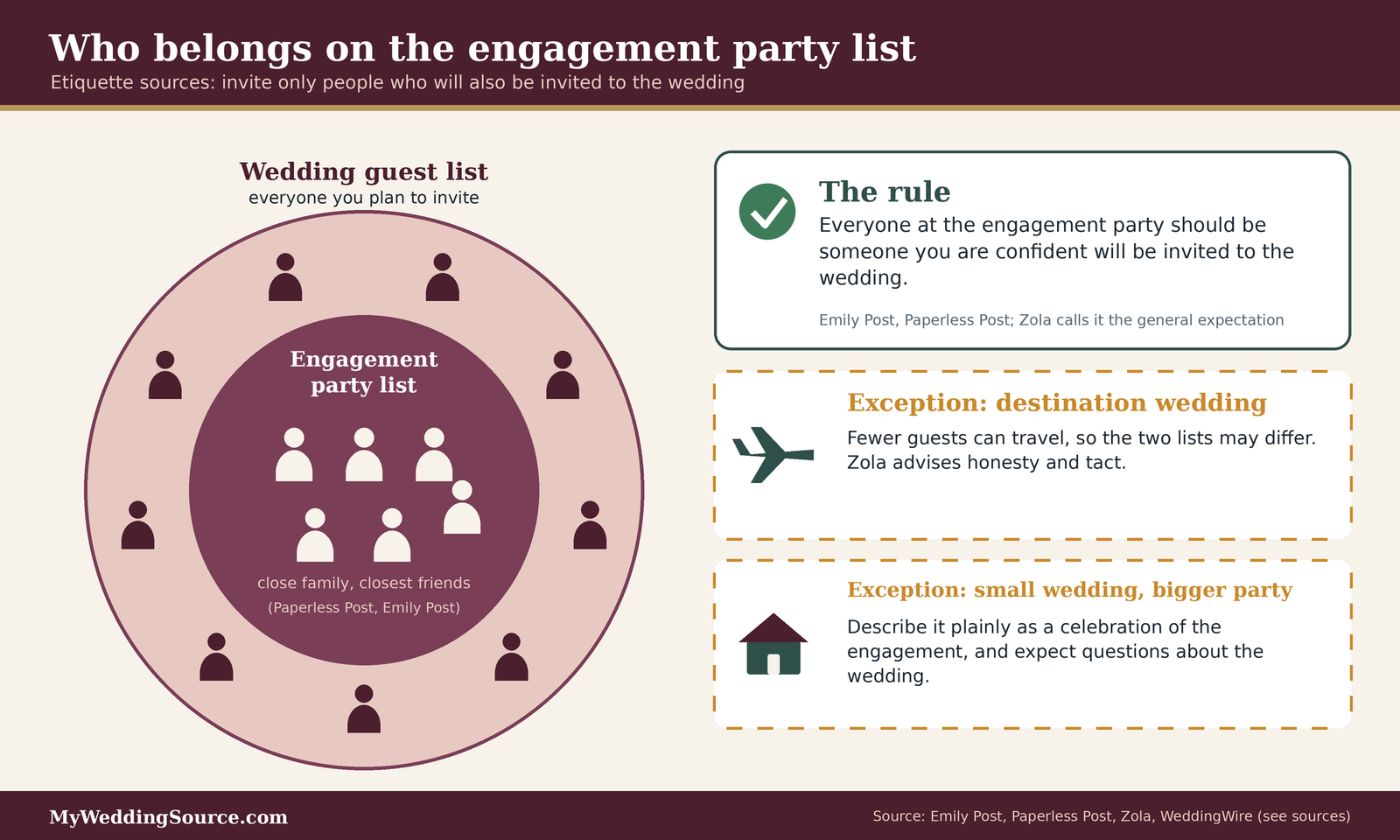
Etiquette sources we read agree on one rule more firmly than any other: invite to the engagement party only people you are confident will also be invited to the wedding. They are looser about nearly everything else. Hosts can be parents, friends, or the couple, and whoever hosts generally pays. Zola suggests holding the party roughly one week to three months after the proposal. Gifts are optional. Choose the guest-list policy first, write it in one sentence, and the rest of the engagement party gets easier to plan.
What an engagement party is, and whether you need one
Before the rules, it helps to be clear about what the event is for. An engagement party is a gathering that celebrates a couple’s engagement, usually hosted by someone who loves them and attended by the people closest to them. It is not a wedding rehearsal, a shower, or a requirement. Some couples have one, some have three, and some go straight from proposal to planning without a party at all. The Knot’s guide to who pays for the event cites its own Real Weddings Study for the figure that about a quarter of couples who are about to marry have one, though the article does not describe how that was measured, so treat it as a rough sense of how common it is and not as a precise rate.
What the party is for, and what it is not
The simplest way to protect your time and your budget is to give the event one job. The sources we read describe a few jobs that recur: announcing the news to a wider circle, introducing two families who have not met, and kicking off planning with the people who will matter most. Each job points to a different kind of gathering.
Announcing the news
If the main goal is to share the news with people who live nearby, the party works best soon after the proposal, with a short window, a simple menu, and an invitation that goes out by text, email, or phone call. Zola says one to four weeks is ideal when loved ones are local or when the couple plans to announce the engagement at the party itself, which suits a casual gathering at home or a restaurant.
Introducing two families
If the main goal is to let both families meet, you will want a quieter and more structured event. WeddingWire advises scheduling any first meeting between the two sets of parents before the party, even the night before or the morning of, and choosing a neutral, quiet setting such as a restaurant over someone’s home. The reason is practical: the first hour of a party often splits by family side, and a short introduction makes it easier for the couple to mingle.
Reasons to skip it, shrink it, or split it
None of the sources we read treats the engagement party as mandatory. Emily Post’s guidance, published on its Substack, treats the party as a kickoff to planning that suits the couple who want one, and the others describe it as optional. A few situations come up often enough to deserve a plain answer.
When a smaller gathering fits better
A dinner for the two families, a backyard afternoon, or a toast at a parent’s house can do everything an engagement party is meant to do at a fraction of the effort. If you are weighing a small ceremony, our guides to small wedding planning and micro wedding planning discuss how guest-count decisions ripple through the rest of the plan, and an engagement party list is one of the first places that ripple shows.
When two or three parties make sense
Emily Post and WeddingWire say couples whose families live in different places may have more than one engagement party, such as one in each hometown, and Zola says multiple parties by different hosts are possible. If you do this, keep a single master guest list in a shared note so the same person is never accidentally left out of one city and added to another, and decide up front whether the second event is a repeat of the first or a smaller, different one.
Decide the guest-list policy first
Of every decision around an engagement party, the guest list has the longest shadow. A name you add in a burst of enthusiasm in the first week becomes a name you either invite to the wedding or explain later. That is why the more careful sources treat the guest list as the first decision, not the last.
Write the policy in one sentence
A policy is a rule you can repeat without negotiating. Write yours in a single sentence and keep it with the hosts’ notes. Examples of the shape, which are our own illustrations and not quotations: “Everyone at the engagement party will be invited to the wedding.” Or: “The party is for family and the closest friends, and the wedding will be larger.” The second version is workable only if you say it honestly to the people who are in and the people who are not.
Name who is in and who is out
Emily Post’s guidance is the firmest we found: consult the couple and invite only guests who will certainly be invited to the wedding itself. Paperless Post, an online invitation company, says the same and adds that the engagement list should be smaller than the wedding list and limited to close family and the closest friends. WeddingWire notes that guests will likely assume an invitation to the party means an invitation to the wedding, so the two lists need to stay aligned, and it advises talking the list through with the hosts before invitations go out.
A practical test, offered as our own editorial suggestion: before you add a name, ask yourself whether you would be comfortable hearing that person say, “Congratulations, and thank you for including us at both.” If the answer is yes, they are on the list. If the answer is “maybe, depending on budget,” they are not yet.
Write exceptions as rules, not favors
Exceptions are where hurt feelings start, because an exception made as a favor invites a request for the next one. Write exceptions as conditions that anyone could meet. For example: “Children of the immediate family are invited to the party but not to the wedding, and this is clear on both invitations.” Or: “Coworkers are not invited to the party; we will invite colleagues to the wedding.” The rule is the same for everyone, so no one is singled out.
If the hosts are the ones adding guests, decide in advance how many names each host may add and who has the final say. Emily Post advises that a host who is organizing the party on the couple’s behalf should build the list with them, and that is a good default for any host.
Where the sources agree and where they bend
The rule that everyone at the engagement party is also invited to the wedding is stated most firmly by Emily Post and Paperless Post. Zola states it as the general expectation and then names exceptions. It helps to see those exceptions as a pattern.
The destination wedding exception
Zola notes that a destination wedding changes the math, since fewer guests can attend, which is one reason the two lists may differ. If yours do the invitation should say clearly that the wedding will be small or far away, so no one reads the invitation as a promise. We suggest putting one honest sentence on the invitation or in the note that goes with it.
The small wedding with a larger party
Zola also notes couples who want a small wedding but a larger engagement party. The article advises honesty and tact. Our reading: this works best when the party is plainly described as a celebration of the engagement, the wedding date and guest count are not yet shared, and the couple is prepared for a few guests to ask about the wedding. A short, consistent answer helps, and the pushback section later in this guide has wording for it.
Hosts and payers: who does what
Traditional etiquette gave the bride’s parents the job of hosting an engagement party. Every source we read describes that custom as the older default and describes a wider set of hosts today, and several say plainly that there is no single right way to decide.
Choosing a host
The Knot’s guide to who pays lists the common arrangements: the bride’s parents, the groom’s parents, both sets of parents together, friends, the couple, or the person who proposed, particularly if the party is a surprise right after the engagement. Zola says that today close friends or the couple often host, and that multiple parties by different hosts are possible. Emily Post says that no one needs to wait for another family to act.
When parents host
Parent-hosted parties tend to be smaller and family-centered, according to The Knot, sometimes with friends included. If a parent is hosting, give them a clear list of must-invite names from the couple’s side, a rough budget conversation, and the policy sentence from the previous section. Parents often have people they want to invite, and a respectful conversation on day one saves a hard one later.
When friends or the couple host
Friends who host usually work from the couple’s list and the couple’s taste. The Knot notes that these parties can be at a formal venue or an informal space like a home. If the couple hosts for themselves, we recommend naming a trusted friend or relative as the day-of contact, so the couple can spend the event with their guests and not with the caterer.
Who pays, and how to split it
Zola says that whoever hosts is generally expected to cover the cost, and that hosts can divide the work, such as one person handling the venue and another the food and drinks, or share the bill for an event space. The Knot says costs are sometimes split between hosts or covered by one person. Neither article gives percentages, and we would not invent any. The point is to decide in writing, early, and in a way that nobody finds awkward.
Put the split in writing
A short message after a phone call is enough: “We agreed that Ana’s parents will cover the venue and food, Sam’s parents will cover the bar, and the couple will cover invitations and decor.” The names here are fictional and the split is only an example of the form. The message lets everyone check that their understanding matches, before deposits are paid.
Keep the engagement party budget separate from the wedding
If the couple is paying, it helps to keep a separate line for the engagement party in your wedding budget, since money spent here is money not available later. Our wedding budget calculator and the overview of how to pay for a wedding can help you set that line, and our average wedding cost guide explains what the larger budget has to cover. ## Timing: when to hold the party and when to send invitations
Timing questions come in two layers. The first is when the party happens relative to the proposal and the wedding. The second is how far ahead guests should hear about it. The sources are fairly consistent on both, though the figures are guidance and not rules.

Where the party sits in the engagement
Zola ties timing to the proposal and not to the wedding date. Its guidance is that most engagement parties happen within the first few months, with a recommended window of one week to three months after the proposal. Paperless Post says much the same, adding that wedding details such as the date do not need to be settled before the party.
The first few weeks
An engagement party in the first weeks suits a surprise celebration, a gathering of nearby friends, or a couple who want to share the news with everyone at once. The cost is speed: invitations go out quickly, and the couple may still be deciding how big the wedding will be. If that is you, our policy-sentence approach matters even more, because there is no wedding guest list yet to check against.
The second and third months
An engagement party a month or two later gives more room for out-of-town relatives to arrange travel and for hosts to book a place. It also gives the couple time to talk through the guest-list question properly. Zola says invitations should go out as early as possible so guests can arrange time off and travel, which is a good reason to choose the later end of the window if relatives are far away.
How the party fits with save-the-dates and invitations
Emily Post’s guidance is that the party usually comes soon after the engagement as a kickoff to planning, ideally before save-the-dates, and if possible at least a month before wedding invitations. It also notes that a later party is possible in a long engagement, though attention shifts toward the wedding as it gets closer. That sequence matters because guests at the party will start asking questions about the date and venue.
Before save-the-dates
If the engagement party comes before the save-the-dates, guests will have no wedding date to ask about, and the conversation stays on the engagement. If the date is already set, it is reasonable to say so at the party. If not, the answer “We’re still deciding, and we’ll tell you as soon as we know” is honest and short. Our guide to save-the-date cards covers when those go out.
A long engagement
If the engagement is long, the engagement party can be held later without losing meaning. Emily Post’s caution is that attention shifts as the wedding approaches, so a later engagement party may feel like a second event competing for the same guests, the same budget, and the same weekend. In that case, check the larger sequence against the wedding planning timeline before choosing a date.
How far ahead to send invitations
Guidance on invitation timing varies by source. Emily Post advises three to six weeks ahead and always including an RSVP date. Paperless Post, which sells online invitations, advises about four to six weeks, with four acceptable for online invitations. Zola says to send them as early as possible, and notes that evites are acceptable for short-notice events as long as there is a clear way to RSVP.
Three to six weeks as a working range
A reasonable synthesis of the sources for an engagement party is three to six weeks, starting at the longer end when guests must travel and the shorter end for a local casual gathering. This is our reading of three sources that overlap, not a rule from any of them. Whatever date you choose for the engagement party, include an RSVP deadline, because the hosts need a head count for food and seating.
Holiday and weekend traps
Paperless Post advises weekend evenings, a two- to four-hour window with clear start and end times, and avoiding the days just before and after winter holidays. The advice is from an invitation vendor, but it is easy to sanity-check against your own guest list: if several close friends have standing commitments that weekend, move the date before the invitations go out.
Budgeting from the guest count outward
The Knot’s guide to who pays for an engagement party states that guest count has the biggest effect on budget, since food, drinks, and seating are per-person costs. That is a useful starting point, because it means the guest-list policy you wrote in the previous section is also your first budget decision.
What the published ranges say, and what they do not
The Knot’s figures come from individual planners quoted in the article and not from a survey, and the article was last updated in December 2023. We use them below only as ranges to reason with, and we label our own arithmetic as an estimate. Costs vary widely by region, season, and vendor, so please treat all of these numbers as starting points for your own quotes.
The ranges quoted
According to The Knot, a private room or venue that includes food, drinks, furniture, and linens can run about $2,000 to $10,000 or more. Small bites run about $15 to $20 per guest. Decor is roughly $1,000 to $3,000, a DJ averages $700 to $1,000, a rented PA system about $150, and rentals of tables and chairs around $1,000 when the venue does not provide them. Games, such as printed cards and pens, usually cost under $40 plus prizes. Favors are optional. The article describes overall budgets as running several thousand dollars depending on scale and detail.
What these ranges leave out
The ranges say nothing about invitations, photography, or the cost of travel for the hosts. They also do not separate a venue fee that includes food and drinks from a bare room fee, so adding the venue range to the food range could double count. When you collect quotes, ask each vendor exactly what is included, a point the Knot’s article also makes when it advises reading venue contracts closely for booking fees, food and beverage minimums, service fees, and taxes.
Three illustrative scenarios
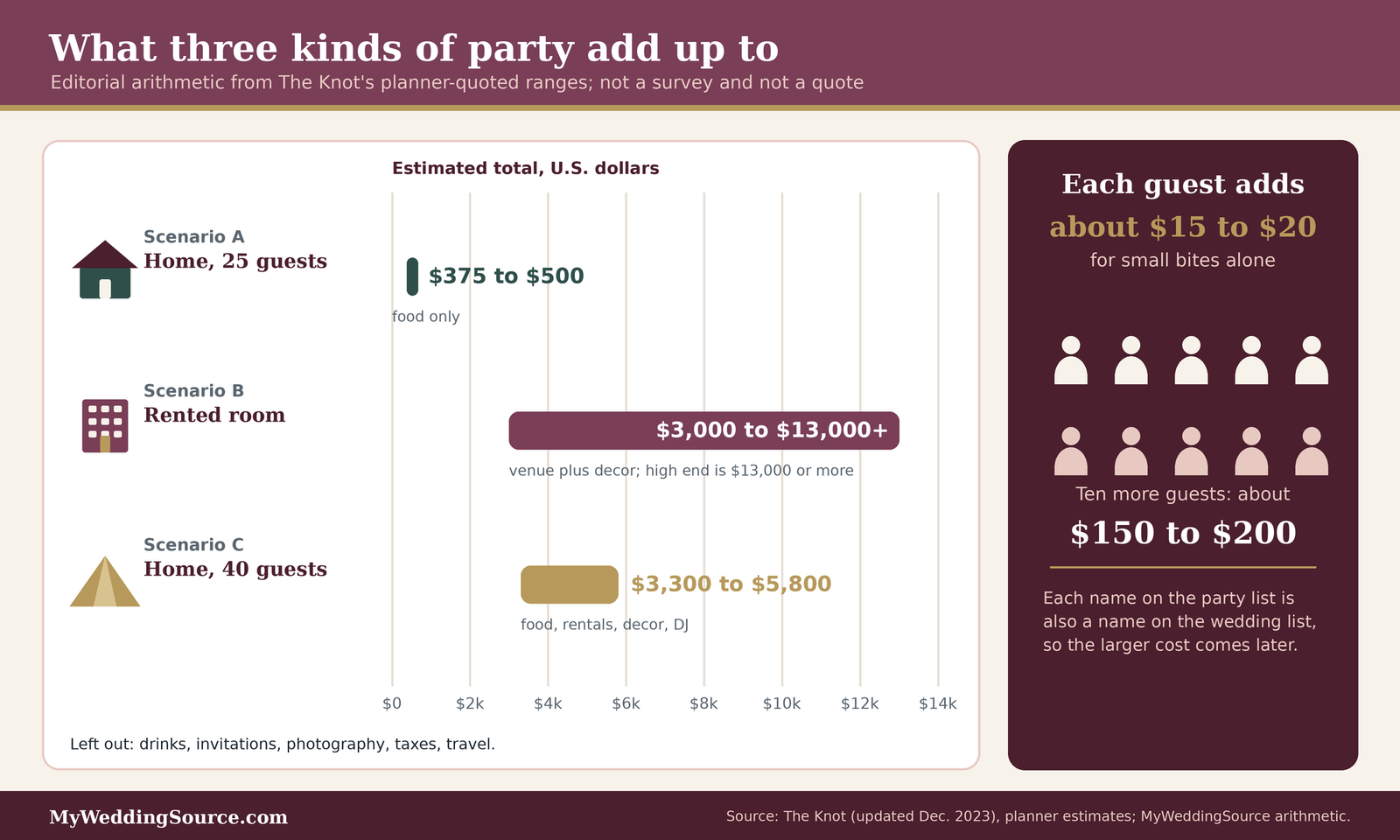
To show how the guest count and the format interact, here are three scenarios built only from the ranges above. They are our editorial arithmetic and not quotes, forecasts, or surveys, and they leave out drinks, invitations, photography, and taxes because the sources we used did not give comparable figures.
Scenario A: a home gathering for 25
Twenty-five guests at $15 to $20 per head for small bites comes to about $375 to $500. If the hosts already own seating and use their own space, and skip decor and entertainment, the sourced items add up to that figure alone. Drinks are not included.
Scenarios B and C: a rented room, and a larger party at home
For scenario B, imagine a venue package at the low and high ends of The Knot’s range plus the decor range: about $3,000 at the low end ($2,000 plus $1,000) and about $13,000 or more at the high end ($10,000 plus $3,000). For scenario C, imagine 40 guests at home with small bites ($600 to $800), rented tables and chairs (about $1,000), decor ($1,000 to $3,000), and a DJ ($700 to $1,000): about $3,300 to $5,800. Scenario B’s spread shows how much the venue choice drives the total, and scenario C shows that a home party is not automatically the cheapest once rentals and entertainment are added.
What a guest adds
Using The Knot’s small-bites range of about $15 to $20 per guest, each additional guest adds roughly that much for food alone, which is our estimate and does not include drinks or seating. Twenty extra names could add about $300 to $400 in food before any other cost. The larger cost is usually later: each person you invite to the engagement party is someone you are expected to invite to the wedding, so the money question and the guest-list question are really the same question.
Contracts and quotes: what to check before you pay
If you use a venue or caterer for the engagement party, the same habits that apply to a wedding apply here, scaled down. The Knot advises calculating the budget before collecting quotes and ranking your top three priorities, which is a good filter for a small event like an engagement party.
Read for minimums and fees
Look for booking fees, food and beverage minimums, service charges, and taxes. A minimum can turn a modest guest list into an expensive evening if the room is sized for far more people. If you plan to serve alcohol, see our guide to the open bar wedding for the structure of bar choices, which applies at smaller scale too, and our wedding catering guide for how food service is priced.
Ask about cancellation and insurance
Ask what happens if you cancel or the guest count drops, and what deposit is refundable. For a larger paid venue, ask whether your event is covered by any liability or event insurance, and read our overview of wedding insurance before assuming a policy covers a pre-wedding party. Policies differ, so we cannot say what any particular one covers.
Communicating the plan: channel, wording, and what to put in print
Once the policy, host, date, and budget for the engagement party are settled, the remaining work is telling people. The channel you choose says something about how formal the party is, and the sources agree on that point.
Matching the channel to the message
Emily Post advises that the invitation should match the party’s formality: printed, calligraphed, or handwritten for formal parties, and whatever gets responses for casual ones, including texts, emails, or digital invitations. Phone calls suit small gatherings, and group texts are discouraged for larger parties. Zola adds that engagement party invitations are separate from announcements of the engagement.
Print or digital for durable facts
Details that people will need to find again, such as the address, start and end time, dress code, whether dinner is served, and the RSVP date, belong somewhere guests can look them up. Paperless Post advises stating what food will be served, such as cocktails and light bites or a full dinner. Zola says the dress code belongs on the invitation, either as a general term or a fuller description. A printed card, an email, or a private event page all work if they carry those facts.
Personal outreach for sensitive exceptions
Anything that touches feelings, in the middle of engagement party planning or after it, should not be handled by a group message: telling a relative that children are not invited, explaining why a long-time friend is not on a small list, or asking a parent to limit their additions. A phone call or a private message is a better channel because it lets the person respond. For a ready-made look at attire language, our guide to cocktail attire explains what that dress code means to most guests.
Table 1 pairs common situations with a recommended channel and the logic for handling exceptions. It reflects our synthesis of the etiquette sources above, so adjust it to your own family.
| Situation | Policy or expectation | Best channel | Sample approach | Exception logic |
|---|---|---|---|---|
| Formal sit-down dinner | Guest list matches the wedding list | Printed or emailed invitation, 3 to 6 weeks ahead | State the start time, dinner, dress code, and RSVP date | Exceptions are made by host and couple together, in writing |
| Casual backyard gathering | Close family and nearby friends | Text, email, or evite with an RSVP link | Short and warm; say what food will be served | Anyone added later is checked against the wedding list first |
| Family not yet acquainted | Parents meet before the party | Phone call, then a quiet, neutral setting | Introduce both sides early in the evening | If a meeting beforehand is impossible, schedule a simple dinner the day of |
| Small or destination wedding | Party list may be larger than the wedding list | Personal call to people who will not be invited to the wedding | Say plainly that the wedding will be small or far away | Put the honest sentence on the invitation as well |
| Out-of-town relatives | Invite early, keep the plan flexible | Email with a clear date and an easy way to ask questions | Give the date as early as possible | Offer a video option if travel is not realistic |
Wording you can adapt
Good wording is short, warm, and specific. The aim is not to sound scripted, so treat these as shapes to adapt, not text to paste. They are our own illustrations.
A formal version
“Together with their families, Ana Rivera and Sam Lee invite you to celebrate their engagement on Saturday, April 11, from 5 to 8 in the evening at the home of Mr. and Mrs. Rivera, 12 Maple Lane. Cocktail attire. Dinner will be served. Please reply by March 14 to the email address on the card.” The sentence for dress code and the sentence for food answer the two questions guests ask most, and the RSVP date gives the hosts a head count. The names, address, and dates are fictional.
A conversational version
“We’re engaged, and we’d love you to celebrate with us. Come to Mom and Dad’s on April 11 from 5 to 8. It’s backyard casual, and there will be plenty of food. Let us know by March 14 if you can make it. Hugs.” Casual wording still carries the essentials: the date, the time, the place, the dress, and the deadline. Everything else can wait for a follow-up message.
Explain the purpose of each sentence
When you write your own wording, ask what each sentence is doing. A sentence that gives a fact earns its place. A sentence that apologizes in advance, or that promises more than the budget can deliver, usually does not.
Facts first, tone second
Lead with what, where, when, and how to reply. After that, add a single line of warmth. A long personal story belongs in a conversation or a toast, not on an invitation.
One sentence about gifts, if at all
Emily Post says hosts should ask the couple for a few gift suggestions in case guests ask, and says creating a registry for the party is inappropriate, while WeddingWire says asking for gifts directly is improper. If you want to keep things simple, do not mention gifts on the invitation, and have the hosts answer the question if guests ask. We discuss the gift question in the next section. ## Gifts, registries, and toasts
Gifts are the part of engagement party etiquette where the sources disagree most openly. Understanding where they differ helps you choose a position and explain it kindly.
What guests are expected to bring
On the central question, the sources are in rough agreement: a gift is optional. The Knot says guests do not have to bring one, and that the couple will not reject the gesture. Emily Post says gifts were not historically expected but are now customary in many parts of the country, particularly from close friends and family, and that the decision depends on your relationship with the couple, your budget, and local custom. Paperless Post says engagement gifts are not expected and are typically saved for the shower.
A modest range, if you want one
The Knot suggests about $50 to $75 for a gift or a cash gift, and says that figure should depend on your overall gift budget and your relationship with the couple, taking into account that you may also give at a shower and at the wedding. Emily Post suggests inexpensive items that help a couple start a collection, such as a cookbook, picture frame, or bottle of wine. Treat those as one publication’s ideas and not as a standard.
What to do if you are unsure
Emily Post’s advice is simple: call the host and ask. If you are the host and the couple would rather not receive gifts, the same source says couples concerned about guests’ budgets may ask the host to let guests know not to bring any. That one sentence in a message can save a guest an hour of worry.
The registry disagreement
Whether to have a registry for the party is where reputable sources contradict each other, and a clear-eyed look at the disagreement helps the couple decide.
What each source says
Emily Post says a couple should not already have a registry for the engagement party, and that creating one is inappropriate. WeddingWire advises the opposite emphasis: expect some guests to bring gifts anyway, so set up a registry and a wedding website beforehand, while also saying that asking for gifts is improper. The Knot suggests guests check whether the couple has an engagement registry, and does not say registering is expected. Paperless Post says the couple does not need to include a registry.
How to choose
A calm way through is to separate having a registry from announcing one. If you have a registry because a few relatives will ask where to look, you can share it when asked and leave it off the invitation. If you would rather not have one yet, have the hosts offer two or three ideas instead, as Emily Post suggests. For a broader look at the decision, our guide to the wedding registry explains how couples build one.
Thank-you notes and toasts
Two small habits keep the day feeling gracious without adding much work.
Thank-you notes
WeddingWire advises sending a handwritten thank-you note to everyone who attends, whether or not they brought a gift, and suggests a note and possibly a small gift for the hosts. Paperless Post recommends a note when a guest brings a gift or sends a card. We would follow the broader version: it is faster than deciding who deserves one.
Toasts
Zola describes the typical order: the hosts toast first, then the couple’s parents, family, close friends, and perhaps coworkers or acquaintances, with the couple closing by thanking the hosts and guests. Emily Post encourages toasts, advises keeping them sentimental, kind, and positive, and suggests keeping stories short and being careful with humor. If you plan toasts, tell the speakers in advance and give them a rough time limit.
Handling pushback without rewriting the rule
Even a thoughtful policy gets tested. The most useful preparation is a short list of the objections you expect, a one-sentence answer to each, and a decision about where you would actually bend. The scenarios below are our editorial examples, and the table summarizes them.
Short, consistent answers
Consistency matters more than cleverness. If the answer changes depending on who asks, people compare notes and the policy starts to look like favoritism. A short answer, said the same way each time, also lowers the temperature.
Predictable objections
The ones that come up most often are “Can I bring a plus-one?”, “Why wasn’t my cousin invited?”, “Are kids welcome?”, “Is this a gift-giving party?”, and “Does this mean we are invited to the wedding?” The last is the one to prepare for most carefully, because the etiquette sources we read generally treat an invitation to the engagement party as a signal of an invitation to the wedding, and WeddingWire says guests will likely assume as much. If a guest is on the engagement party list, you should be able to answer yes.
Give guests an easy way out
Not everyone can come, and none of the sources suggests that declining is rude. A gracious invitation makes it easy: include a reply date, an email or phone number, and a line like “We’d love to see you, and we understand if the date doesn’t work.” Emily Post says couples worried about guests’ finances can ask hosts to say that gifts are not necessary, which also takes pressure off anyone attending on a tight budget.
| Pushback | Response principle | Boundary | Graceful alternative | Escalation risk |
|---|---|---|---|---|
| “Can I bring a plus-one?” | Answer with the policy, not the person | Hosts set a count in advance | Offer to introduce them to others at the party | Low if said early; higher if exceptions appear later |
| “Why isn’t my friend invited?” | Be brief and kind | The list is limited to people who will be at the wedding | Offer a separate one-to-one celebration | Medium; avoid explaining other people’s reasons |
| “Are kids welcome?” | State it on the invitation | Same rule for every household | Suggest a nearby sitter option or a daytime event | Medium if the rule is applied unevenly |
| “Do we need a gift?” | Keep it simple: no | Never request gifts directly | Hosts may share two ideas if asked | Low |
| “Does this mean we’re invited to the wedding?” | Be honest | Only invite those you will invite | Say who will be invited, or do not invite them | High if the answer is later changed |
When kindness means logistics
Sometimes the right response to pushback is not better wording but a change to the plan. The hardest examples involve access, children, distance, and food.
Accessibility and getting there
If a guest uses a wheelchair, walker, or other mobility device, or needs interpretation or captioning, the venue matters more than the message. A University of Wisconsin–Madison guide for planning accessible events says to include a short accessibility statement on every invitation explaining how to request accommodations and whom to contact, to make sure the route to the entrance is clear and step-free, and to confirm accessible restrooms on the same floor as the event. It also suggests checking in with guests at the event. The ADA.gov Title III primer says that businesses serving the public are generally treated as public accommodations, but the page does not say whether a party in a private home is covered, so ask any venue what it offers and do not assume.
Children and childcare
If children are part of the family, decide whether the party is adult-only, family-friendly, or daytime. Put that on the invitation so no one has to ask. If you want adults to enjoy themselves at an evening engagement party but some guests have young children, a daytime or early-evening time slot is often more practical than a late one. This is our suggestion and not a rule.
Travel, long distance, and virtual guests
WeddingWire suggests considering a virtual component, either as a separate event or a video station at the party. That is a way to include grandparents or friends who cannot travel. If you have asked people to travel, give them a date early, as Zola advises, and be realistic about what the hosts can offer. You do not need to provide hotel rooms for an engagement party, and nothing we read suggests it is expected.
Food safety and alcohol
Hosting means being responsible for the guests while they are with you. Two items are worth a quick check.
Food that sits out
The USDA says perishable food should not sit in the Danger Zone, roughly 40 to 140 degrees Fahrenheit, for more than two hours, or more than one hour when it is hotter than 90 degrees. It advises keeping cold food at 40 degrees or colder and hot food at 140 or hotter. For an outdoor engagement party in summer, that means setting out smaller trays and refreshing them, not leaving everything out for the whole event.
Alcohol and getting home
If you are serving alcohol, plan non-alcoholic options, food that is substantial enough to go with it, and a way for guests to get home safely. Rules about serving alcohol can differ by state and by venue, and we did not research them or give legal advice, so check your state’s rules and ask the venue what its policies are. For the cost structure of bar service, see our open bar wedding guide.
Avoid promising what the budget or venue cannot deliver
The mistake behind many hard conversations is a promise made too early: a guest count the venue cannot hold, a dinner the budget cannot cover, or a ceremony-sized event in a space that fits half the number of people.
Match the promise to the plan
A promise is any sentence that guests will remember: “We’ll have a full dinner,” “Everyone’s invited,” or “We’ll hold it at the lake.” Before you say any of them, check the plan.
Capacity and cost
Ask the venue for its maximum capacity, not a comfortable number. Our engagement party arithmetic above showed how quickly the cost of rentals, decor, and entertainment can outweigh the food. If your preferred plan exceeds the budget, change the plan, not the policy: shorten the event, move it to an afternoon, serve light food, or host at home.
Be honest about what the day is
A short party with good food and a few toasts is a complete engagement party. If the hosts can do only that, say so on the invitation, with a line like “Cocktails and light bites.” Guests will then arrive with the right expectations, and no one will leave hungry or confused.
Say it on the invitation
State the format in plain words
Guests plan around what they read. “Cocktails and light bites, 5 to 7” tells them to eat beforehand if they are hungry, and “Dinner to follow” tells them to stay. This is our suggestion, and it echoes Paperless Post’s advice to state what food will be served.
Keep the answer the same in person
If a guest asks whether there will be dinner, give the same answer the invitation does. A host who adds a promise in conversation, such as a full meal when the budget covers snacks, creates the very gap this section is meant to prevent.
Special situations worth planning for
A few situations come up often enough to deserve their own notes, and each ties back to the policy and the budget.
Surprises, second celebrations, and family dynamics
Surprise engagement parties
The Knot notes that surprise parties right after a proposal are often hosted by the person who proposed or by friends. If the party is a surprise, the host needs a partner’s trusted ally for the guest list, since one wrong name creates the difficulty the policy was meant to avoid. Our guide to proposal ideas covers how couples plan the proposal itself, including photography and privacy.
Families who have not met
If the two families have never met, WeddingWire’s advice is to arrange the introduction before the party, in a quiet and neutral place, and to introduce relatives to each other early in the evening. A short first conversation often does more good than any amount of planned entertainment.
Photos, music, and the shape of the evening
Pictures worth taking
Photos at an engagement party are usually informal, but they are the first pictures of the two of you celebrating together. A friend with a phone can capture the toast and the family groups. If you want a professional, our guide to wedding photography covers what to ask, and our wedding photographer shot list shows the kinds of moments couples ask for.
Keep the entertainment light
WeddingWire advises minimal entertainment, avoiding loud venues or music, and saving dancing for the wedding. That is one editor’s view, and a live band or DJ is certainly possible, as The Knot’s price ranges show. But conversation is a large part of the point at an engagement party, so choose a level of sound that lets people talk.
A planning sequence you can use
A good plan fits on one page. This sequence is our own synthesis of the sources above, so adjust it to your circumstances and your timeline.
From idea to invitation
Decide, then book
Decide the policy sentence, the host, the budget, and the rough date. Only then ask for quotes. If you need a venue, book it before sending invitations. If you are hosting at home, confirm the date with the people whose presence matters most.
Send invitations and track replies
Send invitations about three to six weeks ahead, include an RSVP date, and track replies in one list. Call the guests who need personal outreach before the invitations go out.
The day itself
Build a short run of show
Paperless Post advises a two- to four-hour window. Within it, plan the welcome, the toasts, food, and a time for photos. Zola’s toast order is a good model: hosts first, then parents, family, friends, and the couple last.
Keep a day-of contact
Name one person who is not the couple to answer questions from guests and vendors. It lets the couple spend the event on conversation, and it keeps the hosts from handling every small problem themselves.
Questions to ask before you book or send anything
- Who is hosting, who is paying, and have we agreed in writing?
- Can we say our guest-list policy in one sentence?
- Is every engagement party guest someone we will invite to the wedding?
- What date works for the people who matter most, and is it within a few months of the proposal?
- What does the venue quote include, and what are the minimums, fees, taxes, and cancellation terms?
- Is the venue accessible, and does the invitation tell guests whom to contact?
- Are children welcome, and does the invitation say so?
- What food and drinks will be served, and how will perishable food be kept safe?
- Will we mention gifts at all, and if so, who answers when guests ask?
- Who is the day-of contact?
FAQ: engagement party questions
Guests and hosts
Do I have to invite everyone at the engagement party to the wedding?
Etiquette sources we read generally say yes. Emily Post advises inviting to the engagement party only people who will certainly be at the wedding, and WeddingWire notes that guests will likely assume an invitation to one means an invitation to the other. Zola names exceptions, such as a destination wedding, and advises honesty and tact.
Who traditionally hosts and pays for an engagement party?
Traditionally the bride’s parents hosted, and the host generally pays, according to The Knot and Zola. Today the couple, either set of parents, or friends often host, and costs can be split between hosts. Decide who pays and what each person covers in writing, before any deposit is paid.
Can a couple host their own engagement party?
Yes. Emily Post, WeddingWire, and The Knot all describe the couple, parents, or friends as possible hosts. If you host your own, we suggest naming a trusted friend or relative as the day-of contact so you can spend the evening with guests instead of vendors.
Is it rude to have more than one engagement party?
No. Emily Post and WeddingWire describe couples with families in different places holding more than one gathering, such as one in each hometown, and Zola says multiple parties by different hosts are possible. Keep one master guest list so the same person is not accidentally invited to one and missed at the other.
Timing, gifts, and money
When should an engagement party take place?
Zola recommends roughly one week to three months after the proposal, with one to four weeks ideal for local guests or an announcement party. Emily Post says it usually comes soon after the engagement, before save-the-dates, and if possible at least a month before wedding invitations.
Are gifts expected at an engagement party?
No, they are optional. The Knot says guests do not have to bring one, and suggests about $50 to $75 if they want to. Emily Post says gifts are customary in many regions, especially from close friends and family, and recommends asking the host if you are unsure.
How much does an engagement party cost?
It depends on the guest count and format. The Knot’s guide, citing individual planners, gives ranges such as about $15 to $20 per guest for small bites and about $2,000 to $10,000 or more for a venue with food and drinks. Overall budgets typically run several thousand dollars. Collect your own quotes.
How far ahead should I send invitations?
Emily Post advises three to six weeks and always including an RSVP date. Paperless Post, an invitation company, suggests four to six weeks. Zola says as early as possible, and that evites are acceptable for short-notice events with a clear RSVP system. Choose the longer end if guests must travel.
Your next steps
Settle the decisions
Write the policy and the split
Write your guest-list policy in one sentence and confirm who is hosting and paying. Then check the guest list against your wedding plans, using our engagement ring guide and the broader engagement rings overview for the earlier part of the journey.
Pick the date and tell people
Choose a date inside the window that suits your guests, then send invitations three to six weeks ahead with an RSVP date. If you will use formal stationery for the wedding, our wedding invitations and wedding RSVP wording guides cover that later stage.
Keep the rest of planning light
Add it to your plan
Put the engagement party on your wedding planning checklist and in the broader wedding planning guide, so its cost and its guest list are counted from the start. For general behavior questions that come up along the way, our wedding etiquette overview is a good companion.
Protect your energy
Planning can feel like a second job. If the schedule is starting to crowd you, our guide to wedding planning stress has practical ways to scale back, and an engagement party that is small and warm is a good place to start.
Sources & methodology
How we built this guide
What we relied on
This guide combines etiquette guidance from Zola, Emily Post, WeddingWire, and The Knot, a vendor blog from Paperless Post, a U.S. Department of Agriculture food-safety statement, the ADA.gov Title III primer, and a university guide to accessible events. The Knot’s cost figures come from individual planners quoted in its article, not from a survey, and the article does not describe methodology for its statement that about a quarter of couples have an engagement party. The three cost scenarios are our own arithmetic from those ranges and are estimates. Where a statement comes from a vendor, we say so.
What we did not do
We did not survey couples, interview hosts, or find a current, methodology-disclosed survey of engagement party costs, so we do not report an average. We did not give legal, medical, or financial advice. Etiquette differs by region and family, and the sources we read sometimes disagree, as noted in the text. Check any venue contract, local law, and accessibility needs for your own event.
Source list
Etiquette and planning sources
- Zola, The Complete Guide to Engagement Party Etiquette: https://zola.com/expert-advice/who-hosts-an-engagement-party
- Emily Post, Etiquette Today: The Engagement Party: https://emilypost.substack.com/p/etiquette-today-the-engagement-party
- Emily Post, Engagement party gifts: https://emilypost.com/advice/engagement-party-gifts
- The Knot, Who pays for the engagement party: https://www.theknot.com/content/who-pays-for-engagement-party
- The Knot, Modern engagement party gift etiquette: https://www.theknot.com/content/engagement-party-gift-etiquette
- WeddingWire, The Dos and Don’ts of Engagement Party Etiquette: https://www.weddingwire.com/wedding-ideas/engagement-party-etiquette
- Paperless Post, Engagement party 101: https://www.paperlesspost.com/blog/engagement-party-101
Government and accessibility sources
- U.S. Department of Agriculture, Food Safety and Inspection Service, USDA urges consumers to keep clear of the Danger Zone this summer: https://www.fsis.usda.gov/news-events/news-press-releases/usda-urges-consumers-keep-clear-danger-zone-summer
- ADA.gov, Title III primer: https://www.ada.gov/resources/title-iii-primer/
- University of Wisconsin–Madison, Guide to Planning an Accessible Event: https://compliance.wisc.edu/documents/guide-to-planning-an-accessible-event/