

An engagement announcement photo session is a short, planned shoot whose pictures will introduce your news to people, so the two decisions that matter most are what you wear and when you shoot, and both are easier to make well when you treat them as one plan with the weather, the location, and your announcement order built in.
Quick answer
For an engagement announcement photo session, pick the outfits first (a shared color family, comfortable fit, hands and ring visible), then pick the hour and the date around light and weather, then write a backup plan that says in advance when you will wear a different layer, move indoors, or reschedule. Shoot before you post, not before you tell the people who should hear from you first. Check any public-land rules early: in the National Park Service pages we read, small hand-carried sessions can be exempt from permits, but larger groups are not. Put usage rights and delivery dates in writing with your photographer.
What an engagement announcement photo session is, and how it differs from other engagement photos
Plenty of couples book a portrait session after they get engaged, and plenty of those sessions are about the keepsake. An engagement announcement photo session has a narrower job. The images are meant to be seen by other people at a particular moment, on a card, in a message, on a website, or on a social feed, and they are often the first visual impression of your wedding. That changes how you should think about clothes, light, and timing, because you are choosing for a small thumbnail as well as for a framed print.
The job the photos have to do
Before choosing a single outfit, it helps to say out loud what the photos are for. The answer shapes everything else in your engagement announcement photo session plan, from how much of your faces should fill the frame to whether you want a single hero image or a small set.
One image that works small
Most people will first see your announcement as a thumbnail in a phone feed or a text thread. A photo that reads clearly at that size usually has two faces in a simple composition, a plain background, and enough contrast between clothes and setting that you do not blend in. That is a practical guideline from how photos display, not a rule, and your photographer can tell you what works with their style. If you plan to send a printed card, ask for one frame with calm space around you, because text needs somewhere to sit. Decide this before you book the engagement announcement photo session, since it changes how the photographer composes.
A set that tells a short story
Some couples want three or four frames, such as a close portrait, a full-length walking shot, a detail of hands, and a laughing one. A set gives you options for different channels and different relatives, and it lets you keep the most personal frames for people close to you. Decide the set before the session, then tell the photographer which frames you consider essential. The rest of the engagement announcement photo session can be looser and more playful.
Pictures for different audiences
A photo you send your grandmother might not be the one you post publicly. Think about audience before you shoot: family, friends, coworkers, and the wider internet each get a different level of closeness. Our guide to the engagement announcement covers who hears first and how to match message to channel, and the photo plan should follow that order rather than lead it.
How this differs from a general engagement shoot
Our article on wedding engagement photos looks at whether to book a session at all, how it works as a rehearsal for the wedding photographer, and what to put in the contract. This guide is narrower. It assumes you are going to have a session whose images will be used to announce, and it focuses on wardrobe and timing decisions.
Announcement use raises the stakes on timing
A general engagement shoot can happen whenever the calendar allows. An engagement announcement photo session often sits between the proposal and a date you have promised to share news, which can leave less room to wait for good weather. That tension is the reason this guide includes a weather decision plan and a backup date rule, so a rainy week does not force a rushed choice. An engagement announcement photo session has a public purpose, so a missed deadline is more noticeable.
Announcement use raises the stakes on wardrobe
Because the photos introduce you publicly, outfits feel more visible than in a private keepsake session. Fit, color, and comfort matter more when a single frame carries the moment. The good news is that a few simple choices, covered below, handle most of the risk, and none of them require a new wardrobe or a stylist.
Where the two kinds of session overlap
Both kinds benefit from a good photographer, a calm schedule, and a plan for light. If you intend to use your announcement photo session as a trial run for your wedding photographer, the wedding photography guide is a useful companion, and many photographers offer a combined package. Ask directly, and do not assume.
What this guide covers and what it leaves out
This is a decision guide for two people (and sometimes a few others) planning an engagement announcement photo session in the United States. It draws on federal weather and health guidance, National Park Service permit pages, and the U.S. Copyright Office’s explanation of who owns a creative work. It does not replace local rules, a photographer’s own policies, or professional advice.
Decisions it covers
You will find choices about the season and date, the hour of the day, outfit palette and fit, the ring and hands, weather triggers for changing plan, location rules, consent, and the terms to settle with a photographer. You will also find edge cases such as a surprise proposal, a long-distance couple, and a session with children or pets.
Decisions it leaves to you
Your style, your budget, and your family customs are yours. We do not tell you to wear formal clothes or casual ones, to shoot at sunrise or at lunchtime, or to include family. We give you the questions and the trade-offs, label our own suggestions as suggestions, and point to the source when a statement rests on one.
Limits on what we can verify
We did not test cameras, clothes, or locations, and we cannot see your local weather. Photographer norms differ by market. Park rules differ by park, and the ones we cite are examples read on the date shown in the sources section. Treat every fee and rule as something to confirm with the site or vendor before you book.
Timing decisions: the date, the hour, and the order of announcements
Timing has three layers that people often blur together: which season or date you choose, which hour you shoot, and when the pictures appear relative to the people you want to tell first. Separating them makes each decision smaller and easier.
Choosing the season and the date
The best date for an engagement announcement photo session is the one where the setting, the weather, and your calendar line up, which rarely means the first available weekend.
Season sets the palette and the risk
Each season gives you a different background and a different set of risks. Warm months tend to bring heat, humidity, and bright light, and cold months bring wind and short days. Shoulder seasons can be gentler but are changeable. Our summer wedding heat plan and winter wedding weather plan explore these risks for the wedding itself, and many of the same ideas apply to a shorter session. Choosing a season is therefore the first real decision in an engagement announcement photo session.
Pick a primary date and a backup date
Choose two dates before you contact anyone, and agree with your photographer on a rule for switching. Many photographers allow a weather reschedule, but policies differ, so ask what counts as bad weather, who decides, and whether there is a fee. A backup date written into the agreement is worth more than a verbal promise. Put both dates in the engagement announcement photo session agreement, with a plain rule for switching.
Protect the people who have to travel
If family or a wedding party member will join you, choose a date they can reach comfortably. An engagement announcement photo session that requires someone to travel in uncertain weather puts them at risk of a wasted trip. For couples with relatives in different places, our guide on planning an engagement party when parents live far apart offers ways to include people who cannot be on location.
Choosing the hour and reading the light
The same couple in the same outfit can look quite different at nine in the morning and at noon. Light is a photographic choice and a comfort and safety choice at once.
Use the shadow rule as a quick check
The U.S. Environmental Protection Agency describes a simple shadow rule for estimating sun exposure: if your shadow is longer than you are, as in early morning and late afternoon, ultraviolet exposure is usually lower, and if it is shorter than you, as around midday, exposure is higher. The same check is handy photographically, because long shadows usually mean lower, more directional light and short shadows mean overhead light that can cast harsh shade under eyes and hat brims. Walk the location at the planned hour before your engagement announcement photo session if you can.
Know when the sun is highest
The Centers for Disease Control and Prevention advises limiting direct sun in the continental United States from about 10 a.m. to 4 p.m. daylight saving time, and the Food and Drug Administration points to 10 a.m. to 2 p.m. as the window when rays are strongest. These windows are not identical, and both are broad guidance rather than a prediction for your town. If the only available slot falls in that window, the weather plan below explains how to shade, cover, and take breaks.
Look up the sun for your actual location
Sunrise, sunset, and the sun’s position vary by place and date. NOAA’s Global Monitoring Laboratory publishes a solar calculator that gives sunrise, sunset, solar noon, and the sun’s elevation for a location, although the page notes that it is no longer actively maintained and is intended for research and entertainment. Use it as a planning aid, and confirm times with your photographer or a local weather service, because atmospheric conditions change what you actually see.

Timing the engagement announcement photo session against the announcement
The calendar between the proposal, the engagement announcement photo session, and the first post is where many couples feel pressure. A clear order helps you avoid learning about it from someone else.
Decide whether to shoot before or after telling people
Some couples shoot first so the first message carries a photo. Others tell close family first and hold the photos for a later public post. Both are fine. Our engagement announcement guide lays out who usually hears first, second, and last, and the safest plan is to personally tell anyone who would be hurt to learn from a feed before you publish anything. Either order works for an engagement announcement photo session, as long as you choose it on purpose.
Ask for the delivery schedule in writing
Photographers differ in how quickly they deliver, and delivery can include a small preview set, a full gallery, or edited selects. Ask when you will receive the first usable images and whether a preview is available for an announcement deadline. Do not assume a date, and do not plan a public post until you hold the files. Our guide to wedding photography deliverables explains common terms.
Leave room between the engagement announcement photo session and the post
Give yourselves a gap for selecting, editing, and a second look. A photo you choose in a hurry is the one you notice a flaw in later. If your announcement is tied to a card, a party, or a save-the-date card mailing, work backward from that date, add a cushion for weather, and treat the cushion as non-negotiable.
Wardrobe decisions: palette, fit, and comfort
Wardrobe is the decision most couples worry about, and the worry usually comes from trying to match perfectly. Photos work better when outfits look like they belong to the same story rather than the same store. Our suggestions in this section are editorial judgment, based on common photography practice, and your photographer’s eye should override them.
Start with the palette and the setting
Outfits only look right against something. Choose the setting first, even loosely, then choose colors that sit well in it.
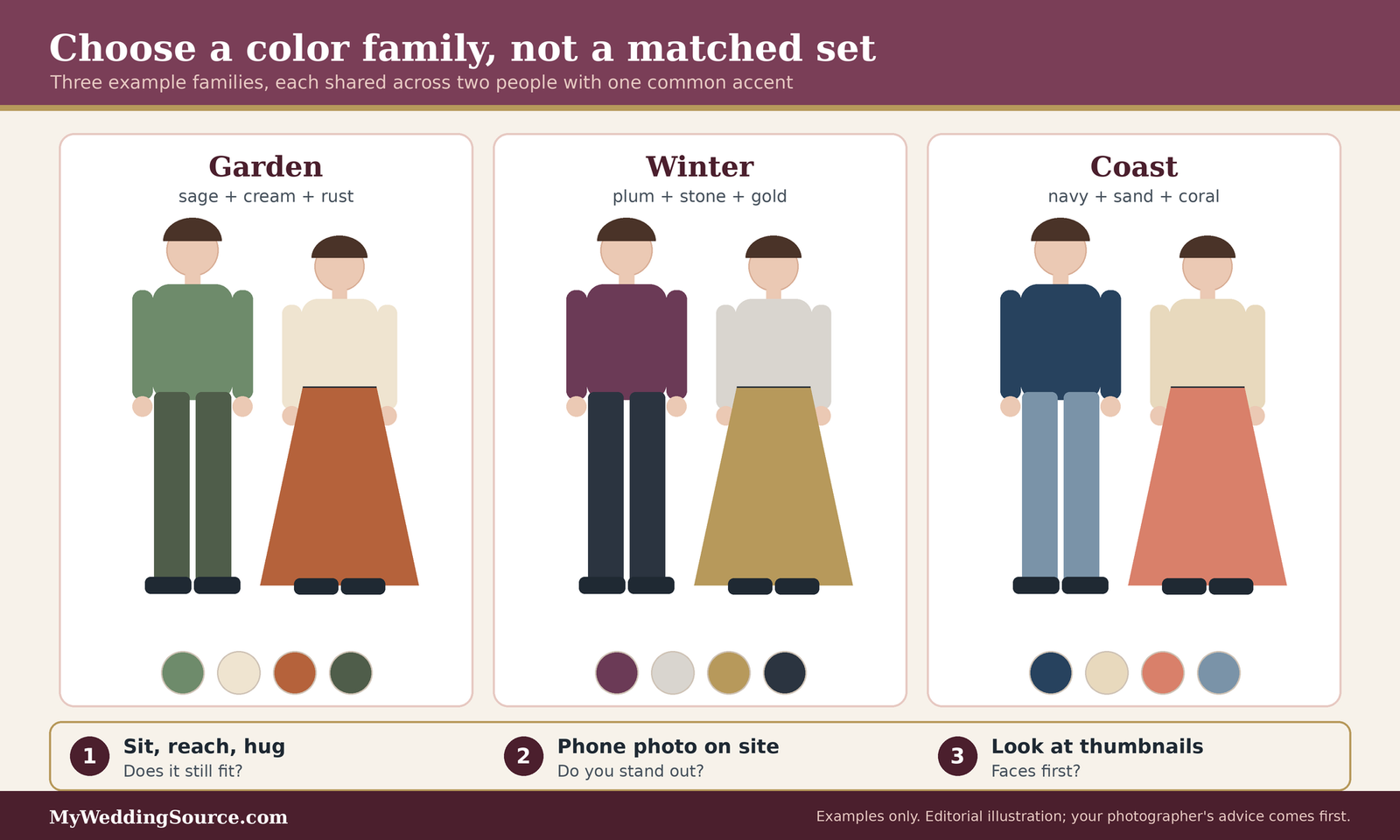
Choose a color family, not a matched set
Choosing a color family means picking three or four shades that go together, then assigning them across two people. One person might wear a deep green and the other a warm cream, with a shared accent such as rust. This reads as coordinated without looking costumed. Avoid dressing in identical colors head to toe, which can flatten the image, and avoid strong competing patterns, which can pull the eye away from faces. That is usually enough guidance for an engagement announcement photo session, and it leaves room for personality.
Test colors against the background
A color that looks lovely at home can disappear in a sunlit field or glare against a brick wall. Photograph yourselves in the outfits at the location, ideally at the planned hour, using a phone, and look at the thumbnails. If one of you blends into the background, change a layer rather than the whole outfit. The check takes minutes and saves the first twenty minutes of the session.
Be careful with whites and blacks
Very bright white can reflect light and lose detail in sun, and solid black can absorb it and feel heavy in heat. Neither is wrong. A practical option is an off-white or soft neutral for one person and a mid-tone for the other. Ask your photographer which tones their camera handles best, because style and equipment vary.
Fit, fabric, and movement
An outfit that looks good standing still can wrinkle or pull in the first five minutes of walking. Because most announcement frames include movement, such as walking, turning, or laughing, test the outfit in motion.
Fit first, fashion second
Choose clothes that fit comfortably when you sit, raise your arms, and hug. Pulling at a waistband or adjusting a strap shows in the photo as a stiff posture. If you are buying or borrowing something new, wear it for an hour at home first. Our wedding dress fit guide covers fit in more detail, and several of its ideas translate to any structured garment. For an engagement announcement photo session, comfort shows up as ease in the face and shoulders, which is what viewers notice first.
Fabric that holds up to the day
Light, breathable fabrics help in heat, and layers help in cold, but wrinkles, static, and see-through weight in bright sun are common issues. Linen creases quickly, silk shows moisture, and thin white cotton can be sheer in strong backlight. You can test these at home in a window. Steam or iron on the morning of the session, and carry a small lint roller and a few safety pins.
Shoes and the ground
Match footwear to the terrain, not to the outfit alone. Grass, gravel, sand, and trails all change what you can wear comfortably, and heels sink in soft ground. Bring a second pair for walking between spots. Photographers can frame images to hide footwear, but they cannot undo a twisted ankle, so comfort is a safety decision as well as a style one.
The ring, the hands, and the finishing details
Many announcement photos feature a hand with a ring, so small details matter more here than in most portraits.
Plan the hand shot early
If a ring photo is part of your plan, tell the photographer, and choose a nail color and shape that photographs well against your ring. Our guide to wedding nails and our comparison of manicure shapes for different ring styles explain how shape and polish interact with a ring. Book a manicure for a day or two before the session so nails are neat but not brand new. Tell the photographer about the hand frame when you book the engagement announcement photo session, not on the day.
Clean the ring and check the fit
A clean ring catches light better, and a ring that spins or slips can be distracting in a hand shot. If your ring is sized for cooler weather, heat and humidity can change how it fits. Our guide to ring sizing explains why fingers change size, and if a ring feels loose or tight, ask a jeweler before the session rather than during it.
Hair, makeup, and skin
Decide how much hair and makeup support you want, and whether a trial is worthwhile. A single engagement announcement photo session does not always call for a professional, but if you want one, our wedding hair trial and wedding makeup guides explain what to ask. Whatever you choose, keep skincare consistent in the days before so a new product does not cause a reaction on session day.
Outfit changes and who else appears
A second outfit adds variety, and extra people add warmth, but both add logistics.
Whether a second outfit is worth it
A second outfit gives you two looks for the price of one engagement announcement photo session, but it costs time, a place to change, and a bag to carry. If you want it, plan the change in a car, a restroom, or a venue room with permission, not outdoors. Photographers differ on whether a change fits within the booked time, so ask before you promise yourselves two looks.
Coordinating family or friends
If parents, siblings, children, or friends will appear in some frames, give them a color family and a short note, not a mandatory outfit. A simple message with three shades and a no-large-logo request is easier to follow. People who feel pressured can look tense, so keep the tone light, and remember it is fine for someone to opt out.
Pets, children, and plain comfort
Pets and children make delightful frames and unpredictable schedules. Plan a short window for them early in the engagement announcement photo session, bring snacks and water, and have an adult whose only job is to take them out when they tire. If the session is long or hot, a short appearance can be warmer in the photo and kinder to everyone than a long one.
The weather decision plan
This section is the working core of the guide. A weather plan is a short list of conditions that trigger a change, written before the day so no one has to negotiate in the middle of a windy field. It has four parts: heat, cold and wind, sun, and air and rain. The thresholds below come from public weather and health agencies where we could verify them, and we label the rest as suggestions.
Heat and humidity
Heat is the condition that most often turns a pleasant plan into a miserable one, partly because it builds slowly and partly because people are reluctant to complain on a special day.
Read the heat index, and add the sun
The National Weather Service explains that the heat index combines air temperature and relative humidity to show how hot it feels, and that its values assume shade and light wind. The agency also says full sun can raise the heat index by up to 15 degrees Fahrenheit. In practice that means a forecast that sounds tolerable can feel much hotter in an open field at midday, so plan for shade or an earlier hour. Add this check to your engagement announcement photo session weather plan a few days out and again the evening before.
Know the warning signs
The National Weather Service describes heat exhaustion as heavy sweating, weakness, cool, pale, clammy skin, a fast, weak pulse, cramps, dizziness, nausea, headache, or fainting, and it describes heat stroke as a severe emergency with symptoms such as confusion, slurred speech, a body temperature above 103 degrees Fahrenheit, and hot, red, dry or damp skin. For heat stroke it advises calling 911. If anyone in your party shows these signs, stop the session. No photo is worth it.
Set simple rules before you go
Agree on a pause rule: a shaded break every set interval, water within reach, and permission for anyone to call a stop without explanation. The agency’s guidance on heat illness mentions moving to a cooler place and loosening clothing for heat exhaustion. If you or a guest takes medication that can interact with heat, the Centers for Disease Control and Prevention has published guidance for clinicians on this topic, so ask a health professional before a hot session. We cannot give medical advice here.
Cold, wind, and short days
Cold weather can produce some of the most beautiful announcement photos, and it can also be the hardest on hands, faces, and patience.
Understand what wind chill measures
The National Weather Service explains that wind chill describes how cold people feel outdoors, because wind speeds heat loss from exposed skin. It is defined only for air temperatures at or below 50 degrees Fahrenheit and wind speeds above 3 miles per hour. The agency gives an example: at 0 degrees Fahrenheit with a 15 mile per hour wind, the wind chill is minus 19 and exposed skin can freeze in about 30 minutes. It also notes that bright sunshine can raise the wind chill by 10 to 18 degrees. For an engagement announcement photo session in cold months, check the wind chill, not only the air temperature.
Plan layers you can remove
The agency does not give clothing instructions on that page, so this advice is ours. Plan outfits so a coat or wrap can come off for frames and go on between them, and choose a coat that photographs well rather than one you plan to hide. Keep a warm car or a venue room close for breaks. If a shot needs bare hands, keep it brief, and warm your hands between takes.
Short days and early dusk
Cold seasons shorten daylight, which can compress your engagement announcement photo session. Use the solar calculator mentioned earlier to confirm sunset and plan to finish before the light fades, so you are not fumbling in the dark on uneven ground. If the best frames depend on a particular light, allow a buffer and avoid scheduling travel right after.
Sun and ultraviolet exposure
Sun is a comfort issue and a skin-health issue, and it is also a photographic one, because squinting and shine appear in pictures.
Use the UV Index as a guide
The Environmental Protection Agency describes the UV Index as a daily forecast of expected ultraviolet intensity, and its guidance advises seeking shade from late morning to mid-afternoon and using broad-spectrum sunscreen with an SPF of 15 or higher, protective clothing, a wide-brimmed hat, and sunglasses when the index reaches the moderate range or above. The Centers for Disease Control and Prevention likewise advises protecting your skin when the UV Index is 3 or higher, and notes that ultraviolet rays reach you on cloudy or cool days as well. Look up the UV Index forecast for the day of your engagement announcement photo session and decide in advance how you will shade and cover.
Sunscreen, hats, and sunglasses, and their photo trade-offs
The Food and Drug Administration advises broad-spectrum sunscreen with an SPF of 15 or higher, reapplication about every two hours, and sooner after sweating, and it recommends sunglasses labeled to block UV. A wide-brimmed hat protects well but can shade the face, and sunglasses can hide eyes. Because both choices involve trade-offs, take protected frames and unprotected frames in short bursts, rest in shade between them, and decide with your photographer which frames matter most.
Shade as a plan, not an accident
Look for open shade, which is shade without direct sun nearby, such as the side of a building or under a tree line. Open shade often gives flattering, even light and keeps you cooler. Scout it ahead of time at the hour you plan to shoot, because shade moves. If the location has little shade, an earlier or later hour is the simplest fix.
Rain, smoke, and the call-off rule
Some conditions end an engagement announcement photo session rather than adjust it. Deciding which ones in advance spares you a stressful debate.
Rain and wet ground
Light drizzle can be photogenic, and heavy rain, lightning, and strong wind are not. Our guide to wedding photography rain backup plans covers umbrellas, covered spaces, and indoor alternatives for the wedding day, and the same thinking applies here. Pick a covered or indoor backup before the day, and ask whether the photographer can shift to it without a fee.
Air quality and wildfire smoke
The federal AirNow program publishes the Air Quality Index, which runs from 0 to 500. Values of 101 to 150 are described as unhealthy for sensitive groups, 151 to 200 as unhealthy, and higher values as very unhealthy or hazardous. If smoke pushes the index into the range that concerns you or a guest, consider moving indoors or rescheduling. AirNow refers readers to its activity guides for specifics, and we are not giving medical advice.
Write the call-off rule
A call-off rule is a short list written before you book: who decides, how far ahead, and what conditions apply. For example, you might decide that heat index, wind chill, air quality, or lightning in the forecast the day before triggers a conversation, and that the final call happens a set number of hours before the start. Share it with your photographer and anyone traveling to join you. A call-off rule turns an engagement announcement photo session from a gamble into a plan, because everyone already agreed what happens.

Location, permission, and consent
The place you choose controls light, weather, comfort, and rules. Many couples assume a public place is automatically free to photograph in, and it often is, but not always, and not for every group size. Check the rules in the same week you pick the date, because permits and reservations can have lead times. Rules vary widely, and we cannot see yours.
Public land and national parks
Federal parks are a popular backdrop, and their rules are published, which makes them a useful example of how permit logic works even if you shoot somewhere else.
What the park pages we read say about small groups
On the Zion National Park page, the National Park Service says a still photography permit is generally required only when a shoot involves more than eight people, and that smaller shoots can be exempt if they happen in areas open to the public, use hand-carried equipment, do not need exclusive use of a site, and do not harm park resources or other visitors. The Capitol Reef page describes a similar rule. Both say commercial status does not decide the question, and each page speaks only for its own park, so another park may differ.
Wedding parties are portrait subjects
The Capitol Reef page defines models as people or objects used to promote a product or service and says portrait subjects, such as wedding parties and high school graduates, are not considered models. For an engagement announcement photo session that is a reassuring detail, but it is one park’s page. The Zion page does not address models, props, or tripods, and it suggests contacting the park to confirm what counts as hand-carried.
Larger groups, fees, and restricted areas
Zion’s page says a special use permit is required for more than eight people, up to a maximum of twelve, with an application fee of $150 due at least three weeks ahead and location fees that depend on group size. It also says photography is not permitted in designated wilderness, including most slot canyons, and on certain named trails. Capitol Reef lists different fees and processing times. Because these figures differ by park and can change, treat them as examples, not a price list.
Where the money goes
The cost of an engagement announcement photo session is mostly the photographer’s fee, plus any outfit, hair, makeup, and travel costs you choose to add. Public-land fees are usually zero for a couple and a few guests, but a large family group at a national park can add real cost. As a rough, labeled estimate using Zion’s posted figures, a party of ten would pay the $150 application fee plus a $50 per-day location fee, so at least $200, before any other permit costs the park charges. Confirm current fees with the park, because these numbers were read on one date and can change.
Private property, venues, and city spaces
Not every beautiful place is open to camera crews, even small ones, and the rules for cities, private gardens, and venues are different from federal ones.
Private owners and venue policies
Gardens, farms, restaurants, and event venues usually need permission, and some charge a fee or require insurance. Ask in writing, and ask whether the photographer’s insurance is acceptable. If you plan to shoot at the venue where you may marry, ask whether it counts as a site visit and whether the venue has preferred vendors, a point our wedding vendor contract guide explains.
City parks and public property
City and county parks sometimes require a permit for professional photography, tripods, or groups, and the rules differ widely. A parks and recreation office can tell you in a short call or email. Our guide to proposal location permissions walks through the same questions for proposals, and the answers often carry over to a portrait session.
Public and private are not the only categories
Between public and private, there are semi-public spaces, such as campuses, transit stations, and shopping areas, that have their own rules, security staff, and times. If a place does not publish a policy, ask before you arrive. A short permission email can prevent an interrupted session, and a photographer who works locally often already knows the answers.
Consent for the people in the frame
An engagement announcement photo session often includes people who did not sign a contract, such as relatives, strangers in the background, or guests. Consent is a courtesy and, in some situations, a legal question, and we do not give legal advice.
Ask guests before you plan to post them
Tell family and friends in advance if they will appear in photos you plan to post, and give them an easy way to say no. Some people have safety, privacy, or custody reasons for staying out of public images. Our guide to wedding planning website privacy and security discusses sharing images with care.
Do not record anyone secretly
Do not hide a camera or microphone to capture guests without their knowledge, and do not ask a photographer to do so. Rules about recording differ by state and by whether audio is involved, and secret recording damages trust even where it is allowed. If you want candid frames, tell people a photographer will be working and that you will share the results.
Children and minors
If minors appear, get a parent or guardian’s agreement first, and ask whether the photographs may be posted or only printed. Some families prefer not to share children’s faces online. Honor that without argument, and consider a back-of-head or hands-only frame for those children.
Working with the photographer: agreements and deliverables
The photographer relationship is where most surprises hide. The agreement should settle who owns what, when you get files, what happens if the weather forces a change, and how the images may be used.
Rights, licenses, and usage
Photos feel like yours because you are in them, but the law treats authorship separately. Knowing the basics helps you read a contract.
Who owns the copyright
The U.S. Copyright Office explains that the author who creates a work initially owns its copyright, and that a transfer of exclusive rights generally must be in writing and signed by the owner or their authorized agent. For photographs, that usually means the photographer holds the copyright unless an agreement says otherwise, and you receive a license to use the images. This is general information, not legal advice.
Work made for hire is narrower than people assume
The Copyright Office’s guidance on works made for hire says a commissioned work qualifies only if it falls into one of nine statutory categories, is covered by a written agreement that expressly says it is a work made for hire, and is signed by all parties. Because the categories are specific, you should not assume a photographer’s portraits count. If the contract uses that phrase, ask what it means in your case and consider asking a lawyer.
Ask what you can do with the images
A license can allow personal use, social posting, printing, and card production, and it can exclude commercial use or editing. Ask whether you may crop, apply filters, or let a card designer place text. Our guides to wedding photo retouching requests and wedding photo raw files explain two areas where expectations differ. Because an engagement announcement photo session produces images meant to be shared, the license matters more here than for a private keepsake.
Scheduling, deposits, and weather terms
Because weather can move your engagement announcement photo session, the contract should say what happens when it does.
Reschedule and cancellation terms
Ask whether the photographer reschedules for weather, how much notice is needed, and whether a deposit transfers to the new date. Ask what happens if you cancel for other reasons, and whether there is a cap on reschedules. Put these terms in writing, along with a rule for who decides. Our wedding vendor contract guide shows common clauses to look for. A reschedule clause is the most useful single line in an engagement announcement photo session agreement.
Time on location
Ask how long the booking lasts, whether travel and setup count toward it, and what overtime costs. An engagement announcement photo session with two outfit changes and a walk between spots needs more time than a single-location portrait. Plan the order of locations to match the light and the walking distance, and give yourselves a buffer for parking and restrooms.
Backup photographer or shared files
Ask what happens if the photographer is ill on the day. Some studios have an associate who can step in, and others reschedule. Our guide to wedding vendor subcontractors explains why you should know in advance who might arrive. Ask where files are stored after delivery and for how long.
Delivery, selection, and sharing
Once the engagement announcement photo session is over, the work shifts to choosing, delivering, and sharing.
Previews and final files
Ask whether you will see a preview, how many final images you receive, and whether you can request specific frames. Some photographers deliver a gallery in an online system with download limits. Ask about download windows, and save your files in more than one place. Our guide to sorting wedding photos without getting overwhelmed offers ways to choose without second-guessing.
Credit and tagging
Photographers often ask for credit when images are posted. This is reasonable in many cases, and it is fair to agree on how and where it appears. If you do not want a location tagged, say so, and ask the photographer not to tag it either, because location tags can reveal where you live or travel.
Match the post to your announcement order
Review your announcement plan one more time before you post. If someone in the family has not been told, hold the post. Our engagement announcement guide includes ideas for wording, and the engagement party article can help if you plan a gathering soon after. A finished engagement announcement photo session still leaves one decision, which is when and to whom the photos go out.
Edge cases and special situations
Not every engagement announcement photo session follows the typical path. These situations come up often enough to plan for.
Surprise proposals and proposal photos
Some proposals include a hidden photographer, and that creates its own wardrobe and timing constraints.
When the proposal and the session are the same day
If a photographer captures the proposal, one person has chosen the outfit and the other has not. Because the proposer cannot ask, they can suggest an occasion, such as a dinner, that requires nicer clothes. Our guide to private versus public proposals discusses how setting changes the experience, and the sibling guide on a proposal picnic setup will cover one specific scene.
Weather on a proposal day cannot be rescheduled
A planned proposal has a backup plan only if you make one. If the photographer is hidden, brief them on the weather plan and an indoor alternative. Agree on a signal to move the moment, and remember that people matter more than the picture.
Follow up with a planned session
If the proposal photos are limited, a short planned engagement announcement photo session within a few weeks can fill gaps. The wardrobe and timing steps above apply, and you can use the proposal frames to decide which poses you liked.
Long distance and far-apart families
Couples who live in different places or have relatives scattered across the country face extra constraints.
Choosing a location that works for both
If you live in different cities, pick a location near one of you, and plan the second person’s travel. Check that both people can be there at the planned hour, and add a buffer for delays. If travel is uncertain, a backup date is especially valuable.
Sharing the news across time zones
Time zones affect when people see a post. Decide whether you want a coordinated moment, and tell relatives in different regions in advance so no one finds out late. This is a courtesy question, not a technical one.
Including people who cannot attend
A video call, a printed photo, or a short message can include relatives who cannot attend. Ask the photographer to capture a frame with a phone screen only if everyone agrees, and be mindful of recording rules.
Accessibility, health, and comfort
A good engagement announcement photo session is one everyone can enjoy, which means planning for mobility, health, and sensory needs.
Mobility and terrain
If anyone uses a mobility aid or tires easily, choose a location with a short, level approach and seating. Ask the photographer to plan shots that minimize walking, and arrange parking close to the spot. Our guide to accessible wedding guest experience explains how to ask about access at a venue.
Health conditions and medications
If you or a guest has a medical condition, take breaks, carry necessary medication, and tell one person where it is. For conditions affected by heat or sun, ask a clinician beforehand. We cannot give medical advice, and no photograph requires you to push through discomfort.
Sensory and social comfort
Some people find long sessions or direct camera attention stressful. Ask the photographer about a slower start, quiet breaks, and a prompt-based style rather than directed poses. Tell them what helps you relax, and agree on a word that pauses everything.
Questions to ask before you book
Good questions make the plan concrete. Ask for answers in writing, and keep them with your agreement.
Questions worth asking before you book
- How do you handle weather, and what is the reschedule policy and fee?
- When will I receive a preview, and when will the final images arrive?
- What license do I receive, and may I print, post, and use the photos on a card?
- Do you carry insurance, and do you know the permit rules at our location?
- How long is the booking, and does travel or an outfit change count toward it?
- What happens if you are unavailable on the day?
- May I see a full gallery from a similar session in similar light?
About the session
These questions help you decide whether the photographer fits your plan.
Style and light
Ask to see galleries from the season and time of day you are considering, not only a highlight reel. Consistency across a full gallery tells you more than a single stunning image. Ask how they handle harsh midday sun, since your schedule may force it. Ask what they would change about your planned hour for an engagement announcement photo session.
Logistics and location knowledge
Ask whether the photographer has worked at your location and knows its rules, shade, and crowd patterns. A photographer who can suggest a quieter time or a better angle is saving you effort. Ask whether they can offer an indoor backup nearby.
About the agreement
These questions protect you when plans change.
Rights and delivery
Ask what the license covers, how images are delivered, and how long the gallery stays online. Ask whether you may share images with a card designer or printer. Put the answers in the agreement, not only in an email thread.
Changes and cancellations
Ask for the terms on weather changes, illness, and cancellations, and for the cutoff dates. Ask whether a deposit transfers. A clear policy is a sign of a professional, and a vague one is worth a follow-up question.
FAQ: engagement announcement photo session questions
Wardrobe and preparation
What should we wear to an engagement announcement photo session?
Choose a shared color family rather than matching outfits, and pick clothes that fit comfortably while moving. Test the outfits against the location in a phone photo, check thumbnails, and bring a spare layer. Your photographer can advise on tones and textures that suit their style and the light.
Do we need a second outfit?
No. A second outfit adds variety, but it also adds time, a place to change, and more to carry. If you want one, ask the photographer whether it fits within the booking and plan the change indoors or in a car, not outdoors.
Should we hire hair and makeup?
It is optional. Professional support can help if you want a polished look or have little time, while a simple routine can work well otherwise. If you hire someone, book a short trial and keep skincare consistent beforehand so a new product does not cause problems.
How do we dress family who join us?
Share a color family and a short note, not a strict outfit. Ask people to avoid large logos and very busy patterns, and let anyone opt out. Keep the tone relaxed, because people who feel pressured tend to look stiff.
Timing, weather, and permission
What is the best time of day?
It depends on your location and season. Early morning and late afternoon bring longer shadows and, according to the EPA’s shadow rule, usually lower ultraviolet exposure. Use a sun calculator for your location, and ask your photographer what works with their style and your outfits.
What happens if the weather is bad?
That depends on your agreement. Ask in advance about reschedules, fees, and who decides. Agree on a call-off rule using heat index, wind chill, air quality, and lightning, and plan a covered or indoor backup so a change does not mean starting over.
Do we need a permit to shoot in a national park?
It depends on the park and the group size. On the pages we read, small groups of eight or fewer using hand-carried equipment in public areas were generally exempt, while larger groups needed a permit. Check the specific park’s page and contact them before you go.
When should we post the photos?
After you have told the people who should hear from you first, and after you hold the final files. Allow time to choose and edit, and check your agreement for credit and tagging requirements. There is no required deadline, so take the time you need.
Your next steps
Make the core decisions
Pick a palette and test it
Choose a color family, assign shades across two people, and take a phone photo at the location. Look at thumbnails, adjust one layer if needed, and stop. Simple choices photograph better than perfect ones.
Choose two dates and an hour
Write a primary date, a backup date, and a target hour using a sun calculator. Share them with your photographer and anyone traveling. Our wedding planning checklist can help you place the session in the wider timeline.
Close the loop on the details
Write the weather and call-off rule
List the conditions that trigger a change, who decides, and the backup location. Keep it to a few lines. Send it to the photographer before you sign.
Confirm permission and paperwork
Check park, city, or venue rules, and ask for permission in writing. Review the agreement for license, delivery, and weather terms. For ring photos, our wedding photographer shot list shows how to ask for detail shots.
Sources & methodology
How we built this guide
What we relied on
This guide draws on National Park Service permit pages for two parks, the Environmental Protection Agency’s UV Index scale, National Weather Service pages on heat and wind chill, federal air quality and sun-safety guidance, a NOAA solar calculator page, and U.S. Copyright Office explanations of authorship and works made for hire. We read each page on November 12, 2026. Where a statement rests on a source, the text says so, and our own suggestions about outfits, colors, and scheduling are labeled as editorial judgment. The cost figure is our own arithmetic from one park’s posted fees and is an estimate.
What we did not do
We did not test cameras, clothing, or locations, and we did not interview photographers. We did not give legal, medical, or financial advice. Park fees and rules are specific to the park and the date we read them, and they can change. Confirm every rule, fee, and policy with the park, venue, or photographer before you book.
Source list
Public land, rights, and legal sources
- National Park Service, Zion National Park, Filming and Still Photography: https://www.nps.gov/zion/planyourvisit/filming-and-still-photography.htm
- National Park Service, Capitol Reef National Park, Filming and Photography Guidelines: https://www.nps.gov/care/planyourvisit/filmphoto.htm
- U.S. Copyright Office, Copyright Basics (Circular 1): https://www.copyright.gov/circs/circ01.pdf
- U.S. Copyright Office, Works Made for Hire (Circular 30): https://www.copyright.gov/circs/circ30.pdf
- U.S. Copyright Office, FAQ: Who can claim copyright: https://www.copyright.gov/help/faq/faq-who.html
Weather, air, sun, and health sources
- Environmental Protection Agency, UV Index Scale: https://www.epa.gov/sunsafety/uv-index-scale-1
- Centers for Disease Control and Prevention, Skin cancer prevention: https://www.cdc.gov/skin-cancer/prevention/index.html
- Food and Drug Administration, Tips to stay safe in the sun: https://www.fda.gov/consumers/consumer-updates/tips-stay-safe-sun-sunscreen-sunglasses
- National Weather Service, Wind chill: https://www.weather.gov/safety/cold-wind-chill-chart
- National Weather Service, Heat index: https://www.weather.gov/safety/heat-index
- National Weather Service, Heat illness: https://www.weather.gov/safety/heat-illness
- AirNow, Air Quality Index basics: https://www.airnow.gov/aqi/aqi-basics/
- NOAA Global Monitoring Laboratory, Solar Calculator: https://gml.noaa.gov/grad/solcalc/
- Centers for Disease Control and Prevention, Heat and medications guidance for clinicians: https://www.cdc.gov/heat-health/hcp/clinical-guidance/heat-and-medications-guidance-for-clinicians.html