

Wedding catering is the largest single line of work between you and a good reception: it covers what guests eat and drink, who prepares and serves it, what equipment it needs, and how the whole thing is priced, so the best decisions start with what must fit your day before anyone talks about menus.
Quick answer
Choose your service style first, because it sets staffing, equipment, timing, and most of the price. Then build a menu around your guest list’s real needs, decide how the bar will work, and compare caterers only after you have turned every quote into the same all-in, per-guest figure. For scale: The Knot’s 2025 Real Weddings Study put the average at $80 per person for 2024 weddings, while Zola’s 2026 cost index lists food and bar separately. Neither number is a quote, so treat both as a sanity check, and get the scope, fees, and cancellation terms in writing before any deposit.
This guide is written for couples who are about to hire a caterer, or who have a venue that supplies one and want to understand what they are buying. We use two kinds of evidence and keep them apart. Survey and cost-index figures come from The Knot and Zola, with the year and what we know about each. Anything labeled an estimate, an example, or a scenario is our own arithmetic or illustration, built with assumptions we state, and none of it is a price anyone will quote you. We are not a caterer, we do not sell catering, and we have no list of “best” caterers to hand you, because the right choice depends on your venue, guest list, and season. If you want the wider plan around this one decision, our wedding planning guide and wedding planning checklist cover the rest of the sequence.
What wedding catering covers before you compare anyone
Before you compare proposals, it helps to agree on what the phrase actually covers, because two companies can both say they handle wedding catering and mean very different things. One may deliver trays of food to a kitchen and leave. Another may supply the food, the servers, the bar, the plates, the linens, the cake cutting, and the cleanup. The price gap between those two proposals is mostly a scope gap, and you cannot judge it until you know which pieces are in the box.
The pieces inside a wedding catering contract
Most wedding catering proposals are built from the same handful of components. Seeing them as separate lines lets you notice when one is missing.
Food, preparation, and service labor
The core is the menu: the cocktail hour, the dinner, and any dessert or late-night food. Attached to it is labor. Someone cooks, someone plates or replenishes, someone clears, and someone manages the pacing so courses reach tables when the toasts end. The Knot’s cost explainer describes a typical package as including food, alcoholic and non-alcoholic drinks, and waitstaff, and notes that rentals such as dinnerware, tables, and chairs may or may not be included. Zola’s cost guide says a basic package usually covers the food, service staff, standard plates, glassware and flatware, setup, breakdown, and a service charge. Those two descriptions do not match exactly, which is the point: “typical” varies by company, so the proposal in front of you is the only description that counts.
Bar service, rentals, and extras
Alcohol and bar service are sometimes bundled with the caterer and sometimes bought separately from a bar company or the venue. Rentals can include tables, chairs, linens, china, flatware, glassware, serving pieces, and chafing equipment. Extras include cake cutting, a champagne toast, late-night food, and vendor meals for your photographer and band. Each one can be a line item, a flat fee, or nothing at all depending on the company. A full proposal should let you see every one of them.
What the venue may already decide for you
Many couples start comparing caterers and only later discover that the venue has rules. It is better to learn those rules first, because they can remove half your options in one afternoon.
In-house, preferred list, or open wedding catering
A venue may require its own kitchen, offer a short list of approved caterers, or allow any licensed outside company. Zola’s guide advises checking a venue’s vendor policies, including required caterer lists and kitchen fees, before you tour, and it reports that venues sometimes charge outside caterers a kitchen or access fee in a range it gives as $500 to $2,000. We could not verify that range independently, so treat it as one publisher’s estimate and ask each venue for its actual policy and cost in writing.
Kitchen access, power, and alcohol rules
Whether a caterer can cook on site depends on the venue’s kitchen, its power, its water, and the loading route. Alcohol rules vary too: some venues require their own license or bartenders, and some forbid outside alcohol. Because liquor and food-service licensing are set at state and local levels, we do not generalize them here. The safe move is to ask the venue for its wedding catering rules in writing and share them with every caterer you are considering.
Setting your priorities, guest count, and budget range
A clear brief for your wedding catering saves you from paying for features you will not notice. Before you request a single proposal, write down the facts that determine what kind of caterer you need.
Turning your day into selection criteria
The reception is a system of constraints, and wedding catering sits in the middle of it. Your venue, headcount, season, hours, and budget fit together, and changing one tends to move the others.
Venue, season, and hours
Start with the room and the clock. Where will dinner be served, and can the room hold a buffet line without a traffic jam? Is the venue indoors, outdoors, or a tent? Does the season push toward cold salads and shade, or hot soups and indoor holding? How long is the reception? A cocktail reception with heavy hors d’oeuvres runs on a different rhythm than a three-course plated dinner, and the start time affects whether guests arrive hungry. These facts reduce the field before you ever discuss flavor.
Guest count and what it does to pricing
Guest count matters, but not in a straight line. The Knot reports no meaningful difference in per-person wedding catering cost between small and large guest lists, and says its per-person averages are multiplied by guest count to get example totals of $4,000 for 50 guests, $8,000 for 100, $12,000 for 150, and $16,000 for 200. That is simple multiplication, not survey data. Zola, on the other hand, says per-person costs can climb to $75 to $100 for very small weddings of 25 to 50 guests because caterers have minimums of roughly $2,500 to $4,000, and that 75 to 100 guests tends to sit near the national average. The two sources disagree on how much size matters, which is a reason to ask each caterer about its own minimums and tiers rather than assuming a rate.
Separating needs from preferences
Not everything on your list is equal. A decision gets easier when you sort it into things that must be true and things you would like.
Hard requirements
Hard requirements are the items that break the day if they fail. Examples include a kitchen the venue will actually allow, safe options for guests with allergies, a menu that respects religious or cultural food rules in your families, the ability to serve everyone within a fixed ceremony-to-toast window, and a total you can pay without borrowing against the honeymoon. If a caterer cannot meet one of these in writing, move on, however good the sample plate looked.
Visual and stylistic preferences
Preferences are the pieces that add pleasure but can bend: a specific cuisine, a raw bar, branded cocktail napkins, a particular plate shape, a dessert display. Mark each preference with how much you would pay to keep it. Doing this on paper now means the conversation with a sales manager stays about your plan instead of theirs.
Using the budget tools in the right order
Wedding catering takes a large share of any wedding budget, so it helps to set the number before the sales conversation, not after it.
Start from the share, not the dream menu
Zola’s cost index data says wedding catering food alone averaged $6,927 and bar and beverage services averaged $5,541, which it describes as roughly 14% and 11% of an average wedding budget, about a quarter combined. If you enter your own total into our wedding budget calculator, you can see what a similar share would mean for your numbers, then adjust up or down for how much food and drink matter to you. The Knot’s survey found 58% of couples said food and beverage were the most important elements of their wedding, so many couples deliberately spend above the average here.
Decide where the money moves from
If wedding catering needs more than your plan gives it, something else must give. Maybe the guest list shrinks, the bar menu narrows, the cake becomes a smaller display, or another category absorbs a cut. Decide that trade before you tour, so a persuasive tasting does not make the decision for you.
Choosing a service style
Service style is the wedding catering decision that shapes everything downstream: how many staff you need, how long dinner takes, what equipment you rent, how the room is laid out, and the final price. Pick it deliberately.
How the common styles actually work
Each wedding catering style has a different mechanical logic. Understanding it helps you predict where problems appear.
Plated dinner
Guests sit and servers bring each course, usually with a choice of entrée made in advance. Zola describes this as the most formal approach and typically the costliest because it needs more servers. Your guests’ choices have to be collected on the RSVPs and mapped to table seating, which adds paperwork and a risk of mix-ups if the escort cards or meal markers are wrong. In return you get a clean, controlled pace and tables that stay settled during toasts.
Buffet
Guests go to one or more food lines. Zola describes buffets as typically more cost-effective because they need fewer service staff. A buffet gives guests choice, includes more dishes, and can handle more dietary variety on one table. The trade-off is time: a long line of guests, a limited number of serving lines, and a room that may need to release tables in waves. The Food Allergy Research and Education organization lists buffets among higher-risk settings for cross-contact because foods sit close together and share utensils, which matters if anyone in your group has a serious allergy.
Family-style, stations, and cocktail receptions
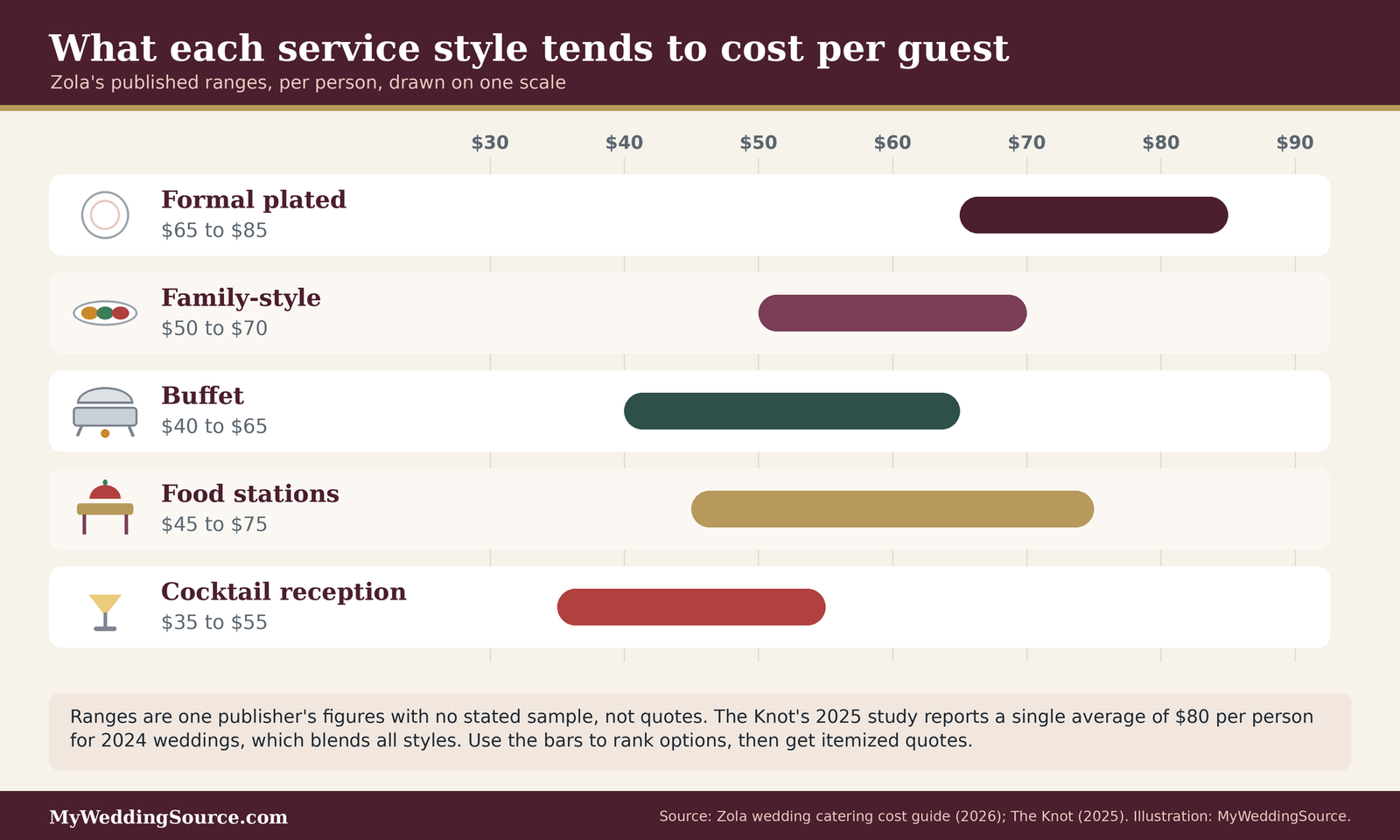
Family-style puts platters on each table, and Zola calls it a middle ground that encourages sharing. Food stations spread multiple small cooking or carving points around the room, and a cocktail reception skips the seated dinner for substantial passed and displayed food. Zola’s cost guide lists approximate per-person ranges for each: $65 to $85 for a formal plated dinner, $50 to $70 for family-style, $40 to $65 for a buffet, $45 to $75 for food stations, and $35 to $55 for a cocktail reception with heavy appetizers. These are one publisher’s ranges without a stated sample, so use them to rank options and not to predict a quote.
Matching a style to the wedding you are actually having
The same style works well in one setting and poorly in another. The matrix below summarizes our own editorial judgment about fit. It is not a ranking of quality, and each row has exceptions.
| Style | Fits best when | Main trade-offs | What to confirm | Where it can fail |
|---|---|---|---|---|
| Plated | Formal evening, toasts at tables, guest list under about 150, a kitchen with proper staging | More servers, advance entrée choices, less flexibility on the day | Server-to-table ratio, entrée counts per table, how substitutions are handled | Courses arrive late if the kitchen cannot stage; mix-ups at tables |
| Buffet | Wide dietary variety, casual or family-focused crowd, room for multiple lines | Lines, slower release of tables, allergen cross-contact risk | Number of lines, who tends the line, sneeze guards, hot and cold holding equipment | Long waits, food sitting out too long |
| Family-style | Shared-meal feel, round or long tables with space for platters | Platters need table room, portions can run out at the end of the table | Platter count per table, refill plan, who carries heavy trays | Crowded tables; uneven sharing |
| Stations | Mingling-focused event with space to move | Needs floor space and extra staff per station, uneven line lengths | Station attendants, power and water needs, traffic flow | Bottlenecks at the most popular station |
| Cocktail reception | Shorter event, non-traditional timeline, guests who will eat standing | Guests may be hungry if the menu is thin; seating is limited | Total pieces per guest, seating for older guests, timing of savory vs. sweet | Guests leaving early and still hungry |
| Food truck or casual | Backyard or relaxed venues with parking and permission | Power, permits, line time, weather | Local permit rules, generator or hookups, line capacity | A single window cannot serve a large crowd quickly |
Who each style suits
The pattern is simple. Choose plated if control, formality, and a polished timeline matter more than flexibility. Choose a buffet or stations if dietary variety, mingling, and a relaxed pace matter more. Choose family-style if you want shared tables and your venue can fit platters. Choose a cocktail reception if the event is shorter or your guests will mostly be on their feet.
Who should avoid each style
Avoid plated if your kitchen is small or your RSVP follow-up is unreliable. Avoid buffets if someone close to you has a serious food allergy and the caterer cannot separate serving equipment, or if the room cannot hold lines. Avoid stations if the floor plan is tight. Avoid cocktail-only service if many older guests need seats or if you expect guests to be hungry for hours.
The hidden operating costs of each style
The menu price is only the visible half. Each style also changes the invisible operating requirements, and those show up on the invoice in labor and rentals.
Setup, staging, and cleanup
A plated dinner needs staging space near the dining room for plating and holding, and enough servers to clear in sync. A buffet needs tables, linens, heating or chilling gear, and attendants. Stations need power, water, and in some cases a cooking surface that complies with local fire rules. Ask each caterer to describe how they will set up your specific room, because a company that has not seen the space is guessing.
The cost of changing your mind late
Switching styles after a contract is signed can change staffing, rentals, and even the menu, so the revision may cost more than the original difference in price. Decide before the deposit, and ask what happens if you want to move from, say, buffet to plated four months out.
Choosing the kind of wedding catering company
Not every kitchen that can cook for a wedding is built for wedding catering. The type of company you hire changes how much of the job you manage yourself, and it should be matched to your tolerance for logistics as much as to your taste.
Full-service, venue, and restaurant options
These are the three most common routes, and each hands you a different amount of responsibility.
Full-service wedding caterers
A full-service caterer handles menu planning, cooking, service staff, often bar service and rentals, and the event-day management. This is the route that carries the most scope in a single contract, which can simplify coordination and make the price easier to normalize. It also means one company’s mistake can touch several parts of your day, so references and written terms matter more.
Venue-supplied wedding catering
Some venues include wedding catering or require it. That can mean a familiar kitchen, a staff that knows the room, and one point of contact for food, bar, and equipment. The trade-off is less choice: menus may be fixed, you may be locked into minimum spends, and you cannot compare a rival company. Ask for the menu, the pricing structure, the fees, and the minimums in writing, and ask what flexibility exists for dietary needs and personal dishes.
Drop-off, trucks, and restaurant partnerships
Lighter-service wedding catering options can make sense for small, casual, or budget-focused weddings, provided you are honest about the gaps.
Drop-off, take-away, and restaurant wedding catering
A restaurant or caterer may deliver food in trays and leave. That may be enough if you have a venue kitchen, a team of family or friends, rented serving equipment, and someone who will manage timing. It is not a good match if you need staff on site, formal service, or someone to take responsibility for food held at the right temperature for hours. Before you choose it, decide who will set up, heat or chill, serve, clear, and clean, and what each person will actually do.
Food trucks and interactive formats
The Knot reports that 13% of couples had an interactive food experience and 4% had a food truck. Zola says trucks can reduce traditional venue wedding catering fees and add a festival feel. Confirm local permit and parking requirements, power or generator needs, and how many guests the truck can serve per hour, since a single window can create a long line. Plan a backup for rain and ask what happens if the truck cannot arrive.
Who each option is not suitable for
Honesty about the limits of each wedding catering option saves money later.
When a lighter option is the wrong choice
If your guest list is large, your venue is complex, you have guests with serious allergies, or the weather is hot and the service will be outdoors, a drop-off arrangement with unpaid helpers puts a lot of pressure on a few people during your wedding. Choose staffed service where the risk is highest.
When a full-service option is more than you need
If you are planning a small gathering, a cocktail party, or a brunch, a full-service caterer with a formal proposal might be larger than the event. Ask whether a smaller package exists. Zola notes that smaller weddings may encounter caterer minimums, so confirm what a minimum covers before you pay it.
A wedding catering menu is not only a list of dishes. It is a promise about what thirty or three hundred specific people can eat, in a specific order, at a specific temperature, in a room you may not control. Building it well is mostly a matter of asking who is coming and what could go wrong.
Starting from your guest list, not a food trend
Trends are fun and worth borrowing from, but your guest list is the actual brief for wedding catering.
Dietary needs and religious or cultural food rules
Gather dietary information on your RSVP card or website, and ask for it as a specific field, not as a vague “let us know.” The Knot’s 2025 study reports that 58% of couples accommodated guests with specific dietary needs, which means it is common enough that every caterer you interview should have a standard process. Ask how they collect, label, and serve special meals, and whether a vegetarian or vegan entrée is a real dish or just a plate of side items. Zola’s guide estimates special dietary meals such as vegan, gluten-free, or kosher can add roughly $8 to $15 per meal, but that is an estimate, and some caterers charge nothing extra for them, so get the policy in writing.
Personal and family dishes
Some couples want a dish from a grandparent’s kitchen or a regional food that signals where they come from. The Knot reports that 15% of couples incorporated food tied to their background or culture, and Zola reports couples moving beyond a default chicken-or-fish choice toward dishes that reflect travels, heritage, or fusion. If you want a personal dish, ask whether the caterer is willing to prepare it, whether you will supply a recipe, and how it will be tested before the wedding, since a recipe scaled to a hundred plates behaves differently than one made for a family table.
Handling allergies as a safety issue, not a menu note
Allergies in wedding catering belong in a different category from preferences because the consequences are medical. We are not medical professionals and this is not medical advice, so involve the guest and, if appropriate, their clinician.
What the law covers, and what it does not
The U.S. Food and Drug Administration lists nine major food allergens: milk, eggs, fish, crustacean shellfish, tree nuts, peanuts, wheat, soybeans, and sesame. Sesame became the ninth after the FASTER Act, signed in April 2021, and the change took effect on January 1, 2023. The FDA also says its labeling requirements cover packaged and labeled foods and do not apply to most foods sold at retail or food service establishments that are not pre-packaged with a label. In plain terms, that means a plate served at your reception does not come with a label, so the protection you rely on is the caterer’s process and your communication, not a package.
What to ask the caterer
Food Allergy Research and Education suggests asking how a dish is prepared, whether the kitchen can prepare food without cross-contact, and whether desserts are made in-house, because purchased desserts may contain hidden allergens that staff cannot confirm. It also advises avoiding high-risk settings such as buffets and being cautious with grilled and fried foods unless the allergen is not cooked on the same equipment. Bring those questions to your caterer: Who prepares the allergen-free meals? Where are they plated? How are they delivered to the right guest? Does the cake or dessert vendor list its ingredients? Put the guest’s name and the specific allergen on your written order so nothing relies on memory.
Tastings and what to do with them
A wedding catering tasting is your best opportunity to evaluate the actual product and the people behind it. Use it as a test, not a ceremony.
What a tasting can and cannot prove
A tasting shows flavor, seasoning, and presentation for a small batch made by a kitchen with time to focus. It does not show how that dish holds for an hour in a chafing dish, how it is plated at volume, or how it travels from a kitchen to your venue. Zola reports that tastings are typically complimentary for weddings above 100 guests or contracts above $10,000, and that smaller weddings may pay $100 to $300, often credited toward the final bill if you book. Those are Zola’s figures, so confirm each company’s policy.
Questions to ask at a tasting
Ask how each dish is held and served. Ask what changes at volume. Ask whether the plated portions you see are the real portions. Ask which items they would simplify for your style of service. Bring the allergen and dietary list so the kitchen can speak to it directly, and take notes and photos so you can compare tastings objectively later instead of relying on memory.
Cocktail hour, dessert, and late-night food
The meals around dinner are where many weddings quietly overspend or run short.
Planning the pieces around dinner
The Knot’s study reports that 66% of couples served a dessert other than wedding cake, 52% had a dessert bar or table, and 27% served late-night snacks. Those are survey percentages, so they describe what some couples chose, not what you should do. Zola’s FAQ guidance suggests ordering late-night snacks for about 60% to 75% of the guest count, though it does not cite the source of that rule. As arithmetic only, for 120 guests that range would be 72 to 90 portions. Whatever number you use, ask your caterer what their experience is and whether leftovers are charged.
Cake cutting and dessert service
If a separate baker supplies the cake, ask the caterer whether a cake-cutting fee applies and what it covers. Zola lists cake cutting at about $1 to $3 per slice in its guide, with the caveat that fees vary. Keep a running list of who is delivering what and when, so the cake, the cutting, and the coffee do not fall between two vendors.
Bar and beverage service
Beverage service is part of the same wedding catering decision. It affects budget, safety, pacing, and the mood of the reception, and it often sits in a different contract from the food.
Choosing a bar structure
The structure you choose decides who pays, how guests behave, and how much complexity your bartenders face.
Open bar, limited bar, and cash bar
An open bar lets guests order from a full menu with the hosts paying. A limited bar offers beer, wine, and maybe one or two signature drinks. A cash bar asks guests to pay. Your decision is about hospitality and budget, and it is worth a frank conversation with whoever is paying. Zola’s guide estimates bar add-ons of $12 to $18 per person for beer and wine and $25 to $35 per person for a full premium bar, and says limiting service to beer, wine, and signature cocktails can lower alcohol costs by roughly 40% to 60%. Those are publisher estimates, not quotes, but they show why the menu design changes the total so much.
Non-alcoholic options
Zola’s 2026 coverage says most couples offer non-alcoholic choices alongside beer, wine, or spirits and describes mocktail menus as rising, while saying fully dry weddings are not becoming more common. Including real non-alcoholic drinks serves guests who do not drink, are driving, are pregnant, or are in recovery, and it costs little compared with the rest of the bar. Ask the bar vendor to quote them as part of the menu so those guests have something with the same quality of glass and garnish.
Doing the drink math with standard sizes
You do not need a formula from a vendor to understand how much a bottle can serve. The National Institute on Alcohol Abuse and Alcoholism defines a U.S. standard drink as about 14 grams of pure alcohol, which equals 12 fluid ounces of regular beer, 5 fluid ounces of table wine, or 1.5 fluid ounces of 80-proof spirits.

How many pours are in a bottle
A standard 750-milliliter bottle holds about 25.4 fluid ounces. At a 5-ounce pour, that is about five glasses. A one-liter bottle of spirits holds about 33.8 fluid ounces, which is about 22 pours of 1.5 ounces. This is our own unit conversion, and actual pours vary with the glass, the bartender, and the drink recipe, so treat the numbers as a planning floor. Ask your bar vendor how many glasses of wine they expect from a case.
Why your vendor’s estimate beats a rule of thumb
Consumption depends on the length of the reception, the time of day, the crowd, the food, and whether the bar is open during the ceremony break. A bar company with experience in your venue and season can estimate better than a general rule can. Ask for their assumed drinks per guest per hour, and ask what happens if you run short or have extra, because many companies handle returns of unopened bottles differently.
Keeping the bar safe and legal
Because rules on alcohol service, licensing, and liability differ by state and sometimes by city, we cannot tell you what yours require. We can tell you what to ask.
License, insurance, and who serves
Ask who holds the liquor license for the event and whether the bartenders are employees of a licensed company or friends doing a favor. Ask whether the venue requires you to carry event insurance and whether it recommends a specific policy for alcohol service. Read any event policy’s exclusions before you rely on it. Check the answers with your venue and a local professional, because this is general education, not legal advice.
Pacing and cutoffs
Plan when the bar opens, when it pauses during the ceremony and dinner service, and when it closes. Agree with the bartenders on a protocol for guests who have had too much and how transportation will work at the end of the night, such as shuttles or ride-share pickup points listed on your website.
Staffing, rentals, and the logistics nobody photographs
The parts of wedding catering that guests never see are often the parts that decide whether the evening runs smoothly. Staffing, equipment, and logistics deserve as much attention as the menu.
Understanding who is actually working your reception
A proposal may list a menu in detail and mention staff in one line. Ask for more detail on how the event will be staffed.
Roles on the day
At a typical seated reception you may have a lead or event captain who coordinates the kitchen and floor, cooks or a chef, servers, bartenders, and people who set up and break down. Not every company uses the same titles or numbers, and a small wedding catering company may combine roles. Ask for the planned roster for your event: how many servers, how many bartenders, who is the single point of contact on the day, and whether that person will be the same one you meet beforehand. Our editorial advice is to ask for the ratio in writing instead of assuming, because we did not find an authoritative standard for staffing ratios and we will not invent one.
Vendor meals and the people who need to eat
Photographers, videographers, planners, DJs, and bands often work through dinner and need to be fed. Zola’s guide says caterers typically charge about 50% to 75% of the per-person rate for vendor meals and suggests planning for 8 to 12 of them depending on the team. As our own arithmetic only, at a hypothetical $72 per-person rate that would be $288 to $648 for the range of vendor meals Zola describes. Ask whether the caterer has a simplified vendor meal, and tell your other vendors what to expect. Our wedding photographer shot list helps you decide when your photographer needs a break, which tells you when to schedule that meal.
Rentals and equipment
Rental details are where an apparently low wedding catering proposal gets expensive, because a base price may assume you will supply everything else.
What is usually rented
Common items are tables, chairs, linens, dinner plates, flatware, glassware, serving platters, chafing dishes, and bar equipment. A venue may include some of these, a caterer may bundle others, and a rental company may supply the rest. Zola says a basic package may include standard plates, glassware, and flatware, and recommends asking about package deals that bundle linens, rentals, and service. Write down every item your wedding catering needs, who provides it, and what happens if something is broken or missing.
Counting, delivery, and return
Ask who counts the inventory at delivery and pickup, and who is responsible if a count comes up short. Check the delivery window and whether it requires someone from your side to be on site. Ask how early the rental company can deliver and when they will pick up, since a late-night reception may mean pickup the next day.
Venue logistics that affect the kitchen
The food has to be cooked, held, and carried, and the venue’s physical layout determines how.
Kitchen, power, water, and access
Visit the kitchen with your caterer if possible. Check where trucks can park, how food gets from the kitchen to the dining room, and whether there are stairs, long hallways, or elevators to manage. If cooking happens in a tent or outdoor area, ask how power, water, and weather protection will work. Ask the venue about loading hours, noise rules, and trash removal.
Weather, backup plans, and the unexpected
Outdoor events need a plan for rain, heat, and wind. Heat has a direct food-safety effect, as the next section explains. Ask the caterer what their backup is if a tent is delayed, a generator fails, or an oven stops working, and make sure the answer matches what the venue allows.
Food safety and timing on the day
You are not expected to supervise a kitchen, but you can ask questions that show whether a caterer takes safety seriously, and you can plan a timeline that does not work against them.
The rules of thumb that protect your guests
Federal food-safety guidance gives a few simple numbers that anyone planning wedding catering or any meal for many people should know. We use the U.S. Department of Agriculture’s Food Safety and Inspection Service as the source here.
Temperature and time limits
USDA explains that bacteria multiply fastest between 40°F and 140°F, a span it calls the danger zone, and that they can double in as little as 20 minutes in that range. Its guidance says perishable food should not sit out of refrigeration for more than two hours, or more than one hour when the temperature is above 90°F. For serving, it says to keep hot food at 140°F or above and cold food at 40°F or below. Those numbers are why buffets need chafing dishes or ice, and why an outdoor summer reception needs more careful planning than a winter one.
Regulation depends on where you live
The FDA publishes the Food Code as practical, science-based guidance for restaurants and retail food, and states and territories decide whether to adopt it. The FDA reports that as of December 31, 2025, 14 states and 3 territories had aligned at least one agency with the latest version, so the specific rules, inspections, and wedding catering permits that apply to your caterer depend on your state and locality. Ask for the company’s license or permit, and ask your venue whether it has any additional requirements.
Building a service timeline that respects the food
Timing is a safety tool and a guest-experience tool at once. Rushed meals and meals that wait too long both hurt.
Working backward from the toasts
For wedding catering, plan the timeline from the point at which dinner needs to be served, then work back. If toasts happen before the meal, add time. If dancing begins right after cake cutting, decide whether dessert is served at tables or stations. Our wedding timeline guide covers the planning calendar as a whole, and you can share your reception schedule with the caterer so the kitchen can plan to it. Ask the caterer to confirm that the schedule is realistic for the style of service you chose.
Where delays come from
The most common sources are late ceremonies, long photo sessions, extended toasts, and slow lines. Each pushes dinner later, and a plated meal that waits in a kitchen can suffer. Give the caterer a contact person who can say “go” or “hold,” and agree on how long food can wait before the kitchen must adjust. If a delay is going to be longer than the caterer’s tolerance, they should tell you early rather than quietly serve food that has lost its quality.
Designing the guest experience
Good wedding catering that arrives badly is a worse experience than ordinary food that arrives well. Think about the guest’s evening from arrival to departure, and the food becomes part of a rhythm instead of an item.
Comfort, access, and pacing
A reception with good wedding catering works when people are fed on time, can reach the food, and are comfortable while they wait.
Seating, lines, and mobility
If you are serving a buffet, think about guests who use mobility aids, older relatives, and parents with children. Ask whether servers can bring plates to those guests, whether the line height and aisle width allow wheelchair access, and whether tables are near the restrooms. Our guide to planning a wedding covers the wider layout choices, and your caterer should help you look at the room for pinch points.
Children, vendors, and the host table
Ask whether the caterer offers a children’s meal and at what price. Give your vendors a time and a place to eat. Decide whether the head table is served first, last, or simultaneously. Small decisions like these prevent awkward gaps where a guest looks around for the person who was supposed to bring their plate.
Communicating the menu to guests
Guests will make better choices about wedding catering and have fewer questions when they can see what is being served.
Menu cards and dietary labels
For plated meals, collect entrée choices on the RSVP and mark them clearly at tables. For buffets and stations, label dishes with the main ingredients and mark the major allergens. A label from a caterer is a communication from the company, so ask how it is prepared and who is responsible for accuracy. Tell guests with serious allergies to speak directly with the caterer or event captain, not with a server who may not know the kitchen.
Attire, climate, and the food people can manage
If you ask for cocktail attire, many guests will be dressed in more structured clothing and may prefer food they can eat neatly while standing. Our cocktail attire guide explains what that dress code means, and it is worth matching the menu to it: handheld pieces for a standing reception, forks and knives for a seated one. In hot weather, favor lighter dishes that survive the temperature, and in cold weather give guests warm options.
What wedding catering costs, and how to compare quotes fairly
Prices for wedding catering are easy to find and hard to compare. Published averages use different definitions, and proposals use different structures. The method below gives you a repeatable way to compare any two quotes.
Reading published averages carefully
Averages for wedding catering are useful as context and dangerous as targets.
What the national numbers say
The Knot’s 2025 Real Weddings Study, which surveyed almost 17,000 U.S. couples who married in 2024, reports an average wedding catering cost of $80 per person, with a regional range of $62 to $123 per person and averages of $79 for hometown weddings, $104 for domestic destination weddings, and $114 for international destination weddings. Its historical averages run from $70 in 2019 to $75 in 2021 and 2022, $85 in 2023, and $80 in 2024. Zola’s 2026 cost index reports catering food at an average of $6,927 and bar and beverage services at $5,541.
Why the two sources look different
They are not measuring the same thing. Zola separates food from bar, and The Knot’s per-person figure appears to include food and drinks. As our own arithmetic, if you divide Zola’s catering average by the 145-guest average from its 2026 First Look Report, you get about $48 per guest for food. Add the bar average and the figure is about $86 per guest. That is in the neighborhood of The Knot’s $80, but it is a rough comparison between two surveys whose methods we cannot fully see, not proof that they agree. We also do not know whether each number reflects planned or paid amounts, so use them as ballparks and not as targets.
Cost check
The Knot reports $80 per person (2024 weddings, near 17,000 couples surveyed). Zola’s index shows $6,927 for catering food and $5,541 for bar and beverage. Our arithmetic across Zola’s two averages and its 145-guest average gives roughly $86 per guest for food plus bar. These are context numbers, not quotes, and your region, season, venue, and menu can move them a great deal. Never budget from an average alone: budget from itemized, all-in quotes.
The quote-normalization method
The method turns every wedding catering proposal into one comparable number. It takes about an hour per quote and prevents most surprises.
Five steps to an all-in per-guest figure
First, list what each quote includes: food, service labor, bar, rentals, linens, setup, cleanup, cake cutting, and vendor meals. Second, find every mandatory add-on: service charge, administrative fee, delivery, kitchen fee, and overtime. Third, ask what tax applies and to which parts of the invoice, since tax rules vary by state and locality, and you should confirm them with the caterer or a local professional instead of assuming. Fourth, price what is missing by getting a quote from the other vendor or by making a clearly labeled estimate. Fifth, divide the total by the guest count you expect to pay for, not the guest count you hope will attend.
A worked example with made-up numbers
The figures below are hypothetical and exist only to show the method. Suppose you have 120 guests and two proposals. Caterer A quotes $72 per person for food, plus a 22% service charge, with rentals not included and sales tax of 8% assumed on food and the service charge. Caterer B quotes $84 per person all-in with service, linens, plates, and glassware included, with the same 8% assumed on the total. Zola reports that service charges commonly fall in an 18% to 22% range, so the 22% here is plausible, but your quote may differ.
| Line | Caterer A | Caterer B |
|---|---|---|
| Headline price per person | $72 | $84 |
| Food at headline price (120 guests) | $8,640 | $10,080 |
| Service charge | $1,901 (22%) | included |
| Rentals (assumed $14 per guest, quoted separately) | $1,680 | included |
| Assumed sales tax (8%, on food and service charge only) | $843 | $806 (8% on total) |
| All-in total before any tip | $13,064 | $10,886 |
| All-in per guest | $109 | $91 |
In this made-up case the cheaper headline price becomes the more expensive proposal once everything is counted. The reverse can easily happen in real life, which is the whole point of normalizing. If Caterer A’s 22% charge does not cover gratuity and you tip an additional 15% on food, as a second example, you would add about $1,296, which raises A to roughly $120 per guest. Whether a tip is expected on top of a service charge is a question for the contract.

Service charges, gratuity, and tipping
This is the part of a proposal where the same words mean different things at different companies.
Service charge versus gratuity
Zola says a service charge of about 18% to 22% of food and beverage usually goes to the company, while a gratuity of 15% to 20% is customarily distributed among the service team, so you may see both. The Knot’s tipping guidance says that if gratuity is already listed in the contract or invoice, extra tipping is generally unnecessary, and if it is not, 15% to 20% of the food and drink fee, divided among waitstaff and bartenders, is a common tip, with $200 to $300 for the maître d’. Both sources are publisher guidance, not rules. The takeaway is to ask for the exact label on each fee and who receives it.
What the tax rule means for you
The Internal Revenue Service addressed automatic gratuities in Revenue Ruling 2012-18. As we read the ruling and a law-firm summary of it, the ruling says whether a payment is a tip is a question of facts, and a mandatory charge is likely a service charge treated as wages for the employer, not a voluntary tip. For you, the useful point is that a mandatory “gratuity” on a contract may not behave like the voluntary tip you would choose to leave. It is employer and tax law, so we are not advising on it. Just ask the caterer in plain words: is this fee optional, and does it all go to the staff?
Ways to lower the bill without lowering the quality
There are sensible ways to reduce the total. They work better when you choose them on purpose.
Date, day, and menu choices
Zola’s guide reports that Friday evening can save roughly 10% to 15% and Sunday afternoon roughly 15% to 20%, with off-peak scheduling in general giving 15% to 25%, and it notes that figures vary. It also gives a chicken dinner around $28 per person against filet mignon around $65, which shows how much a protein choice can change a total. These are publisher estimates, so ask caterers to price your options directly. Our budget calculator can show what a reduced wedding catering line frees up elsewhere.
Where cutting hurts
Be careful about cutting staff, food quantity, and timeline buffers, because those are the places guests feel it. A narrower bar menu or a simpler dessert is usually less noticeable than hungry guests or slow service. Ask each caterer which changes they recommend and which they would not.
When your wedding catering does not fit the standard mold
Most wedding catering advice assumes a Saturday dinner for 100 to 150 guests in a venue near home. Plenty of weddings are different, and the same decisions land differently when the guest list, location, or format changes.
Small weddings and micro-celebrations
Small guest lists open wedding catering options and close others.
Minimums and per-person pricing
Zola says caterer minimums of about $2,500 to $4,000 can push per-person costs to $75 to $100 for weddings of 25 to 50 guests. If that is your range, ask each company what its minimum actually covers, whether it applies to food only or to the entire invoice, and whether a different style, such as a family-style meal or a cocktail reception, avoids it. Restaurants with private rooms, and caterers who specialize in small events, may fit better than companies that mostly serve large weddings. As arithmetic only, a $3,000 minimum spread across 30 guests is $100 per guest, so a minimum can matter more than the menu.
Intimate formats that change the service model
A small group makes room for a shared tasting-style meal, a chef’s table, or family platters, and it makes a plated dinner feel personal instead of formal. It also means a single missed detail, such as an unlabeled dish, is more visible. Ask whether the chef can speak with each table, and whether the menu can be adjusted close to the date for new dietary needs.
Destination and multi-day weddings
Location affects both the price and the process of wedding catering.
What the survey says about cost by location
The Knot’s 2025 study reports wedding catering averages of $79 per person for hometown weddings, $104 for domestic destination weddings, and $114 for international destination weddings. Those figures describe what couples reported, not what you will pay, and the same study shows regional averages from $62 at the low end to $123 at the high end. If you are comparing locations, treat the gap as a reason to request local quotes early.
Working with a caterer you cannot visit
If you cannot be on site, ask for video tastings, a detailed written menu, local references, and a named on-site lead. Confirm the permits and licensing that apply in that jurisdiction, because rules differ between states and countries. Ask how food and ingredients are sourced locally and what happens in case of weather or supply problems. Consider hiring a local planner or coordinator who can see the venue and the kitchen for you.
Welcome dinners, brunches, and extra events
Zola reports that 37% of couples host at least one extra event during their wedding weekend, although it does not give a source for that statistic. If you plan one, treat it as a separate wedding catering decision.
Rehearsal dinners and welcome events
An extra event has its own guest count, timing, and style, and it may fit a different kind of caterer than the main reception. A casual buffet, a restaurant buyout, or a food truck can be a good counterpoint to a formal dinner. Price it separately so it does not disappear into the main contract, and decide who is paying.
Day-after brunches
A brunch is usually simpler to execute and lighter on staffing, and it can be a place to use leftover decor or a smaller guest list. Ask whether the caterer or the venue offers a package, and check what the venue’s rules say about extra hours and fees. Zola lists overtime at $50 to $100 per hour per staff member, so check what counts as overtime in each contract.
Contracts, policies, and what to verify before money is nonrefundable
A good wedding catering proposal feels like a promise, but only the contract is a promise. We are not lawyers and this is general education only. Ask a local attorney if you want advice about your specific contract.
Turning verbal promises into written terms
Anything a salesperson said that mattered to your wedding catering decision should appear in the contract.
What to confirm in writing
At minimum, get the date, times, venue, and the name of the lead person in writing. Confirm the menu with specific dishes and quantities, the service style, staffing, bar details, rentals, and any items you were told were included. Confirm the price per person, every fee, how tax is applied, and when the final guest count must be provided. Ask whether the price is locked, and under what conditions it can change. Ask for the allergen process, and for the substitution policy if an ingredient is not available.
Questions to ask every caterer
- Which exact items are included in the per-guest price, and which are extra?
- What fees apply on top of the menu price, and which of them are optional?
- Is the service charge or gratuity shared with the staff, and does it replace a tip?
- How is sales tax applied to this invoice, and does it cover the service charge?
- When is the final guest count due, and can it go up or down after that?
- What is the deposit schedule, and what is refundable if we cancel or postpone?
- How do you handle severe allergies, and who is accountable for those plates on the day?
- What happens if you are unable to provide a menu item or a staff member?
- What licenses and insurance do you carry, and may we see proof?
- Who will manage the event on the day, and how can we reach them?
Keep a record of what was promised in conversation
After every call or meeting, send a short email summarizing what you understood: the dishes, the quantities, the fees, and any exception the caterer agreed to. Ask them to confirm by reply or to update the contract. A written summary does not replace the contract, but it shows what both sides understood, and it makes gaps visible while they are still cheap to fix. Save these emails in the same folder as the signed documents.
Cancellation, postponement, and substitutions
Weddings change, and a wedding catering contract is where those changes become expensive or easy.
Deposits, payment schedules, and refunds
Ask what portion of each payment is a nonrefundable retainer and what is a prepayment toward food. Ask what happens if you reduce the guest count, change the date, or cancel. Ask whether a postponement transfers the deposit to a new date and whether the price can rise. Keep copies of every payment and receipt. For anything contested, a local attorney or consumer protection office can tell you what your state’s rules say.
Substitutions and shortages
Ask what happens if an ingredient is unavailable or a supplier fails. A good contract describes substitutions of similar quality and value and requires notification. Ask if you can approve substitutes and what compensation applies if the substitution is materially worse.
Verification checklist before you sign
A checklist turns anxiety about wedding catering into a short to-do list. The table below pairs the proof you want with the term you should find and the fallback you want if it fails.
| What to verify | Proof to request | Contract term to find | Fallback if it fails |
|---|---|---|---|
| Menu and quality | Tasting notes, photos of plated portions | Named dishes, portion sizes, quantity per guest | Written right to approve substitutions |
| Dietary and allergy handling | Written process and named contact | Allergy plates specified by guest and allergen | Alternative caterer for those plates, or a pre-approved packaged option |
| Staffing | Roster and role description | Number of servers, bartenders, and a named event lead | Replacement procedure and reduction in fee if short |
| Fees and tax | Itemized quote | Every fee labeled, its recipient, and tax treatment | Written cap on late changes |
| Licenses and insurance | Copies of permits and insurance | A clause stating the caterer is licensed and insured | Right to cancel for loss of license |
| Rentals and equipment | List of items and delivery timing | Inventory, delivery, pickup, breakage terms | Backup rental vendor |
| Cancellation and postponement | Written policy | Refund schedule, transfer terms | Event insurance review with your own advisor |
| Timeline | Run of show | Service start time and flexibility window | Named person with authority to adjust |
Why paperwork protects both sides
A clear contract helps caterers too. It limits disputes about what was promised and lets the kitchen order exactly what you agreed to. Use the table as a conversation guide, and keep copies where both partners and your planner can reach them. Our planning checklist can hold the dates for deposits, final counts, and tastings.
Reading with a second pair of eyes
Ask someone who has not been in the sales conversation to read the contract and mark anything that surprises them. If a fee is unclear, ask the caterer to explain it in writing, not just by phone.
A risk register for your wedding catering plan
Experienced planners often keep a short list of the things that could go wrong and what they would do about each. You can do the same with a single page. The point is not to worry; it is to decide in advance, when you are calm, who acts and how.
Building the register
A useful register has four columns: the risk, the early warning sign, the prevention you can put in place now, and the fallback if prevention fails.
Pick the risks that match your wedding
Do not copy a generic list. Choose from the situations that fit your setup: a tent in July, a venue kitchen you have not seen, a large buffet, a guest with a severe allergy, a caterer with few reviews, a bar run by friends. Each of these changes which risks matter. The table below gives a starting point, and it is our own editorial synthesis, not a statistical ranking.
| Risk | Early warning sign | Prevention | Fallback |
|---|---|---|---|
| Food held too long in heat | Outdoor service, long photo session, no chilling or heating plan | Ask how hot and cold food will be held; schedule service close to the toasts | Caterer adjusts service order; named person can call “hold” or “go” |
| Allergy cross-contact | Vague answers on allergy process; shared serving equipment | Written allergy process; named guests and allergens on the order | Separate pre-plated meal, or a guest’s own safe meal arranged ahead |
| Short staffing | Roster not provided; unclear ratio | Ask for the planned roster in writing | Contract clause on replacement staff or fee adjustment |
| Surprise fees | Proposal lists only a per-person price | Itemized quote; labeled fees and recipients | Written cap on additional charges |
| Rental shortage | No inventory list | Written count and delivery checks | Backup rental vendor |
| Late dinner | Tight ceremony-to-toast gap | Shared timeline; a decision-maker on site | Cocktail hour extended with extra passed food |
| Wrong guest count | RSVPs trickling in | Final-count deadline on your checklist | Agreed process for last-minute adds |
| Vendor cancellation | Thin contract, no insurance proof | Verify license and insurance; clear cancellation terms | A list of backup caterers |
Assign an owner to each row
A risk with no owner is just a worry. Give each row a person: you, your partner, your planner, a venue coordinator, or a trusted relative. Tell the person and give them the caterer’s contact. That way, on the day, the caterer is not forced to find an answer from the one person who is posing for photos.
Using the register during the weeks before the wedding
A register is most useful when you revisit it.
Review it at fixed points
Look at the register when you sign, when you hold the tasting, when the final count is due, and a few days before the wedding. Cross out risks that are resolved and add any new ones. Our wedding planning checklist has room for dates like these, and a shared document works for most couples.
Keep it small
If the list grows past a page, it stops being used. Keep the five or six risks that would genuinely hurt your day and handle the rest through the normal contract and timeline. A tight list that gets read is better than a long one that does not.
The final fit test and your fallback plan
The last stage of wedding catering planning is checking the chosen caterer against the real conditions of your wedding, then preparing for the case where something fails.
Testing the plan against reality
Before the final payment, check the pieces together instead of one by one.
Walk the day from the kitchen to the table
Trace a plate from the kitchen to the table, a drink from the bar to a guest, a vendor meal from the kitchen to the band, and a dessert from the display to the dance floor. At each step ask who does it, how long it takes, and what could slow it down. If the caterer has not visited the venue, arrange a walk-through. Share the final timeline, the table layout, and the dietary list.
Confirm numbers and details a few days out
Reconfirm the headcount, the entrée counts, the allergy plates, the arrival times of the caterer and rental deliveries, and the contact numbers for the day. For wedding catering in particular, make sure at least one person on your side, a planner, venue coordinator, or trusted friend, holds the key details and can make decisions so you do not have to.
Having a fallback
Good planning includes a plan for the unlikely case.
What if a vendor fails
Ask your caterer what they would do if a key staff member is out, if a delivery is late, or if equipment fails. Keep a list of two or three nearby restaurants that could deliver in an emergency, and know whether your contract lets you adjust the headcount at the last minute. The aim is not to expect failure but to know in advance who decides what.
What if guests are hungrier or fewer than expected
Ask about extra portions, how leftover food is handled, and whether late-night food can be ordered on short notice. Ask for a few additional entrées for unexpected guests and ask what the caterer does with food that goes unserved, since policies differ. A flexible plan costs little and saves a lot of stress.
Frequently asked questions
Choosing and pricing
How much should I budget for wedding catering?
The Knot reported an average of $80 per person for 2024 weddings, and Zola’s 2026 index lists food at $6,927 and bar at $5,541. Those are national averages. Your quotes may be higher or lower depending on region, season, menu, and venue, so use averages as context and decide from itemized proposals.
Is a buffet cheaper than a plated dinner?
Often, because a buffet generally needs fewer servers, according to Zola, which lists buffets at $40 to $65 per person and plated dinners at $65 to $85. The difference is not guaranteed. Menu, rentals, and staffing for lines and service can narrow the gap, so compare all-in quotes.
What is the difference between a service charge and a tip?
A service charge is a fee set by the caterer, and Zola says it usually goes to the company. A tip or gratuity is typically given to the service team. Contracts label these differently, so ask what each fee is called, who receives it, and whether it replaces a tip.
Do I need to feed my photographer and band?
Many vendors expect a meal when they work through dinner, and Zola says caterers often charge 50% to 75% of the per-person rate for vendor meals. Ask your caterer about a vendor meal option, and tell each vendor what to expect, including when they can eat.
Safety and logistics
How do I handle guests with food allergies?
Collect allergy details on your RSVP, then speak with the caterer about how those plates will be prepared and delivered. Food Allergy Research and Education suggests asking about cross-contact and ingredients. Packaged-food allergen labeling does not apply to most unpackaged meals served at events, so put the process in writing. This is not medical advice.
How long can food sit out at a reception?
USDA guidance says perishable food should not be left out of refrigeration for more than two hours, or one hour when it is above 90°F, and that hot food should stay at 140°F or above and cold food at 40°F or below. Ask your caterer how they hold food for your service style and season.
Can I bring in my own caterer to my venue?
It depends on the venue. Some require in-house wedding catering, some have preferred lists, and some allow any licensed company, sometimes with a kitchen fee. Zola mentions fees of $500 to $2,000 as one estimate. Ask the venue for its wedding catering policy in writing before you sign anything with a caterer.
When should I book and finalize?
We did not find an authoritative source for a single correct booking date, so we will not state one. Ask your venue and caterers about their availability and their deadlines for deposits, tasting, and final counts. Our wedding timeline guide can help you place those dates in a larger schedule.
Your next steps
Set the foundation
Write your one-page wedding catering brief
Record your venue’s rules, guest count range, dietary needs, service style preference, bar approach, hours, and a total budget. Share the same brief with every caterer so the proposals can be compared fairly. Our wedding budget calculator helps you decide the number before the sales conversations start.
Check the venue before the caterer
Ask the venue for its wedding catering policy, kitchen details, rental inventory, and alcohol rules in writing. If you are still organizing the wider plan, our wedding planning guide shows how this decision fits among the others.
Compare and decide
Normalize every quote
Use the five-step method above to convert each proposal to an all-in per-guest figure, then compare the figures and the scope side by side. Mark anything missing and ask the caterer to fill the gap in writing.
Schedule tastings and a walk-through
Book tastings with your top two or three, bring your dietary list, and ask for a walk-through of the venue with the lead who will run your event. Put each tasting, deposit, and final-count date on your planning checklist.
Close it out
Review the contract with a second reader
Use the verification table, then sign only when each answer is in writing. If any legal point is unclear, ask a local attorney.
Share the final plan
Give the caterer, planner, venue, photographer, and band the same timeline and contact list a few days before the wedding.
Sources & methodology
How we built this guide
What we relied on
This guide combines current U.S. wedding-industry survey and cost-index material from The Knot and Zola, federal guidance on food safety, food allergens, alcohol standard drinks, and tax treatment of mandatory service charges, and advice from a food-allergy advocacy organization. Where a statement comes from a publisher or a vendor-facing guide, we say so, because those figures describe survey respondents or the publisher’s estimates and not what any caterer will quote you. The per-guest comparisons, the hypothetical quote comparison, the bottle-pour conversions, and the vendor-meal and minimum examples are our own arithmetic from the stated assumptions, and they are estimates and illustrations.
What we did not do
We did not collect quotes from caterers, taste food, or inspect kitchens, and we did not find authoritative sources for staffing ratios or booking lead times, so we do not state them. We do not give legal, tax, medical, or insurance advice. Alcohol licensing, catering permits, sales tax on service charges, and contract law vary by state and city, so confirm them with your venue, your caterer, and a local professional.
Source list
Wedding-industry survey and cost sources
- The Knot, Average wedding catering cost (updated March 27, 2025, citing the 2025 Real Weddings Study of 2024 weddings): https://www.theknot.com/content/average-cost-wedding-catering
- The Knot, How much to tip wedding vendors (updated January 26, 2026): https://www.theknot.com/content/wedding-vendor-tipping-cheat-sheet
- Zola, Wedding catering costs (updated February 19, 2026): https://www.zola.com/expert-advice/cost-of-wedding-caterers
- Zola, Wedding food and mocktail ideas, 2026 trends and costs (updated February 19, 2026): https://www.zola.com/expert-advice/wedding-food-ideas-trends
Government and regulatory sources
- U.S. Department of Agriculture, Food Safety and Inspection Service, danger zone and food-handling guidance: https://www.fsis.usda.gov/es/node/3295
- U.S. Food and Drug Administration, Food allergies (nine major allergens, FASTER Act): https://www.fda.gov/food/nutrition-food-labeling-and-critical-foods/food-allergies
- U.S. Food and Drug Administration, Adoption of the FDA Food Code by state and territorial agencies: https://www.fda.gov/food/fda-food-code/adoption-fda-food-code-state-and-territorial-agencies-responsible-oversight-restaurants-and-retail
- National Institute on Alcohol Abuse and Alcoholism, What is a standard drink: https://www.niaaa.nih.gov/alcohols-effects-health/what-standard-drink
- Internal Revenue Service, Revenue Ruling 2012-18 (mandatory charges and tips): https://www.irs.gov/pub/irs-drop/rr-12-18.pdf
Professional and advocacy sources
- Food Allergy Research and Education, Dining out with food allergies: https://www.foodallergy.org/media/1719/download
- Foley and Lardner, Automatic tipping: impact of IRS rules change on the hospitality industry: https://www.foley.com/insights/publications/2014/01/automatic-tipping-impact-of-irs-rules-change-on-th/