

Wedding thank you cards are easy to write one at a time and surprisingly hard to finish as a batch, so the couples who get through them calmly are the ones who decide the timing, the wording, and the gift record before the first present arrives.
Quick answer
Write a note for every gift, however small, and for every person who helped. The published etiquette sources we read agree on the outer limit: within three months, with notes for gifts that arrive before the wedding going out sooner, usually within two to three weeks. Name the gift, say how you will use it, keep it to a few sentences, and sign it from both of you. If you are late, send the note anyway, acknowledge the delay in one line, and move on to the thanks. Wedding thank you cards are a courtesy, not a legal duty, and none of this is legal or financial advice.
Who needs a thank-you card, and who gets another kind of thanks
Most couples picture wedding thank you cards as a stack addressed to guests who sent a present. That stack is the biggest part of the job, but the full list is wider, and it is worth drawing the whole list before you buy stationery so that you order the right number of wedding thank you cards and stamps.
The guest list is only part of the list
The etiquette sources we read all describe the same core rule for wedding thank you cards: anyone who gave you something should hear from you in writing. They differ a little on who else belongs on the list, so it helps to separate people into two groups, givers and helpers, and then check for overlap.
Everyone who gave something
Emily Post’s wedding advice says to send a note for engagement, shower, and wedding gifts, even if you already thanked the giver in person. Emily Post’s thank-you page adds money to the same list, including checks, savings contributions, and charity donations, and both that page and Zola say that every person who chipped in on a group gift should receive their own card. Zola puts the rule of thumb simply: when you are unsure whether someone needs a note, write one. A practical way to apply that is to treat the gift log you will build later as the master list, and to add a line for any person who did something kind even if no object changed hands.
Everyone who helped
The helpers list is the part people forget. Emily Post mentions friends and family who baked, took photos, or arranged flowers, as well as shower hosts and anyone who put up out-of-town guests. Its longer thank-you page also lists your attendants, your parents or whoever hosted, and vendors who went beyond expectations, and says notes to other vendors are optional. Zola names florists and people who housed the wedding party during a shower weekend. If you hosted a rehearsal dinner or had a relative lead a reading, those people belong here too. Because these wedding thank you cards tend to be more personal and go to people you know well, many couples write them first, while the details are fresh.
When a card is the wrong tool
Not every kind of gratitude fits on a card, and a few situations call for something in addition to or instead of one. The sources are consistent that a card is the baseline for gifts, but they treat some relationships differently.
Thanks in person is not a substitute
It is natural to thank someone warmly at the reception and feel finished with wedding thank you cards. Emily Post says the in-person thanks does not replace the note, and its advice is explicit that a generic thank-you post on your wedding website or an email blast does not stand in for a personal note either. The reason wedding thank you cards still matter is practical as much as social. A gift can arrive after the wedding, a card is a record that you noticed it, and a few written sentences are easy for the giver to keep. If you want to add a phone call for a shipped gift, Emily Post suggests following the call with a written note within a day or two.
Vendors and professionals
Vendors are paid for their work, so one of these wedding thank you cards to a photographer, caterer, or officiant is a gesture rather than an obligation. Emily Post says notes to vendors who exceeded expectations are worth sending and that other vendors are optional. We would add one editorial suggestion, which is that a brief, specific note about what someone did (the florist who rebuilt an arrangement in the rain, the photographer who stayed late) is more useful to them than a generic line, and a public review is a separate task from a thank-you note. Our guides on wedding photography and choosing a wedding officiant cover what to expect from those professionals before the day.
How the timing rules for wedding thank you cards fit together
Ask three sources how long you have for wedding thank you cards and you will hear “three months” from all of them. The detail inside that answer is where couples get confused, because the sources start the clock at different moments. Reading them side by side shows a simple pattern.
Three clocks, not one deadline
The clearest way to organize the advice is to run three separate clocks. Gifts that arrive early start one, gifts that arrive around the wedding start another, and the three-month outer limit sits behind both.
Gifts that arrive before the wedding
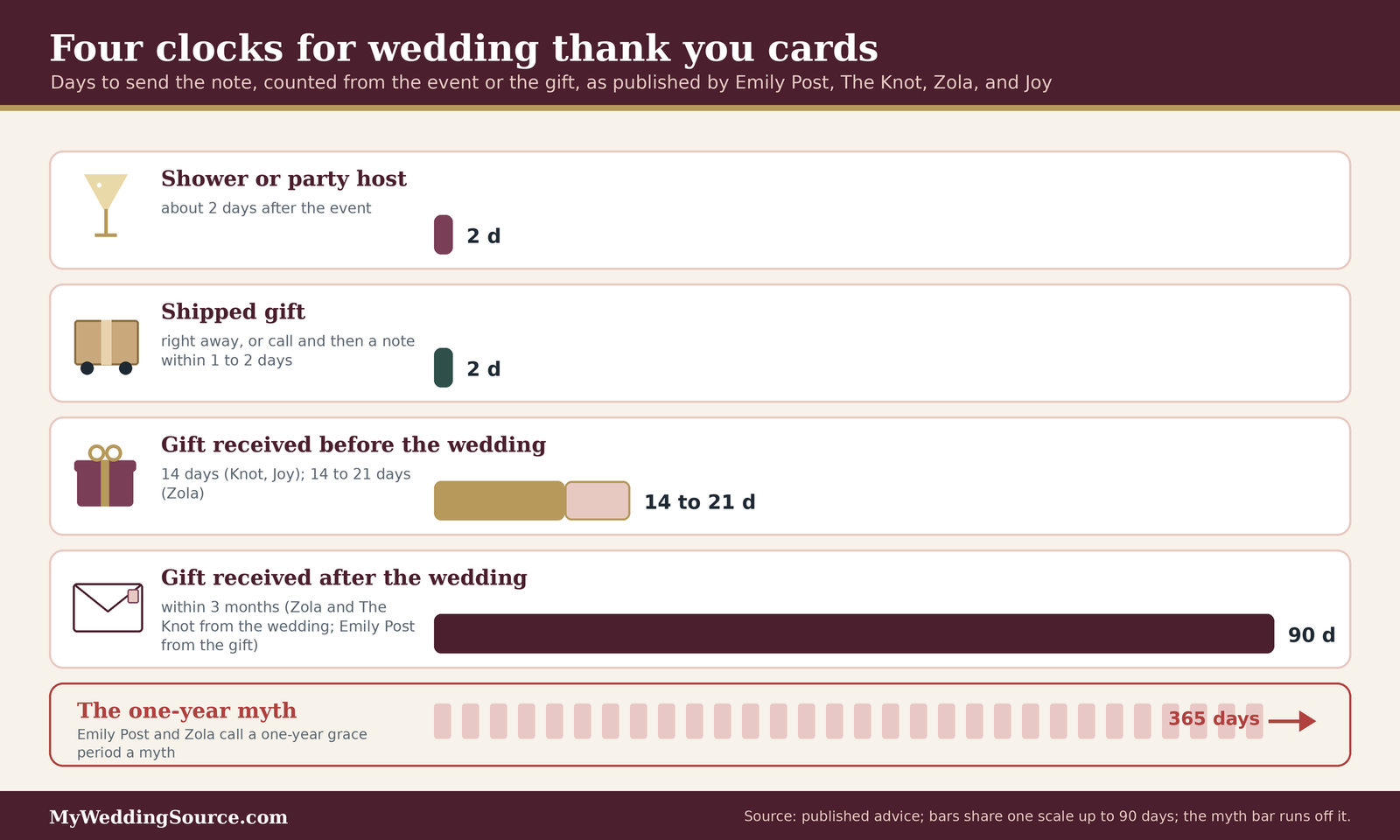
Showers, engagement parties, and early registry orders create the first set of notes. The Knot says to send thank-yous for gifts received before the wedding within two weeks, Joy gives about two weeks, and Zola gives two to three weeks. Emily Post’s guidance is more immediate: ideally write the note the day a gift arrives, and for a shower or party host, send the note within about two days of the event. Emily Post also warns against holding these notes until your wedding photos are ready for a photo card. In practice, the pre-wedding batch of wedding thank you cards is the one to protect, because it competes with a busy planning calendar and is the easiest to let slide.
Gifts that arrive on or after the wedding day
For everything given at or after the wedding, the published outer limit is three months. Zola and The Knot measure it from the wedding date. Emily Post measures it from when you received each gift, which gives later arrivals a little more room. Joy is more specific and suggests a personal target: wedding-day gifts and cards within a month of returning from the honeymoon, and cash fund or registry gifts within about eight weeks after it. Joy is a registry and website company, so treat that schedule as one useful pacing suggestion rather than a rule. If you are planning travel after the wedding, our honeymoon planning guide can help you place the trip so the notes are not squeezed against the departure.
Where the published advice differs
None of the sources we read contradict each other on the main point, but they do differ in emphasis, and knowing where helps you choose a plan that you can defend to yourselves.
Measuring from the gift or from the wedding
If a gift arrives two months after the wedding, the clock matters. Counting from the wedding gives you one month left. Counting from receipt, as Emily Post does, gives you three months. Our suggestion, which is our own judgment and not a published rule, is to take the more demanding reading for planning and the more generous one as a safety net: aim to finish the wedding-day batch within about three months of the wedding, and treat later gifts as their own mini-deadline of a few weeks, so that no single giver waits longer than they would have for a note about a gift given on the day.
The one-year myth
The Knot notes that guests traditionally have up to a year after the wedding to send a gift, and that is probably where the idea of a one-year grace period for thank-yous comes from. Emily Post and Zola both call the one-year grace period a myth, and both say to send notes within three months. It is worth keeping the two ideas apart. A guest may still send a gift in month ten, and that gift deserves a note quickly, but the notes for gifts already received do not get ten months to wait. If you are weighing how this fits with the other stationery on your plate, our wedding planning timeline shows where the after-wedding tasks sit.
Track every gift the day it arrives
Gift tracking is the quiet engine behind good wedding thank you cards. A line that says “thank you for the lovely gift” could have been written by anyone, whereas a note that names the item and a detail of the giver only works if you know who gave what. Emily Post and The Knot both recommend a running record, started when gifts begin to arrive.
A log that survives a busy month
A log for wedding thank you cards should be simple enough that you will still use it in week six. A spreadsheet, a shared note, or the tracker inside a registry service all work. What matters is that you log each item the day it comes in and mark each note as sent.
What each row needs
Joy’s guide suggests logging registry items, cash, checks, and group contributions as they arrive, because waiting makes it harder to remember who sent what. A useful row has the giver’s name as you would write it on the envelope, the date received, a description of the gift or the amount if money, the occasion (shower, engagement party, wedding, or after), how it arrived, a column for what you plan to say about it, and two checkboxes: note written and note mailed. The table below is our own layout, built from the advice above, and you can trim it.
| Column | Why it helps | Example entry (illustrative) |
|---|---|---|
| Name for the envelope | Prevents misspelling and title errors | The Alvarez family |
| Date and occasion | Starts the right clock | Shower, received March 4 |
| Gift or amount | Lets you name it specifically | Cast-iron skillet |
| How it arrived | Helps you find missing tags | Delivered by courier, tag present |
| Plan for the note | Keeps each card distinct | Mention Sunday breakfasts |
| Address confirmed | Avoids returned mail | Yes, from the save-the-date list |
| Written / mailed | Shows what is left | Written, not yet mailed |
Where to keep it
Zola and Joy both offer tools inside their registries that record gifts and addresses, and Zola’s tool can be downloaded as a list. Those tools only know about gifts that came through the registry, so you will still need to enter cash, checks, and anything delivered to a relative’s house by hand. If you use a paper notebook, put it next to the stack of blank cards so that logging and writing happen together. Whatever you choose, keep the address column current. Joy advises confirming mailing addresses before you write, since outdated address books lead to returned mail. The address list you built for your save the date cards and your wedding invitations is the best starting point.
The awkward entries
Most gifts are easy to log. A few kinds are not, and these are the ones that cause apologies later.
Cash, checks, and fund contributions
Money leaves no object to jog your memory, so Joy recommends tracking cash fund contributions on their own. Log the giver, the date, and the amount in your private record even if you will not mention the amount in the note. Emily Post says stating the dollar amount is optional, The Knot notes that some etiquette experts now consider it acceptable because it confirms the right sum arrived, and Zola advises leaving the amount out. Our reading is that the private record protects you either way, and the note itself can follow the preference of the relationship. For wording, all three sources agree on one point: say what the money will do for you. If you are using gifts toward a bigger goal, our guide on how to pay for a wedding explains how couples fit those contributions into a larger budget.
Missing tags and gifts that never arrived
Sometimes a package shows up without a card. Emily Post suggests working out the giver by elimination, such as checking the shipping label, the registry, and who has not yet been matched, and if that fails, making a discreet call so the giver is not left wondering why they never heard from you. The reverse problem is a guest who says they sent something you cannot find. Emily Post says it is reasonable to check in, a while after the wedding, in a way that is not accusatory, in case a gift was lost in the mail. A log helps here because you can show yourself, and the giver, exactly what you did receive and when.
The anatomy of a good note
The best advice on wording wedding thank you cards is surprisingly consistent across sources: be specific, be brief, and sound like yourselves. Emily Post suggests three to five sentences. You do not need a script, but it helps to know the parts that every good note has, so that you can build each one quickly from what is in your log.
Five moves in three to five sentences
A short note is a sequence of small decisions. Writing them in the same order every time is what lets you finish a batch without the notes sounding identical.
Open with thanks and name the gift
Greet the person the way you would speak to them: first names for close friends and relatives, titles for more formal relationships, and the family name for a household. Zola describes exactly this range. Then thank them and name what they gave. Emily Post says to open with the thanks and the gift, then add a compliment about it in your own words. “Thank you for the cast-iron skillet” is better than “thank you for your generous gift”, because the specific noun proves you looked at the log and at the present.
Say how you will use it, then add one personal detail
The Knot’s structure for wedding thank you cards goes on to say how you will use or have used the item, and Zola adds a small personal touch, such as the person’s role in the wedding or a plan to see them. Think of this as the sentence in your wedding thank you cards that only you can write. For a skillet, it might be the first meal you cooked in it. For a guest who traveled, it might be that you were glad they were there for the first dance. For money, it is what the money will do, which we cover in the next section. Then close with a second brief thank-you, and sign. Zola and The Knot both say to have both partners sign, and Emily Post says either one can write the note and mention both as appreciating the gift.

Choose the tone for each relationship
Tone is where couples worry most about wedding thank you cards, and the sources reassure on this point. Warmth matters more than polish. The practical question is how formal each note should be.
Formal, warm, and brief
For grandparents, a boss, or a family friend of your parents, a slightly more formal note with titles and complete sentences tends to be right. For close friends, a short, affectionate, first-name note is fine. The Knot says the inside of the note can be informal and use first names, while the envelope should follow the same addressing style as your invitations. If you wrote a large number of cards, the Knot also says length is flexible, so a few honest sentences beat a long note that you resent writing. Emily Post warns against the opposite error as well, which is gushing: be enthusiastic without claiming a gift is the most beautiful thing you have ever seen unless you mean it.
Do not scale the note to the gift
Emily Post says not to scale the note to the value of the gift, and that every giver should get a real, personal note rather than a perfunctory one. This is easy to say and surprisingly easy to break when you are on card ninety. A practical safeguard is to write a few of the longer, more personal notes in the middle of each session rather than at the end, when you are tired. Another is to keep the plan-for-the-note column in your log, so the personal detail is decided while you have energy and the writing is only assembly.
Wording for the situations that actually come up
Wedding thank you cards fall into a handful of situations, and most of the stress comes from the few that are unusual. The examples below are our own illustrations of the advice in the sources, not templates to copy. Change them until they sound like you.
Money, gift cards, and group gifts
Gifts without a physical object are the ones couples most often ask about when writing wedding thank you cards, and the sources are reasonably aligned on them.
Cash and checks
Emily Post, The Knot, and Zola all say to mention how you plan to use the money. Whether to include the amount is a matter of preference, as noted above. An illustrative line: “Your gift is going into the fund for our first home, and we think of you every time we look at the listings.” A second: “Thank you for the check. It is helping pay for the honeymoon trip, and we will send a postcard.” Neither mentions a figure, which keeps things comfortable if the giver is a relative who would be embarrassed to see it in writing, and both name a specific, believable use. If the money is going to bills or savings and you would rather not say so, “making our first year easier” is honest without being a detailed accounting.
Gift cards and group gifts
The Knot says to handle gift cards the way you handle cash: name the store or card and what you plan to buy or do. For group gifts, Emily Post and Zola both say to write a separate card to each contributor. Zola adds that each card should acknowledge the group effort and the item you received together. If four coworkers pooled for a stand mixer, each gets a note that names the mixer and mentions the group. A single card to “the whole office” is the kind of shortcut these sources warn against, and it is easy to avoid if you log each contributor’s name in the gift record.
Guests whose situation is unusual
Some of your wedding thank you cards will go to people who did not give a gift in the usual way. The Knot offers guidance for each of these cases, and the tone is consistent: thank the person for what they actually did.
Guests who did not attend
If someone could not come but sent a gift, The Knot says to thank them for the gift and say you hope to see them soon. Zola mentions acknowledging distance or effort for guests who traveled far or who sent a gift without attending. A note might say: “We missed you on Saturday and were glad to feel your good wishes. The serving bowl is already in use at family dinners, and we hope to bring you a slice of cake in person soon.” Avoid any wording that makes the person feel guilty for being absent.
Guests who gave no gift, and gifts from people you did not invite
Zola says gifts are not required, and the note to a guest who gave none should focus on their presence and support. The Knot is direct on this point: thank them for attending or for their support, and do not use the note to hint at a gift. For someone who was not invited but sent a gift anyway, The Knot suggests thanking them for their kindness during this time. The Knot also places notes to guests who gave nothing in your last batch, within the same three-month window. That guidance is the reason to send them at all: they came to the wedding, and a card is a way to say so.
Gifts that are not quite right
Every couple ends up with one or two gifts they would not have chosen, or a second blender, and the wedding thank you cards for those are the ones people dread. The sources agree on what to do.
Duplicates and gifts you will not use
Zola says to focus on the guest’s thoughtfulness and your appreciation for it, without commenting on the item. The Knot says the same: still thank the giver warmly and focus on their kindness. For a duplicate, a note can say that the gift arrived at a lucky moment, or that you will find a home for it, if you can say so truthfully. If you plan to exchange something, do it quietly and write the note about the giver, not the item.
What not to say
Emily Post is firm on two points. Never mention that you intend to return a gift, and never hint that you are unhappy with one. That also means not writing “we already have one” even as a joke. If a gift truly misses the mark, thank the person for thinking of you and leave it there. If you need to exchange something, the giver does not need to hear about it.
Families that do not fit one template
Real families are not always a single set of parents hosting a single couple. Wedding thank you cards need to be readable by a guest who does not know your family tree.
Blended families and several hosts
When more than one household hosted or contributed, thank each host in their own note. Emily Post says to thank your parents or whoever hosted the wedding, and Zola says that if a group hosted a party, every host gets a note. Write each of those as a note to a person rather than to a role, using the names the person actually uses. If two sets of parents are divorced and hosted separately, send separate cards, not one to the pair. A guest should never have to work out a relationship from the card.
Different surnames, two brides, or two grooms
Emily Post says the signature can be one name, both names, or each person’s own name. That flexibility is useful for couples who keep separate surnames or who are two brides or two grooms: sign with first names for friends and family, and with both full names for formal relationships. Emily Post’s thank-you page suggests using your current monogram on stationery and saving the married monogram until after the wedding. Beyond that, nothing in these sources prescribes a different form, so follow the style of your invitations and sign each card the way the giver would say your names.
| Situation | Include | Leave out | Sample opening |
|---|---|---|---|
| Physical gift from a guest | Name the item, how you use it, one personal detail | Comments on cost or on whether you registered for it | “Thank you for the cast-iron skillet.” |
| Cash or check | How the money helps you; amount only if you choose | A detailed budget | “Your gift is helping us start our first home.” |
| Group gift | Each contributor named, the group effort, the item | One card for all of them | “Thank you for the stand mixer you all gave us.” |
| Guest did not attend | Thanks for the gift, hope to see them | Guilt about absence | “We missed you, and we are glad you sent your good wishes.” |
| No gift | Thanks for being there | Any hint about gifts | “Thank you for celebrating with us on Saturday.” |
| Duplicate or unwanted item | Their thoughtfulness | Mention of returns or duplicates | “It means a lot that you thought of us.” |
| Host of a shower or party | Specific details of the event | Waiting past a few days | “Thank you for hosting our shower.” |
| Parent or wedding party member | A personal memory or role | A generic card | “We could not have done the day without you.” |
Handwritten, printed, or digital
Format questions about wedding thank you cards come up as soon as the list passes fifty names. The sources lean strongly one way, but there is room for sensible practice, and the main risk is choosing a format that makes the note feel generic.
What the sources say about format
Etiquette writers prefer handwritten wedding thank you cards, and the reasoning is consistent: effort is the message. Where they differ is on how much room that leaves for modern tools.
Handwriting as the default
Emily Post says a handwritten note shows appreciation through the effort of setting aside time to write it. The Knot says to handwrite each note and warns that typed or emailed notes may seem impersonal. Emily Post’s thank-you page adds that printed fill-in-the-blank cards, phone calls, emails, and generic website posts are not appropriate substitutes, and its other advice says not to send form letters or cards that carry only your signature. Use blue or black ink that will not smear or bleed through the card, which is The Knot’s practical tip, and write legibly, which is Zola’s.
Where digital fits
Joy says digital versions of wedding thank you cards are becoming more common, especially for cash fund contributors and virtual attendees, while noting that handwritten notes remain strongly preferred. Zola offers a tool that prints typed messages in a set font inside the card, which is a half-step for people with very long lists. Those are company products, and our own view is to use them with care. A typed message printed on a card is still a personalized message, but it moves toward the preprinted cards that etiquette writers discourage. If a digital note is your only option for someone far away or for a guest you cannot reach by mail, send it promptly and follow it with a card when you can.
Dividing the work
The work of wedding thank you cards is large but it is also divisible, and the sources have practical suggestions for sharing and pacing it.
Sharing the list
The Knot suggests dividing the list between the two of you, and both partners signing every card. Emily Post says either partner can write the notes. A simple split is that each person writes to their own family and friends, and the person who knows the giver better writes that giver’s note. For joint relationships, such as the couple next door, alternate. Keeping the plan column in the shared log helps the person who did not choose the gift still write something specific.
Pacing yourselves
Emily Post suggests a daily goal of three or four notes. The Knot suggests writing for about 30 minutes each night. Joy suggests about ten notes per session. These fit together. Short, regular sessions beat one marathon weekend, because the quality of a note drops fast once you are tired. Put your wedding thank you cards sessions on your calendar like any other appointment, and, if the whole task feels heavy, our guide to managing wedding planning stress has ways to keep a long to-do list from taking over your evenings.
Late wedding thank you cards
Many couples reading about wedding thank you cards are already behind, and the sources agree on what to do. Do not skip the notes. Emily Post says to keep writing even after your first anniversary, and Zola says later is always better than never. The question is how to write them.
How late is late
Lateness with wedding thank you cards comes in degrees, and the right level of apology grows only slowly with the delay.
Past three months
If your wedding thank you cards are past the three-month mark, you are late by the standards of every source here, but the fix is the same. The Knot says a late note is still better than none, and Joy says to acknowledge the delay in one brief line and then focus on gratitude. Avoid extended apologies, because they dilute the thanks. Start your late wedding thank you cards with the people who gave the largest or most personal help, then work through the rest in batches, using the log to be sure no one is missed.
Past a year
Emily Post’s advice is explicit that lateness is not an excuse to stop, and that holds past the first anniversary. A card sent at fourteen months is better than no card, and the person who receives it is more likely to feel remembered than offended. The simplest approach is to be honest and brief about the gap and warm about the gift. If you no longer remember details, use what you do know from the log: the item, the date, and the occasion.
Writing the late note
A late note follows the same five parts as other wedding thank you cards, with one extra sentence.
One line of acknowledgment
Zola recommends a light, self-aware tone with a brief apology. Joy says one brief line. The Knot’s sample note acknowledges the delay directly and then thanks the person for both attending and the gift. Do not explain at length, and do not blame the honeymoon, the move, or the job. Say you are sorry it took so long, and go straight to the thanks.
A sample you can adapt
Here is an illustration, in our own words: “Dear Aunt Marguerite, we are sorry this note is so late. We have been thinking of you since the wedding, and we use the linen napkins every Sunday. Thank you for being there with us and for such a thoughtful gift. We hope to see you soon.” That is five sentences, with one line of acknowledgment, one specific item, one use, and one personal wish.
What wedding thank you cards cost to send
The cash cost of wedding thank you cards is small next to most wedding line items, but it is easy to underestimate, because the stamps are bought at the end, when the budget is thin. Two parts of the cost can be checked against official sources, and the rest depends on the stationery you choose.
What this actually costs
Postage is the one part of wedding thank you cards we can price from an official source. USPS lists a stamped one-ounce letter at $0.82, an extra $0.29 for each additional ounce, and a $0.49 surcharge for nonmachinable letters, such as a square envelope. Card stock and printing depend on your quote, so we left them as a blank to fill in. Budget for the number of notes, not the number of guests, and keep a small reserve for spoiled cards and late additions.
Postage first
USPS publishes its price list as Notice 123, and the version we read shows the prices we report here, as reviewed in November 2026. We also read local news reporting that the Forever stamp rose to 82 cents on July 12, 2026 after approval by the Postal Regulatory Commission. Prices change, so check the current notice before you buy stamps for a large batch.
Letters in standard envelopes
Notice 123 lists a stamped single-piece letter at $0.82 for one ounce and $1.11 for two ounces, which is $0.29 for each additional ounce. A metered letter is $0.78 for one ounce. A postcard is $0.65. A standard card in a rectangular envelope is usually a one-ounce piece, but a heavy card, a photo insert, or extra paper can push it over, and the only way to be sure is to weigh a finished sample with everything in the envelope. We have not weighed any specific card, so treat the one-ounce case as the common situation and not as a promise.
Square and unusual envelopes
The USPS quick service guide for letters says that mail is machinable at automation prices only when its length divided by its height falls between 1.3 and 2.5, and that a square envelope is therefore nonmachinable. The same guide lists other features that make a letter nonmachinable, including closure hardware such as clasps and strings, a piece that is too rigid, and uneven thickness from items such as pens or keys. Notice 123 puts a $0.49 surcharge on nonmachinable letters. By our arithmetic, a stamped one-ounce square envelope is $0.82 plus $0.49, or $1.31. Ask a postal clerk to price a finished sample before you order a large number of envelopes in an unusual shape or with a wax seal or a bulky embellishment. Our save the date cards guide shows the same shape rule on a different card.

A worked estimate for one couple
The numbers below for wedding thank you cards are an illustration, not a forecast. We chose a plausible set of assumptions, wrote them out, and did the arithmetic, so you can replace them with yours.
How many notes
The Knot’s Real Weddings Study, based on 10,474 American couples who married in 2025, puts the average wedding at about 117 guests. Those respondents were invited by email through The Knot and WeddingWire, so the figure reflects people who use those platforms. Guests are not notes, since couples and families receive one card each. For our scenario, we assume 117 guests make up about 72 households, and that about 70 of them give a wedding gift. We also assume 12 givers at engagement and shower events, 8 helpers and hosts, 8 members of the wedding party and parents, and 4 vendors who went beyond expectations. That is about 102 notes. All of these split-ups are our assumptions, and your own gift log will replace them quickly, which is the point of tracking wedding thank you cards from the start.
Postage and time
At $0.82 per stamped letter, 102 notes cost about $83.64 in postage. If every card went out in a square envelope at $1.31, the total would be about $133.62, which is about $49.98 more for the same notes. For time, Emily Post’s suggested pace of three notes a day gives 34 days for 102 notes, and Joy’s pace of about ten notes per session gives about eleven sessions. The Knot’s 30 minutes per night is similar. These figures are estimates for planning wedding thank you cards, not quotes. Add the cost of cards, which we leave for your quote: multiply the price per card by 102 and add a small spare quantity for mistakes, a spare share that is our suggestion and not a published rule.
Check the details before you mail
Small errors in wedding thank you cards are more noticeable than errors elsewhere, because each one is addressed to a person who gave you something. A short check before you mail a batch of wedding thank you cards prevents most of them.
Names and addresses
Names and addresses are the two things that are easy to check and expensive to get wrong.
Spelling, titles, and the way people sign
Check each name against your gift log and, where you can, against how the giver wrote it on their own card or on your RSVP. Zola describes using first names for close relationships, titles for formal ones, and the family name for households. For couples with different surnames or for people with professional titles, copy what they use. Your wedding RSVP wording and invitation list are the best reference because the guests have already seen their names written that way. The Knot says the envelope should be handwritten and follow the same style as your invitations.
Confirm the address column
Joy suggests confirming mailing addresses before you write, because outdated address books cause returned mail. Check the address column of your log against the list you built for your invitations, and ask a relative if you are unsure about a move. If you are writing to someone who sent a gift by courier from a distant city, the return address on the package is a useful clue, which is also how you can cross-check a missing tag.
Production and privacy
A final pass on the physical card and what it says about other people helps with the last few details.
Ink, paper, and photo cards
The Knot recommends blue or black ink that will not smear or bleed through the card, which is a good reason to test your pen on the card stock before you start. On photo cards, Emily Post’s thank-you page says a wedding photo is a nice idea but the timing is tricky, and that an engagement or other special-occasion photo works better, because waiting on wedding photos delays the notes. Emily Post’s other advice says plainly not to hold up a note to include wedding photos. If you want a wedding photo, send it later with a separate note. Our wedding photography guide covers when photographers usually deliver.
Amounts, addresses, and online posting
Do not post givers’ names, addresses, or amounts online, and keep the log behind your wedding thank you cards private. A note can mention what a gift meant to you without publishing who gave what. If you use a digital tool to send e-notes, check what it stores and shares, since registry and card tools are company products with their own data policies. Emily Post says that a generic thank-you post on your wedding website does not replace a personal note, so if you post one for everyone, treat it as an addition. If you are sending digital cards to anyone, check the link or QR code from a phone before sending, and keep the version that went out.
Questions to ask before you order or mail
A few questions, asked in advance, protect you from the usual surprises with stationery and postage for wedding thank you cards.
Questions worth asking before you order or mail
- What does the envelope measure, and what is its length divided by its height?
- Will the post office price a finished sample, with everything inside, before I buy stamps?
- Does the printer offer matching envelopes in a standard shape, and what do spares cost?
- Which of my gifts came through a registry tool, and which do I need to enter by hand?
- Which notes are for people who helped rather than gave, and have I put them on the list?
- Who writes which notes, and who signs?
Before you order cards
These questions help you buy the right number of wedding thank you cards in the right shape.
How many cards, and in what shape?
Count wedding thank you cards, not guests, using the gift log and the helper list. Then ask the printer for the size and the envelope shape. A standard rectangular envelope keeps you out of the nonmachinable group by the USPS ratio rule. If you love a square card, price the postage first.
What will you do about spares?
Ask whether a reprint of a few cards is possible and how long it takes, and whether the paper and envelope will be available. A small reserve is cheaper than a second order, though how many to keep is your own call.
Before you mail a batch
These questions catch the errors that are hardest to fix after the envelope is sealed.
Are the names and addresses right?
Check the batch against your log, not from memory. Read each name aloud and check each address against your list. If you cannot confirm an address, ask before you mail.
Does each card say something specific?
Read the first line of each of your wedding thank you cards and make sure it names the gift or the help. If a note could be sent to anyone, add a sentence. The specific noun is what shows you noticed.
FAQ: wedding thank you cards questions
Timing and etiquette
How long do we have to send wedding thank you cards?
For wedding thank you cards, the sources we read agree on about three months. Zola and The Knot count from the wedding. Emily Post counts from when each gift arrives. For gifts received before the wedding, The Knot and Joy say about two weeks, and Zola says two to three weeks. A late note is still better than none.
Do we need to thank guests who gave no gift?
Yes, a note is still appropriate. Zola says gifts are not required, and The Knot suggests thanking those guests for attending or for their support, without hinting at a gift. Send those notes in your last batch, within the same three-month window, and keep the tone simple and warm.
Is it acceptable to send a thank-you by email or text?
Sources lean toward handwritten wedding thank you cards. The Knot says typed or emailed notes may seem impersonal, and Emily Post says email does not replace a personal note. Joy reports digital notes becoming more common for cash fund contributors and virtual guests. If you use one, send it promptly and consider following it with a card.
Wording
Should we mention the dollar amount of a cash gift?
Opinions differ. Emily Post says the amount is optional, The Knot says some experts now accept it because it confirms the sum arrived, and Zola advises leaving it out. All agree you should say how you will use the money. Keep a private record of the amount, whatever the note says.
What do we write for a group gift?
Send each contributor their own card among your wedding thank you cards. Emily Post and Zola both say so. Zola adds that each card should acknowledge the group effort and name the item you received together. If four coworkers gave one mixer, that means four notes that each mention the mixer and the group, not one card for all.
What do we say about a gift we do not like?
Thank the giver for thinking of you and focus on their kindness. Emily Post says never to mention that you plan to return a gift and never to hint that you are unhappy with it. Zola and The Knot give similar advice, so the note can be about the person.
Practical questions
Who should write the notes, and who signs them?
For wedding thank you cards, Emily Post says either partner can write, and The Knot suggests dividing the list. Zola and The Knot both say both partners should sign. A simple split is that each of you writes to your own family and friends, and both names appear in the sign-off on every card.
Do square envelopes cost more to mail?
Often, yes. USPS says a square envelope falls outside the length-to-height range of 1.3 to 2.5 for machinable letters, and Notice 123 lists a $0.49 surcharge for nonmachinable letters. By our arithmetic, a stamped square card is $1.31 against $0.82 for a standard letter. Ask a postal clerk to price a sample.
Your next steps
Set up before the gifts arrive
Build the gift log and the helper list
Create the log for your wedding thank you cards with the columns in this guide, and add everyone who gave or helped, so that your card count is based on notes and not guests. Start it before the first shower, and use the wedding registry guide to see how registry tools fit alongside your own record.
Decide the calendar and the format
For wedding thank you cards, choose your clocks: a couple of weeks for early gifts, a few days for hosts, and three months for everything else. Put writing sessions on the calendar and pick the card shape and postage before you order. Our wedding planning checklist and wedding etiquette guide can help you place these tasks among the others, and the wedding budget calculator is a place to add the stationery and postage line.
Write, check, and mail
Write in short, regular sessions
Aim for a handful of wedding thank you cards at a time and make each one specific. Write the personal ones first. If you have fallen behind, start now, acknowledge the delay in a line, and keep going.
Check the batch and mail it
Confirm names, addresses, and postage on a finished sample, mail in batches, and mark each note as sent in your log. When the last card is gone, keep the log, since it is a useful record of who was generous to you and when.
Sources & methodology
How we built this guide
What we relied on
This guide to wedding thank you cards combines published etiquette advice from Emily Post, The Knot, Zola, and Joy with United States Postal Service price and mailing-standard documents. Where a statement comes from a registry or website company, we say so, because that company also sells the tools it describes. Etiquette sources describe convention, not law, and where they differ, such as on mentioning the amount of a cash gift, we show the disagreement instead of picking a winner. The worked estimate in the cost section, the note counts, and the writing schedule are our own arithmetic from stated assumptions, and they are estimates. The sample notes are our own illustrations.
What we did not do
We did not survey couples, test stationery, weigh specific cards, or price card printing. We found no current survey on thank-you note habits with a disclosed method, so the guide does not make claims about how many couples send notes late. Postal prices change, so confirm them with USPS before buying stamps. This is general information, not legal, tax, or financial advice.
Source list
Postal sources
- U.S. Postal Service, Notice 123, Price List (prices as reviewed in November 2026): https://pe.usps.com/text/dmm300/Notice123.htm
- U.S. Postal Service, Quick Service Guide 201, Letters, Cards, and Flats (letter dimensions and machinability): https://pe.usps.com/cpim/ftp/manuals/qsg300/Q201.pdf
- U.S. Postal Service, Recommends New Prices for July (news release, April 9, 2026): https://about.usps.com/newsroom/national-releases/2026/0409-usps-recommends-new-prices-for-july.pdf
- Levittown Now, Stamp prices increase this weekend (July 9, 2026): https://levittownnow.com/2026/07/09/stamp-prices-increase-this-weekend/
Etiquette, survey, and registry-company sources
- Emily Post Institute, Wedding Thank Yous: https://emilypost.com/advice/wedding-thank-yous
- Emily Post Institute, Ten Wedding Thank You Note Dos and Don’ts: https://emilypost.com/advice/ten-wedding-thank-you-note-dos-and-donts
- Emily Post Institute, Inside Weddings: Expressing Gratitude: https://emilypost.com/advice/inside-weddings-expressing-gratitude
- The Knot, A Complete Guide to Sending Thank You Notes: https://www.theknot.com/content/a-complete-guide-to-sending-thank-you-notes
- The Knot, Average Wedding Guest List Size (Real Weddings Study): https://theknot.com/content/average-wedding-guest-list-size
- Zola, Wedding Thank You Note Etiquette: https://www.zola.com/blog/wedding-planning/wedding-thank-you-note-etiquette
- Zola, How to Word Wedding Thank You Cards: https://www.zola.com/expert-advice/how-to-word-wedding-thank-you-cards
- Joy, How to Send Wedding Thank You Notes: https://withjoy.com/blog/how-to-send-wedding-thank-you-notes-timeline-etiquette-wording-examples/