

Proposal location permissions are the unglamorous half of a surprise: before you pick a park bench, a hotel rooftop, or a friend’s backyard, someone else has to say yes, and that someone is usually reachable by phone in one afternoon.
Quick answer
There is no national rule for proposal location permissions. Each place sets its own, and in the pages we read, rules are written for weddings, ceremonies, and events, not for a single question asked by one person. A small, unreserved, set-up-free moment in a public park often needs no paperwork, but a reserved area, a larger group, props, a paid photographer, or a drone changes the answer. Rooftops and private property depend on the owner or operator, not on the city. Follow the six-step sequence below: name the exact spot and who manages it, describe your plan in one paragraph, ask four questions, get the reply in writing, brief your helpers, and carry a day-of folder. This is general education, not legal advice.
Most proposals are planned around the question, the ring, and the photographs. Proposal location permissions get very little attention until the plan is nearly done, and that is the order that creates problems. Without a plan for proposal location permissions, a ranger may tell a small group to move along. A rooftop host may say the terrace is closed for a private party. A friend’s landlord may not know a surprise is happening on the lawn. None of these is a disaster, but each can turn a carefully kept secret into a scramble at the worst possible moment.
This guide is built around one practical deliverable, a permission request sequence you can follow for a park, a rooftop, or private property. The guide is written for the person planning the proposal, so it assumes you want to keep the question a surprise while still being straightforward with the people who control the place. Along the way we show what proposal location permissions look like in practice, using what real parks, a city parks department, hotels, and restaurants say on their own pages, so you can see what a typical answer looks like and what to ask.
Everything we report about a specific place comes from a page we read on November 12, 2026, and describes that place on that day. Fees, group limits, and policies change, and a page that is silent about proposals tells you nothing about whether a proposal is allowed. Use the examples as a pattern for your own questions, and confirm the details with the office that manages your spot. If you want the wider picture first, our guides to proposal ideas and proposal and engagement party planning cover the creative and logistical side, and our companion article on private versus public proposals helps you decide how much of an audience you want.
What proposal location permissions actually are
People use the phrase loosely, and mixing up its parts is the most common reason a plan stalls. Proposal location permissions are not one document. They are three layers of yes, and a place can require any combination of them.
Permission, permits, and rules are three different layers
Thinking in layers keeps you from assuming that one yes covers everything. A park may need no permit for a small group and still have rules about where you can stand. A hotel may welcome your idea and still need two weeks to prepare. A homeowner may say yes while the homeowners’ association has opinions about guests.
Permission from the owner or manager
This is the first layer, and it applies everywhere. On private land such as a home, farm, rental, or venue, the owner decides whether you can be there for this purpose at all. On public land, the manager, such as a parks department or a federal park unit, decides whether your date, location, and group size fit its rules. For proposal location permissions on a rooftop, the person who can say yes is often an operations manager, not the person who answers the phone at the restaurant.
Permits and approvals from a government office
This is the second layer of proposal location permissions. It might be a special use permit from a national park, a special events permit from a city parks department, a state park permit, or a fire or building approval for a venue. Some of these apply only above a size threshold. Some apply only if you reserve a specific spot. Some apply only if you bring equipment such as tables, tents, or speakers. We explain the triggers we found in the parks section below.
Rules that apply even with no paperwork
This is the third layer of proposal location permissions, and it is the one people forget. Even where no permit is needed, park rules still apply: where you may walk, whether you may fly a drone, whether you may throw petals, and whether you may block a path. In national parks, a superintendent can restrict or close areas and set conditions on activities, and the public is supposed to be notified. A proposal without a permit is still subject to every posted rule.
Why a proposal is an awkward fit for permit systems
Permit systems were built for events with a start time, an organizer, a headcount, and a cleanup plan. A proposal is a short moment, often unannounced, that might involve two people or fifteen. That mismatch creates two problems you should expect.
Rules are written for events, not for one question
Every park page we read describes weddings, ceremonies, or events. A federal regulation on park special events lists ceremonies among the gatherings that need a permit, which is why a wedding gets handled as a permit matter. A proposal is not a wedding, but if you hire a photographer, bring chairs, and invite family to watch, it starts to look like a ceremony to the person reading your application. The words you use in your request for proposal location permissions matter, and we show how to choose them in the sequence below.
Silence in the rules is not a yes
Brooklyn Bridge Park’s own page is the clearest example we found of a place that names proposals: it lists a proposal as an example of a social gathering that needs a special event permit, applied for at least 21 days ahead, and it also says non-commercial wedding or engagement photography is exempt unless the group is over 20 people or uses more than handheld equipment. Most other pages we read, including Joshua Tree, Denali, Yellowstone, and several New York City parks, never mention proposals at all. That silence does not mean a proposal is allowed or forbidden. It means you have to ask, and the answer will usually depend on how many people come, what you set up, and who is filming.
The proposal location permissions sequence: six steps from idea to written yes
Here is the deliverable at the center of this guide. The sequence works the same way for a park, a rooftop, or a backyard. Only the people you contact change. It is designed so that you reveal as little as possible about the surprise, give the office exactly the information it needs, and finish with a reply you can show to anyone who questions you on the day.

Steps one to three: find the owner, describe the plan, ask the questions
The first three steps of the proposal location permissions sequence are research and a short conversation. They can usually be finished in one afternoon, and they should be finished before you pay for anything that cannot be refunded, such as a photographer’s deposit or a restaurant reservation for afterward.
Step one: name the exact spot and who manages it
Good proposal location permissions work starts with a specific bench, overlook, terrace, or lawn, not the park in general. Then find out who manages that exact spot. A waterfront promenade might belong to a city, a state, a federal agency, or a nonprofit conservancy, and the boundary can be a few hundred feet from where you plan to stand. New York City’s permitting office lists six different primary agencies for public spaces, including the parks department, Brooklyn Bridge Park, and Hudson River Park, which shows how often adjacent spaces answer to different offices. Search the place name plus “special event permit” or “weddings,” and look for a phone number or an email for the permit office.
For a rooftop, the question is who operates the rooftop on the day you want it: the hotel, a restaurant that leases the space, or a building manager. For private property, it is the owner, and if you are renting, the owner and not only the tenant.
Step two: write a plan paragraph the office can answer
Write one short paragraph that tells the office what will happen, in plain terms and without the surprise. State the date and a time window, the number of people who will be present, whether anyone will take photographs and whether that person is paid, whether you will bring anything beyond what a visitor would carry, and whether you plan any sound or decoration. Leave out the ring, the partner’s name, and the emotional context. An office does not need to know why you are asking, and most do not care. They need to know the size and shape of the activity.
A useful test: if a stranger read your paragraph, could they tell whether it falls under a permit threshold? If not, add the missing number. Offices respond faster and more consistently to specific details than to a description such as “a small private moment.”
Step three: ask four questions, in this order
Ask these four questions in the same order each time, because the answers build on each other. First, does this plan need a permit or other approval? Second, if not, are there rules for this spot that would affect it, such as where to stand, group limits, or restrictions on equipment, sound, or drones? Third, is there a better time of day or area for a small private group? Fourth, will you confirm your answer by email?
The second question is the one most people skip. A “no permit needed” answer is not the end of the conversation, because rules still apply. The third question is where you may learn that the overlook is crowded at sunset or that a quieter spot is five minutes away. Park staff and venue managers see hundreds of visits, and their advice on timing is usually practical and free.
Steps four to six: get it in writing, brief your helpers, carry a folder
The last three steps turn an answer about proposal location permissions into something you can use on the day. They matter most when the answer was conditional, such as “no permit for a group under a certain size, but no setup.”
Step four: get the answer in writing and keep the thread
Ask for a short email confirming what was said. If you spoke by phone, write a two-line follow-up of your own: “Thank you for speaking with me today. To confirm, you said that a group of this size with no setup does not need a permit, and that drones are not allowed. Please let me know if I have misunderstood.” Save the reply with the date and the name of the person. If you are planning a surprise, use an email account your partner does not read, and note that a shared calendar or a shared inbox can reveal an exchange you meant to keep private. Our guide to wedding planning website privacy and security covers the habits that help keep planning details contained.
Step five: brief your photographer and helpers on the conditions
Everyone who will be present needs the same short list of conditions: the group size, the areas to avoid, the rule on drones, and what to do if a ranger, security guard, or manager approaches. A photographer who has worked in the park before may know the local rules, but do not assume. Tell them what the office said, and ask whether their own agreement covers permits, insurance, and equipment limits. A friend hiding in the bushes with a speaker is exactly the kind of detail that triggers a sound rule.
Name one person as the point of contact for any official who approaches, ideally a calm friend who is not the one proposing. Their job is simple: be polite, say what you were told, and show the email.
Step six: carry a day-of folder
Put the written confirmation, a screenshot of the relevant rules page, the office’s phone number, and your backup location in a folder on your phone and, if you like, on paper. Add the booking confirmation for any rooftop or venue, and a note of the weather cutoff you chose. The folder is not for showing off. It is for the rare moment when an official asks what is going on, and a calm answer plus a written reply ends the conversation in thirty seconds.
Templates you can copy
The templates below for proposal location permissions are meant to be adapted. Replace the bracketed parts with your own details, and keep the tone matter-of-fact. Our guide to wedding permits goes deeper on the permits that apply to ceremonies and receptions, and the same approach to finding the issuing office works here.
The plan paragraph
“I would like a small private gathering at [spot] on [date] between [start] and [end]. Between [number] and [number] people will be present. One photographer will attend [and is / is not paid]. We will bring [nothing beyond what visitors usually carry / a blanket and a small basket / list items]. We do not plan to use amplified sound, balloons, or drones. Does this plan need a permit or any other approval, and are there rules for this spot that we should know about?”
The email and phone script
For email, use a subject line such as “Question about a small private gathering on [date],” paste the plan paragraph, and close with “Could you confirm your answer by reply so I have it for my records?” For a phone call, say the same thing in three sentences, ask the four questions in order, and write down the name of the person and the date. If the person says they are not sure, ask who would know, and ask whether you may follow up in writing.
Parks: how proposal location permissions work on public land
Parks are where most questions about proposal location permissions begin, because parks are free, scenic, and open. They are also managed by many different agencies, each with its own thresholds. The pages below are examples, not a national picture, but together they show the pattern: a threshold of people, a trigger such as reserving an area or bringing equipment, and a list of rules that apply to everyone.
National parks and the special use permit
National park units handle ceremonies through a special use permit, and each unit sets its own locations, limits, and conditions. We read pages from four of them, and none mentions proposals.
What four national park pages say
Joshua Tree’s page says a special use permit is required for all ceremonies in any area of the park, that each location has its own headcount limit (from 100 people down to 5), and that ceremonies are limited to two hours including setup, photos, and cleanup. Denali’s page says a permit is generally required for ceremonies and events with more than 12 people anywhere in the park. Redwood’s page says all weddings, elopements, and vow exchanges require a permit, with pre-approved locations capped at 20 participants or 6, depending on the site. Yellowstone’s page says a special use permit is required for ceremonies, lists a group cap for each approved location from 5 to 250 people, and says the permit holder is responsible for making sure everyone follows park rules.
All four describe weddings, elopements, and similar ceremonies. A proposal with a handful of people and no setup is not described, and none of the pages says it is exempt. If you are thinking of a national park, proposal location permissions are a matter for the permit office, so phone or email the permit office with your plan paragraph. Yellowstone’s page, for example, lists a general contact number and email and asks you to reach out.
The regulation behind the permit
The federal rule on special events, 36 CFR 2.50, lists ceremonies among the events that are allowed only with a permit and only when they relate to the park. It tells superintendents to deny a permit that would damage park resources, conflict with the purpose of a zone, interfere with visitor services, or create a clear danger. It lets a superintendent require a bond or liability insurance and attach conditions on equipment, timing, or location, and it says the application must reach the superintendent at least 72 hours before the event. That 72 hours is a legal floor. Individual parks, as we show below, ask for much more.
A second rule, 36 CFR 1.5, gives superintendents power to set visiting hours, close areas, limit uses, and attach conditions, and it says the public must be notified of those restrictions. The practical point for proposal location permissions is that a viewpoint can be closed on short notice for safety or resource protection, so a backup location is not optional.
Fees, limits, and lead times at the four parks
The numbers vary. Joshua Tree asks for a $120 non-refundable application fee, at least 15 days’ notice and no more than 12 months, and says review can take up to 15 business days. Denali lists a $200 application fee and asks applicants to apply as early as possible. Redwood lists a $100 fee for pre-approved locations and $200 for others. Yellowstone asks for at least 10 business days and says permits are usually issued only a few weeks before the event, because conditions can change. None of these fees waives park entrance fees. Treat each figure as one park’s number on the day we read it, and ask for the current one.
City and local parks
City parks add their own layer to proposal location permissions. They often set a headcount trigger and a separate trigger for reserving a specific area, and some name proposals directly.
New York City Parks: the twenty-person line and the reserved spot
New York City Parks says special event permits are needed for events with 20 or more people, and that smaller groups may also need a permit to reserve a specific area, use amplified sound, or bring canopies or tables. It says permits take at least 21 to 30 days to process and that applications submitted inside 21 days are not accepted. It lists a $25 administrative fee that cannot be waived. A page from the Fort Tryon Park Trust says groups under 20 generally do not need a special events permit, that passive use of the lawns is permitted, and that tables and other furniture are not. A third source, the centralpark.com visitor FAQ, says a wedding photography permit costs $100 for 30 minutes and is capped at 25 people. That site is a visitor information page rather than a city agency, so confirm its figures with NYC Parks before relying on them.
Brooklyn Bridge Park and the page that names proposals
Brooklyn Bridge Park is the one place we found that mentions proposals by name. Its photography page says non-commercial wedding or engagement photography does not need a film or photography permit unless the group is over 20 people or uses more than handheld equipment. It lists a proposal as an example of a social gathering that needs a special event permit, applied for at least 21 days ahead. It says permits do not grant exclusive access, drones are prohibited around the park with no exceptions, and only handheld equipment is allowed on lawns and turf. The pattern for proposal location permissions is useful even if you are not in Brooklyn: a small proposal with a camera in hand may fall outside the permit, while a gathering or a reserved area may not.
San Francisco and California State Parks: when payment changes the answer
San Francisco’s Recreation and Park Department says personal photography or video does not need a permit, but tripods are restricted in some areas even for personal use. It requires a film permit for work in which the photographer, crew, or talent is paid, with at least five business days’ notice and a per-day fee, and it requires a permit for any drone flight on or over its property. California State Parks says permits are required for events that differ from a park’s pre-approved use, and its definition of commercial photography includes a person paid by someone else to photograph them, listing weddings, quinceañeras, and engagements. It asks for applications at least 30 days ahead.
The common thread is that whether your photographer is paid, and whether you are using more than a camera in hand, can move a proposal from “ask first” to “permit needed.” That is why step two of our sequence asks you to state whether the photographer is paid.
What a park permit cannot promise
Proposal location permissions are not a reservation in the sense most people mean. It is a conditional approval, and the conditions matter as much as the yes.
No exclusive use
New York City Parks says a permit does not guarantee exclusive use of an area, and that the park stays open to others. Joshua Tree says it does not grant exclusive use of any area, and only one activity is allowed per location at a time. Brooklyn Bridge Park says shoots cannot block off areas or prevent public or staff access. Denali says ceremonies may not impede other visitors and areas may not be roped off. If privacy is part of your plan, proposal location permissions will not provide it. Choose a time of day when the spot is quiet, such as early morning, which Joshua Tree itself suggests for busy areas.
Weather, holidays, and closures
New York City Parks says a permit does not guarantee your requested time or location, does not guarantee a refund if it rains or you cancel, and may not be available on Memorial Day, Independence Day, or Labor Day. Fort Tryon’s page says events cannot be held on major holiday weekends. Redwood says permits are generally not issued around major holidays and that some beach sites are open only part of the year. Add the 36 CFR 1.5 closure power, and the lesson is that the date you want may not be the date you get. A flexible window of two or three dates, and a second spot, is a much better plan than one fixed date.
Decoration, sound, and equipment rules differ park to park
Rules on candles, petals, balloons, music, and furniture vary widely, and you cannot guess them. Joshua Tree says items must be listed on the application and cannot be added later, permits only battery-powered candles, and prohibits arches, balloons, and amplified music. Redwood bans live or dried flowers, alcohol, arches, and thrown items, and allows music under a stated volume only if it is listed on the application. The figure below puts two parks side by side. Notice that live flowers are preferred in one and banned in the other, and that champagne is permitted in one and not the other.
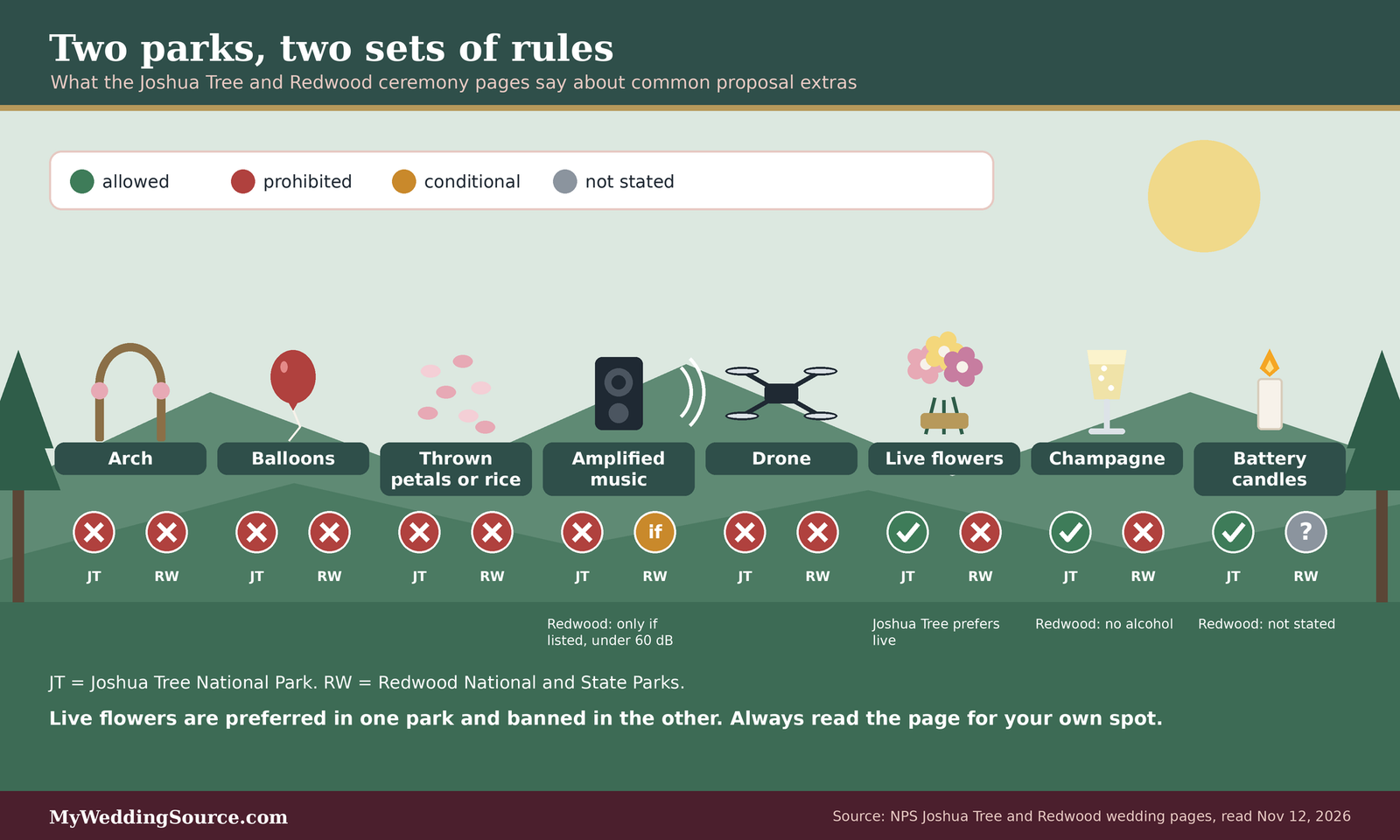
The table below collects the main figures we read on proposal location permissions. It is a sampler of how rules differ, not a guide to any one place.
| Place | What triggers a permit | Minimum notice we read | Fee we read | Proposals mentioned? |
|---|---|---|---|---|
| Joshua Tree National Park | All ceremonies | 15 days | $120 | No |
| Denali National Park | Ceremonies over 12 people | Not stated | $200 | No |
| Redwood National Park | All weddings and vow exchanges | Not stated | $100 or $200 | No |
| Yellowstone National Park | Ceremonies | 10 business days | $300 at one site | No |
| New York City Parks | 20 or more people; reserved areas | 21 to 30 days | $25 | No |
| Brooklyn Bridge Park | Social gatherings; large or equipped photo groups | 21 days | Varies | Yes |
| San Francisco Rec and Park | Paid photography; drones | 5 business days | Per-day fee | No |
| California State Parks | Events beyond pre-approved use; paid photography | 30 days | Varies | Engagement photography named |
Rooftops: who actually says yes
A rooftop looks like a place and works like a business. Almost every rooftop worth proposing on belongs to a hotel, a restaurant, or a building that has rules about who may go up, how many, and when. Proposal location permissions for a rooftop are therefore less about government forms and more about an operator’s calendar, insurance, and staffing.
Four kinds of rooftop and four kinds of answer
The first step in rooftop proposal location permissions is to work out which kind of rooftop you are asking about, because the right person to call and the likely answer are very different.
Hotel rooftops and terraces
For proposal location permissions on a hotel rooftop, note that hotels are used to special occasions, and some publish proposal packages. Four Seasons Hotel Baltimore’s page, for example, describes a proposal package of $2,500 that includes a private space for four hours (with two hours of setup and one hour of breakdown), flameless candles, a champagne toast, and a dedicated proposal specialist. It asks for 14 days’ notice, says a guest count of 20 or more requires a food and beverage minimum, and excludes taxes and service charges. String lights are a separate $500 add-on on one terrace. The page does not mention photography services. That is one hotel’s offer on the day we read it, but it shows what a hotel can handle when you ask early and call it a proposal.
Restaurant and bar rooftops
Restaurants and bars may be open to the public, which means you may have no privacy unless you book a private section. Two examples show typical conditions. Old Ebbitt Grill in Washington describes a private rooftop terrace for standing receptions from May through October, “weather and season permitting,” with minimums and a room fee, and says audio-visual equipment and amplified sound are not permitted. The rooftop at Nobu Hotel Chicago says it is weather permitting, that exclusive hire is recommended for 100 to 120 guests, that its smaller terraces hold 16 to 35, and that no backup space is held unless it is contracted before the event. Neither page is about proposals. Both show that capacity, weather, sound, and backup space are the topics to raise.
Apartment, condo, and office rooftops
Residential and office rooftops are the hardest case, because the person who answers the door may have no authority to say yes. Ask the building manager or the association in writing, and ask who has authority to approve a guest event. Do not assume a resident’s key or code gives you permission to bring guests. A resident may be able to invite you, but the building may have rules about how many guests can go up, what hours the roof is open, and whether outside photographers may enter. We did not find a source that settles these questions for all buildings, because they are set by each building’s own rules and by local codes, so ask.
What rooftops are more likely to raise
Rooftop proposal location permissions raise questions parks rarely do, because a roof is a place where safety rules concentrate.
Capacity and assembly rules
Cities and fire officials set limits on how many people may gather in a space, and venues are responsible for meeting them, not their guests. New York City’s Department of Buildings, for example, says a Place of Assembly Certificate of Operation is needed when 75 or more people gather indoors or 200 or more gather outdoors, and that the obligations fall on the person operating the venue. You will not be applying for that, but it explains why a venue may cap your guest list or refuse a rooftop for a larger group. Ask the manager what the capacity is and whether your helpers and photographer count toward it.
Weather and backup space
A rooftop is the most weather-exposed spot in this guide. Both restaurant pages we read say rooftop use depends on weather, and one says it holds no backup space unless you contract for it in advance. Ask what the weather policy is, who decides, how late the decision is made, what happens to any fee or minimum, and where the backup spot is. Then tell your photographer about the backup, because a plan that changes without them rarely goes well.
Sound, decoration, and outside vendors
Rooftop venues often limit amplified sound because of neighbors, and some limit outside decoration because of wind and fire rules. Old Ebbitt’s page says amplified sound is not permitted at any time on its terrace. Ask whether candles are allowed and whether they must be flameless, whether you may bring flowers or signs, whether outside vendors need to provide insurance, and whether you may bring your own photographer. Hotels often have a preferred way of handling these requests, and following it is usually easier than arguing for an exception.
How to make a rooftop request in practice
A good rooftop request for proposal location permissions is early, specific, and honest about the size of the moment.
Timing, budget, and the minimum spend
Four Seasons asks for 14 days, and Old Ebbitt’s pages list food and beverage minimums that run into the thousands of dollars for private use of the terrace. A minimum spend is not a fee. It is an amount you commit to spend on food and drink, and it can still be larger than most proposals warrant. Ask for the total including taxes, service charges, and any minimum, and ask whether a smaller area, a weekday, or a daytime slot changes it.
What to ask staff to keep quiet
Staff who handle proposals often keep secrets well, but they still need instructions. Ask who will know, whether the person who takes the booking will also be at the door on the day, and how they will greet your partner if you arrive together. Ask them to avoid mentioning a “special event” at the host stand. If your partner might call the venue, agree a neutral phrase. Some hotels build this kind of coordination into a package, as Four Seasons describes.
Private property: homes, rentals, farms, and borrowed spaces
Private property is the easiest place to get a yes and the easiest place to skip the question. There is no permit office, so the only thing standing between your proposal location permissions and a bad surprise is a conversation with the person who has the authority to say yes. For proposal location permissions on private land, that conversation is the whole process.
Permission from the person who can give it
On private land, the person who owns a space and the person who controls it on a given day are not always the same, and the difference is where most private-property misunderstandings begin.
Owners, tenants, and hosts
If a friend or relative owns the place, ask them directly, tell them the date, the time window, and the number of people, and ask whether anything about the property limits it, such as neighbors, a shared yard, or an association. If the place is rented, ask the owner or the manager, not only the tenant, because a lease may limit guests, photography, or events. If you are staying in a short-term rental, read the listing’s house rules and ask the host in writing before you invite anyone. We do not have a source that sets those rules for all rentals, so treat visitor and event limits as a question to ask rather than a fact.
A farm, garden, or private venue is a business, and many have a set process for small events. Ask what they charge, whether a photographer must be approved, and how they handle weather. If you want a larger moment at such a place, our guide to outdoor wedding venues explains what site managers typically need to know, and the same questions apply to a proposal.
Trespass in plain terms
Trespass is about entering someone else’s property without permission. Cornell’s Legal Information Institute describes trespass to land as knowingly entering someone else’s property without their permission, in a way that intrudes on their property interests. The same page says the intent that matters is the intent to enter, not an intent to do harm. In practice, that means “it was a nice view” is not a defense, and a good intention does not turn an unapproved entry into an approved one. We did not find a source that explains how signs, fences, or revoked permission work in every state, and the details differ by state, so check your state’s rules or ask a lawyer if the situation is unclear.
The plain version for planners: if a place is posted, fenced, locked, or closed for the day, ask first. If someone with authority says you may not be there, leave without argument and use your backup spot.
Neighbors, shared access, and the people nobody told
Private property often has people around it who were not part of the conversation. A shared stairwell, a rooftop that serves several apartments, a lake path with a neighbor’s dock, or a driveway that belongs to someone else can all matter. Ask the owner who else uses the space on that day, and whether anyone should be told. A short courtesy note to the neighbors, saying that a small family event is happening and when, prevents a call to the police about unfamiliar people in a yard. You do not have to reveal what the event is.
Cameras, recording, and guests who did not agree to it
A proposal is increasingly a recorded event, and recording is where private property meets state law. Our rule is simple: do not secretly record people who have not agreed to it, and tell everyone who will be filmed that a photographer will be there.
Hidden cameras and private places
The Reporters Committee for Freedom of the Press explains that every state and the District of Columbia has hidden-camera laws, often limited to recording nudity in private places, and that many also address unattended cameras. It says that secret recording in a private place can support a civil invasion-of-privacy claim even where no criminal law applies. The practical rule is that a camera placed in a bedroom, bathroom, or another place where people expect privacy is never part of a proposal plan, and that an unattended camera on someone else’s property should be disclosed to the owner.
Audio recording and consent rules vary by state
The same source explains that federal law and most states use a one-party consent standard for recording conversations, meaning one participant must know and agree, while about eleven states, including California, Florida, Illinois, Maryland, Massachusetts, Pennsylvania, and Washington, mainly require every participant to consent. Where a camera records audio, the audio portion is generally governed by those recording laws. Where it records no audio, wiretap laws generally do not apply, though hidden-camera and privacy rules may. Because people at a proposal talk, and because guests may be in a different state from the one you are in, the safe assumption is to make sure everyone who may be recorded knows a photographer or videographer is present. This is general information, not legal advice.
A simple standard: tell the guests
If relatives are waiting to celebrate, tell them in advance that a photographer will be present and will share images with you. If a venue’s guests may wander into frame, ask the venue what notice it gives. If a guest asks not to be photographed, honor it. These steps cost nothing, keep your plan on the right side of both the rules and your relationships, and spare you a difficult conversation about who owns the photos. Our guide to wedding photography deliverables covers how images are delivered and shared, and it is worth reading before you sign with anyone.
Photographers, drones, and the permissions they bring
Many proposal location permissions questions turn on a person who is not in the proposal: the photographer. A photographer can change a park’s answer, add insurance requirements, and bring equipment that is limited or banned. A drone can change it more.
When a photographer changes the permit answer
In proposal location permissions terms, the same photograph can be casual or commercial depending on who pays and what equipment is used. Different offices draw the line in different places.
Paid photography is treated differently in some places
San Francisco says personal photography does not need a permit and that work where the photographer, crew, or talent is paid does. California State Parks defines commercial photography as a person paid by someone else to photograph them and names engagements. Brooklyn Bridge Park exempts non-commercial wedding or engagement photography unless the group is over 20 or uses more than handheld equipment. A national park FAQ on commercial still photography says most still photography does not need a permit, and that a permit is needed for shoots that use models, sets, or props, take place where or when the public is barred, or would cost the agency money to manage; it says portrait subjects such as wedding parties do not count as models, but props or sets with them can trigger a permit. For proposal location permissions, Redwood says photographers and videographers serving a permitted wedding do not need separate permits, and commercial vendors are listed as support personnel on the application.
The lesson is that “a friend with a phone” and “a hired photographer with a reflector” can get different answers in the same park. Say which one it is.
Tripods, reflectors, and other gear
Equipment is where small details create problems. San Francisco says tripods are restricted in certain areas even for personal use. Brooklyn Bridge Park allows only handheld equipment on its lawns and turf and says anything beyond handheld must be listed on the permit. Yellowstone and Joshua Tree pages do not address photographer equipment, which means you should ask. Tell your photographer to bring only what you have cleared, and ask them what they usually carry so no surprise comes up on the day.
What a photographer’s own agreement should cover
A professional photographer who works in public places often has a process for permits, insurance, and location rules. Before you sign, ask whether their agreement says who is responsible for permits and fees, whether they carry liability insurance and can provide a certificate if a venue asks, whether they have shot at your location before, and what happens if you have to move the location. Our guides to wedding photography and the wedding vendor contract explain what to look for in an agreement, and our wedding engagement photos article covers planning a session around a proposal. If you are still choosing, the sibling guide on an engagement announcement photo session covers what happens after the question.
Drones
Drones deserve their own section in any guide to proposal location permissions, because a drone is the item most likely to be banned outright and most likely to attract a ranger.
National parks may prohibit drones
The National Park Service says that under a 2014 policy memorandum, superintendents can ban launching, landing, and operating uncrewed aircraft on park lands and waters, and that the policy is still in force. It says the ban ends at park boundaries, that FAA rules still apply, and that violating it is a misdemeanor carrying up to six months in jail and a $5,000 fine. Joshua Tree and Redwood both list drones as prohibited on their wedding pages. The safe assumption in any national park is no drone unless the park tells you otherwise in writing.
FAA basics apply on top of local rules
The FAA says recreational flyers must pass its free online safety test, TRUST, and carry proof; must register drones weighing 250 grams or more; need authorization to fly in controlled airspace near airports; must stay at or below 400 feet in uncontrolled airspace; and are responsible for knowing the rules that apply where they fly. FAA rules are the minimum, not the whole answer, because a park, a city, or a private owner can add rules of its own.
City parks and private land set their own drone rules
Brooklyn Bridge Park prohibits drones in or around the park with no exceptions. San Francisco requires a permit for any drone flight on, from, within, or over its parks property, and lists conditions that include a licensed pilot, $2 million in insurance naming the department, no flights over uninvolved people, a secure perimeter, and a park ranger on site with a staffing charge. On private property, the owner decides, and you should still ask neighbors. For most proposals, the simplest answer is to skip the drone and ask the photographer for a high vantage point from the ground.
What it costs and how to work backward from the date
Proposal location permissions rarely cost much on their own, but the surrounding items add up. The goal of this section is to help you budget for what can be known and plan around what cannot.
What this actually costs
For a small proposal in a public place, the permit itself can be the smallest cost, and sometimes there is none. From the pages we read on November 12, 2026: New York City Parks lists a $25 fee, Joshua Tree $120, Redwood $100 or $200, Denali $200, and one Yellowstone site $300. San Francisco lists $369 per day for a simple exterior still photography shoot, and National Park Service Manhattan Sites asks for a $50 fee plus liability insurance of at least $1 million per occurrence naming the United States as an additional insured, for special events. Hotels and restaurants price differently: Four Seasons Baltimore lists $2,500 for a proposal package before taxes and service charges, and Old Ebbitt lists a $2,500 rooftop room fee plus food and beverage minimums from $5,500. These are examples from specific places, not averages, and they may have changed.
What the fees cover
Fees for proposal location permissions are rarely a single number. Understanding what each one buys helps you ask the right questions about total cost.
Application and permit fees
An application fee for proposal location permissions is usually non-refundable and covers the cost of processing. Joshua Tree, for example, says its fee is non-refundable, and New York City Parks says its fee is nonrefundable and cannot be waived. Entrance fees are separate: Joshua Tree says they are not waived for participants or guests. If your application is denied, the fee does not come back, so apply only after you have talked to the office and understand the likely answer.
Insurance, monitoring, and cleanup
Larger permits can add costs. National Park Service Manhattan Sites says that if its permit is approved, staff monitoring costs are billed to the permittee, and that it requires a certificate of liability insurance. Redwood mentions event monitoring billed per staff hour and cleanup or resource damage billed at cost. For a very small proposal you are unlikely to meet these conditions, but if your plan grows to include a gathering of friends, a setup, and a vendor, ask whether insurance or monitoring is required and whether your photographer’s insurance can satisfy it. Our guide to wedding insurance explains how event coverage works in general, though a proposal-sized event may not be something an insurer covers, so ask before assuming.
Package prices and minimum spends
Hotel and restaurant prices combine a room, service, and food. Ask for the total including taxes, service charges, and any minimum, and ask what the price includes. A $2,500 package that includes a toast, candles, and a coordinator is a different thing from a $2,500 room fee with a separate minimum. Compare the totals, not the headline numbers.
Working backward from the date
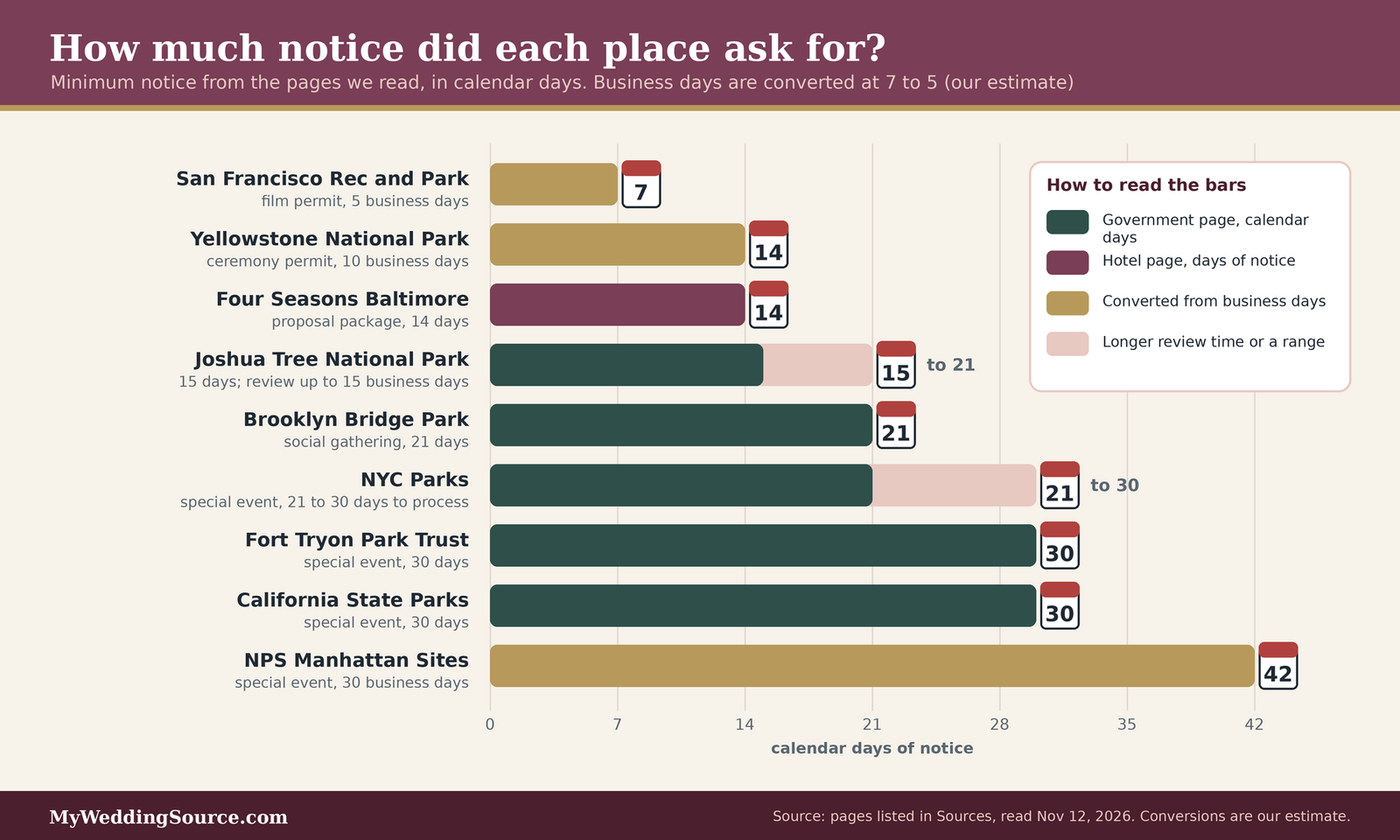
Lead times are the part of proposal location permissions you cannot rush, and they vary more than fees. The figure below sorts the minimum notice we read, from the shortest to the longest.
Start the owner conversation first
Begin proposal location permissions work with the person who can say yes or no, before you buy a ring box, hire a photographer, or ask friends to travel. A slow reply is the single most common reason a date moves. If the office needs 21 to 30 days and you ask 3 weeks out, your application may not be accepted at all. The same logic applies as with any vendor: the item with the longest queue goes first.
Build a buffer for review time
The minimum notice is the shortest time an office will accept an application, not the time it takes to receive an answer. Joshua Tree asks for 15 days but says review can take up to 15 business days. Yellowstone says permits are usually issued only a few weeks before the event. Add at least two weeks to any stated minimum, and choose two or three acceptable dates so that a denial does not reset the clock.
What to do if you are inside the lead time
If you have less time than an office requires, you have four honest options. Ask whether a shorter route exists for your plan. Brooklyn Bridge Park, for example, asks for two business days for photography applications but 21 days for a social gathering. Choose a spot with no permit trigger, such as a smaller group with no reserved area and no setup, after confirming the rules by phone. Move to private property where you have the owner’s permission. Or move the date. Do not guess at the first option: New York City Parks, for one, does not accept applications inside its 21-day window.
Edge cases and what to do when the answer is no
Most plans for proposal location permissions meet at least one of the situations below. Each has a calm response.
When the rules do not mention proposals
This is the most common situation in proposal location permissions, and the pages we read are almost all silent on proposals.
Call and describe the plan
Use the plan paragraph. Describe the size, the setup, and the photographer, and ask the four questions. The office will tell you which category your plan falls in, and the answer is more reliable than any web page. If the office says “that’s not something we regulate,” ask whether any rules for the spot still apply, and ask for a short email to that effect.
The small, unreserved, set-up-free version
Some places say small groups that do not reserve an area do not need a permit. New York City Parks says events with 20 or more people need one and that smaller groups may need one to reserve a specific area, use amplified sound, or bring canopies or tables. Fort Tryon’s trust says groups under 20 generally do not need a special events permit and that passive lawn use is permitted without tables or furniture. That is the shape of the safe version: a few people, nothing reserved, nothing set up, no sound system. It is not a promise that nothing applies, so keep the written reply handy.
Setups that quietly turn a proposal into an event
Small additions can cross a line without feeling like it. A picnic with a table, a banner, a tent, a speaker, balloons, a rented arch, or a row of chairs is no longer passive use. Joshua Tree and Redwood both prohibit arches, and New York City Parks requires signs and banners to be declared and bars tents from being staked. If a setup is central to your plan, our guide to proposal picnic setup covers what to bring and what to leave at home, and the venue’s own list of allowed items should be your starting point.
When the answer is no, or “not that spot”
A no on proposal location permissions is useful information. It tells you what to adjust, and it usually arrives with an alternative.
Ask what they can offer
Ask what the office or manager would approve: a different area, a different time, a smaller group, or a different day. Joshua Tree lists multiple locations with different limits, and Redwood lists pre-approved sites and says others are reviewed. Staff often know a quieter spot that fits your plan better than the one you chose.
Have a backup that does not need a permit
Choose a second location before you start, ideally one with a different manager, such as a private garden with the owner’s permission, a quiet hotel lobby lounge with the manager’s agreement, or a viewpoint in a different jurisdiction. A backup that needs its own permit is not a backup. Keep it to the same time window so that your helpers can pivot without confusion.
Ask for the decision in writing
If the answer is no, ask for the reason and the rule in writing, and ask whether the decision can be appealed or revisited at a later date. You are unlikely to need either, but a written no helps you plan and prevents an argument with a different employee later.
Surprise, secrecy, and the paper trail
A proposal is different from most events because the person it is for is not supposed to know, and proposal location permissions create paperwork. Permission work creates records, and records can leak.
Keep your partner out of the thread
Proposal location permissions emails, confirmations, and invoices often go to a shared account, a shared calendar, or a card statement your partner can see. Use a separate email address for permit and venue messages, avoid shared calendars, and pay with a card or account your partner does not review. Ask venues to use your phone number for last-minute calls. These are small habits that protect a surprise better than any code word.
Tell helpers what they must know and no more
Anyone listed on an application, such as a photographer or a coordinator, must know enough to be honest with the office. Redwood, for instance, asks that commercial vendors be listed as support personnel. Tell them the facts and the rules, and tell them to keep the surprise. A friend who is listed but never told the conditions can accidentally break them.
If the moment does not happen as planned
Crowds, weather, and closures can change a plan on the day. Decide in advance who calls it, usually you and your point-of-contact friend, and what the signal is for moving to the backup. If someone else is proposing at your spot, or the area is busy, move. Your partner will remember how it felt, not how perfectly it matched the plan.
Questions to ask before you propose
Use the three groups below as call and email scripts for proposal location permissions. Each group is for a different kind of place.
For parks and public land
Ask these of the managing office before you pick a date.
Questions for the permit office
Ask about thresholds, notice, and the rules that apply even without a permit. Use the list below in the order shown.
Questions to ask the park or city office
- Who manages this exact spot, and is there another agency next to it that I should also ask?
- For a group of this size, with this setup, and a photographer who is or is not paid, is a permit or any approval needed?
- If no permit is needed, which rules still apply, such as where to stand, drones, sound, petals, candles, tripods, or furniture?
- How much notice do you need, and how long does review take?
- What is the total cost, including application fees, entrance fees, insurance, and monitoring?
- Is exclusive use available, and what happens if other visitors are present?
- What happens if weather, a closure, or a holiday affects my date?
- Can you confirm your answers by email?
How to use the answers
Write each answer next to the question, with the name of the person and the date. If two answers conflict, such as a phone answer and a web page, go with the more restrictive one until the office confirms in writing. If an answer depends on a number, such as a group size, repeat the number back so there is no doubt about what was approved.
For rooftops, hotels, and private spaces
Ask these of the operator or the owner.
Questions for the operator or owner
Ask who decides, how many people are allowed, and what the day looks like.
Questions to ask the rooftop, hotel, or property owner
- Who has the authority to approve a proposal at this spot, and who will be there on the day?
- What is the capacity, and do my photographer and helpers count toward it?
- What is the weather policy, who decides, and where is the backup space?
- Are there limits on sound, candles, flowers, signs, or outside vendors?
- Is a private section available, and what is the total price including taxes, service charges, and any minimum?
- May I bring my own photographer, and do they need to provide insurance?
- Who on your staff will know about the plan, and what will they say if my partner asks?
- Can you confirm the arrangement in writing?
How to use the answers
Compare the operator’s conditions with your plan line by line. If the capacity, sound, or vendor rules conflict with your plan, change the plan, not the rule. Ask for a revised confirmation by email if anything changes after the first reply.
For photographers and helpers
Ask these of anyone who will be on site.
Questions for your photographer
Ask what they already know about the spot, what they will carry, and who is responsible for permits. Ask how they will stay out of the way, how they will handle strangers who stop to watch, and what happens to the images, including where they may be shared. Ask for the answers in the agreement.
Questions for helpers and family
Ask each person to keep the plan confidential, to follow the rules you were given, and to take direction from your point of contact if an official approaches. Tell them where to stand, when to arrive, and when to leave. Our wedding vendor due diligence checklist offers a general way to vet anyone you hire.
FAQ: proposal location permissions questions
Parks and public land
Do I need a permit to propose in a park?
It depends on the park, the group size, and what you bring. The pages we read cover weddings and events and mostly do not mention proposals. Brooklyn Bridge Park does, and treats a proposal as a social gathering that needs a permit. Describe your plan to the managing office and keep the written reply.
Can I propose in a national park without a permit?
Possibly, if the group is small and you set nothing up, but you should ask. National park pages we read require special use permits for ceremonies, and Denali sets the line at groups over 12. A proposal is not defined on those pages, so email the permit office and ask whether your plan falls under the rules.
Rooftops and private property
Who do I ask about a rooftop?
Ask whoever operates the rooftop on your date, which may be a hotel, a restaurant, or a building manager. Ask for the person with authority to approve a proposal, not only the host. Request the capacity, weather policy, and total price in writing, and tell them whether a photographer will attend.
Can I propose on a friend’s property?
Yes, with the owner’s permission, which is the whole requirement in most places. Tell them the date, time, and number of people, ask about neighbors, shared access, and any association or lease rules, and confirm the plan in writing. If the property is rented, ask the owner or manager, not only the tenant.
Photographers and drones
Does a photographer change the permit answer?
It can. San Francisco and California State Parks treat paid photography as commercial, while Brooklyn Bridge Park exempts non-commercial engagement photography below its group and equipment limits. Redwood says photographers serving a permitted wedding need no separate permit. Tell the office whether your photographer is paid and what equipment they will carry.
Can I use a drone for a proposal?
Often not. National park superintendents can ban drones, Joshua Tree and Redwood prohibit them on their wedding pages, and Brooklyn Bridge Park bans them outright. The FAA also requires passing a safety test and registering drones of 250 grams or more. Ask the land manager first, and consider a ground-level photographer instead.
Timing and backups
How far ahead should I ask?
Ask as soon as you have a spot, and before you pay for anything refundable only in part. Minimum notice we read ranged from five business days to about 30 days, with review taking longer. Add at least two weeks as a buffer, and choose two or three acceptable dates and a backup spot.
What if the answer is no?
Ask what they would approve instead, such as another area, time, or group size, and ask for the reason in writing. Then move to your backup, ideally a place with a different manager and no permit trigger. A no early in the process costs far less than a conversation with a ranger on the day.
Your next steps
This week
Pick two spots and find their managers
Choose a first-choice and a backup for your proposal location permissions, and find who manages each. Write down the office, the phone number, and the email. Our wedding planning checklist can help you keep the wider plan organized once the proposal is done.
Write your plan paragraph
Fill in the proposal location permissions template above with your own numbers. Read it aloud once. If it sounds like a wedding, trim the setup. If it sounds too vague, add the numbers.
Before you commit money
Make the calls, then confirm by email
Ask the four questions about proposal location permissions, send the follow-up, and save the replies in a folder your partner will not see. Do this before paying a photographer’s deposit or a venue minimum.
Brief everyone and build the day-of folder
Share the conditions with your photographer and helpers, name a point of contact, and put the confirmations, rules pages, and backup plan in your folder. After the yes, our engagement party guide and engagement announcement guide help you plan what comes next.
Sources & methodology
How we built this guide
What we relied on
This guide to proposal location permissions combines federal regulations on national park special events and park closures, individual park and city parks pages on ceremonies, photography, and drones, FAA guidance for recreational drone flyers, a building department page on assembly certificates, a legal encyclopedia entry on trespass, a press-freedom group’s guide to recording laws, and venue pages from hotels and restaurants. Every fee, group limit, and lead time we quote comes from a page we read on November 12, 2026, and describes that place on that day. Where a statement comes from a hotel or restaurant, we attribute it to the business, because a venue describes its own offer. Our lead-time chart converts business days to calendar days with a simple 7-to-5 ratio, and those conversions are our estimates.
What we did not do
We did not call any office, test any application, or give legal advice. Most pages we read cover weddings and ceremonies and do not mention proposals, so statements about proposals are our reading of those pages, not a ruling from any agency. Rules on private property, recording, and drones differ by state and locality and change. Confirm your own plan with the office that manages your spot and, if you need legal advice, with a licensed attorney.
Source list
Federal and state government sources
- 36 CFR 2.50, Special events (National Park Service), eCFR: https://www.ecfr.gov/current/title-36/chapter-I/part-2/section-2.50
- 36 CFR 1.5, Closures and public use limits (National Park Service), eCFR: https://www.ecfr.gov/current/title-36/chapter-I/part-1/section-1.5
- National Park Service, Joshua Tree National Park, Weddings and Ceremonies: https://www.nps.gov/jotr/planyourvisit/weddings-and-ceremonies.htm
- National Park Service, Denali National Park and Preserve, Permits: Weddings, Ceremonies, and Gatherings: https://www.nps.gov/dena/planyourvisit/weddings-ceremonies-and-gatherings.htm
- National Park Service, Redwood National and State Parks, Weddings and Celebrations: https://nps.gov/redw/planyourvisit/supweddings.htm
- National Park Service, Yellowstone National Park, Wedding information: https://www.nps.gov/yell/planyourvisit/weddinginfo.htm
- National Park Service, Uncrewed aircraft in the national parks: https://www.nps.gov/articles/uncrewed-aircraft-in-the-national-parks.htm
- National Park Service, Manhattan Sites, Special use permit instructions and requirements: https://home.nps.gov/cacl/planyourvisit/upload/508-Special-Use-Permit-Instructions-and-Requirements-6-3-21.pdf
- National Park Service, Frequently asked questions: commercial filming and still photography: https://www.nps.gov/drto/learn/management/frequently-asked-questions-commercial-filming-and-still-photography.htm
- Federal Aviation Administration, Recreational flyers: https://www.faa.gov/uas/recreational_flyers
- California State Parks, Special event permits: https://www.parks.ca.gov/?page_id=28710
City and local government sources
- NYC Parks, Frequently asked special events permit questions: https://php1-84.nycgovparks.org/permits/special-events/faq
- NYC Mayor’s Office of Citywide Event Coordination and Management, Primary permitting agencies: https://www.nyc.gov/site/cecm/support/primary-permitting-agencies.page
- NYC Department of Buildings, Place of Assembly Certificate of Operation: https://www.nyc.gov/site/buildings/property-or-business-owner/place-of-assembly-certificate-of-operation.page
- San Francisco Recreation and Park Department, Film, video, and photo permits: https://www.sfrecpark.org/428/Film-Video-and-Photo
- Brooklyn Bridge Park, Film and photography permits: https://brooklynbridgepark.org/pages/film-and-photography-permits
Legal, nonprofit, and venue sources
- Cornell Legal Information Institute, Trespass: https://www.law.cornell.edu/wex/trespass
- Reporters Committee for Freedom of the Press, Introduction to the Reporter’s Recording Guide: https://www.rcfp.org/introduction-to-reporters-recording-guide/
- Fort Tryon Park Trust, Permit FAQs: https://forttryonpark.org/visit-and-park-map/permit-faqs/
- Central Park visitor guide, Permits for weddings and special events (visitor information site, not a city agency): https://www.centralpark.com/visitor-info/FAQ/permits/
- Four Seasons Hotel Baltimore, The Perfect Proposal package: https://www.fourseasons.com/baltimore/weddings/packages/the-perfect-proposal/
- Old Ebbitt Grill, Private rooftop terrace: https://www.ebbitt.com/private-events-venue/rooftop-terrace-private-weather-season-permitting/
- Rooftop at Nobu Hotel Chicago, Private events: https://noburestaurants.com/chicago-rooftop-at-nobu-hotel-chicago/private-events-2