

Wedding RSVP etiquette comes down to one idea: ask for a clear answer by a date your caterer can live with, make replying easy, and follow up kindly with anyone who goes quiet.
The invitations are in the mail, or about to be, and now a number you will pay for depends on dozens of other people’s mailboxes, inboxes and good intentions. Some guests will reply the night the invitation arrives. Others will prop the card on a counter for three weeks, and a few will answer “yes” for two people when the envelope named one. None of this makes anyone a villain, but every reply, late reply and non-reply turns into a decision about plates, chairs, favors and a contract with a hard deadline.
This guide is about that handling: how to set the reply-by date, whether guests should answer online or by mail, what the reply should ask, how to track the answers, what to say to people who stay silent, and how to respond when a reply does not match the invitation. It also looks at the part most etiquette columns skip, which is what happens to the money when the headcount you give the caterer turns out to be wrong. We keep the sample reply-line wording short here because our wedding invitation wording guide covers it in depth, and we leave guest-list rules and envelope addressing to the wedding invitation etiquette guide. Names, dates and dollar figures in the examples are invented or illustrative, and where etiquette sources disagree we say so and tell you what is left for you to decide.
What an RSVP is for, and what each side owes
What the reply does for you
It turns an invitation into a number you can plan around
“RSVP” comes from the French “répondez, s’il vous plaît,” which means “please reply,” and that is the whole job of the card or web form. Emily Post’s guidance on wedding response cards says reply cards are included “to give you an accurate guest count for the reception,” which tells you what the request is really about. The invitation list is the number of people you asked, and the reply list is the number of people who have committed to being there. Between those two numbers sit your venue capacity, your seating chart, your catering order and a good part of the budget. A reply that arrives early is a small gift, and a reply that never arrives is a gap you will have to fill with a phone call.
It gives vendors a date to plan against
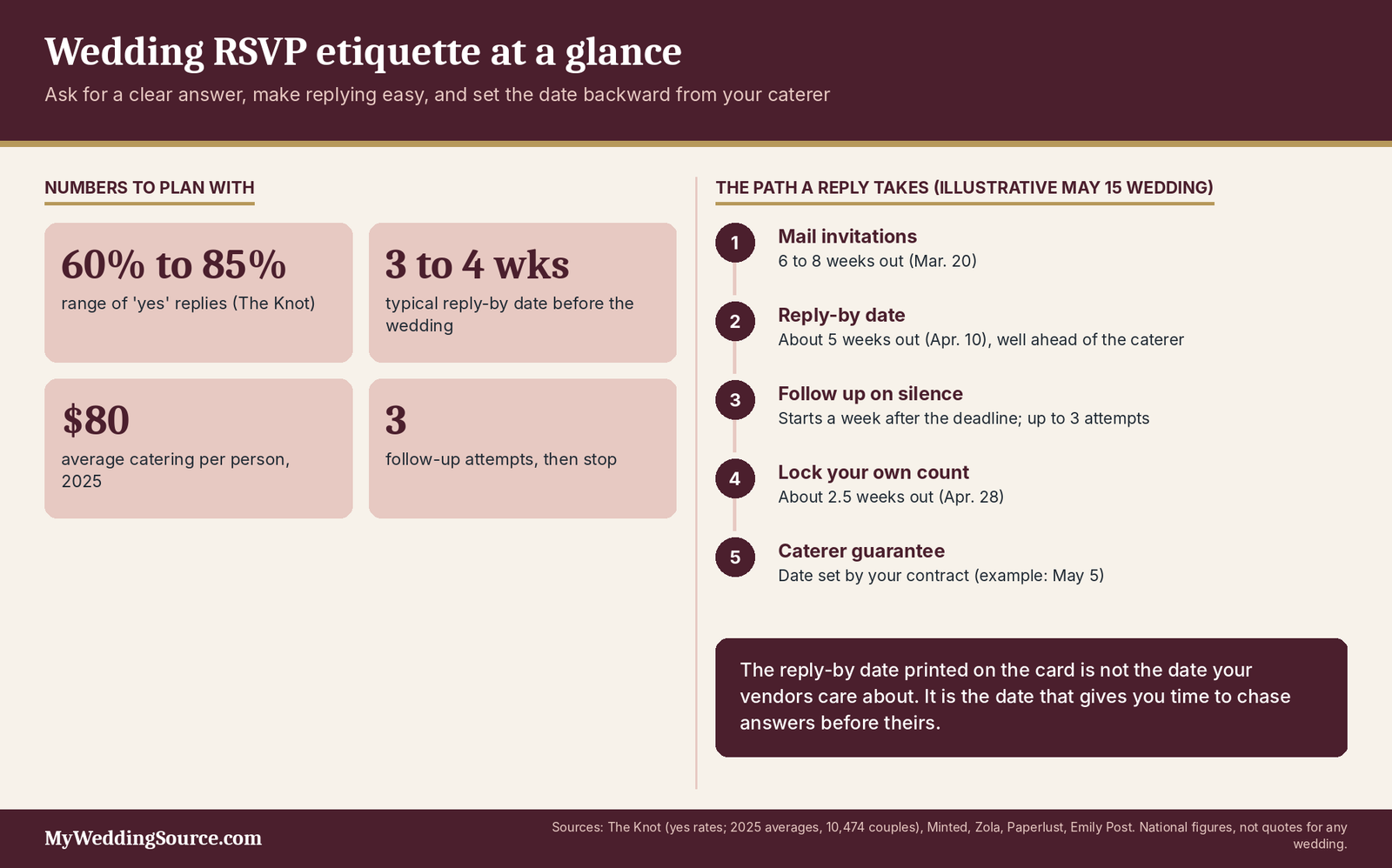
Caterers, rental companies and venues all work from a final count, and the count has a deadline that you did not choose. Minted’s wedding invitation wording page notes that a reply-by date typically falls three to four weeks before the wedding, which leaves time for a final head count with the caterer about one week before and for finalizing the seating chart. That one-week figure is Minted’s general planning assumption, not a rule, so your own contract may ask for the number sooner. The practical meaning is that the reply-by date printed on the card is not the date that matters most to your vendors. It is the date you chose to make sure you have enough days to chase answers before the real deadline arrives.
What guests and hosts each owe
The guest’s side: answer promptly and honestly
Etiquette puts the first obligation on the person who received the invitation. Emily Post’s advice on missing and extra RSVPs says guests should reply “immediately,” which is a high bar but a useful one, because an invitation that sits unanswered tends to stay unanswered. A prompt “no” helps as much as a prompt “yes,” since it frees a seat for someone else and takes a name off the follow-up list. Guests also owe the couple an accurate answer about who is coming, which means replying only for the people named on the invitation and not assuming the invitation extends to a date or children. When a guest is unsure, a short message that says “I’m trying to confirm time off, can I let you know by Friday?” is far better than silence, and a couple who hears it can plan around the date.
The host’s side: make replying easy and answer questions fast
Hosts owe guests a reply process that is hard to get wrong. That means a clear date, a clearly stated method, enough information to decide (the location, the date and a way to find travel details), and a quick answer when someone asks a question. Many missed replies are not defiance but friction: a card without a stamp, a website link that is hard to find, a form that does not say who is invited. Emily Post recommends pre-addressing and stamping the reply envelope to make mailed replies easier, and that same instinct applies online, where a link that opens straight to the right household’s names saves guests from typing anything they could get wrong. If a guest asks whether children are invited, answer the question the same way every time, because guests compare notes and consistency is the main thing they judge.
When should replies be due, and how should guests send them?
Setting a reply-by date that works backward from the caterer
The ranges sources give, and why they differ
Published advice on the reply-by date is a range, not a single answer. Minted and Zola both suggest asking for replies 3 to 4 weeks before the wedding, while Emily Post’s response card guidance says two to three weeks, and the stationery company Paperlust offers a sample timeline in its RSVP follow-up guide that sets the deadline six weeks out. The sources disagree because they weigh different things: the shorter windows leave guests less time to forget, and the longer windows leave hosts more room to follow up before the final count. A vendor’s sample timeline is one editorial opinion rather than a standard, so treat it as a way to see how the dates stack up. The sensible reading is that the earlier end of the range is safer when you expect to chase many replies, and the later end is fine for a small, close group that tends to answer quickly.
Building your own date, step by step
Start with the caterer, not the card. Find the date in your contract by which the final count is due, subtract a few days for your own last pass through the tracking sheet, and then subtract the time you will need to follow up with people who have not answered. If you plan one week of waiting, two rounds of follow-up and a short cushion, you are looking at roughly three to four weeks between the printed reply-by date and the vendor deadline. The Knot’s invitation timing guide says to mail invitations six to eight weeks before the wedding, closer to eight when replies come back by mail and closer to six when invitations include a QR code or digital RSVP option. The table below walks through a worked example for an invented Saturday wedding on May 15, 2027, with a caterer guarantee due on Wednesday, May 5.
| Step | Date (example) | Weeks out | What happens |
|---|---|---|---|
| Invitations mailed | Sat., March 20 | 8 | Paper replies have time to travel both ways |
| Reply-by date on card | Sat., April 10 | 5 | Three-week window for guests to answer |
| First follow-up wave | Sat., April 17 | 4 | A week after the deadline, per the Paperlust guide |
| Second wave and phone calls | Sat., April 24 | 3 | Calls to older relatives, text to friends |
| Internal count lock | Wed., April 28 | 2.5 | Remaining silent households marked as declined |
| Caterer guarantee due | Wed., May 5 | 1.5 | Contract date; confirm the exact day in yours |
| Seating chart final | Sat., May 8 | 1 | Table assignments follow the locked count |
Online, mail or both
What each method does well
The method you choose changes who replies easily and how much work lands on you. Mailed cards feel traditional and require no device, but they need a stamp, a mailbox and a legible handwriting sample. Online forms collect names, counts and meal choices in a form you can sort, and some let you set up reminders to anyone who has not answered. The Knot’s 2023 Guest Study, cited in its article on how many guests say yes, found that 60% of guests prefer paper invitations to digital ones (the study surveyed 1,000 U.S. adults aged 18 to 54 who attended at least one wedding in 2023), so a paper preference is common even among younger guests. Joy, a wedding website company, reports that its couples receive 80% to 90% of online RSVPs within two weeks, compared with 50% to 60% for paper cards, though those figures come from its own users and have not been independently checked.
| Method | Strengths | Watch-outs |
|---|---|---|
| Mailed reply card | Familiar, tangible, works without a device | Postage on both ways; handwriting; slow to return; manual entry |
| Online form on wedding website | Sortable data, meal and dietary fields, reminders | Some older guests will not use it; needs a clear link or QR code |
| Both, with one stated as official | Gives every guest an easy option | Two records to reconcile; guests may reply twice |
| Email or phone reply only | No printing; personal | Only practical for small lists; you must log every answer |
Making a hybrid work without double replies
Many couples offer both a mailed card and a website, and the system works if guests know which one counts. A sentence on the card such as “Please reply by April 10 on our website, or return the enclosed card” sets expectations, and a note in your tracking sheet that says “website wins in a conflict” settles disputes before they begin. Greenvelope’s discussion of digital invitations, a vendor source, suggests sending digital invitations to most guests and mailing printed versions to relatives who may not use email or a smartphone, and Joy likewise advises putting the website address on printed cards so older guests can choose it. The postage math is small but real: with the USPS prices effective October 4, 2026, a reply envelope needs a $0.82 stamp and a reply postcard needs $0.65, so stamps for 80 reply pieces cost about $65.60 with envelopes versus $52.00 with postcards, a difference of about $13.60. Check that a postcard format meets USPS size rules before you order, and weigh a full sample suite at the post office, since reply pieces add ounces.
What should the reply ask, and who is it for?
Names, numbers and plus-ones
Print or pre-fill the names of the people invited
The most reliable way to prevent an extra name on a reply is to tell guests who the reply is for before they write anything. Emily Post’s response card guidance describes the “M” line, a blank that precedes the guest’s own name, and says the line should include a plus-one only when the guest was invited to bring one. A bare “number attending” blank invites guessing, because a household that was invited as two adults can easily write “4” if the question does not say who is on the list. Online, the cleaner design is a household form that lists each invited person with a yes/no choice beside their name, so that no one has to type a count. If you use a paper card, many couples pre-print the names (“Alex Rivera and Sam Okafor”) with a single check for each, and leave a blank only for a guest you have deliberately invited to bring an unnamed date.
Plus-ones, children and “and guest” on a reply
A plus-one is a guest invited through another guest, and the reply is where that invitation gets used or declined. The Knot’s advice on uninvited plus-ones suggests that guests in serious relationships typically receive a plus-one, that casual daters generally do not, and that wedding party members always do, and Emily Post says partners of invited guests, whether married, engaged or living together, should be included on the invitation. Whatever rule you adopt, the reply should reflect it exactly: either name the guest, write “and guest” on the envelope and give the reply form a line for the guest’s name, or print only the invitee’s name. Collect the plus-one’s name, because the caterer, the place card and the entrée tally all need it. For the wording and policy behind these choices, see our plus-one etiquette guide; children follow the same logic, and the child-free wedding etiquette guide covers how to word an adults-only policy so a reply form is not the first place guests discover it.
Meal choices, dietary needs and other questions
Collecting entrée choices without chaos
If your reception offers a choice of entrées, the reply is where the choice is made, and it needs more discipline than any other field. Emily Post notes that guests traditionally write their name or initials beside the selection and recommends a discreet system, such as a symbol on the place card, because guests may forget what they chose by the time the plates arrive. For a couple, that means the reply must produce a name-by-name list, not a total: “three beef, two fish” does not tell a server which guest gets which plate. Online forms make this easy by attaching each choice to a named person, and they let you set the same entrée list the caterer will print on the menu. Before you add choices, ask your caterer whether offering several entrées changes the price or the minimum, since some contracts treat each additional entrée as a separate preparation, and ask by when the caterer needs the per-entrée count, which is often the same date as the guarantee.
Allergies and dietary needs: ask early, pass it on in writing
A line asking about dietary restrictions is worth including on almost every reply, and Minted’s wording page offers both a casual version (“Please inform us of any dietary restrictions”) and a formal one (“Special dietary requirements”). The reason is practical and, for allergies, a safety matter. The FDA’s food allergy page lists nine major allergens (milk, eggs, fish, crustacean shellfish, tree nuts, peanuts, wheat, soybeans and sesame), says symptoms can start within minutes to a few hours, and warns that “a mild allergic reaction does not always mean the allergy is mild.” Food Allergy Research & Education notes that the FDA Food Code asks food service managers to understand allergens and avoid cross-contact, so a caterer should be able to work from a clear written list. Collect the guest’s name, the allergen and a way to reach them, send the list to your caterer in writing as soon as it is complete, and invite any guest with a serious allergy to speak with the caterer directly. This is general information, not medical advice, and local rules for caterers and venues vary.
How do you track replies without losing the thread?
Building the tracking sheet
Columns that earn their place
A tracking sheet is a working document for the next ten weeks, so every column should answer a question you will actually ask. Keep one row per invited person, grouped under a household heading, and record how the person was invited (named, “and guest,” child), the date the reply arrived, the channel it came through, the answer, the entrée choice, any dietary note and the name of whoever is responsible for follow-up. Add a status column with three values: confirmed, awaiting, declined. The Paperlust follow-up guide suggests a separate tab for people who have not responded, with columns for contact method, contact date, response date and final status, and color-coding green for confirmed, yellow for awaiting and red for not attending. Give two people edit access, put the “last updated” date at the top, and agree on who logs replies so that the sheet is never half-updated.
Handling households, split replies and corrections
Households produce the messy cases. A mother replies for her adult children, a guest checks “yes” and writes “maybe” in the margin, or a partner replies on the website while the other mails a card with a different answer. Log what you received as received, in a notes column, and keep the status column for what you have confirmed. When two replies disagree, call or message the household rather than guessing, and settle on the latest confirmed answer; recording the rule in the sheet (“later confirmed reply wins”) keeps you from reopening the question each time. If a reply comes back with a name you did not invite, flag it in a separate column and handle it before the count is updated, so that an uninvited person does not slip into the caterer total by default. Our invitation etiquette guide covers the policy side of those extra names, and a later section here covers the scripts.
Forecasting the final count
What yes rates look like
Before replies arrive, you will want a rough sense of how many of the people you invited are likely to come. The Knot’s article on RSVP rates, updated in February 2024, cites one study putting confirmations at about 83% and others putting the range between 60% and 85%, and its senior editor Hannah Nowack describes about 80% yes at the RSVP stage as a sweet spot and suggests starting from a 20% decline estimate. The article lists the factors that push the number around: flights, hotels and time off deter out-of-town guests; The Knot’s 2023 Guest Study put the average cost of attending a wedding at about $580; adults-only policies lead some parents to decline; spring weekends compete with graduations and other weddings; and guests on multi-person invitations may not use every seat. The same article also notes that attendance on the day is a separate question, because a small number of guests may back out at the last minute. These are national rules of thumb from a wedding publisher, not predictions for your list.
Turning a rate into a planning range
A single percentage hides the fact that different parts of your list behave differently, so a segment-by-segment estimate is more useful than one national figure. The table below is an invented example for a 110-person invitation list, with assumed rates that are placeholders you would replace with your own judgment, such as a higher rate for nearby family and a lower one for guests who must fly. The result, about 85 people or 77% of the list, falls inside the 60% to 85% range The Knot cites, which is a useful reasonableness check but not proof of anything. Use the middle estimate for first-draft budgeting and the high end when you check venue capacity, and revise as real replies arrive; by the reply-by date, actual answers should replace every assumption.
| Segment (invented) | Invited | Assumed yes rate | Expected yes |
|---|---|---|---|
| Local family | 30 | 90% | 27 |
| Local friends and coworkers | 40 | 80% | 32 |
| Out-of-state family and friends | 40 | 65% | 26 |
| Total | 110 | 77% overall | 85 |
What do you say to guests who have not replied?
Deciding who follows up, when and how
Pick one owner per household
The first rule of follow-up is that every silent household has exactly one person responsible for contacting it. Paperlust’s RSVP follow-up guide recommends assigning one person per side of the family, ideally a parent or sibling who already has a relationship with the people being contacted, and reserving the couple’s own messages for their closest friends. Emily Post makes the same practical point in its missing RSVP guidance, which suggests asking a helper such as a parent, future in-law or bridesmaid to make the calls. The reason is not to avoid the awkward conversation but to avoid duplicated ones: a guest who receives a text from the couple, a call from an aunt and a note from a bridesmaid in the same afternoon will feel pursued. Put the owner’s name in the tracking sheet beside each household, and agree on the first and last dates they may contact it.
Match the channel to the relationship
The same message lands differently depending on how you send it. Paperlust suggests starting with a text for close friends under 60 and calling if there is no reply within 48 hours, phoning guests over 60, emailing professional contacts and acquaintances, and sending a brief warm text to people you have not seen in years, with email as the next step if there is no answer in a few days. It also suggests keeping calls short, making them in the early evening, and following a voicemail with a text. That guide is a stationery vendor’s editorial advice, not an etiquette authority’s rule, so adapt it to your family: if your grandmother lives in her text messages, text her. The point of the table below is to give each relationship a default so that you are not deciding from scratch on every call.
| Relationship | First contact | If no reply | Tone |
|---|---|---|---|
| Close friend or sibling | Text from the couple | Call after 2 days | Warm, one line, link included |
| Relative over 60 | Phone call from a family helper | Second call, then a card by mail | Unhurried, offers to take the answer by phone |
| Coworker or acquaintance | Email with link | One more email, then stop | Brief, professional |
| Friend not seen in years | Short text | Email after a few days | Friendly, mentions the date |
| Out-of-state relative | Text or email with travel details | Phone call | Mentions travel plans without pressure |
Scripts you can copy and adapt
The first, friendly nudge
The first message should make replying easier, not make the guest feel behind. Keep it to two or three sentences: say who you are if you need to, name the wedding date, give the link or the fastest way to answer, and name the date you need to know by. For a close friend, that might read, “We’re finalizing the headcount this week and don’t have your answer yet. Here’s the link whenever you have a minute: [link]. Even a quick ‘can’t make it’ helps us plan!” For a more formal contact, try, “We are gathering the final guest list for our wedding on May 15 and would be grateful for your reply by April 24. You can respond here: [link].” These are editorial suggestions, so adjust the voice to your own, and leave out any hint that the guest has been slow, which is how the line between a reminder and a scolding gets crossed.
The deadline-aware second message
A second message earns its place by being specific about the date, the next step and what will happen without an answer. Paperlust’s second-email suggestion states that no reply by the deadline will be read as not attending, which is clear but can feel abrupt, so soften it with an offer to hold a place if something is genuinely unsettled. For example: “We have to give our caterer the final numbers on April 28. If we don’t hear from you by then, we’ll plan on missing you, but please tell us if you’re still deciding and we will try to make room.” Send it from the same channel as the first message unless that channel has clearly failed. Do not mention how many times you have already contacted the guest, because the count adds pressure without adding information.
The phone call and voicemail
Older relatives, and many people who dislike forms, will answer a call that they would ignore as a text. Open by asking whether they can join you on the date, not by mentioning that they have not replied: “Hi, Aunt Marisol, it’s Sam. We’re finalizing numbers for May 15 and I wanted to ask if you and Uncle Ben can be there.” Then offer to record the answer yourself so that no one has to find a card, and read back what you wrote down, including the number attending and any meal choices. If you reach voicemail, leave a short message with the date and your number, and follow with a text. Calls made in the early evening reach more people than calls in the middle of a workday, and a short, warm call can resolve in two minutes what a week of messages would not.
When to stop and mark a guest as not attending
Follow-up needs an endpoint, because a limit is kinder to everyone than an open-ended chase. Paperlust’s guide sets the cap at three contact attempts across at least two channels, after which it suggests marking the guest as not attending and not holding a seat. That is a sensible default, with one adjustment for close family: if a parent or sibling has not answered, a conversation is better than silence, and a personal call may be needed even after three automated attempts. When you do mark a household as declined, note the date in the sheet so that a later “yes” can be handled consistently, and consider sending a short, kind line to close the loop: “We missed you in our RSVPs and have to give final numbers to the caterer, so we’re planning on you not being able to join us. If that’s wrong, please let us know today.”

What do you do when a reply does not match the invitation?
Replies that break the invitation
Extra names and unplanned plus-ones
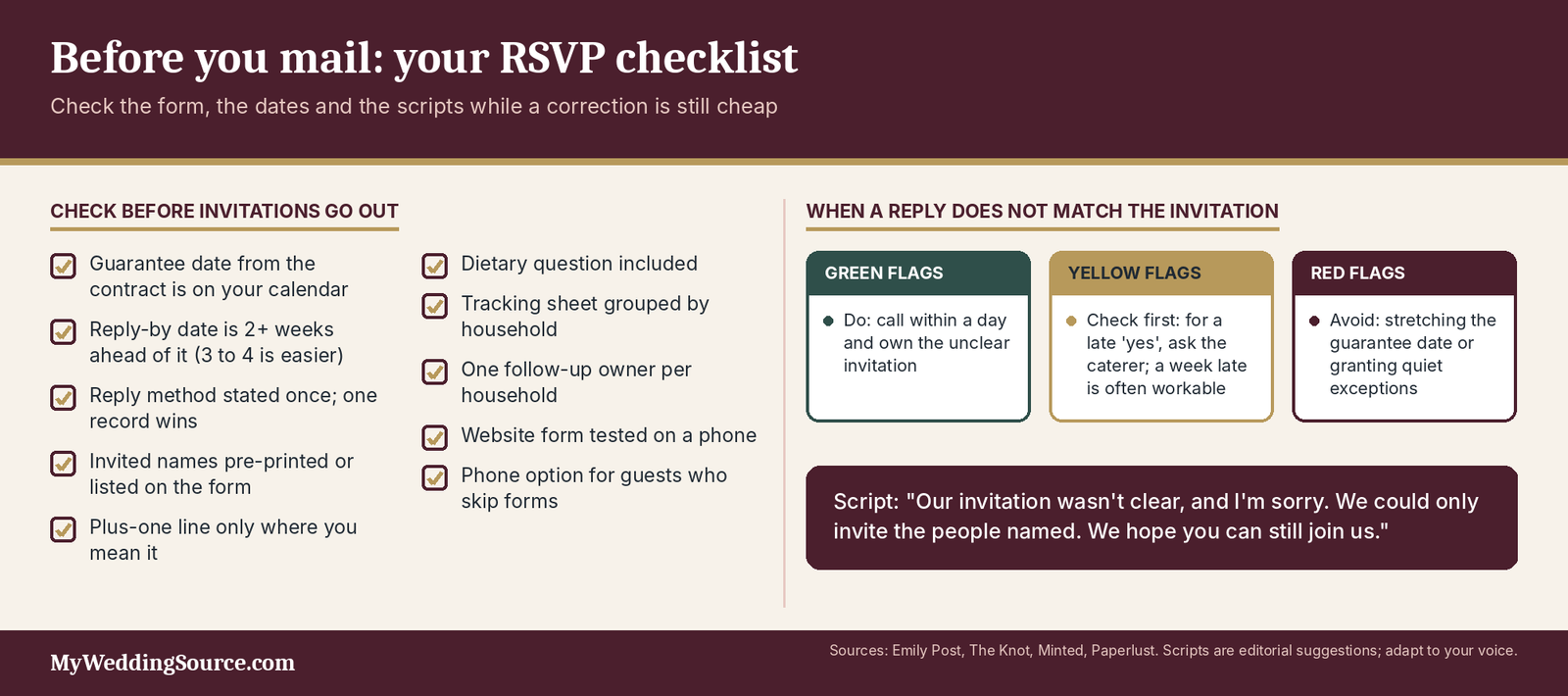
A reply that lists someone you did not invite is usually a misunderstanding, not a negotiating tactic, and it is easiest to fix by phone within a day or two. Emily Post’s advice on missing and extra RSVPs says it is “impolite of a guest to ask, or even worse, assume” that they can bring a date, adds that “you’re not rude in saying no,” and notes that letting single guests bring a date is a thoughtful gesture but not required. The Knot likewise advises double-checking RSVPs and calling the guest if an unexpected name appears, since the guest may simply be confused. Take responsibility for the unclear invitation, even if it was clear: “I’m sorry for the mix-up. We could only invite the people named on the invitation, and we’d love to have you there.” Then correct the tracking sheet immediately, so that the extra name does not slip into the number you give the caterer.
Children added to a reply
Children are the case where hosts feel the most pressure to give in, and the guidance is to be warm and consistent. Emily Post’s advice on uninvited children is to call promptly, assume good intent because some guests genuinely believe their children are included, and refocus on who the invitation named. It suggests wording like, “I’m sorry if there was any confusion, but the invitation was only for you and Henry. We hope you can still attend,” and says that if a guest then declines, that choice is theirs. Holding the line matters because an exception would be unfair to the guests who arranged childcare, which is a point of fairness more than rule enforcement. For out-of-town guests, a list of local sitters or hotel childcare options shows you are trying to help, and our child-free wedding etiquette guide covers the policy language that prevents the conversation in the first place.
Late replies, changed minds and cancellations
A “yes” that arrives after the deadline
Late replies are a vendor question before they are an etiquette question. Paperlust’s guide suggests that a reply within about a week of the deadline can often be accepted if the caterer allows late additions, possibly with a surcharge, and that a reply two or more weeks late may not be possible because the count may be final. It also says there is no obligation to hold space for a guest who declined and later wants to attend, and advises against extending the caterer’s deadline for late responders. The honest sentence when you cannot add someone is short and kind: “Thank you for telling us. We gave our final numbers to the caterer last week, and I’m so sorry we can’t add seats.” When you can add someone, tell your caterer the same day and note the new total in the tracking sheet, because the quiet addition that never reaches the kitchen is how a guest ends up with no plate.
A “yes” that turns into a “no”
People get sick, flights get canceled and childcare falls through, and a small number of cancellations is an ordinary part of weddings. The Knot’s RSVP article expects a small handful of guests to back out at the last minute, and the most helpful etiquette is simple: guests should tell the hosts as soon as they know, by phone or text, without a long explanation. For hosts, the first response is “thank you for telling us,” not a question about why. What you do with the empty seat depends on your contract, because a cancellation that comes after the guarantee date may still be billed, a point the next section covers in detail. If the cancellation comes before the date, reduce the count immediately, update the seating chart and, if you have a waiting list, decide whether there is still enough time to invite someone from it.
| Situation | First move | Sample line (adapt to your voice) |
|---|---|---|
| Reply names an uninvited date | Call within a day; take the blame | “Our invitation wasn’t clear, and I’m sorry. We could only invite the people named.” |
| Reply adds children | Call; stay warm and firm | “The invitation was for you and Henry. We hope you can still join us.” |
| Reply arrives a week late | Ask the caterer if late adds are allowed | “Thank you! Let me check with our caterer and I’ll confirm tomorrow.” |
| Reply arrives two weeks late | Check the contract; likely decline | “We gave our final numbers last week and I’m so sorry we can’t add seats.” |
| Guest cancels after saying yes | Thank them; update sheet and count | “Thank you for telling us. We’ll miss you.” |
| Guest wants to switch entrée | Check the caterer’s deadline | “We can change it through [date]. After that the kitchen is locked.” |
What does the guaranteed count actually cost?
How a guarantee turns replies into a bill
What a guarantee is and when it locks
A guaranteed count is the number of meals you commit to paying for, whether or not that many people eat. Contracts set a date, usually some days before the wedding, after which the number cannot go down, and often it can go up only if the kitchen has room and you accept a surcharge. As one real example of the structure, Utah State University’s catering policies require final changes by 5 p.m. on the Wednesday of the week before an event, do not allow decreases after that cutoff, and bill the greater of the guaranteed count or the number actually served. The same policy applies a 15% surcharge to meals added after Thursday at 2 p.m. and a 25% surcharge per additional guest on the day of the event. That is one institution’s catering policy, not a wedding-industry standard, so use it as an illustration of how the pieces fit and read your own contract for the real numbers.
The layers on top of the sticker price
A plate is rarely just the menu price. The Knot’s average wedding cost page reports average catering of $80 per person for couples married in 2025 (10,474 couples), which is a useful national reference but not a quote for any caterer. For the illustration below we assume a service charge of 22% and sales tax of 7%, which are placeholders that vary by caterer and state, so an $80 plate becomes about $97.60 after the service charge and about $104 after tax. A late addition that carries a 15% surcharge lands near $120. These layers are why the cost of a wrong guarantee is higher than the menu price suggests, and why it helps to ask your caterer for the all-in figure.
Three ways to set the number
Comparing three guarantee strategies
Suppose you invited 110 people, 88 had confirmed yes by your internal count date, and 86 eventually attended because two guests became ill after the deadline. The table shows what three guarantee choices would cost in empty plates, using the all-in price of about $104.43 per meal. Guaranteeing the full invitation list is the costliest mistake, because it pays for every person who declined or never answered. Guaranteeing the exact confirmed number is the cheapest when nothing changes, but it leaves no room if two more guests turn out to need a plate. A modest buffer of about 5% above the confirmed count, in line with the 5% to 10% that Paperlust suggests, costs a few extra plates and protects you from the kitchen having nothing for a late yes.
| Strategy | Guarantee | If 86 attend: empty plates | Cost of empty plates |
|---|---|---|---|
| Guarantee everyone invited | 110 | 24 | about $2,506 |
| Confirmed yes plus about 5% buffer | 92 | 6 | about $627 |
| Exactly the confirmed yes count | 88 | 2 | about $209 |
Reading your contract for the guarantee clause
Because the clause sets the price of being wrong, read it before you decide on the reply-by date. You are looking for the lock date, any right to lower the count after it, the surcharge schedule for increases, the treatment of children and vendor meals, and what happens to food prepared but not eaten. Our wedding cost per guest guide goes deeper on how minimums, service charges and per-head fees combine, and the wedding food and catering hub collects the other decisions that depend on this number. If the venue has its own food-and-beverage minimum, the guarantee and the minimum are separate commitments, and both can bind at once.
What happens to empty plates and surprise arrivals
Empty seats and what to do with the food
An empty seat does not always mean wasted food, but the answer depends on the venue and the caterer. The Utah State policy cited above notes that billed meals that go unconsumed may be picked up after the event if arranged in advance, which suggests a question worth asking your own caterer before the day. Food safety limits what is possible: the USDA’s leftovers guidance says perishable food should be refrigerated within two hours, or within one hour when the air is above 90°F, and that cold buffet food left out for more than two hours should be discarded. Plated meals that were never served are different from food that sat on a guest table or buffet, so ask the caterer which meals can be packaged and who handles it. Decide in advance whether you want to offer extras to guests, donate them where permitted, or simply accept the cost.
Surprise arrivals and day-of changes
The hardest RSVP problem is a guest who arrives without a reply, or with a person you did not invite. The Knot’s uninvited plus-one article advises asking the venue or planner whether an extra chair and place setting can be added, notes that the surprise guest may have to sit apart from their date if seating is tight, and says not to go out of your way to accommodate someone who was not invited. Day-of arrivals are the case where an extra plate may cost the most, since a policy like the 25% surcharge in the Utah State example shows how steeply a day-of increase can be priced. Delegate the response to a planner, coordinator or a calm friend so that you are not managing a seating chart in your wedding clothes. Afterward, a private conversation is better than a public one, and the tracking sheet note (“arrived without reply, seated at table 9”) is useful for your next vendor conversation.
How do special situations change the RSVP plan?
Timing and travel
Holidays, destination weddings and overseas guests
Longer travel means earlier invitations and earlier deadlines. The Knot’s timing guide suggests mailing eight weeks ahead for a holiday wedding or up to three months for a bigger buffer, and nine to ten weeks ahead for overseas guests. Its RSVP article notes that flights, hotels and time off deter out-of-town, out-of-state and international guests, so a wedding with many travelers should expect lower yes rates and more last-minute changes. For these weddings, consider two reply dates, an early one for people who must book travel and a later one for everyone else, and see our guides on Thanksgiving weekend weddings and destination wedding guest costs for how travel expense shapes the decision to say yes.
Multi-event weekends and ceremony-only guests
When guests are invited to different events, the reply has to capture each one separately. Minted’s wording guidance suggests listing each event on the reply card with “will attend” and “will not attend” options or a checkbox per event, and Emily Post notes that response cards are not used for ceremony-only invitations. In practice, a rehearsal dinner, welcome party, ceremony, reception and farewell brunch may each have a different guest list and a different caterer, so a single “yes” is not enough. Make a separate column for each event in your tracking sheet and send each vendor only its own count. Tell guests plainly which events they are invited to, because a guest who sees five events on the website may assume all five are for them.
Access, families and communication
Accessibility and special accommodations
Some guests decline because the venue or schedule does not work for them, and an RSVP form is a low-pressure place to give them a way to say so. The Knot’s RSVP article notes that guests may decline if the venue or event does not meet their needs and suggests adding online RSVP questions about accommodations. A neutral line such as “Is there anything we can do to help you enjoy the day?” invites a reply without asking anyone to disclose a diagnosis. Pass anything you receive to your venue and coordinator promptly, and follow up with the guest to confirm what you have arranged. If you already know that part of the venue has steps or a long walk, say so on the website, since guests can only decide well with accurate information.
Households that reply for everyone, and guests who need a different route
Some replies come from a parent filling in the form for an adult child, or an adult child filling it in for a grandparent. That is fine if the person replying has the right answers, and a quick confirmation call prevents errors. Offer a phone or email option on the website and card for guests who cannot use the form, and have a helper log replies taken by phone into the same tracking sheet. If many guests are likelier to read another language, consider a short translated line on the reply instructions, but keep the structure identical so you can compare answers. The aim is that every guest can reply in the way that suits them, and every reply ends up in the same place.
FAQ: wedding RSVP questions
Questions from guests
Do I have to reply if I know I can’t go?
Yes, and the sooner the better. Emily Post’s guidance says guests should reply “immediately,” and a prompt decline helps hosts because it frees a seat and removes you from the follow-up list. A short message is enough: “Thank you so much for the invitation. We can’t make it, but we’re celebrating you from afar.” You do not need to explain why, and hosts generally do not need a reason. If you are unsure, tell the hosts when you will know, because a date to expect an answer is much more useful than silence.
Can I change my answer after I RSVP “yes”?
Sometimes you must, and the courteous way is to tell the hosts as soon as you know, by phone or text. The earlier the better, since a change before the caterer’s deadline lets hosts reduce the count and may save them the cost of a plate. After the deadline, the meal may still be billed, so a brief apology is appropriate. If you want to switch an entrée, ask whether the caterer’s deadline has passed, and accept a “no” gracefully if it has.
Questions from hosts
Is “regrets only” ever a good idea?
It is risky, because silence is ambiguous. If a guest does not reply to a regrets-only invitation, you cannot tell whether they plan to come, forgot or never received it, and you still need an accurate count. A request for a reply either way gives you a record for every household and gives you something to follow up on. This is editorial judgment, not an etiquette rule, and it matters most when a caterer’s guarantee depends on your count.
What if a reply arrives after the caterer’s deadline?
Check the contract first, then the kitchen. Paperlust’s guide suggests a reply within about a week of the deadline can often be accommodated if the caterer allows late additions, possibly at a surcharge, while two weeks late may not be possible. Ask your caterer what the surcharge is and whether they have room, and tell the guest kindly if the answer is no. Do not extend the vendor’s deadline informally for one guest, because the extra plates are your responsibility.
Should I guarantee the number invited or the number who said yes?
Guarantee your expected count, not your invited count. In the illustration above, guaranteeing all 110 invited guests would have cost about $2,506 more than a tight count if 24 of them did not attend, and a buffer of about 5% above confirmed yeses cost a few hundred dollars. Your caterer may have a minimum, so check it before you set the number, and ask whether you can adjust downward before the lock date. This is general information, not financial or legal advice, and contract terms vary.
Your next steps
This week
Work backward from the guarantee date
Find the guarantee clause in your catering contract and put its exact date in your calendar. Count back about 10 days for your internal lock, then three to four weeks to the reply-by date on the invitation, and compare the result with the date you planned to print. If the dates do not fit, move the mailing earlier or the reply-by date, not the caterer’s deadline. Write the dates in a shared note with your partner, and decide who will watch each one.
Build the tracking sheet and assign owners
Create the sheet with one row per invited person, grouped by household, and add columns for status, entrée, dietary notes, reply channel and follow-up owner. Assign one person to each family or friend group who might need a nudge, and agree on the first and last contact dates. Add a second tab for non-respondents. Send a test reply through your wedding website yourself, from a phone, to check that the form works and the data lands where you expect.
Before you mail or sign
Check the reply wording and the form
Read the reply line and the website form as a guest would. Check that each invited person’s name appears, that the reply-by date and method are stated once, and that a plus-one line appears only where intended. Confirm that a dietary question is present and that an address, email or phone number is easy to find for anyone who prefers not to use the form. Our wedding invitation wording guide has sample lines to adapt.
Ask your caterer five questions
Ask when the guarantee locks, whether it can go down, what late additions cost, how children and vendor meals are counted, and what happens to prepared food. Ask for the answers in writing, attached to the contract or in an email you can find later. If the answers conflict with your timeline, you still have time to adjust the reply-by date. Then set a reminder for the day after the lock date to confirm the number the caterer has on file.
Sources & methodology
- Emily Post, wedding response cards — purpose of reply cards, reply-by timing, M line, plus-ones, entrée choices, ceremony-only invitations.
- Emily Post, missing or extra RSVPs — replying “immediately,” phoning non-respondents, uninvited dates.
- Emily Post, RSVPs that include uninvited children — calling promptly, holding firm, suggested wording.
- The Knot, how many people RSVP no — yes-rate range, 20% decline starting point, 2023 Guest Study findings, partial RSVPs, accessibility.
- The Knot, when to send wedding invitations — mailing windows, paper versus digital RSVP timing, holiday and overseas guests.
- The Knot, average wedding cost — 2025 averages including $80 per person catering (10,474 couples).
- The Knot, uninvited plus-ones — plus-one norms and handling a surprise guest.
- Minted, wedding invitation wording — reply-by timing, dietary lines, multi-event checkboxes.
- Zola, wedding invitation wording — asking for replies 3 to 4 weeks out.
- Paperlust, how to follow up on wedding RSVPs — follow-up timing, channels, attempts, late replies, buffers (stationery vendor guidance).
- Greenvelope, are digital wedding invitations tacky and Joy, digital vs print invitations — online RSVP, older guests, response speed (vendor sources, self-reported).
- Utah State University, catering policies — one institution’s example of guarantee deadlines, surcharges and billing rules.
- USPS Notice 123 — stamped letter and postcard prices effective October 4, 2026.
- FDA, food allergies — nine major allergens and reaction timing.
- Food Allergy Research & Education, food allergies and restaurants — Food Code expectations for allergen knowledge and cross-contact.
- USDA FSIS, leftovers and food safety — time limits for perishable and buffet food.
Methodology: Yes-rate ranges, guest-study figures and averages are survey findings from The Knot and are national, not predictions for your list. Postage prices are published USPS rates. The timeline, segment forecast, guarantee strategies, service charge, tax and empty-plate costs are illustrative calculations, not quotes, and the surcharge schedule comes from one university’s catering policy, not a wedding-industry standard. Follow-up channels and buffers come from a stationery vendor, response-speed claims from wedding technology companies, and the scripts, “regrets only” view and accessibility suggestions are editorial judgment. Nothing here is legal or financial advice, and contract terms vary.
Freshness note: Recheck USPS Notice 123 whenever postal rates change and The Knot’s yes-rate and cost pages each February when new study data appears. Confirm your own contract’s guarantee date and surcharge terms before you set the reply-by date. Review this page each October.