
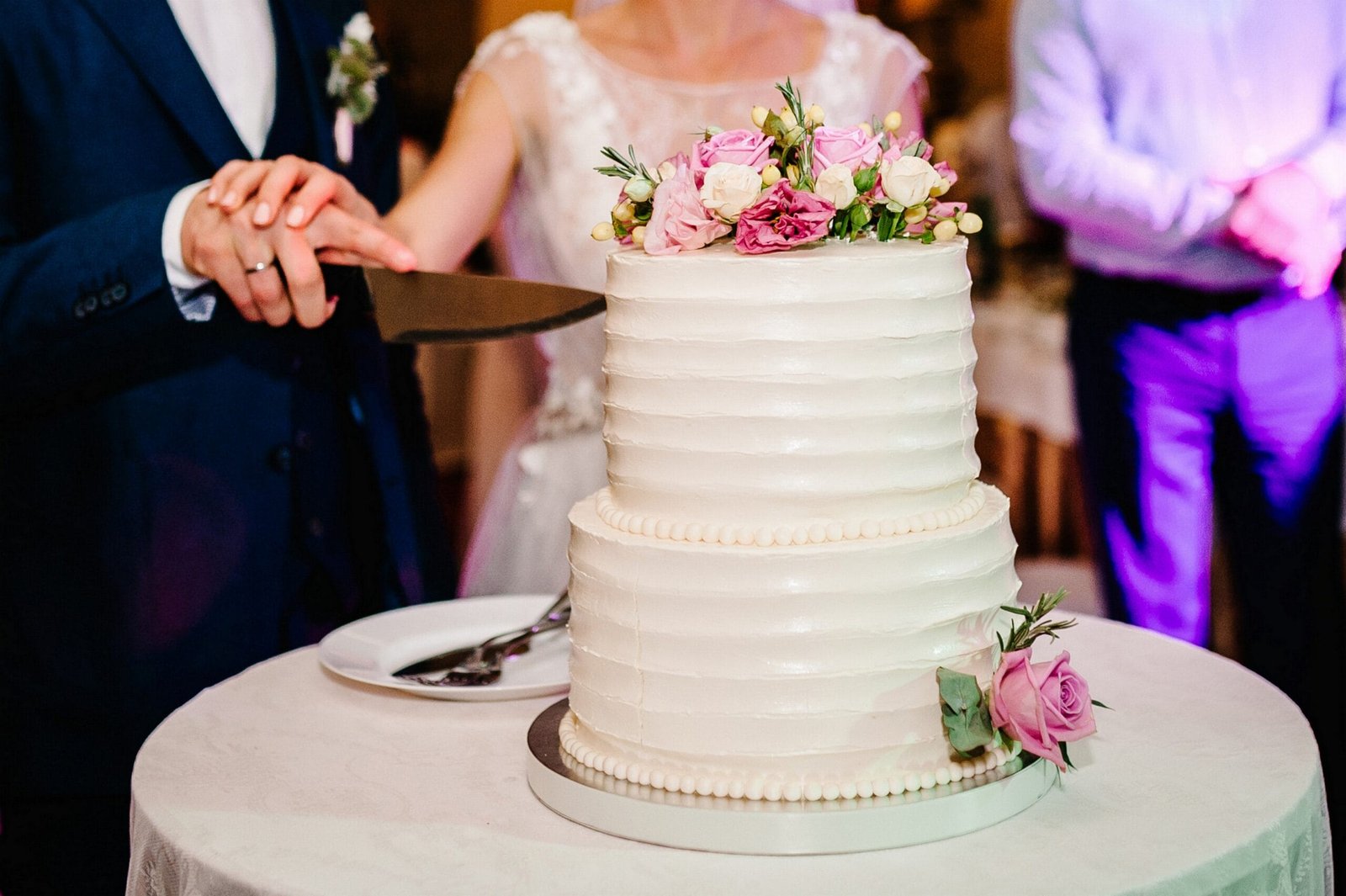
Couples researching wedding cake servings almost always start with the wrong number. They picture their guest list, picture one slice per person, and assume that number is what they should order. It rarely is. Wedding cake servings follow their own math, built around a slice size most people have never actually measured, and getting that math wrong is one of the most common ways couples overpay or underorder.
This guide leads with the servings question, because almost every other decision follows from it. Once you know how many servings you actually need, the number of tiers, the diameter of each one, the total price, and even the delivery logistics start to fall into place. We will build that number together first, then walk through design, venue conditions, delivery, food safety, baker questions, and realistic alternatives once your target count is set.
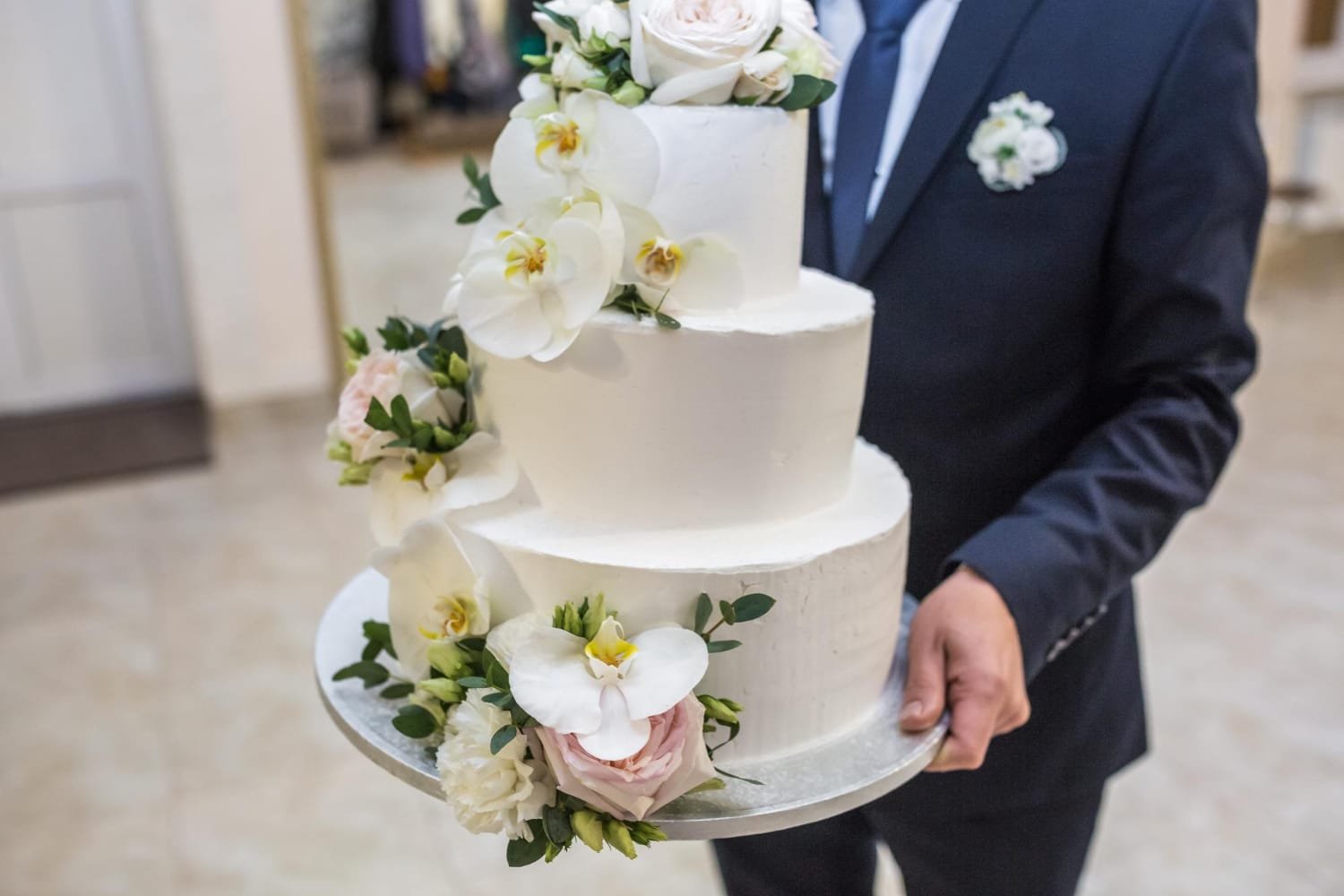
How Many Wedding Cake Servings You Actually Need
Your guest count and your servings count are not the same number. Confusing them is the single most common wedding cake miscalculation.
A wedding cake serving is smaller than you think
The wedding-industry standard slice is roughly one inch wide by two inches deep, cut through the full height of the tier. That is noticeably smaller than a birthday-party wedge, and it exists because cake usually shares the dessert course with other sweets rather than standing alone. Ask your baker directly which slice size their quote assumes. A “100-serving cake” built on the smaller wedding standard looks meaningfully different from one built on a larger party cut.
Adjust for guests who will not eat cake
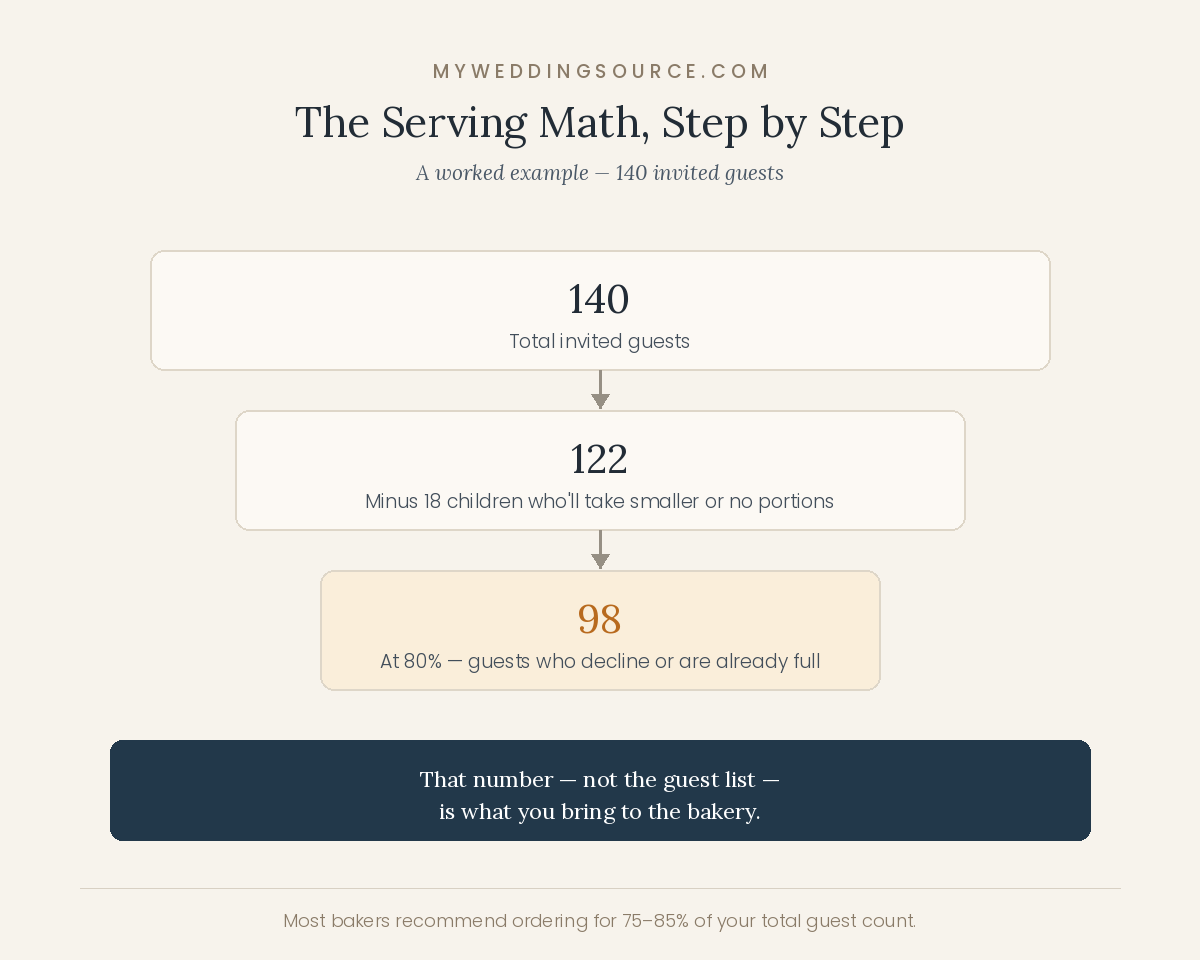
Children typically take smaller portions or skip cake entirely. Some adults decline a slice, especially after a full dinner or alongside other desserts. Most bakers recommend ordering wedding cake servings for roughly 75 to 85 percent of your total guest count, not the full number. If you are serving other desserts alongside the cake, lean toward the lower end of that range.
A worked example
Picture 140 invited guests. Subtract 18 children who will take small or no portions, leaving 122 adults. Apply an 80 percent adjustment for guests who decline cake or are already full, and you land close to 98 servings. That number, not your original guest count, is what you bring to a bakery consultation. Ordering to your full invitation list routinely means paying for cake nobody eats.
Worth confirming directly
Ask your caterer whether cake will be plated and served, or set out for guests to serve themselves. Self-serve stations tend to waste more cake than plated service, which can justify a slightly higher count.
A Servings Reference Chart by Tier and Diameter
This chart follows the widely used Wilton wedding-slice standard: one inch wide, two inches deep, cut through a roughly four-inch tier. Treat it as a planning reference, not a guarantee. Actual yield shifts slightly with tier height, cutting technique, and each baker’s own convention.
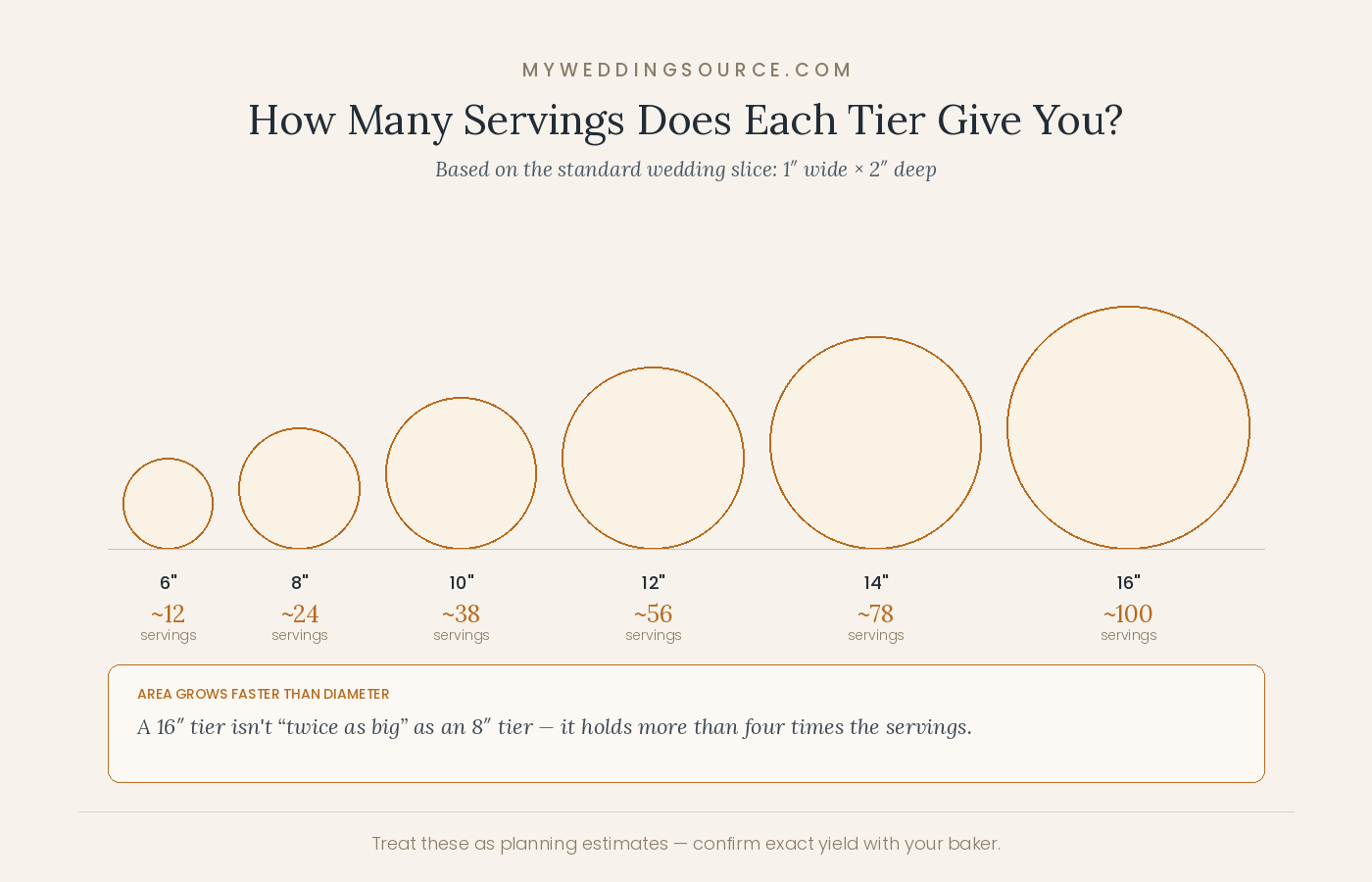
Servings by single-tier diameter
| Diameter | Round tier | Square tier |
|---|---|---|
| 6 inch | ~12 servings | ~18 servings |
| 8 inch | ~24 servings | ~32 servings |
| 10 inch | ~38 servings | ~50 servings |
| 12 inch | ~56 servings | ~72 servings |
| 14 inch | ~78 servings | ~98 servings |
| 16 inch | ~100 servings | ~128 servings |
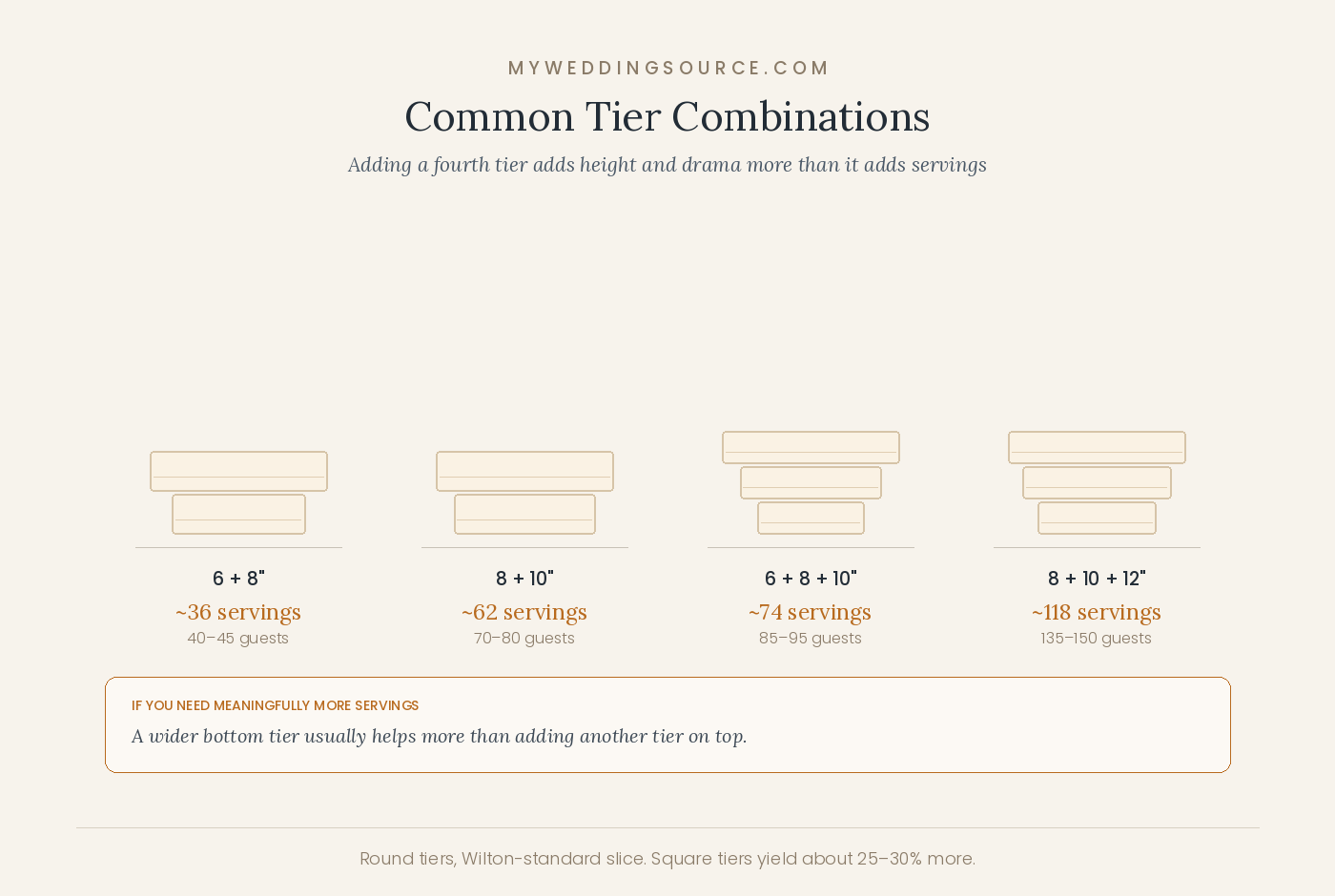
Common tier combinations
| Tier combination (round) | Approximate servings | Fits a guest list of about |
|---|---|---|
| 6 + 8 | ~36 servings | 40–45 guests |
| 8 + 10 | ~62 servings | 70–80 guests |
| 6 + 8 + 10 | ~74 servings | 85–95 guests |
| 8 + 10 + 12 | ~118 servings | 135–150 guests |
| 6 + 8 + 10 + 12 | ~130 servings | 150–165 guests |
Notice that adding a fourth tier to a three-tier cake adds height and visual drama more than it adds servings. Going from 6+8+10 to 6+8+10+12 only adds about 56 servings. If you need meaningfully more servings, a wider bottom tier usually helps more than an extra tier does.
How Your Serving Count Shapes Tiers, Size, and Structure
Once you know your target number, the design conversation gets much more concrete. The serving count you need determines what is structurally realistic, not just what looks good in a photo.
More wedding cake servings means more engineering, not just more cake
A cake built to serve 130 guests needs real internal support: dowels or plastic rods inside each tier, separator plates between layers, and often a central rod through the whole structure. This is invisible to guests and essential to the baker. Larger serving counts push a cake toward more tiers or wider tiers, and either path adds real structural labor on top of the ingredients.
Height and layer count do not add servings
Adding layers inside a tier adds visual height. It does not add servings. A 10-inch tier with two layers and a 10-inch tier with four layers yield the same number of slices, because servings are calculated from diameter, not from how tall the tier looks. If you want a dramatic silhouette without extra servings, ask your baker about a taller single tier rather than assuming height and serving count move together.
Square tiers close the gap when space is tight
Square tiers consistently out-serve round tiers of the same diameter, often by 25 to 30 percent, because a square pan has no curved edge trimmed away. If your venue’s cake table is limited in width, or you want a smaller-looking cake that still covers a large guest count, square tiers are worth asking your baker about directly.
Display Cake vs. Full-Size: Two Ways to Hit Your Count
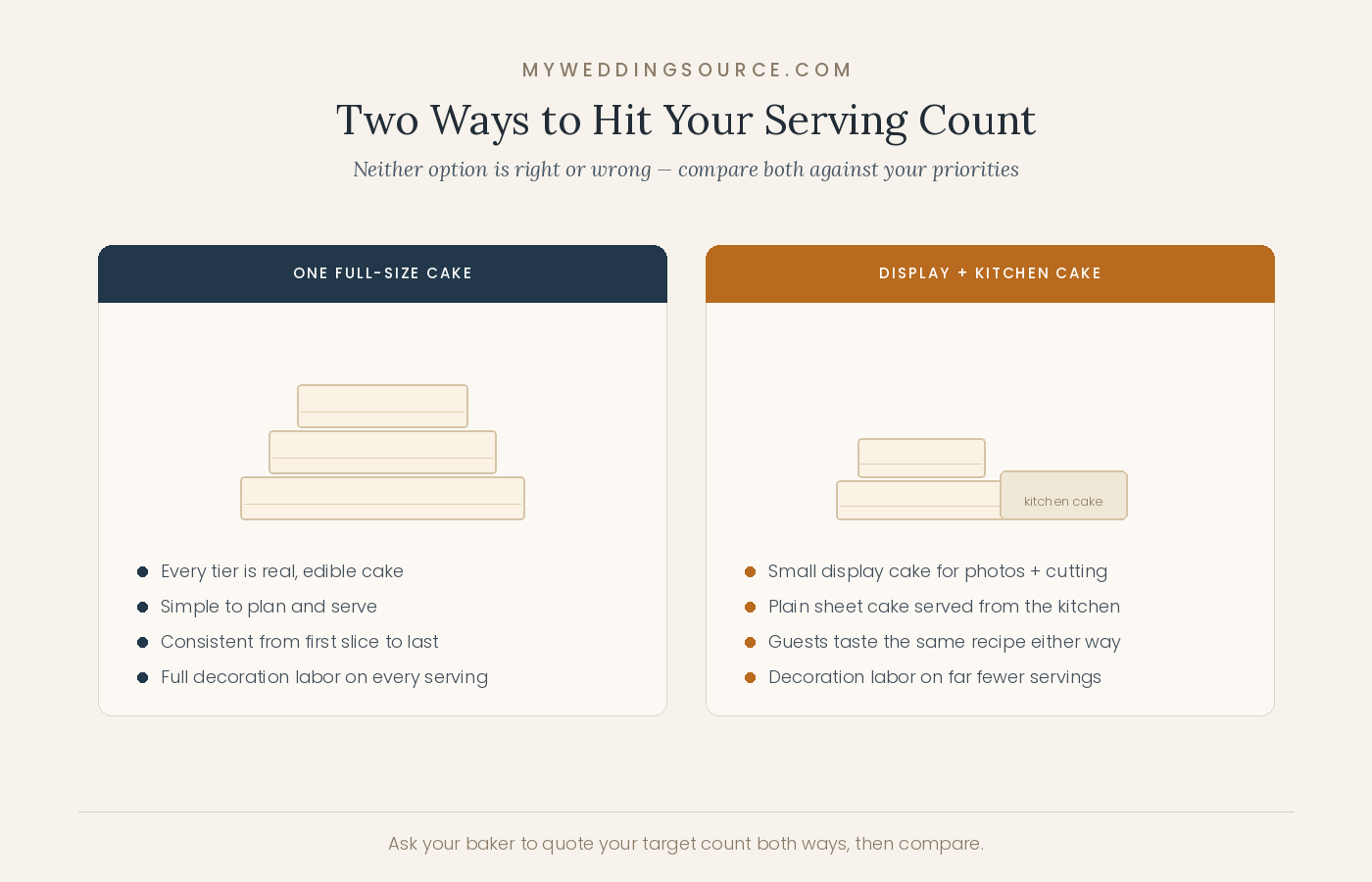
Couples generally reach their target serving number in one of two ways, and neither is universally better. Compare both against your own priorities.
Option one: one cake, sized to the full count
Every tier is real, edible cake, and the full structure gets served to guests. This is simpler to plan and photographs consistently from first slice to last. It also means paying full decoration labor across every serving, which is the more expensive route per slice.
Option two: a smaller display cake plus a kitchen cake
A smaller, fully decorated cake handles photos and the cutting ceremony. A plain sheet cake, baked from the same recipe, gets served to guests from the kitchen, unseen. Guests taste the same cake. Your photos show the full design. You pay decoration labor on a fraction of your total servings, since kitchen cake is typically priced well below the decorated rate.
Neither option is right or wrong. A single full-size cake suits couples who want every served slice to match the display exactly. A display-plus-kitchen-cake split suits couples prioritizing total cost. Ask your baker to quote both ways for your target serving count, then compare the totals side by side.
What Extra Wedding Cake Servings Actually Cost
Price scales with servings, but not in a straight line. Two forces push against each other as your count grows.
Ingredient cost per serving stays fairly flat
Batter, filling, and basic buttercream cost roughly the same per serving whether you order 60 or 160. This part of the price scales predictably with your target count.
Decoration labor does not scale the same way
A larger cake often needs proportionally more decoration time, not just more batter, especially with hand-piped detail, sugar flowers, or intricate texture repeated across a bigger surface. This is why a 150-serving elaborate cake frequently costs far more than double a 75-serving version of the same design.
A concrete example
| Servings | Design | Illustrative total |
|---|---|---|
| 40 | Two-tier, smooth buttercream | $250–$400 |
| 85 | Three-tier, piped detail, fresh flowers | $650–$1,100 |
| 150 | Four-tier, hand-piped, sugar flowers | $1,400–$2,600 |
Servings alone do not explain that spread. The 150-serving cake serves under four times as many guests as the 40-serving one, yet costs six to eight times as much. Decoration labor, layered onto a larger structure, drives the difference far more than the batter does.
Seasonal ingredients affect cost per serving too
Out-of-season fruit fillings typically cost more per serving than seasonal ones, since ingredients have to travel farther or get replaced with a preserved version. Ask your baker which flavors are in season for your wedding date. A seasonal filling at your target serving count is often both cheaper and better tasting than an out-of-season substitute at the same price point.
Venue Conditions That Change How Many You Need
Plated versus self-serve
Plated cake service, portioned by staff, wastes very little. Self-serve stations, where guests cut their own pieces, tend to run generous and waste more. Confirm which style your caterer uses before finalizing a count, since it can shift your target by five to ten percent either direction.
Heat, humidity, and outdoor display
A cake sitting on an outdoor table in heat softens faster and gets cut less cleanly, which can waste servings at the edges. Tell your baker about your venue’s conditions so they can recommend a more heat-stable finish if needed.
Delivery and Setup for Larger Serving Counts
A bigger cake is not simply a heavier version of a small one. It is a more complex delivery.
Tiered delivery and on-site assembly
Bakers typically transport large tiers separately and assemble the full structure at the venue, reducing the risk of damage in transit. Ask whether your quote includes on-site assembly, and confirm how much setup time the baker needs before guests arrive.
Delivery fees scale with complexity, not just size
A tall, multi-tier cake generally costs more to deliver than a single tier of similar total weight. It requires more careful handling, and often final touch-ups after the cake has acclimated to the room. Treat delivery as a real line item tied to your serving count, not a flat add-on.
How the Meal Context Changes Your Target Number
The same guest count can need very different wedding cake servings depending on what else is on the table. Context matters as much as headcount.
Cake as the only dessert
If cake is the sole sweet offered, lean toward the higher end of the 75 to 85 percent range. Guests without an alternative are more likely to take a slice, and a shortage is more noticeable when there is nothing else to reach for.
Cake alongside a dessert table or late-night snacks
When cake shares the spotlight with cookies, a candy bar, or a late-night food station, many guests take a smaller cake portion or skip it entirely. Lean toward the lower end of the range here, closer to 70 to 75 percent, and put the savings toward the other desserts instead.
Brunch and daytime weddings
Guests at earlier receptions sometimes eat less rich food overall. A slightly lower serving target, combined with a lighter cake flavor, often fits daytime celebrations better than a full evening-reception count.
What Happens to Leftover Servings
Even careful math leaves some cake at the end of most weddings. Decide in advance what happens to it.
Boxing slices for guests
Some couples ask their caterer or a member of the wedding party to box portions for guests to take home. This reduces waste and gives out-of-town guests a small keepsake of the day.
The top-tier tradition
Many couples freeze the top tier to eat on their first anniversary, following a long-standing tradition. Ask your baker how well your specific icing and filling actually hold up in a freezer over a full year, since not every recipe survives that stretch equally well.
Venue cleanup responsibility
Confirm with your venue whether they handle leftover cake storage and cleanup, or whether that falls to you or your planner. This is a small detail that is easy to overlook until midnight on the wedding day itself.
Food Safety and Allergens
A larger serving count means more guests exposed to whatever the cake contains, which makes allergy communication genuinely important.
Common allergens in a standard recipe
The major food allergens commonly identified in U.S. labeling include milk, eggs, wheat, soy, tree nuts, peanuts, fish, shellfish, and sesame. Standard wedding cake recipes typically contain several of these by default. Tell your baker about any guest allergy early, since substitute recipes often need testing time before they can be scaled to a full serving count.
Perishable fillings need a temperature plan
Cream cheese frosting and fresh fruit fillings are more perishable than standard buttercream, and a larger cake often sits out longer simply because it takes more time to fully serve. Ask your baker how long these components can safely sit at room temperature, and share your venue’s actual conditions.
Flavor combinations at a large serving count
Some flavors scale more easily than others once your target number climbs past 100 servings. Fresh fruit fillings can become harder to source consistently at scale, particularly out of season. A classic vanilla, chocolate, or lightly spiced cake tends to hold its texture and flavor more reliably across a large batch than a delicate, fruit-forward recipe does. Ask your baker directly whether your chosen flavor is realistic at your specific serving count, especially if you are set on something seasonal or unusual.
Offering more than one flavor
Many bakers can split a large serving count across two or three flavors, often by assigning a different flavor to each tier. This adds a small amount of complexity to the order but rarely changes the total price significantly, since the total servings stay the same. If your guest list has strong, divided preferences, ask whether a mixed-flavor approach fits your target number without adding real cost.
Larger serving counts need more lead time
A cake built for 150 servings takes real production time, and popular bakers book their calendars months ahead, especially for peak wedding season weekends. Confirm how far in advance your baker needs your final target number locked in. Six to twelve months is a reasonable window for a busy bakery handling a large serving count, though a smaller or newer bakery may have more flexibility closer to your date.
Kitchen capacity varies by bakery
Not every bakery is set up to produce 150-plus servings at the quality level of their smaller work. Ask directly about the largest wedding cake they have completed recently, and request to see photos of it rather than only their smaller portfolio pieces. A baker who does beautiful 40-serving cakes does not automatically produce the same quality at four times the volume.
Ask whether the tasting fee applies toward your order
Many bakeries charge a small fee for a tasting appointment, and some apply that fee as a credit toward your final order once you book. Confirm this detail before you schedule, since it is a minor cost that adds up if you are tasting with more than one bakery while deciding on your target serving count and design.
A groom’s cake changes the math too
Some couples add a separate groom’s cake alongside the main wedding cake, particularly in parts of the American South. This is typically a smaller, standalone cake with its own flavor and design. It is served in addition to the main dessert, not counted within your primary serving total. If you are considering one, treat its servings as a separate line item outside your main wedding cake servings count, and confirm with your baker whether it needs its own delivery slot and setup time on the day.
Documents to Confirm Before You Sign
Bring this list to your bakery consultation once you know your target serving count.
- Exact serving count and slice size, written into the contract, not left as a verbal understanding.
- Tier combination and shape, round or square, matched to that count.
- Flavor and filling choices, confirmed as realistic at your specific volume.
- Delivery date, time, and setup window, coordinated with your venue’s own schedule.
- Deposit amount and final payment deadline, tied to your final guest-count confirmation date.
- Policy for guest-count changes, including any fee for adjusting the order close to the wedding.
Baker Questions and Contract Terms
Questions specific to your serving count
- Given our target number of wedding cake servings, what tier combination do you recommend?
- Do you offer a display-cake-plus-kitchen-cake option, and how is it priced?
- What is your price per serving at our specific design and count?
- How does delivery and setup pricing change with a larger structure?
- Can you accommodate our specific allergy needs at this serving count?
- What happens if our final guest count changes close to the wedding?
What belongs in the contract
Get your exact serving count and the assumed slice size written into the contract, not just a total price. This single detail prevents more disputes than any other line item, since a lower quote sometimes hides a smaller serving size rather than a better deal. Also confirm the deposit schedule, the final headcount deadline, and the delivery window in writing.
Bring your target number to the tasting
A tasting confirms flavor and texture, but it rarely tells you how a recipe behaves at full scale. Tell your baker your target serving count before the tasting, so they can flag anything that changes at volume, such as a delicate filling that needs adjustment for a larger batch. This is a normal professional conversation, not an unusual request.
Alternatives When You Need Fewer or More Servings
A smaller guest list changes the math favorably
Every ten guests removed from your list saves roughly eight to nine servings once you apply the standard adjustment. A guest list trimmed from 150 to 120 can move you down an entire tier combination, which is often a meaningful price difference.
Cupcakes and dessert tables scale differently
A cupcake tower or a dessert table can match any serving count without the structural engineering a tall tiered cake requires. This can simplify both design and delivery, though a large, varied dessert table with several labor-intensive items can still cost as much as a mid-size cake. Compare total cost per serving across formats rather than assuming any format is automatically cheaper.
Home-baked options at a small scale
For a smaller serving count, some couples consider a skilled friend or family member baking the cake. This works best at modest serving numbers, since scaling a home kitchen’s production to 100-plus servings introduces real food-safety and logistics challenges a professional kitchen is built to handle.
Cake stands scale with tier count, not just size
A wider, taller cake built for a large serving count needs a sturdier stand than a small two-tier design. Ask whether your baker provides a stand rated for your specific structure, or whether you need to source one through your venue or a rental company. A stand that is not rated for the weight of a full-scale cake is a real safety concern, not just an aesthetic one.
Children’s servings deserve their own line
Some caterers offer a smaller children’s plate for the meal, and the same logic can apply to cake. If your venue can portion smaller cake servings for young guests, you may be able to count children at a lower serving weight rather than excluding them from the count entirely. Ask your caterer and baker whether this option exists before finalizing your target number, since it can meaningfully change your total for a wedding with a large number of young guests.
Common Mistakes
Ordering to the full guest list
Most weddings do not need servings equal to the total headcount. Adjust for children and guests who decline cake before finalizing a number.
Assuming height and servings move together
Extra layers inside a tier add drama, not slices. If you need more servings, ask for a wider tier or another tier, not a taller one.
Comparing quotes without matching slice sizes
A lower total can hide a smaller serving cut. Always ask what serving size each baker’s quote assumes before comparing prices.
Choosing a design before confirming the count
An elaborate design priced for 75 servings can become a very different number at 150. Settle your target count before falling in love with a specific look.
Skipping the display-plus-kitchen-cake conversation
Many bakers offer this option, and many couples never ask about it. It is worth a direct question even if you end up choosing a single full-size cake instead.
Forgetting delivery scales with structure, not just weight
A tall, multi-tier cake at a high serving count typically costs more to deliver safely than its total weight alone would suggest.
Deciding your target number is a budget conversation, not just a math problem
Before you lock in a serving count, decide who is covering the cake as part of your overall budget conversation. Some couples fund it entirely from their own catering budget. Others split it with family contributions, or receive it as a specific gift from a relative who wants to cover one distinct piece of the wedding. Knowing your real spending ceiling before you calculate your target servings prevents the common trap of falling in love with a design, then discovering the honest serving count for your budget is smaller than expected.
Servings-Planning Worksheet
- ☐ Total guest count: ____________
- ☐ Adjusted target (guests minus children, minus non-eaters, at 75–85%): ____________
- ☐ Tier combination matched to that number: ____________
- ☐ Slice size confirmed with baker: ____________
- ☐ Full-size vs. display-plus-kitchen-cake decided: ____________
- ☐ Price quoted for both options, if comparing: ____________
Where professional standards fit in
Organizations such as the Retail Bakers of America maintain industry standards and educational resources that reflect current professional practice. Reviewing that kind of resource can help you understand what a well-run bakery operation typically looks like, particularly for a large serving count where production planning matters more than it does for a small cake. Use it as one data point alongside reviews, a tasting, and direct conversation.
Frequently Asked Questions
How many wedding cake servings do I actually need?
Start with your total guest count, subtract children who will likely take smaller portions, and apply a further reduction to roughly 75 to 85 percent for adults who decline a slice or are already full. Most couples end up ordering meaningfully fewer servings than their total invitation list. Confirm with your caterer whether cake will be plated or self-served, since that changes how much buffer makes sense.
How many people does a standard three-tier wedding cake serve?
A classic 6, 8, and 10-inch round three-tier cake serves approximately 74 wedding-size servings, based on the widely used industry standard slice of one inch by two inches. An 8, 10, and 12-inch combination serves closer to 118. Confirm the exact numbers with your specific baker, since tier height and cutting technique can shift the total slightly.
Do more tiers always mean more servings?
Not necessarily. Adding height to an existing tier through extra layers does not change its serving count, since servings are calculated from diameter, not height. To genuinely increase your serving count, you need a wider tier or an additional tier, not a taller version of one you already have.
Do square cakes really serve more people than round ones?
Yes. A square tier consistently yields more servings than a round tier of the same diameter, often 25 to 30 percent more, because there is no curved edge trimmed away during cutting. If your priority is maximizing servings within a given footprint, square tiers are worth discussing with your baker.
What is a display cake and kitchen cake, and should we consider it?
It is a common cost-saving approach where a smaller, fully decorated cake handles photos and cutting, while a plain sheet cake made from the same recipe is served to guests from the kitchen. Guests taste identical cake, your photos show the full design, and you pay decoration labor on far fewer total servings. It suits couples prioritizing cost; a single full-size cake suits couples who want every served slice to match the display.
Why does a bigger cake cost so much more than a proportionally larger price?
Decoration labor rarely scales in a straight line with servings, especially with hand-piped detail or sugar flowers repeated across a larger surface. A cake with four times the servings of a smaller one can easily cost six to eight times as much. You are paying for more decorated surface area and more structural engineering, not just more batter.
How do I compare quotes from different bakers fairly?
Confirm the exact serving count and slice size each quote assumes before comparing totals. A lower price sometimes reflects a smaller serving size rather than better value. Ask each baker to quote your specific target number of wedding cake servings using the same slice standard, so you are comparing equivalent amounts of actual cake.
What if our guest count changes after we book the cake?
Ask this question before signing anything. Many bakers can adjust a tier size or add a small additional tier if your count grows, though availability and pricing depend on how much notice you give. Confirm the process and any change fees in writing at the time you book, rather than assuming flexibility exists.
Is a cupcake tower a good alternative if we need a large serving count?
It can be, since cupcakes scale to any serving number without the structural engineering a tall tiered cake requires. Cost does not automatically drop, though: a large, elaborate cupcake display with many flavors and decorative details can cost as much as a mid-size tiered cake. Compare total cost per serving rather than assuming any format is inherently cheaper.
Should cake servings change if we are also serving a dessert table?
Yes, usually downward. When guests have other sweet options, fewer of them take a full cake slice. A target closer to 70 to 75 percent of your guest count often fits better than the higher end of the standard range. Redirect the savings toward the dessert table itself, and confirm with your caterer how the two are typically balanced at similar events.
Can one baker split our order across two different flavors?
Most bakers can, often by assigning a different flavor to each tier without changing your total serving count or price significantly. This is a reasonable way to accommodate divided preferences on a large guest list. Ask about it directly when you discuss your target number, since not every baker offers it as a standard option.
How far in advance should we book a wedding cake for a large guest count?
Six to twelve months ahead is a reasonable target for a busy bakery handling a large serving count, particularly during peak wedding season. Popular bakers with strong reputations for large-scale work often book up faster than smaller operations. If you have a specific baker in mind, reach out early enough to confirm your date before locking in other vendors that depend on it, such as your venue’s dessert service timeline.
Start With the Number, Then Design Around It
The most reliable way to plan a wedding cake is to settle your actual serving count first, then let tiers, design, and price follow from that number. Couples who start with a design they love, and try to fit their guest count around it afterward, tend to run into trouble. They either overpay for excess servings or scramble to add a tier at the last minute.
Calculate your adjusted guest count using the method in this guide. Then ask two or three bakers to quote that exact number two ways: as a single full-size cake, and as a display cake with a matching kitchen cake. Comparing those two totals, for the same serving count, shows you exactly what you are paying for.
The couples who feel best about their cake afterward are rarely the ones who chose the most elaborate design available. They are the ones who matched their design to a number they had actually calculated, confirmed that number in writing, and left themselves room to adjust it without starting the whole search over again.
Your next step
Calculate your adjusted serving count using the 75 to 85 percent guideline. Then ask two or three bakers to quote that exact number two ways: as a single full-size cake, and as a display cake with a matching kitchen cake. Comparing those two totals, for the same serving count, shows you exactly what you are paying for.
