

Wedding guest transportation planning comes down to one question you can answer with a stopwatch and a seat count: how many minutes does a vehicle need to complete a full loop, and how many loops can your timeline afford? Everything else in wedding guest transportation planning, from vendor checks to accessibility to the last ride home, hangs from that answer.
Quick answer
For wedding guest transportation planning, start with three numbers: how many guests need a ride, how many minutes a vehicle takes to load, drive, unload, and return (the loop), and how long your arrival window is. Divide guests by planned seats per vehicle to get the number of loads, then divide loads by the loops each vehicle can finish inside the window. Dwell time at pickup and drop-off is easy to forget and can fill more than a quarter of each loop. Verify the operator through the Federal Motor Carrier Safety Administration (FMCSA) before you pay a deposit, ask about accessible vehicles early, and end the night with a published final departure instead of an open-ended “rides available.” The examples in this guide are our own planning arithmetic; replace every number with your operator’s.
Moving a wedding crowd is not mysterious, but it is unforgiving. Guests arrive in clumps, the ceremony does not wait, and the last ride of the night happens when everyone is tired and some people have been drinking. Good wedding guest transportation planning is mostly arithmetic and clear ownership. This guide builds that arithmetic step by step, shows how to check carriers and vehicles, covers accessibility in plain terms, and ends with a return-night schedule you can adapt.
If you want the broader overview of shuttles, limos, and quotes first, our wedding transportation guide covers that ground. This article is narrower and more operational: it treats wedding guest transportation planning as a small fleet-dispatch problem and gives you the tools to size it.
What wedding guest transportation planning is, and whether you need it
Plenty of weddings need no organized transportation at all, and some need wedding guest transportation planning only for one leg. Guests drive to a church, drive to a hall across the parking lot, and drive home. Wedding guest transportation planning becomes worth the effort when distance, parking, alcohol, access needs, or a split schedule make “everyone finds their own way” a risky default. The work of wedding guest transportation planning is the same whether you are moving twelve people or two hundred: decide who rides, choose the vehicles, time the loops, and write down who is in charge.
Decide whether you have a transportation problem
Before you price anything, look at the facts of your own day. A short, honest scan of your map and guest list usually answers the question in an afternoon.
Signals from the map
Look at the distance between where guests sleep, where the ceremony happens, where the reception happens, and where they will go afterward. Long gaps between venues, a rural road with no lighting, a venue with a small lot, a city center where parking is expensive or restricted, and a site that sits behind a security gate or ferry crossing are all signals. If your venue or city limits event parking, ask the venue directly; our wedding venue questions guide lists what to confirm about lots, load-in routes, and curfews.
Signals from the guest list
For wedding guest transportation planning, read the list for who actually needs help. Out-of-town guests who flew in without cars, older relatives who prefer not to drive at night, guests who use mobility devices, small children traveling with car seats, and anyone you expect to drink are the usual groups. If you are still building the list, the wedding guest list guide helps you think about who is attending and where they are coming from. A short question on your RSVP card about transportation needs gives you real numbers instead of guesses, and our RSVP etiquette guide shows how to ask without making the card feel like a survey.
Define the three legs
It helps to break the day into legs, because each leg has a different deadline, a different crowd, and a different failure mode. Treating wedding guest transportation planning as one line item is how couples end up with a great morning plan and no plan for midnight.
The arrival leg
This is the movement from lodging or a staging point to the ceremony or first venue. It has a hard deadline: the ceremony start time. Late guests miss the event, and early vehicles leave guests waiting in the heat or cold. The arrival leg is usually the most compressed, because everyone wants to arrive in the same short window, and it is the leg where vehicle count matters most.
The between-venues leg
If the ceremony and reception are in different places, there is a second movement in the middle, often during the cocktail hour or photographs. It can reuse the same vehicles, which creates a handoff problem: a vehicle cannot be at the ceremony and at the hotel at the same time. Our related article on wedding transportation for split ceremony and reception locations goes deeper on this specific case.
The departure leg
This is the ride home or back to lodging. It has a soft start and a hard safety stake: guests leave in a trickle and then in a rush, and the people leaving last are the people most likely to have been drinking. The departure leg deserves the most careful design and gets the least attention in most plans, which is why a full section below is devoted to it.
Separate your plan from the operator’s plan
You do not need to become a dispatcher to do wedding guest transportation planning well, but it helps to know which decisions are yours and which belong to the company that owns the vehicles. Mixing them up produces the classic argument in which a couple thinks the company is handling signage and the company thinks the couple is.
What you own
You own the guest list for each run, the pickup and drop-off locations, the arrival window, the final departure time, the communication to guests, and the decision about fallback. You also own the choice of how much risk to tolerate: how many spare seats, whether to keep a vehicle on standby, and whether to subsidize rideshare for stragglers. These are planning decisions, and they are cheaper to make before the contract than after.
What the operator owns
The operator owns the vehicles, the drivers, the licensing and insurance, the maintenance, and the routing decisions that keep the vehicle legal and safe. Ask the operator to commit in writing to seat counts, dispatch times, and who is on call if a vehicle breaks down. Ask who the driver reports to on the day, and whether a dispatcher answers the phone at the hour you need. A professional wedding planner or day-of coordinator can hold this relationship for you; see our planner versus coordinator comparison if you are deciding whether to hire one.
A decision framework for wedding guest transportation planning
The wedding guest transportation planning framework has three steps and one test. Classify who needs help, choose the service model, check it against the physical constraints of your sites, and then test the result with the loop arithmetic in the next section. Working in this order prevents the common mistake of choosing vehicles first and then discovering they do not fit the problem.
Step one: classify guests by need
Not everyone needs the same thing, and treating all guests as one group inflates your fleet. Sort them first; you can always add a buffer later.
Guests who will drive themselves
In wedding guest transportation planning, local guests with cars and a safe plan to get home are the group you need to do the least for. They still need clear parking information. Give them an address, a parking note, and a reminder about where the venue’s lot ends and overflow begins. If your venue has limited parking, a short note in your invitation details avoids a jam at the entrance, and our wedding invitation wording guide can help you place logistics where guests will see them.
Guests who should not or cannot drive
This group includes out-of-town guests without a car, guests who will be drinking, older guests who avoid night driving, and anyone who has told you they would rather not drive. This group, plus the wedding party, usually forms the core of your ride list. Count them from RSVPs, not from instinct, and keep a separate line for guests who want a ride only one way, because that changes your arrival and departure numbers differently.
Guests with access needs
Guests who use wheelchairs, scooters, walkers, or service animals, and guests who cannot manage steps or long walks, need specific vehicles and extra dwell time. Count them separately from the start. Their boarding takes longer, and the vehicle that serves them may not be the same one as everyone else. The accessibility section below treats this in detail, and our accessible wedding venue guide covers the venue side of the same question.
Step two: pick the service model
There are three basic models for wedding guest transportation planning, and most weddings use a blend. The right choice depends on how concentrated the demand is and how predictable the schedule is.
A fixed loop with scheduled departures
A shuttle or minibus runs between two points on a published schedule. It is efficient when many guests move between the same places at roughly the same time, and it is the model the loop arithmetic below describes. Its weakness is rigidity: a guest who misses a run waits for the next one, and a half-empty run still costs the same.
On-demand rides
Taxis, rideshare, and private car services respond to individual requests. They suit scattered demand, such as guests leaving at many different times from many different places. They are weak when demand spikes, because everyone requests at once, and availability at a rural venue or late at night is not assured. Treat any on-demand plan as unconfirmed capacity unless a company has committed to it in writing.
A hybrid plan
Most couples end up here: a scheduled shuttle for the predictable movements and an on-demand backup for exceptions. The hybrid plan works best when you decide in advance which guests use which service and when the backup activates. A hybrid also lets you keep the shuttle fleet small, because the shuttle only has to serve the peak you can predict.
Step three: test the plan against your sites
A wedding guest transportation planning decision that looks right on paper may not fit the road or the parking lot. Visit the sites, or ask the venue and the operator to confirm the following before you sign.
Staging, turning, and curb space
Large vehicles need room to turn, a place to wait that is not blocking guests or vendors, and a curb or lot where people can step down safely. Ask the venue where a vehicle can stop, whether there is a loading zone, and whether a coach can physically enter the property. Some historic venues, gated estates, and narrow lanes cannot accept a full-size bus, which forces a smaller vehicle and therefore more loops.
Roads, weather, and local rules
Check bridge or tunnel limits, low overpasses, unpaved lanes, and any local rules about oversize vehicles or event traffic. Weather matters for both safety and timing: rain slows loading and driving, and heat or cold changes how long guests will tolerate waiting at a curb. Our wedding rain plan guide covers how to build weather contingencies into the rest of the day, and the same thinking applies to your pickup points.
The vehicle-loop timeline for wedding guest transportation planning
This is the working core of wedding guest transportation planning. A vehicle loop is the full cycle a single vehicle completes before it can carry its next group: load at the pickup point, drive to the destination, unload, drive back, and reset. If you know the loop time, you can predict how many guests one vehicle can move in any window, which tells you how many vehicles you need. Every number below is a placeholder from our own planning arithmetic, and your operator’s real numbers should replace them. The structure is what matters; your operator’s real numbers replace ours.
Anatomy of one loop
A loop has five parts. Most casual plans count only two of them, the two drives, and that is where timelines quietly break.
Drive legs
The drive out and the drive back are the parts everyone remembers. Measure them at the time of day you will actually run, not at midnight on a quiet weekday. A route that takes eighteen minutes with no traffic can take thirty on a Saturday afternoon if an event, a festival, or construction shares the road. When possible, have the operator or a friend drive the route at the right hour and time it. If the operator quotes a drive time, ask whether it assumes event traffic.
Dwell at pickup
Dwell is the time a vehicle sits still while people board. It includes guests walking out, finding their group, a headcount, stowing bags or strollers, seating, and any boarding assistance. Dwell is the part most plans ignore, and it grows with group size. A van with twelve passengers loads quickly. A coach with forty-eight, boarded by guests who are dressed up, carrying gifts, and chatting, takes noticeably longer. In our example we assume four fixed minutes plus roughly fifteen seconds per guest, which is a placeholder, not a measured figure.
Unload, reposition, and buffer
At the destination, guests step off, the driver checks the aisle for left items, and the vehicle repositions to wherever it will wait. We assume two fixed minutes plus roughly nine seconds per guest. Then add a small buffer for traffic lights, a driver restroom stop, or a lot that is more crowded than expected. Four minutes is a modest buffer; some plans need more.

The loop formula and a worked example
The arithmetic behind wedding guest transportation planning is short enough to do on paper. Let us walk through it with explicit assumptions so you can see where each number comes from and swap in your own.
The inputs we assumed
Imagine 140 guests staying at a hotel, a ceremony venue 20 minutes away, and 28-seat minibuses. We plan 24 guests per vehicle rather than 28, which leaves slack for the driver’s helper, a stroller or two, some luggage, and the reality that not every seat fills. With 24 guests, the loading dwell comes to about 10 minutes (4 plus 24 times 0.25) and the unloading dwell to about 6 minutes (2 plus 24 times 0.15). The buffer is 4 minutes. These are our assumptions, not industry standards, and nothing in the sources we read supplies them.
The result
Add the five parts: 10 minutes of loading, 20 minutes out, 6 minutes of unloading, 20 minutes back, and 4 minutes of buffer. The loop is 60 minutes. Dwell accounts for 16 of those minutes, about 27 percent. Divide 140 guests by 24 per vehicle and round up: 6 loads. If one minibus did all six loads, the last guests would board more than five hours after the first, so the number of vehicles has to rise.
How to read it
In wedding guest transportation planning, think of a loop as a bus ticket that expires. Each vehicle can serve one wave of guests every 60 minutes, so a window shorter than 60 minutes needs a separate vehicle for every wave. A window of an hour or more lets a vehicle return and serve another wave. The next sub-section turns that into a formula.
Sizing the fleet to the arrival window
The arrival window is the span from the first guest arriving at the venue to the last. It is set by your ceremony time, how early the venue can receive guests, and how long you are willing to ask people to wait.
Work backward from the ceremony
Start with the ceremony time. Subtract the time the venue wants guests seated. That is your deadline for the last arrival. Then decide how early you can open the doors, or the lawn, or the cocktail area. The distance between those two moments is the window. For a ceremony at 4:30 pm where guests need to be seated by 4:15 and the venue opens at 3:35, the window is 40 minutes. If your venue has a patio and drinks before the ceremony and guests can arrive an hour earlier, the window grows.
The formula we use is simple. Loops per vehicle equals the window divided by the loop time, rounded down, plus one, because the first wave arrives at the start of the window and every subsequent wave arrives one loop later. Vehicles needed equals loads divided by loops per vehicle, rounded up. With our 60-minute loop and 6 loads, a 40-minute window allows one loop per vehicle and needs 6 vehicles. A 70-minute window allows two loops and needs 3. A 130-minute window allows three loops and needs 2.

When to add a vehicle and when to add a wave
Adding a vehicle shortens the span but costs more. Adding a wave means guests arrive in two or three clumps, which only works if the early arrivals have somewhere to be. Ask yourself what the first wave does for an hour: is there a lawn, a lounge, drinks, a photo area, or shade? If so, a second wave is a design choice. If not, it is a problem you are handing to the venue. For some weddings the right answer is to move the ceremony a little later and open the doors earlier, which widens the window without changing the fleet.
The table below shows the same 140 guests with three vehicle types. The planned guests per vehicle, the dwell times, and the loop are our placeholders using the same formula.
| Vehicle | Seats | Planned guests | Loop (min) | Loads | Vehicles, 40-min window | Vehicles, 70-min window | Vehicles, 130-min window |
|---|---|---|---|---|---|---|---|
| Passenger van | 14 | 12 | 55 | 12 | 12 | 6 | 4 |
| Minibus | 28 | 24 | 60 | 6 | 6 | 3 | 2 |
| Motorcoach | 56 | 48 | 69 | 3 | 3 | 2 | 2 |
How the loop breaks: sensitivity and cliffs
A wedding guest transportation planning model is only as good as its weakest assumption. The loop formula has a rounding step, and rounding creates cliffs: a small change in loop time can double the fleet.
Slow loading and the rounding cliff
Suppose your minibus loop is not 60 minutes but 71, because guests loaded slowly and the driver waited for a late group. In a 70-minute window, the vehicle no longer has time for a second wave. The calculation drops from two loops per vehicle to one, and the fleet needed rises from 3 to 6. Eleven extra minutes doubled the vehicle count. This is the cliff, and it is why we recommend building a small buffer into the window rather than planning to the minute.
Traffic, events, and detours
Traffic does the same thing from the other direction. If the 20-minute drive becomes 28 minutes each way, the loop grows by 16 minutes. A plan with one or two loops per vehicle has little room for that. Ask for the route to be tested at the right hour, ask what the operator does when a road is closed, and decide in advance whether you would rather add a vehicle or shift the ceremony start.
Dwell for accessible boarding
Boarding a guest who uses a wheelchair on a vehicle with a lift or ramp takes longer than boarding a guest who walks up steps. Uber’s own page for its wheelchair-accessible service notes that riders may need driver help and to be secured in place, which typically makes trips take longer. The page does not give a number, and neither do the federal sources we read.
Add a placeholder, then replace it
For planning only, we add 10 minutes of dwell at each end for a vehicle carrying a wheelchair user, which lengthens our 60-minute loop to 80. That is a placeholder. Ask the operator how long their lift and securement procedure takes in practice, whether the driver is trained to do it, and whether a second person is available to help. Replace our 10 minutes with the number you are given.
Keep the accessible run in the schedule on purpose
An accessible vehicle with an 80-minute loop cannot complete two loops in a 70-minute window. Build the accessible run as its own scheduled departure, timed so that the guests it carries arrive early rather than last. Do not leave the accessible vehicle to fill gaps; it is the vehicle that can least afford to run late.
A worksheet you can fill in tonight
Use this table for your own wedding guest transportation planning. Each row is one leg you need to move. Fill in guests, planned seats per vehicle, loop time, and window, and the last column gives you the vehicle count.
| Leg | Guests riding | Planned guests per vehicle | Loads (guests / planned, rounded up) | Loop time (min) | Window (min) | Loops per vehicle (window / loop, rounded down, plus 1) | Vehicles (loads / loops, rounded up) |
|---|---|---|---|---|---|---|---|
| Hotel to ceremony | |||||||
| Ceremony to reception | |||||||
| Reception to hotel, early | |||||||
| Reception to hotel, final |
Add the spare seat rule
After you compute the vehicles, add one spare vehicle or a confirmed standby. This is not a luxury. A breakdown, a missed turn, or a lift that will not deploy takes a whole vehicle out of service, and the number of loops in your plan has no slack to absorb it. Our wedding vendor timeline guide and wedding day timeline both explain where this kind of slack belongs in the larger schedule. For a deeper treatment of staggered departures, see our guide on how to calculate wedding shuttle capacity with staggered departures.
Check the answer against the venue
Finally, ask whether the venue can receive the plan. Six vehicles arriving in a 40-minute window need curb space and a turnaround. Two vehicles arriving in a staggered rhythm are easier to manage. If the venue cannot take six vehicles at once, you have just learned that your window or your fleet needs to change, and you learned it before signing a contract.
Routes and pickup points that guests can actually find
The loop arithmetic assumes guests are standing where the vehicle expects them, which is why pickup design belongs in wedding guest transportation planning. In practice, a pickup point that is hard to find or hard to reach adds minutes to dwell and creates the stranded-guest stories every couple dreads hearing. Route and pickup design is where wedding guest transportation planning meets plain wayfinding.
Choose pickup points on purpose
In wedding guest transportation planning, a pickup point is a small piece of infrastructure: a curb, a door, a name, and a person who knows when the vehicle is coming. Give it the same attention you would give a seating chart.
Pick a spot with room and shelter
The best pickup point has a flat curb, space for the vehicle to stop without blocking traffic, a place for guests to wait that is out of the weather, and good lighting after dark. A hotel lobby with a covered entrance is easier than a street corner. For a rural venue, a marked gravel pull-off with a lantern is better than a vague “by the barn.” If the vehicle is large, confirm it can legally and physically stop where you plan.
Name it and mark it
Guests remember names better than addresses. Call it “the hotel’s side entrance by the flagpole” rather than “Entrance B.” Put the name on your guest instructions and confirm it with the hotel or venue so staff give the same answer. Our guide to wedding signage covers sign design generally; for transportation, the most useful signs are the simplest: one sign at the pickup point with the vehicle name, the time of the next run, and a phone number.
Drive the route like a driver
Maps flatter reality, and wedding guest transportation planning should not rely on them alone. Before you publish a schedule, run the route at the hour you will use it and note anything a driver would care about.
Time it and note the traps
Record the drive time, the turn that is hard to see, the one-way streets, the left turn across traffic that takes three light cycles, and any stretch with no shoulder. If you cannot drive it yourself, ask the operator for a driver’s note and ask whether a driver has serviced that venue before. A driver who knows the gate code and the back entrance saves more time than a larger bus.
Plan for the return and the empty leg
The route back is not the same as the route out. One-way streets, restricted turns, and event closures can change it. Also note where the empty vehicle waits. If it parks in a place that blocks guests or vendors, it will be asked to move, and every move costs a loop minute. If your ceremony site is also where vendors load in and out, our wedding vendor timeline guide helps you see where those flows collide.
Tell guests only what they need
In wedding guest transportation planning, too much information is as unhelpful as too little. Guests need the pickup point, the times, the drop-off point, and who to call.
One page, one phone number
Give guests a single page or card with the schedule, the pickup name, a map pin, and one phone number staffed by a person, not an operator’s call center. Put it in the welcome bag, on a hotel front-desk sheet, and in your wedding website’s logistics page. Avoid repeating it in five versions with slightly different times; the version that is wrong is the one guests will follow.
Tell them what to expect
Say how long the ride is, whether the vehicle is accessible, whether it will wait for latecomers, and what the last run is. If you expect to leave a guest behind rather than hold a run, say so kindly in advance. Guests handle firm times better than vague promises.
Checking the company, the driver, and the vehicle
Before you commit, wedding guest transportation planning requires knowing that the operator is legitimate, insured, and able to supply the vehicles you will schedule. This section summarizes what FMCSA, the federal agency that regulates interstate bus and van carriers, tells travelers to check. It is a consumer checklist, not legal advice, and rules vary for operators that run only within one state. Confirm your state’s requirements with your state transportation agency or the operator.
Verify the company
FMCSA’s traveler guidance offers a straightforward routine for wedding guest transportation planning. It takes about fifteen minutes and is the single best protection against a bad contract.
Look up the USDOT number and operating authority
FMCSA says the most reliable way to look up a company in its Bus Safety Search tool is by USDOT number, because company names can be similar. Ask the operator for the number and look it up yourself. Check the safety rating, which FMCSA describes as Satisfactory, Conditional, Unsatisfactory, or Not Rated, and check whether the company has an out-of-service notice. Under “Active For-Hire Authority,” FMCSA says “Passenger” should show “Yes.” If a company has no USDOT number, FMCSA says to contact the state transportation agency, because the company may operate only within a single state.
Confirm active insurance
FMCSA’s guidance says to verify active insurance through its Licensing and Insurance system. For interstate for-hire carriers, FMCSA lists minimum public liability coverage of $5,000,000 for vehicles that carry 16 or more passengers including the driver and $1,500,000 for vehicles that carry 15 or fewer, and says the level for a fleet is set by the vehicle with the highest seating capacity. Ask for a certificate of insurance that names the venue or your planner as certificate holder if the venue requires it, and ask whether the coverage applies to your event type. Our wedding insurance guide covers event insurance from the couple’s side.
Verify the driver and hours
Safe wedding guest transportation planning needs a rested, qualified driver. Federal rules set some of the baselines, and a good operator will describe them without prompting.
Licensing and medical qualification
FMCSA’s trip-planning page says drivers need a Commercial Driver’s License with a passenger endorsement for vehicles carrying 16 or more people including the driver, and a valid medical examiner’s certificate. It suggests asking whether the company bans texting and cell phone use while driving and whether it runs a drug and alcohol testing program. For vans in the nine-to-fifteen-passenger range, FMCSA’s overview says carriers must register for a USDOT number and that direct-compensation carriers must meet driver qualification and medical examination rules; the details differ by how the carrier is paid, so ask the operator which rules apply to your booking.
Hours of service and the backup driver
FMCSA’s summary for passenger carriers says a driver may drive up to 10 hours after 8 consecutive hours off duty, may not drive after 15 hours have passed since the last 8-hour off-duty period, and is limited to 60 hours on duty in 7 days or 70 hours in 8 days depending on whether the employer operates every day. FMCSA also notes exemptions, such as the short-haul record exemption for drivers who stay within 150 air miles and are released within 14 hours. A single-evening wedding rarely hits those limits, but a destination wedding with a morning shuttle, an evening shuttle, and a long deadhead might. If your trip requires more driving than the limits allow, FMCSA’s guidance says to arrange a safe backup driver.
Verify the vehicle and capacity
In wedding guest transportation planning, a promise of “up to fifty-six passengers” is a ceiling, not a plan. Treat it that way.
Seats, not capacity claims
Ask for the exact vehicle: make, model, number of belted seats, whether a lift or ramp is installed, and whether the vehicle will be the same one on the day. Compare the seat count to the planned guests in your loop arithmetic. A vehicle listed as a 28-passenger bus may seat fewer once a wheelchair securement area or a rear luggage rack is counted. We recommend not planning to the maximum seat count on any vehicle; the loop table above uses 24 guests for a 28-seat minibus for that reason.
Breakdown and replacement
Ask what happens if the vehicle fails. Does the operator have a replacement vehicle, how far away is it, and how long would it take to arrive? Ask whether you will be charged for the replacement. Get the answer in writing. A vehicle that breaks down on the way to the ceremony is a bigger problem than one that breaks down on the way back, and your contract should reflect that.
Questions to ask the transportation company
- What is your USDOT number, and what is your safety rating and operating authority status for passenger service?
- Can you send a current certificate of insurance, and what limits apply to the exact vehicle I am booking?
- How many belted seats does this specific vehicle have, and how many can you commit to in writing for my event?
- Is the vehicle accessible, with a lift or ramp, and how long does your driver typically take to board and secure a wheelchair?
- Who is the driver, what license and medical certification do they hold, and has the driver worked this venue before?
- What is your plan and response time if the vehicle breaks down or is delayed, and what does it cost?
- What are your minimum hours, overtime rate, fuel and mileage charges, gratuity policy, and cancellation terms?
- Which phone number will a person answer on the day, and who has authority to change the schedule?
Accessibility in wedding guest transportation planning
Accessible wedding guest transportation planning is a problem you can solve early and a crisis you cannot solve at the curb. It starts with knowing what the law generally expects of transportation providers and ends with specific vehicles, specific boarding times, and a named person for each guest who needs support. Nothing here is legal advice; the rules depend on the type of operator and vehicle, and a transportation attorney or the agencies listed in the sources can answer specific questions.
What the federal framework says, in plain terms
The Americans with Disabilities Act (ADA) and the Department of Transportation’s rules reach private transportation in several ways. The summaries below come from the ADA National Network, the Federal Transit Administration, and the text of the regulations, and they describe general rules, not your contract.
Charter and tour buses
The ADA National Network says over-the-road bus companies that run fixed routes must provide accessible vehicles, and that demand-responsive companies, which include charter and tour operators, must provide an accessible bus to passengers with disabilities when given 48 hours of advance notice. FMCSA’s trip-planning page also lists ADA-accessible buses with wheelchair lifts and securement areas among the features of a safe interstate for-hire carrier. For a wedding, the practical lesson is to say it early: tell the company which guests need an accessible vehicle long before the 48-hour mark, because the supply of lift-equipped vehicles may be small on a busy Saturday.
Shuttles and equivalent service
The same ADA National Network summary says airport shuttles, hotel shuttles, and private buses are covered private entities, and that providers using inaccessible vehicles must offer equivalent service, meaning the same travel points, cost, and timeframe in the most integrated setting appropriate. A separate DOJ rule, 28 CFR 36.310, covers businesses that provide shuttle and similar transportation but are not primarily in the business of transporting people, such as a hotel or venue that runs its own wedding shuttle. It requires them to follow the general nondiscrimination rules, to remove transportation barriers where doing so is readily achievable, and to meet the Department of Transportation’s vehicle requirements. If your hotel or venue provides a shuttle, ask how they meet these obligations.
What a provider may not do
The FTA’s summary of 49 CFR Part 37 says private entities may not impose special charges for required accommodations, may not require a rider to bring an attendant, and may not deny general service to someone who can use it. For taxis, the ADA National Network says providers may not refuse service because of a disability, may not refuse to help stow a mobility device, and may not charge more. These are the baseline; individual vehicles and contracts add detail.
Plan the accessible loop
Once your wedding guest transportation planning identifies who needs an accessible vehicle, treat them as a distinct wave with its own timing, not as an afterthought attached to the main shuttle.
Count, name, and ask
List each guest who needs an accessible vehicle, the type of device they use, and whether they travel with a companion. Ask each guest directly and privately rather than assuming. Some guests need a lift, some need a low step and a handrail, and some need only a longer boarding window. The more specific the answer, the better the operator can match a vehicle. Our guide to wedding transportation for guests using wheelchairs goes into fleet questions for that group in more depth.
Time it with extra dwell
Use the dwell placeholder from the loop section, then replace it with the operator’s actual number. Schedule the accessible run so guests arrive early rather than last, and make sure the pickup and drop-off points have a level, stable surface where a lift can deploy. A gravel path or a steep curb cut can make a lift unusable even when the vehicle is perfect.
Do not assume rideshare will fill the gap
Rideshare companies list accessible options in some places, but availability varies. The Uber page we read describes its wheelchair-accessible service as available “where available” and, at the time we read it, in a limited pilot covering four cities. That page may be out of date, and other apps have their own rules. For a guest who needs a lift or ramp, a confirmed booking with a named operator is safer than hoping an app will have a vehicle. Check the current options in your market before you rely on them.
Needs beyond wheelchairs
Mobility is one of several access needs in wedding guest transportation planning. Plan for the others with the same care.
Stairs, stamina, and long walks
Many guests do not use a wheelchair but cannot manage a high bus step, a long walk from a parking lot, or a gravel path in dress shoes. A vehicle with a low step, a handrail, and a driver willing to wait improves the experience for them. Place accessible pickup points close to the door and ask the venue to hold a close-in drop-off zone. Our accessible wedding venue guide helps you check those details on the venue side.
Service animals and sensory needs
The ADA.gov service animal guidance says staff may ask only whether the dog is required because of a disability and what work or task it has been trained to perform, may not ask for documentation, and may exclude an animal only if it is out of control and the handler does not take effective action, is not housebroken, or poses a direct threat. Brief your drivers on this before the day. For guests with sensory sensitivities, a quieter vehicle, a seat near the door, and advance notice of how long the ride will last can make the trip manageable; ask the guest what would help.
Children and car seats
If children are riding, ask the operator about child restraints. NHTSA’s Countermeasures That Work guide reports that in a New York City crash study, children under eight were much less likely to be in a child restraint in taxis than in other passenger vehicles, and that a survey found nearly 60 percent of parents of children under five transported children differently in rideshare vehicles than in their own cars. Child restraint rules vary by state and by vehicle type, and large buses are treated differently from cars. Ask the operator what it provides, and tell families to bring their own seats when needed. Our child-free wedding etiquette guide is relevant if your invitation policy affects who needs transportation.
Final departures: the ride home
The last ride of the night is the part of wedding guest transportation planning where the stakes are highest and the attention is lowest. Guests are tired, some have been drinking, the music is ending, and everyone is deciding at once. A published final departure turns a chaotic exit into a managed one, and it is the most important output of wedding guest transportation planning.
Why the last run matters
Alcohol-impaired driving is a persistent public safety problem that wedding guest transportation planning can help reduce, and a wedding reception concentrates the risk in a few hours.
What the numbers say
NHTSA reports that 11,904 people died in drunk-driving crashes in 2024, about 32 a day, and that driving with a blood alcohol concentration of .08 or higher is illegal in all 50 states and D.C. NHTSA also says drivers at .08 are about four times more likely to crash than drivers with zero blood alcohol, and the risk rises sharply at higher levels. These figures are national and not specific to weddings, but they explain why a ride plan is a safety decision, not just a convenience.
What you can and cannot promise
You cannot control what guests do, and you should not promise that no one will drive. You can make the safe option easy and obvious: a schedule they can see, a pickup point they can find, a final departure they trust, and a backup for anyone who misses it. If you are serving alcohol, our open bar wedding guide and wedding mocktails guide cover the bar side of the same responsibility.
Build the departure schedule
In wedding guest transportation planning, work from the end of the night backward. The end time of the reception is the anchor, and the final departure is set after it.
Anchor to the end of the music
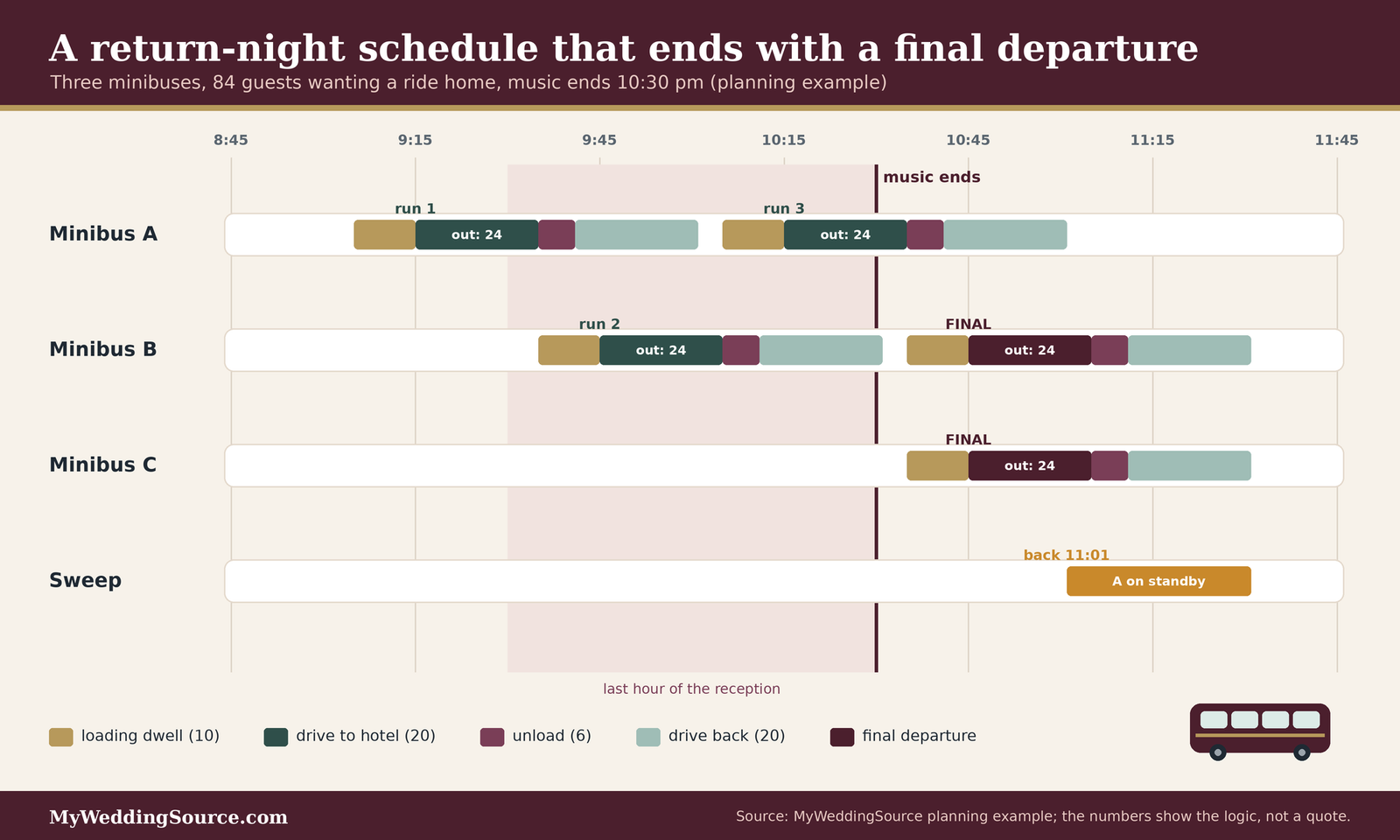
Decide when the music ends. The last dance is a natural marker; our wedding last dance guide covers how to use it. Then decide how long guests need to collect belongings, say goodbyes, and walk to the pickup point. In our example, the music ends at 10:30 pm and the final departure leaves at 10:45 pm, giving guests 15 minutes. Adjust that for your venue; a long walk or a coat check needs more.
Run early, mid, and final departures
A single late run forces everyone into one vehicle at one time. Spread demand with an early run for guests who want to leave before the reception ends, a middle run, and a final departure. In our example, 84 guests want a ride home out of 140, with three minibuses on the same 60-minute loop. Minibus A leaves at 9:15 and 10:15, minibus B leaves at 9:45 and 10:45, and minibus C leaves at 10:45. That is five loads of 24, or 120 seats, for 84 riders. The extra 36 seats are deliberate slack for stragglers and for guests who change their mind.
Keep a sweep vehicle on standby
After the final departure, one vehicle returns to the venue and stays for a defined period. In our example, minibus A is back at the venue at 11:01 and stays on standby until 11:30 for stragglers, vendors, or the couple’s family. Define the standby period in the contract and tell the point person who may call it. Standby costs money, so decide whether the couple, the planner, or the venue authorizes it.
Handle the exceptions
A wedding guest transportation planning schedule will not survive contact with a real reception unchanged. Decide how you will handle the common exceptions before they happen.
The guest who misses the final run
State in advance what happens. A published rule works better than an improvised one: after the final departure, the point person calls a pre-arranged car service or taxi and records the guest’s name and destination. Share a rideshare code or a prepaid voucher if the budget allows. A separate guide on the end-of-night ride plan treats this problem on its own.
The guest who should not drive
If a guest has been drinking and insists on driving, a calm, private conversation from a trusted person, not the couple, is the most effective approach. Have a plan for offering a ride, a hotel room, or a ride to be returned for the car in the morning. Do not make this the responsibility of the transportation driver; they are not trained for it and cannot leave their vehicle.
The drop-off point
Plan where each run stops. Most guests will go back to the hotel, but some will go home. If you offer multi-stop routes, add them to the loop arithmetic: each extra stop adds dwell and drive time. A plan that stops at three homes may need a larger buffer or a different vehicle.
Communication and day-of roles
A schedule only works if the people in it know about it. The second half of wedding guest transportation planning is communication: who tells guests, who tells drivers, and who decides when the plan changes.
Collect needs before you publish times
In wedding guest transportation planning, ask early enough that the answers can shape the fleet, and late enough that guests know their own travel plans.
Put the question on the RSVP
A short, specific question works better than a general one. Ask whether the guest wants a ride from the hotel to the ceremony, a ride back after the reception, or both, and whether anyone in their party needs an accessible vehicle or a child seat. Keep a separate column for each leg in your tracking sheet. If you also collect meal choices and song requests, keep the transportation question on its own line so it does not get skipped. Our RSVP wording guide and RSVP etiquette guide cover how to phrase these without pressure.
Follow up with the people who did not answer
Some guests will not reply to the transportation question. Decide in advance whether you will assume they will drive or assume they will ride. Assuming they will drive is cheaper but leaves gaps; assuming they will ride inflates the fleet. A middle path is to call or text the remaining guests a few weeks before the date, and to keep a small buffer of seats for last-minute changes.
Name one point person
One person should own wedding guest transportation planning on the day. It should not be the couple.
What the point person does
The point person holds the schedule, the operator’s dispatch number, the guest list for each run, and the authority to call the backup. They confirm with the operator the day before and the morning of the wedding, check the pickup points an hour before the first run, and keep a log of departures and arrivals. They also decide when a run goes without a late guest. A planner or day-of coordinator is a natural fit; a reliable friend or relative with a phone and a printed run sheet is another.
What the point person needs
Give them the printed run sheet, a contact list for every driver and dispatcher, the venue contact, the hotel contact, a backup rideshare or taxi number, and a clear budget for emergencies. Tell them in writing what decisions they can make without calling you. Our wedding week checklist includes a place to confirm these details in the final days, and the wedding emergency kit guide covers the small items worth carrying.
Write the run sheet
The run sheet is the single page of wedding guest transportation planning that turns the loop arithmetic into times drivers and staff can follow.
What goes on it
For each run, list the vehicle, the driver, the pickup point and time, the loading start time, the departure time, the drop-off point, the expected arrival, and the return time. Add the phone numbers and the plan for a missed run. The table below shows a short version of the return-night example from the previous section.
| Run | Vehicle | Loading starts | Departs | Arrives at hotel | Back at venue | Guests |
|---|---|---|---|---|---|---|
| 1 | Minibus A | 9:05 pm | 9:15 pm | 9:35 pm | 10:01 pm | up to 24 |
| 2 | Minibus B | 9:35 pm | 9:45 pm | 10:05 pm | 10:31 pm | up to 24 |
| 3 | Minibus A | 10:05 pm | 10:15 pm | 10:35 pm | 11:01 pm | up to 24 |
| Final | Minibus B | 10:35 pm | 10:45 pm | 11:05 pm | 11:31 pm | up to 24 |
| Final | Minibus C | 10:35 pm | 10:45 pm | 11:05 pm | 11:31 pm | up to 24 |
| Sweep | Minibus A | standby | on call | on call | to 11:30 pm | as needed |
Share the right parts with the right people
Drivers get the full sheet. Guests get the schedule and the pickup point. The venue gets the arrival and departure windows so it can hold curb space. The hotel front desk gets the times and the phone number. Giving each group only what it needs reduces the chance that someone follows the wrong version.
Costs, contracts, and fine print
Pricing for wedding guest transportation planning varies widely by region, vehicle, hours, and season, so we do not quote a price. We can show you how the price is built and where surprises hide.
How the cost builds up
Quotes usually combine an hourly or flat rate, a minimum number of hours, fuel and mileage, gratuity or a service fee, and sometimes tolls, parking, and overtime. Our loop arithmetic shows why the billable time is longer than the ride time: a vehicle is on your clock from the moment it starts loading until it is released, including every dwell and return drive. In the return-night example, minibus A is needed from about 9:05 pm to 11:30 pm if it stays on standby, roughly two and a half hours, while minibus C is needed only from 10:35 pm to 11:31 pm, under an hour, which may fall under the operator’s minimum. Ask every operator to price the same itinerary, and compare the all-in total, not the hourly rate. These figures are our own estimates, not quotes. Our wedding budget guide and hidden wedding costs guide show where transportation fits in the larger plan.
Normalize quotes to one itinerary
In wedding guest transportation planning, companies quote in different shapes, so a direct comparison needs one common itinerary.
Send the same run sheet to every company
Give each operator the same run sheet: pickup points, times, number of guests, number of vehicles, and the standby period. Ask them to price that plan, not their own version. If one company proposes fewer vehicles, ask for their loop arithmetic and compare it to yours. A cheaper quote that assumes shorter dwell or a faster drive is not cheaper if it fails.
Add the extras
Ask each company to list fuel, mileage, gratuity, tolls, parking, overtime, waiting time, cleaning, and cancellation fees. Add them to the total. A lower hourly rate with a higher minimum can cost more than a higher hourly rate with no minimum.
Contract clauses worth reading twice
You do not need a lawyer to read the contract behind your wedding guest transportation planning, but you do need to read it. The following clauses create most of the disputes. This is general information, not legal advice.
Vehicle, seats, and substitutions
The contract should name the vehicle type and seat count and say what happens if the operator substitutes another vehicle. A substitution that reduces seats or removes accessibility features should require your consent. Our wedding vendor contract guide explains how to read the rest of the agreement.
Time, overtime, and cancellation
Look for the start and end of the billing clock, whether it includes travel from the garage, the overtime rate, the cancellation window, and what happens if the wedding is postponed. Make sure the standby period and the final departure time are written in, not assumed.
Disclosure and conflicts of interest
Transportation recommendations can carry commercial interests, so ask about them directly.
Ask about referral fees
If a venue or planner recommends a transportation company, ask whether they receive a referral fee or commission. It is common in the industry and not necessarily a problem, but you should know.
Our own disclosure
We may earn commissions from some links on other pages of this site; this guide contains no affiliate links and no paid placement, and we have no relationship with any operator named in it.
Edge cases that break a clean plan
The loop formula in wedding guest transportation planning is a model, and models have limits. These situations are the ones that most often force a rethink.
Place-based edge cases
Some venues change the wedding guest transportation planning math before you start.
Remote and rural venues
Long drives mean long loops, and loops that long leave you with few waves. Cell coverage may be poor, so drivers and the point person need a plan for communication without a signal, such as fixed check-in times or a walkie-talkie pair. Pickup windows matter more here, and our guide to guest pickup windows for rural wedding venues goes further on that case.
City centers and restricted streets
Urban venues may restrict vehicle length, loading time, and curb access. A bus that cannot stop in front of the venue may need to drop guests a block away, which adds walking time and affects accessible boarding. Ask the venue and the city’s event office about permits and loading zones; our wedding permits guide covers the general idea.
Destination weddings
At a destination, guests may arrive by air at different times, which spreads demand across a day instead of a window. A hotel-based shuttle schedule may serve arrivals better than a single wave. Our destination wedding checklist covers the broader planning, and a local operator often knows traffic patterns that an out-of-town company cannot.
Guest-based edge cases
People do not behave like variables, which is the humbling part of wedding guest transportation planning.
Late arrivals and early leavers
Some guests will be late to the pickup, and some will want to leave early. Decide in advance how long a vehicle waits. A published rule, such as “we depart at the posted time,” protects everyone else’s timeline. Offer the early leaver a rideshare voucher or a seat on an earlier run.
Large family groups and the wedding party
The wedding party and immediate family often have a different timeline from guests: photos, hair and makeup, and last-minute errands. Give them a separate vehicle and schedule so they do not delay the shuttle. Count them in the fleet math, because they use seats and dwell too.
Day-of failures
Something will go slightly wrong in any wedding guest transportation planning. The goal is a small problem, not a large one.
A vehicle is late or does not arrive
Set a trigger in advance: if a vehicle is more than a set number of minutes late, the point person calls the backup. The trigger should be tight enough to matter and loose enough to avoid false alarms. Have a pre-arranged backup, such as a second company on call, and a way to tell guests what is happening.
Weather and road closures
Heavy rain, ice, or a closed road can lengthen drives and slow loading. Ask the operator about its weather policy, and decide whether you would shift the schedule, add a vehicle, or hold the ceremony. Our winter wedding weather plan shows how to make these decisions in advance.
Three short scenarios
Examples make wedding guest transportation planning concrete. All numbers here are our own illustrations built on the same assumptions as the loop section.
A small town wedding with one venue
In this wedding guest transportation planning example, a couple marries at a church and holds the reception in the church hall next door. Guests park at the church. No shuttle is needed for the ceremony, but a dozen guests staying at a motel five minutes away want a ride home.
What the plan looks like
One 14-seat van, 12 planned guests, a five-minute drive each way. With the same formula, the loop is about 7 minutes of loading, 5 driving out, 4 unloading, 5 driving back, and 4 of buffer, roughly 25 minutes. One run carries the dozen riders, a second run 25 minutes later covers anyone who changes their mind, and the van can wait at the hall until the end. The plan costs little and uses the arithmetic only to confirm that one vehicle is enough.
Where it can still go wrong
If three guests need a wheelchair-accessible van, one vehicle is not enough. This is the situation where early counting pays off: asking about access needs on the RSVP reveals the problem months in advance.
A winery with a hotel across town
In this second wedding guest transportation planning example, a couple holds the ceremony and reception at a winery 25 minutes from the main hotel. Of 120 guests, about 80 want a ride. The venue has a small lot and asks for no more than two large vehicles at the same time.
What the plan looks like
Two motorcoaches with 48 planned guests each carry 96 seats for 80 riders in a single wave, so there is no second loop to schedule, as long as the venue’s limit of two large vehicles at once is respected. On a 25-minute route, one coach loop is about 79 minutes (16 loading, 25 out, 9 unloading, 25 back, 4 buffer). If the venue could take only one coach at a time, the second wave would arrive 79 minutes after the first, and the arrival window would need to be at least that long. The question becomes whether the venue can handle two coaches arriving together; the answer is a call before signing.
Where it can still go wrong
On the return night, two coaches leaving at once means guests who leave 20 minutes before the final run have no vehicle. Add a minibus for early departures and keep the coaches for the final run.
A destination wedding with staggered arrivals
In this third wedding guest transportation planning example, a couple holds a three-day wedding at a resort two hours from an airport. Guests arrive across a full day.
What the plan looks like
Instead of one arrival wave, the plan uses scheduled airport pickups every two hours, timed to flight arrivals, with a coach for the large evening block. Driver hours matter: a two-hour drive each way means several round trips, and the FMCSA limits on driving time can matter and may call for a second driver. The loop for each run is more than four hours, so a vehicle serves only a few waves.
Where it can still go wrong
Flight delays break the schedule. The operator must be able to hold a vehicle or send another one. Ask whether waiting time is billed and how it is calculated.
A planning sequence from first call to final loop
The arithmetic of wedding guest transportation planning matters less if it arrives too late to change anything. This sequence is our suggested order of work, not an industry standard; adjust it to your date and your operator’s booking habits.
Before you book anyone
The early work in wedding guest transportation planning costs nothing and shapes everything that follows.
Map, count, and decide the model
Draw the legs on a map, count riders from RSVPs or estimates, and decide whether a fixed loop, on-demand rides, or a hybrid fits. Write down your arrival window and your final departure time as draft numbers. If you are still choosing a venue, our wedding venues guide and the venue questions linked above help you ask about vehicles, lots, and curfews before you sign.
Draft the loop table
Fill in the worksheet with placeholder dwell and drive times. You will not have the operator’s numbers yet, and that is fine. The draft tells you whether you are looking at two vehicles or twelve, which changes which companies are worth calling.
While you are collecting quotes
This is when wedding guest transportation planning starts to meet real vehicles.
Ask for the same itinerary and the same evidence
Send each company your draft run sheet and ask the questions in the callout above. Ask each one how far ahead it books and how it handles peak dates; availability of accessible vehicles may be tighter than availability of standard ones. Do not pay a deposit until you have looked up the USDOT number and the insurance on file.
Replace the placeholders
As operators give you real drive times, dwell estimates, and seat counts, update the worksheet. If a number surprises you, ask why. A company that has run your venue before often knows the loop better than you do, and its numbers deserve to replace yours.
In the weeks before the wedding
The last stretch of wedding guest transportation planning is about confirmation, not invention.
Lock the run sheet and brief everyone
Send the final run sheet to the operator, the venue, the hotel, and the point person. Walk the pickup points if you can. Confirm accessible boardings individually with the guests involved, and confirm the standby period and the final departure in writing.
Rehearse the exit
On the rehearsal day, show the point person the pickup points and the order of the first run. Our wedding rehearsal guide covers the larger rehearsal; add ten minutes for transportation. The day before and the morning of, confirm vehicles, drivers, and phone numbers by call, not just email.
Frequently asked questions
Planning and sizing
How many guests will actually need wedding transportation?
Wedding guest transportation planning usually involves fewer riders than you expect, but only your RSVPs can say. Local guests with cars often drive themselves, while out-of-town guests, older relatives, the wedding party, and anyone who may drink are the usual riders. Add a short transportation question to the RSVP and count answers by leg, because some guests need only a ride home.
What is a vehicle loop and why does it matter?
A loop is the full cycle one vehicle completes: load, drive, unload, return, and reset. It matters because the loop time decides how many waves a vehicle can serve in your window. In our example the loop is 60 minutes, and 16 of those minutes are dwell, which plans often leave out.
Safety and carriers
How do I check that a charter company is legitimate?
Ask for the USDOT number and look it up in FMCSA’s Bus Safety Search tool. Check the safety rating, out-of-service status, passenger operating authority, and insurance on file. FMCSA says a company with no USDOT number may operate only within one state, so contact your state transportation agency. Rules vary by vehicle and carrier type.
What insurance should a transportation company carry?
FMCSA lists minimum public liability coverage of $5,000,000 for interstate for-hire vehicles carrying 16 or more passengers including the driver, and $1,500,000 for 15 or fewer. State rules may differ for in-state carriers. Ask for a current certificate of insurance for the specific vehicle and confirm it before you pay a deposit.
Accessibility and families
Can we request an accessible vehicle for a guest who uses a wheelchair?
Yes. In wedding guest transportation planning, ask early. The ADA National Network says charter and tour bus operators must provide an accessible bus when given 48 hours of notice, and covered shuttle operators with inaccessible vehicles must provide equivalent service. For a wedding, confirm the exact vehicle, lift, and boarding time in writing, and plan extra dwell time.
Is rideshare a reliable backup for guests who need accessible rides?
Not by itself. Uber’s own page describes its wheelchair-accessible service as available where offered and described a limited pilot in four cities when we read it, which may be out of date. For a guest who needs a lift or ramp, a confirmed booking with a named operator is safer than an app.
The ride home
When should the final departure leave?
Set it after the music ends, with enough time for guests to collect belongings and reach the pickup point. In our example the music ends at 10:30 pm and the final departure leaves at 10:45 pm, with a standby vehicle until 11:30 pm. Publish the time, and tell guests what happens if they miss it.
What if a guest misses the last ride?
In wedding guest transportation planning, write the fallback before the day. Have your point person call a pre-arranged taxi, car service, or rideshare, record the guest’s name and destination, and decide who pays. A rideshare voucher for stragglers is a small cost compared with the risk. NHTSA reports that 11,904 people died in drunk-driving crashes in 2024.
Your next steps
Run the numbers
Fill in the worksheet
Start wedding guest transportation planning by taking the fleet-sizing worksheet and filling in one row per leg with your own guest counts, a draft loop time, and your arrival window. Check whether a one-minute change in loop time moves the vehicle count. If it does, you are near a cliff and should widen the window or add a spare.
Draft the departure schedule
Write the music end time, the final departure time, and the standby period. Then build the early and mid runs around them. Our wedding day timeline shows where the exit fits in the whole day.
Check the people and the paperwork
Verify the operator
For wedding guest transportation planning, look up the USDOT number, rating, operating authority, and insurance on file before you pay a deposit, and keep a copy of what you find. Ask the questions in the callout, and get seat counts, accessibility, and breakdown plans in writing.
Hand the plan to one person
Give your wedding guest transportation planning point person the run sheet, the phone numbers, and the authority to call the backup. For the broader plan, see our wedding planning checklist and our wedding transportation guide, and read about staggered departures and shuttle capacity if your event is large.
Sources & methodology
How we built this guide
What we relied on
This guide combines federal consumer guidance on hiring buses and vans, federal rules on carrier insurance and driver hours, the ADA regulations and guidance on transportation by private entities, and national traffic-safety data. Where a statement comes from a company, we say so; the Uber page, for example, describes one company’s service and may be out of date. The loop arithmetic, the dwell assumptions, the fleet tables, the return-night schedule, and every example number are our own planning estimates, not industry standards and not quotes. We checked the sources listed below on November 12, 2026; regulations, phone numbers, and company policies change, so confirm current details before you rely on them.
What we did not do
We did not test vehicles, time routes, survey operators, or verify any company’s licensing. We did not give legal, insurance, or medical advice. Federal rules differ by vehicle size, type of carrier, and whether a trip crosses state lines, and state and local rules add to them. Ask your operator and, for legal questions, a qualified professional or the relevant agency.
Source list
Government and regulatory sources
- U.S. Department of Transportation, home page and links to FMCSA, FTA, and NHTSA: https://www.transportation.gov/
- FMCSA, Look Before You Book: Put Bus Safety First: https://www.fmcsa.dot.gov/travelplanner
- FMCSA, Top 3 Things to Know When Planning Your Next Bus Trip: https://www.fmcsa.dot.gov/safety/passenger-safety/top-3-things-know-when-planning-your-next-bus-trip
- FMCSA, Safety Information for Travelers and Trip Planners: https://www.fmcsa.dot.gov/safety/passenger-safety/safety-information-travelers-and-trip-planners
- FMCSA, Licensing and Insurance Requirements for For-Hire Motor Carriers of Passengers: https://www.fmcsa.dot.gov/safety/passenger-safety/licensing-and-insurance-requirements-hire-motor-carriers-passengers
- FMCSA, Overview of Federal Requirements for Interstate 9 to 15 Passenger Vehicles: https://www.fmcsa.dot.gov/sites/fmcsa.dot.gov/files/2020-02/Overview%20of%20Federal%20Requirements%20Interstate%209%20to%2015%20Passenger%20Vehicles%20Brochure.pdf
- FMCSA, Hours of Service for Motor Carriers of Passengers (2022): https://www.fmcsa.dot.gov/sites/fmcsa.dot.gov/files/2022-07/Hours%20of%20Service%20for%20Motor%20Carriers%20of%20Passengers_2022.pdf
- eCFR, 28 CFR 36.310, Transportation services provided by public accommodations: https://www.ecfr.gov/current/title-28/chapter-I/part-36/subpart-C/section-36.310
- eCFR, 49 CFR Part 37, Subpart B, Applicability: https://www.ecfr.gov/current/title-49/subtitle-A/part-37/subpart-B
- Federal Transit Administration, Part 37, Transportation Services for Individuals with Disabilities: https://www.transit.dot.gov/regulations-and-guidance/civil-rights-ada/part-37-transportation-services-individuals-disabilities
- ADA.gov, Frequently Asked Questions about Service Animals and the ADA: https://www.ada.gov/resources/service-animals-faqs/
- NHTSA, Drunk Driving: https://www.nhtsa.gov/risky-driving/drunk-driving
- NHTSA, Countermeasures That Work, emerging issues in child restraint use: https://www.nhtsa.gov/node/138411
Advocacy, technical assistance, and company sources
- ADA National Network, The ADA and Accessible Ground Transportation: https://adata.org/?p=1545
- Uber, Uber WAV (company page describing its own service): https://www.uber.com/us/en/drive/services/uberwav