
Learning how to handle an alcohol-free wedding without surprising guests mostly means learning to announce it well: an alcohol-free wedding rarely upsets anyone on its own, but finding out late, sideways, or at the door does, so the real work is deciding what you mean by alcohol-free and then telling every guest, vendor, and family member the same plain thing at a calm, predictable pace.
Quick answer
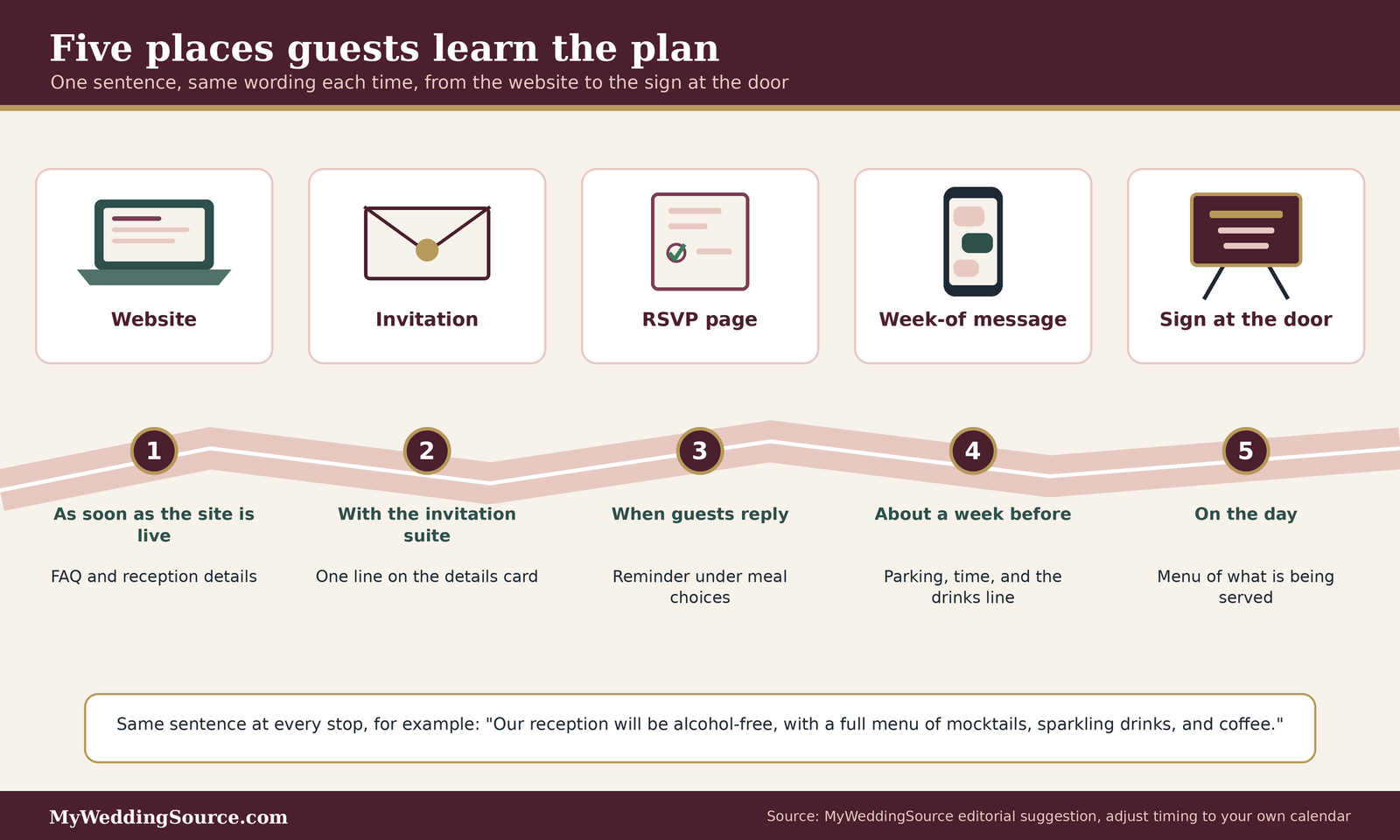
Here is how to handle an alcohol-free wedding without surprising guests, in four moves. First, write a one-sentence policy that settles the gray areas (the toast, guests’ own bottles, the hotel after-party). Second, tell people in layers: the wedding website first, then the invitation suite, then the RSVP page, then a short week-of message, then a sign at the entrance. Third, put real effort into the drinks that are served so the glass in every hand looks intentional. Fourth, brief your venue, caterer, DJ, and planner so nobody improvises a different answer. You do not owe anyone an explanation, and a short, warm, factual note is enough.
How to handle an alcohol-free wedding without surprising guests: what “surprise” really means
Most advice about dry weddings jumps straight to mocktail recipes. That is useful later, but it skips the part that causes friction. A guest who knows ahead of time that no alcohol will be served, and who does not feel judged for it, will usually adjust within a minute of arriving. A guest who learns the news while holding a car key and a gift bag has a different afternoon. This guide on how to handle an alcohol-free wedding without surprising guests is built around that gap between what people expect and what they find.
It also holds one deliverable you can use immediately: a wording bank with ready-to-adapt sentences for the website, the invitation, the RSVP page, text messages, the entrance sign, and the awkward conversations. Everything is written in plain language and none of it requires you to justify your choice.
We checked the sources in this guide on November 12, 2026. Rules for serving and bringing alcohol are set locally and change, so treat anything about permits as a prompt to ask your venue and your local alcohol authority, not as legal advice.
Surprise comes from mismatched expectations
Alcohol is not the surprising part. The surprise is a guest’s picture of the evening colliding with the reality of it. People build that picture from habit, from other weddings they have attended, and from the way a venue or invitation is styled. A formal evening invitation with a cocktail-hour line suggests a bar. A reception at a winery suggests wine. A Saturday night with dancing suggests drinks. If your day breaks that pattern, you can close the gap in two ways: change the signals, or say the thing out loud. Usually you do the second.
Three kinds of surprise to prevent
The first kind is the guest who arrives expecting a bar and finds none. They are not offended, but they are momentarily thrown, and they may have planned their evening around a drink. The second kind is the guest who finds out mid-reception, usually from another guest or from a server, and feels they should have been told. The third kind, and the one that has real consequences, is the guest who needed advance notice to make arrangements: someone who would have booked a ride, someone who would have chosen a different hotel, or someone who would have come to the rehearsal dinner differently. Each of these is solved by earlier, clearer information.
What a calm announcement does
A calm announcement does three jobs at once. It removes the uncertainty so people stop wondering. It signals that the decision is settled, which discourages bargaining (“Could we just have wine at dinner?”). And it models the tone you want guests to take with each other. A one-line note that states the fact and invites guests to enjoy the day reads as confident. A paragraph of apology reads as an invitation to argue.
Who needs to know early, and why
You will naturally think of guests first. Several other groups depend on the same information, and each one is harmed in a different way by a late reveal.
Guests who plan transportation and lodging around drinking
Some guests decide how they will get home based on whether they expect to drink. Others decide whether to book a room at the venue or a cheaper one across town. Knowing the policy early lets them choose either way. This is also practical for you: fewer last-minute questions about rides, and a clearer picture of how many shuttle seats you need. If you are arranging group transportation, our guide to wedding guest transportation planning covers the logistics, and our wedding end-of-night ride plan is useful for the final departure window.
Guests who will be relieved
Not everyone who reads “no alcohol will be served” feels disappointed. Some guests are in recovery from alcohol use disorder. Some are pregnant. Some avoid alcohol for religious, medical, or personal reasons. Some are driving and prefer not to be the only person without a drink. Learning the policy early lets these guests relax about the event instead of preparing a polite answer for every offer of a glass. For context, the National Institute on Alcohol Abuse and Alcoholism reports that, based on the 2024 National Survey on Drug Use and Health, about 27.1 million U.S. adults, or roughly one in ten, had alcohol use disorder in the past year. You will not know who in your guest list is in that group, which is a good reason to make the policy welcoming rather than a topic of debate.
Vendors and the venue
Your venue manager, caterer, bartender or beverage supplier, planner, DJ, and photographer will all be asked about the drinks by someone. If they give different answers, guests hear mixed messages. If your catering contract assumes a bar, you may also be paying for service you do not need. The “Vendor and venue questions” section later in this guide gives a checklist for each one.
Why couples choose an alcohol-free wedding, and why you do not owe a reason
Couples go alcohol-free for many reasons: one or both are sober, the venue does not allow alcohol, a faith tradition discourages it, budget, family members who are in recovery, wanting a daytime or family-focused event, or simply preference. Most etiquette writers who cover the topic say the same thing about explanations: you can state the fact without a justification. The wedding site Zola advises that you do not have to explain why, and that you should make the policy clear on invitations or the website.
Reasons are personal
A reason offered to one guest becomes a story told to everyone. If your reason is private, such as your own recovery, a family member’s illness, or a faith practice you do not want debated, you are free to keep it private. “We are keeping the celebration alcohol-free” is a complete sentence. If you do want to share a reason, share the version you would be comfortable hearing repeated at the reception.
What the broader picture looks like
Drinking habits in the United States are shifting. In its annual consumption poll, conducted by telephone with 1,002 adults in July 2025, Gallup found that 54% of U.S. adults said they drink alcohol, which it described as a record low for its trend, and that adults aged 18 to 34 reported a 50% drinking rate. A majority, 53%, said moderate drinking is bad for health. The poll has a margin of error of about four percentage points, and it describes attitudes in general rather than your particular guest list. It is a reminder that a meaningful share of any guest list may already drink little or not at all, which is a good reason to treat the non-drinker’s experience as central and not as an afterthought.
Decide what alcohol-free means for your day
Before you write a single invitation sentence, settle what the policy actually covers. Guests will test the edges, and vendors will ask. The most common source of conflict is not the decision to skip alcohol, it is the fuzzy boundary around it.
Four versions of “alcohol-free”
These are working definitions used in this guide, not legal categories. Pick the one that matches what you want, and write it down.
Fully dry on site
No alcohol is served, and none is welcome at the ceremony, the reception, or any couple-hosted events that weekend. This is the clearest version and the simplest to communicate. It works best when the venue itself does not permit alcohol, such as many parks, religious buildings, and community halls, because the venue’s own rules back you up. Ask your venue exactly what its policy says.
Alcohol-free service, with guests free to drink elsewhere
You do not provide or serve alcohol, and you do not police what guests do outside the event. Guests may meet for drinks before or after. This is common and is the arrangement etiquette writers describe as acceptable: meeting friends for drinks beforehand or afterward is considered fine, while bringing flasks or bottles into the reception is not. It is easy to explain, but it works better when the written policy says so out loud.
Alcohol-free except for a toast
You serve no bar, but offer a sparkling toast to adults who wish to take one, with a clearly equal non-alcoholic alternative. This is a middle path some couples choose. It is also the version most likely to create confusion, because the toast becomes a loophole in the story (“so alcohol is served?”). If you choose it, say so exactly, and check your venue’s policy and local permit rules before you promise it.
Alcohol-free event, with a separate drinks gathering hosted by someone else
The wedding itself is dry, and friends or family organize an after-gathering at a bar. This keeps your event consistent while acknowledging that some guests will want to continue the evening elsewhere. The wedding site LoveToKnow suggests that guests who want to drink plan an after-party at a bar or club. The important point is that the couple is not hosting it, which keeps the wedding’s policy clean.
Gray areas to settle before you write the wording
The toast
Decide what is in the glass. Sparkling juice, sparkling cider, a non-alcoholic sparkling wine, or even water all work, and guests raise a glass either way. Because a non-alcoholic product can contain a trace of alcohol, read the label if the reason for your policy is strict. The federal Alcohol and Tobacco Tax and Trade Bureau (TTB) says a malt beverage may carry “non-alcoholic” only with a statement that it contains less than 0.5 percent alcohol by volume nearby, and may be labeled “alcohol free” only if it has none. We cover this in more detail in the vendor section and in our guide to nonalcoholic beer and wine.
Guests’ own bottles
Say what happens. The etiquette site Bridal Musings advises that guests should respect the couple’s decision and that bringing flasks or bottles to drink during the event is considered disrespectful. That is an opinion about etiquette, not a rule, so your own sentence is what counts. A venue may also have its own rule on bringing alcohol in, and it may be stricter or looser than you expect. Ask.
The wedding party’s morning and the hotel after-party
Couples often forget the edges: getting-ready mimosas, a groomsmen’s cooler in the truck, a hotel suite after-party. If your policy matters to you, tell the wedding party directly, before the group text turns into a plan. You generally cannot control what adults do in a hotel room, but you can say what you are hosting and what you are not.
Write the one-sentence policy
A policy you can paste anywhere
A good policy fits in one sentence and answers the questions people ask. Here are three versions, from firmest to softest. Adapt the wording to your voice.
We are hosting an alcohol-free celebration, with no alcohol served and none brought in, and we have planned a full menu of non-alcoholic drinks.
Our reception will be alcohol-free. We will serve a full menu of mocktails, sparkling drinks, and coffee, and we hope you will join us.
No alcohol will be served at our wedding. Friends who would like to gather afterward are welcome to organize something nearby.
Test it on a skeptical friend
Read your sentence to a friend who is not in on the planning and ask what questions it leaves open. If they ask “Can I bring wine?”, “Is there a toast?”, or “Is this the whole night or just dinner?”, your policy has a gap. Closing those gaps now means they will not turn into text messages from guests three days before the wedding.
Tell guests in layers, not in one big announcement
One mention in one place is easy to miss. Guests read the invitation once, skim the website, and forget both by the weekend. Telling people in layers means the same short fact appears at each point where they make a decision, so nobody has to remember it from the first mention.
The five touchpoints
The sequence below is our editorial suggestion, not an industry rule, and the timing assumes a typical planning calendar. Adjust it to your own dates. The important idea is that the website goes first and the sign goes last.
Touchpoint one: the wedding website
Put the policy in the FAQ and in the details section for the reception, using the exact sentence you wrote earlier. The website is where guests look when they are deciding about travel, so it is the right first home. Bridal Musings recommends adding the note to the website FAQ, partly because it helps guests plan transportation. If you send a save-the-date with a website link, guests can find the policy before they have decided anything.
Touchpoint two: the invitation suite
A single line on the reception card or details card is enough. You do not need a banner or an exclamation point. The line should say what you are doing in the same words as the website so the two never seem to disagree. For general invitation wording conventions, see our guides to wedding invitation wording and wedding invitation etiquette.
Touchpoint three: the RSVP page
The RSVP is the moment guests commit, which makes it the best place for a reminder and a useful question. A short line under the meal choices (“Our reception is alcohol-free”) closes the loop. You can also add an optional field for drink preferences, so guests can tell you what they would like to see. Our guide to wedding RSVP wording covers how to structure the card, and the notes on RSVP etiquette help with follow-up.
Touchpoint four: the week-of message
Send a short message about a week before the wedding with the practical details: arrival time, parking, dress, and one line about drinks. The reminder is not for the guests who read everything. It is for the ones who read nothing.
Touchpoint five: the sign at the door
A small, tasteful sign at the entrance or the drinks table confirms the policy for anyone who missed the earlier notes and tells guests what is available. See our guide to wedding signage for design and placement.
Choose a tone and stay with it
Tone matters more than length. The same fact can sound warm, neutral, or defensive.
Warm and brief
Warm wording leads with what guests will have, not what they will not. “We have a full menu of mocktails, sparkling drinks, and fresh coffee” lands better than “No alcohol, sorry.” This tone is a good default for most couples.
Plain and practical
If your guest list prefers straightforward information, state the fact and move on: “No alcohol will be served at the reception.” The plain version works well when the policy is tied to the venue’s rules or to a religious or family tradition that guests already understand.
What to avoid
Avoid apologizing (“We know this may disappoint some of you”), because it invites debate. Avoid moralizing (“We believe the best celebrations do not need alcohol”), because it can sound like a judgment of anyone who drinks. Avoid threats on the invitation itself. One wedding-planning site does suggest stating that anyone arriving intoxicated will be asked to leave, which is a reasonable policy if you mean it, but it reads better in a private note to the wedding party and vendors than printed on a card.
Timing: when to tell people
The earliest useful moment
As soon as you know. If your venue has already told you no alcohol is allowed, the information can go on the website the day it launches. The earlier guests learn, the less it feels like a change.
The latest responsible moment
Before guests book travel and before invitations go out. If a policy change happens late, such as a venue revising its rules or a couple deciding to go dry after invitations are out, send a short, direct update by whatever channel you used for the original invitation, and mention it again on the website and in the week-of message. Do not rely on a single email.
The wording bank: alcohol-free guest communications examples
Below are ready-to-adapt sentences for each touchpoint, followed by scripts for common conversations. Change names, details, and tone to suit you. None of these needs a legal review, but if your venue has its own policy language, use that exact language wherever it applies.
Website and invitation wording
Website FAQ entries
Will alcohol be served? No. Our reception is alcohol-free. We will have a full menu of non-alcoholic drinks, including mocktails, sparkling beverages, and coffee.
Can I bring my own? We are asking that guests not bring alcohol to the ceremony or reception. If you would like to celebrate with a drink afterward, we would love for you to join friends nearby.
I need a particular drink for dietary or health reasons. Who do I tell? Please note it when you RSVP, or email us at the address on this page, and we will pass it to our caterer.
Invitation card lines
An alcohol-free celebration.
Mocktails, sparkling drinks, and coffee will be served.
Please join us for dinner and dancing. This will be an alcohol-free reception.
Save-the-date and website homepage line
Join us as we celebrate, alcohol-free, on [date]. Details are on our website.
RSVP, message, and reminder wording
RSVP page
Our reception will be alcohol-free. Please let us know if you have a drink preference or dietary need.
Text or email, week of the wedding
We are so glad you are coming. A few details: parking is on [street], the ceremony begins at [time], and the reception will be alcohol-free, with mocktails, sparkling drinks, and coffee. See you soon.
A note for the wedding party and family
A quick note so we are all on the same page: we are keeping the day alcohol-free, including getting ready, the ceremony, and the reception. If you have questions, ask us and not the guests, and we would be grateful if you would help us keep it simple.
Scripts for common conversations
Guests may raise the topic directly, by message or in person. Short, friendly, unrushed answers work best. You can say them to anyone.
“Can we at least have wine at dinner?”
Thank you for asking. We have thought about it and we are keeping the whole day alcohol-free. We have put a lot of care into the drinks and the food, and we hope you will enjoy them.
You can say the same thing again if they push. Repeating the same sentence calmly is more effective than finding new reasons.
“Is it okay if I bring a bottle for the table?”
We would rather keep the reception alcohol-free, so please leave it at home. We would love for you to join us afterward at [place], if you like.
“Why are you not serving alcohol?”
It is what feels right for our day. Is there something we can do to make sure you have a drink you will enjoy?
The last line turns the conversation toward what you can offer. You are not obliged to explain more.
When the person asking is paying or helping to pay
If a parent or relative is contributing to the wedding and has a strong opinion, this conversation deserves privacy and time. Agree on the policy before invitations go out, and let the contributor know what is included in the beverage budget. See our guides on how to pay for a wedding and wedding etiquette for more on shared decision-making.
Wording to leave out
Phrases that invite debate
“Sorry, no alcohol.” “We know some of you will hate this.” “Don’t worry, you can drink after.” Each of these frames the policy as a loss, and invites the response “then why not just serve it?”
Phrases that judge guests
“We want a wholesome reception.” “Everyone can have fun without drinking.” These can land as criticism of guests who do drink. Describe what you are doing, not what you think of people who do something different.
Make the day feel full: the drinks guests will actually see
The strongest way to prevent a sense of absence is to make the drinks that are present feel deliberate. Guests notice a drinks table that looks like an afterthought. They do not notice a missing bar if the table in front of them is generous and well made.
Build a real non-alcoholic program
Offer variety, not a single pitcher
Advice from several wedding sites converges on the same idea: set up a mocktail bar that feels like a regular bar. Bridal Musings suggests fresh juices, kombucha, non-alcoholic ciders, lemonades, sparkling water, sodas, and iced teas, with house syrups and garnishes so guests can customize. Zola suggests a signature non-alcoholic drink for cocktail hour and a list of mocktails for dinner, plus options such as infused water, kombucha, cold-pressed juice, hot chocolate, or espresso depending on season and time of day. Our guide to wedding mocktails goes deeper on recipes and quantities, and our guide to coffee bars versus espresso carts helps with the warm-drink side.
Presentation matters
The same sources point out that glassware, garnishes, and decorative ice change how a drink feels. A drink served in a proper glass with a garnish looks like a celebration, and a drink in a plastic cup looks like a compromise. For glass logistics, see wedding bar glassware rental and wedding bar ice planning. If your day is outdoors in warm weather, plan hydration points as well; the sibling guide on beverage stations for outdoor heat covers that case: beverage stations for outdoor heat.
The toast
Pick something that looks like a toast
A toast needs a glass and something in it. Sparkling juice, sparkling cider, non-alcoholic sparkling wine, or even a signature mocktail all do the job. Hand the glasses to everyone before the speeches start so that no guest is left empty-handed, and so that the toast is the same for everybody. Our guides to wedding speeches and rehearsal dinner toasts help with timing.
Read the label on non-alcoholic wine and beer
“Non-alcoholic” does not necessarily mean zero. TTB’s guidance explains that a malt beverage may be labeled “non-alcoholic” only if the label states that it contains less than 0.5 percent alcohol by volume, while “alcohol free” is reserved for malt beverages with no alcohol at all. A trade summary of TTB’s 2026 low- and no-alcohol presentations says products under 0.5% ABV are not considered alcoholic beverages under that framework and may be labeled either way. If your guests include someone in recovery, someone pregnant, or someone avoiding alcohol for religious reasons, a labeled-below-0.5% product may or may not suit them; the decision belongs to the guest. The simplest approach is to be transparent. Put the product name and the phrase “contains less than 0.5% alcohol” on the menu card, or choose a product labeled alcohol-free.
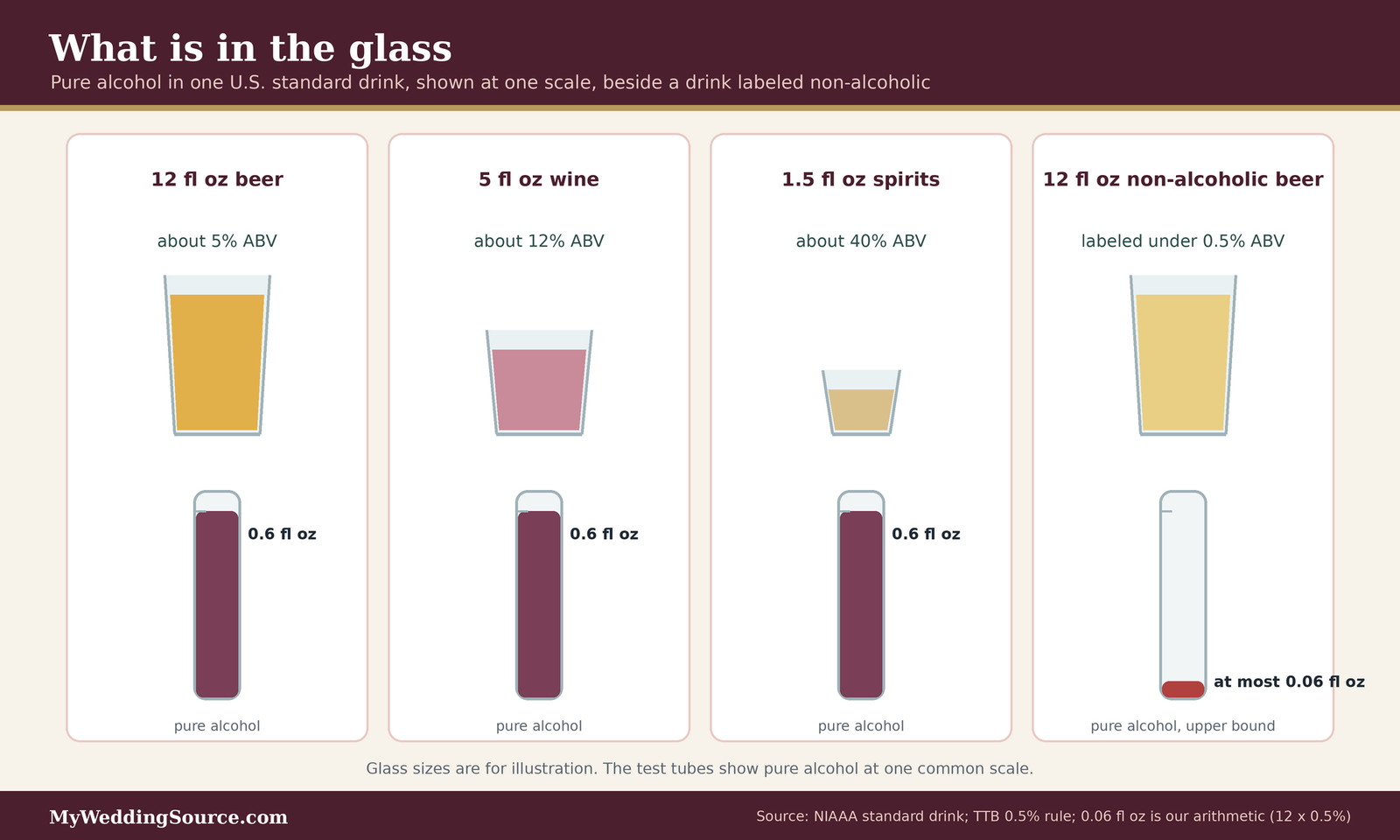
For comparison, the National Institute on Alcohol Abuse and Alcoholism defines one U.S. standard drink as 14 grams, or 0.6 fluid ounces, of pure alcohol. A 12-ounce beer at about 5% alcohol by volume holds one standard drink. As our own back-of-envelope estimate, a 12-ounce drink at the 0.5% ceiling would contain about 0.06 fluid ounces of alcohol, roughly a tenth as much. Real products often contain less. This is arithmetic for illustration, not a statement about any specific product or a guide to whether a given person should drink it.
Pacing the evening without a bar
Plan the energy curve
Without a bar as the social center, other things carry the evening: the meal, the music, activities, and movement. Zola suggests a lively band or DJ, icebreakers, and activity stations such as a photo booth or lawn games. LoveToKnow suggests food trucks, lawn games, and other entertainment. Our guides on wedding entertainment ideas and the wedding photo booth are good places to start.
Expect a different end time
Bridal Musings notes that dry weddings often end earlier, with guests tending to leave around 9 or 10 p.m. That is one writer’s observation rather than data, but it is a useful planning prompt. Ask your venue and your DJ whether the contract hours match the evening you expect, and consider a last dance or a send-off that gives the night a clear finish. See our wedding last dance guide.
Where the bar budget goes
Skipping alcohol does not mean the beverage line disappears. You may spend less on alcohol, bartenders, and bar rentals, and more on glassware, specialty drinks, a coffee or dessert station, and food. LoveToKnow suggests putting the money an open bar would have cost toward a memorable meal. We cannot give you a number for your area, because pricing varies widely by market and vendor. Ask your caterer to quote the non-alcoholic program as its own line item, so you can see what you are actually buying, and compare it with the alcohol package you did not buy. Our wedding budget and wedding catering cost guides show how to track it.
Vendor and venue questions to settle in writing
Your policy is only as consistent as the least-informed person who talks to guests. Put it in contracts and briefing notes, so that everyone, from the venue coordinator to the person carrying trays, gives the same answer.
The venue
Ask what the venue’s rules actually are
Venues differ widely. Some do not allow alcohol at all. Some allow it only through an approved caterer or a licensed bartender. Some allow guests to bring it. The rules also depend on local and state law, which varies. As an illustration of how different the rules can be, North Carolina’s alcoholic beverage control agency says a wedding generally needs a Limited Special Occasion permit if fortified wine or spirits are served by someone other than the property owner, while beer or unfortified wine served free to adults, with the owner’s permission, may not need one. Montana’s revenue department, in a fact sheet for event venues, says a venue without an alcohol license may let guests bring alcohol to a private party that is not open to the public, but may not sell or serve it or include it in the rental price, and that a licensed venue generally may not allow people to bring their own. These are two examples from two states, they may have changed since we checked, and they are not advice about your location. Your venue and your local alcohol authority are the sources to rely on.
Confirm the venue will back you up
If your event is alcohol-free by choice rather than by the venue’s rules, ask whether staff will enforce it if a guest brings a bottle, and what the venue’s policy is if someone arrives visibly intoxicated. It is easier to settle this in the contract than at nine o’clock on the wedding night. Our wedding venue questions guide has a broader list, and our guides to outdoor and garden venues cover places where alcohol rules are often handled differently.
The kitchen and caterer
Check for alcohol inside the food
A dry event can still contain alcohol in sauces, desserts, marinades, and flavorings. A guest in recovery, a guest who avoids alcohol for religious reasons, or a pregnant guest may want to know. Ask the caterer for an ingredient list for each dish, and mark anything that contains wine, beer, liqueur, or spirit-based flavoring. Our guide to wedding dietary restrictions covers collecting and passing along this kind of information, and our guide on planning a halal menu with mixed dietary needs shows how one kitchen can serve different needs.
Cooking does not always remove it
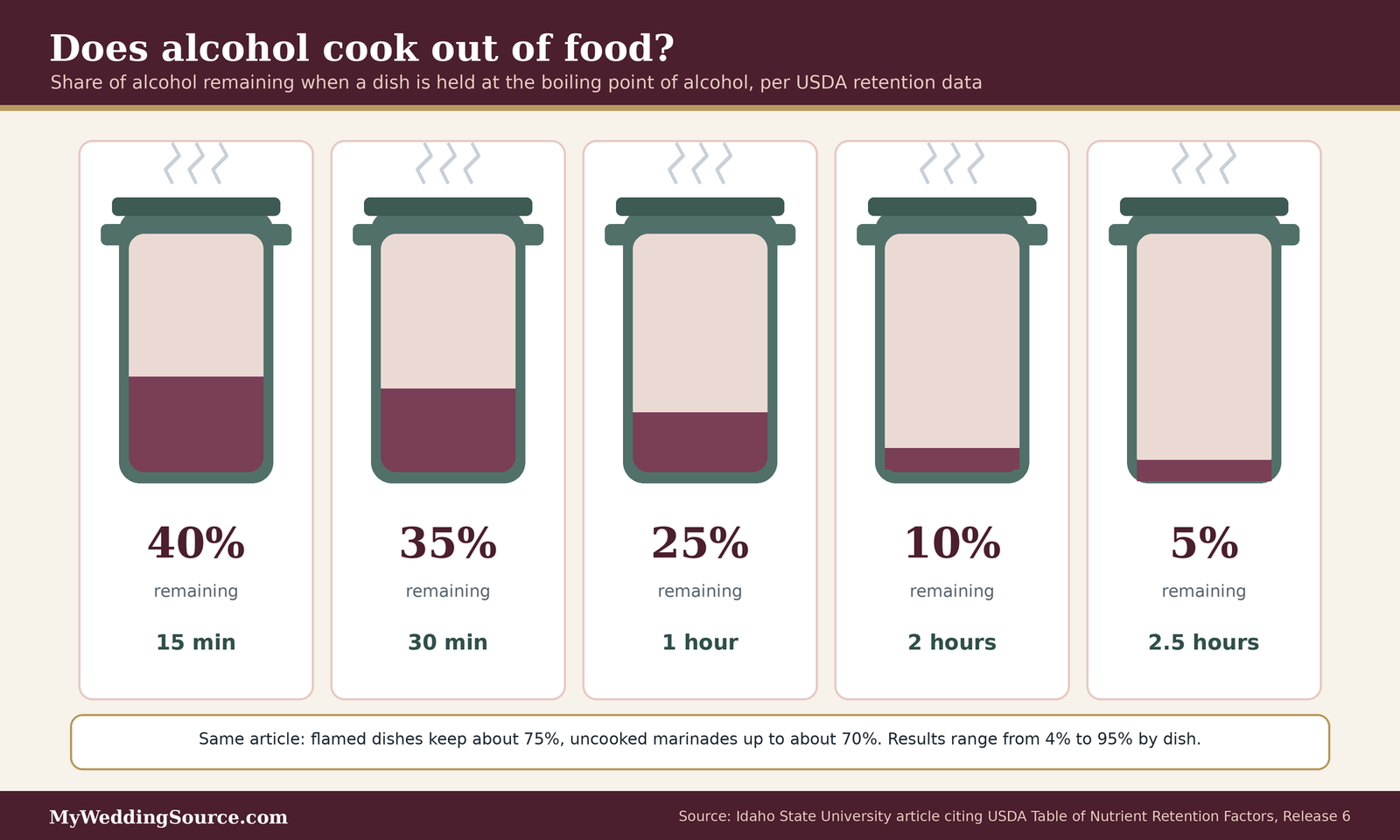
It is a common belief that alcohol “burns off” in cooking. According to an Idaho State University health sciences article that cites the USDA’s table of nutrient retention factors, the amount remaining depends on time and method: for alcohol cooked at its boiling point, about 40% remains after 15 minutes, 35% after 30 minutes, 25% after an hour, 10% after two hours, and 5% after two and a half hours. The same article says a USDA-funded study found remaining alcohol ranging from 4 to 95 percent depending on the dish, and that flamed dishes and uncooked marinades retain much more. If your policy matters to any guest for health, recovery, or faith reasons, the practical answer is to ask the caterer to leave alcohol out of the menu or label it clearly.
Catering contract details
Ask whether your catering quote assumes a bar package, and remove anything you do not need: bartenders, bar setup, garnish trays, and alcohol service fees. Ask how the non-alcoholic drinks will be staffed and replenished, since a mocktail bar with no one tending it empties fast. Our guides to wedding catering and catering service planning cover service styles and staffing.
Beverage supplier, planner, DJ, and photographer
The beverage supplier or bartender
If you hire a bartender or beverage service to make non-alcoholic drinks, ask for sample recipes, quantities per guest, and what happens if someone requests alcohol. Our guides to choosing a wedding bartender and wedding bar service planning are written for alcohol programs but their staffing and quantity advice carries over.
Planner, DJ, and photographer
Give your DJ or emcee a short script that states the policy if guests ask, and remind them not to joke about the bar or invite guests to “head to the bar.” It is a common line, and easy to forget. Tell your photographer if you do not want drink-in-hand photographs, or if you want photographs of the mocktail bar. Our wedding vendor communication deadlines guide helps you decide when each vendor needs the final brief.
Questions to ask your venue and vendors
- What does your written policy say about alcohol on the premises, including guests bringing their own?
- Will your staff enforce our alcohol-free policy, and what is the process if a guest brings alcohol or arrives intoxicated?
- Does any permit or insurance requirement apply to our event, and who is responsible for it?
- Does our catering quote include bar service we do not need, and can we remove it?
- Which dishes, sauces, desserts, or flavorings contain alcohol, and can you substitute?
- How will the non-alcoholic drinks be staffed, replenished, and labeled?
- If we serve a non-alcoholic wine or beer, what is the exact alcohol content on the label?
- Who will answer guests’ questions about the drinks on the day?
Edge cases: what to do when the plan meets real people
No policy survives contact with every guest. These are the situations that come up most often, and a calm answer you decided in advance.
Guests and bottles
The guest who brings alcohol anyway
Decide who responds before it happens. The best answer is private and brief: a venue coordinator or a trusted friend asks the guest to leave the bottle in the car, and offers a drink from the bar. If you prefer a lighter touch, assign it to someone in the wedding party or a family member who the guest respects. Do not make it your job on your wedding day.
The guest who is angry about the policy
A guest might tell you, or someone in your family, that they are unhappy. You can listen and decline to debate. “Thank you for telling me. We have decided, and I hope you will come.” If the person says they will not attend, that is their decision. Do not renegotiate at the last minute for one guest; it signals to the others that the policy is negotiable.
The guest who arrives already drinking
This one is about safety more than etiquette. If someone arrives intoxicated, ask the venue coordinator or planner to handle it, not a family member. The point is not punishment, it is getting that person home safely. The National Highway Traffic Safety Administration advises planning a ride before drinking, using a sober driver or ride service, and, if you are hosting, making sure every guest leaves with a sober driver. NHTSA reports that 11,904 people died in drunk-driving crashes in 2024, and that driving with a blood alcohol concentration of .08 or higher is illegal in all states, with Utah’s limit set at .05. An alcohol-free reception lowers the risk, but it does not remove the risk of guests who drink beforehand.
Guests with particular needs
Guests in recovery
You may know that someone in your wedding is in recovery, or you may not. A warm, uncomplicated policy helps either way. Avoid singling anyone out, avoid putting them in charge of enforcing the policy, and avoid referencing their recovery in public. If a guest or family member is struggling and asks for help, the Substance Abuse and Mental Health Services Administration runs a free, confidential, 24-hour National Helpline at 1-800-662-HELP (4357), in English and Spanish. This is information, not medical advice, and a wedding planner is not the right person to manage someone’s health.
Pregnant guests
The Centers for Disease Control and Prevention says there is no known safe amount of alcohol use during pregnancy and no safe time to drink during pregnancy. An alcohol-free reception means a pregnant guest does not have to decide whether to explain, and does not have to hold a glass she is not drinking. This is one of several reasons a mocktail with some visual flair is better than a plain glass of water.
Guests under 21 and guests who are religious abstainers
NHTSA notes that all states set the minimum legal drinking age at 21, so an alcohol-free event also avoids the question of who is allowed to be served. Guests whose faith practice avoids alcohol will welcome the clarity. If you are hosting a mixed-faith guest list, the alcohol-free policy can be a quiet gesture of hospitality, and you do not need to name any particular tradition. Our guide to child-free wedding etiquette is relevant if your policy and your guest list overlap, and LoveToKnow notes that without alcohol more guests may choose to bring children.
Family, weekend events, and shared hosting
The rehearsal dinner and welcome events
Decide whether your policy covers the whole weekend or only the wedding. Many couples keep the wedding alcohol-free and let the rehearsal dinner follow the host’s own rules, especially when someone else is paying. If so, say so on the schedule to avoid a mixed message. Our guides to welcome drinks versus a welcome dinner, rehearsal dinners at a brewery, and wedding weekend event planning help you see where the lines fall.
The hotel after-party
You can host your wedding as alcohol-free and still be aware that guests will gather at the hotel bar. The question is whether you are hosting it. If you are not, you do not need to address it beyond saying where friends are welcome to meet. If you are, treat it as a separate event with its own invitation and its own rules.
A family member who is paying and wants a bar
Treat this as a private conversation, not a group decision. List what you are comfortable with and what you are not. Some families agree on a compromise, such as a reception that is alcohol-free and a separately hosted family dinner. Zola’s overview mentions middle-ground formats, such as serving only wine or champagne during cocktail hour, or an open bar early followed by a pause. Those formats require a licensed provider and are no longer “alcohol-free” in the sense used in this guide, so decide deliberately.
Day-of: signs, scripts, and safe rides
A small amount of signage
At the entrance and the drinks table
A short sign at the entrance or beside the drinks station reinforces the message without sounding like a rule. Good options include “Tonight’s menu” with the drinks listed, “Mocktail bar,” or “Alcohol-free celebration.” If a sign names the non-alcoholic wine or beer, include the alcohol content as it appears on the label. Placement and design are covered in our wedding signage guide.
Menus and cards
Printed menu cards at each place or a small card at the drinks table let guests choose without asking. A line like “Non-alcoholic wine, less than 0.5% alcohol by volume” gives guests the information they need to decide for themselves.
Scripts for the people who talk to guests
The emcee or DJ
Provide a short script: the drinks station location, what is on the menu, and the toast moment. Ask the emcee to avoid jokes about the bar, “last call,” and “drink up.” One sentence about the policy at the start of the reception can be enough if you want it said aloud. See our wedding reception guide for the order of events.
Servers and venue staff
Give them the answer to the question they will be asked most: “Is there any alcohol?” A good answer: “Tonight is alcohol-free, but we have a wonderful mocktail menu. May I bring you one?”
Getting everyone home
Make rides part of the plan
NHTSA’s advice for hosts is to make sure every guest leaves with a sober driver. At an alcohol-free reception, most guests will arrive and leave sober, but some will have had drinks beforehand or will plan to go to an after-party. Share ride options on the website and in the week-of message, and keep a printed list of taxi and ride service contacts at the venue. See our guide on wedding transportation for shuttle options.
Have a plan for the guest who should not drive
Decide in advance who will arrange the ride. A venue coordinator, the planner, or a designated friend can do this quietly. Keep your own role small. Our wedding emergency kit guide includes a few other items worth having on hand.
When something goes wrong
Mistakes in communication
A guest was not told
If someone says they did not know, apologize for the miss without apologizing for the policy: “I am sorry that did not reach you. Here is what we have planned for drinks.” Then check how the information was sent and fix the gap for the rest of the guests.
A vendor gave the wrong answer
If a vendor told a guest that alcohol would be served, correct it with the guest and give the vendor a written one-line policy. Ask the vendor to confirm in writing. This is one reason to put the policy in every contract and brief.
A change of plan
The venue or the family changes the rules
If the rules shift after invitations go out, update every touchpoint at once: website, email, RSVP page, and the week-of message. State the change plainly, say what it means for guests, and say what you are doing about it.
You change your mind
It is your wedding. If you decide to serve a limited amount of alcohol after announcing an alcohol-free event, tell guests clearly and early, and check permit and venue rules first. Changing in the other direction, from alcohol to none, deserves the same notice.
The policy
Do we have to explain why our wedding is alcohol-free?
No. Wedding etiquette writers, including Zola and Bridal Musings, say a short, factual note is enough. Share a reason only if you are comfortable hearing it repeated. A sentence such as “We are keeping the celebration alcohol-free” answers the question without inviting debate about your reasons or your guests’ habits.
Where should we announce it first?
Put it on your wedding website, in the FAQ and the reception details, as soon as the site goes live. Then repeat the same wording on the invitation suite, the RSVP page, the week-of message, and a sign at the entrance. Guests make travel and transportation decisions from the website, so it should be the first and most complete source.
Can we still serve a sparkling toast?
You can offer a toast with sparkling juice, cider, or non-alcoholic sparkling wine, and it looks the same in a glass. If you want an alcoholic toast, say so in your policy, because it changes what you are announcing, and check your venue’s rules and local permit requirements before you promise it.
Guests and etiquette
What if a guest brings their own alcohol?
Decide in advance who responds, and keep it quiet and kind. Ask the guest to leave the bottle in the car, and offer a drink from the mocktail menu. Etiquette writers generally treat bringing flasks or bottles into a dry reception as disrespectful, but your written policy and your venue’s rules matter most.
Is it okay to suggest guests gather elsewhere afterward?
Yes. LoveToKnow suggests letting guests who want to drink plan an after-party at a bar, and meeting friends for drinks before or after is generally considered acceptable. Friends or family should organize it, so the wedding itself stays consistent. You can mention a nearby place on the website without hosting anything.
Will guests leave early?
Some may. Bridal Musings observes that dry weddings often wind down around 9 or 10 p.m., though that is one writer’s observation and not data. Plan the key moments, such as dinner, toasts, cake, and the first dance, earlier in the evening, and ask your venue and DJ about contract hours.
Drinks and safety
Is non-alcoholic beer or wine really alcohol-free?
Not always. The federal Alcohol and Tobacco Tax and Trade Bureau says “non-alcoholic” malt beverages must state they contain less than 0.5 percent alcohol by volume, and “alcohol free” is reserved for products with none. Check the label, put it on the menu, and let guests decide for themselves.
Does alcohol cook out of food?
Not completely. A university article citing USDA retention data says about 40 percent of alcohol can remain after 15 minutes at the boiling point, falling to about 5 percent after two and a half hours, with wide variation by dish. If a guest avoids alcohol for any reason, ask your caterer to leave it out or label it.
Your next steps
A short plan for how to handle an alcohol-free wedding without surprising guests:
Decide and write it down
Write your one-sentence policy
Settle the toast, guests’ own bottles, and the weekend scope, then write one sentence you can paste anywhere. Test it on a friend and tighten any gaps.
Put it in contracts and briefs
Send the policy to your venue, caterer, planner, DJ, and photographer, and ask each to confirm in writing. Use the question list above as your starting point and our wedding vendor timeline to set deadlines.
Tell guests and plan the drinks
Publish in layers
Add the wording to your website first, then the invitation, the RSVP page, a week-of message, and a sign. Use our wedding planning checklist to place each one on your calendar.
Build the drinks list
Choose a signature drink, a sparkling toast, a coffee or tea option, and at least one item that looks celebratory in a glass. Start with our guides to wedding mocktails and nonalcoholic beer and wine, and for a broader view of the place you are booking, see our outdoor wedding venues and wedding venue cost guides.
Sources & methodology
How we built this guide
What we relied on
This guide on how to handle an alcohol-free wedding without surprising guests combines federal and public-health sources on alcohol, a federal labeling framework for non-alcoholic beverages, state alcohol-regulator examples, a national poll of drinking habits, and etiquette and planning advice from wedding publications. We checked the sources on November 12, 2026. Where a statement comes from a wedding publication or a trade blog, we say so, because those sources reflect the opinions and habits of their writers. The comparison of a 0.5 percent product with a standard drink is our own arithmetic and is an estimate. The sample wording is ours.
What we did not do
We did not test products, measure alcohol content, or review any venue’s contract. We did not give legal, medical, or financial advice. Alcohol permit and venue rules are set by states, counties, and cities and change over time; ask your venue and your local alcohol regulator. Anyone concerned about their own or a loved one’s drinking should speak to a clinician or call a helpline.
Source list
Government and public-health sources
- Centers for Disease Control and Prevention, About alcohol use and health: https://www.cdc.gov/alcohol/about-alcohol-use/index.html
- Centers for Disease Control and Prevention, Alcohol and pregnancy: https://www.cdc.gov/alcohol-pregnancy/about/index.html
- National Institute on Alcohol Abuse and Alcoholism, What is a standard drink: https://www.niaaa.nih.gov/alcohols-effects-health/what-standard-drink
- National Institute on Alcohol Abuse and Alcoholism, Alcohol use disorder in the United States, age groups and demographic characteristics: https://www.niaaa.nih.gov/alcohols-effects-health/alcohol-topics/alcohol-facts-and-statistics/alcohol-use-disorder-aud-united-states-age-groups-and-demographic-characteristics
- National Highway Traffic Safety Administration, Drunk driving: https://www.nhtsa.gov/risky-driving/drunk-driving
- Substance Abuse and Mental Health Services Administration, National Helpline: https://www.samhsa.gov/find-help/national-helpline
- Alcohol and Tobacco Tax and Trade Bureau, Malt beverage alcohol content: https://www.ttb.gov/regulated-commodities/beverage-alcohol/beer/labeling/malt-beverage-alcohol-content
- North Carolina ABC Commission, Do you need a permit for a special event: https://abc.nc.gov/webform/ncc_permit_application_flowchart
- Montana Department of Revenue, Event venues fact sheet: https://revenue.mt.gov/files/ABCD/Alcoholic-Beverage-Control-Publications/Fact-Sheets/Event-Venues.pdf
Polling, university, and trade sources
- Gallup, U.S. drinking rate at new low as alcohol concerns surge: https://news.gallup.com/poll/693362/drinking-rate-new-low-alcohol-concerns-surge.aspx
- Idaho State University, No worries, the alcohol burns off during cooking, but does it really: https://isu.edu/news/2019-fall/no-worries-the-alcohol-burns-off-during-cookingbut-does-it-really.html
- Daily Intake blog, TTB releases low and no alcohol beverage guidance (March 2026): https://www.dailyintakeblog.com/2026/03/ttb-releases-low-and-no-alcohol-beverage-guidance/
Wedding planning and etiquette sources
- Zola, How to plan a sober wedding: https://www.zola.com/expert-advice/how-to-plan-a-sober-wedding
- Bridal Musings, Dry wedding etiquette: https://bridalmusings.com/177037/dry-wedding-etiquette/
- LoveToKnow, Dry weddings, tips from invitation to reception: https://www.lovetoknow.com/celebrations/weddings/dry-wedding