
Knowing how to plan a kosher-style menu without misleading guests comes down to one habit: say exactly what the food is, say what stands behind that claim, and never let a menu card, invitation, or caterer’s shorthand promise more than your kitchen can prove.
Quick answer
“Kosher-style” has no single agreed meaning. It is not the same as kosher, and it is not a certification. Before you book anyone, write one plain sentence that defines your kosher-style menu (for example: no pork, no shellfish, and no meat served with dairy, prepared in an ordinary kitchen without a supervisor). Share it with the families, the caterer, and any guest who keeps kosher. If anyone needs a menu that is actually kosher, that is a different plan with a different vendor, a supervisor, and a different budget, and you should ask your rabbi or a kashrut authority what standard applies.
This guide is general planning information. It is not a religious ruling, a legal opinion, or a food-safety certification. Questions about what counts as kosher belong with the people whose practice it is: your rabbi, a kashrut agency, or the families involved. Questions about the law in your state belong with your state’s consumer or agriculture authority or an attorney.
The phrase sounds simple, and that is the problem. Caterers use it, brides and grooms use it, guests read it, and each group may attach a different meaning. A kosher-style menu is a legitimate and common choice, especially for families who want familiar Jewish dishes at a mixed celebration. The trouble starts only when the words stretch past what the kitchen is doing.
One phrase, several meanings
The most useful thing to understand first is that no rulebook defines “kosher-style.” It is a descriptive phrase, not a status, and different sources use it differently. That is why a written definition matters more than the phrase itself.
The three common readings
My Jewish Learning, a widely used educational site, describes the term as having no single agreed meaning and lists three main interpretations. The first is traditional Jewish food, often Eastern European Ashkenazi dishes such as bagels with lox, chicken soup, and deli sandwiches, made without kosher ingredients. The second is food made only of ingredients that could be kosher, though they are not certified, so a chicken soup with no dairy in it could qualify even if the bird was not slaughtered under kosher rules. The third is food that avoids only the most serious prohibitions, such as pork and shellfish, even if meat and dairy are mixed. The same page notes that some people use the term for Jewish-style food that includes forbidden ingredients, such as pork hot dogs, and that the term became popular in early twentieth-century America.
Notice how far apart those readings are. A menu that fits the first reading could include a pork item. A menu that fits the second could not. A menu that fits the third might serve a cheeseburger, which a more careful reading would exclude. If you and your caterer have not said which reading you mean, you may each believe you agree while planning different dinners.
Event-planning sources do not agree either
A meetings-industry planning guide, Meetings and Conventions, describes a “kosher-style” event as one where the food is kosher but no rabbi supervises preparation and no separate kosher kitchen or dishes are required. It contrasts that with stricter “glatt kosher” events that need more rigorous supervision. That is a third definition in circulation, and it is a good illustration of why the label alone is risky. A guest who reads “kosher-style” on your menu cannot tell whether the kitchen is following that version, the My Jewish Learning versions, or nothing in particular.
For your planning, the practical lesson is straightforward. Treat the phrase as a conversation starter with your caterer, not as a specification. Whatever your caterer says in reply, ask them to write it down in their own words.
Why guests may hear more than you meant
A menu card is a small piece of text that carries a lot of weight. People make decisions from it: whether to eat, whether to bring their own food, whether to mention it to the host, whether to tell a relative that it is safe. Think about who reads your menu and what each person is likely to assume.
Guests who keep kosher
A guest who keeps kosher at home will usually read the word kosher as a claim about supervision and strict handling, not about taste or tradition. When they see “kosher-style,” many will understand that the meal is not supervised. Some will check with you. Others will not, and may eat something they would otherwise avoid, or sit through a dinner unable to eat, and feel awkward about asking. The kindest move is to tell them what the food is before they have to ask.
Guests who do not keep kosher
Most of your guests may not keep kosher at all. They may read “kosher-style” as a flavor, a nod to tradition, or an assurance that the food is somehow cleaner or safer. That is a different kind of misunderstanding. Kosher status says nothing about allergens, and a dish being prepared in a traditional way does not make it safe for a person with a food allergy. Later in this guide we keep those two questions apart, because they are easy to blur on a menu.
Where the rules and the law sit
Most of what follows is about trust between you and your guests, not about legal compliance. Still, it helps to know that claims about kosher food are not only a matter of etiquette in some places.
Some states regulate kosher claims
New York’s Agriculture and Markets Law is one example of a state that regulates how food is represented as kosher. Section 201-a, as summarized from the statute’s public text, addresses packaged and unpackaged food sold as kosher, requires certifier information to be registered for certain kosher claims on packaged food, and requires advertisements claiming a food is kosher to name the certifier. Section 201-b covers retail sellers, including a window sign for sellers that offer both kosher and non-kosher meat and record-keeping for kosher meat and poultry purchases. We read those sections as written on a public legal site and did not review court decisions about them. We also did not survey other states, and this is not legal advice. The takeaway is modest: in at least one state, calling food kosher is a regulated claim, and a vendor who is vague about it deserves a follow-up question. Your caterer is the business making the claim, so ask what local rules they follow.
The general truth-in-advertising idea
The Federal Trade Commission’s small-business guidance describes a simple test for advertising: a statement is deceptive if it, or something it leaves out, would likely mislead a reasonable consumer on a point that matters to their decision, and advertisers need a reasonable basis before they make a claim. Your wedding menu is not an ad, and you are not a business. But the idea carries over as a sound standard for a host. If a detail would matter to a guest deciding whether to eat, it is a material detail, and a clear sentence beats a clever phrase.
The steps below are ordered the way decisions actually unfold. First you decide what you are claiming. Then you choose the dishes. Then you follow the food through the kitchen, the buffet, and the bar to see where a claim could slip. Finally you put the words on the page.
Choose the claim you can stand behind
A useful way to think about this is a ladder of claims. Each rung asks for more evidence than the one below it. Picking a rung before you pick a caterer keeps the rest of the conversation honest.
The four rungs
The ladder in the illustration below is our own planning tool, not a religious classification. The lowest rung is Jewish-inspired: dishes that come from Jewish food traditions, with no claim about kosher rules at all. The next is kosher-style, defined: a written list of the rules you are following, such as no pork, no shellfish, and no mixing meat and dairy, prepared in an ordinary kitchen. Above that is kosher-supervised for the event: a mashgiach, the kosher supervisor, oversees the kitchen and the food for this event. At the top is kosher-certified caterer: a caterer whose operation is regularly certified by a kosher agency, with certificates you can read.
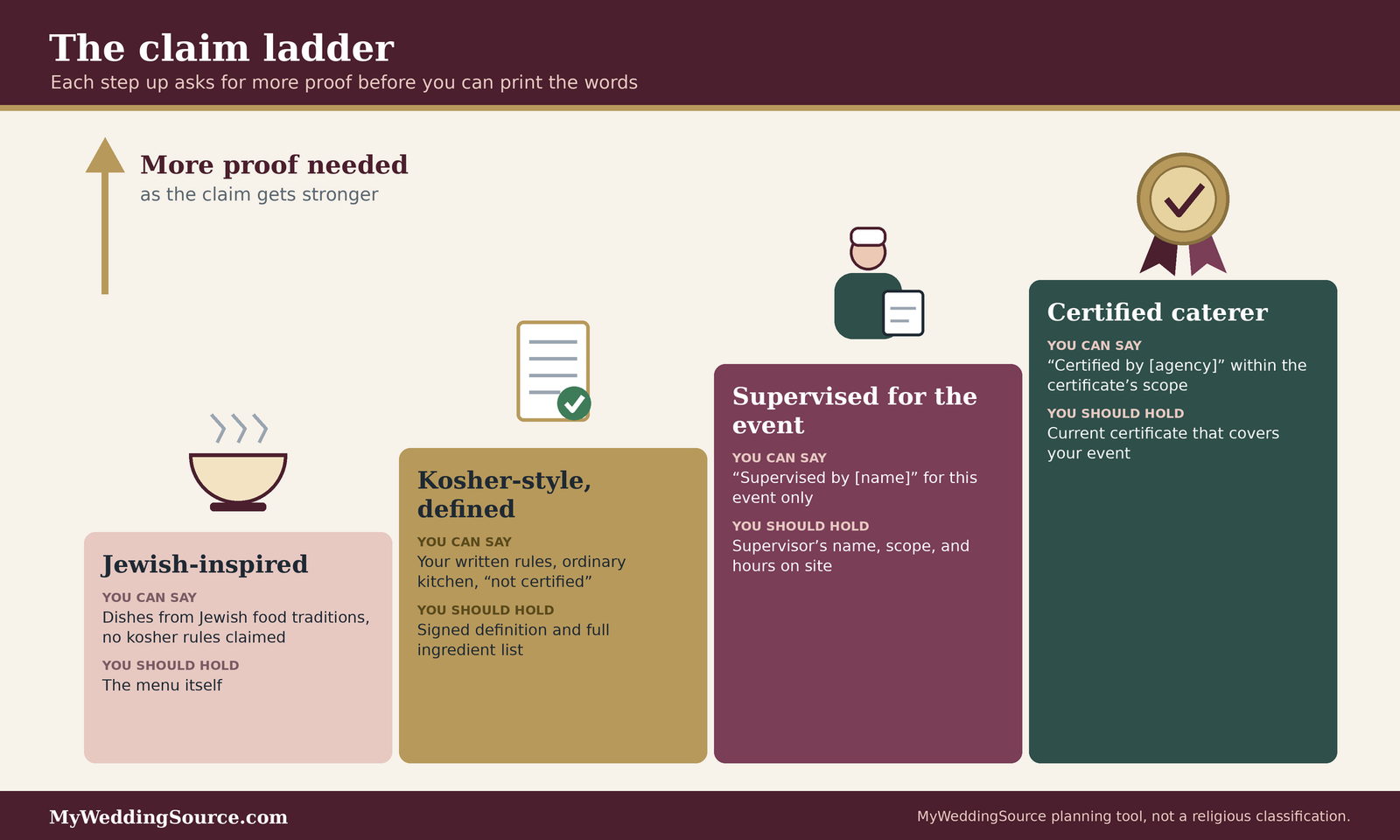
Each rung comes with a sentence you can honestly print and a piece of evidence you should be able to hold. For Jewish-inspired, the evidence is simply your menu. For kosher-style, the evidence is your written definition and the caterer’s signed agreement to follow it. For supervised and certified, the evidence is the agency’s name, the supervisor’s name, and a document that says what is covered.
Picking a rung
Most couples choose between the second and the third or fourth. The deciding question is who is at the dinner and what they need. If a close relative or an observant guest will only eat food that is actually kosher, a kosher-style menu will not meet their need, however carefully it is written, and you should talk with your rabbi or a kashrut authority about what to do. If the aim is a warm nod to family tradition at a mixed celebration, a clearly defined kosher-style menu can be exactly right, as long as it is labeled as what it is.
Decide with the families first, not the caterer
Caterers are skilled at executing a menu, but they should not be the first people to define your family’s standard. They will tend to describe what they already offer. The families are the ones who know what the day means to them.
Who needs to weigh in
Ask both sets of parents, any grandparents who are likely to have strong views, and any guest you already know keeps kosher. Keep the question open. “What would make this meal feel right to you?” gets a more honest answer than “Is kosher-style okay?” You may learn that one grandmother only needs no pork and no shellfish, while a cousin keeps a fully kosher home. Those are different needs, and now you know about both.
One written paragraph
Once you know, write a short paragraph that you can hand to anyone. It should say what the menu will and will not contain, whether any supervisor is involved, what the kitchen is, and what you are not claiming. Example wording: “Our dinner follows a kosher-style plan: no pork, no shellfish, and no meat served together with dairy. It is prepared in the caterer’s regular kitchen without rabbinic supervision and is not kosher-certified.” That paragraph is the document your caterer signs against, your invitation draws from, and your menu card summarizes.
Match the evidence to the rung
The evidence you ask for should match the claim. Over-asking at the lowest rung wastes everyone’s time. Under-asking at the highest rung is where guests get misled.
For a kosher-style menu
At the kosher-style rung, the evidence is a written menu with every dish and key ingredient listed, a statement from the caterer that no item on the menu conflicts with your written definition, and an agreement to tell you before any substitution. You are not asking for a certificate, because none exists. You are asking for specificity and accountability.
For a supervised or certified menu
At the higher rungs, the evidence is documentary. Ask which agency certifies the caterer, what the certificate covers, whether a supervisor will be present for this event, and who that person is. The Chicago Rabbinical Council’s guidance on party planners puts the point plainly: if no mashgiach is present and no certificate or table card says what is certified, assume the event is not actively supervised. The same guidance recommends asking for a written list of all food sources and bringing it to your rabbi or a local kashrut expert.
This section is about dishes. The goal is not to teach kosher law, which would be beyond our role, but to help you choose dishes that make your written definition easy to keep and hard to break by accident.
Start with the rules nearly everyone agrees on
Even the loosest readings of “kosher-style” tend to share a core. It is worth stating that core out loud, because the details around it are where mistakes happen.
Pork and shellfish
My Jewish Learning notes that some people use the term to mean food with no pork or shellfish. For a kosher-style menu, that is a good baseline, and it is easy to describe. Be thorough in your check: a menu with no pork chops can still contain bacon in a salad, a pork-based sausage in a stuffing, or shrimp in a hors d’oeuvre tray. Ask the caterer to read the whole menu, not just the entrees, against the baseline.
Meat and dairy together
The same source explains that combining meat and dairy violates kashrut even when each ingredient is individually kosher, which is why a cheeseburger would not usually count as kosher-style. For your menu, that means checking more than the main course. A butter-finished sauce on a chicken dish, a cream-based soup before a brisket, cheese in a salad served beside meat, and a dairy dessert after a meat entree all create a meat-and-dairy meal. Decide whether the dinner is a meat meal, a dairy meal, or a meat-free meal, and then hold every course to it.
Meat, dairy, pareve, and fish
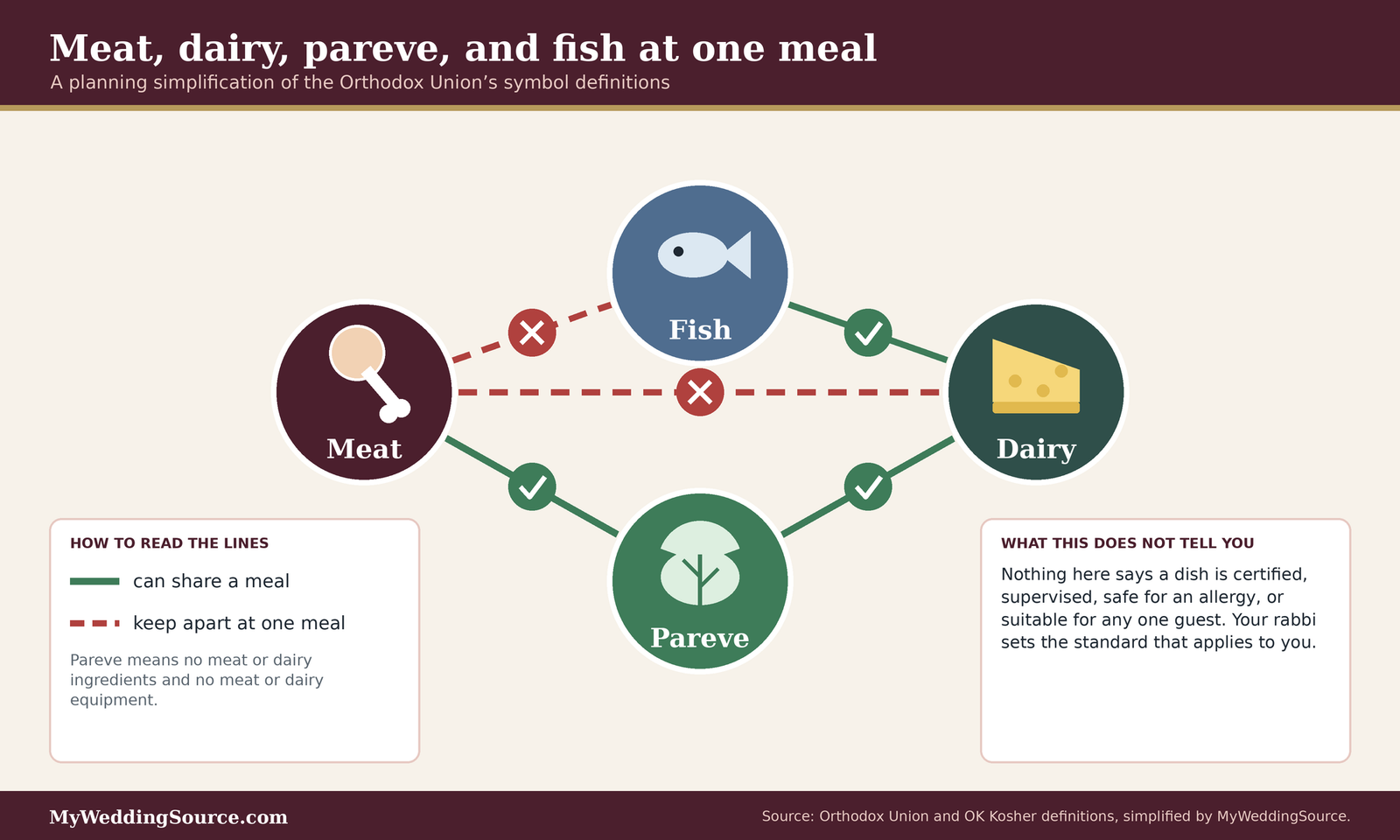
Four categories do most of the work in a kosher-style menu plan. The Orthodox Union’s symbol guide explains them in plain terms, and its definitions are a helpful reference for how the categories relate, even if you are not seeking certification.
Pareve is the bridge
The OU describes pareve as a product that contains no meat, dairy, or their derivatives and was not made on dairy or meat equipment, so it can be eaten with either meat or dairy. OK Kosher, another certifying agency, explains that pareve is Hebrew for neutral. For menu planning, pareve dishes are your flexible friends. Roasted vegetables, rice, potatoes, salads with oil-based dressings, and fruit can sit beside either kind of main, provided the ingredients and the equipment really are free of meat and dairy. That last clause matters: a vegetable dish finished in butter, or cooked in a pan used for dairy, is no longer neutral.
Meat, dairy, and fish
The OU explains that an item marked as meat contains meat or its derivatives, or was made on meat equipment, and cannot be eaten or cooked with dairy. An item marked dairy cannot be eaten or cooked with meat. Fish gets its own treatment: the OU says fish should not be eaten with meat, though it can be eaten with dairy, and using a separate pot for fish is customary. For a buffet or plated menu, that translates into a simple plan. Pick a lane for the main course, keep the other lane off the menu for the whole meal, and keep fish away from the meat course or at least clearly separate.
A note on what the lanes do not tell you
These categories describe a religious classification. They do not tell you whether the food is safe for an allergy, whether it fits a vegetarian guest, or whether it is certified. A pareve cake can contain eggs, wheat, and nuts. A dairy-free dish can still be unsuitable for someone who avoids it for another reason. Keep the classification in one column of your planning sheet and the allergen information in another.
Hidden dairy and hidden meat
The easiest way to break a rule is to forget that an ingredient came from somewhere. Prepared sauces, soups, desserts, and finishing touches are where it happens.
The usual suspects
Ask the caterer about butter used to finish sauces and vegetables, cream in soups and mashed potatoes, cheese in salads and breads, milk or cream in coffee service, and dairy-based desserts. On the other side, ask about stocks, pan drippings, rendered fat, and gelatin, which can bring meat or animal ingredients into dishes that look plain. We are not making claims about how each of these is treated under religious rules. The point is that each is an ingredient you can ask about and write down.
Coffee and dessert
The OU’s description of hotel events highlights a practical example: milk stored near coffee urns, and the habit of serving nondairy creamer in portion-controlled servings so that dairy does not appear at a meat meal’s dessert course. Even at a kosher-style event, coffee service is where a meat dinner can quietly become a meat-and-dairy dinner. If your menu is a meat meal, ask for nondairy creamer, and ask for a dessert that matches the lane.
Sample menus by claim level
The menus below are illustrations we composed for planning. They are not certified, not reviewed by a religious authority, and not a template for a kosher event. They show how a defined rule shapes a menu.
A kosher-style cocktail hour
Passed items might include smoked salmon on cucumber rounds, mushroom and barley bites, potato latkes with applesauce, stuffed grape leaves, and a vegetable crudité with hummus. Under the lane rules above, salmon is fish and would not sit with a meat course, so the plan either keeps the cocktail hour fish-and-pareve and the dinner meat, with a note, or keeps the whole evening meat-free. Dairy spreads such as cream cheese would put dairy on the table before a meat dinner, so a defined plan would leave them out or move the whole event into a dairy-and-fish lane.
A kosher-style plated dinner
A meat-lane plated dinner might serve chicken soup with matzo balls, a roasted chicken or braised brisket, roasted potatoes, green beans with olive oil, and a fruit-based dessert with sorbet and nondairy coffee service. The path is simple: soup stock, sauces, and sides all stay free of dairy, and the dessert is chosen to fit. It is a coherent kosher-style menu under a written definition, and it is still not a kosher menu, because no one supervised how the chicken was slaughtered or how the kitchen was run.
A kosher-style brunch
A dairy-and-fish lane lends itself to brunch: bagels with lox and cream cheese, a vegetable frittata, blintzes, fruit salad, and coffee with real cream. It is a classic fit for the “traditional Jewish food” reading of the term. It also shows why the lane choice matters. Nothing on this table could share a plate with a meat course, so a couple who want a brisket at the same event need a separate service and clear signage, or a decision to keep to one lane.
Follow the food: where a kosher-style claim can slip
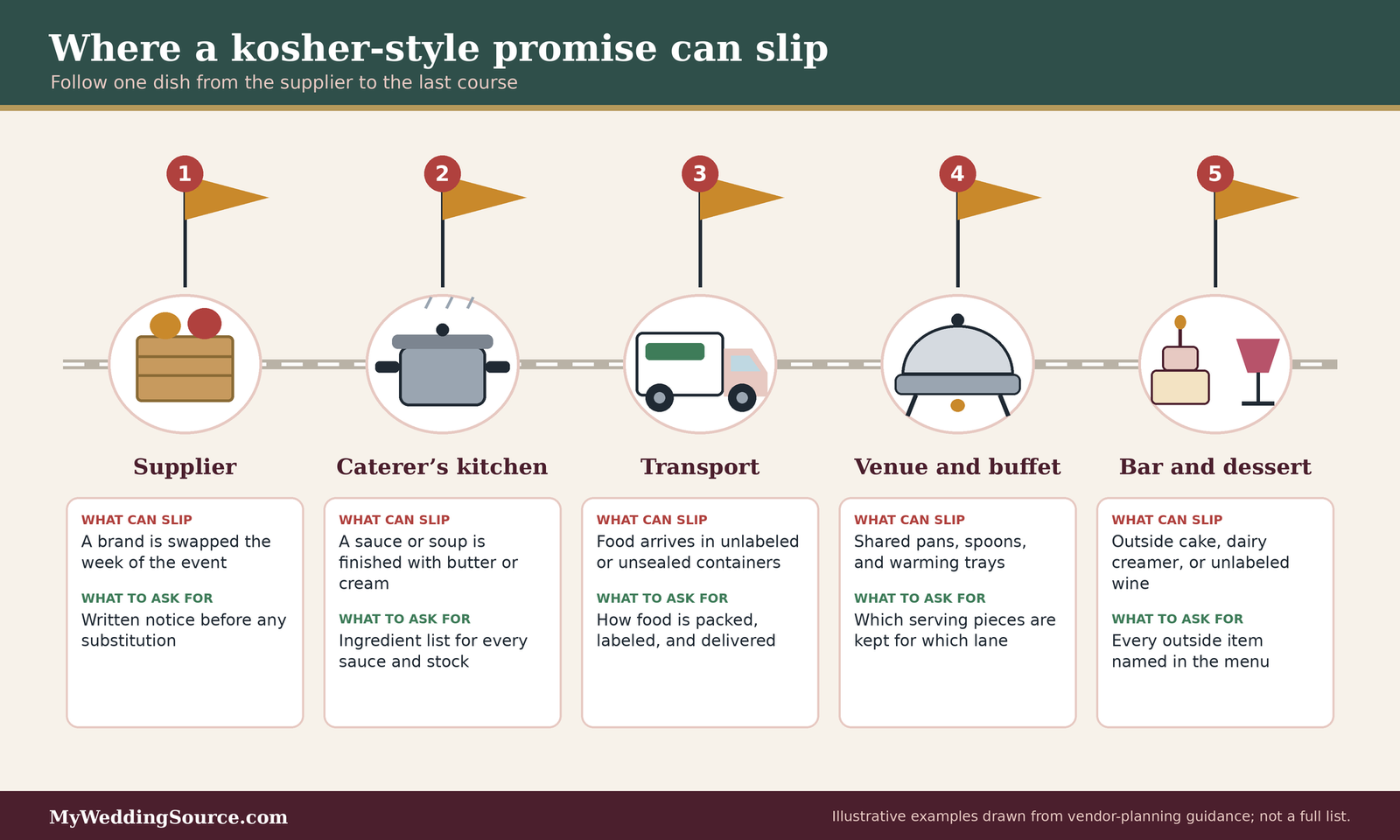
A menu on paper is easy to keep consistent. A menu in motion, from supplier to truck to venue kitchen to buffet to bar, passes through many hands, and this is the stretch of how to plan a kosher-style menu without misleading guests that most couples never see. Following it step by step shows where your written definition is at risk and who owns each risk.
From supplier to buffet
Think of the food as having a route. At each stop, someone decides something that your guests will never see.
Suppliers and substitutions
Caterers buy from distributors, and distributors change what is in stock. A brand of dessert, a type of bread, or a pre-made sauce can be replaced the week of the event. For a kosher-style menu, the risk is not malice. It is an ordinary swap that happens to add a dairy ingredient to a meat menu, or bacon bits to a salad. Ask the caterer to agree in writing that any substitution to a menu item will be flagged to you in advance, and ask who makes that call.
Transport and sealing
For supervised events, the OU’s description of hotel affairs notes that food is typically prepared off-site at the caterer’s commissary under supervision, and supervisors check that containers arrive sealed and labeled. You may not need that level of control for a kosher-style menu, but the idea is useful. Ask how food travels, whether it arrives in labeled containers, and whether anything is prepared or finished at the venue by someone other than the caterer’s team.
Venue kitchens and shared space
The venue’s kitchen is often where a plan meets reality. Many venues have their own preferred caterers, standard equipment, and house rules, and a kosher-style menu must work inside them.
Ordinary kitchens
If your menu is kosher-style and your caterer works in an ordinary kitchen, your written definition is the standard. The kitchen will probably also prepare other food, and may handle pork, shellfish, and dairy in the course of other business. That does not make your menu dishonest. It means you should say, in your own materials, that the menu is prepared in a regular kitchen. You can say that plainly and still serve a warm, thoughtful dinner.
Kosher supervision in a non-kosher venue
If any guest needs food that is actually kosher, the picture changes. The Orthodox Union and STAR-K both describe how supervisors work in commercial kitchens that are not kosher. Per the OU’s accounts, supervisors arrive early, often around six or seven in the morning, to clean and kasher ovens, sinks, and hotel utensils using methods such as boiling water or dry heat, cover work surfaces that cannot be kashered, direct staff on which dishes and utensils to use, and watch the bar and buffet. STAR-K’s training story adds that equipment must be thoroughly clean before kashering, that kashering pots on the day of an event is generally avoided as a policy to prevent mistakes, and that some equipment needs administrator approval. The Meetings and Conventions planning guide adds that having a supervisor oversee an event and kasher the kitchen typically takes twelve to fourteen hours. We are summarizing sources, not describing a procedure you should follow. The practical point is that this is a project with its own lead time, people, and cost, and it is not something a caterer can add on casually the week before the wedding.
The bar, desserts, and outside items
Menus rarely go wrong in the entree. They go wrong at the edges, where a vendor who was not part of the kitchen conversation adds something.
Wine and liquor
The Meetings and Conventions guide notes that kosher wines are labeled mevushal, that many hotels stock them or work with kosher suppliers, and that wine brought in from outside usually incurs a corkage fee, which it puts at roughly eight to twenty dollars per bottle. The Chicago Rabbinical Council’s guidance warns that wine which is not mevushal may be disqualified if handled by the wrong people, and advises confirming the certification of liquor and wine. For a kosher-style event, you do not need to use kosher wine, but you should not describe the wine as kosher unless you hold the evidence. For an event with guests who need the real thing, handle the bar as part of the supervised plan, as the OU describes, with sealed original bottles and supervised fruit cutting.
Cakes, desserts, and outside food
The Chicago Rabbinical Council guidance describes a common problem: party planners sometimes add outside desserts, cookies, or sushi from unsupervised kitchens, and these can be placed beside the caterer’s food and mistaken for certified food. The lesson applies to your wedding too. If your plan says dessert is dairy-free, a cake from a different bakery can quietly break that. If you plan to serve a cake from a bakery, a dessert station, or a late-night snack, ask the caterer to include those items in your written menu. Our guides on the wedding cake and grazing tables explain how those pieces are usually arranged.
Rentals and serving pieces
The same guidance points out that dishes, flatware, pots, and display pieces from rental companies or other unsupervised sources can compromise a kosher event, especially if they mix uses. For a kosher-style menu, the stakes are lower, but the habit helps: ask whether the rented serving pieces are being used for both meat and dairy dishes at the same event, and consider keeping them separate if your lane plan depends on it. Our rental planning checklist covers how to confirm what arrives.
Food safety and allergens are separate questions
It is easy to merge three things on a menu card: kosher-style, safe, and allergen-free. They are three different claims, and a menu can honestly make only the ones it can support.
Safe cooking temperatures
FoodSafety.gov lists safe minimum internal temperatures: 165 degrees Fahrenheit for poultry, 160 for ground meat, 145 for beef steaks and roasts followed by a three-minute rest, and 145 for fish. Those are food-safety numbers and have nothing to do with religious rules. A properly supervised kosher kitchen and an ordinary kitchen are both expected to meet them. Our catering service planning guide covers how buffets and plated service handle holding temperatures, and our halal menu guide includes a similar planning approach for another faith-based menu.
Allergens are a different list
The FDA recognizes nine major food allergens: milk, eggs, fish, crustacean shellfish, tree nuts, peanuts, wheat, soybeans, and sesame. It also explains that cross-contact is the unintended transfer of an allergen into food that should not contain it, and that “may contain” statements are voluntary and cannot replace proper controls. Neither a kosher-style label nor a pareve classification tells a guest with an allergy anything. A pareve dessert can contain eggs, wheat, or nuts, and a kosher-style plan does not require anyone to avoid those. If a guest has an allergy, treat it as its own list with its own conversation, as our guide on wedding dietary restrictions explains. Never tell a guest a dish is safe for their allergy because it is kosher-style, and do not guarantee allergen-free food.
The question sheet
This is the working tool of the guide. Use it in conversations with the caterer, the certifier if there is one, the venue, and the families. Adapt the rows to the rung you chose, and ask for the answers in writing.
Questions for the caterer
The caterer is the first and most important voice, and the questions below are meant to be asked early, before you sign anything.
Define the terms
Start by asking the caterer what “kosher-style” means in their own kitchen, and listen without correcting. Then compare their answer with your written paragraph. Where they differ, fix the difference now.
| Question | Why it matters | Evidence to ask for |
|---|---|---|
| What does “kosher-style” mean at your company? | The phrase has no single definition | Written description in the caterer’s words |
| Is any part of this menu supervised or certified by a kosher agency? | Separates kosher-style from kosher | Agency name, certificate, scope of coverage |
| Will a mashgiach be present at our event? | Active supervision is a different claim | Name of the supervisor, hours on site |
| Does any dish contain pork, shellfish, or their derivatives? | Baseline for most definitions | Ingredient list for every dish |
| Are meat and dairy ever served together at this menu? | The most common accidental conflict | Course-by-course plan |
| Where is the food prepared and in what kind of kitchen? | Kosher-style kitchens are usually ordinary kitchens | Kitchen description, prep location |
| What happens if an ingredient is substituted? | Substitutions break promises quietly | Written agreement to notify before changes |
| Which items come from outside suppliers? | Cakes and sides often arrive from elsewhere | Supplier list with the items they provide |
| How do you handle allergens separately? | Kosher-style does not address allergies | Written allergen procedure |
Ask for the ingredient list
For a kosher-style menu, the ingredient list is the strongest evidence you can ask for. A caterer who can name the ingredients of every sauce, stock, and dessert can also tell you whether any of them conflict with your definition. A caterer who cannot is telling you something useful.
Questions for the certifying agency or supervisor
If you decide to hold a supervised or certified event, the conversation moves to the people who provide the supervision. These are the people who can say what is and is not covered.
Scope and standards
Ask which agency certifies the caterer, what the certificate covers (the caterer’s own kitchen, a specific venue, or only some dishes), and whether it applies at an off-premises event. The OU’s accounts of hotel affairs suggest further questions: whether hotel equipment will be kashered, whether food is sealed and checked on arrival, how many supervisors will be present and whether one is stationed at the food at all times, how the bar is handled, and how waitstaff are instructed. We adapted those questions from the OU’s article, which describes what supervisors do rather than offering a checklist.
Names, documents, and approvals
Ask for the certificate, the supervisor’s name, and the contact for the agency. Ask who approves any change. The STAR-K training story notes that a supervising rabbi may need to approve substitutions or changes in personnel, so ask who has that authority for your event. Then ask your own rabbi to review the plan. It is their question to answer, not the caterer’s and not ours.
Questions for the venue
The venue controls the kitchen, the hours, and often the rules, and it may or may not have worked with a kosher event before.
Kitchen and access
Ask whether the venue allows outside caterers, whether it has a separate kitchen, whether a supervisor can enter and set up early, and whether the kitchen can be reserved for your use without other food being prepared. The Meetings and Conventions guide notes that venues may charge extra for kosher cookware and tableware, and that some allow dishwashers to be kashered. Our wedding venue questions guide covers the broader list for any venue.
Timing and staff
Ask about setup times, how late the kitchen can be used, and how venue staff will handle service and clearing. If your plan involves a Friday evening or Saturday event, ask about electronic locks, elevators, and lighting. The Meetings and Conventions guide notes that some observant guests cannot operate elevators or switch on lights on the Sabbath or holidays, and that planners should ask whether the venue can provide staff for those tasks.
Questions for yourselves and the families
The sheet is not only for vendors. Some of the most useful questions are for you.
What are we promising?
Ask each other and the families what they would feel if a guest asked, “Is this kosher?” If the answer is “We want to be able to say yes,” you are on a higher rung than kosher-style. If the answer is “We want to say it is traditional food, with our own rules,” a defined kosher-style menu fits.
What would we do if it goes wrong?
Decide in advance what you will say if a guest asks about something on the menu that does not fit their practice. A simple, kind answer, such as “We labeled this as kosher-style, which means ours is not supervised, and we are so sorry if that is not what you needed,” is better than defensiveness. Decide too what you will do for a guest who needs something different, such as offering a pre-ordered kosher meal from a certified provider.
Questions to ask before you sign
- In your own words, what does “kosher-style” mean for our menu, and can you put it in the contract?
- Will anyone from a kosher agency supervise the food at our event, and will you show us the certificate?
- Which dishes contain meat, which contain dairy, and which contain neither?
- Which items come from outside the kitchen, such as the cake or the bread?
- How will you tell us if a substitution is needed, and how soon?
- If a guest needs strictly kosher food, what can you arrange and what will it cost?
- How do you handle guests with allergies, separately from the menu style?
Everything above can be done well and still go wrong if the words on the page claim more than you planned. This is the last place misunderstanding gets in, and the easiest to fix.
A wording bank
Wording is where you tell the truth in a form guests can read at a glance. The table below suggests wording you can adapt. These are our drafting suggestions, not legal language.
What to say
| If the kitchen is doing this | Wording that fits | Wording to avoid |
|---|---|---|
| Jewish-inspired dishes, no stated rules | “Inspired by Jewish family recipes” | “Kosher,” “kosher-style” |
| Written kosher-style rules, ordinary kitchen | “Kosher-style menu: no pork, no shellfish, no meat served with dairy. Not kosher-certified.” | “Kosher,” “strictly kosher” |
| Supervisor for this event only | “Prepared under the supervision of [name], [agency or rabbi]” | “Certified kosher” unless an agency certifies it |
| Certified caterer, certificate in hand | “Catered by [name], certified by [agency]” | Any claim beyond the certificate’s scope |
| One or more outside items | “The cake is from [bakery] and is not part of the kosher-style plan” | Letting the cake sit among labeled dishes unmarked |
What to avoid
Avoid the words kosher, glatt, certified, or supervised unless you hold the matching evidence. Avoid reassuring labels that you cannot back up, such as “made the traditional way.” Avoid claiming that the menu is healthier, cleaner, or safer because of its style, because those claims are not part of what kosher-style means. And do not use a certifier’s name or logo without permission and proof, since a symbol on a card is itself a claim.
Invitations and RSVPs
You can tell guests a lot before they arrive. A brief, matter-of-fact line gives guests who care the chance to ask and spares you an awkward moment at the table.
Asking guests what they need
Add a plain question to your RSVP, such as “Please tell us about dietary needs, including whether you keep kosher or have allergies.” Give a free-text box. Follow up privately if someone says they keep kosher, and ask what they need, as opposed to assuming. Our RSVP wording guide and RSVP etiquette guide offer sample structures.
Telling guests what to expect
On your wedding website, a short line works well: “Dinner will be a kosher-style menu: no pork or shellfish, and no meat served with dairy. It is prepared in a regular kitchen and is not kosher-certified. Please tell us if you need anything different.” Write it kindly and place it where guests will look, such as the FAQ page and the menu card. Our invitation wording guide can help with where such details belong.
Signs and place cards
On the day, the buffet line or the plate is where a guest decides. Clear signage lets them decide with the right information.
Buffet and station cards
Label each dish by name and by lane: meat, dairy, or neither. If a dish contains a major allergen, say so on a separate line from the kosher-style label, so the two are never confused. Our wedding signage guide covers sizes, placement, and materials. For plated service, a small menu card at each place or a line on the table menu serves the same purpose.
A note for guests with special meals
If you have pre-ordered meals for guests who need food that is actually kosher, make sure the caterer knows who they are and how they are marked. A sealed, labeled meal delivered to the right seat is a kindness. A meal that arrives unlabeled and gets mixed up with others defeats the point. Ask the caterer to describe their process for this, and tell the guest in advance what to expect.
Edge cases that trip up good plans
Most weddings fit the patterns above. A few situations deserve their own attention, because they are where well-meant plans most often mislead someone.
Sabbath and holiday weddings
An evening or Saturday wedding raises questions that go beyond the menu. If observant guests will attend, timing, staffing, and food handling all matter, and you should involve your rabbi early.
What supervision means on the Sabbath
The Orthodox Union’s article on catered affairs on Shabbos describes two kinds of oversight: one for the kashrus of the food and one for ensuring that Sabbath rules are observed during preparation. It stresses that someone specific must be responsible, whether the host, the caterer, a rabbi, or a supervisor, and warns guests not to assume the caterer will be present, that the rabbi is watching, or that the hosts are tracking details. As a planner, that means assigning the job in writing, not assuming it is covered.
Menu and timing choices
The same article notes that food arriving after the Sabbath begins raises questions, that dishes cooked to order cannot be made on the Sabbath, that warming methods must be set before it starts, and that automatic hot-water urns can cook water as they refill. It recommends delivering food well before the Sabbath. For your menu, that points toward dishes that hold well, a caterer who understands the constraints, and early delivery. It is not a substitute for asking your rabbi, who will know your community’s standards.
Mixed groups and vegetarian menus
Many couples reach for a vegetarian or vegan menu as a way to make everyone comfortable. It can help, but it does not settle the question.
Vegetarian is not automatically kosher
A vegetarian menu removes meat from the equation, but it does not address the other layers. STAR-K’s training story describes careful inspection of leafy greens and herbs for tiny insects, and the OU notes that wine, liquor, and some processed items carry their own questions. A vegetarian menu may be a good kosher-style choice, because it avoids the meat-and-dairy conflict at the root, and it is a thoughtful option for mixed groups. It is still not a promise of strict kosher status, so label it for what it is.
Guests with other needs
Mixed groups often include vegetarian, halal-observing, allergic, and gluten-free guests alongside those who keep kosher. A kosher-style label does not meet any of those needs. Our guide to wedding dietary restrictions explains how to collect and track them, and the halal menu guide shows how another faith-based menu is handled when needs overlap. Do not assume that satisfying one list satisfies the others.
Passover-season weddings
If your date falls near Passover, ask your rabbi and caterer early, because extra rules apply and the labels change.
A plain symbol is not a Passover symbol
The OU explains that its plain symbol indicates a product is kosher but not necessarily kosher for Passover, while its Passover marking indicates both. OK Kosher likewise describes a P as certification for Passover and says P is not the same as pareve. A kosher-style menu is not a Passover menu, so do not use the word Passover on a menu card unless a rabbi or agency is behind it.
Ask early
Passover cooking has its own ingredient and equipment questions, and caterers differ in whether and how they handle them. We did not research Passover requirements in depth and do not describe them here. If your wedding is in that season and you want to serve a Passover-compatible menu, talk to your rabbi and to caterers with experience in it before you set a date or a budget.
When a family asks for more, or less
Plans change. A grandparent who was quiet in the first meeting may call in month six. Treat the change as information, not an inconvenience.
Moving up a rung
If a family member needs a stricter standard, the options are to move the whole event up a rung, add a supervised kosher meal for those guests, or hold a smaller kosher-supervised event alongside the celebration. Each has a cost and a lead time. The earlier you ask, the more options you have. Ask your rabbi what would meet the need, and ask a certified caterer what they can provide at your venue and date.
Moving down honestly
Sometimes a budget or a venue means you cannot do what you hoped. If you cannot support a stricter claim, drop the claim, not the standard of honesty. Change “kosher” to “kosher-style” or to “Jewish-inspired,” update the invitation and website, and tell the families directly. A short, kind explanation protects trust more than a menu that quietly promises more than it can deliver.
Money, timing, and contract language
A kosher-style menu in an ordinary kitchen should cost about what other catered menus cost for the same dishes. Supervision and certification are where cost and lead time enter.
What this actually costs
For a kosher-style menu in an ordinary kitchen, the main cost is the menu itself, so ask for itemized quotes. Supervision is where cost appears. A meetings-industry guide, with no publication date we could verify, reports that a supervisor who kashers a kitchen usually charges $25 to $35 per hour, and that one or two additional supervisors may cost $18 to $25 per hour each. As our own rough estimate only, thirteen hours at those rates is about $325 to $455 for one kashering supervisor, before extra staff, kosher cookware, or venue fees. Real quotes vary, so treat that as a planning placeholder and ask your caterer and agency for current numbers.
What to budget for
Costs depend on the rung you chose. Our wedding catering cost guide covers general catering pricing, and our wedding budget guide helps you place it among other expenses.
The kosher-style budget
Expect to pay for the menu, service, rentals, and any outside items, the same as any catered dinner. Ask whether the caterer charges more for the kinds of ingredients you are specifying, and compare itemized quotes. We found no reliable published price comparison between kosher-style and ordinary menus, so we cannot say whether one costs more. Ask for the numbers.
The supervised or certified budget
At the higher rungs, ask about supervisor fees, hours, kitchen preparation, kosher cookware and tableware, and venue charges. The Meetings and Conventions guide notes that caterers typically supply kosher cooking equipment and kosher staples such as nondairy creamer and margarine, and that hotels often require caterers to bring their own coffee and tea. Those details vary by venue, so get a quote that lists each item.
A timeline that leaves room
Time is the other cost. Supervised events and venue approvals take longer than a standard booking.
Early planning
Decide the rung and write your paragraph before you tour venues or caterers. Talk with the families, then with your rabbi if you are considering a supervised event. At the venue and caterer stage, ask the questions on the sheet and hold the answers. Our wedding vendor timeline shows where menu decisions typically fit.
Final stretch
Confirm the menu in writing, including the lane for each course, outside items, and the plan for any guests who need special meals. Print signs and menu cards that match. Confirm who will be present on the day and how to reach them. Our wedding reception guide and vendor meals guide cover related day-of details, since your vendors will eat too, and their meal should fit the plan.
Contract language to ask for
Ask your caterer to put the definition and the evidence into the agreement. Our guides on vendor contracts and vendor due diligence explain what to look for in general.
Clauses worth asking for
Ask for your written definition attached to the contract, the full menu with key ingredients, a commitment to notify you before substitutions, a list of outside suppliers, and, if applicable, the name of the certifying agency and supervisor. Where a supervisor is involved, ask the contract to say what happens if the supervisor cannot attend. Ask what the caterer will do and what you will be told.
Subcontractors and outside items
Many caterers use subcontractors for desserts, bread, bar service, or rentals. Our guide to vendor subcontractors explains what to ask. For a kosher-style menu, ask who supplies each outside item and whether it fits the written definition. For a supervised event, ask whether the supervisor approves each of those items.
Meaning and wording
What does kosher-style mean on a wedding menu?
There is no single definition. Educational sources describe it as traditional Jewish dishes made without kosher supervision, food with only ingredients that could be kosher, or food that avoids just pork and shellfish. Because readings differ, write your own definition and have the caterer confirm it in the contract.
Is kosher-style the same as kosher?
No. Kosher food follows the full set of Jewish dietary laws, and certified kosher food is supervised by an agency. Kosher-style food falls short of that standard. If any guest needs food that is actually kosher, a kosher-style menu will not meet the need, and your rabbi or a kashrut agency can advise on what will.
Guests and communication
How do I tell guests without making it awkward?
Put one plain sentence on your website and menu card: what the menu avoids, that it is prepared in a regular kitchen, and that it is not certified. Add an RSVP question about dietary needs. Short, matter-of-fact wording tends to spare guests from having to ask in public.
What should I do for a guest who keeps strictly kosher?
Ask them privately what they need, then offer a realistic option, such as a pre-ordered meal from a certified provider, delivered sealed and labeled. Do not assume a kosher-style dish will work. Ask your rabbi or the guest what standard they follow, and ask the caterer whether such a meal can be arranged.
Vendors and evidence
Do I need a mashgiach for a kosher-style menu?
Not for a kosher-style menu, which by definition has no kosher supervision. A mashgiach is the supervisor involved in kosher or supervised events, and sources describe that role as a significant project with its own cost. If you want one, ask your rabbi or a kashrut agency and book early.
Can my caterer say the menu is kosher if the ingredients are?
Be careful. Educational sources say kosher status depends on far more than ingredients, including supervision and handling, and some states regulate kosher claims. Ask the caterer what they mean, ask what certification stands behind it, and keep the word off your menu unless you hold the evidence.
Safety and allergies
Does kosher-style mean a dish is allergen-free?
No. Kosher and pareve classifications say nothing about allergens. The FDA lists nine major allergens, including milk, eggs, wheat, and sesame, and a pareve dessert can contain several. Keep a separate allergen list, ask the caterer how they prevent cross-contact, and never promise an allergen-free dish.
Are kosher-style dishes safer to eat?
No. Food safety depends on cooking and holding temperatures and handling, not on religious classification. FoodSafety.gov lists safe minimum internal temperatures, such as 165 degrees Fahrenheit for poultry. Ask your caterer how they handle food safety, and do not describe a menu as safer because of its style.
Your next steps
Decide the claim
Write your paragraph
This is the short answer to how to plan a kosher-style menu without misleading guests: define it, document it, and print only what you can show. Talk with both families, then write a short paragraph that says what the menu will and will not contain, what kind of kitchen prepares it, and what you are not claiming. This single page does most of the work in the rest of the plan. Our wedding catering guide offers the wider picture of working with a caterer.
Check with your rabbi if anyone needs more
If a guest or relative needs strictly kosher food, ask your rabbi or a kashrut agency what standard applies and what to arrange. Then ask caterers with experience in supervised events what they can provide at your venue and date.
Hold the vendors to it
Use the question sheet
Take the caterer, venue, and agency questions above to your tastings and calls. Ask for answers in writing, and keep them with your contract. Our wedding planning checklist can help you place these steps in the larger schedule.
Match every word on the page
Before anything is printed, compare your website, invitation, menu card, and buffet signs with your written paragraph. If a word promises more than the kitchen can show, change the word. Our wedding planning guide can help you keep the rest of the plan on track.
Sources & methodology
How we built this guide
What we relied on
This guide draws on an educational explanation of the term “kosher-style,” the public text of two sections of New York’s Agriculture and Markets Law, practical writing from kosher certifying organizations about supervised events, a meetings-industry planning guide, the FDA’s food allergy information, FoodSafety.gov temperature guidance, and the FTC’s small-business advertising guidance. Where a statement comes from one organization, we say so, because certifiers and trade publications reflect their own standards and customs. The sample menus, the claim ladder, the wording bank, and the cost illustration are our own and are labeled as such. We checked these sources on November 12, 2026, and links and prices can change.
What we did not do
We did not give religious rulings, legal advice, or food-safety certification, and we did not test any caterer or venue. Standards for kosher food differ among communities and agencies, so this guide does not say what is or is not kosher. We did not survey the laws of states other than New York, review court decisions, or research Passover or Sabbath requirements in depth.
Source list
Government, legal, and regulatory sources
- U.S. Food and Drug Administration, Food Allergies: https://www.fda.gov/food/nutrition-food-labeling-and-critical-foods/food-allergies
- FoodSafety.gov, Safe minimum cooking temperatures: https://www.foodsafety.gov/food-safety-charts/safe-minimum-cooking-temperature
- Federal Trade Commission, Advertising FAQs: A Guide for Small Business: https://www.ftc.gov/business-guidance/resources/advertising-faqs-guide-small-business
- New York Agriculture and Markets Law section 201-a (kosher food, public legal text): https://newyork.public.law/laws/n.y._agriculture_and_markets_law_section_201-a
- New York Agriculture and Markets Law section 201-b (retail sale of kosher food, public legal text): https://newyork.public.law/laws/n.y._agriculture_and_markets_law_section_201-b
Kosher certifiers and educational sources
- My Jewish Learning, What is kosher style?: https://www.myjewishlearning.com/article/what-is-kosher-style/
- Orthodox Union, All OU symbols explained: https://www.oukosher.org/blog/industrial-kosher/all-ou-symbols-explained/
- Orthodox Union, Kashrus supervision at hotel affairs: https://oukosher.org/blog/consumer-kosher/kashrus-supervision-at-hotel-affairs/
- Orthodox Union, The catered affair on Shabbos: https://oukosher.org/blog/consumer-kosher/the-catered-affair-on-shabbos/
- Orthodox Union, Kosher catering at a non-kosher venue: what’s happening in the kitchen: https://outorah.org/p/30657
- OK Kosher, The kosher symbols clarified: https://www.ok.org/companies/what-is-kosher/the-kosher-symbols-clarified/
- Chicago Rabbinical Council, Using a party planner at your simcha: https://consumer.crckosher.org/wp-content/uploads/2022/12/Using-a-Party-Planner-at-Your-Simcha.pdf
- STAR-K, kosher foodservice training story (article ID 2186): https://www.star-k.org/articles/wp-json/wp/v2/posts/2186
Event-planning sources
- Meetings and Conventions, Planning a kosher F&B event: https://www.meetings-conventions.com/Resources/Meeting-Planning/Planning-a-Kosher-F-B-Event