
Wedding beverage stations for outdoor heat work best when you plan them as a small supply chain: how much water you need, who refills it and when, where guests can reach it, and which permits and insurance cover the drinks that are not water.
Quick answer
Treat wedding beverage stations for outdoor heat as four jobs: stock (a written volume estimate with a reserve), refill (a named person on a clock), reach (stations near seats and shade, not only at the bar), and cover (the permits and insurance for any alcohol). As a planning estimate, not a rule, we use about 12 ounces of water per guest for every hour guests spend outdoors in real heat, plus a 25% reserve. For 120 guests over four outdoor hours, that is about 45 gallons before the reserve. Rules for alcohol service differ by state and venue, so confirm them in writing. This guide is general planning education, not legal, medical, or insurance advice.
A hot afternoon exposes every weak point in a drink plan. The bar line is long, the water jug is empty, the person who was supposed to refill it is photographing the cake, and an aunt in the third row is quietly feeling dizzy. None of that is dramatic, and all of it is avoidable.
This guide is about wedding beverage stations for outdoor heat, and especially the unglamorous part: water refill logistics. It also includes a bartender permits and insurance checklist, because the same hot day that makes water urgent makes alcohol service riskier and makes it more important that someone is clearly responsible for it. We kept the structure practical: numbers you can adjust, a refill clock you can hand to a vendor, a station layout you can sketch on a napkin, and questions you can send before you sign anything.
What wedding beverage stations for outdoor heat are for
A beverage station is not a decoration with a spigot. In hot weather it is a piece of guest-safety infrastructure that also happens to look nice if you plan it well. Before you choose a jar style or a lemon garnish, it helps to be clear about the job the station has to do, and about the neighboring topics this guide deliberately leaves to other articles.
A station is a system, not a table
The table people see is the last link in a chain. Water has to come from somewhere safe, be moved to the site, be kept cool, be poured by someone or by guests, and be replaced before it runs out. Each link has an owner, or it has nobody.
Supply
Supply is the water, ice, cups, and any flavorings, and it begins with a number. It is easy to order beverages by the look of the table instead of by a calculation, and that is how a handsome 3-gallon dispenser ends up serving 150 people in the sun. In this guide, supply always means a written quantity with a reserve, and a delivery or pickup time. Good supply is the first test of any set of wedding beverage stations for outdoor heat.
Access
Access means guests can find the station, reach the spigot, and fill a cup without a long wait or a trip across hot ground. A station that is technically present but 200 feet away behind the bar is not access. We come back to placement later, including a layout drawing, because location often matters more than volume. Access is where many wedding beverage stations for outdoor heat are won or lost.
Staffing
Staffing means a named person responsible for checking and refilling the station on a schedule. That person may be a caterer, a rental company attendant, a venue coordinator, or a friend with a clear written task. Our rule of thumb is that any station without a named owner is a station that will be empty at the worst time. Even well-stocked wedding beverage stations for outdoor heat need a person attached to them.
What this guide covers, and what it leaves to other guides
There is a lot of overlap between heat, drinks, and vendors, and repeating it all would not help you. We cover water supply and refilling, station design for hot sites, and the permits and insurance questions around alcohol. We link out for the rest.
Bars, ice, and bartenders
For bar counts, bartender throughput, and staffing, see our guides to wedding bar service planning and choosing a wedding bartender. For how much ice to order and how fast it melts, see wedding bar ice planning. We touch on ice only where it affects a water station. Here we only cover the parts of the bar that touch wedding beverage stations for outdoor heat.
Heat planning for the whole day
For ceremony timing, shade, dress, and the full-day heat plan, see our summer wedding heat plan. This guide zooms in on one slice of that plan: the drinks.
Why heat changes the math for wedding beverage stations for outdoor heat
You do not need a medical degree to plan water for a wedding, but it helps to know what government health sources say about heat, who is more at risk, and how alcohol fits in. That context explains why we plan for more water than a normal party, and why we put stations where guests actually stand.
What the heat index and full sun mean for a guest
Air temperature alone understates how hot an outdoor afternoon feels. Two numbers from the National Weather Service are worth keeping in mind when you set a plan.
Humidity raises how hot it feels
The National Weather Service gives a worked example on its heat index page: at an air temperature of 96°F and 65% relative humidity, the heat index, which describes how hot it feels to the body, is 121°F. You do not need to memorize a chart. The point is that humidity can move the felt temperature far above the thermometer reading, so check the forecast heat index for your venue, not only the high temperature. This is why we size wedding beverage stations for outdoor heat to the felt temperature and not the thermometer.
Full sun can add more
The same page notes that heat index values are calculated for shady, light-wind conditions, and that full sunshine can raise them by as much as 15°F. A ceremony lawn with no tree cover is a full-sun location. If your station and your seating are both in full sun, plan for guests to drink more and to need shade sooner than the forecast alone suggests. Shade, or the lack of it, changes how you set up wedding beverage stations for outdoor heat.
Who needs the water most
Heat affects everyone, but the CDC names groups who need extra precautions, and several of them are likely to be on your guest list.
Groups the CDC highlights
The CDC’s heat pages list adults 65 and older, infants and young children, pregnant people, people with heart disease, people with asthma (especially children), and people exercising or working outdoors as groups that need extra care in heat. A wedding often contains most of these groups at once, in the same row, at the same time. That is a reason to put water at the ceremony itself and not only at the cocktail hour. Think of these groups as the people wedding beverage stations for outdoor heat are really for.
Medications can change heat risk
A CDC clinical page explains that some common prescription medicines can raise heat-related risk, for example by reducing thirst, interfering with sweating or temperature control, lowering blood pressure, or affecting electrolytes. The page notes its guidance is expert opinion and its medication table is not complete. You cannot know which guests take what, and you should not ask. What you can do is make water, shade, and seats easy to find so that guests can manage their own needs without having to explain them. Easy access to water helps guests manage their own needs at wedding beverage stations for outdoor heat.
Alcohol, caffeine, and sugar in the heat
Drink choices also matter, and this is where a beverage plan can quietly help or quietly hurt.
What the CDC suggests
The CDC’s heat page suggests limiting alcohol, sugary drinks, sodium-heavy drinks, and caffeine when it is hot. It does not give a numeric limit, and we are not going to invent one. The practical translation for a wedding is modest: make water the easiest, coldest, most visible drink on site, and make nonalcoholic options feel like real choices, not leftovers. Keep that suggestion in mind when you stock wedding beverage stations for outdoor heat.
Pair every bar with water, not instead of it
A water station next to a bar line can feel like a hint, so some couples avoid it. We think the opposite works better. Put water at the ceremony seats, along the cocktail walk, and near the dance floor, and let the bar be the bar. Our guides to wedding mocktails and nonalcoholic beer and wine cover the in-between drinks that give guests an attractive option that is not alcohol.
How much water to stock
There is no official per-guest water number for weddings, and we looked. OSHA’s page on water, rest, and shade for workers says to provide cool water near the work, in quantities sufficient for the full duration, but it does not give a volume or a drinking interval. The Mayo Clinic gives a daily range for healthy adults but says needs change with heat, humidity, and activity. So what follows is our own planning arithmetic, labeled as an estimate, built on the sources we can cite.
Start with a baseline, then add for heat
A baseline is useful because it shows how much more a hot afternoon asks of you.
The Mayo Clinic baseline
The Mayo Clinic notes that studies suggest an average healthy adult gets enough from about 2.7 to 3.7 liters (about 11.5 to 15.5 cups) of total fluid per day, from all beverages and food, and that food supplies roughly 20% of the water people need. It also lists heat and humidity as factors that increase needs. If we take about 80% of that range as beverages and spread it over a 16-hour waking day, we get roughly 4.5 to 6 ounces of fluid per hour. That is our arithmetic, not a medical standard, and it is only a starting point for a person who is sitting indoors. That baseline is the floor under any plan for wedding beverage stations for outdoor heat.
Our planning assumption for a hot site
Outdoors in real heat, in clothing that is not designed for it, guests drink more, and not all of it is water because some will choose bar drinks. We use three planning rates for water alone: 8 ounces per guest per outdoor hour for a mild day with plenty of other drinks, 12 ounces for a typical hot day, and 16 ounces for high heat in full sun. These are assumptions you can change, and there is no source for them beyond the reasoning above. They are meant to make a plan that errs toward having enough. Use these three rates to size wedding beverage stations for outdoor heat for your own site.
Three scenarios for 120 guests over four outdoor hours
Numbers make the decision concrete. We use 120 guests and four hours outdoors, roughly a half hour of seating and arrival, a half hour ceremony, a cocktail hour, and a bit of photos and early reception time outside.

Read the jug picture
At 8 ounces per guest-hour, 120 guests over four hours need about 30 gallons. At 12 ounces, about 45 gallons. At 16 ounces, about 60 gallons. In five-gallon jugs, that is 6, 9, and 12 jugs. Water weighs about 8.3 pounds per gallon, so a full five-gallon jug is roughly 42 pounds of water before the jug, which tells you why somebody needs a cart or a second pair of hands. The picture gives a quick sense of scale for wedding beverage stations for outdoor heat.
Add a reserve you will not touch until you need it
We add a 25% reserve for spills, a late-running ceremony, a hotter hour than forecast, and the guests who fill a bottle for later. For the 12-ounce scenario, 45 gallons plus 25% is about 56 gallons, or roughly 12 five-gallon jugs. The reserve should be physically separate, in shade, with a person who knows it exists. A reserve nobody remembers is not a reserve. A reserve is cheap insurance for wedding beverage stations for outdoor heat.
Turn gallons into dispensers and refills
Gallons are only half the answer. What matters on the day is how many times someone has to walk out and refill, and how fast water leaves the station at its peak.
Match dispenser size to the refill plan
A typical drink dispenser holds anywhere from a couple of gallons to five or more, and a larger dispenser means fewer refills but a heavier lift and a longer warm-up if it sits in sun. As a worked example, if a station serves from a 3-gallon dispenser and you plan to refill at one-quarter full, a refill is needed after roughly 2.25 gallons leave it. At our 12-ounce rate, that is about 24 guests’ worth of one hour of drinking per refill. A station serving 40 guests would need attention about every 35 minutes. This is our arithmetic, and it is the reason we favor larger vessels for the busiest stations. Dispenser size is one of the quieter decisions in wedding beverage stations for outdoor heat.
Decide the refill trigger in writing
“Keep it full” is not a plan. A written trigger works better: refill when the vessel is one-quarter full, check every 30 minutes during outdoor hours, and check at the minute the ceremony ends. We chose those numbers for simplicity, not from a standard, and a caterer may have a better rhythm. What matters is that the trigger is specific enough for a stranger to follow.
Water refill logistics for wedding beverage stations for outdoor heat
Refill logistics is where most beverage plans quietly fail, because it is nobody’s headline job. The caterer is busy with food, the planner is busy with the timeline, and the couple is, correctly, busy getting married. The fix is to turn refilling into a short task list with a clock and a name attached.
The refill clock
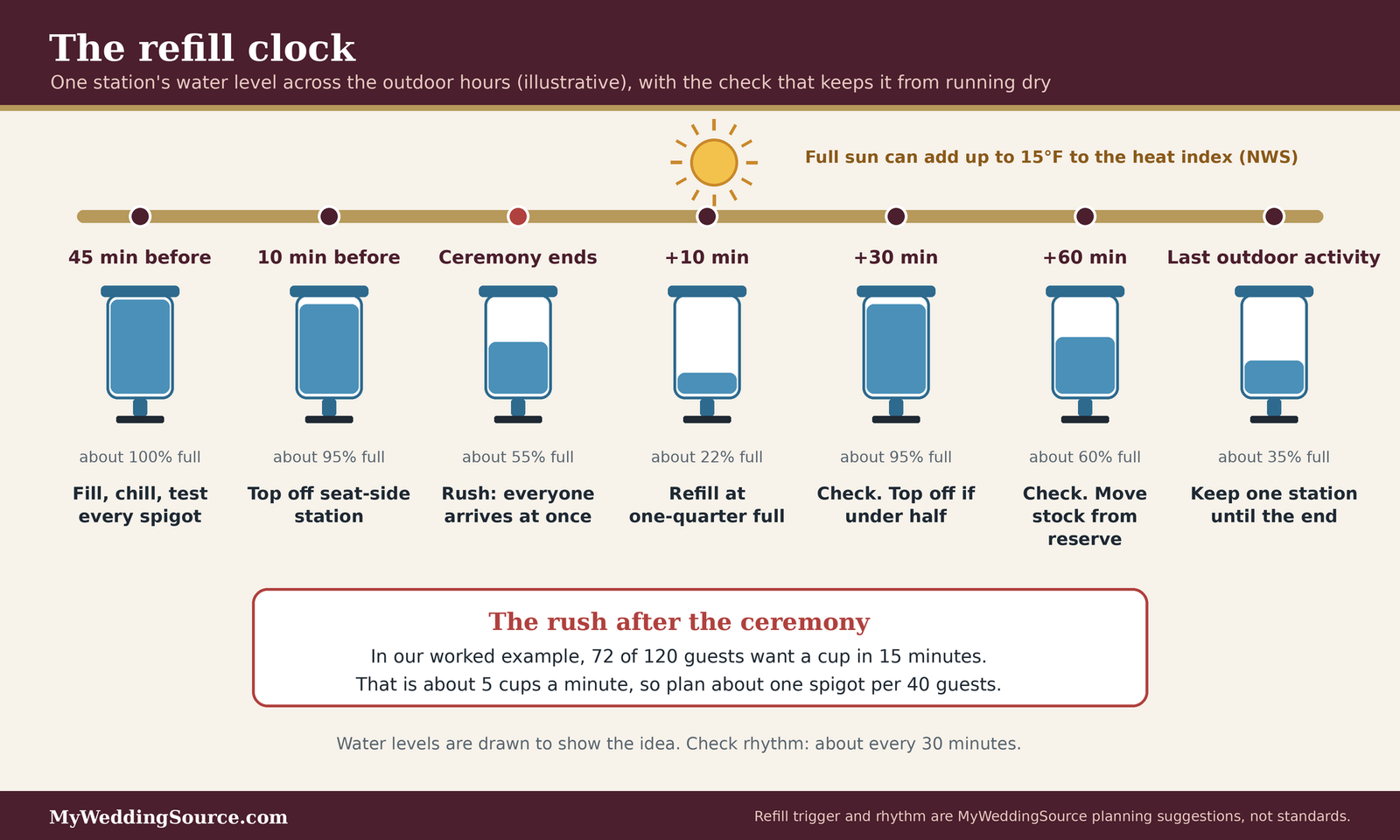
A refill clock lays the outdoor hours out as checkpoints. It does not need to be fancy, and the version below fits on an index card.
Before guests arrive
Fill and chill the stations before the first guest parks, not as the first guest walks up. Fill the dispensers, place the reserve jugs in shade, set out cups and trash bins, and test every spigot once. Our suggestion is to finish this check at least 45 minutes before the earliest arrival, so that a leaking spigot is a small repair and not a public problem. Confirm who holds the key, gate code, or hose connection if water has to come from the venue. Setup is where wedding beverage stations for outdoor heat either start well or start behind.
During the ceremony and the gap after it
The most important refill happens at the moment the ceremony ends. Guests who sat in full sun for half an hour or longer will move toward the nearest station together, and that rush can empty a small dispenser in minutes. Have the attendant top off every station during the last few minutes of the ceremony, quietly and from behind the seating. Then check again about 30 minutes later, and keep that rhythm for as long as guests are outdoors. This single moment decides whether wedding beverage stations for outdoor heat look prepared.
After the outdoor portion
When the party moves indoors or into a tent, do not strip the outdoor stations too early. Guests still wander out for photos, and the wedding party often stays outside longest. Leave at least one station running until the last outdoor activity ends, and collect cups and jugs once it has. Our guide to returning wedding rentals after a Sunday reception covers what happens to the dispensers and tubs after the party. Winding down wedding beverage stations for outdoor heat too early is a common slip.
Throughput: how many spigots you need at the peak
Total volume tells you how much water to stock. Throughput tells you whether guests wait in the sun to get it. The peak is short and predictable: right after the ceremony.
A worked example for the post-ceremony rush
Assume, as a planning guess, that about 60% of 120 guests, so 72 people, want a cup within 15 minutes of the ceremony ending. That is about 5 cups per minute. If one self-serve spigot fills about 3 cups per minute once you account for guests handing cups around, positioning, and chatting, then two spigots are the minimum and three leave slack. By this estimate, one spigot per 40 guests is a sensible peak design. The 60% and the 3 cups per minute are assumptions, so time a real spigot at your tasting or walkthrough and adjust. The rush is the best stress test for wedding beverage stations for outdoor heat.
Ways to widen the peak
You can reduce the peak without adding spigots. Pre-fill a few trays of cups with water and ice for the moment the ceremony ends. Have servers carry water out to the seating. Spread stations along the exit path. Staggering the release of guests, for example by inviting the front rows to leave first, can also help, though that is a ceremony-flow decision for your planner. Which is the right fix depends on your site, and a short walkthrough usually shows it.
Where the water comes from
Water has to come from somewhere, and the source affects safety, cost, and who needs to be on site.
A tap or hose bib at the venue
If the venue has a tap near the service area, ask whether the water is from a public system, what the connection is, and whether you may use it. The CDC says nine in 10 people in the United States get tap water from a public water system, and that public utilities treat water and must meet EPA standards. A venue on a public system is usually the simplest source. If you connect a hose, the Boulder County, Colorado temporary event guidelines require a food-grade hose when connecting to a potable supply, which is a useful standard to borrow even where it is not required of you. Ask your caterer what they use. The venue tap is the simplest source for wedding beverage stations for outdoor heat.
A private well
Rural venues, farms, and ranches often use private wells. The CDC says that if you use a private well, you are responsible for making sure the water is safe, and it advises testing at least once a year for germs and chemicals. For a wedding, the practical step is to ask the venue when the well was last tested and to ask for the result. If they cannot tell you, plan to bring bottled or delivered water for drinking stations instead. Our guide to the outdoor wedding infrastructure checklist covers other utilities a field site may lack. A well changes the supply question for wedding beverage stations for outdoor heat.
Hauled water
Bringing water in is a legitimate answer, and for many sites it is the best one. Five-gallon jugs, delivered tanks from a rental company, or cases of bottled water all work if you have the storage and the labor. Remember the weight: a full five-gallon jug is roughly 42 pounds of water by our arithmetic, and a dozen of them is a lot to move across a lawn, so add the cart, the helper, and the load-in time to your plan. Check the venue’s rules as well, which our guide to wedding venue load-in restrictions explains. Hauling is a normal solution for wedding beverage stations for outdoor heat at remote sites.
Design and placement for wedding beverage stations for outdoor heat
With volume and refills sorted, the next job is making the station easy to use. Good design for wedding beverage stations for outdoor heat is mostly about location, height, and shade. The decoration comes after.
Where to put the stations
Placement decides whether the water you stocked gets drunk.
Near the seats, not only at the bar
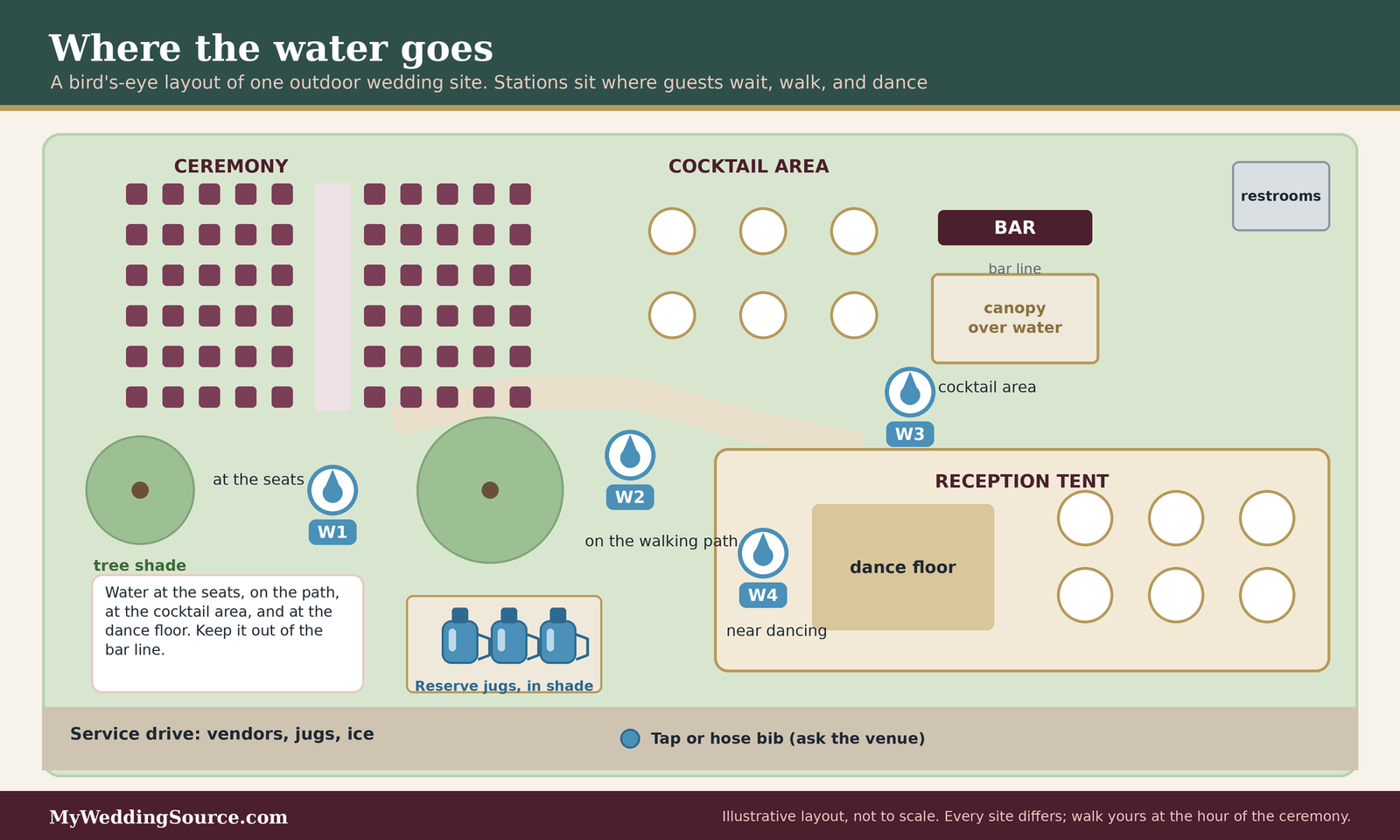
The ceremony seating is where guests sit for the longest stretch without access to anything. A small station at the edge of the seating, or a server carrying water to the aisle, does more good than a beautiful station at the cocktail hour. Place one near the ceremony site, one on the walking path to the cocktail area, one at the cocktail area, and one near the dance floor or tent. Spread them so that no guest is more than a short walk from water. Seat-side water is the biggest upgrade to most wedding beverage stations for outdoor heat.
In shade, or make shade
OSHA’s page on water, rest, and shade says to provide a cool place for breaks outdoors, which could be shade, a tent, a nearby building, or an area with fans or misting devices. For guests, the same idea applies. A station in full sun delivers warm water and sends guests into the sun to get it. If the site has no natural shade, a small canopy or umbrella over the station is a modest rental that does real work. Place the nearest seats in shade too. Shade is part of the equipment list for wedding beverage stations for outdoor heat.
Away from the bar line
Bars attract queues. Put a water station within sight of the bar but not inside its queue, so someone who only wants water is not stuck behind eight people ordering cocktails. The reverse also holds: a bartender should not be asked to serve as the water station. Keeping them separate protects the bar’s pace and the guest’s thirst.
What goes on the table
The details of the table determine whether guests use it.
Vessels that guests can operate
Choose dispensers with a spigot that a guest can push or turn with one hand, with a stable base, at a height that is comfortable from a standing or seated position. Check the weight with a full load. Dispensers with a loose lid, a stiff tap, or a narrow stand cause spills, and a spill in the heat becomes a muddy patch that guests avoid. Test each vessel at its full weight before the wedding, when you can still change it. Good vessels keep wedding beverage stations for outdoor heat running without staff hovering.
Cups, and where used cups go
Estimate cups from the same arithmetic as water: one cup per guest per outdoor hour, plus about 25% for drops and second cups, so about 600 cups for 120 guests over four hours. Provide visible trash and recycling at every station, ideally with a lid, so cups do not blow across the lawn. If you are using reusable glassware, our guide to wedding bar glassware rental covers counts and breakage. Cups are the least glamorous line in wedding beverage stations for outdoor heat, and they run out fast.
Flavors and electrolyte drinks
Cucumber, lemon, or mint water is a nice touch, but it is a garnish on top of plain water, not a replacement for it. OSHA’s guidance for workers says that for jobs longer than two hours, electrolyte-containing drinks such as sports drinks are useful because water alone does not replace the salts lost in sweat. Guests are not workers, and a wedding afternoon is not a job site, so we treat this as a hint, not a rule. If you offer a second option, label sugar content plainly and keep plain water as the first choice.
Making stations easy to find and use
A station that guests cannot see or cannot use is not doing its job.
Signage
Clear, large, plain signs help, such as “Free water here” with an arrow. Our guide to wedding signage covers materials and placement. Put a sign at the end of the aisle and at the start of the walking path so guests learn the pattern before they are thirsty. Signs are a cheap way to make wedding beverage stations for outdoor heat feel obvious.
Reach and accessibility
Guests who use wheelchairs, walkers, or canes, and guests with limited grip strength, need a firm path, a spigot at a reachable height, and sometimes a person who can fill a cup. Pre-filled cups on a tray, on a stable table, are a good second option beside a spigot. See our guides to wedding transportation for elderly guests with walking aids and the accessible wedding guest experience for related planning.
Children and pets
Children drink at different times and from different heights, so a lower table or a small pitcher with cups helps. If service animals are attending, a bowl of water for them in shade is a considerate addition, and our guide to wedding guests with service animals covers etiquette and logistics.
Keeping drinks safe and cool
Water is simple, but it is also a food. A few handling rules keep it that way, and they cost almost nothing.
Water quality and containers
Clean water in a dirty container is not clean water for long.
Food-grade hoses and containers
The Boulder County guidelines for temporary events, written for food vendors and not for private weddings, require potable water, a food-grade hose for connections to a potable supply, and smooth, cleanable, non-absorbent containers for ice, and they prohibit Styrofoam coolers. Wedding caterers may be governed by a different local rule, so ask yours which one applies. As a common-sense practice, we recommend that anyone hauling or dispensing drinking water use food-grade equipment that is cleaned before the event. Clean equipment is the baseline for any of the wedding beverage stations for outdoor heat we describe.
Cleaning and covering dispensers
Cover dispensers against dust, insects, and curious hands, and keep serving utensils clean. The same Boulder County guidelines say to protect drinks and dispensers from dust, insects, and customers and to wash fruit used in drinks before it goes in. For infused water, wash citrus and cucumbers before slicing, and keep the fruit inside the dispenser or in a removable infuser so guests do not reach into the water.
Ice at the water station
Ice makes water cold and also introduces a food-safety step, so treat it as an ingredient.
Scoops, not hands or glasses
The FDA’s page on packaged ice advises using clean, unbreakable tools such as tongs or an ice scoop, not touching ice with dirty hands or glasses, and storing ice in clean containers meant for food. Provide a scoop with its own holder, not left in the ice, and tell the attendant that the scoop is for ice only. The FDA page does not explain the word, but a glass used as a scoop can break and leave fragments in the ice, so keep glass away from the ice bin. Ice handling is a small detail that belongs in wedding beverage stations for outdoor heat.
Keep drinking ice separate from cooling ice
Ice that goes into a cup should not be the same ice that chills a case of bottled drinks. Bagged ice from a packaged source is labeled and regulated, and the FDA notes that packaged ice shipped across state lines is regulated as a food, while small local producers are overseen by state and local authorities. See our wedding bar ice planning guide for how much to order and how to store it.
Sweet drinks and perishable mixers
Lemonade and iced tea are popular in the heat, and they bring more risk than water.
Time and temperature
FoodSafety.gov says that bacteria that cause food poisoning multiply fastest between 40°F and 140°F. Plain water and ice are not the main concern, but dairy-based drinks, cut fruit, and anything that is not shelf-stable are. Keep those on ice or in a refrigerated unit, and do not leave them out in full sun for long stretches. When in doubt, ask your caterer about their time limits, and see our guide to the summer wedding heat plan for a fuller treatment of food safety in heat. Perishable drinks are the one place wedding beverage stations for outdoor heat carry real food-safety risk.
Allergens and labeling
Sweet drinks often contain ingredients guests care about, such as citrus, nuts in syrups, dairy, or alcohol in “punch.” Label each dispenser with its contents and, if you have a signature drink, whether it contains alcohol. This is a courtesy and a safety step, and it also supports guests who do not drink alcohol, for whatever reason, without making them ask.
The bartender permits and insurance checklist
If your drinks include alcohol, the beverage stations sit inside a legal and insurance frame that varies by state, county, and venue. This section is a checklist for asking the right questions and getting the answers on paper. It is not legal advice, and it cannot tell you what your jurisdiction requires. Your state or local alcohol regulator, your venue, your caterer, and an insurance professional can.
Rules differ by state, and two examples show how much
We looked at two state-level publications to show the range, not to describe your state. Both were checked on November 12, 2026, and rules change, so treat them as illustrations.
Massachusetts: a caterer license with conditions
The Massachusetts Alcoholic Beverages Control Commission’s caterer license page says a caterer must hold a license to sell alcohol at private events held away from the caterer’s own premises. It lists conditions that include a maximum of five hours of service per event, written notice to the local police chief and licensing authority at least 48 hours before the event, liquor liability insurance of at least $250,000/$500,000, and ServSafe or TIPS certification for each person serving. The page does not mention weddings, so confirm how a wedding is classified with the regulator.
Wisconsin: no catering license, and cash bars are restricted
A Wisconsin Department of Revenue publication says the state does not issue a retail alcohol “catering license” and that caterers may provide servers to dispense, not sell, alcohol at some functions. It gives the example of a wedding reception at an unlicensed venue not open to the public, where the couple bought the alcohol from the caterer earlier. It also says a cash bar at a catered event is illegal unless the venue has a retail license that authorizes on-premises sales, and that unused alcohol cannot be returned to the caterer. The takeaway is not the Wisconsin rule itself. It is that a cash bar, a drink ticket, or a returned case can each be a legal question in one state and a non-issue in another.
Your state, and who to call
Look for your state’s alcohol beverage control agency or liquor board, which may go by a different name, and read its pages on caterers, special events, and private parties. Many agencies have a phone number for questions. Ask the same two things each time: who needs a license or permit for this event at this location, and what is required of the people who pour? Write down the name, date, and answer.
The permits and licenses checklist
The table below is a checklist of items to confirm. We have written it so you can paste it into an email to your caterer and venue. Not every row applies to every wedding, and who holds each item varies by state and by contract, so the “usually” column is a starting point for a conversation and not a rule.
| Item to confirm | Who usually holds it | What to ask for in writing |
|---|---|---|
| Alcohol license or permit covering the bar at this address | Licensed caterer, bar company, or the venue | License type, number, issuing agency, expiration date, and whether it covers this location and date |
| Venue’s own alcohol rules | Venue | Whether outside alcohol, outside bartenders, or a venue-licensed bar is required, and any carry-in rule |
| One-day or temporary event permit, if needed | Varies: venue, vendor, or host | Whether one is required, who applies, the deadline, and the fee |
| Food and beverage service permit | Caterer | A copy, and whether it covers off-site events |
| Server training or certification | Each bartender or server | Name of the program, whether state law requires it, and whether each person pouring has it |
| Host liquor liability coverage | Couple or host | Whether the venue requires it, coverage type, limits, and event date |
| Liquor liability for the bar vendor | Bartending company or caterer | Certificate of insurance, limits, and exclusions |
| Certificate of insurance to the venue | Each vendor, sent to the venue | Venue’s exact legal name, additional insured or certificate holder wording, and policy dates |
| Cash bar or drink ticket rules | Depends on law and contract | Whether selling alcohol requires a different license or coverage, and who rings up sales |
| Service hours and last call | Bar vendor and venue | Start time, end time, last call, and who decides to stop service |
| Leftover and unopened alcohol | Contract and local law | Who owns it, where it goes, and whether any can be returned |
| Nonalcoholic service | Couple and bar vendor | Which nonalcoholic drinks are included, and whether they cost extra |
Licenses and permits: reading the first four rows
The first four rows answer one question: is the bar legal at this place? A venue that has its own license may require you to use its bar, and a venue that has none may require a vendor license or a temporary permit. Do not assume one vendor’s license travels to another county or state, because the Wisconsin publication we cited says a caterer’s license is tied to a fixed location and does not travel with the business. Ask, and keep the copy.
Training and who pours
The fifth row addresses who is actually serving. Programs such as ServSafe and TIPS are named in the Massachusetts caterer license requirements, and some jurisdictions require server training by law while others leave it to employers. Our choosing a wedding bartender guide explains what certifications show and what they do not. Ask who is pouring, not only which company is on the contract.
What to ask when you do not know whether a permit is needed
If you cannot tell whether a permit applies, ask the venue first and the state regulator second. Venues often handle this regularly, and many have a standard answer. If the venue says it is the vendor’s problem, ask the vendor in writing and request a copy of the license that covers the date. Do not wait until the week of the wedding, since some permits have deadlines. Our guide to wedding permits covers the broader permit picture for a ceremony and reception site.
Insurance: host coverage and vendor coverage are different things
Insurance language is confusing, and what follows is a plain-language summary of a single industry source, with the caveat that policies differ and you should ask an insurance professional about yours.
Host liquor liability
An Insurance Canopy article on wedding alcohol liability, published in April 2026, says that if alcohol is present, the host needs liquor-related coverage, and that host liquor liability applies when guests receive alcohol free, such as an open bar or BYOB. Insurance Canopy sells insurance, so treat its framing as the view of a seller. We include it because the structure it describes is consistent with what venues commonly ask for. For the wider picture, see our guide to wedding insurance.
Vendor liquor liability
The same source says bartenders, caterers, and other vendors who serve alcohol need their own liquor liability coverage for their role, and that even when a vendor serves, the host still needs host liquor coverage. It also says that if guests pay for alcohol, as with a cash bar or paid drink tickets, the coverage is often treated as retail liquor liability instead. This is a good reason to read our wedding drink ticket system guide before you choose that format.
Certificates of insurance and additional insured wording
The article says venues commonly require a certificate of insurance showing the coverage exists, and that the venue may need to be listed as an additional insured or a certificate holder, which are different things. It recommends checking the venue’s exact legal name, the event date, the coverage type, and the limits against the venue’s requirements, and notes that vendors usually send their certificates directly to the venue. A small mismatch, such as the wrong legal name, can delay approval, so send the venue’s requirements to each vendor early.
What this actually costs
Most of the cost of wedding beverage stations for outdoor heat is labor and logistics, not water: an attendant’s hours, dispenser and canopy rentals, delivery, cups, and trash service. We did not find reliable published prices for these, so get quotes in writing and ask what is included. On the alcohol side, license, insurance, and training costs often sit with the vendor and may appear in their price. As one example, the Massachusetts caterer license page lists a $1,650 license fee, a vendor cost that a caterer may fold into pricing. Ask for a line-by-line quote so you can see what you are paying for.
Service practices that reduce risk in the heat
Permits and insurance are the paper layer. The practices below are what happen at the bar, and they matter more when guests are hot, dehydrated, or on medication.
Water is easy to reach, and stays easy to reach
Make sure the bar offers water freely. Water offered only on request puts a guest in the position of asking, and not everyone wants to. Free water at the bar, with a sign, removes that awkwardness. The CDC suggests limiting alcohol in the heat, which is a good reason to make the alternatives obvious. This keeps wedding beverage stations for outdoor heat from sitting only beside the bar.
Nonalcoholic options and no assumptions
Do not assume anyone’s drinking age, drinking choices, or reasons for not drinking. Offer attractive nonalcoholic drinks at every bar and station, and ask the bar vendor how they verify age and how they handle guests who should not be served more. Our wedding mocktails guide gives you recipes and presentation ideas, and the open bar wedding guide discusses how bar format changes pacing.
Stop-service rules and who decides
Agree in advance who can decline to serve a guest, and how the couple wants it handled. Most professional bartenders already have a policy, and a clear contract line saves the staff from making a hard call alone. Ask the vendor to describe, in plain terms, what they do when a guest appears unwell, and make sure the answer includes getting that guest water, shade, and a seat.
Staffing and heat safety for the people behind the stations
Guests are not the only people in the sun. Bartenders, servers, and the person refilling jugs are working outdoors, often in dark clothing, lifting heavy loads. A beverage plan that ignores them tends to fail from the back.
Heat safety for vendor staff
OSHA’s guidance is written for employers, and weddings are not job sites in the usual sense, but its principles are a good model for what to expect from vendors.
Water, rest, and shade for staff
OSHA says employers should provide cool drinking water placed near the work, encourage frequent drinking instead of waiting for thirst, require breaks when heat stress is high, and provide a cool place for breaks, such as shade, a tent, or an air-conditioned vehicle. Ask your vendors how they handle this for their staff, and make sure the bar and the refill attendant have shade and a cooler of their own water. Staff who are cooled and hydrated are better placed to keep the stations running. The people who run wedding beverage stations for outdoor heat are working in the same heat as the guests.
Break coverage
If a refill attendant takes a break, the stations should not go empty. Write a backup name on the refill clock. For small weddings that may be one friend assigned a 15-minute window, and for larger weddings it may be a second attendant. Our guide to wedding vendor meals covers how to schedule food and breaks for the people working your day.
Recognizing and responding to heat trouble
You do not need to treat guests, but someone on site should know what trouble looks like and who calls for help. This section summarizes public health sources and is not medical advice.
What the sources list as signs
The CDC’s page on overheating lists muscle cramping, unusually heavy sweating, shortness of breath, dizziness, headaches, weakness, and nausea. The CDC’s NIOSH page describes heat exhaustion as headache, nausea, dizziness, weakness, irritability, thirst, heavy sweating, and a raised body temperature, and heat stroke as confusion, slurred speech, loss of consciousness, hot dry skin or heavy sweating, seizures, and a very high body temperature. It says heat stroke is the most serious heat illness and that body temperature can rise to 106°F or higher within 10 to 15 minutes.
First steps and when to call
For suspected heat stroke, the NIOSH page says to call 911, stay with the person, move them to a cool shaded area, and cool them quickly with cold water or wet cloths. For heat exhaustion, it says to get medical evaluation, not to leave the person alone, move them out of the heat, and give cool water in small frequent sips. Name one person, ideally your planner or coordinator, as the contact for any guest in distress, and give the venue address to your vendors so they can describe it clearly to a dispatcher.
A cool corner with a purpose
A shaded, seated area with water and a staff member nearby gives a guest who feels unwell somewhere to go. Mark it on the day-of timeline and tell the wedding party where it is. Our wedding emergency kit guide covers what else to have on hand. A cool corner is a natural companion to wedding beverage stations for outdoor heat.
Edge cases for wedding beverage stations for outdoor heat
No plan survives every day. These are the situations that most often break a hot-weather beverage plan, with ways to handle them.
Guest-specific situations
Your guest list will contain people for whom the default plan does not fit.
Older guests and guests with medical needs
The CDC lists adults 65 and older among the groups needing extra care and says heat can make existing health conditions worse. Seat these guests in shade, near a station, and consider assigning a family member or an usher to bring water. Heat can also affect medications, and the CDC’s clinical page notes it can damage inhalers and EpiPens and degrade insulin. Remind guests, gently, in your day-of communications, that they can keep medicine in a cool bag. These guests are a good test of whether wedding beverage stations for outdoor heat are truly accessible.
Children, pregnant guests, and others who may not ask
Infants and young children and pregnant people are also on the CDC’s list. Children often will not ask for water, so put cups on a low table and have parents or helpers offer it. Pregnant guests may appreciate a seat in shade and a quiet note from the couple that water and a cool room are available.
Guests who do not drink alcohol
Guests may not drink for health, religious, recovery, family, or personal reasons, or because they are driving. Make nonalcoholic drinks visible and appealing, and do not single anyone out by asking. Our guide to nonalcoholic beer and wine can help you build a list that feels like a menu.
Site-specific situations
Some places make the plan harder, and it is better to know before the day.
No water on site
A field, a beach, or a hilltop may have no tap at all. In that case, hauled water becomes your supply, and the numbers earlier in this guide become your delivery order. Plan storage in shade, plan for the weight, and add a reserve. Our guide to portable restrooms for outdoor weddings shows how the same site problem affects restroom handwashing water. A site with no tap is the hardest case for wedding beverage stations for outdoor heat.
Power and cooling
Chilled dispensers and refrigerators need electricity, and a generator adds noise, fuel, and a vendor to manage. If power is unreliable, plan for insulated coolers and ice instead of powered chillers, and see wedding generator rental for what to ask. Coolers tend to lose cold faster in the sun than in shade, so keep them shaded.
Grass, gravel, sand, and slopes
Soft ground makes dispenser stands wobble and carts hard to move. Place stations on level, firm ground, and put a mat or board under heavy dispensers if you have to. A spill on sand disappears, while a spill on a gravel path can be a hazard for a walker, so check each surface at your site visit.
Day-of situations
The forecast changes, schedules slip, and supplies run short.
The heat is worse than forecast
If the heat index rises, increase the check frequency, open the reserve, and consider moving stations closer to seating. Talk to your planner about shortening the outdoor stretch, delaying the ceremony start, or moving guests to shade sooner, as our summer wedding heat plan describes. A decision made early costs less than one made after a guest feels unwell. A hotter day means wedding beverage stations for outdoor heat need more of everything.
The ceremony runs late
A delay in full sun means guests keep sweating while the water keeps running down. When you hear about a delay, send the attendant to top off every station, bring pre-filled cups to the seating, and ask whether guests can be moved to shade while they wait. Build slack into the timeline from the start, as our guide to the wedding vendor timeline explains.
You are running out
If supplies are low, the reserve goes out first, then cases of bottled water from the venue or a nearby store. Choose a person with a vehicle and a clear errand in advance, even if the errand never happens. Know where the nearest store is, and write it on the refill clock. Every set of wedding beverage stations for outdoor heat needs a plan for the moment supplies run short.
Questions to ask before you finalize wedding beverage stations for outdoor heat
Good questions turn assumptions into promises. Send these in writing and keep the replies with your contracts, since our guide to wedding vendor due diligence explains why.
Questions to ask before you finalize drinks
- Where does drinking water come from at this site, is it a public system or a well, and when was it last tested?
- Who refills the water stations, how often, and who covers that person’s breaks?
- How many gallons or jugs are included in your quote, and what is the reserve?
- How many dispensers and spigots will be set up, and where will they stand?
- Is there shade at the stations, or can you provide a canopy?
- What licenses or permits does the bar need at this address on this date, and who is applying for them?
- Can you send your certificate of insurance to the venue with the exact legal name and wording it requires?
- What does each bartender hold in the way of training or certification, and what is your policy for declining service?
- What is the plan if the forecast heat index is higher than expected?
- What happens to leftover water, cups, and alcohol at the end of the night?
Questions for the venue
Venues control water, power, shade, and rules, so they are the first stop.
Water, power, and rules
Ask where taps and hose bibs are, whether you may connect to them, how to reach the service area, and what hours load-in is allowed. Ask whether the venue has its own alcohol license or requires one from an outside vendor, and whether it has a preferred bar. Our wedding venue questions guide has a longer list. The venue’s answers shape every part of wedding beverage stations for outdoor heat.
Shade and heat policies
Ask whether the venue has a heat policy, where shaded areas are, whether there is an indoor retreat, and who the on-site contact is on the day. A venue that has hosted summer weddings before often has a good answer, and a venue that has not may be glad you asked.
Questions for the caterer and bar vendor
Caterers and bar companies usually supply the dispensers, ice, and staff, so their answers shape the plan.
Staffing and equipment
Ask who owns the water station: the bar team, the catering team, or a separate attendant. Ask whether dispensers are food-grade and cleaned before use, how they chill water, and whether stations include scoops and covers. Ask about a staffing plan for breaks in the heat. Your caterer’s equipment is the physical core of wedding beverage stations for outdoor heat.
Licensing and insurance
Ask for copies of licenses, certificates, and training records, and compare them with the checklist in this guide. If anything is unclear, ask the regulator. A professional vendor should be comfortable with this, and hesitation is useful information.
Questions for the rental company
Rental companies supply dispensers, canopies, tables, and sometimes water tanks and coolers.
Equipment condition and delivery
Ask about dispenser capacity, spigot type, cleaning, and delivery and pickup windows, and whether canopies include weights or stakes suitable for your ground. Our wedding rental planning checklist covers the full rental conversation. Rented gear is part of the reliability of wedding beverage stations for outdoor heat.
Damage and cleaning terms
Ask what happens if a dispenser leaks, cracks, or comes back dirty, and read the damage terms in the contract. Our guide to wedding rental damage waivers explains what waivers do and do not cover.
Planning the water
How much water should we plan per guest at an outdoor wedding in heat?
There is no official number, so we use a planning estimate of about 12 ounces per guest for each hour outdoors in real heat, rising to 16 ounces in full sun and falling to 8 ounces on a mild day. Add roughly 25% as a reserve. Adjust with your caterer, since bar drinks also count.
How many water stations do we need?
Our estimate is about one self-serve spigot per 40 guests at the post-ceremony peak, spread across the seating, the walking path, the cocktail area, and the dance floor. For 120 guests, that is three spigots at minimum, divided among at least three or four locations. Time a real spigot at your walkthrough and adjust.
Can we use the venue’s tap water for guests?
Often yes, if the venue is on a public water system and you connect with food-grade equipment. The CDC says public utilities treat water and must meet EPA standards, and private wells are the owner’s responsibility to test. Ask the venue about the source and recent test results, and bring bottled or hauled water if the answer is unclear.
Alcohol, permits, and insurance
Do we need a permit to serve alcohol at our wedding?
It depends on your state, county, venue, and whether alcohol is sold or given away. Examples show the range: Massachusetts requires a caterer license for selling at private events, and Wisconsin has no catering license at all. Ask your venue and state alcohol regulator, and request written answers. This is not legal advice.
Who needs liquor liability insurance, the couple or the bartender?
Often both. An insurance industry source says hosts need host liquor coverage when alcohol is free, bar vendors carry their own liquor liability, and venues commonly ask for certificates of insurance. Requirements vary, so ask your venue what it requires and ask an insurance professional about your own policy.
Should we offer a cash bar in outdoor heat?
That is a budget and law question more than a heat question. In some states a cash bar needs a retail license and different coverage, as the Wisconsin publication notes. From a guest perspective, free water and visible nonalcoholic drinks matter more than the bar format. See our guides on open bars and drink tickets.
On the day
What should we do if a guest feels faint or overheated?
Move them to shade, sit them down, give cool water in small sips, and stay with them. Call 911 for confusion, slurred speech, loss of consciousness, or seizures, which the CDC’s NIOSH page associates with heat stroke. Name one coordinator in advance who responds to these situations. This is general information, not medical advice.
Is it okay to put the water station next to the bar?
You can, but we prefer stations at the seats and on the walking paths, with water also free at the bar. A water station inside a bar queue slows everyone. Keep the stations within sight of the bar, but outside its line, and make sure each one has its own attendant or refill check.
Your next steps
Build the plan
Write down the numbers
Choose your guest count, your outdoor hours, and a per-hour rate, then calculate gallons, jugs, cups, and a 25% reserve. Put the totals on one page and share it with your caterer. Our wedding planning checklist shows where this item fits in the bigger timeline. One page of numbers is the backbone of wedding beverage stations for outdoor heat.
Assign the refill owner
Name the person who refills, the backup who covers breaks, and the person who decides when to open the reserve. Put the names on the refill clock and give a copy to your planner, your caterer, and the venue coordinator. A named owner is what makes wedding beverage stations for outdoor heat work.
Confirm the rules
Send the checklist
Paste the permits and insurance checklist into an email to your venue, caterer, and bar vendor, and ask for written answers by a date. Keep the replies with your contracts.
Walk the site at the same hour
Visit the venue at the time of day your ceremony will happen, check the shade, test a spigot, and mark station locations. If your plan changes after that, our outdoor wedding infrastructure checklist and wedding week checklist help you recheck the details. A site walk is the last check on wedding beverage stations for outdoor heat.
Sources & methodology
How we built this guide
What we relied on
This guide combines U.S. government and public-health pages on heat, drinking water, ice, and food safety, two state alcohol-regulation publications used as examples, a county temporary-event guideline, and one insurance-industry article on wedding alcohol liability. Statements from the insurance article are attributed to it because it is written by a seller of insurance. The water volumes, refill intervals, spigot counts, and reserve percentages are our own planning estimates built on those sources, and no source gives a per-guest wedding figure. Sources were read on November 12, 2026.
What we did not do
We did not give legal, medical, or insurance advice, and we did not verify the rules in your state or county. Alcohol, permit, and insurance requirements vary and change, so confirm them with your regulator, venue, and insurer. We did not test dispensers, measure spigot flow rates, or survey vendors, and we found no reliable published price data for station rentals. This guide does not endorse any vendor or product.
Source list
Government and public-health sources
- FoodSafety.gov, U.S. Department of Health and Human Services: https://www.foodsafety.gov/
- National Weather Service, Heat Index: https://www.weather.gov/safety/heat-index
- CDC, About heat and your health: https://www.cdc.gov/heat-health/about/index.html
- CDC, Heat and medications guidance for clinicians: https://www.cdc.gov/heat-health/hcp/clinical-guidance/heat-and-medications-guidance-for-clinicians.html
- CDC NIOSH, Heat-related illnesses: https://www.cdc.gov/niosh/heat-stress/about/illnesses.html
- CDC, About drinking water: https://www.cdc.gov/drinking-water/about/index.html
- OSHA, Heat exposure: water, rest, shade: https://www.osha.gov/heat-exposure/water-rest-shade
- FDA, FDA regulates the safety of packaged ice: https://www.fda.gov/food/buy-store-serve-safe-food/fda-regulates-safety-packaged-ice
Alcohol regulation, local guidance, insurance, and health references
- Massachusetts Alcoholic Beverages Control Commission, Apply for a 12C caterer license: https://www.mass.gov/how-to/abcc-apply-for-a-caterer-license
- Wisconsin Department of Revenue, Catering alcohol beverages: https://www.revenue.wi.gov/DOR%20Publications/3108CateringAlcoholBeverages.pdf
- Boulder County Public Health, Temporary event guidelines: https://assets.bouldercounty.gov/wp-content/uploads/2017/05/temp-event-guidelines.pdf
- Insurance Canopy, Who’s responsible for wedding alcohol liability: https://www.insurancecanopy.com/?p=139860
- Mayo Clinic, Water: how much should you drink every day: https://www.mayoclinic.org/healthy-lifestyle/nutrition-and-healthy-eating/in-depth/water/art-20044256