
A wedding vendor timeline is the behind-the-scenes schedule of when each vendor can enter the venue, when they must be finished, when they eat, and when everything leaves, and it is the document that quietly decides whether your guest-facing schedule actually works.
Quick answer
Build your wedding vendor timeline backward from the moment guests arrive. Start with the dates you cannot move (venue access, contract deadlines, delivery cutoffs), give every vendor a written arrival window and a written finish time, and pad each block rather than the whole day. Plan for tasks to take longer than they do on an ordinary day, schedule vendor meals on purpose, and name one person who can approve changes. Finalize the plan about a month out, confirm it with each vendor one to two weeks out, and share one version with everyone.
What a wedding vendor timeline covers and what it leaves out
Most couples build one schedule, the one printed on the invitation or the program, and assume vendors will work around it. In practice the guests see about five or six hours, while the people serving them are on site for many more. A wedding vendor timeline is the second, longer schedule that sits underneath the first. It answers questions guests never ask: when can the rental truck back up to the door, who has the room between noon and two, when does the band plug in, and who is allowed to be in the building at midnight?
This guide stays on that second schedule. If you want the broader sequence of planning milestones, our wedding planning timeline covers the months before the wedding, and the wedding planning checklist covers tasks. Here, we focus on the day and the days just before it.
The difference between a guest schedule and a vendor schedule
The two schedules share a few anchor points, such as the ceremony start and the first dance, but they are built for different readers. Keeping them apart prevents the most common planning mistake, which is treating the invitation time as the vendors’ start time.
What guests see
Guests see an arrival time, a ceremony, a cocktail hour, a meal, some toasts, dancing, and a send-off. That version is short, forgiving, and written in plain language. It leaves out anything that happens before doors open, and it does not need to explain how the room changes between the ceremony and the reception. If you want help with the reception portion, see our wedding reception guide.
What vendors need
Vendors need a call time at the venue, a loading location, a contact on site, a finish time, a meal plan, and the point at which they hand off to someone else. A florist needs to know when the ceremony space will be clear of rental crews. A band needs to know how far the vehicle can park from the stage. A caterer needs to know what the kitchen has available and when. None of that appears on a guest program, so it has to live in a document of its own: your wedding vendor timeline.
The six windows every vendor timeline needs
Whatever the size of your wedding, six windows organize the vendor side of the day and give your wedding vendor timeline its shape. Naming them early gives you a framework for every conversation with a venue or vendor.
Delivery, setup, and sound check
Delivery is when items arrive, setup is when they are placed and tested, and sound check is when audio equipment is tuned in the room with real conditions. Each has an owner and a start time, and the three overlap more than people expect. Rentals cannot be styled until they arrive, and a speaker cannot be tested until the room is mostly set.
Meals, strike, and venue access
Meals are the planned breaks for the people working your wedding. Strike is theater language for taking everything down and out, and it is used by many wedding professionals. Venue access is the written permission that governs all of it: the hours the building is yours, where vehicles can park, which doors and elevators are available, and what the venue requires from every outside company. Every other window on the list depends on this one.
Build the schedule from hard deadlines rather than generic month labels for your wedding vendor timeline
Planning guides often divide the work into months, and that is useful for getting oriented. For vendors, the better structure is a list of hard dates, because each vendor works against its own calendar and your date is only one of many. A hard deadline is a date after which something becomes harder, costlier, or impossible. The goal of a good wedding vendor timeline is to find those dates first and then work backward from the wedding to the dates you control.
Find the dates you do not control
Some deadlines belong to other people, and they are the ones that cause the most trouble because they do not move when you do. Collect them before you build the rest of the wedding vendor timeline, and write each one down with the source of the date.
Pull contract, venue, shipping, and travel deadlines
Open every contract and highlight each date: final headcount due, final payment due, the last day to change a menu, the last day to change a rental order, delivery dates, and the date when photos or products will be handed over. Wisconsin’s consumer protection agency advises couples to get costs and delivery dates spelled out in writing, and to confirm things like how long a photographer will work and when photos arrive. Then add the dates from outside your contracts: the shipping time for anything coming from out of state, and the travel days for anyone who is flying in, including a photographer or musician. Treat the earliest date on your list as the real starting line.
Add legal or document processing time
Some items on your list are not vendors at all, and they still affect the schedule. A marriage license is the obvious example. The Better Business Bureau’s planning timeline places getting the license in the one to two months before the wedding and notes that waiting periods vary by location, so the local clerk’s office is the authority. Our marriage license guide explains how the process generally works. If a vendor needs a certificate of insurance or a signed venue rider, ask how long that paperwork takes to produce, because an insurance contact may need several business days. That is general planning advice, not a rule, so check your own venue’s requirements.
Work backward from the wedding date with realistic buffers
Once the fixed dates are on the page, build the rest in reverse. Start at the wedding date, subtract the time each task needs, subtract a buffer, and see where that lands. If the result falls before today, your wedding vendor timeline has a conflict, and you have found it early, which is the cheapest time to find one.
Separate decision time from production time
Every task in a wedding vendor timeline has two clocks. Decision time is how long you need to choose, and production time is how long the vendor needs to make or arrange the thing after you choose. A florist may need a week or more to source stems after you approve a design, and a rental company needs your final counts before it can pull inventory. Wisconsin’s guide recommends ordering a gown nine to twelve months ahead and finishing fittings at least four weeks before the wedding, which shows how much production time sits behind a single item. When you plan, put the decision deadline in your own calendar and the production deadline in the vendor’s, so that missing one does not silently consume the other.
Add slack for revisions, shipping, and human delay
A buffer is a block of time you plan not to use. Wedding professionals quoted by The Knot describe a rule of thumb, sometimes called the 30/5 rule, in which a task that takes five minutes on an ordinary day can take about thirty on a wedding day. Minted suggests padding each item by at least five minutes and sometimes ten to fifteen, while Joy recommends thirty-minute buffers between major blocks. These are different judgments from different publishers, not measurements, so treat them as a range and choose by risk: pad more where a delay would touch a hard stop such as a sunset, a curfew, or a vendor’s finish time.
| Milestone | Target date | Buffer | Owner | Depends on |
|---|---|---|---|---|
| Venue access hours and rules confirmed in writing | At or before the venue contract | None; this sets every other row | Couple | Venue contract |
| Final headcount to caterer and rental company | The date in each contract | One week to review RSVPs | Couple | Guest list, RSVPs |
| Vendor timeline drafted and sent for comment | About six weeks out | Two weeks for edits | Planner or couple | Venue rules, vendor calls |
| Timeline finalized | About one month out | Two weeks before confirmations | Planner or couple | Vendor comments |
| Fittings and attire complete | At least four weeks out | One week | Couple | Alteration shop |
| Marriage license in hand | One to two months out, per local rules | Waiting period plus a week | Couple | County clerk |
| Vendor confirmation calls or emails | One to two weeks out | Three business days | Planner or couple | Final timeline |
| Final payments and tip envelopes ready | One to four weeks out, per contract | Two days | Couple | Contracts |
| Day-before walkthrough or call with venue | Day before | Evening buffer | Planner or venue manager | Final timeline |
| Load-in begins | Per timeline | Per vendor | Each vendor | Venue access |
The dates in the table pull from the planning timelines published by the Better Business Bureau, The Knot, and Wisconsin’s consumer agency. The buffers and owners are our own suggestions and not industry standards.
Delivery, setup, and load-in windows by vendor in a wedding vendor timeline
Load-in is the stretch of time when vendors bring in what they need and prepare it. It is where most of the invisible work of a wedding happens, and where most collisions occur, because several vendors need the same room at the same time. A sensible order exists, and it is fairly consistent across the sources we reviewed: heavy and structural items first, decorative items next, people-based services in the middle of the day, and food and music close to the start.
Heavy items and decor come first
Furniture, tents, linens, and florals shape the room. They need clear floor space and people who can move quickly, so they usually arrive before anyone who needs a finished room.
Rentals arrive first
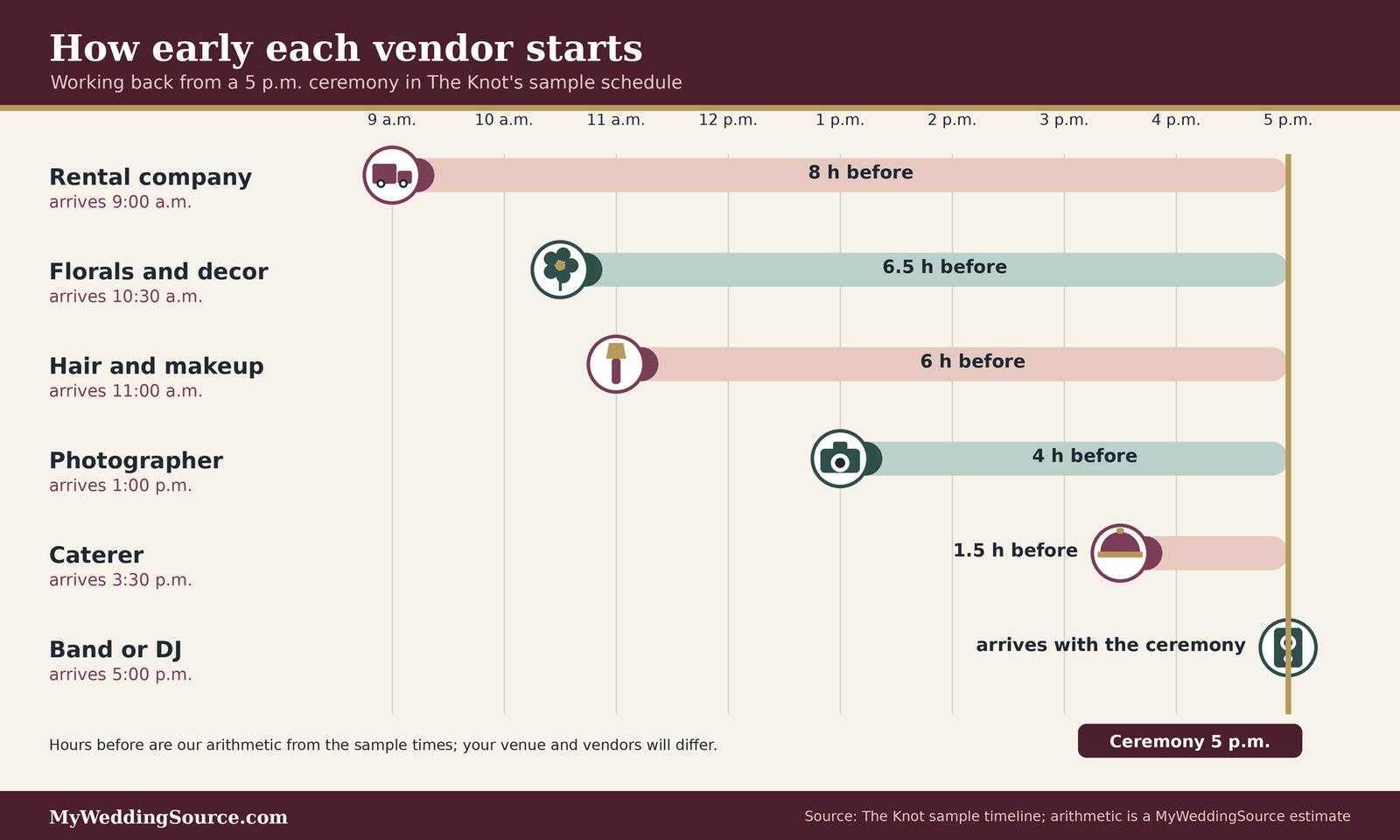
In the sample schedule from The Knot for a ceremony at five in the afternoon, the planner arrives at nine in the morning and the rental company, delivering tables, chairs, and serving pieces, arrives first thing that morning as well. The reason is practical: tables must be placed before linens, linens before centerpieces, and centerpieces before the caterer sets service. If your venue does not allow morning access, rentals are the first item to renegotiate, because their delay pushes everything behind them. Ask the rental company for a delivery window in writing, not just a date.
Florals and decor follow
The same sample puts florals and decor at about ten thirty, after rentals. Florists can only place arrangements once tables and chairs are set. Wisconsin’s guide suggests that a florist’s contract state delivery times and locations and say who moves flowers from the ceremony to the reception, which matters whenever the two spaces differ. If you want help choosing what the florist brings, see our guides to seasonal wedding flowers and wedding decor.
People-based services fill the middle of the day
Hair, makeup, and photography are services performed on people, so they depend on the people being ready, and they carry their own time costs.
Hair and makeup need more room than they appear to
The Knot’s sample has hair and makeup arriving around eleven and recommends allowing at least three hours for services plus about thirty minutes of setup, with roughly thirty minutes per person for each service. Multiply that out and a party of six who each want hair and makeup takes far longer than a single hour. Our estimate is that six people at thirty minutes per service, for two services each, comes to about six hours of artist time, so ask whether one artist or a team will attend. The number of artists is the lever, not the clock.
Photographers need a start that matches the story you want
The sample has the photographer arriving at one in the afternoon, and The Knot notes that photography packages often cover eight to ten hours. By our arithmetic, an eight-to-ten-hour package that begins at one o’clock ends between nine and eleven at night. If you want getting-ready photos earlier, either the start time moves or the package grows. Wisconsin’s guide advises confirming how long the photographer will stay, because some leave before the reception unless extra time is paid for. Our wedding photographer shot list and wedding photography guide can help you decide which moments deserve the most time.
Food and music arrive close to the moment they are needed
Caterers and musicians depend on the room being finished. They arrive later than rentals and florals, but not by much, because they need real setup time too.
Caterers need kitchen time, not just table time
The Knot’s sample says a caterer typically needs to load in four to five hours before dinner and places it at three thirty in the afternoon. That window covers unloading, kitchen setup, finishing food, and arranging service. Caterers also need a place to stage food, ice, and equipment, and they need to know whether the venue has a prep kitchen or a loading dock. Our wedding catering guide explains how catering contracts are generally structured, and the vendor timeline should echo whatever the caterer commits to in writing.
Bands and DJs need time before guests arrive
In the same sample the band arrives around five o’clock for a five o’clock ceremony, and the article quotes a planner suggesting that smaller deliveries and music arrive at least two hours before the invitation start time. Those two points do not match, and the gap is a good reminder that sample schedules are illustrations. Different bands need different amounts of time: a solo musician needs less than a full band with a drum kit and a sound engineer. Ask the act how long its setup takes and add a margin, rather than borrowing a number from an article.
Sound checks, power, and the ceremony-to-reception flip
Sound is the part of a wedding that is easiest to ignore until it fails, and it is easy to leave out of a wedding vendor timeline. Microphones, speakers, and playlists have to work for an officiant, a processional, and a room full of people, and they have to work in a space that looks very different once guests fill it. The flip, the change of a space from one use to another, is the other time-hungry transition. Both belong in your wedding vendor timeline as named blocks with owners, not as footnotes.
Plan the sound check like a real task
A sound check is a test with a result. It is complete when the people who will use the equipment have used it and the output has been judged from where guests will be.
When to schedule it
Schedule the check after the room is physically set and before guests or other vendors fill it, and leave a margin in case the check turns up a problem. Neither The Knot’s nor Minted’s timeline articles set a specific sound-check length, so we do not either. Ask the DJ or band to tell you what they need, put that duration into the schedule, and add a buffer. If the ceremony is outdoors, ask whether the same equipment will be moved to the reception and how long that move takes.
Who needs to be there
The person speaking into the microphone, usually the officiant, should be present for at least a brief test, because voices differ and so do microphone settings. A planner or coordinator should know where the controls are and who may touch them. If a family member is doing a reading, give them a time to test, not a surprise at the ceremony. Our wedding ceremony guide and wedding officiant guide cover how ceremonies are organized.
Plan the flip as a task with a crew
When a ceremony room becomes a reception room, chairs move, tables appear, and the layout changes entirely. That takes people and time, and it happens while guests wait somewhere else.
Make the cocktail hour long enough
Minted points out that if the ceremony space doubles as the reception room, the cocktail hour must give the team enough time to transform it. In practice that means counting the people on the flip crew, the number of items to move, and the route between spaces. Ask the venue or rental company how long the flip takes for a guest count like yours, and tell the photographer so the cocktail-hour photos do not collide with the work. Our own suggestion is to schedule the flip as a block with a start time, an end time, and an owner.
Give vendors somewhere to stage
A flip fails when vendors have nowhere to put things. Ask the venue where musicians can leave instrument cases, where the caterer can hold hot equipment, and where the photographer can leave a bag. Mark those spaces on a simple map and send it with the timeline. If the venue offers only a single back room, share it by schedule: caterer first, then band, then photographer, and write that order down.
Fit dependencies together without creating calendar collisions
A timeline fails less often because one vendor is late than because two vendors need the same thing at the same moment. Dependencies are the links between tasks: this cannot start until that finishes. Making the links visible is the single most useful thing a wedding vendor timeline can do, and it costs nothing.
Identify what must happen before the next task can start
Pick any vendor and ask what has to be true before their work can begin. The answers form a chain, and the weakest link in the chain sets the real schedule.
Map approvals, measurements, counts, and permits
Tables cannot be ordered without a headcount, linens need table dimensions, a tent may need a site inspection or permit that the venue or municipality controls, and amplified music may be limited by local rules. We cannot say what your city requires, and we did not find a single national rule, so ask your venue and your local government. For every wedding vendor timeline, create a short list for each vendor of the approvals, counts, and measurements required, mark which ones you must supply, and put each in your calendar with the vendor’s deadline.
Protect the steps that cannot be rushed
Some steps simply need time: dress alterations, custom orders, food that must be cooked before service, and cake that must be set. Wisconsin’s consumer guide reports that many bridal shops require a large nonrefundable deposit for custom orders, which is a reason to confirm the timeline before paying. Mark the steps that cannot be shortened and protect them with the largest buffers, because an extra hour cannot rescue a gown that arrived late.
Coordinate multiple people against the same milestone
Once more than two people hold part of the plan, the plan fragments. A clear structure keeps all the versions in agreement.
Give partners and vendors one shared version
For a wedding vendor timeline, choose one document and name one owner. Whether it is a shared spreadsheet, a PDF, or a printed sheet, everyone should work from the same file and the same date stamp. The Knot’s guidance is to finalize the timeline about a month before the wedding and confirm it about a week before. Put a version date at the top of the wedding vendor timeline, and ask each vendor to reply with the words “received and agreed” so you know the right version reached them. If you are managing this yourself and feeling stretched, our wedding planning stress guide explains where the load usually concentrates.
Set a change-notification rule when timing moves
A wedding vendor timeline will move at least once. Decide in advance what counts as a change worth announcing, such as any shift of fifteen minutes or more to a start time that another vendor depends on, and who tells whom. A short rule helps: the owner of the timeline announces every change in one message to the full group, and nobody makes side agreements. The Better Business Bureau advises confirming all services and details one to two weeks before the wedding, which is also the best moment to send a final version. ## Vendor meals, breaks, and the food clock
Feeding the people who work your wedding is a logistics decision as much as a courtesy. A hungry photographer is a slower photographer, a caterer with no break may lose focus, and a band that eats at the wrong moment may miss a cue. Meals are also the part of the wedding vendor timeline that most often gets forgotten until the day, when someone asks where the vendors should eat. Plan them the way you plan any other block.
Decide who eats, and when
Not every vendor needs a meal, and the contract should say so. The Knot notes that photographers, videographers, and planners need dinner and often eat in shifts, while vendors who are only there a few hours may not need a meal at all.
Count vendor meals into the headcount
Joy recommends adding vendor meals to your catering headcount, and FindLaw lists staff meals among the additional charges a vendor contract can include. That means the cost can appear in two places: on the caterer’s invoice, as an extra plate, or in a vendor’s own contract, as a required meal. In a wedding vendor timeline, ask each vendor whether a meal is included, requested, or not needed, and ask the caterer whether vendor plates are priced differently from guest plates, because many caterers offer a simpler meal. Record the final number with your headcount deadline.
What this actually costs
Vendor meals are small per plate and easy to miss in total. As a hypothetical example, if a caterer charged $45 for each vendor meal and nine team members needed one, that would add $405 to the final invoice (nine times $45, our arithmetic and not a quote). Overtime is the larger risk. Vendors commonly charge by the hour past the contracted time, and the Better Business Bureau advises getting rental length and overtime charges in writing. Ask for the hourly rate before you sign, and compare it against moving the schedule up instead of extending the day.
Place meals where they help, not where they hurt
The Knot’s sample schedule serves vendor meals during the guests’ first course, with the band eating earlier, at about ten minutes past five, so it can prepare before performing. It also has lunch delivered around half past twelve for the couple and wedding party while they get ready, and it suggests light food. Joy suggests a hot meal during cocktail hour. These are different judgments, so choose the slot that fits your plan: a band eats before it plays, a photographer eats when the family is seated, and a planner eats when the room is running smoothly. The point is to put a time on it in the wedding vendor timeline, not to settle for a vague promise.
Keep the guest meal safe and on time
The meal your guests eat is subject to timing rules that exist for health reasons, and the wedding vendor timeline is where those rules turn into practice.
Respect the two-hour limit
The U.S. Food and Drug Administration says perishable food left at room temperature should be discarded after two hours, and after one hour when the room is above 90 degrees Fahrenheit. It also advises keeping hot food at 140 degrees or warmer and cold food at 40 degrees or colder. These are general consumer food-safety rules, not a replacement for your caterer’s licensed practices, but they are a useful sanity check on any timeline that has food sitting on a buffet for a long stretch. A summer outdoor reception is where the one-hour rule matters most, so a hot-weather wedding vendor timeline should say when food comes out and when it is replaced.

Use fresh dishes instead of long holds
The University of California’s food-safety guidance for parties, which repeats the FDA’s advice, recommends serving from small platters and swapping in fresh ones rather than topping off a nearly empty dish, and it notes that some warmers only reach about 110 to 120 degrees, below the hot-holding level. That has timeline implications: if guests arrive in waves, the caterer needs time to rotate dishes. Ask your caterer how service is paced and who watches the clock, and build the wedding vendor timeline around that pacing. Our guide to wedding catering explains the service styles that make this easier or harder.
Strike, breakdown, and venue access at the end of the night
The end of a wedding is usually planned in one line: last dance, send-off, done. Behind that line, a dozen tasks happen in an order, under a curfew, in a building that still has to be returned in the condition the contract requires. The strike plan is the least glamorous part of a wedding vendor timeline, and it is where overtime charges and venue fines tend to hide.
Plan the final hour as a sequence
The last hour has a rhythm. If you write it down, vendors can start their own work at the right moments instead of waiting for a cue that never comes.
Last song, last call, and the send-off
Minted suggests scheduling the last song about ten minutes before the reception ends, and its sample puts the grand exit around eleven with breakdown complete by midnight. That is one publisher’s sample, but the logic is sound: an exit needs time, and so does turning off the music. If you are serving alcohol, our guide to open bar weddings explains why the last-call time should be agreed with the bartending team before the day, and the timeline should list it.
Dessert, coffee, and the first departures
Minted advises that catering staff begin preparing dessert and coffee tables about an hour before the reception ends, and The Knot suggests scheduling a time for catering staff to clear plates. Both are small items that avoid a long idle gap in the middle of the evening. Decide who may leave first: photographers often finish at the end of their package, bands at the end of the last set, and the caterer after the kitchen is clean. List each departure in your wedding vendor timeline so the venue knows who is still on the property.
Know the venue’s rules about access before you sign
Access is a contract term, not an assumption. Two venues with the same capacity can have very different rules about when vendors may enter and when everything must be gone.
Hours, parking, elevators, and curfews
Joy recommends visiting the venue at the same time of day as the wedding to check parking, light, and noise, and asking about accessibility, such as stairs without an elevator, on the tour. Add questions about loading: whether there is a dock, a freight elevator, a cart, a time limit on loading zones, and whether vendors may park close to the door. Ask about the curfew in two ways, as the end of the event and as the time everyone must be out. If the venue is a hotel or a hall, our comparison of banquet halls and hotel ballrooms discusses how access rules differ.
Who removes what, and by when
Items left behind are a common surprise. Rentals may be picked up the next morning, flowers may be claimed by a family member, and gifts and cards need to reach a safe place. Name a person for each, and write down the pickup time for rentals. Wisconsin’s guide advises asking caterers who pays for broken dishes, which belongs on the same list. If you hire a day-of coordinator, ask whether they will manage the end-of-night handoff. If no one is assigned, the default owner is usually the couple’s family, at midnight.
Stress-test the final wedding vendor timeline against real wedding-day constraints
A wedding vendor timeline that works on paper has not yet been tested. Stress-testing means asking where the plan is most likely to break, how much it can absorb, and who decides when it does. The exercises below take less than an hour and use only the numbers you already have.
Test the schedule against travel, light, access, and fatigue
Four constraints do most of the damage on the day: movement between places, the light, the doors, and the people. Your wedding vendor timeline should show each of them as an explicit item.
Check transition time rather than event time only
Most schedules, including many a wedding vendor timeline, count events and ignore the walk, drive, or flip between them. Add every transition as its own line in the wedding vendor timeline: getting the wedding party from the hotel to the venue, moving from ceremony to cocktail hour, and moving the couple from photos to the entrance. For light, you can look up the sunset time for your date and location using a public calculator, such as the one published by the National Oceanic and Atmospheric Administration, which describes itself as no longer actively maintained, so cross-check the result with a local weather service. If an outdoor portrait session has to finish before the light fades, treat that sunset time as a hard stop.
Model what happens when one block runs 20 minutes late
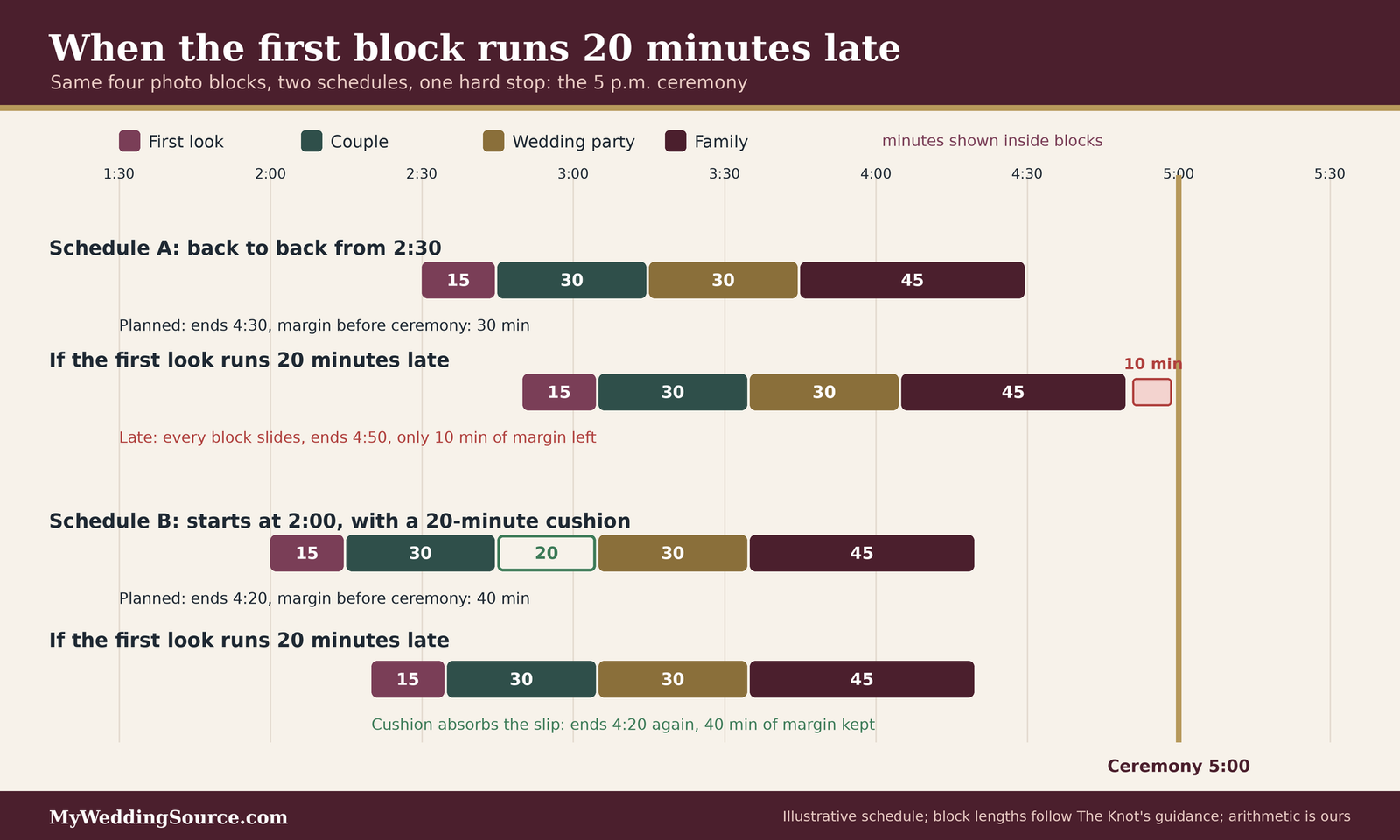
Try this exercise with your wedding vendor timeline. Take the first block of the afternoon and make it twenty minutes late, then slide every later block by the same amount, and look at what lands on a hard stop. Here is an illustrative case that uses published guidance as inputs: a first look of about fifteen minutes (The Knot says a first look takes fifteen minutes at most), thirty minutes of couple portraits, thirty minutes of wedding party photos, and forty-five minutes of family portraits (The Knot suggests keeping family portraits to forty-five minutes to an hour). Back to back from two thirty, the block ends at four thirty, leaving thirty minutes before a five o’clock ceremony. A twenty-minute slip cuts that margin to ten minutes. Starting at two with a twenty-minute cushion after the portraits instead leaves the schedule intact after the same slip, because the cushion absorbs it. That is our own arithmetic on a hypothetical schedule.
Define the trigger for switching to plan B
A backup plan in a wedding vendor timeline only helps if someone decides to use it, and the decision is hardest to make at the exact moment it is needed. Write the trigger down in advance.
Name who makes the call
Choose one person, by role and by name, who may declare a switch to plan B and change the schedule. It is rarely the couple, who are the least available people on the day. A planner, a coordinator, or a trusted family member works. Write the decision rule into the wedding vendor timeline next to the name: for example, if the ceremony cannot start by a certain time, or if rain is forecast at a certain point, we switch. The rule should be concrete enough that two people reading it would reach the same answer. Our guide to wedding insurance explains what coverage typically does and does not address, and Wisconsin’s guide notes that insurance generally does not cover cancellation for a change of heart.
Write the communication path before the decision is urgent
When plan B is triggered, vendors need to hear it from the same person, in the same words, within minutes. Create a short call tree: the decision owner tells the planner or coordinator, who messages the vendors in one group thread, who confirm receipt. Collect mobile numbers for every vendor lead and a second contact at each company, and print the list. If everyone is communicating by text during the event, agree in advance who answers. The point of the path is that no vendor learns a major change from a guest.
| Trigger | Impact | Owner | Fallback | Communication |
|---|---|---|---|---|
| Rental delivery arrives late | Tables and chairs not ready for florals and caterer | Planner or venue manager | Reorder load-in so florals start in a finished area; ask the rental company for a revised arrival | Text to florist and caterer within minutes |
| Hair and makeup runs long | Photos and ceremony start slip | Planner | Cut or shorten the first-look block, not the family portraits | Message to photographer and bridal party |
| Sound check fails | Ceremony audio unreliable | DJ or band lead | Backup microphone; move the officiant closer to the speaker | Quick note to officiant and planner |
| Cocktail hour too short for the flip | Guests wait outside the reception room | Venue manager | Extend cocktail hour with extra appetizers; delay dinner | Tell caterer, band, and photographer |
| Food waits past the two-hour mark | Quality and safety concern for the buffet | Caterer | Rotate fresh dishes; replace anything held too long | Caterer informs planner |
| Vendor meal missed | Tired or absent staff | Planner | Provide boxed meals at the next break | Message to vendor lead |
| Reception runs past venue curfew | Venue fees, rushed strike | Planner or venue manager | Move the last song earlier; start vendor breakdown on cue | Announce time to the band and the caterer |
| Rain or heat affects outdoor plans | Ceremony or cocktail hour moves | Named decision owner | Use the plan B space already reserved | Single group message |
Questions to ask venues and vendors before you sign
The best moment to shape a wedding vendor timeline is before the contracts are signed, because afterward every change has a price. The questions below give you language for both venue tours and vendor calls. Ask for the answers in writing and save them with the contracts.
Questions worth asking before you sign
- During which hours do vendors have access to the venue, and what are the loading and parking rules?
- Is there a freight elevator, cart, or dock, and are there stairs that block equipment?
- What is the curfew for the end of the event, and by what time must every vendor be out?
- How long does a flip from ceremony to reception take in this space, and who does it?
- Does each vendor require a meal, and how is it priced?
- What is the hourly rate for overtime, and who must approve it on the day?
- How soon before the wedding do you want the final timeline, and in what format?
- Who is our on-site contact for each company, and what is the backup number?
Ask the venue
The venue controls the clock for every other vendor, so its answers shape the whole schedule. Treat the tour as an information-gathering visit and take notes on times, doors, and distances.
Access and rules
Ask what hours the venue is yours, whether early access costs extra, and whether a second event may be in the building before or after yours. Ask whether the venue requires approved vendors, certificates of insurance, or rules about open flames, amplified music, or outside catering. We did not find a single national standard for these, so the venue’s written policy is the only authority that counts. Take photos of the loading route.
Contract language
Read the venue contract for the words that set the wedding vendor timeline: access, load-in, load-out, curfew, and overtime. If anything is described only verbally, ask for it to be added. The Better Business Bureau advises putting every promise in writing. Ask for the venue’s own sample wedding vendor timeline, since many venues have seen the same problems many times and can tell you what has worked. Our guide to venue questions offers a longer list for tours.
Ask each vendor
Vendors know how long their work takes. Ask them for numbers in plain terms and compare the answers against the sources in this guide.
Time commitments
Ask for the arrival time, setup duration, finish time, and any break they need, so each entry in the wedding vendor timeline comes from the vendor and not from a guess. Ask how many people will come, because a larger team shortens setup but raises the meal count. Ask for the longest delay they have seen at a wedding like yours and what they do about it. If a vendor cannot explain how long their setup takes, that is information worth having before you sign. The cost and the wedding vendor timeline are related, and our wedding budget calculator can help you test the effect of extra hours.
Changes, overtime, and cancellation
FindLaw’s overview notes that cancellation fees often rise as the event date approaches, and that additional charges can include travel, parking, and staff meals alongside overtime. Ask how a change in start time is handled, whether a shift of an hour is free, and what the penalty is for a late finish. Ask whether the vendor will provide a substitute if someone is ill. Contract language varies, and this is general education, not legal advice, so ask an attorney if a clause is unclear.
FAQ: wedding vendor timeline questions
Planning and setup for a wedding vendor timeline
How far in advance should a wedding vendor timeline be finished?
The Knot suggests finalizing the schedule about a month before the wedding and confirming it about a week before. The Better Business Bureau advises confirming vendor details one to two weeks out. A practical approach is to send a draft six weeks out, collect comments, and send the final version a month out, then confirm again in the last two weeks.
How early should vendors arrive?
It depends on the vendor. In The Knot’s sample for a five o’clock ceremony, rentals arrive first thing in the morning, florals around ten thirty, and hair and makeup at eleven. Minted describes load-in as taking about four to six hours. Ask each vendor how long its setup takes and add a buffer for delays.
Do vendors need a meal?
Not always. The Knot says photographers, videographers, and planners need dinner and often eat in shifts, while vendors who are on site for only a few hours may not need one. Joy recommends adding vendor meals to the catering headcount. Ask each vendor whether a meal is included, requested, or unnecessary, and put the number in writing in the wedding vendor timeline.
What belongs in a wedding vendor timeline besides arrival times?
Include arrival and finish times, loading instructions, on-site contacts, meals, any equipment tests, the flip between ceremony and reception, the last song, and the strike plan. Add the venue’s access hours, curfew, and parking rules. Our suggestion is to note who is responsible for each item so that every task has an owner.
Contracts and problems
What should vendor contracts say about the wedding vendor timeline?
For a wedding vendor timeline, Wisconsin’s consumer guide advises putting costs, delivery dates, and key details in writing, including how long a photographer will work and who delivers and transports flowers. The Better Business Bureau adds rental length and overtime charges. Ask each vendor to state the start and finish times and what happens if the day runs long.
What is a reasonable buffer between blocks?
Published advice varies. Minted suggests padding each item by at least five minutes, sometimes ten to fifteen, while Joy recommends thirty-minute buffers between major blocks. The Knot describes a rule of thumb where a five-minute task takes about thirty on a wedding day. Use more buffer before hard stops such as sunset, curfew, or a vendor’s finish time.
How long can food sit out at the reception?
The FDA says perishable food left at room temperature should be discarded after two hours, or after one hour when the room is above 90 degrees Fahrenheit. It also advises keeping hot food at 140 degrees or warmer and cold food at 40 or colder. Your caterer’s licensed practices apply first, so ask how service is paced.
What if a vendor runs late on the day?
Use the plan you wrote into your wedding vendor timeline. The named decision owner checks which later blocks are affected, uses a fallback if one exists, and tells everyone in one message. If the vendor’s delay costs you time, ask afterward what the contract says about it. This is general information and not legal advice, so check your own contract.
Your next steps
Build the first draft
Collect the hard dates
Start your wedding vendor timeline by opening every contract and listing each deadline, delivery date, and finish time in one place. Add the venue’s access hours and curfew. Then add the dates that are not in contracts, such as the marriage license waiting period and fitting deadlines. Our wedding planning guide and how to plan a wedding pages can help you place those items in the larger plan.
Draft the vendor schedule backward
Draft the wedding vendor timeline from the moment guests arrive and subtract each vendor’s setup time, then subtract a buffer. Add a meal slot for each vendor that needs one, a flip block if the room changes, and a strike plan with owners. Send the draft to every vendor and ask for comments within a week.
Test and share it
Run the late-block exercise
Slide your first afternoon block of the wedding vendor timeline twenty minutes later and watch what lands on a hard stop. Add a cushion where it breaks, and write the plan B trigger and owner next to the highest-risk items.
Send one version
Finalize the wedding vendor timeline about a month out, label it with a date, and send the same file to everyone. Confirm with each vendor one to two weeks before the wedding, and print copies for the planner, the venue contact, and the vendor leads. Our wedding etiquette guide covers tipping and thanking vendors, and our wedding party costs guide can help if the day-of plan involves your attendants.
Sources & methodology
How we built this guide
What we relied on
This guide draws on federal food-safety guidance for serving food at gatherings, consumer-protection guidance from a state agency and the Better Business Bureau, a legal overview of vendor contract terms, and sample schedules and advice published by wedding publishers. Where a statement comes from a publisher’s sample, we attribute it, because a sample is an illustration and not a standard. The arithmetic on photo-package end times, hair and makeup hours, vendor-meal cost, and the late-block exercise is our own and is labeled as an estimate or a hypothetical.
What we did not do
We did not survey vendors or test any wedding vendor timeline at live weddings, and we did not find a national rule for load-in, sound checks, permits, or noise limits. Those depend on your venue, your city, and your contracts. Nothing here is legal, insurance, or food-safety advice for your specific event. Ask the venue and each vendor for written terms, and ask a qualified professional if a clause is unclear. Some timing details come from the publishers’ own pages and may change.
Source list
Government, consumer-protection, and legal sources
- U.S. Food and Drug Administration, Serving safe buffets: https://www.fda.gov/food/buy-store-serve-safe-food/serving-safe-buffets
- University of California Agriculture and Natural Resources, Food safety for parties and large groups (FoodSafety.gov material): https://ucanr.edu/node/134344
- Wisconsin Department of Agriculture, Trade and Consumer Protection, Avoiding Wedding Catastrophes: https://datcp.wi.gov/Pages/Publications/Wedding219.aspx
- Better Business Bureau, Wedding tips: https://www.bbb.org/article/money/16783-bbb-wedding-tips
- Better Business Bureau, Weddings: key dates: https://www.bbb.org/article/news-releases/19283-weddings-key-dates
- FindLaw, Common wedding vendor contract terms you should know: https://www.findlaw.com/legalblogs/law-and-life/common-wedding-vendor-contract-terms-you-should-know/
- National Oceanic and Atmospheric Administration, NOAA Solar Calculator: https://gml.noaa.gov/grad/solcalc/
Wedding publisher sources
- The Knot, Wedding timeline: https://www.theknot.com/wedding-timeline
- Minted, Wedding day timeline: https://web.minted.com/wedding-ideas/wedding-day-timeline
- Joy, Wedding day mistakes to avoid: https://withjoy.com/blog/wedding-day-mistakes-to-avoid-4/