
Wedding kids meals look like a small line on the catering invoice, but they decide whether the youngest guests eat safely, whether the parents get to sit down, and whether the final bill matches what you thought you agreed to, so the age cutoff, the plate, and the vendor terms are worth settling in writing.
Quick answer
Published caterer policies do not agree on who counts as a child. The four we found in the United States range from “under three is free” to “twelve and under,” and some say nothing at all about toddlers or about children eleven and older. Ask your caterer for the age range, the price rule, the plate, the allergy process, and the headcount rule for wedding kids meals in one written document. Then taste the actual plate for wedding kids meals, check how it is cut for small mouths, and see how long it sits before it reaches the table. Nothing here is medical or legal advice, and no caterer can honestly promise a food-allergen-free plate.
What wedding kids meals are, and what they are not
When a couple says they want wedding kids meals, they usually mean three different things at once. They mean food a child will actually eat, a price that is lower than an adult plate, and a way to count small guests without arguing about it later. A caterer may mean something narrower: a specific menu, offered to a specific age range, at a specific price, with specific rules about the guest count. Most of the confusion about wedding kids meals comes from those two definitions not matching.
The three jobs a children’s plate does
A good plan for wedding kids meals has to do three jobs, and it helps to name them separately because they pull in different directions.
Feed a child who may not like surprises
Many young children eat a short list of foods and refuse the rest, and a reception is not the place where most of them feel adventurous. They are dressed up, tired, surrounded by strangers, and often past their usual dinner time. A plain, recognizable plate is a kindness to the child and to the parent, who would otherwise spend the toast cutting up food nobody will eat. The point of the menu is less about the food being “for kids” and more about it being familiar, mild, and easy to eat without a knife.
Keep the table moving
Parents of small children often cannot relax until the child is fed. If the kids’ plates arrive late, the parents hover, the dance floor stays empty, and the family photo schedule slips. A plate for wedding kids meals that comes out early, or that is ready the moment the guests sit down, is as much a scheduling tool as a food choice. We come back to timing later, because it is one of the cheapest things to fix and one of the most often skipped.
Keep the invoice honest
The third job is financial. Children’s pricing varies between caterers, and the rule that produces the final number can be a flat rate, a percentage off the adult plate, a free tier, or all three. Our guide to wedding catering cost covers how catering invoices are built in general. For children, the specific risks are an age band that does not match the ages of your actual guests and a headcount rule that charges you for children who do not show up.
Where the term gets slippery
The phrase “kids meal” covers at least two different products, and caterers do not always say which one they mean.
A separate children’s menu versus a reduced-price adult plate
Some caterers offer a distinct children’s entree, such as chicken tenders or macaroni and cheese, at a flat price. Others simply charge less for a child to eat the same food as an adult, either as a smaller plated portion or from the buffet. Those are not the same purchase. The first gives you a different menu and often a fixed price. The second gives you adult food in a smaller size, which suits an adventurous eight-year-old and may not suit a three-year-old at all. Ask which one you are being quoted before you compare prices.
Children’s pricing on a buffet
On a buffet there is no plate to shrink, so caterers usually discount the per-person buffet price for children and let them serve themselves. That can work well for older children and badly for the youngest ones, who need an adult to build the plate, cut the food, and carry it. If you are weighing a buffet, our guide to wedding catering service planning explains how the service style changes staffing and timing, and the same logic applies to the children at your event.
Age cutoffs: what caterers actually publish
There is no universal rule for when wedding kids meals end and an adult plate begins on a catering invoice. We looked at the public wedding pricing sheets and packets of four U.S. venues and caterers and at one Australian consumer-advice page that quotes several caterers. We are describing what each document says, not recommending any of them, and the dates and prices on them may have changed since they were posted. Treat them as examples of how the question gets answered, not as a benchmark.
Four published policies side by side
The four U.S. documents answer the age question for wedding kids meals in four different ways. The figure below draws their stated age bands on one ruler, and the gaps in the drawing are as informative as the colored bars.
A free tier for the youngest, a flat charge for the middle
A botanical garden’s wedding catering estimate sheet says children under three are free but that the caterer still needs a count, and it lists children three to ten as charged, with a rate that starts at eighteen dollars per person. The sheet does not say what happens to children eleven and older. A second venue’s wedding menu lists a children’s meal for ages three to ten at fifteen dollars and ninety-five cents, with chicken tenders, macaroni and cheese, and fruit. That document does not address children under three or over ten, and it does not say whether the children count toward the guest total.
A half-price rule and a sliding discount
A lodge’s 2025 wedding dining packet prices children twelve and under in two ways. A child can eat a half-size plated entree or the buffet at half price, or can choose a child-friendly entree such as chicken fingers, macaroni and cheese, cheese pizza, or plain pasta for a flat twelve dollars. The packet says wedding kids meals must be included in the final guest count. An inn’s wedding packet uses a sliding scale: children two and under are free, children three to seven get fifty percent off adult prices, and children eight to twelve get thirty percent off.

What an Australian caterer survey adds
An Australian wedding-advice page that collects answers from several caterers shows the same spread. Caterers on it describe cutoffs at twelve, at thirteen, and “over ten,” with prices that include half price, seventy-five percent of the adult rate for ages five to eleven, a flat rate for ages eight to fourteen, and a per-year-of-age charge. The page also notes that its answers were posted years ago and that cutoffs vary by caterer and menu type. It is not U.S. data, but for wedding kids meals it supports a simple conclusion: ask the caterer, because nobody can tell you the standard.
Reading the gaps in a policy
Once you see the ruler, the next step is to look for what a policy leaves out. A cutoff that names ages three to ten is silent about two years on either side.
The youngest guests
Several policies make children under three free but still ask for a count. That request is practical, because a toddler may need a high chair, a place setting, or a bowl of something soft. If the policy is silent on the under-three group, ask whether a toddler who eats from a parent’s plate still counts toward the guarantee and whether a high chair is available. One of the packets we read asks you to tell staff if you need high chairs during service, which is the kind of detail worth confirming in advance.
The ten-to-thirteen gap
The widest disagreement is at the upper edge. One policy stops at ten, two at twelve, and the Australian examples reach thirteen or fourteen. Some of the Australian caterers say older children and teen boys often eat as much as adults, and one suggests counting them that way. If you have guests who are eleven to fourteen, you cannot assume the price for wedding kids meals applies. Ask what the policy says on the day of the event, not on the date you sign.
Choosing a cutoff for your own guest list
You will probably be handed the caterer’s age bands, but you still decide how to apply them to your own guests, and a few habits prevent trouble.
Decide by the child, not just by the birthday
A tall eleven-year-old and a small eleven-year-old may eat very differently. If your list includes children near the cutoff, tell the caterer in advance and ask whether a parent can request the adult plate for a child who will eat it. Putting the decision in writing avoids a surprise adult charge for a child who was counted as a child, and it prevents a hungry child from being served a portion built for someone half their size.
Handle teens as adults unless told otherwise
Treating teenagers as adults for food, drinks, and seating, rather than offering them wedding kids meals, is the safer default for most receptions. It also matches how most of the policies above stop at twelve or earlier. If you want a middle option, such as a reduced-price adult plate for teenagers, ask whether the caterer offers one rather than assuming it exists. The question of who is invited at all is a separate matter; see our guide to child-free wedding etiquette if you are still deciding that.
Menu choices for wedding kids meals
Once the age band is settled, the menu for wedding kids meals is the part most couples enjoy, and it is also where small details quietly matter: the size of each piece, the temperature, and whether the plate arrives at a moment the child can sit still for it.
The plate: three ways to build it
Caterers tend to offer one of three structures for wedding kids meals, and each suits a different child.
A dedicated children’s entree
The published examples above name the usual suspects: chicken tenders or fingers, macaroni and cheese, cheese pizza, plain pasta, and fruit on the side. The appeal is predictability. A child who has eaten macaroni and cheese a hundred times will eat it at a wedding, and a parent can see at a glance what is on the plate. The limitation is that a plate built from breaded and cheesy foods can be heavy on a long evening, so it is fair to ask whether a vegetable or fruit is included, as the first venue above does with fruit.
A smaller version of the adult entree
A half-size plated entree suits a child who likes what the adults are eating, and it spares the caterer from running a second menu. The trade-off is that sauces, spices, bones, and garnishes come along with the adult dish. Ask the kitchen whether the smaller plate can be served with the sauce on the side and with the protein cut into small pieces, and whether the portion really is half, or simply a few bites fewer.
Buffet access with an adult filling the plate
Letting children eat from the buffet at a reduced price is the simplest structure for the caterer and the most hands-on for the family. It works best for children old enough to serve themselves with help and for tables where an adult is happy to build plates. For toddlers, it is usually better to ask for a small separate plate that can be brought to the table, since a buffet line is a poor place to hold a hungry two-year-old.
How much food is a child’s portion?
Couples often ask how big wedding kids meals should be, and caterers rarely publish a number. A public benchmark exists, but it was built for a different purpose, so use it with care.
What the USDA child-care benchmark is, and is not
The U.S. Department of Agriculture’s Child and Adult Care Food Program sets minimum serving sizes for meals served in child-care programs. It is a reimbursement standard for those programs. It is not a rule for weddings, and a caterer has no obligation to follow it. We use it here only because it is a published, age-based reference for what a nutritionally complete child’s lunch or supper contains, and it gives you a way to compare a plate against a neutral yardstick.
The numbers for three age groups
For lunch and supper, the USDA’s minimums for ages one to two, three to five, and six to twelve are shown below, and the figure draws them to scale within each row.
| Component | Ages 1-2 | Ages 3-5 | Ages 6-12 |
|---|---|---|---|
| Fluid milk | 4 fl oz | 6 fl oz | 8 fl oz |
| Meat or meat alternate | 1 oz equivalent | 1.5 oz equivalent | 2 oz equivalent |
| Vegetables | 1/8 cup | 1/4 cup | 1/2 cup |
| Fruit | 1/8 cup | 1/4 cup | 1/4 cup |
| Grains | 1/2 oz equivalent | 1/2 oz equivalent | 1 oz equivalent |
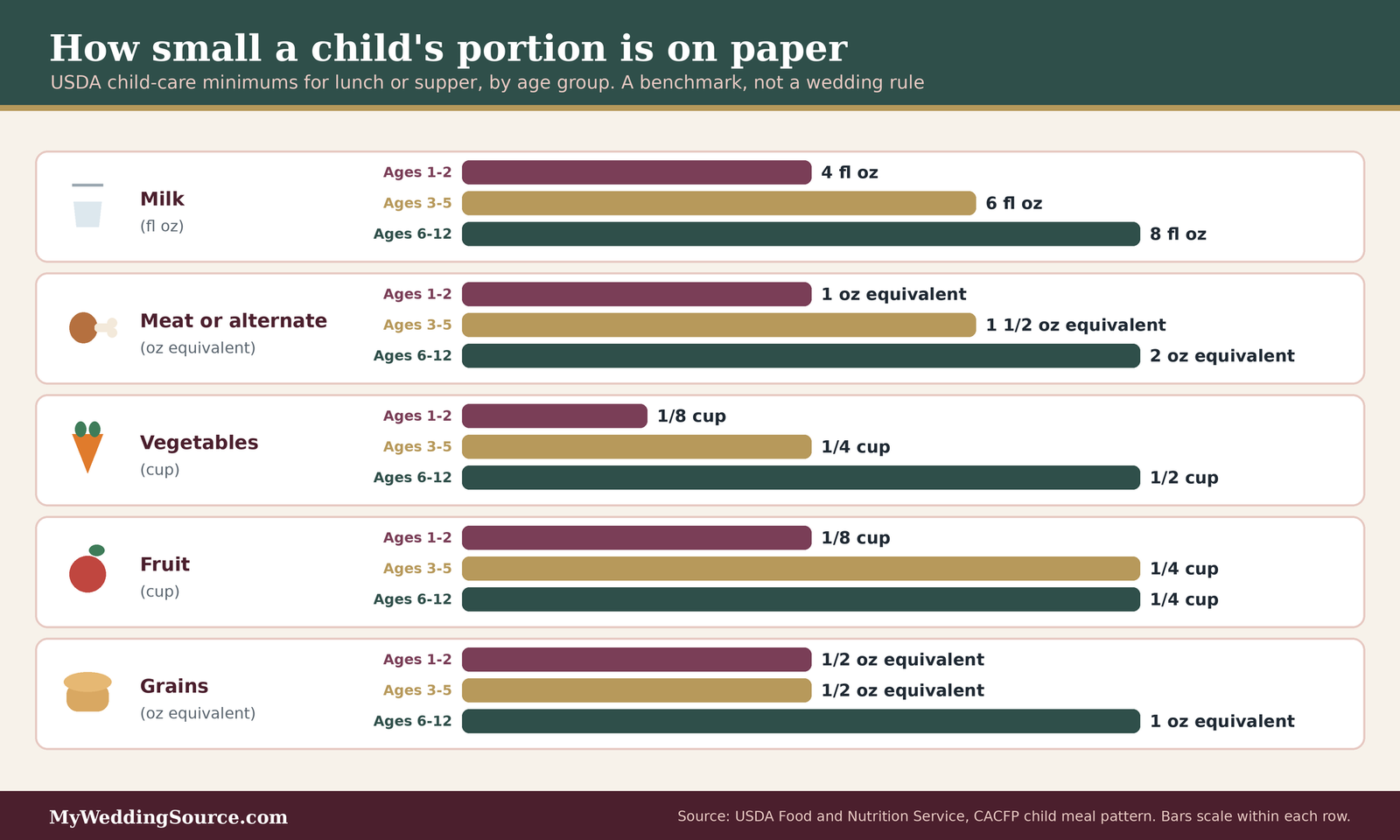
Read the table as a sanity check on wedding kids meals, not a target. A plate of three chicken tenders and a scoop of macaroni may exceed the meat and grain minimums while falling short on vegetables, and a reception plate is a celebration meal, not a nutrition audit. What the benchmark does show is that the amounts are small. If a caterer proposes a plate that looks like a full adult entree for a four-year-old, expect waste and ask whether a smaller portion is offered.
Drinks, dessert, and everything around the plate
Wedding kids meals include more than the entree, and the extras are where hidden charges and avoidable problems tend to appear.
What the child drinks
Ask whether the price of wedding kids meals includes milk, juice, or water, and whether the beverage service for children is separate from the adult bar. If you are serving a non-alcoholic option for everyone, our guide to wedding mocktails has ideas for drinks that do not look like they belong to the children’s table. The USDA table above lists milk as a standard component of a child’s meal, so it is reasonable to ask whether milk is available if a parent requests it.
Cake, dessert, and the sugar question
Cake is usually served to everyone, and the price of wedding kids meals rarely covers it separately. Confirm that the child’s price includes a slice, or that cake is priced by the slice regardless of age. For planning slice counts, see our guide to wedding cake servings. If dessert tables or stations are part of your plan, ask whether children can reach them without a parent, because that affects both allergen safety and the amount of sugar consumed before a late bedtime.
Choking hazards and food safety for young guests
This is the part of wedding kids meals that is most easily overlooked, because the menu looks harmless. Foods that are routine for adults can be a real hazard for the youngest children, and receptions are busy, noisy, and full of distractions.
Foods to change for small children
The U.S. Centers for Disease Control and Prevention publishes a list of foods that are choking hazards for young children, and the American Academy of Pediatrics gives similar advice. We summarize the overlap here. Neither source is a substitute for advice from your child’s doctor, and both lists note that they may not include every hazard.
The high-risk list
CDC’s list for young children includes whole or uncut grapes, berries, cherries, and melon balls, raw carrots and hard apple pieces, whole nuts and seeds, chunks of nut butter, hot dogs, sausages and meat sticks, large chunks of cheese, popcorn, chips, pretzels, and hard, round, or sticky candy. The AAP advises holding back the highest-risk foods until a child is four or older, depending on development, and says round firm foods such as hot dogs and grapes should only be served chopped into very small pieces. Several items on that list are common at weddings: grapes on a fruit plate, nuts at a cocktail hour, and candy in favors.
How food should be cut
The AAP’s guidance for infants and young children is to cut food into pieces no larger than one-half inch. That is a specific, checkable instruction, and it belongs in your conversation with the caterer. Ask whether chicken tenders for the youngest children can be cut, whether fruit is served in small pieces rather than whole, and who will do the cutting. In a plated dinner the kitchen can do it. On a buffet it falls to the parent.
Supervision at the table
Food preparation is only half of the advice from both organizations. The other half is about how the child eats.
Seated, calm, and watched
CDC advises that children sit upright when eating, that they not eat while walking, crawling, or lying down, and that adults watch them at all times while they eat. AAP adds that many choking incidents happen when older siblings hand foods or small objects to younger children. A wedding reception, with its dance floor and its running cousins, is a setting where those rules are hard to keep. Seat families with small children near an exit and away from the busiest part of the dance floor, and tell parents where the children’s plates will be served.
A note for the venue and the planner
Share the choking and supervision guidance for wedding kids meals with whoever manages the room. If the reception includes a candy bar, a nut-heavy appetizer, or favors with small hard candy, a coordinator can position them out of the reach of toddlers or flag them for parents. This is a planning courtesy, and your caterer is not a pediatrician. Parents remain responsible for what their own children eat.
Temperature and time on the plate
A children’s plate often needs to reach the table quickly, so it may be prepared early. That can make it the plate most at risk of sitting too long.
The danger zone and the two-hour rule
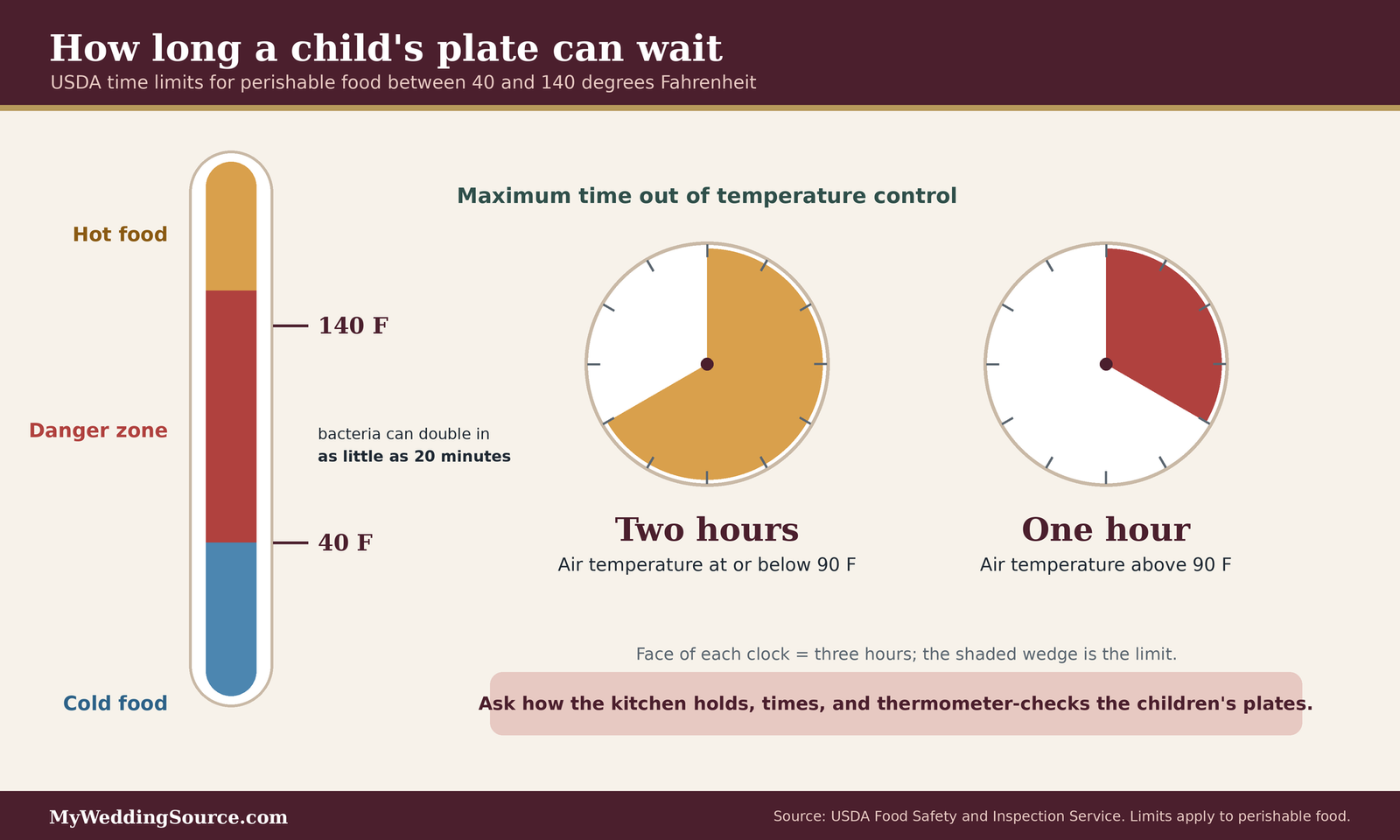
The USDA’s food safety service describes the temperature danger zone as 40 to 140 degrees Fahrenheit, where bacteria multiply fastest, and says they can double in as little as twenty minutes. Its guidance is that perishable food should not sit in that range for more than two hours, or more than one hour when the air temperature is above 90 degrees. Cold food should be kept at or below 40 degrees and hot food at or above 140 degrees. These rules apply to every plate, but they matter most for wedding kids meals that are prepared early and held.
What to ask about holding and serving
Ask how and where the plates for wedding kids meals are held before service, whether hot items stay in warming equipment, and whether the kitchen checks temperatures with a thermometer. For outdoor or summer weddings, ask how the caterer manages the one-hour limit. Our guide to the summer wedding heat plan covers shade, ice, and timing for hot days. A reasonable caterer can answer these questions in a sentence. A vague answer is information.
Food allergies and dietary needs for children
Allergies are the single most important reason to treat wedding kids meals as a safety question and not only a menu question. We are not clinicians and nothing here is medical advice. What follows is how to structure the conversation so that the people who know the child’s condition, the parents, and the people who control the kitchen, the caterer, actually talk to each other.
What labels and lists can tell you
Most caterers will have an allergy policy of some kind, and for wedding kids meals it helps to know what the federal rules do and do not cover.
The nine major allergens
The FDA identifies nine major food allergens: milk, eggs, fish, crustacean shellfish, tree nuts, peanuts, wheat, soybeans, and sesame. Sesame became the ninth under the FASTER Act of 2021, with its labeling requirement taking effect on January 1, 2023, and the FDA notes that products already on shelves before then did not have to be relabeled. HealthyChildren.org, from the AAP, lists the same nine as the common triggers in children and says peanuts, tree nuts, milk, and sesame cause most severe reactions. For context on how common the problem is, a CDC data brief reported that food allergy prevalence among U.S. children rose from 3.4 percent to 5.1 percent between 1997-1999 and 2009-2011. That figure is more than a decade old, and we cite it only to show the problem is not rare.
What packaged-food labels cover, and what they do not
Federal labeling rules apply to packaged foods. The FDA says allergen sources must be declared at least once, either in parentheses after an ingredient or in a “contains” statement, and that “may contain” advisory statements are voluntary. It also notes that most unpackaged retail foods fall outside these labeling rules. A plated wedding meal is unpackaged. That means a label on a case of frozen chicken tenders in the caterer’s storeroom is not a guarantee about what ends up on your child’s plate, and the conversation has to cover the kitchen, not just the ingredients.
What to ask the caterer
Good questions are specific. They also leave room for the caterer to say “we cannot promise that,” which is the honest answer in many kitchens.
Ingredients, cross-contact, and who prepares the plate
Ask which allergens the kitchen can accommodate, which it cannot, and how the plate is prepared. Cross-contact happens when an allergen transfers from one food to another through shared surfaces, utensils, or oil. One lodge packet we read states that its facility is not certified nut-free, gluten-free, or dairy-free and that trace contamination is possible, which is a useful example of an honest disclosure. If a caterer cannot describe how a safe plate is made, treat that as the answer.
Who tells whom, and when
Decide in advance how the allergy information travels. A written list from the parents to you, from you to the caterer, and from the caterer to the servers is better than a verbal reminder on the day. Ask whether the child’s plate is marked at the kitchen and delivered by a named person, and whether the table’s server knows which child has the allergy. The same lodge packet asks guests with allergies to notify their server during service, which puts the burden on the guest, so ask whether your caterer adds a process of its own. Our guide to wedding dietary restrictions covers collecting this information from adult guests too.
Why parents should still bring their own plan
No caterer should be asked to be the only safeguard. HealthyChildren.org advises families to keep a written allergy and anaphylaxis plan for any time a child is away from home, and says epinephrine is the main treatment for severe reactions and should be given right away, followed by a call to 911. The FDA also advises anyone with a known food allergy who develops symptoms to stop eating and seek medical care. A parent who brings medication, knows where the nearest adult who can help is seated, and has told that adult the plan, has done more for the child’s safety than any menu change.
Religious and cultural dietary needs for children
Dietary rules are not only about allergies, and wedding kids meals have to honor them too.
Ask the parents what the rule actually is
For wedding kids meals, families interpret religious dietary rules in different ways, so ask the parents what they need rather than guessing from the family’s background. A request for a halal or kosher-style plate can mean very different things, and you should never promise certification you cannot document. Our guides to a halal menu with mixed dietary needs and a kosher-style menu explain how to describe what you are offering accurately.
Vegetarian, vegan, and medical diets
A vegetarian child’s plate is easy for most caterers, but confirm what it contains, because some pastas and sauces include animal products. Children on medically prescribed diets, such as a gluten-free diet for celiac disease or a textured diet for a swallowing difficulty, need a direct conversation between the parents and the caterer. We do not give medical guidance here. Our role as the hosts is to make sure the question is asked early enough that the kitchen has time to answer it.
When children eat: timing and seating
The best wedding kids meals still fail if the child sits down at the wrong moment. Timing and seating are free to change and cost nothing but a conversation with the caterer and the planner.
When the children’s plates arrive
You have two realistic choices, and the right one depends on the format of your dinner.
Serve children first or at the same time as the adults
Serving the children’s plates ahead of the adult entrees means the children are fed, quiet, and ready to move before the toasts begin. The cost is that a child who finishes early may be bored while the adults are still eating. Serving at the same time keeps the table social but leaves the parents to manage a hungry child through the first course. Some families prefer the early option, and it is worth asking the caterer whether the kitchen can plate the children’s entrees ahead of the main service. In a family-style dinner, see our notes on family-style service for long tables for how shared platters work with children.
What to do about the youngest children
A child under three may not eat a plated meal at all. Ask the parents what they will bring and tell the venue, because some venues restrict outside food and others make exceptions. If outside food for a baby or toddler is allowed, put that permission in writing, and ask where a bottle can be warmed or a pouch can be kept cold. Our guide to wedding vendor meals explains how venues and caterers handle other categories of outside food, which can help you frame the request.
A kids’ table, or families together
The seating question affects the meal, because children who are seated away from their parents are also eating away from the person who would cut their food.
The case for a separate children’s table
A children’s table can give older children a sense of occasion, keep their noise in one place, and let parents sit together as a couple. It works best for children who are old enough to be without a parent for the length of dinner, and when one adult, such as an older cousin or a hired sitter, is assigned to the table. For the youngest children, the choking and allergy guidance above argues against placing them out of an adult’s sight.
The case for family tables
Seating children with their parents keeps small guests supervised and makes it easier for a parent to cut food and watch for allergens. The cost is that the parents’ dinner is interrupted. A compromise some couples use is to seat the youngest children with parents and to give the older children their own table nearby. For the planning mechanics, see our guide to the wedding seating chart, and if any child has sensory needs, the guide to low-stimulation wedding dining areas covers quieter spaces.
Vendor terms to read before you sign
The terms are where wedding kids meals turn into money. Three kinds of clause matter: how children are counted, how they are priced, and what happens when something changes. For the general approach to contracts, see our guides to vendor due diligence and contract change orders.
Counting and guarantees
A headcount clause for wedding kids meals that treats children differently from adults is a common source of disagreement, and the published packets show how varied the rules are.
Do children count toward the guarantee?
One packet we read says children’s meals must be included in your final guest count. Another says the guaranteed count is due five business days before the event and cannot be reduced, and that you pay for the greater of the guarantee or the number served, unless the contract sets minimum meal requirements. The packet does not say whether children are part of that guarantee, which is exactly the type of gap to close in writing. Ask: if a child who was counted does not attend, do we still pay for the plate?
The free tier still needs a number
The botanical garden sheet makes wedding kids meals free for children under three but asks how many there will be. That is sensible, since the kitchen may need a chair, a place setting, or a small portion. When a free tier exists, ask whether the free children appear on the guarantee at zero dollars, and whether they are covered by the same final-count deadline as everyone else.
Fees on top of the plate
A child’s price is rarely the whole story, because fees and taxes are added to the base number.
Service charges and taxes
The venue menu we reviewed lists a service charge of twenty percent and taxes as additional costs but does not say whether they apply to the children’s price. The botanical garden sheet states that its estimate does not include taxes and that gratuity will not be added to the invoice. These are two different answers to the same question. Ask for the price of wedding kids meals with service charge and tax included, so that you compare totals, not base prices.
Outside food, shared plates, and extras
Ask whether a parent may share a plate with a toddler, whether a child who wants an adult plate can swap at the table, and whether outside food is ever allowed for medical or allergy reasons. The lodge packet says it provides all food and beverages except wedding cakes and that leftovers cannot leave the premises, so a child’s uneaten plate cannot be boxed up. Policies like that are routine, but they surprise people at the end of the evening.
Changes, swaps, and the day-of rules
Contracts get amended. What matters is whether the terms for wedding kids meals can be amended without penalty.
Which date sets the child’s age
Ask whether a child’s age is measured on the date you sign, the date of your final count, or the date of the wedding. A child who turns eleven between the contract and the event can change the price band. Put the rule in the contract and, if possible, add a sentence that a parent may choose either plate for a child within a year of the cutoff.
Menu swaps and late changes
Ask how late you can change one of the wedding kids meals, for instance when a child develops a new allergy or a family cancels. A written change order is better than a verbal promise on the phone, and it should say who pays if the change affects the final count.
A tasting scorecard for the children’s plate
Most couples taste the adult menu and never see the plate for wedding kids meals, which means the one dish that will be served to the pickiest and least forgiving guests is the one nobody has tried. This section is the working tool of the guide: a scorecard you can bring to a tasting, with service measures a caterer can answer in numbers. The scoring system is our own, built from the sources above. It is not an industry standard.
Setting up the tasting
A tasting of wedding kids meals takes ten extra minutes if you ask for it in advance.
Ask for the plate by name
When you book a tasting, ask the caterer to include the children’s entree, the half-size adult plate, and the vegetarian option, if you are offering them. Our guide to wedding caterer tastings explains how to run the main tasting. For the children’s plate, the extra request is simply to see it plated the way it will be served, not on a sample tray.
Bring a child, or a child’s eyes
If a child you know is willing, let them taste. If not, taste it as a tired child would: lukewarm, with the sauce already soaked into the bread. Cut a piece and see how large it is against the half-inch guidance, and bend a tender to see whether it is tough. A plate that holds up lukewarm is a plate that will survive a real reception.
Scoring the plate and the service
Score each line from zero to two, where zero means the caterer cannot answer or the plate fails, one means a partial answer, and two means a clear answer in writing or a plate that passes. Ten lines give a total out of twenty.
| Line | What you check | Two points if |
|---|---|---|
| Age band | Written age range and price rule | It states ages, the price rule, and the date the age is measured |
| Plate content | What is actually on the plate | It includes a protein, a starch, and a fruit or vegetable the child recognizes |
| Piece size | A ruler against the food | Pieces for young children are about one-half inch or smaller, or the kitchen will cut them |
| Plate temperature | A thermometer, if the kitchen allows | Hot food is at or above 140 degrees Fahrenheit when set down |
| Kitchen-to-table time | A stopwatch from the pass to the table | The plate reaches the child within a few minutes of leaving the pass |
| Serve order | When children’s plates go out | Children are served before or with the first adult entrees, by agreement |
| Allergy process | Who prepares and delivers a flagged plate | The caterer can name each step and says what it cannot promise |
| Substitutions | How a swap works at the table | A parent can change plates without a fee or a long wait |
| All-in price | Child’s price with service charge and tax | The caterer gives one total per child in writing |
| Count rule | How children enter the guarantee | The contract states whether children count and when the number is final |
How to use the numbers
A total of sixteen to twenty is a plate and a service you can plan around. Ten to fifteen means one or two lines need a written fix before you sign. Under ten means the caterer is not ready to serve young children, or has not thought about them yet. These thresholds are our judgment, and they are most useful when you compare two caterers on the same sheet.
Which lines deserve the most weight
Two lines matter more than the rest: the allergy process and the piece size, because those are the lines tied to physical risk. A caterer who scores two on every other line but cannot describe an allergy process is not a good fit for a guest list with an allergic child. Conversely, a caterer with a modest score on price may be a good fit if the safety lines are strong. Give yourself permission to weigh them.
Measures you can ask any caterer for
The scorecard includes several service numbers that sound technical but are simple to request.
Kitchen-to-table time and temperature
Ask the caterer how long a plate takes to travel from the kitchen pass to the table, and how long the first children’s plates wait before the room is ready to eat. The USDA guidance gives a limit of two hours in the temperature danger zone, or one hour above ninety degrees, so any holding time that approaches those limits is a problem. A caterer who tracks times can answer in minutes.
Staffing at the children’s end of the room
Ask how many servers cover the section where children sit, and whether one person is assigned to flagged plates. We do not have a published standard for server-to-guest ratios at weddings, so treat a number as a conversation starter, not a benchmark. What matters is that someone is named.
A worked comparison of two caterers
This is a made-up example to show how the scorecard works. Neither caterer is real, and both are quoting wedding kids meals.
Caterer A: the lower price
Caterer A quotes a flat price for wedding kids meals and offers chicken tenders and fruit. The ages are stated in the quote, the pieces are not cut, the plate is plated ahead and held, and the allergy answer is “tell the server.” On our scorecard, that might earn two points for age band, two for plate content, zero for piece size, one for temperature, one for time, one for serve order, zero for allergy process, one for substitutions, one for all-in price, and one for count rule, for a total of nine.
Caterer B: the higher price
Caterer B quotes a higher price for wedding kids meals but cuts the pieces for children under six, plates the children’s entrees just before the adult service, describes a flagged-plate process, and states that the guarantee includes children. That might score two on most lines for a total of seventeen. The price gap is real, and the scorecard does not tell you whether it is worth paying. It does tell you what the extra money buys.
What wedding kids meals cost, with real arithmetic
Prices for wedding kids meals depend on the caterer’s rule and on your guests’ ages, so a single average would be meaningless. Instead, this section shows you how to build your own number and runs one worked example with a made-up adult price. Everything here is our own arithmetic and an estimate.
What this actually costs
The cost of wedding kids meals is number of children in each age band times the price rule for that band, plus any service charge and tax. Two catering quotes with the same adult price can differ by hundreds of dollars once the children’s rule is applied. Always compare the all-in total for your own guest list, not the per-child headline. Use the figures below as a worked example, not a quote.
Build the number for your guest list
The formula is simple, and the work is in gathering the inputs.
Count children by age band
List every child by age on the event date, then group them using the caterer’s bands. A spreadsheet of five columns is enough: name, age on the wedding date, band, plate type, and price. Our guide to wedding cost per guest explains how to fold catering into a total per-guest figure.
Apply the price rule, then the fees
Apply each band’s rule: free, flat, percentage off, or adult price. Then add service charge and tax if they apply to children. A twenty percent service charge on a children’s total can add up when there are many small guests, so ask whether it applies. The all-in total is the only number to compare.
One example, four rules
Suppose, purely for illustration, an adult plate is one hundred dollars before service charge and tax, and the guest list includes fourteen children: two aged one to two, five aged three to seven, four aged eight to ten, and three aged eleven to twelve. The table applies four published-style rules to that same list. The rules are adapted from the policies described earlier, but the one hundred dollar adult price and the ages are invented.
| Rule | How it applies | Total for fourteen children |
|---|---|---|
| Flat children’s plate | Under three free, three to ten at 16 dollars, eleven and up at adult price | 444 dollars |
| Half price for twelve and under | All fourteen children at half the adult price | 700 dollars |
| Sliding discount | Two and under free, three to seven at half off, eight to twelve at 30 percent off | 740 dollars |
| Adult price for everyone | No children’s pricing | 1,400 dollars |
What the example shows
For wedding kids meals, the spread between the lowest and highest totals is 956 dollars on a guest list with only fourteen children. The flat plate is cheapest partly because it frees the toddlers and sets a low price for the middle band, but it charges adult price to the three oldest children. The half-price rule charges for the toddlers but caps everyone at fifty percent. A larger guest list or a higher adult price would widen the gap, so the difference matters more than it looks.
What the example does not show
The example leaves out the service charge, taxes, the cost of a high chair, and the cost of any adult plate a child eats instead of a children’s plate. It also assumes every child attends, which brings us back to the guarantee: a rule that charges for children who do not show up changes the arithmetic. Redo the table with your own numbers and the caterer’s actual terms before you decide.
Edge cases that break the standard policy
A policy for wedding kids meals is built for an average family and tested by guests who are not average. These are the cases worth thinking about before the contract is signed.
Guests who sit between categories
Not every young guest is a child in the way the policy imagines.
Infants, toddlers, and babies on laps
A baby who does not eat solid food is not a meal, but may still be a person in a chair at a table. Ask whether infants count in the guarantee, whether they are counted in table capacity, and whether the venue has high chairs. Policies like the botanical garden’s ask for a count of children under three even when they are free, so tell the caterer.
Teenagers and the child who eats like an adult
A fourteen-year-old and a ten-year-old are very different eaters, and the Australian examples we read say as much. Treat teenagers as adults, and decide in advance how to handle the child who is just under the cutoff and clearly hungry. A written rule that a parent may choose the adult plate at the child’s price, or at a stated compromise price, avoids a conversation at the table.
Children with a role in the day
Children who take part in the ceremony have a schedule of their own.
Flower girls, ring bearers, and the wedding party
Children in the wedding party often eat early, because they have been in photos and rehearsals since the afternoon. Our guide to flower girl and ring bearer rehearsals covers how to prepare them, and a snack before the ceremony can prevent a hungry child at the aisle. If you want them in matching outfits, see our notes on flower girl dresses. Ask the caterer whether the wedding party’s children can be served early or sit at the head table.
Children of vendors and staff
Photographers, DJs, and musicians sometimes bring a family member, and vendor meals have their own rules. Our guide to vendor meals explains the usual arrangements. A child who arrives with a vendor is not on your guest list and is not covered by your children’s pricing unless the contract says so.
Special situations
A few cases need more than a menu change.
A mostly adult wedding with a few children
If your reception is adult-focused with a handful of children, a separate line for wedding kids meals may not be worth the extra item. A half-size adult plate or a request to the kitchen for a simple dish may be easier. Our child-free wedding etiquette guide covers how to set expectations about who is invited, and our guide to plus-one etiquette covers the related question of guests bringing others.
A weekend of events
If children are invited to a rehearsal dinner, a welcome party, or a brunch, each event has its own food and its own policy. Our guide to wedding weekend event planning explains how to plan the full schedule. Ask each vendor separately rather than assuming one children’s rule applies to every meal.
Questions to ask before you sign
Bring these to the caterer, and ask for the answers about wedding kids meals in writing. Our guide to wedding venue questions has companion questions about the space.
Questions worth asking about children’s meals
- What ages count as children, and which date is the age measured on?
- Is the child’s price a flat rate, a percentage off, or the adult price, and does it include service charge and tax?
- What is on the children’s plate, and can the pieces be cut for young children?
- Can a parent switch a child to the adult plate, and what does that cost?
- How does the kitchen handle a flagged allergy plate, and what can it not promise?
- Do children count toward the guarantee, and what happens if one does not attend?
- When are the children’s plates served, and how are they held before service?
- May parents bring outside food for an infant or toddler, and is that in writing?
About the plate and the rules
These questions turn a general quote for wedding kids meals into a written commitment.
Questions on the menu and portion
Ask to see the plate for wedding kids meals at the tasting, ask how large the portion is, and ask whether a vegetable or fruit is included. If the portion looks like an adult entree, ask whether a smaller one is offered.
Questions on the age rule
Ask the age band, the date of measurement, and what happens to a child who turns a year older before the event. Ask what the policy says about children under three and over twelve.
About safety and service
These questions are the ones to press on, because they touch on safety.
Questions on allergies
Ask who prepares and delivers a flagged plate, how cross-contact is handled, and what the caterer cannot promise. If a caterer says its food is allergen-free, ask how that is verified, and ask for the answer in writing.
Questions on timing and temperature
Ask when children’s plates are served, how they are held, and whether the kitchen checks temperatures. For a hot-weather event, ask how the caterer manages the one-hour limit that applies above ninety degrees.
FAQ: wedding kids meals questions
Ages and pricing
What age should a child’s meal stop at a wedding?
There is no standard. The four U.S. documents we read stop at ten or twelve, and Australian caterers mention up to thirteen or fourteen. Ask your caterer for the age band and the date the age is measured, and treat teenagers as adults unless the contract says something different.
Do babies and toddlers count as guests for catering?
Often they count as a headcount but not as a charge. Some caterers make children under three free yet still ask how many will attend. Ask whether toddlers appear on the guarantee, whether a high chair is available, and whether parents may bring food for a baby, and get the answers in writing.
Food and safety
What should a children’s wedding menu include?
The published examples include chicken tenders or fingers, macaroni and cheese, cheese pizza, plain pasta, and fruit. A balanced plate also has a vegetable or fruit and a drink. Ask the caterer to show the plate at the tasting so you can judge portion size and how it is cut.
Which foods are choking hazards for young children?
CDC lists whole grapes, nuts, hot dogs, chunks of cheese, popcorn, hard raw vegetables, and hard or sticky candy, among others. AAP advises cutting food into pieces no larger than one-half inch and watching children while they eat. Ask your child’s doctor about your own child.
Allergies and diets
Can a caterer guarantee an allergen-free plate?
Be cautious of any caterer that promises it. The FDA says “may contain” statements are voluntary and that most unpackaged retail foods fall outside its labeling rules, and one venue we read states that trace contamination is possible. Ask how the kitchen prevents cross-contact, and ask what it cannot promise.
How do we handle a child with a severe food allergy?
Have the parents give you a written plan and share it with the caterer, and ask the kitchen to flag the plate. HealthyChildren.org says epinephrine is the main treatment for severe reactions and should be given right away followed by a call to 911. Parents should bring their own medication and plan.
Contracts and logistics
Do children count toward the guaranteed headcount?
It depends on the contract. One packet we read says wedding kids meals must be included in the final count, and another sets a guarantee that cannot be reduced and does not mention children. Ask whether children count, when the number is final, and whether you pay for a child who does not attend.
Can children eat from the adult buffet at a lower price?
Many caterers offer that, usually as a percentage off the adult price, such as half price in one packet we read. It suits older children better than toddlers, who need an adult to build and cut the plate. Ask whether a smaller plated portion is available for the youngest guests.
Your next steps
Decide the rules
Write down your own age policy
Choose the age at which a child stops being covered by wedding kids meals for your guests, decide how to treat the child who is just under the line, and list the children by age on the wedding date. Share the list with the caterer so the bands match your guests.
List the allergy and diet needs
Ask parents about allergies, religious rules, and medical diets, and collect the answers in writing. Pass them to the caterer, and agree on who will deliver each flagged plate.
Test and confirm
Taste the children’s plate
Use the scorecard for wedding kids meals at the tasting, bring a ruler and, if allowed, a thermometer, and score each line. For the wider plan, see our guides to wedding catering and the wedding reception.
Put the terms in the contract
Add the age band, the price rule, the guarantee rule, the serve order, and the allergy process for wedding kids meals to the contract, and confirm the all-in price. If dessert stations are part of your plan, our guide to wedding dessert station allergens covers what to ask about them.
Sources & methodology
How we built this guide
What we relied on
This guide combines federal food-allergy and food-safety guidance, pediatric guidance on choking and allergy, the USDA child-care meal pattern, and the public wedding pricing documents of four U.S. venues and caterers plus one Australian consumer-advice page. We read each source in November 2026 and the date checked is November 12, 2026. Prices, ages, and policies in the venue documents may have changed since they were posted, and we describe what each document says without endorsing it. The cost example, the scorecard, and its thresholds are our own arithmetic and judgment, and the one-hundred-dollar adult price is invented.
What we did not do
We did not taste any menu, visit any venue, or speak with any caterer, and we did not verify any caterer’s current prices. We are not medical, legal, or financial advisers. For a child with an allergy, a swallowing difficulty, or another medical diet, talk to the child’s doctor and to the caterer directly.
Source list
Government and public-health sources
- U.S. Food and Drug Administration, Food allergies: https://www.fda.gov/food/nutrition-food-labeling-and-critical-foods/food-allergies
- Centers for Disease Control and Prevention, Choking hazards for infants and toddlers: https://www.cdc.gov/infant-toddler-nutrition/foods-and-drinks/choking-hazards.html
- USDA Food Safety and Inspection Service, Keep clear of the danger zone this summer: https://www.fsis.usda.gov/news-events/news-press-releases/usda-urges-consumers-keep-clear-danger-zone-summer
- National Center for Health Statistics, Data Brief No. 121, Food allergy among U.S. children (May 2013): https://www.cdc.gov/nchs/products/databriefs/db121.htm
- USDA Food and Nutrition Service, Child and Adult Care Food Program child meal pattern: https://fns-prod.azureedge.us/node/21097
Pediatric and advocacy sources
- American Academy of Pediatrics, HealthyChildren.org, Choking prevention: https://www.healthychildren.org/English/health-issues/injuries-emergencies/Pages/Choking-Prevention.aspx
- American Academy of Pediatrics, HealthyChildren.org, Food allergies in children: https://www.healthychildren.org/English/healthy-living/nutrition/Pages/Food-Allergies-in-Children.aspx
Venue, caterer, and consumer pricing documents
- Lewis Ginter Botanical Garden, Wedding catering pricing estimate sheet (2021): https://www.lewisginter.org/wp-content/uploads/2021/07/Wedding-Catering-Pricing-Estimate-Sheet.pdf
- Alta Lodge, 2025 wedding dining packet: https://www.altalodge.com/wp-content/uploads/2024/10/2025WeddingDiningPacket.pdf
- Davian’s, Wedding menu (2021): https://www.davians.com/wp-content/uploads/2021/02/Wedding-Menu.pdf
- Bavarian Inn, Wedding packet (2025): https://www.bavarianinn.com/wp-content/uploads/2025/01/Wedding-Packet.pdf
- Easy Weddings (Australia), How old is the cut-off for kids meals: https://www.easyweddings.com.au/WeddingCaterers/advice/how-old-is-the-cut-off-for-kids-meals