

Wedding catering service planning is the work that begins after you pick a caterer and a menu: deciding how the food will be kept safe, how it will reach each guest in the right order and at the right temperature, how dietary needs travel from your RSVP list to a specific plate, and how many people it takes to make all of that happen without anyone improvising.
Quick answer
Good wedding catering service planning rests on four lanes that share one document: food safety (hold hot food at 140°F or above and cold food at 40°F or below, and watch the two-hour clock, which drops to one hour above 90°F), service timing (a run-of-show built around when food leaves the kitchen, not only around speeches and dances), dietary needs (every restricted plate traced from RSVP to table with a named person responsible), and staffing (a count of tasks and hand-offs, confirmed with your caterer in writing). Ask for the caterer’s own procedures for each lane, put them on one master sheet, and review it at the venue walk-through, a week out, and the morning of.
This guide is about operations, not menus or prices. If you are still choosing between service styles or comparing proposals, start with our wedding catering guide and our breakdown of what wedding catering costs, then return here when you have a caterer and a date. The guide that follows is general information and is not legal, medical, or food-safety certification advice. Your local health department sets the rules that apply to your venue and your caterer, and your guests’ clinicians know their own conditions.
We checked the sources listed at the end of this guide on November 12, 2026. Government pages change, and the temperatures and time limits we quote come from federal agencies and a state health department document, so confirm them against your caterer’s written procedures before the wedding.
Most couples spend their catering energy on tastings, which is reasonable, because flavor is what guests remember. But a menu is only the first half of the job. The second half is invisible when it works: the warming equipment that holds a braise at a safe temperature through a delayed ceremony, the server who knows which plate has no sesame, the hand-off between kitchen and floor that keeps salads cold and entrées hot. Wedding catering service planning is the practice of making that second half explicit.
Why the second half of catering gets skipped
The reasons are ordinary. Menus are tangible and operations are abstract, so the first gets discussed in meetings and the second gets assumed. Caterers also vary widely in how much of their process they volunteer, and a couple who has never watched a banquet kitchen run has no reason to know which questions matter.
The assumption that the caterer handles everything
In most cases a professional caterer does handle most of it, and that is the point of hiring one. The risk lies in the seams: the places where your responsibilities, the venue’s rules, and the caterer’s procedures meet. A caterer may assume the venue provides refrigeration, while the venue assumes the caterer brings its own. A couple may assume a guest’s allergy note on the RSVP reaches the kitchen, while the caterer assumes the planner will send a separate list. Wedding catering service planning means finding those seams before the wedding and assigning each one to a named person.
The cost of finding a gap on the day
In wedding catering service planning, gaps found at a tasting cost an email. Gaps found at 6:40 p.m. on the wedding day cost whatever the nearest fix is, usually a worse version of the original plan. That asymmetry is the whole argument for doing this work early, on paper, with the people who will actually be in the room.
The four lanes this guide uses
To keep a large subject manageable, this guide sorts operations into four lanes. Every task, question, and risk in the sections that follow belongs to one of them, and the master sheet in the next section keeps them side by side.
Safety and timing as one clock
In wedding catering service planning, food safety and service timing look like separate topics, but they run on the same clock. Perishable food has a limited window between the kitchen and the guest, and every schedule decision, from how long cocktail hour runs to whether toasts happen before or after dinner, spends some of that window. We treat them as two lanes so each gets proper attention, but you will see them reference each other constantly.
Dietary needs and staffing as the people lanes
Dietary needs and staffing are the lanes of wedding catering service planning where individual people matter most: the guest who needs a safe plate and the team member who has to put it in front of them. A written list is necessary but not sufficient. Each restricted plate needs a human owner, and each human owner needs to know what the plate is, who it is for, and what to do if something looks wrong.
What this guide does not cover
Menu selection, service style comparison, bar planning, cake design, and pricing are covered elsewhere on this site, and repeating them here would dilute the operational focus.
Where to find the adjacent topics
For service styles and menu choices, see the wedding catering guide. For the guest-facing side of allergies and restrictions, including how to word an RSVP question, see our wedding dietary restrictions guide. For vendor meals, see feeding your wedding vendors. For the whole-day schedule, see the wedding day timeline. This article on wedding catering service planning sits underneath them and concerns itself with what happens in the kitchen and on the floor.
What no article can decide for you
No guide can tell you whether a specific caterer is licensed in your county, whether a specific kitchen passes inspection, or whether a specific dish is safe for a specific guest. Those are questions for the health department, the caterer’s documentation, and the guest’s own clinician. We point to where each answer lives, and we mark anything that is our own reasoning as an estimate or a suggestion.
The operations master sheet: one document for four lanes
The central deliverable of this wedding catering service planning guide is a master sheet you can copy into a shared spreadsheet or a printed binder. Its purpose is to make every operational decision visible, owned, and dated. The sheet below is our own structure, built from the sources at the end of this guide and from the way professional food-safety materials organize responsibilities. It is not an industry standard and no caterer is required to use it, but most will happily respond to it line by line.
How to read and fill in the sheet
The sheet has four lanes, and each lane has items grouped by when they need to be settled. A “done” status means you have the answer in writing, not that someone said it was fine on a phone call.
The three columns that matter
In wedding catering service planning, every row needs three things: an owner (a person, not a company), a deadline (a date, not “before the wedding”), and evidence (an email, a contract clause, a photo of a label, a line on the caterer’s event order). If a row has no owner, assign one. If it has no deadline, set one. If it has no evidence, it is a hope, not a plan.
Who should own which lane
The couple usually owns the dietary lane’s inputs (the guest list and its needs) and the sign-off on the whole sheet. A planner or day-of coordinator, if you have one, usually owns the timing lane. The caterer owns the safety lane’s procedures and the staffing count. The venue owns whatever its contract says it owns, which is why the next section asks you to read that contract for kitchen, power, and refrigeration terms. If you have no planner, a trusted friend or family member can own the timing lane on the day, provided they have the sheet and the authority to hold the schedule.
The master checklist
| Lane | Item | Settle by | Evidence that closes it |
|---|---|---|---|
| Safety | Caterer’s license, permit, and insurance documents (as your jurisdiction requires) | At booking | Copies on file; permit number noted |
| Safety | Cold-holding and hot-holding equipment list for the event | Venue walk-through | Written equipment list matched to menu |
| Safety | Plan for the two-hour (one-hour above 90°F) limit on each station | One month out | Caterer’s written holding procedure |
| Safety | Thermometer practice: who checks, how often, what gets logged | One month out | Caterer’s temperature log template |
| Safety | Staff illness policy and handwashing stations | One month out | Policy in writing |
| Safety | Leftover and take-home policy | At contract | Contract clause |
| Timing | Kitchen access time and load-in window | Venue walk-through | Venue and caterer both confirm in writing |
| Timing | Food-ready times for each course or station | Two weeks out | Run-of-show with kitchen times |
| Timing | Trigger rules if the ceremony or photos run late | Two weeks out | One-page delay plan agreed by caterer and coordinator |
| Timing | Toast and speech placement relative to service | Two weeks out | Run-of-show approved by all vendors |
| Timing | Cake cutting, dessert, and late-night food times | Two weeks out | Run-of-show |
| Dietary | Full guest-need list with names and table numbers | RSVP deadline | Spreadsheet shared with caterer |
| Dietary | Caterer’s written plan for each restricted plate | Three weeks out | Email naming preparation method and marking |
| Dietary | Ingredient lists or labels for sauces, desserts, and bar items | Final headcount | Documents from caterer |
| Dietary | Plate-marking and hand-off method | Final headcount | Described in writing; practiced at tasting if possible |
| Dietary | Emergency plan and who knows it | Wedding week | Contact list and one-page plan |
| Staffing | Staff count by role (servers, bartenders, kitchen, captains) | Final headcount | Event order listing roles and hours |
| Staffing | Arrival, breaks, and departure times | Two weeks out | Event order |
| Staffing | Overtime terms if the event runs long | At contract | Contract clause with hourly rate |
| Staffing | Vendor meals and where staff can eat | Final headcount | Count and location confirmed |
| Staffing | Day-of contact who can make decisions on site | Wedding week | Named person and mobile number |
How to use the sheet in a spreadsheet
Paste the table into a shared spreadsheet and add three columns: owner, due date, and status. Color-coding is optional, but a single filter for “no evidence yet” turns the sheet into a weekly to-do list. Review it with your caterer or coordinator at the walk-through, again two weeks out, and finally in wedding week.
How to use the sheet when you do not have a planner
If you are coordinating on your own, assign the last row of the staffing lane first. Having one named, reachable decision-maker on site matters more than any other line, because that person resolves everything the sheet did not anticipate. Our wedding vendor timeline guide can help you set arrival times for the other vendors around the caterer’s.
What the sheet will not do
A master sheet for wedding catering service planning makes problems visible. It does not make them disappear, and it can create a false sense of safety if it is filled out and never used.
The sheet is only as good as the evidence column
Writing “caterer confirmed” with no attached email is the same as writing nothing. When a vendor gives a verbal answer, send a one-line email restating it and ask them to reply “confirmed.” That reply is your evidence, and it takes a minute.
The sheet is not a substitute for professional certification
For wedding catering service planning, the caterer’s own credentials come first. If your caterer holds a food-safety manager certification or the venue is inspected by your local health department, those are meaningful credentials, and the sheet cannot stand in for them. It helps you verify that the credentials exist and that the plans built on them cover your specific event. For a caterer who cannot show a current license or permit where your jurisdiction requires one, treat that as a reason to pause and ask the local health department what applies.
Food safety on a wedding day: temperatures, time, and hands
Food safety in wedding catering service planning is not different in kind from food safety anywhere else, but a wedding stresses the system: large batches, long gaps between cooking and serving, borrowed kitchens, and a schedule that depends on emotional events that do not run on time. Understanding a handful of rules lets you ask better questions and recognize a confident answer when you hear one.
The numbers that matter and where they come from
The core numbers appear on every major federal food-safety page, and they agree with each other. We quote them here from the sources listed at the end of this guide.
The danger zone and the two clocks
The U.S. Department of Agriculture and FoodSafety.gov describe the danger zone as 40°F to 140°F, the range in which bacteria multiply quickly; USDA says they can double in as little as 20 minutes. Perishable food should not sit in that range for more than two hours, and the limit drops to one hour when the temperature is above 90°F. FDA’s guidance on serving buffets repeats the same limits and applies them to food left out at room temperature. For wedding catering service planning, the practical reading is that every dish on a buffet, a cocktail-hour station, or a dessert table is running a clock from the moment it leaves controlled temperature.
Hot-holding and cold-holding targets
Keep hot food at 140°F or above and cold food at 40°F or below, according to FDA and FoodSafety.gov. FDA also notes that some warmers only reach 110°F to 120°F, so a warmer’s label matters, and it suggests keeping backup hot dishes in an oven set between 200°F and 250°F until they are needed. For cold items that will be out more than two hours, FDA advises setting dishes on ice, and for outdoor serving it adds that meltwater should be drained and ice replaced often.

Cooking temperatures, and why the caterer’s thermometer matters
In wedding catering service planning you will rarely watch a kitchen cook your entrée, but you can ask how the caterer verifies it. The federal minimum temperatures are published in a single chart, and a caterer who uses a probe thermometer on every batch will recognize the numbers immediately.
Minimum internal temperatures in the federal chart
FoodSafety.gov lists 165°F for poultry, casseroles, and leftovers; 160°F for ground meats and egg dishes; and 145°F for steaks, roasts, chops, and fish, with a three-minute rest for the meat cuts. These are minimums for safety, not statements about doneness or flavor. Some caterers cook to higher internal temperatures for texture. A wedding with a fixed menu and a mixed guest list, including older adults, young children, and anyone pregnant or immunocompromised, is not usually the occasion for cooking below those minimums, and it is reasonable to ask your caterer how they handle it.
Why the probe matters more than the clock
Time and appearance are poor guides. FoodSafety.gov advises inserting a food thermometer into the thickest part of the food, avoiding bone, fat, and gristle. Ask your caterer whether they probe each batch, who does it, and whether results are logged. A caterer who answers with specifics, such as the thermometer type, the interval, and the log, has a system. A caterer who answers “we’ve been doing this for years” may also have a system, and you can ask the follow-up question without insult.
The people side of food safety
Most of the safety conversation focuses on temperature, but food is also handled by people, and people can carry illness. CDC says most reported norovirus outbreaks are caused by people who touch or prepare food while sick, or by food from contaminated water.
Handwashing and bare-hand contact
For wedding catering service planning, note that FoodSafety.gov and CDC both say to wash hands with soap and water for at least 20 seconds, and CDC adds that alcohol-based sanitizers can supplement but should not replace handwashing. CDC also advises avoiding bare-hand contact with ready-to-eat foods, which means foods that will not be cooked again, such as salads, garnishes, bread, and desserts, and using gloves or tongs instead, with hands washed before and after glove use. At a wedding this is visible: servers plating salads with gloves or tongs, handwashing stations available to kitchen staff, and no one breaking down a raw-protein station and then plating dessert without washing.
Staff illness policies
For your wedding catering service planning, CDC says food workers should stay home when sick and for at least 48 hours after symptoms stop, and that norovirus can survive cooking temperatures up to 145°F, so cooking does not make an ill worker’s contamination safe. You cannot inspect a caterer’s staff for illness, and you should not try. You can ask whether the caterer has a written illness policy and whether they have backup staff who can cover a same-day absence. A caterer with a deep bench can honor that policy without cutting the service team to the bone, and one without it may feel pressure to send a sick person to work.
How common foodborne illness is, and what to do with that number
A single statistic can anchor the conversation without alarming anyone.
The federal estimate in context
CDC’s widely cited estimates, published in 2011, put annual foodborne illness in the United States at roughly 47.8 million cases, 127,839 hospitalizations, and 3,037 deaths, which CDC summarizes as about one in six Americans getting sick each year. These are national estimates across all settings, including homes, and they are more than a decade old, so treat them as a sense of scale, not a measure of wedding risk. The useful takeaway for wedding catering service planning is that foodborne illness is common enough that the standard controls, temperature, time, and hygiene, exist for good reason, and a caterer who follows them is doing ordinary, important work.
What a caterer’s inspection record can and cannot tell you
If your local health department publishes inspection results, reading them can be informative, though not decisive: inspection systems differ by jurisdiction, and a single bad day may or may not reflect typical practice. Ask the caterer directly about their most recent inspection and what changed afterward. Honest answers are a good sign.
What local rules add
The federal numbers above are guidance. The rules that bind a caterer come from state and local governments.
The Food Code is a model, not a national law
FDA describes the Food Code as a model offered for adoption by local, state, tribal, territorial, and federal jurisdictions, with the 2022 edition as the tenth. Jurisdictions adopt it, modify it, or write alternatives that provide equivalent protection. That means your county’s requirements may differ from what we describe, including holding temperatures at the margin and how time can be used as a control. For example, a guidance document hosted by the Virginia Department of Health describes a four-hour limit when time alone is used as the control for food that starts at 41°F or colder or 135°F or hotter, with each item marked and discarded at the end of the period. That is one jurisdiction’s description of one method, and it shows why you should ask your caterer which rule set applies at your venue.
Asking your health department
In wedding catering service planning, a short call or email to the county or city health department that covers your venue is worthwhile when the arrangement is unusual: an outside caterer in a venue with no commercial kitchen, a food truck, a tent, a private home, or a potluck-style contribution from family. Ask what permits the caterer or the venue needs and whether any temporary event rules apply. The answers belong in the “evidence” column of your master sheet.
Where the food is made: kitchens, power, refrigeration, and transport
Wedding catering service planning often hinges on a question couples rarely think to ask: where, physically, will the food be prepared, held, and finished? Hotels and many banquet halls have commercial kitchens designed for this. Barns, gardens, private estates, tents, and rented halls often do not, which means the caterer has to bring the kitchen with them. Both arrangements can work well, and each has its own failure points.
Reading the venue’s kitchen setup
The venue contract and the venue walk-through are your best sources. Our wedding venue questions guide covers the general list, and the questions below are the ones that bear specifically on food.
What a commercial kitchen provides and what it does not
In wedding catering service planning, a venue with a commercial kitchen usually has ranges, ovens, refrigeration, prep sinks, and a dish area. Even then, ask which of those are available to an outside caterer, whether there is a fee, and whether the kitchen is shared with another event that day. A kitchen that exists is not the same as a kitchen that is yours for the afternoon. For wedding catering service planning, ask for the hours of access in writing, because a load-in window that begins ninety minutes before service starts leaves less room for error than one that begins four hours before.
What a “catering kitchen” or warming kitchen often means
Many venues advertise a catering kitchen that is really a staging space: counters, a sink, perhaps a refrigerator, and outlets for warmers. That is fine for a caterer who cooks off-site and finishes on-site, and it is a problem for a caterer who expected to cook there. Ask the caterer to look at the space, or to send someone who knows what the kitchen needs to do, before you sign either contract. Photographs from a marketing page are not a substitute for a walk-through by someone who will use the room.
Power, water, and cold storage
Equipment is only as good as what feeds it, and wedding catering service planning should account for that. A warmer without a dedicated circuit may trip a breaker at the worst possible moment.
Electrical capacity and generators
Ask the caterer for a list of equipment that needs power and its total electrical draw, and ask the venue what circuits are available and whether they are shared with the band, the lighting, or the bar. If the answer is uncertain, ask whether a generator is needed and who provides it. This is a question for the caterer and the venue to settle between themselves, and your role is to make sure they are talking to each other and to get the answer in writing.
Water, handwashing, and ice
FoodSafety.gov says to wash hands with soap and water for at least 20 seconds. FDA notes that when running water is not available, a water jug, soap, and paper towels or moist disposable towelettes can substitute. At a tent or field venue, ask where handwashing stations will be, how much water the caterer is bringing, and how ice will be kept and replenished. Ice does double duty at a wedding, for drinks and for cold-holding, so ask whether those supplies are counted separately.
Moving food from kitchen to table
In wedding catering service planning, prepared food often travels, from a commissary kitchen to the venue, from the kitchen to a tent, or from a back-of-house corridor to a buffet. Each leg is a place where temperature can drift.
Transport and the first leg of the clock
FDA says hot food should be at or above 140°F and wrapped well in an insulated container until serving, and that cold food should be at 40°F or below in a cooler with ice or frozen gel packs. Ask how the caterer transports hot and cold food, whether they check temperatures on arrival, and what they do if something is out of range. The answer you want is a specific procedure, such as logging the temperature at the door and discarding or reheating according to a rule, and not a general assurance.
Reheating and finishing on site
In wedding catering service planning, reheating is a normal and safe part of catering when done properly. FoodSafety.gov lists 165°F as the minimum for leftovers and casseroles, and FDA notes that egg dishes such as quiches or soufflés should be reheated to 165°F before serving. The question for your caterer is whether the equipment on site can reheat the food to the temperature the caterer’s procedures require and how much of the dinner depends on that equipment. The more dishes that need the same oven at the same time, the more worthwhile it is to ask for a staging plan.
Service timing: building a run-of-show around the food
Most wedding timelines are built around emotional beats: the entrance, the first dance, the toasts, the cake. Food gets slotted in between. A run-of-show that treats food as a constraint, not a gap-filler, tends to produce better meals and calmer evenings. This section treats timing as part of wedding catering service planning and gives you tools to check a draft schedule.
Work backward from when the food must be on the table
Wedding catering service planning cares about two moments for each course: when it must leave the kitchen, and when guests are expected to eat it. Everything else on the schedule is flexible by comparison.
The kitchen-first schedule
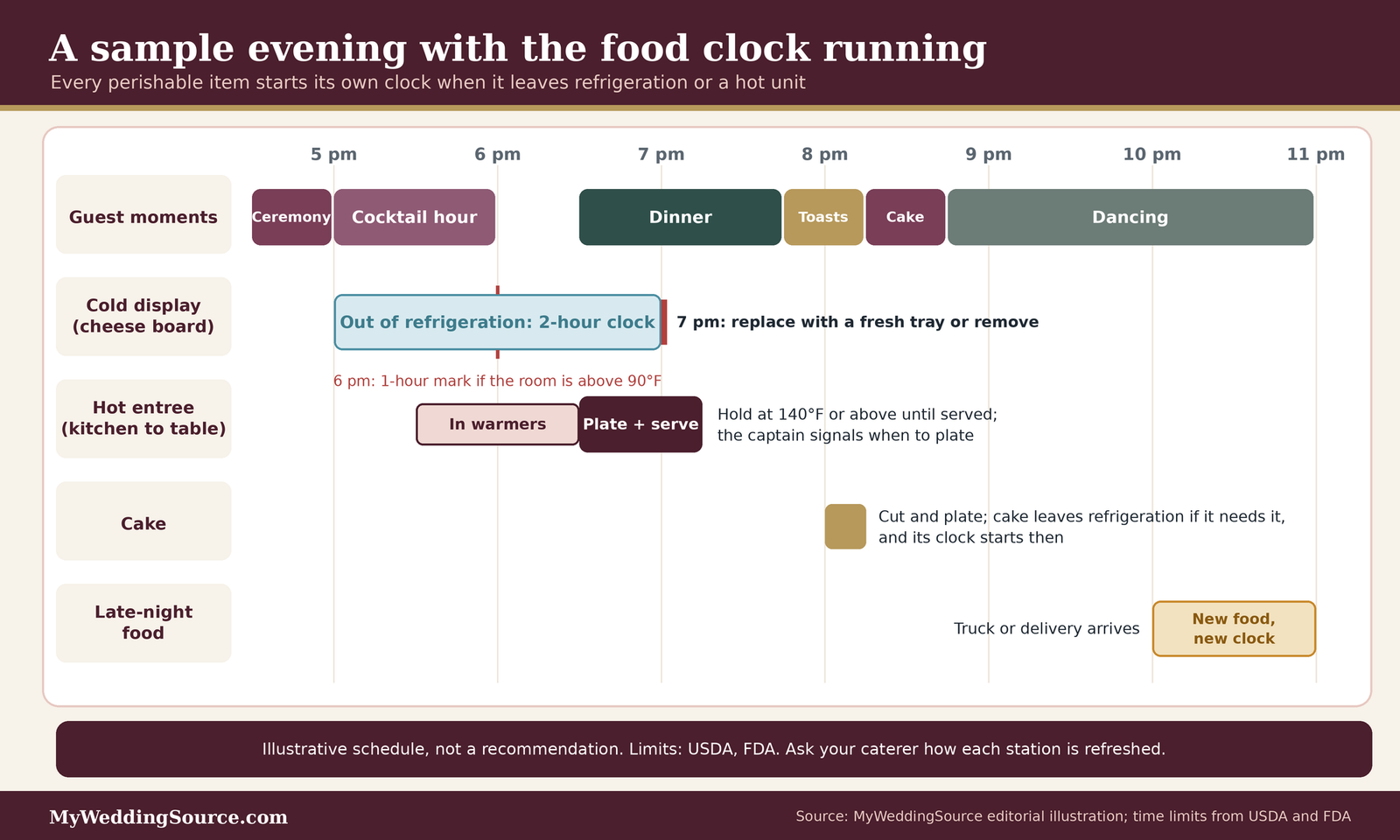
For wedding catering service planning, ask your caterer for the time each course or station needs to start plating or opening, and write those times into the run-of-show before you schedule anything else. Then place the ceremony, photos, cocktail hour, entrances, and toasts around them. If a draft schedule puts a long toast set between the salad and the entrée, the question for the caterer is how the entrée will be held and whether it stays at a safe, good temperature. That is a better question to ask in a planning meeting than at 7:15 p.m. Our wedding day timeline guide shows how the larger schedule fits together.
Cocktail hour and the two-hour clock
Cocktail-hour stations are some of the longest-running food displays at a wedding. A cheese and charcuterie board, a raw bar, or a dip station can be out for the entire hour or more, and the two-hour limit applies from the moment perishable items leave refrigeration. USDA and FDA both tie the limit to the temperature in the room, dropping to one hour when it is above 90°F. If the display is meant to last longer than the limit, ask how the caterer will replace it: a fresh tray from refrigeration is a standard answer, and topping off a half-empty dish is not. FDA specifically advises replacing nearly empty dishes with freshly filled ones and not adding food to a partly filled dish.
How service style changes the timing
The three common styles distribute the same food over time very differently. Our wedding catering guide compares them on cost and experience; here we compare them on the clock.
Plated service and the pace of courses
Zola describes plated service as one where guests are served at roughly the same time, and notes that it takes more labor than a buffet. The practical effect is that plated dinners have a predictable middle: once the first plates go out, the schedule is fixed to the pace of the kitchen. The risk is a delay at the front of the line, such as an entrance that runs long or a ceremony that starts late, because plated food that is plated cannot wait as gracefully as food in warming equipment. Ask whether the caterer holds plating until a signal, who gives that signal, and what happens to the plates already made if the signal is delayed.
Buffet and station service and the line
In wedding catering service planning, a buffet moves guests through the food instead of moving the food to guests, which means the line is the timeline. Zola notes that buffet guests wait in line and that the wait, while it can be social, is real. A simple estimate helps. If one serving line moves about four guests per minute (our assumption for illustration, not a measured figure), then 120 guests take about thirty minutes at a single-sided buffet and about fifteen minutes if the buffet is served from both sides. Ask your caterer what rate they plan for and how they release tables so the line does not form all at once, for instance table by table, or in groups starting with the oldest guests and those with mobility needs.
Family-style, stations, and hybrid service
Family-style service puts shared platters on tables, and stations spread the food across the room. Both reduce the single-line problem and add their own: family-style food is out on the table at room temperature after it arrives, so the same time limits apply once it is there, and stations multiply the number of places where hot and cold holding has to work. Ask how many stations are planned, how each is kept at temperature, and who is assigned to each one.
Pacing around speeches, dances, and cake
Moments that guests care about can easily collide with the food.
Placing toasts relative to service
There is no single right answer, and good couples choose based on their guests and their caterer. Toasts before dinner keep the focus on the speakers and let guests eat in peace afterward, but they delay the first course. Toasts during dinner use time that would otherwise be quiet, though they can interrupt eating and cool the food. Toasts after dinner are comfortable for the kitchen and risk losing the room. Ask your caterer which of these suits their kitchen and service style, and read our wedding speeches guide for how to brief the people speaking.
Cake, dessert, and late-night food
Cake cutting is a short, photogenic moment, but the cake service afterward takes time, since slices must be cut, plated, and carried. Our wedding cake servings guide covers the numbers. For timing, ask who cuts and plates the cake, whether the caterer or the baker is responsible, and when the cake leaves refrigeration if it needs it. Late-night food is a separate service with its own clock: a food truck or a pizza delivery that arrives at 10 p.m. is a new set of perishable items entering the room, and the same hold-time rules apply from the moment they are set out.
When the schedule slips
Weddings run late, and the useful question is how the food responds.
A one-page delay plan
In wedding catering service planning, ask your caterer and day-of coordinator to agree on a one-page delay plan with triggers and actions. A trigger might be “ceremony not ended by a stated time” or “cocktail hour has run longer than planned.” An action might be “kitchen holds plating,” “cocktail hour stations are refreshed,” or “entrée order is changed.” The plan does not need to be elaborate. Its value is that when a delay happens, the people who must act already agreed what they will do, and no one has to find the couple to ask.
Who has the authority to hold the kitchen
Decide in advance who can tell the kitchen to hold. It might be the planner, the venue coordinator, or the caterer’s captain. The couple should not be that person, because they will be elsewhere. Write the name on the master sheet.
Dietary needs in the kitchen and on the floor
Collecting dietary information is a guest-communication task, and our wedding dietary restrictions guide covers how to ask and how to sort the answers. This section picks up where that guide leaves off: once you have the list, how do you make sure a restricted plate is prepared, marked, carried, and served correctly? In wedding catering service planning, this is the lane where a small gap in communication can matter most.
Why allergies need a different standard than preferences
Preferences are a matter of enjoyment, and wedding catering service planning treats them lightly. Allergies and celiac disease are matters of health, and the operational standards differ accordingly.
What the FDA says about reactions
FDA lists nine major food allergens in the United States: milk, eggs, fish, crustacean shellfish, tree nuts, peanuts, wheat, soybeans, and sesame. Sesame became the ninth when the FASTER Act took effect on January 1, 2023. FDA’s consumer page lists eleven symptoms, from hives and mouth tingling to vomiting, wheezing, throat swelling, and loss of consciousness, which can start within minutes to hours of eating. It describes anaphylaxis as severe and potentially life-threatening, and warns that a mild reaction does not always mean the allergy is mild. For a wedding, the takeaway is that the person most at risk is the one who has to trust your plan, and a plan that treats their need as a menu note is below the standard the problem deserves.
Why labeling law does not settle the question at a wedding
FDA’s labeling rules require major allergens to be declared on most packaged foods, either in parentheses after an ingredient or in a “contains” statement. FDA’s sesame page describes the requirement as applying to packaged foods and dietary supplements. That is useful when a caterer buys a packaged sauce, because the label should tell them what is in it. It does not describe what happens in a kitchen where a sauce is made from scratch, a station shares a spoon, or a plate is assembled on a counter that held something else. Those are operational practices, and the caterer’s procedures are what protect your guest.
What the restaurant research suggests about where plans fail
A study of reactions in restaurants offers a sober look at how things go wrong, even when people try.
The communication findings
An analysis of data from the patient registry of FARE (Food Allergy Research & Education) covered 2,827 people who reported reactions between September 2017 and September 2019. Dining out was the second most common setting for reactions, at 21%, after the home at 44%. In 53.9% of restaurant reactions the person had told staff about the allergy, and in 26.6% the allergen was listed on the menu. In 13.7% the allergen was declared and staff had been informed, and a reaction still occurred. Hidden ingredients, such as something in a sauce, accounted for 16.9%. The data are self-reported and from a registry, which the authors note introduces recall and participation bias, and they do not cover weddings. We cite them for the pattern, which is that telling someone is not the same as the plate being right.
What the authors recommend
The same study concludes that restaurants should train all staff, not only managers, ask about dietary restrictions routinely, and declare allergenic ingredients on menus, and it found that declaring allergens combined with informing staff was the most effective combination. Translated to a wedding, the lessons are that every person who touches or carries a restricted plate should know what it is, that ingredient information should exist in writing for every dish, and that the guest should hear from someone, at the table, that their plate is the one that was prepared for them.
What a good caterer’s allergy procedure looks like
FARE also publishes a self-assessment checklist for restaurants. It is written for restaurant operators and not for weddings, and we use it as a reference for the kinds of controls a careful kitchen has, not as a certification standard.
Kitchen controls to ask about
The FARE checklist describes practices such as prohibiting ingredient substitutions without approval, keeping standardized recipes with full ingredient lists including sub-ingredients, tagging recipes with the nine major allergens and gluten, and having a written policy on “may contain” advisory labels. For preparation, it describes making allergy-friendly meals first, using barrier methods and dedicated or color-coded utensils and cutting boards, washing hands and changing gloves between items, and discarding or relabeling any dish that may have touched an allergen. Ask your caterer which of these they follow. A good answer names specific practices and does not rely on general reassurance.
Floor controls to ask about
The same checklist describes separate tongs for every topping, avoiding shared cooking surfaces, and discarding and remaking any allergy-friendly meal that may have touched an allergen. It also asks for at least one trained allergen champion on duty during operating hours, with staff knowing who that person is each shift. For a wedding, that translates to asking who the allergen lead is on your event, whether that person is in the room during service, and whether the servers know to find them. Our wedding catering guide treats allergies as a safety issue and not a menu note, and your master sheet carries the name.
Tracing a restricted plate from RSVP to table
The core of this lane of wedding catering service planning is a chain of custody for each restricted plate. A chain has links, and each link has a person.
The seven links of the plate path
For wedding catering service planning we suggest seven links, drawn in the illustration below: the guest’s answer on the RSVP, the master list with names and table numbers, the caterer’s written plan for that guest, ingredient verification for every component, preparation in the kitchen (first, with clean tools), marking on the plate or the tray, and the hand-off to a named server who delivers it to the named guest and says what it is. Not every wedding needs every link in full, since a plated dinner for sixty differs from a buffet for two hundred, but each link is a place where information can be lost, and each is worth a deliberate decision.
Marking methods and their trade-offs
Caterers mark restricted plates in different ways: a colored pick or flag, a card on the plate, a ticket on the tray, a different plate style, or table-number tickets. Each has trade-offs. A visible marker helps servers and may attract attention from other guests. A discreet ticket protects privacy and relies on the server’s reading. Ask your caterer which method they use, whether it is the same for every restricted plate, and how a server confirms they are at the right seat. Using place cards or a small table-level note to identify the guest gives the server a second check.

Gluten, celiac disease, and “gluten-free” at a wedding
In wedding catering service planning, gluten-free requests come from a mix of medical need and preference, and the kitchen cannot tell which from the request alone.
What the federal definition says
FDA’s definition of gluten-free labeling is fewer than 20 parts per million of gluten in foods labeled that way, and the claim is voluntary but must be used accurately. FDA says restaurants’ use of the term should be consistent with the federal definition, and it notes that the federal rule technically covers manufacturers and that state and local governments oversee restaurants. FDA estimates about three million Americans have celiac disease, an autoimmune reaction to gluten that damages the lining of the small intestine. A caterer who offers a gluten-free plate should be able to describe what they do beyond leaving off the bread.
Questions that separate a thoughtful answer from a casual one
Ask whether the gluten-free plate is prepared with separate utensils and surfaces, whether sauces, gravies, and dressings are checked for wheat, and whether the starch, such as pasta or a roll, is a gluten-free product with a label. Ask whether fried items share oil with breaded items. A caterer who says they can accommodate “gluten-friendly” preferences but not celiac disease is giving you useful information, and you can pass it to guests honestly.
Religious, cultural, and ethical dietary needs
Halal, kosher, vegetarian, vegan, and similar requirements are different from allergies, since the stakes are about practice and belief and not physical safety.
Do not promise certification you cannot document
Terms such as halal and kosher can mean different things to different families and communities, and some require certification, specific preparation, or supervision. We cannot tell you what standard your guests follow. If you plan to offer a halal or kosher meal, ask the caterer what they can document, such as a certified supplier or a certified preparation arrangement, and describe it to guests in those exact terms. Do not describe a menu as certified unless you hold evidence of it. Our upcoming guide on planning a halal wedding menu with mixed dietary needs goes deeper.
Vegetarian and vegan plates are operational too
A vegetarian or vegan entrée is a plate with its own preparation steps. Ask whether sauces use animal-derived stocks, whether grilled vegetables share a surface with meat, and whether desserts contain dairy or eggs. These are less urgent than allergen questions for most guests, though they matter to the guests who asked, and the same chain of custody serves them.
Desserts, drinks, and the items nobody lists
Allergens hide in the courses that feel like afterthoughts.
Cake, dessert stations, and favors
A wedding cake often contains wheat, milk, and eggs, and may contain nuts or sesame in a filling or decoration. If a baker makes the cake and the caterer serves it, make sure the baker’s ingredient list reaches the caterer’s allergen lead. Dessert stations multiply the risk, because shared tongs, nearby trays, and mixed signage make cross-contact easy. Our upcoming article on dessert station allergens covers labels and separation, and our dessert bar versus wedding cake guide covers the tradeoffs.
Drinks, garnishes, and mocktails
Bar items can include allergens in syrups, garnishes, foam, and nut-based liqueurs. Ask the bar team for an ingredient list for any signature drink. For guests who do not drink alcohol, our wedding mocktails guide covers options, and your caterer can tell you how those drinks are prepared and whether they share equipment with alcoholic drinks.
When something goes wrong
A wedding catering service planning document should include what happens if a guest has a reaction.
Emergency basics
FDA advises that if symptoms start after eating a known allergen, the person should stop eating, consider whether emergency treatment such as epinephrine is needed, and seek medical attention. We are not clinicians and cannot give medical instructions. What we can say is that your plan should name who calls emergency services, who stays with the guest, who knows where the venue address and entrance are, and who holds any information the guest has chosen to share. FARE’s restaurant checklist asks that most staff be trained to recognize anaphylaxis and know the emergency policy, so it is reasonable to ask the caterer about their own.
Preserving the evidence
FDA suggests keeping food packages and contacting the manufacturer and a health care provider after a reaction. A caterer should be able to tell you which ingredients and packages were used for a given dish and should keep them until the event is over. Add this to the master sheet as a short line: “Packaging and ingredient lists kept on site until end of event.”
Staffing: who works the event, how many, and how to check the math
In wedding catering service planning, the most common staffing mistake is not buying too little or too much. It is never learning the number. A proposal that reads “full service staff included” gives you no way to compare it with another, or to know whether the team is enough for your plan. Wedding catering service planning treats staffing as a count of tasks, translated into people and hours, and written into the event order.
Roles at a catered wedding
A catered wedding has more roles than most guests notice, and wedding catering service planning should name them. Understanding them helps you ask for the right count.
The kitchen side
The kitchen team prepares, finishes, and plates. It typically includes a chef or kitchen lead, cooks, and prep or dish staff. At an off-site wedding the kitchen team may be working in a temporary space with limited equipment, which makes their number and experience more important, not less. Ask how many people will be in the kitchen, what their roles are, and when they arrive.
The floor side
The floor team includes servers, a captain or event manager, bussers, bartenders, and sometimes runners or station attendants. Zola says basic packages usually include servers, bartenders, and kitchen staff. Ask who the on-site manager is, whether that person is working the floor or free to manage, and whether the captain is a separate person from the servers. A manager who is also carrying plates cannot respond to a problem in the room.
How service style changes the staffing question
Zola notes that buffets generally need fewer staff than plated service, since running plates to tables takes more people than dishing food, and that plated dinners require more labor for preparation and presentation.
Counting tasks instead of ratios
For wedding catering service planning, published ratios of servers to guests exist, but we did not find an authoritative source for them and do not quote one. A more reliable method is to count the tasks. For a plated dinner, list the courses, the number of tables, how many plates one server can responsibly carry, and how quickly each course needs to reach all tables. For a buffet, list the number of serving lines, the stations that need an attendant, and the tasks of resetting and refreshing. Then ask your caterer to describe how their team handles those tasks, and ask for the resulting headcount.
A worked example, labeled as an estimate
Suppose 120 guests at twelve tables of ten, and a single plated entrée. Assume, for illustration only, that a server can carry three plates per trip and that a round trip to a table takes about two minutes. That is forty trips. With ten servers working in parallel, each makes four trips, so the course reaches every table in roughly eight minutes. With five servers it would take about sixteen minutes, which is a long time for the first plates to wait. These numbers are assumptions chosen to show the arithmetic, not measured rates, and your caterer’s real figures will differ. The method is the point: ask for their assumptions, and check that the result matches the pace you want.
Hours, breaks, and what happens when the event runs long
Staff are people with shifts, and your wedding catering service planning should reflect that in the contract.
Arrival, breaks, and departure
Ask when staff arrive, when they take breaks, and when they leave. Servers who arrive just before cocktail hour have less time to learn the room than those who arrive two hours before. Ask whether staff breaks are planned around the service schedule, and where staff can eat. Our wedding vendor meals guide covers how to feed the people working your event, and Zola says most caterers charge 50% to 75% of the per-person cost for vendor meals and suggests budgeting for 8 to 12 of them.
Overtime and extensions
Zola’s catering cost article says overtime runs $50 to $100 per hour per staff member, and that figure is one publisher’s reported range, not a rule. If your reception might run long, ask your caterer for their overtime rate in the contract, whether it is per person, and who has the authority to approve it on the day. Our wedding vendor tipping guide covers gratuity and service charges, and our wedding vendor contract guide covers what terms to look for.
The day-of decision-maker and communication
The staffing lane of wedding catering service planning depends on communication as much as headcount.
One person with authority
Choose one person on the caterer’s side and one on yours who can decide things on the spot. Exchange mobile numbers. Make sure the caterer’s captain knows the planner, the venue coordinator, and the DJ or band leader by name. Our wedding reception guide shows how the reception’s moving parts fit together.
Briefing the team before service
A short pre-service briefing, run by the caterer’s captain, is common in professional catering. Ask whether it will include the restricted-plate list, the run-of-show, and the delay plan. If you or your planner can attend for five minutes, you can answer questions about names, tables, and the order of events, and you can confirm that the dietary information reached the servers and not only the manager.
Heat, weather, and outdoor service
Outdoor weddings add beauty and subtract control, and they change wedding catering service planning. The food-safety rules do not change when the venue is a lawn, but the tools for meeting them do, and wedding catering service planning for an outdoor event deserves its own pass. Our guides to outdoor wedding venues, summer wedding heat planning, and rain plans cover the wider picture, and this section focuses on food.
Temperature is the first variable
Everything about the two-hour clock in wedding catering service planning depends on the air around the food.
The ninety-degree threshold
USDA, FDA, and FoodSafety.gov all say the two-hour limit drops to one hour when the temperature is above 90°F. At an afternoon summer wedding in a hot region, a buffet table in direct sun can be above that threshold even if the forecast says otherwise, since sun on a table and a chafing dish is not the same as air temperature in the shade. Ask the caterer how they will shade the food, how they will know when they have crossed the one-hour line, and what they will do about it. A common answer is to serve in smaller batches from refrigeration, and a better answer includes a person assigned to watch the clock.
Coolers, ice, and shade
FDA advises keeping coolers out of direct sun and limiting how often they are opened, using separate coolers for drinks and for perishables, and draining meltwater and replacing ice often for cold dishes served on ice. USDA gives similar advice about keeping coolers out of sunlight. For a wedding, ask whether the caterer has a shaded staging area, whether drinks and perishables are stored separately, and who is responsible for ice during service.
Tents, trucks, and temporary kitchens
Many outdoor weddings use a tent kitchen or a catering truck, which changes wedding catering service planning.
What a tent kitchen needs
A tent kitchen is a temporary space with its own power, water, and holding equipment. Ask the caterer what they bring, whether they have set up on this kind of site before, and what the backup is if equipment fails. Check that your venue permits cooking equipment and open flames in the tent area, since some sites restrict them, and whether permits are required. Our wedding permits guide explains the general landscape, and your local health department and fire authority can confirm what applies.
Food trucks and mobile vendors
A food truck is a self-contained kitchen that brings its own rules. Ask whether the truck holds the permits your county requires, how many guests it can serve per hour, and where it will park and plug in. A truck’s service rate is a physical limit, and a line that takes forty-five minutes is a design problem to solve before the wedding, for instance by staggering release or adding a second service window.
Weather you cannot control
Rain, wind, and heat waves affect food service directly, so wedding catering service planning should include them.
Rain and wind
Wind scatters napkins and disturbs buffet covers, and rain moves everything under a roof. Ask your caterer what the indoor plan looks like, how long it takes to switch, and who decides. A plan that requires moving a fully set buffet is a bigger risk than one that was designed to fit under cover from the start. Raw items and ready-to-eat items should stay separated on the move, and FoodSafety.gov and FDA both advise keeping raw meat, poultry, and seafood and their utensils apart from cooked and ready-to-eat food.
Heat waves and fallback menus
In extreme heat, a caterer may propose substituting dishes that hold better, such as swapping a mayonnaise-based salad for one dressed with oil and vinegar. We cannot say from our sources which dishes hold better, and your caterer’s experience matters here. What you can do is ask in advance which dishes they would swap in a heat wave and agree in writing that substitutions of that kind are allowed, so a safe change does not become a negotiation on the day.
Edge cases: delays, headcount surprises, take-home food, and borrowed kitchens
Every wedding has an unusual feature that wedding catering service planning has to absorb. The point of this section is not to cover every case but to show how the four lanes apply when the plan departs from the standard shape.
Guests, headcounts, and special meals
The headcount you give the caterer is a safety input as well as a cost input in wedding catering service planning.
Late changes and extra guests
A last-minute addition can strain a plan that was built around exact counts, especially for restricted plates, which are often prepared in limited quantities. Ask your caterer for their final-headcount deadline and what happens after it. Our wedding RSVP etiquette guide can help with the human side of late responses. For restricted guests, the deadline is firmer: a guest whose needs are not on the list cannot be served safely by improvisation.
Children’s meals and mixed-age tables
Children’s meals are a separate plate with their own timing, since many families prefer them early. Ask whether the kids’ meals are plated at the same time as the adult course or earlier, and whether they share a station with allergy-friendly plates. If a guest has a child with an allergy, treat the child’s plate with the same chain of custody as any other. The guest may also want to hold the epinephrine device at the table, which is their decision, and you can make sure the servers and the table captain know.
Food that stays after dinner
What happens to the food after service is also a food-safety question for wedding catering service planning.
Leftovers and take-home boxes
FDA advises refrigerating leftovers no later than two hours after serving, and USDA and FDA both advise dividing large amounts into shallow containers so they cool faster. Many couples like the idea of sending guests home with food, and some caterers or venues prohibit it for liability and safety reasons. Ask about the policy and put it in the contract. If take-home food is allowed, the practical question is who packs it, how quickly, and in what, and whether guests will have access to refrigeration soon enough. The simplest policy, and often the one caterers prefer, is that food that has been out on a buffet is not packed.
Packed food for the couple or the family
A common request is a late-night meal or a next-day brunch for the couple. That food should be packaged straight from refrigeration or a hot-holding unit, not from a table that has been out. Ask the caterer to set it aside in advance and label it with the date and time, and ask whether they can provide reheating instructions that use the 165°F minimum for leftovers that FoodSafety.gov lists.
Borrowed kitchens, family cooks, and potlucks
Not every wedding is fully catered by professionals, and wedding catering service planning still applies.
Home kitchens and family contributions
A family member who wants to cook for the wedding is offering something valuable, and the rules still matter. Rules for food served to the public at an event vary by jurisdiction, and some places restrict home-prepared food at events or require permits. Ask the local health department what applies, and if the answer is that it is allowed, apply the same principles: keep hot food at or above 140°F, keep cold food at or below 40°F, and keep a thermometer on hand. Make sure someone owns the clock and the ingredient list, as with any other dish.
Hybrid arrangements
Some couples hire a caterer for the main meal and ask relatives to bring desserts or sides. Each additional contribution adds a source of allergens without a label, and a family dessert may contain nuts that nobody thought to mention. Ask contributors for ingredient lists, place their dishes in a clearly marked spot, and tell your allergen lead about them. Keeping family contributions out of the restricted-guest plan is a reasonable boundary, and a gracious one.
When a vendor cancels or fails
Plan for failure without dwelling on it; wedding catering service planning is partly about fallbacks.
A fallback for the caterer
Ask what the caterer’s plan is if the lead chef is ill or a key staff member cannot work. Ask whether they have a backup team or a partner company, and what the contract says about cancellation by the caterer. Our wedding insurance guide explains what event insurance generally does and does not cover, and the details depend on the policy, so read it before you rely on it.
A fallback for equipment
A failed warmer or refrigerator is the most common equipment problem. Ask what the caterer carries as a spare and how fast replacement can arrive. A plan that includes a nearby source of ice, a backup warmer, or an oven at the venue is more realistic than one that assumes nothing breaks.
Vendor questions, contract terms, and the cost of operations
The last piece of wedding catering service planning is turning conversations into commitments. You do not need legal training to do it, and this guide does not give legal advice. The aim is to make sure the answers you collect become terms you can point to.
What operations cost, and where it hides
In wedding catering service planning, operational items often appear in proposals as line items that look small and add up.
What this actually costs
Zola’s catering cost article, last updated February 19, 2026, reports that basic packages typically include a service charge of 18% to 22% of food and beverage costs, that most caterers also expect gratuity of 15% to 20% distributed among the service team, that vendor meals are often priced at 50% to 75% of the per-person rate, that overtime runs $50 to $100 per hour per staff member, and that kitchen fees for outside caterers run $500 to $2,000. These are one publisher’s reported ranges. As an illustration of our own arithmetic, a 20% service charge on a $10,000 food and beverage subtotal would add about $2,000. Treat that as an estimate and compare itemized proposals, not averages.
Fees that relate to operations
Ask the caterer to list every fee that relates to staffing, equipment, and kitchen use: service charge, gratuity, delivery, equipment rental, staff travel, kitchen or facility fees, and cake-cutting or corkage fees. Our wedding catering cost guide covers how to compare quotes, and our wedding budget guide shows where catering sits in the larger plan.
Where an operational promise should live
If the caterer says staff will arrive three hours before service, or that a restricted plate will be prepared in a separate area, that promise should appear in the event order or contract, not only in email. Emails are useful evidence, but a signed event order is what the team on the day works from.
Questions to ask
The questions below group the whole wedding catering service planning guide into a single list you can take to a meeting.
Questions to ask your caterer and venue
- Which license, permit, and insurance documents do you hold, and can I have copies?
- Which equipment will you bring, and what does the venue provide for power, water, and cold storage?
- How do you hold hot and cold food, and what is your procedure for the two-hour limit, and the one-hour limit above 90°F?
- Who takes and logs food temperatures during service, and how often?
- What is your policy when a staff member is ill, and who covers an absence?
- At what time does each course or station start, and what is your plan if the ceremony runs late?
- How is a restricted plate prepared, marked, and delivered, and who is your allergen lead on my event?
- Can I see ingredient lists for sauces, desserts, and bar items?
- How many staff will work in the kitchen and on the floor, with what roles, arrival times, and hours?
- What are your overtime terms, vendor meal pricing, and policy on leftovers and take-home food?
- If the lead chef or a key staff member is unavailable, what is the backup plan?
- Where are the answers to these questions written in our contract or event order?
How to use the question list
Send the list in advance so the caterer has time to answer thoughtfully, and ask for written answers. Replies that include documents, procedures, and numbers are a good sign. Replies that offer only reassurance may simply mean the person is busy, and a second request is reasonable.
Reading the answers
You are not trying to catch anyone. You are looking for specificity, since someone who runs a careful operation can describe it in detail, and for willingness, since a caterer who welcomes the questions is more likely to welcome your guests’ needs. If the answers raise concerns, our wedding vendor contract guide covers how to approach a negotiation and which terms are worth asking for.
Terms worth asking to see in writing
Every contract is different, and a lawyer can advise on yours; for wedding catering service planning, the categories below are common places to look. The categories below are common places to look.
Operations terms
Look for the event order, the staff count and hours, the kitchen access times, the equipment list, the holding and temperature procedures if the caterer provides them, the final-headcount deadline, the substitution policy, and the leftover policy. Substitution policy matters especially for dietary needs: ask that the caterer not substitute an ingredient in a restricted plate without notifying you.
Dietary terms
Look for language that the caterer will follow the written list of restricted guests, will not describe any dish as allergen-free or certified without documentation, and will give you ingredient information on request. Never ask a caterer to guarantee allergen-free food, and be cautious of any caterer who offers one, because cross-contact can happen in supply chains and kitchens that nobody fully controls. A better term is a commitment to specific preparation steps and a clear statement of what the caterer cannot control.
Wedding week and the day itself: a rehearsal for the kitchen
A walk-through of the plan, a short rehearsal of the hand-offs, and a morning-of check reduce the chance that anything on the master sheet fails quietly. Our wedding week checklist and rehearsal guide give the general frame.
The week before
The final week of wedding catering service planning is for confirmation, not decisions.
Sending the final package
Send the caterer a single package: the final headcount, the restricted-guest list with names and table numbers, the seating chart, the run-of-show with kitchen times, the delay plan, and the name and number of the day-of decision-maker. Our wedding seating chart guide explains how to produce a clean chart. Ask the caterer to confirm receipt and to reply with any questions.
Confirming the evidence column
Open your master sheet and look for rows with no evidence. Fill them with a short email each. If a row cannot be closed, decide whether to accept the risk, change the plan, or escalate. A one-line “accepted” note is a legitimate outcome, and an unexamined blank is not.
The morning of the wedding
On the day, the coordinator’s job in wedding catering service planning is to keep the plan connected to reality.
A five-minute call with the caterer’s captain
Call or meet the captain before the ceremony and confirm that the team has arrived, that equipment is running, that cold storage is cold, and that the restricted-plate list is in the hands of the allergen lead. Confirm the kitchen times in the run-of-show and the delay plan. This is the most useful five minutes of the day for the food.
Signals and communication during service
Agree on how the captain will signal readiness and how the coordinator will signal a delay. A simple phrase or a text message is enough. Make sure the DJ or band leader knows the order of events, since announcements are the most common way a schedule drives the kitchen.
After service
The work of wedding catering service planning does not end when the plates are cleared.
Cleanup, leftovers, and returns
Confirm who is responsible for removing food, trash, and equipment, and by when. Confirm that leftover food follows the policy you agreed, and that anything meant for the couple was packed from refrigeration or hot-holding and not from the buffet. Confirm that rented items are returned and that the venue’s cleanup requirements are met.
Thank-you and feedback
Tell the caterer what went well. If something went wrong, write it down while it is fresh and send it, because a clear, calm account helps the caterer and may matter for any dispute. Our wedding vendor tipping guide explains tipping norms for the service team.
FAQ: wedding catering service planning questions
Food safety and timing
How long can wedding food sit out?
USDA, FDA, and FoodSafety.gov say perishable food should not stay between 40°F and 140°F for more than two hours, or more than one hour when the temperature is above 90°F. Ask your caterer how each station is replaced or removed before that limit, and who watches the clock.
What temperatures should hot and cold food be held at?
Federal guidance says to keep hot food at 140°F or above and cold food at 40°F or below. FDA adds that some warmers reach only 110°F to 120°F, so check the equipment label. Ask your caterer who measures temperatures during service and whether they keep a log.
Who is responsible for food safety, the caterer or the venue?
It depends on your contracts and local rules, so ask both. A caterer usually controls preparation, holding, and service, while a venue may control the kitchen, power, and refrigeration. Your local health department can say which permits apply, and your master sheet should name an owner for every item.
What should happen if the ceremony or photos run late?
Agree on a short delay plan in advance. It should say what triggers a delay, whether the kitchen holds plating, how cocktail-hour stations are refreshed, and who has the authority to call it. Hot food should stay at or above 140°F while it waits, so ask how the caterer manages that.
Dietary needs and staffing
Can a caterer guarantee allergen-free food?
Be cautious of any such promise. FDA says medical diagnosis and strict avoidance are the main prevention methods, and cross-contact can occur in kitchens and supply chains. A better request is a written description of how restricted plates are prepared, marked, and delivered, plus ingredient information for every dish, with the limits stated honestly.
How do I make sure the right plate reaches the right guest?
Trace each restricted plate from your RSVP list to the table: a master list with names and table numbers, the caterer’s written plan, ingredient checks, clean preparation, clear marking, and a named server who delivers it and says what it is. Ask who your caterer’s allergen lead is and whether servers are briefed.
How many servers do I need?
We did not find an authoritative ratio, so we do not quote one. Zola notes that plated service takes more staff than a buffet. Count the tasks: courses, tables, stations, and pace. Then ask your caterer for the headcount by role and the assumptions behind it, and have it written into the event order.
Can guests take leftovers home?
Policies differ, and some caterers and venues prohibit it. FDA advises refrigerating leftovers no later than two hours after serving, and food that sat out on a buffet is often the problem. Ask for the policy in your contract, and set aside food for the couple straight from refrigeration, not from the table.
Your next steps
Build the sheet
Copy the master sheet and assign owners
Paste the checklist into a shared spreadsheet and add owner, due date, and status columns. Give every row a person, not a company, and set the first review for the venue walk-through. If you have not yet chosen a caterer, our wedding catering guide and caterer tasting guide help with that step.
Send the question list
Email the caterer and venue the questions in this guide, ask for written answers, and file each reply in the evidence column. Our wedding venues guide can help you compare what venues provide.
Make the plan real
Run the timing and dietary checks
Draft a run-of-show that starts from the kitchen times, add a one-page delay plan, and send the restricted-guest list with names and table numbers by the caterer’s deadline. Our wedding day timeline guide covers the rest of the day.
Confirm in wedding week
Send the final package, close or accept every open row, and plan a five-minute call with the caterer’s captain before the ceremony. If your event is outdoors in warm weather, read our summer wedding heat plan as well.
Sources & methodology
How we built this guide
What we relied on
This guide draws on federal food-safety and allergen pages from FDA, USDA, FoodSafety.gov, and CDC, a state health department guidance document on time as a control, a peer-reviewed-style analysis and a restaurant self-assessment checklist from FARE, and one wedding-industry publisher’s cost and staffing commentary. Temperatures, time limits, allergen counts, and statistics are attributed to the page they came from. The scenario figures for service lines and server trips, and the fee illustration, are our own arithmetic from stated assumptions, and they are estimates. We checked each source on November 12, 2026, and some pages carry their own earlier update dates, which we note where we cite them.
What we did not do
We did not inspect kitchens, test equipment, or interview caterers or health officials, and we did not find an authoritative published ratio of servers to guests, so we give a method in place of a number. We do not give legal, medical, or food-safety certification advice, and we do not recommend specific caterers or products. Your local health department sets the rules that bind you, and your guests’ clinicians know their own conditions. Check licenses, permits, and written procedures with the people who hold them.
Source list
Government and regulatory sources
- U.S. Food and Drug Administration, Food Allergies: What You Need to Know: https://www.fda.gov/food/buy-store-serve-safe-food/food-allergies-what-you-need-know
- U.S. Food and Drug Administration, FASTER Act: Sesame is the ninth major food allergen: https://www.fda.gov/food/food-allergies/faster-act-sesame-ninth-major-food-allergen
- U.S. Food and Drug Administration, Gluten and Food Labeling: https://www.fda.gov/food/allergens/gluten-and-food-labeling
- U.S. Food and Drug Administration, Serving Safe Buffets: https://www.fda.gov/food/buy-store-serve-safe-food/serving-safe-buffets
- U.S. Food and Drug Administration, Eating Outdoors, Handling Food Safely: https://www.fda.gov/food/buy-store-serve-safe-food/eating-outdoors-handling-food-safely
- U.S. Food and Drug Administration, Food Code 2022: https://www.fda.gov/food/fda-food-code/food-code-2022
- USDA Food Safety and Inspection Service, USDA urges consumers to keep clear of the Danger Zone this summer: https://www.fsis.usda.gov/news-events/news-press-releases/usda-urges-consumers-keep-clear-danger-zone-summer
- FoodSafety.gov, Safe Minimum Cooking Temperatures: https://foodsafety.gov/keep/charts/mintemp.html
- FoodSafety.gov, 4 Steps to Food Safety: https://www.foodsafety.gov/keep-food-safe/4-steps-to-food-safety
- Centers for Disease Control and Prevention, Norovirus Fact Sheet for Food Workers: https://cdc.gov/norovirus/communication-resources/facts-for-food-workers.html
- Centers for Disease Control and Prevention (archive), 2011 Estimates of Foodborne Illness: https://archive.cdc.gov/www_cdc_gov/foodborneburden/2011-foodborne-estimates.html
- Virginia Department of Health (hosted guidance document), Time as a Public Health Control: https://www.vdh.virginia.gov/content/uploads/sites/196/2024/06/4-hr-Guidance-for-Time-as-a-Control_508c.pdf
Allergy organization and industry sources
- Food Allergy Research & Education, Characteristics of food allergic reactions in United States restaurants: https://www.foodallergy.org/resources/characteristics-food-allergic-reactions-united-states-restaurants
- Food Allergy Research & Education, restaurant self-assessment checklist: https://www.foodallergy.org/media/5237/download
- Zola, Buffet vs. Plated: Which Style of Catering to Choose: https://www.zola.com/expert-advice/venues-vendors/food-catering/buffet-vs-plated-which-style-of-catering-to-choose
- Zola, Wedding Catering Costs: Real Numbers and Budget Tips: https://www.zola.com/expert-advice/cost-of-wedding-caterers