
Wedding invitation etiquette comes down to five decisions: who is on the list, how each envelope is addressed, when each piece goes out, how replies get tracked, and what you say when a reply does not match the invitation, and this guide walks through each one with scripts, a mailing timeline and the postage math.
The guest list is nearly final, your printer wants addresses by Friday, and a friend has just asked whether her boyfriend of four months “counts” as a plus-one. Each of those small questions is really an etiquette question in disguise, and each one gets harder to answer once the invitations are in the mail. Etiquette here does not mean stiff rules from a Victorian handbook. It means a shared set of expectations that lets guests understand, without having to ask, whether they are invited, who else is invited, what to do next and when to do it.
This page covers the courtesy side of invitations: guest list rules that hold up under pressure, envelope addressing for modern households, the order in which save-the-dates, invitations and reminders should land, RSVP tracking, uninvited guests, social media requests, and paper versus digital. It deliberately skips the sample sentences for host lines, divorced-parent wording and reply cards, because those live in our wedding invitation wording guide. For a shorter primer on mailing windows, the wedding invitation timing and wording page is a good companion. Names, dates and households in the examples below are invented, and etiquette authorities do not always agree, so where they differ we say so and tell you what to decide for yourselves.
Who gets an invitation: the guest list rules that hold up
Rules most etiquette sources agree on
Married, engaged and long-term partners come as a unit
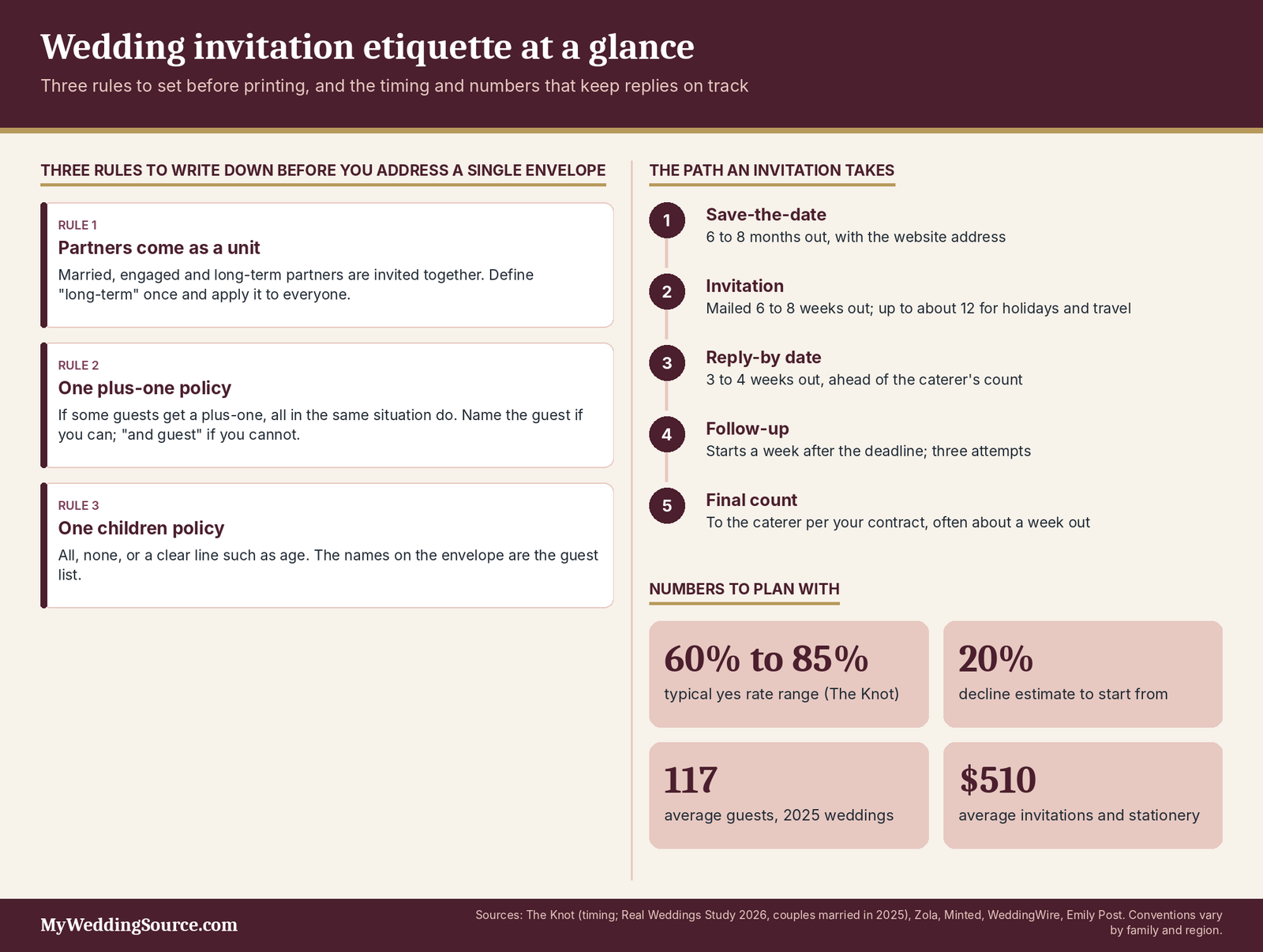
The most widely repeated guest list rule is that a guest’s committed partner is invited, whether or not you have met them. Emily Post’s guidance on sending invitations says invitations are always addressed to both members of a married couple, even if only one of them is likely to attend, and WeddingWire’s guest list etiquette page says that for friends in long-term relationships, inviting their significant other is necessary even if you have never met. The reasoning is practical as much as polite: a guest who is asked to attend a wedding alone, while their spouse of six years stays home, will likely decline or arrive resentful. Where couples draw the line is usually “long-term,” and a workable definition is a partner who is married, engaged, or has lived with the guest for a defined stretch such as a year. Pick your definition once, write it in your planning notes, and use it for every name on the list so that you can explain it in one sentence if someone asks.
Wedding-event invitations create expectations
WeddingWire’s guidance adds a rule that surprises couples who have not thought about it: anyone invited to a wedding-related event, such as an engagement party, bridal shower or bachelor or bachelorette party, should generally be invited to the wedding itself. The exceptions it names are destination weddings, which tend to run smaller, and office showers, where you should tell coworkers in advance that the wedding invitation list is limited. That means your guest list begins before the invitations do, at the first event where you collect addresses and names. If you are planning a large shower and a 60-person wedding, say so early and keep the shower list tighter than the wedding list so that nobody receives a pre-wedding invitation and then discovers there is no wedding one. The same page also suggests inviting coworkers you see socially outside work, and notes that inviting every coworker is not required, so choosing a cutoff such as “our immediate team” or “no coworkers” is both common and defensible.
Rules you set yourselves, then apply evenly
Plus-ones: choose a rule and use it for everybody
No major etiquette source says every single guest must get a plus-one, and several say the opposite: it is a courtesy that depends on budget and space. What they do agree on is consistency. WeddingWire puts it plainly: if you allow some guests to bring a plus-one, you must allow all of them to. The Knot’s advice on uninvited plus-ones suggests limiting plus-ones to guests who are married, engaged or living together, and being ready to explain the rule by pointing to budget and space. A common modern compromise is to extend plus-ones to anyone in an established relationship and to single guests who would know nobody else at the event, such as a friend from out of town seated at a table of strangers. Whatever you choose, write the rule down before you start addressing envelopes, and read our plus-one etiquette guide if you want the deeper scripts for the hard cases.
Children: all, none, or a clear line
WeddingWire’s guidance on children is similarly blunt: kids are not required, you can host an adults-only event, and if you invite children you cannot selectively include some families without inviting awkward conversations later. The one exception it mentions is the children of the wedding party, which is a common carve-out when a flower girl or ring bearer is part of the ceremony. A line drawn by relationship (“nieces and nephews only”) works less well than a line drawn by age (“under 18 not invited”) or by role, because relationship lines invite the question of who counts as close enough. For the wording of an adults-only line and what to do when a guest pushes back, our child-free wedding etiquette guide has the detail. Here, the etiquette point is that the envelope has to match the policy: the names on it are the only guests who are invited.
When the list changes: cuts, B-lists and the polite no
Why a B-list works only if you plan the dates around it
Some couples hold a second tier of guests and invite them as first-round declines come in. The Knot’s guide to how many people RSVP no mentions assembling a B list when needed, though it does not lay out a method, so what follows is editorial judgment. If the first invitations go out about 8 weeks before the wedding with a reply-by date about 4 weeks out, B-list invitations sent immediately after the first deadline would arrive with only about 4 weeks of notice, which is short for guests who travel. The fix is to send the first round earlier, to ask for replies sooner, or to accept that the second round will skew local. Keep the tiers private, never ask a first-round guest to “let you know soon” in a way that reveals a waiting list, and treat every second-round guest exactly as warmly as a first-round one.
What to say to people who ask about an invitation
A coworker, cousin or old friend will eventually ask whether they are invited, and a calm answer prevents hurt that lasts longer than the question. A script that works across most relationships is: “We kept the guest list very small because of the budget and the venue, and I wish we could have had everyone.” It is truthful, it does not rank anyone, and it does not open a negotiation. Avoid specific comparisons such as “we only invited family” if a family member’s partner is not on the list, because that sentence will be checked. If a close relative presses, repeat the same two sentences once more, then change the subject, and let your partner or a parent handle follow-up if the conversation becomes tense. Hold the same line after the wedding as well, since photos will show who was there and questions can resurface at the next family dinner.
Addressing envelopes: names, titles and who is on the inside
Outer envelope, inner envelope, and what each one signals
What goes on each envelope
The outer envelope is the mailing envelope. It carries the postage, a return address and the guest’s name and address, written with titles and full names in the formal style. The inner envelope, when there is one, carries only names, and it is the envelope that settles who is invited. According to Emily Post, the inner envelope bears the title and last names of the specific people invited, and leaving someone off it signals that they are not invited. Zola’s addressing guide adds that the inner envelope is more casual and may use first names, but only for people you know well. Formal invitations avoid abbreviations and middle initials, with Mr., Mrs., Ms. and Dr. the usual exceptions, and the outer and inner names should match before you seal anything.
No inner envelope? Put the invitation scope on the outer envelope
Many modern suites skip the inner envelope, and Zola notes that this is increasingly common. Without one, the outer envelope has to do both jobs, which means it should list every invited person, including children, and it should avoid the shorthand “and family” unless you truly mean everyone living in the house. Emily Post advises that if there is no inner envelope, children’s names go on the outer envelope beneath their parents’ names. A practical test is to read the outer envelope aloud as if you were the recipient: if you could reasonably wonder whether an adult nephew or a visiting in-law is included, name them or leave them off and plan a conversation. The envelope is the last line of defense against uninvited guests, so ambiguity there costs you later.
Couples, titles and households
Married, unmarried, different last names and same-sex couples
Zola’s guide says the same rules apply to same-sex couples as to any other couple, and that is the right default. For married couples with different last names, list either name first according to preference, closeness or alphabetical order, and put hyphenated last names last. For unmarried couples who live together, Zola offers either separate lines in alphabetical order by last name or one line leading with the person you know better, while Emily Post shows them on one line joined by “and,” as in Ms. Nancy Fellows and Mr. Scott Dunn. Couples who do not live together should receive separate invitations, since the invitation then reflects the relationship as the guest lives it. When you do not know how a couple prefers to be addressed, ask when you collect addresses and note it in the same spreadsheet.
Doctors, judges, military, clergy and gender-neutral titles
Titles are where small errors look largest, mostly because the people who care about them care a great deal. Zola says a doctor is listed first regardless of gender, with “Doctor” spelled out for formality or “Dr.” for academic doctors, and that two doctors with the same last name can be addressed as “Doctors.” For judges it recommends “The Honorable,” and for clergy, rabbis and military members the title comes first regardless of gender, with the higher rank first when both partners hold titles. For nonbinary guests Zola says “Mx.” is common, but the safest approach is to ask for each person’s preference rather than assume. The same advice applies to widows and divorced women, where Zola suggests asking whether the guest prefers “Ms.” or “Mrs.” and which surname to use, and a one-line address-collection form makes those questions routine rather than awkward.
Children and families
Emily Post says invited children without their own invitation are listed on the inner envelope on a line below their parents’ names. Zola describes a family option where a single envelope is addressed to the family name or to parents first with children in age order, and it follows an older convention of “Miss” for girls under 18. Many couples now use first names for children and skip the titles, which is easier to read and carries the same message. Guests 18 and older who live at home are typically sent their own invitation, though one envelope addressed to the parents and the adult child by name is acceptable for a casual wedding. A final check: if a household has an invited teenager and an uninvited cousin visiting for the weekend, the names on the envelope are the only thing that distinguishes them, so spell them out.
| Situation | Outer envelope | Inner envelope |
|---|---|---|
| Married couple, same last name | Mr. and Mrs. Daniel Brooks | Mr. and Mrs. Brooks |
| Married couple, different last names | Ms. Alicia Torres and Mr. Daniel Brooks | Ms. Torres and Mr. Brooks |
| Unmarried couple, same address | Ms. Nancy Fellows and Mr. Scott Dunn | Ms. Fellows and Mr. Dunn |
| Same-sex couple | Mr. Marcus Reed and Mr. Theo Park | Mr. Reed and Mr. Park |
| Couple, one is a doctor | Dr. Barbara Werner and Mr. James Werner | Dr. Werner and Mr. Werner |
| Parents with invited children | Mr. and Mrs. James Darling | Mr. and Mrs. Darling, Emma and Noah |
| Single guest with a named guest | Ms. Dana Whitfield and Mr. Luis Ortega | Ms. Whitfield and Mr. Ortega |
| Single guest, unnamed guest | Ms. Dana Whitfield | Ms. Whitfield and guest |
| Nonbinary guest | Mx. Riley Chen (confirm preference) | Mx. Chen |
Plus-ones and single guests on the envelope
Name the guest if you can
If you know who the guest is bringing, put the name on the envelope. Zola’s guidance is to address it as you would an unmarried couple when the plus-one’s name is known, which makes the invitation specific and gives the caterer a real name for a place card. A named guest also closes off the follow-up question of whether the invitation is transferable. When the guest is a new partner whose name you do not know, ask the invited guest for the name in a friendly message, framed as helping with the seating chart rather than screening anyone.
When you write “and guest”
When you cannot get a name, Zola says to write “and guest” after the invited person’s name, with neither “and” nor “guest” capitalized. Emily Post recommends addressing the outer envelope to the invitee only and the inner envelope to the invitee “and Guest,” and for a single-envelope suite it suggests a short note asking the guest to share their companion’s name. Both approaches work because they keep the outer address clean and put the plus-one on the line where it is read. The mistake to avoid is a reply card that says “number attending ___” for a guest who has one plus-one, because a blank invites a number you did not choose. A pre-printed line such as “We have reserved 2 seats in your honor” is a gentler way to state the count that does not require you to say anything pointed.
Timing handoffs: when each piece goes out and who it is for
A mailing timeline that works backward from the caterer
The window, step by step
Most invitation timelines are written forward from the engagement, which is why couples end up surprised by a printer’s lead time. Etiquette is easier to hit if you work backward from the one date that cannot move, the day your caterer or venue needs a final count, and place every other step before it. Zola’s invitation timing guidance puts save-the-dates 6 to 8 months before the wedding, invitations 6 to 8 weeks before, and replies 3 to 4 weeks before. The Knot’s timing advice agrees on 6 to 8 weeks for mailing, leans toward 8 weeks when you want paper replies and toward 6 when replies are digital, and says anything more than 12 weeks out risks guests having to change their answers later. The table below stacks those windows with the steps that must happen before and after them, so you can see how little slack there is between “mail” and “final count.”
| Step | When (before the wedding) | What it is based on |
|---|---|---|
| Collect addresses and confirm the list | 7 to 9 months | Editorial: must finish before save-the-dates |
| Send save-the-dates | 6 to 8 months | Zola |
| Order printed invitations | About 18 to 20 weeks if mailing at 8 weeks | Joy: 10 to 12 weeks before mailing; plus mailing window |
| Mail invitations (local and domestic) | 6 to 8 weeks | Zola, The Knot |
| Mail invitations (holiday, long travel) | 8 weeks, up to about 12 weeks | The Knot |
| Mail invitations (overseas) | 9 to 10 weeks | The Knot |
| Reply-by date | 3 to 4 weeks | Zola, Minted (Emily Post: 2 to 3 weeks) |
| Start following up on silence | 1 week after the deadline | Paperlust (editorial judgment) |
| Final count to caterer | Often about 1 week before; confirm in your contract | Minted; your vendor contract controls |
Why the reply-by date is earlier than guests expect
Guests treat a reply-by date as a soft suggestion until they learn what happens behind it. Minted connects its 3-to-4-weeks-out guidance to giving the caterer a final head count about one week before the wedding, and Emily Post says a date two to three weeks before the wedding gives hosts time to follow up with guests who have not replied. Those are the two sources that disagree by a week, and the practical answer is to pick the longer cushion if your caterer or venue asks for numbers earlier, or if you expect to chase many stragglers. A reply-by date also needs a buffer inside it for mail time: a card dropped in a mailbox on the final day may take several days to reach you. A short note on the website such as “We need your answer by [date] so we can give the caterer a final count” turns the date from a demand into an explanation, and guests usually respond to explanations.
Holidays, travel and short engagements
Holiday weekends and long trips
The Knot recommends about 8 weeks for holiday weddings and as much as 3 months when guests need a bigger buffer, with etiquette expert Diane Gottsman quoted as saying that around a major holiday like Christmas, people need more time because they plan in advance. The problem is concrete: flights and hotel rooms around busy weekends sell out, and a guest who cannot get a reasonable fare will often decline instead of asking for help. Our analysis of Thanksgiving weekend wedding costs, travel problems and guest etiquette shows how quickly those travel costs stack up for guests, and the invitation timeline is the cheapest lever you have. Send the save-the-date earlier than usual, put lodging and travel information on the website at the same moment, and consider mailing at the 10-to-12-week end of your window.
Overseas guests and destination weddings
For overseas guests, The Knot says to mail around 9 to 10 weeks ahead to allow for longer shipping, and for destination weddings it says about 8 weeks, with the invitation sent at the same time to all guests. Gottsman is quoted as saying you can go up to a year ahead for overseas guests. If your list includes people who need visas, passports or unpaid leave, the date on the save-the-date matters more than the date on the invitation, which is a point we expand on in the destination wedding etiquette guide. The Knot also suggests sending all invitations at the same time, which is a quiet fairness rule: a cousin who receives an invitation two weeks after another cousin will notice. Mail in one batch, and if some guests need a head start, tell them the date privately and let the save-the-date carry it.
Short engagements and skipping the save-the-date
Not every couple has a year to plan, and the timing advice flexes with the engagement. The Knot says that if you skip save-the-dates after a long engagement (it cites 14 months as typical, from its Real Weddings Study), you should send invitations about 6 months out, and about 3 months out for shorter engagements. In effect, a longer-than-usual invitation lead time replaces the save-the-date’s job, and a digital version can go out first so that guests can hold the date while the printed suite is in production. If you are mailing with less than 6 weeks left, The Knot calls that late by etiquette and practicality standards and suggests using digital RSVPs and skipping traditional response cards to save time. The more compressed the schedule, the more important a clear website, because every question guests would otherwise ask by text becomes one you have to answer.
Which piece of paper carries which job
What belongs inside the envelope
Guests read a suite in layers: the envelope, the main card, then everything tucked behind it. Minted describes the usual enclosures as a reply card with a reply-by date, a guest name line and accept or decline boxes; a reception card if the reception is at a different location, treated as a separate event; an information card for directions, transportation and lodging; and an activity card for multi-event weekends. The rule of thumb is that anything a guest needs in the first minute lives on the main card, and anything they will look up later or that may change lives on the website. Keep the number of enclosures to what you will use, because each extra card adds weight, and weight changes postage, which we cover in the paper and digital section below.
The wedding website as the handoff
Etiquette sources agree that the website should not usually appear on the main invitation card. Minted says to list it on the reception card or an additional information card, and suggests the save-the-date as a good place for the URL or a QR code. Emily Post’s registry etiquette page says to keep registry and gift information off the invitation and enclosures, and to let guests know by word of mouth and on the wedding website instead. A website is the right home for anything that changes (schedule, shuttle times, weather plans), anything long (accommodation options, accessibility information), and anything that would look out of place on cardstock (registry links, phone policies). Test the address on a phone before printing, and make sure it still works if the guest types it without “www,” because a dead link on 100 printed cards cannot be fixed with a correction.
| Piece | Best for | Keep off it |
|---|---|---|
| Save-the-date | Date, city, website address or QR code | Formal details that may change |
| Main invitation | Hosts, names, date, time, venue, reply request | Registry, gifts, hashtags |
| Reply card | Guest names, accept or decline, count, meal choice | Open-ended questions |
| Information or activity card | Lodging, directions, weekend schedule, adults-only line | Gift or cash requests |
| Wedding website | Updates, registry, phone policy, FAQs, travel | Private details, home addresses |
| Reminder message | Deadline, link, who to contact | New policies guests have not seen |

RSVP management: tracking replies and forecasting the count
Build the reply system before the cards ship
Choose one reply route, or state the hierarchy
The cleanest RSVP system has one front door. Emily Post says reply envelopes should be pre-addressed and stamped to make mailed replies easier, and also notes that hosts who prefer email or phone replies can leave out the envelope and list contact details on the card. If you offer both a card and a website, say which counts: guests who see an envelope and a URL will wonder which one is official, and some will use both and contradict themselves. A line such as “Please reply on our website or with the enclosed card” is honest about the choice, and a note that the website is checked first tells you which record wins. Our wedding RSVP etiquette guide goes further into reply wording and follow-ups, while this section focuses on the system behind them.
Track by household, not just by name
A tracking sheet should have one row per invited person, grouped by household, with columns for address, invited as, plus-one status, reply, number attending, meal choice, dietary notes and how and when you followed up. The household grouping matters because invitations are addressed to households, and replies come back for households, so a family of four who sends one card for “three attending” tells you something that a flat guest list hides. Record the date each reply arrived and the channel (card, website, text), because on the busy days near the deadline you will not remember who said what. Two people with access to the sheet is better than one, so that your partner can update it while you are at work. Add a column for “sent by whom” if you split follow-ups with a parent, which prevents the same guest getting three nudges.
Forecasting the headcount
What yes rates look like
Yes rates vary with the guest list, and published ranges are wide. The Knot’s article on how many people RSVP no cites studies putting the likely confirmation share at about 83% and others ranging from 60% to 85%, while Hannah Nowack, a senior editor there, suggests around 80% yes at the RSVP stage and advises you to start at a 20% decline estimate and adjust from there. The same article notes that out-of-town, out-of-state and international guests are more likely to decline because of flights, hotels and time off work. It also warns of partial RSVPs, in which invited households do not use all their allotted seats, and of last-minute cancellations from people who said yes. Treat these as national rules of thumb: your own mix of local friends and distant relatives will drift, and a guest list that is mostly local can run higher than one that is mostly travelers.
From yes rate to a number you can order against
The Knot’s 2025 Real Weddings Study put the average guest count at 117 for couples married in 2025, drawn from 10,474 couples as reported on its average wedding cost page. As an illustration only: if you invited 117 people and applied a 20% decline rate, you would plan for about 94 attending; at the low end of the quoted range (60% yes) you would have about 70, and at the high end (85% yes) about 99. That 29-person spread is the real reason caterers and venues want a final count so late and a minimum so early, and it is why a firm reply-by date is not rude. Use the middle estimate for first-draft budgeting and the high estimate when you check venue capacity and seating, so that an unexpectedly high yes rate does not leave you short. Our guide to the wedding food and catering decisions explains how those numbers feed into per-person pricing and guarantees.
Following up with silence
A three-touch follow-up
Silence is the most common RSVP problem, and it is easier to handle with a plan than with irritation. One stationery planner’s follow-up guide at Paperlust recommends waiting seven days after the deadline before contacting anyone, matching the channel to the person (a text for friends under 60, a phone call for older relatives, email for professional contacts), and capping outreach at three attempts across at least two channels before marking a guest as not attending. That is a vendor’s editorial advice, not an etiquette authority’s rule, but it is sensible and easy to adapt. Keep each message short, include the link or the deadline, and ask a yes-or-no question: “We are finalizing numbers for the caterer. Will you be able to join us on June 6?” Do not mention how many times you have already tried, and do not send the second nudge from an account that makes it look like a form letter.
Late replies and the caterer cutoff
Late replies are inevitable, and the decision is about your vendor, not your mood. The same Paperlust guide suggests that responses within about a week of the deadline can often be accommodated if the caterer allows late additions, while responses two or more weeks late may not be accepted because the count may already be final. Check your contract for the exact guarantee date, and set your internal deadline a few days ahead of it so that you have room to resolve the last stragglers. When a late “yes” arrives after you have closed the list, say so kindly and early: “We have given our final count to the caterer, and I am so sorry we cannot add seats.” A kind, prompt no is better than an ambiguous maybe that becomes an unfed guest on the wedding day.
Uninvited guests and extra names: prevention and scripts
Prevent it on paper
The envelope is the guest list
Most uninvited-guest problems start with an invitation that was easy to misread. If the outer envelope reads “The Alvarez Family” and you meant two parents and a teenager, a grandmother visiting for the summer will reasonably assume she is included. Name each invited person, keep a household-by-household list that matches the envelopes, and compare the two before mailing. The Knot’s advice is to set a plus-one rule early and be ready to explain it by citing budget and space, which is a better sentence to rehearse than an apology after the fact. A study The Knot cites from a jewelry company found that 33% of respondents would or had brought an uninvited plus-one (45% of ages 18 to 24), though the article does not give the sample, so read it as a signal that the behavior is common, not as a measured rate.
Say the rule once, in the right place
An unspoken rule is not a rule, so state it where guests will look. For adults-only weddings and plus-one limits, the website and information card are the natural homes, and the wording options in our child-free wedding etiquette guide and the plus-one etiquette guide can be adapted. A rule that appears only in a family group chat will miss the guests who need it most, because they are rarely in the chat. Also tell the people most likely to field questions, which usually means parents and the wedding party, so that they repeat the same sentence you would. If a relative says, “Oh, you know she’ll bring the kids,” the answer should already be agreed.
When extra names arrive anyway
An extra name on a returned card
A reply that lists more people than you invited is rarely a power move; it is more often confusion or a hopeful test. Mpls.St.Paul Magazine’s etiquette column advises calling the guest, apologizing for the mix-up, and explaining that the invitation was meant only for them because of space or budget limits, and The Knot likewise says to check RSVPs carefully and call when an unexpected name appears, since the guest may just be confused. Call rather than text, because tone carries better by voice, and take the blame for the unclear invitation even if it was clear. Then write the correction into your tracking sheet right away so that the caterer count does not pick up the extra name by accident.
Someone arrives with an uninvited guest
Day-of arrivals are harder, because there is a person in front of you and a hungry crowd behind them. The Knot’s advice to couples is not to panic: ask the venue or planner whether an extra chair and place setting can be added, and know that you “shouldn’t bend over backward to accommodate someone who wasn’t invited to begin with,” so a table that can only fit one more may mean the extra guest sits apart from their date. The same column pairs that with a practical rule: avoid drama on the day itself, find a seat if you can, and have a candid conversation with the guest afterward. Delegate this to your planner, coordinator or a calm friend, so that you are not the one managing a seating chart in your wedding attire.
Uninvited children
Children are the case where the pressure to relent is strongest, and Mpls.St.Paul Magazine is direct about it: be firm, call the guest, apologize for the confusion and explain that the invitation was for adults only. Its reasoning is that bending the policy is unfair to the guests with children who did arrange care. For out-of-town guests, a list of local babysitting services or hotel child-care recommendations lets you offer help without changing the plan. If you are including children, mean it fully and make seating, food and timing work for them; if you are not, the earlier you say so, the fewer awkward phone calls you will make.
| Situation | First move | Script idea (adapt to your voice) |
|---|---|---|
| Reply card lists an unnamed extra guest | Call within a day | “Our invitation wasn’t clear, and I’m sorry. We could only invite the people named on the envelope.” |
| Reply adds children | Call, stay firm, offer child-care ideas | “We’re keeping the day adults-only. Here are some local sitters if that helps.” |
| A guest arrives with an uninvited plus-one | Ask venue for a seat; do not make a scene | Planner says “Let’s find you a spot,” then you follow up privately after the wedding. |
| Family member asks for an exception | Repeat the rule once, kindly | “We drew one line for everyone, and we can’t make exceptions.” |
| Guest asks “can I bring a date?” | Check your plus-one rule | “We’re only able to include named guests, but we’d love to have you.” |
What an extra guest actually costs
The per-plate arithmetic
An unplanned guest is rarely just one chair. Dividing The Knot’s $34,200 average total by its 117-guest average gives roughly $292 of spending per guest, a blunt illustration that treats every cost as if it scaled with headcount, which it does not. Your real number depends on your caterer’s per-person price, any bar service and rentals, so ask the vendor for the marginal cost of one more place setting. Beyond the meal, the extra guest needs a place setting, a chair and a spot at a table that may already be full. Knowing the number gives you a respectful reason to say no and a factual reason to say yes when you choose to make an exception.
The fairness cost
The bigger cost is trust. If one guest brings an uninvited date and is welcomed, the guest who left their partner at home will notice. Etiquette sources keep returning to consistency because a guest list is a promise that the same rule applied to everyone. If you decide to make an exception, make it deliberately and privately, such as for a guest who had a genuine misunderstanding, and tell your caterer before the day.
Social media rules for invitations, ceremonies and photos
What to ask guests, and where to ask it
Unplugged ceremonies without a scolding sign
If you want phones away during the ceremony, say it in more than one place. The Knot’s unplugged ceremony guidance lists a sign, an officiant announcement, a note on the website and a note in the ceremony program as options it calls totally etiquette appropriate, and it offers a compromise: the officiant invites guests to take as many photos as they want at the altar moment, then asks them to put phones away for the rest of the ceremony. Planner Cowie, quoted by BizBash, suggests a small note in the programs instead of a large sign banning cell phones. The wording is most effective when it explains the reason, such as “Our photographer will capture the ceremony, and we’d love your full attention.”
Hashtags and posting-time requests
A wedding hashtag helps you gather guest photos in one place, and BizBash quotes planners suggesting it appear on signs and even on the save-the-date, with the couple sharing social preferences with guests early and often. Posting requests are separate: planners in the same article advise guests not to post the dress, decor or venue until the couple has made their debut, and ask vendors and staff about their own posting policies. If your preference is “post after the ceremony” or “please do not tag children,” say that precisely on the website, because “no social media” is too vague to follow. Keep it a request, not an order, and avoid language that sounds like a threat.
What couples should do before the invitations ship
Do not publish what identifies guests or your plans
Photographing the suite is tempting, but a clear photo can expose your website address, a QR code, home addresses or a reply code. Crop or blur anything that leads to private information, and consider password-protecting your website if it contains addresses, lodging details or family information (that is editorial judgment, not a legal requirement). Also resist posting about the guest list itself, since a public thread about who is or is not invited creates the exact comparison your envelopes were designed to avoid. When B-list invitations are still pending, a public photo of the first mailing may also invite the question “where’s mine?”
Give vendors and the wedding party the same ask
Social policies are only as strong as their weakest link. BizBash quotes a creative director saying to ask clients what their social media policy would be for both guests and planner staff, and to get a release before posting. Tell your photographer, planner and venue what you do and do not want shared, and give your wedding party a short written version, since they are the guests most likely to be asked for photos in the getting-ready room. A one-line instruction (“Please hold dress and venue photos until after the ceremony”) prevents most surprises.
Paper, digital or both: etiquette and what it costs
When digital works and when paper still wins
Format follows formality and the guest mix
Digital invitations are widely accepted, but the vendors writing about them are selling something, so treat their claims as perspective. Greenvelope’s resource page, from a digital-invitation company, argues that “execution” matters more than the medium and says paper “still wins” for ultra-formal weddings, keepsake invitations, and the handful of guests, often a grandparent’s generation, who do not use email or a smartphone reliably. Joy’s digital-versus-print guide, from another digital platform, says print remains the convention for black-tie or white-tie events and that older guests may need printed invitations with the website URL for online replies. Both agree on the hybrid path: send most guests a digital invitation and mail a small paper run to those who need one, using the same design.
Timing does not change when the format does
Digital delivery is instant, but guests still need notice. Greenvelope says guests still need 6 to 8 weeks for a wedding, which matches The Knot’s window. Joy adds that custom print orders take 4 to 8 weeks plus 1 to 2 weeks for addressing and mailing, and suggests ordering 10 to 12 weeks before mailboxes need them. For hybrid sends, mail the paper invitations within a day or two of each other and send the digital ones at the same time, so that no one hears late.
What invitations cost, and what etiquette choices change
The average and what it covers
The Knot’s $510 average covers stationery in general and is a national figure for couples married in 2025, not a quote for any one printer. It can swing sharply depending on whether you print save-the-dates, order letterpress or foil, add an inner envelope and liners, and how many households you mail to. The count of households, not guests, determines most of the cost, because invitations go to households; 117 guests might be about 75 mailings. A digital-only suite can lower the stationery bill substantially, while one platform estimates digital invitations cost 70% to 90% less than print, an unsourced figure from a vendor that should be treated as a ballpark.
Postage rules that change the bill
USPS Notice 123 lists stamped letter prices effective October 4, 2026: $0.82 for 1 ounce, $1.11 for 2 ounces, $1.40 for 3 ounces, a $0.49 nonmachinable surcharge and $0.65 for a postcard. The Domestic Mail Manual says a letter is nonmachinable if its length divided by height is under 1.3 or over 2.5, if it has clasps, strings or buttons, if it is rigid, or if the contents cause uneven thickness, and letters are limited to 3.5 ounces. A square envelope has a ratio of 1.0, so it triggers the surcharge, which is why a square design can cost more to mail than a standard rectangle. Emily Post recommends having a fully assembled invitation weighed at the post office before you buy stamps, and weighing two complete sets if out-of-town guests receive extra pieces.
| Scenario (illustrative, 75 households) | Outbound stamp | Reply stamp | Total per household | 75 households |
|---|---|---|---|---|
| 2 oz suite, replies online | $1.11 | none | $1.11 | $83.25 |
| 2 oz suite, prepaid reply postcard | $1.11 | $0.65 | $1.76 | $132.00 |
| 2 oz suite, prepaid reply envelope | $1.11 | $0.82 | $1.93 | $144.75 |
| 3 oz suite, prepaid reply envelope | $1.40 | $0.82 | $2.22 | $166.50 |
| Square 2 oz suite, prepaid reply envelope | $1.60 | $0.82 | $2.42 | $181.50 |
Weigh a sample and ask who gets the replies
Postage is the one cost you can eliminate by testing, so build a full sample suite, put it on a kitchen scale and take it to the post office before buying stamps. Emily Post also notes that responses and gifts usually go to the return address on the outer envelope, so use an address where someone will be home or can collect mail, or list a different address on the reply card. If you ask for replies by email or phone instead of mail, you can leave out the reply envelope and print the contact details. Each of those choices is cheap to make at the design stage and expensive to fix after printing.
Special situations: families, languages and guests with different needs
Family and cultural expectations
Ask each family how they want to appear
Etiquette conventions are a starting point, not a verdict on any family’s customs. Some families expect elders to be named first, some expect honorifics or religious titles, and some use naming patterns that do not fit “Mr. and Mrs.” at all. Zola’s addressing guide makes the same point in miniature by advising you to ask widows and divorced women about their preferred title and surname. A short message to each host family and to the elders on the list, asking “How would you like your name to appear on the envelope?”, costs a few minutes and avoids a reprint. Do not assume that a tradition you have read about is the one a particular family follows.
Bilingual and multilingual invitations
If part of your guest list reads another language more comfortably, consider printing the key details (date, time, place, reply request) in both languages on the card or an insert. This is editorial judgment rather than a published rule, but it follows the same principle as the rest of this guide: a guest should be able to understand, without asking, whether they are invited and what to do next. Have a fluent speaker proofread each language separately, and keep the spellings of names consistent across versions. If a translation is only partial, say which parts are translated so that guests do not assume the English version is the only one that counts.
Access and reach
Accessibility and dietary information without singling anyone out
Guests rarely ask whether a venue has steps or whether the menu will work for them until they are already worried. A line on the website such as “Please tell us about any access or dietary needs when you reply” invites the information without asking anyone to identify themselves in public, and it gives your caterer lead time. Put accessible parking, step-free routes and seating details where guests will find them, and repeat the contact person’s name so no one has to guess whom to ask. If your reply card includes meal choices, Emily Post suggests a discreet marker on the place card so servers know who ordered what.
Guests who do not use email or text
A hybrid approach protects guests who do not use email or a smartphone reliably, and Greenvelope’s page specifically names the grandparent generation as the group most likely to need paper. For those guests, mail the paper suite on schedule, add a phone number for replies, and offer to take their answer by phone yourself or through a relative. Overseas and out-of-state guests may need more travel time, so send details early and mention time zones when you give a time for any live-streamed ceremony. These small additions rarely cost money, and they turn a one-size-fits-all system into one that fits the people in it.

FAQ: wedding invitation etiquette questions
Guest list and envelope questions
Do I have to invite a friend’s partner if I have never met them?
Generally yes, if the relationship is long-term. WeddingWire’s guest list etiquette page says that for friends in long-term relationships, inviting their significant other is necessary even if you have not met, and Emily Post says invitations are always addressed to both members of a married couple. The guest list is where you define “long-term” for your own wedding, so choose a standard such as married, engaged or living together and apply it evenly. If a friend is newly dating someone, you have more discretion, but a kind, specific note beats silence. Write your rule down so you can explain it in a sentence.
Is it rude to write “and guest” on an envelope?
It is not rude when it is the only practical option, and both Zola and Emily Post describe it as an accepted form. Zola says to use lowercase “and guest” after the invited person’s name, while Emily Post suggests addressing the outer envelope to the invitee only and the inner envelope to “Mr. James Smith and Guest.” A named guest is warmer and easier to seat, so ask for the name if you can. If you are using “and guest,” tell the invitee in a friendly message so they understand they are welcome to bring someone.
Do I need an inner envelope?
No, and Zola notes that skipping it is increasingly common. The inner envelope’s job is to say exactly who is invited, so without one the outer envelope must list every invited person, including children. If you drop the inner envelope, double-check that the outer addresses are specific enough, and put the scope on your website as well. Think of an inner envelope as an etiquette tool you can use or replace, not a requirement.
Timing, replies and format questions
When should I mail invitations, and when should the reply-by date be?
Mail 6 to 8 weeks before the wedding for most weddings, allow 8 weeks or more for holidays and travel, and set the reply-by date 3 to 4 weeks out, as Zola and Minted recommend. Emily Post says two to three weeks is typical, so your decision rests on how early your caterer needs a count. Work backward from your vendor contract, and add a few days of cushion for mailed cards. If you are unsure, pick the earlier date and explain the reason on the website.
What do I do when guests do not reply?
Wait about a week after the deadline, then contact guests in the way they prefer: text, email or a phone call. Cap your effort at three attempts, as one stationery planner’s guide recommends, and then mark the guest as not attending. Check your tracking sheet first, since some replies may have arrived by a different route. Give the caterer your count by the contract deadline and tell late repliers kindly if it has passed.
Are digital-only invitations acceptable?
Yes, for most weddings, and the more formal the event, the more reasons there are to offer paper to at least some guests. Vendors that sell both formats say digital is widely accepted for casual to semi-formal weddings and that print remains the convention for black-tie events. The hybrid path of digital for most and paper for a few is a flexible middle ground. Whichever you choose, keep the timing the same: guests still need 6 to 8 weeks.
Your next steps
This week
Write your three rules
Put your definitions of partner, plus-one and children in one note and share it with both families and your wedding party. Use plain sentences, such as “Married, engaged or living together get a plus-one,” and test each one against your hardest case. Ask yourself whether you could explain the rule to the guest it excludes without apologizing for it. If the answer is no, revise it before any envelope is addressed.
Collect addresses and name preferences
Send a short form or message to every household asking for the mailing address, the exact way names should appear, and any access or dietary needs. Add a column for plus-one names, and a second for how each household prefers to reply. Record the answers in the tracking sheet that you will use through the RSVP deadline. Label the form clearly so households know it is for addresses and not an early RSVP.
Before you pay the printer or mail anything
Weigh a sample and confirm the dates
Assemble one complete suite with every enclosure, weigh it, and ask the post office for the exact postage, including any nonmachinable surcharge. Then read your caterer’s contract and write down the guarantee date, subtract your cushion, and set the reply-by date. Order printed pieces so that they are in hand with time to assemble and address them before your mailing date. Photograph the sample and keep it with your postage receipts in case you need to correct anything.
Proof the envelopes against the list
Before sealing, check each outer and inner envelope against the tracking sheet and make sure the names match. Have someone who did not write the list read the envelopes for any ambiguity that might invite an uninvited guest. Test the website address and QR code on a phone, then confirm the page lists the reply method, the deadline, and the contact person. Mail everything in one batch and drop the first suite in your own mailbox to see what arrives.
Sources & methodology
- Emily Post, addressing and sending wedding invitations — inner and outer envelopes, couples, children, “and Guest,” weighing the invitation, return address.
- Zola, how to address wedding invitations — titles, doctors, Mx., unmarried and same-sex couples, plus-ones, families, no inner envelope.
- Zola, wedding invitation wording — save-the-date, invitation and reply timing, keeping gift information off invitations.
- The Knot, when to send wedding invitations — 6 to 8 weeks, holiday, overseas and destination timing, short engagements.
- The Knot, how many people RSVP no — 60% to 85% yes range, 20% decline starting point, partial RSVPs, B list mention.
- The Knot, average wedding cost — 2025 averages: $34,200 total, 117 guests, $510 invitations and stationery, 10,474 couples.
- The Knot, uninvited plus-ones — preventing and handling uninvited guests; cited survey.
- The Knot, unplugged ceremonies — ways to communicate a phone policy and the officiant compromise.
- WeddingWire, wedding guest list etiquette — long-term partners, plus-one consistency, children, coworkers, wedding-event invitees (Canadian edition of a U.S. publisher).
- Minted, wedding invitation wording — enclosures, reply-by timing, website placement.
- Emily Post, wedding response cards — reply-by timing, pre-stamped envelopes, meal choices.
- Emily Post, wedding registry etiquette — registry details off invitations, on the website.
- Mpls.St.Paul Magazine, what to do with pesky guests — scripts for extra names, children and day-of arrivals.
- BizBash, social media dos and don’ts at weddings — hashtags, posting timing, program notes, vendor policies.
- USPS Notice 123 — stamped letter, nonmachinable surcharge and postcard prices effective October 4, 2026.
- USPS Domestic Mail Manual 101 — letter dimensions, 3.5-ounce limit, aspect ratio and nonmachinable criteria.
- Paperlust, how to follow up on wedding RSVPs — follow-up timing, channels and attempt cap (stationery vendor guidance).
- Greenvelope, are digital wedding invitations tacky and Joy, digital vs print invitations — digital etiquette, hybrid sends and production lead times (vendor sources, unsourced estimates).
Methodology: Averages and yes-rate ranges are survey findings from The Knot and are national figures, not quotes for any wedding. Postage prices are published USPS rates; the postage table, per-guest arithmetic, headcount example, names and envelope examples are illustrative calculations based on those rates, not quotes. Etiquette conventions come from publishers whose advice overlaps but does not always agree (for example on reply-by timing), the digital-invitation and follow-up material comes from vendors, and the B-list timing, bilingual, privacy and accessibility suggestions are editorial judgment. Nothing here is legal advice, and religious, cultural and family traditions may call for different wording.
Freshness note: USPS prices change on the Postal Service’s schedule, so recheck Notice 123 and weigh a sample before you buy stamps. Recheck The Knot’s Real Weddings Study each February and any etiquette page you rely on if it is more than a year old. Review this page each October.