
Deciding how to pay for a wedding is a cash-flow problem and a family conversation before it is a shopping problem, and the choices you make about savings, family help, and borrowing will still be on your monthly statements long after the flowers are gone.
Quick answer
The most durable way to pay for a wedding is to set the budget from the money you can actually gather by a firm date, then fit the guest list and the scope to that number, not the reverse. Savings and agreed family contributions come first, and borrowing is a last, small, short-term gap-filler with a repayment plan written down before you sign anything. This guide is general education and not personal financial, tax, or legal advice, and we are not financial advisors, so check your own numbers with a qualified professional before you borrow or accept a large gift.
People searching for how to pay for a wedding usually already know roughly what they want to spend. What they lack is a way to compare the real options against each other: savings, family money, credit cards, loans, and promotional financing. This guide does that comparison with the same criteria for every option, adds worked scenarios with arithmetic you can reuse, and ends with a rule you can apply to your own situation. For the broader budgeting framework, start with our wedding budget calculator, then come back here for the funding decision.
Define the decision and the constraints that make it hard
The question of how to pay for a wedding is narrower than “how much will the wedding cost.” It is “which sources of money will cover the bills, in what order, and on what terms.” Those are different questions, because a wedding is paid in installments over many months while most gifts and any family help arrive on someone else’s schedule.
What the numbers say couples are working with
Before comparing ways to pay for a wedding, it helps to know what couples report spending and how they report paying. The figures below come from three published surveys, and each has its own sample and method, so we treat them as context and not as a target to match.
Two big surveys, two averages
The Knot Worldwide’s 2026 Real Weddings Study surveyed 10,474 U.S. couples who married between January 1 and December 31, 2025, recruited by email invitation through 2025. It reports an average wedding cost of $34,000, steady year over year, with an average of 117 guests and $292 spent per guest, up $8 from 2024. Zola’s 2026 First Look Report surveyed more than 11,500 couples who are getting married in 2026 and reports an average expected cost of $36,000, flat for a second year, with an average guest count of 145. The two numbers are close, but they describe different groups: one is couples who already married and reported what they spent, and the other is couples still planning and reporting what they expect to spend. The Knot’s page does not say whether its average includes the ring or the honeymoon, so do not assume either way.
For a quick sense of scale, our own arithmetic from those published figures suggests roughly $290 per guest in The Knot data ($34,000 divided by 117 guests) and roughly $248 per guest in Zola’s planning figures ($36,000 divided by 145). Those are rough ratios of averages, not a measured cost per guest, and they will move with your region and venue.
Planned, paid, and per-guest: reading cost figures carefully
A cost figure can mean three different things, and the difference matters when you plan how to pay for a wedding. A planned figure is a budget someone wrote down. A paid figure is what actually left their accounts, and it often runs higher because of tips, alterations, shipping, and last-minute changes. A per-guest figure divides one by the other and hides the fact that some costs, such as photography and attire, do not shrink when the guest list does. Zola reports that 84% of couples believe their wedding costs more than the same wedding would have two years ago, and 78% worry that the economy or tariffs will raise their final bill. The Knot reports that 85% of couples said the economy affected their planning. None of that tells you what your wedding will cost, but it is a good argument for a cushion in whatever budget you set.
The inputs that change your answer
Averages are a poor guide to how to pay for a wedding because the answer depends on a handful of inputs that are specific to you. Write each one down before you compare funding options, because each shifts which option makes sense.
Guest count, venue, timeline, and relationships
Guest count is the largest lever, because catering, rentals, invitations, and favors scale with it. Our guides to wedding catering and the wedding reception explain which costs move with headcount and which do not. Venue is next: its deposit schedule determines when the first large payment is due, which matters more than the total. Timeline is the third input. A wedding fourteen months away gives you savings runway, while one four months away may force a choice between a smaller event and borrowing. Relationships are the fourth: who is likely to contribute, who expects a say, and who will quietly judge the choices all shape what funding is actually available. Zola reports that 71% of couples receive some family financial help, and that among those, 69% say both families contribute. That suggests help is common, but it still has to be asked about directly.
Hard constraints versus social pressure
A hard constraint is a number you cannot move: the total in the account on the date of the first deposit, the monthly amount you can save without missing rent, the credit you will not use. Social pressure is everything else that feels like a constraint but is actually a preference, such as a guest list that includes distant relatives because someone expects it. Zola reports that 60% of couples call managing their budget against online inspiration their top planning stressor, up 12% from last year, and that 48% increased their budget or moved money around to get something they saw online. LendingTree’s survey of 1,050 newlyweds, fielded in March 2025 and reported by FOX 5 New York, found that 34% spent more than they were comfortable with to impress others. Sorting your list into hard constraints and pressure is the cheapest way to start working out how to pay for a wedding, because it costs nothing and it shows you where the budget has room.
The second-order effects most people miss
Each choice about how to pay for a wedding changes more than the wedding budget. It changes your cash position for the next several years, your relationship with the people who gave money, and the experience of the day itself.
What the decision changes after the wedding
Zola reports that 52% of couples are postponing other goals to pay for the wedding, including general savings (70% of that group), buying a home (59%), paying down student loans or other debt (38%), and starting a family (29%). Those are survey responses, not outcomes we can verify, but they point at the real trade: every dollar spent on the wedding is a dollar that is not an emergency fund, a down payment, or a faster loan payoff. In LendingTree’s survey, 67% of respondents took on debt for the wedding, and among those still repaying, 41% said it would take at least a year. If you borrow, the repayment is the part of how you pay for a wedding that outlasts everything else you bought, and it deserves a line in your monthly budget before the first deposit.
Fairness, workload, and the guest experience
Money also has social effects. When one family contributes most of the budget, it is common for that family to expect more influence over decisions, a point Jove Meyer made in a 2024 Associated Press report. A plan for how to pay for a wedding that depends on a family’s money should include an explicit conversation about what, if anything, comes with it. There is also a workload effect: paying less often means doing more yourself, from assembling centerpieces to managing vendors, and that labor competes with your job and your sleep. Finally, there is the guest experience. A smaller guest list lets you spend more per person, while a large one spreads the budget thin, and neither is wrong. Our wedding etiquette guide covers the guest-list conversation in more detail.
Compare how to pay for a wedding against the same criteria
There are five common answers to how to pay for a wedding: your own cash flow, family contributions, credit cards, personal loans, and other borrowing such as buy now pay later or retirement-plan loans. They differ on speed, cost, risk, and who else gets involved. The sections below describe each one on the same terms, followed by a decision matrix that puts them side by side.
Cash: savings, a longer runway, and a smaller guest list
Cash is the only way to pay for a wedding with no repayment risk. Its cost is time and the opportunity cost of what else the money could do.
Saving on a schedule
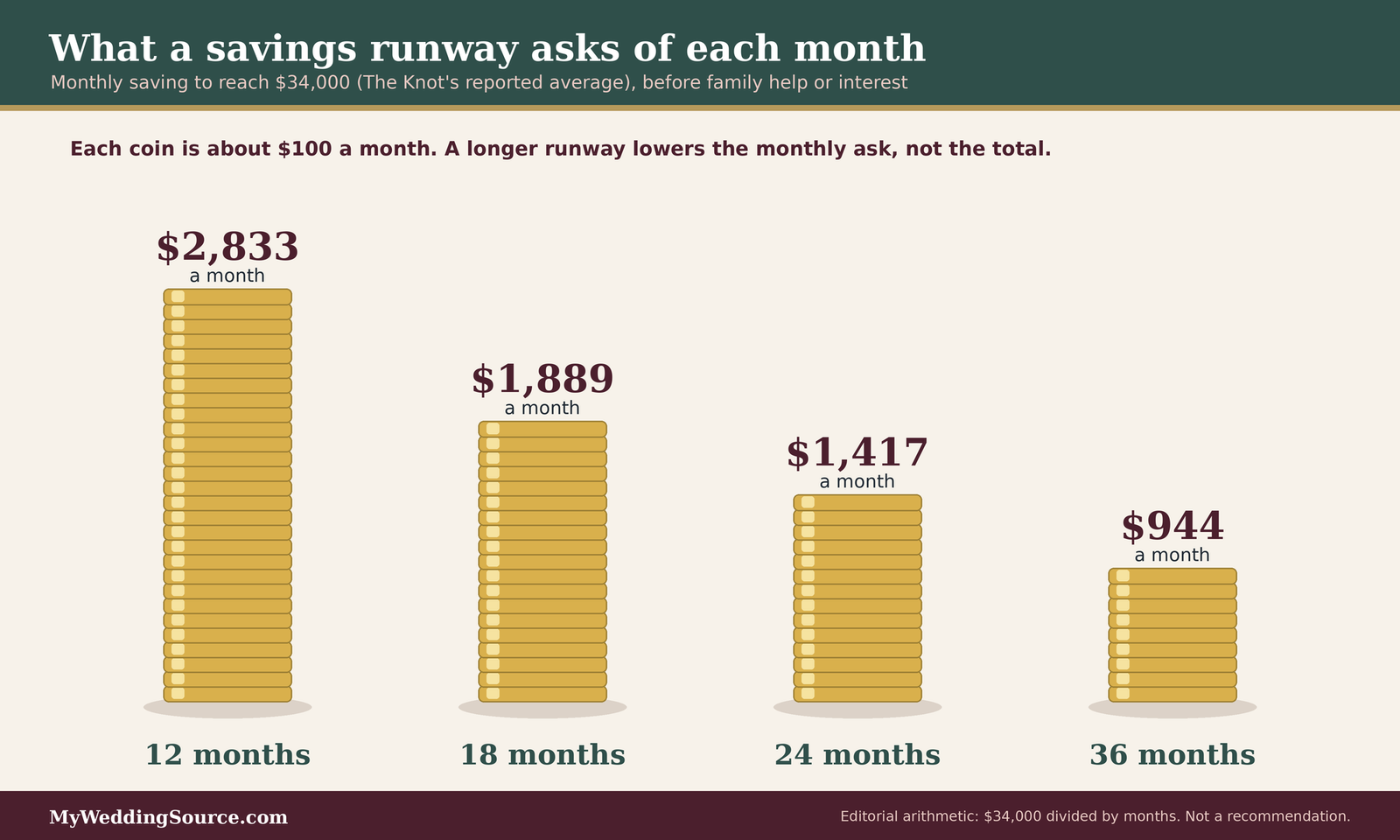
The arithmetic of how to pay for a wedding from savings is simple, and it is worth doing before you fall in love with a venue. Divide your target by the months you have. By our arithmetic, saving $34,000 over 12 months takes about $2,833 a month, over 18 months about $1,889, over 24 months about $1,417, and over 36 months about $944, before any family help or interest. Zola reports that 51% of couples saved for years before getting engaged, so saving ahead is a common starting point for how to pay for a wedding, which is one reason the engagement date is less meaningful than the date of the first large deposit. If your monthly number is out of reach, the honest options are to lengthen the runway, lower the target, or find another source for part of it.
Trimming the cost per guest
The Knot reports $292 per guest on average, so removing guests lowers the bill, but not by $292 each, because some costs are fixed. As a rough illustration, if 20 fewer guests saved the average cost per guest, that would be about $5,840 by our arithmetic, which is probably an overestimate because the venue fee, photographer, and attire stay the same. When you decide how to pay for a wedding, ask each vendor which line items change with headcount and which do not, and get the answer in writing. The open bar decision is a common example: bar costs often scale with guests and hours, so how you structure it can move the total by more than a few invitations will.
Family contributions and the conversation behind them
Family money is common in how couples pay for a wedding, and it is also the source with the most unspoken terms. The way to handle it is to turn the unspoken into the spoken before you commit to vendors.
Traditional split versus modern practice
Emily Post’s long-standing guidance describes a traditional division in which the bride’s family covers the reception, flowers, photography, and invitations, while the groom’s family covers the rehearsal dinner, the officiant, the license, and the honeymoon. The same source says these guidelines are flexible and depend on circumstances, and that couples and families often share costs. The Knot’s survey, as reported by the Associated Press in 2024, found that parents on average contributed slightly more than half of the budget, with couples covering the rest. That is a 2023-era average from one site’s users, so it is a reference point, not a norm. Zola’s 2026 numbers point in the same direction in a different form: 88% of couples contribute financially (29% pay fully and 59% partly), and 71% receive some family help. Experts quoted by the Associated Press advised treating the conversation as a frank discussion about money, not assuming anyone will contribute, and accepting that contributions need not be equal. The same report notes that some couples, especially same-sex couples, fund the wedding themselves to avoid conditions attached to parental money.
Gift-tax basics when parents give cash
Parents who give cash sometimes ask whether it is taxable. We are not tax advisors, and your situation may differ, but the IRS publishes the basic rules. The annual gift tax exclusion is $19,000 per recipient for both 2025 and 2026, and spouses who each give can each use the exclusion, so a married pair can give up to $38,000 to one person in a year without using the larger lifetime exemption. The IRS says the donor is generally responsible for any gift tax, and that gifts to a spouse are generally not taxable gifts. Larger gifts and special cases, such as gifts split across several years, are worth a conversation with a tax professional. For most families, the practical takeaway is that a large wedding gift is a topic for the giver’s tax preparer, not a reason to avoid asking.
Credit cards and promotional financing
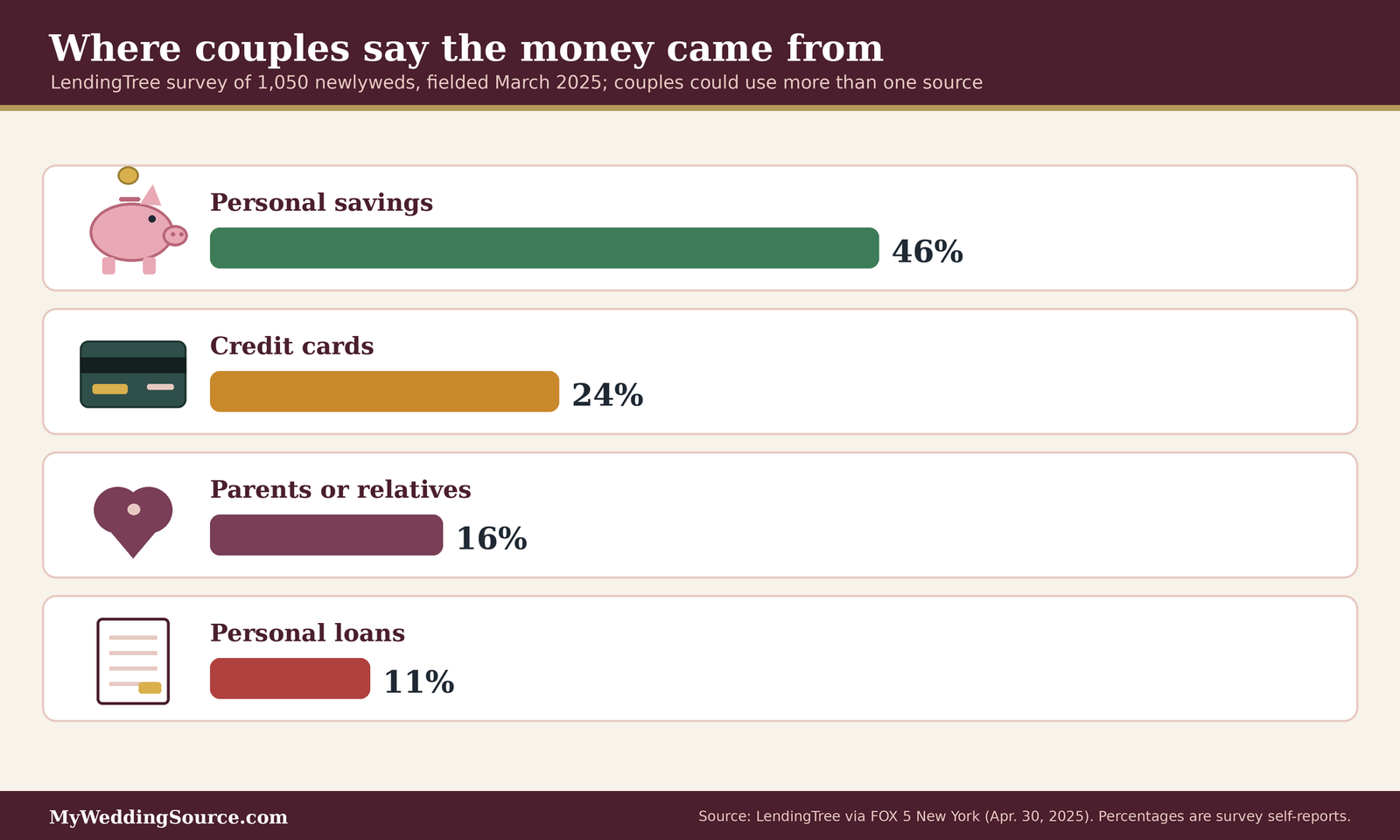
Credit cards are one common way couples pay for a wedding in part, which makes the mechanics worth understanding. LendingTree’s 2025 survey, as reported by FOX 5 New York, found that 24% of couples used credit cards as a funding source and that couples could use more than one source. Zola’s 2026 survey reports that 32% of couples are optimizing credit cards, for example by earning points or opening new cards.
How card interest works
According to the Consumer Financial Protection Bureau, many issuers calculate interest daily using your average daily balance and a daily periodic rate. The grace period usually covers only new purchases, and only if you are not already carrying a balance, so paying the full statement balance by the due date generally avoids interest on those purchases. If you pay more than the minimum but less than the full balance, the issuer generally applies the extra amount to the highest-rate balance first. For scale, the Federal Reserve’s G.19 release of November 6, 2026 reports an average credit card rate of 22.36% on accounts assessed interest in the third quarter of 2026, and 21.19% across all accounts. Your own rate may be higher or lower, and it can change, so use the rate on your actual card.
Deferred interest and 0% offers
Promotional offers can be a useful tool or a trap, and the difference is in the wording. A true 0% introductory APR charges no interest during the promotion, and afterward charges interest on the remaining balance. Deferred interest works differently. The CFPB explains that if you do not pay the purchase off by the end of the promotional period, you can be charged interest on that purchase back to the day you made it, and any balance left when the period ends triggers interest for every month of the period, not just on the remainder. Missing payments can end the promotion, and minimum payments usually do not clear the balance in time. As an illustration of our own, if you put $3,000 of vendor payments on a deferred-interest offer, paid $2,500 evenly over 12 months, and the card charged retroactive interest at 22.36%, the back-charged interest could be around $415 on the declining balance, which is nearly as much as the $500 you still owed. That is an estimate, since issuers calculate differently. The safe use of any promotional offer when you pay for a wedding is to divide the purchase price by the number of months, pay at least that amount each month, and aim to finish a month or two early.
Using a card for protection, not credit
Cards can also protect money you have already decided to spend on a wedding. The Federal Trade Commission explains that the Fair Credit Billing Act dispute process covers credit cards and other revolving credit, including goods or services not delivered as agreed. You generally must send a written dispute to the billing-inquiry address within 60 days of the first bill showing the error, the issuer must acknowledge within 30 days and resolve within 90, and while a dispute is open you can withhold the disputed amount. For disputes about goods or services, you first need to try to resolve the problem with the seller, and the federal rules include a purchase minimum and a distance limit unless the seller is also the card issuer. The FTC page does not discuss debit cards, so do not assume the same rights apply. A card paid in full every month can be a safety layer for large deposits, but only if the balance is paid off.
Personal loans, buy now pay later, and retirement-plan loans
When savings and family help fall short, some couples turn to formal borrowing to pay for a wedding. These options have different costs and very different risks.
Personal loans
A personal loan gives you a fixed amount, a fixed payment, and a fixed end date, which makes it easier to plan than a revolving card balance. The Federal Reserve’s G.19 release reports an average rate of 11.90% on 24-month personal loans at commercial banks for the third quarter of 2026, which is lower than the card average above, though individual offers vary with credit and lender. By our arithmetic, borrowing $8,000 at 11.90% over 24 months gives a payment of about $376 and about $1,029 in total interest, and borrowing the same amount at 22.36% over 24 months gives about $416 a month and about $1,995 in interest. Zola’s survey reports that 4% of couples took out a loan, while LendingTree’s survey reports 11% using personal loans, a reminder that differences in sample and wording change the answer. Before signing, ask for the annual percentage rate, any origination fee, and whether there is a prepayment penalty, since all three change the real cost.
Buy now pay later
Buy now pay later splits a purchase into installments, often four, and is marketed as interest-free. The CFPB’s 2025 analysis of 2022 data from six providers found that about 21.2% of consumers with a credit record used these loans, that about 63% of borrowers had overlapping loans at some point in the year, and that users tended to carry larger balances on other unsecured debt. The data is from a limited sample and shows association, not cause. For a wedding, the risk is stacking several small plans across vendors until the combined monthly total is hard to see. If you use one, list every plan, amount, and due date in one place, and treat the total as a bill.
Retirement-plan loans
Some employer plans allow loans against a 401(k) balance. The IRS explains that a plan can limit a loan to the lesser of $50,000 or the greater of $10,000 or 50% of your vested balance, that loans generally must be repaid within five years with payments at least quarterly, and that an unpaid loan is generally treated as a deemed distribution, taxed as an actual distribution including any early distribution tax. The IRS also describes a plan loan offset, which reduces your account balance for an unpaid loan, and says special rollover timing applies when the offset results from leaving a job. We would not suggest this route for a wedding without advice from a tax professional or plan administrator, because the long-term cost is your retirement balance, and the rules for what happens to an unpaid balance if you leave your job are specific to your plan, so ask your plan administrator before you borrow.
Score the options with transparent assumptions
A decision matrix for how to pay for a wedding works only if the criteria are the ones that actually change your answer. The matrix below uses ranges and plain labels instead of scores, because exact numbers would suggest a precision these inputs do not have.
| Option | Typical cost of money | Speed | Main risk | Who it suits | Who should avoid it |
|---|---|---|---|---|---|
| Savings over a set runway | None, apart from lost time | Slow | Date slips or emergencies drain it | Couples with 12 or more months and steady income | Couples with a firm, near date |
| Family contribution | None in dollars; possible strings | Medium | Unspoken expectations, uneven amounts | Families who can discuss terms openly | Families where money brings control |
| Credit card, paid in full monthly | None if paid in full; possible rewards | Fast | Balance carries over | Couples who pay the statement every month | Anyone already carrying a balance |
| Credit card carried over time | Average about 22% APR on balances that accrue interest | Fast | Interest compounds, long payoff | Rarely a good fit | Almost everyone, as a plan |
| Deferred-interest promotion | None if paid on time; back-charged interest if not | Fast | One missed payment or unpaid dollar | Disciplined couples with a firm payoff date | Anyone unsure of finishing on time |
| Personal loan | Average about 12% APR on 24-month loans | Medium | Fixed payment for years; fees | Small gaps with a stable budget | Couples already stretched |
| Buy now pay later | Often none on short plans | Fast | Stacked plans, hard to track | Single, small vendor payments | Many overlapping purchases |
| Retirement-plan loan | Interest repaid to your own account | Medium | Default becomes taxable; job change | Rarely a good fit | Couples without tax advice |
Reading the matrix with ranges, not fake precision
Read each row as a trade between cost, speed, and risk; that trade is the core of how to pay for a wedding. Savings and family contributions cost the least and arrive the slowest, which is why they work best for couples with a long runway. Borrowing is faster and costs more, and the cost rises quickly with the term, so it is the last piece of how to pay for a wedding, not the first. The rates in the table are national averages, so a couple with strong credit may see less and a couple with limited credit may see more, which is why the table uses words like “about” and “typically.”
Where two options tie
Two ways to pay for a wedding tie more often than people expect. A card paid in full every month and a savings plan are effectively the same cost, so the tie-breaker is whether the card gives you protection and rewards without tempting you to carry a balance. A personal loan and a family loan can tie on cost, but the family loan adds social risk, so put it in writing if you choose it. When two options tie, pick the one that keeps the fewest moving parts to track.
What an $8,000 gap can cost
By our arithmetic, covering an $8,000 shortfall with a 24-month personal loan at the 11.90% Federal Reserve average costs about $376 a month and about $1,029 in interest. The same amount on a card at the 22.36% average costs about $416 a month over 24 months and about $1,995 in interest. If the card payment is stretched to 36 months, the payment drops to about $307 and the interest rises to about $3,053. These are illustrations and not offers, and your actual rate, fees, and term will differ.

Test the options with contrasting scenarios
Abstract comparisons only go so far. The three scenarios below are illustrations we built to show how the best funding mix changes with size, timing, and family help. They are not case studies of real couples, and every figure is an assumption we state so you can swap in your own.
A small, simple wedding
The first scenario on how to pay for a wedding is a couple with a short guest list, a flexible date, and no family contribution. It shows how little borrowing is needed when scope and timeline are set first.
Assumptions for the small case
Assume a total budget of $15,000 for a ceremony and a modest reception with a short guest list, a date 18 months away, and no help from relatives. Assume the couple can set aside $833 a month, which is $15,000 divided by 18 months, before any interest, and that they keep a separate emergency fund untouched. These are our assumptions, chosen to be easy to follow, not a typical couple.
What the numbers say for the small case
In this small case, how to pay for a wedding is mostly a savings question. Because the monthly savings target matches the runway, no borrowing is needed, and the only real risk is timing. A venue that asks for a deposit in month three will be paid out of an account holding about $2,500, so the question to ask early is how much of the total is due before the savings catch up. If the early deposits are too large, the cheaper fix is to choose a venue with a smaller deposit or a later schedule, not to open a loan. Notice what did the work in this answer to how to pay for a wedding: setting the budget from savings capacity, and sequencing payments to match cash on hand. For a small event, the wedding planning timeline is the right place to line up deposits with your savings.
A mid-sized wedding with a funding gap
The second scenario is the common one in how to pay for a wedding: a budget near the published averages, some family help, and a gap that has to be filled somehow.
Assumptions for the mid-sized case
Assume a $34,000 budget, which is The Knot’s reported average, with the couple contributing $14,000 from savings and both families together contributing $12,000. That leaves an $8,000 gap, by our arithmetic. Assume a date 15 months away and that gifts at the wedding are not counted toward the budget, because they usually arrive after the bills are due. LendingTree’s survey as reported by FOX 5 New York found that 41% of respondents used cash gifts for the honeymoon and 24% used them to pay down wedding debt, which is a reason not to plan on them as a funding source.
Closing the $8,000 gap
There are four ways to close it, and the matrix above suggests an order. The first step in how to pay for a wedding with a gap is to shrink the gap: trimming the guest count, simplifying one large cost, or lengthening the runway. If three months of extra saving at about $1,000 a month is realistic, that closes $3,000 of it without any interest. The second is to ask whether either family can add to its share, using the conversation framework later in this guide. The third is a small personal loan for what remains, which at the 11.90% average costs about $376 a month for 24 months on the full $8,000, or less on a smaller remainder. The fourth is a card, used only if the balance can be paid within a few months. A card carried for 24 months at 22.36% costs roughly twice as much in interest as the personal loan on the same amount, by our arithmetic, so it makes sense only as a short bridge.
Why the preferred option changes
The preferred option flips on two conditions. If the couple has three more months of runway and steady income, extending the runway beats any loan. If the date is fixed and the gap is still $8,000, a small, fixed-rate loan with no fees and no prepayment penalty is easier to plan around than a card balance. If the couple already carries card debt, the best answer may be to shrink the wedding instead, since adding a loan to existing debt is where the strain usually begins. That is a general principle, not advice about your finances.
| Scenario | Assumptions | Preferred approach | The threshold that flips it |
|---|---|---|---|
| Small and simple | $15,000 budget, 18 months, no family help | Savings only, with deposits sequenced to cash on hand | If a large deposit is due before savings catch up, change the venue or schedule, not the funding |
| Mid-sized with a gap | $34,000 budget, $14,000 savings, $12,000 family, $8,000 gap, 15 months | Shrink the gap first, then a small fixed-rate loan for the rest | If extra months of saving can close the gap, skip the loan |
| Large and complex | $60,000 budget, $22,000 savings, $20,000 family, $18,000 gap, 12 months | Reduce scope until the gap is a number the couple would be comfortable repaying | If the repayment would cut into retirement or emergency savings, shrink the event |
| Existing card debt | Any budget, unpaid card balances | Pay down or pause before adding any wedding debt | If the balance would be gone before the first deposit, borrowing may be reasonable |
A large, complex wedding
The third scenario is where how to pay for a wedding becomes a real planning decision, because the numbers are big enough that a few percentage points matter.
Assumptions for the large case
Assume a $60,000 budget with a larger guest list and a multiday weekend, a date 12 months away, $22,000 from the couple’s savings, and $20,000 from families. The remaining gap is $18,000, by our arithmetic. Zola reports that 18% of couples plan a full two-to-three-day weekend and that 37% host at least one extra event, so this is not an unusual shape, even if the total is above the surveys’ averages.
What the numbers say for the large case
At the 11.90% personal-loan average, borrowing $18,000 over 36 months costs about $597 a month and about $3,500 in interest, by our arithmetic, which is meaningful but manageable only if the couple’s budget has room for it. At the 22.36% card average, the same amount over 36 months costs about $691 a month and about $6,900 in interest, which is why we would not treat a card as a plan at this size. The better first move is to look at scope. Our wedding planning guide describes how to set priorities before you decide how to pay for a wedding, and the choice that usually saves the most is an extra event, since each one adds its own food, space, and time. If the couple removes one event worth $5,000 (our assumption) and trims 12 guests (about $3,500 at The Knot’s $292 average, likely an overestimate), the gap shrinks to somewhere near $9,500 by our rough arithmetic, and the loan payment shrinks with it.
Why the preferred option changes again
For a large wedding, the decision rule is no longer about the cheapest source. It is about the largest repayment you would be comfortable making for the length of the loan, in a month when something else goes wrong. If the answer is less than the payment, the scope has to shrink. If a family contribution can rise, the conversation should happen early and in writing. And if the whole plan relies on gifts or on a future raise, treat it as a risk, not as funding.
The payment calendar
Whatever the size, how to pay for a wedding comes down to a calendar, and the calendar often matters more than the total.
Deposits and cash-flow timing
List every vendor with its deposit, its due dates, and the final payment, then compare that schedule with the money you will actually hold on each date. Our wedding planning checklist is a good starting point for the vendor list, and the wedding invitations and save-the-date guides remind you of the smaller costs that arrive early. Add a cushion line for tips, alterations, shipping, and changes. Because Zola reports that 84% of couples think their wedding costs more than the same one would have two years ago, a cushion is a reasonable response to uncertainty, not pessimism.
Protecting prepaid money
Large prepayments carry risk that belongs in any plan for how to pay for a wedding, because a vendor can close, a venue can change terms, and a date can move. The National Association of Insurance Commissioners explains that event insurance typically covers liability and may cover cancellation from causes such as weather, illness, or vendor failure, including lost deposits, but that costs from calling off an event voluntarily are generally not reimbursed. It advises checking your homeowners or renters policy, confirming the company is licensed in your state, buying early because coverage may take days to start, and keeping contracts and deposit records. Insurance is an optional part of how to pay for a wedding safely, so weigh its price against your deposits, and read exclusions before you buy. Our own wedding photography and wedding decor guides describe contract terms to look for, such as cancellation and substitution rules.
Turn the analysis into a rule you can apply
The analysis of how to pay for a wedding reduces to a short rule. Everything else in this section is a way to apply it and to name the exceptions.
The threshold that should drive the choice
The threshold is the repayment you would be comfortable making every month for the length of the loan, on the worst month of the year. Anything above that number should be solved by changing the wedding, not the financing, and that is the simplest rule for how to pay for a wedding.
Give a default when uncertainty remains
When you are unsure how to pay for a wedding, default to this order: first, set a budget from money you will hold by a firm date; second, agree family contributions in writing; third, shrink scope until the gap is small; fourth, if a gap remains, use the shortest, fixed-rate, fee-light option you can find and write the payoff date on your calendar. This default for how to pay for a wedding is conservative, and it is designed for the common situation of a wedding that is a few months to a year away. It is not a prediction of what will work for you.
Name the exception that overrides the default
The exception is a case where waiting costs more than borrowing, for example a venue that is only available on one date, or a family event that cannot move. Even then, the exception only holds if the repayment fits under the threshold above. Another exception is existing debt: if you already carry high-interest balances, the default flips toward paying those down before adding new borrowing. Zola reports that 38% of the couples postponing other goals are delaying paying down student loans or other debt, so this trade-off is common and worth noticing early.
The next conversation and data point
A plan for how to pay for a wedding is only as good as the agreements behind it. These are the people and numbers to line up before you sign anything.
List who must agree
To agree on how to pay for a wedding, at a minimum both partners must agree on the total, the guest list, and the repayment. Then, anyone contributing needs a clear conversation about the amount, the timing, and whether any decisions come with it. Experts quoted by the Associated Press suggested treating contributions as support and not obligation, and noted that whoever provides the most money often has the most say. For couples with a wedding etiquette question about how to raise it, the simplest approach is to ask what each person is comfortable giving, then thank them without negotiating. If a parent offers a fixed amount, ask when it will be available, because the payment schedule matters as much as the total.
List the quotes and figures to obtain
To settle how to pay for a wedding, gather written quotes with deposit schedules, a guest-count estimate with a range, the exact amount in savings today, any family contribution in writing, and the interest rate, fees, and term of any borrowing you are considering. Compare your estimate with the budget tool at our wedding budget calculator, and with wedding planning steps in order. Do not forget costs that sit outside the wedding itself, such as the marriage license, the wedding rings, and the honeymoon, which LendingTree’s survey as reported by FOX 5 New York described as the most expensive part of the celebration at about $6,260 on average. If you are insuring a ring, our engagement ring insurance guide explains the hidden costs.
Questions to ask before you borrow or accept money
Good questions about how to pay for a wedding prevent the problems that show up three months later. Write the answers down and keep them with your contracts.
Questions to ask before you borrow or accept money
- What is the annual percentage rate, the fee, and the total I will repay?
- Is there a penalty for paying early, and what happens if I miss a payment?
- If this is a promotional offer, is the interest waived or deferred, and what date does it end?
- If a family member is giving money, how much, by what date, and is anything expected in return?
- What would the monthly payment be on the worst month of the year?
- Which vendor deposits are refundable, and under what conditions?
- Have we told each other about every other debt we carry?
About borrowing
These questions confirm the real cost of how to pay for a wedding with borrowed money. Ask for the annual percentage rate, any origination fee, the term, and the total repaid, and compare them with the national averages in this guide. Ask whether the rate is fixed, and what happens to the payment if it is not.
About family help
These questions confirm the terms. Ask each person what they can give and when, whether it is a gift or a loan, and whether they expect a role in decisions. A clear answer at the start prevents a harder conversation later, and in writing it also helps with any gift-tax questions their tax preparer may have.
About vendors
Ask each vendor for the deposit, the due dates, the cancellation terms, and what happens if the date moves. Put the answers in one document, and add the payment dates to your calendar so none of them arrive as a surprise.
FAQ: how to pay for a wedding
Planning the money
What is the best way to pay for a wedding?
For most couples, the best way to pay for a wedding is the lowest-risk approach: to use savings and agreed family contributions first, then shrink the wedding to fit. Borrowing is a last resort for a small gap. We are not financial advisors, so check your own situation before you borrow, especially if you already carry other debt.
How much should we save before we book anything?
There is no single number for how to pay for a wedding, because it depends on the budget and the date. A useful test is to divide the budget by the months until your first large deposit, then ask whether that monthly amount is realistic after your other bills. If it is not, lengthen the runway or reduce the scope before signing contracts.
Should we count wedding gifts when planning how to pay for a wedding?
We would not. Gifts usually arrive after most bills are due, and LendingTree’s 2025 survey, as reported by FOX 5 New York, found that many couples used cash gifts for the honeymoon or to pay down wedding debt. When thinking about how to pay for a wedding, treat gifts as a bonus that can restore savings, not as money you can spend in advance.
Family money
Who traditionally pays for a wedding, and does that change how to pay for a wedding today?
Emily Post describes a traditional division in which the bride’s family pays for the reception and the groom’s family pays for the rehearsal dinner and honeymoon, but notes the guidelines are flexible. In practice today, surveys report that costs are commonly shared among both families and the couple, so decide yours by conversation, not by tradition.
Do my parents owe gift tax if they give us money?
Possibly not. The IRS lists an annual gift tax exclusion of $19,000 per recipient for 2025 and 2026, and generally holds the donor responsible for any gift tax. Your parents’ situation may differ, so we suggest they ask a tax professional. This is general information, not tax advice.
Borrowing
Is a personal loan or a credit card better to pay for a wedding?
On average rates, a personal loan is usually cheaper than a card balance carried over time: the Federal Reserve reports about 11.90% on 24-month personal loans and about 22.36% on card accounts assessed interest for the third quarter of 2026. Your rates will differ, so compare actual offers, fees, and total repayment before choosing.
Is 0% deferred interest safe for wedding purchases?
Only if you can pay the full amount before the promotion ends, which makes it a narrow answer to how to pay for a wedding. The CFPB explains that with deferred interest, an unpaid balance can trigger interest back to the purchase date. Divide the price by the months, pay at least that amount monthly, and finish early. If you are unsure, skip the offer.
Should we borrow from a 401(k) to pay for a wedding?
We would approach it with caution and professional advice. The IRS says plan loans generally must be repaid within five years and that an unpaid loan is generally treated as a taxable distribution. Rules vary by plan, so ask your plan administrator and a tax professional before borrowing against retirement savings.
Your next steps
Set the number
Write down your hard constraints
List the total you will hold by your first deposit date, the monthly amount you can save, and any borrowing you will not do. To start deciding how to pay for a wedding, use the wedding budget calculator, and keep the list somewhere you will both see it.
Have the family conversation
Ask each contributor what they can give, when, and with what expectations. Write the answers down, and thank each person without negotiating. If a delicate question comes up, our wedding etiquette guide can help with wording.
Build the calendar
Map deposits to cash
List each vendor, deposit, and due date, then compare the schedule with your balance. Use the wedding planning timeline to line up deadlines, and add a cushion for tips and changes.
Decide on a gap plan
If a gap remains, write down the maximum monthly payment you would be comfortable with and the payoff date. Compare actual offers before you sign, and keep every contract and receipt together.
Sources & methodology
How we built this guide
What we relied on
This guide combines two industry surveys of U.S. couples (The Knot Worldwide and Zola), a LendingTree survey as reported by FOX 5 New York, a 2024 Associated Press report, published etiquette guidance from Emily Post, federal sources on gift tax, retirement-plan loans, credit card interest, deferred interest, buy now pay later, and billing disputes, interest-rate averages from the Federal Reserve, and state-insurance-regulator guidance on event insurance. Where a statement comes from a survey, we say which one and what year it covers, because samples and methods differ. Scenario figures, payment amounts, and interest totals are our own arithmetic from stated assumptions, and they are estimates and illustrations, not offers or predictions.
What we did not do
We did not survey couples, test lenders, or review individual loan or card offers, and we are not financial, tax, or legal advisors. Rates, tax limits, and survey figures change over time, and your own credit, income, and contracts will differ. For a decision about borrowing, gifts, or retirement accounts, talk with a qualified professional and read the terms you are offered.
Source list
Government and regulator sources
- Federal Reserve, G.19 Consumer Credit, release of November 6, 2026: https://www.federalreserve.gov/releases/g19/current/
- IRS, Frequently asked questions on gift taxes: https://www.irs.gov/businesses/small-businesses-self-employed/frequently-asked-questions-on-gift-taxes
- IRS, Retirement plans FAQs regarding loans: https://www.irs.gov/retirement-plans/retirement-plans-faqs-regarding-loans
- Consumer Financial Protection Bureau, How credit card interest is calculated: https://www.consumerfinance.gov/ask-cfpb/how-does-my-credit-card-company-calculate-the-amount-of-interest-i-owe-en-51/
- Consumer Financial Protection Bureau, Deferred interest promotions on credit cards: https://www.consumerfinance.gov/ask-cfpb/i-got-a-credit-card-promising-no-interest-for-a-purchase-if-i-pay-in-full-within-12-months-how-does-this-work-en-40/
- Consumer Financial Protection Bureau, Research on heavy buy now pay later use (January 2025, archived): https://www.consumerfinance.gov/archive/newsroom/cfpb-research-reveals-heavy-buy-now-pay-later-use-among-borrowers-with-high-credit-balances-and-multiple-pay-in-four-loans/
- Federal Trade Commission, Disputing credit card charges: https://consumer.ftc.gov/articles/disputing-credit-card-charges
- National Association of Insurance Commissioners, Consumer insight: event insurance: https://content.naic.org/article/consumer-insight-event-insurance
Industry surveys and etiquette sources
- The Knot Worldwide, 2026 Real Weddings Study: https://www.theknotww.com/press-releases/the-knot-worldwide-unveils-2026-real-weddings-study
- Zola, 2026 First Look Report: https://www.zola.com/expert-advice/the-first-look-report-2026
- FOX 5 New York, reporting on the LendingTree 2025 wedding cost and debt survey: https://www.fox5ny.com/news/wedding-costs-2025-debt-trends
- Associated Press via ABC News, Who pays for the wedding? Traditional etiquette doesn’t always hold (2024): https://abcnews.go.com/Business/wireStory/pays-wedding-traditional-etiquette-hold-113017271
- Emily Post Institute, Wedding expenses: the traditional division: https://emilypost.com/advice/wedding-expenses-the-traditional-division