

Wedding etiquette is a set of courtesies for treating guests, family, and each other well, and the most useful way to apply it is to decide your policies first, put each one in the right channel, and then hold it kindly when someone pushes back.
Quick answer
Most wedding etiquette problems are not about forks or font choices. They come from a rule that was never written down, a message sent through the wrong channel, or an exception granted to one person and denied to another. A reliable approach to wedding etiquette has four parts: state each policy in one sentence, say who it covers, put it where guests will actually see it (the envelope, the website, or a private call), and keep your answer the same every time someone asks. Leading U.S. sources agree on the core points, which are that the people named on the invitation are the people invited, that guests reply promptly, that registries stay off the invitation, and that handwritten thank-you notes are due within about three months. They differ on edge cases such as plus-ones for long-term partners, and this guide shows you how to choose on purpose.
What wedding etiquette is for, and what it cannot do
Wedding etiquette has a reputation for being a list of stiff rules about who sits where. In practice, most of it is a shared agreement about how to avoid embarrassing people. A wedding brings together relatives, friends, coworkers, and strangers who have never met, and none of them have read the same book. The conventions exist so that a guest does not have to guess whether a child is welcome, whether a gift is expected, or whether the photo they are about to post will upset someone.
This section sets the ground rules for the rest of the guide: what wedding etiquette can settle, what it cannot, and how to tell the difference between a convention and an obligation. If you only want the practical templates, you can skip ahead to the situation table later in the guide, but the way you think about the rules will shape every decision after this one.
Wedding etiquette is a courtesy system, not a rulebook with referees
Nobody enforces wedding etiquette. There is no authority that can fine a host for a printed registry card or fine a guest for a late reply. What happens instead is social: people form impressions, feelings get hurt, and sometimes relationships cool. That is why wedding etiquette is worth taking seriously, because the cost of a misstep is paid in goodwill, and goodwill is exactly what a wedding weekend runs on.
The practical test: would this make someone feel respected
One writer on plus-one policy puts the idea plainly: wedding etiquette is about making people feel respected as much as it is about rules. When two conventions conflict, or when a convention does not cover your situation, ask which choice leaves the most people feeling respected without creating a promise you cannot keep. That one question resolves a surprising number of disputes.
Why consistency matters more than any single rule
A policy that is slightly unusual but applied evenly rarely causes lasting trouble. A policy that is conventional but applied unevenly almost always does. Guests compare notes. If a cousin brought a date and a sibling was told no, the difference becomes the story, and the original rule is forgotten. Throughout this guide, the recurring advice is to write the rule so that it can be applied to everyone, then apply it.
Convention, venue rule, contract term, law, and family custom are different things
Many arguments over wedding etiquette are really arguments between two kinds of rule that are being treated as one. A venue’s stated maximum capacity is not a courtesy. A caterer’s final-count date is a contract term. Your grandmother’s expectation that every aunt be invited is a family custom, and it may be important to her, but it is not a rule of wedding etiquette. Naming the kind of rule you are dealing with changes what you can negotiate.
A quick way to sort a rule
Ask who could change it. A courtesy convention can be bent by you, because the wedding belongs to the couple. A venue rule can only be changed by the venue, usually in writing. A contract term can be changed only by amendment. A law applies whether or not anyone mentions it. A family custom can be changed only by conversation, and usually by someone the family trusts. If you cannot say who could change a rule, you probably do not yet know which kind it is.
Why this helps when you say no
Telling a relative that “etiquette says” something invites a debate about wedding etiquette. Telling them that the venue limits the room to a set number of people, or that your caterer needs a final count by a particular date, is a statement about a constraint, and most people accept constraints more easily than opinions. This is not a trick. It is simply more accurate: if the real reason you are limiting the list is capacity or budget, say so, and save the etiquette conversation for the questions that are genuinely about wedding etiquette.
Set the boundary before you choose the wording
The most common mistake in this territory is to start with the message. A couple sits down to write a website FAQ or an email to a relative before they have decided what the policy actually is. The result is vague language that invites exceptions. Decide the boundary first, and the wording of any wedding etiquette message usually becomes straightforward.
Three working definitions help. A policy is a decision that applies to everyone in a defined group. An exception is a decision that applies to a named person for a stated reason. A favor is an exception whose reason you would not want to explain to the others in the group. The goal in wedding etiquette is to have policies and rule-based exceptions, and as few favors as possible.
State the policy in one sentence
If a policy cannot be said in one sentence, it is not yet a policy. It is a mood. One sentence forces you to choose who is in and who is out, and it gives you something you can repeat to a parent, a friend, a planner, and yourself at two in the morning.
Name who is included and who is excluded
Write the sentence with both halves. “Children under eighteen are not invited, except those in the wedding party.” “Everyone invited may bring one guest.” “We are inviting the people who are named on the envelope.” Notice that each of these names the group that is included and the group that is not, so there is no unspoken middle category.
Here is a worked example. Suppose a couple has a list of 117 invited guests, which matches the average guest count The Knot reported for couples married in 2025. They are weighing a plus-one for every single guest. For the sake of the illustration, assume 20 of the 117 are single guests who would each bring a date. The Knot’s 2026 Real Weddings Study reported an average of about $292 per guest, based on an average cost of $34,000 and 117 guests. If that average held at the margin, which it will not exactly because venue and some vendor costs are fixed, 20 added guests would add on the order of $5,840. This is editorial arithmetic, not a quote. The real marginal cost depends on your per-person catering, rentals, and stationery, and your caterer can tell you the real number. The point is that “a plus-one for everyone” is a budget decision and a capacity decision, and the one-sentence policy makes you look at both.
Write exceptions as rules rather than favors
Every list has special cases: a parent’s oldest friend, a roommate who is practically family, a coworker who sits next to the groom. If you handle each as a one-off, you will eventually be asked why one was allowed and another was not. Instead, write the exception as a rule that others could meet: “Out-of-town family members traveling more than three hours may bring a spouse or partner.” “Wedding party members may bring a guest.” “People who live with an invited guest are included.” If the rule is fair, you can state it to anyone. If you cannot state it without embarrassment, it is a favor, and you should decide whether it is worth the cost.
One planner quoted by The Knot makes the same point for the wedding party: choose one consistent rule so that if one member gets a plus-one, all of them do. The same logic holds for relatives. A rule such as “all siblings bring a partner” prevents the painful conversation about which sibling’s partner counts.
Separate wedding etiquette from law, venue rule, or family custom
Once the policy exists, label it. A short note beside each policy in your planning document, such as “courtesy,” “venue,” “contract,” or “family,” prevents later confusion and tells you who must be asked before anything changes.
Label what is optional
Some widely repeated rules are optional by the authorities’ own account. Emily Post’s wedding etiquette guidance says that offering a plus-one to an unattached single guest is a kind gesture but not a requirement. The same source says a honeymoon fund or donation registry is acceptable when you explain how contributions will be used. Registry links are described as suggestions, not requirements, for guests. Marking these as optional frees you to decide on the basis of budget and the feel of your day.
Other items are better treated as fixed. If your venue publishes a maximum capacity or requires insurance, that is not optional. If your caterer’s agreement sets a deadline for the final guest count, that is not optional either. This guide does not give legal advice, and the details of any contract or local rule are specific to you, so read your own documents and ask the venue or an attorney when a clause is unclear.
Show where reputable sources disagree
Respected sources do not agree on everything, and pretending they do will make you feel more anxious than you need to be. A few examples that matter in practice:
- Partners who are not married. Emily Post’s guidance says partners of invited guests should be included whether the couple is married, engaged, or living together, and that dating partners who do not live together need not be. The Knot’s plus-one guide treats engaged couples, cohabiting partners, and people who have been dating for more than a year as serious relationships and leans toward giving a plus-one when unsure. The two are close, but the thresholds differ.
- Where to say “no children.” Emily Post’s advice is to let the envelope do the work and not to print “adults only” on the invitation. A local magazine piece on the same question agrees that formal invitations should not carry an age limit, but suggests that a website FAQ can state that the event is child-free. These are compatible, with the website being a second channel and not a substitute.
- Registry on the website. Emily Post says registry information belongs on the website and by word of mouth, not on the invitation or its enclosures, and recommends against sharing it on social media. Its wedding website guidance adds that registry links should sit on their own page and not be spread across the site.
When sources disagree, pick the one that matches your guests and your values, write the policy down, and apply it evenly. Nobody can fault a couple for following a respected source consistently.
Wedding invitation etiquette: who is named, what is printed, and when it is mailed
An invitation does three jobs at once. It tells guests where to be, it tells them who is invited, and it sets the tone for the day. Wedding etiquette sources spend most of their energy on the second job, because that is where hurt feelings start. This section follows the invitation from the envelope to the mailbox.
The envelope is the guest list
Emily Post’s wedding etiquette guidance treats addressing as the signal of who is invited. The inner envelope, where one is used, is described as the final word on who is invited, and guests are not expected to add people the invitation does not name. This is the single most useful fact in wedding invitation etiquette, because it means you can set a clear boundary without printing a single awkward sentence.
How the wording on the envelope sets the guest count
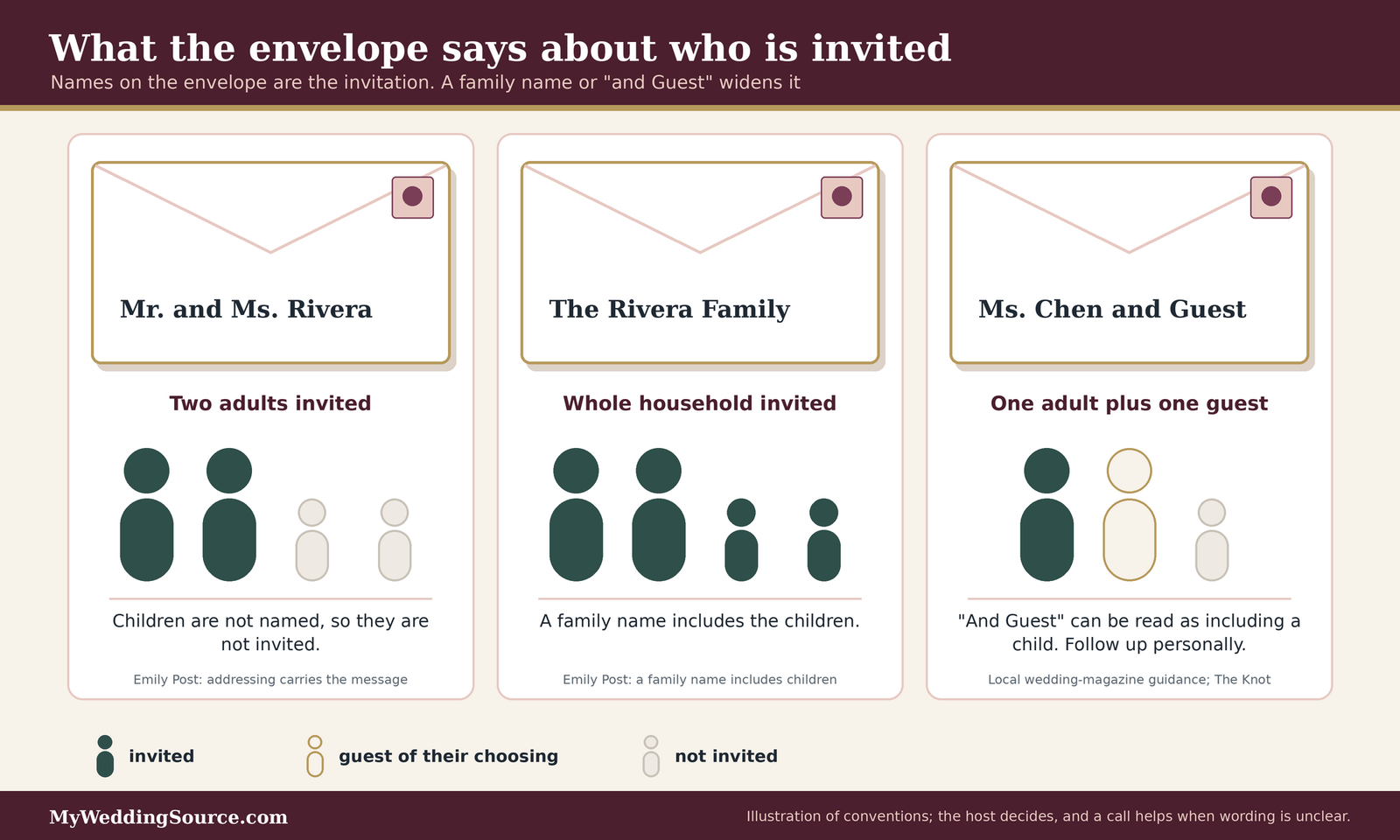
Addressing an invitation to “Mr. and Mrs. Hayward” invites the couple. Addressing it to “The Hayward Family” or listing the children by name invites the children as well, according to Emily Post’s advice on signaling that children are not invited. An invitation to “Ms. Chen and Guest” invites Ms. Chen and one person of her choosing. A separate local-magazine piece cautions that “and Guest” can be read as permission to bring a child, so if you use it, follow up personally where there is any chance of confusion.
The drawing below shows the same rule in three envelopes. Names on the envelope are the invitation, and a family name or “and Guest” widens it.
Making the reply card match
If you include a response card, print the invited names on it and leave no visible blank space for extra names. One etiquette writer recommends this directly: design the card with only the invited names so there is no room for additional family members. If you use an online reply form instead, set it up so that only the invited names appear and add a short note asking guests to contact you about anyone not listed.
What belongs on the invitation, and what belongs elsewhere
Formal invitations carry a small amount of information: who is hosting, who is invited, when and where, and how to reply. Everything else is better placed on a website or an enclosure.
Keep the invitation itself short
Emily Post’s wedding website advice says not to print the website address on the invitation itself, and to share it on the reply card, the map, or a separate enclosure. A local-magazine piece on child-free weddings also advises keeping formal invitations free of attire notes, age limits, and website references. Taken together, the pattern is consistent: the invitation is a formal document, and the practical details live on supporting pieces.
Where the registry goes
Emily Post’s registry advice is explicit that registry or gift details should be left off the invitation and its enclosures, and that couples should tell people by word of mouth and on the wedding website. It adds that close family and members of the wedding party should know where you are registered, since they will probably be asked. If a guest asks you directly, answering is perfectly polite. What the guidance discourages is putting the request on paper that carries your invitation.
When to mail, and how to do the arithmetic
Timing is the part of wedding invitation etiquette that is easiest to get wrong because it depends on how far your guests are traveling and how you collect replies.
The timing guidance from The Knot
The Knot recommends mailing invitations six to eight weeks before the wedding. It notes that going earlier than about twelve weeks risks guests changing their replies when their schedules shift, and that anything after six weeks is late. It suggests the eight-week end when you use paper reply cards, since the cards need time to travel back, and allows closer to six weeks if you use digital replies. It also suggests nine to ten weeks for overseas guests and about eight weeks for a destination wedding, and says save-the-dates help guests start booking travel. If you skip save-the-dates, the invitation does their job, so a longer lead time becomes more important.
The Knot also notes that its own data show a 14-month average engagement and suggests sending invitations about six months ahead for couples who skip save-the-dates, with a shorter engagement meaning about three months. These are recommendations from one publication, not rules. Your own constraints, such as a holiday weekend or a venue that fills quickly, may move your dates.
Our wedding planning timeline shows how these dates fit into the broader schedule, and the wedding planning checklist is a place to record the dates once you pick them.
Postage: a worked example with stated assumptions
Postage is easy to underestimate. USPS’s published price list (Notice 123), as retrieved for this guide, shows a one-ounce stamped letter at $0.82, a metered one-ounce letter at $0.78, an additional $0.29 for each extra ounce, a $0.49 nonmachinable surcharge, and $0.65 for a postcard. Rates change, so confirm the current figures at the post office before you buy stamps.
USPS’s Domestic Mail Manual describes a machinable letter as rectangular with a length divided by height between 1.3 and 2.5, and describes a letter as nonmachinable when it fails those physical standards or has a non-paper exterior. A square invitation has a ratio of 1.0, so by that standard it would fall outside the range. Ask the post office to confirm how your finished piece will be classified, because the same manual says rigid items cannot be mailed inside a letter and that clasps, strings, and buttons are not allowed on automation-compatible pieces.
Here is an illustration with assumptions. Say you mail 80 invitations, one per household, using a 117-guest list as the reference size. This is a labeled assumption, since household counts vary.
- A standard one-ounce stamped invitation: 80 times $0.82 is $65.60.
- The same invitation with the nonmachinable surcharge: 80 times $1.31 is $104.80, a difference of $39.20.
- Paper reply cards returned by mail as postcards at $0.65 each: 80 times $0.65 is $52.00 if every household replies by mail. A reply card in an envelope at $0.82 would be $65.60.
These figures cover postage only, not stationery, and they assume a one-ounce weight. A full suite with several inserts can cross an ounce, adding $0.29 per additional ounce under the same price list. The practical step is to take one fully assembled sample to the post office, have it weighed, and ask what it will cost to mail.
Guest list decisions in wedding etiquette: plus-ones, children, family, and coworkers
The guest list is where wedding etiquette meets budget. Every name has a cost and a relationship attached, and almost every complaint about a wedding traces back to someone who expected to be on the list or expected to bring someone. A clear method is more useful than a long list of rules.
Plus-ones: a decision with a budget on one side and feelings on the other
Wedding etiquette authorities agree on the easy cases and diverge on the hard ones. The method below treats the decision as a sequence of questions, from the least negotiable to the most.
The cases most sources agree on
Spouses and engaged partners are invited as a couple, and Emily Post’s guidance extends that to partners who live together. The Knot agrees on married couples, engaged couples, and cohabiting partners. Emily Post’s advice on handling guests also says that spouses, fiancés, and partners who live with you should be invited, and that dating partners who do not live together need not be. Neither source requires you to invite a casual date, and The Knot lists casually dating guests and coworkers among those who usually do not get a plus-one, with the caveat that if one coworker gets one, all should.
The cases where you decide
Between a committed relationship and a casual date sits a wide band: partners of a year or more who live apart, friends who will know nobody, relatives whose partners you have never met. The Knot suggests asking how each request affects your budget, venue capacity, seating chart, and the atmosphere of the evening, and leans toward giving a plus-one when you are unsure about a long-term couple. Emily Post is more conservative about dating partners who do not live together. For your own policy, pick one threshold, write it as one sentence, and test it against your actual list before you announce it. A common stress test is to run the sentence against every sibling, cousin, and close friend and see whether any result feels unfair.
A separate view, from a writer on plus-one policy, argues that a marriage-only rule can turn the guest list into a ranking of relationships, and that explaining the rule through venue capacity or budget tends to land better than explaining it through relationship status. That is a view worth considering when you write your wording, because it suggests you describe the constraint and not the judgment.
Children: the clearest policy, and the one most often blurred
Whether to invite children is a decision that belongs to the couple. Emily Post’s wedding etiquette guidance says that the couple decides, that no one else has the right to insist on bringing uninvited children, and that exceptions should not be made even for family once the decision is set.
Signal the policy through the envelope and the website
The conventional signal is the envelope, as described above. A local-magazine piece adds that an adults-only reception is acceptable, that children can be in the ceremony while staying out of the reception, and that a website FAQ can state that the event is child-free. It also recommends sending invitations early, so guests can arrange childcare and out-of-town guests do not book travel for children, and assigning a close family member or member of the wedding party to answer questions.
Handle the RSVP that names uninvited children
Emily Post’s separate advice on this situation suggests assuming good faith, calling promptly and kindly, restating who the invitation was for, and holding your position if the guest pushes back. If the guest then declines, that is the guest’s choice. A sample of the tone the guidance suggests is something like: “I’m sorry if there was any confusion, but the invitation was addressed to you and Henry. We hope you can still join us.” That wording is our adaptation of the approach, not a quotation.
The harder case is a parent traveling a long distance who has no childcare. Emily Post’s advice acknowledges that some guests may be unable to attend and suggests offering to help arrange babysitters or setting up a supervised children’s room at the reception. Whether that is affordable is a budget decision, and we return to it in the section on logistics.
List size, cutoffs, and the people who were not invited
Every list has a boundary, and whoever is just outside it can feel it.
Using the national average as a sanity check
The Knot’s 2026 Real Weddings Study reports an average of 117 guests for couples married in 2025, drawn from self-reported responses from 10,474 U.S. couples recruited through its membership. It reports 115 in 2023 and 116 in 2024, and a pre-pandemic figure of 131 for 2019. Respondents were self-selected, so treat the number as a reference point and not as a norm. The Knot itself suggests comparing your list to the average to gauge scale, which can help when relatives push to add more people.
Write the cutoff as a category, not a headcount
“We are inviting family and friends we see regularly” is not a policy, because “regularly” is open to interpretation. “We are inviting first cousins and closer, and friends we have seen in person in the past two years” is a policy. You may pick different criteria, but pick criteria that you can explain without naming a person. Your caterer’s final-count date, which is a contract matter and not a courtesy matter, gives you a date after which changes are no longer practical, so build your cutoff and your reply deadline around it.
If you use a second tier of invitations, sometimes called a B-list, treat it as a scheduling tool and not as a wedding etiquette category. The risk is timing. If invitations go out in waves, the later wave still has to respect the six-to-eight-week window described earlier, which means you need to know your first-wave replies early. Decide the dates before you mail the first batch.
Choose the channel before you write the message
A policy that guests never see is not a policy. The same sentence can land gracefully in one place and badly in another, so channel is part of wedding etiquette. Four channels cover almost everything: the printed invitation, the wedding website, a text or email, and a private conversation. Each has a job.
Match the message to invitation, website, text, or private conversation
The simplest rule is to match the message to its permanence and its emotional weight. Facts that do not change belong in print. Facts that may change, or that need more words, belong on the website. Short logistics belong in a text or email. Anything that could hurt belongs in a conversation.
Use print for durable facts
The invitation carries the host line, the names of the invited guests (through addressing), the date, the time, the place, and the reply instructions. Emily Post’s website guidance and the local-magazine piece on child-free weddings, both discussed earlier, point the same way: the invitation is formal and compact, so it stays free of policies that need explanation. If you put your attire, children policy, or phone policy in print, you invite a debate about whether it was polite to put it there.
One safe approach is to print only what a guest cannot proceed without. Everything else goes one step away, on a card in the envelope or on the website, with a pointer from the reply card.
Use personal outreach for high-emotion exceptions
A person who might be hurt should hear it from a person. Emily Post’s guidance says that when children are not invited, the host should ideally call the parents before invitations are sent, and when RSVPs come back with extra names, the host can phone the guest and restate who was invited. The Knot likewise recommends that individual plus-one requests be handled privately, with the policy stated on the website and not printed on the invitation as a refusal. A call or a handwritten note carries tone in a way that a form email cannot.
Texts and email sit in the middle. They are fine for reminders (“Shuttle leaves at 4:15”) and for confirmations. They are a poor medium for a first conversation about a disappointing decision, because a short written message can read colder than you meant.
A situation matrix you can copy and adapt
The table below is our own synthesis of the guidance cited in this article. It is meant as a starting point and should be adjusted to your guests, your venue, and your family.
| Situation | Policy to state in one sentence | Best channel | Sample approach | Exception logic |
|---|---|---|---|---|
| Adults-only reception | “Our reception is for guests eighteen and older.” | Envelope addressing, then website FAQ | Address only invited adults; call parents of any nearby children before mailing | Wedding party children only, applied to everyone in the party |
| Plus-ones | “Married, engaged, and live-in partners are invited together; others are named on the envelope.” | Envelope, then website | Name the guest if you know them; use “and Guest” only for chosen cases | Out-of-town relatives or wedding party, stated as a rule |
| Registry | “Registry details are on our website.” | Website, word of mouth | Tell family and the wedding party; leave it off the invitation | None needed |
| Cash or honeymoon contributions | “A contribution to our honeymoon fund is welcome, never expected.” | Website, personal reply when asked | Explain how funds will be used | None needed |
| Phones during the ceremony | “We invite you to be present; please keep phones away.” | Enclosure card, website, officiant, sign | Tell the officiant; offer a photo moment later | Guests who need to be reachable, handled quietly |
| Dress code | “Cocktail attire” or the relevant term | Website, enclosure, venue-specific notes | Link to a plain explanation and give examples | Cultural or religious attire, welcomed |
| Late replies | “Please reply by our date so we can give our caterer a final count.” | Reply card, follow-up call | Call guests who have not replied; accept late replies if you can | Illness or emergencies, handled kindly |
| Uninvited guest arrives | “We are happy you are here.” | Day-of conversation with planner or caterer | Add a seat if possible; skip the lecture | Capacity, if the venue is truly full |
Reading the matrix
The row to notice is the last one. Emily Post’s wedding etiquette guidance on handling guests recommends asking the caterer or planner to add seats and welcoming uninvited arrivals warmly, and skipping the lecture, because accepting someone despite their lapse is part of gracious hosting. That is a case where wedding etiquette asks you to be more generous than the earlier policy. It still does not mean the policy was wrong. It means the day itself is not the moment to enforce it.
Adapting a row to your own wedding
Treat each row as a first draft. Replace the sample sentence with your own, change the channel if your guests do not use the website, and add a column for who is responsible for the message. A row that no one owns is a row that does not get sent. Where your venue, caterer, or family has a rule that conflicts with the row, the rule wins and the row should be rewritten to match it.
Give yourself wording you can adapt without sounding scripted
Template language is useful when it is a starting point and harmful when it is read aloud. The versions below are drafted by us, not copied from any source, and each is followed by a note about what its sentences are doing, so that you can rewrite them in your own voice.
Formal and conversational versions
For a website FAQ about children (formal): “We love the children in our lives and have decided to make our reception an adults-only celebration. Children in the wedding party are the only exception. We hope the early notice helps you plan, and we are glad to suggest local childcare options if that would be useful.”
For the same message in a phone call (conversational): “I wanted to tell you before the invitations come out, because I’d hate for you to hear it second-hand. We’re keeping the reception adults-only, and I know that makes travel harder for you. We’d really love to see you there. If a sitter would help, I can send you a couple of ideas.”
For a plus-one request (formal): “Thank you for asking. Our venue and budget limit the guest list, so we are keeping the celebration to the guests named on the invitation. We would be very happy to have you there.”
For a plus-one request (conversational): “I wish we could. The room only holds so many, and we had to make the same call for everyone. I really hope you’ll still come.”
Why each sentence is there
Look at the structure. Each message begins with appreciation or reassurance so the person knows the relationship is not in question. The second sentence states the policy plainly, with no apology that would suggest it is negotiable. The third sentence gives a reason that is true and that applies to everyone, such as capacity or the same decision for all guests. The last sentence invites the person to come, because the message should end on welcome. The structure is also the guard against over-explaining. A longer message tends to give the other person more material to argue with.
If you find yourself writing a fifth sentence, ask whether it is a new fact or just reassurance repeated. Repeated reassurance usually weakens the boundary.
Money and wedding etiquette: who pays, what guests spend, and how gifts are handled
Money is the part of wedding etiquette that most often involves hidden assumptions. Who is hosting? What does a guest owe? What will a guest end up paying? The research here helps, as long as you remember that survey numbers are averages from particular samples and not predictions for your wedding.
Cost context
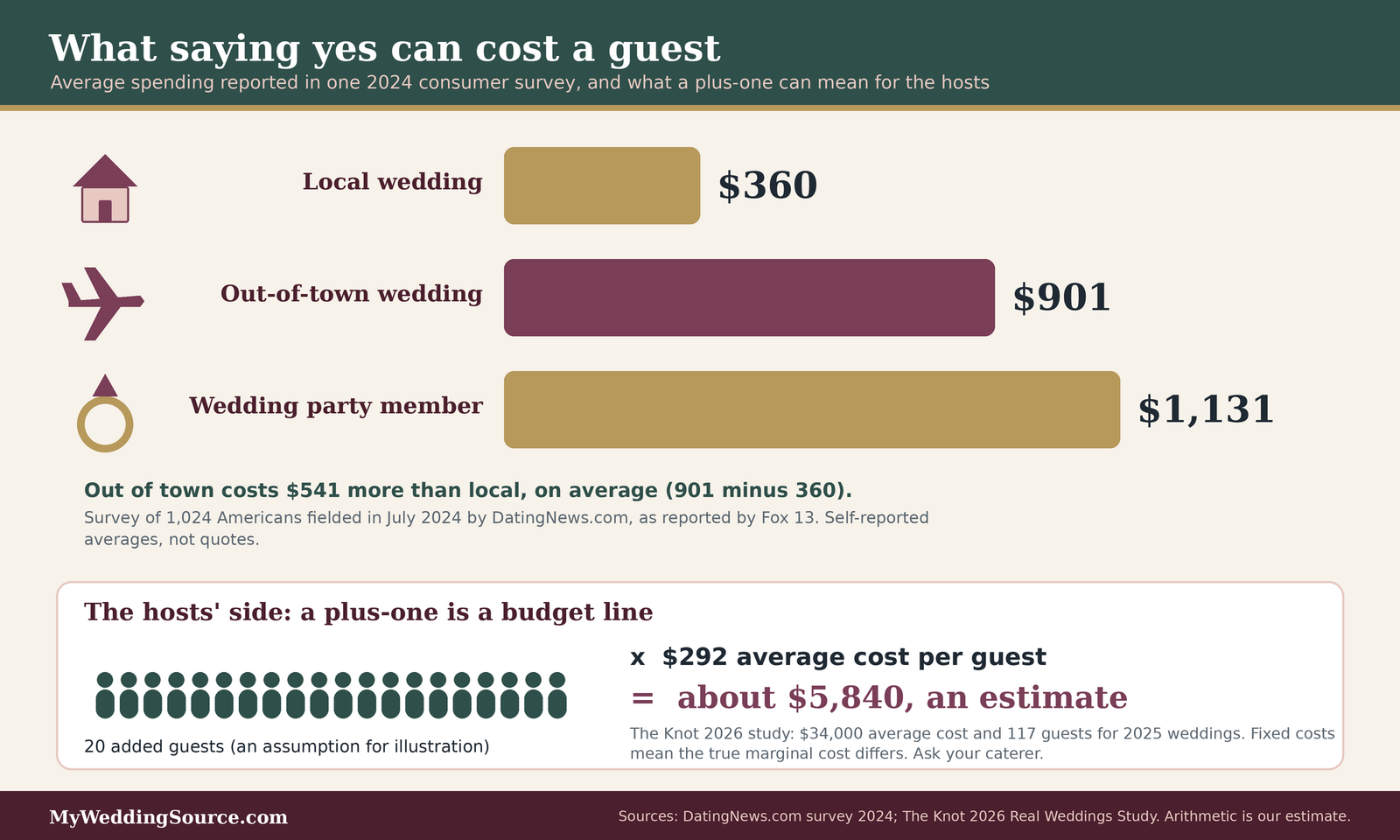
The Knot’s 2026 Real Weddings Study reports an average wedding cost of $34,000 for couples married in 2025, an average of 117 guests, and an average of $292 per guest, based on self-reported responses from 10,474 U.S. couples. Coverage of the prior Knot report, on 2024 weddings, listed an average total of $33,000. A DatingNews.com survey of 1,024 Americans in July 2024 found that 29 percent said they had skipped a wedding that year because attending was too expensive, with average guest spending of $360 for a local wedding, $901 for an out-of-town wedding, and $1,131 for a wedding party member. Both are survey averages with their own samples and are not quotes or predictions. Use them to sanity-check your own plans, and ask vendors for real quotes.
Who pays, and what money does and does not buy
Emily Post’s wedding etiquette guidance on wedding expenses lays out a traditional division and then says plainly that roles are flexible today. Nearly any funding arrangement works, according to that guidance, with the exception of asking guests for money.
The arrangements that work
The same source lists common options: the couple pays for everything, the two families split the cost in half, or the couple pays one third with each family paying one third. It suggests that anyone involved can start the budget conversation, that participants usually include the couple and the parents or stepparents, and that everyone should come prepared with what they can afford and agree on a spending limit first. Our wedding budget calculator is a good place to model those splits before the conversation.
Contribution is not control
On control, Emily Post’s guidance is direct: contributing money does not automatically give hosts control, and the wedding belongs to the couple regardless of who pays. Parents can offer suggestions, while the couple decides on details such as colors, food, flowers, music, and design, and the couple should respect the agreed financial limits because exceeding them is a common source of conflict. If a family member’s contribution comes with strings, it is wiser to know that before you accept, and to decide whether the strings are worth it.
One more financial note, labeled as general information and not tax or legal advice. The IRS lists an annual gift tax exclusion of $19,000 per recipient for 2026, and it states that the exclusion applies to gifts to each recipient. Whether a particular gift to a couple counts as one recipient or two, and whether any filing is needed, is a question for a tax professional.
What a guest owes, and what a guest actually spends
Wedding etiquette says what a guest owes: a prompt reply, a gift if they choose, and thanks. It says less about what a guest spends, which can be substantial.
Guest costs are part of the invitation
Emily Post’s wedding etiquette guidance on expenses says guests pay for their own travel, lodging, and meals, plus a wedding gift. That is the convention, and it is also the reason travel-heavy weddings come with a hidden question. The DatingNews survey above puts average spending at $901 for an out-of-town wedding against $360 for a local one, a gap of $541. The survey was fielded in July 2024 among 1,024 respondents, and we did not find a fuller methodology, so we use it only as an indication of scale.
Zola’s 2022 guest survey of more than 2,500 people reported average spending of over $550 per wedding, average travel costs of $593 by car and about $1,314 by plane, and that about two-thirds of guests take time off work. It is older and measures a different set of guests, so treat it as supporting context and not as a current benchmark. Both surveys suggest the same thing: the cost of attending can be real, and guests deserve early notice.
Courtesies that reduce the guest’s bill without changing your budget
A few steps cost you little. Send save-the-dates early if guests will travel, which The Knot says helps them start booking. State the schedule, including start and end times, on the website so guests can book flights and hotel nights without guessing. List lodging at a range of prices, with ride-share or shuttle information. Emily Post’s wedding website guidance lists lodging, schedule, and transportation among the items that belong on a site. Where you can afford a courtesy, such as a shuttle, state it; where you cannot, say nothing you will not deliver.
Registries, cash requests, and thank-you notes
The three items travel together because they form one loop: a guest decides on a gift, the couple acknowledges it, and neither is forced.
Registry and honeymoon fund etiquette
Emily Post’s wedding etiquette guidance says the choice of gift is always up to the giver, that registry details go on the website and travel by word of mouth, and that preprinted store inserts are acceptable for showers but not for wedding invitations. It also says honeymoon registries are acceptable when you describe how each contribution will be used, and donation registries are acceptable unless the cause is controversial. It recommends not sharing a registry on social media. If you want cash or a contribution to a fund, a short sentence on the website is the conventional place, with wording that makes clear that attendance matters more than a gift. Here is wording we drafted: “Your presence is the gift we care about most. If you would like to give something, our registry and honeymoon fund are linked below.”
Thank-you notes
Emily Post’s guidance on wedding thank-yous says notes are due within three months of receiving a gift, and the best practice is to write on the day a gift arrives, or failing that, three or four notes a day. It says notes should be handwritten, and that fill-in-the-blank cards, phone calls, emails, and generic website posts do not count. For money gifts, mentioning the amount is optional, though it confirms the correct sum arrived, and the note should say what you plan to do with the money. Group gifts get an individual note to each contributor, and hosts of showers and parties get a note, with a small gift, ideally within two days of the event. The guidance also says not to hold early gifts’ notes while waiting for photos. The practical consequence is that thank-you notes are best treated as a running chore through the engagement, and not as a project for after the honeymoon.
Dress code and attire: say it once, say it plainly
Attire is where a small vagueness creates a large amount of worry. “Cocktail,” “semi-formal,” and “dressy casual” mean different things to different people, and guests who are unsure often write to the couple, ask the wedding party, or buy something they will not wear again. The etiquette of a dress code is mostly the etiquette of clarity, which makes it one of the easier parts of wedding etiquette to get right.
Where the dress code goes, and where it does not
Placement follows the channel rules for wedding etiquette from earlier. The dress code is not printed on a formal invitation, according to the local-magazine guidance cited above, which advises keeping attire notes off formal invitations. It belongs on the website and, if you like, on an enclosure card.
State the term and one concrete example
A single word is often not enough, so pair it with a plain description. For example: “Cocktail attire: knee-length or midi dresses, suits or dressy separates, no jeans.” Our guide to cocktail attire explains what the term usually means and how it differs from neighboring terms, which you can link from your website so that you do not have to define it from scratch. The Emily Post wedding website guidance lists weather and attire tips among optional extras, which is a reminder that you decide how much to say.
Account for weather, venue, and travel
A dress code is more helpful when it acknowledges conditions. If the ceremony is on grass, say so, so guests can choose their shoes. If the reception is outdoors in the evening, a mention of layers helps. If many guests are flying in, a note that clothing can be steamed at the hotel helps as well. None of this adds length to the invitation, and all of it fits on a website page.
The wedding party and family members
The wedding party’s attire is a different conversation, because it involves money.
Attendants usually pay for their own clothing
Emily Post’s wedding etiquette guidance on expenses says bridesmaids pay for their attire, accessories, and travel, and groomsmen pay for their attire rental or purchase and travel, with lodging and flowers generally covered by the overall wedding budget. If you ask attendants to wear specific items, that guidance is a reminder to settle the price range before you choose. If the cost is more than you would expect them to bear comfortably, consider offering to cover a share. This is a recommendation, not a rule, and it depends on your budget.
Cultural and religious attire
Some guests will wear attire that reflects their tradition, and some ceremonies have their own expectations about covering shoulders or heads. Emily Post’s wedding website guidance suggests including religious or cultural guidance about what to expect at a service and how guests should participate. A short note on the website is considerate, and it also tells guests who are unfamiliar with the tradition what to wear without making anyone feel singled out.
Social media has created a new category of wedding etiquette question: who can post what, and when. The sources here are practical and fairly consistent, though the evidence is mostly advice and not data, and we found no authoritative survey that we are comfortable citing on how many couples ask for unplugged ceremonies. For that reason we do not give a percentage.
Unplugged ceremonies and how to ask
An unplugged ceremony is one where guests are asked to keep phones away. It is a decision for the couple, and the sources suggest it works best when guests hear about it early and kindly.
Tell guests early, in more than one place
Zola’s advice on banning phones suggests agreeing on the policy with your partner first and considering a compromise, such as allowing phones at the reception. It suggests an enclosure card in the invitation envelope and a note on the wedding website, tells you the invitation itself does not need to mention it, and offers sample wording that invites guests to be fully present, to silence phones and keep them out of sight, and that promises professional photos later. It also suggests a large sign at the ceremony and asking the officiant to remind guests to power down before the ceremony begins. A regional wedding magazine’s social media piece makes the guest’s side of the same point, saying guests should keep phones away during the ceremony and that raising one as the couple walks down the aisle is especially unwelcome.
Make allowances for guests who need to be reachable
Zola’s guidance also suggests making exceptions for guests who need their phones, such as parents waiting to hear from a babysitter, and handling those requests with understanding. A quiet word with the officiant or a family member in advance is easier than a public exception. If you use a “phone valet” basket, consider a way for someone to check messages at the start of the reception.
Our wedding photographer shot list is a useful companion here, because an unplugged ceremony works best when guests trust that the important moments are being captured. If you tell guests that professional photos are coming, tell your photographer that, so the promise can be kept.
Posting, hashtags, and what not to share
Beyond the ceremony, the wedding etiquette questions are about timing and consent.
Hashtags and guest photos
A regional wedding magazine’s piece on social media etiquette says couples can create a hashtag to invite guests to share photos, that guests should use it if one exists, and that couples who allow photos should tag the vendors who helped. It also notes that couples who do not want wedding photos online can set up a phone check and a full social media blackout. If you want a rule such as “please wait until we have posted before you share,” put it on the website and tell the wedding party so that they can answer questions.
Registries, thank-yous, and private details online
Two items from earlier belong here too. Emily Post’s registry guidance recommends not sharing the registry on social media, and its thank-you guidance says that website posts and similar generic acknowledgments do not count as thank-you notes. Wedding website guidance also cautions against intimate personal details and suggests choosing a platform that keeps guests’ contact information private. A sensible default is to treat the website as a practical tool, to keep guests’ details off it, and to post personal content on your own accounts, on your own timing.
Handle pushback without rewriting the rule case by case
Sooner or later, whatever your wedding etiquette policies are, someone will push back. It is not a sign that the policy was wrong. It is a sign that the policy matters to someone, and that person is entitled to disappointment even if they are not entitled to an exception. This section is about holding a boundary without losing the relationship.
Prepare responses to the most predictable objections
Objections are predictable. Preparing a short response in advance means you will not be inventing a policy in the middle of a hard conversation.
Keep the answer short and consistent
Choose one sentence for each policy and repeat it. The Knot’s guidance on declining plus-one requests suggests describing the celebration as by invitation only and, when asked for specifics, saying that you will check what the venue allows and then explaining any limits kindly. Emily Post’s wedding etiquette guidance on children says that making an exception for one family is unfair to those who followed the invitation and arranged childcare. Both point to the same principle: the more elaborate the explanation, the more it can be argued with, so keep the reply short, and keep it the same each time.
A useful practice is to write the sentence down and share it with the people who will be asked, including parents, attendants, and the planner. A local-magazine piece on child-free weddings similarly suggests assigning a close family member or a member of the wedding party to field questions about children, so the couple is not the only one answering. Make sure everyone who answers is using the same sentence.
Give guests a graceful way to decline
Good wedding etiquette accepts that a boundary can leave a guest with a hard choice, such as attending without a child or without a partner. Emily Post’s wedding etiquette guidance on RSVPs says that if a guest declines because an uninvited family member cannot come, that outcome is the guest’s choice, and that declining early gives hosts time to invite someone else. Make that path easy. A line such as “We completely understand if the timing doesn’t work, and we will miss you” gives the person permission to decline without drama. Then do not argue the decision. Send a note afterward, share photos, and keep the relationship warm.
| Scenario | Response principle | Boundary to hold | Graceful alternative | Escalation risk |
|---|---|---|---|---|
| A relative insists on bringing children | Restate the policy once, with warmth | The invitation names who is invited | Offer sitter suggestions, or a supervised space if budget allows | High if one family gets an exception and others do not |
| A guest adds a plus-one on the RSVP | Assume a misunderstanding and call promptly | The envelope is final | Offer to find out what the venue allows only if you truly can add | Medium, as the guest may decline |
| A friend asks why their partner is not invited | Describe the constraint, not the relationship | One stated threshold, applied to all | Offer to revisit the rule for everyone, never for one person | Medium to high, especially among siblings |
| A parent wants to add guests you do not know | Separate who pays from who decides | The cap agreed in the budget conversation | Offer a fixed number of slots, stated as a rule | High if left vague |
| A guest cannot afford to travel | Respond with understanding, not pressure | None needed; attendance is optional | Share the schedule early, list lodging at several prices | Low |
| A guest posts before you do | Ask kindly once, then let it go | The unplugged request, if you made one | Share your hashtag and photographer timing | Low |
| A guest asks for a registry link in the invitation | Redirect to the website | Registry stays off the invitation | Tell them it is on the website | Low |
| A guest wants a different meal or a seating change | Pass to the planner or caterer | Final-count date | Offer a clear deadline for changes | Low to medium |
How to read the table
The escalation column is our own judgment and not a measurement. It is a prompt to spend your attention where relationships are most likely to be strained. If a row says high, prepare a call and a written sentence in advance. If it says low, a short message will do.
Know when kindness means changing logistics, not language
In wedding etiquette, the right response to a hard conversation is sometimes not a better sentence. It is a practical change that removes the problem.
Offer accessibility, childcare, or travel help where appropriate
Emily Post’s wedding website guidance suggests including a space on the RSVP for accessibility needs, allergies, dietary restrictions, or questions about children or plus-ones. That is a low-cost step that turns a private worry into a request you can plan for. For guests with mobility needs, ask your venue about accessible entrances, restrooms, parking, and seating, and put the answers on the website.
The ADA describes Title III as applying to businesses and nonprofits that serve the public, such as restaurants, hotels, and retail stores, and the page we consulted did not specifically mention event venues. We therefore do not state whether a particular venue or event is covered. If accessibility is a concern, ask the venue directly what accommodations it provides and consider asking a lawyer if the answer is unclear. This is general information, not legal advice.
On childcare, Emily Post’s guidance mentions arranging babysitters or a supervised children’s room as ways to ease the situation for out-of-town parents, and a local-magazine piece suggests offering childcare or alternatives if the budget allows. Both are optional courtesies. If you offer one, check the cost and any insurance or licensing implications with the venue first.
Avoid promising what the budget or venue cannot deliver
A kind impulse can produce a promise you cannot keep, such as “we’ll find room for her” or “we’ll cover your hotel.” Before you say it, check three things: the venue’s capacity and rules, your caterer’s final-count date and per-person price, and whether you can say yes to everyone in the same position. Our wedding budget calculator can help you test what an extra ten guests would do to your plan. If the answer is that you cannot, say so, and offer what you can: a call, a photo album, a visit after the wedding.
The guest’s side: replying, changing plans, and being a good guest
A guide to wedding etiquette that speaks only to the couple is half a guide. Guests set the tone too, and many of the conflicts above start with a guest who did not know what was expected. If you are a guest reading this, or if you are a couple writing a note to guests, this section collects the shared expectations.
Replying and changing your answer
Reply behavior is where the largest number of practical problems start, because the couple cannot finalize anything until replies arrive.
Reply promptly, and reply to the people named
Emily Post’s guidance says to reply as soon as you can, within a day or two of receiving the invitation, and no later than the stated deadline. If the invitation has a response card, use it and return it by the date printed on it. If there is no card, a formal reply in the third person or a brief personal note works, and an electronic reply is fine if the invitation offers an email address. The same guidance says guests should not ask to bring someone who was not invited, children and houseguests included, and that an invitation extends only to the people the host named. If you reply for yourself only on an “and Guest” invitation, do not bring a companion.
Changing your mind
Emily Post’s replies guidance says that switching a yes to a no is acceptable only for illness or injury, a death in the family, or an unavoidable work conflict, and that you should call the hosts right away, since they may need to tell the caterer or invite someone in your place. Switching a no to a yes is fine only if it will not disrupt the hosts’ plans. As a host, you can make this easier by writing your reply deadline and your caterer’s final-count date into your own planning notes, so that you know exactly when changes become impossible.
Declining with grace, and attending with grace
Declining is acceptable. The guidance from Zola’s guest survey is blunt: if a wedding does not fit your budget, saying no is the best option. Declining early gives the hosts time to invite someone else, according to Emily Post’s reply guidance, and a short, warm note works better than a long explanation. Whether to give a reason is not settled by the sources we read, and the sample personal note in Emily Post’s wedding etiquette guidance includes one. A brief reason is kind; it is not required.
What to do when you have been invited without a guest
If you were invited alone, the polite choices are to attend alone or decline. Emily Post’s wedding etiquette guidance says declining a request to bring someone is acceptable on the host’s side, since weddings are costly and usually are not meant as dating events, and it is equally acceptable for a guest to decline an invitation that does not suit them. Do not make the couple relitigate the guest list. If the policy genuinely causes a hardship, such as a long trip alone, a single, brief, private conversation is the most you should ask for.
What to do when you are the guest everyone is watching
A few small habits matter more than any rule. Thank the hosts before you leave and again the next day, which Emily Post’s reply guidance recommends. Keep your phone away during the ceremony. Follow the couple’s posting preference if they have stated one. If you are given a seat or a table you did not choose, accept it without comment. These are small, and they are what the couple will remember.
The weekend around the wedding: showers, dinners, and vendors
The wedding day is only part of wedding etiquette. The events around it have their own guest lists, their own hosts, and their own ways to go wrong.
Showers, rehearsal dinners, and other events
Each extra event is a second guest list, and wedding etiquette applies to every one of them. The simplest approach is to decide each list separately and write the reasoning down.
Keep the invitation lists aligned
Emily Post’s wedding website guidance notes that if the rehearsal dinner is limited to certain guests, you should leave it off the public site, or the wrong people may show up. The guidance on handling guests also says that the same rule about who is included applies to the rehearsal dinner, so partners who live with an invited guest are included, and dating partners who do not live together need not be. A tidy approach is to keep one plan for each event and share details only with the people invited.
Remember who is hosting
A person who hosts a shower or party is a host in their own right. Emily Post’s thank-you guidance says shower and party hosts should receive a note, with a small gift, ideally within two days of the event, and that people who house or entertain out-of-town guests should receive a note and a small gift too. Planning a small thank-you budget at the start keeps these from being forgotten.
Vendors and the people who work your day
Vendors are not guests, but wedding etiquette applies to them as well.
Meals, breaks, and clear communication
The sources we reviewed for this guide do not provide a standard on vendor meals or tipping, so we do not state one. The sound approach is to put the answers in your vendor contracts, ask each vendor what they need for a long day, and confirm in writing. Emily Post’s guidance says that vendors who go beyond expectations may receive a courteous thank-you note, though it is not required for everyone.
Share the schedule with the people who need it
A clear written timeline is itself a courtesy. Our wedding planning guide and plan a wedding pages cover the larger planning picture, and the wedding photographer shot list shows what to share with your photographer, including any family groupings so that no one is left out of the portraits.
Putting it together: a one-page policy sheet and a timeline
The ideas about wedding etiquette above are most useful when they live in one document that you and your partner share. This section shows how to build it, with a worked example, and how to place each message in time.
A worked scenario with a one-page policy sheet
The scenario below is invented for illustration and is not a real couple. It shows how the method works with realistic constraints.
The scenario
Alex and Jordan are planning a 110-person wedding at a venue that holds 120. Alex’s parents are contributing and have asked to add six guests. Jordan has eight cousins, three of whom have young children. Alex has a close friend who has been dating someone for six months. The couple wants an adults-only reception, with children in the wedding party the only exception. Their caterer’s final-count date is three weeks before the wedding.
The sheet
Using the method in this guide, they write one line for each decision:
- Capacity: “The venue holds 120. We are capping the list at 110 so that last-minute additions have room.” This is a venue rule.
- Children: “Adults-only reception, wedding party children excepted.” This is a courtesy policy, signaled by addressing and the website, with calls to three families before invitations go out.
- Plus-ones: “Married, engaged, and live-in partners are named together; other guests are named individually. Wedding party members may bring a guest.” This is a courtesy policy with a rule-based exception, and it means Alex’s friend’s partner of six months is not invited under the threshold, which Alex explains by phone using the capacity reason.
- Parents’ additions: “Alex’s parents have six slots, stated as a number, to use for people they know.” This separates who contributes from who decides, in line with Emily Post’s guidance that contributing money does not give control.
- Replies: “Reply by our date; we will call anyone who has not replied.” This ties to the caterer’s date.
- Registry and gifts: “On the website; not on the invitation.”
- Phones: “Unplugged ceremony; phones welcome at the reception.” Announced by enclosure card, website, sign, and officiant.
The sheet takes one page and answers most questions before they are asked. It also exposes the one painful decision, which is the friend’s partner. Because the threshold is applied to everyone, the couple can have that conversation without it becoming a verdict on the relationship. This is an illustration of a method, and the right answer for a real couple depends on their own budget, venue, and relationships.
When each message goes out
A timeline turns the policy sheet into dates. The drawing below places the main messages relative to the wedding date, using the timing recommendations from The Knot and Emily Post that are cited in this guide.

Reading the timeline
The invitation window comes from The Knot, which recommends mailing six to eight weeks before the wedding, and the advice to launch the website before save-the-dates, if possible, comes from Emily Post’s wedding website guidance. The three-month window for thank-you notes comes from Emily Post’s thank-you guidance and counts from the day a gift is received, which means gifts that arrive before the wedding have their own clock. Your caterer’s final-count date is shown as a placeholder because it comes from your contract and not from etiquette. Our wedding planning timeline puts these dates alongside vendor booking, attire, and other tasks.
Adjusting the timeline to your situation
If your guests are traveling, move the website and save-the-dates earlier. If your venue has a hard capacity, send the first wave of invitations earlier so that you know your replies in time to invite a second wave within the six-to-eight-week window. If you are planning a holiday weekend, The Knot suggests eight weeks as a target and allows going closer to three months. If you expect to send paper reply cards, favor the eight-week end.
Questions to ask before you finalize your policies
Questions worth asking before you send anything
- What is the venue’s maximum capacity, and does it count vendors and staff?
- What is the caterer’s final-count date, and what happens to changes after it?
- What does each additional guest cost at the margin, including rentals and stationery?
- Which policies are courtesy, which are venue rules, and which are contract terms?
- Who will answer questions from guests, and do they know the one-sentence policy?
- Does the website cover lodging, schedule, attire, children, and registry?
- Has anyone who might be hurt by a policy heard it from us first?
Questions for the venue and caterer
Some wedding etiquette questions are really questions about facts that only these two can supply.
Capacity, accessibility, and timing
Ask for the capacity in writing and what it includes. Ask about accessible entrances, restrooms, parking, and seating, and whether the venue can accommodate guests with mobility needs. Ask about end times and whether the schedule can change. Put the answers on your website.
Counts, changes, and costs
Ask for the final-count date in writing, what happens if the count changes afterward, and the per-person cost for catering, rentals, and service, so you can run the plus-one arithmetic with real numbers instead of an average.
Questions for yourselves
The hardest wedding etiquette questions are the ones you ask each other.
Which policies would you change for the right person
If there is a policy you would break for one person, ask whether the reason is a rule you could state. If it is, adopt the rule. If it is not, ask whether the favor is worth the cost to the others and to the policy.
Who needs to hear it first
List the people who could be hurt, and decide who will call. Do it before the invitations are mailed, so that the first they hear of a decision is your voice and not an envelope.
Frequently asked questions about wedding etiquette
Guests and invitations
Is it rude to write “adults only” on a wedding invitation?
Emily Post’s wedding etiquette guidance advises against printing it. Address the envelope to the invited adults only and let the addressing carry the message. A website FAQ page can state the policy plainly as a second channel, and a personal call to parents of nearby children, ideally before invitations mail, is kinder than any printed line.
Who should get a plus-one under modern wedding etiquette?
Sources agree that spouses, engaged partners, and live-in partners are invited together. They differ on long-term partners who live apart, so choose one threshold, write it as a sentence, and apply it to everyone. Single guests may be offered a guest, but Emily Post’s guidance treats that as kind, not required.
How far ahead should wedding invitations be mailed?
The Knot recommends six to eight weeks before the wedding, with the eight-week end suiting paper reply cards, nine to ten weeks for overseas guests, and about eight weeks for destination weddings. Save-the-dates help guests who must travel. Check your caterer’s final-count date, because your reply deadline needs to fall before it.
Money and gifts
Do wedding guests have to give a gift?
Emily Post’s wedding etiquette guidance says the choice of gift is always up to the giver, and that registry links are suggestions. A guest who cannot afford a gift or the trip can decline or attend with a card. Couples should avoid wording that treats gifts as a condition of attending.
How long do couples have to send thank-you notes?
Emily Post’s wedding thank-you guidance says notes are due within three months of receiving a gift, and the best practice is to write on the day the gift arrives. It says notes should be handwritten, and that emails, phone calls, and generic website posts do not count. Group gifts need a note to each contributor.
If parents pay for the wedding, do they decide the details?
Emily Post’s guidance on expenses says contributing money does not automatically give hosts control, and that the wedding belongs to the couple regardless of who pays. Parents can offer suggestions. Agree on financial limits and any expectations before accepting money, so that surprises do not appear after deposits are paid.
Phones and pushback
Is an unplugged ceremony good wedding etiquette, and how do I ask?
It is a reasonable choice for the couple. Zola suggests telling guests early through an enclosure card and the wedding website, posting a sign, asking the officiant to remind guests, and promising professional photos later. Consider allowing phones at the reception and making quiet exceptions for guests who need to be reachable.
What should I do when a guest adds an uninvited child or date to the reply?
Emily Post’s wedding etiquette guidance suggests assuming good faith, calling promptly, apologizing for any confusion, and restating who was invited. Hold your position gently if the guest pushes back, and accept it if they decline. If an uninvited guest simply arrives, ask your caterer to add a seat and skip the lecture.
Your next steps
Write your policies down
Draft the one-page sheet
List the wedding etiquette decisions in this guide, including list size, children, plus-ones, registry, phones, attire, and reply deadline, and write one sentence for each. Mark each as a courtesy, a venue rule, a contract term, or a family custom, and note who could change it. Our wedding planning checklist is a good home for the finished sheet.
Test it against your real list
Run each sentence against every sibling, cousin, close friend, and coworker on your list, and watch for any result you would not want to explain. Revise the rule, not the exception. If a rule costs more than your budget allows, our wedding budget calculator shows what changes when guest count changes.
Put each message in its channel
Set your dates
Pick your invitation mailing date, your reply deadline, and your website launch date, working backward from your caterer’s final-count date. The wedding planning timeline shows where those dates sit among the rest of the work, and the wedding planning guide gives the larger picture.
Make the calls first
Call the people who might be hurt before the invitations arrive, and share the one-sentence policy with everyone who will field questions. Then, when pushback comes, your wedding etiquette policy lets you answer once, kindly, and the same way each time.
A useful companion piece: Cocktail Attire Wedding: What to Wear, What to Avoid, and How to Shop Smarter.
Sources & methodology
How we built this guide
What we relied on
This guide synthesizes published etiquette guidance from Emily Post’s site and The Knot, a Zola guest-experience article and survey summary, wedding-cost data from The Knot Worldwide’s 2026 Real Weddings Study and its coverage in the press, a 2024 consumer survey reported by Fox stations, the U.S. Postal Service’s published price list and Domestic Mail Manual, the IRS’s gift-tax page, the ADA’s introduction to the law, and several regional wedding-magazine pieces. Where a statement comes from a publication or retailer, we say so, because each source has its own perspective. The postage and plus-one cost figures are our own arithmetic from the cited prices and are estimates. Sample wording, the situation matrix, the pushback table, and the worked scenario are our own and are illustrations, not quotations.
What we did not do
We did not survey couples or guests, test any product, or give legal, tax, or financial advice. Survey averages come from particular samples and do not predict your wedding. Postal rates and policies change, so confirm current USPS prices before buying stamps. Etiquette authorities disagree on some points, and we have said where. We could not verify statistics about how many couples hold unplugged ceremonies, so we do not give one. For contracts, tax, and accessibility obligations, consult your venue, a tax professional, or an attorney.
Source list
Government and regulatory sources
- U.S. Postal Service, Notice 123, Price List: https://pe.usps.com/text/dmm300/Notice123.htm
- U.S. Postal Service, Domestic Mail Manual, Section 201, Physical Standards for Letters, Cards, Flats, and Parcels: https://pe.usps.com/text/dmm300/201.htm
- Internal Revenue Service, Frequently asked questions on gift taxes: https://www.irs.gov/businesses/small-businesses-self-employed/frequently-asked-questions-on-gift-taxes
- ADA.gov, Introduction to the ADA: https://www.ada.gov/topics/intro-to-ada/
Etiquette authorities and wedding publications
- Emily Post, How to signal no children at your wedding: https://emilypost.com/advice/how-to-signal-no-children-at-your-wedding
- Emily Post, When a guest’s RSVP includes uninvited children: https://emilypost.com/advice/when-a-guests-rsvp-includes-uninvited-children
- Emily Post, How to handle missing or extra RSVPs: https://emilypost.com/advice/how-to-handle-missing-or-extra-rsvps
- Emily Post, Wedding invitation replies: https://emilypost.com/advice/wedding-invitation-replies
- Emily Post, Inside Weddings: Handling your guests with grace: https://emilypost.com/advice/inside-weddings-handling-your-guests-with-grace
- Emily Post, Wedding thank yous: https://emilypost.com/advice/wedding-thank-yous
- Emily Post, Wedding registry etiquette: https://emilypost.com/advice/wedding-registry-etiquette
- Emily Post, Wedding website tips: https://emilypost.com/advice/wedding-website-tips
- Emily Post, Wedding expenses: who pays for what: https://emilypost.com/advice/wedding-expenses-who-pays-for-what
- Emily Post, Invitation etiquette: https://emilypost.com/advice/invitation-etiquette
- The Knot, When to send wedding invitations: https://www.theknot.com/content/when-to-send-wedding-invitations
- The Knot, Plus-one etiquette guide: https://www.theknot.com/content/plus-one-etiquette-guide
- Zola, Unplugged wedding: how and why to ban phones at a ceremony: https://zola.com/expert-advice/ban-phones-at-my-wedding
- D Weddings, Wedding social media rules and etiquette: https://dweddings.com/story/wedding-social-media-rules-etiquette/
- My New Orleans, How to indicate no kids are invited to your wedding: https://www.myneworleans.com/how-to-indicate-no-kids-are-invited-to-your-wedding/
- The Wed, Should only spouses get a plus-one: https://thewed.com/magazine/should-only-spouses-get-a-plus-one
Surveys and cost data
- The Knot Worldwide, 2026 Real Weddings Study (press release): https://www.theknotww.com/press-releases/the-knot-worldwide-unveils-2026-real-weddings-study
- The Knot, Average wedding guest list size: https://theknot.com/content/average-wedding-guest-list-size
- Fox Business, Wedding season is here: how much will one cost in 2025 (reporting The Knot 2025 Real Weddings Study): https://www.foxbusiness.com/lifestyle/wedding-season-here-how-much-one-cost-2025
- Fox 13, 1 in 3 Americans declining wedding invites due to cost, survey finds (DatingNews.com survey, 2024): https://www.fox13news.com/news/wedding-costs-guest-local-out-of-town-dating-news-survey
- Zola, How guests are prepping for one of the busiest wedding years ever (2022 guest survey): https://www.zola.com/expert-advice/wedding-guest-report-2022