

A wedding coffee bar vs espresso cart decision looks like a menu choice, but it is really a choice about two limits, how fast a drink reaches a guest’s hand and how many watts the format asks a venue to supply, so settling those two numbers first makes everything else easier.
Quick answer
In a wedding coffee bar vs espresso cart comparison, a self-serve coffee bar (batch-brewed coffee in insulated dispensers) moves a crowd faster because guests pour in parallel, and it needs less staffing, but it is limited to what you have stocked and it cannot make a latte. A staffed espresso cart makes made-to-order drinks, but vendors publish roughly 50 to 90 drinks per hour per barista, so a crowd that arrives all at once will wait. On power, a standard 120-volt, 15-amp circuit is about 1,800 watts, and one published compact espresso machine lists 1,800 watts at 120 volts by itself. Ask each vendor for the full electrical load, a drinks-per-hour number for your menu, a decaf and non-dairy plan, and proof of insurance and permits in writing. This guide is general information, not legal, medical, or electrical advice, so confirm local rules with your venue, your health department, and a licensed electrician.
Wedding coffee bar vs espresso cart: what you are really choosing
Couples usually meet the wedding coffee bar vs espresso cart choice in the middle of other beverage decisions, after the bar, the late snack, and the cake have already taken up a lot of attention. Coffee feels like a small item. Then a vendor asks about your electrical panel, or a caterer mentions a staffing fee, and the small item turns into a logistics question. This guide treats the wedding coffee bar vs espresso cart decision the way a careful planner would, by comparing the two formats on the things that actually differ: speed, power, space, cost, and what you have to tell guests.
Two formats that share a name
The words “coffee bar” and “espresso cart” are used loosely by vendors, so it helps to define them before starting a wedding coffee bar vs espresso cart comparison. In this guide, each term has one meaning, and the rest of the article sticks to it.
A coffee bar is a station guests run themselves
A coffee bar, in the sense used here, is a self-serve table. Hot coffee is brewed in advance and held in insulated dispensers, and guests add their own milk, sweetener, and toppings. One published budget guide describes this format as the caterer or venue supplying insulated dispensers, cups, lids, cream, sweeteners, stirrers, and a waste bin, with guests pouring their own drinks. The electrical demand sits mostly in the brewing, which can happen in a kitchen before guests arrive, not at the table.
An espresso cart is a small staffed café
An espresso cart is a mobile counter with a machine, a grinder, a barista, and a short menu of made-to-order drinks. The same budget guide describes a staffed cart as including an espresso machine, grinder, barista, cups, milk, flavor options, setup, and breakdown, with guests ordering drinks one at a time. Because each drink is made individually, the cart’s speed depends on one person’s hands, and its electrical demand runs the entire time it is open.
Hybrids, and why they matter
Many weddings end up with something between the two sides of a wedding coffee bar vs espresso cart choice, such as a staffed cart that also puts out an insulated dispenser of plain coffee for guests who do not want to wait, or a caterer’s self-serve station with a hot-water dispenser for tea. A hybrid can solve a speed problem and a menu problem at once. It can also double the power and space questions, so this guide treats hybrids as a real option and keeps coming back to the arithmetic.
Why service speed and power decide the wedding coffee bar vs espresso cart question
Taste, theme, and price matter in a wedding coffee bar vs espresso cart decision, but they rarely cause trouble on the day. Speed and power do. A line that grows past what guests will tolerate, or a breaker that trips in the middle of dessert, is what people remember.
Speed is how fast a drink reaches a hand
Speed here means throughput during the busiest part of service, not the average over an evening. In a wedding coffee bar vs espresso cart comparison, this matters because coffee demand at a reception is not spread evenly. It tends to arrive in a burst after dessert is served or after the dancing slows. A format that handles a slow trickle well can fall behind in a burst, so the useful question is how long the last guest in the burst waits.
Power is how many watts the format asks the venue to supply
Power means the electrical load the equipment places on a circuit, and whether the venue can provide it where the equipment sits. Espresso machines use electric heaters to make hot water and steam, and one machine can draw a large share of a standard circuit by itself. A self-serve bar can lower the on-site load or move it elsewhere. Neither format is automatically easy, and the details differ enough that the wedding coffee bar vs espresso cart decision should include your venue’s electrical layout from the start.
What this guide leaves to other articles
The wedding coffee bar vs espresso cart question overlaps with several topics that already have their own guides on this site. Keeping the scope of this wedding coffee bar vs espresso cart guide clear helps you find the right page for each decision.
Late-night timing has its own guide
If your main question is when a coffee cart should open, how long it should stay, or how a late-evening window changes the plan, our guide to a late-night coffee cart at a wedding covers timing and the evening schedule in detail. This article focuses on comparing the two formats against each other, so we spend less time on the clock and more on throughput and circuits.
Alcohol and coffee drinks are a separate service
Coffee can appear in alcoholic drinks, and some couples want that. That is a bar service decision with its own rules, covered in our wedding bar service planning guide and our guide to the open bar wedding. We touch on it briefly in the menu section below, mainly to make sure nobody assumes anything about who drinks.
Service speed in a wedding coffee bar vs espresso cart
In the wedding coffee bar vs espresso cart comparison, speed is where the two formats differ most, and it is also where published information is thinnest, because most numbers come from the vendors who sell the service. The sections below separate what vendors say from what arithmetic can tell you.
What vendors publish about espresso carts
Published throughput figures for staffed carts cluster in a fairly narrow range, but they come from different kinds of sources and describe different conditions.
The published numbers
A quote platform, Flashquotes, says one cart with one barista serves at most about 50 to 65 drinks per hour, and that two carts with two baristas roughly double that to about 100 drinks per hour. A coffee-cart caterer, Goodhart Coffee Catering, says “over 50 drinks per hour per barista.” An espresso caterer, Espresso Elegance, says its most skilled baristas can make up to 90 eight-ounce drinks in an hour, dropping to 75 per hour with twelve-ounce cups. These are the sources’ own statements, and the caterers are selling the service, so treat their figures as claims to verify.
Why published numbers are ceilings, not promises
A drinks-per-hour figure usually describes a barista working steadily on a simple menu. Real service has pauses. A guest changes an order, someone asks about decaf, the milk pitcher needs refilling, the group at the front orders six different drinks. A complex menu with flavored syrups and multi-step drinks will run slower than a menu of drip and a few espresso drinks. When a vendor quotes a number, ask which menu it assumes. If your menu is bigger than the vendor’s usual menu, assume your throughput will be lower.
Use a range, then ask for your own number
For wedding coffee bar vs espresso cart planning, use the low end of the published range, which is about 50 drinks per hour, and the high end of about 65, then ask the vendor for a figure for your menu. A vendor who has run weddings of your size should be able to answer without hesitation, and a vendor who cannot may not have run them.
How a self-serve coffee bar moves
A self-serve bar is limited by different things than a cart, and that difference sits at the center of the wedding coffee bar vs espresso cart choice. Guests do the work, so the number of people serving at once is the number of guests standing at the table.
Brewer output is the real supply limit
The constraint is how much brewed coffee exists. A published specification sheet for a Fetco commercial batch brewer lists output of 3.9 gallons per hour in a configuration that plugs into a standard 15-amp outlet, and 5.8 gallons per hour in a configuration that needs a 20-amp outlet, both at the manufacturer’s standard factory settings with 3 liters per batch. By our arithmetic, 3.9 gallons per hour is about 14.8 liters, which is roughly 62 eight-ounce cups per hour, or about 42 twelve-ounce cups. That is a production rate. It does not mean guests are limited to 62 cups an hour, because coffee brewed earlier sits in insulated dispensers ready to pour.
Stocked coffee pours in parallel
Brewed ahead and held in dispensers, coffee can serve several guests at once. Four people can pour at the same time from four dispensers, which is a different kind of speed than a single barista working through a queue. The practical limit becomes how many dispensers are out, how much coffee is in each, and how quickly someone refills them. For a burst of 100 eight-ounce cups, our arithmetic gives about 23.7 liters, or roughly eight 3-liter batches. One brewer at the 3.9-gallon rate would need about 1.6 hours to produce that, so the supply has to be stocked ahead of the burst, and a vendor should tell you how many dispensers and how many batches they plan to have ready. We have not found a published figure for how long a given dispenser holds coffee at serving quality, so ask your vendor for that and do not assume it.
Where a self-serve bar slows down
Self-serve is not automatically fast. The slow point moves from the barista to the table. A narrow table with one dispenser and a crowd of guests stirring cream and sugar can back up. Lids, sleeves, stir sticks, and milk need to be spread along the table in a way that lets people move. Guests who want a latte or cappuccino will not find one, which can disappoint some of your guests. A short sign explaining what is offered helps.
A worked queue example
To make the comparison concrete, here is a simple model. It is our own arithmetic, built on stated assumptions, and it is an estimate, not a prediction.
The assumptions
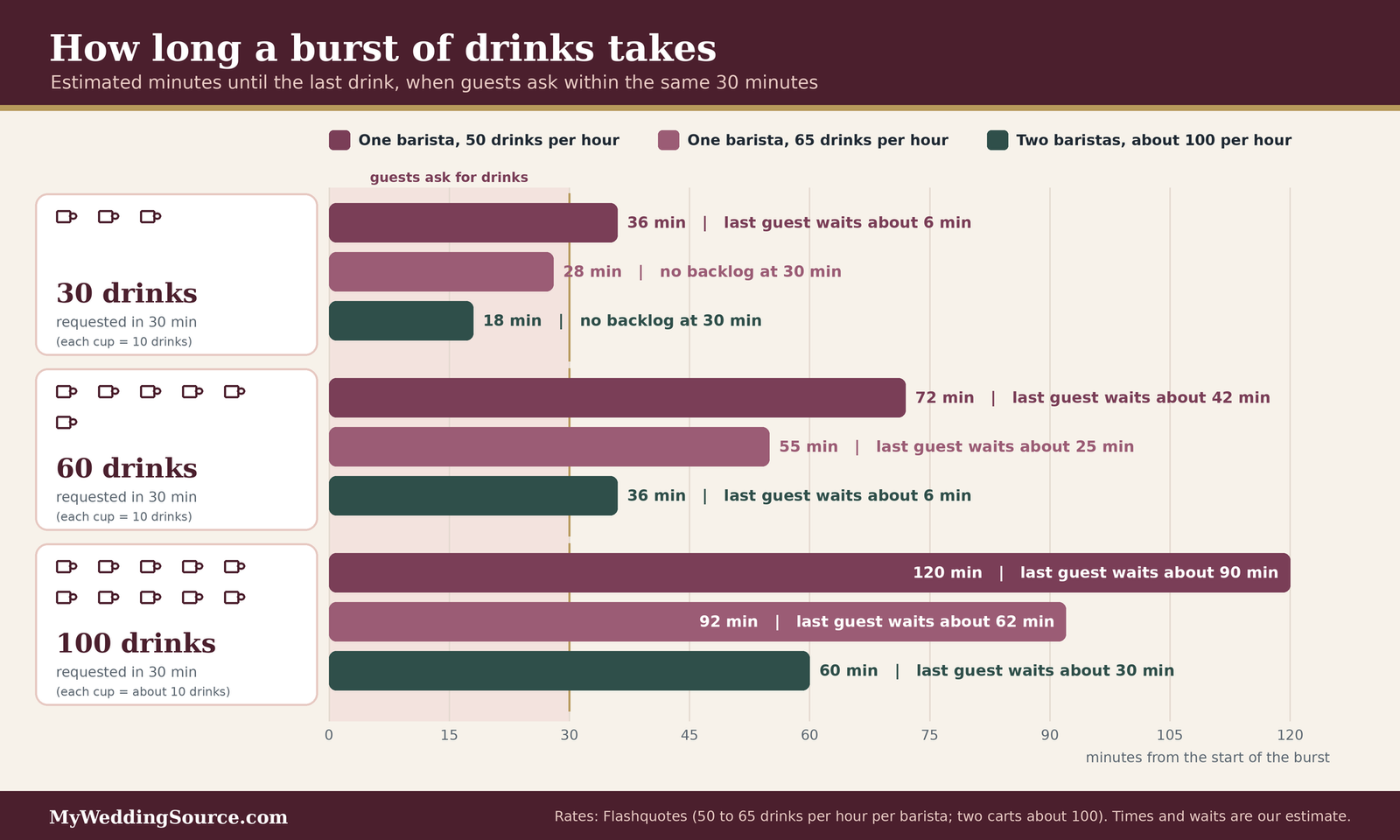
Suppose a certain number of guests ask for a staffed drink within the same 30 minutes, for example just after dessert. Suppose they arrive steadily across that half hour and the cart starts serving at the beginning of it. Use the published planning rates of 50 and 65 drinks per hour for one barista, and about 100 drinks per hour for two baristas, taken from the Flashquotes figures. The last guest’s wait is the time to finish all drinks minus the 30-minute arrival window, and cannot be below zero.
The results
| Drinks requested in 30 minutes | One barista at 50 per hour | One barista at 65 per hour | Two baristas at about 100 per hour |
|---|---|---|---|
| 30 | Done in 36 min (last guest waits about 6 min) | Done in 28 min (no backlog) | Done in 18 min (no backlog) |
| 60 | Done in 72 min (about 42 min) | Done in 55 min (about 25 min) | Done in 36 min (about 6 min) |
| 100 | Done in 120 min (about 90 min) | Done in 92 min (about 62 min) | Done in 60 min (about 30 min) |
How to read the numbers
In a wedding coffee bar vs espresso cart decision, the first row shows that a modest burst is fine, even for one barista. The second row shows what many weddings look like: if 60 of 120 guests ask for coffee in the same half hour, one barista leaves the last guest waiting somewhere between about 25 and 42 minutes, and a second barista cuts that to a few minutes. The third row shows why a large crowd is a real constraint. Many guests will not wait an hour for a drink, so some may give up and the queue may thin on its own. A planner would not count those lost drinks as a success.
What a self-serve bar does with the same burst
In the same wedding coffee bar vs espresso cart scenario, the burst on a self-serve bar is mostly a supply problem. If the dispensers are full, 60 guests can pour 60 cups in a few minutes, limited by how many people can stand at the table. If the dispensers run empty halfway through, the line moves from a barista to a refill, which is slower. The planning questions are how many dispensers, how many batches, and who refills. A published budget guide warns that one barista making individual drinks cannot serve 150 guests in a 20-minute dessert rush without a line, which is the same point from another angle.
Power needs in a wedding coffee bar vs espresso cart
If speed is what guests notice, power is what vendors and venues notice in any wedding coffee bar vs espresso cart plan. It is also the part of the wedding coffee bar vs espresso cart comparison that is easiest to get wrong, because the numbers are specific and the consequences of ignoring them are a tripped breaker or worse.
Reading a circuit
You do not need to be an electrician to read the basic numbers behind a wedding coffee bar vs espresso cart choice, but you should know what they mean and who to ask. This section is general information and not electrical advice.
Volts times amps is watts
A standard residential outlet in the United States is rated at 120 volts and 15 amps, which works out to 1,800 watts, because watts are volts multiplied by amps. A home-services article from HomeServe gives the same figure, and notes that a 20-amp circuit is 2,400 watts by the same arithmetic. Everything that is running on that circuit shares those watts.
The continuous-load guideline
The same HomeServe article, citing the National Electrical Code, says a continuous load, meaning one drawn for three hours or more, should not exceed 80 percent of the breaker’s rating. For a 15-amp circuit that is 1,440 watts, and for a 20-amp circuit it is 1,920 watts. An espresso cart that runs for a few hours is close to that definition, so a machine whose label shows its maximum at 1,800 watts is a sign to ask questions. The label figure is a maximum rating, so ask the vendor what the cart typically draws and what else shares the circuit.
Why vendors ask for a dedicated circuit
Some espresso vendors ask for a dedicated circuit, which means an outlet whose breaker serves nothing else. Espresso Elegance, for example, says its cart needs access to a standard 110-volt outlet on a dedicated circuit. A dedicated circuit protects the cart from other loads such as lighting and speakers, and protects those loads from the cart. At a venue, you can ask which outlets share a breaker and whether the venue knows. Flashquotes also says the steam boiler on a 120-volt, 15-amp circuit is the capacity constraint for a cart, not the espresso machine itself.
What each format draws
Published numbers for real equipment give a sense of scale for a wedding coffee bar vs espresso cart comparison. They are examples, not a catalog of every machine you might meet, and your vendor’s equipment will differ.
The espresso machine
One compact La Marzocco model listed on the manufacturer’s Canadian site shows a maximum of 1,800 watts at 120 volts, with a 0.23-liter coffee boiler and a 1.6-liter steam boiler. That single data point equals the whole rating of a 15-amp circuit, which is why vendors ask for dedicated power. A cart may use a different machine, and the grinder, a refrigerator for milk, a hot-water source, and lights are extra. You cannot add these from published numbers alone, so ask the vendor for the full load of everything on the cart.
The batch brewer
The Fetco specification sheet lists several electrical configurations for one brewer. The configuration with a standard 15-amp plug lists 1.1 to 1.6 kilowatts and 10.9 to 13.0 amps, and the configuration with a 20-amp plug lists 1.7 to 2.4 kilowatts and 16.5 to 19.7 amps. A self-serve bar uses power while the brewer is running, but if coffee is brewed in the caterer’s kitchen and carried out in insulated dispensers, the dining room needs little or no power for the coffee itself. Ask whether the brewing happens on site, and whether a kettle or hot-water dispenser for tea is on the table.
The extras that add up
Whichever side of the wedding coffee bar vs espresso cart choice you pick, small items get added to the circuit: a lamp or string lights, a small refrigerator for milk, a hot-water dispenser, a phone charger, a card reader. None of these are large alone, but they share the breaker. Ask the vendor to list every plug-in item and its wattage, and add them to the main machine.

Cords, generators, and outdoor service
When the venue’s outlets are far from where the equipment should sit, or there are none, the plan has to change. Here the guidance is safety guidance, and it comes from government sources.
Extension cords
The U.S. Consumer Product Safety Commission’s generator safety alert says to use heavy-duty extension cords rated for outdoor use, with a wattage rating that exceeds the total load connected to them, and to check them for cuts or tears. A thin or long cord on a high-wattage machine is a risk. If a vendor plans to run a cord across a lawn or a walkway, ask what it is rated for and how it will be protected so guests do not trip. Espresso Elegance says outdoor events need power within 50 feet of the setup and cords protected from rain, which shows the kind of detail a vendor should have ready.
Generators and carbon monoxide
If a generator is needed, the CPSC says portable generators must run outdoors only, never in garages, sheds, or other enclosed spaces, and must be kept at least 20 feet from doors, windows, and vents that could let exhaust reach people. The same alert says never to plug a generator into a wall outlet to power house wiring. Our guide to wedding generator rental covers sizing and placement in more detail, and our outdoor wedding infrastructure checklist helps you spot other utility gaps at an outdoor site.
Who decides what is safe
You do not have to resolve the electrical details yourself. Ask the venue which outlet and breaker the vendor can use, ask the vendor for the full load, and ask a licensed electrician or the venue’s facilities manager whether the two fit together. For an outdoor wedding, ask the generator provider to confirm that the unit can carry the load. A vendor who gives you a clear number and a clear answer is usually a good sign.
Cost and staffing in a wedding coffee bar vs espresso cart
Price is rarely the first thing couples compare in a wedding coffee bar vs espresso cart decision, but it is often the thing that settles the choice once speed and power are understood. Published ranges are broad, they come from a small number of sources, and they skew toward certain markets, so treat them as planning ranges and ask for a written quote.
What published ranges say about cost
Affordable Wedding Venues & Menus describes a simple self-serve coffee station at about $2 to $5 per guest and an upgraded coffee and tea bar at about $4 to $8 per guest, and a staffed mobile coffee cart at commonly $700 to $1,800 for a typical wedding, with premium espresso bars in high-cost markets at $1,500 to $2,500 or more. Flashquotes, drawing on its own platform bookings, reports a median booking near $1,040, service hours at $150 to $200, and a base price of $300 to $500 for setup, breakdown, and cleanup, with travel at $1.25 per mile round trip. Both sources say prices vary by market, and Flashquotes notes its data skews toward metro areas. Ask for a written quote built on your own hours, guest count, and menu. These are not guaranteed prices.
What the published ranges describe
The numbers above come from two very different kinds of sources, and it is worth knowing which is which before leaning on them.
Self-serve pricing
The self-serve range is expressed per guest, so it scales with headcount. For 100 guests, the budget guide suggests roughly $250 to $500 for a simple station and $400 to $800 for an upgraded one. The guide notes that you should confirm whether cups, napkins, syrups, milk alternatives, refills, and cleanup are included, because those items are where a low price can quietly grow.
Staffed cart pricing
The staffed cart range is expressed per event, and it is shaped by fixed costs such as travel and setup that do not scale with guests. Flashquotes says fixed costs like these do not scale with headcount, which is why its per-person averages fall as the guest count rises. The same budget guide uses a two-hour mobile espresso package at $1,250 in a sample budget, and adds $250 for a second barista in a 150-guest example.
What the figures do not tell you
None of these sources promises that the figure applies to your venue, your date, or your menu. A Saturday in peak season in a dense metro area can sit well above a midweek event in a smaller market. Use the published ranges to see whether a quote is in a sensible region, and let the written quote decide the actual number.
A worked estimate
Here is a simple wedding coffee bar vs espresso cart estimate built from the published figures. It is our arithmetic, with the assumptions stated, and it is an estimate, not a quote.
A self-serve bar for 120 guests
Using the budget guide’s per-guest ranges, a simple station for 120 guests would be about $240 to $600, and an upgraded coffee and tea bar about $480 to $960. These are 120 multiplied by the low and high ends of each range. Add any delivery, rental, or staffing fee a caterer lists separately.
A staffed cart for two hours
Using the Flashquotes components, a two-hour cart would be about $300 to $500 for the base plus $150 to $200 for each of two service hours, which gives about $600 to $900 before travel, taxes, gratuity, and any second barista. The two sources are not measuring the same thing, since one reports platform bookings and the other describes typical wedding packages, so the gap between this estimate and the $700 to $1,800 range is a reminder to get real quotes.
What a second barista changes
From the queue table above, a second barista can cut the last guest’s wait in a 60-drink burst from roughly 25 to 42 minutes to a few minutes. The budget guide’s sample adds $250 for a second barista at 150 guests. Whether that is worth it depends on how many guests you expect to want a drink in the same window and how much waiting you can accept.
Where the money hides
Most surprises come from items outside the quoted price. A short list, checked against your contract, keeps them visible.
Venue and vendor fees
The budget guide advises asking about load-in times and freight-elevator restrictions, venue-required insurance, and whether the venue requires an outside-vendor fee or in-house beverage purchases. Any of these can change the total. Our guide on wedding vendor contracts helps you read the clauses that matter, and our wedding rental planning checklist keeps equipment items in one place.
Hours, travel, and gratuity
Service hours, travel miles, taxes, and tip can be quoted separately. Ask for one total, with each line itemized, and ask what happens if your timeline shifts. If you are building the wider budget, the wedding budget guide and wedding catering cost guide can help place this line in context.
Space, access, and layout in a wedding coffee bar vs espresso cart
Space is the quiet third constraint in a wedding coffee bar vs espresso cart choice. Equipment has a footprint, a line needs somewhere to stand, and some guests need to reach the service point without struggle.
Footprint and flow
In a wedding coffee bar vs espresso cart plan, both formats need more room than the table or cart itself, and the line is part of the footprint.
What a cart needs
Published figures are vendor-specific. Espresso Elegance says its cart is four feet long before setup and its operating area is about seven feet by four and a half feet after setup. Flashquotes describes a standard cart with a counter about five feet wide that fits in a sedan. Ask each vendor for the exact footprint and the clearance behind the cart, where the barista, milk, and supplies sit.
Where the line forms
A line should not cross the path to the bar, the restrooms, the dance floor, or an exit. A staffed cart creates one line at one spot, so its position matters. A self-serve bar spreads guests along a table, which can spread the crowd out, but it needs a wide enough table. Ask your venue where the equipment can go and which walkways must stay clear. Our wedding venue questions guide has a set of layout questions to bring to a walkthrough.
Flow at a self-serve bar
At a coffee bar, think about the sequence a guest follows: cup, coffee, milk, sweetener, lid, trash. Place items in that order along the table, from left to right, with the trash at the end. Put decaf in a clearly different dispenser from regular, with a sign that makes the difference obvious from a few feet away. Our wedding signage guide covers sign basics.
Accessible service
A good wedding coffee bar vs espresso cart setup works for guests who use wheelchairs, guests with limited reach, and guests with low vision. Our accessible wedding guest experience guide covers this broadly. A few points are specific to coffee.
Counter height
The U.S. Access Board’s 2010 ADA Standards, in section 904.4.1, describe an accessible portion of a sales or service counter as at least 36 inches long and no higher than 36 inches above the floor, with a clear space for a side approach. Those standards apply to the design of certain built facilities, and a temporary cart or table at a private event may not be covered, so this is a useful target and not a legal statement about your event. Ask your vendor whether the cart has a lower section, or whether a separate table at that height can be added.
Reach, weight, and hot liquids
A guest who has to lift a full insulated dispenser to pour may struggle, and hot coffee spilled in a crowd is a hazard. Pump-style dispensers can help, and so can a staff member or volunteer who is assigned to assist. For a staffed cart, a barista can hand the drink to the guest, and a small tray or a place to set the cup down on the guest’s side of the counter helps.
Signs and information
Large, high-contrast labels for decaf, regular, and milk options help everyone. A short note on the menu about what is dairy-free and what contains nuts helps guests decide without asking. If a guest cannot see the menu, a barista can read it aloud, and a coordinator can pass the information along.
Menu, nonalcoholic alternatives, and guest disclosure
Coffee service quietly includes decisions about caffeine, allergens, alcohol, and children, and each has a reasonable default. This section covers the menu and the information to share with guests, and it builds on the guidance in our sibling guides on nonalcoholic drinks.
Nonalcoholic alternatives and a guest disclosure table
A wedding coffee bar vs espresso cart service should not assume every guest drinks coffee, drinks alcohol, or can drink either. A short list of nonalcoholic alternatives, with a plain note about what to tell guests, keeps service welcoming.
The table
| Option | Where it fits | What to tell guests | What to ask the vendor |
|---|---|---|---|
| Decaf coffee | Either format, in a clearly labeled dispenser or as a menu item | Mark it clearly and keep it visibly separate from regular | How decaf is brewed and kept separate from regular |
| Hot tea and hot water | Self-serve bar, or a cart with a hot-water source | List the tea types, and note any caffeine or herbal ingredients | Whether hot water is available, and its power needs |
| Hot chocolate or steamed milk | Staffed cart, or self-serve with a dispenser | Note that it contains milk, and list any added flavors | Which milks and syrups are used, and ingredient lists |
| Plant-based milks | Either format | List which ones are offered, and note allergens such as soy, tree nuts, or oat if present | Brands, ingredient lists, and how cross-contact is handled |
| Iced coffee or cold drinks | Either, if ice and cold storage are available | Tell guests what is in it, and note the caffeine | Where the ice and cold milk are stored |
| Mocktails or nonalcoholic spirits | Bar service or a separate station | State plainly that the drink contains no alcohol | Whether the vendor can serve it, and how it is labeled |
| Coffee with alcohol | Licensed bar service only, if at all | Label plainly, and never serve it by default | Who holds the alcohol permit, and local rules |
How to use the table
Pick two or three options that suit your guests and your wedding coffee bar vs espresso cart plan, and write each one on a sign. The “what to tell guests” column is a starting point, and your caterer may have its own wording. For more ideas, our guides on wedding mocktails and wedding nonalcoholic beer and wine cover nonalcoholic drinks, and the sibling guide on how to handle an alcohol-free wedding without surprising guests covers how to communicate it.
Caffeine, decaf, and sensitive guests
A coffee service makes caffeine easy to get. Most guests will be fine, and some will not.
What the FDA says
The U.S. Food and Drug Administration cites 400 milligrams a day for most healthy adults as an amount not generally associated with negative effects, which it says is roughly two to three twelve-ounce cups of coffee, and says a twelve-ounce cup of regular brewed non-specialty coffee typically contains about 113 to 247 milligrams. It also says people who are pregnant, trying to become pregnant, or breastfeeding should talk to a health care provider about limits, and that sensitivity varies with body weight, medications, and medical conditions. We do not give medical advice, so the practical step is simply to offer a clear decaf choice.
Make decaf easy to find
Decaf should not require a favor. Put it on the menu or in a labeled dispenser, and tell the barista to offer it. Guests who skip caffeine for any reason should be able to choose without explaining.
Children and teens
Decide ahead of time whether the cart or bar will serve minors, and tell the vendor. A warm, caffeine-free option such as steamed milk, hot chocolate, or herbal tea gives younger guests something to hold and sip. Check with parents when in doubt.
Allergens and cold milk
Coffee drinks often contain milk, soy, or nuts. A made-to-order drink usually has no ingredient label, so the information has to come from the vendor.
The major allergens
The FDA lists nine major food allergens, which are milk, eggs, fish, crustacean shellfish, tree nuts, peanuts, wheat, soybeans, and sesame. Three of them, milk, soy, and tree nuts, are common in coffee drinks. The FDA says people with food allergies should read labels and avoid the foods they are allergic to, and that symptoms can appear within minutes to hours.
Plant-based milks
Plant-based milks can contain allergens. Food Allergy Research & Education notes that almond is on the FDA’s list of tree nuts that require labeling, and recommends reading ingredient lists every time. Ask your vendor which milks they use, request the ingredient lists, and put a short note on the menu. Do not promise guests that the service is allergen-free, because cross-contact can happen with shared equipment such as steam wands and pitchers.
Keeping milk cold
A Minnesota Department of Health page says cold foods should be held at 40 degrees Fahrenheit or colder, hot foods at 140 degrees or warmer, and that foods should not sit at room temperature for more than two hours. FoodSafety.gov says bacteria that cause food poisoning grow rapidly between 40 and 140 degrees. These pages address food service generally, so ask your vendor and your local health department how they apply to milk at a cart or bar, and where the milk is stored.
If alcohol is part of the picture
A sound beverage plan avoids assumptions about who drinks, and a coffee service is a good place to apply that rule.
Do not assume who drinks
Some guests do not drink alcohol, some are underage, some are driving, and some are pregnant. A coffee station that serves only spiked drinks excludes them. Offer a full nonalcoholic menu as the default, and treat any alcoholic coffee drink as an opt-in item at a licensed bar. We do not assume BYOB either, so check your venue’s rules on outside alcohol.
Coffee does not cancel alcohol
The Centers for Disease Control and Prevention says that when caffeine is used with alcohol, it does not reduce the effects of alcohol on the body, and that caffeine can make alcohol seem weaker than it is. A coffee station is a pleasant end to a night, but it is not a safety plan, so arrange rides, shuttles, or lodging for guests who have been drinking. Our guide to wedding bar service planning discusses the wider plan.
Licenses and who may pour
Rules on serving alcohol differ by state and by venue, and a coffee vendor may not hold the permit that alcohol service requires. We cannot say what applies to you, so ask your venue and your local liquor authority, and ask any vendor to confirm in writing who holds the license and what insurance applies. This is not legal advice.
Choosing between a wedding coffee bar vs espresso cart
With the numbers in hand, the wedding coffee bar vs espresso cart choice is a short sequence of questions. The decision path below turns the guide into a quick check you can do with your partner, and the edge cases afterward cover situations the path does not.
A decision path
The path asks three questions in order. It is a planning aid, not a rule, and a vendor may offer a better answer for your venue.

Question one, do guests expect espresso drinks
In the wedding coffee bar vs espresso cart decision, if your guests would be disappointed without a latte or cappuccino, a staffed cart is the format that makes them. If most guests would be happy with a good cup of regular or decaf, a self-serve coffee bar covers the need at a lower cost and with less waiting. Be honest about your guests, and not about what looks good in a photo.
Question two, can the venue supply the power
If the venue can give a dedicated circuit where the cart will sit, or the vendor can bring a suitable generator for an outdoor site, a cart is workable. If power is uncertain, a self-serve bar with coffee brewed elsewhere moves the electrical question out of the room. Do not decide until you have heard back from the venue.
Question three, how big is the burst
Estimate how many guests will want a drink in the busiest half hour. If it is around 30 drinks or fewer, one barista can manage. If it is closer to 60, plan a second barista or add a self-serve dispenser for plain coffee. If it is closer to 100, you probably need both a larger staffed setup and a stocked self-serve option. Use the queue table above as a starting point and ask your vendor to check it against their experience.
Edge cases
Some situations push the wedding coffee bar vs espresso cart answer one way or the other, and it helps to name them.
A small guest list
For a small gathering, the wedding coffee bar vs espresso cart burst may be too small for queue math to matter. A cart can feel more like a gift at that size, and the cost per guest may be higher. A self-serve bar with a nice pot of coffee and tea is a modest choice that works well. Our micro wedding planning guide covers small events more broadly.
An outdoor site without outlets
If the site has no suitable outlet, a staffed cart means a generator and the safety rules above, and a self-serve bar means insulated dispensers brewed elsewhere. The second option avoids the generator question. Our wedding beverage stations for outdoor heat guide covers a related topic, since a hot drink in summer may be less welcome than a cold one, and our summer wedding heat plan offers wider heat planning.
A venue with an exclusive caterer
Some venues require you to use their caterer or an approved vendor list. In that case, the wedding coffee bar vs espresso cart choice may be limited to what the caterer offers, and an outside cart may carry a fee or may not be allowed at all. Ask early, and read the section on outside vendors in your contract. Our wedding catering service planning guide covers the caterer relationship.
Pairing coffee with dessert
Coffee often goes with the cake or a dessert table, and that is where the burst happens. Our guide to a dessert bar vs wedding cake covers dessert choices, and timing coffee to open as dessert is served helps spread demand. For a use of ice and cold drinks, our wedding bar ice planning guide covers the cold side.
Vendor and source questions for a wedding coffee bar vs espresso cart
Good questions protect you from vague quotes and surprises in a wedding coffee bar vs espresso cart booking. Ask for answers in writing and keep them with your contract.
Questions to ask
The block below, for any wedding coffee bar vs espresso cart booking, combines questions from the sources we reviewed with questions that follow from the numbers in this guide.
Questions to ask before you book a coffee bar or espresso cart
- What is the full electrical load of everything you plug in, how many circuits does it need, and do you bring a generator or battery system?
- How many drinks per hour can one barista make with my menu, and how many baristas do you recommend for my guest count and my busiest half hour?
- For a self-serve bar, how many insulated dispensers will you bring, how many batches will be ready before service, who refills them, and how long does coffee stay at serving quality?
- What is the footprint of the cart or table, and how much clearance do you need? Is there a section at an accessible height?
- What is your decaf plan, your non-dairy plan, and your process for guests with allergies? Can you share ingredient lists for syrups and milks?
- How do you keep milk cold, and how do you handle water, wastewater, and handwashing?
- What licenses and permits do you hold for my county, and can you send copies and a certificate of insurance?
- How is the quote built, including base fee, hourly rate, travel, taxes, and gratuity, and what happens if my timeline changes?
- Do you serve or recommend any alcoholic coffee drinks, and who holds the permit if so?
Put the answers where everyone can see them
Copy the answers about your wedding coffee bar vs espresso cart plan into a shared document, and send it to your venue and your coordinator. The person standing at the circuit panel later in the evening may never have heard of your cart, and a clear record helps them. Our wedding vendor timeline guide can help place the vendor’s arrival and breakdown on the day’s schedule.
Compare quotes on the same terms
Ask each vendor to quote on the same guest count, hours, and menu, so the numbers are comparable. If one includes a second barista and another does not, the totals mean different things.
Permits, insurance, and red flags
Requirements for a wedding coffee bar vs espresso cart vary by place, so this section gives examples and not rules.
Permits
Rules differ by state and county. As one example, the Minnesota Department of Agriculture says mobile food establishments, including temporary food stands, need a Food Handler License unless they operate under a Special Event Food Stand License, and it lists food carts as a category. Your state will have its own rules. Ask the vendor which permits they hold for your county, and ask your venue and local health department whether anything else applies.
Insurance
Ask for a certificate of insurance and check whether the venue requires specific coverage. The budget guide lists venue-required insurance among the items to ask about. Our wedding insurance guide covers event coverage generally, and our wedding vendor due diligence checklist walks through verifying a vendor.
When to walk away
Goodhart Coffee Catering’s own page lists company claims such as its number of carts and reviews, and a vendor’s claims about itself are marketing until you verify them. If a vendor cannot or will not give you an electrical load, a drinks-per-hour number, or proof of insurance and permits, treat that as information. A different vendor, a caterer’s coffee service, or a self-serve station may be a better fit, and there is no shame in changing the plan.
FAQ: wedding coffee bar vs espresso cart questions
Speed and power
Which is faster, a coffee bar or an espresso cart?
For a crowd, usually a stocked self-serve bar, because guests pour at the same time. A cart serves one drink at a time, and vendors publish about 50 to 90 drinks per hour per barista. A self-serve bar can run short if dispensers empty, so ask how many are stocked.
Can an espresso cart run on a normal outlet?
Sometimes. One compact machine’s published maximum is 1,800 watts at 120 volts, the full rating of a 15-amp circuit, and some vendors ask for a dedicated circuit. Ask the vendor for the total load and ask the venue which breaker serves the outlet before you commit.
Does a self-serve coffee bar need power at the table?
Often very little. Coffee can be brewed in a kitchen and carried out in insulated dispensers. A hot-water dispenser or on-site brewer adds load, and a commercial brewer sheet lists 1.1 to 1.6 kilowatts for its 15-amp version. Ask where the brewing happens.
Menu and guests
How do we handle guests who avoid caffeine or alcohol?
Offer decaf, hot tea, and a caffeine-free option such as steamed milk or hot chocolate, label them clearly, and treat alcoholic coffee drinks as an opt-in item at a licensed bar. Do not assume who drinks. A short sign for each option saves guests from having to ask.
How do we handle allergies at a coffee service?
Talk to those guests and the vendor ahead of time. The FDA lists nine major allergens, including milk, soy, and tree nuts, and a made-to-order drink usually has no label. Ask for ingredient lists and a cross-contact process, and never promise an allergen-free service without the vendor’s evidence.
Cost and planning
How much does each option cost?
Published ranges vary. One budget guide gives about $2 to $8 per guest for self-serve and about $700 to $1,800 for a staffed cart, and Flashquotes reports a median booking near $1,040. Travel, taxes, gratuity, a second barista, and venue fees can add to that, so ask for a written quote.
How many baristas do we need?
It depends on how many guests want a drink in your busiest half hour. By our estimate, one barista can handle about 30 drinks in that window, 60 drinks leaves the last guest waiting 25 to 42 minutes, and a second barista cuts that sharply. Ask your vendor to check the math.
Can we have both a coffee bar and an espresso cart?
Yes, and it can solve both speed and menu limits. A stocked self-serve dispenser for plain coffee takes pressure off the barista, who can focus on espresso drinks. The tradeoffs are cost, space, and power, so ask the vendor for the combined load and footprint.
Your next steps
Gather the numbers
Estimate your burst
For your wedding coffee bar vs espresso cart decision, write down your guest count, the half hour when most guests will want coffee, and your guess at how many will order. Use the queue table to see whether one barista is enough, and send the number to your vendors.
Call the venue about power and space
Ask which outlet the equipment can use, which breaker serves it, who can reset it, whether outside vendors are allowed, and where the equipment and the line can sit without blocking walkways or exits. Our wedding venue cost can help if you are still comparing sites.
Lock it in
Get the answers in writing
Send the wedding coffee bar vs espresso cart question list to each vendor, and ask for copies of licenses, a certificate of insurance, an allergen plan, and a menu that includes decaf and a nondairy option. Our wedding planning checklist helps you keep the wider schedule in view.
Add coffee service to the run sheet
Once the wedding coffee bar vs espresso cart choice is made, add arrival, setup, opening, last call, and breakdown times to the schedule your coordinator, caterer, and DJ use, and name a point person. Then share rides or lodging plans so guests know how they will get home.
Related reading: Planning breakfast for the getting-ready rooms.
Sources & methodology
How we built this guide
What we relied on
This guide combines federal guidance from the FDA, the Consumer Product Safety Commission, the Centers for Disease Control and Prevention, and the U.S. Access Board, state agency pages from Minnesota, a manufacturer’s published product page and a commercial brewer specification sheet, a home-services article on circuit loads, and published pages from coffee-cart vendors and a quote platform. Where a statement comes from a vendor, a platform, or a manufacturer, we say so, because those sources describe their own products and prices. The queue and cost figures are our own arithmetic from the assumptions stated in the text, and they are estimates. We checked these sources on November 12, 2026. Prices, rules, and vendor terms change, so confirm them before you rely on them.
What we did not do
We did not test any machine, measure any circuit, or visit any venue. We do not give legal, medical, financial, or electrical advice, and this guide is not a substitute for a licensed electrician, your local health department, your venue, or a clinician. We did not verify any vendor’s insurance or permits, and we cannot promise that any drink is free of any allergen. We could not find a published figure for how long a batch-brew dispenser holds coffee at serving quality, so we did not state one. Always ask for evidence in writing.
Source list
Government and regulatory sources
- U.S. Food and Drug Administration, Spilling the Beans: How Much Caffeine Is Too Much?: https://www.fda.gov/consumers/consumer-updates/spilling-beans-how-much-caffeine-too-much
- U.S. Food and Drug Administration, Food Allergies: https://www.fda.gov/food/nutrition-food-labeling-and-critical-foods/food-allergies
- U.S. Consumer Product Safety Commission, Portable Generator Safety Alert: https://www.cpsc.gov/s3fs-public/Portable-Generator-Safety-Alert-2017_5123.pdf
- Centers for Disease Control and Prevention, Effects of Mixing Alcohol and Caffeine: https://www.cdc.gov/alcohol/about-alcohol-use/alcohol-caffeine.html
- U.S. Access Board, 2010 ADA Standards, Chapter 9 Built-In Elements: https://www.access-board.gov/ada/chapter/ch09/
- FoodSafety.gov, Parties and Large Groups: https://www.foodsafety.gov/keep/events/parties/
- Minnesota Department of Health, Buffet food safety: https://www.health.mn.gov/people/foodsafety/away/buffet.html
- Minnesota Department of Agriculture, Temporary Food Establishments: https://www.mda.state.mn.us/food-feed/temporary-food-establishments
Manufacturer, vendor, and reference sources
- La Marzocco, Linea Micra product page: https://lamarzocco.com/ca/en/home-products/espresso-machines/linea-micra
- Fetco, CBS-2131XTS specification sheet: https://www.rewonline.com/images/spec/fet/fet-cbs-2131xts.pdf
- HomeServe, How much can you plug into one outlet?: https://www.homeserve.com/blog/home-improvement/overloaded-outlet/
- Flashquotes, How Much Does Coffee Cart Catering Cost?: https://flashquotes.com/blog/coffee-cart-catering-cost
- Affordable Wedding Venues & Menus, Wedding Coffee Bar Cost: https://affordableweddingvenuesandmenus.com/blog/wedding-coffee-bar-cost
- Espresso Elegance, Espresso Catering FAQ: https://espresso-elegance.squarespace.com/espresso-catering-faq
- Goodhart Coffee Catering, 10 Things to Consider When Choosing a Coffee Cart Caterer: https://goodhart-coffee.squarespace.com/blog/10-things-to-consider-when-choosing-a-coffee-cart-caterer
- Food Allergy Research & Education, Update on FDA guidance on food allergen labeling: https://www.foodallergy.org/fare-blog/update-fda-guidance-food-allergen-labeling