
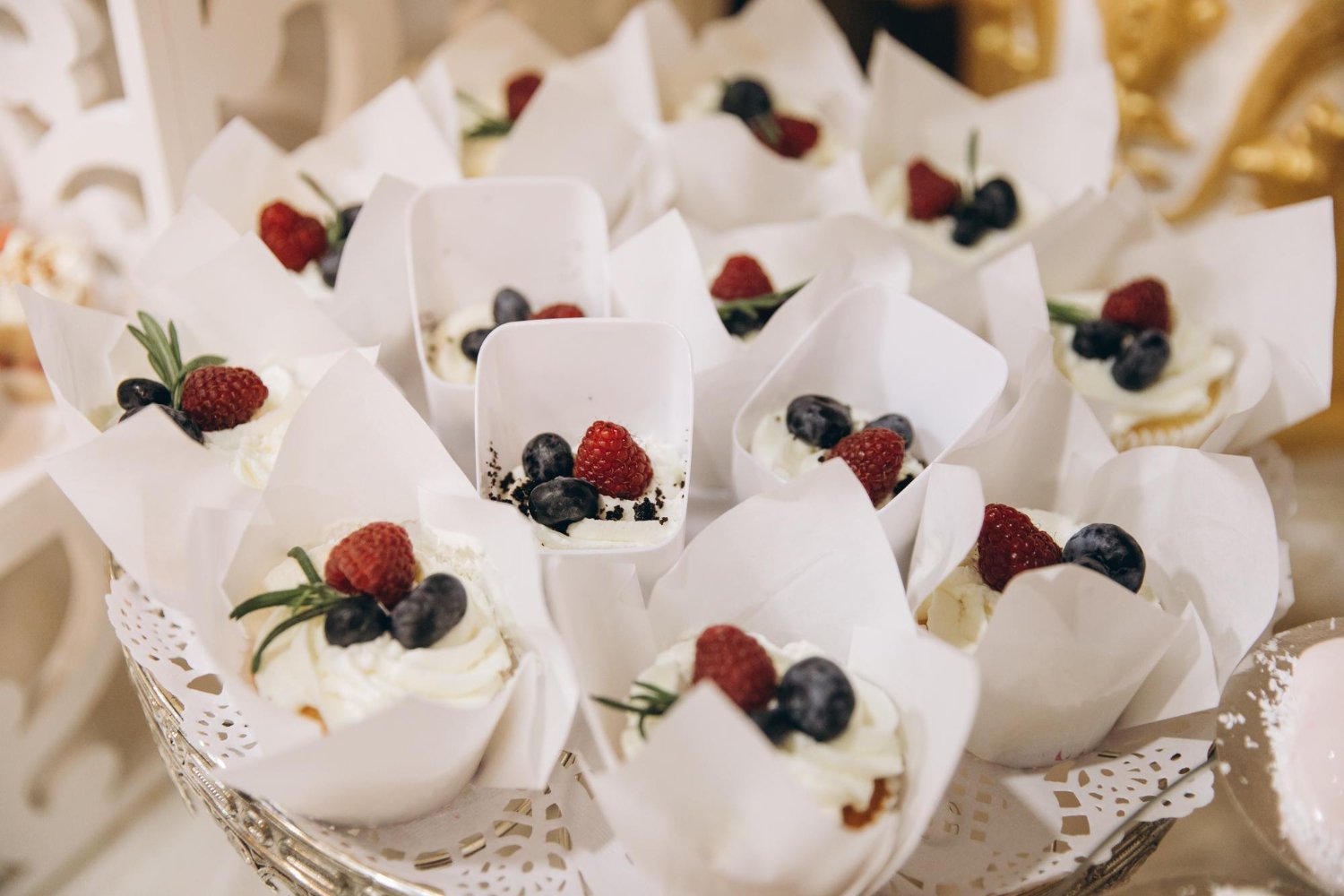
Wedding dessert station allergens are rarely about one dramatic ingredient; they are about shared tongs, unlabeled crumbs, and a line of guests who cannot tell which cupcake is which, so the safest stations are planned on purpose with labels, separation, and a clear way to talk to guests.
Quick answer
A dessert station is hard on guests with food allergies because it is usually self-service, shared utensils move between trays, and many items look alike. Plan wedding dessert station allergens as three jobs done together. Label every item with the major allergens it contains, in plain words, right in front of the item. Separate anything for an allergic guest by using sealed or individually plated desserts, dedicated utensils, and a clean prep surface instead of relying on a “nut-free” tray beside a nut tray. Communicate early, by asking about allergies on the RSVP, naming one person on the caterer’s team who owns the answers, and agreeing in writing what will be served to each guest. No station can honestly be called allergen-free unless a vendor can show how it was made, and nothing here is medical or legal advice.
Wedding dessert station allergens are where a careful dinner can quietly come undone. The entrée was plated to order and the server knew who needed what, and then the room walks over to a bar of cupcakes, cookies, candy, and a chocolate fountain with a dozen hands and five spoons. This guide treats the whole topic as a planning problem that a couple, a caterer, and a baker can solve together. It explains what labeling and notice rules generally say, builds a decision table that matches each type of dessert station to its allergen risk and controls, and gives you words to use with vendors and guests.
For this guide on wedding dessert station allergens we drew on federal and state food-safety guidance, a national allergy organization’s compliance checklist for food service, and clinical sources on allergy and celiac disease. We checked every source for this article on November 12, 2026. Rules and vendor practices vary by state, county, and caterer, so use this guide to ask better questions, and rely on your local health department and your vendors’ written answers for what applies to your day. If you are still choosing between a dessert bar and a cake, our guide to dessert bar vs wedding cake covers that decision first.
Why wedding dessert station allergens need their own plan
Plated dinners come with a natural checkpoint: a server delivers a specific plate to a specific person. A dessert station removes that checkpoint. Guests choose for themselves, children reach across the table, and nobody is standing there to say that the cookie on the left shares a tray with peanut butter. Understanding why wedding dessert station allergens differ from plated-dinner allergens helps you decide how much of the checkpoint you need to rebuild.
The nine allergens and where they hide in sweets
Federal labeling law recognizes nine major food allergens, and desserts can contain most of them. Knowing the list makes it easier to read a recipe or a vendor’s answer.
The nine major allergens
The U.S. Food and Drug Administration lists the nine major food allergens as milk, eggs, fish, crustacean shellfish, tree nuts, peanuts, wheat, soybeans, and sesame. According to the FDA, sesame was added most recently, and the labeling requirement for sesame in packaged foods took effect on January 1, 2023. Fish and shellfish rarely show up in a dessert, but the other seven are everyday dessert ingredients, so wedding dessert station allergens can include almost any of the nine.
Where they appear in a dessert
Typical dessert recipes lean on wheat flour, eggs, milk, butter, and cream. Nuts appear in crusts, toppings, pralines, nut flours, and spreads. Soy and sesame are less obvious, which is why they belong on your question list. Because recipes differ, treat this as a prompt for questions, not as a list of facts about any particular dessert. The only reliable answer comes from the actual recipe and ingredient labels used by your baker or caterer.
Cross-contact, not just ingredients
A guest can avoid an allergen by reading what is in a dessert. The harder problem at a station is what touched it. For people with allergies and celiac disease, that second route can be just as serious as the first.
What cross-contact means in plain words
Cross-contact happens when an allergen-containing food touches a food that does not contain that allergen, either directly or through a shared surface, utensil, or hand. The National Institute of Diabetes and Digestive and Kidney Diseases describes this for gluten: it can spread to gluten-free foods through contact with gluten-containing foods during growing, processing, storage, preparation, or serving. The same logic applies to a spoon that scoops a nut topping and then a plain scoop of ice cream.
Why a station multiplies the risk
At a staffed counter, one person controls the utensils. At a self-service station, dozens of guests do. The FDA’s own research on cleaning found that how much allergen stays on or moves between surfaces depends on the type and amount of the allergen, the wipe or cloth used, and the texture of the surface. A buffet table is a surface that is touched, wiped, and re-stocked all evening, which is why the controls in this guide focus on utensils, surfaces, and layout, and not only on ingredients.

Why a dessert station is not the same as the cake
The wedding cake is a single item in the vendor’s hands, cut and plated by staff. A station is a system of many items and many touch points, and it deserves its own plan.
The cake has a checkpoint; the station does not
When staff cut and serve cake, they can ask each guest who needs what, and the baker’s ingredient list covers one product. Our guide to wedding cake flavors helps you choose flavors with this in mind, and our overview of wedding cake planning covers the cake itself. Once you add a dessert bar, wedding dessert station allergens become a many-recipe problem, possibly with several suppliers.
The station often adds outside suppliers
Wedding dessert station allergens multiply when tables combine the caterer’s items, a bakery’s cookies, a candy supplier’s jars, and a rented fountain. Each source has its own ingredients and its own handling. Ask who is responsible for each category, and see our guide to wedding vendor subcontractors for how to confirm who is actually preparing what.
What labeling and notice rules generally say
Labeling rules are the backbone of allergen information, but they were written for packaged foods and for restaurants, not for wedding dessert station allergens specifically. Learning where the rules apply and where they stop tells you where you must ask for more. This section is general information, not legal advice, and requirements vary by location.
Packaged items versus items made and served on site
Federal rules and state rules cover different situations, and a dessert station often mixes both. A sealed, store-bought cookie and a cupcake frosted in the caterer’s kitchen are treated differently.
Packaged foods carry a label
For packaged foods, the FDA requires the major allergens to be declared on the label. For sesame, the FDA describes three acceptable formats: naming sesame in the ingredient list, adding a “Contains” statement next to the ingredients, or putting sesame in parentheses after an ingredient name. The FDA also notes that products already shipped or on shelves before 2023 did not have to be pulled, so some older packages may not show sesame. For wedding dessert station allergens, that means you can use the package label on a sealed item as evidence, and you should read the label yourself.
Unpackaged foods rely on notice and conversation
The rules for food prepared and served on site come mostly from states and localities, which adopt versions of the FDA Food Code. As one example, the Illinois Department of Public Health says that a permit holder must notify consumers in writing about major allergens in unpackaged items, and that accepted methods include brochures, menu notices, label statements, table tents, and placards. The same page says that for buffets and bakery cases, each item containing a major allergen needs written notice, and that blanket statements may work depending on the method. Other states differ, and Massachusetts, for instance, requires allergen awareness posters and menu statements telling diners to notify staff of allergies. Ask your caterer which rules apply to their handling of wedding dessert station allergens and how they meet them.
Gluten-free and “allergen-friendly” claims
Guests often shorthand their needs as “gluten-free” or “nut-free,” and vendors sometimes use the same words on a sign. These claims have different meanings, and some have no standard meaning at all.
What “gluten-free” means on a package
NIDDK explains that the FDA requires foods labeled gluten-free to contain less than 20 parts per million of gluten, an amount it says is too small to cause problems for most people with celiac disease. It also notes that the FDA rule does not cover USDA-regulated meat, poultry, and some egg products, or most alcoholic beverages. The FDA’s gluten-free page, last updated in March 2026, describes the claim as voluntary and notes an open request for information about labeling and preventing gluten cross-contact in packaged foods. That context matters for wedding dessert station allergens because a handmade dessert on a wedding table is not a packaged food with a regulated claim.
Why “nut-free” or “allergy-friendly” needs evidence
The National Institute of Allergy and Infectious Diseases notes that precautionary statements such as “may contain trace amounts” are voluntary and not standardized. That tells you that wording on a sign tells you what a vendor chooses to say, not what a test shows. If a baker says a cupcake is nut-free, ask whether the recipe has no nut ingredients, whether the bakery handles nuts, and how the surfaces and tools are cleaned between products. Our editorial rule is simple: do not promise an allergen-free dessert without evidence, and do not accept that promise from a vendor without seeing how it is kept.
Training and who is in charge
Rules also cover people. Many jurisdictions expect the person in charge at a food business to understand allergens, which is worth knowing when you evaluate a caterer.
The Food Code and allergy awareness
The FDA’s reference crosswalk for its retail food risk study lists allergy awareness training for managers and food employees, tied to Food Code provisions on demonstrating knowledge and on the person in charge. The crosswalk notes that the allergen items are optional in the study. It also files cross-contact under protection of food during storage, preparation, and display, which includes separation of packaged and unpackaged food, utensil contact, glove use, and consumer self-service.
State examples worth knowing
The Virginia Department of Health says that at least one supervisory employee must be a certified food protection manager, and that the person in charge must make sure employees are trained in food allergy awareness. Massachusetts says that effective October 7, 2024, the person in charge is responsible for training employees on allergen awareness. These are examples, not a national rule. A reasonable question for any caterer is who on the dessert team has training in wedding dessert station allergens and related food-allergy topics, and what it covered.

The wedding dessert station allergens decision table
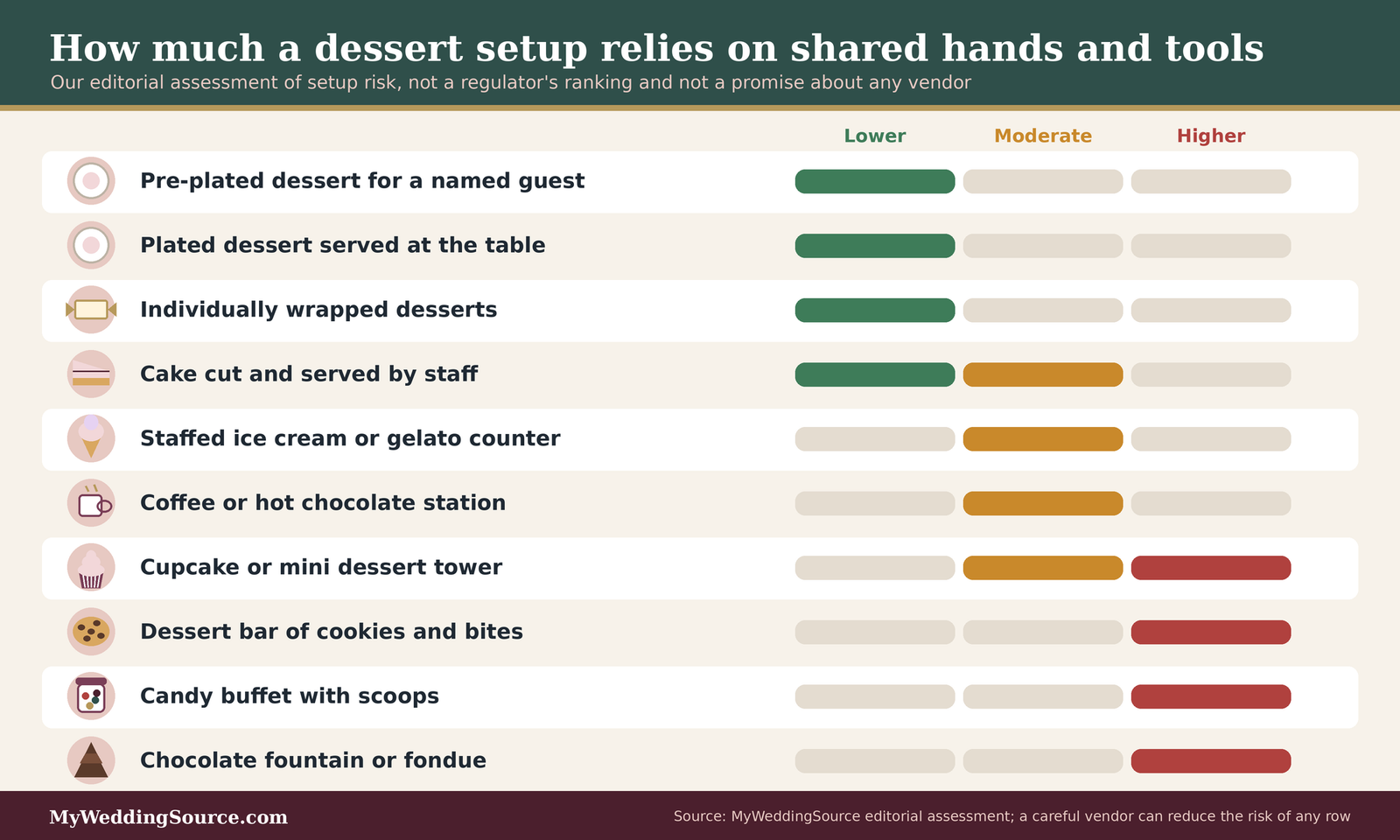
This is the core of the guide: a table for wedding dessert station allergens that pairs each common type of dessert station with where its allergen risk comes from, how much it depends on guests’ own behavior, and the controls worth asking your caterer or baker to confirm. Use it at your tasting and again when you review the contract.
How to read the table
The decision table for wedding dessert station allergens is our own editorial tool. It is built from the cross-contact principles in FDA, FARE, and state sources, applied to the way dessert stations are usually set up. It is not a ranking from any regulator, and it does not predict what will happen at your wedding.
What the risk column means
We describe risk in three plain levels, based on how many shared hands, shared utensils, and unlabeled look-alike items the setup involves. “Lower” means staff or sealed packaging control most contact. “Moderate” means staff control some steps but guests still handle shared items. “Higher” means guests serve themselves from open, shared items with shared tools. These levels describe the setup for wedding dessert station allergens, not any particular vendor, and a careful vendor can reduce the risk of almost any row.
What the controls column means
The controls are things to ask for and to put in writing. They draw on practices in the FARE food service compliance checklist, such as using separate utensils for each item at self-serve areas, grouping items with the same allergen together, and keeping full ingredient information available on site. They also draw on the FDA’s cleaning research. A control that a vendor cannot describe in detail is a control you should treat as not yet in place.
The table, by who serves the dessert
The first table of wedding dessert station allergens covers stations where staff or sealed packaging control most contact. The second covers stations where guests serve themselves.
Table one: staff-controlled and sealed options
| Station type | Where allergen risk comes from | Setup risk | Controls to ask for |
|---|---|---|---|
| Plated individual dessert served at the table | Recipe ingredients; a plated item may be built next to other plates in a shared kitchen | Lower | Plate allergy orders first on clean surfaces with clean utensils; name the person who hands the plate to the guest; keep a written ingredient sheet for each dessert |
| Cake cut and served by staff | Fillings, frostings, and decorations; one knife used across several flavors | Lower to moderate | Clean knife and server between flavors; allergy slices cut first and plated separately; ask for ingredient lists for every layer and filling |
| Sealed individually wrapped desserts | The package label is the main evidence; production-line cross-contact is outside the vendor’s control | Lower | Keep the original packages or labels; read each label yourself; do not unwrap and rewrap; keep sealed items away from open ones |
| Pre-plated allergy-safe dessert for a named guest | Anything that touches the plate on the way out, including a shared tray or reused tongs | Lower if covered and labeled | Prepare in a cleaned area before other desserts; cover, label, and hold until pickup; hand it to the guest or the guest’s table; remake any plate that is contaminated |
| Staffed ice cream or gelato counter | A shared scoop, shared toppings, and shared cones | Moderate | Fresh scoop for each guest with an allergy; toppings dispensed with their own utensils; ask what is in each flavor and where it was made |
Table two: self-service stations
| Station type | Where allergen risk comes from | Setup risk | Controls to ask for |
|---|---|---|---|
| Cupcake or mini dessert tower | Look-alike items; frosting transfers on touch; crumbs fall to lower tiers | Moderate to higher | One tier or one tray per allergen group; a card in front of each flavor; separate tongs per tray; staff refresh trays rather than guests rearranging them |
| Dessert bar of cookies, bars, and bites | Shared trays and serving tools; items that share a plate | Higher | Group items with the same allergen together; separate utensil per item; label cards for every item; one attendant to watch for swapped utensils |
| Candy or sweets buffet with scoops | Many unpackaged items, shared scoops, and open bins | Higher | Prefer pre-bagged portions; if scooping, one scoop per bin and clear lids; read package labels for each candy |
| Chocolate fountain or fondue | Dipping items touch the shared flow; double dipping; the chocolate itself may be a nut or milk product | Higher | Ask what the chocolate contains; consider a staffed version where a server skewers items; ask for a separate pot for allergy guests if you want it available |
| Donut wall, cookie table, or family-brought dessert tables | Home or small-business recipes with no ingredient record; tables with many contributors | Higher | Ask each contributor for an ingredient list in writing; label every tray; consider keeping any outside desserts on a separate table with a notice |
| Coffee, hot chocolate, or cordial station next to desserts | Milk, nut milk, flavored syrups, and shared spoons; splashes onto nearby trays | Moderate | Label dairy and nut milks; keep the station away from the dessert trays; use individual stir sticks |
How to use the table with your caterer
The table is a conversation tool. It works best when you take it to a tasting and mark each row with the vendor’s actual answer.
Mark every row with what you will serve
Circle the station types you plan to offer, and write the vendor’s answer in the controls column. If the answer is “we will be careful,” ask what that looks like in practice. Our wedding caterer tastings guide explains how to run the tasting itself, and it is the right place to ask for ingredient lists and for a demonstration of how an allergy plate is prepared.
Choose fewer stations rather than watching more
Each additional row in the table adds wedding dessert station allergens to manage: a set of items, utensils, and label cards. If a station is not worth its allergen workload, a simpler setup serves everyone better. A single staffed dessert counter plus sealed alternatives is easier to control than five separate self-service tables. Our guide to wedding grazing tables discusses a similar trade-off for savory spreads.
What the table cannot tell you
A table can show where risk concentrates, but it cannot replace a conversation with a guest who has allergies, and it cannot certify any vendor.
It does not certify a vendor or a product
No row in the table makes wedding dessert station allergens go away, and none means a dessert is safe. The decision rests on the actual recipe, the actual kitchen, and the actual allergy the guest has. If a guest has severe allergies, they and their clinician are the experts on what level of risk is acceptable. The couple’s job is to give the guest accurate information and a safe option, not to decide on their behalf.
It does not replace local requirements
Your caterer is responsible for meeting the labeling, notice, and training rules in their jurisdiction. If you are using a venue’s in-house kitchen, ask the venue what its permit requires. Our wedding venue questions guide includes food-service questions to add to your list.
Labels for wedding dessert station allergens that guests can use
A label for wedding dessert station allergens does one job: it lets a guest decide in a few seconds whether to take an item. Most signs for wedding dessert station allergens fail because they are decorative, vague, or placed where nobody reads them. Plan the label as a piece of safety information first and as a design piece second. Our guide to wedding signage covers the look; this section covers what the words need to say.
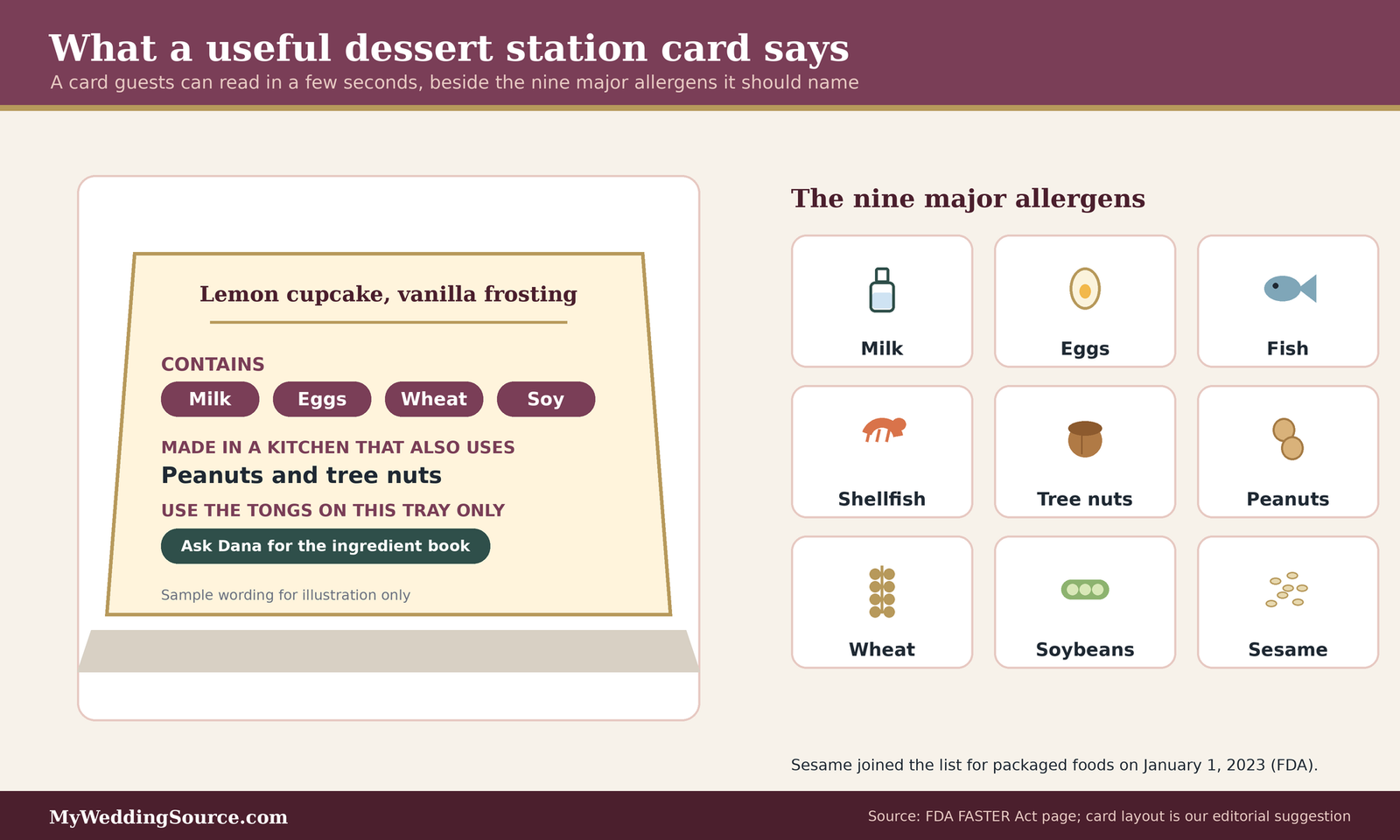
What each station card should say
The content of the card matters more than its font. Aim for a card that answers the questions a guest with an allergy would otherwise have to ask a stranger.
Name the item and list the major allergens it contains
Put the item name at the top, followed by a plain line such as “Contains: milk, eggs, wheat, and soy.” Use the same nine allergen words the FDA uses, because guests with allergies are used to reading them on packages. Avoid decorative abbreviations and symbols that need a legend. If an item has no major allergen ingredients, say so only if the recipe and ingredient labels confirm it.
State how it was made, in one honest line
A line such as “Made in a kitchen that also uses peanuts and tree nuts” gives a guest information that “nut-free” never could. NIAID points out that advisory statements are voluntary and not standardized, so write your own line and base it on what your vendor tells you. If your vendor cannot say what else shares the kitchen, write that the kitchen shares equipment and let guests decide.
Where and how to display them
A correct label in the wrong place does not help. Placement is as important as wording, and it connects to the separation steps in the next section.
Put the card directly at the item, not on a distant sign
For wedding dessert station allergens, Illinois guidance for buffets and bakery cases asks for a written notice for each item with a major allergen, though it also says blanket statements may work depending on the method used. A single poster listing every item is harder to use than a card at each tray. If the setup uses tiered stands, a small card at each tier or on each plate does the work. Guests should be able to read it before they reach for a utensil.
Offer a printed full ingredient book as a backup
Illinois also says that QR codes are acceptable written notice, but that the business should consider whether they suit its customers and provide printed copies on request. For a wedding with older guests or patchy venue signal, a printed binder at the station with every recipe’s ingredients is a practical safety net, and it costs little. The FARE checklist similarly lists making full ingredient information available on site as a front-of-house control.
Keeping labels accurate on the day
Labels go wrong in predictable ways. A supplier changes a recipe, a vendor swaps an item, or a tray gets moved and the card stays behind.
Lock the menu and require approval for substitutions
The FARE checklist lists written vendor policies, regular label reviews, and no substitutions without approval as ingredient-accuracy controls. For a wedding, translate that into a sentence in your contract: no item may be substituted on the dessert menu without approval from you or your planner, and any substitution must come with an updated ingredient list. Our guide to wedding contract change orders shows how to handle changes in writing.
Assign someone to check cards after setup
At setup, ask a named person to walk the station and compare each card to its item, tray by tray. The same person checks again after any refill. This takes two minutes and catches the common error where a restocked tray holds a different product than the card claims. A planner, coordinator, or the catering captain can do this, and our guide on wedding vendor final walkthroughs is a good place to add the task.
Separation: how a station keeps allergens apart
Separation is the physical half of managing wedding dessert station allergens. Labels tell guests what is where, and separation makes sure the labeled thing stays what the label says. The practices below come from FARE’s food service checklist and the FDA’s cleaning research. They are controls to ask about, not a guarantee.
Utensils, trays, and layout
Layout decisions about wedding dessert station allergens are cheap before the event and nearly impossible during it. Decide them at the planning stage, and put them on the setup diagram your caterer uses.
One utensil for each item
FARE’s checklist calls for separate utensils for each item at self-serve areas. At a dessert table this means a pair of tongs or a spatula per tray, never a shared pair, and ideally utensils with a different color or tag for each allergen group. When a guest drops tongs in the wrong tray, the whole tray is affected, so ask your caterer how an attendant will catch and replace those mistakes.
Group like items and keep spill-prone items low
The same checklist suggests grouping items that share an allergen together at self-serve areas, covering airborne-risk items like flour, and keeping spill-prone items low or separated. At a dessert station, that might mean all nut-containing items on one table or one end, each on its own tray, with sealed or plated alternatives on a separate surface. Crumbs, powdered sugar, and drips fall downward, so avoid placing a nut dessert above a nut-free one on a tiered stand.
Keep an alternative table out of the traffic flow
A plated or sealed alternative for guests with allergies should not sit at the end of a self-service line where hands and sleeves reach across it. Give it its own spot, a staff member to hand it over, and a label. A guest should not have to wait in line or ask in front of the room to reach the safe choice.
Cleaning and preparation
The FDA’s work on wiping and cleaning is the most useful single source for the kitchen side. It tested whether Food Code wiping and cleaning guidance, written for microbes, also removes allergens.
What the FDA’s cleaning study found
The FDA’s retail food protection staff summarize a study in which peanut, milk, and egg residues were put on stainless steel, textured plastic, and maple wood. A full wash, rinse, sanitize, and air-dry process removed allergens well and limited transfer. Scraping off food before cleaning helped. Wet cloths and alcohol or quat sanitizing wipes did better than dry wipes, storing cloths in sanitizer solution reduced transfer between surfaces, and allergens were harder to remove from textured plastic.
What that means for a dessert caterer
Ask how serving trays, tongs, and cutting boards are washed between uses, and whether textured or scratched plastic trays are used for allergy plates. Ask what happens when a staff member wipes a table between guests: a dry napkin is not the same as a wet cloth stored in sanitizer. These are fair questions, and a well-trained caterer will be able to answer them. If the answer is a shrug, take that into account.
In the kitchen before the station opens
Most risk from wedding dessert station allergens is decided before the dessert leaves the kitchen. Ask what happens in the hours before service.
Prepare allergy-safe items first
FARE’s checklist lists preparing allergen-free orders first, using barriers and dedicated utensils, washing hands and changing gloves between items, and discarding or relabeling any meal that has been contaminated. For a dessert caterer, this means making the allergy plates or sealed portions at the start of prep, on a cleaned surface, with clean tools, and keeping them covered and labeled until they are served.
Watch fried items and shared equipment
The Virginia Department of Health’s guidance says not to use the same grill or fryer that was used to prepare an allergen. If your dessert includes fried items such as doughnuts or churros, ask what else the fryer is used for and whether it is cleaned between products. A shared fryer is a reason to offer a different safe option instead.
Talking with guests before and during the wedding
Good labels still depend on guests telling you what they need, and wedding dessert station allergens are no exception. Collecting that information early, and handing it to the right person, is what turns a station from a hazard into a choice. Our guide to wedding dietary restrictions covers the full menu; here we focus on dessert.
Before the wedding: asking and answering
The easiest time to learn about a guest’s allergy is when they reply to your invitation. The hardest time is when they arrive at a dessert table with a plate in their hand.
Ask on the RSVP, and follow up personally
Add a line to your response card or website asking about food allergies and dietary needs, and make it clear who will see the answers. Our guide to wedding RSVP wording offers phrasing ideas. When a guest lists a severe allergy, a short, personal message from you or a family member works better than a form: thank them, ask which foods and what kinds of exposure matter to them, and tell them what you plan to offer. Keep the answers private, since health information belongs to the guest.
Turn answers into a single list for the caterer
Collect allergy answers in one place and send the caterer a list with guest names, table numbers, and the allergens named. Ask the caterer to confirm in writing that dessert has been checked against that list, not only the main course. If your guest list is in a shared spreadsheet, see our guide to wedding guest spreadsheet permissions so health details are not visible to everyone who can open the file.
On the day: one owner and a visible plan
A plan for wedding dessert station allergens with five owners has none. Name one person at the caterer’s team and one on your side who will answer allergy questions at the station.
Name an allergen lead for the station
The FARE checklist suggests an “allergen champion” on every shift in a food service operation, and training that covers allergen identification and anaphylaxis response. Ask your caterer who fills that role at your event and how the person is introduced to guests. A small card at the station saying “Ask for [name] about ingredients” removes the awkwardness of asking.
Give allergic guests a private, easy path
Many guests do not want to announce an allergy to a room. Offer a way to receive a safe dessert without lining up, such as a server who brings a pre-plated or sealed dessert to the table. Our guide to wedding seating charts can help you seat guests with similar needs near the person who will deliver it, and our kids meals article covers what to do for children at the same event.
If a guest has a reaction
This is the part nobody wants to plan, and planning it is a kindness. This is general information, not medical advice, and the guest’s own emergency plan comes first.
Know the basics of anaphylaxis
NIAID describes anaphylaxis as a serious allergic reaction involving more than one body system that begins quickly and can be fatal, and says epinephrine is the treatment and should be given right away, usually by injection in the thigh. It says antihistamines are only a secondary treatment and should not replace epinephrine, and that you should call 9-1-1. The Virginia Department of Health’s guidance for restaurants gives similar steps: use the person’s epinephrine auto-injector, call 9-1-1, remove the food, and get medical care immediately. The CDC states that early recognition and treatment can prevent serious harm or death.
Make the plan visible to the team
Tell your planner, caterer, and a few trusted friends or family where an allergic guest keeps their auto-injector, who knows how to use it, and who will call for help. Ask the venue where the nearest address marker for emergency responders is, so a call is quick. You do not need to alarm other guests; you need two or three people who know what to do.

Working with your caterer, baker, and venue
Wedding dessert station allergens are a purchasing issue, and the answers you need are best secured before you pay a deposit. This section turns the earlier ideas into questions and contract language. It is general guidance and not legal advice.
What to ask, and what to put in writing
Verbal assurance is where most allergy plans fail, because the person who made the promise is often not the person working your event.
Ask for the process, not the promise
“Can you make it nut-free?” invites a yes. “Walk me through how an allergy plate is made and held” invites detail. Ask which allergens the kitchen handles, how surfaces and tools are cleaned, how the allergy plate is labeled, and who hands it to the guest. Ask whether any dessert comes from an outside bakery and, if so, what that bakery’s practices are. Our guide to wedding vendor due diligence can help you decide how deeply to verify.
Write the allergy terms into the contract
Ask the vendor to put into the contract or a signed addendum: the list of dessert items, the ingredient list for each, the process for allergy plates, the name of the allergen lead, and the rule that substitutions need approval. Our guide to wedding vendor contracts explains the clauses to look for. If a vendor refuses to put a claim in writing, treat it as an unverified claim.
What this can cost
We did not find a reliable, sourced price range for allergen controls at wedding dessert stations, so we do not give figures. Costs depend on your caterer and region. What you can do is ask for them as line items: individually wrapped or plated alternatives, extra attendants for a self-service station, separate prep time, extra labeling, and any charge for an outside baker’s ingredient documentation. Compare those items with the cost of simplifying the station, since fewer open, shared items often means fewer controls to pay for. For the bigger picture, see our guide to wedding catering cost.
Tastings, outside suppliers, and the venue kitchen
The tasting is your best chance to see how the vendor thinks about wedding dessert station allergens, and a place to catch problems cheaply.
Use the tasting to see the system
Ask to see the ingredient list and label card for each dessert you try, and ask how the allergy plate would be made. Ask what the vendor would do if a guest with a nut allergy asked about the chocolate. If you have a guest with a serious allergy, do not use that guest as a taster. Ask the vendor for documents instead, and share them with the guest so they can decide.
Clarify who owns the outside bakery or candy supplier
If your dessert table includes items from a bakery or a candy supplier, ask the caterer whether they will set them out as delivered. Keep original packaging, and ask the supplier for ingredient lists with the same detail as the caterer’s items. If the venue requires its own caterer to handle all food, ask how they treat outside desserts and whether they will label them. Our wedding catering guide helps with sorting those roles.
Late-night and take-home sweets
Wedding dessert station allergens do not always end at the station. Late snacks, coffee carts, and favors raise the same questions with fewer staff nearby.
Late-night treats and coffee carts
A late-night cart brings a new set of shared tools and a different staff team. Our guide to the late-night coffee cart covers service, and the allergen question is the same: what is in the milk and syrups, and what are the spoons and steamers used for? Ask for a card at the cart that names dairy, nut milks, and syrups.
Favors and boxed desserts
A box of cookies or candy to take home should be labeled with the major allergens like any other item. If you are making favors, see our wedding favors guide, and for homemade items include a card with the ingredients, since guests may not know what is in a handmade treat. Packaged items with intact manufacturer labels are the simplest way to give guests the information they need.
Edge cases and judgment calls
Real weddings produce situations for wedding dessert station allergens that no table anticipates. These are the ones we see most often, with the reasoning rather than a rule, because the right answer depends on the guest and the vendor.
Allergies that need special thought
Different wedding dessert station allergens behave differently at a station, and some guests have more than one.
A severe nut or peanut allergy
For a guest with a severe nut allergy, the usual instinct is to label a nut-free tray. A more cautious plan is to avoid nut-containing items at the station altogether if the guest has asked for that, and to confirm the guest’s comfort level before deciding. The same FARE principle applies: avoid cross-contact on shared surfaces and remake any compromised item. Ask the guest what level of precaution they want and tell them what you decide.
Celiac disease and gluten
NIDDK advises people with celiac disease to call ahead, tell staff about the condition, ask about preparation, and speak with the chef, and says that at social gatherings you can tell the host and ask about gluten-free food. For a station, a plated or sealed gluten-free dessert from a vendor that can describe its process is more dependable than a gluten-free cupcake sitting beside wheat items. The NIDDK page also warns that cross-contact with gluten grains is common for oats.
Several allergies, or an allergy to something unusual
A guest with milk, egg, and wheat allergies may not be able to eat most dessert items, and fruit is often the simplest answer. The CDC notes that symptoms and severity vary between people and can change over time for the same person, and FARE says over 170 foods have been reported to cause reactions in the U.S., so ask the guest what they need. The Virginia Department of Health also notes that alpha-gal syndrome can be triggered by mammal-derived products such as gelatin and some dairy, so ask guests with that condition about gelatin in desserts.
Setups that complicate the plan
Some popular dessert ideas make managing wedding dessert station allergens harder, and it is better to know in advance.
Open-flame and made-to-order stations
Among wedding dessert station allergens, a flambé or made-to-order crepe station creates a cooking surface that will be used for many ingredients and many guests. Ask whether the station uses a separate pan for each order and what is on the surface in between. If the vendor cannot control it, a plated alternative is a better choice for a guest with allergies.
Large guest counts and crowded rooms
With a crowd, wedding dessert station allergens are harder to watch, since staff cannot see every tray, and utensils will migrate. Consider fewer self-service items, more staff, and sealed alternatives, and review the floor plan with the caterer. Our reception floor plan guide helps you leave enough space for a line to form without guests crowding the trays.
Guests who prefer to bring their own dessert
Some guests will want to bring their own safe dessert. Treat that as a reasonable choice: ask the caterer where it can be stored and served, and make sure it is labeled so it is not mistaken for part of the station. Our guide to a wedding with an immunocompromised guest covers related safety planning.
Questions to ask before you book the dessert station
Use these questions on wedding dessert station allergens with your caterer, baker, and venue. Ask for the answers in writing and keep them with your contract.
Questions worth asking about dessert station allergens
- Which of the nine major allergens are in each dessert, and can I see the ingredient list for every layer, filling, and topping?
- What else is made in the kitchen or bakery that produces these desserts, and how are surfaces and tools cleaned between products?
- How is a dessert for a guest with an allergy prepared, covered, labeled, and delivered?
- Who is the allergen lead at my event, and what training do they have?
- Will every item at the station have its own label card and its own utensil?
- What happens if an item has to be substituted on the day?
- If a guest has a reaction, who on your team knows what to do, and what is the plan?
About the food
These questions confirm what is actually in the desserts, which is the foundation for wedding dessert station allergens planning.
Ingredients and sources
Ask for the full ingredient list, including sub-ingredients such as chocolate, sprinkles, glazes, and fillings, and ask whether any item arrives pre-made from a supplier. If the vendor relies on supplier labels, ask how often they re-check them, because manufacturers change recipes. The FARE checklist lists regular label reviews and standardized recipes with full sub-ingredient lists as controls.
Kitchen and equipment
Ask what the kitchen also handles, what equipment is shared, and how it is cleaned. Ask specifically about fryers, mixers, and sheet pans, which are easy to overlook. A vendor who can describe this without hesitation is one you can plan with. A vendor who cannot should be asked to find out, or should be given a simpler menu.
About the people and the plan
These questions confirm who will be responsible when guests start to arrive at the station.
Training and ownership
Ask who has allergy awareness training, what it covered, and who will be at the station. Ask whether staff are trained to respond to a severe reaction. The FARE checklist suggests training at hire, annually, and as needed, and an allergen champion on every shift. Ask the vendor for their own version of that.
Written agreements
Ask for the dessert menu, the ingredient lists, the allergy-plate process, and the substitution rule in the contract or an addendum. Ask what the vendor will do if a guest reports a problem during the event, and whether they keep an incident record. FARE’s checklist lists incident reports after any complaint or reaction as part of good guest communication.

FAQ: wedding dessert station allergens
Planning basics
Are wedding dessert station allergens a bigger risk than plated dessert allergens?
Often, yes. Self-service stations remove the staff checkpoint that connects a specific plate to a specific guest, and they add shared utensils and look-alike items. A staff-served or plated dessert gives the caterer more control. A careful vendor can make either safe, so judge the process, not the format.
What allergens must be on a label?
For packaged foods, U.S. law covers nine major allergens: milk, eggs, fish, crustacean shellfish, tree nuts, peanuts, wheat, soybeans, and sesame. For unpackaged food made and served on site, requirements come mostly from state and local rules, so ask your caterer how they meet the local requirement for written notice.
Can a caterer promise that wedding dessert station allergens are fully controlled?
Be cautious about any promise. Advisory wording such as “may contain” is voluntary and not standardized, according to NIAID, and a sign says only what a vendor chooses to say. Ask for the recipe, the kitchen practices, and the cleaning steps, and get the answer in writing before relying on it.
Setup and separation
Is a separate nut-free tray enough for wedding dessert station allergens?
Not by itself. A separate tray helps only if the tray, the tongs, the table, and the hands are also kept apart, and if the label is accurate. FARE’s checklist suggests separate utensils for each item and grouping items with the same allergen. Plated or sealed alternatives are often more dependable than a separate tray.
How should a gluten-free dessert be served?
Treat it like any other allergy item. NIDDK says gluten can spread to gluten-free food on contact during preparation or serving, so a sealed or pre-plated dessert held away from wheat items is more dependable than one on a shared tray. Ask your vendor how it is made and kept apart.
Guests and communication
How do I ask guests about allergies without making it awkward?
Add a short line to the RSVP asking about food allergies or dietary needs and saying who will see the answers. For guests with serious allergies, follow up personally, thank them, and tell them what will be available. Keep the information private and share it only with the caterer and your planner.
What if a guest wants to bring their own dessert?
Welcome it as a reasonable safety choice. Ask your caterer where it can be stored and served, label it clearly, and keep it away from the shared station so it is not mistaken for a station item. Offer to keep it in a kitchen fridge if it needs one.
What should we do if a guest has a reaction?
Follow the guest’s own emergency plan. NIAID says epinephrine is the treatment for anaphylaxis and should be given immediately, that antihistamines should not replace it, and that you should call 9-1-1. Tell a few people before the reception where the guest keeps their auto-injector. This is general information, not medical advice.
Your next steps
Decide what the station will be
Pick the station type with the table
Go back to the decision table for wedding dessert station allergens and circle the stations you are considering. If one of them is a high-contact self-service setup, ask whether the same dessert could be served by staff or in sealed portions. Our guide to dessert bar vs wedding cake helps you weigh the options, and our cake servings guide helps you size whatever you choose.
Decide what alternative you will offer
To keep wedding dessert station allergens manageable, choose one safe alternative that can be sealed or plated, such as fruit or a vendor-prepared allergy plate, and decide how it will reach the guest who needs it. Offering it to every guest, and not only the ones with allergies, can make it feel less singled out.
Lock in the details
Get the answers in writing
Send your caterer the question list from this guide and ask for written answers before the contract is final. Save the answers with your agreements, and add the allergen lead’s name to your day-of contact list. Our wedding planning checklist has a place for these follow-ups.
Communicate with guests and then re-check
For wedding dessert station allergens, collect allergy answers on the RSVP, send a single list to the caterer, and ask a named person to compare each station card to its item at setup. Check again if anything is refilled or replaced. Our wedding party coordination checklist is a good place to assign the check.
Sources & methodology
How we built this guide
What we relied on
This guide combines federal food-safety and labeling information from the FDA, a national allergy organization’s food service compliance checklist and statistics, clinical information from NIAID, the CDC, and NIDDK, and examples of state health department guidance. We checked each source on November 12, 2026. The station decision table is our own editorial assessment, built by applying the cross-contact principles in these sources to common dessert setups. It is not a regulator’s rating. State and local examples are examples, not a statement of what applies where you are marrying.
What we did not do
We did not test any vendor, kitchen, or dessert, and we did not find or give price figures. We are not doctors or lawyers, and nothing here is medical or legal advice. We did not consult a registered dietitian or a food-safety-certified caterer for this article. A guest’s clinician and your local health department are the right authorities for individual and local questions.
Source list
Government and public-health sources
- U.S. Food and Drug Administration, Allergen Removal and Transfer Using Wiping and Cleaning Methods in Retail Food Establishments: https://www.fda.gov/food/retail-food-protection/allergen-removal-and-transfer-using-wiping-and-cleaning-methods-retail-food-establishments
- U.S. Food and Drug Administration, The FASTER Act: Sesame Is the Ninth Major Food Allergen: https://www.fda.gov/food/food-allergies/faster-act-sesame-ninth-major-food-allergen
- U.S. Food and Drug Administration, Gluten-Free Labeling of Foods: https://www.fda.gov/food/food-labeling-nutrition/gluten-free-labeling-foods
- U.S. Food and Drug Administration, Risk Factor Study Food Code Reference Crosswalk (March 2024): https://www.fda.gov/media/177279/download
- Centers for Disease Control and Prevention, Food Allergies: https://cdc.gov/school-health-conditions/food-allergies/index.html
- National Institute of Allergy and Infectious Diseases, Food allergy patient guidelines: https://www.niaid.nih.gov/sites/default/files/faguidelinespatient.pdf
- National Institute of Diabetes and Digestive and Kidney Diseases, Eating, Diet, and Nutrition for Celiac Disease: https://www.niddk.nih.gov/health-information/digestive-diseases/celiac-disease/eating-diet-nutrition
State health departments
- Illinois Department of Public Health, Allergen Requirements FAQ for retail food: https://dph.illinois.gov/topics-services/food-safety/retail-food/allergen-requirements-faq.html
- Virginia Department of Health, Food Allergens: https://www.vdh.virginia.gov/environmental-health/food-safety-in-virginia/food-allergens/
- Massachusetts Department of Public Health, Food Allergen Awareness Guidance: https://www.mass.gov/lists/food-allergen-awareness-guidance
Allergy organizations
- Food Allergy Research and Education (FARE), Allergen Compliance Checklist for food service (2025): https://www.foodallergy.org/media/5237/download
- Food Allergy Research and Education (FARE), Facts and Statistics: https://www.foodallergy.org/resources/facts-and-statistics