
A wedding breakfast for getting-ready rooms is a small order with unusually strict timing: a dozen or so people, one or two rooms, a few hours of hair, makeup, and photos, and no kitchen, so the useful questions are who is actually in the room, when each person will eat, and what the outlets can power.
Quick answer
For a wedding breakfast for getting-ready rooms, count everyone who will be in the room at the busiest moment, including stylists and the photo team, then plan one hot handheld item, one bakery item, and one fruit or yogurt serving per person, plus about 15% spare (our planning estimate, not a published standard). For coffee, vendors suggest brewing for roughly three quarters of the group at a morning event, and one vendor suggests up to two cups each at brunch. Aim for delivery about 30 minutes before the first chair is used, keep perishable food out no more than two hours (one hour above 90°F), and add up the wattage of everything on one outlet before you bring a coffee machine into a room that also has hair tools plugged in.
What a wedding breakfast for getting-ready rooms has to solve
Most wedding food advice is written for the reception: a known headcount, a kitchen, a service staff, and a timeline that the caterer controls. The morning meal is different. The room might be a hotel suite, a venue’s bridal suite, a rented house, or a corner of a hall. The people eating come and go in a pattern set by hair and makeup, not by a meal schedule. Because of that, a wedding breakfast for getting-ready rooms needs its own plan, and it is easier to build that plan when you separate the three jobs it has to do: feed the right number of people, deliver the food at a time that is both convenient and safe, and keep the room’s power from tripping.
Who is actually in the room
The headcount for a wedding breakfast for getting-ready rooms is almost never the same as the size of the wedding party. Starting with the right number prevents the two most common errors, which are ordering for six when fourteen show up and ordering for fourteen when the stylists are already covered by their own meal arrangement.
Count heads at the busiest moment
Walk through the morning in your mind at about the time the photographer arrives. Who is in the room? The couple or the person getting ready, attendants, parents, a grandparent who came to watch, the hair and makeup artists and any assistants, a photographer and videographer, and perhaps a few children. Write each person down. The number you get is your peak headcount, and it is the one that drives seating, coffee, and the electrical load. Our guide to setting up the wedding morning beauty room covers the physical layout, and it is worth reading alongside this one because chairs, mirrors, and outlets compete with the food table for the same wall space.
Separate eaters from visitors
Some people in the room will eat a full breakfast, some will take a coffee and a pastry, and some will not eat at all because of nerves or a tight schedule. For planning, treat everyone in the peak headcount as an eater, then add a spare margin instead of trying to predict who will skip. The reason is practical: an underfed room in the middle of a long morning is a bigger problem than a few extra fruit cups, and spare items from a closed container can usually be shared with the wedding-day vendors later, within the safe-holding limits covered below.
Why a wedding breakfast for getting-ready rooms is its own planning problem
A wedding breakfast for getting-ready rooms is small enough that a full catering package is awkward, and large enough that a few grocery bags will not cover it. That in-between size is why couples feel lost when they try to price it. It helps to name the constraints before looking at options.
The order is small but the clock is tight
A reception dinner is served in a window the caterer controls. A morning meal is eaten in fragments between hair appointments, photos of the dress, and last-minute errands. The food has to be ready when the first person sits down and still be safe, and still be appealing, for as much as two or three hours afterward. That mismatch between a long eating window and the short safe-holding time for perishable food is the core design problem, and the timing section below is built around it.
The room is not a kitchen
Getting-ready spaces rarely have a working refrigerator, a hot-holding appliance, or a table sized for platters. Many have a single bathroom counter and a few outlets that are already spoken for by hair tools. Whatever you order for a wedding breakfast for getting-ready rooms needs to survive in those conditions. This is also why a lot of the practical advice that follows comes back to the same question: what does the room, and the building around it, actually allow? If you are not sure, the questions in our venue questions guide and our note on load-in restrictions at venues are a good place to start before you place any order.
How many people to feed and how much to order
Published sources give firm numbers for coffee, for safe holding times, and for allergen rules. They do not give a standard portion table for a getting-ready breakfast. We looked and did not find one from a government source or a major caterer association, so the food quantities in this section are our own planning model, built from simple arithmetic and labeled as an estimate wherever they appear. Treat them as a starting point to adjust with your caterer, who knows the actual size of their portions.
Build the headcount before the menu
The most useful single piece of work for planning a wedding breakfast for getting-ready rooms is a short headcount sheet. It takes about ten minutes and it feeds every later calculation for the wedding breakfast for getting-ready rooms.
A three-line headcount sheet
Write three numbers. First, people who will sit in a chair for hair or makeup, because those people will eat in staggered fashion. Second, people who are present but not being styled, such as parents and the photographer. Third, working vendors who may be covered by a separate meal arrangement, usually the stylists. Add the first two for the group you are feeding, and decide separately about the third. Our guide to feeding vendors on the wedding day explains how contracts and vendor meals are normally handled, which keeps you from double-feeding or, worse, assuming someone else will.
Three sample group sizes
To keep the arithmetic concrete, this guide uses three sample sizes: eight people, fourteen people, and twenty-four people. Eight is a small room: a person getting ready, a few attendants, and a stylist. Fourteen is a typical busy suite, with parents, a photographer, and an assistant. Twenty-four is a large family morning, perhaps across two rooms. These are illustrations chosen for the math, not statistics about weddings.
A planning model for the food
Because no source gives a standard for a wedding breakfast for getting-ready rooms, the model below is deliberately simple. It rests on one idea: in a room where people eat at different times, variety and ease of handling matter more than volume. One consumer wedding publication’s guidance for bridal suites, for example, favors light, bite-sized food that is quick to eat, needs few utensils, and does not get messy. It also lists breakfast items such as breakfast sandwiches or burritos, yogurt parfaits, mini muffins or croissants, and bagels, along with coffee, tea, and juice. We use that publication as a list of ideas, not as a quantity standard.
The per-person starting point
Plan for each person in the peak headcount: one hot handheld item (a breakfast sandwich, burrito, or egg-based bite), one bakery item (a mini muffin, croissant, or half bagel), and one fruit or yogurt serving. Add 15% spare on all three, rounded up to the next whole item. The 15% is our own figure, chosen because it covers the person who takes two and the late arrival without leaving a large surplus. If your group is going to be in the room for most of the morning, or includes people who start very early, add a second hot item for each.
What the numbers look like at each group size
The table applies the starting point to the three sample groups. Every figure is our estimate.
| Peak headcount | Hot handheld items | Bakery items | Fruit or yogurt servings | Total items |
|---|---|---|---|---|
| 8 people | 10 | 10 | 10 | 30 |
| 14 people | 17 | 17 | 17 | 51 |
| 24 people | 28 | 28 | 28 | 84 |
The arithmetic is headcount multiplied by 1.15 and rounded up: eight people become 9.2, which becomes ten; fourteen become 16.1, which becomes seventeen; twenty-four become 27.6, which becomes twenty-eight. If your caterer sells in packs of six or twelve, round to the pack size and ask whether mixed packs are possible so you are not stuck with a dozen of a single flavor.
Water, juice, and everything that is not coffee
Coffee gets the attention in any wedding breakfast for getting-ready rooms, but the drink most people need during a long morning of hair dryers and warm rooms is water.
Water first
The same consumer guidance on bridal suites recommends keeping water on hand and offering straws so lipstick stays intact. We would add one planning point of our own: set out water before anything else, because it is cheap, it is the item no one will argue about, and it is the one thing everyone in the room will use. A reasonable estimate is two individual bottles per person for the morning, which is our own estimate, and a good place to trim if your venue provides pitchers or a water dispenser.
Juice, tea, and the sparkling question
Offer juice and at least one tea option for people who do not drink coffee. If you want sparkling wine for a morning toast, that decision depends on the time of day, the preferences of the person getting ready, and any venue or vendor rules about alcohol in rooms. Keep it separate from the breakfast order, and keep a nonalcoholic option beside it. Our guide to wedding mocktails has ideas for drinks that look celebratory in a glass without a different set of rules.
Coffee for the getting-ready room: how much, and in what form
Coffee is the one part of a wedding breakfast for getting-ready rooms where published vendor guidance gives usable numbers. The rules below come from coffee suppliers and caterers, so treat them as vendor planning guidance, not independent research. They also disagree a little, which is useful, because the gap between them gives you a range instead of a false single answer.
Turning headcount into cups, pounds, and gallons
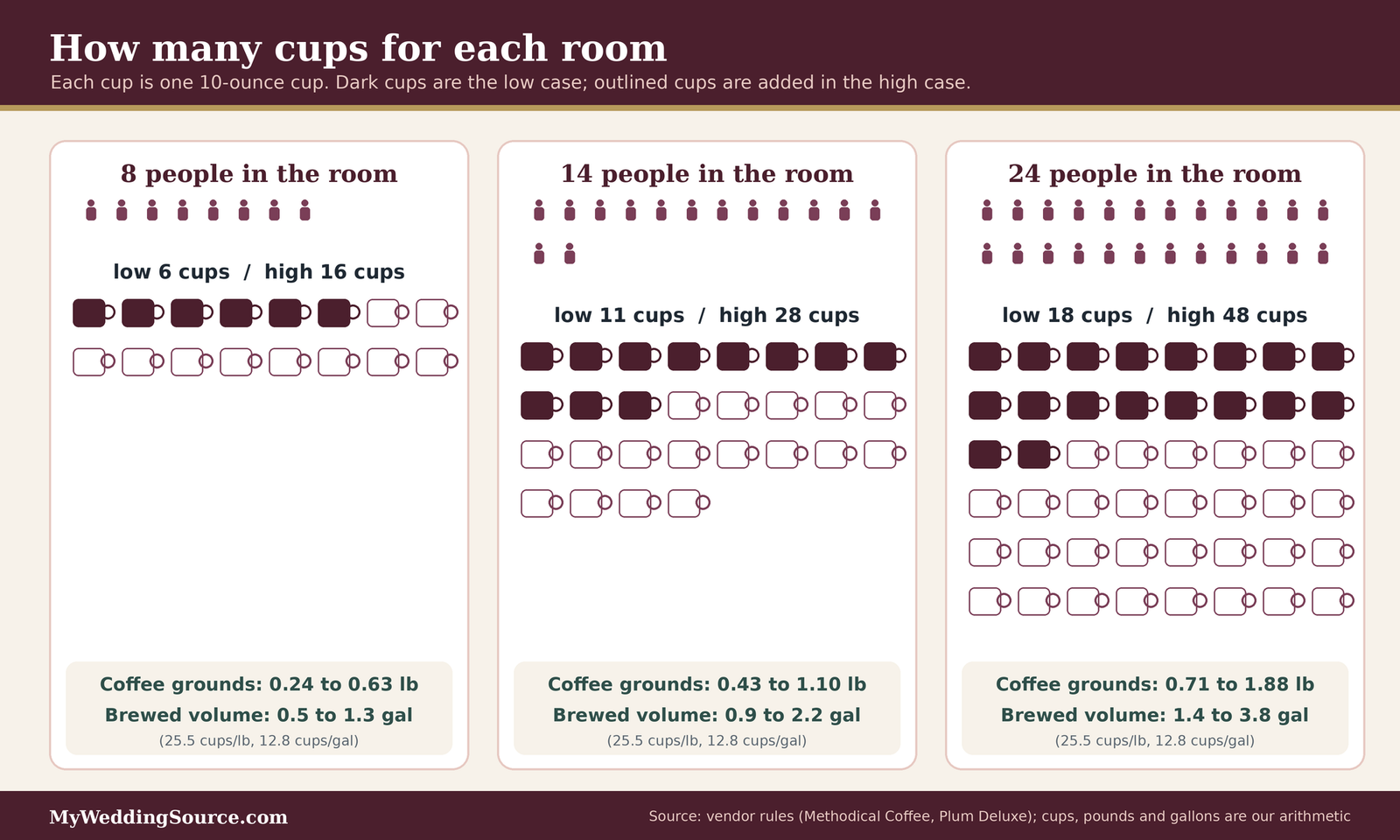
Two different vendor rules, applied to the same wedding breakfast for getting-ready rooms group, produce a low case and a high case. Plan toward the middle and decide which side you want to lean on based on how long the morning is.
The two vendor rules
A wholesale coffee roaster that publishes an events guide suggests brewing coffee for about 75% of guests at a morning, brunch, or breakfast event, compared with about half of guests at an evening event. A party-supply brand’s beverage guide suggests roughly one cup per person per event, doubled to about two cups per person at brunch. They are measuring slightly different things, so we combine them into a bracket: the low case is 75% of the group taking one cup, and the high case is everyone taking two.
From cups to coffee beans and brewed volume
The roaster’s guide states that one pound of coffee yields about 25.5 cups at 10 ounces each, using a 1:16 ratio of coffee to water, and that a gallon of brewed coffee is about 12.8 cups of that size. Those are the conversion factors we use. The roaster also notes that an average paper cup or mug holds 10 to 12 fluid ounces, so if your mugs run large, expect fewer cups per pound.
| Peak headcount | Low case (cups) | High case (cups) | Pounds of coffee, low to high | Gallons brewed, low to high |
|---|---|---|---|---|
| 8 people | 6 | 16 | 0.24 to 0.63 | 0.5 to 1.3 |
| 14 people | 11 | 28 | 0.43 to 1.10 | 0.9 to 2.2 |
| 24 people | 18 | 48 | 0.71 to 1.88 | 1.4 to 3.8 |
What the range tells you
The spread is wide, and that is the honest answer. For a short morning where coffee is a first-hour item, the low case is realistic. For a long morning with a late first look and many hours in the room, the high case is closer. When in doubt, brew toward the middle and keep a way to make more: a second carafe, extra grounds, or a venue kitchen that will refill an airpot. Running out of coffee at ten in the morning is a worse outcome than having a half carafe left over.
Choosing the service style
There are three common ways to serve coffee with a wedding breakfast for getting-ready rooms, and the right one depends on headcount, space, and power.
Thermal carafes and airpots
A coffee supplier or a caterer delivers brewed coffee in insulated carafes or pump-top airpots with cups, lids, creamers, and sweeteners. Nothing is plugged in, nobody needs to stand and brew, and guests serve themselves. This is the lowest-risk option for small and mid-size groups, and it is the one that works in a hotel room with limited outlets. The trade-off is that brewed coffee in a carafe cools over a morning. Ask the supplier how long the carafes hold temperature, because this guide cannot give you a sourced figure and brands differ.
A countertop brewer in the room
A drip brewer or a single-serve machine that you or the venue provide can work for a group of four to eight, but it draws power on the same circuit as everything else in the room. The electrical section below shows why that matters. If you go this way, put the machine on a different wall or in a different room from the hair tools, and do not plug it into a power strip that is already feeding them.
A staffed coffee cart
A cart with a barista makes individual drinks, which people enjoy and which photographers like for candid moments. It is also the most demanding option: it needs power and often water, floor space, and a vendor who will arrive early and stay for a set window. A published planning guide from a wedding-menu site describes staffed mobile coffee carts as commonly costing roughly $700 to $1,800 for a typical wedding, with premium espresso bars higher, and describes those figures as planning ranges, not quotes. Those numbers are for reception-scale service, so a short morning booking may price differently. For a wedding breakfast for getting-ready rooms, a cart can make sense when the morning group is large, when the cart is already booked for the reception and the vendor will add an early shift, or when the getting-ready room is in a house or venue with a patio where a cart can set up outside. Our comparison of a coffee bar versus an espresso cart walks through that decision for the reception, and the same logic applies here at smaller scale.
Caffeine, decaf, and nerves
A wedding breakfast for getting-ready rooms has its own caffeine arithmetic, because people may drink more coffee than usual while also feeling anxious or excited.
What the FDA says about daily caffeine
The U.S. Food and Drug Administration says that about 400 milligrams of caffeine a day is an amount not generally associated with negative effects for most healthy adults, which it equates to roughly two to three 12-ounce cups of coffee. The same FDA page notes that a 12-ounce cup of regular brewed coffee typically contains about 113 to 247 milligrams, and that decaf still contains a small amount, usually 2 to 15 milligrams per 8-ounce cup. For anyone who is pregnant, trying to become pregnant, or breastfeeding, the FDA recommends asking a health care provider whether to limit caffeine. We are not giving medical advice here, only pointing to the agency’s guidance.
Making decaf easy to find
Put out one clearly labeled decaf carafe or decaf pods, and a caffeine-free tea. It costs little, helps anyone who is sensitive, and helps the person getting ready who would rather stay calm than wired. Label carafes with a sticker or a folded card. Unlabeled carafes in a crowded room are the usual cause of accidental caffeine for someone who meant to avoid it.
Delivery timing: working backward from the first chair
The time a wedding breakfast for getting-ready rooms should arrive is not a fixed rule, like “two hours before the ceremony.” It is a calculation from three anchor times, one safety limit, and one practical question about who will meet the delivery. Once you write the anchors down, the right arrival time usually becomes obvious.
Find the three anchor times
Each of these is set by someone else on the wedding team, so collect them before you talk to the caterer.
When the first person sits down
The earliest anchor is the start of the first hair or makeup appointment. The food should be set up and ready before that appointment starts, because a stylist who arrives hungry after an early start will be eating while working. Our guides to hair and makeup scheduling for a bridal party and to scheduling a large bridal party show how those appointments are usually sequenced, and the first start time from that schedule is your first anchor.
When the photographer arrives
The second anchor is the arrival of the photographer and videographer. Getting-ready photos often begin with details and the dress, and a food table that is still a mess of delivery boxes will end up in the background. Ask your photographer when they plan to capture the room, and aim to have food presented neatly before then. Our notes on flat lay photography and the photographer shot list show what usually gets photographed early.
When the building lets anyone in
The third anchor is the access window. A delivery driver cannot set up in a suite that is locked, and some buildings restrict when outside vendors can enter or use certain elevators. Confirm the earliest time someone can let the caterer in and who will meet them. If no one on your team can be there, ask the caterer whether they can leave food at a front desk or a loading area, and whether they will take responsibility for it at that point.
Respect the food-safety clock
Once food for a wedding breakfast for getting-ready rooms is out, a clock starts. The rules below come from U.S. government and state health sources, and they are the reason that “deliver everything at once and let people graze for four hours” is not a safe plan for perishable items.
The two-hour rule and the heat exception
The federal food safety website says to never leave perishable foods out of refrigeration for more than two hours, and to refrigerate within one hour if the food has been exposed to temperatures above 90°F, as in a hot car or a summer picnic. The Food and Drug Administration’s guidance on party and buffet food says the same: discard perishable food left at room temperature more than two hours unless it is kept hot or cold, and the safe holding time drops to one hour above 90°F. A hotel room in summer, a room with the sun on a window, or a tent can easily pass 90°F.
Hot above 140, cold below 40
The Minnesota Department of Health’s buffet guidance, which matches federal guidance, says hot food should be held at 140°F or warmer and cold food at 40°F or colder, and that cold dishes can be nested in ice or served in small trays refilled from the refrigerator. The federal food safety site explains that bacteria multiply quickest between 40°F and 140°F. The FDA also notes that some food warmers only hold 110 to 120°F, which is below the safe hot-holding temperature, so ask whether a caterer’s warmers actually reach 140°F before you rely on them in a room.
Reheating and replacing
State and federal guidance say stored egg dishes such as quiche should be reheated to 165°F before serving, and to swap in fresh platters rather than topping up a dish that has been sitting. For a getting-ready room, that means a caterer who delivers hot sandwiches should explain how they will be held, or deliver them to be reheated on site. If you have no way to hold food hot, favor items that are safe at room temperature for the time they will be out, and ask the caterer which items those are.
Choose a delivery pattern for the wedding breakfast for getting-ready rooms
Given the two-hour limit, there are three realistic delivery patterns for a wedding breakfast for getting-ready rooms. None is right for every wedding, so compare them against your anchor times.
One drop at the start
Everything arrives before the first appointment and is set out together. This is the simplest to coordinate and the easiest to photograph, and it works well when the morning is short and the group eats within a window of about an hour. The risk is that food sits out too long on a long morning. A practical fix is to set out only the first half and keep the rest closed in the delivery containers, in a cooler or the room’s refrigerator if there is one, and swap fresh items in at the two-hour mark.
Two waves
The caterer delivers once before the first appointment and again about two hours later with fresh items and a coffee refill. Delivery fees can double, but the food is better and the safety question is easier to answer. This pattern suits a long morning with a late first look, or a large group that arrives in two shifts.
One drop with staged service
All the food arrives early but only part of it is out. Someone on your team, such as a designated friend, a planner, or a venue coordinator, puts out the next batch at set times and removes the earlier items. It needs a named person with a watch and an understanding of the time limits. It costs nothing extra, but it is the pattern most likely to fail on a busy morning if no one owns it.
| Pattern | Best when | Main risk | What it needs |
|---|---|---|---|
| One drop at the start | Short morning, group eats within about an hour | Food sits too long if the schedule slips | Cooler or fridge for the second half |
| Two waves | Long morning, large or staggered group | Second delivery fee and a second access window | Someone to meet the caterer twice |
| One drop, staged service | You have a reliable helper | Batches get forgotten | A named person and a written schedule |
A worked timeline
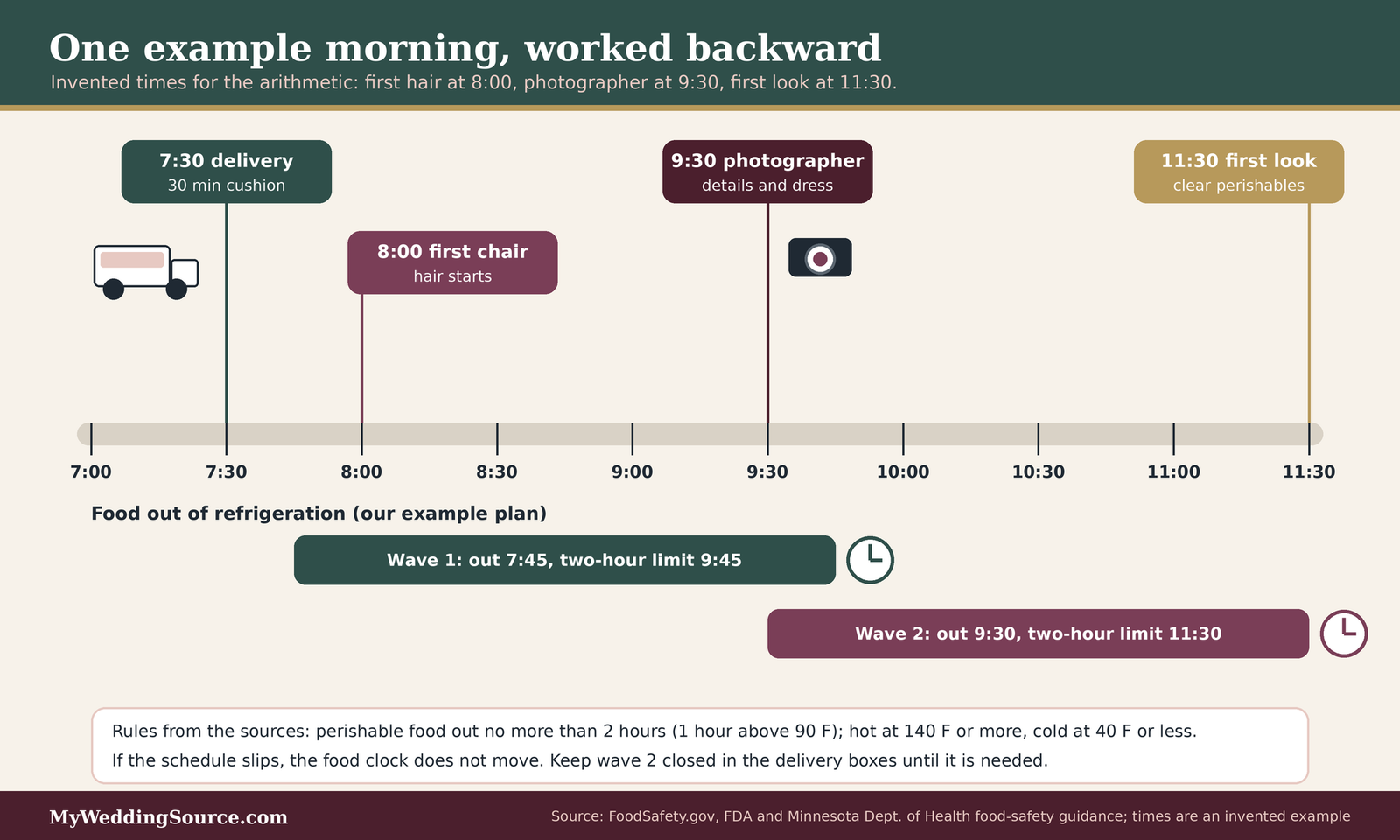
To show how the anchors fit together for a wedding breakfast for getting-ready rooms, here is an illustrative morning. The times are an example we invented for the arithmetic, not a recommendation for your wedding. The first hair appointment is at 8:00 a.m., the photographer arrives at 9:30, and the first look is at 11:30.
Setting the delivery time
Working backward from the 8:00 a.m. first appointment, we would ask the caterer to arrive at 7:30 a.m., leaving about 30 minutes for access, setup, and a quick check of the food. That 30 minutes is our own cushion, chosen because deliveries commonly run a little late and because the first stylist may arrive early. If the room is not available until 7:45, the delivery moves to 7:45 and the cushion shrinks. Write down the real access time first and choose the cushion second.
Planning the two-hour marks
Food set out at 7:45 reaches the two-hour limit at 9:45. That is before the photographer finishes the details shots, and it is well before the first look at 11:30. A sensible plan is to put out only the first half of the food at 7:45, replace it with the second half at about 9:30, and remove everything perishable from the room at about 11:30 after the last person has eaten. If the room is warm and you cannot hold food hot or cold, shorten each window. Every one of these times for the wedding breakfast for getting-ready rooms should be on a short written schedule that someone in the room has seen.
Coffee cart electrical and queue plan
If you choose a brewer in the room or a staffed cart, two things decide whether the morning runs smoothly: how much electricity the room can supply to everything plugged into it, and how long the line gets when everyone wants coffee at once. Both are arithmetic, and both are easier to plan on paper than to fix at 7:45 a.m. with a tripped breaker.
An electrical worksheet for the room where the wedding breakfast for getting-ready rooms is set up
The method below for a wedding breakfast for getting-ready rooms is deliberately plain. It uses one formula and three published figures, and it ends with a decision about where each machine goes.
Watts equal volts times amps
A university environmental health and safety guide explains that you work out a device’s load by multiplying amps by volts, then adding the devices together; its example is a 10-amp appliance at 125 volts, which draws 1,250 watts. The same guide says to confirm that a cord’s wattage rating suits the equipment, and gives a 15-amp cord rated at 1,875 watts as an example. Every real device has a label with its rating, and the manufacturer’s rating is the most current source, so the worksheet should use the numbers printed on the equipment your stylists and your coffee vendor actually bring.
The 80% rule for cords
That same guide advises keeping the total load below about 80% of the rating, because cords begin to heat up past that point; for the 1,875-watt example cord, it says to expect roughly 1,500 watts or less. We use 1,500 watts as the working limit for one cord or one outlet group in this guide. This is the cord guidance from the source, and we are not giving electrical advice about breakers or wiring. The venue, the hotel engineering team, or a licensed electrician must tell you which outlets share a circuit and what that circuit can carry.
Typical appliance ranges
A table of common appliance wattages published by the Utah Division of Water Rights, which attributes it to the U.S. Environmental Protection Agency, lists a hair dryer at 1,200 to 1,875 watts, a coffee maker at 900 to 1,200 watts, a toaster at 800 to 1,400 watts, and a microwave oven at 750 to 1,100 watts. A Penn State energy course publishes the same ranges and notes that they vary by manufacturer and age. We use them only to show the shape of the problem. They are ranges for typical household devices, and your actual hair dryer, curling iron, or coffee machine can be higher or lower.
| What is plugged in on one cord or outlet group | Total watts, low to high | Compared with 1,500 W |
|---|---|---|
| One coffee maker | 900 to 1,200 | Within the limit |
| One hair dryer | 1,200 to 1,875 | Low end within, high end over |
| One hair dryer plus one coffee maker | 2,100 to 3,075 | Over at the low end |
| Two hair dryers | 2,400 to 3,750 | Over at the low end |
| One coffee maker plus one microwave | 1,650 to 2,300 | Over at the low end |

What the worksheet tells you about the room
The table is not about any specific hotel or venue. It shows that a hair dryer and a coffee maker together exceed a single cord’s working limit even at the low end of both ranges. That gives you a clear rule for planning.
Keep the coffee machine away from the styling station
If your plan involves a brewer or a cart, ask the venue or hotel which outlets are on separate circuits and put the machine on a different circuit from the hair tools. If that is not possible, schedule: hair dryers are used in bursts, so a drip brewer can run at a time when the dryers are quiet, and be switched off before the first dryer starts. Do not rely on luck. Walk the room with a stylist and ask which wall they plan to use.
Ask about bathroom and damp-area outlets
The university guide notes that you should use a GFCI, a ground-fault circuit interrupter, in damp areas, and not use a cord when it is wet. Bathrooms and kitchenettes are damp areas in many buildings, and they are also where stylists often plug in tools. Ask the venue which outlets are protected in this way, and keep drinks and coffee machines away from water at sinks.
Cords, outdoor setups, and generators
A cart in a hotel ballroom hallway and a cart on a lawn have very different power problems.
Extension cord rules from the source
The same guide’s rules are practical and short. Do not plug extension cords into each other. Do not plug a power strip into an extension cord. Fully unwind a cord in use, and check the prongs and the jacket for cracks or damage before each use. Do not run cords through doorways, and do not place objects on them or let people walk on them. Use only cords marked for outdoor use outdoors. Extension cords are meant for temporary use, which fits a one-morning setup but does not fit a vendor who leaves a long cord running across a hallway all day.
If a generator is part of the plan
For an outdoor or off-grid setup, vendors sometimes bring a generator. The U.S. Consumer Product Safety Commission’s generator safety alert says to place a generator at least 20 feet from any door, window, or vent that could let carbon monoxide into a building, and never to run one in an enclosed or partly enclosed space such as a garage or shed, even with fans or open doors. It warns that carbon monoxide is colorless and odorless and can build to deadly levels within minutes. If the vendor proposes a generator for a getting-ready house or a venue suite, ask where it will sit relative to the room’s windows and doors, and see our guide to generator rental for the questions to ask before you agree.
The queue arithmetic
A line at a coffee cart is another bit of arithmetic that is easy to underestimate in a room where everyone wants a coffee in the same twenty minutes.
Barista speed
A coffee-cart catering company’s published planning guidance says to plan on about 50 drinks per barista per hour, which is about 1.2 minutes per drink. Other vendors publish faster rates for simple menus, and a cart that makes only drip coffee will move faster than one making espresso drinks. We use 50 per hour because it is a stated planning figure from a vendor that publishes its formulas, and it is conservative.
A worked line-length table
If everyone in the room asks for a drink at nearly the same moment, the last person waits for everyone ahead of them. Using the 50-per-hour rate and the low and high cup counts from the coffee table, the last person in line would wait the times below. This is our estimate. Real lines spread out, and people take a drink and move on.
| Peak headcount | Drinks, low to high | One barista, last wait in minutes | Two baristas, last wait in minutes |
|---|---|---|---|
| 8 people | 6 to 16 | 7 to 19 | 4 to 10 |
| 14 people | 11 to 28 | 13 to 34 | 7 to 17 |
| 24 people | 18 to 48 | 22 to 58 | 11 to 29 |
Flattening the line
You can shorten the line without hiring another barista. Put a thermal carafe of plain drip coffee beside the cart for people who do not want a made-to-order drink. Ask guests to order at staggered times, by announcing that the cart opens when the first hair appointment starts and that people can order any time over the next two hours. Pre-take orders on a shared note so the barista can work through them in the order the stylists need people free. For a room of eight, a cart is not usually worth the line, the cost, or the outlet it takes. A room of twenty-four may be a different story, and a second barista halves the wait in the table above.
Cost of a wedding breakfast for getting-ready rooms and how to compare quotes
Published prices for this exact service are scarce, and any figure on a blog is a regional planning range, not a quote for your city. This section shows what a source does give, and what to ask for so you can compare quotes fairly.
Published ranges for coffee service
A wedding-menu planning site gives ranges for coffee at receptions, and the ranges give an order of magnitude even though a morning room is smaller.
Self-serve coffee
The planning guide describes simple self-serve coffee as about $2 to $5 per guest, and an upgraded self-serve coffee and tea setup as about $4 to $8 per guest, calling them planning ranges, not guaranteed quotes. A self-serve setup with carafes, cups, and condiments is the closest match to what a getting-ready room usually needs.
Staffed cart
The same guide describes staffed mobile coffee carts as commonly running $700 to $1,800 for a typical wedding, with premium espresso bars higher. Its sample budgets assume a two-hour service window. That means a one-time morning booking for a small room may be proportionally expensive, which is one more reason a cart is usually a choice for larger groups or for a cart that is already booked for the reception.
What this actually costs
We did not find a reliable published price for a getting-ready breakfast in the United States, so we will not invent one. What you can compare is the structure of the quote: the per-person food price, a delivery fee, a minimum order, setup and pickup fees, service-ware such as plates, cups, and napkins, any service charge or tax, and the cost of a second delivery wave. For the coffee alone, a published planning guide gives about $2 to $8 per guest for self-serve and about $700 to $1,800 for a staffed cart at reception scale. Ask each vendor to price the same headcount, the same delivery time, and the same items so the numbers line up.
Reading a breakfast quote
A quote for a wedding breakfast for getting-ready rooms can look inexpensive and still be incomplete. Ask for every cost to be listed.
The line items to look for
Look for the food price per person and what a portion includes, a delivery fee and the delivery window, a minimum order, the setup fee, pickup of equipment or trays and who does it, service-ware, labor if anyone stays, a service charge, tax, and a gratuity policy. For the bigger catering picture, our guide to wedding catering service planning explains how full-service quotes are built. Our guide to vendor communication deadlines can help you decide when to confirm the headcount and delivery details so the final invoice matches the quote.
A hypothetical worked comparison
To show how to compare, here is a made-up example, labeled as hypothetical. Caterer A quotes $16 per person for fourteen people, a $40 delivery fee, and no setup fee. Caterer B quotes $14 per person for fourteen people, a $60 delivery fee, and a $35 setup fee. The first total is 14 times $16 plus $40, which is $264. The second is 14 times $14 plus $60 plus $35, which is $291. The cheaper per-person price is not the cheaper quote. These numbers are for illustrating arithmetic only and are not market prices.
Allergens, dietary needs, and clear labels
A wedding breakfast for getting-ready rooms is usually a quick, informal meal, which is when allergen mistakes slip in. Nobody expects a seated dinner with printed menus, and yet people with food allergies are in the room.
What the FDA says
The U.S. Food and Drug Administration lists nine major food allergens: milk, eggs, fish, crustacean shellfish, tree nuts, peanuts, wheat, soybeans, and sesame. Sesame was added by the FASTER Act, signed in April 2021, with labeling requirements taking effect on January 1, 2023.
What labels do and do not tell you
For packaged foods, the FDA says the label must name the food source of each major allergen. It also says that advisory statements such as “may contain” are voluntary and are meant for unavoidable cross-contact after good manufacturing practices, not as a substitute for them. Some products fall outside that labeling system, including meat, poultry, and egg products regulated by USDA, and alcoholic beverages regulated by TTB. A bakery box, a catered sandwich, or a platter prepared in a commercial kitchen may not carry a label at all, so you will need to ask.
Cross-contact is the issue to ask about
The FDA defines cross-contact as the inadvertent introduction of a major allergen into a product. For a getting-ready room, the practical cases are a knife used on cheese and then on a vegetarian sandwich, a shared tray of muffins with and without nuts, or a tong used on every platter. We cannot tell you whether a caterer’s kitchen is safe for a particular person. Only the caterer and the person with the allergy, along with their health care provider, can decide that, and no one should promise an allergen-free breakfast without evidence.
Setting up the table
The setup itself is where much of the risk is controlled, and it costs nothing.
Label each item
Ask the caterer for a short ingredient or allergen list for each item and put a small card in front of it. For a room of fourteen, a handwritten card per item is enough. Mark vegetarian, gluten-free, and nut-containing items clearly. Gluten-free and vegan labels are not the same as allergen-free, so only label what the caterer has told you in writing.
Separate and serve with care
Put a person’s allergy-friendly food in a closed, labeled container and let them serve themselves from it first. Use separate utensils for every dish and do not move a spoon from one dish to another. If someone in the wedding party has a serious allergy, talk with them directly about what they will eat that morning, and consider bringing food that they trust. Our guide to dietary restrictions at weddings goes deeper on how to collect and use this information for the full event.
Edge cases that change a wedding breakfast for getting-ready rooms
The plan above for a wedding breakfast for getting-ready rooms assumes a room with a door someone can unlock, a few outlets, and a morning that runs roughly on schedule. Weddings rarely cooperate. These are the situations that most often force a change, with the question that settles each one.
Space and access
Where the room is matters as much as how many people are in it.
A hotel room or suite
Hotel rooms are small, and hotels have their own rules about outside food, deliveries, and equipment. Ask the front desk whether outside caterers may deliver to a room, whether a person has to meet the driver in the lobby, and whether a table or a cart can be brought up. Look for a refrigerator and ask whether it is working. Do not assume that a minibar fridge can hold a tray of fruit or sandwiches, and check the temperature with a thermometer if you plan to rely on it. The federal food safety site recommends an appliance thermometer to confirm that a refrigerator holds 40°F or below.
A bridal suite far from the loading area
At a large venue the getting-ready suite may be a long way from where the caterer parks. Ask whether the caterer can reach the suite, how long they need to carry food in, and whether a freight elevator or a cart is available. Our guide to venue load-in restrictions covers the questions about timing and access that can change delivery windows.
Schedule changes
A plan that works at 7:30 a.m. may not work at 9:00 a.m. if the morning slips.
The morning runs late
If hair runs behind, the food clock still runs. Remove any perishable item that has been out for two hours, or one hour above 90°F, even if it looks untouched, as the federal and state guidance says. Keep the second batch closed in the delivery containers until it is needed, so a delay does not waste the second half of the order. A short written schedule, taped to the cooler or the wall, lets a friend make these calls without asking you.
The group changes size
A last-minute guest, a family member who joins for photos, or a stylist who brings an assistant can change the headcount. This is why the model includes 15% spare. If the group grows by more than a few people, call the caterer about the wedding breakfast for getting-ready rooms rather than stretching what you have. For the final headcount cutoff, use the timeline in your caterer’s agreement, and see our vendor timeline guide for how other vendors handle theirs.
Other rooms, other eaters
The room you are feeding may not be the only one in a wedding breakfast for getting-ready rooms plan.
The other side of the wedding party
A second room for a wedding breakfast for getting-ready rooms, often for the other partner and their attendants, has the same needs on a different schedule. Decide whether to place one combined order with two delivery points, which is simpler to price, or two separate orders. Either way, send each room’s headcount and access time in writing.
Children and older guests
Children in the room may need a simpler menu than a burrito, and an older relative may prefer a seated plate to a handheld item. Add a few plain items, such as fruit, plain toast, or a yogurt, and keep them in the same spare margin. Our guide to kids’ meals at weddings has ideas for children’s food at the reception that adapt well to the morning.
Questions to ask the caterer and the venue
Short, specific questions about a wedding breakfast for getting-ready rooms get specific answers. Put them in an email about your wedding breakfast for getting-ready rooms and ask for replies in writing, so you have a record if something changes on the day.
Questions to ask before you book
- What exact items and portion sizes are included per person, and what is the price for the headcount we gave you?
- What time can you arrive, how long does setup take, and who must meet you?
- How do you keep hot items at 140°F or warmer, and cold items at 40°F or colder, for the time they will be in the room?
- Which items are safe at room temperature for the two-hour window, and which should stay closed until needed?
- Can you provide an ingredient and allergen list for every item, and how do you prevent cross-contact?
- Does the room have a working refrigerator, and which outlets are on separate circuits?
- Is there a fee for delivery, setup, pickup, or a second delivery wave?
Questions for the caterer
These questions are about what is delivered and how it is held.
Food, portions, and holding
For a wedding breakfast for getting-ready rooms, ask for the specific items and the size of each, and ask the caterer to describe how each stays safe during the morning. If a caterer cannot explain how hot items are held, it is a sign that you should choose room-temperature items or arrange a reheating step. Ask how long the carafes keep coffee hot.
Allergens and substitutions
Ask which items contain the nine major allergens named by the FDA, whether the kitchen prepares nut-containing items in the same space, and what substitutions are possible for one or two people. Ask for the answers in writing, and ask the caterer to be honest if they cannot guarantee separation.
Questions for the venue or hotel
These questions are about what the building allows.
Access, space, and rules
Ask when the room opens, who can let a delivery in, whether outside food and coffee equipment are permitted, and whether furniture can be moved to make a table. Ask whether a cart can enter the building and which route it must take. Our general list of questions to ask a venue covers many of these in one place.
Power and water
Ask which outlets are on which circuit, whether a coffee machine or cart may use them, and whether the outlets near water are protected. If a cart needs water or a drain, ask where those are. If the answer is unclear, ask whether the building’s engineering contact can look at the room before the day. For outdoor setups, ask whether a generator is allowed and where it could sit.
FAQ: wedding breakfast for getting-ready rooms
Planning and quantities
How much food do I need for a getting-ready room?
Count everyone in the room at its busiest, then plan one hot handheld item, one bakery item, and one fruit or yogurt serving per person, plus about 15% spare. That ratio is our own planning estimate, because we found no published standard. Confirm portion sizes with your caterer and add a second hot item for long mornings.
How many cups of coffee should I plan for?
Two vendor rules give a range. One roaster suggests brewing for about 75% of people at a morning event, and a party-supply guide suggests about two cups per person at brunch. For fourteen people, that is roughly 11 to 28 cups, or about 0.4 to 1.1 pounds of coffee.
Should the stylists and photographer be included in the headcount?
Include them in your count so you can decide on purpose. Some contracts cover vendor meals and some do not, so check each agreement. If a vendor is covered separately, you can leave them out of the order but keep the spare margin. Our guide to vendor meals explains how this usually works.
Do we need a coffee cart for a small group?
Usually not. For eight people, thermal carafes are simpler, cheaper, and need no outlet. A cart can make sense for twenty or more people, or when a cart is already booked for the reception. A published planning guide puts staffed carts at about $700 to $1,800 for a typical wedding.
Timing, safety, and power
When should breakfast be delivered?
Work backward from the first hair or makeup start, and aim to arrive about 30 minutes earlier so there is time for access and setup. That cushion is our own suggestion. Confirm the building’s access time first, and plan a second delivery or staged service on a long morning.
How long can food sit out?
Federal guidance says perishable food should not be left out of refrigeration for more than two hours, or one hour when the temperature is above 90°F. Hot food should stay at 140°F or warmer, and cold food at 40°F or colder. When in doubt, discard it and do not rely on how it looks or smells.
Can a coffee maker and hair dryers share an outlet?
Probably not. Published ranges list a hair dryer at 1,200 to 1,875 watts and a coffee maker at 900 to 1,200 watts, which together exceed the 1,500-watt working limit a university guide gives for one cord. Ask the venue which outlets are on separate circuits, and keep the coffee machine away from the styling station.
How do we handle allergies at a casual breakfast?
Ask the caterer for an ingredient and allergen list for each item, label every dish, use separate utensils, and keep an allergy-friendly option in a closed container. The FDA lists nine major allergens, and “may contain” statements are voluntary. No one can promise an allergen-free breakfast without evidence, so talk directly with the person affected.
Your next steps
Gather the facts
Write the headcount sheet
List the people who will be seated for hair or makeup, the people who are present but not being styled, and the vendors who may be covered separately. Use the peak headcount for the food and coffee calculations. Our wedding party coordination checklist can help you collect the contacts and times in one place.
Collect the anchor times for the wedding breakfast for getting-ready rooms
Write down the first appointment, the photographer’s arrival, the access time, and the first look. From those, set a delivery time and a removal time for perishable food. Our wedding planning checklist can help you place this task in the larger timeline.
Confirm the details in writing
Send the questions
Send the caterer and the venue the question list above for your wedding breakfast for getting-ready rooms, and ask for written replies about the menu, the delivery time, the allergen information, the outlets, and the fees. Keep the replies together with your other vendor emails.
Prepare a back-up kit
Pack a small kit with an appliance thermometer, serving utensils, labels, napkins, and a few shelf-stable snacks, and add anything else you would want on the morning. Our wedding emergency kit guide covers the rest of the day-of supplies.
Sources & methodology
How we built this guide
What we relied on
This guide to a wedding breakfast for getting-ready rooms combines U.S. federal and state food-safety guidance, the FDA’s allergen and caffeine pages, a Consumer Product Safety Commission generator alert, a university extension-cord safety guide, published appliance-wattage tables, and planning guidance from coffee suppliers, a coffee-cart caterer, and wedding publications. Vendor and publication claims are labeled as such and treated as practical guidance, not independent research. Every food count, cup count, wait time, and total in the tables is our own arithmetic from the stated assumptions and is labeled as an estimate. The sample group sizes, the 15% spare margin, the 30-minute delivery cushion, and the example timeline are our own planning choices.
What we did not do
We did not test any equipment, survey caterers, or find a published standard for getting-ready breakfast portions, and we did not quote current local prices. We do not give medical, legal, or electrical advice. Allergy questions belong with the person affected and their health care provider, and questions about wiring and circuits belong with the venue or a licensed electrician. We do not link to products or vendors for commissions in this guide. Sources were last checked on November 12, 2026, and some pages may change.
Source list
Government, public-health, and university sources
- U.S. Food and Drug Administration, Food Allergies: https://www.fda.gov/food/food-labeling-nutrition/food-allergies
- U.S. Food and Drug Administration, Spilling the Beans: How Much Caffeine Is Too Much?: https://www.fda.gov/consumers/consumer-updates/spilling-beans-how-much-caffeine-too-much
- U.S. Food and Drug Administration, party and buffet food safety guidance: https://www.fda.gov/media/84739/download
- FoodSafety.gov, The 4 Steps to Food Safety (Chill): https://www.foodsafety.gov/keep-food-safe/4-steps-to-food-safety
- Minnesota Department of Health, Buffet food safety: https://www.health.state.mn.us/people/foodsafety/away/buffet.pdf
- U.S. Consumer Product Safety Commission, Portable Generator Safety Alert: https://www.cpsc.gov/s3fs-public/Portable-Generator-Safety-Alert-2017_5123.pdf
- University of Washington Environmental Health and Safety, Extension cords: https://ehs.washington.edu/system/files/resources/extension-cords.pdf
- Utah Division of Water Rights, Appliance wattages (EPA table): https://www.waterrights.utah.gov/sustainability/appliance_wattages.pdf
- Penn State EGEE 102, Common Appliance Power Ratings: https://courses.ems.psu.edu/egee102/book/export/html/2387
Vendor and publication sources
- Methodical Coffee Wholesale, How Many Cups of Coffee in a Pound (roaster guide): https://wholesale.methodicalcoffee.com/blogs/news/how-many-cups-of-coffee-in-a-pound-a-guide-to-serving-coffee-at-events
- Flashquotes, Coffee Catering Calculator (vendor planning tool): https://flashquotes.com/tools/coffee-catering-calculator
- Plum Deluxe, Party Math: Figuring Out How Much Beverage to Serve (retailer guide): https://plumdeluxe.com/beverage-math
- Affordable Wedding Venues & Menus, How Much Does a Wedding Coffee Bar Cost (planning site): https://affordableweddingvenuesandmenus.com/blog/wedding-coffee-bar-cost
- Inspired Bride, What You Need in Your Bridal Suite (wedding publication): https://www.inspiredbride.net/?p=49316