

Wedding bar glassware rental looks like a simple per-glass price, but the amount you pay is shaped by three quieter numbers: how many glasses you order, how the rental company treats breakage, and what it charges to bring the crates back, so this guide shows you how to count, compare, and ask before you sign.
Quick answer
For wedding bar glassware rental, start with a count, not a price. Published planner advice we found suggests about one water glass and two wine glasses per guest at dinner, plus two lowball glasses and one highball glass per guest if you run a full bar, and about ten percent extra for breakage and misplaced glasses. Then compare quotes on three lines: the breakage method (a percentage waiver, a tabletop credit, or replacement cost per item), the delivery and pickup fee including late-evening and timed-window surcharges, and the return condition (rinsed, racked, or washed). The waiver percentages we found ranged from 4% to 14% of the order, so the cheapest glass rate is not always the cheapest total. This guide gives you a worked 120-guest example, a break-even table, and a list of questions to ask.
What wedding bar glassware rental includes, and what a quote can hide
A wedding bar glassware rental is usually bundled with other rentals, such as plates, flatware, linens, tables, and chairs, from one party rental company. In a wedding bar glassware rental, the glasses themselves are the easy part. The harder part is the set of rules wrapped around them: what counts as breakage, who pays for a missing glass, when the truck returns, and what shape the glasses must be in when it does. Two quotes for a wedding bar glassware rental with the same per-glass rate can differ by a few hundred dollars once those rules are applied, and the difference is often found only in the terms page.
We built this guide from the published terms of several rental companies, advice from caterers quoted by national wedding publications, and public rules from a few county park systems. We did not receive a quote from any vendor, and we have no business relationship with any company named here. Where a number comes from a company, we say so. Where it comes from our own arithmetic, we label it an estimate.
The line items in a wedding bar glassware rental quote
Most quotes can be read as four layers. The first is the rental rate, charged per piece or per rack. The second is delivery and pickup, often quoted as one round-trip fee. The third is breakage protection, which may be an optional percentage added to the whole order. The fourth is a set of conditional charges that appear only if something goes wrong, such as missing-item fees, cleaning fees, or a surcharge for a pickup that cannot happen in the standard window. Reading all four layers before you compare is the difference between comparing prices and comparing offers.
The rental rate per piece
A national wedding publication reported that barware averaged about 50 cents per glass at the time its backyard-wedding guide was written in 2020, and the same advice suggested working with a local rental company instead of single-use cups. That figure is a dated average from one article, not a price list, and rates differ by region, glass type, and season. We use 50 cents as an illustration for a wedding bar glassware rental later because it is the only published average we found, and we show a second, higher rate so you can see how the math scales. Replace both with your own quote.
Delivery and pickup as a separate cost
In a wedding bar glassware rental, delivery and pickup often cost more than the glasses. One company’s published terms quote delivery and pickup as a round-trip fee based on time and location, and another quotes a flat local round trip, with free will-call pickup if you collect and return the order yourself. We walk through the fee structures in the pickup section below, with real published examples. For now, the point is that this line item moves with your event time, so a late reception costs more to serve than a daytime one.
Breakage protection and replacement charges
Breakage is treated differently from company to company in a wedding bar glassware rental. Some sell a damage waiver as a percentage of the order. One publishes a tabletop credit. Some charge a replacement cost only for items that are not returned. This is where a wedding bar glassware rental quote can look cheap and turn expensive, or the reverse, and it is the part we spend the most time on.
Who this guide helps, and what it does not cover
This guide is for couples, planners, and family members who are arranging a wedding bar glassware rental for a reception and want to understand the terms before they sign. It is written for a hosted bar at a reception with a rented glass program. If your venue or caterer supplies glassware as part of a package, you may not need a separate wedding bar glassware rental, but you can still use the questions here to read their terms.
This is planning information, not legal or financial advice
We are not lawyers, insurers, or licensed bar operators. Whether a damage waiver is worth buying, how a credit card dispute works, and what your liquor liability obligations are depend on your contract, your venue, and your state. Where we describe rules, we describe what a published source says and suggest that you confirm it with the vendor, the venue, and, for insurance or liquor questions, a licensed professional.
Vendor terms vary, and they change
A rental company can revise the terms of a wedding bar glassware rental, and the pages we read are a snapshot. We checked each source in November 2026 and cite the page by name in the sources list. If a policy matters to your decision, ask the vendor to send the current version in writing and keep it with your contract. Our wedding vendor due diligence checklist explains how to collect that paperwork before you pay a deposit.
How many glasses a wedding bar glassware rental order needs
You cannot judge a breakage policy until you know how many glasses are in play, because a percentage waiver and a replacement-cost policy behave very differently at 300 glasses than at 900. The count also drives the total of your wedding bar glassware rental, your number of racks, and the length of the pickup. So the first piece of a wedding bar glassware rental is a count you can defend.
No single industry standard exists. What exists are rules of thumb from caterers and rental companies, and they differ because service styles differ. We use the figures a Martha Stewart wedding article attributed to a caterer, and a second article that gave its own set, and then show you how to adjust them for your plan.
Published per-guest starting points
The most useful published starting points separate the dinner table from the bar, because the two uses behave differently. At the table, glasses are tied to a seat. At the bar, they are tied to a trip, and guests who set a glass down somewhere often come back for a fresh one.
Glasses at the dinner table
A Martha Stewart article by Alyssa Brown suggested planning on one water glass and one or two wine glasses per person for the dinner tables, with a Champagne glass added if you are doing a toast, or letting guests toast with whatever they already hold. A second Martha Stewart article, by Lauren Wellbank, quoted a caterer who suggested one water glass and two wine glasses per guest, especially when wine is served at the table. Read together, these give a range of one to two wine glasses per guest, and a sensible plan states which end of that range it picked and why.
Glasses at the bar
For a full bar, the same caterer quoted by Wellbank suggested adding two lowball glasses and one highball glass per guest, and described an average split as three types: a wine glass, an all-purpose tumbler, and a lowball. Brown’s advice for bar service was to expect that guests need a new cocktail glass each time they visit the bar, because many misplace drinks and come back empty-handed. C Party Rentals, a rental company, made the same point from the rental side: an open bar needs the most glasses, some guests accept a refill in the same glass, but most expect a new one with each drink.
Glasses for the toast
A toast glass is a single-use piece for most of the night, which is why it is easy to forget. Brown noted that a Champagne glass is an optional add if you are toasting with sparkling wine, and that guests can toast with whatever they already have. If you toast with sparkling wine, count one glass per guest who will drink it, and count a nonalcoholic option too, since not every guest will raise the same drink. Our wedding nonalcoholic beer and wine guide covers options that look at home in a toast.
A worked example for 120 guests
To make the counts concrete, we apply the published starting points to a reception of 120 guests. Every figure below is our arithmetic from the published rules of thumb, not a quote. We use the higher end of each range so the order errs toward having enough, and we show the effect of the ten percent extra that Brown recommended for breakage in transit and other surprises.
The beer-and-wine example assumes bottled beer, so beer needs no glass, a point Brown also made. It counts one water glass and two wine glasses per guest. That is 120 water glasses and 240 wine glasses, or 360 glasses, and with a ten percent extra, 396.
The full-bar example counts the same water and wine glasses, adds two lowball glasses and one highball glass per guest (240 and 120), and adds a Champagne glass for each guest (120). That is 120 plus 240 plus 240 plus 120 plus 120, or 840 glasses, and with a ten percent extra, 924. If you skip the Champagne glass, the base is 720 and the total with extras is 792, which is the figure we carry into the break-even table later.

The beer-and-wine example
A beer-and-wine bar is the lightest wedding bar glassware rental load, and that matters because it also has the shortest wash and the least to break. Its weak point is wine glasses, which are the most fragile pieces on the bar. If your caterer plans to serve wine at both the table and the bar, remember that a guest who leaves a glass at the table and gets a new one at the bar is using two, which is why the high end of the range is a reasonable planning number.
The full-bar example
In a wedding bar glassware rental, a full bar roughly doubles the count, and it adds three or four distinct shapes, which means more racks, more sorting at pickup, and more categories for a missing-item fee to apply to. If the bar menu is short, you can reduce the shapes. Brown listed beer, white wine, red wine, cocktail, Champagne, and water glasses as bar basics, with shot, lowball, and dessert wine glasses as options depending on your menu. A tighter menu means fewer glass types to rent, rack, and count.
Adding the ten percent
Brown advised ordering about ten percent more than you think you need, and said your caterer can recommend the right amount for your count. We cannot verify that ten percent suits every event, and a caterer who has run your venue before may suggest more or less. Treat ten percent as a conversation starter. It also helps to separate extras that you expect to break from extras you expect to have on hand if guests carry glasses off to the lawn, which is a different problem from breakage.
What moves the count up or down
The published rules of thumb are averages, and Wellbank’s caterer said to order extras of everything. Three factors usually decide whether your event sits above or below the average, and your caterer or bartender can help you place yourself.
How glasses get washed during the event
C Party Rentals noted that enough wait staff and washing capacity can allow glasses to be reused during the evening, and it listed dishwasher access as one of the factors to consider. Wellbank quoted Liz Curtis of Table + Teaspoon saying a bartender can wash glassware quickly with an assistant collecting used glasses, and that if you have no wait staff, you should order enough glasses to avoid relying on washing during the event. In practice, a plan with a dishwasher and staff to run it can reduce the count, while a plan without them should lean to the high end. The tradeoff is a cheaper rental against a more expensive staffing plan, and only your caterer can price the second half.
Who is drinking what
The count falls if many guests drink bottled beer, canned drinks, or no alcohol, and it rises if guests mix drinks or switch between wine and cocktails. C Party Rentals listed the number of children and whether guests drink heavily among its planning factors. A note of caution: do not assume who drinks. Many receptions have guests who do not drink alcohol, and they still use a glass for water, juice, or a mocktail. Our wedding mocktails guide covers zero-proof drinks that rely on the same glasses.
Seated or standing
C Party Rentals also listed whether guests are seated or standing as a factor. A seated dinner keeps glasses on tables where they can be found. A standing cocktail hour sends glasses to windowsills, planters, and chair arms, and that is where missing glasses come from. If your cocktail hour is long, count it as its own service, with its own set of glasses and its own collection plan, a step covered in our wedding bar service planning guide.
Breakage allowances in wedding bar glassware rental: five ways companies handle broken glass
A breakage allowance is the rule that decides who pays when a glass breaks or chips. It is not a standard term. In the published terms we read, five different approaches appeared, and they are not interchangeable. Knowing which approach your vendor uses tells you what to ask next, and it changes how much of the ten percent extra you should treat as a safety margin.
The table summarizes what each company’s own page said when we checked it. It is a comparison of published terms, not a recommendation of any company, and these are examples from a handful of regions. Your vendor’s terms may differ, so use the table to learn the shapes of policies, not to guess your price.
| Company (published page) | Breakage method | Cost basis | What the page says is excluded or limited |
|---|---|---|---|
| Party Rental Ltd | Damage waiver fee that the page says cannot be waived | 4% of the gross rental order | Theft or missing items, vandalism or improper use, weather damage, electrical damage; those are charged at replacement cost |
| A Classic Party Rental | Optional damage waiver | 10% of the rental equipment total | Material damage, vandalism, misuse, abuse; broken items must be returned to be covered; lost items are treated as missing |
| Encore Events Rentals | Optional damage waiver plus a tabletop credit | 14% of the total rental cost | Vandalism, misuse, theft, missing or unreturned items, rain or sprinkler damage, excessive damage |
| Peak Event Services | Damage waiver by product line | 6.5% to 9% depending on product line | Minor breakage means fewer than five items in a crate or rack; a full crate or rack of broken glass is major damage and is billed |
| Party Reflections | No waiver named; replacement cost billed for lost or broken items | Replacement cost, not charged if the items are returned | Missing-item fees apply if items cannot be located before pickup |
| Rental World | Damage waiver, percentage not stated on the page | Not stated | The page lists broken or chipped dishware or glassware among its exclusions |
Percentage waivers: a fee on the order, not on the glasses
The most common method we found is a damage waiver, an optional or standard fee added to the rental order that covers minor damage from normal use. It is calculated on the order, not on the glasses, and that detail drives most of the math in this guide. A waiver on a glass-only order is small. A waiver on an order that includes tables, chairs, linens, and china is larger, and it covers more kinds of items, so the glass breakage portion is only part of what you are paying for.
A 4% waiver
Party Rental Ltd’s help pages describe a damage waiver of 4% of the gross rental order. It covers minor damage from ordinary wear, with broken glassware and chinaware listed as examples, along with stained linens, dented trays, and scratched flatware. The fee does not apply to sale items or services, and the company says it is non-refundable, taxable, and cannot be waived. It does not cover theft or missing equipment, vandalism or improper use, items left in bad weather, or electrical damage from incorrect current. Items damaged for those reasons, or lost, are charged at replacement cost.
A 10% or 14% waiver
A Classic Party Rental’s FAQ describes an optional damage waiver of 10% of the rental equipment total, non-refundable, covering general wear and tear such as a few chipped glasses or china pieces. It requires that broken items be returned to the company to fall under the waiver. Encore Events Rentals describes an optional damage waiver of 14% of the total rental cost, a one-time, non-refundable charge for accidental damage, and separately describes a tabletop credit that covers broken tabletop items and a small amount of missing items such as glassware and china. Percentages this different show why you should compare the total, not the headline.
A percentage that varies by product line
Peak Event Services lists a damage waiver of 6.5% to 9%, depending on product line, and defines minor breakage as fewer than five items in a crate or rack. A full crate or rack of broken china or glassware is major damage, and the client pays a replacement charge. This means a waiver can help with scattered chips but offer no protection against the one event that matters most for glass: a dropped rack. If your vendor uses a threshold like this, ask what size a rack is and what counts as an item.
Credits, replacement costs, and thresholds
Not every company sells a waiver. A different approach is to charge replacement cost for what is lost or broken, sometimes with a credit or a threshold that forgives a small amount. This approach can be cheaper for a careful, small event and costlier for a busy one, and it makes the replacement price per glass the most important number in the contract.
A tabletop credit
Encore Events Rentals describes a credit for broken tabletop items and a small amount of missing items such as glassware and china. The page does not say how large the credit is, which makes it a question to ask. Whenever a credit or an allowance is described as small or minor, ask for a number, in glasses or in dollars, and ask whether it is per rack, per item type, or per order.
Replacement cost without a waiver
Party Reflections’ FAQ does not use the term waiver. It says a replacement cost is given to you upon return of the equipment for lost or broken items, and that if lost items are returned, the replacement cost is not charged. The page also says to locate missing items before pickup to avoid missing-item fees. This approach rewards a count at the end of the night, because a glass found behind a planter is a glass you do not pay for. Our wedding vendor timeline guide places that kind of final sweep in the closing hour.
Minor versus major damage
Peak’s fewer-than-five rule is the clearest published threshold we found, and it shows why one dropped rack can change a bill. When a vendor separates minor from major damage, ask who decides which category an incident belongs to and whether you can see photos of the damage and the count. Peak’s page also says missing or damaged items must be reported with photos before the event begins, which is a deadline many renters overlook.
What waivers leave out
A waiver is not insurance, and the exclusions sit in the same paragraphs as the coverage. The same few exclusions recur across companies, and they are where an unexpected charge usually comes from. Reading them before the event is easier than disputing them after.
Lost is not the same as broken
A Classic’s page treats lost items as missing, not broken, and notes that you can recover the cost by returning them. Party Rental Ltd’s page says theft or missing equipment is excluded. Encore’s page excludes missing or unreturned items. In all three, a glass that leaves the venue in a guest’s hand is a different category from a glass that breaks in the bus tub, and the waiver does not help with the first one. This is why the count at pickup is as important as the waiver itself.
Misuse, vandalism, and weather
Party Rental Ltd, A Classic, and Encore each exclude vandalism or misuse, and Party Rental Ltd and Encore exclude weather or sprinkler damage. For glassware, the practical meaning is that crates left on open grass during a storm, or glasses used for something other than drinking, may not be covered. Ask where crates will be staged overnight and whether the vendor requires them to be under cover.
One company’s list excludes glass itself
Rental World’s damage waiver page lists broken or chipped dishware or glassware among the items it excludes, and the page does not state a percentage. We do not know how that company applies the exclusion in practice, and the wording may reflect a particular product line or contract. It is a useful reminder that the word waiver does not guarantee that glass is covered, and that you should ask the question directly: if a wine glass breaks at the bar, do I pay for it?
A break-even worksheet for wedding bar glassware rental
A waiver on a wedding bar glassware rental is a bet on how many glasses will break. If you buy it and nothing breaks, you paid for peace of mind. If you skip it and a rack falls, you pay replacement cost. The worksheet below lets you test that bet with your own numbers. It uses the published waiver percentages above and a stated assumption for the replacement cost of a glass.
We chose a replacement cost of $3 per glass as an illustration. It comes from a rental-industry buying guide by Blossom Furnishings, which used a $3 purchase price as the example in its return-on-investment calculation. A rental company’s replacement charge may be higher or lower, since it can include handling or a minimum, and it may differ for stemware and crystal. Ask for the real number and replace ours.
Waiver cost versus the cost of breaking glasses yourself
To compare a waiver with replacement cost, we need to know two things: how much the waiver costs, which depends on the order total, and how many glasses we expect to break. We built the table for the 792-glass full-bar order from the earlier example, with no Champagne glasses, and for two possible order totals.
Our assumptions
The first order is a glass-only order of 792 glasses at 50 cents each, which is $396. The second is a full-service order of $2,500, which is our own placeholder for glasses plus tables, chairs, linens, and china from the same company. The $2,500 figure is not a benchmark. It exists to show that the same percentage means a different amount on a bigger order. The replacement cost is $3 per glass, as described above.
The break-even table
| Waiver percentage | Waiver on a $396 glass-only order | Glasses you would need to break to match it | Waiver on a $2,500 full-service order | Glasses you would need to break to match it |
|---|---|---|---|---|
| 4% | $15.84 | about 5 | $100 | about 33 |
| 6.5% | $25.74 | about 9 | $162.50 | about 54 |
| 9% | $35.64 | about 12 | $225 | about 75 |
| 10% | $39.60 | about 13 | $250 | about 83 |
| 14% | $55.44 | about 18 | $350 | about 117 |
How to read the table
On a glass-only order, even a 14% waiver costs about $55, and it pays for itself if about 18 of 792 glasses break, which is about 2.3% of the order. On a $2,500 order, a 14% waiver costs $350 and breaks even at about 117 glasses, which is about 14.8% of the 792. The table shows why the same policy can be a good deal on one order and a poor one on another, and why it is worth asking whether the waiver applies to the entire order or only to a selected category. It also shows why a waiver that covers linens, china, and trays, as the waivers above do, is not only about glass.
How much breakage is realistic
The break-even table answers one half of the question. The other half is how many glasses you might actually break, and we have to be honest here: we could not find a published breakage rate for a single wedding reception. What we found is an annual figure from the rental side.
The industry figure we found
Blossom Furnishings cited industry averages of roughly 5 to 10 percent annual breakage for glassware in its buying guide for rental businesses. That number describes a rental company’s inventory over a year, across many events, wash cycles, and transports, and it is not a forecast for your event. It is the closest published number we found, and it is why we use two, five, and ten percent as scenarios below, not a single prediction.
Three breakage scenarios
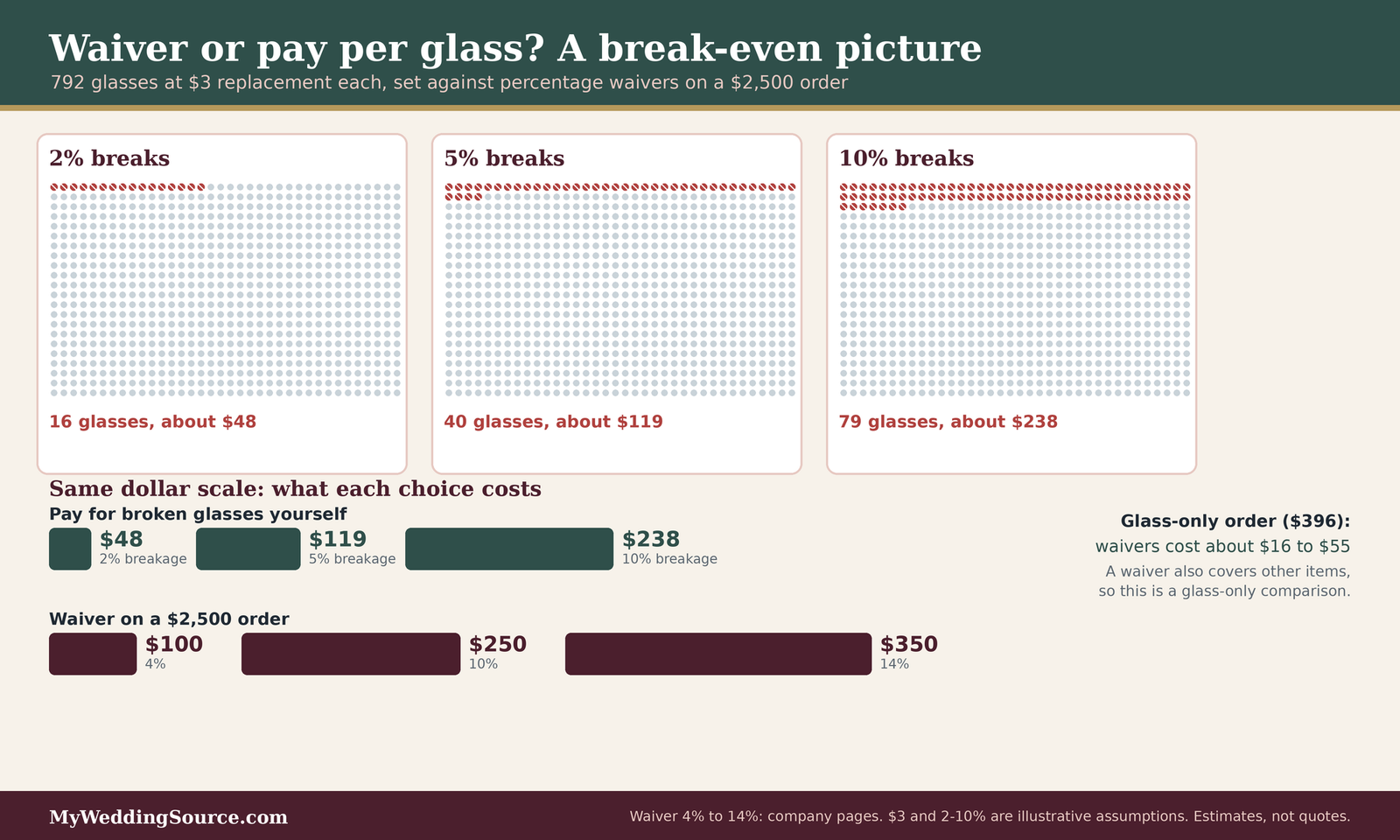
At two percent of 792 glasses, about 16 glasses break, which is about $48 at $3 each. At five percent, about 40 glasses break, which is about $119. At ten percent, about 79 glasses break, which is about $238. Compare those numbers with the waiver costs in the table. On a glass-only order, the waiver ($16 to $55 across the percentages above) is in the same range as the two-percent scenario. On a $2,500 order, the 4% waiver at $100 sits between the two-percent and five-percent scenarios, and the 14% waiver at $350 is higher than even the ten-percent scenario. Those comparisons describe glass only, and a waiver also covers other items.
Build a quote comparison matrix
The best way to use a break-even table is to turn it into a matrix of real quotes. Ask each company to price the same order, and then compare totals, not rates. The matrix is simple to build and it exposes differences that a rate sheet hides.
Ask every company for the same order
Give each vendor the same glass counts, the same delivery date and address, the same pickup window, and the same return condition. Ask each to quote with and without the waiver, if a waiver is offered. This turns a stack of different quotes into rows you can compare, and it makes any difference in terms visible. Our wedding rental planning checklist lists the other rentals to include in the same request, since the waiver percentage applies to the whole order.
The columns to fill in
Use these columns for each quote: rental total for glasses; rental total for everything else on the order; delivery and pickup fee; any timed-window or late-evening surcharge; waiver or credit cost; replacement cost per glass for each type; missing-item fee; cleaning fee conditions; and the date the final invoice arrives. The last column matters because Encore’s page says its final invoice is issued within 72 hours after the rentals are checked in at the warehouse, so a late return is also a late bill.
Where the money goes
In a wedding bar glassware rental, the glasses are often the smallest line. In our 792-glass example at an average of 50 cents each, the glasses come to about $396, and at a higher assumed rate of $1.00 they would come to about $792. Against that, one company’s published pickup ladder adds $200 to $500 for evening and overnight windows, a firm delivery time can add $250, and a waiver can run from 4% to 14% of the whole order. A glass-only order and a full-service order can therefore have very different best choices. Ask each company to quote the same order with delivery, pickup, and breakage terms shown as separate lines, then add them up. Our wedding budget and wedding cost per guest guides help you place the bar in the larger plan. These are estimates built from published terms, not quotes.
Pickup fees, delivery windows, and return condition for wedding bar glassware rental
Pickup is the half of a wedding bar glassware rental that couples tend to think about last, and the part that can surprise them most. A wedding bar glassware rental is not finished when the reception ends. It is finished when the crates are counted and loaded on a truck, and the time that happens, and the condition the glasses are in, can add to or reduce the bill. Receptions that end late are the ones most likely to push a wedding bar glassware rental into a surcharge.
How delivery and pickup fees are structured
The published terms we read used four structures: a round-trip fee, a flat local fee with a free self-pickup option, a fee that depends on the time window, and a surcharge for after-hours or last-minute service. Most companies combine two or more. For a wedding bar glassware rental, knowing the structure is more useful than any single price, because the structure tells you which of your decisions, like the reception end time, will move the number.
The round-trip fee
Peak Event Services quotes delivery and pickup as a round-trip fee based on time and location. A Classic Party Rental lists a local round trip of $200 within its home area, subject to change. Party Reflections says its fees vary by location and cover delivery to one central spot that the truck can reach, and that items going upstairs or to a remote site must be disclosed when reserving and are quoted separately. Peak adds that delivery locations must be within 100 feet of the accessible truck, or labor fees apply. For a backyard wedding with a long carry from the driveway, that sentence matters.
Will-call and self-pickup
A Classic lists will-call pickup or return as free, with returns accepted during set hours, and recommends recounting with staff on site. Occasional Tables, a Nashville rental company, says pickup and drop-off at its rental studio is free, while delivery, setup, and pickup at your location are available for a fee. Wellbank’s Martha Stewart article also noted that picking up rentals yourself can reduce delivery fees. Self-pickup can save money, but it makes you responsible for loading, protecting, and returning delicate crates, and Party Reflections notes that it accepts no liability for loading or unloading at will-call. For a hundred-plus glasses, ask whether a friend with a van and a free Monday is a plan or a risk.
Timed windows and firm times
In a wedding bar glassware rental, a fee for a specific delivery time is common. A Classic lists $250 for a morning or afternoon window and $500 for a specific time during business hours. Peak lists $250 for a specific or firm time and $150 for a window under four hours in the off-season. Party Reflections says the lowest-cost option is an 8 a.m. to 5 p.m. window on both delivery and pickup days. If your venue has a loading dock schedule, or a hard rule about when vendors can enter, a firm window may be worth buying, and you should ask for the price in writing.
Late-night receptions and pickup timing
A reception that ends at 10 or 11 p.m. creates a pickup problem for a wedding bar glassware rental, because the standard window usually closes earlier. Rental companies handle this in two ways: they pick up the next morning, or they charge for an evening or overnight pickup. The choice affects your bill and the safety of the glasses overnight, and it is the part of the plan that a venue contract may restrict as well.
One company’s published fee ladder
Peak Event Services publishes a ladder of added fees on top of the base round trip. Normal delivery hours are 6 a.m. to 6 p.m. Outside them, it lists $200 for 6:01 to 8:59 p.m., $350 for 9:00 to 10:59 p.m., and $500 for 11 p.m. to 4:59 a.m. It also lists $500 for holidays, $200 for a last-minute order placed the same or next business day, and $250 for a specific or firm time. These are one company’s numbers, and we show them as an example of how steep the ladder can be, not as typical prices.

Next-morning pickup and overnight storage
If pickup is the next day, the crates must stay somewhere. Peak’s page says equipment must be protected from weather at all times and returned to the delivery location, and that if it cannot be found on site, a secondary pickup crew fee applies. So the plan for overnight storage is part of the quote. Ask where the crates will sit, who has a key, whether the venue allows them to stay overnight, and who is responsible if something goes missing. A locked room is a better answer than a loading dock.
Weekend returns and the cost of waiting
A Classic notes that Friday-to-Monday rentals use a one-day rate, and Party Reflections notes that weekend events usually mean a Monday or Tuesday pickup for items like tents. Encore says its final invoice arrives within 72 hours after the items are checked in. For glassware, the practical question is whether holding the glasses until Monday affects your rental period, and whether a Sunday pickup carries a weekend premium. A Classic’s page lists a $750 minimum for after-hours or weekend delivery, so do not assume a Sunday pickup is the same price as a Monday one.
What condition the glasses must be in when they go back
Return condition is where a wedding bar glassware rental can quietly cost more. In a wedding bar glassware rental, most companies do not expect you to wash glasses, but they do expect them to come back in a certain state, and a failure to meet that state can trigger a cleaning fee. The rules are published, and they are strikingly similar across companies.
Scraped, rinsed, and racked
Peak says china, glassware, flatware, and cooking equipment must be scraped free of food and cannot have writing on them. A Classic says glasses and china should go back on their racks, that items do not need to be cleaned, and that plates and utensils should be scraped and rinsed of food, with cleaning fees if significant residue remains. Party Reflections says to rinse or wipe off plates and glassware, count all items, and place them in one central location for the driver to count. Occasional Tables adds a rule about liquid: pour all liquid out of glassware before returning it. Wedding bars create a particular version of this problem, since half-finished drinks, citrus, and garnish end up in glasses.
Who washes the glasses
For the companies above, the answer is the rental company. A Classic says it professionally washes all items after they are returned, and Party Reflections says all foodservice and linen items are washed every time they go out on an order and that it cleans and sterilizes the items after you return them. Occasional Tables says some items must be hand-washed to keep their quality and that its rentals are for single use. If your caterer or bartender plans to wash glasses on site during the event, that is a separate process, covered below, and it should be confirmed in the caterer’s contract.
No writing, no stickers, no markers
Peak’s rule against writing on glassware and its separate rule against stickers or adhesive labels on chairs are easy to miss. A wine charm, a paper tag, or a marker on a glass is fun at a party. It can become a cleaning issue at return. If you plan to personalize glasses, buy your own, or ask the vendor whether a removable charm is acceptable.
Counting and documenting at pickup
In any wedding bar glassware rental, a count is the strongest protection you have against a charge for missing glasses, and it costs nothing. The published terms point to a routine: count at delivery, report problems early, count again at pickup, and ask for the final tally in writing.
The delivery count
Peak says missing or damaged items must be reported with photos before the event begins, and Party Reflections says its drivers require a signature confirming receipt of all contracted items. So the day-of routine starts with the delivery: open the crates, count by type, photograph anything chipped, and sign only after you or your planner have checked. Our wedding week checklist puts delivery checks in the final days before the event.
The pickup count
A Classic recommends recounting with staff on site at return, and Party Reflections says to count all items and place them in one central location for the driver to count and load. Ask your caterer who will do the final sweep, because glasses migrate. If your venue has outdoor spaces, a person with a tray and a flashlight is worth more than any waiver. Our wedding vendor subcontractors guide explains how to find out which company is actually handling which part of the evening.
The final invoice and disputes
Encore’s page says its final invoice arrives within 72 hours after rentals are checked in and notes damaged or missing items on it. Ask when the invoice arrives and how long you have to question it. Keep your delivery photos, your signed count, and your pickup count in one folder. If a charge looks wrong, ask the company to show the check-in record and photos. This is general consumer practice, not legal advice, and a dispute with a vendor is a case for your contract and, if needed, a professional.
Washing, glass quality, and what to pick for a wedding bar glassware rental
The glass you choose for a wedding bar glassware rental affects breakage, how it looks in photos, and how many times it can be washed. It also decides whether a hand-wash is possible, and whether your caterer’s dishwasher is a fit. Most couples pick by look, which is reasonable, and a few questions will keep that choice from causing trouble later.
Clean glasses at the bar
A clean glass is a safety issue as well as a quality issue. FoodSafety.gov, a federal resource run by the U.S. Department of Health and Human Services, lists cleaning as one of four core food safety practices and advises washing hands, utensils, and surfaces often. The page does not give specific guidance about washing glasses, and we do not claim it does. We use it for the principle, and we leave the specifics to the rental company and the caterer.
Hands, surfaces, and handling
Bartenders who handle ice, garnishes, and glasses should wash hands often, as the federal guidance says for food handling in general. Ask your caterer how glasses from the wedding bar glassware rental are handled at the bar, whether staff hold glasses by the stem or base, and how garnishes and ice are kept separate from used glasses. Our wedding bar ice planning guide covers ice handling and how much to order, which interacts with glass count at a busy bar.
Spots, film, and cloudiness
Spotted glasses are mostly a rinse and drying problem, and Blossom Furnishings advises rental companies to choose glass that resists cloudiness, called etching, through hundreds of commercial wash cycles. For you, the practical question is how the rental company washes and whether it polishes. If your photographer will shoot a toast close up, ask for glasses that arrive polished and racked, and have a few extras available on the bar for the moment you need one.
Where used glasses go during the event
A bus tub or rack under the bar, a runner collecting from tables, and a clear spot for the wash are all details that determine how many glasses get reused. C Party Rentals noted that enough wait staff and washing capacity allow glasses to be reused, and Curtis said a bartender can wash quickly with an assistant collecting used glasses. If you do not have staff for this, order more glasses and plan on cleaning after the event, not during it.
Glass material, shape, and durability
Not all glass in a wedding bar glassware rental is equal, and a few design details influence breakage and cost. We rely on Blossom Furnishings here, a company that sells to rental businesses, and we note that it describes what suits a rental inventory, which is not the same as what suits a guest’s preference.
Soda-lime and crystal
Blossom recommends high-quality soda-lime glass as the rental standard and treats crystal as a premium option that chips more easily and costs more to replace. If your quote shows crystal or a delicate cut, ask for the replacement price per glass, because a waiver percentage can look small while a per-glass replacement price is high. A heavier, sturdier glass may be a better choice for a bar where guests carry drinks across grass.
Stems, rims, and weight
Blossom’s guide lists beaded or rolled rims, reinforced stems, and balanced weight as signs of durability, advises against ultra-thin stems unless priced at a premium, and notes that gold rims wear faster in dishwashers. For a wedding, a stemless wine glass is easier to carry and less prone to snapping, but a stem may suit your look. The choice is yours, and it is helpful to know that it also affects breakage.
Ask for a sample
Blossom advises testing samples by washing, stacking, and simulating transport before a big purchase. You can borrow the idea. Ask the rental company whether you can see the actual glass, hold it, and compare it with the photograph. Some companies show samples at a showroom, and the visit is also a chance to ask about racks, which hold the glasses that arrive and leave.
Venue, permit, and service rules that shape a wedding bar glassware rental
A rental company’s terms are not the only rules that apply to a wedding bar glassware rental. The venue may limit glass, a park may ban alcohol, and your insurance or caterer may require specific arrangements. These are rules you cannot negotiate with the rental company, so check them before you reserve glasses.
Places that limit glass
Glass is not welcome everywhere. Public parks and some outdoor venues restrict it for safety and cleanup reasons, and rules differ by place. We found two county park examples that show how different the rules can be, and we use them to illustrate the question, not to speak for your venue.
County park examples
El Paso County, Colorado, publishes wedding guidelines for its parks. They say alcohol consumption is not allowed on any county parks property, ask people not to use glass containers, and make the permit holder responsible for cleaning the reserved facilities and taking out any trash that does not fit the provided receptacles. Palm Beach County, Florida, publishes special-event guidelines that say no glass containers are allowed for dispensing beverages, within its food vendor requirements. The two pages are about different kinds of events and different rules, and both show that a park permit can rule out a glass program entirely.
What to ask your venue
Ask three things in writing: whether glass is allowed, where, and for how long; whether outside alcohol and outside rentals are allowed; and whether the venue has loading, storage, and cleanup rules for rental vendors. Our wedding venue questions guide has a longer list. If your venue restricts glass, ask whether it offers an approved alternative before you reserve glass for the bar.
Alcohol service, liability, and permits
Who serves alcohol, under whose license, and with what insurance behind it is a separate question from who rents the glasses. We are not able to give legal advice, and the rules vary by state and county, but we can point to examples of what a venue may ask for.
Licenses and insurance examples
Palm Beach County’s special-event page says a liquor license is required to sell alcohol and that, if alcohol is served free and no admission fee is charged, the insurance certificate must show host liquor liability coverage of at least one million dollars per occurrence. That is one county’s rule for one kind of event and does not apply to your wedding by default. It shows why your plan for glassware should be tied to your plan for service. Our wedding permits and wedding insurance guides explain where to start, and a licensed caterer or insurance professional can tell you what applies to you.
Know what a standard pour is
The National Institute on Alcohol Abuse and Alcoholism defines a U.S. standard drink as any beverage with 0.6 fluid ounces or 14 grams of pure alcohol, and gives examples of 12 ounces of regular beer, 5 ounces of table wine, and 1.5 ounces of distilled spirits at about 40 percent alcohol by volume. NIAAA notes that actual strength varies and that standard amounts may not match customary serving sizes. For glassware, the useful point is that glass size and pour size are not the same thing. Ask your bartender what the planned pour is for each glass, so the order and the bar plan agree.
Do not assume who drinks
A good bar plan serves everyone, including guests who do not drink alcohol, are under the legal age, or choose not to have a drink that day. A wedding bar glassware rental should support that. Waters, sodas, mocktails, and nonalcoholic beer and wine all need glasses, and they are a reasonable place to use a different glass shape so that a guest’s drink is not mistaken for someone else’s.
Nonalcoholic service is part of the count
If you run an alcohol-free event, or if you offer a significant nonalcoholic menu, the glass count shifts toward water and tumblers, and the wine glass count falls. Our guides on wedding nonalcoholic beer and wine and wedding mocktails help you plan the menu so the glassware order matches it.
Do not make it obvious who is drinking
A distinct glass for nonalcoholic drinks can help staff, but it can also single out guests. Many couples prefer to serve zero-proof drinks in the same glasses as everything else, and let guests choose. Ask your bartender how they would handle it and whether the glasses at the bar need to be distinguishable for service reasons.
Edge cases that change a wedding bar glassware rental plan
The advice so far assumes a standard reception with a venue that allows glass, a truck that can reach the bar, and a pickup that fits the rental company’s hours. Many weddings do not fit that pattern. The cases below are the ones that most often change a wedding bar glassware rental, and each one turns on a question you can ask early.
Backyards, tents, and long carries
A backyard or tented wedding moves the bar away from the places where rental trucks, dishwashers, and storage rooms usually are. It is also the setting where weather and distance matter most, and where breakage terms that exclude weather damage are most likely to be tested.
Truck access and the carry
Peak Event Services says delivery locations must be within 100 feet of the accessible truck, or labor fees apply, and Party Reflections says items going upstairs or to a remote site must be disclosed when reserving and are quoted separately. A bar set up at the far end of a lawn may sit well beyond that distance. Measure from where the truck can park to where the crates will sit, and tell the company the number before it quotes. Our outdoor wedding infrastructure checklist covers other site logistics.
Weather and staging
Party Rental Ltd, Encore, and Peak each describe weather or sprinkler damage, or equipment left outdoors unprotected, as outside normal waiver coverage or as damage billed at replacement cost. Crates of glasses that sit in a damp tent overnight, or on grass near sprinklers, are an avoidable exposure. Ask the vendor how to stage racks, and ask your venue whether sprinklers run overnight. Our summer wedding heat plan also covers the heat side of a beverage plan, and the drink stations sibling guide, wedding beverage stations for outdoor heat, goes further.
Changing the order after you book
Guest counts change, and so do dates. A glass order is often the easiest thing to adjust, if you ask early, and one of the hardest after a cutoff. The cutoffs are published and differ by company.
Guest count changes
Because the glass count follows the guest count, a late change in RSVPs changes the order. Ask when the count is final, whether you can add glasses after that date, and whether there is a minimum order. A guest count that rises may call for more glasses, and a count that falls may not reduce the bill if the company has already pulled the order. Our wedding week checklist suggests when to confirm final counts with vendors.
Date changes and cancellations
Peak’s page says removals and date changes are not accepted less than two days before the shipping date. We read that as a sign to check each company’s cutoff, because they differ, and to ask what happens to a deposit if the date moves. Whether a deposit is refundable is a contract matter, and our wedding insurance guide explains what event cancellation coverage may or may not include.
Small events, multi-day weekends, and bars without glass
Some weddings need fewer glasses, some need glasses on several days, and some should not use glass at all. A wedding bar glassware rental is flexible if you plan it as a set of events, not a single order.
Small weddings and minimum orders
For a micro wedding, a wedding bar glassware rental may need only a few dozen glasses, and some companies may set a minimum order or a minimum delivery fee. We did not find a published minimum, so ask. For a very small guest list, a will-call pickup or a caterer-supplied set may cost less than a delivered rental, and the break-even table above will show you that a percentage waiver is small on a small order.
Welcome drinks and rehearsal dinners
If you host a welcome drink, a rehearsal dinner, and a reception, treat each as its own wedding bar glassware rental count and decide whether glasses are reused across events. Our welcome drinks versus full welcome dinner guide helps you think about the first event. A single rental period may cover several days at one rate, as a Classic’s one-day weekend rate suggests, but a second delivery is usually a second fee, so ask.
When glass is the wrong choice
If your venue or park bans glass, or if the bar sits next to a pool, beach, or dance floor where bare feet are likely, glass may not be a good idea even where it is allowed. Ask the rental company what shatter-resistant or alternative drinkware it offers, and ask the venue what it approves. A hybrid plan, with glass at the dinner tables and something else at the outdoor bar, is a common way to keep a polished look where it matters. We did not find a published comparison of costs, so ask for both quotes.
A timeline for ordering, counting, and returning glassware
The most effective use of this guide is a sequence of small actions for your wedding bar glassware rental that start before you book and end after the pickup. The steps below follow the published terms we read, and they leave room for your caterer’s own process.
Before you book
The decisions you make before booking a wedding bar glassware rental set most of the cost, because they fix the count, the pickup time, and the breakage method. They are also the cheapest to change.
Decide the service plan first
Settle the drink menu, the bar style, and whether you want bottled beer, a full bar, or a short list, because those choices set the glass types and count. Our open bar wedding and signature cocktail batching for weddings guides explain how those choices change the work at the bar. If you plan to hire a bartender, our choosing a wedding bartender guide helps you ask who brings glassware and who washes it, and our wedding drink ticket system guide covers pacing of orders at a busy bar.
Get three quotes on the same order
For your wedding bar glassware rental, send the same glass counts, delivery address, event end time, and return condition to at least two or three companies, and ask them to show breakage, delivery, and pickup separately. Put the answers in the matrix above. Read the contract for the sections on damage, missing items, cleaning, and late returns, and keep a copy.
In the final weeks
Two to four weeks before the event, confirm the details that tend to drift: the final count, the delivery window, the pickup plan, and who is on site to receive and return the order.
Confirm the count and the windows
Send a final glass count by type for the wedding bar glassware rental and ask the company to confirm the delivery window, the pickup window, and any surcharges in writing. If your reception end time moved, check whether the pickup now falls in a more expensive window. Ask who will be on site at delivery with authority to sign, since Party Reflections says drivers require a signature confirming receipt of all contracted items.
Tell the venue and the caterer
Send the venue the delivery schedule and the amount of equipment, and ask where crates can be staged and stored. Tell the caterer or bartender which glasses are arriving and who is responsible for washing, racking, and the final count. Our wedding reception guide covers how the reception day flows around these hand-offs.
On the day and after
On the day of a wedding bar glassware rental, your job is to keep the count honest. After the event, your job is to close the loop quickly, before photos and memories fade.
Count at delivery
Open the crates, count by type, photograph chips or cracks, and note anything missing. Peak says to report missing or damaged items with photos before the event begins. Sign when the count is right and keep a copy of the signed delivery record.
Count at pickup and keep the paperwork
At the end of the night, collect glasses from tables, lawns, and restrooms, rack them as the company requires, pour out liquid, and recount with the driver or the company’s staff. Keep the delivery photos, the signed counts, and the final invoice together. If there is a charge you do not understand, ask the company to explain it in writing before you pay.
Questions to ask a glassware rental company
- How many glasses of each type do you recommend for my guest count and bar menu, and how did you arrive at the number?
- How do you handle breakage: a percentage waiver, a tabletop credit, or replacement cost, and is it applied to the whole order or only to the glassware?
- What is the replacement price per glass for each type, and is there a handling charge or a minimum?
- If a rack of glasses breaks, how do you define minor and major damage, and who decides which one it is?
- Are lost or missing glasses treated differently from broken ones, and can I avoid a charge by returning a glass later?
- What are the delivery and pickup fees, and what do a firm time, a short window, a late-evening pickup, a weekend, or a holiday add?
- What is the standard delivery and pickup window, and how far can your truck be from the bar before labor fees apply?
- In what condition must glasses be returned: poured out, rinsed, racked, no writing or stickers, and what is the cleaning fee if they are not?
- Who washes the glasses, how, and can I see a sample of the glass I would receive?
- When does the final invoice arrive, how long do I have to question it, and can I see the check-in record and photos?
Counts and costs
How many glasses do I need for a wedding bar?
For a wedding bar glassware rental, published planner advice suggests about one water glass and two wine glasses per guest at dinner, and two lowball glasses plus one highball glass per guest for a full bar. Many sources also recommend about ten percent extra. Ask your caterer or bartender to confirm the count for your menu and whether glasses will be washed during the evening.
What does wedding bar glassware rental usually cost?
A Martha Stewart article put barware at about 50 cents per glass on average in 2020, but prices vary by region, glass type, and season. The bigger variables are delivery, pickup, and breakage terms. Ask each company for a wedding bar glassware rental quote on the same order, with each of those costs shown as a separate line.
Is a damage waiver worth it?
It depends on the percentage, the order total, and what the waiver covers. Published waivers we found ran from 4% to 14% of the order. On a larger order, the fee can exceed the likely cost of broken glasses, but it may also cover linens, china, and other rentals. Use the break-even table, then ask the vendor.
Breakage, pickup, and returns
Who pays when a glass breaks?
It depends on the contract. Some companies cover minor breakage under a waiver, some bill replacement cost, and one published page lists broken glassware among its waiver exclusions. Lost glasses are often treated differently from broken ones. Ask in writing how breakage, chips, and missing glasses are handled, and who decides which category applies.
Do I have to wash rental glasses before returning them?
Most published terms we read do not require it. They ask you to pour out liquid, scrape or rinse off food, and return glasses on their racks, and some companies charge a cleaning fee if significant residue remains. One company says some items must be hand-washed by its staff. Ask your vendor for its exact return conditions.
Why does a late reception raise the pickup cost?
Some rental companies charge extra for evening or overnight pickups. One company’s published ladder adds $200 for 6:01 to 8:59 p.m., $350 for 9:00 to 10:59 p.m., and $500 from 11 p.m. to 4:59 a.m. Many companies instead pick up the next morning, so ask which option you are being quoted.
Venues and special situations
Can I use glass at a park or outdoor venue?
Not always. One county park system we read asks people not to use glass containers and bans alcohol, and another prohibits glass for dispensing beverages within its food vendor rules. Rules differ by place and by event type, so ask your venue or permit office in writing before you reserve glasses.
What if my guests do not drink alcohol?
Plan for them as part of the count. Water, soda, mocktails, and nonalcoholic beer and wine all need glasses, and a zero-proof menu may shift the order toward tumblers and water glasses. Do not assume who drinks. Serving everyone in the same glassware avoids singling anyone out, unless your bartender needs a distinct glass for service.
Your next steps
Build the numbers
Write your glass count
List your drinks for the wedding bar glassware rental, pick a per-guest count for each glass type from the published ranges, add your extra, and share the list with your caterer. Ask them to adjust it for washing capacity and bar style, then use the adjusted count for every quote.
Fill in the comparison matrix
Ask two or three companies for the same order and fill in the columns: glass rental, other rentals, delivery and pickup, surcharges, waiver or credit, replacement cost per glass, missing-item fee, cleaning conditions, and invoice date. Compare totals before you compare rates.
Lock in the details
Confirm the pickup plan and the venue rules
Check the reception end time against the pickup windows, decide where crates will be stored, and confirm that your venue allows glass and rental vendors. Our wedding rental planning checklist and wedding planning checklist help you keep the rest of the rentals in the same plan.
Assign the counts
Choose who will receive the delivery, who will sweep for stray glasses, and who will do the pickup count. Put names in your vendor timeline, and keep a photo of every count.
Sources & methodology
How we built this guide
What we relied on
This guide to wedding bar glassware rental combines published terms from several party rental companies, two articles from a national wedding publication that quote caterers on glass counts, a rental-industry buying guide, public rules from two county park systems, and two federal resources on food safety and standard drink sizes. We checked each page in November 2026. Where a figure comes from a company, we attribute it to that company, because rental terms reflect what the seller offers. The glass counts, break-even figures, and breakage scenarios are our own arithmetic from the published rules of thumb and stated assumptions, and they are estimates, not quotes.
What we did not do
We did not request quotes, test glassware, measure breakage at real weddings, or review any contract. We could not find a published breakage rate for a single wedding reception, so we used scenarios. Terms change and differ by region, and the companies we cite are examples, not recommendations. We do not give legal, insurance, or financial advice. Ask each vendor for its current terms in writing, and ask a licensed professional about insurance and alcohol rules.
Source list
Government and public-agency sources
- FoodSafety.gov, U.S. Department of Health and Human Services, food safety basics (clean, separate, cook, chill): https://www.foodsafety.gov/
- National Institute on Alcohol Abuse and Alcoholism, What is a standard drink: https://www.niaaa.nih.gov/alcohols-effects-health/what-standard-drink
- El Paso County Parks, Wedding guidelines: https://epc-assets.elpasoco.com/wp-content/uploads/sites/21/Parks/Wedding-Guidelines-Remediated.pdf
- Palm Beach County Parks and Recreation, Special events guidelines: https://discover.pbc.gov/parks/SpecialEvents/Guidelines.aspx
Rental company terms (company pages, checked November 2026)
- Party Rental Ltd, What happens if I break or misplace something: https://help.partyrentalltd.com/what-happens-if-i-break-or-misplace-something
- Party Rental Ltd, Do you charge a damage waiver fee: https://help.partyrentalltd.com/do-you-charge-a-damage-waiver-fee
- Rental World, Damage waiver: https://www.rentalworld.com/faqs/damage-waiver-dwc/
- Peak Event Services, Rental terms and policies: https://www.peakeventservices.com/rental-terms-policies/
- A Classic Party Rental, Frequently asked questions: https://aclassicpartyrental.com/faqs
- Encore Events Rentals, Are there any additional fees: https://www.encoreeventsrentals.com/simple-faqs/are-there-any-additional-fees
- Party Reflections, Special event rentals FAQ: https://partyreflections.com/faq/
- The Occasional Tables, Frequently asked questions: https://theoccasionaltables.tapgoods.com/answers-to-your-frequently-asked-questions
Planning articles and industry guides
- Martha Stewart (via Yahoo Life), Alyssa Brown, Seven questions to ask yourself before ordering glassware for your wedding, May 2021: https://www.yahoo.com/lifestyle/seven-questions-ask-yourself-order-130000046.html
- Martha Stewart (via Yahoo Life), Lauren Wellbank, Your guide to ordering barware for a backyard wedding, September 2020: https://www.yahoo.com/lifestyle/guide-ordering-barware-backyard-wedding-164200393.html
- C Party Rentals, How many plates and glasses do you need for your wedding: https://cpartyrentals.com/plates-glasses-need-for-wedding/
- Blossom Furnishings, How to choose wedding glassware for event rentals: https://blossomfurnishings.com/how-to-choose-wedding-glassware-for-event-rentals-the-professional-buyers-guide/