

A wedding reception feels effortless to guests only when someone has decided, in advance, how long each stretch lasts, who runs it, what it depends on, and what happens when it slips, so this guide builds the wedding reception block by block, from the first drink to the last song, and shows where the dead time usually hides.
Quick answer
Start with the times you cannot move: the venue’s end time, sunset, vendor hours, and any travel between the ceremony and the wedding reception. Then fit the blocks inside them. Published planning guides from Zola and WeddingWire put a full wedding reception at roughly 4 to 7 hours including cocktail hour, with cocktail hour at about 60 to 90 minutes, toasts at about 3 to 6 minutes each, and open dancing at about 1.5 to 2.5 hours. Those are planners’ habits, not rules. Write the wedding reception schedule as a run-of-show with a named owner for every block, add 10 to 15 minutes of slack before any hard stop, and decide in advance which block you will shorten if the wedding reception runs late.
Why a wedding reception loses energy, and where the dead time hides
Most guests cannot name what made a party feel flat. They remember standing around, a long wait before dinner, a song that cleared the floor, or a toast that went on until the food went cold. Those moments have causes, and most of them are visible on a schedule if you know where to look. Before building the evening, it helps to see what a wedding reception is actually made of and which seams are most likely to leave people waiting.
A wedding reception is a chain of jobs, not one long party
It is tempting to treat the wedding reception as a single event with a start time and an end time. A more useful picture is a chain of separate jobs, each handled by different people with different equipment, and each ready to start only when the one before it has finished. When a chain is drawn out, the weak links show up as gaps between the jobs.
The five jobs the evening has to do
In our reading of the published timelines, every wedding reception asks the same five things of the wedding reception. It has to gather guests and get them settled, feed them, honor the couple and the people around them through toasts and traditions, move them onto a dance floor or into some other shared activity, and close the night so people leave warm instead of drifting off. Different weddings weight these differently. A rehearsal-dinner-sized gathering may be almost all feeding and honoring, while a large Saturday night may spend half its hours moving and closing. Naming the five jobs helps you notice when one of them has been left out or given too little time.
Why a block is only as good as its handoff
Each job has an owner: the caterer for dinner, the DJ or bandleader for music cues, a coordinator or emcee for announcements, a photographer for the moments that need light. The handoff between owners is where dead time lives. A caterer who is waiting for an announcement and an emcee who is waiting for the caterer will both be waiting. We suggest writing the handoff next to every block on your schedule, in a phrase such as “caterer signals emcee when the last table is served,” so no one has to guess who moves first.
Where the dead time usually shows up
Dead time is any stretch in which guests have nothing to do, nothing to hear, and no sign of when it will end. It is not the same as quiet time. A calm ten minutes while people finish dessert and talk is fine. Ten minutes of watching staff move chairs is not.
Between the ceremony and the doors opening
The first gap sits between the last moment of the ceremony and the first moment of the wedding reception. Zola advises that guests should be able to get from the ceremony to the wedding reception in about an hour to an hour and a half, and says a gap that is too short can feel rushed while one that is too long leaves guests restless with nothing to do. If you are using one venue for both, a cocktail hour of about 60 minutes, and 90 at most, is Zola’s suggestion. The risk is greater when couple portraits, family formals, and a room flip all have to fit inside the same window.
Between the entrance and the first plate
The second gap is the stretch after guests are seated and before food reaches them. It grows when announcements, a welcome toast, and a first dance are stacked in front of dinner without anyone checking how long they take. WeddingWire’s order of events advises serving guests soon after they come in so they have energy for dancing, and our reading is that this is more than politeness: it is a way to protect the dance floor.
Between the cake and the last song
The third gap is the soft landing that is too soft. Zola’s wedding reception timeline notes that cutting the cake can signal to guests that the night is ending, which is why it suggests scheduling it later when you want a longer evening. WeddingWire advises the opposite emphasis, cutting the cake early so the dance floor opens afterward without interruption. Both are reasonable, and the difference is a reminder that cake timing is a choice about energy, not a fixed tradition.
What the published timelines agree on, and where they differ
Planning sites publish many sample timelines, and they look similar at a glance. Comparing four of them closely shows a firm common core and a few places where the advice genuinely splits. Knowing which is which keeps you from treating one site’s habit as a universal rule.
Where the guides agree
All four sources we read place a cocktail hour before the couple’s entrance, put dinner before open dancing, and treat toasts as a short block rather than a performance. They also agree on rough proportions: dinner and its toasts take well over an hour, open dancing takes the final one to two and a half hours, and the evening ends with a deliberate last dance. Zola’s hourly breakdown suggests an entrance and first dance of 20 to 30 minutes at most, dinner including toasts of 1.5 to 2 hours, and open dancing of 1.5 to 2.5 hours. The Knot’s 4 p.m. ceremony sample runs from a 5:30 p.m. entrance to a 10:30 p.m. last dance. WeddingWire’s order of events places the grand exit at the very end.
Where they disagree
They disagree about total length and about some sequencing. Zola’s hourly breakdown puts a full wedding reception at about 5 to 7 hours and treats the cocktail hour as an extra hour before it, while WeddingWire says wedding receptions typically last 4 to 7 hours including the cocktail hour. They also differ on the first dance, which WeddingWire says can come right after the entrance or after dinner, and on cake timing, as noted above. Zola’s own wedding reception timeline, an example of a roughly four-hour evening, puts toasts after dinner starts and the cake late, while The Knot’s sample has toasts as dinner wraps and the cake at the 9 p.m. mark.
None of the guides cite hard data on timing
It is worth saying plainly that the timing figures in these guides are expert habit, not measured results. In the pages we read, none of them points to research behind the numbers. WeddingWire says only that 87% of recently married couples had a first dance, attributed to its own internal data. That does not make the advice wrong. Planners see hundreds of evenings. It does mean you should treat the numbers as starting points and adjust to your guests, your venue, and your contract.
Run a dead-time audit on your own wedding reception schedule
Published timelines tell you what others do. An audit tells you where your own plan leaves people waiting. It takes about twenty minutes with a printed schedule and a pen, and it is a method of our own, not an industry standard.
Mark every handoff and every wait
Go down the schedule and draw a line wherever one owner stops and another starts: caterer to emcee, emcee to DJ, DJ to photographer. At each line, write two things. First, who gives the signal. Second, what guests are doing during the seam. If either answer is “I am not sure,” you have found a place where time will leak. A common example is the seam between the last plate and the first toast, where the caterer is clearing, the emcee is waiting for a quieter room, and the speaker is waiting for a microphone.
Score each block by idle minutes
For each block, estimate how many minutes a typical guest has nothing to do, nothing to hear, and no cue about what comes next. Our rule of thumb, which is a judgment and not a measured threshold, is that a wait of more than about ten minutes without a cue deserves a fix. The fix is rarely to fill the silence with more programming. More often it is a small signal: a song change, a short announcement, a server who tells a table what is coming. Suppose the audit finds that the seam between cocktail hour and doors is 20 minutes of unannounced waiting. The fix may be as simple as having the emcee invite guests to find their seats and the DJ change the music, which costs nothing and tells the room that something is about to happen.
Build the evening block by block
The sections below walk the wedding reception in order and assign each stretch a suggested length. The lengths come from the published ranges above where we can point to them, and from our own judgment where we cannot. We mark the difference. Everything is built around a single worked example so the pieces fit together: a Saturday in mid-October, a ceremony and reception at the same venue, and 117 guests, which matches the average guest count The Knot reports in its 2026 Real Weddings Study of couples married in 2025.
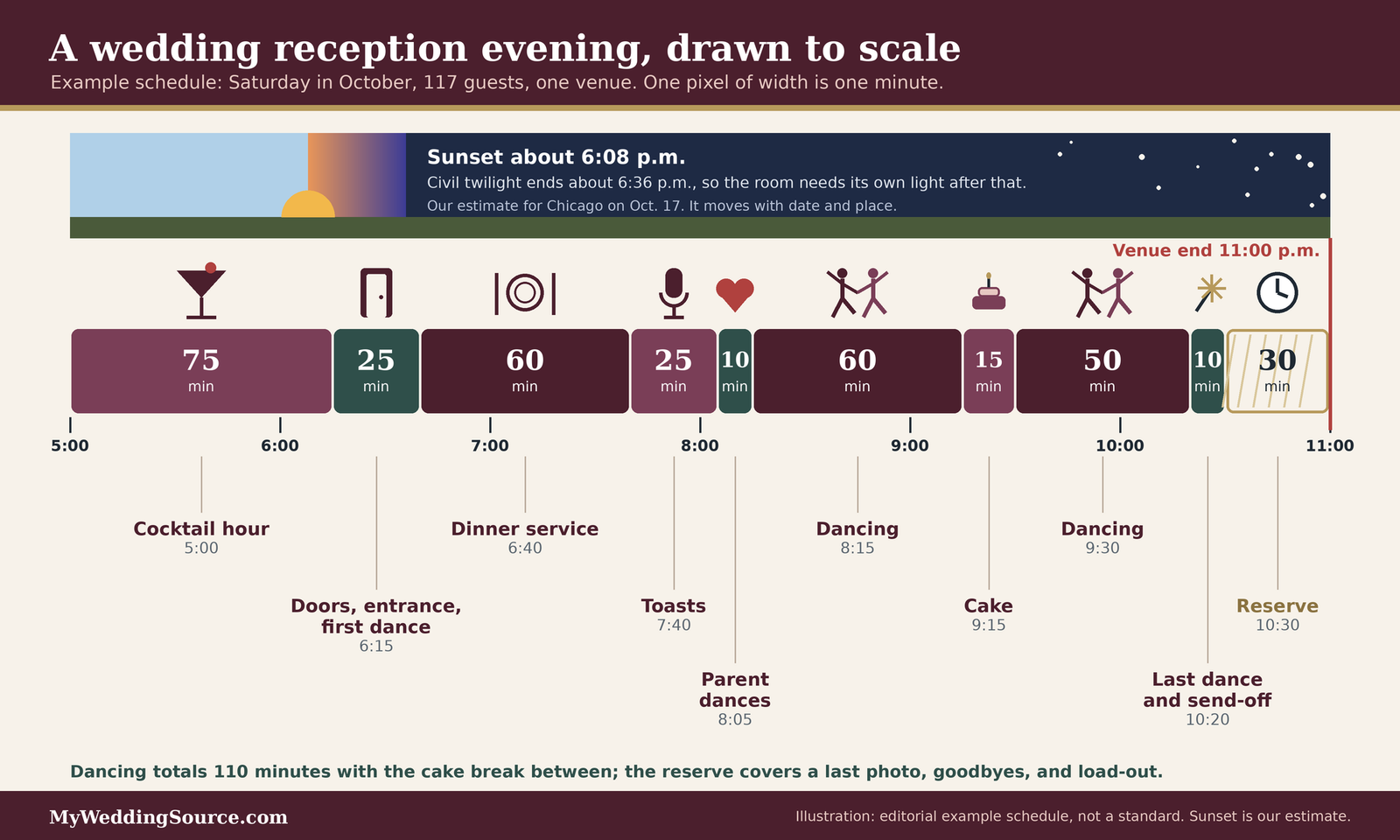
Cocktail hour: gather, settle, and give the couple room
Cocktail hour has two audiences with opposing needs. Guests want drinks, food, and something to look at. The couple and wedding party, in many schedules, need that same window for photographs and a few minutes to breathe. Zola describes cocktail hour as the time when the couple and wedding party handle photos while guests are entertained, and notes that the wedding reception officially begins when the couple arrives.
Length, and who is where
Zola says cocktail hour typically runs one to two hours, treats one hour as often too short and two as a strain on attention, and favors about 1.5 to 2 hours when photos need to fit without rushing. In its guide to the gap between ceremony and reception, though, it says an on-site cocktail hour usually lasts 60 minutes and at most 90. We take the overlap, 60 to 90 minutes, as a sensible planning range. In our example the ceremony ends at 5:00 p.m., the couple takes portraits for about 35 minutes, and cocktail hour runs until 6:15 p.m., which is 75 minutes for guests. The Knot’s 4 p.m. sample notes that without a first look many family and couple portraits move to after the ceremony and the couple may miss part of cocktail hour, so decide early whether that trade is acceptable to you.
Bars, food, and the lines that make people wait
Zola recommends multiple bars and bathrooms to reduce lines, plus clear signage and possibly name tags. We would add one planning check of our own: divide your guest count by the number of bar stations and ask the bar provider how many guests per bartender they plan for during the first half hour, when demand is highest. A single bartender for 117 guests will produce a queue however good the music is. The check costs nothing and the answer tells you whether lines are a risk.
Something to do besides stand
Zola lists live music and games such as cornhole as examples of entertainment during cocktail hour. For guests who do not know each other, a small prompt, such as a seating chart posted where people will see it or a light activity near the bar, gives them a reason to start a conversation. If your guests will be wearing something more dressed-up than usual, our cocktail attire guide explains what a cocktail dress code usually means, which also helps you decide how long people will want to stand on grass or gravel.
The entrance, the first dance, and the welcome
This is the shortest block in the evening and the one most often stretched. Zola’s hourly breakdown caps the entrance and first dance at 20 to 30 minutes at most, longer only when the wedding party performs a choreographed routine. The reason to hold the line is that guests are seated and waiting, hungry, and still a little in cocktail-hour mode.
Opening the doors and seating guests
WeddingWire advises opening the room about 15 minutes before the wedding party introductions so guests can find their tables, and notes that a DJ announcement can help. We add that 15 minutes is tight for a room of more than 100 unless the seating chart is easy to read and has more than one entry point. In our example, doors open at 6:15, introductions begin at 6:25, and the couple enters at about 6:28.
Placing the first dance
WeddingWire says the first dance can happen right after the entrance or after dinner. Zola’s timeline and The Knot’s sample both put it right after the entrance. Our view is that the entrance placement keeps the sequence tidy, because the music is already playing and the room is already standing, and that the after-dinner placement can be a good choice when a couple is nervous about eating while an audience waits. Whichever you choose, tell the DJ, the photographer, and the caterer, because each of them has a job that depends on it.
A short welcome
A brief welcome from the couple or a family host, with any blessing, thanks, or serving instructions, lets guests know dinner is starting. WeddingWire lists it as a distinct step before the meal. In the Zola sample timeline it takes about ten minutes. We would hold it to two or three minutes unless the speaker is particularly practiced, because every minute here is a minute before food.
Dinner, toasts, and the vendors who keep working
Dinner is usually the longest single block in the wedding reception. Zola’s hourly breakdown puts dinner including toasts at 1.5 to 2 hours. It is also the block with the most moving parts and, for that reason, the one in which small delays compound.
How service style changes the clock
Plated service, buffet, and family-style do not take the same time, and no source we read gives a measured service time for each, so we treat any figure as an assumption to check with your caterer. As an illustration, suppose a buffet has two lines and each guest takes about one minute to serve themselves. Then 117 guests across two lines is about 117 / 2, or roughly 58 minutes from the first guest to the last, before anyone sits down with a full plate. With four lines the figure drops to about 29 minutes, and if each guest takes two minutes at two lines it rises to about 117. The point of the arithmetic is not the answer but the question to ask: how many minutes from the first plate to the last, at my guest count, for my menu, and how is that figure derived? This is our own illustrative calculation, not a published benchmark.
Toasts without the cold food
Zola’s wedding reception timeline suggests keeping speeches under about five minutes and leaving buffer in case a speaker runs long, and WeddingWire advises 3 to 6 minutes each. Both place toasts during or just after dinner. The Knot’s sample has them start as dinner wraps up and calls the block optional. If you have five speakers at about four minutes each, that is 20 minutes of speaking, before microphone handoffs and introductions, so we would plan 25 to 30. Ask speakers for a time limit in writing, and ask the emcee to hold the microphone rather than relying on anyone’s sense of time.
Feeding the people who are working
WeddingWire advises feeding vendors who are on site all evening, allowing at least 30 minutes, ideally right after the couple is served. The reason is practical: a DJ or photographer who has not eaten by the time dancing starts is working hungry, and a meal break in the middle of the dance floor block leaves a hole. Check your vendor contracts, because some include a meal and some assume you will provide one, and the headcount matters to the caterer.
Dancing, cake, and the last hour
By this point guests have been at the venue for several hours, so energy is the resource to manage. The Zola breakdown says open dancing of under an hour is too short and more than two hours can feel tiring, with a 1.5 to 2.5 hour window overall. The final job is to give the wedding reception a clear ending.
Getting the floor open
Zola’s timeline advises switching to an upbeat song immediately after the parent dances so guests are invited onto the floor while attention is high, and notes that you can adjust the party block to whether your crowd dances all night or prefers to mingle. Our suggestion is to ask the DJ or bandleader to open with songs you know your guests will recognize and to hold anything experimental until the floor is already full. Our worked example opens the floor at 8:15 p.m., right after the parent dances.
When to cut the cake
The two sources that comment on cake timing give two different pieces of advice, and both are defensible. If you want the floor to open without interruption, cut early, as WeddingWire suggests. If you want to keep the night going, cut later, as Zola suggests, because guests may take it as a cue to head home. In our example, with a 10:30 p.m. exit and an 11 p.m. venue end, we put the cake at 9:15, about an hour into dancing, which also matches Zola’s hourly breakdown, and we follow it with a short late-night snack if the budget allows.
A last dance and an exit that does not stall
WeddingWire advises that the DJ or bandleader announce the last dance and that the photographer be given time for a final shot at the grand exit. The Knot’s sample puts the last dance at 10:30 p.m. with an optional grand exit after it, and Zola’s timeline adds a private dance and a send-off with materials such as sparklers or streamers. If you want a send-off, ask the venue in writing whether it is permitted and where, since many venues set their own rules about open flame and outdoor access.
Start with the hard stops of the wedding reception
A reception schedule built from the first drink forward quietly assumes the wedding reception can run as long as it needs to. A schedule built from the last hard stop backward is more honest. The question is not “what do we want to do,” it is “what is fixed, and what is left over once the fixed things are placed.” Our recommendation is to list the fixed items first, then to give each flexible block a length, and to look at what remains as your real buffer.
Find the times you do not control
Four kinds of fixed time usually shape a wedding reception: the venue’s contract hours, the light, the vendors’ paid hours, and any travel. None of them is exotic, but each is easy to overlook until it collides with something else.
The venue’s contract and curfew
Read the venue contract for three times: when you may enter to set up, when music must stop, and when everyone, including vendors, must be gone. These are often three different times. Zola notes that many venues have a 10 p.m. curfew, which is a reason to check yours rather than assume. If the contract also covers load-out, work that into the wedding reception schedule, because your last dance does not end the venue’s day. Contract language varies and we cannot read yours, so treat this as a checklist of questions to take to the venue, not as legal advice.
Questions worth asking your venue about the schedule
- What are the exact times for setup, music cutoff, and full clearance, including vendors?
- How long does your staff need to flip the room, and where will guests wait?
- What is the charge for going past the contracted end?
- What are the rules on amplified sound, open flame, outdoor use, and send-off materials?
- What is the step-free route between each space we will use?
- Who is on site as the venue contact for the whole event?
Sunset, twilight, and what it does to the schedule
If any part of the evening happens outdoors, or the room has big windows, sunset is a fixed time. The U.S. Naval Observatory defines sunset as the moment the Sun’s upper edge appears to touch a level horizon, and civil twilight as lasting until the Sun’s center is 6 degrees below it. The National Weather Service describes civil twilight as a period when the horizon and nearby objects are still distinguishable and artificial light is often not needed. After it ends, outdoor activity generally needs artificial light. Neither source gives a lighting plan for a party, so the practical step is ours: find sunset for your date and place, then add roughly the length of civil twilight to see when the outdoors will go dark.
Here is our own estimate, computed from standard solar-position formulas and accurate to within a few minutes. For Chicago, sunset on Saturday, June 20, 2026 is about 8:28 p.m. Central Daylight Time, with civil twilight ending near 9:03 p.m. On Saturday, October 17, it is about 6:08 p.m., with civil twilight ending near 6:36. On Saturday, December 12, in Central Standard Time, it is about 4:20 p.m., with civil twilight ending near 4:51. The pattern matters more than the minutes: in October the evening light is gone by dinner, and in December it is gone before a 4:30 p.m. ceremony even ends. Check an official sunrise and sunset calculator for your exact venue and date before relying on any of these.
Vendors’ paid hours and overtime
Every vendor with a time block has a start, an end, and usually an overtime rate. The Knot’s survey writeup lists hours booked, including ceremony or after-party music, as one of the main factors in what a DJ or band costs. That means the length of your schedule has a price, and a schedule that runs 30 minutes past a contracted end can change the invoice. Write each vendor’s contracted hours next to your run-of-show, and mark the minute at which overtime begins.
Add document and processing time where the reception depends on it
Not every deadline belongs to a vendor. Some belong to rental companies, equipment suppliers, caterers, and the venue’s own approval processes, and these often take longer than people expect.
Counts and approvals
Caterers and rental companies usually ask for a final guest count some days before the event, and bars and bakeries may have their own cutoffs. We cannot give a standard figure because contracts vary, so the useful move is to pull every count deadline from every contract into one list. The number of tables, chairs, linens, plates, and meals all follow from the final count, so a late count has a bigger knock-on effect than it seems.
Permits and special requests
Some venues require approval for amplified music, outdoor tents, open flame, food trucks, or after-hours access. Whether any of these apply to you depends on your venue and local rules, and we have not tried to survey them. The safe habit is to ask the venue in writing which of your plans need approval, who grants it, how long it takes, and what the fallback is if it is refused. Put the answer on the same deadline list as everything else.
Work backward with buffers you can defend
With the fixed times on the page, the flexible blocks can be sized and the buffers made visible. A buffer is a gap you can name and point to, not a general hope that things will go smoothly.
Separate decision time from production time
A task has two clocks. Decision time is how long it takes you, your partner, and any family involved to agree. Production time is how long the vendor needs once you decide. A song list can take a few minutes to produce once you decide, but deciding can take weeks. We recommend setting your own decision deadline earlier than the vendor’s production deadline, so the vendor’s date never becomes the date you start deciding.
Slack for revisions and human delay
People are late with replies, speakers forget to send their remarks, and a vendor takes a day to answer an email. Rather than assume this will not happen, build a few days of slack into every task that depends on another person. The table below sets out our suggested backward timeline. The windows are our own planning suggestions, not industry standards, and your contracts and venue will set the real ones.
| Window before the wedding | What gets decided or confirmed | Owner | Depends on | Buffer to protect |
|---|---|---|---|---|
| 12 to 9 months | Venue, date, contracted hours, curfew, load-in time | Couple | Rough guest count and budget | Two weeks to compare contracts |
| 9 to 7 months | DJ or band booked; sound limits and power checked with the venue | Couple, venue | Venue hours and room layout | Ask for a hold in writing |
| 7 to 5 months | Service style and bar plan; rentals sketched | Couple, caterer | Guest count range and room size | Menu tasting can slip a month |
| 5 to 3 months | Cocktail hour and dinner format; emcee chosen; photo and entertainment add-ons | Couple, planner | Venue rules, vendor list | Two weeks for approvals |
| 3 to 2 months | Music planning form, must-play and do-not-play lists; speaker list | Couple, DJ | Run-of-show draft | One week for speaker replies |
| 8 weeks | Floor plan, seating approach, accessibility check | Couple, venue, caterer | Estimated count | Time to redo the layout |
| 4 weeks | Draft run-of-show shared with every vendor; count deadlines identified | Planner or couple | All vendor contracts | Two weeks before the first count deadline |
| 2 weeks | Final guest count; final run-of-show; vendor arrival times | Planner or couple | Final RSVPs | A few days for RSVP stragglers |
| 1 week | Final payments and tip envelopes; weather and plan B call | Couple, planner | Forecast, contracts | One day for rescheduling |
| Wedding day | Run-of-show in every vendor’s hands; one person has the authority to change it | Day-of lead | Everything above | Slack before every hard stop |
For a wider planning calendar covering the whole wedding, see our wedding planning timeline and our wedding planning checklist; this table covers only the pieces that shape the wedding reception.
Handle the gap between ceremony and reception
If the ceremony and the party are at different places, or if the ceremony is at a different time of day than the first drink, the gap itself needs a plan. A gap with no plan becomes the first source of dead time.
Same site, short turn
At a single venue, the gap is mostly a room flip. Zola’s guidance is a cocktail hour of about an hour, and 90 minutes at most. Ask the venue how long its staff need to turn a ceremony space into a dining room, whether guests will be in the room during the turn, and where the couple and wedding party wait. The room flip is a task with an owner and a clock, so write both down.
Different sites, real travel
If the ceremony and reception are in separate places, Zola’s example of a 3:30 p.m. ceremony end, a 30-minute drive, and a 5 p.m. cocktail hour leaves up to an hour of slack. Check your drive time at the same day of the week and time of day. Add the time to park, walk in, and find a bathroom. If you have a shuttle, ask how many trips it needs and whether the last guests will arrive after the doors have already opened.
A longer gap, and what guests do with it
When the gap is long, Zola suggests posting a map of nearby cafes and sights on the wedding website, letting out-of-town guests return to their lodging, hosting a casual pre-reception gathering, or setting out snacks at the ceremony site. Zola also warns that guests with a long gap may drink heavily or eat a full meal elsewhere beforehand. We would add a note on the invitation, so no one has to guess whether to eat first.
Music, the DJ, the emcee, and sound
Music sets the pace of a wedding reception more than any other single element. It also takes the largest share of one decision that couples often make last. This section covers how to choose between a DJ, a band, and a playlist, how to compare quotes fairly, and how to plan sound and volume so the room works for everyone in it.
Choose between a DJ, a band, and a playlist
The choice among these three is a choice about cost, control, and what your guests will respond to. There is no wrong answer, only a tradeoff that deserves to be made on purpose.
What couples actually hire
The Knot’s 2026 Real Weddings Study, which surveyed 10,474 U.S. couples married in 2025, found that 71 percent of couples hired a DJ and 12 percent a live band. The writeup says price was the main factor couples cited when choosing wedding music. Those numbers show which choice is common, not which one is right. They are drawn from couples who answered an email invitation through The Knot or WeddingWire, so they describe that group, not every couple in the country.
What each option is built to do
A DJ plays recorded music and usually handles announcements and cues. A band performs live and often brings its own sound and lighting. The Knot’s writeup describes a typical band as a four- to six-piece group playing for four to six hours with basic sound and lighting, and a typical DJ as one or two people. If you are choosing a playlist alone, the venue’s sound system and a trusted friend with the authority to run announcements become the key questions. Nothing about our reading suggests that a playlist cannot work, but it removes the person whose job is to read the room and the microphone, so it raises the importance of the handoffs we discussed earlier.
Who each option does not suit
A band takes up space and power and needs a stage or a corner of the floor, which may not suit a small room. A DJ is a poorer fit if your family expects a live performance, or if the crowd’s taste is so varied that you want a performer to adapt in real time. A playlist is a weak fit for a large guest list with formalities such as introductions, toasts, and multiple dances, because nobody is cueing them. These are our judgments about fit, not published findings.
Compare quotes on the same footing
Quotes from music vendors rarely look alike. One lists a flat fee, another prices per hour, a third includes a ceremony and a cocktail hour. Dividing each by the hours of actual performance gives a fair comparison, and it is a method we recommend, not a published industry standard.
A worked example with made-up quotes
The figures here are invented to show the method and are not real quotes. Suppose DJ A quotes $1,800 for 4 hours of wedding reception music, with an overtime rate of $150 per hour. DJ B quotes $2,100 for 5 hours, including ceremony music and wireless microphones, and a travel fee of $100. A band quotes $4,500 for a 4-hour performance, with sound and lighting included and a $400 fee for a fifth hour. Suppose you need 5 hours of music in total: background music for cocktail hour plus the dance block. For DJ A, 4 hours are included and the fifth costs $150, so the total is $1,950, or about $390 per hour. For DJ B, the 5 hours cover everything and the total is $2,200 with travel, or about $440 per hour. For the band, the fifth hour is $400, so the total is $4,900, or about $980 per hour, assuming the band also plays cocktail hour. The method matters more than the answer: put every quote on the same clock and include overtime, travel, and equipment.
Questions to ask before you sign
Questions worth asking any music vendor
- Which hours does this price cover, and what is the rate for each additional hour?
- Does the price include the ceremony, cocktail hour, and announcements, or only the dance block?
- Who is the person who will actually show up, and what is the substitution policy if they cannot?
- What do you need from the venue: power, space, load-in time, parking, and a meal?
- What sound limits, curfew, or volume rules does the venue set, and have you worked there?
- How do you handle requests from guests, and who has the final say on the playlist?
- What happens if the schedule runs late: do you stay, and at what rate?
- What is the cancellation and refund policy, in writing?
These questions confirm the scope. If a vendor’s answers change the price, update your quote comparison before you decide.
Plan the music, the microphone, and the volume
Two details of sound deserve a plan: what is played, and how loudly. Both are simple to decide ahead of time and awkward to fix on the wedding reception.
The song plan
In its 2025 study release, The Knot reports that Elvis Presley’s “Can’t Help Falling in Love” topped the list of first-dance songs among couples married in 2024, followed by Chris Stapleton’s “Joy of My Life,” Kelsey Hart’s “Life With You,” Etta James’s “At Last,” and Taylor Swift’s “Lover.” That tells you what others choose, not what you should. Most DJs ask for a must-play list, a do-not-play list, and the songs for set moments: entrance, first dance, parent dances, cake, and last dance. We recommend keeping the must-play list short, since a long list leaves no room to read the crowd, and giving the do-not-play list a reason for each entry, so the DJ can judge near-misses.
Background music and dance music are different jobs
Cocktail hour and dinner call for music that supports conversation, and the dance block calls for music that pulls people onto the floor. A DJ or band that is excellent at one is not always the person you want for the other, and some quotes treat them as the same hours. Ask what will play during dinner and who chooses it, and confirm in writing whether the vendor will provide background music for the first part of the wedding reception or whether the venue’s system or your own playlist will cover it. A quiet, well-chosen dinner set also protects the dance floor, since guests who have talked comfortably through a meal arrive at the dance block rested instead of shouting over speakers.
Volume and hearing
The U.S. National Institute for Occupational Safety and Health recommends limiting workplace noise exposure to 85 A-weighted decibels as an 8-hour average, and applies a 3-decibel exchange rate, meaning each 3-decibel increase halves the allowable time. By that rule, 88 dB allows about 4 hours, 91 dB about 2 hours, and 100 dB about 15 minutes. That limit is for workers and does not cover recreational exposure, such as music at a party, and we are not giving medical advice. Even so, it is a useful yardstick for the DJ, the band, and venue staff, who are exposed for the whole event. A practical step is to ask your vendor how they manage volume, to keep dinner music at a level where people at a table can talk, and to place older guests and anyone sensitive to noise away from the speakers.
Requests, announcements, and the emcee
Decide in advance who holds the microphone. WeddingWire and Zola both describe the emcee or coordinator as announcing the cocktail hour, entrance, toasts, cake, and send-off, with the DJ handling music cues. If your DJ will serve as emcee, confirm that this is included in the quote. If a friend will, give that person the run-of-show in print, and ask them to practice the names of the wedding party aloud.
What a wedding reception costs, and what a better schedule changes
The schedule you build for a wedding reception does not just decide how the night feels. It decides how many hours you pay for, how many hands you need, and how much room there is for the things that go wrong. This section sets out what the largest U.S. couples survey reports, explains why the averages cannot be added together, and shows where the wedding reception schedule moves the price.
What the survey figures say
The most useful public numbers come from The Knot’s 2026 Real Weddings Study, which surveyed 10,474 U.S. couples married between January 1 and December 31, 2025. Respondents were recruited by email through The Knot and WeddingWire memberships, so the results describe couples who use those services, not every U.S. couple. The figures are what couples reported, which is not the same as a vendor’s quote for your date.
The averages that shape a reception
Cost context
The Knot’s 2026 study (couples married in 2025) reports a national average total of $34,200, an average guest count of 117, and an average of $292 per guest. For the wedding reception specifically, it lists an average reception venue cost of $12,900, catering at $80 per person, alcohol at $2,800, a wedding reception DJ at $1,800, a live band at $4,500, additional non-musical entertainment at $1,500, event rentals at $2,000, lighting and decor at $1,900, and transportation at $1,100. The page does not say whether the venue figure includes catering. Averages are not quotes: your price depends on your region, date, guest count, and contract.
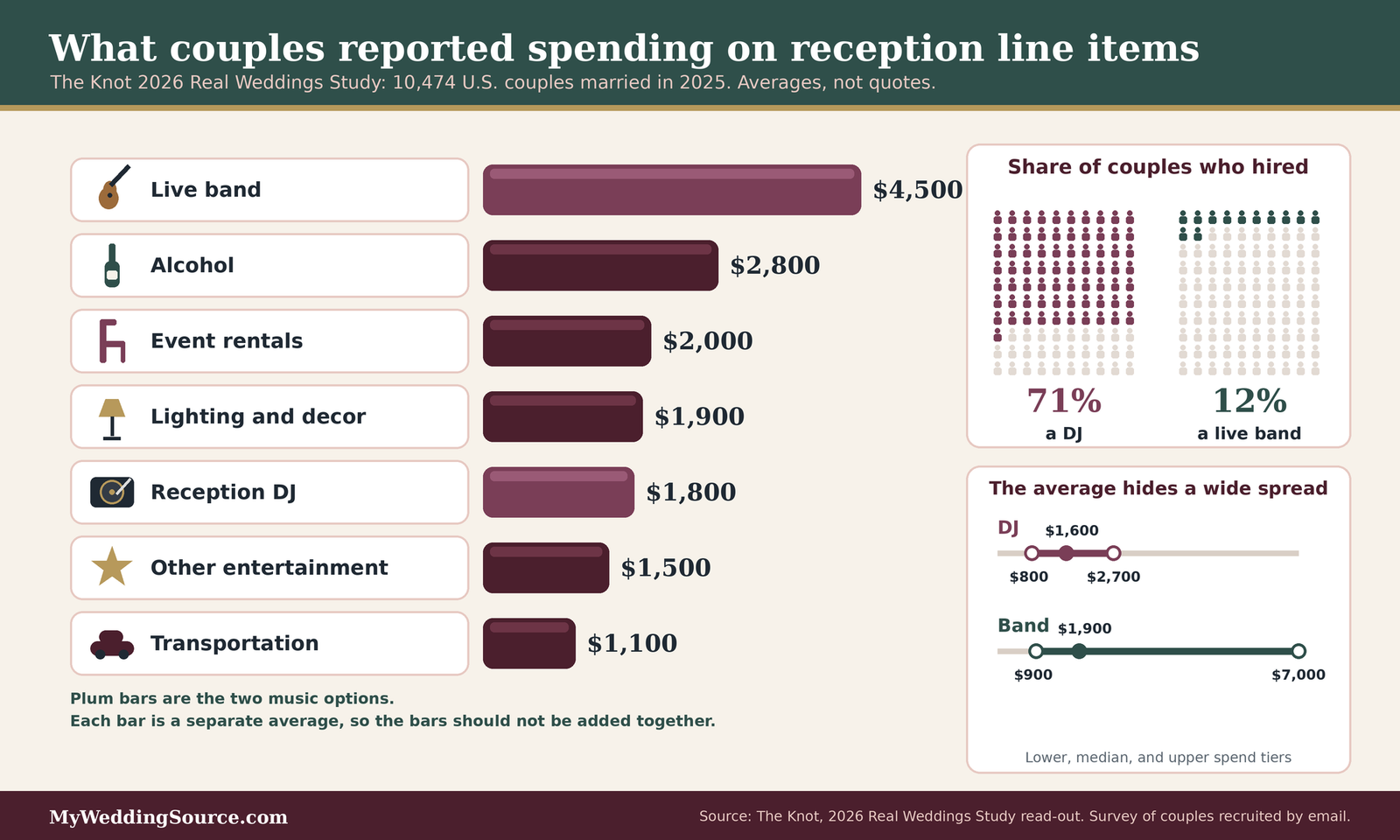
The two music figures need a second look. The Knot’s DJ and band writeup says averages are pulled up by couples in the highest spend tier, and gives quartile figures to show a fuller picture. For bands, the lower, median, and upper figures are $900, $1,900, and $7,000. For DJs, they are $800, $1,600, and $2,700. The median is a better guide to the typical couple than the average, and the spread is a warning that a quote far from the average may be normal for your market.
Region and guest count
The same writeup reports that the Mid-Atlantic is highest for both bands and DJs, at $7,300 and $2,500, and the West is lowest for bands at $3,200. Guest count matters too. For 1 to 50 guests it reports band and DJ averages of $1,600 and $1,200, for 51 to 100 guests $3,000 and $1,600, and for 101 or more guests $5,400 and $1,900. A wedding reception of 117 guests therefore sits in the highest band, and a quote that looks high for a small party may be ordinary for a large one.
What the survey does not tell you
The pages we read do not report how long the average wedding reception lasts, what a photo booth costs, or how much couples spent on a late-night snack. The earlier 2025 study release, covering couples married in 2024, likewise does not report cost for music, DJs, or photo booths. Where a number is missing, we have not filled it in. For the pieces you need priced, such as photo booths, get quotes and use the normalization method above.
Use averages with care, then run your own arithmetic
An average is a way to check whether a quote is wildly out of range, not a way to build a budget. Two habits keep averages from misleading you.
Why you cannot add the averages
It is tempting to add the wedding reception line items to see what an average wedding reception costs. As an illustration, using our own arithmetic: 117 guests at $80 per person is $9,360 for catering. Add the $12,900 venue, $2,800 alcohol, $1,800 DJ, $1,500 entertainment, $2,000 rentals, and $1,900 lighting and decor, and the total is $32,260. That is nearly the entire $34,200 average wedding, before photography, attire, rings, flowers, or a license. The sum cannot be right, and the reason is that category averages describe different groups of couples: not everyone buys every item, and venue pricing may already include some of the others. So treat the figures as a sanity check on one line at a time. Build your own budget from quotes, and use our wedding budget calculator to keep the pieces in one place.
Where an extra hour costs money
Time is where the schedule meets the budget. The Knot’s writeup lists the number of hours booked as a main factor in music pricing, and in our worked quotes above an extra hour of DJ time was $150 and an extra hour of band time was $400, but those figures are invented to show the method, not market rates. The principle holds: ask each vendor what an additional hour costs, and ask the venue what it charges for running past the contracted end. Then compare the cost of one more hour with what that hour buys. An extra half hour of dancing after a late dinner is often worth less than a shorter dinner that starts the dancing earlier.
Extras that change the clock
Photo booths, additional entertainment, late-night food, and send-off effects all add time as well as money. The Knot lists average additional non-musical entertainment at $1,500, and its 2025 study release mentions glambots, laser shows, and video mapping as trends, without cost or adoption figures. Each of these needs its own slot or a standing place in the room. Before you book one, ask where it will be, when it runs, whether it needs power and space that the dance floor also needs, and whether it competes with the first dance or the toasts.
Plan for the guests: access, comfort, and food safety
A schedule that works on paper still fails if guests cannot reach the room, hear the speeches, or eat safely. A few practical checks catch most of these problems, and none of them require expertise.
Access and comfort
A wedding reception brings together people of many ages and abilities, and the venue’s layout decides how easily they move from one block to the next.
Routes, seating, and the walk between spaces
ADA.gov explains that Title III of the Americans with Disabilities Act covers public accommodations, which it describes as private businesses and nonprofits serving the public, with restaurants and hotels among the examples, and that the main requirement is giving people with disabilities a fair chance to use what the business offers. Whether a given venue is covered, and what it must provide, is a legal question we cannot answer for you. The practical questions are simple: Is there a step-free route from parking to the ceremony, the cocktail area, the dining room, the dance floor, and the restrooms? How far is each walk? Where can someone sit down near the bar and the dance floor? Ask the venue to describe the route in writing and walk it yourself if you can.
Older guests, children, and those who tire early
A long evening is tiring for some guests, so think about where they sit and when they might want to leave. Seat older relatives and parents of small children away from the speakers and near an exit if possible, and put their table in the first group served. Tell the caterer about any kids’ meal request. If you hope to include them in a dance or a toast, place that block early, before the evening’s long tail. Decide who will help with rides, so the wedding reception schedule does not rely on a guest to drive home exhausted.
Food, drink, and the clock
Food safety is a time-and-temperature problem, which makes it a scheduling problem too. The rules are simple, and they are the caterer’s job, but it helps to know them so you can ask good questions.
What the FDA says about holding food
The U.S. Food and Drug Administration advises keeping hot food at 140°F or warmer and cold food at 40°F or colder, discarding perishable food left at room temperature for more than 2 hours unless it is being kept hot or cold, and shortening that to 1 hour when the area is above 90°F. It also advises replacing nearly empty dishes with freshly filled ones rather than topping off a full dish, with cold backup dishes kept in the refrigerator and hot backup dishes in an oven at 200°F to 250°F. Those rules are written for buffets, and they apply just as well to a cocktail hour in summer heat or a late-night snack table. A longer cocktail hour is a reason to ask your caterer how appetizers are kept cold or hot, not just how they look.
Bar pacing and the first drink
The bar is both a service and a pacing tool. A line at the bar during cocktail hour is dead time in a different form, and a bar that is crowded after dinner cuts into the dance floor. Ask how many bartenders will be on at each stage, whether a signature drink or a beer-and-wine option speeds service, and whether bar service pauses during toasts. The Knot lists average alcohol spending at $2,800, but whether that is reasonable for your guest list depends on drinking habits and your venue’s rules, which a survey average cannot show. Our advice is to avoid a last-call announcement that lands before the last dance, because guests can read it as a signal to leave.
Late-night food, and when it helps
WeddingWire lists late-night snacks, such as sliders, fries, or pizza, as an optional step if the budget allows. We see it as a pacing tool more than a treat: a snack at the 9:45 mark gives dancers a reason to stay and gives the dance floor a natural refill. If the food will sit out, apply the FDA’s two-hour guidance, and if the room is warm, the one-hour figure. Ask the caterer to bring it out in batches, not all at once.
Size the room and the dance floor for your wedding reception
A wedding reception can have the right schedule and still feel flat if the room works against it. A dance floor that is too large looks empty, one that is too small turns dancers into traffic, and a bar placed next to the speakers makes every conversation louder.
Dance floor arithmetic, with the assumptions stated
We did not find a published standard for dance floor size, so this is our own illustration with assumptions you should replace with your vendor’s numbers. Suppose 117 guests attend and about 40 percent are dancing at the busiest moment, which is 47 people. If each dancer needs about 4 square feet, the floor needs roughly 190 square feet. At 6 square feet each, it needs about 280. A 12-by-12-foot floor is 144 square feet, and a 16-by-16-foot floor is 256. The assumptions that matter most are the share who dance and the space each person takes, and both depend on the crowd and the music. Ask your DJ, band, or rental company what they recommend for your guest count and your music, and ask the venue whether the floor is built in or rented.
Where everything else goes
Every job in the room needs a place. The DJ or band needs power, a view of the floor, and a spot that is not directly in front of a table of grandparents. The cake table needs a clear approach and good light for photographs. The bar needs room for a line that does not block a walkway or the entrance to the restroom. A photo booth needs power and distance from the speakers. Guests at every table should be able to see the people giving toasts. Sketch the room on paper, mark where the line forms for each service, and move anything that collides before the day. A schedule only works if the room can carry it.
Adjust the flow to the kind of reception you are having
Everything above assumes a seated dinner, a dance floor, and an evening of four to six hours. Plenty of wedding receptions look different, and a different shape changes which blocks matter. The principle stays the same: name the jobs, give each an owner and a length, and look for the handoffs.
Smaller, shorter, or less formal receptions
A smaller guest list changes the clock more than most couples expect, because fewer people means shorter lines, quicker service, and a room that fills with sound at lower volume. The Knot defines weddings with under 50 guests as intimate and those over 100 as large, which is a useful way to think about how much formality a room can carry.
An intimate dinner for a small group
When the guest list is under 50, the plated-versus-buffet question matters less, and a shared table or a few long tables can replace the full production of introductions and a stage. Toasts can be spontaneous, since a group that size can hear one another without a microphone. Zola cautions that a wedding reception should not run shorter than about four hours unless there is a second location, and that guidance is aimed at conventional evenings. For a small dinner, we think the useful test is whether the guests have had enough time to eat, talk, and stand up for a dance or two, not whether the clock reached an arbitrary figure.
A cocktail-style reception without a seated meal
If you serve heavy appetizers and stations instead of a plated dinner, the dead-time risks shift. Guests have no assigned moment to sit, so the wedding reception needs other anchors: a toast at a set time, a first dance, a cake, and a visible change in the music. Plan more seating than you expect, because guests who stand for hours will leave early. Ask the caterer how often stations will be replenished, and apply the FDA’s guidance on time and temperature to every station, since food sits out longer when there is no single serving moment.
A daytime or brunch reception
A daytime reception has a different light problem and a different energy curve. There is no sunset to plan around, but a midday sun can be harsh on guests seated outdoors, and the dance floor may need a different kind of invitation. Because the clock starts earlier, the venue’s end time and the guests’ later commitments become the fixed times. We have not found a published timeline built for daytime wedding receptions, so treat our adjustments as suggestions: shorten the dancing block, add a clear send-off cue, and ask the caterer for portions suited to the hour.
Traditions, performances, and the things guests have not seen coming
Many receptions include moments that are not on any generic timeline: a cultural or religious ritual, a family performance, a game, or a surprise. They add meaning, and they also add minutes that nobody has counted.
Rituals and customs
If your wedding includes traditions from your family’s culture or faith, give each a length, an owner, and a place in the schedule, in the same way as the toasts. Ask the person who knows the custom best how long it takes in practice, and whether it needs a particular space, an announcement, or a pause in the music. Tell the DJ and the photographer what to expect, since they will be better able to support something they understand. If you are not sure how long something takes, build in a margin and ask the person leading it to run through it once beforehand.
Games, dances, and surprises
WeddingWire advises scheduling games and cultural traditions while guests are still dancing, and keeping formalities to a minimum once dancing has started to protect momentum. That fits our reading of the other guides. A bouquet toss, a dollar dance, or a group line dance can each be a high point or a speed bump depending on whether they interrupt a full floor or a thin one. The Knot’s sample timeline calls the bouquet and garter toss an optional tradition that is becoming less common, which is a reminder that any moment you do not care about can come out of the wedding reception schedule.
Photo booths and other entertainment
Anything that runs alongside the main schedule, such as a photo booth, a caricature artist, or a lawn game, takes pressure off the dance floor and gives non-dancers something to do. It also needs a place, power, and an attendant. Ask the vendor how many guests it can serve per hour, how it handles a line, and whether it prints or shares photos digitally. Place it where the line will not block a walkway or the bar. Our wedding photographer shot list can help you tell your photographer which moments matter most, and our wedding planning guide shows how to fit these extras into the larger plan.
Stress-test the schedule before the day
A schedule only proves itself under pressure, so test it before the pressure arrives. The aim is not to predict every problem but to know which blocks can absorb a delay, which cannot, and who decides what to cut.
Check transitions, not just blocks
Most schedules list how long each block lasts and say nothing about the minutes between them. Those minutes are where plans slip, because every transition needs people to stop one task and start another.
Transition time is real time
Here is the schedule we have used throughout, with the transitions written in.
| Block | Planned | If dinner starts 20 minutes late |
|---|---|---|
| Ceremony ends; cocktail hour begins | 5:00 | 5:00 |
| Doors open | 6:15 | 6:15 |
| Introductions and couple’s entrance | 6:25 to 6:30 | 6:25 to 6:30 |
| First dance and short welcome | 6:30 to 6:40 | 6:30 to 6:40 |
| Dinner service (including table visits) | 6:40 to 7:40 | 7:00 to 8:00 |
| Toasts | 7:40 to 8:05 | 8:00 to 8:25 |
| Parent dances | 8:05 to 8:15 | 8:25 to 8:35 |
| Dance floor opens | 8:15 | 8:35 |
| Cake cutting | 9:15 | 9:35 |
| Last dance | 10:20 | 10:40 |
| Send-off | 10:30 | 10:50 |
| Venue end (vendors out) | 11:00 | 11:00 |
The planned version leaves 30 minutes between the send-off and the venue’s end time, which is meant to cover a final photograph, goodbyes, and load-out. In the late version only 10 minutes remain, which is below the 10 to 15 minutes of slack we recommend for a hard stop. Nothing in the first half of the table can absorb the delay, because every block that follows dinner depends on it.
Model what happens when one block runs 20 minutes late
Delays move forward, not backward. If dinner begins 20 minutes late, everything after it shifts by 20 minutes unless something is cut. The question is what can be cut without hurting the night. The dance block is the most flexible. Zola says open dancing of under an hour is too short, so you have room to trim a 125-minute dance block by 20 minutes and stay above that line. Toasts can lose a speaker. The cake can move or shrink. The things you cannot move are the sunset, the venue’s end, and the vendors’ paid hours.

Rehearse the wedding reception on paper
Rehearsals are usually imagined as something the wedding party does at the ceremony site. The schedule deserves one too, and it can be done in an hour with no one in costume.
Walk the guest’s path
Take the floor plan and trace a single guest from the car to the last dance. Where do they park, where do they check in, which door leads to cocktail hour, how far is the bathroom, and where does the line form at the bar? Then trace a second guest who uses a wheelchair or a cane, and a third who is carrying a toddler. Count the minutes it takes each of them and compare those numbers with the transition times on your schedule. If the path is longer than the time you have allowed, adjust one or the other. This is the cheapest test in the guide and the one most likely to turn up a surprise, such as a door that is locked during cocktail hour.
Read the run-of-show aloud with the people who will use it
Send the draft to the venue contact, the caterer, the DJ or band, the photographer, and the day-of lead, and ask for a short call in which each person reads their own lines out loud: when I arrive, when I eat, what I need before each cue, and who I look at to start. Ten minutes of reading aloud turns up more conflicts than a week of email, because people notice what they cannot do when they hear it said. Afterward, send a clean copy with the date and a version number, so nobody works from an old draft.
Decide the trigger for plan B
A plan B is only useful if someone knows when it starts. Without a trigger, every delay becomes a debate, and the debate costs more time than the delay.
Write the triggers as numbers
A trigger is a condition that is true or false, not a feeling. “If dinner service has not started by 7:00” is a trigger. “If things seem behind” is not. For each block, write the time by which it must start, and the action to take if it does not. The table below lists the failure points we see most often in published timelines and in the issues described above.
| Trigger | Effect | Owner | Fallback | Message |
|---|---|---|---|---|
| Portraits run past 5:35 | Couple misses cocktail hour; sunset window shrinks | Photographer, day-of lead | Cut one family grouping; take a sunset portrait later | Text the day-of lead; DJ extends cocktail music |
| Doors cannot open at 6:15 | Guests wait in cocktail area; entrance slips | Venue, caterer | Open cocktail area seating; delay entrance in 5-minute steps | Emcee announces a short delay; caterer holds food |
| Dinner not served by 7:00 | Toasts and dancing shift later | Caterer | Serve in smaller waves; cut the welcome and table visits | Caterer tells day-of lead; day-of lead tells emcee |
| Toasts run past 8:15 | Dance floor opens late | Emcee | Trim last speaker; move parent dances after the first dance set | Emcee signals speaker with a card |
| Dance floor empty at 8:30 | Energy drops; photographer has nothing to shoot | DJ or bandleader | Switch to a crowd favorite; shorten or skip planned extras | DJ and couple agree on a hand signal |
| Venue end approaches (10:30 for an 11:00 end) | Send-off squeezed; vendors rush load-out | Day-of lead, venue | Move the last dance up 10 minutes; skip the private dance | Emcee announces last song; vendors told at 10:00 |
| Weather turns for an outdoor block | Guests, equipment, or food exposed | Day-of lead, venue | Move cocktail hour or send-off indoors | Pre-written text or announcement; staff briefed |
| Music or sound fails | Silence during a key moment | DJ or band; venue | Backup speaker or playlist; battery microphone | DJ tells day-of lead; emcee covers with a short announcement |
Name who makes the call
Every trigger needs one person with the authority to act. In a typical wedding that person should not be the couple, who are the center of the event and cannot step out of it, and should not be a parent who is also a guest. A professional planner or venue coordinator can do the job. If you do not have one, assign a trusted friend or relative who is not in the wedding party, give them the run-of-show and a short list of what they can decide, and tell every vendor who that person is. Zola recommends a day-of coordinator to keep timing on track, and we agree that the role matters more than the title.
Write the communication path before it is urgent
When something changes, people need to hear about it in a fixed order. Decide ahead of time who tells whom: the day-of lead to the caterer, the emcee, the DJ, and the photographer, and the emcee to the guests. Put every vendor’s mobile number on a single page, and agree on the channel: a group text works for most teams. Decide what is reported immediately, such as a delay of 10 minutes or more, and what can wait. Tell the wedding party that they should not solve a problem on their own, but pass it to the day-of lead.
FAQ: wedding reception timing and flow questions
Length and pacing
How long should a wedding reception last?
Published guides differ. Zola puts a full wedding reception at about 5 to 7 hours, and WeddingWire says 4 to 7 hours including cocktail hour. Neither cites research. Start from your venue’s contract hours and your guests’ energy, then plan roughly 1.5 to 2.5 hours of open dancing instead of stretching dinner.
How long should cocktail hour be?
Zola says cocktail hour typically runs one to two hours, and suggests 60 to 90 minutes when it happens at the same venue as the ceremony. Shorter squeezes photos, and longer leaves guests restless. Plan around portrait time and travel, and give guests drinks, food, and something to do while they wait.
People and moments
How long should toasts be?
Zola suggests keeping speeches under about five minutes, and WeddingWire says 3 to 6 minutes each. With five speakers, plan 25 to 30 minutes including microphone handoffs. Ask each speaker for a time limit in writing, and have the emcee hold the microphone so the wedding reception schedule does not depend on anyone’s sense of time.
When should the first dance happen?
WeddingWire says it can come right after the entrance or after dinner, while Zola’s and The Knot’s sample timelines put it right after the entrance. Choose based on how comfortable you are being watched before eating. Tell the DJ, the photographer, and the caterer, because each has a task that depends on it.
Music and money
Do most couples hire a DJ or a band?
In The Knot’s 2026 study of 10,474 couples married in 2025, 71 percent hired a DJ and 12 percent a live band, with averages of $1,800 and $4,500. Averages are pulled up by high spenders, so check the median figures too, which were $1,600 and $1,900.
How do I compare music quotes fairly?
Put every quote on the same clock. Decide how many hours of music you need in total, then add overtime, travel fees, equipment, a vendor meal, and any ceremony or cocktail music. Divide by hours for a cost per hour. Get the scope, substitutions, and cancellation terms in writing before you compare.
When the schedule slips
What if the schedule runs late?
Decide in advance which blocks you will cut. Dancing is usually the most flexible, and toasts and cake can shift, but the venue’s end, sunset, and vendor hours cannot. Write each trigger as a time, name one person who decides, and keep 10 to 15 minutes of slack before any hard stop.
Do I need a day-of coordinator?
Zola recommends a day-of coordinator to keep cocktail hour on time. It does not have to be a professional, but someone needs the run-of-show and the authority to act, and it should not be the couple or a parent who is also a guest. Ask your venue what its coordinator covers.
Your next steps
Set the frame this week
Write down the fixed times
List the venue’s setup, music cutoff, and clearance times, sunset for your date and place, and each vendor’s contracted hours. Place them on one page, and mark the minute at which overtime begins. Everything else on the schedule is a flexible block that has to fit between them.
Draft a first run-of-show
Use the example schedule in this guide as a template, replacing each time with your own. Give every block a length, an owner, and a handoff. Share the draft with your venue contact and your caterer first, since they are most likely to spot a conflict. Our wedding planning timeline can help you place this task in the larger calendar.
Lock in the details before you sign
Compare music and venue terms on the same clock
Normalize your music quotes by hours, and ask the venue the questions in the box above. Keep every answer in writing, and update your budget in the wedding budget calculator when a quote changes.
Name the decider and the triggers
Choose your day-of lead, write three or four triggers as clock times, and tell each vendor who the lead is. For the rest of the wedding, our wedding planning checklist and guide to how to plan a wedding cover the tasks that surround the wedding reception.
Sources & methodology
How we built this guide
What we relied on
This guide combines the most recent publicly posted U.S. survey figures from The Knot, planner guidance from Zola, The Knot, and WeddingWire, and government and scientific sources on food holding times, noise exposure, sunset and twilight definitions, and public accommodations. Where a statement comes from a company, we say so, because the sample, the incentives, and the method differ from those of an independent study. Sunset and twilight times, the worked quotes, the buffet line example, and the schedule are our own illustrations or arithmetic. They are estimates, and none of them is a quote or a benchmark.
What we did not do
We did not survey couples, interview planners, or test any vendor, and we did not review any venue contract. We found no published research on how long each wedding reception block should last, so the timing ranges are planners’ habits and not findings. We have not given legal, medical, or financial advice. Contracts, local rules, and venue policies vary, so confirm every term in writing with the vendor or venue involved, and consult a professional for questions about your own contract or health.
Source list
Survey data and planner guidance
- The Knot, Average wedding cost (2026 Real Weddings Study): https://www.theknot.com/content/average-wedding-cost
- The Knot, Average cost of a wedding band and DJ: https://theknot.com/content/average-cost-wedding-band-dj
- The Knot, Average wedding guest list size: https://theknot.com/content/average-wedding-guest-list-size
- The Knot Worldwide, 2025 Real Weddings Study press release: https://www.theknotww.com/press-releases/weddings-shine-bright-in-2025-the-knot-study-reveals-couples-prioritize-celebration-joy-and-connection-amid-socioeconomic-instability
- The Knot, Wedding timeline for a 4 p.m. ceremony: https://www.theknot.com/content/wedding-timeline-4pm-ceremony
- Zola, How long is a wedding reception: https://www.zola.com/expert-advice/how-long-is-a-wedding-reception-an-hourly-breakdown-of-your-wedding-night
- Zola, How long is cocktail hour: https://www.zola.com/expert-advice/how-long-is-cocktail-hour-the-power-of-happy-hour
- Zola, How much time between ceremony and reception: https://www.zola.com/expert-advice/how-much-time-should-you-have-between-a-wedding-ceremony-and-reception
- Zola, Wedding reception timeline: https://zola.com/expert-advice/wedding-reception-timeline
- WeddingWire, Wedding reception order of events: https://www.weddingwire.com/wedding-ideas/wedding-reception-order-of-events
Government and scientific sources
- U.S. Food and Drug Administration, Serving safe buffets: https://www.fda.gov/food/buy-store-serve-safe-food/serving-safe-buffets
- CDC NIOSH, Understanding noise exposure limits: https://cdc.gov/niosh/bulletin/2016/noise.html
- National Weather Service, Twilight types: https://www.weather.gov/lmk/twilight-types
- U.S. Naval Observatory, Rise, set, and twilight definitions: https://aa.usno.navy.mil/faq/RST_defs
- ADA.gov, Introduction to the ADA: https://www.ada.gov/topics/intro-to-ada/