
A wedding last dance looks spontaneous to guests and is rarely left to chance by the people running the night, because the wedding last dance, the send-off, the ride home, the noise cutoff, and the photographer’s last hour all depend on one another, and the easiest way to protect them is to plan backward from the one time you cannot move.
Quick answer
Find your hard stop first: the time music must end under your venue contract or local rules, and the time vendors must be out. Then work backward. Plan the wedding last dance as a short, announced moment, give the exit its own few minutes after it, and keep about 10 to 15 minutes of slack before the hard stop. Ask three questions early: Is the send-off you want allowed here (sparklers often are not)? How will each guest get home? Will the photographer still be there? Zola says many venues have a 10 p.m. curfew and some are earlier, and WeddingWire says photographer contracts often end about an hour into dancing, so those two answers frequently decide the whole ending. This guide is general planning information, not legal advice. Your venue contract and your local rules control.
Why the wedding last dance needs a clock instead of a feeling
Most couples picture the wedding last dance as a feeling: the room is full, the song is right, and everyone sings along. Those nights happen, and they are almost always the product of a few dull decisions made weeks earlier. This section covers the dates and limits that frame the ending, because every other choice in the guide fits inside them. If you are still building the evening around it, our wedding reception guide covers the blocks that come before the wedding last dance.
Find the dates and times you do not control for the wedding last dance
Some limits are written down and some are merely assumed. The goal is to turn every assumption into a line in a document, because an assumed limit tends to be discovered at the worst possible moment, such as when a venue manager starts turning on the house lights while the wedding last dance is still playing.
Venue end time, music cutoff, and load-out
Venues usually have two or three different clocks, and couples often hear only one of them. The first is when the event ends. The second is when amplified music has to stop, which can be earlier than the event end. The third is when vendors must be packed and out, which determines when your DJ, planner, and florist need to start breaking down. Zola says many venues have a 10 p.m. curfew and some are earlier, and that you may be able to buy an extra hour on the day only if the venue has no hard curfew and the option was agreed in advance. Read your contract for all three clocks, and write them at the top of your run-of-show. If the contract does not state a music cutoff, ask the venue to confirm it in an email so there is a record.
Sunset, light, and the photographer’s contract
Two more limits are less obvious. The first is light. The U.S. Naval Observatory defines sunset as the moment the upper edge of the sun meets the horizon, and civil twilight as the period when the sun’s center is up to 6 degrees below the horizon, after which outdoor activities usually need artificial light. For an evening exit this matters because a sparkler or lantern effect only reads well on camera after the sky has darkened, and The Knot says sparkler and bubble exits are best done at night so photos capture the glow. The second limit is the photographer’s contract. WeddingWire says photographers’ contracts often end about an hour into dancing, and that extending coverage to the end of the night costs extra, so a couple may end up choosing between getting-ready coverage and the exit. We cover that choice in its own section below. For both limits, look up your local sunset for your date and compare it with your planned exit time.
Work backward from the final minute of the wedding last dance
Planning the wedding last dance backward feels odd at first, because most of us plan forward from the ceremony. It is the right direction here because the ending has a fixed end and a flexible beginning. You cannot add time after the venue’s cutoff, but you can shorten dinner toasts, trim open dancing, or begin the wedding last dance a little earlier.
Separate the decision from the production
In planning the wedding last dance, a decision is something only you can make: which song, whether you want a grand exit, who goes first through the line. Production is the physical work of making it happen: buying sparklers, briefing a DJ, arranging a car, asking a venue for permission. Decisions can take as long as they need, but production has lead times that other people control. A good rule is to settle the decisions at least a month before the wedding and then give production the time it needs. That month is our editorial suggestion, not a published standard, and it is there so that you are not choosing a song and also chasing a shuttle quote in the same week.
Add slack for revisions and human delay
Every handoff around the wedding last dance is a place where someone can be a few minutes late. The DJ may be mid-song when the planner signals. The line of guests may form more slowly than expected after a long night of dancing. WeddingWire notes that guests who have been drinking can be hard to direct, so a simple setup is better. We suggest holding 10 to 15 minutes of slack between the planned exit and the hard stop, and counting that slack as untouchable. It is our editorial rule of thumb, chosen because it is long enough to absorb one slow handoff without making the evening feel padded.
A worked scenario: building the ending from a 10 p.m. stop
The assumptions behind the example
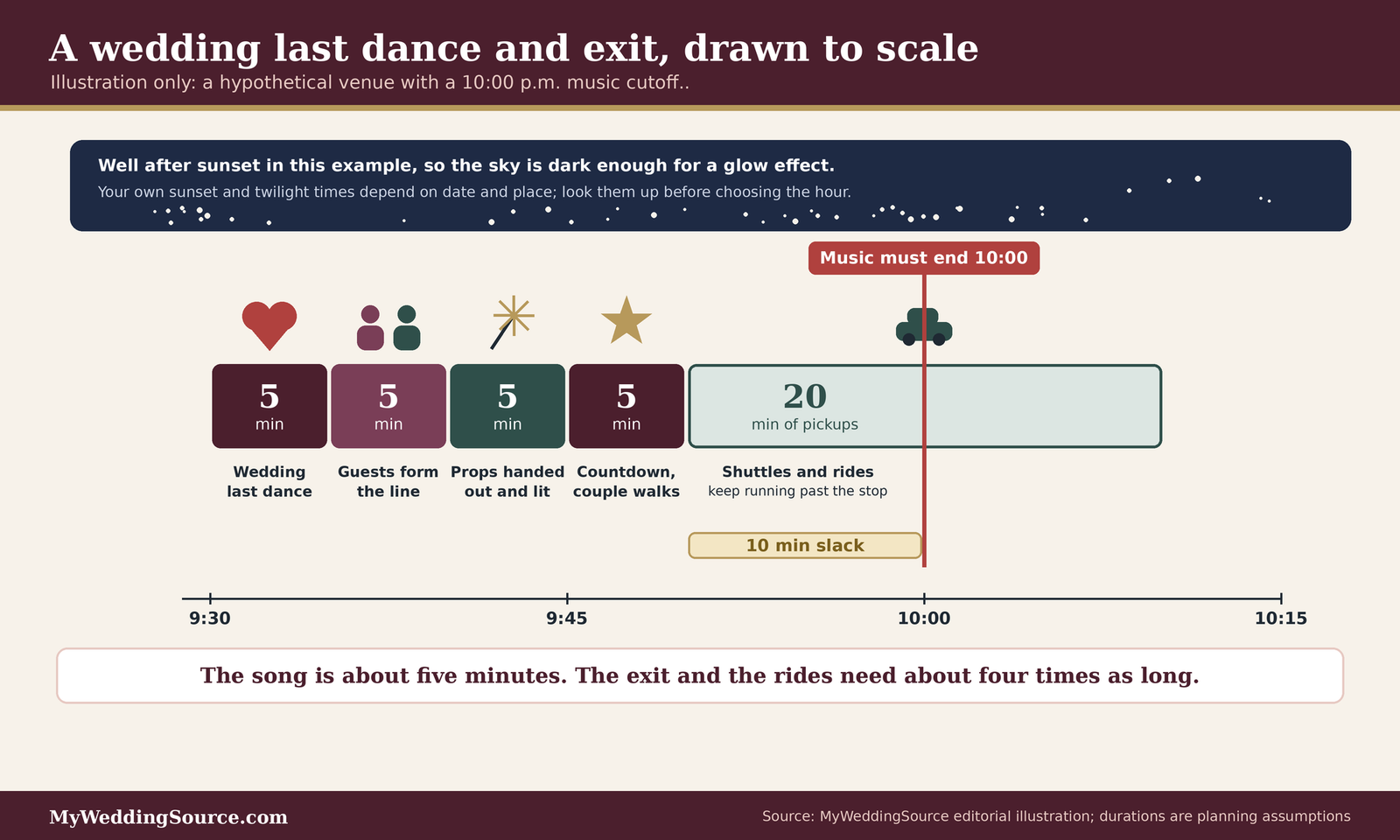
The table below is an illustration, not a template to copy. It assumes a hypothetical venue where music must end at 10:00 p.m. and vendors must be out by 11:00 p.m., a hypothetical guest count of about 120, and a send-off at the front door. The durations are our own planning assumptions and will differ for your venue and guest list.
How to read the timeline
| Time (illustrative) | Step | Owner | Depends on | Buffer |
|---|---|---|---|---|
| 9:20 p.m. | DJ announces the final few songs | DJ | Emcee confirms with planner | None |
| 9:30 p.m. | Wedding last dance begins | DJ | Photographer and videographer in position | 5 min |
| 9:35 p.m. | Guests directed to the exit line | Planner or wedding party | Sparklers or props staged and counted | 5 min |
| 9:40 p.m. | Props handed out, lighting begins | Vendors or trained helpers | Venue approval, water bucket in place | 5 min |
| 9:45 p.m. | Countdown and couple walks through | Emcee and photographer | Line formed, couple at the door | 5 min |
| 9:50 p.m. | Couple leaves in the car | Driver | Luggage already loaded, route confirmed | 10 min to hard stop |
| 9:50 to 10:10 p.m. | Guest pickups and shuttle loops | Planner or venue contact | Rides booked and shared | Overlaps hard stop |
| 10:00 p.m. | Music must end | Venue and DJ | None | Hard stop |
Look at what the table makes visible about a wedding last dance. The wedding last dance is only about five minutes of the plan. The exit takes about twenty, and the rides run past the music cutoff. That is the point of writing it out: couples who budget time only for the song are surprised when the rest of the ending needs four times as long.
Choosing the wedding last dance itself: song, staging, and crowd
Before the logistics comes the creative decision about the wedding last dance. The wedding last dance matters because people remember endings. It is also the cheapest part of the whole plan to get right, since it costs nothing beyond a conversation with your DJ or bandleader.
Pick the moment and the song
The Knot describes the wedding last dance as the chance to bring everyone together one more time, and says it can be a romantic ballad or an upbeat party song. That is a useful starting point, because it frames the choice as one about the room and not only about the couple.
Three ways to stage a wedding last dance
There are three common arrangements for a wedding last dance, and each suits a different crowd. In the first, the couple dances alone while guests watch from the edge of the floor. It is intimate and photographs well, and it works if you are comfortable being watched and the room is not too tired. In the second, the couple calls everyone onto the floor for a final song together, which keeps energy up and puts the whole room in the memory. In the third, guests form a circle or a tunnel around the couple, which pairs naturally with a send-off that follows. Our editorial view is that the second and third are safer when you are unsure, because they spread attention across the room. Whichever you choose, tell the DJ the staging in advance so the announcement and the lighting match it.
The song, the edit, and the DJ cue
The Knot suggests choosing something tied to your story or a song with a sing-along hook, and says your DJ may have good exit songs to recommend. Practical details are easier to settle in advance than at 9:30 p.m. Confirm the exact version of the track that will play, because a radio edit, an album version, and a live recording can differ in length and in how they end. Confirm how the DJ will cue it: a spoken announcement, a lights change, or both. And ask whether the song should fade out or end on its natural last note, since the transition into the send-off feels different in each case. Most of these questions take a minute to ask and a minute to answer, and they remove the guesswork from a moment that happens in front of everyone you know.
Fit the wedding last dance to the crowd you actually have
A wedding last dance that works for a room of college friends can fall flat in a room of mixed ages, and the reverse is also true. A short check of who will still be there helps.
Older guests, children, and early leavers
Not everyone stays until the end. If grandparents, young children, or guests with early travel plans are leaving before the wedding last dance, consider a short private farewell earlier, so they are not left out. This is where the staging matters, too. A final dance that asks everyone to move may exclude guests who cannot, so consider a version that works from a seat, such as a toast or a group wave. Our wedding etiquette guide covers the courtesies around thanking guests before they go.
When guests have been drinking
By the end of the night, some guests will have had several drinks. That does not change how you plan the wedding last dance itself, but it changes the exit that follows it. Simple instructions, fewer moving parts, and trained helpers are all more reliable than a plan that depends on every guest following a complex cue. If you are deciding how much alcohol to serve in the final hour, our open bar wedding guide walks through the choices, and the transportation section below covers getting guests home.
The send-off: whether to do one, what is allowed, and how to make it safe
A send-off is the part of the wedding last dance and exit that most often meets a rule. Venues restrict it, fire codes limit it, and photographers need warning about it. It is also optional. The Knot’s 2025 Real Weddings Study, which surveyed nearly 17,000 couples married in 2024, found that 43 percent of Gen Z respondents and 26 percent of Millennials had a grand reception exit, so plenty of couples skip it, and plenty do it.
Decide whether a grand exit should follow your wedding last dance
A send-off after the wedding last dance is worth it when it gives guests a clear, joyful ending and gives you a moment to leave on your terms. It is not worth it when it adds stress, cost, or risk that outweighs those benefits.
A real exit, a staged exit, or neither
A real exit after the wedding last dance means you are actually leaving. WeddingWire’s advice is blunt on this point: do not stage a grand exit unless you are genuinely leaving, because walking outside and then returning for an after-party feels anticlimactic. If you are leaving, pack what you are taking and have it in the car beforehand. A staged exit is the alternative. Zola suggests photographing a fake send-off earlier in the evening with the photographer, while most guests are still present. That trades the emotion of a real goodbye for better odds of good pictures and a bigger crowd. The third option is no exit at all. If you plan to head to an after-party, Zola says a quiet “Irish goodbye” can be fine. Our view is that the real exit is the best fit when you are leaving the venue for good, the staged exit suits couples with a tight photography budget or an unpredictable crowd, and no exit suits couples who would rather spend that time dancing.
What a send-off costs besides money
Money is the obvious cost, but not the only one. WeddingWire warns that extra props, extra planner and photographer time, and cleanup can cost more than expected. There is also a cost in time. A send-off adds roughly fifteen to twenty minutes to the ending in the scenario above, which is time taken from the dance floor, from the photographer’s contract, and from your buffer. Finally, there is a cost in risk, which we cover below. Write down the three costs next to each other before you commit, and ask whether the moment is worth all three for your wedding in particular.
Clear it with the venue before you buy anything
The single most common mistake after choosing a wedding last dance is buying props before asking permission. The Knot’s top expert tip for send-offs is to clear every idea with the venue first, and Zola lists sparklers among the items venues commonly restrict.
What to ask the venue
Ask whether sparklers, smoke, bubbles, lanterns, confetti, and fireworks are allowed on the property, and in which areas. Ask whether the venue requires its own staff, a fire marshal, or a certificate of insurance for any of them. The Knot also advises confirming that sparklers are permitted and meet local fire ordinance requirements. Ask who is responsible for cleanup and whether there is a fee. Get the answers in writing, because a verbal yes from one manager does not always survive a change of staff. If the venue says no to your first choice, ask what it does allow, since many venues have a standard alternative.
When the city or county also has a say
A venue’s yes does not necessarily end the question. Fire and open-burning rules are set at the city or county level, and a venue may be unaware of a temporary restriction, such as a burn ban during a dry season. We cannot summarize rules for your location, and they change, so ask the local fire department or code office how to check. Treat this as general education, not legal advice. If your local rules are unclear, choose an alternative that does not involve flame, because the cost of switching early is small and the cost of switching on the night is high.
Sparklers, safety, and flame-free alternatives
Sparklers are the classic send-off and also the option with the most real risk, so they deserve a clear-eyed look.
What federal safety guidance says
The U.S. Consumer Product Safety Commission says sparklers burn at about 2,000 degrees Fahrenheit, hot enough to melt some metals, and reports an estimated 1,300 emergency-room-treated injuries involving sparklers in its 2025 fireworks data. It also advises that young children should never play with or ignite fireworks, including sparklers, and recommends keeping a bucket of water or a garden hose nearby and avoiding fireworks while impaired by alcohol or drugs. Those statements are about fireworks in general, and a wedding is a different setting, but the logic carries over. A wedding exit combines open flame, close crowds, formal clothing, and guests who have been drinking. That is a reason to treat the plan with care, not to panic.
How to run one if the venue approves
If your venue and your local rules allow sparklers, WeddingWire’s advice is practical. Buy long sparklers, because short ones burn out too quickly. Provide about one lighter per 10 guests, so the first sparklers do not go out before the last are lit. Keep a bucket of water nearby. Have vendors, not guests, handle the lighting, since guests may be tipsy by then. Use at least two people handing out sparklers at the door and one at the far end organizing the line, then count down so everything is lit at once. And have the couple walk slowly rather than run, which gives the photographer time to capture the shots. As a quick estimate using that one-per-10 rule, a guest list of 120 means about 12 lighters and a guest list of 60 means about 6. That is our arithmetic, not a published figure, and you may want spares.

Flame-free options that still photograph well
If the venue says no, or if you would simply rather avoid flame, there are alternatives. The Knot suggests glow sticks as a substitute if sparklers are not permitted, and also mentions cold sparkler machines as a safer alternative, especially if guests may have been drinking. Zola describes LED or fiber-optic wands, lanterns lit with battery tea lights, and colored bubbles as other options, and calls glow sticks a safer choice than pyrotechnics when children or flammable materials are nearby. WeddingWire adds that glow sticks or ribbon wands can be gathered afterward, which helps with venues that care about the environment. None of these produces exactly the look of a sparkler tunnel. They produce a different look with less to go wrong, and for many weddings that is a fair trade.
Getting everyone home: the couple’s ride and the guests’ rides
Transportation is the least glamorous part of the wedding last dance and exit and the part most likely to affect safety. It is also the part with the longest lead time, because shuttles, drivers, and cars have to be booked.
The couple’s departure
If you are doing a real exit, the car is part of the picture and part of the schedule.
The getaway car and the practical details
A car waiting at the door gives the send-off a destination. It is also a logistics item that needs a driver, an arrival time, a route, and a place to wait that does not block the exit line. The Knot mentions a getaway car driving through a colorful smoke haze as one send-off idea, which is a reminder to check that nothing in the effect interferes with the driver’s visibility. Confirm the arrival time with the driver for about 15 minutes before your planned exit, not at the exit time, so a late arrival does not strand you in front of the line. If a friend is driving, ask them to stay sober for the evening and confirm that in advance.
Luggage, gifts, and the dress
The unromantic details matter. Pack what you are taking and have it in the car before the exit, as WeddingWire advises. That includes a change of clothes if you are heading to an after-party, any gifts or cards you are carrying, and the dress, if someone else is taking it home. Assign one person, not the couple, to collect anything left behind at the venue. This is also a good moment to confirm who will return rented items and who has the key to your accommodations.
Getting guests home safely
Guests are the larger group and the harder problem. The simplest rule is that every guest who has been drinking should have a plan for getting home that does not involve driving themselves.
What the federal data says about the drive home
The National Highway Traffic Safety Administration reports that in its 2007 roadside survey, about 70 percent of drivers with a blood alcohol concentration of .08 or higher were driving home, and about half had come from a bar, restaurant, or friend’s house. NHTSA says that having alternative transportation is important to reduce the need for intoxicated people to drive after drinking, and lists rideshare, nonprofit safe ride programs, and public transit as the main options. A 2017 NHTSA-cited survey found that 19 percent of respondents had used rideshare after drinking, with use higher in urban areas than in suburban or rural ones. That last point matters for wedding venues, which are often outside cities. A rideshare plan that works in a downtown hotel may not work at a barn thirty minutes from the nearest town. This is general information, not a legal determination about anyone’s responsibility.
Shuttles, rideshare, and a shared plan
Your options range from a contracted shuttle, to a block of hotel rooms within walking distance, to a rideshare plan with a clear pickup spot. Each has trade-offs. A shuttle gives you control and a schedule, but it costs money and has to be booked early. A hotel block is simple if the hotel is close, but it asks guests to book rooms. Rideshare is flexible but depends on drivers being available, particularly at a remote venue. Whichever you choose, put the plan in front of guests before the wedding, on your website and in the final reminder, and again at the end of the night with a clear announcement. NHTSA’s review found that the most successful programs are widely publicized and low cost or free, and that lesson applies on a small scale. If you are booking a shuttle, ask about the number of loops it will make, how long each loop takes, and what happens if it is late, and see our wedding venue questions guide for what else to ask the venue about parking and access. If you are weighing coverage for unexpected cancellations or incidents, our wedding insurance guide explains what a policy may and may not cover, and the policy wording is what counts.
What the ending can add to your bill
We could not find a reliable U.S. survey figure for what a send-off costs, so we will not invent one. Instead, here is how to price it yourself, using quotes from your own vendors.
- Photographer or videographer time: WeddingWire says extending coverage to the end of the night costs extra. Ask for the hourly overtime rate and multiply by the hours between the end of your contract and the exit.
- Props: Sparklers, wands, bubbles, or glow sticks scale with guest count. Multiply the per-unit price by your guest count plus a margin for lost or failed items.
- Helpers: If a vendor or planner is handling the lighting and the line, ask whether that is included or billed separately.
- Shuttle or car: Ask for the hourly rate and the minimum booking, since a short shuttle run often has a minimum charge.
- Venue fees: Ask about cleanup, fire-safety staff, and any overtime if the exit pushes past the end time.
Add the lines together and compare them with the value you place on the moment. If the total surprises you, drop to a simpler option rather than cutting safety items such as the water bucket or the trained lighter.
Noise rules and the wedding last dance
Noise is the limit couples understand least when planning a wedding last dance, because it comes from two different places. One is your contract with the venue. The other is the law where the venue sits. They are not always the same, and the stricter one wins.
Who sets the rules
It helps to know where noise rules come from, so you know whom to ask.
Federal, state, and local roles
The U.S. Environmental Protection Agency says that noise was concluded in 1981 to be best handled at the state and local level, and that primary responsibility moved to state and local governments after its noise office closed. In practice, that means there is no single national rule for how late amplified music can play at a wedding. The limits you face come from your city, county, or state, and from your venue. We cannot summarize them for your location, and we are not giving legal advice. If a rule matters to your plan, ask the venue and your local code or police non-emergency office how it is written and how it is enforced.
Venue contract versus local ordinance
A venue contract may set a music cutoff that is earlier than the local rule, and the venue may enforce it with fees or a shutdown. A local rule may be stricter than the contract in some places, particularly for outdoor amplified sound. The safest planning assumption is that you must satisfy both, and that the earlier of the two times is your real music cutoff. Put that time in your run-of-show. Ask whether the cutoff applies to live music, to DJ equipment, and to speakers used for a send-off, since an outdoor speaker for the exit may be treated differently than the main sound system.
Design the wedding last dance around a cutoff
Once you know the cutoff, you can build the wedding last dance and the send-off to fit inside it without feeling rushed.
Indoor, outdoor, and acoustic endings
An indoor reception usually has more control over sound leaving the building, while an outdoor one is more exposed to neighbors and to local rules. If you must end amplified music early, one option is an acoustic ending: a final song sung by the room with no amplification, or a live musician playing quietly. Another is to move the amplified portion earlier and let the last stretch be a quieter send-off. Neither is a loss. Many guests remember a calm, communal ending more than a loud one, and our editorial view is that a gentle close tends to suit a late hour. Ask your DJ or band whether they have a quiet mode for the wedding last dance.
What the cutoff changes in the schedule
Work backward again for the wedding last dance, as in the earlier table. If music must end at 10:00 p.m., decide whether the wedding last dance should end at 9:35, so the send-off and rides fit before the hard stop, or whether the wedding last dance should be the final amplified moment and the send-off should be quiet. Both are fine, but they lead to different plans. For the months before the wedding last dance, our plan wedding timeline guide helps you place milestones in the months before the wedding, and the table above handles the final evening.
Questions to ask your venue and vendors about the ending
- What time must amplified music end, and is that time in my contract?
- When must the event end, and when must vendors be out?
- Are sparklers, smoke, bubbles, lanterns, or confetti allowed, and where?
- Does the local fire department or code office need to approve anything?
- Who handles cleanup after the send-off, and is there a fee?
- Is there a place for a shuttle or rideshare pickup that does not block the exit?
- Can the DJ play a quiet or acoustic last song if the cutoff moves earlier?
- Does the photographer’s contract cover the exit, and what does overtime cost?
- Who is the single person who can say yes or no on the night?
Photo and video logistics for the wedding last dance and exit
The wedding last dance is a short moment that photographs well when everyone is prepared and badly when the photographer learns of it ten minutes before. It is also the moment most likely to fall outside a standard contract.
Contract hours and coverage for the wedding last dance
The most common surprise is that the photographer has already gone home.
Will the photographer still be there for the wedding last dance?
WeddingWire says photographers’ contracts often end about an hour into dancing. If your dancing begins at 8:00 p.m., that could mean coverage ends around 9:00, which is ahead of the 9:30 final dance in our scenario. That is an illustration of the arithmetic, not a statement about your contract. Check your own contract for the end time, and compare it with the wedding last dance and the exit. Our wedding photography guide explains how coverage packages are usually structured.
Paying for extra time versus rearranging the day
If coverage ends too early, there are three options. You can pay for overtime, which WeddingWire says costs extra. You can move the staged part earlier, as Zola suggests with a photographed fake send-off while most guests are still present. Or you can shift the coverage, giving up an hour of getting-ready photos to cover the exit instead, which WeddingWire describes as a trade-off some couples make. There is no correct answer, only a choice between photographs of the morning and photographs of the ending, and which you value more is personal.
Lighting and positioning
Even with the right hours, a wedding last dance needs light and a clear view.
Light, sunset, and the glow effect
As noted earlier, sparkler and bubble effects read best at night, according to The Knot. The U.S. Naval Observatory’s twilight definitions are a reminder that dusk lasts a while after sunset, and a sky that is still bright will wash out sparklers. In a summer wedding with a late sunset, the exit may need to happen later than you expect, and in a winter wedding it may happen earlier. Check your date’s sunset and talk to the photographer about when it will be dark enough. If you choose a staged exit earlier in the evening, plan for artificial light or choose an effect that does not depend on darkness.
Briefing the photographer and videographer
WeddingWire advises telling the photographer and videographer what will happen, where, and when, so they can scout the area and plan shots, and The Knot advises warning the photographer in advance about special effects. Give them a one-page briefing with the location of the exit line, the direction the couple will walk, the time, the cue for the countdown, and any safety constraints. Ask them to scout the exit area earlier in the day, when there is still light. WeddingWire also suggests that couples walk slowly rather than run. Share the same page with the DJ and the planner, which brings us to coordination. For the shots you want during the rest of the night, our wedding photographer shot list is a useful starting point.
Fitting the pieces together without collisions
By now there are many moving parts: a DJ, a photographer, a venue, helpers, rides, and guests. The risk is not any single piece but the collisions among them.
Who needs to know what about the wedding last dance
Most problems with a wedding last dance are communication problems.
One shared run-of-show
Put the whole wedding last dance and exit on one page, with times, owners, and dependencies, and send the same version to everyone who touches it. The table earlier in this guide is a model. A shared document prevents the common problem of the DJ working from one time, the photographer from another, and the shuttle from a third. When a time changes, update the document and send it again, rather than patching the change by text message.
A change-notification rule
Decide in advance how changes are communicated. For example, name one person, usually the planner or a trusted friend, who is the only one allowed to change times on the night. Any change goes through that person, who notifies the DJ, the photographer, the venue contact, and the driver. This feels formal for a wedding, but it prevents the situation where three people each move the exit by a few minutes in different directions. WeddingWire’s advice to have a planner or DJ announce the plan and explain where to go points the same way: one voice, one cue.
Know what must happen first
Some steps cannot start until others finish, and a few cannot be rushed at all.
Map approvals, counts, and permits
Make a short list of the things that require someone else’s approval or a count: venue permission for the send-off, the fire department’s approval if required, the guest count for props, the number of shuttle seats, and the photographer’s overtime agreement. Mark each with the date by which you need the answer. If any one is missing a week before the wedding, treat it as a risk and switch to the simpler option rather than hoping it resolves.
Protect the steps that cannot be rushed
Three things are hard to compress on the day: lighting a large group of props at once, getting a crowd to form a line, and loading a shuttle. WeddingWire suggests at least two people at the door and one at the far end organizing the line, and a countdown so everything is lit at once. Give those steps their full time in the schedule. If you must trim, trim the open dancing before the exit, as the next section explains.
Stress-testing the plan before the day
A wedding last dance plan that looks fine on paper may fail at the first delay. A quick stress test shows which parts are sturdy.
Test the transitions around the wedding last dance, not only the blocks
Event time is easy to plan. Transition time is where plans break.
Check the handoffs
Walk through the wedding last dance and exit and ask, for each handoff, who signals whom, and how. The DJ ends the song, and the emcee announces the exit. The emcee finishes, and the planner starts the line. The line forms, and the vendors start lighting. The countdown ends, and the couple walks. Each of those is a place where someone is waiting for someone else, and each should have an owner. Our wedding planning checklist is a good companion for tracking the surrounding tasks.
What happens when one block runs 20 minutes late
Suppose the toasts run 20 minutes over. If the wedding last dance and exit are pinned to the same clock times, the 20 minutes has to come from somewhere. Zola says dancing should run about 1.5 to 2.5 hours, so as an illustration, losing 20 minutes from a 90-minute dance block is about 22 percent of it, and from a 150-minute block about 13 percent. That arithmetic is ours. The lesson is that open dancing is the flexible block, and the exit and the rides are not, since the venue and the vendors are bound by the hard stop. Decide ahead of time that the lost 20 minutes will come out of open dancing, so no one has to improvise at 9:15.

Define the trigger for plan B
A plan B only helps if everyone knows when it starts.
Name who makes the call
Choose one person to decide when to switch plans: the planner if you have one, or a trusted friend if you do not. The couple should not be the decision-makers on the night. Their job is to enjoy it. Tell the DJ, the photographer, and the venue contact who that person is, so questions go to one place.
Write the communication path before it is urgent
Write down how the decision travels. For example, the planner tells the DJ, who announces it, while a helper tells the photographer and the driver. If it rains, the exit moves inside or the effect changes. If a shuttle is late, the planner tells guests to wait in a specific spot. If the venue shortens the cutoff, the DJ moves the wedding last dance up. The table below lists some failure points, who owns each, and a fallback. It is illustrative, so adapt it to your own wedding.
| Trigger | Impact | Owner | Fallback | Communication |
|---|---|---|---|---|
| Venue says no to sparklers | No flame effect | Couple, then planner | Glow sticks, wands, or bubbles | Update the shared run-of-show and notify the photographer |
| Rain or wind at the exit | Exit cannot happen outside | Planner | Move the line inside or under cover; skip flame | Planner tells the DJ, who announces |
| Toasts run 20 minutes late | Less time before the hard stop | Planner | Trim open dancing; keep the exit time | Planner notifies the DJ and the photographer |
| Photographer’s coverage ends early | Exit not photographed | Couple | Overtime, or a staged exit earlier | Confirm in writing before the wedding |
| Shuttle or rideshare late | Guests wait at the door | Planner | Hotel lobby or covered waiting spot | Announcement and helper at the pickup spot |
| Venue shortens music cutoff | Last dance moves earlier | Venue contact and DJ | Acoustic or quiet final song | DJ announces the new order |
| Guests slow to form the line | Exit delayed | Wedding party and planner | Shorten the line; skip the countdown | Emcee gives a clear, repeated instruction |
FAQ: wedding last dance questions
Timing and staging
When should the wedding last dance happen?
There is no standard time. Zola says many venues have a 10 p.m. curfew and some are earlier, so start from your music cutoff and work backward. Place the wedding last dance late enough to be the finale, with a few minutes of slack after the exit before the venue’s hard stop.
How long should the wedding last dance and exit take together?
It depends on the setup. In our illustrative scenario the song takes about five minutes, the exit about fifteen to twenty, and rides continue past the music cutoff. Those are our planning assumptions, not published figures. Ask your DJ and planner for their own estimates and add 10 to 15 minutes of slack.
Do we have to do a grand exit?
No. The Knot’s 2025 Real Weddings Study found 43 percent of Gen Z and 26 percent of Millennials respondents had one, so many couples skip it. WeddingWire says to stage an exit only if you are truly leaving, and Zola says a quiet goodbye can be fine before an after-party.
Rules and safety
Are sparklers allowed at my venue?
Often they are not. Zola lists sparklers among items venues commonly restrict, and The Knot advises confirming they are permitted and meet local fire ordinance requirements. Ask the venue in writing, then check with the local fire department if the answer is unclear. If the answer is no, glow sticks or wands are common substitutes.
How dangerous are sparklers?
The Consumer Product Safety Commission says sparklers burn at about 2,000 degrees Fahrenheit and reports an estimated 1,300 emergency-room-treated injuries in its 2025 fireworks data. It advises keeping water nearby and not using fireworks while impaired. At a wedding, have trained helpers light them, and consider a flame-free option if children are present.
Is there a legal noise limit for wedding music?
There is no single national rule. The Environmental Protection Agency says noise is mostly handled by state and local governments, so limits come from your city, county, or state, and from your venue contract. Ask both which time applies, and plan around the earlier one. This is general information, not legal advice.
People and photos
How do guests get home safely?
Plan rides before the wedding. NHTSA lists rideshare, nonprofit safe ride programs, and public transit as alternatives to driving after drinking, and notes rideshare use is higher in urban areas. At a remote venue, consider a shuttle or a nearby hotel block, and share the plan with guests in advance and again at the end.
Will my photographer capture the exit?
Check your contract. WeddingWire says photographers’ contracts often end about an hour into dancing, and that coverage to the end of the night costs extra. Ask for the overtime rate, or move a staged exit earlier. Tell the photographer the time, place, and cue in advance so they can scout and prepare.
Your next steps
Lock the limits
Get the three clocks in writing before the wedding last dance
For your wedding last dance, ask the venue to confirm, in email, when the event ends, when amplified music must stop, and when vendors must be out. Put those three times at the top of your run-of-show, and build the rest of the ending backward from the earliest.
Ask about the send-off before you buy
Ask what the venue allows and what local fire rules require. Choose the effect only after you have the answer, and have a flame-free option ready. Our wedding reception guide shows how the earlier blocks fit around these limits.
Brief the people
Send one page to everyone
Write a one-page wedding last dance plan with times, owners, the exit line, and the plan B trigger. Send the same version to the DJ, photographer, planner, driver, and venue contact, and name who changes it on the night.
Settle rides and coverage
Book the shuttle or confirm the rideshare plan, tell guests, and confirm the photographer’s end time against your exit. For the wider schedule, see our wedding planning checklist and wedding photographer shot list.
Next step if you are comparing options: Wedding Reception Playlist: A Practical Guide for U.S. Couples.
Sources & methodology
How we built this guide
What we relied on
This guide combines federal safety and transportation guidance on sparklers and alternative transportation, the EPA’s description of who regulates noise, the U.S. Naval Observatory’s definitions of sunset and twilight, and published planning advice from The Knot, Zola, and WeddingWire. Where a statement comes from a wedding publisher, we say so, because that advice reflects editorial judgment and not research. The wedding last dance sample timeline, the lighter counts, and the percentages for a late block are our own arithmetic or illustrations, built on assumptions we state, and they are estimates.
What we did not do
We did not survey venues or couples, test sparklers, or look up noise or fire rules for any specific location, and we found no reliable national figure for what a send-off costs. This is general planning information and not legal advice. Your venue contract and your local rules control, and they change, so confirm them directly.
Source list
Government and public-agency sources
- U.S. Consumer Product Safety Commission, Fireworks safety education center: https://cpsc.gov/Safety-Education/Safety-Education-Centers/Fireworks
- National Highway Traffic Safety Administration, Countermeasures That Work, Alternative transportation: https://www.nhtsa.gov/book/countermeasures-that-work/alcohol-impaired-driving/countermeasures/other-strategies-behavior-change/alternative
- U.S. Environmental Protection Agency, Clean Air Act Title IV, Noise pollution: https://www.epa.gov/clean-air-act-overview/clean-air-act-title-iv-noise-pollution
- U.S. Naval Observatory, Rise, set, and twilight definitions: https://aa.usno.navy.mil/faq/RST_defs
Wedding publishers and planning guides
- Zola, How long is a wedding reception, an hourly breakdown: https://www.zola.com/expert-advice/how-long-is-a-wedding-reception-an-hourly-breakdown-of-your-wedding-night
- Zola, Wedding send-off ideas: https://www.zola.com/expert-advice/wedding-send-off-ideas
- WeddingWire, How to create an epic wedding send-off: https://www.weddingwire.com/wedding-ideas/wedding-send-off
- The Knot, Unique wedding reception exits: https://www.theknot.com/content/unique-wedding-reception-exits
- The Knot, Wedding exit songs: https://www.theknot.com/content/wedding-exit-songs
- The Knot, The order of dances at a wedding: https://theknot.com/content/order-of-dances-wedding