
Wedding flower substitution clauses decide what your florist may swap when a stem is short, who has to say yes, and what happens to the price, so reading them closely before you sign is far cheaper than discovering them in the final week.
Quick answer
Good wedding flower substitution clauses do three things: they limit swaps to flowers that are similar in color, form, and value, they say who approves a change and by when, and they name the few flowers you will not accept a change on. Add a rule that any swap to a hanging or overhead piece is re-checked with the venue and rigger before it is built. Ask for the wording of your wedding flower substitution clauses in writing, ask what the florist does first when a stem is short, and keep a short list of must-keep flowers. This is general planning information, not legal advice.
Most couples meet the substitution paragraph of a florist contract late and quickly. It sits near the bottom, written in cautious language, and it often reads as boilerplate. Yet it is the single paragraph that decides whether a missing flower becomes a quiet design adjustment or a painful surprise on the morning of the wedding. This guide takes wedding flower substitution clauses apart. It explains why florists need it, why shortages happen at all, how to sort swaps into levels, how to read the usual phrases, and how to handle the special case of anything that hangs from a ceiling.
It is written for couples who have already chosen a florist or are comparing proposals. If you are still deciding what to order, or want a second opinion on wedding flower substitution clauses you have been sent, start with our guide to wedding flowers and the list of questions to ask a wedding florist, then come back here before signing. A florist contract is a vendor contract like any other, and the general habits in our guide to wedding vendor contracts apply to it too.
Wedding flower substitution clauses: what they promise and what they leave open
Before comparing wording, it helps to know what these clauses are for. They are not a trap and it is not a guarantee. It is a rule for managing uncertainty in a product that is grown, cut, shipped, and stored before it reaches your venue.
Wedding flower substitution clauses in plain terms
Wedding flower substitution clauses are short passages in the florist’s agreement that tell you what the florist may do if the exact flowers, vases, or materials in your proposal cannot be had. Different florists write them in different ways, and the differences matter more than the length.
What a substitution clause usually contains
Most wedding flower substitution clauses share a handful of building blocks. They state that flowers are natural products and may vary in shade, size, and shape. They say the florist may replace an unavailable item with something comparable. They often add that photos you have shared are for inspiration rather than an exact promise. Some add a standard of comparison, such as similar style or equal value, and some add a notice step. A business blog aimed at florists describes a well-written version as one that tells the client that reasonable swaps may happen for shade, color, or quantity, promises best effort instead of perfection, and keeps swaps close to what was ordered.
What wedding flower substitution clauses are not
It is not a promise that every flower will arrive exactly as pictured, and it is not permission to replace a premium flower with a cheap filler. The same florist-facing source makes this point directly, noting that swapping a premium rose order for inexpensive filler would go beyond what the client agreed to. Read your wedding flower substitution clauses for the boundary between “comparable” and “different,” because that boundary is where disputes start. Wedding flower substitution clauses also do not replace the rest of the agreement: the scope of services, the payment schedule, and the cancellation terms still do their own work, as our guide to change orders in wedding contracts explains.
Why florists need the clause at all
It is tempting to read wedding flower substitution clauses as a way for the florist to avoid responsibility. Sometimes that is the effect, but the underlying reason is practical, and understanding it helps you negotiate fairly instead of defensively.
Flowers are a perishable crop with a long supply chain
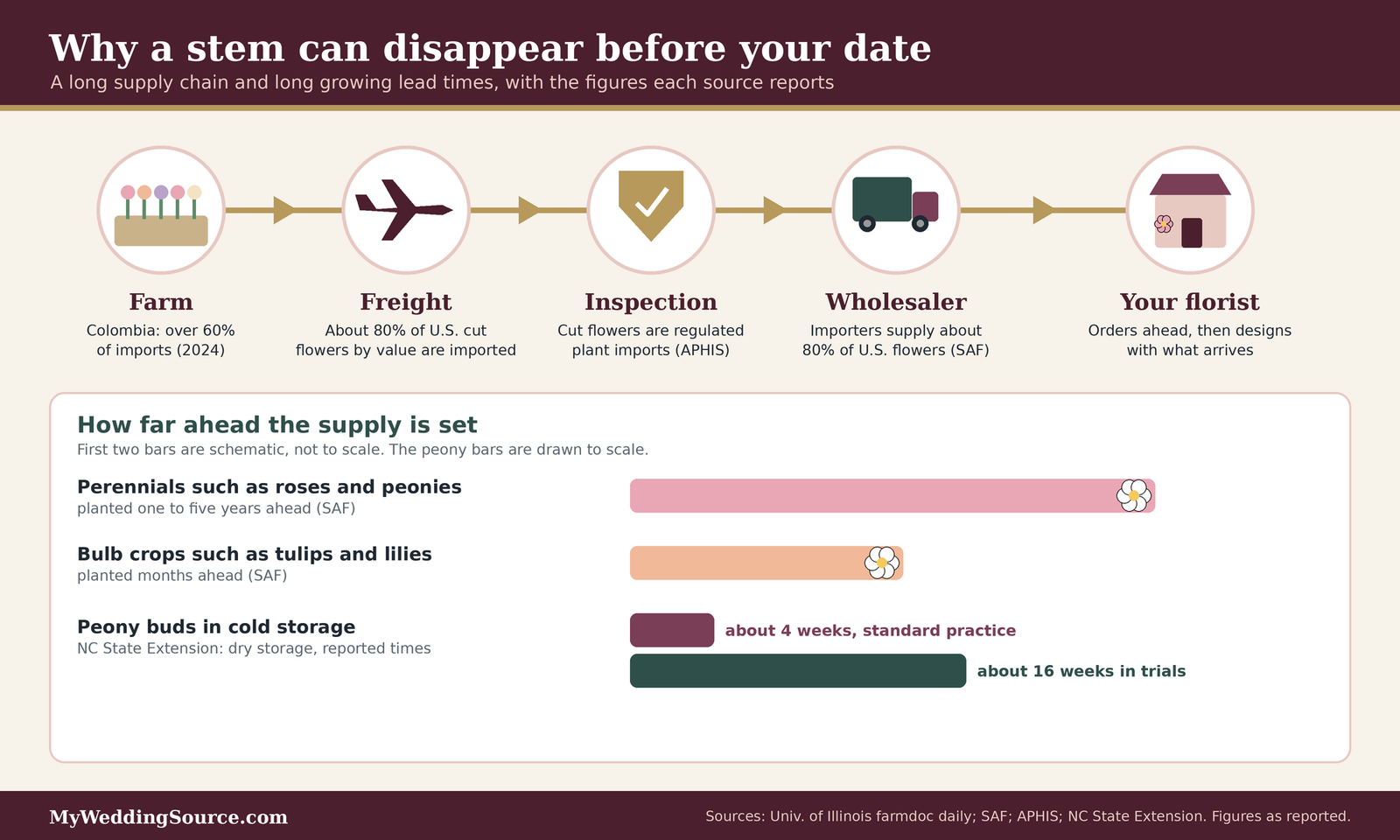
A florist cannot keep every variety in a cooler waiting for your date. Stems are grown on farms, often abroad, cut at a chosen stage, packed, flown or trucked, cleared, and sold through wholesalers. A shortfall at any step can leave a florist with fewer of your flowers than the contract describes, and the florist may learn this only days before the event. Wedding flower substitution clauses exist because the florist is promising an outcome that depends on suppliers the florist does not control.
Designers sell a look, not a stem list
Most couples are really buying a palette, a mood, and a scale: soft blush and cream, loose and garden-like, tall and airy. A florist who can swap one pale pink flower for another pale pink flower of similar shape can still deliver that look. That is why florists resist contracts that name a variety and promise only that variety. It is also why you should decide, before you sign, which flowers are really part of your look and which are simply the current way of reaching it.
Why shortages happen and what “seasonal” really means
Couples often hear “that flower is out of season” and assume a local calendar. The reality is more layered. Understanding it makes you a calmer and better-informed negotiator, and it helps you tell a genuine shortage from a florist trying to upgrade you.
Where wedding stems actually come from
Knowing the source of most cut flowers explains why shortages can look sudden. The supply is global, concentrated, and tied to a few busy weeks.
Imports dominate by value
An agricultural economics analysis from the University of Illinois reports that roughly 80% of the cut flowers sold in the United States by value are imported, with Colombia supplying over 60% of imports and Ecuador about 25% in 2024. The same analysis says roses made up about half of import value that year. For a couple, the practical meaning is that a rose in your arrangement may well have traveled by air from South America, while a delicate garden flower may come from a nearby farm. Those two supply lines fail in different ways, and your florist will know which is which.
Why some flowers stay domestic and fragile
The same analysis notes that U.S. growers have shifted toward specialty flowers that are harder to ship long distances, and that about 70% of domestic cut flower output comes from California. Specialty stems with narrow harvest windows are, by their nature, the ones most likely to be unavailable on your exact date, and your florist can tell you which of your choices fall in that group. If your inspiration photos are full of them, wedding flower substitution clauses matter a great deal. Our guide to seasonal wedding flowers shows which blooms tend to be reliable in which months.
Why a flower vanishes in a given week
A flower can be plentiful in general and scarce on your date. Four forces explain most of the gap.
Lead times and holiday peaks
The Society of American Florists (SAF) describes Valentine’s Day and Mother’s Day as the two demand peaks of the floral year, when volumes far exceed normal weekly levels and the whole chain scales up. Importers, who the group says supply about 80% of U.S. flowers, secure extra freight and warehouse capacity. SAF also notes that perennials such as roses and peonies are planted one to five years ahead and bulb crops months ahead, so growers cannot add supply in a few weeks when demand rises. A wedding in the shoulder weeks around a holiday can feel the squeeze even though it is not the holiday itself. SAF’s material does not describe wedding season specifically, so treat that connection as a planning inference, not a measured fact.
Cold storage stretches a season but only so far
Peonies show how storage changes availability. North Carolina State University’s cut flower program reports that peonies can be held dry at about 32 to 34 degrees Fahrenheit for roughly four weeks under standard practice, and that in its trials a colder storage temperature extended usable stock to around sixteen weeks in three cultivars. That is why you can sometimes see peonies outside their short natural window. It is also why quality varies: buds held too long can fail to open or open deformed. When a florist tells you peonies are risky for a date, this storage reality is often behind the caution.
Weather, freight, and inspection
A frost, a flood, a strike, or a grounded flight can thin a shipment. Imported cut flowers are also regulated plant products. The U.S. Department of Agriculture’s Animal and Plant Health Inspection Service (APHIS) lists cut flowers and bouquets among regulated imports, and its guidance says requirements depend on the commodity and country of origin and can change. U.S. Customs and Border Protection (CBP) reported that it processed about 801 million cut flower stems between January 1 and February 14, 2014, with Miami air cargo handling roughly 84% of them. That is a dated figure from a peak season, but it shows how much of the supply funnels through a few ports, which is one reason a single disruption can ripple outward.
Price moves before supply disappears
Scarcity often shows up first as price. A BizBash article from September 2021 quoted one designer citing a 30 to 50% per-stem increase during that year’s flower shortage. That is one designer in one unusual year, not a rule, but it illustrates why florists include price-adjustment language and why wedding flower substitution clauses and a pricing clause should be read together.
What a shortage means for your contract
A shortage is not a failure of anyone’s character, and it is not unusual. The question is how the paperwork distributes the risk.
Who carries the risk by default
Without a clause, the florist is bound by the proposal and carries most of the risk of not delivering what was described. With a broad clause, you carry more of it, because the florist is free to deliver something different. The best wedding flower substitution clauses split the risk: the florist takes responsibility for sourcing early and for notifying you promptly, and you accept reasonable variation inside agreed limits.
Why early notice is the real protection
You cannot negotiate a shortage away, but you can control how early you hear about it. A florist who orders in time and tells you the moment a supplier cannot confirm a variety gives you days to choose between alternatives. A florist who tells you on the morning of the event gives you only the option to accept. When you read wedding flower substitution clauses, look for the notice step first, because it determines how much choice you will actually have. Our guide to wedding vendor timeline shows how to place that step on your calendar.
A ladder for wedding flower substitution clauses: sorting swaps from harmless to design-changing
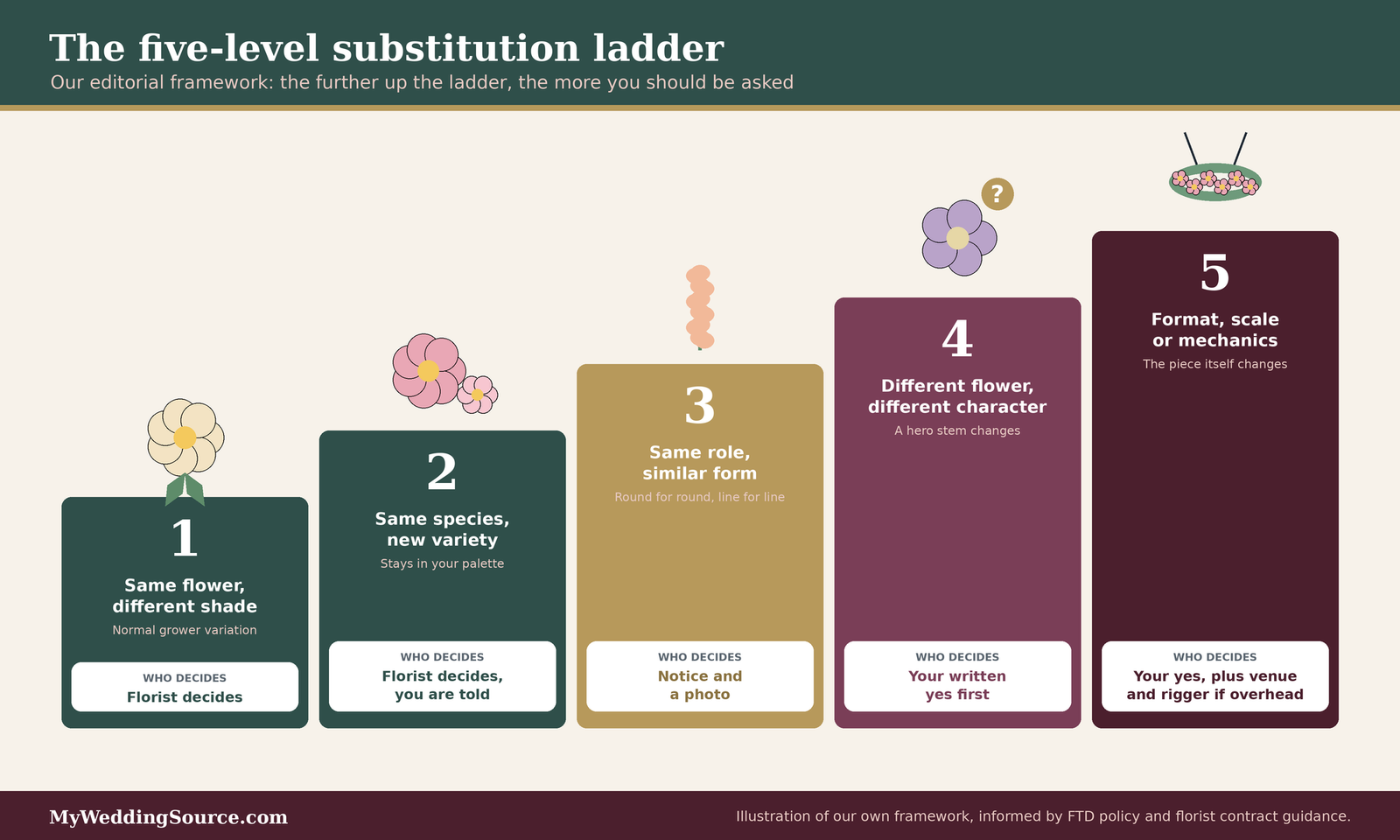
In wedding flower substitution clauses, the word “substitution” covers swaps that nobody would notice and swaps that change the whole piece. Treating them as one thing is how couples end up either panicking over a different shade of cream or accepting a different flower without realizing it. A five-level ladder gives you shared vocabulary with your florist.
The ladder for wedding flower substitution clauses below is our own editorial framework, built from the principles in published florist substitution policies and contract guidance. It is not an industry standard, and your florist may use different terms. Its purpose is to make the conversation concrete.
Levels one to three: changes inside the recipe
These swaps keep the flower, or something very close to it, and change only how it looks at the margins. They are the everyday reality of working with a natural product.
Level one: same flower, different grower or shade
The variety is the same, but the stems come from a different farm, so the cream is slightly warmer or the bloom slightly smaller. This is normal variation, and most couples never see it. Wording that says flowers may vary in shade and size is how wedding flower substitution clauses usually describe this level. You do not need to approve it, but you should know it exists, and it is the reason a sample is a guide and not a guarantee.
Level two: same species, different variety or color within your palette
Here the florist replaces one variety with another of the same type, such as one pale pink spray rose for a similar one. Wire-service floral policy gives a useful model. The FTD member policy says that when a mixed arrangement needs a swap, the recipe colors should be kept whenever possible, even if that means using different varieties of equal or greater value, and that for single-flower arrangements the variety matters most, followed by color. That policy is written for wire orders, not weddings, but its logic transfers well: protect the look, then the flower type, then the exact variety.
Level three: same role, similar form
The florist replaces a flower with a different one that plays the same part in the design: a spiky line flower for another line flower, a round bloom for another round bloom. The FTD policy states the principle plainly, that line flowers replace line flowers and round flowers replace round ones, and that arrangement type, size, volume, and shape should not change. A level-three swap is acceptable for many couples, but it is the point where you should ask for notice and ideally a photo. Your guests may not notice, but you might.
Levels four and five: changes to the design itself
These swaps change what the piece is. They deserve explicit approval, not just notice, because they cannot be undone once the flowers are cut and arranged.
Level four: a different flower with a different character
The florist replaces a hero flower, such as the large focal bloom of a bouquet, with a different type that changes the character of the piece. Your photos will show the difference, and so will your own memory of what you chose. Contract language that lets the florist do this without asking is the part of wedding flower substitution clauses to renegotiate. The Curate contract guide, written for florists, recommends keeping swaps within a reasonable distance of the original order, which implies that a hero-flower change is outside the ordinary range.
Level five: a change of format, scale, or mechanics
This is a different arrangement, not a different flower: a smaller bouquet, a flat garland replacing a full arch, a changed container, or different mechanics for holding stems. The FTD policy treats arrangement type as a protected feature and lists examples such as not swapping a spray for a container or a basket for a wreath. For a wedding, level five also includes anything that changes weight, size, or attachment method on a piece that hangs or stands where guests walk. Those changes go to the rigging checklist later in this guide.
Who should approve each level
A ladder is only useful if each rung has an owner. The simplest rule is that the further down the ladder, the more you should be asked.
Levels one and two: florist decides, you are informed
For the first two levels, most couples are comfortable letting the florist decide, provided the contract says the swap will stay within your palette and be of equal or greater value. Your wedding flower substitution clauses can say that the florist will mention changes in the final design confirmation. The point is not to approve each stem; it is to have a record that the florist considered your palette.
Levels three to five: you approve before it is built
From level three, ask for a message before the piece is built, with a photo of the proposed substitute or a description specific enough to picture. Level four and five should require your written yes. If your wedding flower substitution clauses give the florist “sole discretion” over all of these, you can accept that and rely on trust, or you can ask to carve out your must-keep flowers, which we cover in the approval section below.
Reading wedding flower substitution clauses line by line
Different florists use different phrases in wedding flower substitution clauses, and a phrase that sounds protective can be empty while one that sounds harsh can be perfectly fair. This section is a decoder. Read it with your actual contract beside you.
Phrases in wedding flower substitution clauses that protect you
These phrases set a standard the florist has to meet. If your contract has none of them, ask for at least one.
“Equal or greater value”
This phrase ties a swap to the price or worth of what you ordered. It matters because it prevents a downgrade. It is also vague on its own: value to whom, and measured how? Ask whether the florist means the wholesale cost of the stems, the retail price in the proposal, or the look. A fair practice is to treat it as the replacement stem’s cost at the time of purchase, which the florist can show you, rather than a feeling.
“Similar in color, style, and size”
This is the basic standard used in the wire-service policy and in many independent contracts. It anchors the swap to your palette and the shape of the design. You can strengthen it by naming your palette in the contract, for example by attaching the color story or board as an appendix, and by saying that substitutes must fall within it.
“Notify and approve”
The strongest phrase is a notice-and-approval step, where the florist tells you about a change and waits for your yes within an agreed window. Because florists work to tight timelines, they may offer notice without approval for small changes and approval for large ones. That split is reasonable, and it matches the ladder above.
Phrases in wedding flower substitution clauses that leave the door open
These phrases are not wrong, but they give the florist room. Read them for what they permit.
“At the florist’s sole discretion”
This gives the final design and flower choice to the florist. A legal-services blog for creative vendors describes it as a clause that gives the florist final say over design and flower selection even when clients make requests. For a designer-led approach that you chose because you trust the style, this is natural. For a couple with strong must-haves, it needs a carve-out: “except for the flowers listed in Schedule A,” for instance.
“Inspiration photos are for reference only”
This is a fair statement of reality, since no florist can duplicate a photo exactly, but it can also be used to excuse a different design. Ask the florist to look at your photos and tell you in writing which elements they can reproduce and which depend on availability. That conversation is more useful than any boilerplate.
“Market conditions” and price adjustments
Some contracts let the florist change the price if costs rise before ordering. The same legal-services source suggests such a clause should cover unexpected, uncontrollable increases, not ordinary gradual changes. Ask when the price is locked, because a price that is fixed the day you pay your deposit protects you better than one that floats until the order date.
Wording you can bring to your florist
The following sample language is our own plain-English illustration of a balanced clause, not a legal template. A lawyer licensed in your state should review anything you intend to rely on.
A balanced sample
“If a flower or material in the proposal cannot be sourced, the florist will first try to obtain it from another supplier. If that fails, the florist will offer a substitute that is similar in color, form, and size and of equal or greater value, and will tell the couple as soon as the florist knows, and no later than ten days before the event. Substitutes for the flowers listed in Schedule A require the couple’s written approval. The florist will not substitute for any item on an overhead or hanging piece without confirming the change with the venue and rigger.”
Optional additions for special cases
Depending on your situation you might add a line on allergies (“no substitute containing the listed flowers”), on cultural or religious meaning (“flowers listed in Schedule A carry meaning and may not be replaced”), and on photographs (“the florist will send a photo of the finished sample or finished piece when feasible”). Not every florist will accept every line, and that is a useful signal about how they work.
| Common wording | What it usually permits | What to ask |
|---|---|---|
| “Flowers may vary in shade and size” | Level one changes | Can you show me the range for my flowers? |
| “Similar in color, style, and size” | Levels two and three | Which colors fall outside my palette? |
| “Equal or greater value” | A price floor for swaps | Measured by cost, price, or look? |
| “Notify and approve” | Your yes before a change | How many days do I have to answer? |
| “Sole discretion” | Florist’s final design call | Can my must-keep flowers be carved out? |
| “Photos for inspiration only” | No exact-match promise | Which parts can you match? |
| “Market price adjustment” | A price change before ordering | When does my price lock? |
| “Venue policies prevail” | Venue rules outrank requests | Where can I read those rules? |
Approval rights in wedding flower substitution clauses: who says yes, and by when
An approval right that has no deadline is not worth much. Florists need time to reorder and design; you need time to reply. The practical work is agreeing on both clocks before a problem exists.
Deadlines that make the clause real
Two dates do most of the work: the day your choices lock and the day by which the florist must tell you about a problem.
The lock date for your design
Many florists set a cutoff after which your order cannot change, because they place wholesale orders and plan labor around it. A legal-services source for creative vendors lists a “changes to the quote” clause that sets a cutoff window for exactly this reason. Ask what yours is. If you want to swap a flower yourself, move a color, or add pieces, you need to do it before the lock. In return, ask the florist to commit to the same date for confirming that your flowers are on order.
The shortage notice window
Ask for a number of days, not a promise to be “prompt.” A reasonable request is that the florist tell you within a day or two of learning that a supplier cannot confirm a variety, and no later than a set number of days before the event. Choose a number that leaves you time to look at options and say yes. Our guide to the wedding flower logistics checklist shows the other handoffs that sit around that date, from cooler space to delivery windows.
Deciding what you will not negotiate
Approval rights are most useful when they are narrow. If every flower is a must-keep, the florist cannot work, and you will be unhappy with whatever arrives. If none is, you have no protection.
Build a short must-keep list
Look at your proposal and mark the two or three flowers that carry the look or carry meaning: the focal bloom in your bouquet, a flower from a family garden, a flower tied to a tradition or to someone’s memory. Those go into a schedule that requires your approval before any swap. Everything else is in the flexible pool. A list of two or three is realistic for a florist to honor; a list of fifteen usually is not.
Describe flexible items by role, not by name
For the flexible pool, give the florist a role description instead of a stem name: “a soft, ruffled, pale flower in the hand-tied bouquet,” “a trailing green for the arch edges.” This lets the designer choose the best available option and keeps the swap in your palette. It also reduces the chance that a florist, trying to follow your wording exactly, buys a premium stem you did not need. Our guide to wedding colors can help you describe a palette in words a designer can act on.
Communication in the final weeks
Even a well-written clause needs a rhythm of contact. A short, predictable routine prevents most last-minute disputes.
A simple photo-approval routine
Ask the florist to send a photo of any substitute stem, a sample, or a mock-up of a changed piece, when practical. Reply in writing, even if only “yes, this works,” so that both of you have a record. Keep the photos with your contract. If you are working with a planner, decide in advance who receives and answers those messages, so that approvals do not get lost in a group chat.
What to do when the news arrives late
Sometimes a florist truly learns of a shortage near the end. If that happens, ask three questions: what are the options, what does each cost, and what will you see on the day. Ask for the plan in writing even if it is only a few lines. Stay inside what the contract allows, but do not feel bound to accept the first offer if the proposed swap lands in level four or five of the ladder. A calm request for a better option is usually well received, because the florist wants a good result too.
Overhead pieces and wedding flower substitution clauses: when a swap changes the load
Anything that hangs above guests, such as a floral chandelier, a suspended installation, or a heavy garland across a ceiling, raises a different kind of question. A substitution that is a harmless design change on a table can change the weight, size, or attachment of a piece that someone has already approved for a specific load. For these pieces, “approval” has a second meaning: not only yours, but the venue’s and the rigger’s. Our companion piece on wedding hanging floral installations covers how those installations are planned. This section covers only how substitution interacts with them.
We cannot assess any building, ceiling, or rig, and nothing here is engineering advice. The safe default is simple: never hang or attach anything overhead that the venue and a qualified rigger have not approved for that location.
Why a swap overhead is not just a design change
A table arrangement that arrives slightly heavier is a nuisance. An overhead piece that arrives heavier than the approved plan is a safety question. That difference is why this part of a contract needs its own sentence.
Weight, size, and attachment can all shift with a swap
Replacing one flower with another can change the weight of the piece, because stems differ in size and water content. A different stem might also change how far the piece extends, how much it can swing, or where hardware attaches. Replacing a container, a frame, or the method used to hold the stems changes the mechanics outright. A retailer’s guide to suspended botanicals describes the process as involving certified riggers who know venue requirements and local safety codes, and says planners arrange a structural review by qualified engineers that checks the ceiling’s load capacity and attachment points. That is one retailer’s account, but it matches the cautious approach most venues expect.
The approved design is the approved load
The approval you obtained was for a specific design. Treat the venue’s and rigger’s sign-off as attached to that design, not to the general idea of “flowers up there.” If the florist changes the design materially, the original sign-off may no longer describe what is being hung. That is why wedding flower substitution clauses for overhead pieces should say the florist will not make material substitutions without going back to the people who approved the original.
An approval checklist for suspended pieces
This checklist is the practical tool for this section. Use it with your florist and venue contact, and adapt it to the venue’s own forms. It does not replace their requirements.
Before you sign
Ask the venue whether overhead attachments are allowed at all, who must approve them, and whether the venue requires its own rigger or a named list. Ask for the policy in writing. Ask the florist whether the piece in the proposal needs rigging, who will perform it, and whether that cost and the venue’s fees are in the quote. If the venue prohibits overhead attachments, ask for a design that stands or is supported from below instead.
Before the design locks
Ask the florist to give the rigger and venue the design details they need: dimensions, a weight estimate for the finished piece, the hardware, and the proposed attachment points. Ask what margin the rigger or venue will accept before a change needs review. Write down who holds the approved plan on the wedding day. If a particular flower is being used because it is light, ask what happens if only a heavier alternative is available.
After any substitution
Ask the florist to tell you and the venue contact whenever a flower, container, frame, or method on the overhead piece changes, even slightly. Ask whether the new version stays within the approved weight and attachment plan, and who confirmed that. If it does not, the safe answer is to pause and get approval again, or to move to a design that does not hang. A faux-flower component on a high piece is one option designers mention, and BizBash’s planning article suggests using high-quality faux flowers in high places where guests are unlikely to touch them. Even then, the weight and attachment still need approval.

Who is responsible for what
Overhead work involves several parties, and wedding flower substitution clauses that name who does what prevent gaps.
The florist, the venue, and the rigger
The florist designs and builds; the venue controls the building and its rules; the rigger, where one is required, installs and takes responsibility for the attachment. A contract should say who hires the rigger and who pays. It should also say that venue policies take priority over client requests, a point the Curate florist-contract guide makes directly. If you are not sure who has authority over your ceiling, ask the venue contact before you ask the florist.
Your role as the person who signs
You are the one who signs the florist’s agreement, so you are the person who can make the rigging step explicit. Ask for a sentence such as: “Any overhead or hanging element will be installed only as approved by the venue and, where required, a qualified rigger, and any change to its weight, size, or attachment will be re-approved before installation.” If a florist declines to include something like it, that tells you something about how they handle overhead work.
What shortages cost: price, credits, and fairness
Money is the second half of every conversation about wedding flower substitution clauses. A swap that is acceptable on appearance can still be unfair if the price does not follow the value.
What this actually costs
Substitution is not free for either side. A swap to a more expensive stem costs the florist more, and an unapproved swap to a cheaper stem costs you value. The fair question is not “what is the price of the flower” but “what did my proposal price, and what is being delivered for it?” We cannot give you a typical price difference, because stem prices vary by variety, season, and year. One designer quoted by BizBash in 2021 cited a 30 to 50% per-stem increase during that year’s shortage, which shows how quickly costs can move. Ask the florist how price differences are handled in both directions before you sign.
When a swap should change the price
It helps to decide in advance how a swap will be settled. Practices differ from florist to florist, so the contract should say how a like-for-like swap and a small price difference are handled.
Equal-value swaps and no-extra-charge language
If the clause promises a substitute of equal or greater value, ask for it to say that the florist will not charge more for the swap. That puts the cost of a normal shortage on the party best placed to manage it. If the florist wants the right to charge more for a premium substitute, ask that the extra charge require your prior approval. A change that costs you more should always be your decision.
A downgrade should show up as a credit
If the replacement is less valuable than the item in the proposal, a fair clause says the difference is credited. Without such language you may have no practical remedy except a conversation. Keep any photos of the finished work and the proposal’s item list side by side, because that comparison is the evidence of what changed. We cannot say what remedy applies to you, because it depends on the contract and your state’s law, so consider consulting a lawyer if you face a significant dispute.
Price changes before the florist orders
Some of the cost risk arrives before any substitution happens, in the form of wholesale price changes. How the contract treats that risk is worth reading next to the substitution paragraph.
Price adjustment clauses
A florist-facing legal source describes a price-adjustment clause as one that allows changes for unexpected, uncontrollable cost increases, not for normal, gradual cost changes. Ask whether your agreement has one, what event triggers it, and how much notice you get. A fixed price after deposit is best for you. A clause that lets the price float until the order date is not unusual, but it should be visible.
Keep a modest buffer
Because stem costs can move, many couples set aside a small contingency in the floral budget instead of expecting the proposal to hold to the dollar. The size is your decision and depends on your florist’s terms and your comfort. Our wedding flower logistics checklist and the broader planning guides on this site can help you place it within the whole budget. If the contract already has a firm price, your buffer can stay smaller.
Edge cases that standard wedding flower substitution clauses rarely cover
Standard wording in wedding flower substitution clauses is written for the typical order. Real weddings have complications, and a few of them deserve a specific sentence in your agreement.
Health, meaning, and rules about the flowers themselves
Some flowers are in your order for reasons that have nothing to do with color. One of those wedding flower substitution clauses that treats every stem as interchangeable can quietly undo those reasons.
Allergies and fragrance sensitivities
If a guest, a member of the wedding party, or you have a pollen or fragrance sensitivity, your florist may have chosen low-scent or low-pollen flowers on purpose. A swap can reintroduce what was removed. Name the restricted flowers in the contract and ask that substitutes be checked against the list. Our guides to planning flowers with pollen allergies and to hosting guests with severe fragrance sensitivities explain the planning side. Neither is medical advice, and anyone with a serious reaction history should talk to a clinician.
Flowers that carry meaning
A flower from a family garden, a stem used in a cultural or religious tradition, or a plant tied to a memory is not interchangeable with a similar-looking one. Put these on your must-keep schedule and say why. A florist who understands that a particular bloom matters will often work harder to find it, and will give you early notice if it is at risk.
Sourcing and materials
Some substitutions turn on where a plant comes from or what holds it together, not how it looks.
Protected and regulated plants
Orchids are a common wedding flower, and APHIS notes that protected plants such as orchids, and many other species, fall under endangered species rules enforced alongside the Convention on International Trade in Endangered Species of Wild Fauna and Flora. APHIS also lists cut flowers and bouquets as regulated imports, and says requirements depend on the commodity and country of origin. As a couple you are unlikely to import anything yourself. The practical advice is to buy from your florist, to be wary of any plan to bring flowers or plants through customs from a trip abroad, and to ask the florist whether a particular stem faces import restrictions that could affect availability.
Foam, wire, and mechanics
A florist might change how stems are held, for example by replacing water-absorbing foam with another method. Researchers at RMIT University reported that freshwater and marine invertebrates in lab tests ingested particles of green floral foam, and that the foam released chemicals more toxic to aquatic invertebrates than those from other plastics tested, while noting that more work is needed to understand the effects. That is a single study and does not tell you what is right for your wedding. If you care about it, ask the florist what they use and why, and ask that any change in mechanics on an overhead or standing piece be treated as a design change that needs approval.
Other situations worth a sentence
A few more situations come up often enough to plan for.
Wholesale boxes, DIY help, and partial service
If you buy flowers in bulk and arrange them yourself, or hire a florist for only some pieces, there are usually no wedding flower substitution clauses at all, because you are the buyer of the stems. In that case the supplier’s terms are what matter: ask about the policy for short or damaged boxes, delivery dates, and whether you can approve a replacement variety. A friend who volunteers to help is a separate matter, and our guide to DIY wedding decor covers the practical limits of that approach.
A change of florist
If your florist cannot perform, whether from illness or closure, your agreement should say what happens next, including whether the deposit is refunded and whether the florist will help find a replacement. Our guide to wedding vendor replacement policies covers that scenario in detail. It is a rare event, but one worth a sentence in the agreement. Insurance can sometimes help with vendor failure, depending on the policy, so read the terms in our wedding insurance guide before assuming any coverage.
Fresh, silk, and dried alternatives
Some couples add a fallback that does not depend on the fresh supply. A mix of fresh and artificial or dried material can protect a design from shortages. Our guide to fresh versus silk wedding flowers discusses the trade-offs. If you plan to use artificial material as a fallback, ask the florist to include that in the agreement as an option you approve, not as a surprise.
Claims about sustainability and leftover flowers
Substitution decisions are sometimes presented as environmentally motivated. Treat such claims carefully.
Do not assume a swap is greener
Replacing an imported stem with a local one may or may not reduce environmental impact, and we did not find a source that lets us say so in general. If your florist makes a claim such as “this is more sustainable,” ask what it is based on and ask for specifics, such as where the flower was grown. A vague promise is not a reason to approve a swap.
What happens to leftover stems
Extra stems from a swap or a short order do not have to go to waste, but disposal depends on what the material is and what it was treated with. The U.S. Environmental Protection Agency’s home composting page lists plant stalks among yard materials that can be composted and tells readers to leave out herbicide-treated plants and diseased or pest-infested ones; it does not mention flowers specifically, so ask your florist how a given material was treated. Our guide to wedding flower donation after the reception covers another path for leftover arrangements.
Questions to bring to your florist
A short list of questions, followed by the follow-ups that matter most, will cover most of what this guide has described.
Questions to ask your florist before you sign
- When a flower in my proposal is short, what do you try first before you substitute?
- What standard does a substitute have to meet: color, form, size, and value?
- Which changes do you tell me about, and which do you need my approval for?
- How many days before the wedding will you tell me about a problem?
- Can we list two or three must-keep flowers that cannot be swapped without my yes?
- How is the price handled if a substitute costs more or less?
- If any piece hangs or stands overhead, who approves a change to its weight or attachment?
Questions about the supply
These questions help you understand how real the risk is for your date and your flowers.
Ask about sourcing and timing
Ask when the florist places the order for your flowers and whether any of your choices are known to be risky for your date. Ask whether the florist uses more than one supplier and what the plan is if the first one cannot deliver. A florist who answers confidently and specifically is more likely to manage a shortage well than one who answers with general reassurance.
Ask about the design
Ask which parts of your design depend most on a single flower, and what the florist would do if it were unavailable. Ask for two or three acceptable fallback flowers for each hero stem, and ask to see photos of them. Having a pre-agreed fallback turns a crisis into a choice you made months earlier.
Questions about the paperwork
Finally, make sure the answers end up in the agreement and not only in conversation.
Get the answers in writing
Ask that what you discussed be reflected in the contract or an attached schedule, with dates. Verbal promises are easy to forget and hard to prove. If the florist’s standard contract cannot be changed, ask for a short email that states the points in plain language and confirms them. Compare what you receive to the guidance in our vendor due diligence checklist.
Read the whole agreement
Wedding flower substitution clauses sit among other terms: payment, cancellation, delivery, liability, and indemnification. FindLaw’s overview of common wedding vendor contract terms points out that vendors may add extra charges and may ask you to waive certain claims, and that vendors are generally willing to share contracts early so you have time to review. Ask for the draft early, read it fully, including every one of the wedding flower substitution clauses, and consider legal review if the stakes are high. We are not lawyers and this is not legal advice.
Frequently asked questions
Clause basics
What are wedding flower substitution clauses in a contract?
They are the part of a florist’s agreement that says what the florist may do when a flower, vase, or material in your proposal is unavailable. It usually allows a comparable replacement and may set standards for color, form, size, and value. Read yours for who decides, how you are told, and when.
Can a florist swap flowers without asking me?
That depends on your contract. Many wedding flower substitution clauses let the florist make reasonable changes within a similar look and give notice afterward, while larger changes may need your approval. If you want a say on specific flowers, ask for those to be listed in a schedule that requires your written yes.
What does “equal or greater value” mean?
It means the replacement should be worth at least what the original was in your proposal. The phrase is vague, so ask whether value is measured by the stem cost, the price in the quote, or the overall look, and ask that the florist not charge more for a normal like-for-like swap.
Are inspiration photos a guarantee?
No. Florists generally treat photos as a style guide because flowers vary by season, grower, and batch. Ask which elements the florist can match and which depend on availability, and get that answer in writing so that you know what you are approving.
Shortages, price, and special pieces
Why would a flower be unavailable on my wedding date?
Reasons include long growing lead times, holiday demand peaks, weather, freight delays, import inspection, and limited cold storage. Most U.S. cut flowers are imported, so a disruption in a few places can affect many orders. Your florist can tell you which of your choices carry higher risk.
What should I do if my florist says a flower is short?
Ask for the options, the cost of each, and a photo or description of what you would receive. Check your contract for notice and approval rules. Decide whether the change lands inside your palette or changes the design, and reply in writing so there is a record.
Do substitutions matter for hanging installations?
Yes, because a swap can change weight, size, or attachment on a piece the venue and rigger approved for a specific design. Ask that any material change be re-approved before installation, and never hang anything overhead that the venue and a qualified rigger have not approved.
Should I ask for a refund if I dislike a substitute?
Check your contract first, since remedies vary and depend on state law. Raise concerns calmly and early, with photos comparing the proposal and the result. If the amount is significant, consider speaking with a lawyer. We cannot give legal advice or say what remedy applies to you.
Your next steps
Before you sign
Mark the clause and mark your must-keeps
Find the wedding flower substitution clauses in your florist’s agreement and underline each phrase from the decoder table. Then pick two or three flowers that must not change without your yes, and write a short sentence on why each matters. Send both to the florist and ask how they would handle them. This single step turns generic wedding flower substitution clauses into ones that fit your wedding.
Ask for notice, approval, and price language
Ask for the number of days of notice in a shortage, written into the wedding flower substitution clauses, the approval rule for changes at the higher rungs of the ladder, and a sentence saying that substitutes will be of equal or greater value at no extra charge. If the florist’s standard form cannot change, ask for a short email confirming these points.
In the final weeks
Confirm that your flowers are on order
Ask your florist to confirm that the key flowers are ordered under the wedding flower substitution clauses you agreed and whether any supplier has flagged a problem. Put the notice date and the approval deadline on your calendar. Our wedding vendor timeline can help you place those dates among the rest of your vendor tasks, and our bouquet guide can help you decide how flexible your hand-held flowers need to be.
Re-check anything overhead
If any piece hangs or is supported overhead, confirm with the florist, venue, and rigger that the approved design is the design being built. Ask for any change to be reconfirmed before installation day. If something cannot be approved, switch to a design that does not hang instead of pressing ahead.
Sources & methodology
How we built this guide
What we relied on
This guide combines a wire-service substitution policy, florist-facing contract guidance, a vendor-contract overview, university and trade-group material on cut flower supply, federal pages on plant imports and composting, and one study on floral foam. Where a point comes from a florist business blog, a retailer, or a trade group, we say so, because those sources reflect their own markets and habits. The substitution ladder, the clause decoder, the sample clause, and the rigging checklist are our own editorial frameworks and are not industry standards. Dates and figures are given as the sources report them, and some, such as the 2014 customs data and the 2021 shortage reporting, are older than the rest. Sources were checked on November 12, 2026.
What we did not do
We did not review any particular contract, inspect any venue, rig, or ceiling, test any flowers, or give legal or engineering advice. Contract rights vary by state and by the exact wording of an agreement, and rigging approval belongs to the venue and a qualified rigger. Ask your florist and venue for their policies in writing and consider legal review for significant disputes.
Source list
Government, university, and research sources
- U.S. Department of Agriculture, APHIS, What Plant Material Requires a Permit?: https://www.aphis.usda.gov/plant-imports/what-plant-material-requires-permit
- U.S. Customs and Border Protection, Cut flower imports, FY 2014: https://www.cbp.gov/newsroom/spotlights/cut-flower-imports-fy-2014
- U.S. Environmental Protection Agency, Composting at home: https://www.epa.gov/recycle/composting-home
- University of Illinois, farmdoc daily, Valentine’s Day and the gains from agricultural trade: cut flowers in the U.S.: https://farmdocdaily.illinois.edu/2025/02/valentines-day-and-the-gains-from-agricultural-trade-cut-flowers-in-the-us.html
- North Carolina State University Cooperative Extension, Peony postharvest handling: https://cutflowers.ces.ncsu.edu/wp-content/uploads/2019/12/Peony-Postharvest-Handling-Nathan-Jahnke.pdf
- ScienceDaily, RMIT University study on floral foam (Science of the Total Environment, 2019): https://www.sciencedaily.com/releases/2019/12/191210111651.htm
Trade, florist, and consumer sources
- FTD, Substitution Policy: https://www.ftdi.com/quality/substitution.htm
- Society of American Florists, Seasonality of the industry infographic: https://safnow.org/wp-content/uploads/2025/06/Seasonality-of-Industry-Infographic-.pdf
- Society of American Florists, best practices for coping with supply shortage (via Perishable News): https://perishablenews.com/?p=180883
- BizBash, 7 Ways Event Planners Can Navigate the Current Flower Shortage (September 23, 2021): https://www.bizbash.com/catering-design/florals/article/21734932/7-ways-event-planners-can-navigate-the-current-flower-shortage
- Curate, Printable wedding florist contract template: https://curate.co/blog/printable-wedding-florist-contract-template/
- The Legal Paige, The clauses you absolutely should have in a florist contract: https://thelegalpaige.com/blogs/blog/the-clauses-you-absolutely-should-have-in-a-florist-contract
- FindLaw, Common wedding vendor contract terms you should know: https://www.findlaw.com/legalblogs/law-and-life/common-wedding-vendor-contract-terms-you-should-know/
- David’s Bridal, Suspended botanicals: transforming wedding ceilings into living canopies: https://www.davidsbridal.com/content/luxury-wedding/suspended-botanicals-transforming-wedding-ceilings-into-living-canopies