

Good wedding venue questions do three jobs: they make competing quotes comparable, they bring fees and rules into view before any money moves, and they leave every answer in writing, so you sign a contract you have read instead of a tour you enjoyed.
Quick answer
Send a short set of wedding venue questions by email before you book any tour, ask the rest in person or against a written proposal, and do not pay a deposit until you have read the whole contract. This guide gives you fifty wedding venue questions in eight groups, each tagged with the moment it works best: email, tour, proposal, or contract. The groups cover dates and holds, money, space, time and rules, vendors and alcohol, weather, guest access, and the contract itself. It also shows how to price two venues on the same terms, so the lower headline number does not decide the matter by accident.
Turn a venue search into a written brief for your wedding venue questions
A tour is a sales conversation in a beautiful room, and the room does most of the talking. The way to keep your own wedding venue questions in the lead is to decide your facts first, so every venue answers the same prompt. This section builds that brief and explains how to read the numbers you will hear. For the wider picture of choosing a venue alongside the rest of the plan, our wedding planning guide and wedding planning checklist cover the other decisions that sit around it.
Fix the facts every venue prices against
Two venues cannot be compared if one quoted a Friday for ninety guests and the other quoted a Saturday for one hundred and thirty. Before you send a single message, write down the assumptions you will give everyone, and do not change them midstream without telling every venue.
Give every venue the same date, count, and hours
Write one short paragraph and paste it into every inquiry. It should hold your first-choice date and one or two alternates, a guest count with a range (for example, a likely count and the most you could imagine inviting), the hours you want for ceremony and reception, and whether the ceremony will be on site. Add anything that shapes cost, such as whether you expect a full meal, a plated dinner, or lighter food. When every venue receives identical facts, the differences in their replies are about the venue and not about your inconsistent question. If your guest list is still unsettled, say so, and ask each venue how its pricing moves at the low and high ends of your range. The Knot’s 2026 Real Weddings Study, which surveyed couples married in 2025, reports an average of 117 guests, which is a reasonable reference point if you have nothing else, though it is an average and not a target. Written once, this paragraph becomes the front page of your wedding venue questions.
Separate must-haves from nice-to-haves
A venue can fail you in two different ways. It can miss a requirement, or it can miss a preference, and treating both as equal makes the shortlist muddy. Take ten minutes with your partner and sort your wishes into three piles. The first holds requirements that would end the search if unmet, such as a step-free route for a grandparent, a space that holds everyone seated, or a ceremony and reception on one property. The second holds strong preferences that you would trade for something else. The third holds inspiration, such as a particular view or a vintage look. Give the first pile to every venue in writing. A planning timeline helps here as well, since some requirements, like a date during a popular season, expire quickly. Our wedding timeline guide shows how far ahead different decisions tend to be made. Everything after that is a wedding venue question you can ask at your own pace.
Know what the averages say before you hear a quote
Quotes feel more reasonable, or more shocking, depending on what you expected. Reading the published averages carefully gives you a more honest anchor, and it also shows how much those numbers differ depending on who measured them and how.
What the two big surveys report
The Knot reports that the average ceremony and reception venue cost for couples married in 2025 was about $12,900, based on its survey of 10,474 U.S. couples. Zola, using a different method that combines platform data, budgets, and vendor-reported pricing in its Wedding Cost Index, reports an average venue cost of $8,573, with a typical range of about $6,900 to $10,300. Those numbers are not in conflict. They come from different groups of couples, define “venue” a little differently, and measure different things (what couples reported spending versus what a cost index modeled), so neither is a quote you should expect.
Cost reality check
Published venue averages run from roughly $8,600 (Zola’s Wedding Cost Index) to roughly $12,900 (The Knot’s 2025 couples survey), and neither is a price list. Zola also reports that 57% of couples face a mandatory venue service fee, and that those couples report about twice the unexpected fees of couples whose venues do not charge one. Use averages to sanity-check a quote, then price your own date, count, and hours. Our average wedding cost guide explains how to read these figures, and the wedding budget calculator turns them into your own plan.
Note the unit as well as the number. A survey average describes couples who already booked, in markets across the country, at many guest counts. Your venue may sit far above or below it for entirely ordinary reasons, such as a coastal city, a Saturday in October, or a very small or very large guest list.
Why your quote will not match an average
An average has no fees in it that you can see. A quote does. A venue’s headline rental figure may exclude a service charge, an administrative fee, taxes, cleaning, security, or rentals, and a different venue may bundle some of the same items into the rental price. That is why the most important wedding venue questions are not about the number at all. They are about what the number includes, what sits outside it, and what changes if your plans change. The price you want is the one you will actually pay, in total, after every line item for the same date, count, and hours. The worked example later in this guide shows how to build that figure for two venues.
How the fifty questions are organized
A list of fifty wedding venue questions is only useful if you can use it without reading all fifty to every venue. The wedding venue questions below are grouped by topic, and each carries a tag showing the stage at which it works best.
Four moments, four sets of questions
Ask some things by email, because the answer rules a venue in or out quickly and saves everyone a trip. Ask others at the tour, because they depend on seeing the space. Ask a third set against the written proposal, because they depend on seeing exact numbers. Save a last set for the contract, because they depend on the wording that will bind you. The tags in the lists, email, tour, proposal, and contract, mark these moments. In a WeddingPro research report that draws on a Venue Selection Study of 781 U.S. couples who had engaged or married within the previous two years, couples typically inquired with about five venues and toured about four. That is a useful picture of the process: most couples narrow in stages, and wedding venue questions that eliminate a venue early are the cheapest ones to ask. The report was framed around 2023 planning, so treat the pattern as a rough guide and not a current measurement. Sorting your wedding venue questions by stage keeps each conversation short and the answers easy to compare.
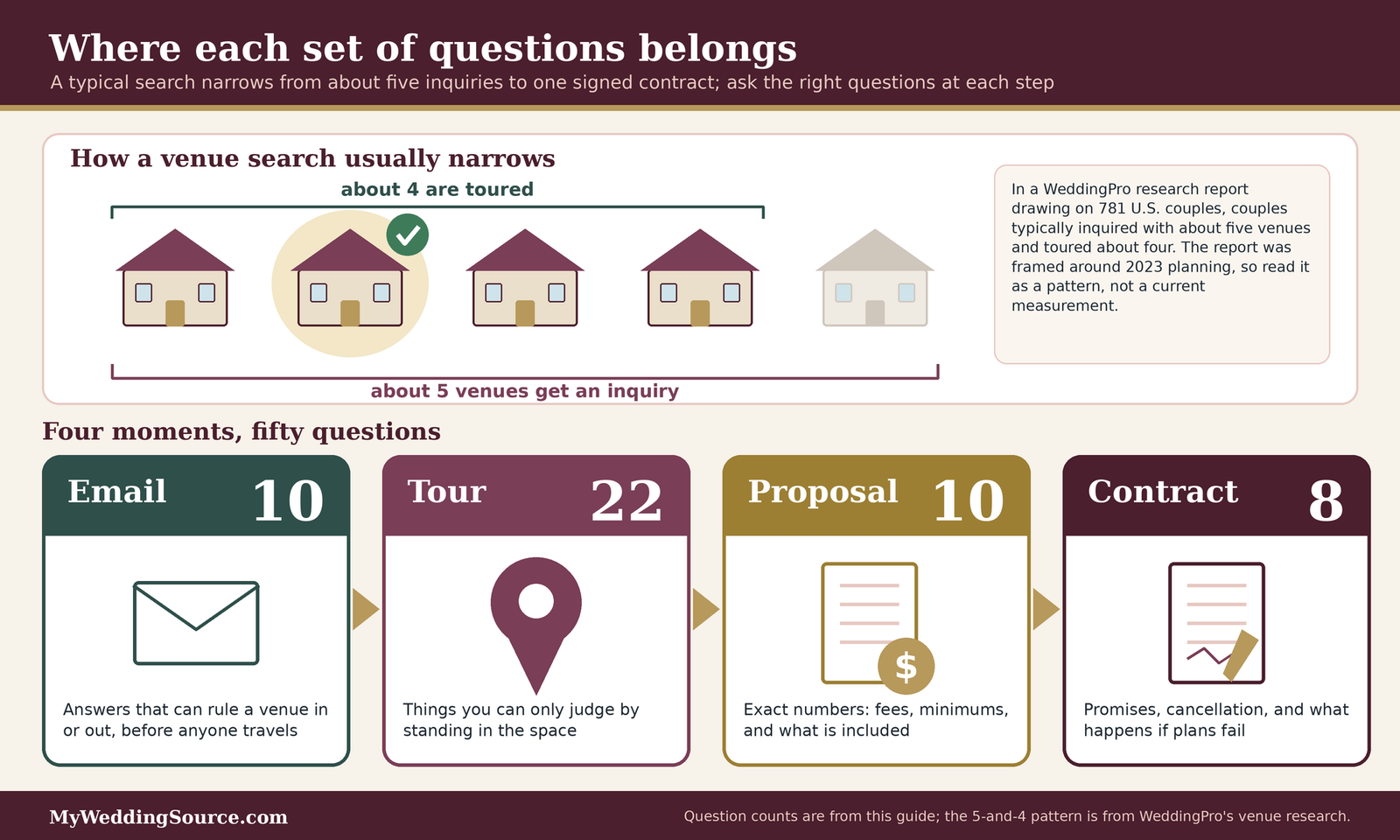
Keep one answer sheet
Create one shared document or spreadsheet with your wedding venue questions down the side and the venues across the top. Fill in each answer the same day, in your own words, and note whether it came by email, in person, or in the contract. A written answer is worth more than a spoken one, and a spoken answer should be turned into an email that says “to confirm what we discussed”. If a coordinator gives you different answers on different days, the sheet shows it. The following ten are worth sending before you book a tour.
Questions to ask
Send these ten wedding venue questions by email before you book a tour:
- Is our date open, and is anyone holding it? (question 1)
- Which fees are added to the base price, and which are taxed? (question 7)
- What is the deposit, and what part is refundable, until when? (question 10)
- What is the seated capacity with a dance floor? (question 14)
- How many hours do we have, and what do they include? (question 20)
- When must the music stop and guests leave? (question 21)
- May we hire any vendors, or only from a list? (question 26)
- Who may serve alcohol, and may we bring our own? (question 31)
- Where do all guests go if it rains or storms? (question 33)
- May we see the full contract before paying a deposit? (question 44)
Wedding venue questions about dates, holds, and money
The first group of wedding venue questions decides whether a venue is even in the running. The map below shows how all fifty are grouped, so you can see where each set falls before you read it.

Dates and holds
Availability sounds like a yes-or-no question, but the answer has layers. A date can be open, tentatively held by someone else, priced at a premium, or open only for part of the day.
Is the date really open?
Ask for the answer in an email, because it becomes a record. If the venue says a date is “pending,” that usually means another couple has an unsigned hold, and the venue may call you if the first couple lets it lapse. Ask how long that hold lasts and what happens when it ends. Some venues run more than one event in a day, so a date can be open for a ceremony slot but not for your full day. Zola’s venue-tour guidance lists the same-day question explicitly, along with whether a weekday or off-season date lowers the price. These first wedding venue questions cost nothing to ask and can save a tour.
- Is our exact date open, and is anyone else holding it? Ask how long a hold lasts, and whether you will be told if it lapses. (email)
- Do you host more than one event on the same day, and how are the groups kept apart? This affects arrival times, parking, noise, and where guests wait. (tour)
What does a hold cost, and how do prices vary?
A hold is a promise to keep a date for you for a short time, sometimes free and sometimes tied to a fee. Ask whether the holding fee becomes part of your deposit or is a separate charge. Then ask which dates and weekdays are priced differently. A venue may price a Saturday evening in peak season very differently from a Sunday or a Thursday, and a single price sheet for the whole year may not be offered unless you ask. If you are flexible, ask for the same quote on two or three candidate dates, so you can see what a different day is worth in dollars. Put these wedding venue questions to every finalist so the answers line up.
- What does it cost to hold the date, and does that money count toward the deposit? (proposal)
- Which dates, days of the week, and seasons are priced differently, and what are the tiers? (proposal)
- If we need to change the date after booking, who decides whether a new date is available, and what does the change cost? (contract)
Fees, minimums, and payments
The price of a venue is rarely one number. It is a base figure plus a set of charges that depend on the venue’s model, and a good half of the surprises that couples report come from the second part.
Fees that sit outside the headline price
Common add-ons include a service charge, an administrative fee, gratuity, cleaning, security, labor for setup or teardown, and taxes. Zola’s reporting on its 2026 data found that 57% of couples face a mandatory venue service fee, so it is a mainstream practice, not an exception. The point is not that fees are wrong. The point is that you can only compare venues if you know which ones apply, and whether a percentage fee is calculated on the rental, on food and drink, or on both. Ask also whether taxes and service charges apply to each other, because a percentage added to a number that already includes a percentage grows faster than you might expect. The rules for tax and gratuity differ by state and by city, so this guide does not state them, and you should ask the venue to show the arithmetic on a sample invoice. Few wedding venue questions save as much confusion as the request for a sample invoice.
- What does the base price include, listed item by item? Ask for the list in writing. (proposal)
- Which fees are added to the base price: service charge, administrative fee, gratuity, cleaning, security, labor, and taxes? (email)
- Which of those fees are taxed, and which have a service charge applied to them? Ask for a sample invoice that shows the order of the arithmetic. (proposal)
- Is there a food and beverage minimum, and how is it calculated if the guest count drops? (proposal)
The payment schedule and how you pay
A deposit is the first payment, but it is also a decision about risk. Ask how much it is, when it is due, and what part is refundable, until what date. Then ask for the full schedule, including the final payment and the date by which you must confirm a guest count. The Better Business Bureau advises paying a deposit only after both partners have signed the contract, never paying the full amount up front, and paying by credit card, which can make it easier to dispute a charge if a vendor does not deliver. Ask which payment methods the venue accepts and whether card payments carry a fee, since a card fee is a real cost and the protection it buys is worth weighing against it. Among the wedding venue questions about money, the refund deadline deserves the plainest answer.
- What is the deposit, when is it due, and what part is refundable, until what date? (email)
- What is the full payment schedule, including the final payment, and are alternative schedules available? (proposal)
- Which payment methods do you accept, and is there a fee for paying by credit card? (proposal)
- When is the final guest count locked, and what happens to the price if it changes afterward? (contract)
Wedding venue questions about space, time, and rules
Photos show a space at its best, with an empty floor and no clock. These wedding venue questions test the space against a real day: your guests, your vendors, and the minute the music has to stop.
Space, capacity, and layout
A venue’s published capacity is a maximum, and the version that matters to you depends on what you want to do inside it: sit everyone for dinner, add a dance floor, run a band, stage a buffet, or flip a ceremony room into a reception room.
Capacity for your layout, not the maximum
A hall that holds one number of people for a standing reception may hold a smaller number for a seated dinner with a dance floor and a head table. Ask for the capacity of each layout you are considering, and ask the venue to show you a floor plan with your count on it. If a single room hosts both the ceremony and the reception, ask how long the flip takes, who does it, and where guests wait. In WeddingPro’s venue research, couples ranked price, the ability to host both ceremony and reception on site, and availability as the three most important factors, which fits with how much a single-site day simplifies the logistics. Capacity is one of the wedding venue questions that can end a search in a single email.
- What is the seated-dinner capacity with a dance floor, and what is it without one? Ask for a floor plan with our count drawn on it. (email)
- Which spaces will we use for the ceremony, cocktail hour, dinner, and dancing, and does anyone have to turn a room over between them? (tour)
- Are those spaces private to us, or shared with other guests, diners, or members? Ask also about patios and bridal suites. (tour)
Posted occupancy, exits, and the fire marshal
Every public space has a legal occupant load, set by a building or fire authority and not by the venue’s marketing. Rules differ by city and state, so treat this as an example and not a rule. In Portland, Oregon, the fire bureau says an event in an assembly building needs a temporary permit when the calculated load exceeds 500 people, and an event in a non-assembly space, such as a tent or warehouse, needs one above 49. The same page says the approved permit states the legal occupancy and that exits must stay visible, unlocked, and unobstructed. Your local fire marshal sets the rule for your location. Ask the venue who has set the posted capacity, whether a permit is involved for your event, and who is responsible for pulling it, because a decorated room or an extra tent can change what counts. These wedding venue questions sound technical, but they protect your guests as much as your plan.
- What is the posted occupancy of each space we will use, who set it, and does anything we plan (a tent, a stage, a large installation) change it? (tour)
- Where are the restrooms, how many serve our guest count, and are they in the main building? (tour)
- Where do vendors load in, and what are the stairs, doors, and elevator limits? Ask this before you rent anything large. (tour)
Time, rules, and the clock
The hours on the contract and the hours on your timeline are two different documents until you reconcile them. This is where overtime, curfews, and rules about decor tend to appear.
The hours you actually have
“Eight hours” can mean eight hours of access or five hours of event with setup inside it. Ask what the rental window includes, whether setup, getting ready, the rehearsal, and load-out fall inside it, and what an extra hour costs. Then ask the harder question: when must the music stop, and when must guests be out? The Knot notes that many venues stop loud music around 10:30 p.m., which can shorten a late dance party that you assumed would run later. Write your run of show backward from the curfew, and see whether your priorities fit. Our wedding reception guide covers how the order of events shapes the evening. Treat the curfew as one of the wedding venue questions that shapes everything after it.
- How many hours do we have the space, and does that include setup, getting ready, and load-out? (email)
- When must the music stop, and when must all guests leave? Ask whether the venue or a local ordinance sets the time. (email)
- When can vendors and florists arrive, and when must everything be out? Ask what a late load-out costs. (tour)
- Can we have a rehearsal in the space, and when? (tour)
Decor and house rules
House rules are the part of a contract that couples often read last and regret first. Candles, open flame, sparklers, confetti, glitter, hanging decor, nails, tape, helium, and fog machines are all commonly restricted somewhere, and a restriction found after you have bought the items is a cost. Ask for the written list, and ask who on site enforces it. Ask also who is your point of contact during the event. A venue manager, an in-house coordinator, and a hired planner have different jobs, and the person who answers your calls on Tuesday may not be the person standing in the room on Saturday. These wedding venue questions are easy to forget on a tour, so keep them on your sheet.
- What rules apply to decor, including candles, open flame, confetti, sparklers, nails, hanging items, and rentals? Ask for them in writing. (tour)
- Who is our point of contact on the day, are they a venue employee or a hired planner, and are they there for the whole event? (tour)
Wedding venue questions about vendors, food, and alcohol
Many venues are not only a place but also a bundle: a caterer, a bar, a coordinator, a list of preferred vendors. How much of that bundle is optional is one of the biggest differences between venues that look similar, and it is rarely visible in photos.
Vendors and catering
The first practical test of a venue’s flexibility is the vendor policy. Some venues let you hire anyone. Some require their own caterer. Many fall in between, with a preferred list, a fee for outside vendors, or a paperwork requirement.
Preferred lists and outside vendors
Ask whether you may hire any vendors you like for flowers, photography, music, and cake, or whether you must choose from a list. Ask whether there is a fee for a vendor who is not on the list, and whether every vendor must provide a certificate of insurance. The Knot’s venue-tour guidance mentions all three as standard wedding venue questions, along with loading access and when vendors may begin setup. A short list is not necessarily a problem if the vendors are good and priced fairly, but you should know that you are buying a limit. If you already have a photographer in mind, check this first. Our wedding photography guide explains what to ask a photographer, and the venue should be on the same page about timing and access. Few wedding venue questions limit your other hiring as much as this one.
- May we hire any vendors we like, or only vendors from a list? (email)
- Is there a fee or extra paperwork for a vendor who is not on the list? (proposal)
- What insurance certificate does each vendor need to provide, and who collects them? (tour)
Catering, tastings, and special diets
When catering is in-house, it is part of the venue’s price, and the quality is part of the venue’s reputation. Ask whether the menu is fixed or flexible, whether you can have a tasting before signing and not only after, and how the venue handles children’s meals, vendor meals, and dietary needs, including allergies. Price each of those items before you sign. Zola’s venue-tour guidance suggests asking whether the menu is a plated meal, a buffet, or both, and whether a tasting is available. If the venue allows outside caterers, ask whether it charges a fee for the privilege and what equipment the caterer may use. Our wedding catering guide goes deeper on menus and per-person costs. Keep these wedding venue questions on your sheet whether or not you expect to use the in-house caterer.
- Is catering in-house only, and can we taste the menu before we sign? (tour)
- How are dietary needs, children’s meals, and vendor meals handled and priced? (proposal)
Alcohol and staffing
The bar and the people who run it are a cost, a risk, and a quality issue at once, and they are often described in the fewest words in a contract.
Who may pour, and what it costs
Alcohol rules vary by state and by venue, and this guide does not state them. What you can ask is simple: who may serve alcohol, whether you can supply your own, and if so, whether there is a corkage or handling fee and a requirement to use the venue’s bartenders. Ask also whether the price is per person, by consumption, or by the bottle, and what happens if the bar runs dry. Some venues require a liquor liability policy for events that serve alcohol, which is another reason to ask about insurance early. Our open bar wedding guide compares bar models and what drives their cost. These wedding venue questions apply to any bar model, whether you choose an open bar or a limited one.
- Who may serve alcohol, may we bring our own, and what do corkage, bartender, and handling fees cost? (email)
How many people are on the floor
Ask how many servers and bartenders the venue schedules for your guest count, and how the ratio is set. A cocktail hour for one hundred and twenty with one bartender is a long line, and a dinner with too few servers runs late and cold. You are not asking to run the venue’s staffing. You are asking whether the venue has a standard, whether that standard is in the contract, and what it costs to add staff if you want more. Zola’s guidance on touring a venue lists staffing and day-of support among the wedding venue questions to ask. The answer tells you whether the venue’s usual ratio is a floor or a promise. Staffing wedding venue questions are best asked before the proposal, so the ratio can be priced.
- How many servers and bartenders will work our event, how is that number set, and what does extra staff cost? (tour)
Wedding venue questions about weather and backup plans
Weather is the one variable that every outdoor or partly outdoor wedding shares, and the one that the venue’s marketing photos never show. The wedding venue questions here are really about who decides, where everyone goes, and what it costs when the plan changes.
Rain, lightning, and shelter
A rain plan is only a plan if it can hold every guest, at the same time, in a space that is safe. That is a more demanding test than a tent in a photo.
Where everyone goes, and who calls it
Ask for the backup space by name, and ask how many guests it seats with your layout. Then ask who decides to move, and by what time. Waiting too long to decide is the most common way for a backup plan to fail. The National Weather Service says that the lightning threat can extend roughly six to ten miles from a storm, that activities should stop as soon as you see lightning or hear thunder, and that they should not resume until at least thirty minutes after the last thunder. It describes large, substantial buildings as the best shelter and says small structures such as rain shelters and sheds are not safe. Its guidance for events also recommends a written plan with clear stop, shelter, and resume rules, and a designated weather monitor who has the authority to enforce it. The NWS page does not address tents specifically, so ask the venue where guests go during lightning and not only during rain. Our garden wedding venues guide covers this in more depth for outdoor sites. Weather wedding venue questions are easier to ask while the sky is clear than after a forecast turns.
- If it rains or storms, where do all of our guests go, and does that space seat everyone at once with our layout? (email)
- Who decides to move indoors, and by what time before the ceremony? (tour)
- Does the venue have a written severe-weather or lightning plan, and may we read it? (tour)
Heat, cold, wind, and sun
Not all weather problems are storms. A ceremony lawn facing the afternoon sun, a patio in a cold wind, or a tent without airflow in August can be uncomfortable without being dangerous. Ask what the venue provides for shade, heat, and cooling, whether it has fans, heaters, or blankets, and what the ceremony site looks like at the time of day you plan. If you can visit at that hour, do. A tour at noon tells you little about a ceremony at five. The point is not to find a flawless venue. It is to know the weakness in advance and plan for it, so guests are not surprised by it. These wedding venue questions rarely appear on a standard tour, which is why they are worth asking.
- What does the venue provide for heat, cold, wind, and direct sun, and what would we need to rent? (tour)
When the plan changes, and what it costs
A backup plan has a price, and the price is part of the venue’s real cost. Ask this before you compare quotes, not after.
What the switch costs
Ask whether moving to the backup space costs extra, how long setup takes, and who pays for the labor to move chairs, flowers, and sound equipment. If the backup space is a tent, ask who rents it, who owns the permit, and when you must commit. A tent that must be ordered several days ahead forces a decision before the forecast is clear. In the worked example later in this guide, a required rain tent is the item that flips which venue is cheaper, which is why it appears there as a line item and not as a footnote.
- Is there an extra charge for using the backup space, how long does the switch take, and when must we commit to it? (proposal)
When the venue itself is the problem
Sometimes the backup plan is for the venue, not the weather: a burst pipe, a power outage, a closure, or a double booking. The weather plan and the failure plan are related, because both depend on the contract. The contract section later in this guide gives the wedding venue questions for those cases. For now, note that a venue that cannot describe what it does when the space becomes unusable has told you something useful about its preparation.
Wedding venue questions about guests, access, and getting home
A venue is only a good fit if the people you invited can get in, move around, sit comfortably, and get home. Couples tend to think about this late, usually after a relative asks.
Access and accommodations
Accessibility is a matter of fit and, in some cases, of law. The Department of Justice’s ADA page says Title III covers businesses open to the public and requires them to remove barriers in existing facilities when doing so is readily achievable. It also says religious organizations are excluded, so a hall owned by a church may be treated differently from a hotel ballroom. Whether a particular venue is covered, and what it must do, is a legal question for the venue and, if needed, for an attorney, and this guide does not offer legal advice. As a planner, your wedding venue questions are simpler: can everyone on the list get to everything they need?
The accessible route
Ask the venue to describe, and then show you, the route from drop-off to the ceremony, the reception, and the restrooms. The ADA primer says an accessible route must be at least three feet wide and kept clear of obstacles, and that an alternate accessible entrance must stay open whenever other public entrances are open. For a garden, field, or barn, add the surfaces: gravel, grass, cobblestones, and thresholds can be a barrier for a wheelchair, walker, or cane, even if the building itself is fine. Walk the route yourself, and do it in the shoes and with the speed of the guest you are thinking about. Of all the wedding venue questions, these are the ones that decide whether a guest can attend.
- What is the accessible route from drop-off to the ceremony, the reception, and the restrooms, and may we walk it? (tour)
- Are the surfaces along that route firm and stable, and are there steps, thresholds, or slopes that would stop a wheelchair or walker? (tour)
- Is there an accessible restroom, and is it near the reception space? (tour)
Other accommodations
Access is not only about wheels. Guests may need shade, seating, a quiet space, large-print materials, or a way to follow a spoken ceremony. The ADA primer says that only dogs individually trained to perform tasks related to a disability are service animals under the law, and that businesses must communicate effectively with people who have vision, hearing, or speech disabilities. For a wedding, that points to a practical question: what will the venue do when a guest asks for something, and who is the person to ask? If you know of a specific need, tell the venue early, in writing, and ask for the plan in writing too. Ask these wedding venue questions early, so any accommodation can be planned instead of improvised.
- What accommodations can you offer for guests who need seating, shade, a quiet space, or help following the ceremony, and who handles requests on the day? (tour)
Parking, rides, and rooms
Logistics after the ceremony matter as much as the ceremony, and they are part of the venue’s fit, especially in a rural or limited-parking location.
Parking and shuttles
Ask how many parking spaces are available, whether guests may park on site, whether the venue supports or requires valet or shuttle service, and whether vendors compete for the same spaces. For a venue without much parking, a shuttle from a hotel may be both a courtesy and a necessity. Ask whether the venue allows shuttles to drop off at the door and where they stage. Estimate vehicles and not guests, since many guests arrive in pairs or groups, and compare that estimate with the spaces the venue describes. Add these wedding venue questions to your list even for a venue with a large lot.
- How many parking spaces do you have, and is valet, shuttle, or off-site parking allowed or required? (tour)
Late-night rides and lodging
Ask where rideshares and shuttles pick up at the end of the night, whether there is a safe waiting area, and how the venue handles guests who should not drive. Ask also about nearby lodging, and whether the venue has a block, a partner hotel, or on-site rooms. Our small wedding planning and micro wedding planning guides explain how smaller guest lists can open up venue choices that large lists cannot, including house rentals and restaurants. These wedding venue questions are about the end of the night, which tours rarely cover.
- Where do rideshares and shuttles pick up late at night, and what lodging is nearby or on site? (tour)
Wedding venue questions that belong in the contract
Everything said on a tour is a conversation. Only what is in the signed agreement is a promise. The last group of wedding venue questions is about turning what you were told into what you can rely on, and about what happens when plans fail on either side. This is general education and not legal advice. Contract terms and consumer rights vary by state, so if the stakes are high, ask a lawyer licensed where the venue is located to review the document.
Read the quote and contract as one system
A proposal says what you will pay. A contract says what you will get and what happens if something goes wrong. They are written by different people for different purposes, and the gaps between them are where most disputes begin.
Match every promise to a line item
Sit down with the proposal on one side and the contract on the other, and highlight every statement made during the tour, whether it was “we always include the tables” or “the coordinator stays until the last guest leaves.” Then find each one in the paper. The Better Business Bureau advises getting every promise in writing, and says a contract should list dates, times, products, quantities, prices, key staff names, arrival times, cancellation and refund terms, and overtime charges. In short, anything that is missing is not a promise, no matter how warmly it was said. Ask for the contract before you pay a deposit, because after the payment you have less leverage to ask for changes. Nothing makes wedding venue questions more useful than finding the answer in the paper.
- May we see the full contract, including all addenda and policies it refers to, before we pay a deposit? (email)
- Which things we were told on the tour or by email are not in this contract, and can they be added in writing? (contract)
- Who signs for the venue, and what legal business name will appear on the contract and on our receipts? This matters if the business is sold or if you ever need to dispute a payment. (contract)
Flag vague language around overtime, changes, and fees
Look for words that leave room for the venue to decide later: “approximately,” “reasonable,” “as needed,” “subject to availability,” “at the venue’s discretion,” and “additional fees may apply.” None of these is sinister on its own, but each is a place to ask for a number or a rule. Overtime is the classic example. If the contract says overtime is charged “at the then-current rate,” ask for the current rate in writing. If a clause lets the venue substitute a space, a vendor, or a menu item, ask what a comparable substitute means and who decides. A contract with clear numbers is easier to enforce, and a venue that is willing to put numbers in writing is showing good faith. Turn each vague phrase into one of your wedding venue questions and ask for the number.
- Which parts of this contract can be changed, and how are changes confirmed in writing and signed by both sides? (contract)
Cancellation, damage, and insurance
This is the part couples hope not to need. It is also the part that tells you the most about how the venue sees the relationship.
When plans change or the venue fails
Ask what happens to your money if you cancel, if you postpone, and if the venue cannot deliver. The BBB advises asking what happens to the deposit in each case, whether it can transfer to a new date, how much notice is required, and who the vendor’s backup is. Then ask the question that many couples skip: what if the venue cancels, closes, is sold, loses a license, or the space becomes unusable? A good contract says what the venue owes you in that case, such as a refund, a comparable substitute, or help finding one. Ask how the contract treats events outside either side’s control, and whether your payments are protected. Our wedding insurance guide explains what insurance can and cannot cover, and the how to pay for a wedding guide covers payment planning more broadly. These wedding venue questions feel pessimistic, but a good venue answers them without hesitation.
- What happens to our deposit and payments if we cancel or postpone, and does the amount change as the date gets closer? (contract)
- What happens if the venue cancels, closes, changes owners, or the space becomes unusable, and what do you owe us? (contract)
Liability, damage, and insurance
Ask whether the venue carries its own liability insurance, what it requires you to carry, and how a damage deposit is held and returned. The Knot reports that many venues require event liability insurance, and that if a venue does not carry its own, couples need a policy. It reports that basic wedding insurance typically costs about $75 to $550, with general liability starting around $100, but quotes vary by provider, location, and coverage amount. Ask who is responsible for damage by guests and by vendors, and whether the damage deposit is returned automatically or only on request. Get the timeline for the return in writing. Add these wedding venue questions to your list before you price a policy.
- What liability insurance do we need to carry, does the venue carry its own, and how is a damage deposit held and returned? (contract)
Compare finalists on risk-adjusted value, not on the headline number
By now you have answers from two or three venues, and the numbers do not line up. This section turns messy replies into one comparison you can trust, then adds the part a price cannot show.
Normalize packages and exclusions
A fair comparison means pricing the same wedding at every venue, including the items that one venue includes and another leaves to you.
Build one worksheet for every finalist
List every cost your event requires, whoever supplies it: the rental fee, tables and chairs, linens, restrooms, lighting, a required coordinator, cleaning, security, a rain plan, extra hours, service charges, taxes, and insurance. For each finalist, fill in what is included and price what is not, using a real quote where you can and a clearly marked estimate where you cannot. Do not guess silently. A line you estimate should be flagged, and a line you cannot price at all should become a question for the venue. Then add the column and compare totals. If a venue refuses to itemize, that is a finding in itself. The answers to your wedding venue questions fill in most of the lines.
A worked example with two venues
The numbers below are an illustration we made up to show the method. They are not quotes and not averages. Imagine a Saturday wedding for 120 guests with a reception that runs until 11 p.m. Venue A is an outdoor site with a low rental fee. Venue B is an event hall with an in-house package that costs more at first glance. In the example, Venue A’s headline fee is $6,500 and Venue B’s is $10,800, a gap of $4,300. Once the missing items are priced, the order flips: Venue A reaches $14,310 and Venue B reaches $13,710.
| Cost item | Venue A: outdoor site | Venue B: hall package |
|---|---|---|
| Headline rental fee | $6,500 | $10,800 |
| Tables and chairs | $1,400 | Included |
| Restroom trailer | $1,100 | Included |
| Lighting | $900 | Included |
| Required coordinator | $1,200 | Included |
| Cleaning fee | $450 | Included |
| Rain tent (backup space) | $2,600 | Included (indoor backup) |
| Service charge (assumed 20% of the fee) | None | $2,160 |
| Extra hour to reach 11 p.m. | Included | $600 |
| Event liability policy | $160 | $150 |
| Total | $14,310 | $13,710 |
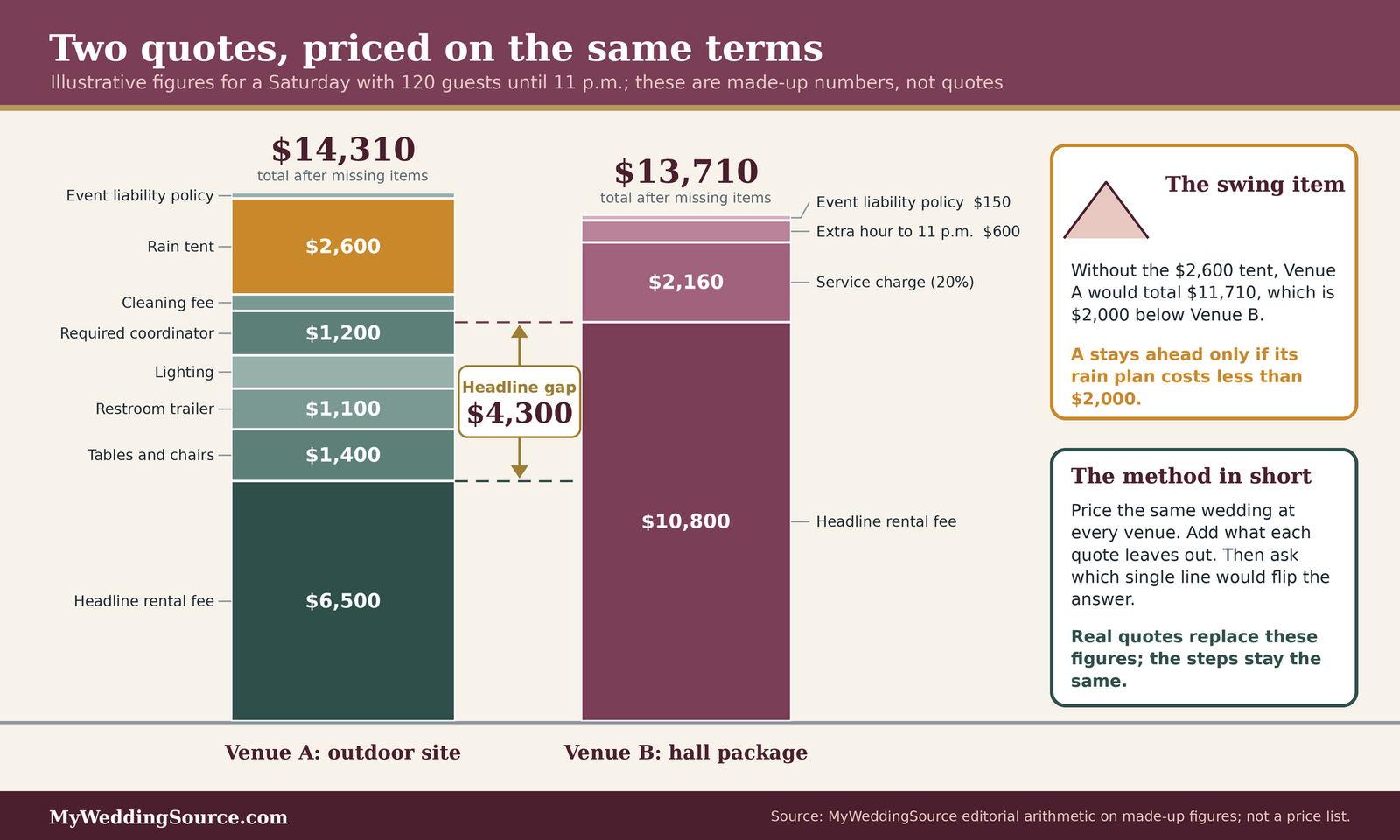
The rain tent is the swing item. Without it, Venue A would total $11,710 and cost $2,000 less than Venue B. The tent would have to cost less than $2,000 for A to stay ahead. That threshold is the useful result: it tells you exactly which question to ask next, which is whether the site has a covered space that makes the tent unnecessary, and whether it could be less expensive than the quote. Replace each figure with your own quotes and the answers to your wedding venue questions, and the method still works.
Score what the price does not show
Two venues with the same total can still differ in risk. A score is a way to make that visible, as long as you do not pretend it is more precise than it is.
A decision matrix for the factors that change the answer
The matrix below lists the factors that most often change which venue is right, the question that settles each, and what a worrying answer looks like. Use it after the worksheet, not instead of it, and let your wedding venue questions supply the answers.
| Factor | Question that settles it | Why it changes the answer | Warning sign |
|---|---|---|---|
| Total cost on equal terms | What is the full itemized total for our date, count, and hours? | A low headline can hide required add-ons | Refusal to itemize |
| Vendor freedom | May we hire anyone, and at what fee? | A short list limits quality and price choices | A fee that applies only to outside vendors, with no explanation |
| Weather backup | Where does everyone go, and who calls it? | A plan that cannot seat everyone is not a plan | Backup space named but not sized |
| Hours and curfew | What is included, and when must music stop? | Late events and early curfews collide | Overtime “at the then-current rate” |
| Access | Can everyone reach every space? | Fit is the first requirement | No description of the route |
| Cancellation and venue failure | What do we get back, and what if you cancel? | Risk is not shared evenly by default | Silence about venue-side cancellation |
| Responsiveness | How quickly and clearly do they answer? | Slow or shifting answers before booking may signal slow service afterward | Answers that change from one person to the next |
Contrasting scenarios and the threshold that flips them
Decisions depend on assumptions. The table shows four common situations, what the evidence in this guide suggests, and the condition that would reverse it. These are illustrations of reasoning, not predictions about any venue.
| Scenario | Assumption | Lean toward | Flips when |
|---|---|---|---|
| Outdoor site with a low rental fee | You rent tables, chairs, restrooms, lighting, and a tent | Itemize before you compare | The rain plan alone costs more than the gap to an all-inclusive hall |
| Hall with a food and beverage minimum | The minimum assumes your full guest count | The hall, if your count stays near the minimum | The count drops enough that you pay for food no one eats |
| Weekday date at a popular venue | A lower price for a Thursday or Sunday | The weekday, if key guests can attend | Travel costs or missing guests outweigh the savings |
| Hall with limited accessibility | One guest needs a step-free route | Ask for the route in writing first | No accessible route exists and the guest would not be able to attend |
You can also score responsiveness, clarity, backup strength, and flexibility from one to five for each finalist, and weight them by what matters to you. As an illustration, suppose you weight clarity and backup strength at three and responsiveness and flexibility at two, so the maximum is 50. A venue scoring 4, 3, 2, and 4 on responsiveness, clarity, backup, and flexibility earns 8 plus 9 plus 6 plus 8, or 31. A venue scoring 3, 5, 4, and 3 earns 6 plus 15 plus 12 plus 6, or 39. The weights are our suggestion, and the scores are your judgment, so treat the result as a way to start a conversation with your partner and not as a verdict.
Decide the condition for booking
You do not have to choose a venue the moment you like one. You can choose it on a condition, and write the condition down.
List the unresolved questions that must be answered
Before you commit, write down the questions that remain open and sort them into two lists. The first holds items that must be answered before you pay, such as the full contract, the rain plan’s capacity, and the cancellation terms. The second holds items that can be resolved after booking, such as exact menu choices or the order of events. If a must-answer item stays open after a reasonable time, that is information. A venue that is pressing you to sign today and cannot answer a basic question is asking you to take on risk it has not explained, and the BBB specifically advises against committing on the spot to “today only” offers. Treat each open item as one of your wedding venue questions, with a name and a date against it.
Confirm the deposit, payment schedule, and amendment process
Once the open items are answered, confirm four things in one email: the deposit amount and due date, the refundable portion and its deadline, the full payment schedule, and how changes are made. Ask the venue to reply “confirmed.” If the contract already says all four, the email costs a minute. If it does not, you have just found a gap while it is still cheap to fix. Then sign, pay the deposit by the method you chose, and put the key dates in your calendar. Our wedding planning checklist can hold them next to everything else. By this stage, your wedding venue questions have done their work, and the email simply fixes the answers in place.
How to pay a deposit, and how to protect it
The deposit is the first real money, and it is often the money you worry about most. Paying the right way does not remove the risk, but it can improve your options.
Payment method and consumer protections
How you pay changes what you can do if something goes wrong, and the differences are worth knowing before you hand over a card.
Why a credit card can help
The Federal Trade Commission explains that under federal billing rules for credit cards, a billing error includes charges for items not delivered as agreed, and that you can dispute it. It says your written dispute must reach the card issuer within 60 days of the first bill that shows the error, that the issuer must acknowledge it within 30 days and resolve it within 90, and that you can withhold the disputed amount during the process. The Better Business Bureau gives similar practical advice: pay by credit card, and avoid cash, wire transfers, gift cards, and payment apps for deposits. This is general information and not legal advice, and a dispute may not succeed. Whatever method you choose, ask the wedding venue questions about payment before you hand anything over.
The timing problem with an early deposit
A deposit paid a year before the wedding raises a practical question that the FTC’s description makes visible. The 60-day period it describes runs from the first bill that shows the error, so it is worth asking your card issuer how its process applies to a service that will be delivered long after you paid. Do not assume. Ask the issuer, keep your contract and receipts together, and if a problem begins to appear, such as a venue that stops replying or announces a closure, act promptly instead of waiting for the date. You can also report a serious problem to the FTC at ReportFraud.ftc.gov, which the agency’s consumer page recommends.
Insurance and its limits
Insurance can reduce some risks and ignore others, and what a policy covers is in its exclusions, not its headline.
What wedding insurance may and may not cover
The Knot describes two main parts: cancellation or postponement coverage, which can respond to events outside your control such as severe weather, a venue closing, a vendor no-show, or illness, and liability coverage, which responds to guest injuries or damage to the venue. It says policies set per-category caps and deductibles, and that changing your mind about the marriage is not covered. The BBB notes that insurance may cover lost deposits if a vendor closes or fails to appear, and advises reading the exclusions. Buy a policy from a licensed insurance professional and compare at least two, and do not treat this guide as a recommendation of any policy. Ask the insurer your own wedding venue questions about the contract before you buy.
Questions that tie the venue to the policy
Bring the venue contract to any insurance conversation. Ask the insurer whether your policy would respond to the specific events in the contract, such as the venue’s closure, a tent failure, or a cancellation for weather. Ask the venue whether its own policy names you or your guests, and whether it requires proof of yours. If the contract requires you to carry a specified policy, ask for the exact wording, so the policy you buy matches the requirement and does not need to be replaced.
Frequently asked questions
Before you tour
How many venues should I tour?
Couples in WeddingPro’s venue research typically inquired with about five venues and toured about four. Your number depends on your market and how quickly your email questions narrow the list. Tour as many as it takes to find two comparable finalists, then stop, because every extra tour adds a favorite and a delay.
Should I ask wedding venue questions by email or in person?
Ask by email when an answer could rule a venue out, such as date, capacity, fees, curfew, and deposit. Ask in person when you need to see the space, such as the route, the light, and the backup room. After any tour, send a short follow-up that restates what was said, because a written answer is easier to rely on.
How much should a venue cost?
There is no single figure. The Knot reports an average of about $12,900 for couples married in 2025, while Zola’s cost index reports $8,573, using different methods and definitions. Your price depends on date, guest count, region, and what is included, so compare itemized totals for your own wedding and treat averages as context only.
What is a hold on a date?
A hold is a venue’s temporary promise to keep a date while you decide, sometimes free and sometimes for a fee. Ask how long it lasts, whether the fee counts toward the deposit, and what happens if another couple wants the same date while you are still deciding. Then confirm the answers in writing.
Before you sign or pay
Is a venue deposit refundable?
It depends on the contract, and many deposits are not fully refundable. Ask what portion can be returned, until which date, and whether the deposit can transfer to a new date. Make sure the answer is written in the contract, not only said on a tour, and consider whether wedding insurance fits your situation.
How should I pay a venue deposit?
The Better Business Bureau advises paying a deposit by credit card, only after both partners have signed, and never paying the full amount up front. A card can make a dispute easier, though it is no guarantee. Ask your card issuer how its dispute process works for a service you will receive months from now.
Do I need insurance for my venue?
Not always, but many venues require liability coverage, according to The Knot, which reports that basic wedding insurance policies cost about $75 to $550. Cancellation coverage may respond if a venue closes. Read exclusions carefully, ask the venue what it requires in writing, and compare policies from a licensed insurance professional.
What if the venue changes something after I sign?
Ask for the change in writing, signed by both sides, before you rely on it. If the venue cannot deliver something the contract promises, ask for the remedy the contract lists, and contact your card issuer promptly if you paid by card. This is general education and not legal advice, so consider a local attorney for large disputes.
Your next steps
This week
Write your brief and send the ten email wedding venue questions
Paste the same date, guest range, hours, and must-haves into every inquiry, and add the ten wedding venue questions from the Questions to ask box. Record each reply in your answer sheet the day it arrives. If you are still choosing a date, our plan wedding guide and wedding timeline can help you decide what must come first. The Knot reports an average engagement of 15 months, which is useful context for deciding how fast to move.
Tour with your wedding venue questions, not just your eyes
Take the tour-tagged questions with you, walk the accessible route, stand where the ceremony will happen at the time of day you plan, and ask to see the rain plan space. Photograph every list or rule the venue shows you. Our wedding ceremony guide can help you think through where guests sit and what they will see.
Before you sign
Price both finalists on one worksheet
Fill in the worksheet from the worked example with your own quotes, flag every estimate, and look for the swing item. Then use the decision matrix to check what price does not show. Bring the result to your partner and agree on the condition for booking before you go back to the venue.
Read the contract, then pay by card
Match every spoken promise to a line in the contract, confirm the deposit and amendment terms in one email, and pay the deposit by credit card after both of you have signed. Save the contract, receipts, and emails together, and put the final count and final payment dates in your calendar.
Next step if you are comparing options: Fake Wedding Venue Listing: Warning Signs and How to Verify the Business.
Sources & methodology
How we built this guide
What we relied on
This guide combines current U.S. wedding-cost surveys from The Knot and Zola, with their sample sizes and years stated where we found them; a vendor-facing research report on how couples search for venues; federal guidance on credit card disputes and on accessibility; National Weather Service guidance on lightning at outdoor events; one city fire bureau’s permit rules as an example of local occupancy rules; and consumer advice from the Better Business Bureau and The Knot. Where a figure comes from a company’s own survey or index, we say so, because those instruments differ and are not quotes. The worked example, its totals, the break-even threshold, and the scoring illustration are our own arithmetic on made-up figures and are labeled as such.
What we did not do
We did not tour venues, review contracts, or test any venue’s practices. We did not verify state or local rules on sales tax, service charges, gratuity, alcohol, permits, or consumer remedies, and those differ by location. The Portland fire permit rules are one city’s example, not a national rule. The WeddingPro research is older than the 2025 surveys and is used only to describe how couples search. Nothing here is legal, insurance, or financial advice, and a lawyer licensed where your venue is located is the right person to review a contract.
Source list
Government and regulatory sources
- Federal Trade Commission, Using credit cards and disputing charges: https://consumer.ftc.gov/articles/using-credit-cards-and-disputing-charges
- U.S. Department of Justice, ADA Title III: https://www.ada.gov/topics/title-iii
- U.S. Department of Justice, ADA Title III primer: https://www.ada.gov/resources/title-iii-primer
- National Weather Service, Lightning safety for sports and outdoor events: https://www.weather.gov/safety/lightning-sports
- City of Portland (Oregon) Fire and Rescue, Public assembly permit requirements: https://www.portland.gov/fire/permits-inspections/public-assembly-permit-requirements
Surveys, industry research, and consumer guidance
- The Knot Worldwide, 2026 Real Weddings Study press release: https://www.theknotww.com/press-releases/the-knot-worldwide-unveils-2026-real-weddings-study
- The Knot, The average wedding cost, according to The Knot data: https://www.theknot.com/content/average-wedding-cost
- The Knot, Average engagement length: https://www.theknot.com/content/average-engagement-length
- The Knot, Wedding venue site tour questions to ask: https://www.theknot.com/content/wedding-venue-site-tour-questions-to-ask
- The Knot, Wedding insurance 101: https://www.theknot.com/content/wedding-insurance-101
- Zola, Average cost of weddings: https://www.zola.com/expert-advice/how-much-does-a-wedding-cost
- Zola, Questions to ask when touring a wedding venue: https://www.zola.com/expert-advice/questions-to-ask-when-touring-a-wedding-venue
- WeddingPro, What couples really want from their wedding venues: https://pros.weddingpro.com/report/what-couples-really-want-from-their-wedding-venues
- Better Business Bureau, Wedding planning key dates and tips: https://www.bbb.org/article/news-releases/19283-weddings-key-dates