
Wedding signage earns its place by answering a question a guest would otherwise have to ask a person, and it becomes clutter the moment it only repeats a mood, a hashtag, or a joke that nobody needed in that spot.
Quick answer
Walk the route your guests will take, from the parking area to the last goodbye, and put a sign only where a real question comes up: where to go, where to sit, what is being served, and what is expected of them. Published planner guidance from The Knot puts the typical count at five to ten signs, and one printing company suggests eight to twelve, so treat the number as a range, not a target. Size letters for the farthest reader, keep contrast high and glare low, and place each sign where a line can form without blocking a path or an exit. Then order proofs early, because a typo on a printed board is the most common avoidable signage error.
What wedding signage is for, and what it is not
Wedding signage is any printed, painted, lettered, or displayed text that tells guests something: where to go, where to sit, what to do, what is being served, or what a tradition means. It overlaps with decoration, because a sign is also an object in the room, but its job is different. A centerpiece can fail quietly and nobody notices. A seating chart that fails produces a crowd.
This guide to wedding signage stays narrow on purpose. Our wedding decor guide covers the room, the lighting, the budget, and how to compare installed quotes for the whole design. Here we deal only with the text on the walls, easels, tables, and stands, and with the decisions that are specific to it: how many signs, how large, where, in what material, and how to get them proofed and delivered without a mistake.
A sign answers a question before it is asked
Most guests arrive without knowing the building, the order of the day, or the people. They arrive in a small state of uncertainty, and every unanswered question costs them a little attention that would otherwise go to you. Good wedding signage removes that uncertainty quietly. Poor signs add to it by competing with each other or by saying nothing useful.
The questions guests actually carry
Think about the sequence. Where do I park or get dropped off? Which door is the ceremony? Can I sit anywhere? Where do I put the gift? Is there a program? Where is the restroom? Where is my table? What is that drink? Is that station for everyone? Can I take photos? Where is the exit if I need to leave early? Each question is a candidate for a sign, a staff member, or a printed card. The Knot’s planner-sourced list of sign types follows nearly the same sequence: welcome, directions, restrooms, seating chart, table identifiers, food and beverage, and a few optional extras.
The cost of missing wedding signage
When a sign is missing, a person fills the gap. That person is usually a parent, a bridesmaid, or a venue coordinator, and the time they spend pointing could have gone elsewhere. This is the practical argument for a short list of essential wedding signage: they replace a repetitive job. The argument weakens for decorative signs, which replace nothing.
Where wedding signage ends and decor begins
The boundary between wedding signage and decor is useful because it tells you where to cut when the budget or the room is tight. Anything that carries information is wedding signage. Anything that carries only atmosphere is decor, and decor can be judged by the five-jobs test in our decor guide.
Information signs and mood signs
A welcome sign with the names and date, set where cars arrive, is mostly a mood sign at a venue where the building is clearly signed already, but it is also the first photograph of the day, so many couples keep it. A directional arrow to a ceremony site behind a hedge is purely information. A neon “Better Together” over the dessert table is mood. None of these is wrong. The point is to know which one you are buying, so the information signs are never the ones that get dropped.
Signs that are not signage
Some items look like wedding signage but belong in other plans. Programs and menus printed as cards are paper goods, covered in our guides to wedding programs and wedding invitations. Escort cards are a seating tool. Calligraphy on envelopes belongs to the stationery order. We include programs and escort cards later only where they change how many signs you need.
Map the guest journey before you pick a look
A wedding has more than one audience in more than one place. The ceremony crowd is seated and facing forward. The cocktail crowd is standing, moving, and holding a drink. The dinner crowd is seated again but is now looking for a table. Each group reads signs differently, so wedding signage planning starts with a map, not a Pinterest board.
Walk the route and mark the decision points
Take a floor plan or a venue map and trace the path a guest will follow. Mark every spot where the path forks, where it passes a door that might be the wrong one, and where people will gather or wait. These spots are the decision points. A sign belongs at a decision point or a place where people queue, and almost nowhere else.
Start outside the building
Guests often arrive in the dark, in the heat, or in a hurry. Walk from the farthest likely parking spot, from the drop-off point, and from the nearest public street, and ask whether a stranger could find the entrance. Venues usually have their own exterior signs, and some limit or prohibit additions to wedding signage. Ask first. Where the venue sets the rules, our wedding venue questions guide lists what to confirm before you sign a contract.
Follow the transition points
The moments when the whole crowd moves at once are where confusion peaks: from ceremony to cocktail hour, from cocktail hour to dinner, and from dinner to the dance floor. Each move is a place where people look for cues. If the ceremony and reception are in different rooms, or different buildings, the directional piece of your wedding signage may be the most valuable one you order. If the room is a single space and the staff will announce dinner, you may need almost none.

Decide which signs earn a place
Once the route is marked, list all the wedding signage you might want and run it through three questions. The method is our own editorial approach, not a published standard, and it is meant to be quick.
The three-question test
First: would a guest be confused or delayed without it? If yes, it is essential. Second: would a person have to answer the same question more than a few times? If yes, it is helpful. Third: does it only repeat something already visible, or only add mood? If so, it is decorative. Essential signs get the best spot and the most legible lettering. Helpful signs fill in. Decorative signs are optional and should be the first to go when space or budget is short.
Worked example of the test
Take an illustrative wedding for 120 guests at a hotel ballroom, with the ceremony in a garden courtyard 200 feet away. The directions from the lobby to the courtyard are essential, because guests will otherwise cluster in the lobby. A seating chart is essential, because there are assigned tables. A bar menu is helpful, because the bartenders would otherwise repeat the same list. A “Mr. and Mrs.” sign above the head table is decorative. A sign saying where to leave cards is helpful, because the question will come up once the first guest arrives with an envelope. That gives two essential, two helpful, and one decorative piece of wedding signage, a short list a venue and a printer can handle. This is an invented scenario to show the method, not a typical wedding.
How much wedding signage you need: a range, not a target
Counts of wedding signage in published guides differ because they are written for different weddings and, in some cases, by companies that sell signs. Treat them as a sanity check on your own list.
What the published guides say about wedding signage
Two sources are useful for context, with a caveat about each. One is editorial. The other is a seller.
Editorial guidance
The Knot’s wedding signs page, a source on wedding signage that draws its advice from named wedding planners and cites no survey data, says couples typically need five to ten signs depending on venue size and preferences. It lists the welcome sign, directional signs, the seating chart with table identifiers, and food and beverage signs as the most important, and treats shuttle, restroom, and guest book signs as additions where needed.
Seller guidance
Paperlust, a company that prints wedding signs, suggests eight to twelve signs for most couples, and breaks them into ceremony signs (welcome, ceremony seating, order of service, unplugged), reception signs (cards and gifts, seating chart, table numbers, bar menu, food stations, hashtag, photo booth, favors, guest book), and situational ones like parking directions. Because the company sells the product, we read the number as a ceiling for a full set, not a recommendation to buy a full set.
Build your own count
The range is useful, but your venue sets the real number of signs for your wedding signage. A single-space micro wedding may need three. A multi-location day with a shuttle may need fifteen.
Small weddings need fewer signs
At a gathering where everyone knows everyone and the host can stand at the door, a sign is mostly decoration. Our guide to micro-wedding planning and small wedding planning explain how scale changes what you buy. For a few dozen guests, one welcome sign and a seating plan may be all you need.
Large and multi-location weddings need directional signs most
The more places a guest has to find, the more the directional sign matters. A day that moves from a church to a reception hall, or from a ceremony lawn to a barn across a field, needs signs at each fork and a plan for people who arrive after dark. Count forks and doors, not themes.
Make every sign readable: size, letters, contrast, and height
A sign that cannot be read from where guests stand has no function, however well it is designed. Readability is the one part of wedding signage that has real published numbers behind it, because accessibility standards for permanent building signs include a table of letter heights by viewing distance.
Letter height follows viewing distance
The U.S. Access Board’s 2010 ADA Standards, in section 703.5, set minimum character heights for visual signs by mounting height and viewing distance. They apply to permanent signs in covered facilities. A temporary piece of wedding signage is a different situation, and nothing here is a legal test for your event. We use the table as a benchmark because it is the most careful public statement of how big letters need to be.
The benchmark, and what it implies
For characters mounted 40 to 70 inches above the floor, the minimum height is 5/8 inch when the viewing distance is under 72 inches. Beyond that, the table adds 1/8 inch for each additional foot of viewing distance. As our own arithmetic from that rule, the minimum letter height works out to about 1.1 inches at 10 feet, about 1.75 inches at 15 feet, and about 2.4 inches at 20 feet. The table defines height by the capital letter “I,” so a script font with a small x-height may look much smaller than the number suggests.

Using the benchmark on an easel sign
Measure the farthest spot where a guest will first need to read the sign, not the closest. If guests will first see a seating chart from 12 feet away, the benchmark suggests capital letters of roughly 1.4 inches for the headline and a bit less for names, which is far larger than a typical 8-point wedding font. In practice that means fewer words per board, not a bigger board. The Access Board’s table defines viewing distance as the distance to an obstruction that stops a person from approaching further, so on an easel where guests can step up close, the benchmark is conservative. We use it as a margin of safety for the first glance, then let guests step closer for the details.
Contrast, glare, and type
Letter height is only half of readability in wedding signage. A tall pale letter on a pale board is still hard to read.
Contrast and finish
The same Access Board section calls for characters that contrast with their background, either light on dark or dark on light, and for a non-glare finish on both. That second point is easy to miss in wedding work, where gloss laminate, mirror, glossy acrylic, and metallic foil all look beautiful in a studio and throw a hot reflection under a spotlight or in late sun. When you can, hold a printed sample under the same light the sign will have, and tilt it. One seller guide suggests white lettering on a dark stain for the strongest contrast on wood. If the sign will be read in candlelight, test it in candlelight.
Script, decorative fonts, and long lines
The Access Board’s rules for permanent signs call for conventional letterforms and rule out italic, script, and highly decorative styles for the characters that must meet the standard. Wedding signage often uses script on purpose, and nothing prevents it, but script carries a cost in legibility at a distance. A common compromise, which is our editorial suggestion, is script for the couple’s names and a plain sans serif for everything a guest must act on, such as table numbers, directions, and drink names. Keep lines short and give them room, since the Access Board’s guidance on spacing runs from about 135 to 170 percent of letter height between lines.
Height and accessible placement
Where a sign sits matters as much as how big it is, and placement is the heart of wedding signage. A sign at the wrong height may be read by tall guests only, or blocked by the person in front.
Mounting and eye height
The Access Board’s standard requires visual characters of permanent signs to start at least 40 inches above the floor. A seller of wedding signs suggests centering a large easel sign around 4.5 to 5 feet off the ground and placing smaller tabletop signs on a standard table about 30 inches high. We read those as practical, not authoritative, and note that for guests who use wheelchairs or are shorter, the lower half of a tall board is easier to read than the top. Keep the essential words in the middle, not at the top edge.
Clear space around a sign
A sign pulls a crowd, and a crowd needs room. The Access Board’s accessible routes chapter sets a minimum clear width of 36 inches for accessible walking surfaces. A private wedding is not the same legal situation as a public building, so we use this only as a practical benchmark: an easel and the people reading it should not narrow a path below the width of a standard doorway. If the entrance table, the guest book, and the sign are all in one corridor, move one of them.
Decide where each sign goes
Placement of wedding signage is a series of small decisions. Our suggestions below come from the published planner and seller guidance we reviewed, plus ordinary event logistics, and they are meant to be adjusted to your venue.
Arrival and ceremony
The first wedding signage sets the tone and relieve the first anxiety: am I in the right place?
Welcome and directions
The Knot’s guide places a welcome sign where guests first arrive, which is especially useful at a private estate or a remote venue where nothing else announces the event. Directions matter most where the ceremony is not obvious from the parking area. Place each directional sign so that it can be seen from the previous decision point, and add a sign at the point where a wrong turn is most tempting. On a long path, a sign every fork is better than a sign every few steps.
Ceremony seating, reserved rows, and unplugged signs
A reserved sign for the first row or two tells guests where family will sit, and The Knot notes that it encourages everyone else to sit closer. If you ask guests to put phones away, a seller’s guide suggests placing the sign at the ceremony entrance or at the end of the aisle. A photographer can tell you which spot gets noticed. Our guides to the wedding ceremony and the wedding photographer shot list are useful before you decide what to ask of guests.
Cocktail hour and reception entrance
This is where the crowd is densest and the layout tends to be tightest.
Cards, gifts, and the guest book
A gifts and cards sign is optional, per The Knot, since a card box usually explains itself, though a sign can help start the habit. A guest book needs a sign only when it comes with instructions, such as a photo activity. Put them near the reception entrance, off the main path, with a small table and room to stand. See our wedding registry guide if you want to say something about gifts.
Food, drinks, and stations
Food and beverage signs tell guests what is being served, name signature drinks, and note dietary information. The Knot suggests that a tabletop drink list can speed the bar line. If you serve alcohol, the sign is information, not a substitute for staff who check identification and follow venue and state rules. Our guides to open bar weddings and wedding catering go into the service itself. For food stations, label ingredients where guests with allergies or dietary needs will look, and have the caterer approve the wording.
Restrooms, exits, and the rest of the building
These are the signs guests look for in a hurry.
Restrooms and quiet spaces
The Knot recommends restroom signs where bathrooms are not obvious, and where different restrooms serve different parts of the event. Keep them simple and keep the wording consistent with the venue’s own signs. If you add a sign for a quiet room, nursing space, or accessible entrance, make sure it points to a space that exists and is open.
Exits and venue signs
Do not cover, relabel, or hide any sign the venue already has. A Kansas State Fire Marshal fact sheet on decorations says decorations must not hide, obstruct, or narrow exit doors and pathways, and that exit signs and emergency lights must not be hidden or obstructed, since in an emergency they may be the only way to find an exit. Your decorative sign should never stand in front of one. We treat that as a rule that overrides any design decision, and we return to it in the venue-rules section.
Put the placement decisions in one matrix
Read the design matrix
The table puts scale, sightline, material, lighting, venue rules, and guest impact in one place. The sizes are ones that sellers and guides publish as common choices, so treat them as starting points to test in your room.
| Sign | Usual size (inches) | Sightline test | Material that holds up | Lighting note | Venue rule to check | Guest impact if it fails |
|---|---|---|---|---|---|---|
| Welcome | 18×24 indoors, 24×36 outdoors or beyond about 10 ft | Readable on arrival from the farthest approach | Rigid board or wood; PVC or aluminum outdoors | Avoid backlight from windows or low sun | Where easels may stand; whether exterior signs are allowed | Missed first photo; guests unsure they are in the right place |
| Directional | Large enough to read at the fork | Visible from the previous decision point | Weighted or staked sign; weather-safe | Needs light after sunset | Whether stakes, tape, or ties are allowed | Guests miss the ceremony or crowd the lobby |
| Seating chart | 24×36 for up to about 120 guests, larger above | Readable from the queue, not just the front | Foam board or PVC on a sturdy easel | Even light, no glare | Where a line may form | Queue at the door, delayed dinner |
| Table identifiers | Card or small frame | Visible from the aisle, above centerpieces | Card stock, acrylic, or wood | Candlelit tables need a plain contrast | Candle and height limits | Guests wander looking for their seat |
| Bar and food | 18×24 easel or 8×10 in a tabletop frame | Readable while standing in line | Matte print, framed | Not near heat or open flame | Alcohol service rules; allergen labeling by caterer | Repeated questions; long line |
| Restroom and exits | Match the venue’s style | Visible from the corridor | Light paper or board, temporary | Never block emergency lighting | Fire code; must not cover exit signs | Confusion; a safety issue |
Adapt the matrix to your venue
Copy the table into a note, add a column for the exact spot, and fill it in during a venue walk. The last column is the most useful one: if you cannot say what happens when a sign fails, you may not need it. Send the finished list to the venue coordinator, the printer, and whoever will set the signs out, so they all work from the same version.
Seating charts and table identifiers
The seating chart is the one piece of wedding signage almost every guest has to use, which makes it the sign most likely to create a queue. It deserves its own plan.
Choose the format for the seating chart
The format decides the size, the spot, and how long guests stand in front of it.
By table or alphabetical
A seating-chart guide from Wedibox suggests listing guests by table when there are fewer than about 100 guests, keeping names alphabetical within each table, and switching to an alphabetical list for larger groups so guests can find their last name quickly. That threshold is the author’s rule of thumb, not a measured result. Our reading is simple: a by-table display shows who sits with whom, which suits a small room where people want to know, and an alphabetical list suits a big room where speed matters more.
Escort cards and QR codes as relief valves
The same guide suggests that for more than 100 guests you add escort cards or a QR code beside the sign so many people can check at once without a line. Escort cards are one card per guest or couple, laid out alphabetically with the table number. They take more setup time than a single board, but they let many guests find their seats at the same time. If you use a QR code, assume that some guests will not scan it and make sure the board still works without it.
Size and place the chart
Size is a function of the number of names and the distance from which they have to be read.
A rough throughput estimate
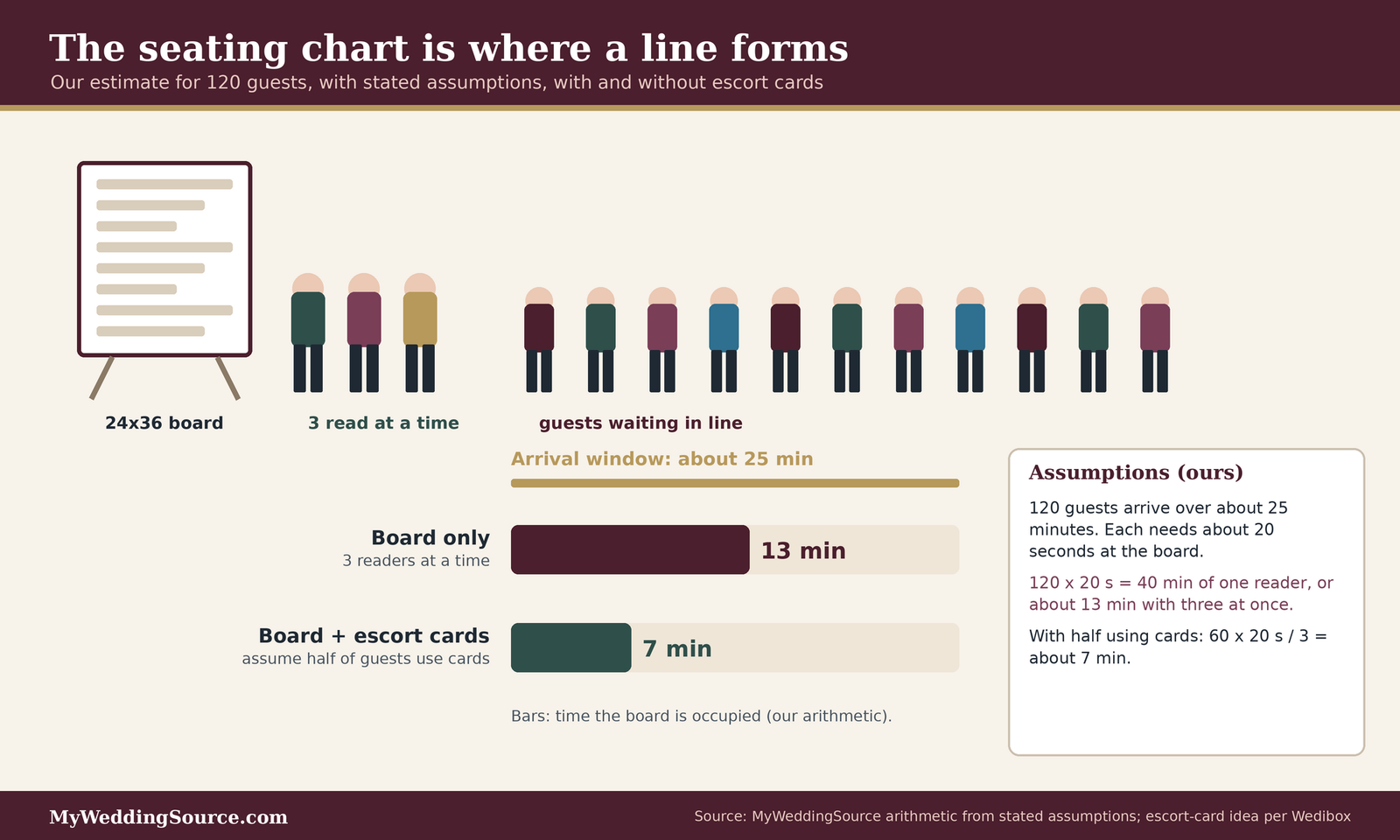
The following is our own arithmetic with assumed inputs, not a measurement. Suppose 120 guests arrive over about 25 minutes, that each guest needs about 20 seconds in front of the chart to find a name and read the table number, and that three people can read a 24×36 board at once without crowding. Total reading time is 120 times 20 seconds, which is 2,400 seconds, or 40 minutes of one person’s attention. With three readers at a time, that is about 13 minutes of board time, so the board is occupied for more than half of the arrival window and a line forms whenever guests arrive in a burst. Add escort cards that let guests find a seat without queuing, and the load on the board drops. If your estimates differ, such as a longer cocktail hour or a smaller list, the answer changes, which is the point of writing it down.
Where the chart should stand
Wedibox suggests placing the chart at the reception entrance or where guests leave cocktail hour so they read it before going in, and suggests a 24×36 board for up to about 120 guests and 30×40 beyond that. Put it where a line can form beside it, not across it. Avoid a spot where the sign blocks a door, a server path, or the view of the head table. Light it evenly, and check for glare from a nearby window or spotlight. Our guide to the wedding reception covers the flow of the room around it.
Table numbers and names
Table identifiers have to be seen from across a room, which is a different job from the chart.
Match the chart, and make them visible
The Knot notes that identifiers should match the seating chart and do not have to be numbers; they can be named for meaningful places. A name is charming and slower to scan than a number, so if the room is large, add a small number to the name. Make them visible from the aisle, above centerpieces, without blocking sightlines across the table. Our wedding table settings guide covers how they sit with the rest of the tabletop.
Accessibility at the table
Place identifiers where a seated guest, a guest with limited vision, and a server can all see them. Large print and strong contrast help everyone. A list read aloud by a host, or a short list at the door for guests who need help, is a simple fallback. The Access Board’s scoping text lists seat and row designations and menus among the items its sign requirements do not cover, so no standard sets a size for table identifiers. That does not change the practical point: a guest who cannot read the table number has been left out.
Venue rules, fire code, and safety
Venue rules are the part of wedding signage most likely to override your plan, so learn them before you order. Learn them before you order.
What the venue controls
A venue can limit what you bring and where you put your wedding signage.
Mounting, stakes, and adhesives
Many venues prohibit nails, tape, tacks, and anything that marks a wall, floor, or lawn. Others do not allow stakes in the ground because of irrigation lines. A sign that has to be taped or staked to be seen is a sign you may not be able to use. Ask what a sign may stand on, hang from, or lean against. A Kansas State Fire Marshal fact sheet on decorations also says decorations must not be hung from sprinkler pipes or heads, since that could impair the system.
Outdoor, public, and permitted spaces
Parks, beaches, and public gardens often have permit rules about signs, stakes, and amplified sound. Rules differ by place and change, and we cannot summarize them. Ask the managing agency, and get the answer in writing. Our guide to garden wedding venues points to what outdoor sites commonly ask.
Fire code and egress
Safety rules are not a matter of taste.
Exit signs and paths
As noted above, the Kansas fire marshal fact sheet says decorations must not obstruct exits and exit signs. The practical result is that no sign, easel, or sign table goes in front of an exit door, a lit exit sign, or an aisle that leads to one. Walk the room with the venue coordinator and ask them to mark where signs may not go.
Candles, lights, and cords
If a sign is lit by candles or string lights, the venue’s candle policy and electrical limits apply. The same fact sheet notes that candles are generally prohibited in the buildings it covers, with limited exceptions under supervision, and cautions against temporary wiring and extension cords. Wedding venues vary, so ask your venue directly. Battery-powered light, with the venue’s approval, avoids most of the issue.
Who is responsible
Setup, moving, and teardown
Name the person who sets out each sign, moves it from the ceremony to the reception, and packs it away. In its wedding consumer guide, Wisconsin’s consumer protection department advises couples to confirm who transports flowers between spaces, and we apply the same question to signs, easels, and framed boards. Put it in the vendor’s scope or in a written plan for friends and family.
Damage, loss, and insurance
Rented stands and framed pieces can be damaged or lost. Ask who is responsible, and read the rental or venue contract before you sign. Both Wisconsin and the Ohio Attorney General advise couples to get promises in writing and not to sign a blank contract. We are not lawyers, and this is general information. If you want to understand how insurance can fit, see our wedding insurance guide.
Choose materials, stands, and weather plans for wedding signage
The material changes the price, the weight, the glare, and what survives a breeze. Most of the published material guidance for wedding signage comes from companies that sell signs, so we attribute it and leave the choice to your venue and season.
Compare the common wedding signage materials
Sellers describe the same handful of materials, with similar strengths and trade-offs.
Foam board, PVC, and aluminum composite
An online seller of wedding signs, iCustomLabel, describes foam board as lightweight with a smooth matte print surface, well suited to indoor receptions and budget-minded sets, with corners that need protection in transport. It describes PVC as semi-rigid and better than foam board at resisting moisture and warping, for indoor or outdoor use, and aluminum composite as very durable, lightweight, and rigid, recommended for 24×36 signs and for long viewing distances. A second seller, Wild Bloom, puts foam board at about 3/16 inch thick, able to stand on an easel without a frame, and says water can damage it, so outdoor use needs a rain plan. Paperlust likewise recommends PVC over paper outdoors.
Acrylic, wood, and fabric
iCustomLabel describes acrylic as a modern, premium look, best for minimalist or gallery-style weddings, and suggests a painted back layer for color and readability. It describes wood as warm and rustic, suited to barns and vineyards, with white lettering on a dark stain for the strongest contrast. Paperlust says fabric should not be used in heavy wind without anchoring. Clear acrylic reflects light and can be hard to read against a busy background, so test it where it will stand. These are seller opinions, and none of the sources reported tests.
Stands and displays
A sign is only as good as what holds it up.
Easels and their limits
Wild Bloom reports basic floor easels at about $15 to $30 and suggests centering a 24×36 sign at roughly eye level, about 4.5 to 5 feet up, and using a weighted floor easel at the beach. A tall flat board on a light easel is a sail. On grass or in wind, ask about weights, sandbags hidden in a basket, or a stand with a wide base, and never lean a sign on something that can tip toward a guest.
Hanging, framing, and tabletop options
A tabletop frame suits a small bar sign or a guest book instruction card. Wild Bloom suggests 18×24 on an easel or 8×10 in a tabletop frame for a bar menu, and 8×10 or 11×14 for a guest book. Hanging signs need hardware the venue approves. Mirrors and glass need a stable base and a plan for transport, and a heavy piece can be a hazard if it falls.
Plan for weather and light
Outdoor weddings add wind, rain, sun, and dusk.
Wind, rain, and sun
Choose weather-resistant materials for outdoor signs, weight them, and keep a covered backup spot. Sun can fade prints and heat a dark board, and rain can ruin foam board. If a ceremony may move indoors, ask which signs move with it and who moves them.
After dark
Directional signs matter most when the light is gone. Ask whether a path is lit, whether a sign needs its own light, and whether battery lights are permitted. Light a sign from the front and slightly above, so the lettering is not shadowed by the board’s own frame.
Price the installed wedding signage set, not the single sign
Wedding signage prices are scattered, and most of the published numbers come from sellers. They are useful for orientation, not for a budget.
What published sources report about wedding signage
Survey data
The Knot’s Real Weddings Study reports a share of the budget for floral design and decor, a category it defines to include signage, at about 9 percent of the total budget, and our decor guide covers those figures. We found no current survey that reports signage as its own line, so we do not offer a national average.
Published retail figures
A seating-chart guide from Wedibox lists a printed 24×36 poster at about $15 to $30 online, foam board from about $14, and acrylic from about $27, citing retailer listings, plus a frame or stand at $50 to $150 and hand-lettered mirror or custom acrylic at $100 to $300, without a source. Wild Bloom puts basic easels at about $15 to $30. These figures are from sellers or from guides that do not verify them, and prices change.
Cost note
Treat any published sign price as a starting point. Ask for a written quote that lists the sign, the stand, delivery, setup, teardown, and replacement if a proof is wrong. Add the total to your wedding budget calculator, and check how our guide to how to pay for a wedding fits it into your plan.
Normalize quotes
A quote for a sign set may leave out the stand, the proof, the shipping, or the person who puts it up.
Table 2: installed-cost layers
Use the table as a wedding signage checklist when you compare printers, rental companies, or a calligrapher. The last column repeats the published ranges above, which are not quotes.
| Layer | What it covers | What to ask | Illustrative range from published figures |
|---|---|---|---|
| Printed sign | Board, print, lettering, proof | Is a proof included? How many revisions? | About $15 to $30 for a poster; foam board from about $14; acrylic from about $27 |
| Stand or frame | Easel, frame, weights, hooks | Bought or rented? Is a weighted base included? | About $15 to $30 for a basic easel; $50 to $150 for a frame or stand |
| Custom lettering | Calligraphy, painted or etched work | Per sign or per word? Who owns the artwork? | About $100 to $300 for a hand-lettered or custom piece, per one guide |
| Delivery | Shipping, pickup, venue drop-off | Who receives it and signs for it? | Quote-specific |
| Setup and teardown | Placing, moving, and packing signs | Who does it, and when? | Quote-specific, often a vendor or friend task |
| Replacement | Reprint if a typo or damage occurs | Who pays, and how fast is a reprint? | Quote-specific |
A worked example with assumptions
As an illustration only, take eight signs for the 120-guest wedding above: seven printed boards, including the seating chart, and one custom lettered piece, with four basic floor easels. Using the published ranges, seven boards at about $15 to $30 come to roughly $105 to $210, the custom piece at about $100 to $300 adds that range, and four easels at about $15 to $30 add roughly $60 to $120. That is our own arithmetic from seller figures: roughly $265 at the low end and $630 at the high end, before shipping, tabletop frames, larger stands, or a larger seating chart. A real quote may be higher or lower. The exercise shows where the money goes, and that one custom piece can cost as much as all the printed boards combined.
Decide what to rent, buy, or make
Not every sign needs to be bought new.
Reusable inventory
Stands, frames, and easels are reusable; printed boards are one-time unless the text is neutral. Ask the venue and your other vendors what they already have. A venue’s own easels or a florist’s rented stands can cost less than buying new.
Do it yourself, with limits
Making signs yourself can be rewarding and inexpensive. Be honest about the time, and about who will fix a mistake on the morning of the wedding. If you ask a friend with good handwriting to letter your signs, give them the exact text, the size, and a deadline well before the day. Our wedding calligraphy guide covers how to brief a letterer.
Proof, order, and set up
Most wedding signage disasters are avoidable errors: a misspelled name, a wrong date, a table number that does not match the chart, a sign left in a car.
A timeline you can reuse
The wedding signage timeline below is our editorial suggestion, built around the lead times that sellers state. Confirm each with your own vendor.
Working backward from the day
Paperlust advises ordering at least three to four weeks before the wedding, and Wedibox advises ordering a sign at least ten days ahead so a typo can be fixed. We read both as minimums, so we plan earlier for anything custom. Fix the wedding signage list and the venue’s rules first, then draft the text and send it to the printer with the sizes. Order seating-chart signs last, after your RSVP deadline, because they depend on final names. Our plan wedding timeline guide shows where this fits, and the wedding RSVP wording guide helps with the deadline.
Late changes and buffer
Leave a buffer for a reprint. If you must change the seating chart late, a printed insert or a small card is cheaper and faster than a new board. Ask the printer what the deadline is for a rush job and how much it costs.
Proof every sign
A proof is a check before the printer starts.
What to check
Read the text aloud from the proof, one word at a time, and ask a second person who did not write it to do the same. Check names, spelling, dates, times, table numbers against the final seating list, and drink names against the bar menu. Check the size on the proof against the sign’s real size by cutting a piece of paper to scale and holding it where the sign will stand. Check that the color on screen matches a physical sample, since screens distort color.
Substitutions and approvals
If a printer cannot get a material, ask what they would use instead, and who approves it. Put acceptable substitutions in the order or contract: a different foam board is fine, a different size or font is not. Wisconsin’s consumer protection department advises couples to get every promise in writing, and the same applies to sign orders.
Day-of setup
Hand over a map and a list
Give the person who sets out your wedding signage a one-page list: each sign, where it goes, which way it faces, and what it stands on. Add a photo of the finished position, if you have one from the rehearsal. Assign someone to move ceremony signs to the reception and to take down the welcome sign last.
A short last-look routine
Before guests arrive, walk the route once, from the parking area to the reception entrance. Read each sign from the farthest likely spot. Check that nothing blocks an exit, a path, or a door. This takes ten minutes and finds most of what goes wrong.
Test which wedding signage stays and which goes
The final question about wedding signage is not whether a sign is beautiful but whether it has a job.
Remove the clutter
Look for repeats
Two signs saying the same thing in two places are one sign too many. A welcome sign and a welcome banner, a hashtag sign on every table, three quotes in a row on the dessert table: pick the best placement and remove the rest. The room will look calmer and the remaining wedding signage will be easier to read.
Keep the personal ones
A sign that explains a tradition, remembers someone, or tells a short story can be the most memorable. The Knot lists cultural context signs and memorial display signs among the useful types, because they help guests understand and feel included. Keep a few, give them room, and make sure the wording is checked by someone who will recognize an error.
Photograph it
Walk it with a camera
Photograph each sign from where a guest and your photographer will stand, at the time of day it will be seen. This catches glare, a pole growing out of the sign, and a sign that is too small to read in a wide shot. Our wedding photography guide covers what to share with your photographer.
The final decision rule
For each sign, write the question it answers or the feeling it adds. If you cannot, remove it. If it answers a question, check that it is legible from the farthest reader, that it stands where a line can form safely, and that it is clear of exits. Whatever is left is your wedding signage.
Ask the venue and the printer about wedding signage
Questions to ask
- Where may signs stand, and are stakes, tape, hooks, or hanging hardware allowed?
- Which of our signs would be in front of, or near, an exit, a fire extinguisher, or a sprinkler?
- Does the venue supply easels, stands, or tables for signs, and is there a fee?
- Are candles, string lights, or cords allowed with a lit sign?
- Can the printer show a proof at actual size, and how many corrections are included?
- What happens if a sign has a printing error or arrives damaged, and how quickly can it be replaced?
- Who sets out, moves, and packs up each sign, and by what time?
FAQ: wedding signage questions
Count and choice
How much wedding signage do I need?
Published planner guidance from The Knot puts the typical range at five to ten signs, and a printing company suggests eight to twelve. Your own count of wedding signage depends on the venue. Count the forks, doors, queues, and questions guests will have, and add only signs that answer one of them.
Which wedding signage is essential?
The Knot names the welcome sign, directional signs, the seating chart with table identifiers, and food and beverage signs as most important. Add restroom or shuttle signs where the venue does not make them obvious. Anything else, such as hashtags and fun signs, is optional and should be the first to go.
Size and placement
How big should a wedding welcome sign be?
Sellers commonly suggest 18×24 inches for indoor spaces and close viewing, and 24×36 for outdoor spaces or when guests first see it from more than about 10 feet away. These are seller rules of thumb, so check legibility from the farthest reader in your own venue before you order.
Where should the seating chart go?
Put it at the reception entrance or where guests leave cocktail hour, with space beside it for a line to form. A seating-chart guide suggests a 24×36 board for up to about 120 guests. Avoid doorways, server paths, and glare from windows, and check the lighting at dinner time.
Venue and safety
Can a sign block an exit or aisle?
No. A Kansas State Fire Marshal fact sheet says decorations must not hide or obstruct exit doors, pathways, exit signs, or emergency lights. Keep easels and sign tables clear of exits and aisles, and ask the venue coordinator to mark where signs may not go before the day.
Do I need to follow ADA sign rules for my wedding signs?
The 2010 ADA Standards set sign rules for permanent signs in covered facilities, and Section 216.1 exempts temporary signs of seven days or less. That does not make readability optional for your guests. We use the standard’s letter-height table as a benchmark. For legal questions, ask the venue or a lawyer.
Orders and mistakes
When should I order signs?
Sellers state minimums: Paperlust suggests at least three to four weeks before the wedding, and Wedibox suggests at least ten days so a typo can be fixed. Plan earlier for custom work. Order the seating chart last, after your RSVP deadline, because it depends on final names.
What if wedding signage arrives with a mistake?
Check the proof before printing, since a printed error usually means a reprint. Ask the printer in advance who pays for corrections and how fast a replacement can arrive. Keep a plain backup, such as a printed insert, a paper card, or a hand-lettered sign, for a late error.
Your next steps
Plan the signs
Map the route and list the questions
Walk the venue with a floor plan for your wedding signage, mark every fork, door, and queue, and write the question guests will have at each. Our wedding planning guide and wedding planning checklist show where this step belongs.
Run the three-question test
Mark each piece of wedding signage as essential, helpful, or decorative. Order the essential ones first, then decide what the budget and the room can take. Revisit the wedding decor guide if the room needs more than signs.
Confirm and order
Confirm the rules in writing
Ask the venue where wedding signage may stand, what they may hang from, and where they must not go. Check exits, candles, and cords, and put the answers in an email you can find later. Our wedding etiquette guide is a useful companion when the wording of a sign touches a sensitive topic.
Proof, order, and assign setup
Send the wedding signage text and sizes to the printer, proof every sign against the final list, and name the person who sets out, moves, and packs up each one. Put the order date and the proof deadline on your timeline.
Sources & methodology
How we built this guide
What we relied on
This guide combines a federal accessibility standard, a state fire marshal fact sheet, state consumer-protection guidance on wedding contracts, planner-sourced editorial advice from The Knot, and published guides from companies that sell wedding signs and seating-chart products. Where a statement comes from a seller, we attribute it, because sellers have a commercial interest and prices, sizes, and lead times change. Letter-height figures are our arithmetic from the Access Board’s table, and the throughput and cost examples are our own estimates with stated assumptions.
What we did not do
We did not test signs, measure venues, or review any seller’s products, and we do not recommend a vendor. We did not find a current national survey that reports signage spending on its own, so we do not give an average. Nothing here is legal advice. Confirm venue rules, local fire-code requirements, and contract terms with the venue, the local authority, or a lawyer.
Source list
Government and regulatory sources
- U.S. Access Board, 2010 ADA Standards, Chapter 7 (communication elements and features, section 703 signs): https://www.access-board.gov/ada/chapter/ch07
- U.S. Access Board, 2010 ADA Standards, Chapter 2 (scoping requirements, section 216 signs): https://www.access-board.gov/ada/chapter/ch02
- U.S. Access Board, 2010 ADA Standards, Chapter 4 (accessible routes): https://www.access-board.gov/ada/chapter/ch04/
- Kansas State Fire Marshal, Decorations fact sheet: https://firemarshal.ks.gov/DocumentCenter/View/1553/Decorations
- Wisconsin Department of Agriculture, Trade and Consumer Protection, Weddings consumer guide: https://datcp.wi.gov/Documents/Wedding219.pdf
- Ohio Attorney General, Consumer Advocate newsletter, Avoid wedding disasters (July 2012): https://ohioattorneygeneral.gov/Media/Newsletters/Consumer-Advocate/July-2012/Avoid-Wedding-Disasters
Wedding industry and editorial sources
- The Knot, Wedding signs: https://www.theknot.com/content/wedding-signs
- The Knot, Wedding budget breakdown (Real Weddings Study): https://www.theknot.com/content/how-to-save-and-splurge-on-the-wedding
Seller and printer guides (commercial sources)
- Paperlust, Wedding signs: the complete guide to every type and display option: https://paperlust.co/blog/wedding-signs-complete-guide/
- Wild Bloom Design Studio, What size should a wedding welcome sign be: https://wildbloomdesignstudio.com/blogs/news/what-size-should-a-wedding-welcome-sign-be-a-complete-guide
- iCustomLabel, Wedding sign materials guide: https://icustomlabel.com/blogs/wedding-decor-and-gifts/wedding-sign-materials-guide
- Wedibox, Wedding seating chart guide: https://www.wedibox.com/blog/wedding-seating-chart-guide